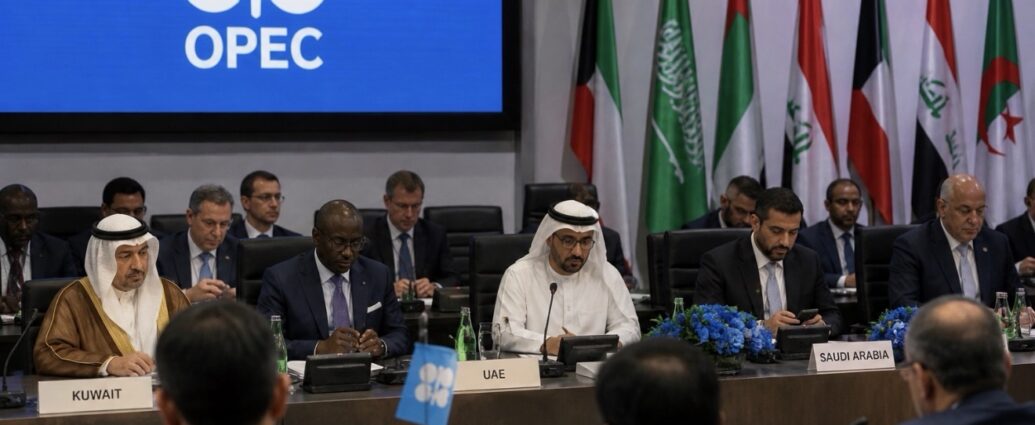
The Nasdaq 100 surged past 28,000 during Tuesday morning trading, setting a fresh record as AI-driven gains in semiconductor stocks continued to power the broader tech sector, defying pressure from elevated oil prices and geopolitical tension.

• State Street Materials Select Sector SPDR ETF shares are trending higher. What’s driving XLB shares up?

The S&P 500 climbed 0.8% to 7,259 by midday trading in New York, while the Dow Jones Industrial Average added 0.6% to 49,228 and the tech-heavy Nasdaq 100 jumped 1.1%.

Small-caps led the tape, with the Russell 2000 rallying 1.6% to 2,840 as falling Treasury yields lifted rate-sensitive corners of the market. The CBOE Volatility Index slipped 4.6% to 17.45, signaling a notable easing of risk aversion.

The driving force was a sharp drop in energy prices. WTI crude tumbled 4.1% to $102.08 a barrel and Brent slid 3.5% to $110.47 after President Donald Trump signaled progress in negotiations with Iran.

The 10-year Treasury yield ticked down to 4.07%, and the long bond eased to 4.42%, supporting interest-rate-sensitive sectors. The U.S. Dollar Index drifted lower as the euro firmed to 1.1700 and the British pound advanced to 1.3564. 

Gold added 0.9% to $4,562 an ounce, while Bitcoin (CRYPTO: BTC) rebounded 1.9% to $81,404, lifting crypto-linked equities.

Tuesday’s Performance In Major U.S. Indices, ETFs

Index Last Change % Change
S&P 500 7,259.11 +58.36 +0.8%
Dow Jones Industrial …

Full story available on Benzinga.com

This post was originally published here
By JBizNews Desk | May 5, 2026

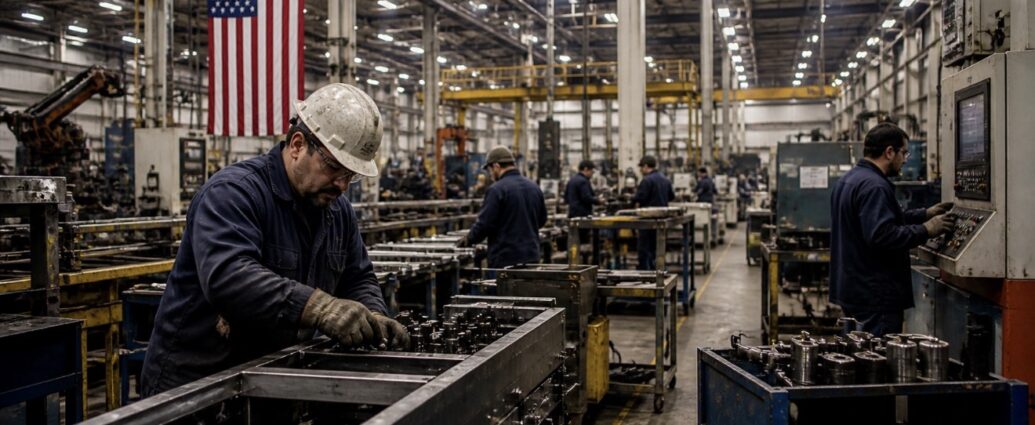
U.S. manufacturing is still growing — but beneath the surface, the sector is showing clear signs of strain.

The latest data from the Institute for Supply Management (ISM) showed the manufacturing Purchasing Managers’ Index (PMI) holding at 52.7% in April, marking the fourth consecutive month of expansion and the strongest reading since mid-2022. Any reading above 50 indicates growth, suggesting that factories are continuing to produce and fulfill orders.

But a deeper look at the report reveals a more complicated picture — one defined by rising costs, weakening hiring, and declining confidence among industry leaders.

The most striking signal came from prices. The ISM Prices Index surged to 84.6%, its highest level in two years, reflecting sharp increases in the cost of raw materials and energy. The rise was driven in part by higher oil prices tied to the Middle East conflict, as well as tariffs and supply constraints affecting key inputs like steel and aluminum.

“Cost pressures are clearly building,” said Susan Spence, Chair of the ISM Manufacturing Business Survey Committee, noting that energy-related inputs have been particularly volatile. “Companies are facing a difficult pricing environment.”

At the same time, hiring is moving in the opposite direction. The Employment Index fell to 46.4%, indicating contraction as manufacturers reduce headcount despite ongoing production.

That divergence — strong output but weak hiring — suggests companies are becoming more cautious, focusing on efficiency rather than expansion.

Survey responses from industry executives reinforce that view. Nearly 70% of comments in the April report were negative, with many citing the impact of the Iran conflict and rising input costs.

“All products tied to crude or energy have seen multiple price increases,” one chemical industry executive noted, highlighting the direct link between geopolitical developments and manufacturing costs.

Another concern is the nature of current demand. Some of the strength in new orders appears to be driven by customers placing orders early to avoid expected price increases — a form of stockpiling that may not reflect underlying demand.

“If customers are pulling forward orders, that can create a temporary boost,” said Timothy Fiore, former ISM Chair, noting that such activity can be followed by a sharp slowdown once inventories are built up.

The ISM data suggests that current manufacturing activity corresponds to roughly 1.8% annualized GDP growth, a solid but moderate pace that falls below earlier expectations for the year.

For the broader economy, manufacturing plays a key role not just in production, but in signaling future trends. Changes in factory activity often precede shifts in hiring, investment, and overall economic momentum.

Looking ahead, the sector’s trajectory will depend heavily on input costs and global conditions. If energy prices stabilize, manufacturers may regain confidence. If costs continue to rise, margins could come under increasing pressure, leading to further cuts in hiring and investment.

For now, the message from the factory floor is clear: production is holding up — but the foundation is becoming more fragile.

© JBizNews.com. All rights reserved.

By JBizNews Desk | May 5, 2026

The most important economic number of the week — and possibly the month — will arrive Friday, when the U.S. government releases its April jobs report, offering the clearest real-time test yet of how the economy is holding up under the pressure of rising oil prices and escalating geopolitical risk.

The report, published by the Bureau of Labor Statistics, will shape expectations for Federal Reserve policy, influence market direction, and provide a direct signal to American households about the strength of the labor market at a moment when inflation risks are climbing again.

Heading into the release, the data presents a mixed picture. The U.S. economy added 178,000 jobs in March, a sharp rebound from the 133,000 jobs lost in February, according to the Labor Department. The unemployment rate edged down to 4.3%, though much of that improvement came from a decline in labor force participation rather than a surge in hiring.

Wage growth, meanwhile, showed signs of cooling. Average hourly earnings rose 0.2% in March and 3.5% year-over-year, the slowest pace since 2021 — a figure that is increasingly important as consumers face higher costs for fuel, food, and borrowing.

“Wages are the real story here,” said Diane Swonk, Chief Economist at KPMG, noting that slower wage growth limits consumers’ ability to absorb rising costs. “If wage gains don’t keep up with inflation, households are effectively losing ground.”

Economists surveyed by Bloomberg expect the April report to show a more modest gain of roughly 60,000 to 70,000 jobs, reflecting a labor market that is still expanding but clearly slowing. The unemployment rate is expected to hold steady, while wage growth could show signs of firming slightly.

Recent labor market indicators have added to the uncertainty. Weekly jobless claims have fallen to historically low levels — near the lowest since 1969 — suggesting layoffs remain limited. At the same time, private payroll data from ADP has pointed to uneven hiring trends across sectors.

The key question is whether the impact of the Iran conflict — particularly higher energy prices — has begun to filter into hiring decisions.

Goldman Sachs economists have raised their probability of a U.S. downturn within the next 12 months to 30%, citing the inflationary impact of rising oil prices. The firm expects the unemployment rate to gradually increase to around 4.6% by the end of 2026, as higher input costs weigh on business expansion.

“The labor market is typically a lagging indicator,” said Jan Hatzius, Chief Economist at Goldman Sachs, noting that the effects of economic shocks often take months to show up in employment data. “What we’re seeing now may not fully reflect what’s coming.”

For the Federal Reserve, the report carries significant weight. Policymakers have paused interest rate changes in recent meetings, balancing progress on inflation with concerns about economic growth. A stronger-than-expected jobs report could reinforce the case for holding rates steady, while weaker data could increase pressure to begin easing.

The implications extend well beyond Washington. Job growth and wage trends directly affect consumer spending, which accounts for roughly two-thirds of U.S. economic activity. Any sign of weakening in the labor market could ripple through housing, retail, and service industries.

For American workers, the headline job number matters — but not as much as wages. With inflation still running above the Fed’s 2% target and energy prices climbing, real income growth remains under pressure.

“If people are working but falling behind financially, that’s not a strong labor market in practical terms,” Swonk said.

Looking ahead, Friday’s report will serve as a critical checkpoint — not just for where the economy stands today, but for where it may be headed. If hiring remains resilient, it could signal that the economy is absorbing geopolitical shocks. If cracks begin to appear, it may confirm that higher costs are starting to take a toll.

Either way, the data will set the tone for markets, policymakers, and households in the weeks ahead — at a moment when the margin for error is narrowing.

© JBizNews.com. All rights reserved.

Leonardo DRS (NASDAQ:DRS) released first-quarter financial results and hosted an earnings call on Tuesday. Read the complete transcript below.

This content is powered by Benzinga APIs. For comprehensive financial data and transcripts, visit https://www.benzinga.com/apis/.

View the webcast at https://edge.media-server.com/mmc/p/wq468j8j/

Summary

Leonardo DRS reported strong financial results for Q1 2026 with a 6% increase in revenue year-over-year and a 28% increase in adjusted EBITDA.

The company raised its full-year guidance, expecting revenue to range between $3.9 billion to $3.975 billion and adjusted EBITDA between $515 million and $530 million.

Key strategic initiatives include investing in R&D and capital expenditures to support growth in shipbuilding, air and missile defense, counter UAS, unmanned systems, and space capabilities.

Operational highlights include robust customer demand leading to a 17th consecutive quarter with a book-to-bill ratio of at least 1, achieving record funded backlog.

Management emphasized the alignment of their technology portfolio with U.S. defense budget priorities and highlighted successful execution in areas like tactical radars and infrared sensing.

Full Transcript

OPERATOR

Ladies and gentlemen, good day and welcome to The Leonardo DRS first quarter fiscal year 2026 earnings conference call. At this time all participants are in a listen only mode following the Company’s prepared remarks. There will be an opportunity to ask questions and instructions will be provided at that time. As a reminder, this event is being recorded. I would now like to turn the call over to Steve Vather, Senior Vice President, Corporate Development and Investor Relations. Please go ahead.

Steve Vather

Good morning and welcome everyone. Thank you for joining today’s quarterly Earnings Conference call. With me today are John Bieloni, our president and CEO, and Mike DePold, our CFO. They’ll discuss our strategy, operational highlights, financial results and outlook. Today’s call is being webcast on the Investor Relations section of the website where you can also find the earnings release and supplemental presentation. Management may also make forward looking statements during the call regarding future events, future trends and the anticipated future performance of the company. We caution you that such statements are not guarantees of future performance and involve risks and uncertainties that are difficult to predict. Actual results may differ materially from those projected in the forward looking statements due to a variety of factors. For a full discussion of these risk factors, please refer to our latest form 10K and our other SEC filings. We undertake no obligation other than as may be required by law to update any of the forward looking statements made on this call. During this call, management will also discuss non GAAP financial measures which we believe provide useful information for investors. These non GAAP measures should not be evaluated in isolation or as a substitute for GAAP performance measures. You can find a reconciliation in the non GAAP measures discussed on this call in our earnings release. With that, I will turn the call

John Bieloni

over to John thank you Steve and welcome everyone. We appreciate you joining us to discuss our first quarter 2026 results. This morning we’re pleased to report strong quarterly results and an excellent start to 2026. The team’s steadfast execution is translating into tangible financial outperformance as results clearly demonstrate. Revenue for the first quarter was up 6% year over year. Adjusted EBITDA grew 28% year over year, allowing us to deliver adjusted diluted EPS of $0.26 a share. Importantly, we’re delivering these results while maintaining healthy levels of organic investment in R and D and capital expenditures. This disciplined approach reflects our commitment to meeting both current and future customer needs as we continue to build on our foundation of growth. Let me share a few performance highlights from the quarter. Robust customer Demand drove our 17th consecutive book to bill of at least 1x revenue, bolstering our funded backlog to new company records and enhancing visibility and growth for the full year. That momentum, coupled with favorable material receipt timing, accelerated revenue growth and enabled outperformance against our expectations in Q1. Increasing volume, favorable program mix, and solid operational execution unlocked higher profitability and margin expansion. Overall, the strength delivered in the first quarter gives us confidence to raise our expected growth and profitability for the full year. Our differentiated technology portfolio and exceptional people are foundational to these results. I want to thank the entire team for their dedication and unwavering commitment to our customers, partners and shareholders. The global threat environment remains elevated with limited signs of near term easing. Against that dynamic backdrop, our focus remains on delivering differentiated technologies that drive overmatch and mission success for our customers. Our customers are operating with a clarity of a full year Appropriations for fiscal year 26 Additionally, there are indications that supplemental defense funding enacted through the last summer’s reconciliation package will be deployed this fiscal year, accelerating the procurement of critical capabilities. The overall funding and budget environment continues to be favorable. Last month, the Administration released its fiscal year 27 budget request proposing $1.5 trillion in total defense spending. As usual, Congress will consider and negotiate the final funding allocations. Importantly, we remain strongly aligned with our customer spending priorities including shipbuilding and industrial based resiliency, layered air and missile defense, counter uas, unmanned systems, space and missile replenishment. Furthermore, the recent tensions in the Middle east, along with ongoing conflict in Ukraine continue to reinforce several key lessons shaping requirements and budgets. First, missiles and one way drones are now so widespread that that attacks that were once anomalous are expected at scale and are proliferating. This reality is fundamentally reshaping requirements and the nature of warfare. Layered air defense and counter UAS are no longer optional, they are now required. Second, adversaries are increasingly targeting large radars and other high value assets that degrade infrastructure sensing and defensive capabilities to quickly create exploitable vulnerabilities. This is accelerating the shift towards distributed, resilient and modular sensing and battle management architectures that can be rapidly proliferated, replaced and scaled. We’re already seeing this trend in space with the shift from geosynchronous to low earth orbit satellites and is also beginning to manifest in the ground and naval arenas where unmanned vessels can be utilized as sensor and and effector equipped perimeters deployed around manned platforms. Third, volume scalability and effector cost symmetry are essential to counter growing threats. Magazine depth and munitions stockpiles are a key factor in operational endurance. We’re supporting production ramps across several weapon systems, advancing seeker capabilities for improved sensing on next generation missile platforms and introducing lower cost seekers to enable more symmetric countermeasures. Each of these trends represents a fundamental shift and plays directly to DRS strengths. DRS is a market leader in tactical radars and our technology continues to deliver significant operational and mission impact. Additionally, our tactical radars continue to see immense global demand and we are aggressively increasing throughput and production capacity to satisfy that appetite. Recent hostilities have again demonstrated that force protection cannot be confined to fixed sites it must also be embedded in maneuver units and proliferated at scale. Our force protection solutions span multiple domains. In the quarter we received a $533 million production contract IDIQ with the Distributed Aperture Infrared Countermeasure System or DEERCA, for aircraft survivability. DEERCM combines both missile warning and infrared countermeasures into one system and leverages multiple sensors to provide a 360 degree threat picture, each with a laser director to defeat increasingly capable missiles that threaten aircraft. As recent operations have demonstrated, both rotary and fixed wing platforms without this capability our vulnerable and contested airspace. Across our portfolio, our capabilities are modular and platform agnostic, optimized for size, weight, power and cost to meet customers specific needs. Let me illustrate that with a few examples. We can deploy power and propulsion technologies on a platform as compact as a medium unmanned surface vessel and scale all the way to the Columbia class submarine. That modularity approach is one we strongly advocate for as the Navy considers future service combatant platforms. Similarly, our infrared sensing capabilities span deployment from attritable Class 1 drones to the most sophisticated ground combat vehicles. And because our technologies are domain agnostic, that same sensing capability can deploy across ground, air, sea and space. We also stand to benefit as customers accelerate modernization and expand production rates, a tailwind evident throughout our portfolio. We’re investing in both research and development and capital against that broader demand. Overall, we view these trends as part of an enduring structural shift and they align directly with our core strengths. The business continues to perform well and we remain focused on three key strategic priorities, innovation, growth and execution. The diversity and differentiation of our portfolio creates multiple growth avenues. Our increased investment innovation is evident through the accelerated pace of procurement ready prototypes that meet the needs of our customers. Those capabilities include next generation multi domain counter UAS solutions, key technologies underpinning next generation command and control architectures, and cutting edge space sensing capabilities, among others. In the quarter, we demonstrated counter UAS mission execution from both unmanned ground and unmanned naval platforms, further validating a platform agnostic approach where our enabling technologies can be integrated into virtually any platform. We also released Thor, a tactical high performance embedded computing product. Thor is an open architecture rugged chassis designed to deliver high density processing as a tactical edge with native support for AI enabled operations and multi sensor data fusion. We remain deeply committed to a truly open architecture approach giving our customers the flexibility deploy best of breed hardware and software solutions not blocked to a single provider. Our approach is open, flexible, modular and affordable enabling customers to scale sustainably. Our capabilities extend beyond hardware into integration and software. We apply the same open and modular philosophy to software as we do hardware. Our platform level operating system Sage Core accelerates data fusion across disparate sensor and effective solutions, converting that data into actionable intelligence for improved and faster decision making. Sage Core is a key component of the integrated counter UAS solution being tested with our NAEP customers today. Our innovation and growth initiatives are backstopped by customer trust earned through consistent execution. As we add new efforts to the portfolio including the SDA Tracking Layer Trots 3 program, we’re applying the same operational rigor that guides execution across the company. Our customers operate in some of the most demanding and consequential environments in the world and earning their trust requires more than great technology. It requires consistent, reliable delivery and partnership. We take that mandate seriously and our ultimate measure of success is enduring, ensuring that our customers have what they need when they need it. We believe that solid execution enables growth and that philosophy and that philosophy is embedded in everything that we do. With that, I’ll turn it over to Mike to walk through the financials.

Mike DePold (Chief Financial Officer)

Thanks John. John covered the strategic backdrop and why our portfolio remains well positioned. Let me walk through first quarter results by key metric and then discuss our revised 2026 outlook. Overall, our first quarter results were well above the framework we provided on our last call as both revenue and profitability came in stronger than expected. Revenue in the first quarter was 846 million up 6% year over year. Quarterly revenue exceeded expectations on favorable receipt timing and the year over year growth came from programs related to tactical radars, infrared sensing and electric power and propulsion. The strong contribution from tactical radars and infrared sensing was evident in the increased ASC segment revenue. …

Full story available on Benzinga.com

This post was originally published here

Ocugen (NASDAQ:OCGN) reported first-quarter financial results on Tuesday. The transcript from the company’s first-quarter earnings call has been provided below.

This transcript is brought to you by Benzinga APIs. For real-time access to our entire catalog, please visit https://www.benzinga.com/apis/ for a consultation.

View the webcast at https://edge.media-server.com/mmc/p/znywz75g/

Summary

Ocugen Inc announced a $115 million offering of convertible senior notes, expected to close on May 7, 2026, enhancing cash reserves to $112.1 million and extending cash runway into 2028.

The company is advancing its gene therapy platform across three late-stage programs targeting retinitis pigmentosa, Stargardt disease, and geographic atrophy, with plans to file three BLAs by 2028.

Financially, Ocugen Inc reported an increase in operating expenses to $19.4 million for Q1 2026, with a net loss of $0.06 per share, and cash equivalents of $32.2 million as of March 31, 2026.

Notable progress includes completing enrollment in late-stage programs, positive phase 2 data for OCU410 in geographic atrophy, and preparations for a rolling BLA submission for OCU400 in the third quarter of 2026.

Management emphasized strategic partnerships for commercialization, especially for OCU410GA, and is exploring creative pricing models with payers to facilitate market access.

Full Transcript

OPERATOR

Good morning and welcome to Ocugen Inc’s first quarter 2026 financial results and business update. All participants line are currently in listen only mode. Following the speaker commentary there will be a question and answer session. I will now turn the call over to Tiffany Hamilton, Oxygen Head of Corporate Communications. You may now begin.

Tiffany Hamilton (Head of Corporate Communications)

Thank you Operator and good morning everyone. Joining me on today’s call and webcast is Dr. Shankar Muhsinuri, Ocugen Inc’s chairman, CEO and co founder who will provide a business update and an overview of our clinical and operational progress. Rita Johnson Green, our Chief Financial Officer, is also on the call to provide a financial update for the quarter ended March 31, 2026. Dr. Huma Kumar, Chief Medical Officer, will be available to answer questions following the presentation. This morning we issued a press release covering our business and operational highlights for the first quarter 2026. We encourage listeners to review the press release which is available on our website at ocugen.com A replay of this call along with the accompanying slide presentation will be available on the Investors section of the Ocugen website. Before we begin, please note that certain statements made during today’s discussion may be forward looking in nature, including those related to our clinical development pipeline, regulatory pipelines, commercialization strategy and financial information, and our anticipated Cash Runway. These statements reflect management’s current expectations and are inherently subject to risks, uncertainties and assumptions that may cause actual results to differ materially from those expressed or implied. We encourage you to review our filings with the securities and Exchange Commission, including the risk factors detailed therein, for a more comprehensive understanding of these potential risks. Finally, Ocugen Inc’s quarterly report on Form 10Q covering the first quarter of 2026 will be filed today. I will now turn the call over to Dr. Moosunuri.

Shankar Muhsinuri

Thank you Tiffany and good morning everyone. Before I walk through the quarter, I want to discuss the 115 million offering of convertible senior notes that we announced yesterday. With the recent offering, the Company is expected to have cash cash equivalents and restricted cash off 112.1 million at closing, which includes the revenue debt payoff. The Company will use the remaining net proceeds for general corporate purposes and expects to extend cash Runway into 2028. The offering is expected to close on May 7, 2026 subject to customary closing conditions and includes an option to retire the debt with a cash payment. If the remaining Janus Henderson warrants are exercised, the Company will receive an additional 15 million in gross proceeds, increasing expected cash, cash equivalent and restricted cash to $127.1 million. Now I would like to step back because Ocugen Inc’s potential is worth putting into context. For more than a decade gene therapy in ophthalmology has been confined to a single gene, a single mutation and a single small patient population. Our modifier gene therapy platform takes a fundamentally different approach. Rather than targeting individual mutations, it is designed to address the root cause of complex retinal diseases with modulating master regulators, nuclear hormone receptors that govern entire gene networks. The platform is gene agnostic, inherently multifactorial and designed to deliver durable benefit from a single one time subretinal injection. What this means in practice is that oxygen is not building three separate drugs. We’re advancing one platform across three late stage programs, each targeting a major cause of blindness for which patients today have either no approved treatment whatsoever are therapies that demand chronic injections and carry meaningful safety burdens. Retinas pigmentosa or rp, Stargardt disease and geographic atrophy or GA together affect approximately 3 million people across the United States and Europe, a combined patient population and a commercial opportunity far larger than anything currently served by approved gene therapies and ophthalmology. Across our pipeline spanning phase one through phase three, we have treated more than 250 patients across multiple doses and indications and we have not observed a drug related serious adverse events. In our Most recent readout, OCU410 demonstrated approximately twice the treatment benefit over currently approved therapies in GA delivered a one time injection. We remain on track to file three BLAs over next three years by 2028 and first of those RQ400 for RP will begin rolling submission in the third quarter of this year. This positions the first half of 2027 as a catalyst rich window for Ocugen Inc with phase three top line data for AQ400 top line phase two three data for AQ410ST and BLA submissions, all expected to converge over a short period. In the first months of 2026 we completed enrollment in two of our late stage programs, delivered positive phase to top line data in the third and are diligently working toward initiating our first BLA submission later this year. Let me walk you through how each program is advancing starting with RQ400 for RPE. The Phase 3 Limelight Clinical Trial is the only broad gene agnostic RP trial and the largest known phase three orphan gene therapy trial in the field. Approximately 300,000 people in the US and Europe are living with RP, which is caused by mutations in more than 100 genes. The only approved gene therapy for RPE today targets a single gene RPE65 which accounts for just 1 to 2% of all RPE cases. RQ400 is designed to provide a therapeutic option for the remaining 98 to 99% of RPE patients and that is a fundamentally different commercial opportunity. Enrollment in Limelight is Now complete with 140 patients randomized 2 to 1 across the row and gene agnostic arms covering over 25 genetic mutations associated with early to advanced stage RP, including pediatrics. The breadth of population intended to validate the gene agnostic mechanism of action of our novel modifier gene therapy platform. The primary endpoint is 12 month change in visual function and assessed by luminance dependent navigation assessment or LDNA (Luminance Dependent Navigation Assessment). We plan to initiate the rolling BLA submission for RQ400 in the third quarter of 2026 and complete BLA submission by the second quarter of 2027. Phase three top line data is expected in the first quarter of 2027 with the potential FDA approval targeted for the fourth quarter of 2027. On the manufacturing side, process performance qualifications, PPQ batches completion is on track for the second quarter of 2026 and brand planning and marketing initiatives led by Abhigupta, our EVP of commercial and business development continue to scale in preparation for launch. RQ400 continues to demonstrate encouraging long term durability with the three year data supporting sustained improvement in visual function compared with untreated eyes. In the Phase 1/2 study the treatment effect was maintained over time across evaluable subjects with the clinically meaningful mean changes in LLVA observed at years 1, 2 and 3 in both the multiple mutation and ROW subgroups. Importantly, these results suggest the benefit is not limited to a single genetic subtype reinforcing the program’s gene agnostic mechanism for action. From a safety perspective, RQ400 continues to show a favorable profile with no serious adverse events reported as being related to treatment. At the three year time point, 88% of treated valuable subjects demonstrated either improvement or preservation in visual function relative to untreated eyes, highlighting both durability and consistency of the response. Taken together, these data support the potential for OCU 400 to deliver sustained clinical benefit over time in retina’s pigmentosa while maintaining a strong safety profile. Turning to OCU410SD for Stargardt disease Stargardt Disease is a pediatric onset retinal disorder affecting approximately 100,000 patients in the US and Europe and roughly 1 million globally. There are no approved therapies available for these patients today. OCU410ST is designed to address over 1200 pathogenic mutations in the ABCA4 gene with a single one time treatment. On April 1, we announced the completion of enrollment and dosing in our Phase 23 Guardian 3 pivotal confirmatory trial, enrolling 63 participants in in less than nine months, well ahead of the originally planned timeline. That pace reflects both the depth of unmet need in Stargardt disease and the exceptional engagement of our investigators and patient community. The interim analysis is planned for the third quarter of 2026 with the top line phase III data expected in the second quarter of 2027 and BLA submission to follow by mid 2027. OCU 410ST continues to demonstrate a favorable safety and tolerability profile with the no product related serious adverse events reported to date. Turning now to OCU410 for GA late stage dry age related macular degeneration. GA represents our largest commercial opportunity with approximately 2 to 3 million patients in the United States and Europe combined. There are currently no approved treatments for GA in Europe. The United States Approved therapies require 6 to 12 intrauterial injections per year, indefinitely carry meaningful safety risks, including conversion to Vit AMD in roughly 12% of treated patients and face real world dropout rates of nearly 40%. GA is a multifactorial disease driven by four distinct pathways that contribute to the progressive degeneration of the macula, lipid deposits, drusen, chronic inflammation, oxidative stress and complement activation. The currently approved therapies in the US address only one of these four pathways, the complement system, which is partly why they have been unable to demonstrate meaningful functional outcomes for patients. OCU410 operates differently by delivering rora, a nuclear hormone receptor that acts as a master regulator of retinal homeostasis. OCU410 is designed to address all four disease pathways simultaneously with a single subretinal injection has the potential to redefine the standard of care in this indication. In March, we reported positive top line 12 month data from our phase 2 ARMADA clinical trial. The study enrolled 51 patients aged 50 years and older with GA lesions in the foveal or non foveal region. Randomized 1 to 1 to receive a single subretinal administration of OCU 410 at a medium dose, high dose or no treatment in the control group. The optimal dose, which is the medium dose, demonstrated a 31% reduction in lesion growth relative to control at 12 months with a P value of less than 0.05. To put this in context, currently approved intrautereal therapies have shown approximately 15% reduction at 12 months for avanthicopigal and 22% reduction at 24 months for Pancytico Plan OCU 410 administered as a single on time …

Full story available on Benzinga.com

This post was originally published here

Anything promising easy money in the market tends to come with a catch, and many investors say too many people are learning that the hard way.

In a recent Reddit thread, everyday investors discussed which so-called passive income or trading strategies are quietly hurting people who believe they have found a shortcut to wealth. The original post set the tone, warning that “anything promising easy, high passive income with minimal downside is usually either overhyped, incomplete, or transferring risk to you.”

Chasing Income Instead Of Returns

A major theme in the discussion was how often investors confuse simple ideas with smart ones.

Don’t Miss:

Blind value investing was one example. Some investors said buying cheap-looking stocks without really understanding the company can end badly. As one commenter explained, many of these companies are “cheap for a reason,” whether due to declining fundamentals, weak growth, or structural issues.

Others took aim at technical analysis, with one calling it “astrology for men.” The criticism wasn’t that charts are useless, but that many people rely on them as if they can predict outcomes in a system that is largely unpredictable.

Trying to “buy the dip” also drew skepticism. While the idea sounds appealing, multiple people argued it often turns into a guessing game. One investor said it ends up being “a more stupid version” of dollar-cost averaging, especially when people try to time short-term moves.

Speculation Disguised As Investing

Crypto hype and high-yield platforms were also frequently mentioned, especially those promising steady returns. “The No. 1 sign that something is definitely a scam is when the offer is too good to be true,” one commenter wrote, pointing to platforms that offered unusually high interest rates before collapsing.

Trending: What If Your Investment Income Didn’t Rely Entirely on Market Swings? Some Investors Are Taking a Different Approach  

YOLO-style options trading also came up repeatedly. Several investors described people treating options like lottery tickets, hoping to turn small amounts into life-changing money.

The same mindset showed up in sports betting and other forms of gambling that some people frame as investing. As one person joked, “Just ask my friends. They’re all killing it!”

Collectibles, including trading cards, were another example. While some people have made money, others said these markets are basically driven by hype, hard to sell quickly, and come and go with trends. One commenter compared it to past bubbles, saying it felt like “Beanie babies all over again.”

Across these examples, the pattern was the same: strategies that look exciting or easy often come with risks that aren’t obvious at first.

What Actually Works, According To Investors

Despite the criticism, the thread wasn’t anti-investing. In fact, many agreed on what tends to work over time.

Low-cost index funds and broad market ETFs were mentioned repeatedly as a reliable foundation. Just get a total market index, man,” one commenter put it simply.

See Also: 1.5 Million Users Are Already Working Inside This AI Platform — Investors Can Still Get In  

Consistency also came up as a key factor. Instead of trying to time entries or chase trends, many emphasized steady investing over time.

Another big point was to stop focusing only on income. That means looking at dividends, price gains, and reinvesting as one combined result, not separate pieces.

Your mindset matters too. …

Full story available on Benzinga.com

This post was originally published here

Private equity and venture capital firms have been increasingly acquiring restaurant franchises in recent years, with global investment in the sector doubling in 2025, according to an S&P Global report.

The trend has drawn mounting criticism, as some argue that private equity ownership tends to emphasize rapid expansion and financial returns at the expense of food quality and everyday operations.

• Where is EATZ stock headed?

When a franchisor is acquired by private equity, it’s not inherently bad, but it does change the game: priorities, timelines, leadership and relationships shift, Susan Blackbeth, founder and managing partner of Auspicious Owl Group, said during a podcast with Franchise Business Review.

“Sometimes franchisees don’t feel heard, and they don’t feel understood, and they don’t feel like they are really getting a voice in the room,” she said.

Misaligned timelines between the franchises and private equity can create real strain on operations, Blackbeth stated. Franchisees tend to think long-term, say 10 or more years, while private equity typically thinks in exit terms of five to seven years.

data-variant=”card”
data-news-mode=”manual”

>


Read Also:

EXCLUSIVE: OpenVC Unveils NYSE Index Bridging Public-Private Markets

This post was originally published here

On Tuesday, KBR (NYSE:KBR) discussed first-quarter financial results during its earnings call. The full transcript is provided below.

Benzinga APIs provide real-time access to earnings call transcripts and financial data. Visit https://www.benzinga.com/apis/ to learn more.

View the webcast at https://events.q4inc.com/attendee/192758066

Summary

KBR Inc reported a solid start to 2026 with disciplined execution, resilient operations, and strong cash generation despite geopolitical challenges.

The company reaffirmed its 2026 guidance, with 67% of STS and 91% of MTS revenue guidance already covered by work under contract.

KBR Inc continues to see strong demand in core markets, showing a steady pipeline and significant bookings, particularly in energy security and infrastructure.

The strategic focus remains on a planned tax-free spin of MTS, with a targeted distribution date of January 4, 2027, to create two independent pure-play companies.

Management highlighted the successful use of the KBR Pulse app during the Middle East conflict to maintain employee safety and communication.

The company is experiencing a mix of headwinds and tailwinds across its segments, with Mission Tech facing award delays but Sustainable Tech showing strong revenue growth.

KBR Inc’s operational highlights include advancements in digital capabilities and strategic partnerships to enhance project execution and maintenance.

Full Transcript

Gabrielle (Moderator)

Hello everyone and thank you for joining KBR Inc’s first quarter 2026 earnings conference call. My name is Gabrielle and I will be coordinating your call today. During the presentation, you can register a question by pressing STAR followed by one on your telephone keypad.. If you change your mind, please press STAR followed by two. Please kindly limit yourself to one question and one follow up. If you have any further questions, please rejoin the queue. I will now hand over to our host, Rachel Goldwaite, Head of Investor Relations. Please go ahead, Rachel.

Rachel Goldwaite (Head of Investor Relations)

Thank you and good morning. Welcome to KBR’s first quarter 2026 earnings call. Joining me today are Stuart Brady, President and CEO and Chad Evans, Executive Finance President and CFO. Stuart and Chad will cover highlights from the quarter and then we’ll open the line for your questions. Today’s earnings presentation is available on the Investors section of our website at kbr.com this discussion includes forward looking statements reflecting KBR’s views about future events and their potential impact on performance as outlined on slide 2. These matters involve risks and uncertainties that could cause actual results to differ materially from these forward looking statements. As discussed in our most recent Form 10-K, available on our website, this discussion also includes non GAAP financial measures that the company believes to be useful metrics for investors. A reconciliation of these non GAAP measures to the nearest GAAP measure is included at the end of our earnings presentation. I will now turn the call over to Stuart.

Stuart Brady (President and CEO)

Thank you Rachel and good morning everyone. I’ll pick up on slide 4. Now, before we get into the results, I wanted to share a brief zero Harm moment on staying connected, especially in challenging times at kbr. Zero harm starts with keeping our people informed and supported, even when they’re hard to reach. Whether they’re on a remote site, a project location or in an office. The focus on reaching the unreachable is what led to the launch of the KBR Pulse app. Pulse was not built in response to a crisis. It actually came out of our global employee hackathon, where our teams identified a better way to stay connected across our diverse and distributed workforce. It is employee driven, built by our people, for our people, and it provides easy access to news, safety updates and company resources wherever work happens. When the conflict in the Middle east escalated, Pulse quickly became a critical channel for sharing timely updates and guidance. Most importantly, it helped us stay closely connected with our teams in the region and all of our people have remained safe, supported and informed. Pulse helps us reach employees who are not sitting at desks and reinforces our ability to to act as one team even in the most challenging environments. It is a practical example of how listening to our people and then investing in the right digital tools strengthens our zero harm culture and supports resilience when it most matters. On to slide 5. Today’s call will cover these key topics. Firstly, I’m pleased to report that we started the year well, demonstrating disciplined execution and resilient operations. Secondly, we continue to see demand in our core markets with clear pipeline visibility. Third, we’re advancing our planned spend transactions, more on that later and thus sharpening our strategic focus. And finally, we are reaffirming our 2026 guidance and remain committed to execution, margin discipline and strong cash generation. Moving to slide six where I’ll start by covering the Sustainable Technology Solutions (STS) business Over the last few quarters we’ve seen customer priorities move toward energy security, reliable supply and resilient infrastructure. A more complex geopolitical environment is reinforcing these trends and shaping both capital spending and services demand across our end markets. With that context, I want to provide a bit of colour on where we’re winning work today and how those wins align to our strategy and how that sets up the near term pipeline on the next slide. For the third consecutive quarter, Sustainable Technology Solutions (STS) delivered book-to-bill XLNG well above 1.0. Demand continues to be anchored in energy security, downstream reliability and long duration asset services with a balanced mix of capital projects and recurring services work supporting growth and improving backlog visibility. In energy security and transition, customers are prioritizing execution certainty across upstream, downstream and gas infrastructure. The this quarter highlights include project management services for the Zalif south refinery in Libya, integrated field management services at the Majnoon oil field in Iraq and a long term general maintenance contract at SATORP in Saudi Arabia. These wins reflect continued investment in mission critical assets where reliability really matters, in critical materials and circularity. We are winning life cycle orientated work that extends asset life and improves performance. During the quarter we secured a long term catalyst supply agreement supporting Indorama’s ammonia operations alongside optimization work across chemicals and materials assets in infrastructure and transport. We continue to pursue selective program and project management opportunities including water infrastructure work in the Middle east and sustained activity in Australia across rail, water and defence adjacent infrastructure. Overall, our bookings reflect a capital linked engineering and project foundation for selective layering of recurring operations and maintenance services. This deepens our customer relationships and extends our role across the asset lifecycle and of course improves backlog visibility. We’re also adding digital capabilities where they strengthen our role with the customers. A partnership with Applied Computing supports data driven and AI enabled solutions that are expected to connect project execution to maintenance and operations while staying disciplined within our Capital light model. To put this in context, we with some key metrics Sustainable Technology Solutions (STS) first quarter book to bill XLNG was 1.2 times with trailing 12 month book to bill of 1.2 times. Backlog ended the quarter at approximately $4.7 billion and that is up 9% year over year. The ITAM pipeline, again excluding LNG is more than $5 billion, was roughly 80% from repeat customers and work under contract today now covers approximately 67.67% of our 2026 revenue guidance, which is a good place to be at this time of the year. The momentum we are seeing in bookings is consistent with the pipeline outlook, which brings me to slide 7. This matrix shows where near term pipeline activity is clustering by market and region. It’s directional, not a forecast of timing, size or conversion. Stepping back, the pattern reflects two core dynamics. First, we are seeing broader distribution of critical programs rather than reliance on single large awards. Second, customers are advancing work through early engineering and phased scopes reflecting discipline progression across project life cycles. From there, five themes explain how demand is showing up across regions. First, energy security and Resilience in the Middle east, customers continue to prioritize reliability, redundancy and throughput expansion across critical infrastructure. Recent geopolitical conflict is reinforcing these priorities with increasing emphasis on resilience alongside restoration and rebuilding efforts where needed. Importantly, we have not seen any material change in capital spending priorities as customers continue to fund essential programs already underway. These tend to move as multi year programs that award engineering work early, supporting a steady and visible near term opportunity set. With a strong local footprint and established relationships, KBR remains well positioned to support customers across the region, particularly as they navigate evolving conditions. Second, resource security within critical minerals and circularity across the Middle East, Africa and parts of the Americas, governments and producers remain focused on maintaining an expanding supply of essential inputs, particularly ammonia. This includes continued demand for licensed ammonia technology and proprietary solutions with customers increasingly engaged early with engineering LED scopes again supporting durable near term booking opportunities. Thirdly, pragmatic transition activity In Europe, near term transition demand remains largely engineering driven including design, permitting and modularization across key transition value chains. We are seeing particular demand in areas such as sustainable aviation fuel alongside policy driven feasibility and pre feed studies as customers assess options and navigate regulatory frameworks. Fourth, energy security and critical materials across the Americas, customers are pursuing targeted programs that strengthen energy exports, improve reliability and of course support domestic supply chains, particularly across LNG adjacent infrastructure and processing and separation assets tied to critical materials and finally infrastructure and transport. In Australia, near term opportunities remain concentrated in government funded transportation, defence and enabling infrastructure programs with a strong emphasis on alliances, framework agreements and stage delivery models. Work is predominantly engineering PMC and early works rather than full greenfield execution which supports recurring capital like bookings and reflects customers focus on resilience, capacity expansion and program continuity. Overall, the matrix reinforces the sts. Bookings and near term pipeline are diversified and concentrated in staged programmatic work aligned with resilience and resource security priorities and this plays directly to our engineering led capital like model and repeat customer relationships. Now onto slide 8 for the mission Tech business. As we’ve discussed over the last few quarters, awards are not flowing at historical levels. In this environment our focus remains on what we can control, increasing both the volume and quality of our bid activity, expanding access to the IDIQ vehicles and continuing to position the business for future awards. While several larger opportunities remain pending and in some cases under protest, we continue to win work that aligns with our core capabilities and the government’s most enduring priorities. Recent Mission Tech wins reflect a consistent set of strengths. We’re applying digital engineering and analytics to help accelerate timelines, leverage AI and data driven insights to support higher confidence decisions, and delivering trusted execution and mission critical environments in space and national security. We won new work supporting the US Space Force applying digital engineering and analytics to help accelerate the development and deployment of next generation space capabilities. We also secured a new role providing joint data and analytical support to senior defense leaders focused on translating complex data into actionable insight for critical decisions. On the civilian side, we were awarded a recompete with the Department of Transportation’s Volpe center extending a long standing partnership focused on using AI, analytics and systems engineering to modernize transportation and improve safety. And lastly, we secured contract extension under the Army’s logat program, reinforcing KBR’s role supporting the US military with mission critical logistics and sustainment in complex operating environments. Before moving on, I wanted to briefly address what we’re seeing at NASA. KBR has supported NASA missions for more than 60 years and recently the Administrator has indicated an interest in insourcing certain core workforce competencies. If implemented, these changes would affect the mix of work across some programs and that impact is reflected in our 26 outlook, which Shad will discuss in more detail as he walks through the guidance. Importantly, KBR continues to support NASA in areas for deep mission experience. Independent technical expertise and operational continuity are essential. We are very proud of our team’s contribution to the Artemis 2 mission and of our decades long service to the Agency. As you’ll hear from Shad, these mission tech dynamics are being offset by strength in sustainable tech, so the impact is primarily mixed as we reaffirm our full year guidance, stepping back and looking across the portfolio Recent wins really force Where MTS has differentiated we operate in mission critical environments that demand speed, technical depth and trusted execution with digital and data capabilities playing an increasingly central role in mission success. So to put this in context with some key metrics, MTS’s first quarter book to bill was 1.0 with trailing 12 months book to bill of 1.0 backlog and options ended the quarter at $18.5 billion with 39% of that funded excluding the PFIs. Bids awaiting award totaled $16 billion and work under contract now covers approximately 91% of our 26 revenue guidance and we continue to make progress towards our bid volume goal of $25 billion in 2026 with significant submissions expected in the next two quarters. With that, I’ll turn to Slide 9 and our near Term Pipeline opportunities. This slide provides a directional view of where we see the MTS near term pipeline forming across markets and customer sets. It is not intended to indicate precise timing, size or conversion, but rather to highlight where demand is clustering. Based on our current visibility, we see two core dynamics shaping the pipeline. First, customers are prioritizing a more selective set of enduring mission critical programs with long term relevance and funding durability, a trend evident across US and allied defence markets including Australia. Second, they are increasingly valuing partners who can integrate across domains and translate software and data driven architectures into operational capability at speed. Those dynamics translate into several clear demand themes across the portfolio. First, national Security, Space and Space Mission Operations where programs award technical debt and integrated delivery from digital engineering through operations. This includes long standing work supporting the US Space Force’s military satellite communications mission and related space architecture. Second, integrated air and missile defense including Counter UAS and Directed Energy. Here customers are prioritizing layered scalable solutions that reduce cost per engagement. Our role centers on integrating new capabilities into existing architectures so customers can field solutions faster and of course more affordably. Third, connected Biospace and Decision Advantage as customers invest to compress decision cycles by linking sensors to decisions at the edge. We are supporting architecture and integration efforts aligned with JADC2 objectives including work related to the Air Force Battle Network. Finally, we continue to see durable demand in readiness, sustainment and deployed mission support including allied life cycle programs. These missions place a premium on reliability scale and end to end accountability and we’re increasingly applying AI enabled tools including through our partnership with Tag Up AI to help improve sustainment workflows and readiness outcomes across these areas. The common thread is customers prioritizing speed, integration and measurable mission outcomes, areas where MTS is positioned to deliver onto slide 10 and an update on the Spin Next, I’ll provide an update on the tax free spin of MGS which remains central to our strategy and to sharpen focus and of course create long term shareholder value. The strategic rationale for the separation remains unchanged. The spin reflects the culmination of a decade long portfolio transformation and will result in two independent pure play companies with clearer strategic focus, distinct investment profiles and dedicated leadership aligned to their end markets. As part of this process, we evaluated all strategic alternatives and concluded that a spin is the right path to unlock value and position both businesses to for long term success. We are executing on this path while ensuring the separation is completed in a way that protects continuity, minimizes risk and positions both companies for success. From day one. We continue to believe a quarter end spin is the most practical approach both operationally and financially and and given the scope and complexity of separation, a fourth quarter timeline provides additional Runway to address these complexities. As a result, we are working toward an effective spin date of January 4, 2027 so the first business day of fiscal 27. On the regulatory front, we have confidentially resubmitted our form 10 including the fiscal 2025 audited carve out financials. We expect continued confidential refinement through the SEC review process before transitioning to a public filing which we currently anticipate in September. In parallel, we’re advancing the IRS private letter ruling process to support a tax free transaction. From a leadership standpoint, we are now well advanced on talent migration. The MTS CEO search is in its final stages with board interviews planned for later this month and the CFO process is expected to follow shortly thereafter. At the same time, additional leadership and functional appointments are beginning to be announced across both organizations, helping to build clarity and momentum. Operational separation continues to progress. We have completed the IT Stand Up Project …

Full story available on Benzinga.com

This post was originally published here

Sell-side EPS estimates are 13-15% too low. The defense business is modeled at zero. Three catalysts are converging.

This week’s Wolf Pick: Nokia (NOK)

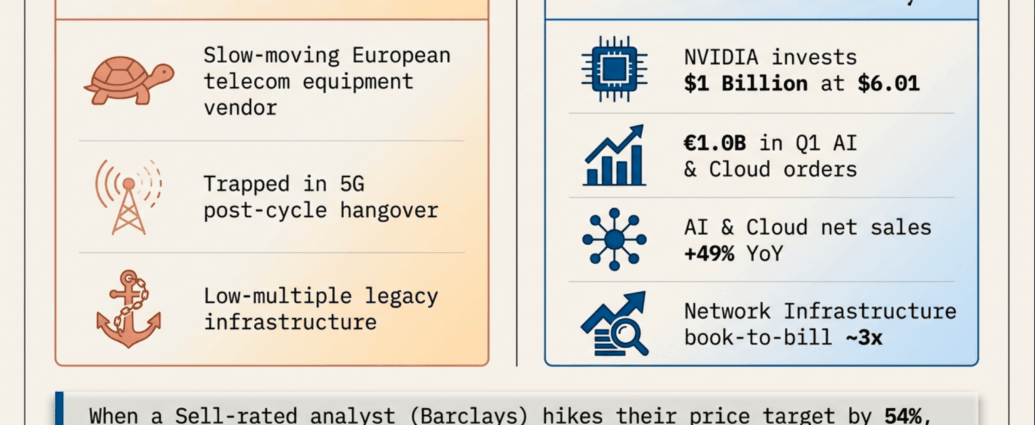
Most people hear Nokia and think of the indestructible brick phone from 2004. Wall Street’s version isn’t much better. Until recently, consensus treated Nokia as a slow-moving European telecom equipment vendor trapped in the 5G spending hangover. That mental model just broke.

Nokia closed Friday at $13.30, a 16-year high. The stock is up roughly 166% over the past 12 months from a 52-week low of $4.00. Three things happened in the last six months that sell-side models haven’t fully absorbed, and they all point in the same direction: Nokia is re-rating from a low-multiple telecom laggard into a credible AI infrastructure name.

The NVIDIA signal and the orders that followed

In October 2025, NVIDIA committed $1 billion of its own balance sheet to Nokia at $6.01 per share. That’s not a strategic press release partnership. That’s real money at a specific price, anchoring Nokia inside NVIDIA’s AI-RAN initiative with T-Mobile for field trials at the end of this year.

Then Q1 2026 earnings landed on April 23 and reset the conversation. According to independent research shared with Wolf Financial, Nokia booked €1.0 billion of AI and Cloud orders in Q1 alone. AI and Cloud net sales grew 49% year over year. Gross margin expanded 320 basis points to 45.5%. Free cash flow jumped 40%. Network Infrastructure book-to-bill (the ratio of new orders to revenue shipped) ran at roughly 3x in AI and Cloud.

The number that matters most is one management revised on the earnings call. At their November Capital Markets Day, Nokia framed its AI and Cloud addressable market as growing at a 16% compound rate through 2028. Five months later, that figure was revised to 27%. The reason: …

Full story available on Benzinga.com

This post was originally published here

Ballard Power Systems (TSX:BLDP) held its first-quarter earnings conference call on Tuesday. Below is the complete transcript from the call.

This content is powered by Benzinga APIs. For comprehensive financial data and transcripts, visit https://www.benzinga.com/apis/.

Access the full call at https://event.choruscall.com/mediaframe/webcast.html?webcastid=hgUGKLap

Summary

Ballard Power Systems reported a 26% increase in revenue for Q1 2026, driven by bus and rail markets, and achieved a 14% gross margin, marking the third consecutive quarter of positive gross margin.

The company signed multi-year agreements with major bus OEMs like New Flyer, Wrightbus, and Solaris, strengthening its position in the hydrogen bus market and expanding its fleet services offerings.

Operational highlights include the introduction of Project Forge, an automated manufacturing line expected to enter full production in the second half of the year, aimed at reducing costs and improving quality.

The company continues to focus on reducing product costs, expanding commercial structures, and exploring new applications such as stationary power for grid stability and energy resilience.

Ballard Power Systems ended the quarter with $516.8 million in cash, and despite not providing specific revenue or net income guidance, it expects revenue to be weighted toward the second half of the year.

Full Transcript

Sumit Kundu (Investor Relations)

Thank you Operator and good morning. Welcome to Ballard’s first Quarter financial and Operating Results conference call. With us today on the call are Marty Neese, Ballard’s President and CEO; Kate Igbolode, Chief Financial Officer; and Ralph Robinette, Ballard’s new Chief Operating Officer. We will be making forward looking statements based on management’s current expectations, beliefs and assumptions concerning future events. Actual results could differ materially. Please refer to our most recent annual Information form and other public filings for our complete disclaimer and related information. I’ll now turn the call over to Marty.

Marty Neese (President and CEO)

Thank you Sumit and welcome everyone to today’s conference call. This morning I will give an Overview of our Q1 2026 performance and provide a commercial update. I will focus on the progress we are seeing in the bus market. We are also joined by our new Chief Operating Officer Ralph Robinette. He will introduce himself and share updates on our operations. Kate will then review our financial results in more detail. We had a solid start to the year. Deliveries into the bus and rail markets drove revenue growth compared to last year. We also delivered another quarter of positive gross margins. This is our third consecutive quarter of positive gross margin. It reflects disciplined cost and commercial management and marks an important step in our transformation toward becoming cash flow positive. To build on this progress, we have set a few near term focus areas including deepening our partnerships with bus OEMs in key geographies improving and expanding our fleet services, capabilities and offerings Lowering costs through automation and intelligence. I’ll spend a few minutes on these and provide some additional color Turning to Buses we have made several important announcements in the bus market this year. In North America, we signed a multi year agreement with New Flyer representing approximately 50 megawatts of fuel cell engine supply. This strengthens our position as fleets continue to scale in the US Bus market. In the uk, Wrightbus selected Ballard to power its next generation hydrogen bus platform using our newest FCmove™ engine. In the eu, Solaris also selected Ballard as the fuel cell supplier for its next generation hydrogen bus platform including the FCmove™ SC for its 12 meter bus. These announcements matter for several reasons. First, these new agreements are multi year partnerships with leading bus OEMs in major markets. They include both engine sales and long term service support. This strengthens our position as fleet scale and as our fleet services business continues to grow. Our intelligent fuel cell engines help us deliver better service. They provide real time performance data that allows us and our OEM partners to respond faster and keep buses on the road. Our remote operations center adds another layer of support by improving parts planning, logistics and predictive insights. Combined with our industry leading durability, these capabilities position our engines as a zero emission solution that can match or even exceed battery, electric and diesel alternatives on uptime and total cost of ownership. Ballard Fleet Services plays a key role in this strategy. We are moving from being only a module supplier to becoming a proactive data driven fleet partner. Our approach is built on more than 300 million kilometers of real world operating data. Using this experience we created the industry first uptime standard which brings together predictive maintenance, training, service support and parts assurance. These offerings are designed to deliver up to 98% fleet availability. This creates real value for OEMs by reducing after sales friction and lowering risk. It also gives operators more predictable life cycle costs and stronger protection against budget swings. As our installed base grows, these services expand our recurring revenue and turn our fleet into a long term strategic asset. Second, these long term agreements support our product cost reduction goals. Both Wrightbus and Solaris have committed to our 9th generation FC Move SC platform. This engine was designed to reduce cost and simplify installation and maintenance. We cut the number of components by more than 40% while improving power density and durability. Each new bus we deploy also creates a long tail of service opportunities. Buses stay …

Full story available on Benzinga.com

This post was originally published here
On Tuesday, Ballard Power Systems (NASDAQ:BLDP) discussed first-quarter financial results during its earnings call. The full transcript is provided below.

This content is powered by Benzinga APIs. For comprehensive financial data and transcripts, visit https://www.benzinga.com/apis/.

View the webcast at https://event.choruscall.com/mediaframe/webcast.html?webcastid=hgUGKLap

Summary

Ballard Power Systems reported Q1 2026 revenue of $19.4 million, a 26% increase year-over-year, driven by growth in the bus and rail markets.

The company achieved a positive gross margin for the third consecutive quarter, improving to 14%, reflecting disciplined cost management and operational efficiency.

Strategic initiatives include expanding partnerships with bus OEMs, advancing fleet services, and reducing costs through automation, with significant agreements signed with New Flyer, Wrightbus, and Solaris.

Operationally, the focus is on improving quality, cost reduction, and scaling production capabilities, with Project Forge expected to enhance manufacturing efficiency.

The company maintains a strong cash position of $516.8 million, with no immediate financing needs, and continues to aim for positive cash flow.

Management expressed optimism about future growth in stationary power and rail sectors, as well as increased penetration of green hydrogen.

Full Transcript

Sumit Kundu (Investor Relations)

Thank you Operator and good morning. Welcome to Ballard Power Systems’ first Quarter financial and Operating Results conference call. With us today on the call are Marty Neese, Ballard Power Systems’ President and CEO Kate Igbolode, Chief Financial Officer and Ralph Robinette, Ballard Power Systems’ new Chief Operating Officer. We will be making forward looking statements based on management’s current expectations, beliefs and assumptions concerning future events. Actual results could differ materially. Please refer to our most recent annual Information form and other public filings for our complete disclaimer and related information. I’ll now turn the call over to Marty.

Marty Neese (President and CEO)

Thank you Sumit and welcome everyone to today’s conference call. This morning I will give an Overview of our Q1 2026 performance and provide a commercial update. I will focus on the progress we are seeing in the bus market. We are also joined by our new Chief Operating Officer Ralph Robinette. He will introduce himself and share updates on our operations. Kate will then review our financial results in more detail. We had a solid start to the year. Deliveries into the bus and rail markets drove revenue growth compared to last year. We also delivered another quarter of positive gross margins. This is our third consecutive quarter of positive gross margin. It reflects disciplined cost and commercial management and marks an important step in our transformation toward becoming cash flow positive. To build on this progress, we have set a few near term focus areas including deepening our partnerships with bus OEMs in key geographies improving and expanding our fleet services, capabilities and offerings Lowering costs through automation and intelligence. I’ll spend a few minutes on these and provide some additional color Turning to Buses we have made several important announcements in the bus market this year. In North America, we signed a multi year agreement with New Flyer representing approximately 50 megawatts of fuel cell engine supply. This strengthens our position as fleets continue to scale in the US Bus market. In the UK, Wrightbus selected Ballard to power its next generation hydrogen bus platform using our newest FC Move FC engine. In the EU, Solaris also selected Ballard as the fuel cell supplier for its next generation hydrogen bus platform including the FC move SC for its 12 meter bus. These announcements matter for several reasons. First, these new agreements are multi year partnerships with leading bus OEMs in major markets. They include both engine sales and long term service support. This strengthens our position as fleet scale and as our fleet services business continues to grow. Our intelligent fuel cell engines help us deliver better service. They provide real time performance data that allows us and our OEM partners to respond faster and keep buses on the road. Our remote operations center adds another layer of support by improving parts planning, logistics and predictive insights. Combined with our industry leading durability, these capabilities position our engines as a zero emission solution that can match or even exceed battery, electric and diesel alternatives on uptime and total cost of ownership. Ballard Fleet Services plays a key role in this strategy. We are moving from being only a module supplier to becoming a proactive data driven fleet partner. Our approach is built on more than 300 million kilometers of real world operating data. Using this experience we created the industry first uptime standard which brings together predictive maintenance, training, service support and parts assurance. These offerings are designed to deliver up to 98% fleet availability. This creates real value for OEMs by reducing after sales friction and lowering risk. It also gives operators more predictable life cycle costs and stronger protection against budget swings. As our installed base grows, these services expand our recurring revenue and turn our fleet services into a long term strategic asset. Second, these long term agreements support our product cost reduction goals. Both Wrightbus and Solaris have committed to our 9th generation FC Move SC platform. This engine was designed to reduce cost and simplify installation and maintenance. We cut the number of components by more than 40% while improving power density and durability. Each new bus we deploy, also creates a long tail of service opportunities. Buses stay in …

Full story available on Benzinga.com

This post was originally published here

Vornado Realty (NYSE:VNO) held its first-quarter earnings conference call on Tuesday. Below is the complete transcript from the call.

Benzinga APIs provide real-time access to earnings call transcripts and financial data. Visit https://www.benzinga.com/apis/ to learn more.

The full earnings call is available at https://edge.media-server.com/mmc/p/iv6i4ys9/

Summary

Vornado Realty reported a decrease in first-quarter comparable FFO to $0.52 per share from $0.63 last year, attributing the decline to various factors including higher interest expenses.

The company announced the acquisition of a 49% interest in Park Avenue Plaza, a Class A office building, expecting the transaction to be approximately $0.10 accretive on a full-year basis.

Vornado Realty anticipates continued growth in the New York office market, projecting significant earnings growth in 2027 as leasing activities at Penn1 and Penn2 take effect.

Management highlighted strong leasing activity, with average starting rents in Manhattan at $103 per square foot and a robust pipeline of over 1 million square feet of leases in negotiation.

The company actively engages in share buybacks and recently authorized an additional $300 million buyback program.

There were significant discussions about the potential development of 350 Park Avenue, with Citadel as a key anchor tenant.

Vornado Realty’s liquidity position remains strong with $2.6 billion, comprising cash and undrawn credit lines.

Full Transcript

OPERATOR

Good morning and welcome to the Vornado Realty Trust first quarter 2026 earnings call. My name is Rocco and I will be your operator for today’s call. This call is being recorded for replay purposes. All lines are in a listen only mode. Our speakers will address your questions at the end of the presentation during the question and answer session. At that time, please press star then one on your touchtone phone. I will now turn the call over to Mr. Steve Borenstein, executive Vice President and Corporation Counsel. Please go ahead.

Steve Borenstein (Executive Vice President and Corporation Counsel)

Welcome to Vornado Realty Trust’s first quarter earnings call. Yesterday afternoon we issued our first quarter earnings release and filed our quarterly report on Form 10Q with the Securities and Exchange Commission. These documents as well as our supplemental financial information package are available on our website www.vno.com under the Investor Relations section. In these documents and during today’s call we will discuss certain non GAAP financial measures. Reconciliations of these measures to the most directly comparable GAAP measures are included in our Earnings Release Form 10Q and Financial Supplement. Please be aware that statements made during this call may contain forward looking statements and actual results may differ materially from these statements due to a variety of risks, uncertainties and other factors. Please refer to our filings with the Securities and Exchange Commission, including our annual report on Form 10-K for the year ended December 31, 2025 for more information regarding these risks and uncertainties. The call may include time sensitive information that may be accurate only as of today’s date. The Company does not undertake a duty to update any forward looking statements on the call today from management. For our opening remarks are Steven Roth, Chairman and Chief Executive Officer and Michael Frankel, President and Chief Financial Officer. Our senior team is also present and available for questions. I will now turn the call over to Steven Roth.

Steven Roth (Chairman and Chief Executive Officer)

Thank you Steve and good morning everyone. Business at Vornado continues to be excellent and it’s getting better and better. We are riding the wave of a strengthening, long lasting landlord’s market and New York is by far and away the strongest real estate market in the country. Michael will get into the details shortly, but today I have different fish to fry and and I will ask the first question Question: What do you make of the spat between Mayor Mondavi and Ken Griffin and how will it affect your 350 Park Avenue development? Answer Let me begin by saying that I do not and cannot speak for Ken, but I do unambiguously stand with him. And notwithstanding the mistakes and bad form of the recent video that went viral we are pulling for Mayor Mondavi to succeed. Let me establish my credentials. Vornado is a New York company and I am a New Yorker, born in Brooklyn and attended DeWitt Clinton Public High School in the Bronx. Both Vernado and I are lucky to be New Yorkers. My daughter and three granddaughters live in the Bronx and my son and his family live in Brooklyn. My wife of 56 years and I live and work in Manhattan. We follow the rules and we pay our fair share. Vornado will pay $560 million in real estate taxes this year and I’m pretty sure that’s in the top three. And that doesn’t begin to count the personal income taxes that I and our Grenado population pay to the city and state of New York. We work our asses off. We are not boastful. We are very proud of our lifetime of achievements. We are the company that is investing billions to transform the Penn District. New York is a union town and we are a union shop employing thousands of hard working New Yorkers in our buildings and on our construction sites. The ugly unnecessary video stunt is personal to Ken and sort of personal to me too. You see, Vornado and I are the developers of both 220 Central Park south residential building and the 350 Park Avenue Citadel Tower. We are all shocked that our young mayor would pull this stunt in front of Kent’s home and single them out for ridicule. This was both irresponsible and dangerous. As I said, Vornado is the owner of the 65 year old building on Park Avenue on the Park Avenue blockfront that will be raised to make way for the Citadel New York headquarters tower which will employ thousands further cementing New York as the financial capital of the world and pay significant taxes and on and on. This building is being designed by the same Foster and Partners architectural team that designed JPMorgan Chase’s new headquarters down the block. This is now the if we move forward project. Now, a project of this scale takes years and we have already worked with two prior city administrations, both of whom have recognized the benefits and have been enthusiastically welcoming and supporting and supporting. As evidenced by the rare unanimous ULIP approval for this project. Demolition began literally days ago and we at Tornado are ready to go. I must say that I consider the phrase tax the rich, quote tax the rich when spit out with anger and contempt by politicians both here and across the country to be just as hateful as some disgusting racial slurs. And even the phrase from the river to the sea. What these poll pauls seem to Be saying is that the rich are evil or the enemy or the targets, or maybe even just suckers. But the rich whom the politicians are targeting started at nothing, are the epitome of the American dream. They are our largest employers and largest philanthropists. And it is the 1% that pay 50% of New York’s income taxes. They are at the top of the great American economic pyramid for a reason. They should be praised and thanked. Ken, our partner and friend, is the best of the best. So where are we now? As we discussed last quarter, Ken exercised his option to enter our development joint venture and build a new 1.9 million square foot tower with Citadel as the anchor tenant. We have until the middle of July to sign decide whether to participate with Ken in the venture or to sell to him. It’s a good bet that we will go all in. This fence cannot be mended by a short, terse, insincere private apology. What I beg my mayor to do is to begin every day being business welcoming and business friendly as his first priority. That’s the only way to get the growth and financial wherewithal to accomplish his programs, some of which I must say are interesting and valid. Public safety, schools, child care, clean street housing, affordability, homeless programs, et cetera. The election is over. Now is the time for hard work and management, not showboating. New York is an enormous enterprise with a city budget of $120 billion and a state budget of $250 billion. If there is a 5 or $10 billion budget shortfall, surely that can be found. That money can be found by managing rather than by taxing. It is interesting to note that high tax New York spends more than double per capita. Double per capita than low tax or no tax, Florida or Texas. There is a lesson here. Maybe something good can come out of this blunder. Maybe we can draft Kent to become active and lead an effort to educate New York voters and to elect right minded candidates. Ken can do it. He’s the one who could galvanize the entire business community. Here’s an interesting fact to it. Members of the partnerships in New York city alone employ 1 million voters. Hundreds of our business leaders would line up to support Ken. I would be first in that line. I was taught and I believe that. I believe in an America where after an election, all sides get behind us and support the winning candidate for the greater good. Our mayor is young, smart and energetic. With a little tweak here and a little tweak there, his leadership could make this great city even greater. He will learn over time that growing a tax base is a winner and raising taxes is a loser. I will say it again. He will learn over time that a growing tax base is a winner and raising taxes is a loser. And that’s a hard working 1% are allies, not enemies. Let’s learn from this mistake and move upward. Turning to Vornado, we now have a lineup of assets and in process projects which I am confident will deliver the highest growth in our industry. Executing on all this is now our singular focus. In this year 2026, we will complete the heavy lifting of leasing at Penn1 and Penn2. As Michael and Tom have already been saying quarter after quarter. Our published numbers will reflect all this by the end of 2026 and going into 2027. As part of our focus on enhancing our portfolio and making great deals, we announced last week the acquisition of a 49% interest in Park Avenue Plaza, a 1.2 million square foot class A office building along the prime stretch of Park Avenue. This asset is directly across the street from our 350 Park Avenue project. The building is 99% occupied by blue chip tenants with an 11 year weighted average lease term and rents that are 40% to 50% below market. Prime Park Avenue AAA assets rarely trade and we believe we made an excellent purchase. We’re buying the asset at $950 per square foot which is 65 to 70% discount to replacement cost and we are inheriting a fixed rate, a sub 3% loan through 2031 to leverage off an enhanced return. We expect the transaction to be approximately $0.10 accretive on a full year basis. In the first year we are happy to be partnering with the Fisher family who own the other 51% of the assets. We have a long relationship with the Fisher family. They are a first class operator who think much like we do with Park Avenue Plaza. Our recent acquisition of 623 Fifth Ave and the pending development of 350 Park Ave, we will be adding, call it 2 million square feet at share of the very highest quality prime assets to our portfolio at Very Accretive economics. Speaking of 623 Fifth Avenue, our 383,000 square foot asset which we are redeveloping to be the premier boutique office building in Manhattan. We are far along in our design and planning. We are receiving outstanding reaction from the market and already have active tenant interest at or above our underwriting. Demand for our retail assets is robust and accelerated.

Michael Frankel (President and Chief Financial Officer)

We have a handful of assets for sale in the market. I covered share buybacks in my recently posted shareholders Letter to date, under our $200 million share buyback program, we have repurchased 7 million common shares at an average of $25.80 per share, totaling $180 million. Last week our board authorized an additional $300 million buyback program. Now to Michael thank you Steve and Good morning everyone. First quarter Comparable FFO was $0.52 per share compared to $0.63 per share for last year’s first quarter. This decrease is consistent with our comments from the prior quarters and is primarily due to the reversal of previously accrued Penn one ground rent expense in the prior year’s first quarter and higher net interest expense partially offset by higher FFO resulting from the execution of the NYU master lease at 770 in the prior year and strong income growth at Penn 1 and Penn 2. We have provided a quarter over quarter bridge on page two of our earnings release and on page six of our financial supplement. We now expect full year 2026 comparable FFO to be slightly higher than 2025, ramping up each quarter due to gap rents coming online, lower interest expense after our June 2026 bonds repaid, and some seasonality relating to our signage business. As previously indicated, we expect there to be significant earnings growth in 2027 as the positive impact from 10:1 and Penn2 lease up takes effect, as well as the positive impact of the recent acquisition of Park Avenue plus Turning to Leasing the Manhattan office market is head and shoulders the best in the country and is off to its strongest start to

OPERATOR

a year in over a decade. Manhattan leasing volume reached nearly 12 million square feet, the highest first quarter level since 2014. There is a significant supply demand imbalance in the 180 million class, a better building market in which we compete as the availability rate in the prime submarkets in Midtown and the west side has tightened significantly and there is little new supply coming for the foreseeable future given the significant cost and duration to build. This is all resulting in tenants competing for space and rents rising aggressively. The landlord’s market we have been long predicting is very much here, while the macro environment we operate in today has gotten even more complicated since our last call and the geopolitical volatility is as high as we’ve seen in some time. The US Economy just continues to chug along as does New York’s. While there is a risk that the Middle east conflict lasts much longer and has a greater economic impact, to date we have not seen any change in tenant behavior. Moreover, while there has been a lot of AI fear mongering out there and while we are respectful to risk, we believe it is overblown. Over the past 50 years, office using jobs have continually evolved based on new technology from the computer revolution of the 1980s when personal computers and word processors were introduced to the 2000s when the Internet transformed workflows and the way we communicate to now with AI improving efficiencies and increasing productivity. In every example, office using jobs were not reduced but they shifted from clerical based functions to knowledge based roles and each new revolution spurred productivity and economic growth. With new businesses and net positive jobs created, there will be winners and losers, but by industry, by job function and by geography. But make no mistake, New York and San Francisco will be winners as the intellectual and innovation capitals of the country where talent will continue to aggregate and in the best buildings At Vornado we are coming off our second best leasing year in our company’s history where we leased 3.7 million square feet with 960,000 square feet of New York office in the fourth quarter. Business continues to be very good and the momentum from last year has continued during the first quarter of 2026. In the first quarter released 426,000 square feet of office space overall, including 311,000 square feet in New York. Our metrics were very strong. Average starting rents in Manhattan were $103 per square foot with mark to markets a positive 11.7% GAAP and positive 9.7% cash and an average lease term of nine years. Our new York office pipeline is robust and has over 1 million square feet of leases in negotiation and various stages of proposal. Turning to the capital markets, the financing markets continue to be strong and liquid for Class A New York office assets, though pricing has widened a bit given the current geopolitical environment. The investment sales market continues to heat up as well, with a broadening set of buyers keenly focused on New York City. We are very active in the capital markets in the first quarter, most of which we covered on the last call. Given we’ve dealt with almost all of our 2026 and 2027 maturities, we don’t have any significant financings we need to complete for the next 18 months. We do still have a few loans that we need to work through at lenders over the next two to three years. Finally, our liquidity remains strong at $2.6 billion, which is comprised of cash of $1.2 billion and our undrawn credit lines of $1.4 billion. With that, I’ll turn it over to the operator for Q and A thank you. We will now begin the question and answer session. If you have a question, please press star then one on your touchtone phone. If you wish to be removed from the queue, please Press Star then 2. If you are using the speakerphone, you may need to pick up the handset first before pressing the numbers. Once again, if you have a question, please press star than one on your touchtone phone. Each caller will be allowed to ask a question and a follow up question before we move on to the next caller. This first question comes from Steve Sacwa at Evercore isi. Please go ahead.

Steve Sacwa

Yeah, thanks. Good morning, Steve. Thanks for your opening comments on the city and the administration. I guess maybe going to Michael’s commentary on just the pipeline and the million feet. I didn’t know if Michael or Glenn could maybe expound a little bit on how much of that is for upcoming lease expirations, how much of that is for kind of vacancy within the portfolio. And I guess most of that’s probably in New York, but maybe discuss kind of The New York vs. Chicago vs. San Francisco demand trends.

Glenn

Hi Steve, it’s Glenn. How you doing? So you know, our pipeline is extremely well balanced. Of the million feet, it’s right down the middle. 50% new expansion, 50% renewal. The other thing I’ll note is on renewals due to the lack of quality space available in the market, we’re seeing many of our tenants coming to us early on renewals since they can find quality alternatives, which is a key indicator of …

Full story available on Benzinga.com

This post was originally published here

ONE Gas (NYSE:OGS) released first-quarter financial results and hosted an earnings call on Tuesday. Read the complete transcript below.

This transcript is brought to you by Benzinga APIs. For real-time access to our entire catalog, please visit https://www.benzinga.com/apis/ for a consultation.

The full earnings call is available at https://events.q4inc.com/attendee/511969668

Summary

ONE Gas reported a 6% year-over-year growth in adjusted EPS for Q1, despite experiencing one of the warmest winters on record.

The company affirmed its financial guidance with adjusted net income projected between $306 million and $314 million for the year.

Operational highlights include a 20% increase in storage capacity, which saved customers $98 million during Winter Storm Fern.

ONE Gas maintained a strong safety record, winning the Safety Achievement Award from the American Gas Association for the ninth consecutive year.

Strategic initiatives focus on customer growth, with ongoing capital projects and new large load opportunities such as data centers and manufacturing facilities.

The company plans to insource its Watch and Protect function to enhance safety and operational efficiency.

Management emphasized the effectiveness of weather normalization mechanisms despite the unusual weather conditions.

ONE Gas continues to support growth through strategic investments, leveraging existing systems for economic development.

Full Transcript

OPERATOR

Good day and welcome to the One GAS First Quarter Earnings Conference call and webcast. Today’s conference is being recorded at this time. I would like to turn the conference over to Erin Daly. Please go ahead. Ms. Daley thank you.

Regina

Regina Good morning everyone and thank you for joining us on our first quarter 2022 earnings conference call. This call is being webcast live and a replay will be made available later today after our prepared remarks. We are happy to take your questions. A reminder that statements made during this call that might include ONE Gas expectations or predictions should be considered forward looking statements and are covered by the Safe harbor provision of the Private Securities Litigation Reform act of 1995, the securities act of 1933 and the securities and Exchange act of 1934 each as amended. Actual results could differ materially from those projected in any forward looking statement. For a discussion of factors that could cause actual results to differ, please refer to our SEC filings. This call will include financial results and guidance with respect to adjusted net income and adjusted net income per share, which are non GAAP financial measures as defined by the sec. A reconciliation of the Company’s GAAP net Income and GAAP earnings per share to adjusted net income and adjusted net income per share, along with additional disclosures required by Regulation G are available in the earnings release we issued yesterday. Joining us this morning are Sid McInally, Chief Executive Officer, Chris Signalfi, Senior Vice President and Chief Financial Officer and Curtis Dinan, President and Chief Operating Officer. And now I’ll turn the call over to Sid.

Sid McInally (Chief Executive Officer)

Thanks Erin and good morning everyone. We’re glad to be with you to discuss our first quarter results and to affirm our guidance. We delivered strong Results in the first quarter with adjusted EPS growing 6% year over year despite one of the warmest winters in the history of our service territory, 25% warmer than the first quarter last year. Our performance reflects disciplined execution of our long term plan, advancing our regulatory strategy, driving operational efficiencies and supporting growing customer needs. We continue to meet our growth targets while maintaining a strong focus on customer affordability, which was particularly important during a volatile winter. While conditions were historically warm across Kansas, Oklahoma and Texas, we did experience Winter Storm Fern in January, a brief isolated cold event that temporarily drove higher gas prices across our service territory. Our 20% increase in storage capacity since Winter Storm Yuri allowed us to shield customers from price volatility and save $98 million relative to purchasing gas at spot prices. Ultimately, this performance reflects the same focus that guides our business every day safe, reliable and affordable service to our customers and long term value creation for our investors. Safety remains a priority for our company. Our strong performance in 2022, especially in the areas of workplace safety and safe driving, continues to place ONE Gas among the safest natural gas utilities in the nation. The Safety Achievement Award is given each year by the American Gas association to companies who experience the fewest number of serious injuries when compared to peers. Last month, AGA named ONE Gas as the winner of this award. For 2022, the ninth consecutive year, ONE Gas has received the Safety Achievement Award. We’re grateful for the commitment and dedication of our entire workforce to operating safely

Chris Signalfi (Senior Vice President and Chief Financial Officer)

as we serve our customers and support our coworkers. Now I’ll ask Chris to discuss the details of our financial performance and regulatory activities. Chris thanks Sid and good morning everyone. As Sid noted, we delivered strong first quarter financial performance, demonstrating the resilience of our business model during a historically warm winter. This was largely due to new rates taking effect and the impact of Texas House Bill . We are affirming our financial guidance which includes adjusted net income of 306 million to $314 million and adjusted earnings per diluted share of $4.83 to $4.95. Adjusted net income for the first quarter was $133.4 million or $2.11 per diluted share, compared with $120.1 million or $1.99 in the same period last year. First quarter revenues reflect an increase of approximately $27 million from new rates. Depreciation and amortization expenses was down 6% year over year and interest expense was down 9%. Texas and Oklahoma experienced their warmest winters since 1895 when regional temperature tracking began. Kansas had its second warmest winter in that period and its warmest of the past 34 years. While we have effective weather normalization mechanisms that tempered the earnings impact, we were not completely insulated along with earnings impacts. Cash flows were affected as we monetized less gas and storage than we would have under normal conditions. Higher spring storage balances mean we will inject less this retail season. We expect the storage related cash flow impact to normalize as we move through the remainder of the year. First quarter OM expenses increased approximately 8.6% year over year compared with 1.9% year over year growth in the prior year period. The increase was primarily driven by employee related costs. We also experienced elevated line locating activity in particular, more fiber installations led to an increase in line locating tickets. Quarterly O and M naturally fluctuates due to the timing and the nature of our operations and we continue to expect compound annual OM expense growth of 3 to 4% over our five year plan. Other income net decreased by $2.6 million compared with the same period last year in part due to decreases in the market value of investments associated with our non qualified deferred compensation plan. Excluding amounts related to KGSS-1 interest expense was $3 million lower year over year in the first quarter due in part to the impact of Texas House Bill 4384 and 2025 Federal Reserve rate cuts, a reminder that our 2026 guidance did not assume any rate reductions. Turning to liquidity during the first quarter we executed Forward Sale agreements under our at the Market Equity program for approximately 237,000 shares of common stock. We also have roughly 269,000 shares remaining to be issued under a forward Sale agreement executed in May of last year. Had all shares under forward sale agreement been fully settled as of March 31, net proceeds would have totaled approximately $41.5 million. We will continue …

Full story available on Benzinga.com

This post was originally published here

Michael Saylor‘s Strategy Inc. (NASDAQ:MSTR) reports first-quarter earnings after the bell Tuesday, with attention shifting from Bitcoin (CRYPTO: BTC) accumulation to the company’s $8.5 billion preferred-stock funding engine.

The Stretch instrument, listed as STRC, has become the primary capital rail behind Strategy’s Bitcoin purchases and the most contested feature of its balance sheet heading into the call.

The Stretch Debate

Economist Peter Schiff has spent the run-up to earnings hammering the structure, calling Stretch (NASDAQ:STRC) “the most obvious Ponzi that has ever existed.”

The Financial Times’ Alphaville column raised similar concerns, warning of Strategy’s “teetering financial tower” and comparing the preferred-stock funding loop to pre-2008 mortgage securitization dynamics.

Strategy carries roughly $1.5 billion in annual STRC dividend obligations on the 11.5% yield, with …

Full story available on Benzinga.com

This post was originally published here

Oaktree Specialty Lending (NASDAQ:OCSL) held its second-quarter earnings conference call on Tuesday. Below is the complete transcript from the call.

This content is powered by Benzinga APIs. For comprehensive financial data and transcripts, visit https://www.benzinga.com/apis/.

Access the full call at https://events.q4inc.com/attendee/630715121

Summary

Oaktree Specialty Lending reported a reduction in non-accruals to 2.6% of the total debt portfolio, down from 3.1% last quarter, and increased liquidity to $671 million.

Net asset value per share decreased to $15.69 from $16.30, driven by unrealized mark-to-market write-downs; adjusted net investment income was $33.7 million or $0.38 per share.

The company has sold certain liquid credit positions to build dry powder and maintain leverage, with a focus on investing in private credit deals with wider spreads and improved lender protections.

Management discussed the market environment, emphasizing the current volatility as a recalibration phase and highlighting the company’s preparedness to capitalize on future opportunities.

The board declared a total cash dividend of $0.34 per share, with a base dividend adjusted to $0.30 per share and maintaining a supplemental dividend based on excess adjusted net investment income.

Full Transcript

OPERATOR

Welcome and thank you for joining Oaktree Specialty Lending Corporation’s second fiscal quarter 2026 conference call. All lines have been placed on mute to prevent any background noise. After the Speaker’s remarks, there will be a question and answer session. If you would like to ask a question during this time, simply press STAR followed by the number one on your telephone keypad. If you would like to withdraw your question, press Star one again. Today’s conference call is being recorded. I’ll now turn the call over to Allison Murmy, OCFL’s Head of Investor Relations.

Allison Murmy (Head of Investor Relations)

Thank you operator. Our second quarter 2026 earnings release which we issued this morning along with the accompanying slide presentation can be accessed on the Investors section of our website oaktreespecialtylending.com. Before we begin, I want to remind you that the comments on today’s call include forward looking statements including reflecting current views with respect to, among other things, future operating results, and financial performance. Actual results could differ materially from those implied or expressed in the forward looking statements. Please refer to the relevant SEC filings for a discussion of these factors in further detail. Oaktree undertakes no duty to update or revise any forward looking statements. I’d also like to remind you that nothing on this call constitutes an offer to sell or solicitation of an offer to purchase any interest in an Oaktree fund. Investors and others should note that OCSL uses the Investor section of its corporate website to announce material information. The company encourages investors, the media and others to review information that it shares on its website. Now I’ll turn the call over to Matt Pendo, President of OCSL.

Matt Pendo (President)

Matt thank you Allison and good morning everyone. I will begin with an overview of our second quarter fiscal 2026 results, after which Armin Panozian, our CEO and co Chief Investment Officer, will share his perspective on the market environment. Raghav Khanna, our co Chief Investment Officer, will then cover portfolio activity and Chris McCown, our CFO and Treasurer. We’ll close with a review of our financial resultss before we open the call for questions. Despite external noise around private credit and BDCs, our team remained focused on reducing non accruals and positioning our balance sheet for flexibility. As of March 31, 2026, non accruals were 2.6% of the total debt portfolio measured at fair value, down from 3.1% last quarter and 4.6% one year ago. As an update post quarter in april we sold 2 legacy non accrual positions, Dominion Diagnostics and all web leads. We expect to make further progress reducing non accruals and realizing cash proceeds that we can deploy into performing assets over the coming months. Managing our balance sheet is a high priority as we position OCSL for a more attractive investment environment. During the quarter, we sold a portion of our liquid credit positions at cost, a strategic decision to build dry powder, maintain leverage below the midpoint of our target range and rotate out of lower yielding public credit. We ended the second quarter with available liquidity of 671 million, up $100 million from last quarter and net leverage of 1.04 times, down from 1.07 times last quarter. Turning to financial highlights, net asset value per share was $15.69 as of March 31, 2026 compared to $16.30 as of December 31, 2025. The decline was driven primarily by unrealized mark to market write downs of software loans. During the quarter, the fair value of our performing software loans declined by approximately 310 basis points, largely consistent with movements in broadly syndicated software loans. Importantly, we believe that these markdowns generally are not indications of deteriorating fundamentals in the underlying portfolio companies, but rather reflecting the repricing of risk in the broader markets. Adjusted net investment income from the quarter was $33.7 million, or $0.38 per share, as compared with $36.1 million or $0.41 per share in the prior quarter. The decrease reflected lower reference rates, lower non recurring income and ending leverage below the midpoint of our target range for the quarter. Our board declared a total cash dividend of $0.34 per share. Due to our conservative use of leverage, we have adjusted our base dividend to $0.30 per share while maintaining our supplemental dividend at 50% of excess adjusted net investment income above our base dividend. The dividends are payable on June 30, 2026. The stockholders are record as of June 15, 2026. With that, I’ll turn the call over to Armin to share his perspective on the market environment and what we see ahead.

Armin Panozian (CEO and Co Chief Investment Officer)

Thank you Matt. It was an eventful quarter for private credit. We believe the volatility that we are seeing reflects a period of recalibration rather than a systemic issue. Rising impairments, questions surrounding valuations, the use of leverage, liquidity mismatches, software exposure in an AI, driven world and refinancing risks are all part of the current dialogue surrounding private credit. This may help explain, at least in part, why market sentiment may appear more negative than borrower performance alone would suggest. As the confluence of concerns weigh on investor confidence. The current debate around private credit risks may conflate a range of distinct factors and lead to overly broad conclusions. It is important to differentiate between the fundamentally sound concept of private credit, namely tailored non bank lending, from specific challenges affecting certain segments of the market. Direct lending or making private loans to finance mid sized buyouts isn’t inherently flawed. The question for any manager is whether their portfolio assets and liabilities were built to handle a market correction. At Oaktree, we have more than three decades of experience investing in sub investment grade credit and navigating market cycles. This moment is familiar to us. For example, in 2020, OCSL’s positioning was the result of deliberate choices we made well before the COVID related market dislocation arrived. By late 2019 we had cleaned up the legacy portfolio that was acquired from the prior advisor, reduced leverage and built liquidity in the fund. When dislocation arrived in March 2020, we had the dry powder and the conviction to go on offense. In 2020 we deployed nearly $1 billion of capital and produced nearly an 11% total economic return in a year when many managers retrenched. Today, OCSL is executing with a similar mindset. We continue to make progress toward turning around underperforming assets, operating below the midpoint of our leverage target, remaining disciplined in deployment and maintaining strong liquidity. We did not predict the current environment, but we prepared to invest into it. Market volatility increased this quarter and AI, related concerns and geopolitical unrest resulted in wider spreads across public liquid credit markets. At the same time, elevated net redemptions in non traded BDCs prompted many managers to reassess their cost of capital and liquidity positions, pushing private credit into a phase of price discovery. Towards quarter end, market conditions stabilized and the private credit deal pipeline began to rebuild. We are encouraged that spreads on new private credit investments have widened to SOFR +500 to 550 basis points, approximately 50 to 100 basis points above the 2025 types and supports improved forward returns. We are also seeing modest improvements in …

Full story available on Benzinga.com

This post was originally published here
MFA Finl (NYSE:MFA) reported first-quarter financial results on Tuesday. The transcript from the company’s first-quarter earnings call has been provided below.

Benzinga APIs provide real-time access to earnings call transcripts and financial data. Visit https://www.benzinga.com/apis/ to learn more.

View the webcast at https://event.choruscall.com/mediaframe/webcast.html?webcastid=gPDAxTgM

Summary

MFA Finl reported a negative economic return of 1.2% for Q1 2026, impacted by market volatility due to geopolitical tensions and higher interest rates.

The company’s investment portfolio grew to $12.5 billion, with significant additions in non-QM loans, agency securities, and business purpose loans.

Management introduced a new Distributable Earnings (DE) metric to give investors a clearer view of portfolio earnings, expecting DE to align with the common dividend later in 2026.

Cost reduction initiatives at MFA Finl and Lima One have led to an estimated $20 million in annual savings, with further reductions expected from a corporate headquarters relocation.

The company successfully completed two non-QM securitizations in March, demonstrating resilience in market operations despite widened spreads.

Lima One had strong origination activity, generating $7.7 million in mortgage banking income, with expectations for continued growth.

Delinquencies rose to 7.8% in the residential loan portfolio, primarily due to legacy multifamily book issues, but are expected to normalize as troubled assets resolve.

Management remains confident in their asset mark process, noting gains from resolutions of delinquent loans.

Full Transcript

OPERATOR

Greetings and welcome to the MFA Financial first quarter 2026 financial results. At this time all participants are in a listen only mode. A question and answer session will follow a formal presentation. If anyone should require operator assistance during the conference, please press star on your telephone keypad. As a reminder, this conference is being recorded. I would now like to turn the call over to Hal Schwartz, General Counsel, to begin.

Hal Schwartz (General Counsel)

Thank you, thank you operator and good morning everyone. The information discussed on this conference call today may contain or refer to forward looking statements regarding MFA Financial, Inc. Which reflect management’s beliefs, expectations and assumptions as to MFA’s future performance and operations. When used, statements that are not historical in nature, including those containing words such as will, believe, expect, anticipate, estimate, should, could, would or similar expressions are intended to identify forward looking statements. All forward looking statements speak only as of the date on which they are made. These types of statements are subject to various known and unknown risks, uncertainties, assumptions and other factors, including Those described in MFA’s Annual Report on Form 10K for for the year ended December 31, 2025 and other reports that it may file from time to time with the Securities and Exchange Commission. These risks, uncertainties and other Factors could cause MFA’s actual results to differ materially from those projected, expressed or implied in any forward looking statements it makes. For additional information regarding MFA’s use of forward looking statements, please see the relevant disclosure in the press release announcing MFA’s first quarter 2026 results. Thank you for your time. I would now like to turn this call over to MFA CEO Craig Knudsen.

Craig Knudsen (Chief Executive Officer)

Thank you, Hal Good morning everyone and thank you for joining us for MFA Financial’s first quarter 2026 earnings call. With me today are Brian Wolfson, our President and Chief Investment Officer, Mike Roper, our Chief Financial Officer and other members of our senior management team. I will offer some general remarks on the macro, economic and political landscapes and will then provide an update on MFA’s business initiatives and portfolio activities. Then I’ll turn the call over to Mike followed by Brian before we open up the call for questions. Moving to market conditions in the first quarter of 2026, it was very much a tale of two market environments. Fixed income markets began the year with a continuation of strong investor demand and low volatility that we experienced in the second half of 2025. The economy continued to exhibit resiliency and the labor market seemed to stabilize, particularly with a surprisingly robust January non farm payroll print in early February. Mortgages performed particularly well, aided also by a directive for the GSEs to purchase $200 billion of agency mortgage backed securities in early January. Unfortunately, the party ended abruptly with the onset of a war in Iran, which spiked volatility, pushed rates sharply higher and dramatically raised oil prices, higher energy prices, renewed fears of inflation and markets adjusted expectations for fewer or even no rate cuts later this year. Mortgage spreads widened significantly against this backdrop and and contributed to an economic return for MFA in the first quarter of -1.2%. However, despite the market volatility and heightened geopolitical tension, markets remained open and orderly. We priced two non QM securitizations in March and while spreads were modestly wider, the market functioned normally. This is a testament to the expansion, maturity and and depth of these markets over the last four years. The second of these two non QM securitizations was a re lever of two previous deals, which is a good example of what we often refer to as an underappreciated source of optionality that our ability to call these deals as they season and pay down, enabling us to lower borrowing costs and unlock additional capital. We grew our investment portfolio to $12.5 billion in the first quarter and adding almost $700 million of agencies including To Be Announced (TBAs), $471 million of non QM loans and Lima One originated $219 million of business purpose loans. Our asset management team continues to work diligently to resolve delinquent loans in the portfolio. This can be maddeningly time consuming, but our team has been working out delinquent loans for over a decade, the majority of which were purchased as non performing loans and they’re the best in the business at this and uniquely suited to the task. Finally, our listeners will recall that we began a program in the third quarter of last year to issue additional shares of our two outstanding preferred stock issues via an ATM and use the proceeds to repurchase common shares at a significant discount to book. While this program is modest in size thus far, this is very accretive and importantly, because we are issuing equity in the form of preferred stock, we are not shrinking our equity base despite repurchasing common stock. Finally, we continue to pursue expense reductions both at MFA and at Lima one, which Mike will discuss shortly. I will note that we have added an additional distributable earnings metric that we are introducing in response to requests from analysts and investors. Distributable Earnings prior to Realized Credit losses and Mike will describe this in more detail shortly. We believe that this new DE metric offers a useful representation of how we think about the earnings power of the portfolio and for those of you that follow Commercial Mortgage REITs, this should be a very familiar concept. Taken together, MFA has a diversified business strategy that includes multiple attractive target asset classes with a robust ability to source these assets, a reliable and proven ability to obtain durable non recourse leverage to generate attractive ROEs, a highly competent in house asset management capability, a keen focus on expense management and a demonstrated responsible capital issuance philosophy. And I’ll now turn the call over to Mike to discuss our financial results.

Mike Roper (Chief Financial Officer)

Thanks Craig and good morning everyone. At March 31, GAAP book value was $12.70 per share and economic book value was $13.22 per share each down approximately 3.8% from the end of 2025. MFA again paid a common dividend of $$0.36 and delivered a quarterly total economic return of negative 1.2%. For the first quarter, MFA generated a GAAP loss of approximately $1 million or $$0.11 per basic common share. Our GAAP results for the quarter were adversely impacted by net mark to market losses on the portfolio of approximately 28.8 million driven by higher rates and wider spreads. On March 31, net interest income for the quarter was 59.2 million, an increase from 55.5 million in the fourth quarter driven by rate cuts late last year and growth in our investment portfolio. These benefits were partially offset by interest income reversals totaling $3.5 million associated with loans moving to non accrual status in our transitional loan portfolio during the quarter. On the G and A front, we’re happy to report that we again made significant progress with our cost reduction initiatives. In February we entered into a series of agreements to relocate our corporate headquarters to a new location here in New York without paying any early lease termination fees. As a result of these agreements, we expect some short term noise in our reported …

Full story available on Benzinga.com

This post was originally published here

USA Compression Partners (NYSE:USAC) held its first-quarter earnings conference call on Tuesday. Below is the complete transcript from the call.

This content is powered by Benzinga APIs. For comprehensive financial data and transcripts, visit https://www.benzinga.com/apis/.

View the webcast at https://events.q4inc.com/attendee/820543991

Summary

USA Compression Partners reported strong financial performance for Q1 2026, with net income of $38.3 million and operating income of $91.4 million.

The company completed the integration of JW Power, adding over a million horsepower to its fleet and expects to achieve annual synergies of $10-20 million by 2027.

Despite extended lead times for new engines, the company has contracted over 90% of its 2026 horsepower and is placing orders for engines through 2029.

USA Compression Partners maintained its full-year guidance, including an EBITDA range of $778 to $800 million and a distributable cash flow range of $480 to $510 million.

Management expressed optimism about the growing demand for natural gas and the company’s strategic position in the market, while also highlighting efforts to manage cost increases due to rising oil prices.

Full Transcript

OPERATOR

Good Morning. Welcome to USA Compression Partners First Quarter 2026 Earnings Conference Call. During today’s call, all parties will be in the listen only mode. At the conclusion of Management’s prepared remarks, the call will be open for question and answer session and if you would like to ask a question during this time, Please press the Star 1 on your telephone keypad. To withdraw your question, please press the Star 1 again. Thank you and this conference is being recorded today, May 5, 2026. I would now like to turn the call over to Clint Green, President and CEO. His

Clint Green (President and CEO)

Good morning everyone and thank you for joining us. With me today is Chris Paulson, Senior Vice President and CFO, Chris Watson, Senior Vice President and COO and other members of our leadership team. This morning we released our operational and financial results for quarter ending March 31, 2026. Today’s call will contain forward looking statements based on our current beliefs and certain non GAAP measures. Please refer to our earnings release and SEC filings for reconciliations and definitions of non GAAP measures and related risk factors as we discuss performance Please note that JW acquisition closed on January 12th and therefore Q1 earnings excludes the impact of revenues and expenses for JW power for the first 11 days of the quarter. Before we get into the quarter, I want to take a moment to recognize our team on safety. Our people go to work in the field every day, working around complex equipment, driving millions of miles a month and the way they return to their family matters more than any financial metric we report. In 2025, our combined TRIR finished at a 0.39, a 50% reduction from 2024 and well below the Bureau of Labor Statistics (BLS) industry average of 0.70, a benchmark we have now beaten for 12 consecutive years. We are proud of these results and we remain committed to continuous improvement moving to the quarter which included two integrations that established upward momentum for the company. First, we kicked off the integration of JW Power at the time when horsepower lead times continued to extend. Customer discussions commenced immediately upon closing, starting the process of onboarding new customers to the USA Compression Partners platform. As of early March, we have integrated the Combined Operations Organization and established a new reporting structure. Second, on February 1, our integration of Legacy USA Compression data into a new Enterprise Resource Planning (ERP) system was completed. Our respective integration teams worked long hours to enable a smooth transition of both and I can’t be more appreciative of their efforts. Throughout it all, we have maintained our operational momentum while delivering Distributable Cash Flow (DCF) and leverage metrics and that show meaningful year over year improvement to our unitholders. The company is now broadly diversified across every major basin, horsepower class and customer type. In the last few months we have contracted over 90% of our 2026 horsepower which will more than double the new horsepower deployed in 2025. Additionally, we have continued the momentum in our small horsepower class with utilization up nearly 10% year over year. The introduction of JW Power’s manufacturing capabilities is enabling us to manage a dynamic compression market differently than the past. Certain new engine lead times have recently tripled from 50 weeks to approximately 150 weeks and while historically we might hesitate to commit to the full horsepower cost that far in advance, we are now able to directly acquire highly marketable engines with optionality to package for our own internal contract compression needs or Future resale to third parties. Engine costs represent approximately 25 to 40% of the total skid cost with just a fraction of that cost provided as a deposit in the event of an unexpected contract compression market shift over the next several years. We believe we could also divest those engines for other use cases, further reducing any unlikely downside exposure. Additionally, the diversity of our manufactured compression products including midsize large horsepower, electric and high pressure gas lifts supports more competitive pricing for our customers while enabling us to adapt to the ever changing marketplace. So far the oil directed rig count remains flat this year but producers are showing more optimism looking out over 12 month horizon than we have seen for some time. Reflecting a much improved commodity backdrop, the 12 month oil strip has significantly lagged physical spot prices and arguably is underpriced for an immediate and permanent ceasefire much less a long term conflict. We believe spot natural gas prices do not reflect the LNG risk associated with the Strait of Hormuz. Finally, Waha pricing is anticipated to materially improve with export capacities increasing in Q4 of 2026. I will now turn the call over to Chris Walson, our Chief Operating Officer who will provide additional insights to our current operations and our out year growth plan.

Chris Watson (Senior Vice President and COO)

Thanks Clint. As of today the operations and commercial organizations have been integrated with both JW employees and Legacy U employees under new reporting structures consistent with a best in class approach. The longer term result will be streamlined route optimization, customer contracts, vendors inventory safety protocols and systems data. As discussed in the prior quarter, we expect approximately 10 to 20 million dollars of annual run rate synergies by year end 2027 and we are still tracking towards those estimates. The current new compression lead times have presented a new challenge for near term business continuity and long term planning for both contract compression and manufacturing. As a result we have already placed orders for engines engineering in package components for 2027 and engines for 2028 and a portion of 2029. Package component lead times remain well inside of engine lead times, but will continue to monitor and place these orders when needed. These advanced planning efforts should enable new contract compression growth to stay largely consistent with 2026 in excess of 100,000 horsepower each year. As far as our manufacturing book is concerned, we have some specialty horsepower slated for resale, but the vast majority is expected to go into our fleet. Our 2028 orders are nearly entirely weighted to large 3600 series engines which are the most desired by our compression customers, while also having substantial optionality for sale should the market shift. We continue to have robust conversations across our diverse customer portfolio and and as Clint mentioned, we have contracted more than 90% of nearly 110,000 new horsepower expected to be added to the fleet in 2026 and are presently in the middle of multi year strategic planning discussions with some of our strongest customers to shore up our 2027 book. Notably, we experienced lower churn rates than expected in Q1, which is a reflection of the tightness in the current market. This backdrop, coupled with the idle units acquired from jw, positions us for outsized horsepower growth in the back half of the year and into early 2027. Finally, while oil prices have moved up significantly in the last month, we are focused on minimizing cost increases tied to lubricants. If oil prices were to remain at current levels, we would expect much of that increase to show up in the second half of the year as our lubricant contracts renew. I will now turn the call over to Chris Paulson to discuss our financial results in detail.

Chris Paulson (Senior Vice President and CFO)

Thanks Chris. For basis of comparison, our quarter and year ago financials exclude the benefit of JW that closed on January 12th for Q1 2026. Our income statement reflects the results of JW’s contributions for 79 days in the quarter and therefore our non GAAP financial numbers including EBITDA and DCF reflect the same. By contrast, our non GAAP operating metrics tied to horsepower including utilization, average revenue per horsepower per month and average active horsepower calculated based on month end and therefore fully reflect JW’s horsepower contribution for the quarter. As we highlighted in our December 1 deal announcement, while JW provides meaningful near term accretion and immediate deleveraging, the company in aggregate also has lower gross margin than our legacy asset base, in part due to the manufacturing and AMS operations that contributed approximately 10% of legacy EBITDA turning the page to Q1 results, we increased pricing to an all time high averaging $22.73 per horsepower, a 5% increase in sequential quarters and an 8% increase compared to a year ago. Average active Horsepower ended at 4.438 million. Our first quarter adjusted gross margins came in at 64.4%. Regarding the consolidated financial results, our first quarter 2026 net income was 38.3 million, operating income was 91.4 million, net cash provided by operating activities was 86.1 million and cash interest expense net was 47.1 million. Our leverage ratio at the end of the fourth quarter was 3.74 times. Turning to operational results, our total fleet horsepower at the end of the quarter was approximately 4.931 million horsepower, adding approximately 1.037 million horsepower as compared to the prior quarter largely tied to the JW acquisition. Our average utilization for the first quarter was 91.9%, a decrease compared to the prior quarter. After incorporating JW first quarter 2026, expansion capital expenditures were 26.4 million and our maintenance capital expenditures were 9.2 …

Full story available on Benzinga.com

This post was originally published here

On Tuesday, Vitesse Energy (NYSE:VTS) discussed first-quarter financial results during its earnings call. The full transcript is provided below.

Benzinga APIs provide real-time access to earnings call transcripts and financial data. Visit https://www.benzinga.com/apis/ to learn more.

View the webcast at https://event.choruscall.com/mediaframe/webcast.html?webcastid=4jkYYV7U

Summary

Vitesse Energy reported a 7% year-over-year increase in production to 15,962 barrels of oil equivalent per day, with oil contributing 89% of total revenue.

The company closed a Powder River Basin acquisition in early April, expected to add 1,400 barrels per day, funded with equity to maintain balance sheet flexibility.

For Q1 2026, adjusted EBITDA was $33.4 million, with an adjusted net loss of $300,000 due to a $48.2 million unrealized hedge loss.

Vitesse Energy declared a second-quarter cash dividend at an annualized rate of $1.75 per share, with 73% of 2026 oil production hedged at favorable prices.

Management reiterated a focus on disciplined capital allocation, returning capital to shareholders, and maintaining a conservative balance sheet, with no change to previously issued guidance.

Full Transcript

OPERATOR

Greetings welcome to the Vitesse Energy first quarter 2026 earnings call. this time, all participants are in a listen only mode. A question and answer session will follow the formal presentation. Please note this conference is being recorded. I will now turn the conference over to the Director Industry Relations and Business Development at Vitesse, Ben Mesier. Thank you. You may begin.

Ben Mesier (Director Industry Relations and Business Development)

Good morning everyone and thanks for joining. Today we will be discussing our first quarter 2026 results. Our 10Q and earnings release were released yesterday after market close and an updated investor presentation can be found on the Vitesse website. I’m joined this morning by our CEO and President Jamie Bernard, our CFO Jimi Henderson and Brian Cree, our former President who is with us in a Senior Advisor capacity. Before we begin, please be reminded that this call may contain estimates, projections and other forward looking statements within the meaning of the federal securities laws. Forward looking statements are subject to several risks and uncertainties, many of which are beyond our control. These risks and uncertainties can cause actual results to differ materially from our current expectations. Please review our earnings release and risk factors discussed in our filings with the SEC for additional information. In addition, today’s discussion may reference non GAAP financial measures for reconciliation of historical non GAAP financial measures to the most directly GAAP measure. Please reference our 10Q and earnings release. Now I will turn the call over to Vitessea’s CEO and President Jamie Benard.

Jamie Bernard (CEO and President)

Thank you Ben Good morning everyone and thank you for joining today’s call. It’s a privilege to begin my tenure as CEO and President of the Vitesse as of last Friday. I want to thank the group for their hard work getting us to where we are today and I look forward to building on the strong foundation already in place. I want to thank Brian Cree in particular for his commitment to ensuring a seamless handoff and for his continued partnership as a Senior advisor. Through this transition. Vitesse’s primary objective of returning capital to stockholders has not changed. Our board reaffirmed that commitment last week in declaring our second quarter cash dividend at an annualized rate of $1.75 per share. Our fundamental strategy remains consistent disciplined capital allocation towards high rate of return opportunities. This includes organic development of our long duration asset base, purchases of near term development opportunities and accretive acquisitions. We will continue to maintain a conservative balance sheet and hedge at prices that support our dividend. The Powder River Basin acquisition that closed in early April is a good example of that strategy in action. It is accretive in all key financial metrics and funded with equity to preserve balance sheet flexibility. You should expect more of the same discipline going forward. I’ll now turn the call over to Brian Cree to provide more detail on our results and operations.

Brian Cree (Senior Advisor, Former President)

Good morning everyone and thanks Jamie. I’ve been fortunate to serve as President of Vitesse over the past 13 years. We’ve accomplished a great deal together. I’m most proud of the strength of our team and the culture we’ve built. Jamie, you’re in good hands and I look forward to working alongside you through this transition. Production for the first quarter averaged 15,962 barrels of oil equivalent per day, up 7% year over year and above our internal expectations. Oil production contributed 89% of total oil and natural gas revenue in the quarter. These results do not yet include any contribution from the Powder River Basin acquisition, which closed in early April. This acquisition is anticipated to add an average of 1,400 net barrels of oil equivalent per day over the remainder of 2026 and was closed without issue for 1.9 million shares of Vitesse common stock. Our underlying asset continues to be developed at a consistent and robust pace. As of March 31, 2026, we had 19.9 net wells in our development pipeline, including 6.2 net wells that were either drilling or completing, and another 13.7 net locations that had been permitted for development. As we previously discussed, 3 and 4 mile development continues to increase across the Williston Basin for Vitessee 72% of our year to date AFES have been for these extended laterals and drilling activity continues to progress further into areas where we hold concentrated acreage positions. As of last week, 67% of the 28 rigs drilling in the Williston were on Vitesse acreage. With the continued hostilities in the Middle east, we have opportunistically layered on additional oil hedges through the end of 2028 at levels supportive to our dividend. For the remainder of 2026, we have approximately 73% of our oil production hedged through swaps and collars with a weighted average floor of $64.68 and ceiling of $67.20 per barrel. We have approximately 50% of our 2026 natural gas production hedged through collars with a weighted average floor of $3.73 and ceiling of $4.91 per MMBtu. Both percentages of hedged oil and natural gas volumes are based on the midpoint of our annual guidance. Thank you for your time. Now I’ll hand the call over to Our cfo, Jimmy Henderson.

Jimmy Henderson

Good morning everyone. Before I get into the first quarter performance, I want to welcome Jamie to the team. I’m excited about the company’s future and look forward to working together. With that, I want to highlight a few items from our financial results for the first quarter of 2026. Please refer to our earnings release and 10Q which were filed last night for any further details. As Brian mentioned, production for the quarter was right at 16,000 boe per day with the 63% oil cut for the quarter, adjusted EBITDA was 33.4 million and we had an adjusted net loss of 300,000 GAAP. Net loss was 42.3 million driven by a 48.2 million unrealized hedge loss. As a reminder, this loss is due to forward prices as of March 31 and is a non cash item. These hedges allow us to lock in the underlying returns as our asset is developed or properties are acquired, which in turn support our dividend and our balance sheet. Free cash flow for the quarter was 12 million after 18.7 million of development capital expenditures net of divestitures. With the Powder River Basin acquisition contributing for the remainder of 2026 and our hedge book now extending through 2028, we remain very well positioned to support our $1.75 annualized dividend. As for the balance sheet, we ended the quarter with total debt of $144.5 million, putting net debt to our trailing twelve month adjusted EBITDA at just 0.82 times. In April, we amended our revolving credit facility expanding availability by 25 million. The elected commitment amount and borrowing base now sit at 275 million with total liquidity before internal cash flows of roughly 130 million. Our previously issued guidance has not changed and incorporates the Powder River Basin acquisition as previously mentioned. We are optimistic that the development pace could increase in the current environment, but at this time, our operators continue to be diligent as we’ve seen through the industry as a whole. In closing, I want to recognize the team’s execution this quarter. Leadership transitions are important moments for any organization, but what ensures continuity is the strength of the people across the business. We are entering this next chapter from a position of strength, fully aligned on strategy and ready to execute. With that, let me now pass the call back to the operator for questions.

OPERATOR

Thank you. We will now be conducting a question and answer session. If you would like to ask a question, please press * one on your telephone keypad. A confirmation tone will indicate your line is in the question queue. You may press * two. If you would like to remove your questions from the queue for participants using speaker equipment, it may be necessary to pick up your handsets before pressing the * keys. One moment please, while we poll for questions. The first question comes from the line of Jeff Cramp with Nordland Capital Markets. Please go ahead.

Jeff Cramp

Morning, everyone. Hey, Jeff. Hey, Jamie. Curious for you with this being your first earnings call and welcome and congrats. If you could just lay out, you know, at a high level, you know, kind of what’s your vision for Vitessa over the coming years and maybe what attracted you to …

Full story available on Benzinga.com

This post was originally published here


By JBizNews Desk | May 5, 2026

Jerome Powell is stepping down as Federal Reserve Chair in less than two weeks — but he is not stepping away from power.

In a move that is reshaping the balance of influence inside the central bank, Powell confirmed he will remain on the Federal Reserve’s Board of Governors after his chairmanship ends on May 15, ensuring he continues to vote on interest rates and monetary policy decisions through January 2028.

The decision immediately complicates President Donald Trump’s efforts to exert greater control over the Fed, denying the White House an immediate majority on the seven-member board at a time when the administration has been pushing aggressively for lower interest rates.

“My decisions on these matters will continue to be guided entirely by what I believe is in the best interest of the institution and the people we serve,” Powell said at his final press conference as chair.

Most Fed chairs retire when their term ends. Powell is doing the opposite.


A Direct Clash Over Control of the Fed

Powell’s decision lands in the middle of an increasingly public and personal conflict with President Trump, who has repeatedly criticized the Fed for keeping borrowing costs too high.

On Monday, Trump escalated his rhetoric, posting an AI-generated image of Powell being dropped into a dumpster on Truth Social, writing: “‘Too Late’ is a DISASTER for America! Interest Rates too high!”

The remark reflects a broader campaign by the president, who has for months pushed for aggressive rate cuts and publicly blamed Powell for slowing economic momentum.

Powell has not responded in kind, but he has made his concerns clear.

“I worry that these attacks are battering the institution,” he said, warning that political pressure risks undermining the Fed’s ability to make decisions based on economic conditions rather than politics. He described the current environment as “unprecedented in our 113-year history.”

By remaining on the board, Powell ensures that the Fed’s leadership transition will not result in an immediate shift in voting control — a dynamic that could shape policy decisions well into 2027.


The Backdrop: Investigations and Pressure

Powell’s decision to stay was also shaped by events inside Washington.

In recent months, the Department of Justice opened a criminal investigation into cost overruns tied to the Federal Reserve’s Washington headquarters renovation — a probe Powell publicly described as a “pretext” tied to disagreements over monetary policy.

He said he would not step down until the matter was resolved.

“My concern is really about the series of illegal attacks on the Fed,” Powell said, adding that they “threaten our ability to conduct monetary policy without considering political factors.”

The DOJ has since dropped the investigation, and Powell said he was “encouraged by recent developments.” But he has made clear he is not leaving yet.

“I had long planned to be retiring,” he said. “The things that have happened in the last few months left me no choice but to stay until I see them through.”


A Divided Fed at a Critical Moment

Powell’s final policy meeting underscored just how fractured the Federal Reserve has become.

The central bank held interest rates steady at 3.50% to 3.75% for a third consecutive meeting, citing heightened uncertainty tied to the Middle East conflict and rising energy prices.

But the decision revealed deep internal divisions.

The meeting produced four dissents — the highest level since 1992. Stephen Miran, a Trump appointee, voted for an immediate rate cut, while three other officials dissented in the opposite direction, opposing language suggesting cuts could be coming at all.

The result is a Federal Open Market Committee being pulled in multiple directions simultaneously — between concerns about persistent inflation and growing pressure to support economic growth.

That tension is expected to intensify under new leadership.


Powell’s Record: Crisis Response and Inflation Fallout

Powell’s eight-year tenure will likely be defined by two sharply contrasting chapters.

In 2020, as the pandemic triggered a global economic shutdown, Powell moved aggressively — cutting rates to near zero and launching emergency lending programs that stabilized financial markets and helped prevent a deeper recession. The response was widely viewed by economists as decisive and effective.

But the Fed’s handling of inflation in 2021 proved more controversial.

Powell and other officials initially characterized rising prices as “transitory,” a view that did not hold. Inflation peaked at 9.1% in June 2022, forcing the Fed into one of the fastest rate-hiking cycles in modern history.

Borrowing costs surged across the economy, contributing to a slowdown in housing, tighter credit conditions, and increased pressure on consumers and small businesses.

Inflation has since eased closer to the Fed’s 2% target, but recent increases in energy prices tied to the Iran conflict have raised concerns that progress could stall.

“Energy shocks complicate the Fed’s job significantly,” said Diane Swonk, Chief Economist at KPMG, noting that geopolitical risks can quickly feed back into inflation expectations.


What Comes Next

Kevin Warsh, Trump’s nominee to succeed Powell, is expected to face a full Senate confirmation vote the week of May 11, putting him on track to take over before Powell’s term expires and to chair the Fed’s next policy meeting in June.

Powell has signaled he will not interfere.

“There’s only ever one chair of the Federal Reserve Board,” he said. “When Kevin Warsh is confirmed and sworn in, he will be that chair.”

But Powell’s continued presence means Warsh will inherit a central bank where his predecessor still holds a vote, where the board is not fully aligned with the administration’s policy preferences, and where internal divisions are already pronounced.

For markets — and for American households — the implications are significant. Interest rate decisions made in the months ahead will directly affect mortgage rates, credit costs, business investment, and consumer spending at a time when economic conditions remain uncertain.


The Final Signal

Powell’s legacy will ultimately be debated — from his pandemic response to the inflation surge that followed. But his final decision may prove just as consequential as any policy move.

By choosing to stay, Powell is not just extending his tenure. He is reinforcing a message about the independence of the Federal Reserve — at a moment when that independence is being openly tested.

As he stepped away from the podium at his final press conference as chair, Powell offered a brief closing line: “I won’t see you next time.”

He won’t be chair.

But he will still be there.


© JBizNews.com. All rights reserved. This article is original reporting by JBizNews Desk. Unauthorized reproduction or redistribution is strictly prohibited.


By JBizNews Desk
BAGHDAD — May 5, 2026

Iraq is offering some of the deepest crude oil discounts ever recorded, cutting prices by as much as $33 a barrel to entice buyers willing to risk sending tankers through the Strait of Hormuz — the world’s most volatile shipping chokepoint — as conflict involving Iran, the United States, and Israeli coalition forces continues to disrupt global energy flows.

The country’s state oil marketer, SOMO, is offering discounts of up to $33.40 per barrel on its flagship Basrah Medium crude, according to a May 3 pricing notice, an extraordinary move that underscores the severity of the disruption gripping one of the world’s most critical oil corridors.

A Country That Cannot Afford to Stop Selling

The urgency is driven by Iraq’s economic reality.

Oil exports account for roughly 90% of the country’s GDP, leaving Baghdad heavily exposed when shipments stall. Production at Iraq’s major southern oil fields has collapsed, dropping from about 4.3 million barrels per day to near 1.3 million, with overall capacity plunging even further during the peak of the disruption.

Within weeks of the conflict’s escalation in late February, output fell by more than 80%, as international shipping companies refused to enter the Persian Gulf amid escalating military risk.

The result: a growing backlog of unsold crude.

Data from Kpler shows more than 20 million barrels of Basrah crude now sitting in floating storage, with an additional 17 million barrels held onshore — volumes Iraq cannot move without convincing tankers to return.

The steep discounts are a direct attempt to clear that backlog.

A Narrow Opening — With Real Risk

Iran has publicly stated that Iraq is exempt from transit restrictions through the Strait of Hormuz, with an Iranian military spokesman describing Iraq as a “brotherly” nation not subject to the same limitations imposed on adversaries.

That exemption has allowed limited movement.

The Ocean Thunder, carrying nearly 1 million barrels of Basrah Heavy crude, became the first Iraqi tanker to successfully pass through the strait on April 5 after being stranded for weeks.

But the exemption has not removed the risk.

Shipping companies remain cautious as tensions continue between Iran and U.S.-led forces. Iran’s military issued fresh warnings on May 4, even as the United States launched Operation Project Freedom to escort neutral vessels through the waterway.

The Scale of the Disruption

The broader energy shock is historic.

The International Energy Agency has described the situation as one of the greatest threats to global energy security in modern history. Oil flows through the Strait of Hormuz have collapsed from roughly 20 million barrels per day before the conflict to just over 2 million at the height of the disruption.

The impact has been immediate:

  • Brent crude surged above $120 per barrel
  • QatarEnergy declared force majeure on exports
  • Gulf producers collectively lost millions of barrels per day in output

The financial toll is equally severe. Gulf states, including Iraq, are losing an estimated $1.1 billion per day in oil revenue while the strait remains constrained.

What It Means for Global Markets

If Iraq succeeds in restarting flows, the release of its accumulated crude could quickly reshape market dynamics.

Basrah crude is a key supply source for Asian refiners, particularly in India, China, South Korea, and Southeast Asia, where demand for medium and heavy sour crude remains strong.

According to Kpler, once shipments resume, Iraq could rapidly restore exports to above 3 million barrels per day as inventories are drawn down — a move that would likely pressure oil prices lower, particularly in sour crude markets.

What Comes Next

For now, Iraq’s pricing strategy tells the real story.

A major oil producer, facing an economic crisis driven by blocked exports, is offering unprecedented discounts simply to get its crude moving again — effectively asking buyers to weigh profit against geopolitical risk.

Whether tankers return in meaningful numbers will depend less on price — and more on whether the world’s most dangerous shipping lane becomes safe enough to cross.

JBizNews Desk
© JBizNews.com. All rights reserved.

Sometimes boring is better, especially when the investment markets are volatile, which is what Bank of America’s “Sleep Like a Baby” 25% stocks, 25% bonds, 25% cash and 25% commodities  portfolio is proving. 

The investment portfolio, which is spread out evenly between stocks, bonds, cash and commodities, is having its best performance since 1933, recently up 26% since the start of the year, according to Michael Hartnett, chief investment strategist for BofA Global Research. 

Since earlier this year, Hartnett has argued that while the traditional 60/40 split served investors well in the past, the 2020s call for a different approach, reported Yahoo Finance

Don’t Miss:

From the 1980s through the 2020s inflation was low and interest rates were falling, which made the 60/40 split a good place for investors to park their money. The 2020s has seen higher inflation and higher interest rates, which is why Hartnett says a 60/40 split is no longer sufficient. 

Peace Of Mind With A Little Growth 

Rather than chasing the AI boom or investing in a red-hot sector, the “Sleep Like a Baby” portfolio is designed to provide investors with peace of mind by giving them exposure to growth via equities, stability through bonds, liquidity with cash and defense through commodities. 

The portfolio isn’t designed to win everything in a given year but the idea is it also won’t all blow up. 

Diversity is the name of the game with this portfolio but commodities are turning out to be the star of the show, outperforming a 60/40 split, reported Yahoo Finance. 

There were only two other occasions when the 60/40 split did better than this allocation — in 1946 following the post-war inflationary period and in 1973 during the oil crisis, according to Toronto’s Globe and Mail.

Trending: Practice futures trading with a $50,000 demo account using real-time market data, then explore live trading when ready with a $60 signup bonus (code BNZ60) on your first $300 deposit.  

Gold Is Driving The Performance 

Not surprisingly, gold is the driving force behind the double-digit gains, although it’s not the only commodity in the portfolio. After all, gold is up 31% annualized, as investors seek a safe haven amid the conflict in Iran, concerns over inflation and volatility in the stock market, according to Yahoo Finance. 

Despite gold’s driving force in the portfolio’s performance Yahoo Finance noted that many investors remain underweight gold, presenting an opportunity to increase their exposure. 

While investors may not be able to construct a portfolio exactly like the “Sleep Like a Baby” on their own, there are low-cost ETFs that can give them broad-based exposure to stocks, bonds, cash and commodities. 

Build More Balanced Portfolios

For investors looking to build more balanced portfolios without relying on outdated allocation models like the traditional 60/40 split, newer tools are making it easier to adapt to changing market conditions. Platforms like Public now offer AI-powered features such as Generated Assets, which allow investors to turn a specific thesis—like inflation …

Full story available on Benzinga.com

This post was originally published here
On Tuesday, Energy Transfer (NYSE:ET) discussed first-quarter financial results during its earnings call. The full transcript is provided below.

This content is powered by Benzinga APIs. For comprehensive financial data and transcripts, visit https://www.benzinga.com/apis/.

View the webcast at https://edge.media-server.com/mmc/p/269bhg44/

Summary

Energy Transfer reported a strong financial performance with adjusted EBITDA of $4.9 billion for Q1 2026, a notable increase from $4.1 billion in the previous year.

The company raised its 2026 adjusted EBITDA guidance to a range of $18.2 billion to $18.6 billion, up from the previous range of $17.45 billion to $17.85 billion.

Significant operational highlights include record midstream gathering, NGL fractionation, NGL export, and crude oil transportation volumes.

Energy Transfer plans substantial capital investments with new growth projects, including the Springerville lateral pipeline and expanded natural gas services to power plants and data centers.

The company sees potential long-term growth opportunities, particularly in the Permian Basin and international LPG markets, driven by global demand shifts due to geopolitical conflicts.

Management expressed confidence in achieving or exceeding the high end of their guidance range, citing the strong performance and strategic positioning of their assets.

Full Transcript

Operator

Good morning and welcome to the Energy Transfer first quarter 2026 earnings call. All participant lines will be in the listen only mode. Should you need assistance, please signal a conference specialist by pressing the star key followed by zero. After today’s presentation there will be an opportunity to ask questions. To ask a question we press STAR and then one on your touchstone phone. To withdraw your question you may press STAR and then two. Please note this event is being recorded. I would now like to turn the conference call over to Mr. Tom Long, Co Chief Executive Officer. Thank you and over to you.

Tom Long (Co Chief Executive Officer)

Thank you Operator & good morning everyone & welcome to the Energy Transfer first quarter 2026 earnings call. I’m also joined today by Mackey McCree, Dylan Bramhall & other members of the senior management team who are here to help answer your questions after our prepared remarks. Hopefully you saw the press release we issued earlier this morning. As a reminder, our earnings release contains an update to guidance & a thorough MDA that goes through the segment results in detail & we encourage everyone to take a look at the press release as well as the slides posted to our website to gain a full underst&ing of the quarter & our growth opportunities. As a reminder, we will be making forward looking statements within the meaning of Section 21E of the securities Exchange act of 1934. These statements are based upon our current beliefs as well as certain assumptions & information currently available to us, & are discussed in more detail in our Form 10Q for the quarter end March 31, 2026, which we expect to file later this week. I’ll also refer to adjusted EBITDA & Distributable Cash Flow or dcf, both of which are non GAAP financial measures. You’ll find a reconciliation of our non GAAP measures on our website. Let’s start today by going over our financial Results. For the first quarter of 2026. We generated adjusted EBITDA of approximately $4.9 billion compared to approximately $4.1 billion for the first quarter of last year. DCF attributable to the partners of Energy Transfer as adjusted was approximately $2.7 billion compared to approximately $2.3 billion for the first quarter of 2025. These results were supported by strong operations including record midstream gathering volumes, NGL fractionation volumes, NGL export volumes & crude oil transportation volumes. For the quarter & for the first quarter of 2026, we spent approximately $1.5 billion on organic growth capital primarily in the intrastate, NGL & refined products, midstream & interstate segments excluding sun & USA compression CAPEX turning to our 2026 guidance as a result of our strong first quarter performance across our segments as well as revised expectations for the rest of 2026, we now expect our 2026 adjusted EBITDA to range between approximately $18.2 billion & $18.6 billion compared to the previous range of between approximately $7.45 billion & $17.85 billion. This includes a beat of approximately $500 million & the capture of our full year optimization target in the first quarter as well as the expectations for continued outperformance for the balance of the year. Now turning to Organic Growth Capital Guidance, we now expect 2026 organic growth capital guidance to be between approximately $5.5 billion & $5.9 billion compared to our previous guidance of approximately 5 billion to $5.5 billion excluding sun & USAC. This increase is primarily a result of the addition of several new growth projects including the construction of the new Springerville lateral off our existing Transwestern pipeline, the construction of pipelines & meter stations to provide natural gas to various power plants & data center sites in Oklahoma & Arkansas. Accelerated timing on longer term projects like Desert Southwest & Florida Gas Transmission capital spend & gathering system & compression build out in the midstream segment primarily in the Permian Basin associated with recent contract acreage dedication extensions. I will provide additional details about these projects later in the call. Beyond these projects, we continue to have a significant backlog of opportunities that are expected to support future growth. Now turning to our results by segment for the first quarter & we’ll start with NGL & refined products. Adjusted EBITDA was approximately $1.2 billion compared to approximately $978 million for the first quarter of 2025. We saw higher throughput across our Gulf coast pipeline operations & record performance at our Mont Belvie fractionators. In addition, new chilling capacity placed into serversus last year contributed to a $50 million increase in earnings as well as record export volumes from our needle & terminal in the first quarter. This more than made up for fog delays experienced in the fourth quarter of 2025. During the first quarter of 2026 we realized higher gains of $65 million due to the timing of the settlement of NGL & refined product inventory hedges which offset losses realized in the fourth quarter of 2025. Results for the quarter also included an increase of approximately $50 million from higher premiums from the sale of propane & butane for both export & domestic supply, as well as approximately $25 million increase due to inventory write down losses realized in the first quarter of last year for midstream adjusted EBITDA was approximately $887 million compared to approximately $925 million for the first quarter of 2025. Base business earnings increased primarily due to growth in the Permian Basin where we saw volumes up 8% related to new & upgraded processing plants brought online since the first quarter of last year. In addition, we saw a $25 million decrease due to lower NGL natural gas prices compared to last year. As a reminder, the first quarter of last year included the recognition of revenue of $160 million from winter storm URI for the crude oil segment, adjusted EBITDA was approximately $869 million compared to approximately $742 million for the first quarter of 2025. During the quarter we saw continued growth across several of our crude oil pipeline & gathering systems. Results also included a $60 million increase related to favorable impacts to our crude oil inventory value as a result of rising crude oil prices. We expect these gains to be mostly offset with hedge losses & during the second quarter of this year. In addition, we recognized $43 million of revenue that had previously been reserved related to the recontracting & extension of a legacy shipper contract during the recently completed successful DAPL open season. And we had lower expenses due to a $43 million adjustment to an accrual for a litigation related contingency. In our interstate natural gas segment, adjusted EBITDA was approximately $519 million compared to approximately $512 million for the first quarter 2025. This increase was primarily due to higher contracted volumes at higher rates on several of our pipelines including Panh&le, Eastern Trunk Line, Florida Gas & Transwestern. And for our intrastate natural gas segment, adjusted EBITDA was approximately $437 million compared to approximately $344 million in the first quarter 2025. This was primarily due to an increase of approximately $100 million from winter storm burn. Results for the first quarter show how incredibly well positioned our assets are across the country. Combining our extensive pipeline network, our storage facilities & our terminals with our exceptionally experienced optimization & operating teams, we were able to capitalize on quickly changing dynamics & market volatility for a closer look at some of our major projects & I’ll start with the natural gas side of our business where we continue to see significant dem& for our serversuss. We are making good progress on our Desert Southwest pipeline project. In March 2026, Transwestern Pipeline initiated the FERC pre filing process for the project as previously scheduled & we expect to file the formal certificate application with FERC in the fourth quarter of this year. In April, as the continuation of our Comprehensive Stakeholder Engagement program, we hosted 15 open houses & communities along the entire proposed pipeline route throughout Texas, New Mexico & Arizona. Our teams continue to actively engage with elected officials, county leadership, l&owners & associated communities along the route to communicate project information & updates & we have engaged with over 500 stakeholders today. Our discussions have continued to be very positive as existing & potential stakeholders learn more about the expected economic benefits & realized the critical need for a dependable supply of natural gas to help with the transition from coal fog generation to natural gas power generation & to help address significant power needs in the coming years. Driven by population & dem& growth in Arizona & the Mexico markets, we expect this pipeline to be in serversus providing a reliable energy Source by the fourth quarter of 2029. On the existing Transwestern pipeline, we recently approved the construction of the new Springerville lateral, an approximately 120 mile 30 inch pipeline that will have a capacity of approximately 625 million cubic feet per day & extend south to new natural gas powered generation that is expected to replace two coal fired plants. This project is backed by 20 year agreements & is expected to be in serversus in the fourth quarter of 2029. Total growth capital for this project is expected to be approximately $600 million. New construction of our Hugh Brinson pipeline is going well. We continue to expect Phase 1 to be in serversus in the fourth quarter of this year upon the full build out of the 400 mile pipeline & associated compression required to move 1.5 bcf per day of gas to customers contractual delivery points. However, if we stay on our current schedule, we will have the ability to begin flowing some gas early in the third quarter which is prior to placing Phase one into serversus & we continue to expect Phase two which includes additional compression to be in Serversus in the first quarter of 2027. The pipe is fully contracted from west to east & we also have a growing amount of backhaul volumes committed that are expected to add significant upside turning to Florida gas transmission or Florida Gas Transmission. In February we completed open seasons for two new projects that are supported by 15 to 25 year long term agreements with anchor shippers. The phase nine project, which is designed to exp& perm natural gas transportation capacity to multiple new & existing meter stations located across Florida Gas Transmission’s market area. This project will consist of the construction of approximately 90 miles of pipeline looping as well as new & upgraded Compression with an anticipated capacity of approximately 525 million cubic feet per day. We recently locked in pipe for delivery at the end of 2027 & compression for delivery in the first quarter of 2028 & we continue to expect the project to be available for serversus in the fourth quarter of 2028. The South Florida project is designed to enhance the reliability of critical infrastructure & increase overall deliveries in South Florida. The project has a condition precedent, but Once we reach FID it will consist of the construction of an approximately 40 mile extension with a capacity of approximately 230 million cubic feet per day along with compression & a new meter station & is expected to be available for Serversus in the first quarter of 2030. Energy transfer share of the cost for these two projects is expected to be approximately $565 million & approximately $110 million respectively depending upon final shipper volume elections. We continue to make progress on a new storage cavern at our Bethel Natural Gas storage facility which is expected to double our working gas storage capacity at the facility to over 12 BCF. In February, our intrastate power team added connections to serve three new power plant loads in the state of Oklahoma. We have since added a port connection for a total of approximately 300 million cubic feet per day of new gas supply. The first of these connections is in serversus with two more expected in serversus in the third quarter of this year. The remaining connection is expected to be in Serversus in the fourth quarter of 2028. These connections are supported by long term contracts with investment grade counterparties. In addition, we have entered advanced negotiations to serve another 400 million cubic feet per day of new power plant dem& in Oklahoma & since our last earnings call, Energy Transfer has entered into agreements to provide long term firm natural gas transportation serversuss through our Texas intrastate system to support the Nexus Hubbard Campus located in Central Texas where Nexis is constructing a behind the meter AI hyperscale campus powered by on site natural gas generation. Initial volumes are expected to be approximately 150 million cubic feet per day with certain rights by the transporter to increase its capacity upon election. Costs associated with this project are expected to be fully reimbursed & it is expected to be in serversus by the end of this year. In addition, we recently entered into a LOI to provide approximately 150 million cubic feet per day of firm natural gas transportation serversus through our EGT pipeline to support a new data center site in Arkansas. The facility is expected to be in serversus in mid-2027. Energy Transfer also previously entered into a 20 year binding agreement with Entergy Louisiana to provide at least 250,000 MMBtus per day of firm transportation serversus to fuel their facilities in Richl& Parish, Louisiana. To facilitate flow of this gas, we plan to construct an 18 mile lateral off of our Tiger Pipeline for which our customer recently exercised their option to upsize the pipeline lateral to 36 inches & they continue to have an option to increase their commitment to up to 1bcf per day. In addition to these projects we have multiple ongoing discussions with power plants to provide significant volumes & associated transportation revenues across 15 states which have a high likelihood of reaching FID. Now looking at our Permian processing expansions, the 275 MMCF per day Mustang Draw 1 processing plant is currently being commissioned & is expected to be in full serversus next month & we expect volumes to ramp up quickly & we continue to expect our 275mmcfd Mustang Draw 2 plant to be in serversus in the fourth quarter this year. In our NGL segment, we placed the Gateway NGL pipeline debottlenecking project into serversus in the first quarter of this year providing increased deliveries of Delaware Basin liquids to Energy Transfer’s NGL fractionation complex in Mont Belvieu. Construction is also underway on a new 3 million barrel ethane storage cavern at Energy Transfer’s NGL fractionation complex at Mont Belvieu. The cavern, which is expected to be in serversus in the second half of 2027 will help support our ninth fractionator at Mont Belvieu that is expected to be in serversus in the fourth quarter of this year as well as future ethane export expansions at Nederl&. We’ve recently extended the vast majority of our ethane export agreements into 2041 adding 10 years to the current contracts. We are hopeful to be in the position for incremental Nederl& Ethane expansion in the coming months. In our crude oil segment, we continue to work with Enbridge on a project to provide capacity for approximately 250,000 barrels per day of light Canadian crude oil through our Dakota Access pipeline. The open season is underway & we still expect …

Full story available on Benzinga.com

This post was originally published here

Ingredion (NYSE:INGR) held its first-quarter earnings conference call on Tuesday. Below is the complete transcript from the call.

Benzinga APIs provide real-time access to earnings call transcripts and financial data. Visit https://www.benzinga.com/apis/ to learn more.

The full earnings call is available at https://edge.media-server.com/mmc/p/dfs3yiig/

Summary

Ingredion’s Q1 2026 net sales were down 1%, with adjusted operating income down 22%, primarily due to operational challenges at the Argo facility.

The Texture and Healthful Solutions segment posted its eighth consecutive quarter of volume growth, driven by clean label and texture solutions, and is expected to continue benefiting from increased customer demand.

Ingredion announced plans to cease operations at the Cabo manufacturing facility in Brazil to drive operational efficiencies, which is expected to deliver benefits throughout the year.

Argo facility issues led to a $40 million impact due to higher maintenance and logistics costs, but the company expects the facility to return to normal operations in Q2.

Future outlook has been revised, with net sales anticipated to be flat to up low single digits for 2026, and adjusted earnings per share expected to be in the range of $10.45 to $11.15.

Full Transcript

OPERATOR

Good day and thank you for standing by. Welcome to the Q1 2026 Ingredion Incorporated Earnings Conference call. At this time all participants are in a listen only mode. Please be advised that today’s conference is being recorded. After the speaker’s presentation, there will be a question and answer session. To ask a question, please press star 11 on your telephone and wait for your name to be announced. To withdraw your question, please press Star one one again. I would now like to hand the conference over to your speaker today. Noah Weiss, Vice President of Investor Relations

Noah Weiss (Vice President of Investor Relations)

Good morning and welcome to Ingredion’s first quarter 2026 earnings call. I’m Noah Weiss, Vice President of Investor Relations. Joining me on today’s call are Jim Zalle, our Chairman, President and CEO, and Jason Payant, our Vice President and Interim CFO. The press release we issued today as well as the presentation we will reference for our first quarter results can be found on our website ingredion.com in the Investors section. As a reminder, our comments within the presentation may contain forward looking statements. These statements are subject to various risks and uncertainties and include expectations and assumptions regarding the Company’s future operations and financial performance. Actual results could differ materially from those estimated in the forward looking statements and Ingredion assumes no obligation to update them in the future as or if circumstances change. Additional information concerning factors that could cause actual results to differ materially from those discussed during today’s conference call or in this morning’s press release can be found in the Company’s most recently filed Annual report on Form 10K and subsequent reports on Forms 10Q and 8K. During this call, we also refer to certain non GAAP financial measures including adjusted earnings per share, adjusted operating income and adjusted effective tax rate, which are reconciled to US GAAP measures in Note 2. Non GAAP information included in the press release and in today’s presentation appendix. With that, I will turn the call over to Jim.

Jim Zalle (Chairman, President and CEO)

Thank you Noah and good morning everyone. While we expected a challenging quarter after last year’s strong first quarter, results were weaker than anticipated in Food and Industrial Ingredients US & Canada due to operational challenges at our Argo facility. At the same time, performance in our Texture and Healthful Solutions and Food and Industrial Ingredients LATAM segments were in line with our expectations despite an increasingly uncertain macroeconomic environment. Overall net sales were down 1% and adjusted operating income was down 22% versus last year driven by Argo and softer industry volumes in Food and Industrial Ingredients, US Canada and LATAM. As expected, our Texture and Healthful Solutions segment delivered a solid quarter with broad based volume growth reflecting increased adoption of our expanding solutions portfolio and continued customer demand for clean label offerings. Turning to the next slide, we are pleased that our Texture and Healthful Solutions segment posted its eighth straight quarter of volume growth, up 2%, led by clean Label and Texture Solutions in EMEA and Asia-Pacific in Food and Industrial Ingredients latam. Overall volumes were slightly down for the quarter due to expected weaker consumer demand versus a strong first quarter. Last year we saw a modest recovery in Brazil supported by improved customer demand and early benefits from our Polyol’s network optimization completed at the end of last year. Additionally, this morning we announced plans to cease operations at our Cabo manufacturing facility in Northeast Brazil by end of quarter two. As we drive enterprise productivity to deliver operational efficiencies while sharpening customer mix priorities, we expect the actions we have taken in Brazil both commercially and operationally to deliver continued benefits throughout the year. In our Food and Industrial Ingredients US Canada segment, net sales volumes declined 7% in the first quarter, driven primarily by operational issues at our Argo facility as well as softer demand across certain food and industrial markets. As noted earlier, Food and Industrial Ingredients U.S. & Canada results were negatively impacted by Argo in the quarter. Within our February outlook, we expected 10 to 15 million dollars of additional costs to impact the quarter as the facility recovered to normal grind rates. However, additional operational challenges slowed the recovery and negatively impacted saleable inventory. As a result, the actual quarter one impact was much greater than anticipated, coming in at $40 million comprised of higher maintenance spend and the costs associated with elevated levels of rework. Additionally, we incurred higher logistics costs as we sourced products from other facilities in our network to meet customer commitments. In response to challenges in our refinery operations, we took meaningful actions during the quarter to diagnose and remedy the sources of process failures. We assembled a multidisciplinary team of internal and external experts in refinery unit operations and are pleased to say that downstream production returned to normal levels by quarter end. Unfortunately, in the midst of this progress, on April 10th there was an isolated thermal event in Argo’s corn Germ processing operations. While the front end grind and refinery were not impacted, crude oil production went offline. Our teams are working diligently to restore our Germ processing capabilities and we expect to return to normal operations in this unit within the second quarter. Our balance of the year assumptions for Food and industrial ingredients U.S. & Canada are based on the Germ processing recovery timeline that I just outlined, as well as sustaining current levels of production and yield through the refinery operations at Argo. Turning to a significant Driver of Texture and Healthful Solutions Growth in the Quarter Our solutions sales continue to outpace overall segment growth. As a reminder, our solutions portfolio is approximately $1 billion or 40% of this segment’s revenue. Clean label remains a major growth driver within our solutions offering. It is noteworthy to point out that even against a challenging volume backdrop, customers continue to seek clean label options. Our industry leading portfolio of functional native starches grew strongly in the quarter, benefiting from from sustained customer demand for simpler ingredient panels and increased reformulation support. Examples include customized texturizing systems for dairy and dairy alternative applications as well as solutions supporting reformulation for healthier bakery and beverage platforms. Solutions growth is coming from more than just clean label ingredients. It also reflects the breadth of our capabilities and how we are partnering with customers through co development, providing formulation expertise and differentiated ingredients. This combination is helping us deepen customer engagement and improve mix within texture and helpful solutions. As part of the innovation engine for solutions, we are increasingly leveraging artificial intelligence to power the consumer insights and predictive formulation work that are at the heart of our solutions customer briefs. This is helping us accelerate the brief to solution cycle time. Moving to another bright spot in the quarter, our healthful solutions portfolio comprised of clean taste solutions for sugar reduction and protein fortification continued to grow strongly. Sales of our pea protein isolates driven by recent new product innovations grew more than 50% in the quarter and our clean tasting stevia based solutions also demonstrated a solid 6% growth in the quarter. Growth in these categories is broad based across both branded and private label, reflecting the heightened consumer pull for protein fortified and lower sugar offerings. As we look ahead to the remainder of the year, we are actively monitoring and managing both the direct and secondary effects of higher energy prices. The largest impact we foresee is related to increased logistics costs which we are actively working to offset with in year price increases. It’s important to mention that at this point we don’t foresee major challenges related to sourcing any of our important manufacturing inputs. The work done in recent years to increasingly localize our supply chains should position us well to mitigate disruptions. We are also monitoring the impact higher energy costs are having on packaging inflation and gasoline prices and the effect that together they could have on consumer demand in the second half. At this point, it’s too early to estimate the degree to which these inflationary pressures may impact volumes. We are also carefully monitoring fluctuations in the value of the US Dollar. The Mexican peso has unexpectedly maintained its strength and this is presenting a meaningful transactional foreign exchange headwind for FNII Latam segment the dynamics brought on by new inflationary headwinds are familiar to us as we have successfully managed through these periods before. We have the operational experience to react with agility and we are leveraging our pricing centers of excellence to implement targeted price increases where they are required and where possible. With that, I’ll turn the call over to Jason for the Financial Review.

Jason Payant (Vice President and Interim CFO)

Thank you Jim and good morning everyone. Moving to our income statement, net sales for the first quarter were $1.8 billion, down 1% versus prior year. Gross profit declined 14% with gross margin decreasing to 22.4%, driven primarily by operational challenges at Argo, lower volumes and unfavorable mix in food and industrial ingredients. U.S. & Canada and food and industrial ingredients. LATAM and transactional foreign exchange impacts in Mexico. Reported and adjusted operating income were $203 million and $212 million, respectively. Turning to our Q1 net sales bridge, the 1% decrease was driven by $32 million in lower volume and $22 million in lower price mix, partially offset by $33 million of favorable foreign exchange translational impacts. Moving to the next slide, we highlight net sales drivers by Segment for the first quarter, Texture and Healthsold Solutions net sales were up 2%, driven by sales volume growth of 2% and foreign exchange favorability of 2%, partially offset by lower price mix, food and industrial ingredients. Latam net sales were up 1%, driven by favorable foreign exchange, partially offset by lower volumes and weaker price mix food and industrial ingredients. U.S. & Canada net sales declined 9% driven by operational challenges at Argo and weaker consumer demand. Now let’s turn to a summary of results by segment, Texture and healthful solutions. Net sales were up 2% in the first quarter and operating income was up 1%. The increase in operating income was driven by favorable input costs, foreign exchange and better volumes, partially offset by strategic price and mix management in food and industrial ingredients. Latam net sales were up 1% in the quarter. However, operating income decreased by 9% to $115 million with operating margins of approximately 20%. These decreases were driven primarily by Mexico transactional currency impacts and softer volumes in Mexico and the Andean region. Positive performance in Brazil and the Argentina joint venture helped offset some of these headwinds, allowing the total segment to deliver results in line with expectations. Moving to food and industrial ingredients US Canada first quarter net sales were down 9%, operating income was $34 million, driven by operational challenges at our Argo plant and weaker volumes and mix, Net sales in all other increased approximately 3%, driven by continued growth in protein fortification, particularly in higher value isolate and specialty protein applications. Operating income improved by over $3 million year on year, reflecting improved mix and operating leverage. Turning to our first quarter earnings bridge, the top half of the slide reconciles reported to adjusted earnings per share and the bottom half walks through the drivers of the year over year change. Adjusted diluted earnings per share declined by 63 cents year over year, including 71 cents of margin impacts and 14 cents of volume impacts that were primarily the result of the operational challenges we previously discussed. These headwinds were partially offset by foreign exchange benefits of $0.07 and other income benefits of $0.08 per share as well as $0.07 of non operating items including $0.06 of share repurchase benefits. Turning to cash flow and capital allocation, we continued to demonstrate financial discipline in the quarter year to date. Cash from operations was $33 million, reflecting a planned investment of approximately $205 million in working capital. This was driven primarily by receivables and payables. We invested $110 million of capital expenditures net of disposals to support reliability, capacity and strategic priorities across the business. During the quarter, we continued to return cash to shareholders through $52 million in dividends and the repurchase of $14 million of shares. This underscores our commitment to balance capital allocation and long term shareholder value creation. Now let me turn to our updated 2026 outlook. As Jim noted in his opening remarks, we have revised our outlook to reflect the updated impact from Argo foreign exchange transactional impacts from continued strength of the Mexican peso relative to the US Dollar, the impact of higher energy prices on input costs in logistics and softer volumes in Latam for the full year 2026. We now anticipate net sales to be flat to up low single digits and adjusted operating income will be flat to down low single digits. Our 2026 financing cost estimate is in the range of $35 million to $45 million and a reported and adjusted effective tax rate of 26% to 27.5%. Our full year adjusted earnings per share is now expected to be in the range of $10.45 to $11.15. This outlook assumes sequential operating improvements at Argo and continued resilience in the texture and helpful solutions segment. Our adjusted earnings per share range is based on a diluted share count of 63.5 to 64.5 million shares. We anticipate that our 2026 cash from operations will now be in the range of $725 million to $825 million reflecting our updated net income expectation as well …

Full story available on Benzinga.com

This post was originally published here
Oracle Corp (NYSE:ORCL) shares are trading higher on Tuesday. The rally follows a strategic win with the Department of Defense.

Nasdaq futures are up 0.79% while S&P 500 futures have gained 0.52%.

Defense Deal Drives Momentum

Oracle secured a contract to deploy AI on classified networks. The deal aims to enhance military decision-making. Company executives stated the partnership “aligns with efforts to maintain U.S. leadership in AI and national security.” This move cements Oracle’s position in high-performance government infrastructure.

Massive Hyperscaler Spending Forecasts

Analysts see a major wave of capital expenditures benefiting the firm. Morgan Stanley expects major hyperscalers to spend $805 billion in 2026. This figure could reach …

Full story available on Benzinga.com

This post was originally published here

On Tuesday, Diamondback Energy (NASDAQ:FANG) discussed first-quarter financial results during its earnings call. The full transcript is provided below.

This content is powered by Benzinga APIs. For comprehensive financial data and transcripts, visit https://www.benzinga.com/apis/.

View the webcast at https://edge.media-server.com/mmc/p/37pqrmxd/

Summary

Diamondback Energy announced a shift to a ‘green light’ framework, adding 2-3 rigs and a fifth completion crew to increase production in response to market conditions.

The company plans to maintain its capital efficiency while slightly increasing production, with a focus on the Permian Basin due to the global oil supply disruption.

Diamondback Energy aims to pay down debt rapidly, potentially reaching a net debt of $10 billion earlier than anticipated, with plans to call $750 million of 2026s by year-end.

Despite increasing activity, the company’s reinvestment rate is expected to fall from 44% to 34%, with a focus on maintaining capital efficiency and shareholder returns.

Management highlighted strong operational performance and well productivity, with improvements in completion design and production efficiencies contributing to a robust Q1 production performance.

Full Transcript

OPERATOR

Good day and thank you for standing by. Welcome to the Diamondback Energy first quarter 2026 conference call. At this time, all participants are in a listen only mode. After the speaker’s presentation, there will be a question and answer session. To ask a question during the session, you will need to press star 11 on your telephone. You will then hear an automated message advising that your hand is raised to withdraw your question. Please press star 11 again. Please be advised that today’s conference is being recorded. I would now like to hand the conference over to your first speaker today, Adam Lawless, VP of Investor Relations. Please go ahead.

Adam Lawless (VP of Investor Relations)

Thank you. Corey. Good morning and welcome to Diamondback Energy’s first quarter 2026 conference call. During our call today, we will reference an updated investor presentation and letter to stockholders which can be found on Diamondback’s website. Representing Diamondback today are Kate Spantoff, CEO, Danny Wesson, COO, Jerry Thompson, CFO and Al Barkman, Chief Engineer. During this conference call, the participants may make certain forward looking statements relating to the company’s financial condition, results of operations, plans, objectives, future performance and businesses. We caution you that actual results could differ materially from those that are indicated in these forward looking statements due to a variety of factors. Information concerning these factors can be found in the company’s filings with the SEC. In addition, we will make reference to certain non GAAP measures. The reconciliations with the appropriate GAAP measures can be found in our earnings release issued yesterday afternoon. I’ll now turn the call over to Kate.

Kate Spantoff (CEO)

Thanks, Adam and welcome everyone. As with the last few years, we’re going to go straight into Q&A. So operator, please open the line for questions.

OPERATOR

Thank you very much. One moment. As a reminder to ask a question, you can press star11 on your telephone and wait for your name to be announced. To withdraw your question, please press star 11 again. Please stand by while we compile the Q and A roster. Our first question comes from the line of Neil Mehta of Goldman Sachs. Neil, your line is open.

Neil Mehta (Equity Analyst)

Yeah. Good morning, Case. And good morning, team. So I guess the big development here today that you’ve been signaling is the move to a green light framework from yellow light, adding the two to three rigs and moving to the fifth completion crew. So Case, maybe you just take a moment for the investors online to talk about the thought process that went into this decision and just how you’re thinking about where and when to add activity.

Kate Spantoff (CEO)

Yeah, Neil, I mean, it’s a good question. You know, I think there’s some macro elements as well. As some micro elements and we’ll go through both of those. You know, I think, I think from a macro perspective, you know, obviously there’s a clear market signal. You know, we’re two months into the world’s largest oil supply disruption in history. And you know, I think, you know, Diamondback and Diamondback shareholders very fortunate that, you know, we’re solely based in West Texas. We’re kind of, kind of tourists in this, in this situation. But it’s obviously a very serious situation with, you know, a lot of oil supply off the market. And so, you know, if that isn’t a signal to grow production and an advantaged area like the Permian basin, then I don’t know what is. And we hope there’s a resolution to the conflict. But even if there is, there’s a lot of noise in the system and a lot of barrels that have been taken off the market. So that’s kind of the macro signal that we’ve been looking at as a board and a management team. Obviously, global inventories are starting to decline very rapidly and we’re going to do our small part to add some production into the mix. And then you go down to the micro level or the Diamondback level. I mean, listen, with the best inventory quality and depth in North America being executed at the best cost structure, if this isn’t the time to grow now, then I don’t know when is. And you know, so that decision at a micro level was, you know, honestly fairly easy. And you know, I think the last piece about it is, you know, we’re able to do this in a very capital efficient manner and get it done very quickly. You know, because we have this backlog of ducks and we, you know, prepare our business for, you know, up, down or sideways, you know, we’re able to just make one decision and add a frac crew crew a lot earlier in the year and get that production up immediately. So I think it’s a testament to the team’s preparation. You know, everybody in the organization working together and being able to do this very, very quickly. Whereas I think in other organizations it might take a little longer to make that decision.

Neil Mehta (Equity Analyst)

Thanks, Case. And then the follow up is just on the return of capital framework. You didn’t move away from the fixed framework while you bumped the dividend. You indicated that you might be slowing down the buyback a little bit. So can you talk a little bit about that, what you intended to communicate with that? And then there is a very concentrated ownership base here. And if the family ultimately is going to sell into the market or sell, sell down their stake. Do you still view Diamondback as a logical buyer to help offset that potential risk on the stock?

Kate Spantoff (CEO)

Yeah, I mean, listen, let’s take it a little higher level, right? I mean, I think allocating capital is the most important job we have to do as a management team. And the history of the return of capital program for both ourselves and the industry was put in place after the COVID near extinction event of the industry. And investors said, hey, I want my money back and I want it in a formulaic manner. And I think that’s worked very, very well over the last few years. And I don’t expect our ability to return capital to stockholders to change. We just want the flexibility to make more cyclical moves versus, you know, moves within a 90 day window, within a quarter. So, you know, we have a really, really good track record of buying back our own stock. We bought back 42 million shares for $6 billion to date at $148 a share. You know, clearly with the stock where it is today, that’s a very positive rate of return for our stockholders and I expect that to continue. You know, we recognize we also have a large shareholder that we found a way to help monetize their stake in a very efficient manner. And I think outside of their state, they’re most focused on us creating long term value and allocating a ton of free cash to the balance sheet in times of extremely high oil prices does create long term value with in our mind a higher floor for the stock long term. So I wouldn’t expect anything to change. We have a great relationship with the family. I think we have the ability to help them monetize. And if we use kind of excess free cash flow over the next couple quarters to pay down debt, we can help monetize their stake actually more efficiently coming out of this. They’re long term holders and they want the stock higher.

Neil Mehta (Equity Analyst)

That makes sense. Thank you, Kay.

Kate Spantoff (CEO)

Thanks Neil.

OPERATOR

Thank you very much. Our next question comes from the line of Scott Hanold of RBC Capital Markets. Scott, your line is open.

Scott Hanold (Equity Analyst)

Yes. thanks. You all had some pretty robust production performance in 1Q. And based on our chat last night, it sounds like your completions were as planned. Can you just walk through some specifics why performance was so strong? It sounds like it was a lot more, well, performance just versus any other kind of dynamic. Just give us a little bit of color on that end. And is that something we should anticipate moving forward and what’s embedded in guidance?

Kate Spantoff (CEO)

Yes, Scott, I’ll give a couple high level and then let Danny talk about some of the details. But high level, our well performance year to date looks up relative to last year. I think that is probably a surprise even to us internally. But we’ve always continued to try new things in terms of completion design and efficiency that I think is starting to pay dividends. So I think that’s, you know, that’s helping. That’s one thing. I think the other side of the business, the production side of the business, which we’ve been talking a lot about over the last couple quarters, there’s just kind of a lot of good things happening in the field in terms of less downtime, more automation, call it AI, call it automation, impacting that side of the business. So I think better wells and lower downtime, that’s a good recipe for production beat.

Danny Wesson (COO)

Yeah Scott, you know, Case alluded to it, but we, you know, post the Endeavor merger and getting the teams together, we started trading a lot of ideas on what we were doing to really optimize, you know, primary completions as well as the base. And we talked about it over the past few quarters. But some of the things we’re seeing on the completion optimization side with, you know, perforating strategies, you know, rain design and sand loadings, we think we’re seeing some uplift in the wells and time will tell as we continue to implement that completion design. But also on the production side, some of the stuff we’re doing on the workover side, some of the acid jobs, the chlorine dioxide jobs, the surfactant jobs, we’re starting to see that pay dividends and really layering on that machine learning. As we continue to look at our data streams and processes and, and layered on machine learning and trying to start working towards implementing AI into our field operations, we’re seeing that downtime come down and it’s been a big part of the beat in Q1. Just really that little bits of optimization across the board starting to show through to the top line number.

Scott Hanold (Equity Analyst)

Great. And as my follow up, when you guided oil, you talked about it looked like you’re incurring greater than potentially 520 a day. Can you just talk through if you continue to see this macro environment, how much desire is there to kind of continue to let that oil production grow versus curtail it? And is there a scenario where you’d actually even look to step it up even higher if the macro continues to be heightened?

Kate Spantoff (CEO)

Yeah, I mean it’s a great question, Scott. I think it’s kind of a, a Very fluid situation. And I think the boards wanted us to take this kind of quarter by quarter. Obviously, if there’s outperformance and we still have triple digit oil prices and the market’s still calling for oil to come to market, then I think this is a year where instead of pulling back activity, you kind of just keep the efficiencies going and production continuing to climb. But listen, it’s going to be going to be fluid, right? We’re only two months into this conflict and it could be resolved today. But you know, and who knows what happens to the macro. So I think we’re just ready to react. We still have some things in our back pocket to grow further. But for now this kind of 520 plus thousand barrels a day on oil is the new baseline.

Scott Hanold (Equity Analyst)

Thank you.

OPERATOR

Thank you very much. Our next question comes from the line of Neil Dingman of William Blair. Neil, your line is open.

Neil Dingman (Equity Analyst)

Morning Kayes and teams. Thanks for fitting me in. My question is also on your activity, specifically Kayes, how much, if any will negative Waha prices impact, you know, what you might or might not do? And then same question with oil service prices and you know, maybe ask about are you expecting ofs inflation given what’s going on with prices?

Kate Spantoff (CEO)

Yeah, Neil. I mean on the WAHA side, obviously the pricing is deeply negative. We’re well protected with financial and physical hedges. Our mix of physical to financial is going to be moving more towards physical when these two new pipes come on, hopefully second half of the year. So I think we’re pretty well protected to get through this tight spot from a financial perspective where we can continue to add oily inventory right where we’re drilling some of the oiliest stuff in the basin. So I think we’re pretty well protected there. We’ll continue to work on our physical protection. On the gas side, we’ve worked on a power project now for almost a year and we’ll see if we can get that done. But we talked at length about monetizing our gas and we’re kind of on the cusp of that. That’s starting to happen here when these pipes come on. But Danny, on the service side, what are you seeing?

Danny Wesson (COO)

Yeah, I mean, we hadn’t really seen much pressure to date on the service inflation or service pricing side of the story. It’s really a capacity question. And what does the service capacity look like? And haven’t seen industry activity ramp aggressively through these first couple months of this conflict. And so there’s still quite a bit of capacity out there in the rig. Space and in the completion space and, you know, the calendars are not squeezed enough yet for them, I feel like, to be able to push pricing onto the guys when they go out and, you know, look for this additional equipment. We have seen, obviously some inflation and some of the consumables, you know, and things that are tied directly to the commodity price, but those have been pretty minimal thus far. And we’ll just have to see what activity does not only in the Permian, but in the lower 48 to see what we anticipate service inflation to do through the rest of the year.

Neil Dingman (Equity Analyst)

Thanks, Danny. And then second question just on capital allocation, especially given the continued record free cash flow growth per share you’ll likely have. Kay is wondering specifically, how do you believe capital for MA stacks up, maybe against buybacks or simply the near term debt repayment? Do you factor that in or maybe just talk about capital allocation?

Kate Spantoff (CEO)

Yeah, I mean, Neil, I think my first day of my first finance job in New York City, I was asked the question, what can a company do with their free cash flow? And if we’re going to go through all the options, you can grow, right? Either organically or inorganically. So organic growth, we’ve decided to hit that lever today in a small way by going to the top end of our capital expenditure guidance. Inorganic growth, which, you know, M&A. We’ve obviously been very, very good at M&A over the years. I think this volatility is kind of difficult to get deals done, you know, private or otherwise. So I think generally, you know, M&A is probably fairly quiet at Diamondback for the foreseeable future. Then you go down the other options of what you can do with your free cash. You can pay a base dividend, which we did and decided to increase today, or you can pay down debt, buy back shares, or you can just put the cash on the balance sheet. And I think with oil prices where they are, I don’t know if investors are capitalizing this price environment yet today. And so for us, the bigger use of free cash is going to be to pay down debt rapidly and convert that debt value to equity value in our NAV and keep some cash for a rainy day because this is a very volatile environment and it can flip pretty quickly. Makes sense. Thanks, Kate.

OPERATOR

Thanks, Danny. Thanks, Neil.

Arun Jayram (Equity Analyst)

Thank you very much. Our next question comes from the line of Arun Jayram of JP Morgan Securities. Arun, your line is open. Yeah, Good morning, gentlemen. Case, the calendar 26 and 27 strips around 90 and 75. How do you think about your approach to development in a much stronger oil price than we sat, just call it 90 days ago. And I was wondering if you could just maybe highlight for the two to three incremental rigs, how are you thinking about …

Full story available on Benzinga.com

This post was originally published here

Addus HomeCare (NASDAQ:ADUS) held its first-quarter earnings conference call on Tuesday. Below is the complete transcript from the call.

Benzinga APIs provide real-time access to earnings call transcripts and financial data. Visit https://www.benzinga.com/apis/ to learn more.

View the webcast at https://edge.media-server.com/mmc/p/2qx3b7mg/

Summary

Addus HomeCare reported Q1 2026 revenue of $363.6 million, a 7.7% increase from Q1 2025, with an adjusted EPS of $1.62, up 14.1%.

The company reduced its bank debt to $94.3 million and has $103 million in cash, providing financial flexibility for acquisitions.

Addus HomeCare closed a significant acquisition in Indiana, marking entry into a new market, and expects another acquisition in the state soon.

Operational highlights include a 6.5% same-store revenue growth in personal care and 7.7% in hospice care, with positive hiring trends.

Management remains optimistic about future growth, supported by strategic acquisitions and favorable regulatory developments.

Full Transcript

OPERATOR

Good morning and welcome to the Addus HomeCare’s first quarter 2026 earnings call. All participants will be in listen only mode. Should you need assistance, please signal a conference specialist by pressing the star key followed by zero. After today’s remarks, there will be an opportunity to ask questions. To ask a question, you may press star then one on your touchtone phone. To withdraw your question, please press star then two. Please note this event is being recorded. I would now like to turn the conference over to Drew Anderson. Please go ahead.

Drew Anderson (Moderator)

Thank you. Good morning and welcome to the Addus HomeCare Corporation first quarter 2026 earnings conference call. Today’s call is being recorded to the extent any non GAAP financial measure is discussed. In today’s call, you will find a reconciliation of that measure to the most directly comparable financial measure calculated according to GAAP by going to the Company’s website and reviewing yesterday’s news release. This conference call may also contain forward looking statements within the meaning of the Private Securities Litigation Reform act of 1995, including statements, among others, regarding Addus expected quarterly and annual financial performance for 2026 or beyond. For this purpose, any statements made during this call that are not statements of historical fact may be deemed to be forward looking statements. Without limiting the foregoings, discussions of forecasts, estimates, targets, plans, beliefs, expectations and the like are intended to identify forward looking statements. You are hereby cautioned that these statements may be affected by important factors, among others set forth in Addus filings with the Securities and Exchange Commission and in its first quarter news release. Consequently, actual operations and results may differ materially from the results discussed in the forward looking statements. The Company undertakes no obligation to update any forward looking statements, whether as a result of new information, future events or otherwise. I would now like to turn the call over to the Company’s Chairman and Chief Executive Officer, Mr. Dirk Allison. Please go ahead, sir.

Dirk Allison (Chairman and Chief Executive Officer)

Thank you, Drew. Good morning and welcome to our 2026 first quarter earnings call. With me today are Brian Popp, our Chief Financial Officer, and Heather Dixon, our President and Chief Operating Officer. As we do on each of our quarterly earnings calls, I will begin with a few overall comments and then Brian will discuss the first quarter results in more detail. Following our comments, the three of us would be happy to respond to any questions. As we announced yesterday afternoon, our total revenue for the first quarter of 2026 was $363.6 million, an increase of 7.7% as compared to $337.7 million for the first quarter of 2025. This revenue growth resulted in an adjusted earnings per share of $1.62 as compared to adjusted earnings per share for 1Q25 $1.42, an increase of 14.1%. Our adjusted EBITDA was $44.5 million compared to 40.6 million for the first quarter of 2025, an increase of 9.7% for the first quarter of 2026. Cash flow from operation was $52.4 million as compared to $18.9 million for the same period in 2025. As of March 31, 2026, we had cash on hand of approximately $103 million. With our strong cash flow in the first quarter, we reduced our bank debt to $94.3 million, leaving us with the financial flexibility to consider larger acquisitions as we continue to pursue expansion of our market reach and creating geographic density. During the first quarter we saw an impact on revenue due to the widespread weather event that occurred towards the end of January. Our team did a good job of rescheduling affected personal care visits where possible. However, we could not make up for every weather impacted missed visit. While the amount of the revenue was immaterial to our company, overall, we did see a loss of revenue of approximately $1.5 million as a result of these storms. However, February and March returned to our normalized revenue expectations. As we announced on May 1, we closed on the acquisition of the personal care operations of Homecourt Homecare based in Fort Wayne, Indiana. This acquisition marks our entry into an attractive state which is adjacent to our largest personal care market of Illinois. We have been interested in Indiana for some time as over the past three years they increase rates and work to eliminate client wait lists. I’m excited to welcome all of our new team members from Homecourt Homecare. We have also entered into a definitive purchase agreement for an additional personal care operation in Indiana which will complement Homecourt Homecare. We anticipate that this additional Indiana acquisition should close in the coming months subject to customary regulatory approvals. These two acquisitions continue our strategy of entering new markets with scale and where we have the ability to expand our services. As we mentioned on our last earnings call, the State of Illinois increased our rates in personal care service effective on January 1, 2026, adding approximately $17.5 million in annualized revenues. This most recent rate increase continues to show the important support we are receiving from our state partners as we continue to provide these much needed services to to our elderly and disabled clients. We also understand the New Mexico Legislature included increased funding of $10 million for home and community based services in the budget for the upcoming fiscal year. We are waiting for communications from the New Mexico Medicaid Department regarding how and to which programs the funding will be expended. As we’ve stated before, we continue to believe that the 80:20 provision of the CMS Medicaid Access Rule will be eliminated in the near future. While implementation is still several years away and has no current impact on our business or financial performance, we believe this outcome would be an encouraging development for both our industry and our company. All our recent communications indicate that this part of the Medicaid Access Rule is expected to be eliminated this year. During the first quarter of 2026, we continued to experience positive hiring trends in our personal care segment. Our number of hires per business day in the first quarter of 2026 was 108, up sequentially from 103 hires per day in the fourth quarter of last year and consistent with the first quarter of 2025. We achieved this number in spite of the impact of the weather eventually. I mentioned earlier, as we have mentioned in the last few quarters, our clinical hiring remains consistent and has been mostly stable outside of a few of our urban markets. However, even in those markets we have been able to staff our operations appropriately. Now let me discuss our same store revenue growth for the first quarter of 2026. For our personal care segment, our same store revenue growth was 6.5% compared to the first quarter of 2025. During the first quarter 2026, we saw personal care same store hours increase by 2.2% compared to the same period in 2025, while our percentage of authorized hours served in the first quarter remained consistent with what we experienced in the fourth quarter of 2025. On a sequential basis, personal care same store census was down slightly, partially due to the weather we mentioned before. However, during the first quarter we saw growth in clients served in Illinois, our largest market, which is something we had anticipated for a while. This is important as we look to achieve year over year census growth during 2026. Turning to our clinical operations, our hospice same store revenue increased 7.7% compared to the first quarter of 2025. Our average daily census increased to 3,804 for the first quarter, up from 3,515 for the same period last year, an increase of 8.2% for the first quarter of 2026. Our hospice medium length of stay was 23 days as compared to 25 days for the fourth quarter of 2025 and 19 days for the first quarter of 202025 we are very pleased by the continued growth in our hospice segment over the past several quarters. While our home health same store revenue decreased when compared to the same quarter of 2025, our home health operating income improved over last year’s first quarter and sequentially versus the fourth quarter of 2025. It is also important to understand that over 25% of our hospice admissions in New Mexico and now Tennessee are coming from our own ADDAS home health operations which overlap in these two markets. As we continue to focus on our BRIDGE program, we are pleased to see more patients receiving the benefit of the full continuum of post acute home based care and anticipate seeing similar clinical teamwork to be in Illinois where we also have both home health and hospice operations. We continue to believe that size and scale are important to healthcare services and have been the focus of our strategy for the past 10 years. We continue to evaluate opportunities which would increase both density and geographic coverage as well as seek to further strengthen our relationships with states and managed care organizations. Recently we have begun to see an increasing number of personal care opportunities. Due to our focus on maintaining a conservative balance sheet, we have the ability to actively pursue these transactions. Recently there appears to be more optimism around home health care due to the final home health rule for 2026 being more favorable than was originally proposed. While there is still some uncertainty about the future rate increases, there does seem to be more potential activity in home health care. While we will be open to home health opportunities, we will continue to be diligent as we evaluate possible transactions to further our strategy. Before I turn the call over to Brian, it is important that I thank the Addus team for the care they are providing to our elderly and disabled consumers and patients. We all have come to understand that the majority of this population prefers to receive care at home, which not only remains one of the safest but also the most cost effective places to receive this care. We believe the heightened awareness of the value of home based care is favorable for our industry and will continue to be a growth opportunity for our company. We understand and appreciate that our operations and growth are dependent on both our dedicated caregivers and and other employees who work so incredibly hard providing outstanding care and support to our clients, patients and their families. With that, let me turn the call over to Brian.

Brian Popp (Chief Financial Officer)

Thank you Dirk and good morning everyone. The first quarter of 2026 marked a solid start to a new year for Addus HomeCare. The results for the quarter reflect our continued ability to execute our strategy and deliver consistent growth. Results were highlighted by a 7.7% increase in top line revenue to $363.6 million and a 9.7% increase in adjusted EBITDA to $44.5 million when compared with the first quarter of 2025. Our Personal Care Services segment, which accounted for 77.3% of our revenues, was a key driver of our business. Revenues for the segment grew to $281.1 million, an increase of 8.8% overall and an increase of 6.5% on a same store basis compared to the same quarter last year. We are continuing to see contributions from our acquisition of Gentiva personal care operations in late 2024 and the acquisitions of Helping Hands Home Care Services and Del Ciella Home Care, both of which were acquired in the back half of 2025. The revenues of Gentiva personal care operations are included in our same store numbers for the first time this quarter. In addition to higher volumes, we are continuing to benefit from rate support in some of our key state markets, including our two largest in Illinois and Texas. Our first quarter results included the impact of the 3.9% rate increase in Illinois which became effective on January 1, 2026 as well as the 9.9% rate increase in Texas that became effective on September 1, 2025. Our hospice care business continued to perform well and accounted for 18.1% of revenues for the first quarter. Our hospice revenues were $65.8 million with a same store increase of 7.7% over the same period last year and year over year improvement in average daily census for the period. Home Health Services, our smallest segment, accounted for 4.6% of first quarter revenue at $16.7 million. We continue to look for ways to support and expand our home health service line including through acquisitions as we believe important synergies can be realized by offering multiple levels of home based care in the markets we serve. Yesterday we announced two transactions in Homecourt Homecare, based in Fort Wayne which closed on May 1st, and the signing of a definitive agreement to acquire additional operations of a similar size in the state. Currently, Home court serves approximately 240 clients with annual revenues of approximately $9.7 million. We anticipate our second acquisition in the state will close later this year. We believe our announced expansion into Indiana, a new market for attas, is aligned with our strategy of broadening our geographic coverage with density and scale. Our team looks forward to welcoming the clients and caregivers to the Addas family. We intend to provide additional details on the second acquisition when regulatory considerations permit. Strategic opportunities will continue to play a role in our long term growth planning. Our primary focus will be on identifying opportunities where we can leverage geographic coverage and density providing us with a competitive advantage. We will also seek opportunities to add services to meet our ultimate objective of offering multiple levels of care in the markets we serve. With our size and expanding scale and the support of a strong balance sheet, we are well positioned to execute our strategy. As Dirk noted, total net service revenues for the first quarter were $363.6 million. The revenue breakdown is as Personal Care revenues were $281.1 million or 77.3% of revenue Hospice Care revenues were $65.8 million or 18.1% of revenue and Home Health revenues were $16.7 million or 4.6% of revenue. Other financial results for the first quarter of 2026 include the Our gross margin percentage was 31.9% consistent with the first quarter of 2025. As usual, our gross margin was affected in the first quarter by our annual merit increases and the annual reset of payroll taxes. Looking forward, we anticipate our gross margin percentage will remain relatively stable and consistent with our historical annual pattern. G&A expense was 21.4% of revenue compared with 21.7% of revenue for the first quarter a year ago. Adjusted G&A expense for the first quarter was 19.6% compared with 19.9% a year ago. As we continue to generate leverage from our growing revenue base, the company’s adjusted EBITDA for the first quarter of 2026 was $44.5 million compared with $40.6 million a year ago, an increase of 9.7%. Adjusted EBITDA margin was 12.2% compared with 12% for the first quarter of 2025. Consistent with 2025, we anticipate our adjusted EBITDA margin percentage for the full year will remain above 12%. Adjusted net income per diluted share was $1.62 compared with $1.42 for the first quarter of 2025. The adjusted per share results for the first quarter of 2026 exclude the acquisition expenses of $0.06 and non cash stock based compensation expense of $0.20, including the impact of accelerated vesting for the previously announced retirement of our former President and COO. The adjusted per share results for the first quarter of 2025 exclude the acquisition expenses of $0.13 and non cash stock based compensation expense of $0.13. Our effective tax rate for the first quarter of 2026 was 22.7%. Benefiting from the excess tax benefit related to our stock compensation for the full year 2026, we expect our tax rate to be in the mid 20% range. Day Sales Outstanding (DSOs) were 36.3 days at the end of the first quarter of 2026, compared with 38.2 days at the end of the fourth quarter of 2025, with Day Sales Outstanding (DSOs) for the Illinois Department of Aging at 47.4 days, compared with 54.7 days at the end of the fourth Quarter of 2025. As expected, we saw resolution in some of the normal timing differences in payment cycles we experienced around year end. Our net cash flow from operations was $52.4 million for the first quarter of 2026, a strong start to the year. As of March 31, 2026, the company had cash of $103.1 million with capacity and availability under our revolving credit facility of $650 million and $547.8 million, respectively. Total bank debt was $94.3 million at the end of the quarter, a reduction of 30 million from the end of the fourth quarter of 2025. We have continued to reduce our revolver balance in the second quarter of 2026, with $10 million paid to date. We have a capital structure that supports continued pursuit of our strategic initiatives. Looking ahead, we expect to maintain our disciplined capital allocation strategy and continue to diligently manage our net leverage ratio while also focusing on enhancing shareholder value. This concludes our prepared comments this morning and thank you for being with us. I’ll now ask the operator to please open the line for your questions.

OPERATOR

Thank you. We will now begin the question and answer session. To ask a question, you may press star then one on your touchtone phone. If you’re using a speakerphone, please pick up your handset before pressing the keys. To withdraw your question, please press star then two. In the interest of time, please limit yourself to one question and one follow up. this time, we’ll pause momentarily to assemble our roster. Our first question comes from Brian Tankweloot from Jefferies. Please go ahead.

Brian Tankweloot (Equity Analyst)

Good morning, good morning, guys. Maybe I’ll start Dirk when we think about the caregiver app rollout, I know that’s something that you’re working on in Texas. How do you think about the progress there and what it will take to get it to where you want it to be as quickly as possible? And then what are the expected benefits from that? I mean, how do we think about the P&L translation of this app rollout and why it’s so important.

Heather Dixon …

Full story available on Benzinga.com

This post was originally published here

Investors piling into the AI trade may need something less glamorous than another price target, product demo or promise about the future: a rule for when to stop trusting their favorite market narrative.

That is the central argument from the investing blog Capital Blueprint, helmed by an independent market commentator using the name Jin, who says investors should build what Jin calls a “self-destruct chip” into their AI framework — clear conditions that force them to stop trusting a favorite narrative when the evidence turns against it.

When A Thesis Hardens Into Doctrine 

In Capital Blueprint’s framing, the issue sits around “Microsoft, Google, Amazon, Meta, Tesla, and friends” — a group where the AI story has, the author writes, “hardened into something close to doctrine.”

That does not mean AI is fake, or that the biggest AI-linked stocks are doomed. The point is sharper: a powerful investment thesis can become so familiar, so profitable and so emotionally comfortable that investors stop treating it as a thesis at all.

They start treating it like an immutable truth.

That is where the “self-destruct” switch comes in. The phrase sounds dramatic, but the meaning is practical. 

Investors should decide in advance what evidence would force them to rethink the AI trade — before a stock falls, before an earnings call disappoints and before the crowd finds a new explanation for why the story still works.

data-variant=”card”
data-news-mode=”manual”

>


Read Also:

Fabrinet Stock Tumbles Despite Q3 Earnings, Revenue Beats

This post was originally published here

Uber Technologies, Inc. (NYSE:UBER) and Banco Santander, S.A. (NYSE:SAN) shares rose on Tuesday after the companies announced a Europe-focused financing initiative.

The partnership targets professional fleet operators and aims to accelerate expansion across key regional markets.

The companies introduced a structured funding program worth One billion euros ($1.17 billion) designed to support vehicle fleet growth and operational scaling. The initiative aligns with Uber’s broader strategy to deepen its European footprint and strengthen supply dynamics.

Strategic Financing Push

The agreement focuses on providing tailored funding solutions for commercial fleet operators.

Uber and Santander aim to improve capital access through flexible lending structures. The companies expect this approach to encourage faster fleet upgrades and expansion.

The program spans three years and will deploy capital based on demand trends. Market-specific conditions, onboarding pace and risk evaluations …

Full story available on Benzinga.com

This post was originally published here

Strategy Inc (NASDAQ:MSTR) shares are trending higher on Tuesday as the company continues to aggressively build its Bitcoin (CRYPTO: BTC) treasury.

The Nasdaq is up 1.05% while the S&P 500 has gained 0.61%.

In a recent update, the firm revealed its total holdings have reached 818,334 BTC, acquired at an average price of $75,537 per coin.

Building the Crypto Reactor

Executive Chairman Michael Saylor recently described the company’s model as a “crypto reactor” during an appearance on the “What Bitcoin Did” podcast. Saylor …

Full story available on Benzinga.com

This post was originally published here

Diversified Healthcare (NASDAQ:DHC) reported first-quarter financial results on Tuesday. The transcript from the company’s first-quarter earnings call has been provided below.

Benzinga APIs provide real-time access to earnings call transcripts and financial data. Visit https://www.benzinga.com/apis/ to learn more.

The full earnings call is available at https://event.choruscall.com/mediaframe/webcast.html?webcastid=azi4iaab

Summary

Diversified Healthcare reported strong first-quarter results with normalized FFO of $33.1 million, surpassing analyst estimates. Adjusted EBITDA RE reached $74 million.

Strategic initiatives included capitalizing on demand for senior housing, improving operational efficiencies, and deploying capital into high ROI projects, such as converting underutilized nursing wings.

The company reaffirmed its 2026 guidance with expected normalized FFO between $0.52 to $0.58 per share, indicating confidence in future earnings and cash flow growth.

Full Transcript

OPERATOR

Good morning and welcome to the Diversified Healthcare Trust first quarter 2026 earnings conference call. All participants will be in listen only mode. Should you need assistance, please signal a conference specialist by pressing the Star key followed by zero. After today’s presentation, there will be an opportunity to ask questions. To ask a question, you may press Star then one on your touchtone phone. To withdraw your question, please press Star then two. Please note this event is being recorded. I would now like to turn the conference over to Matt Murphy, the, Manager of Investor Relations. Please go ahead.

Matt Murphy (Manager of Investor Relations)

Good morning. Joining me on today’s call are Chris Bellotto, President and Chief Executive Officer, Matt Brown, Chief Financial Officer and Treasurer, and Anthony Paula, Vice President. Today’s call includes a presentation by management followed by a question and answer session with sell side analysts. Please note that the recording and retransmission of today’s conference call is strictly prohibited without the prior written consent of the Company. Today’s conference call contains forward looking statements as defined by the Private Securities Litigation Reform Act of 1995 and other securities laws. These forward looking statements are based upon DHC’s beliefs and expectations. As of today, Tuesday, May 5, 2026, the Company undertakes no obligation to revise or publicly release the results of any revision to the forward looking statements made in today’s conference call other than through filings with the Securities and Exchange Commission or SEC. In addition, this call may contain non GAAP numbers including normalized funds from operations or normalized FFO, net Operating Income or NOI, and cash basis Net Operating Income or cash basis NOI. A reconciliation of these non GAAP measures to net income is available in our Financial Results package which can be found on our website at www.dhcreat.com. Actual results may differ materially from those projected in any forward looking statements. Additional information concerning factors that could cause those differences is contained in our filings with the SEC. Investors are cautioned not to place undue reliance upon any forward looking statements and finally, we will be providing guidance on this call including NOI. We are not providing a reconciliation of these non GAAP measures as part of our guidance because certain information required for such reconciliation is not available without unreasonable efforts or at all, such as gains and losses or impairment charges related to the disposition of real estate. With that, I would now like to turn the call over to Chris.

Chris Bellotto (President and Chief Executive Officer)

Thank you Matt. Good morning everyone and thank you for joining our call today. DHC delivered a strong first quarter, demonstrating the powerful combination of our active asset management and the deep expertise of our expanded operating partners. The Strategic Changes we made within our Shop portfolio in 2025 continue yielding results with the first quarter aligning with our outlook focused on driving revenue, expense synergies and overall margin improvement. Looking ahead, we are well positioned to capitalize on powerful tailwinds including the burgeoning demand from an aging population and a historically low new supply pipeline for senior housing. We are confident that our best in class operators and strengthened balance sheet will continue to drive superior performance and create significant long term value for our shareholders. Turning to the quarter after the market closed yesterday, DHC issued first quarter results that reflect continued progress across our business. We reported normalized FFO of $33.1 million or $0.14 per share and adjusted EBITDA RE of $74 million, both well ahead of the analyst consensus estimate. Consolidated NOI increased 4.7% year over year to $75.9 billion. Our same property Shop portfolio delivered a robust 13.5% increase in NOI year over year reaching $44.3 million. This was driven by same property occupancy growth of 110 basis points and average monthly rate growth of 5.9%. Our sequential performance reflects the benefits of our active asset management strategy, with contributions from new operator partnerships becoming even more apparent. Our same property NOI margin expanded by 160 basis points to 14.9% with occupancy holding at 82.4%. This margin improvement was driven by progress on both the top and bottom line. On the revenue side, growth was largely supported by an average annual rate increase of 4.5% across 70% of the portfolio in January, complemented by a favorable shift in resident levels of care. On the expense side, our progress has been equally impressive and demonstrates the immediate impact of our new operating partners. For example, during the quarter we secured new dietary and food and beverage contracts that simultaneously enhance the resident experience while locking in significant cost savings for the year. Furthermore, a key area of focus, labor costs, continues to moderate with reduced contract labor and a right sizing of regional and community labor costs. These early results are a direct testament to the enhanced discipline and tighter cost controls our operators are bringing to the portfolio, and we remain optimistic about our ability to capture further efficiencies. Building on our operational momentum, we are increasingly focused on selectively deploying capital into high return ROI projects to drive organic growth. Our strategy targets the repositioning of underutilized or closed skilled nursing wings and converting them into independent living, assisted living, or memory care. We have identified a pipeline of opportunities across 16 communities, including six communities as part of a first phase. These six initial projects are expected to cost approximately $20 million and will add roughly 150 units to the portfolio, representing a significantly lower cost per unit relative to our view of the replacement cost and creating immediate embedded value. Because we currently absorb carrying costs on these vacant wings, these projects are expected to be immediately accretive to earnings upon completion with expected returns starting in the mid teens. Beyond the direct financial returns, these conversions enhance the marketability of the entire community, improving the sales cycle and expected length of stay for residents. We believe these projects represent a compelling and disciplined use of DHC’s capital and we expect these repositionings to begin over the coming quarters. Turning to our medical office and life science portfolio, during the first quarter we delivered solid results. The same Property occupancy increased 60 basis points year over year to 95.3%, generating $25.4 million of NOI, a 3.7% increase over last year and a 4.8% increase sequentially. Leasing activity was healthy with 169,000 square feet of new and renewal leasing at rents that were 12% above prior rents with a 9.5 year weighted average lease term. Looking ahead, just over 9% of annualized rental income in our medical office and life science portfolio is scheduled to expire through 2026, of which 304,000 square feet, or approximately 4.9% of annualized rental income is expected to vacate. Subsequent to the quarter, we signed leases totaling 390,000 square feet which primarily included renewals representing 29% of our 202027 expirations. Turning to our capital markets and balance sheet initiatives, in March we sold 13 unencumbered non core shop communities for aggregate proceeds of $23 million and in April we also exercised land lease purchase options on two of our properties for an aggregate purchase price of $14.5 million. By eliminating …

Full story available on Benzinga.com

This post was originally published here
Harley-Davidson (NYSE:HOG) reported first-quarter financial results on Tuesday. The transcript from the company’s first-quarter earnings call has been provided below.

This content is powered by Benzinga APIs. For comprehensive financial data and transcripts, visit https://www.benzinga.com/apis/.

The full earnings call is available at https://events.q4inc.com/attendee/170803264

Summary

Harley-Davidson reported a 14% increase in North American retail sales, leading to an 8% global retail sales growth despite a challenging consumer environment.

Q1 consolidated revenue decreased by 12%, primarily due to a 54% decline in Harley-Davidson Financial Services revenue as it transitioned to a capital-light model.

The company introduced a new strategic plan called ‘Back to the BRICS,’ focusing on brand enthusiasm, profitable growth, and dealer network strength.

The company reported operating income of $23 million, down from $160 million in Q1 2025, with earnings per share at $0.22 compared to $1.07 a year ago.

Harley-Davidson plans to reintroduce the Sportster motorcycle in 2027 and launch the Sprint model in late 2026 to boost accessibility and meet rider demand.

The company aims to achieve $350 million+ EBITDA by 2027 through cost reductions, improved alignment of wholesale and retail volumes, and expanded parts and accessories sales.

Dealer profitability is a central pillar of the strategy, with actions taken to enhance dealer economics and align incentives.

Tariff costs in Q1 were $45 million, with expectations of a reduced impact in the remaining quarters of 2026 due to favorable regulatory changes.

Harley-Davidson reaffirmed its full-year guidance, expecting retail and wholesale units between 130,000 and 135,000, and highlighted early positive impacts from its strategic initiatives.

Full Transcript

OPERATOR

Ladies and gentlemen, thank you for standing by and welcome to the Harley-Davidson 2026 first quarter investor and Analyst Conference Call.. Please be advised that today’s conference call is being recorded. I would now like to hand the call over to Sean Collins. Thank you. Please go ahead.

Sean Collins (Director of Investor Relations)

Thank you. Good morning. This is Sean Collins, the Director of Investor Relations at Harley-Davidson. You can access the slides supporting today’s call on the Internet at the Harley-Davidson Investor Relations website. As you might expect, our comments will include forward looking statements that are subject to risks that could cause actual results to be materially different. Those risks include, among others, matters we have noted in today’s earnings release and in our latest filings with the fcc. Joining me for this morning’s call are Harley-Davidson Chief Executive Officer Artie Stars and Chief Financial and Commercial Officer Jonathan Reeve. With that, let me turn it over to Harley-Davidson CEO Artie Stars.

Artie Stars (Chief Executive Officer)

Thank you, Sean and good morning everyone and thank you for joining us today for our Q1 2026 financial results as well as an introduction to our new strategic plan, which we’re calling Back to the Bricks. I’ll begin with an overview of of our Q1 performance. Jonathan will then provide additional financial commentary before we turn to our strategy. Before I get into it, I’d like to take a moment to acknowledge our deeply committed and passionate Harley-Davidson employees who work tirelessly to bring Harley-Davidson alive across the world. Thank you Team HD. Starting with retail sales, we’re pleased with our performance. This quarter, North America delivered a 14% increase versus the prior year, contributing to global retail sales growth of 8% in what remains a challenging consumer environment. These results reflect the impact of the actions we’ve taken to drive demand and improve execution. As noted on the Q4 earnings call, dealer health and inventory levels remain a key focus for the company. During the quarter, we reduced global inventory by 22% year over year as we continued to prioritize dealer inventory sell through and aligning wholesale shipments with retail demand. We’ll share more detail on this in our strategy discussion. Strengthening dealer relationships has also remained a priority. We recognize the critical role our dealer network plays in the Harley-Davidson ecosystem and we’re encouraged by the renewed sense of partnership and momentum across the network. This will be an important driver as we move forward into our next chapter. During the quarter, we also formally reopened our Juneau Avenue headquarters in Milwaukee, Wisconsin, affectionately referred to by our Harley-Davidson community as the BRICs, with our employees at headquarters returning to the office for the first time since 2020. Finally, we’ve been encouraged by the early reception to our new marketing platform ride, I’ll speak more about the brand platform and the value we believe it will bring as part of our strategy presentation. With that, I’ll turn it over to Jonathan.

Jonathan Reeve

Thank you Artie, and good morning to all. I plan to start on page four of the presentation where I will briefly summarize the financial results for the first quarter. Subsequently, I will go into further detail on each business segment. Let me start with our consolidated financial Results for the first quarter of 2026. Consolidated revenue in the first quarter was down 12%, driven primarily by Harley-Davidson Financial Services (HDFS) revenue being down 54% as it moved into a new Capital Light model. After the closing of the Harley-Davidson Financial Services (HDFS) transaction where we sold a significant part of the retail loan book and agreed to a forward flow in which we expect to sell approximate two thirds of future originations. Consolidated operating income in the first quarter came in at $23 million compared to operating income of $160 million in Q1 of 2025. This was driven by a significant year over year decline in operating income at both Harley-Davidson Motor Company (HDMC) and Harley-Davidson Financial Services (HDFS). As we expected, the operating loss at LiveWire was $18 million, which was in line with our expectations and $2 million favorable to a year ago. In Q1, earnings per share was $0.22, which compares to $1.07 in Q1 of 2025. Now turning to Page 5 and HTMC retail performance in Q1 North American retail sales of new motorcycles were up 14% versus prior year with approximately 24,000 motorcycles sold in Q1. Retail sales of new motorcycles outside of North America were down 4% versus prior year with approximately 10,000 motorcycles sold, resulting in Q1 global retail sales of new motorcycles being up 8% versus the prior year with a total of approximately 34,000 motorcycles retailed. While we are relatively pleased with the start to the year, particularly in the US we remain mindful of the global consumer discretionary landscape which remains uneven. We are aware that pricing continues to be on the top of customers minds given the current global setup that includes inflationary pressures, interest rates that continue to run above recent historical lows, and global geopolitical uncertainty. In North America, Q1 retail sales were up 14% where US retail sales were up 16% and Canada retail sales were down 8%. Results were driven by continued strength in our touring and trike models as consumers reacted well to our new 2026 motorcycle launch and targeted customer incentives. This translated into a significant market share gain with Harley-Davidson Reaching 38% of the US 601cc plus market up 2 percentage points Year over year. Dealer inventory In North America declined 21% year over year, reflecting a more balanced setup as we enter the main riding season. In EMEA, Q1 retail sales posted a modest decline of 3% in the quarter. Performance reflected a subdued economic environment in Europe, although supported with early model year 2026 price product momentum across the continent, as evidenced by the quick sell through of new units that began arriving later in Q1. The Rev Max platform continued to outperform the broader portfolio led by Adventure Touring, which showed strong growth year over year. In addition, from a market share standpoint, we moved from 2% to 4% of share in the European market in Q1. In Asia Pacific, Q1 retail sales declined by 9% in the quarter. We experienced modest declines in the core portfolio including Touring, Trike and Softail, reflecting broad based pressure across Japan, Australia and China, partially offset by positive results in our non core motorcycle portfolio with strength in Adventure Touring. In Latin America, Q1 retail sales delivered another strong quarter with retail up 21% where both Brazil, our largest Latin American market, and Mexico were up while other Latin American countries were down modestly year over year. Touring and Trike were the standout categories in the market. Dealer inventory at the end of Q1 of 26 was down 22% versus the end of Q1 of 25. Specifically, North American dealer inventory was down 21% and dealer inventory outside of North America was down 23%. This has allowed Harley-Davidson dealers to start the upcoming 2026 riding season with a largely appropriate setup. In addition, the quality of dealer inventory is healthier today than one year ago as it is more current from a model year standpoint. At the end of Q1, North America dealer inventory was comprised of approximately two thirds of current model year 2026 motorcycles. In comparison, in the prior year period, a little less than 1/2 of all dealer inventory was current model year. We expect this improvement in healthy dealer inventory to pay dividends in future periods and believe it sets Harley-Davidson and our dealers up for greater success. Before we get into revenue, let’s conclude with some information on wholesale shipments. From a wholesale shipment perspective. In Q1 of 2026 we delivered approximately 37.3 thousand units compared to 38.6 thousand units in Q1 of 2025, which is down 3% year over year. As we are now beginning the prime riding season in North America, we have recently heard from dealers that they could benefit from more inventory with regard to particular places, models and trim levels. This is a good sign and we expect to ship more units on a year over year basis in Q2 and Q4 while running lower in Q3 in comparison to the prior year periods. We expect this will get us to a more even shipment cadence across the quarters in comparison to what we have delivered in recent years. Now turning to page 6 and Harley-Davidson Motor Company (HDMC) revenue performance in Q1 Harley-Davidson Motor Company (HDMC) revenue decreased by 2% coming in at $1.1 billion. We point out that from a business line standpoint motorcycles came in at $836 million, T&A plus apparel came in at $200 million and licensing and other came in at $20 million. The drivers of overall revenue at Harley-Davidson Motor Company (HDMC) included lower volume or shipments and lower net pricing and incentive spending. These were partially offset by favorable foreign currency. Now turning to page 7 and Harley-Davidson Motor Company (HDMC) margin performance in Q1Harley-Davidson Motor Company (HDMC) gross profit came in at 25.3% which compares to 29.1% in the prior year. The year over year decrease was driven by the unfavorable impacts of increased Tariff costs of $45 million in Q1, which will be covered in more detail in the next slide. Net pricing and incentive spend due to effective sell through of prior model year dealer inventory product mix, lower volumes and higher than expected supply management costs as we work through a unique supplier situation. These were partially offset by the positive effects of tariff recoveries, settlement from prior years and favorable foreign exchange. In Q1 operating expenses totaled $248 million which was $49 million higher compared to prior year. This falls into two broad buckets. The first piece is a restructuring expense of $15 million driven by costs incurred related to strategic changes including the company’s decision to eliminate certain roles resulting in one time employee termination benefits and and other restructuring charges. The second piece consists of $34 million of additional costs in the quarter specifically due to higher warranty spend due to select product recalls. Select people costs primarily related to executive team changes on a year over year basis, increased marketing spend as the marketing development fund matures and limited other discrete expenses to operate the business. In Q1Harley-Davidson Motor Company (HDMC) had operating income of $19 million which compares to operating income of $116 million in the prior year period. Turning to slide 8 in 2026, the overall global tariff regulatory environment continues to evolve. There are a number of factors at play in this space including the potential for increased tariff recoveries, evolution in the application of IEFA section 122 and updates to section 232 steel and aluminum tariffs in Q1 we saw the most significant year over year impact in tariffs we expect to experience this year. This is a result of the increased tariff levels which were initially put in place beginning in Q2 of 2025. In Q1 of 26 the cost of new or increased tariffs was $45 million. As tariff policy changes, there are lags associated with the various tariff levels as these adjustments work their way through our parts inventory imported prior to the current section 232 pronouncements. We continue to pursue mitigation actions where possible and pursue tariff recoveries when applicable. We note that recent US Administration tariff regulation announced in early April included an exemption on certain motorcycles and for parts and accessories for the use in the manufacturing of motorcycles. We would note that Harley-Davidson is a business very centered in and around the United States. Three of our four manufacturing centers are U.S. based and 100% of our U.S. core product is manufactured in the U.S. this change will serve in helping mitigate the impact of to tariffs to Harley-Davidson and enable us to strengthen our commitment to US Manufacturing at this point in time. We expect the cost of increased tariffs to be in a range of 75 million to $90 million for the full year 2026, which is favorable to what we guided to in our prior quarter. From a cadence perspective, our expected tariff amount will decrease consecutively as we work our way across the remaining quarters in 2026. Turning to Harley-Davidson Financial Services (HDFS) on page nine at Harley-Davidson Financial Services, Q1 revenue came in at $112 million, a decrease of 54% driven by lower interest income due to the decline in retail receivables related to the sale of loan assets as part of the new Harley-Davidson Financial Services (HDFS) transaction. Other income within Harley-Davidson Financial Services (HDFS) revenue was favorable year over year and due primarily to new servicing fees, investment income and new gains on third party loan sales. Harley-Davidson Financial Services (HDFS) operating income was $22 million representing an operating income margin of 19.9%. On the expense side, interest expense and the provision for credit loss expense were both significantly lower, which was due to the decreased size of the retail loan portfolio and related debt on a year over year basis and as expected with the change in strategy associated with the Harley-Davidson Financial Services (HDFS) transaction, the Harley-Davidson Financial Services (HDFS) team continues to manage expenses prudently with operating expenses decreasing by $1 million versus prior year. Turning to page 10 in Q1, Harley-Davidson Financial Services (HDFS)’s annualized retail credit loss ratio on managed loans was 3.6% which compares to 3.8% in the year ago period. We are pleased with Harley-Davidson Financial Services (HDFS) loan origination activities as total Retail loan originations in Q1 were up 14%, coming in at $671 million. In Q1, total gross financing receivables were $2.5 billion at the end of Q1, where retail receivables were $1.3 billion and commercial receivables were $1.2 billion. Now turning to Slide 11 for the LiveWire segment. For the first quarter of 2026, LiveWire revenue increased 87% over prior year driven by increases in electric motorcycle and Stasik brand electric balance bike units. Consolidated operating loss decreased by 11% resulting from improved gross profit and lower selling administrative and engineering expenses. In turn, this drove an improvement of over 25% in net cash used by operating activities in Q1 of 26 compared to Q1 of 25 for 2026. LiveWire’s focus is heavily geared around the imminent launch of its S4 Honcho products, in particular continued network expansion, cost savings and improvements, and product innovation and development focused on products that will be profitable and positive drivers of cash flow. Now turning to slide 12 wrapping up with consolidated Harley-Davidson Inc. Financial results we had net cash use of $228 million from operating activities in Q1, which compares to $142 million of operating cash in the prior year period. Operating cash flow was lower than the prior year due to reduced cash inflows at Harley-Davidson Motor Company (HDMC) on lower wholesale shipments. Also at hdfs, the operating cash flow decreased due to reduced interest income and due to new originations of retail finance receivables under the forward flow arrangement that were classified as held for sale which is classified as an operating activity under US gaap. As a result, the originations to be sold to our strategic partners or outflows reduced cash flow from operations as there were no comparative retail finance receivable originations classified as held for sale in the first quarter of the prior year. This was partially offset by the inflows from the proceeds from the sale of retail finance receivables classified as held for sale. This will remain a distinct year over year item as we move through 2026 as a result of the Harley-Davidson Financial Services (HDFS) transaction which concluded throughout the second half of 2025. Total cash and cash equivalents ended Q1 of 2026 at 1.8 billion billion compared to $1.9 billion a year ago. As part of our share buyback strategy in Q4 of 2025 we entered into an accelerated share repurchase agreement to repurchase $200 million of shares of the company’s common stock as part of the ASR Agreement, we received $160 million or 80% of the notional worth of shares or 6.3 million shares delivered to us before December 31, 2025, with the remainder expected to be delivered in early 2026. On February 12, 2026, our ASR was concluded and we received an additional 3.1 million shares on February 13 of 2026. These shares had a value of $64.7 million considering the share price during the ASR’s performance period. Beyond the ASR, the company also repurchased another 3.5 million shares on a discretionary basis for $63.3 million in the first quarter of 2026. Therefore, in Q1 we repurchased a total of 6.6 million shares worth $128 million on a discretionary basis. We note that since our Q2 of 2024 earnings announcement, where we also announced a Plan to repurchase $1 billion worth of our shares through 2026, that we have repurchased a total of 26.8 million shares. That is a total value of $726 million of Harley-Davidson shares purchased. We are pleased with the performance and have decided to conclude reporting on this program as we look forward to aligning our capital allocation approach with the updated strategy that Artie and I will walk through shortly. Share buybacks remain an important part of our capital allocation strategy and you will hear more on this, including a refreshed and updated approach to capital return to shareholders as we enter the main riding season. We remain pleased with our dealer inventory levels and leading market share position in the US new model year 26 motorcycle launch including the new Limited Touring motorcycles and the all new redesigned Trike models. We are also pleased with the reception to a number of new, more affordable motorcycles which have a focus on critical price points to help stoke demand. While we are not changing our financial guidance, we would note that our optimism on the year has increased. This is due in large part to our retail results in North America and we are also pleased with the early actioning of our cost reduction work for the full year 2026. The company reaffirms its guidance and continues to expect at HDMC retail units of $130,000 to 135,000 and wholesale units of 130,000 to 135,000. We believe that global dealer inventory levels are healthy and therefore we expect retail and wholesale to have a largely one to one relationship in 2026. In line with my earlier comments versus prior year, we expect shipments to be higher in Q2, relatively flat in Q3 and then up again in Q4. At the same time, we continue to expect production units at HDMC to be lower than wholesale unit shipped in 2026. As we work to prudently manage overall company inventory levels for 2026, we expect this will have a deleverage impact which will put pressure on operating leverage and operating margin, but we expect to come into alignment by next year. In addition, we still expect to face a greater overall cost for incremental tariffs in 2026 compared to 2025 and which we covered in detail previously. As a reminder, in full year 2025 we incurred a cost of $67 million in new or increased tariffs and in 2026 we forecast a cost of between 75 million to $90 million of new or increased tariffs based upon current tariff levels and versus a 24 baseline. This is an update to the prior range we provided of 75 million to $105 million. At Harley-Davidson Motor Company (HDMC), we expect operating income of positive $10 million to a loss of of $40 million. At HDFS we expect operating income of 45 million to $60 million. As a reminder, the new Business model at HDFS Given the HDFS transaction where Harley Davidson Financial Services now employs a capital light de risk business model and has a significantly changed financial earnings profile relative to before the transaction. For LiveWire, we are forecasting an operating loss in the range of 70 million to $80 million and with that I’ll turn it back to Artie to cover our strategic plan.

Artie Stars (Chief Executive Officer)

Now turning to our Strategic Plan for Harley-Davidson. On behalf of our Harley-Davidson community, Jonathan and I are excited to introduce our Back to the Bricks plan designed to reignite brand enthusiasm with Riders around the world while driving profitable growth for our dealers and shareholders. It is grounded in the work we’ve done since October. We’ve spent significant time assessing the business, engaging deeply with dealers and Riders and most recently through a global roadshow where we connected directly with the majority of our dealer network and all of our global dealer advisory councils. The Back to the Bricks plan will restore Harley-Davidson and position the company for growth. First, we are intensely focused on leveraging Harley-Davidson’s competitive advantages, specifically brand diversified revenue channels and most notably P and A and financing products and our dealer network. Second, we are leaning into a true win win model with our dealer network. Our dealers are not only our retail channel but the frontline builders of our Ryder community. They are the true source of strength and a competitive advantage. When our dealers win, the enterprise wins and so do our shareholders. Third, we have already taken immediate actions to recapture share by better serving the large and community of Riders where Harley-Davidson has a clear right to win. Fourth, we’re doing this from a position of strength and plan to leverage our balance sheet bolstered by cost and restructuring actions to enable both investment in the business and returns to shareholders. We are executing against a clear path to strong and growing free cash flow and EBITDA margin. And lastly, we brought on some great leadership talent to support the business as we enter this new chapter for the company. Moving to slide three there are really three things that define Harley-Davidson. First, we are a 123 year young brand that designs and manufactures the best motorcycles in the world, combining iconic design, precision engineering and a look, sound and feel that is unmistakably Harley-Davidson. Second, through our best in class dealer network, we serve a global community across segments we’ve helped define over decades. Our Riders show up in powerful ways through hog chapters, rallies, events and by giving back to their local communities. And third, maybe most importantly, is the culture of riding. Since starting at the company, I’ve spent time with Riders and dealers at events, rallies and swap meets and what stands out is the emotional connection. Riders talk about their motorcycles, their Rides and their community in deeply personal ways. For them, riding isn’t just about getting somewhere, it’s about the experience itself. The Ride is the destination. Turning to Slide four we’re in the midst of a bold restoration of the business to drive value for shareholders. What’s clear is that our heritage remains a powerful advantage. Not something to preserve, but something to build from. It starts with our portfolio taking a step back. Over the last several years, we leaned heavily into touring and electric. Going forward, we are shifting to a more Rider centric portfolio, one that is more accessible, more customizable and better aligned to the needs of the full spectrum of our Riders. Touring will always remain our core. We’re building clear pathways into the brand that support long term touring growth while also addressing other riding occasions and styles. Importantly, we can do this using our existing platforms, moving from too many of too few to a more balanced lineup. We’re also adopting an enterprise profitability model, recognizing that our success is directly tied to the success of our dealers. When dealers win, we win. By aligning Harley-Davidson and dealer economics, we can create more value for Riders, stronger profitability for dealers and more dependable cash flow for shareholders. Come back to this in more detail shortly. Another key pillar is parts and accessories. Customization is at the heart of Harley-Davidson, it’s how Riders make each bike their own. What …

Full story available on Benzinga.com

This post was originally published here

LiveWire Gr (NYSE:LVWR) released first-quarter financial results and hosted an earnings call on Tuesday. Read the complete transcript below.

This transcript is brought to you by Benzinga APIs. For real-time access to our entire catalog, please visit https://www.benzinga.com/apis/ for a consultation.

The full earnings call is available at https://events.q4inc.com/attendee/170803264

Summary

LiveWire Gr reported a 12% decline in consolidated revenue for Q1 2026, primarily due to a 54% decline in HDFS revenue after transitioning to a capital light model.

The company saw a 14% increase in North American retail sales, contributing to an 8% global growth, despite a challenging consumer environment.

Management introduced a new strategic plan ‘Back to the BRICS’ focusing on leveraging brand strengths, enhancing dealer relationships, and expanding product lines with models like Sportster and Sprint.

LiveWire Gr reaffirmed its full-year guidance, expecting retail and wholesale units to align closely, with plans to manage dealer inventory effectively.

CEO Artie Stars emphasized the importance of dealer profitability, aiming to double it by 2026 through inventory rightsizing and strategic initiatives in parts and accessories.

Full Transcript

OPERATOR

Ladies and gentlemen, thank you for standing by and welcome to The Harley Davidson 2026 first quarter investor and Analyst Conference Call. Please be advised that today’s conference call is being recorded. I would now like to hand the call over to Sean Collins. Thank you. Please go ahead.

Sean Collins (Director of Investor Relations)

Thank you. Good morning. This is Sean Collins, the Director of Investor Relations at Harley Davidson. You can access the slides supporting today’s call on the Internet at the Harley Davidson Investor Relations website. As you might expect, our comments will include forward looking statements that are subject to risks that could cause actual results to be materially different. Those risks include, among others, matters we have noted in today’s earnings release and in our latest filings with the SEC. Joining me for this morning’s call are Harley Davidson Chief Executive Officer Arty Starrs and Chief Financial and Commercial Officer Jonathan Roof. With that, let me turn it over to Harley Davidson CEO Arty Starrs.

Artie Starrs

Thank you, Sean and good morning everyone and thank you for joining us today for our Q1 2026 financial results as well as an introduction to our new strategic plan, which we’re calling Back to the BRICKS. I’ll begin with an overview of of our Q1 performance. Jonathan will then provide additional financial commentary before we turn to our strategy. Before I get into it, I’d like to take a moment to acknowledge our deeply committed and passionate Harley Davidson employees who work tirelessly to bring Harley Davidson alive across the world. Thank you Team HD. Starting with retail sales, we’re pleased with our performance. This quarter, North America delivered a 14% increase versus the prior year, contributing to global retail sales growth of 8% in what remains a challenging consumer environment. These results reflect the impact of the actions we’ve taken to drive demand and improve execution. As noted on the Q4 earnings call, dealer health and inventory levels remain a key focus for the company. During the quarter, we reduced global inventory by 22% year over year as we continued to prioritize dealer inventory sell through and aligning wholesale shipments with retail demand. We’ll share more detail on this in our strategy discussion. Strengthening dealer relationships has also remained a priority. We recognize the critical role our dealer network plays in the Harley Davidson ecosystem and we’re encouraged by the renewed sense of partnership and momentum across the network. This will be an important driver as we move forward into our next chapter. During the quarter, we also formally reopened our Juneau Avenue headquarters in Milwaukee, Wisconsin, affectionately referred to by our Harley Davidson community as the BRICKS, with our employees at headquarters returning to the office for the first time since 2020. Finally, we’ve been encouraged by the early reception to our new marketing platform ride, I’ll speak more about the brand platform and the value we believe it will bring as part of our strategy presentation. With that, I’ll turn it over to Jonathan.

Jonathan Roof (Chief Financial and Commercial Officer)

Thank you Artie, and good morning to all. I plan to start on page four of the presentation where I will briefly summarize the financial results for the first quarter. Subsequently, I will go into further detail on each business segment. Let me start with our consolidated financial Results for the first quarter of 2026. Consolidated revenue in the first quarter was down 12%, driven primarily by Harley-Davidson Financial Services revenue being down 54% as it moved into a new Capital Light model. After the closing of the Harley-Davidson Financial Services transaction where we sold a significant part of the retail loan book and agreed to a forward flow in which we expect to sell approximate two thirds of future originations. Consolidated operating income in the first quarter came in at $23 million compared to operating income of $160 million in Q1 of 2025. This was driven by a significant year over year decline in operating income at both HDMC and Harley-Davidson Financial Services. As we expected, the operating loss at Livewire was $18 million, which was in line with our expectations and $2 million favorable to a year ago. In Q1, earnings per share was $0.22, which compares to $1.07 in Q1 of 2025. Now turning to Page 5 and HDMC retail performance in Q1 North American retail sales of new motorcycles were up 14% versus prior year with approximately 24,000 motorcycles sold in Q1. Retail sales of new motorcycles outside of North America were down 4% versus prior year with approximately 10,000 motorcycles sold, resulting in Q1 global retail sales of new motorcycles being up 8% versus the prior year with a total of approximately 34,000 motorcycles retailed. While we are relatively pleased with the start to the year, particularly in the US we remain mindful of the global consumer discretionary landscape which remains uneven. We are aware that pricing continues to be on the top of customers minds given the current global setup that includes inflationary pressures, interest rates that continue to run above recent historical lows, and global geopolitical uncertainty. In North America, Q1 retail sales were up 14% where US retail sales were up 16% and Canada retail sales were down 8%. Results were driven by continued strength in our touring and trike models as consumers reacted well to our new 2026 motorcycle launch and targeted customer incentives. This translated into a significant market share gain with Harley Davidson Reaching 38% of the US 601cc plus market up 2 percentage points Year over year. Dealer inventory In North America declined 21% year over year, reflecting a more balanced setup as we enter the main riding season. In EMEA, Q1 retail sales posted a modest decline of 3% in the quarter. Performance reflected a subdued economic environment in Europe, although supported with early model year 2026 price product momentum across the continent, as evidenced by the quick sell through of new units that began arriving later in Q1. The Rev Max platform continued to outperform the broader portfolio led by Adventure Touring, which showed strong growth year over year. In addition, from a market share standpoint, we moved from 2% to 4% of share in the European market in Q1. In Asia Pacific, Q1 retail sales declined by 9% in the quarter. We experienced modest declines in the core portfolio including Touring, Trike and Softail, reflecting broad based pressure across Japan, Australia and China, partially offset by positive results in our non core motorcycle portfolio with strength in Adventure Touring. In Latin America, Q1 retail sales delivered another strong quarter with retail up 21% where both Brazil, our largest Latin American market, and Mexico were up while other Latin American countries were down modestly year over year. Touring and Trike were the standout categories in the market. Dealer inventory at the end of Q1 of 26 was down 22% versus the end of Q1 of 25. Specifically, North American dealer inventory was down 21% and dealer inventory outside of North America was down 23%. This has allowed Harley Davidson dealers to start the upcoming 2026 riding season with a largely appropriate setup. In addition, the quality of dealer inventory is healthier today than one year ago as it is more current from a model year standpoint. At the end of Q1, North America dealer inventory was comprised of approximately two thirds of current model year 2026 motorcycles. In comparison, in the prior year period, a little less than 1/2 of all dealer inventory was current model year. We expect this improvement in healthy dealer inventory to pay dividends in future periods and believe it sets Harley Davidson and our dealers up for greater success. Before we get into revenue, let’s conclude with some information on wholesale shipments. From a wholesale shipment perspective. In Q1 of 2026 we delivered approximately 37.3 thousand units compared to 38.6 thousand units in Q1 of 2025, which is down 3% year over year. As we are now beginning the prime riding season in North America, we have recently heard from dealers that they could benefit from more inventory with regard to particular places, models and trim levels. This is a good sign and we expect to ship more units on a year over year basis in Q2 and Q4 while running lower in Q3 in comparison to the prior year periods. We expect this will get us to a more even shipment cadence across the quarters in comparison to what we have delivered in recent years. Now turning to page 6 and HDMC revenue performance in Q1 HDMC revenue decreased by 2% coming in at $1.1 billion. We point out that from a business line standpoint motorcycles came in at $836 million, T&A plus apparel came in at $200 million and licensing and other came in at $20 million. The drivers of overall revenue at HDMC included lower volume or shipments and lower net pricing and incentive spending. These were partially offset by favorable foreign currency. Now turning to page 7 and HDMC margin performance in Q1HDMC gross profit came in at 25.3% which compares to 29.1% in the prior year. The year over year decrease was driven by the unfavorable impacts of increased Tariff costs of $45 million in Q1, which will be covered in more detail in the next slide. Net pricing and incentive spend due to effective sell through of prior model year dealer inventory product mix, lower volumes and higher than expected supply management costs as we work through a unique supplier situation. These were partially offset by the positive effects of tariff recoveries, settlement from prior years and favorable foreign exchange. In Q1 operating expenses totaled $248 million which was $49 million higher compared to prior year. This falls into two broad buckets. The first piece is a restructuring expense of $15 million driven by costs incurred related to strategic changes including the company’s decision to eliminate certain roles resulting in one time employee termination benefits and and other restructuring charges. The second piece consists of $34 million of additional costs in the quarter specifically due to higher warranty spend due to select product recalls. Select people costs primarily related to executive team changes on a year over year basis, increased marketing spend as the marketing development fund matures and limited other discrete expenses to operate the business. In Q1HDMC had operating income of $19 million which compares to operating income of $116 million in the prior year period. Turning to slide 8 in 2026, the overall global tariff regulatory environment continues to evolve. There are a number of factors at play in this space including the potential for increased tariff recoveries, evolution in the application of IEFA section 122 and updates to section 232 steel and aluminum tariffs in Q1 we saw the most significant year over year impact in tariffs we expect to experience this year. This is a result of the increased tariff levels which were initially put in place beginning in Q2 of 2025. In Q1 of 26 the cost of new or increased tariffs was $45 million. As tariff policy changes, there are lags associated with the various tariff levels as these adjustments work their way through our parts inventory imported prior to the current section 232 pronouncements. We continue to pursue mitigation actions where possible and pursue tariff recoveries when applicable. We note that recent US Administration tariff regulation announced in early April included an exemption on certain motorcycles and for parts and accessories for the use in the manufacturing of motorcycles. We would note that Harley Davidson is a business very centered in and around the United States. Three of our four manufacturing centers are U.S. based and 100% of our U.S. core product is manufactured in the U.S. this change will serve in helping mitigate the impact of to tariffs to Harley Davidson and enable us to strengthen our commitment to US Manufacturing at this point in time. We expect the cost of increased tariffs to be in a range of 75 million to $90 million for the full year 2026, which is favorable to what we guided to in our prior quarter. From a cadence perspective, our expected tariff amount will decrease consecutively as we work our way across the remaining quarters in 2026. Turning to Harley-Davidson Financial Services on page nine at Harley Davidson Financial Services, Q1 revenue came in at $112 million, a decrease of 54% driven by lower interest income due to the decline in retail receivables related to the sale of loan assets as part of the new Harley-Davidson Financial Services transaction. Other income within Harley-Davidson Financial Services revenue was favorable year over year and due primarily to new servicing fees, investment income and new gains on third party loan sales. Harley-Davidson Financial Services operating income was $22 million representing an operating income margin of 19.9%. On the expense side, interest expense and the provision for credit loss expense were both significantly lower, which was due to the decreased size of the retail loan portfolio and related debt on a year over year basis and as expected with the change in strategy associated with the Harley-Davidson Financial Services transaction, the Harley-Davidson Financial Services team continues to manage expenses prudently with operating expenses decreasing by $1 million versus prior year. Turning to page 10 in Q1, Harley-Davidson Financial Services’s annualized retail credit loss ratio on managed loans was 3.6% which compares to 3.8% in the year ago period. We are pleased with Harley-Davidson Financial Services loan origination activities as total Retail loan originations in Q1 were up 14%, coming in at $671 million. In Q1, total gross financing receivables were $2.5 billion at the end of Q1, where retail receivables were $1.3 billion and commercial receivables were $1.2 billion. Now turning to Slide 11 for the LiveWire segment. For the first quarter of 2026, LiveWire revenue increased 87% over prior year driven by increases in electric motorcycle and Stasik brand electric balance bike units. Consolidated operating loss decreased by 11% resulting from improved gross profit and lower selling administrative and engineering expenses. In turn, this drove an improvement of over 25% in net cash used by operating activities in Q1 of 26 compared to Q1 of 25 for 2026. LiveWire’s focus is heavily geared around the imminent launch of its S4 Honcho products, in particular continued network expansion, cost savings and improvements, and product innovation and development focused on products that will be profitable and positive drivers of cash flow. Now turning to slide 12 wrapping up with consolidated Harley Davidson Inc. Financial results we had net cash use of $228 million from operating activities in Q1, which compares to $142 million of operating cash in the prior year period. Operating cash flow was lower than the prior year due to reduced cash inflows at HDMC on lower wholesale shipments. Also at hdfs, the operating cash flow decreased due to reduced interest income and due to new originations of retail finance receivables under the forward flow arrangement that were classified as held for sale which is classified as an operating activity under US gaap. As a result, the originations to be sold to our strategic partners or outflows reduced cash flow from operations as there were no comparative retail finance receivable originations classified as held for sale in the first quarter of the prior year. This was partially offset by the inflows from the proceeds from the sale of retail finance receivables classified as held for sale. This will remain a distinct year over year item as we move through 2026 as a result of the Harley-Davidson Financial Services transaction which concluded throughout the second half of 2025. Total cash and cash equivalents ended Q1 of 2026 at 1.8 billion billion compared to $1.9 billion a year ago. As part of our share buyback strategy in Q4 of 2025 we entered into an accelerated share repurchase agreement to repurchase $200 million of shares of the company’s common stock as part of the ASR Agreement, we received $160 million or 80% of the notional worth of shares or 6.3 million shares delivered to us before December 31, 2025, with the remainder expected to be delivered in early 2026. On February 12, 2026, our ASR was concluded and we received an additional 3.1 million shares on February 13 of 2026. These shares had a value of $64.7 million considering the share price during the ASR’s performance period. Beyond the ASR, the company also repurchased another 3.5 million shares on a discretionary basis for $63.3 million in the first quarter of 2026. Therefore, in Q1 we repurchased a total of 6.6 million shares worth $128 million on a discretionary basis. We note that since our Q2 of 2024 earnings announcement, where we also announced a Plan to repurchase $1 billion worth of our shares through 2026, that we have repurchased a total of 26.8 million shares. That is a total value of $726 million of Harley Davidson shares purchased. We are pleased with the performance and have decided to conclude reporting on this program as we look forward to aligning our capital allocation approach with the updated strategy that Artie and I will walk through shortly. Share buybacks remain an important part of our capital allocation strategy and you will hear more on this, including a refreshed and updated approach to capital return to shareholders as we enter the main riding season. We remain pleased with our dealer inventory levels and leading market share position in the US new model year 26 motorcycle launch including the new Limited Touring motorcycles and the all new redesigned Trike models. We are also pleased with the reception to a number of new, more affordable motorcycles which have a focus on critical price points to help stoke demand. While we are not changing our financial guidance, we would note that our optimism on the year has increased. This is due in large part to our retail results in North America and we are also pleased with the early actioning of our cost reduction work for the full year 2026. The company reaffirms its guidance and continues to expect at HDMC retail units of $130,000 to 135,000 and wholesale units of 130,000 to 135,000. We believe that global dealer inventory levels are healthy and therefore we expect retail and wholesale to have a largely one to one relationship in 2026. In line with my earlier comments versus prior year, we expect shipments to be higher in Q2, relatively flat in Q3 and then up again in Q4. At the same time, we continue to expect production units at HDMC to be lower than wholesale unit shipped in 2026. As we work to prudently manage overall company inventory levels for 2026, we expect this will have a deleverage impact which will put pressure on operating leverage and operating margin, but we expect to come into alignment by next year. In addition, we still expect to face a greater overall cost for incremental tariffs in 2026 compared to 2025 and which we covered in detail previously. As a reminder, in full year 2025 we incurred a cost of $67 million in new or increased tariffs and in 2026 we forecast a cost of between 75 million to $90 million of new or increased tariffs based upon current tariff levels and versus a 24 baseline. This is an update to the prior range we provided of 75 million to $105 million. At HTMC, we expect operating income of positive $10 million to a loss of of $40 million. At HDFS we expect operating income of 45 million to $60 million. As a reminder, the new Business model at HDFS Given the HDFS transaction where Harley Davidson Financial Services now employs a capital light de-risk business model and has a significantly changed financial earnings profile relative to before the transaction. For Livewire, we are forecasting an operating loss in the range of 70 million to $80 million and with that I’ll turn it back to Artie to cover our strategic plan.

Artie Starrs

Now turning to our Strategic Plan for Harley Davidson. On behalf of our Harley Davidson community, Jonathan and I are excited to introduce our Back to the Bricks plan designed to reignite brand enthusiasm with riders around the world while driving profitable growth for our dealers and shareholders. It is grounded in the work we’ve done since October. We’ve spent significant time assessing the business, engaging deeply with dealers and riders and most recently through a global roadshow where we connected directly with the majority of our dealer network and all of our global dealer advisory councils. The Back to the Bricks plan will restore Harley Davidson and position the company for growth. First, we are intensely focused on leveraging Harley Davidson’s competitive advantages, specifically brand diversified revenue channels and most notably parts and accessories and financing products and our dealer network. Second, we are leaning into a true win win model with our dealer network. Our dealers are not only our retail channel but the frontline builders of our Rider community. They are the true source of strength and a competitive advantage. When our dealers win, the enterprise wins and so do our shareholders. Third, we have already taken immediate actions to recapture share by better serving the large and community of riders where Harley Davidson has a clear right to win. Fourth, we’re doing this from a position of strength and plan to leverage our balance sheet bolstered by cost and restructuring actions to enable both investment in the business and returns to shareholders. We are executing against a clear path to strong and growing free cash flow and EBITDA margin. And lastly, we brought on some great leadership talent to support the business as we enter this new chapter for the company. Moving to slide three there are really three things that define Harley Davidson. First, we are a 123 year young brand that designs and manufactures the best motorcycles in the world, combining iconic design, precision engineering and a look, sound and feel that is unmistakably Harley Davidson. Second, through our best in class dealer network, we serve a global community across segments we’ve helped define over decades. Our riders show up in powerful ways through HOG chapters, rallies, events and by giving back to their local communities. And third, maybe most importantly, is the culture of riding. Since starting at the company, I’ve spent time with riders and dealers at events, rallies and swap meets and what stands out is the emotional connection. Riders talk about their motorcycles, their rides and their community in deeply personal ways. For them, riding isn’t just about getting somewhere, it’s about the experience itself. The ride is the destination. Turning to Slide four we’re in the midst of a bold restoration of the business to drive value for shareholders. What’s clear is that our heritage remains a powerful advantage. Not something to preserve, but something to build from. It starts with our portfolio taking a step back. Over the last several years, we leaned heavily into touring and electric. Going forward, we are shifting to a more rider centric portfolio, one that is more accessible, more customizable and better aligned to the needs of the full spectrum of our riders. Touring will always remain our core. We’re building clear pathways into the brand that support long term touring growth while also addressing other riding occasions and styles. Importantly, we can do this using our existing platforms, moving from too many of too few to a more balanced lineup. We’re also adopting an enterprise profitability model, recognizing that our success is directly tied to the success of our dealers. When dealers win, we win. By aligning Harley Davidson and dealer economics, we can create more value for riders, stronger profitability for dealers and more dependable cash flow for shareholders. Come back to this in more detail shortly. Another key pillar is parts and accessories. Customization is at the heart of Harley Davidson, it’s how riders make each bike their own. What we often think of as freedom for the soul, or more personally, freedom for your soul. We’re reestablishing parts and accessories as a core growth driver, one where we have a clear right to win and in alignment with dealers, as this is an important component of their profitability. We’re also reinforcing motor clothes and apparel growing from the core of the brand. On promotions, as …

Full story available on Benzinga.com

This post was originally published here
Harley-Davidson, Inc. (NYSE:HOG) reported its first-quarter 2026 financial results Tuesday. The report showed a bottom-line miss alongside a revenue beat. Investors are now focused on a new strategic pivot.

The results were weighed down by a sharp drop in financial services income and weaker margins, despite stronger retail demand.

Harley-Davidson Quarterly Report

Harley-Davidson reported quarterly earnings of 22 cents per share. This figure missed the analyst consensus estimate of 28 cents. It represents a sharp decline from $1.07 per share in the prior year.

Quarterly sales reached $1.173 billion. This outperformed the analyst consensus estimate of $1.009 billion. However, revenue fell from $1.329 billion during the same period last year, according to Benzinga Pro.

First-quarter operating income plunged 85%, mainly due to steep declines at Harley-Davidson Motor Company (HDMC) (-84%) and Harley-Davidson Financial Services (HDFS) (-65%), while LiveWire slightly narrowed its loss. The operating margin fell sharply to 2% from 12.1% a year earlier.

Retail Momentum and Inventory Reductions

North American retail sales grew 14% with 23,803 units sold. Global retail sales rose 8%. The company reduced global …

Full story available on Benzinga.com

This post was originally published here

Apple Hospitality REIT (NYSE:APLE) reported first-quarter financial results on Tuesday. The transcript from the company’s first-quarter earnings call has been provided below.

This content is powered by Benzinga APIs. For comprehensive financial data and transcripts, visit https://www.benzinga.com/apis/.

View the webcast at https://events.q4inc.com/attendee/213168681

Summary

Apple Hospitality REIT reported a strong first quarter 2026 with comparable hotels RevPAR growth of over 2% and same-store RevPAR growth of nearly 3%.

The company raised its full-year RevPAR guidance by 100 basis points to 1% at the midpoint, reflecting strong demand and potential benefits from events like the FIFA World Cup.

Strategically, the company completed the sale of its Hampton Inn and Suites in Rochester, Minnesota and continues to evaluate both acquisitions and dispositions to enhance shareholder returns.

Operationally, recent acquisitions like the Embassy Suites in Madison and the BAC Hotel in Washington, D.C. performed well, and transition of 13 Marriott-managed hotels to franchise is expected to drive operational synergies.

The company maintains a strong balance sheet with approximately $1.6 billion in debt and a weighted average interest rate of 4.6%, providing flexibility for future investment opportunities.

Full Transcript

OPERATOR

Greetings, welcome to the Apple Hospitality REIT first quarter 2026 earnings call. At this time, all participants are in a listen only mode. A question and answer session will follow the formal presentation. If anyone should require operator assistance during the conference, please press *0 on your telephone keypad. Please note this conference is being recorded. I will now turn the conference over to Kelly Clark, Vice President, Investor Relations. Thank you. You may begin.

Kelly Clark (Vice President, Investor Relations)

Good morning and welcome to Apple Hospitality REIT’s first quarter 2026 earnings call. Today’s call will be based on the earnings release and Form 10Q which we distributed and filed yesterday afternoon. Before we begin, please note that today’s call may include forward looking statements as defined by federal SECurities laws. These forward looking statements are based on current views and assumptions and as a result are subject to numerous risks uncertainties in the outcome of future events that could cause actual results, performance or achievements to materially differ from those expressed, projected or implied. Any such forward looking statements are qualified by the risk factors described in our filings with the SEC, including in our 2025 Annual Report on Form 10K and speak only. As of today, the Company undertakes no obligation to publicly update or revise any forward looking statements except as required by law. In addition, non GAAP measures of performance will be discussed during this call. Reconciliations of those measures to GAAP measures and definitions of certain items referred to in our remarks are included in yesterday’s earnings release and other filings with the SEC. For a copy of the earnings release or additional information about the company, please visit applehospitalityreit.com this morning, Justin Knight, our Chief Executive Officer, and Liz Perkins, our Chief Financial Officer, will provide an overview of our results for the first quarter 2026 and an operational outlook for the remainder of the year. Unless otherwise stated, all changes in performance metrics refer to year over year changes for the comparable period. Following the overview, we will open the call for Q and A. At this time, it is my pleasure to turn the call over to Justin

Justin Knight (Chief Executive Officer)

Good morning and thank you for joining us today. For our first quarter 2026 earnings call. We are pleased to report a strong start to the year with comparable hotels RevPAR growth of more than 2% despite challenging year over year comparisons to the first quarter of 2025. Underscoring the strength of the quarter, approximately 2/3 of our hotels delivered RevPAR growth and on a same store basis, RevPAR grew nearly 3% with margin expansion. The efficient operating model of our hotels combined with our prudent management of expenses enabled us to deliver meaningful flow through of top line improvements to bottom line performance resulting in growth across comparable hotels, adjusted hotel ebitda, adjusted EBITDARE and modified funds from operations. Demand momentum has continued into the second quarter. Preliminary reports for the month of April indicate comparable hotels revpar growth of over 4% supported by continued strength in demand and the benefit of favorable year over year comparisons related to the negative effects of Doge Liberation Day and the resulting general macroeconomic uncertainty. While the ongoing conflict in the Middle East and its effects on global energy markets adds to an uncertain geopolitical and economic backdrop, our broadly diversified rooms focused portfolio continues to demonstrate demand resilience. Improving occupancy and forward booking trends give us confidence heading into the summer months. Reflecting our year to date outperformance, we are raising our full year RevPAR guidance 100 basis points to 1% at the midpoint. The revised range maintains a measured view of the year ahead and we believe it could ultimately prove conservative. Transient demand has been stronger than anticipated, early summer performance may benefit from incremental leisure travel tied to the FIFA World cup and we are beginning to lap periods negatively affected by reduced government spending, tariff related disruption and last year’s government shutdown. Taken together, these factors represent potential upside not fully reflected in our updated outlook. Disciplined capital allocation has been central to our success over decades in the lodging industry. We prudently balance near and long term investment decisions to capitalize on current opportunities while positioning for the future over time. This approach is designed to deliver compelling total returns to our shareholders through durable earnings growth and long term capital appreciation. In April of this year we completed the sale of our Hampton Inn and suites in Rochester, Minnesota for approximately $9 million. The sales price represents a 5% cap rate or 14.5 times EBITDA multiple before CAPEX and a 4% cap rate or 19.6 times EBITDA multiple after taking into consideration an estimated $3 million in anticipated capital improvements, we continue to see opportunity to selectively prune our portfolio through transactions that enable us to reinvest proceeds in ways that enhance returns for our shareholders. Recent acquisitions have performed well despite headwinds in several markets. The Embassy Suites in Madison, Wisconsin saw meaningful improvement as the hotel completed its first full year of operations. Bac Hotel in Washington, D.C. also acquired in 2024, produced full year 2025 RevPAR of $205 and a 43% house profit margin. Solid results given the meaningful pullback in government travel and weaker convention calendar last year. The national motto which recently received Hilton’s new Build of the Year award for the motto brand continues to ramp well with average RevPAR approaching $200 over recent weeks and the Home and Suites Tampa Brandon, acquired last year, continues to produce strong yields in advance of a full renovation and repositioning planned this summer. Turning to out year commitments, we continue to have forward contracts for two projects in early stages of development, an AC in Anchorage, Alaska and a dual brand AC& residence inn located adjacent to our Spring Hill Suites in Las Vegas. The AC in Anchorage has broken ground and is expected to be delivered in late 2027. Construction has not yet begun on the Las Vegas project. The dual brand AC and Residence Inn are currently expected to be completed in the second quarter of 2028. The current transaction environment does not yet support accretive opportunities relative to our cost of capital and we do not currently have any agreements for acquisitions in 2026. Consistent with our disciplined approach, we remain actively engaged in the transaction market, evaluating potential hotel acquisitions relative to other uses of capital with a focus on maximizing long term value for our shareholders. As we have continuously demonstrated over the years, the flexibility of our balance sheet and our reputation for strong execution puts us in a position to act quickly when market conditions shift to be more favorable. We also continue to strategically reinvest in our portfolio, ensuring that our hotels remain competitive within their respective markets and maintain a strong value proposition for our guests. For the full year we expect to reinvest between 80 and 90 million dollars including major renovations planned at 21 hotels. The scale of our portfolio efficient design of our rooms focused hotels and our experienced in house project management team enable us to maintain our assets with average annual CAPEX spend of approximately 6% of revenues, significantly lower than full service portfolios. Combined with stronger operating margins, this efficiency translates into substantial free cash flow from operations which we use to fund shareholder distributions and strategic investments. For the quarter, capital expenditures totaled approximately $27.5 million. Supported by strong cash flow from our diverse portfolio of hotels, we continue to return capital to shareholders through attractive monthly distributions which contribute to total returns. During the first quarter, we paid distributions totaling approximately $57 million or $0.24 per common share based on Friday’s closing stock price. Our annualized regular monthly cash distribution of $0.96 per share represents an annual yield of approximately 7.2%. Together with our Board of Directors, we will continue to evaluate these distributions in the context of portfolio performance, capital needs and other accretive opportunities to create long term shareholder value. Throughout our 26 year history in the lodging industry, we have refined our strategy with intention. We invest in high quality hotels that appeal to a broad set of business and leisure customers. We diversify our portfolio across markets and demand generators. We maintain a strong and flexible balance sheet with low leverage. We reinvest strategically in our portfolio and we work closely with the experienced management teams who operate our hotels. We own one of the largest, most diverse portfolios of upscale rooms focused hotels in the United States, 216 hotels with almost 30,000 guest rooms diversified across 83 markets in 37 states and the District of Columbia. Travel demand for our portfolio has remained resilient with meaningful growth in recent months, reinforcing the merits of our strategy. We continue to believe that historically low supply growth from new hotel construction in our markets materially reduces the overall risk profile of our portfolio, limits potential downside and enhances potential upside. At quarter end, 57% of our hotels did not have any new upper upscale or upper mid scale product under construction within a five mile radius. We have confidence in the outlook for the hospitality industry and in the strength and positioning of our portfolio as we look ahead. We will continue to focus on the things within our control, operational execution, disciplined capital allocation and an uncompromising commitment to integrity. Above all, we are committed to creating lasting value for our shareholders. It is now my pleasure to turn the call over to Liz for additional details on our balance sheet financial performance during the quarter and outlook for the remainder of the year.

Liz Perkins (Chief Financial Officer)

Thank you Justin and good morning. The first quarter was a strong start to the year with our portfolio demonstrating the durability of our operating model. We are especially pleased with our performance relative to initial expectations that Q1 would be our weakest quarter in the year with a strong finish to February, an acceleration into March. We ended the quarter with RevPAR growth exceeding the high end of our initial full year guidance range for the quarter. Comparable hotels RevPAR was $115, up 2.2%, ADR was $157, up 0.1% and occupancy was 73%, an increase of 2.1%. Performance improved as we moved through the quarter. In January, Comparable Hotels RevPAR was down 1.6%, reflecting a challenging comparison to the same period last year, nearly half of which was attributable to wildfire related recovery business in early 2025, excluding our California hotels that saw benefit. First quarter RevPAR grew 3% in February, comparable hotels RevPAR increased by 1.5%, supported by strengthening business and leisure demand despite some weather disruption. March performance was particularly noteworthy with comparable hotels RevPAR growth of 5.8%, well ahead of expectations and indicative of broad based demand strength across the portfolio extending beyond the early effects of policy driven demand headwinds experienced last year. For the quarter comparable hotels total revenue was up 4.3% to 337 million doll supported by continued strength in other revenues which were up 10%. The efficient operating models in our hotels combined with disciplined expense management drove strong flow through from top line growth to bottom line results. For the quarter we delivered comparable hotels, adjusted Hotel EBITDA of $108 million up 3.6% and an adjusted hotel EBITDA margin of 32.2%, a reduction of just 20 basis points. Results reflect the ongoing ramp of our recently opened Motto Nashville Downtown and the seasonal impact of Hotel 57, both of which weighed on overall comparable hotels results on a same store basis which excludes the impact of the Motto Nashville Downtown. The transition of Hotel 57 and our recently acquired Homewood Suites Tampa Brandon RevPAR grew by 2.8% for the quarter. Same store total revenue grew 3.1% supported by continued strength in non room revenues which grew 6% in the quarter. Strong top line growth combined with disciplined cost management drove same store adjusted hotel EBITDA growth of 4.2% and 30 basis points of adjusted hotel EBITDA margin expansion. These bottom line results are especially encouraging given the ADR headwinds we faced during the …

Full story available on Benzinga.com

This post was originally published here
On Tuesday, Williams Companies (NYSE:WMB) discussed first-quarter financial results during its earnings call. The full transcript is provided below.

Benzinga APIs provide real-time access to earnings call transcripts and financial data. Visit https://www.benzinga.com/apis/ to learn more.

The full earnings call is available at https://edge.media-server.com/mmc/p/zmbjvxwm/

Summary

Williams Companies reported a 22% growth in earnings per share and a 13% increase in adjusted EBITDA to $2.25 billion for Q1 2026, reflecting strong operational execution and strategic expansion projects.

The company advanced several major projects, including the Naughton Coal conversion, Northeast and Southeast Supply Enhancement Projects, and the Aristotle Pipeline, while announcing new projects like NEO, Atlas, and Silver Spur.

Williams Companies is guiding towards the upper half of its 2026 EBITDA outlook, driven by robust demand for natural gas and expansion in power innovation projects, aiming for a 10%+ earnings CAGR through 2030.

The company is addressing future financing needs to maintain leverage within target ranges and is considering partnerships to support growth in power innovation projects.

Management emphasized continued focus on infrastructure solutions for energy challenges and advocated for permitting reform to facilitate project execution.

Full Transcript

OPERATOR

Good day everyone and welcome to the Williams Companies’ first quarter 2026 earnings conference call. Today’s conference is being recorded at this time for opening remarks and introductions. I would now like to turn the call over to Danilo Giovanni, Vice President of Investor Relations. Please go ahead.

Danilo Giovanni (Vice President of Investor Relations)

Thank you, Antoine, and good morning everyone. Thank you for joining us and for your interest in the Williams Companies. Yesterday afternoon we released our earnings press release and the presentation that our President and CEO Chad Zamrin and our Chief Financial Officer John Porter, who will speak to this morning. Also joining us on the call today are Larry Larson, our Chief Operating Officer and Rob Wengel, our Executive Vice President of Corporate Strategic Development. In our presentation materials you’ll find a disclaimer related to forward looking statements. This disclaimer is important and integral to our remarks and you should review it. Also included in the presentation materials are non-GAAP measures that we reconcile generally accepted accounting principles and these reconciliation schedules appear at the back of today’s presentation materials. So with that I’ll turn it over to Chad

Chad Zamrin (President and CEO)

Thanks Danilo and thank you all for joining us today. We’re off to a Great start. In 2026 our teams delivered another quarter of growth. We advanced our critical pipe and power projects and execution and we commercialized three new major projects and upsized a fourth first quarter. Earnings per share grew by 22% and adjusted EBITDA grew 13% to a record $2.25 billion. Our momentum continues to build, demonstrating the scalability of our strategy, the ongoing strength of our assets and the growing contribution from our expansion projects. Our teams continue to execute high return expansions at a steady pace while adding new projects to our robust backlog. And during the quarter we made consistent progress across our projects and execution. Most notably, we placed the Naughton Coal conversion project into service, a critical milestone that again demonstrates how we help customers transition to cleaner burning natural gas while maintaining affordability and grid reliability. We also kicked off construction on NESSE, the Northeast Supply Enhancement Project and CESE, the Southeast Supply Enhancement Project. Moving these large scale pipeline projects into the construction phase is a testament to our team’s ability to navigate complex permitting to deliver the infrastructure our country so desperately needs. I’m also excited to report that we have now placed on foundation all of the turbines at our Socrates Plato South location. In addition, we’ve completed construction on the first phase of the Aristotle pipeline, which will serve as a natural gas energy artery for several of our power innovation projects in Ohio, including Socrates. And we aren’t slowing down. We continue to sign new deals at attractive multiples that will drive growth through the end of the decade and beyond and help us achieve the 10 plus percent earnings CAGR we set out at analyst day. Based on the strong start to the year and our visibility into the remainder of the year, we are currently pointing toward the upper half of our full year EBITDA guidance as John will detail shortly. Looking forward, we continue to find new ways to solve the energy challenges of today, including the massive power needs of next generation data centers. Today we’re announcing three new major projects that further advance our strategy. The first project, neo, is our fifth commercialized behind the meter Power Innovation project with a high quality hyperscaler counterparty. NEO is the largest power project Williams has announced to date, consisting of 682 megawatts of installed capacity, a 12 and a half year contract and an in service date in the second half of 2028. Like our other power Innovation projects, we expect to execute NEO at an attractive five times build multiple and the project is expected to represent an investment of approximately $2.3 billion. Our second new project is Atlas, which consists of a gas infrastructure agreement to provide up to 164 million cubic feet per day of pipeline capacity to serve a large investment grade customer data center in the Northeast. This project has a 13 year term and we expect it to be in service by the end of this year. While relatively modest in capital expenditure (CapEx), Atlas demonstrates our ability to deliver an efficient natural gas solution for providing backup energy supply to existing data centers in lieu of diesel generation. Our third new project is Silver Spur, which is a significant expansion of our Northwest pipeline system and includes the installation of compression and the construction of a 90 mile transmission pipeline into the Idaho market that will add 275 million cubic feet per day of natural gas pipeline capacity. Silver Spur represents the first phase of our previously discussed Rockies Columbia connector project and is one of the first major expansions of pipeline infrastructure in the Pacific Northwest in over two decades. We are targeting an in service date of early 2030 for Silver Spur. Beyond the three new major projects, we are also announcing an upsizing of the Transco Power Express project in response to the continually growing need for natural gas to power data centers and market growth in Virginia. With the addition of a new customer and the upsizing of an existing commitment, Power Express has been increased to 750 million cubic feet per day of new Transco capacity that is scheduled to come online in 2030. And as we continue to see very strong demand for natural gas translating into new projects and a growing backlog, we are Also seeing the supply response across our footprint. In the first quarter alone, we sanctioned roughly 700 million cubic feet per day of new expansion projects across our gathering and processing portfolio. Collectively, the first quarter results further highlight our position at the intersection of incredible potential and the energy required to achieve it. By achieving another quarter of record results, we while commercializing and progressing key growth projects, the strategic direction is clear. Natural gas demand is rising, our contracted project backlog is growing and we are staying laser focused on execution and value creation. That combination will continue to drive the higher earnings and cash flow that will deliver strong long term return for our shareholders. And with that, I’ll now turn it over to John for a deeper dive into the financials.

John Porter (Chief Financial Officer)

Thanks Chad. As Chad shared, we’ve had a strong start to 2026 with record first quarter 26 EBITDA of 13% over 25, bridging from last year’s 1.99 billion to this year’s 2.25 billion. Our overall financial performance continues to be led by our transmission and Gulf businesses which improved nearly $150 million or about 17%. It was a great first quarter with growth across every business in this segment. Transco grew about 10% year-over-year, driven by higher tariff rates following last year’s rate case settlement as well as the effects of numerous expansion projects. Our Deepwater Gulf businesses grew more than 60% reflecting the combined effects of our recent Gulf expansion projects. We also saw a 35% increase from our natural gas storage business. Our Northeast GMP business grew 10 million or 2% as strong growth in the rich gas areas was offset by volume declines in certain dry gas areas. The west grew 56 million or about 16%, led by our Haynesville investments, including a full quarter of service from our Louisiana Energy Gateway pipeline. Our sequent marketing business had another strong start to the year with $227 million of adjusted EBITDA. And I’ll note that about $15 million of the overall $72 million increase per sequent was related to the Cogentrix investment acquired in March of 25. And as a reminder, we expected to best our Cogentrix investment later this year. Finally, our other segment, which includes our upstream businesses, was down about $20 million primarily due to our divestiture of the upstream Haynesville assets which closed in January of 26. And of course we’ve excluded the roughly $180 million book gain on these assets from all our recurring financial metrics. So it’s a great way to start the year with 13% adjusted EBITDA growth, which also fueled a 22% increase in our adjusted earnings per share. Now, before I hand it back over to Chad, I’ll offer a few thoughts on our full year 26 guidance. As we’ve mentioned, based on the strong start we’ve had in the first quarter, if everything else goes according to plan, we are now guiding to the upper half of our original adjusted EBITDA guidance. As a reminder, 2026 is another year where we expect seasonally lower EBITDA results in 2Q before resuming sequential growth through the second half of the year, including the partial startup of the Socrates facility beginning in the third quarter. Shifting now to capital expenditure (CapEx) leverage and our financing plans, we’re excited to add another significant power innovation project in neo. As a result, we’re increasing our growth Capex Midpoint for 26 to 7.3 billion with the addition of another power innovation project. Leverage moves modestly above our target range of 3.5 to 4 times to 4.1 times. Importantly, as we previously discussed, the balance sheet leverage tightness is primarily an issue for 26 and 27 before the historic earnings growth we expect in 2018 and beyond. In the meantime, we’re preserving multiple options to manage leverage while continuing to advance these projects and other opportunities on the horizon. As I previously discussed, those financing options include bringing in partnership and we continue to see robust interest from a broad group of potential counterparties. But we’re not locked into any single path and we have great flexibility based on timing, market conditions and cost of capital. I’d expect us to firm up our financing plans over the next couple of months. Overall, we’re very encouraged by the strength of our first quarter results, the ongoing strong execution across our project portfolio and the continued commercialization of new business, and we feel well positioned with the flexibility to fund growth. With that, I’ll turn it back to Chad.

Chad Zamrin (President and CEO)

Thanks John. I recently had the opportunity to join an incredible group of leaders, including Secretary of Interior Bergman, Secretary of Energy Wright, EPA Administrator Zeldin and FERC Chairman Sweat. As we celebrated the groundbreaking of our NESSE Project, the first new gas pipeline in New York City in over a decade, a project many thought impossible. Looking out at the crowd, which included Williams employees and union workers who will support their families and communities through their work on this project, I was reminded of the role we play in a stronger, more resilient America. Not just through pipelines and power, but through livelihoods, through the meaning and purpose of the men and women who do the essential work of delivering the energy infrastructure of America. These are the real heroes of our energy and our environment. They work every day to bring affordable energy to homes and businesses, and they work every day to preserve and advance the quality of life that we are blessed to have. And they do it while advancing sustainability and a better world for future generations. As we look forward throughout 2026 and beyond, we will continue to stay focused on smart and sustainable growth and efficient and reliable operations. We will also continue to advocate for permitting and judicial reform to help America further accelerate the infrastructure needed to increase affordability, bolster reliability, and enable economic prosperity and national energy security. Of course, none of the work and progress is possible without the investors who support Williams. Thank you for your support of our company and our team. I want to close by thanking our employees for their unwavering commitment to safely and reliably serving our customers and our nation. The Williams leadership team is incredibly proud to work with such a talented group during this exciting era of growth for our company. And with that, we’ll now open up the line for questions.

OPERATOR

Thank you. At this time, we will conduct a question and answer session. To ask a question during this session, you need to press Star 11 on your telephone and wait for your name to be announced. To withdraw your question, please press star one one. Again, we ask that you please limit yourself to one question and one follow up. Our first question comes from Jeremy Tonette from JP Morgan. Please go ahead.

Jeremy Tonette (Equity Analyst at JP Morgan)

Hi, good morning. Morning, Jeremy. Jeremy, thanks for all the color today and details on the NEO project there. I was wondering if I could dive into the power market a little bit more, if you could, any more incremental color, I guess, on the relative level of appetite that you’re seeing now versus where you were before and I guess how you think deal formation could proceed going forward here after this large deal.

Chad Zamrin (President and CEO)

Yeah. Thanks, Jeremy. And by the way, great job on your note yesterday. I love the “May the Fourth Be With You” theme. Thanks. You know, I would just say that we’ve continued to see very strong interest in our projects. You know, we’ve. I think you’ve seen, you know, the challenges that we’re going to have as a country. You know, we’ve been living the difficulty of building infrastructure on the pipeline side for some time, but we’re also seeing that clearly on the data center side. And I think our ability to bring tailored energy solutions to, you know, data center projects is, is continually being recognized as a smart solution to balance grid reliability, affordability for consumers and the need for speed for these facilities. And so, you know, you’ve seen Our backlog, we talked about it at Analyst Day. NEO represents the single largest project that we’ve announced to date. You will likely, you know, as you do the math, also see that the cost and efficiency of our projects continues to also improve. And so we continue to see robust demand. The backlog, I’d say, remains as robust, if not more so, than we discussed at Analyst Day. And yeah, I’d say we continue to expect the cadence of projects to layer in, as we’ve discussed kind of over the next several years. And so no change. If nothing else, I’d say stronger recognition that a combination of solutions, including behind the meter hybrid solutions and grid complementary solutions, are going to be required for not just the near term, but for a long time to make sure that we can meet the needs of data centers without compromising the grid or consumer affordability.

Jeremy Tonette (Equity Analyst at JP Morgan)

Got it. Thank you for that. And was just curious, I guess the industry has long talked about the need for permitting reform and the importance of gaining that to develop the needed infrastructure in the country. And as you talk to your local state senators, what do they say about the prospects for this in D.C. right now?

Chad Zamrin (President and CEO)

Yeah, look, I mean, we remain hopeful. I’ve spoken about last year the House passed a bill that had many of the provisions that we’d like to see passed into law. The Senate is working on advancing permitting reform this year. And, you know, we’re lucky to have a very strong, you know, delegation from here in Oklahoma, including Alan, who you know, was appointed recently to fill Markwayne Mullin’s seat. We will continue to advocate for meaningful permitting reform. The two primary issues that we’re going to keep focused on, there are a lot of great, I think, improvements that we can see. And the House bill had many of those. But the two primary ones are for us addressing the 401 permitting process and making sure that when you get a FERC certificate, when you’ve gone through the very robust and rigorous environmental permitting process, you have your federal permit, that a single state can’t stop a project through the 401 process. And so we haven’t asked that that not be required, but that that be a part of the federal permitting process. I think that’s pretty reasonable. And then also we as a country, not just for pipelines, we need judicial reform. And so we are advocating for any bill to have strong judicial reform so that, you know, I’ve said this before, we spent 13 years in litigation on Atlantic Sunrise. We won every lawsuit along the way. All that did was delay the project and increase the cost to the consumer. Unfortunately, that’s not unique to Atlantic Sunrise. That’s every infrastructure project in our country. It’s just too easy to tie projects up in litigation. So those are the two big ticket issues with a lot of other, I think, improvements that can be made. And we are hopeful that the Senate will act this year. And I know there’s a lot of good effort going on across the Senate, including Just recently Senator McCormick from Pennsylvania released a bill. We love the effort and the leadership on that front. We think there’s more that we should build upon. But we’re seeing a lot of good efforts from. From the Senate. We’d like to see some get passed this year.

Jeremy Tonette (Equity Analyst at JP Morgan)

Got it. Makes sense. Wishing Alan well in his endeavors.

OPERATOR

Thanks, Jeremy. Thank you. Our next question comes from Julian Dumlin Smith from Jefferies. Please go ahead.

Julian Dumlin Smith (Equity Analyst at Jefferies)

Hey, good morning, team. Nicely done yet again, bigger and better. Just if I can ask a bit more on how you think about the cadence of the 6 gigawatt backlog here first, has that been replenished here? When you think about NIO folding out of that back folding into moving forward here, how do you think about actually seeing the timeline of some of this material? As you talk about time to power, just be very curious on what you’re seeing out there. A lot of your peers talking about …

Full story available on Benzinga.com

This post was originally published here
The Budget Carrier’s Shutdown Doesn’t Just Hurt Its Own Passengers — It Removes the Competitive Force That Kept Every Airline Honest on Price

By JBizNews Desk | New York — May 5, 2026

When Spirit Airlines went dark before dawn on Saturday, May 2, the impact extended far beyond the airline’s own passengers. What disappeared overnight was one of the most important — and least understood — forces keeping airfare prices in check across the United States.

Spirit began an orderly wind-down of operations, canceling all flights immediately and leaving roughly 17,000 workers without jobs, including about 14,000 direct employees and thousands of contractors. The shutdown followed a failed last-minute effort to secure up to $500 million in government-backed support after bondholders declined to move forward. Commerce Secretary Howard Lutnick personally informed CEO Dave Davis that no agreement would be reached.

But the real story isn’t just about stranded passengers or job losses. It’s about pricing power — and what happens when a key source of competition disappears.

The economic role of ultra-low-cost carriers like Spirit has always extended beyond their own customer base. William McGee, a senior fellow at the American Economic Liberties Project, explained it bluntly: “You do not have to fly a small carrier in order to benefit from its presence, because they will bring down the big guys’ fares.” Without that pressure, he warned, “everyone will be paying more.”

That effect is already being modeled by industry analysts. Katy Nastro of Going.com said Spirit’s roughly 5% share of the domestic market had an outsized influence on pricing, particularly in leisure-heavy routes. “We may be in for specific areas to see upwards of 15 to 20 percent more expensive fares due to the fact that we don’t have that low-cost option,” she said.

The impact will not be evenly distributed. Markets where Spirit had a strong footprint — including Orlando, Las Vegas, and Fort Lauderdale — are expected to feel the most immediate pressure. In those cities, Spirit acted as a constant check on pricing, forcing competitors to match or respond to its ultra-low fares.

That dynamic shaped the entire airline industry.

Spirit’s model — charging a low base fare while monetizing add-ons — forced legacy carriers to introduce their own stripped-down “basic economy” offerings. Airlines like Delta, United, and American didn’t adopt those models out of preference; they adopted them because Spirit forced their hand. Now, with that pressure gone, the incentive to maintain those lowest price tiers weakens.

Brandon Oglenski, an airline analyst at Barclays, noted that while Spirit’s direct capacity accounted for just about 1.5% of domestic seats this summer, the broader pricing impact could be far greater. “Beyond direct revenue capture from Spirit’s prior network, we also suspect industry pricing could benefit significantly for nearly all airlines,” he wrote in a note to clients.

History supports that view. When AirTran was absorbed by Southwest in 2011 — and earlier when carriers like ATA Airlines and Independence Air exited the market — fares in key routes rose as competitive pressure declined. The pattern is familiar: fewer low-cost options translate into higher average prices.

Spirit’s collapse was not caused by a single event. It was the culmination of multiple pressures hitting at once.

The airline faced intensifying competition from larger carriers, rising labor and operational costs, and the collapse of its planned merger with JetBlue — a deal blocked in court by federal regulators. At the same time, engine issues grounded portions of its fleet, further constraining revenue.

More recently, macroeconomic forces delivered the final blow. The surge in jet fuel prices tied to the ongoing U.S.-Iran conflict and disruptions in the Strait of Hormuz significantly increased operating costs. For a carrier built on razor-thin margins, that spike proved unsustainable.

Spirit had already filed for bankruptcy protection for the second time in under a year in August 2025. Analysts say the company failed to make deep enough structural changes during its earlier restructuring, leaving it vulnerable when conditions worsened.

Transportation Secretary Sean Duffy placed some of the blame on the blocked JetBlue merger, arguing that regulatory intervention removed a potential lifeline. Critics counter that the merger would have reduced competition anyway by absorbing Spirit into a higher-cost structure — effectively eliminating its low-fare pressure through consolidation rather than collapse.

In the immediate aftermath, major airlines moved quickly to stabilize the situation. United capped one-way “rescue fares” at $199 for most routes and $299 for longer distances, rebooking approximately 14,000 stranded Spirit passengers within hours. Delta, American, and Southwest implemented similar temporary measures.

But those caps are temporary by design.

Once the short-term response ends, pricing will reset — and without Spirit in the system, that reset is likely to trend higher.

Looking ahead, the industry faces a new phase. Fewer seats and fewer competitors could accelerate consolidation, particularly among smaller carriers trying to avoid the same fate. Alternatively, the gap could attract new entrants backed by private capital — though building a national airline network from scratch is neither quick nor easy.

John Kwoka, an economist at Northeastern University, framed the long-term challenge clearly: “What one really wants is that it be easier for another ultra-low-cost carrier to replace Spirit. But policy does not get to make those choices.”

For millions of Americans, the implications will show up in the simplest place — the final price before checkout.

Spirit Airlines was never designed to be luxurious. It was designed to be cheap — and, more importantly, to force everyone else to be cheaper. That role made it one of the most influential players in the industry, regardless of its size.

Now that it’s gone, the effect will be felt not just in empty gates — but in higher fares across the country.

JBizNews Desk
© JBizNews.com. All rights reserved.

Washington — May 5, 2026 — The U.S. dollar has weakened by roughly 10% against a basket of major currencies since the start of the current Trump administration, driving higher consumer costs for groceries and international travel and adding fresh pressure to household budgets already strained by elevated fuel prices and lingering inflation.

The decline in the dollar’s value — tracked by the DXY index — has made imported goods more expensive for American shoppers and vacationers, according to economists and market analysts tracking the currency’s performance. A weaker dollar means foreign producers and suppliers receive fewer dollars for their products, prompting them to raise prices in the U.S. market to protect margins. The effect is now showing up at supermarket checkout lines and travel booking sites across the country.

Groceries have been hit particularly hard. Many everyday food items — from coffee and chocolate to fresh produce, olive oil, seafood, and packaged goods — rely heavily on imports. A 10% currency drop translates directly into higher landed costs for retailers, who are passing much of that increase along to consumers. Industry data shows supermarket prices for imported staples have risen 4-7% in recent months, contributing to the broader cost-of-living squeeze. Families in high-cost coastal cities report feeling the pinch most acutely, with weekly grocery bills climbing by $15–$30 on average for middle-income households.

International travel is facing a similar hit. A weaker dollar makes trips to Europe, Asia, and Latin America significantly more expensive for American tourists. Hotel rates, restaurant meals, and attractions priced in euros, yen, or pesos now cost 8–12% more in dollar terms than they did at the start of the administration. Airline tickets for overseas flights have also climbed, compounding the pain from the ongoing fuel-price crunch that has already battered carriers like Spirit Airlines and European budget operators Ryanair and easyJet. Travel booking platforms report a noticeable slowdown in demand for foreign destinations, with domestic travel gaining some share as families opt for cheaper U.S. vacations.

The currency weakness stems from a combination of factors. Persistent U.S. trade deficits, aggressive tariff policies that have strained relations with key trading partners, and expectations around Federal Reserve interest-rate decisions have all weighed on the dollar. Geopolitical uncertainty tied to the Iran conflict and its ripple effects on global energy markets has added volatility, as investors seek safety in other currencies and assets. While a weaker dollar can benefit U.S. exporters by making American goods cheaper overseas, the immediate pain for consumers — especially on imported essentials — has been more visible and politically sensitive.

Economists warn the trend could exacerbate inflationary pressures at a time when many households are still recovering from pandemic-era price spikes. Mohamed El-Erian, chief economic advisor at Allianz, noted in recent commentary that the dollar’s slide “is acting like a hidden tax on American consumers,” particularly those without the flexibility to substitute domestic products for imports. Retailers and travel companies are scrambling to hedge currency risk, but those costs ultimately flow through to pricing.

For businesses, the impact is mixed. Multinational corporations with heavy overseas revenue are seeing translated earnings boosted when converted back to dollars, but import-dependent sectors — food retailers, apparel, electronics, and tourism operators — face margin compression. The National Retail Federation has flagged rising input costs as a key concern heading into the summer season, while the U.S. Travel Association reports softening international bookings that could weigh on hospitality and airline revenues.

The broader economic picture remains complex. A weaker dollar can support manufacturing and agriculture exports, potentially creating jobs in those sectors. However, with consumer spending accounting for roughly 70% of U.S. GDP, any sustained increase in everyday costs risks cooling domestic demand and complicating the Federal Reserve’s path toward its 2% inflation target. Markets will be watching closely when trading resumes Monday for any signs that the currency move is being priced into equities, bonds, and commodities.

This latest development in the dollar’s trajectory adds another layer to the weekend’s breaking business news. From BlackBerry’s QNX software milestone powering 275 million vehicles to Israel’s cost-of-living crisis surpassing wealthy European nations, Warren Buffett’s warnings on crypto speculation, and the ongoing diplomatic standoff over Iran’s rejected peace proposal, investors and corporate executives are navigating multiple crosscurrents. For American families, the weaker dollar is translating into tangible pain at the grocery store and on vacation planning sheets — a reminder that currency moves have real-world consequences far beyond Wall Street trading floors.

JbizNews- Desk – Economy / Markets


By JBizNews Desk— May 5, 2026

Markets opened cautiously higher Tuesday morning as a record earnings report from Palantir Technologies provided a floor against a sharply escalating global crisis — with Iran striking a South Korean-operated cargo ship, launching a massive missile and drone barrage at the United Arab Emirates, and the U.S. and Israel openly coordinating potential new military strikes.

The S&P 500 rose 0.7% to trade around 7,250, the Dow Jones Industrial Average gained 0.55%, adding roughly 270 points from Monday’s close of 48,941, and the Nasdaq Composite advanced 0.9%. The Russell 2000 was the lone decliner, slipping 0.6%.

Those gains came directly off Monday’s steep selloff, when the Dow shed 557 points, the S&P 500 slid 0.41% to 7,200.75 and the Nasdaq fell 0.19% to 25,067.80 — all driven by the same Middle East escalation now being partially priced out.


Oil: Still the Dominant Story

West Texas Intermediate crude futures fell below $104 per barrel Tuesday but held most of Monday’s gains as Middle East tensions intensified, with the U.S. and Iran exchanging fire in the Strait of Hormuz. Brent crude declined about 1.4% to around $112.90, easing from Monday’s spike when WTI surged over 4% and Brent jumped nearly 6%.

Both benchmarks remain well above pre-war levels — and crude continues to be the single largest driver of global inflation risk.

The consumer is already absorbing the shock. The national average for gasoline hit a record near $4.45 per gallon on May 2, with analysts warning of $5 gasoline by Memorial Day. U.S. gasoline inventories have fallen for eleven consecutive weeks, tightening supply ahead of peak summer demand.

The U.S. Energy Information Administration estimates that Iraq, Saudi Arabia, Kuwait, UAE, Qatar, and Bahrain collectively shut in over 9 million barrels per day of production in April — a disruption with virtually no modern precedent.

UBS analyst Giovanni Staunovo said the outlook remains clear: “The path for prices remains skewed to the upside as long as flows through the strait remain restricted.”

Goldman Sachs has also raised its 2026 oil forecasts, signaling elevated energy costs even under a partial resolution scenario.


Energy Sector Leads

Energy continues to outperform across markets.

It was the only S&P 500 sector to gain Monday, and remains the top-performing sector year-to-date. Companies including Occidental Petroleum, APA Corporation, and Diamondback Energy all moved higher as oil prices surged.

Diamondback Energy reinforced that trend Tuesday, reporting strong first-quarter results, raising production guidance, and increasing its base dividend.


The Geopolitical Backdrop

Markets are being shaped directly by events in the Strait of Hormuz.

The UAE Ministry of Defence said its air defenses intercepted 12 ballistic missiles, three cruise missiles, and four drones launched from Iran. The UAE’s foreign ministry condemned the strikes as “renewed terrorist, unprovoked Iranian attacks targeting civilian sites.”

An Iranian drone struck the Fujairah Petroleum Industries Zone, sparking a large fire and injuring three Indian nationals. Schools across the UAE shifted to remote learning through Friday.

President Donald Trump confirmed that Iran had struck “unrelated nations,” including a South Korean-operated cargo ship, urging Seoul to “join the mission.”

South Korea’s foreign ministry said the vessel caught fire after an explosion in the Strait of Hormuz. The ship, carrying 24 crew members including six South Koreans, reported no casualties and is being towed to Dubai.

At the same time, U.S. and Israeli officials are coordinating potential new strikes on Iran.

Joint Chiefs Chairman General Dan Caine said Iran has attacked commercial shipping nine times and seized two vessels since the ceasefire, while also targeting U.S. forces more than ten times — though still “below the threshold” for full-scale war.

Defense Secretary Pete Hegseth warned: “Iran will face overwhelming firepower if it attacks commercial shipping,” while emphasizing the ceasefire is “not over.”


Palantir and Market Movers

Against that backdrop, Palantir Technologies delivered the session’s strongest corporate signal.

The company reported $1.63 billion in revenue, up 85% year-over-year, beating expectations of $1.54 billion. Adjusted EPS came in at 33 cents, above the 28-cent estimate.

CEO Alex Karp raised full-year guidance to $7.65–$7.66 billion, pointing to sustained high growth.

Despite the beat, shares fell roughly 3–4% in early trading, reflecting valuation concerns.

Other notable movers:

  • Pinterest surged on strong revenue guidance
  • Duolingo dropped ~13% on weaker user growth
  • Tyson Foods rose on strong earnings
  • UPS edged higher after Monday’s decline
  • GameStop slipped following its eBay acquisition proposal
  • Nvidia ticked up ahead of May 20 earnings
  • Bitcoin rose over 2% to ~$80,740

What Comes Next

Tuesday’s market is balancing two opposing forces: record corporate earnings driven by AI and a rapidly escalating geopolitical conflict.

With gasoline at record highs, the Strait of Hormuz still largely restricted, and major powers signaling readiness for further military action, energy prices and inflation remain the single biggest risk to the market’s rally.

Last week’s record highs are now being tested by a much larger question: how long global markets can absorb escalating conflict before it fully resets pricing across the economy.

JBizNews Desk

By JBizNews Desk | Tuesday, May 5, 2026

The U.S. Department of Defense has struck one of the most consequential technology agreements in modern military history, embedding leading artificial intelligence systems from top tech firms directly into classified military networks—while igniting internal resistance inside one of its key partners, Google.

The Pentagon confirmed agreements with Amazon Web Services, Google, Microsoft, Nvidia, OpenAI, SpaceX, Reflection, and Oracle, aimed at accelerating what officials describe as a full transformation toward an AI-driven military. The initiative is designed to give U.S. forces “decision superiority” across all domains of warfare, integrating advanced AI into intelligence, logistics, and operational systems.

For the tech companies involved, the deal represents both a massive commercial opportunity and a strategic alignment with national defense priorities. For Google, it has also triggered a growing internal conflict.

Google’s Deal Sparks Internal Revolt

Google has signed a classified agreement allowing the Pentagon to deploy its Gemini AI models for what officials describe as “any lawful governmental purpose.” The scope of that language has raised concerns among employees, particularly within Google DeepMind and Google Cloud.

More than 600 employees have signed an internal letter urging CEO Sundar Pichai to reconsider the company’s involvement in classified military AI work. The signatories warn that such deployments could enable uses ranging from autonomous targeting systems to large-scale surveillance capabilities.

One researcher familiar with internal discussions said “there was long-standing pride in building AI for beneficial use, and now there is growing concern that these tools could be applied in ways that lack sufficient oversight.” The same source noted that many employees were not fully aware the company was negotiating or finalizing the agreement.

The concerns center on two core risks: the potential for AI systems to assist in identifying or selecting targets in military operations, and the broader capability of AI to aggregate vast amounts of personal data into detailed profiles—functions that, while technically feasible, raise ethical and regulatory questions when deployed in classified environments.

Echoes of a Previous Clash

The internal pushback recalls Google’s 2018 conflict over Project Maven, a Pentagon initiative that used AI to analyze drone footage. At the time, more than 4,000 employees protested the program, leading Google to ultimately withdraw and not renew the contract.

The landscape in 2026, however, is markedly different.

While the earlier dispute involved a relatively limited contract, the current defense AI ecosystem represents tens of billions of dollars in potential spending. The Pentagon has also demonstrated a firmer stance toward companies unwilling to meet its requirements.

A critical shift came in 2025, when Google revised its public AI Principles and removed language that had previously restricted involvement in weapons-related applications. The change signaled a broader repositioning of the company’s approach to government and defense work.

A Clear Message From Washington

The Pentagon’s approach to AI partnerships has also evolved. One notable case involved Anthropic, whose AI system had been used within classified networks. The relationship deteriorated after the company declined to support certain military use cases, leading to its designation as a “supply chain risk” and the loss of government contracts.

The episode sent a clear signal across the industry: participation in defense AI initiatives is increasingly tied to broader access to federal contracts and long-term growth opportunities.

As a result, major technology firms—including Google, Microsoft, Amazon, and others—have moved to secure positions within the Pentagon’s expanding AI infrastructure.

The Financial Stakes

The scale of government investment underscores the urgency. The U.S. defense budget allocated $13.4 billion for AI and autonomy in fiscal 2026, with projections rising sharply in future years as military modernization efforts accelerate.

For companies competing in artificial intelligence, defense contracts offer not only revenue but also strategic positioning in a sector expected to shape the future of both national security and commercial technology.

Analysts note that walking away from such opportunities carries significant competitive risk, particularly as rivals deepen their own government relationships.

What It Means Beyond the Military

The implications extend beyond defense. The same companies building AI for classified military use are deeply embedded in everyday civilian life—powering search engines, cloud infrastructure, communications platforms, and business tools used by billions globally.

This overlap is at the center of the internal debate. Employees and observers alike are grappling with how technologies developed for commercial purposes may be adapted for military applications, often outside the visibility of public oversight.

At the same time, government officials argue that integrating cutting-edge AI is essential to maintaining national security advantages in an increasingly competitive global environment.

What Comes Next

The internal backlash at Google has not yet altered the company’s trajectory, but it highlights a broader tension facing the technology sector: balancing commercial innovation, ethical considerations, and government partnerships in an era where artificial intelligence is becoming central to both economic and military power.

What comes next: As defense spending on AI accelerates and more companies enter classified partnerships, the intersection between Silicon Valley and national security is set to deepen—bringing with it continued scrutiny from employees, policymakers, and the public.

JBizNews Desk

By JBizNews Desk | Tuesday, May 5, 2026

Uber is making one of its most aggressive moves yet to transform its platform beyond transportation, unveiling a sweeping expansion that brings hotel bookings, in-car food ordering, and deeper subscription integration into a single app experience designed to capture more of users’ daily spending.

At the center of the announcement is a new partnership with Expedia Group, allowing Uber users to book hotels directly within the app, with access to more than 700,000 properties globally. The move marks a major step into the travel space, positioning Uber not just as a mobility provider, but as a broader lifestyle and commerce platform.

Uber said its Uber One members will receive 10% back in credits on hotel bookings, along with discounts of at least 20% on a rotating selection of more than 10,000 hotels worldwide. The integration is designed to be seamless, allowing users to plan, book, and manage travel without leaving the Uber ecosystem.

Dara Khosrowshahi, CEO of Uber, framed the strategy as part of a broader shift toward simplifying everyday life through a single interface. “We’re focused on helping people spend less time managing logistics and more time actually living their lives, with Uber becoming the platform that ties it all together,” he said.

The expansion goes beyond travel. Uber also introduced “Eats for the Way,” a feature that allows premium Uber Black riders to pre-order snacks, coffee, or light meals ahead of a scheduled ride. Orders are prepared in advance and placed inside the vehicle before pickup, creating a more personalized, concierge-style experience.

The feature is launching initially in six major U.S. markets—Atlanta, Austin, Los Angeles, Philadelphia, San Diego, and San Francisco—with expectations for broader rollout if adoption proves strong. The offering targets higher-value customers and aligns with Uber’s ongoing push into premium services.

Behind both launches is a clear strategic objective: deepen user engagement and increase the value of Uber’s subscription ecosystem.

Uber One, the company’s membership program, has grown rapidly, reaching approximately 46 million subscribers and now accounting for more than 40% of total platform bookings. By layering additional benefits—such as hotel rewards, exclusive discounts, and integrated services—Uber is aiming to make the subscription more indispensable and harder to cancel.

Industry analysts view the move as a direct play to compete not just with ride-hailing rivals, but with a broader set of platforms including travel booking sites, food delivery apps, and even elements of digital wallets and lifestyle super-apps seen in international markets.

The hotel integration, in particular, places Uber in more direct competition with established travel platforms, including online travel agencies and booking aggregators. However, Uber’s advantage lies in its existing user base and daily engagement, which could allow it to capture incremental travel spend without requiring users to adopt a new platform.

At the same time, the initiative reflects a broader trend in tech toward consolidation of services. Companies are increasingly seeking to become “one-stop” platforms, capturing multiple aspects of consumer behavior within a single app to drive retention and monetization.

For Uber, the opportunity is significant. Travel bookings represent a large and high-margin category, while in-car commerce opens additional revenue streams tied to its core mobility business. If executed effectively, the combination could increase average revenue per user and strengthen long-term customer loyalty.

However, execution risks remain. Integrating travel services into a ride-hailing app introduces new operational complexities, including customer service expectations, pricing transparency, and competition with specialized platforms. Additionally, expanding into premium offerings requires maintaining a consistent and high-quality user experience.

Still, the company appears confident in its direction. By leveraging partnerships rather than building infrastructure from scratch, Uber is able to scale quickly while minimizing upfront investment.

What comes next: As Uber continues to expand beyond transportation, the success of these initiatives will depend on adoption rates and user behavior. If customers embrace the convenience of a unified platform, Uber could significantly increase its role in everyday commerce—reshaping how users book travel, order food, and move through their day.

JBizNews Desk

OpenVC has launched the NYSE OpenVC 500 Index, a new benchmark that bridges major U.S. public companies with large venture-backed firms that still trade privately.

The company says the goal is to give investors a broader way to track where corporate value sits as more high-profile startups delay going public.

“If you’re benchmarking U.S. equity market performance based solely on the performance of publicly-listed companies, you’re missing a huge piece of the puzzle,” said David Shapiro, co-founder and CEO of OpenVC. 

“In fact, the two largest private venture-backed companies in the U.S. today are each valued at more than $850 billion, which would place them comfortably on the list of the 15 largest companies in the NYSE U.S. 500,” Shapiro added. “Add the fact that private companies are pioneering so much of the innovation taking place in artificial intelligence and other areas of the tech sector, and it’s no wonder investors have been demanding greater transparency to the full picture of the U.S. equity market, something we’re very excited to finally be providing them with …

Full story available on Benzinga.com

This post was originally published here

As of May 5, 2026, two stocks in the industrials sector could be flashing a real warning to investors who value momentum as a key criteria in their trading decisions.

The RSI is a momentum indicator, which compares a stock’s strength on days when prices go up to its strength on days when prices go down. When compared to a stock’s price action, it can give traders a better sense of how a stock may perform in the short term. An asset is typically considered overbought when the RSI is above 70, according to Benzinga Pro.

Here’s the latest list of major overbought players in this sector.

MYR Group Inc (NASDAQ:MYRG)

  • On April 29, MYR Group reported better-than-expected first-quarter financial results. Rick Swartz, MYR’s President and CEO, said, “We started the year with strong momentum, delivering year-over-year increases in revenue and gross profit, along with record quarterly …

Full story available on Benzinga.com

This post was originally published here
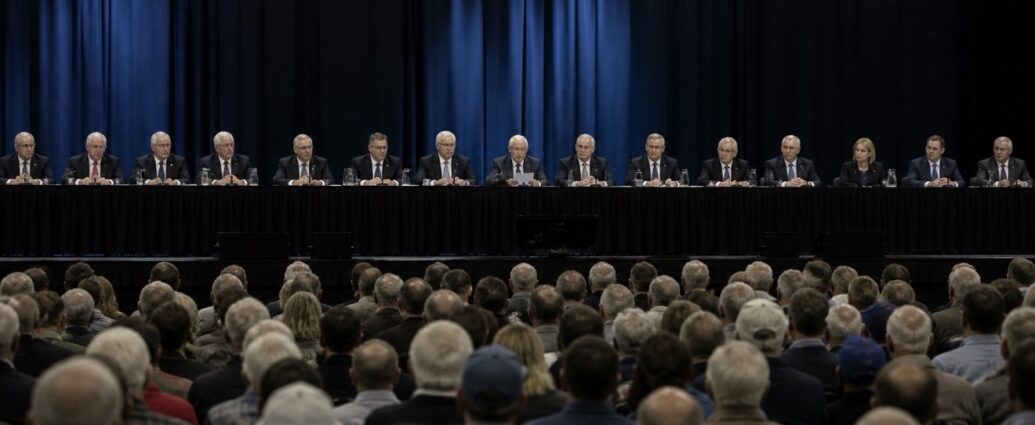
Shares of The Gap Inc. (NYSE:GAP) are demonstrating fundamental resilience, maintaining a top-tier value score in the Benzinga Edge Stock Rankings as the company navigates a recent earnings miss and mourns the loss of co-founder Doris Fisher.

High Value Amid Market Headwinds

Despite short-term price trend turbulence following a recent fourth-quarter earnings report, Gap’s intrinsic worth remains highly rated by financial metrics.

The stock currently boasts a Benzinga Edge value score of 90.80, keeping it firmly in the top decile of the market. Value is a percentile-ranked composite metric that evaluates a stock’s relative worth by comparing its market price to fundamental measures of the company’s assets, earnings, sales, and operating performance.

While Gap stock has experienced a 7.54% year-to-date drop, it maintains a positive long-term upward price trend and a …

Full story available on Benzinga.com

This post was originally published here

DuPont de Nemours (NYSE:DD) reported first-quarter financial results on Tuesday. The transcript from the company’s first-quarter earnings call has been provided below.

Benzinga APIs provide real-time access to earnings call transcripts and financial data. Visit https://www.benzinga.com/apis/ to learn more.

View the webcast at https://events.q4inc.com/attendee/189504581

Summary

DuPont de Nemours exceeded its Q1 2026 guidance with 2% organic sales growth, 130 basis points of margin expansion, and double-digit adjusted EPS growth.

The company raised its full-year 2026 financial guidance and announced a $275 million accelerated share repurchase as part of its capital allocation strategy.

DuPont de Nemours completed the divestiture of the aramids business and issued its 2026 sustainability report, highlighting new 2035 sustainability goals.

Operational highlights include strong safety performance, employee engagement, and advancements in digital and AI capabilities to enhance innovation and commercial execution.

Healthcare and Water Technologies saw 6% net sales growth, while Diversified Industrials experienced 3% growth, supported by favorable mix and productivity improvements.

Management expressed confidence in navigating macro and geopolitical challenges with continued focus on productivity and operational excellence.

Full Transcript

Bailey (Operator)

Thank you for standing by. My name is Bailey and I will be your conference operator today. At this time I would like to welcome everyone to the Dewpoint first quarter 2026 earnings call. All lines have been placed on mute to prevent any background noise. After the speaker’s remarks there will be a question and answer session. If you would like to ask a question during this time, simply press Star followed by the number one on your telephone keypad. If you would like to withdraw your question again, press Star and one I would now like to turn the call over to Anne Giancarlo, VP of Investor Relations. You may begin.

Anne Giancarlo (VP of Investor Relations)

Good morning and thank you for joining us for DuPont de Nemours’s first quarter 2026 financial results conference call. Joining me today are Laurie Koch, Chief Executive Officer and Antonella Franzen, Chief Financial Officer. We have prepared slides to supplement our remarks which are posted on DuPont de Nemours’s website under the Investor Relations tab and through the webcast link. Please read the forward-looking statement disclaimer contained in the slides. During this call we will make forward-looking statements regarding our expectations or predictions about the future. Because these statements are based on current assumptions and factors that involve risks and uncertainties, our actual performance and results may differ materially from our forward-looking statements. Our Form 10-K as updated by our current and periodic reports, includes detailed discussions of principal risks and uncertainties which may cause such differences. Unless otherwise specified, all historical financial measures presented today are on a continuing operations basis and exclude significant items. We will also refer to other non GAAP measures. A reconciliation to the most directly comparable GAAP financial measure is included in our press release and presentation materials and has been posted to DuPont de Nemours’s investor relations website. I’ll now turn the call over to Lori who will begin on slide three.

Laurie Koch (Chief Executive Officer)

Good morning and thanks everyone for joining our call. Earlier today we reported our first quarter financial results which exceeded our previously communicated guidance. Through disciplined commercial and operational execution, we delivered organic sales growth of 2%, 130 basis points of pro forma margin expansion and double digit adjusted Earnings Per Share (EPS) growth. Free cash flow generation and conversion were solid in the quarter. As a result of our first quarter performance along with price increases due to the Middle East conflict, we are raising our full year 2026 financial guidance. Antonella will provide further details shortly. We also announced that we expect to launch a $275 million accelerated share repurchase under our existing program. A clear example of how we continue to advance our strategic priority of driving disciplined capital allocation by returning cash to shareholders. On the next slide I will cover the progress we are making on driving growth and continuous improvement we completed the previously announced divestiture of the Aramids business on April 1. We are confident in our ability to continue to drive growth and opportunity for the employees and customers of the combined businesses. We also recently issued our 2026 sustainability report and announced our new 2035 sustainability goals. A progress we made in 2025 highlights the power of our innovation engine, creating sustainably advanced solutions that help our customers succeed. We continue to reduce our environmental footprint and increase the use of renewable energy sources across our operations while maintaining a strong focus on execution and discipline, Safety and culture continue to differentiate DuPont with record safety, performance and high employee engagement, reinforcing the connection between what we do every day and the value we create for our customers. Our 2035 Sustainability Goals reinforce our commitment to delivering value by embedding sustainability directly into our business strategy. These goals focus on three impact areas: sustainable innovation, resilient operations and people, partners and communities. They are designed to drive growth through innovation, operational excellence and accountability across our value chain while also advancing progress in areas such as climate, action, circularity, safety and responsible sourcing. Moving to slide 4 we continue to advance our strategic priorities and are seeing direct impacts from the implementation of our business system. We strengthen our performance based culture with a clear emphasis on growth and continuous improvement reinforced by the launch of our refresh core values. This is enabling greater consistency across the businesses as we drive excellence in innovation, commercial execution and operations. Starting with innovation, it remains at the core of our value proposition. Our 2025 Vitality Index was 35% above the benchmark we previously outlined, reflecting the strength and relevance of our product portfolio. During the quarter, we delivered a steady cadence of new product introductions and customer wins across healthcare, water and diversified industrial end markets. Recent launches include upgraded FilmTech nanofiltration elements designed to help municipalities and drinking water utilities produce high quality water with lower energy consumption and reduced operating costs. These innovations are being enabled not only by strong R&D execution but but also by continuing investments in digital and AI capabilities. Last week we announced that we are collaborating with an AI-driven platform, an AI driven platform for end to end product and application development focused on accelerating development, improving cycle time and sharpening how we translate ideas into differentiated solutions for customers. This collaboration streamlines and accelerates the work we have been doing on connected lab infrastructure and digital innovation. From a commercial standpoint, we are making steady progress in demand generation and pipeline discipline across the businesses. We are advancing targeted sales plays that bring together our technologies and application expertise to address specific end markets where we see attractive growth and differentiated value. We continue to standardize how opportunities are identified, reviewed and advanced, supported by a clear cadence, better data quality and stronger collaboration between commercial, technical and operations teams. These efforts are driving better visibility, improved conversion and stronger alignment between our commercial team and customers highest value needs Improving the quality and durability of our Pipeline on operational excellence, our teams remain intensely focused on the fundamentals safety, quality, delivery, inventory and productivity. During the quarter, we delivered meaningful improvements in asset reliability and equipment effectiveness across our key facilities which supported better on time delivery and stronger operational throughput. At the same time, we continue to drive productivity through focused maintenance and reliability initiatives, lean execution and Kaizen Activity across our site I am personally excited as we recently kicked off our annual CEO Kaizen event in which myself and the executive leadership team will each participate in events focused on strengthening our value creation processes across the company. We are also advancing how we operate by pairing process discipline with digital and AI capabilities. Over the last several quarters we have expanded the use of data enabled tools to improve maintenance planning, accelerate defect detection and optimize asset performance. These capabilities are allowing our team to convert operational data into actionable insights faster, improving reliability, reducing variability and reinforcing safe operations, all while delivering costs and and productivity benefits. Importantly, this operational rigor positions us well as we navigate a dynamic external environment. While we are mindful of potential macro and geopolitical headwinds, our focus on productivity, automation and structural improvement is creating resilience in the businesses. We are building a strong pipeline of content and improvement projects for the balance of the year aimed at sustaining momentum in growth and productivity. Our first quarter results demonstrate that we are off to a great start. Our April sales were in line with our expectations and we continue to see strong order growth trends across the majority of our businesses. Our teams continue to focus on driving growth and operational discipline and our strategic priorities position us well for long term value creation. With that, I’ll now turn the call over to Antonella to cover the financials and outlook in more detail.

Antonella Franzen (Chief Financial Officer)

Thanks Lori and good morning everyone. The first quarter marked a strong operational start to the year with results exceeding our financial guidance. Favorable top line mix and effective productivity actions drove strong operating Earnings Before Interest, Taxes, Depreciation, and Amortization (EBITDA) performance and meaningful margin expansion in the quarter. Throughout today’s call, I will provide comments on our results against our prior year reported financials as well as on a pro forma basis which adjusts for our post separation corporate cost, interest, expense and income tax rate. This is consistent with the methodology and financial metrics that we Provided at our 2025 Investor Day beginning with our first quarter financial highlights on slide 5, net sales of 1.7 billion were up 4% versus the year ago period on 2% organic sales growth and a 2% benefit from currency. Organic sales growth was led by strength in healthcare and aerospace, partially offset by continued softness in construction markets and logistics disruptions due to the conflict in the Middle East. These disruptions primarily impacted sales in our water business in the quarter. From a segment view, during the quarter organic sales grew 3% in healthcare and water technologies with organic sales growth about flat in diversified industrials. First quarter operating Earnings Before Interest, Taxes, Depreciation, and Amortization (EBITDA) of 414 million increased 15% versus the year ago period on organic sales growth, favorable mix and productivity. This resulted in operating Earnings Before Interest, Taxes, Depreciation, and Amortization (EBITDA) margin of 24.6% in the quarter, an increase of 230 basis points year over year. On a pro forma basis, operating Earnings Before Interest, Taxes, Depreciation, and Amortization (EBITDA) increased 10% with margins expanding 130 basis points year over year. Turning to cash flow, we delivered transaction adjusted free cash flow of 147 million and related conversion of 65%, a solid start to the year. Turning to Slide 6 on a reported basis, adjusted Earnings Per Share (EPS) for the quarter of $0.55 increased 53% year over year. On a pro forma basis, adjusted Earnings Per Share (EPS) for The quarter was up 20% versus the year ago period. The increase was primarily driven by higher segment earnings of $0.06 with an additional $0.03 benefit coming from a lower tax rate, share count and exchange gains and losses. Turning to Slide 7 Healthcare and Water Technologies first quarter net sales of 806 million were up 6% versus the year ago period on 3% organic growth and a 3% benefit from currency. For the first quarter. Health care sales were up high single digits percent on an organic basis versus the year ago period. Organic growth was broad based led by continued strength in medical, packaging and biopharma. Water sales were down low to mid single digits percent on an organic basis as strength in industrial, water and microelectronics markets were more than offset by logistics disruptions in the Middle East. Operating Earnings Before Interest, Taxes, Depreciation, and Amortization (EBITDA) for the segment during the quarter of 244 million was up 9% versus the year ago period on organic growth, favorable mix and productivity gains. This resulted in operating Earnings Before Interest, Taxes, Depreciation, and Amortization (EBITDA) margin of 30.3% in the quarter, an increase of 110 basis points year over year. Turning to diversified industrials on slide 8, first quarter net sales of 875 million increased 3% versus the year ago period on a 3% benefit from currency. Organic sales growth was about flat in the quarter. At the line of business level, organic sales for building technologies were down low single digits percent on continued weakness in construction markets, industrial technologies organic sales were up low single digits percent as continued strength in aerospace and growth in automotive were partially offset by declines in the printing and packaging businesses. Operating Earnings Before Interest, Taxes, Depreciation, and Amortization (EBITDA) for diversified industrials of 200 million was up 8% versus the year ago period on favorable mix and productivity. Operating Earnings Before Interest, Taxes, Depreciation, and Amortization (EBITDA) margin during the quarter was 22.9% expanding 110 basis points versus the year ago period. Turning to slide 9 we are raising our full year 2026 financial guidance given our strong start to the year as well as now including the interest income benefit from the aromage transaction. For the second quarter we estimate net sales of about 1.8 billion, operating Earnings Before Interest, Taxes, Depreciation, and Amortization (EBITDA) of about 430 million and adjusted Earnings Per Share (EPS) of $0.59 per share. Our second quarter net sales guidance assumes about 3% organic growth year over year. Currency is expected to be a slight tailwind in the quarter. For the healthcare and water segment we expect second quarter organic sales growth in the mid single digits percent range led by strength in medical, device, biopharma and industrial water markets. For the diversified industrial segment we expect second quarter organic sales growth in the low single digits percent range on continued strength in aerospace and growth in printing and packaging partially offset by continued softness in construction markets. For the first half, our estimated net sales of about 3.5 billion …

Full story available on Benzinga.com

This post was originally published here
Fiserv Inc. (NASDAQ:FISV) released its first-quarter financial results Tuesday. The report showed a mix of bottom-line strength and top-line challenges.

EPS Outperforms Wall Street Targets

Fiserv reported quarterly adjusted earnings of $1.79 per share. This figure surpassed the analyst consensus estimate of $1.57. However, this represents a decrease from the $2.14 per share reported in the prior year.

Fiserv Revenue Misses Consensus Estimates

The company posted quarterly sales of $4.675 billion. This missed the analyst consensus estimate of $4.729 billion. Revenue fell compared to $4.789 billion in the same period last year, according to

Full story available on Benzinga.com

This post was originally published here
Electronic Arts Inc. (NASDAQ:EA) will release earnings for its fourth quarter after the closing bell on Tuesday, May 5.

Analysts expect the Redwood City, California-based company to report quarterly earnings of $1.30 per share, up from 98 cents per share in the year-ago period. The consensus estimate for Electronic Arts’ quarterly revenue is $1.99 billion (it reported $1.8 billion last year), according to Benzinga Pro.

On Monday, Electronic Arts announced a landmark, multi-year collaboration with Visa (NYSE:V) over EA SPORTS franchises.

Electronic Arts shares fell 0.1% to close at $201.82 on Monday.

Benzinga readers can access the latest analyst ratings on the Analyst Stock Ratings page. Readers can sort by stock ticker, company name, analyst firm, rating change or other variables.

Let’s have a look at how Benzinga’s …

Full story available on Benzinga.com

This post was originally published here

Coinbase Global, Inc. (NASDAQ:COIN) shares rose in Tuesday’s premarket session as investors weighed restructuring efforts ahead of earnings.

In an exchange filing on Tuesday, the cryptocurrency exchange outlined cost-cutting measures and operational changes tied to artificial intelligence adoption, signaling a strategic pivot amid challenging market conditions.

Restructuring Plan

Coinbase announced a workforce reduction impacting about 700 employees, representing roughly 14% of its global staff.

The company expects to complete most of the layoffs during the second quarter of 2026.

The move aims to streamline expenses and reposition the business for evolving technological demands. Management framed the decision as part of a broader effort to improve efficiency and align with long-term priorities.

Cost Impact

The company estimates restructuring-related charges between $50 million and $60 million. These costs primarily include severance payments and other termination-related obligations.

Coinbase expects to record nearly all associated expenses within …

Full story available on Benzinga.com

This post was originally published here

UFP Technologies (NASDAQ:UFPT) reported first-quarter financial results on Tuesday. The transcript from the company’s first-quarter earnings call has been provided below.

This transcript is brought to you by Benzinga APIs. For real-time access to our entire catalog, please visit https://www.benzinga.com/apis/ for a consultation.

View the webcast at https://event.choruscall.com/mediaframe/webcast.html?webcastid=4BtVhg5p

Summary

UFP Technologies reported a 4.1% increase in revenue for Q1 2026, with medical sales up 5.9% and non-medical sales down 15%, largely due to a strategic focus on fast-growing segments in the med-tech space.

Earnings per share growth lagged behind revenue due to startup costs for four new program launches, labor inefficiencies at AJR, and non-recurring legal expenses related to a cyber attack and CEO transition.

The company is expanding capacity with new buildings in the Dominican Republic and planning further expansion in the APAC region to meet demand. Strategic acquisitions are being pursued, although there have been some missed opportunities due to higher bids.

Operational highlights include a significant growth in sales in Santiago, Dominican Republic, and the successful ramp-up of new product development labs in La Romana and Grand Rapids.

Management expressed confidence in the future, citing strong customer relationships and a prepared leadership transition with Mitch Rock taking over as CEO in June.

Full Transcript

OPERATOR

Good day and welcome to UFP Technologies first quarter 2026 earnings conference call. All participants will be in listen only mode. Should you need assistance, please signal a conference specialist by pressing the star key followed by zero. After today’s presentation there will be an opportunity to ask questions. To ask a question, you may press star then one on your telephone keypad. To withdraw your question, please press star then two. Please note this event is being recorded. I would now like to turn the conference over to Ron Letai, Chief Financial Officer. Please go ahead.

Ron Letai (Chief Financial Officer)

Thank you Operator Good morning and thank you for joining us on our 2026 first quarter earnings conference call. With me on today’s call is our CEO and Chairman Jeff Bailey. Today we will make some forward looking statements within the meaning of the U.S. Private Securities Litigation Reform Act of 1995, the accuracy of which is subject to risks and uncertainties. Wherever possible, we will try to identify those forward looking statements by using words such as believe, expect, anticipate, pursue, forecast and similar expressions. Our forward looking statements are based on our estimates and assumptions as of today and should not be relied upon as representing our estimates or views on any subsequent date. Please refer to the cautionary statement regarding forward looking information and the risk factors in Our most recent 10-K, including disclosures of the factors that could cause results to differ materially from those expressed or implied. During this call we will discuss non-GAAP financial measures which include Organic sales Growth, adjusted gross margin, adjusted operating income, adjusted SG&A, adjusted earnings per share and EBITDA, and adjusted EBITDA. A reconciliation of GAAP to non-GAAP measures discussed in this call is contained in the associated press release and is available in the Investor Relations section of our website. I’ll now turn the call over to Jeff.

Jeff Bailey (Chief Executive Officer and Chairman)

Thank you Ron and thank you to everyone joining the call. I am pleased with our first quarter results and start to the year including important progress on our strategic growth initiatives. Our revenue grew 4.1% with medical sales growing 5.9% and our non medical sales declining 15% as we continue to focus our efforts on best fit fast growing segments in the med tech space. Growth in our robotic surgery, patient services and support and interventional and surgical segments of 7%, 11% and 15% respectively were partially offset by declines in wound care as two major customers slowed temporarily due to excess inventory. EPS grew more slowly than revenue due in part to Number one, startup costs related to our four simultaneous program launches, each of which is slowly ramping up and expected to make meaningful contributions in the second half of the year. Number two softer results at AJR versus Q1 of 2025 as they continue to work through their labor inefficiency issues related to turnover following our E VERIFY or legal Right to Work process last year and Number three, non-recurring legal expenses related to a cyber attack and the CEO transition. A lot of exciting things are happening on the business expansion front. In addition to the four successful program launches, three of those four customers have already asked us to double our capacity on the new programs. We are also adding new buildings in both Santiago, Dominican Republic And La Romana, Dominican Republic To expand capacity and accommodate forecast growth in patient services and support and robotic surgery. in both locations. We are co investing with our customers and will take possession of the buildings in the second quarter of this year. We’re also in the planning stages to add capacity in the APAC region to meet growing demand in Asia. Our new product development labs in La Romana and Grand Rapids are performing well adding new programs and new talent to meet growing customer demand. On the acquisition front, we are reviewing multiple opportunities. Although we have been outbid on a couple of recent opportunities, we remain disciplined in our approach to vetting and valuing strategic acquisitions. The three acquisitions we completed in 2025 and the four in 2024 are all performing well and have increased our value to customers and strengthened our position in the market. Mitch Rock is excited to take over as CEO in June and is well prepared to succeed. We have a deep team of talented managers supporting him who understand our strategy and how they fit in. This team, together with our vendor partners, adds significant value to our blue chip customers and growing market segments. Each of these three critical components of our success. Our team, our customers and our vendor partners trusts and respects Mitch and looks forward to continuing to grow with ufp. So for these reasons and many more, I’m very excited about the future of UFP Technologies and the value it can create for our shareholders. Thank you and I will now hand it back to Ron to provide more color on our financials.

Ron Letai (Chief Financial Officer)

Thank you Jeff before reviewing operating results, I’d like to give a brief update on tariffs and the impact of the conflict in Iran on our raw material input costs. In general, effective tariffs are net down from our last update. This should have a positive prospective impact on margins. Additionally, as our suppliers seek refunds from the government, we will be looking for these to flow through to us in the form of vendor credits. Countering these savings are raw material inflationary increases caused by the increased price of oil stemming from the conflict in Iran. It is difficult to estimate the ultimate impact as the news changes daily and therefore the price of oil has been volatile. It remains our expectation that we will pass these through to our customers. …

Full story available on Benzinga.com

This post was originally published here

On Tuesday, Henry Schein (NASDAQ:HSIC) discussed first-quarter financial results during its earnings call. The full transcript is provided below.

This transcript is brought to you by Benzinga APIs. For real-time access to our entire catalog, please visit https://www.benzinga.com/apis/ for a consultation.

The full earnings call is available at https://events.q4inc.com/attendee/812842108

Summary

Henry Schein reported strong first-quarter 2026 financial results with global sales reaching $3.4 billion, reflecting a 6.3% growth year-over-year.

The company continues to see market share gains in the U.S. dental and global technology sectors, offsetting softness in the medical business due to a light flu season.

Strategic initiatives include enhancing product and service offerings, particularly in AI solutions, and aligning commercial efforts to accelerate growth.

Henry Schein is committed to its bold plus one strategy, focusing on operational execution and a culture of continuous improvement.

The company aims for high single-digit to low double-digit earnings growth and an operating income improvement of over $200 million by the end of 2026.

Management expressed confidence in achieving their 2026 financial guidance despite potential macroeconomic uncertainties, emphasizing stable end markets.

Operational highlights include the rollout of their e-commerce platform in North America and strategic acquisitions to strengthen their implant product portfolio.

Full Transcript

OPERATOR

Good morning ladies and gentlemen and welcome to Henry Schein first quarter 2026 earnings conference call. At this time all participants are in a listen only mode. Later we will conduct a Q&A session. Please press the star key followed by one on your touch tone phone if you would like to ask a question at the end of the call. If anyone should require assistance during the call, please press the star key followed by zero on your touch tone phone As a reminder this call is being recorded. I would now like to introduce your host for today’s call, Graham Stanley, Henry Schein Vice President of Investor Relations and Strategic Financial Project Officer. Please go ahead Graham

Graham Stanley (Vice President of Investor Relations and Strategic Financial Project Officer)

thank you Operator and my thanks to each of you for joining us to discuss Henry Schein’s financial results for the first quarter of 2026. With me on today’s call, Fred Lowry, Chief Executive Officer of Henry Schein and Ron South, Senior Vice President and Chief Financial Officer. Before we begin, I’d like to state that certain comments made during this call will include information that’s Forward looking. Risks and uncertainties involved in the Company’s business, may affect the matters referred to in forward looking statements, and the Company’s performance may materially differ from those expressed in or indicated by such statements. These forward looking statements are qualified in their entirety by the cautionary statements contained in Henry Schein’s filings with the securities and Exchange Commission and included in the Risk Factors section of those filings. In addition, all comments about the markets we serve, including end market growth rates and market share, are based upon the Company’s internal analyses and estimates. Today’s remarks will include both GAAP and non GAAP financial results. We believe the non GAAP financial measures provide investors with useful supplemental information about the financial performance of our business, enable the comparison of financial results between periods where certain items may vary independently of business performance, and allow for greater transparency with respect to key metrics used by management in operating our business. These non GAAP financial measures are presented solely for informational and comparative purposes and should not be regarded as a replacement for corresponding GAAP measures. Reconciliations between GAAP and non GAAP measures are included in Exhibit B of today’s press release and can be found in the Financials and Filing section of our Investor Relations website under the Supplemental Information heading and they’re also in our quarterly earnings presentation posted on the Investor Relations website. The content of this conference call contains time sensitive information that is accurate only as of the date of the live broadcast, May 5, 2026. Henry Schein undertakes no obligation to revise or update any forward looking statements to reflect events or circumstances after the date of this call. Lastly, during today’s Q and A session, please limit yourself to a single question so that we can accommodate questions from as many of you as possible. And with that, I’d like to turn the call over to Fred Lowry.

Fred Lowry (Chief Executive Officer)

Thank you Graham and good morning everyone and thank you for joining us today. I’m honored to lead Henry Schein as a CEO and I look forward to building on the strong foundation and proud heritage that define this company while at the same time taking a fresh look at people, process and technology to advance a culture of continuous improvement. I’m also pleased to report our strong financial results for the first quarter, but before we turn to these, I want to highlight some key observations that I’ve had as I progress through my 100 day plan. First, I am impressed by the strong competitive advantages Henry Schein has built over the years. Globally, we successfully serve hundreds of thousands of independent private practices with responsive, consistent overnight delivery. In the US we are the primary distributor for most national DSOs, a position that reflects years of being a trusted and reliable partner. Our reach provides us with supply chain flexibility and sourcing advantages as well as access to a broad global customer base for our suppliers. Secondly, pursuant to our bold plus one strategy, we deliver an extensive integrated offering which includes a broad portfolio of quality corporate brands and specialty products, software equipment products, technical services and business solutions. This differentiated offering makes us the platform of choice for office based practitioners. And third, our ability to deliver an excellent customer experience really sets us apart. Our field sales consultants, they really know their customers deeply and are genuinely invested in their success and they’re supported by our equipment service technicians and when you put that together, we provide a service that is difficult to replicate. When you put all these things together, our technology, our products, our value added services and our people, we create a significant competitive advantage which we will continue to enhance over time. So over the last two months I’ve immersed myself in the business and I’ve spoken with lots of customers and suppliers and employees and a few things that I’ve heard One theme is clear from customers the dental market remains healthy with demand continuing to outpace supply. Therefore, efficiency and workflow optimization are important for our customers to be able to see more patients. What’s encouraging is how well our strategy aligns with our customers needs through the development of open architecture integrated solutions that create a platform allowing our customers to deliver better care while running more productive and more profitable practices. Turning to the medical market procedures continue to shift to non acute care settings, which also aligns well with our unique capabilities to supply the right quantities to all non acute settings, including ambulatory surgical centers, community health centers, private practices and home solutions. I’ve also received feedback that our dental and medical supplier partnerships remain another source of competitive advantage differentiation and I’m committed to providing a broad product offering to our customers supported by strong national brands as well as through our own value added own brand products. Suppliers recognize that our deep customer access and trusted relationships make us the partner of choice for driving growth in their businesses. Through exclusive and targeted promotional programs, we create value for suppliers and customers alike. Now, while it’s still relatively early days for me, I intend to sharpen our operational execution, build a stronger performance culture and create a leaner, more agile Henry Schein, allowing us to respond faster to customer needs and translate our market strength into accelerated growth and improved financial results. As I continue to dive deeper into the business, I expect to identify opportunities to drive growth, to streamline processes and to enhance execution. I’d like to highlight a couple of examples for you today. The first is to enhance the cadence of new products and service offerings. This includes AI solutions which are transforming the industry rapidly and Henry Schein has a tremendous opportunity to develop further value enhancing solutions. I think you’re starting to see this with some of the recent product launches from Henry Schein. Secondly, to align our commercial efforts to accelerate overall growth across each of our businesses. This is contemplated in accelerating the leverage priority of our bold plus one strategy and we’ve already started. It’s clear that Henry Schein has great assets with a differentiated platform to serve as a trusted partner to healthcare practitioners worldwide. As we look ahead, I’m excited by the significant opportunities to accelerate growth through the use of technology, improved operational excellence and becoming a more agile company. Now let’s turn to the first quarter results. I’m pleased with our strong first quarter results that reflect continuing momentum from the second half of last year as we grow market share and expand gross margins, sales strengthened in the US Dental and global technology businesses overcame softness in the medical business. The dental markets remain stable and healthy and we are gaining market share while merchandise prices have increased, particularly in the US Procedure volumes are holding steady. We anticipate further merchandise price increases in the second quarter as a consequence of higher oil prices. Dental practices and in particular DSOs are continuing to invest in equipment and we are seeing DSOs that gaining market share in the overall dental market. The non acute care US Medical market remains strong and our home solutions business continues to grow well. Our medical business had good underlying growth. However the quarter was impacted by a decline in demand for point of care diagnostic test products related to respiratory illness resulting from a light flight. Our specialty products underlying markets remain healthy with European volumes ahead of the US Demand for premium implants is being driven by strong clinical engagement, most recently demonstrated at our Bio Horizons Global Symposium last month where over 40 internationally recognized speakers presented the latest innovations in tissue regeneration, digital workflows, implant based tooth replacement therapies to more than 1,100 clinicians from around the world. Growth in value implants driven by our SIN and biotech dental businesses continues to outpace premium implants. Our global technology business again posted really good growth reflecting continued demand for our cloud based software technology solutions. The development pipeline of AI solutions has increased, and these are mostly integrated into our global suite of practice management software solutions. Last week I had the opportunity to attend our Thrive Live event in Las Vegas which brings together dental professionals to get really hands on training and education and to showcase our range of equipment and software solutions. This year we had over 1,000 attendees and we launched our next generation AI clinical workflow at the event which generated significant excitement. The broad level of interest in our AI solutions was a clear signal that our customers are ready to embrace these tools and that Henry Schein is well positioned to lead that transition. Now let me give you a few highlights into the initiatives that advanced our strategic plan during the quarter. As I mentioned, our overall operating margin expanded and we stabilized margins compared to a year ago. Our high growth high margin businesses are now approaching 50% of our total operating income and we remain on track to exceed our goal of 50% by the end of our strategic planning cycle in 2027. We are just beginning to unlock value from our value creation initiatives. These not only provide a clear path to both cost efficiencies and margin expansion, but I expect them to fuel our growth and further support and enhance customer experience. Execution is really well underway. Let me give you a couple of examples. We’ve appointed an outsourced partner to centralize select back office functions and we expect to see benefits beginning later this year. We continue to strategically buy out minority partners to unlock integration opportunities across the specialty products business. We are starting to generate additional savings from our indirect procurement processes by leveraging our scale advantage and finally, we are implementing gross profit initiatives including value pricing and enhance growth of our corporate brands. Therefore, I am committing to achieving the company’s goal of achieving greater than 200 million of annual operating income improvement within the next few years with $$125 million run rate by the end of 2026. These initiatives along with continued execution of our strategic plan will contribute to us achieving high single high single-digit to low double-digit earnings growth in the coming years. We have also successfully rolled out our global e commerce platform henry schein.com to our Canadian and US laboratory customers. We are well advanced in implementation across the U.S. with over 80% of our U.S. dental e commerce sales now transacted over henry schein.com we expect to complete the U.S. rollout by the end of August and to extend the platform to new customers after we plan to shift our focus to the broader international deployment. Over the past several weeks I have worked through the details of our financial plan. Our growth outlook combined with the progress made on value creation initiatives and a strong start to the year reinforces my confidence and my commitment to that. We are committed to delivering on our 2026 financial guidance. Looking ahead, I plan to continue learning more about the business and identify opportunities to accelerate our momentum. I look forward to sharing updates in our next calls now. With that, I’ll turn the call over to Ron to review in more detail our first quarter results.

Ron South (Senior Vice President and Chief Financial Officer)

Ron thank you Fred and good morning everyone. Today I will review the financial highlights for the quarter, starting with our first quarter sales results. Global sales were $3.4 billion with sales growth of 6.3% compared to the first quarter of 2025. This reflects local currency internal sales growth of 2.5%, a 3.1% increase resulting from foreign currency exchange and 0.7% sales growth from acquisitions. Our GAAP operating margin for the first quarter of 2026 was 5.41%, a decrease of 12 basis points compared to the prior year GAAP operating margin on a non GAAP basis, the operating margin for the first quarter was 7.53%, up 28 basis points compared to the prior year, driven by gross margin expansion within the Global Distribution and Global Technology Project products groups as well as business mix. First quarter 2026 GAAP net income was $107 million or $0.92 per diluted share. This compares with prior year GAAP net income of $110 million or $0.88 per diluted share. Our first quarter 2026 non GAAP net income was $153 million, or $1.32 per diluted share. This compares to prior year non GAAP net income of $143 million, or $1.15 per diluted share. Foreign currency exchange favorably impacted our first quarter diluted EPS by approximately $0.03 versus the prior year. Adjusted EBITDA for the first quarter of 2026 was $289 million compared to first quarter 2025 adjusted EBITDA of $259 million or 11.6% growth. During the first quarter we successfully completed a transaction that provides us a controlling interest in SIN360, the US distributor of SIN Brazil’s value implant systems. We are excited about this transaction as it provides us with greater control over our U.S. implant product portfolio, especially in the faster growing value implant market and allows us to …

Full story available on Benzinga.com

This post was originally published here
Orthofix Medical (NASDAQ:OFIX) held its first-quarter earnings conference call on Tuesday. Below is the complete transcript from the call.

Benzinga APIs provide real-time access to earnings call transcripts and financial data. Visit https://www.benzinga.com/apis/ to learn more.

Access the full call at https://events.q4inc.com/attendee/203860379

Summary

Orthofix Medical reported a solid Q1 2026 with a 3% year-over-year increase in global net sales, reflecting steady execution and strategic focus, especially in their Spine and Therapeutic Solutions segments.

The company made strategic moves to simplify its Spine leadership structure and enhance its commercial focus, particularly on the 7D flash navigation system and upcoming product launches like Virata.

Orthofix Medical expects continued improvement throughout 2026, reaffirming its full-year guidance of 5.5% pro forma constant currency growth, driven by innovation, distributor realignment, and targeted investments.

Operational highlights include a 6% growth in global spine fixation net sales and successful distributor transitions, contributing to a 27% year-over-year net sales growth from the top 30 distributor partners.

Management expressed confidence in their innovation pipeline and operational model, aiming for consistent execution, margin expansion, and sustainable shareholder value.

Full Transcript

OPERATOR

Thank you for standing by. At this time, I would like to welcome everyone to the OrthoFix first quarter 2026 earnings call. All lines have been placed on mute to prevent any background noise. After the speaker’s remarks, there will be a question and answer session. If you would like to ask a question during this time, simply press STAR followed by the number one on your telephone keypad. If you would like to withdraw your question, press star one. Again, we do ask questions be limited to one question and a brief related follow up. Thank you. I would now like to turn the call over to Julie Dooley.

Julie Duwe (Chief IR and Communications Officer)

Thank you and good morning everyone. Welcome to OrthoFix’s first quarter 2026 earnings call. I’m Julie Dooley, OrthoFix’s Chief Investor Relations and Communications Officer. Joining me today are President and Chief Executive Officer Massimo Calafiore and Chief Financial Officer Julie Andrews. Earlier today Orthofix released its financial Results for the first quarter ended March 31, 2026. A copy of the press release and supplemental presentation are available on our investor relations website and a replay of this call will be posted shortly after we conclude. Before we begin, please note that our remarks include forward looking statements. These statements involve risks and uncertainties and actual results may differ materially. All statements other than those of historical facts are forward looking statements. We do not undertake any obligation to revise or update such forward looking statements. Factors that could cause actual results to differ materially are discussed in our most recent filings with the SEC and may be included in our future filings with the SEC. We will also reference various non GAAP financial measures during today’s call. Reconciliations to US GAAP and additional details are in our press release and supplemental materials. Unless otherwise stated, net sales growth rates are on a pro forma constant currency basis and exclude the discounted M6 artificial disk product lines and all results of operations will be on a non GAAP as adjusted basis. Here’s today’s agenda. Massimo will start with business performance and operational highlights. Julie Andrews will follow with our financial results and guidance. Then we’ll open up the call for Q and A. With that I’ll turn the call over to Massimo, who will discuss how our early year execution and recent operational actions are beginning to support improved performance as we move through the year. Massimo

Massimo Calafiore (President and Chief Executive Officer)

thank you Julie and good morning everyone. I appreciate you joining us today. We delivered a Good start to 2026. First quarter results reflect steady execution, improving stability and sharper strategic focus. As the quarter progressed, we began seeing the expected progress from Our Spine commercial channel actions along with stronger operating discipline, supporting our confidence that performance will continue to build through the year. While these results reflect meaningful progress, they also crystallize where we could further raise the bar. That’s why in April we took deliberate steps to simplify our Spine leadership structure, a proactive move as we continue to scale enabling technologies like 7D and advance the launch of Verara later this year. By bringing decision making closer to the field and increasing accountability through direct oversight, we are improving speed, consistency and commercial focus where it matters the Most. Stepping back Q1 reflects where we are as a company today, moving into the next phase of our journey, executing with greater consistency and strengthening our position to benefit from our innovation pipeline as the year unfolds. What we delivered this quarter supports our confidence in continued improvement. Our priorities are execute consistently, convert opportunity into results and demonstrate progress quarter by quarter. Let me turn to business performance highlights starting with Spine In Spine global spine fixation, net sales grew 6% on a constant currency basis with US net sales growth of 4%. Results were supported by enhanced commercial focus, deeper procedural penetration and the ongoing benefits of our distributor transition. Importantly, those transitions are now largely behind us as alignment has improved, we are seeing positive momentum from more consistent field execution. In Q1, our top 30 distributor partners delivered net sales growth of 27% year over year and 24% on trailing 12 months basis, reflecting the success of our strategy to prioritize larger, more dedicated distributors and deeper relationship with our top partners. A key driver of that momentum is 7D which remains a core differentiator in our surgical ecosystem, enhancing precision workflow and surgeon engagement. Following our leadership realignment, we are intensifying our commercial focus on adoption of our 7D flash navigation system to deliver a more integrated spine offering. While Spine is benefiting from better alignment, we are applying the same discipline to biologics. Performance improved sequentially during the quarter as we implemented targeted actions to strengthen execution, expand account penetration and increase utilization across the portfolio. We are refining our Go Forward strategy, building clinical evidence and supporting advocacy. Collectively, these actions are designed to drive improvement through the year and position biologics to exit 2026 with stronger momentum and a more durable growth profile. Beyond Spine and Biologics, our other growth platforms remained resilient. Our therapeutic solution business, formerly bone growth therapies, delivered 5% year over year. Net sales growth and continued to outperform the broader market demands remain stable, utilization is improving and prescribing activities increasing across both spine fusion and fracture care. With its consistent performance and healthy margins, this business continues to be an important contributor to margin and cash generation. Global rim reconstruction posted 3% constant currency growth reflecting steady demand across our core fixation and reconstruction systems. Over the past year we sharpened our focus by prioritizing high value categories, enhancing our mix with platform like Trulock Elevate and Fitbond and de emphasizing lower return product. We believe this action position Limb reconstruction for acceleration as we move through 2026. A common thread across the business is the increasing impact of our Innovation pipeline. We will have a full year contribution from Trulock Elevate and Fitbone and we remain on track for the full market launch of Verara in the second half of the year. Together with the continued inspection of our 7D flash ecosystem, these platforms are designed to deliver differentiated clinical value and support durable multi year growth. In closing, Q1 was a solid start of the year. We are carrying that momentum forward with disciplined execution and targeted investment. The quality and the commitment …

Full story available on Benzinga.com

This post was originally published here

PayPal Holdings (NASDAQ:PYPL) reported first-quarter financial results on Tuesday. The transcript from the company’s first-quarter earnings call has been provided below.

Benzinga APIs provide real-time access to earnings call transcripts and financial data. Visit https://www.benzinga.com/apis/ to learn more.

The full earnings call is available at https://events.q4inc.com/attendee/883299998

Summary

PayPal Holdings reported modest growth with total payment volume up 11% at spot and 8% currency neutral, reaching over $460 billion.

The company announced strategic initiatives focusing on three core business areas: checkout solutions, consumer financial services, and payment services, with an emphasis on modernizing their technology platform and accelerating AI adoption.

Future guidance remains cautiously optimistic with full-year 2026 expectations of slightly positive to low single-digit growth in branded checkout TPV, despite headwinds like high fuel prices and macroeconomic pressures.

Key operational highlights include reorganizing to simplify operations, reducing costs by $1.5 billion over the next two to three years, and prioritizing investments to drive durable growth.

New CEO Enrique Loris emphasized the need to balance investment between consumer and merchant networks, streamline decision-making, and enhance customer value propositions.

Full Transcript

Sarah (Operator)

Good morning and welcome to PayPal’s first quarter 2026 earnings conference call. My name is Sarah and I will be your conference operator today. As a reminder, this conference is being recorded. I would now like to turn the program over to your host for today’s conference, Steve Winoker, PayPal Holdings’ Chief Investor Relations Officer. Please go ahead.

Steve Winoker (Chief Investor Relations Officer)

Thanks Sarah. Welcome to PayPal’s first quarter 2026 earnings call. I’m joined by CEO Enrique Loris and Chief Financial and Operating Officer Jamie Miller. Our remarks today include forward looking statements that involve risks and uncertainties. Actual results may differ materially from these statements. Our commentary is based on our best view of the world and our businesses as we see them today as described in our earnings press release, SEC filings and on our website. Those elements may change as the world changes. Over to you Enrique.

Enrique Loris (Chief Executive Officer)

Thank you Steve and thank you to everybody for joining us this morning. I’m stepping into this role at an important moment for PayPal. I appreciate the opportunity to serve as CEO and I’m confident we will accelerate the growth of the company while improving profitability and cash flow. That is why I’m here. At the same time, I’m also realistic to that we need to make significant changes to improve the strategic and operational issues the company has faced. Today I will share what I have observed since joining the company, how we are shaping our strategic direction and the actions we are taking to move forward with focus and discipline. During my time on the board, I developed a good understanding of PayPal, strengths, opportunities and areas for improvement. Over the past two months I have listened to and learned from our customers, our teams and our investors. This has helped to deepen my view of where we are, where we need to go and how we get there. I will begin with a few initial observations. First, our foundation is strong. The company has valuable assets in our brands, our risk and underwriting capabilities, our technology and most importantly, our team. Our scale and global reach set us apart and are difficult to replicate and the hard earned trust our customers place in us every day is a critical advantage. Second, we operate in markets defined by growth and rapid change. It is during this period that leading companies find ways to differentiate themselves by innovating, delivering new and superior solutions and driving durable growth. This is where PayPal needs to focus. Third, one of our core strengths is our two sided network, serving both consumers and merchants. In recent years, PayPal has put more energy into the merchant side of the network, strengthening the value we offer to the hundreds of millions of consumers who choose PayPal and Venmo, is a key priority. Doing that, we increase the value of our platform for merchants and create a stronger foundation for sustainable growth. Fourth, due to years of underinvestment, we need to accelerate the modernization of our technology platform. Moving faster to become cloud native and aggressively adopting AI in our development processes will help us significantly increase developer productivity and short term time to market. Fifth, we need to simplify how we operate, streamline decision making and clearly define accountability to strengthen execution. Finally, there is potential to significantly reduce the company cost structure. Simplifying the organization and accelerating the adoption of AI across the company will generate significant savings that can be reinvested in growth and used to respond to business headwinds, improving our overall financial profile over time. With this as a context, we need to recommit to the fundamentals. That includes becoming a technology company again, sharpening our focus on consumers, aligning the company around three strong businesses and simplifying how we work with clear accountability and a stronger emphasis on execution. I expect that it will take a few months to completely define our new plan, but I think it is important to start sharing the direction we are taking and some of the actions we have underway. Let me start by sharing the framework we are using to define our strategy. We see three distinct, attractive and in many ways complementary market opportunities where focused investment and sharper execution can meaningfully improve our growth trajectory. Checkout, consumer financial services and payment services. Each has clear near term levers to improve the performance of our existing assets as well as compelling medium term growth opportunities. And in every case we have a strong right to win. I will take each in turn. Let me start with checkout. This is a large and growing market where we deliver meaningful value to consumers and merchants. Within checkout. We also see strong consumer demand for flexible payment options including buy now, pay later solutions. This is becoming an important driver of consumer acquisition while also delivering clear benefits to merchants through higher basket sizes. The second opportunity is in consumer financial services. Consumers are increasingly turning to digital platforms to handle everyday financial activities. This is also a large market opportunity worth more than $200 billion annually in just our top six markets and it is growing at low double digits. What is most attractive about this market is not only size and growth, but also the customer lifetime value opportunity we can tap into. The third opportunity is in payment processing and value added services. The PSP space represents significant untapped value for us driven by the continued shift to digital channels and the increasing complexity of global payments. We are aligning the organization to unlock these growth opportunities. Previously our teams were organized primarily around the customers we serve, consumers, small businesses and large enterprises. That structure resulted in organizational complexity with multiple dependencies and handoffs that slowed decision making and weakened execution. Check out, for example, touched all customer groups and markets, creating a multidimensional matrix for roadmap prioritization. The changes we announced last week will organize the company into three lines of business, each with a single Checkout Solutions and PayPal, Consumer Financial Services and Venmo and Payment Services and Crypto. And importantly, we are bringing together the two sides of the network to maximize our competitive advantage. Simplifying our operating model and clarifying accountability means that each leader will learn clear outcomes and our teams will be able to focus on our most important growth priority. We’re also using these changes to simplify and delayer our organization and we have formed a new AI Transformation and simplification team that will help us work more effectively and drive our enterprise wide AI agenda. Let me now outline how we are thinking about the path forward across each of our businesses. Checkout solutions and PayPal is primarily a checkout focused business and is the highest priority for the company and me. It brings together our consumer and merchant ecosystems under one unified strategy. This structure will enable us to fully leverage our two sided network and accelerate innovation across both sides of the platform. Our intent is not to chase transitory share in any given quarter, but rather to focus on segments and verticals of where we can deliver differentiated value to our customers. I have also emphasized that strengthening the consumer side of the network is key to increasing the value we deliver to merchants. Driving habituation through the adoption of our financial services offerings is an important step toward enhancing the consumer value proposition and reinforcing the power of of our two sided network and our PayPal loyalty program which we introduced in the UK and will expand to additional market is another important step. Over the medium to long term we have a number of compelling innovative initiatives underway. We will take a disciplined approach to prioritization, focusing resources and areas with the greatest potential to drive durable growth and shareholder value. Within this portfolio we will be highly selective as we evaluate our broad set of initiatives including Digital wallet, interoperability, biometric functionality and additional programs under consideration within consumer financial services and Venmo. We have been making good progress in the last few years and have built a strong portfolio of related products, but awareness and adoption remain well below their full potential. Our focus is on becoming more central to our customers financial lives and our goal is to enable consumers to send, spend, save, invest and borrow seamlessly. Venmo will be a key component of our growth plans moving forward. Supported by strong brand and younger demographic, we are in a strong position to expand in this space, deepen engagement and increase customer lifetime value. Payment services and Crypto unifies our processing and platform capabilities into a single scalable offering for merchants. We will bring together the company’s unbranded processing capabilities including Braintree and Value added services such as Fraud Management, Authorization Optimization and Global Payment Infrastructure. They are designed to support businesses of all sizes with flexible, high performance payment solutions. We are also well positioned to capture and monetize its growth. Stablecoin is also part of this enabling faster, lower cost transactions. We have made good progress with PyUSD, which became the largest federally regulated stablecoin in December and we recently expanded its availability to 70 markets globally. At the same time, we have much more opportunity to scale our offerings and accelerate growth in this space across the company. We need to modernize our technology platform to enable greater speed and interoperability across our offerings. As I said earlier, leveraging AI more extensively in our development processes will significantly help us with this effort. Supporting our growth plans is the opportunity to realize cost savings. First, we will remove duplication and layers from our organizational structure. Second, we will accelerate our AI adoption and automation across our operations. Combined, the savings will be significant. We expect to see at least $1.5 billion of gross fund rate savings over the next two to three years. Jamie will discuss more on this point later in the call. Let me touch briefly on some highlights from the quarter before Jamie takes you through our results in more detail. Our first quarter results show some improvement in branded checkout. Branded checkout TPV growth was 2% on a currency neutral basis up from 1% last quarter. We continue to see strength in key parts of the business with Venmo and PST delivering mid teens TPV growth. Transaction margin dollars excluding interest on customer balances grew 3% with contributions from Credit Vembo and PST. Non GAAP earnings per share grew 1%. We also continue to generate robust free cash flow giving us ample room to invest and return capital to shareholders through buybacks and our dividend. On the operational side, our team accomplished a lot in the first quarter from securing apps in presentment on key merchants to enabling interoperability for peer to peer payments between PayPal and Venmo to close. I am confident in our ability to put this company on a more durable path to long term growth and shareholder value creation. We have a strong foundation and we are now organized to move with greater urgency. We have a well defined framework and we will continue to define our strategy and prioritize our plan in line with it. I look forward to sharing more progress as we move ahead. And finally, I want to thank our teams for their continued focus and execution and our customers and shareholders for their trust. I will now turn it over to Jamie.

Jamie Miller (Chief Financial and Operating Officer)

Thanks Enrique. The team and I are energized by the focus, clarity and disciplined prioritization you are already bringing to PayPal. We have a strong market position and a solid foundation and I’m confident we are set up to move faster from here. Turning to the financials in More detail on slide 7 PayPal delivered a solid quarter with both transaction margin dollars and non GAAP earnings per share coming in moderately better than our guide. Total payment volume accelerated to 11% at the spot rate and 8% currency neutral in the first quarter, reaching over $460 billion. Online branded checkout volume growth improved slightly from the fourth quarter while enterprise Payments and Venmo both accelerated into the mid teens. First quarter revenue grew 7% on a spot and 5% on a currency neutral basis. TM dollars excluding interest on customer balance grew 3% in the first quarter. The drivers of our TM dollar growth were broad based, led by credit performance, Venmo monetization, PSP profitability and loss improvement across multiple products. Growth in these areas more than offset the headwind from investments we are making to strengthen our branded checkout position and drive higher engagement, habituation and incremental activity over time. First quarter non GAAP earnings per share increased 1% to $1.34 and compared to our guidance, non GAAP EPS benefited from stronger transaction margin dollar growth with some offset from higher non transaction operating expense. We expect the second quarter to reflect more pressure on a year over year basis driven by the non recurrence of certain prior year items and the timing of anticipated cost savings and investment, both of which I’ll walk through in more detail shortly. Importantly, these are factors we anticipated and we remain confident in our full year 2026 guidance. Adjusted free cash flow, which excludes the timing impact from the origination and sale of pay later receivables, was $1.7 billion or nearly $6.8 billion on a trailing 12 month basis. Turning to slide 8, we continue to drive deeper, more active relationships with our customers. Monthly active accounts increased 1% to 225 million. Transactions per active account excluding PSP improved sequentially to 6% growth. Moving to slide 9 total payment volume in the first quarter grew 11% at the spot rate and 8% on a currency neutral basis to 464 billion. Working our way down the page branded experiences TPV, which includes online checkout, PayPal and Venmo debit as well as Tap to pay grew 5% compared to 4% in the fourth quarter. While debit card and Tap to Pay spend represent a small portion of branded experience’s volume today, they continue to grow rapidly, up 60% year over year. Venmo TPV continues to reach new highs, accelerating sequentially to 14% growth year over year and marking the sixth consecutive quarter of double digit growth. Online branded checkout volume growth improved slightly compared to last quarter, up 2% on a currency neutral basis. Compared to the fourth quarter we saw a slight improvement in the US with softer performance continuing in Europe. Pay with Venmo and Buy Now, Pay later continue to outpace the market, taking share from other payment methods and growing 34% and 23% respectively. P2P and other consumer volume growth remains healthy, up 10% in the first quarter and reflecting the debit card and Venmo momentum …

Full story available on Benzinga.com

This post was originally published here

On Tuesday, Crawford (NYSE:CRD) discussed first-quarter financial results during its earnings call. The full transcript is provided below.

Benzinga APIs provide real-time access to earnings call transcripts and financial data. Visit https://www.benzinga.com/apis/ to learn more.

The full earnings call is available at https://events.q4inc.com/attendee/272191784

Summary

Crawford reported first-quarter 2026 revenues of $309.5 million, slightly down from the previous year due to lower property claims activity in the U.S. caused by benign weather conditions.

The company highlighted its new streamlined operating structure, which began in January 2026, aiming to improve efficiency and support scalable growth across its U.S. and international divisions.

Despite the decrease in U.S. property and casualty revenues by 11.3%, international operations showed revenue growth of 4.5%, driven by demand in markets like Australia, Asia, and Canada.

Crawford’s non-GAAP EPS was $0.16 for both CRDA and CRDB, down from $0.21 in the prior year, with consolidated operating earnings decreasing by 23.2% year over year.

The company’s cash flow from operating activities improved significantly year over year, with a positive $3.3 million in the first quarter of 2026, compared to a use of cash in the same period in 2025.

Crawford maintained its quarterly dividend and engaged in share repurchases, with 1.6 million shares still eligible under its program.

The company expressed optimism about future growth, focusing on resilience, client-centric operations, and leveraging a strong pipeline, particularly in its Broadspire segment.

Full Transcript

Dustin (Conference Operative Facilitator)

My name is Dustin and I will be your conference operative facilitator today. At this time I would like to welcome everyone to The Crawford Company First Quarter 2026 Earnings Release Conference call. In conjunction with this call, the supplementary financial presentation is available on our website at www.procoll.com under the Investor Relations section. All lines have been placed on mute to prevent any background noise. After the speaker’s remarks, there will be a question and answer period. Instructions will follow at that time. Should anyone need assistance at any time during this conference, please press star then zero and an operator will assist you. As a reminder, ladies and gentlemen, this conference is being recorded today, Tuesday, May 5, 2026. Now I would like to introduce Tammy Stevenson Crawford and Company’s General Counsel.

Tammy Stevenson (General Counsel)

Thank you, Dustin. Some of the matters to be discussed in this conference call and in the Supplementary financial presentation may include forward looking statements that involve risks and uncertainties. These statements may relate to, among other things, our expected future operating results and financial condition, our ability to grow our revenues and reduce our operating expenses, expectations regarding our anticipated contributions to our underfunded defined benefit pension plans, collectability of our billed and unbilled accounts, receivable financial results from our recently completed acquisitions, our continued compliance with the financial and other covenants contained in our financing agreements, our long term capital resource and liquidity requirements and our ability to pay dividends in the future. The Company’s actual results achieved in future quarters could differ materially from the results that may be implied by such forward looking statements. The Company undertakes no obligation to publicly release revisions to any forward looking statements made in this conference call to reflect events or circumstances occurring after the date of the call or to reflect the occurrence of unanticipated events. In addition, you are reminded that operating results for any historical period are not necessarily indicative of results to be expected for any future period. For a complete discussion regarding factors which could affect the Company’s financial performance, please refer to The Company’s Form 10Q for the quarter ended March 31, 2026 filed with the securities and Exchange Commission, particularly the information under the headings Risk Factors and Management’s Discussion and Analysis of Financial Condition and Results of Operations as well as subsequent Company filings with the sec. This presentation also includes certain non GAAP financial measures as defined under SEC rules. As required, a reconciliation is provided for those measures to the most directly comparable GAAP measures. I would now like to introduce Mr. Bruce Wayne, Chief Executive Officer of Crawford and Company.

Bruce Wayne (Chief Executive Officer)

Bruce, good morning and welcome to our first quarter 2026 earnings call I’m honored to be speaking with you today as President and CEO of Crawford and Company. Joining me today is Holly Boudreau, our Chief Financial Officer, and Tammy Stevenson, our General Counsel. After our prepared remarks, we will open the call for your questions. As a reminder, Crawford is a global provider of claims management and outsourcing solutions serving large insurance carriers and self insured entities with industry leading expertise across the claims landscape. Our purpose is to restore lives, businesses and communities by providing our clients with dependable and comprehensive claim solutions and outcomes. As we mentioned on our fourth quarter call, effective January 1, 2026, we began operating under two divisions U.S. operations comprised of our U.S. property and casualty and broadspire businesses and international operations which includes all service lines outside of the U.S. we believe this streamlined operating model will strengthen execution, improve client outcomes and drive continued growth across the business as we’ve consistently demonstrated our ability to deliver at scale across more than 70 countries with a team of 10,000 professionals and over $20 billion in claims managed annually sets us apart in a competitive and evolving marketplace. This global reach, combined with over eight decades of deep technical expertise and an unwavering commitment to service excellence and client success, allows us to meet the needs of the world’s leading insurers and corporations regardless of the size or complexity of the program. This combination of global presence, technical depth and proven experience positions Crawford Co. As a trusted partner of choice for clients navigating an increasingly complex risk landscape across a variety of geographies and market conditions. Our organic growth opportunities are underpinned by a combination of favorable industry dynamics and core capabilities. First, risk is becoming increasingly complex. As a result, clients are seeking partners with a demonstrated ability to handle high severity claims with speed and efficiency, something that we’re uniquely positioned to do globally. Second, as I just touched upon, we streamlined our operating structure at the start of 2026 to further improve efficiency and support continued scalable growth. It’s our belief that this strengthened operating model in the US Will allow us to be a more agile and unified organization as we look to provide further value to our clients and partners. Third, our deep expertise and technology capabilities remain a true differentiator. Our ongoing commitment to our people and cutting edge technology translates into service excellence and performance differentiation in the markets we serve. Fourth, natural disasters remain a significant driver of sustained demand for our services, while individual weather events are inherently unpredictable. As we’ve experienced the last few quarters, the broader trajectory points towards an active and complex loss environment in which Crawford service offerings are increasingly needed. Finally, growing complexity across the claims landscape is prompting more carriers and self insured clients to search for dependable third party administrators. Our global TPA operations have the scope, scale and specialized knowledge required to help clients in today’s increasingly challenging claims environment. Let me take a moment to discuss our first quarter 2026 results. We executed well in the quarter despite weather related headwinds in the U.S. that we discussed on our 2025 year end earnings call. First quarter revenues were $309.5 million down slightly compared to last year and reflected the continued trend of lower industry wide property claims activity in the US as we saw a continuation of relatively benign weather conditions to start the year. Importantly, our non weather dependent businesses reflected quarter over quarter growth with Broadspire and International Operations reporting increased revenues compared to the prior year period highlighting the benefit of our diversified operations. Consolidated operating earnings decreased by 23.2% year over year as a result of lower results in our U.S. property and casualty business and higher unallocated and corporate costs partially offset by improved operating earnings in international operations. Our non GAAP EPS was $0.16 for both CRDA and CRDB compared to $0.21 for both share classes in the prior year. Quarter operating cash flow was 3.3 million in the first quarter of 2026, improving by 17.2 million year over year and providing us with continued financial strength and flexibility. We added …

Full story available on Benzinga.com

This post was originally published here

On Tuesday, Enpro (NYSE:NPO) discussed first-quarter financial results during its earnings call. The full transcript is provided below.

This content is powered by Benzinga APIs. For comprehensive financial data and transcripts, visit https://www.benzinga.com/apis/.

Access the full call at https://event.choruscall.com/mediaframe/webcast.html?webcastid=X3O02YZU

Summary

Enpro reported a strong start to 2026 with sales up nearly 11% year-over-year, driven by increased demand in semiconductor markets and contributions from recent acquisitions.

The company increased its full-year guidance, expecting sales to grow between 10% and 14%, with adjusted EBITDA projected to be $315 million to $330 million.

Adjusted EBITDA for the first quarter was up nearly 13% to over $76 million, with an expanded margin of 25.2%, reflecting strong performance in both the advanced surface technology and sealing technology segments.

Strategic investments in capacity expansion and vertical integration are positioning the company well to capture growth opportunities in semiconductor capital equipment spending.

The company maintains a strong balance sheet with a net leverage ratio of 1.9 times, allowing for continued investment in growth initiatives and potential acquisitions.

Management expressed confidence in achieving mid to high single-digit organic growth through 2030, supported by strong order momentum and strategic pricing initiatives.

Full Transcript

OPERATOR

Greetings and welcome to the NPRO first quarter 2026 earnings conference call. At this time, all participants are in a listen only mode. A question and answer session will follow the formal presentation. If anyone should require operator assistance during the conference, please press Star0 on your telephone keypad. Please note this conference is being recorded. I will now turn the conference over to James Gentile, Vice President, Investor Relations. Thank you. You may begin.

James Gentile (Vice President, Investor Relations)

Thanks Jesse and good morning everyone. Thank you for joining us today as we review NPRO’s first quarter 2026 earnings results and discuss our improved outlook for 2026. I’ll remind you that this call is being webcast at npro.com where you can find the presentation that accompanies the call. With me today is Eric Valencourt, our President and Chief Executive Officer, and Joe Bruderick, Executive Vice President and Chief Financial Officer. During this morning’s call, we will reference a number of non GAAP financial measures tables. Reconciling the historical non GAAP measures to the comparable GAAP measures are included in the appendix to the presentation materials. Also, a friendly reminder that we will be making statements on this call including our current perspectives for full year 2026 guidance that are not historical facts and and that are considered forward looking in nature. These statements involve a number of risks and uncertainties including those described in our filings with the SEC. We do not undertake any obligation to update these forward looking statements. It is now my pleasure to turn the call over to Eric Valencourt, our President and Chief Executive Officer.

Eric Valencourt (President and Chief Executive Officer)

Eric thanks James and good morning everyone. Thank you for your interest in NPRO as we discuss our first quarter results, provide an update on strategic initiatives and share our current views for the balance of 2026. Before we discuss our results for the first quarter, I would like to recognize our 4,000 colleagues across the company who are accelerating their personal and professional growth while contributing to NPRO’s strategic and financial successes. Momentum and excitement is showing up throughout the organization and we are off to a strong start in the second year of NPRO 3.0. We are energized to continue providing critical products and solutions to our customers while driving significant enterprise value creation by unlocking compounding strengths of our portfolio. Our leading market positions, committed colleagues and strong balance sheet support the continued execution of our multi year value creation strategy. After my update, I will turn the call over to Joe for a more detailed discussion of our results and drivers of our increased guidance for 2026. Now onto the highlights for the first quarter. We started 2026 off on the front foot with reported sales up nearly 11% year over year, improving demand in semiconductor markets drove sales in the advanced surface technology segment up over 11%. Additionally, the contributions from the two businesses that we acquired in the fourth quarter, Alpha Measurement Solutions and Overlook Industries, drove sealing technology sales up 10.8%. Total company adjusted EBITDA increased nearly 13% to over $76 million at a margin over 25% for the first quarter. We are pleased with these results, especially as we continue to invest in growth opportunities across the company at high margin return thresholds while accelerating investments in the development and growth of our colleagues throughout our organization. Teams are excited to drive our 3.0 strategy forward. Our early progress shows the benefits we expect to unlock as we move into this phase of our strategy. We are confident that our proven excellent execution will allow us to continue to succeed in a variety of macroeconomic backdrops. In ast, positive trends across the segment’s portfolio of products and solutions are translating into strong performance. The slope of the demand curve has steepened with order patterns accelerating during the first quarter ahead of our expectations at the start of the year. For us, execution is top of mind and we began building inventory during the first quarter to ensure that we can effectively deliver for our customers and proactively manage potential capacity, supply chain and labor constraints as demand increases. We are already seeing the investments we made in AST during the downturn begin to bear fruit in the early stages of the recovery cycle. We expect these investments will position us well to capture opportunities from the acceleration of semiconductor capital equipment spending for the balance of the year and beyond. We also believe that our vertical integration model is a key differentiator for NPRO in the next phase of the semiconductor industry growth as many of our new business wins are using more of our solutions to drive value for our customers, enhancing our specified position in critical in chamber tools including gas dispersion and wafer handling applications. In addition, hard work to qualify and earn processor record designations solidifies our position in Leading Edge precision cleaning solutions, a business that is currently strong and accelerating. Our capacity expansions in Taiwan, California and Arizona, both executed and ongoing position us to participate in the rapid expansion of Leading Edge chip production capacity, supporting advanced computing and artificial intelligence in sealing technologies. Segment revenue of 10.8% was primarily driven by the first full quarter contribution from the acquisitions of Alpha and Orlo completed in the fourth quarter of 2025, recovering nuclear solution sales and currency tailwinds. Commercial vehicle sales were down year over year below our expectations as demand remains slow. Although we’re cautiously optimistic that we are nearing the bottom in commercial vehicle markets. Aerospace sales and ceiling were flat year over year reflecting a difficult year over year comparison in commercial aerospace, which was partially offset by continued acceleration in demand for products supporting space applications. Total ceiling segment orders were up double digits during the first quarter. Ceiling technologies marked segment profitability remains strong at 32.5% with disciplined execution to offset continued growth investments, softness in commercial vehicle sales and tepid general industrial demand. Internationally, aftermarket sales represented 60% of ceiling segment revenue in the quarter. Integration is going well at Alpha and Overlook and we are making the appropriate investments to fully integrate these businesses end to EndPro and unlock additional growth opportunities. Our new colleagues are already finding ways to leverage ENPRO network including our sourcing supply chain capabilities and operational expertise while delivering strong top line growth during the first quarter. Additionally, AMI, which we acquired in January 2024 continues to perform above planned. We expect the sealing technology segment to continue to deliver continued best in class performance. Our growth priorities underpinning the NPro 3.0 strategy remain unchanged and will guide our performance through 2030. For the long term, we are positioned to generate mid to high single digit organic top line growth with strong profitability and returns complemented by capability expanding acquisitions to meet our rigorous strategic and financial criteria, we are targeting mid …

Full story available on Benzinga.com

This post was originally published here

On Tuesday, SelectQuote (NYSE:SLQT) discussed third-quarter financial results during its earnings call. The full transcript is provided below.

This transcript is brought to you by Benzinga APIs. For real-time access to our entire catalog, please visit https://www.benzinga.com/apis/ for a consultation.

Access the full call at https://events.q4inc.com/attendee/775360431

Summary

SelectQuote reported strong financial results with revenue of $431 million and adjusted EBITDA of $45 million, marking an 18% year-over-year growth.

The company reaffirmed its fiscal 2026 outlook and emphasized its goal to drive profitability and cash flow, particularly in the senior and healthcare services segments.

SelectQuote introduced a new initiative, SelectQuote Local, to expand its reach through a franchise model, leveraging its marketing and technology platform.

Management highlighted significant progress in operational efficiency, particularly in agent productivity and marketing spend, as well as cost efficiencies in its Kansas City distribution facility.

The company remains committed to maintaining its NYSE listing and is exploring options to address the disconnect between its equity market value and underlying cash flows.

Full Transcript

OPERATOR

One. Again, it is now my pleasure to introduce Matt Gunter, select quote Investor Relations. Mr. Gunter, you may begin the conference.

Matt Gunter (Investor Relations)

Thank you and good morning everyone. Welcome to SelectQuote’s fiscal third quarter earnings call. Before we begin our call, I would like to mention that on our website we have provided a slide presentation to help guide our discussion. After today’s call, a replay will also be available on our website. Joining me from the company I have our Chief Executive Officer Tim Denker and Chief Financial Officer Ryan Clement. Following Tim and Ryan’s comments today, we will also have a question and answer session as referenced on slide 2. During this call we will be discussing some non GAAP financial measures. The most directly comparable GAAP financial measures and a reconciliation of the differences between the GAAP and non GAAP financial measures are available in our Earnings Release and investor presentation on our website. And finally, a reminder that certain statements made today may be forward looking statements. These statements are made based upon management’s current expectations and beliefs concerning future events impacting the company and therefore involve a number of uncertainties and risks, including but not limited to those described in our Earnings Release Annual report on Form 10K for the period ended June 30, 2025 and subsequent filings with the SEC. Therefore, the actual results of operations or financial condition of the company could differ materially from those expressed or implied in our forward looking statements. And with that I’d like to turn the call over to our Chief Executive Officer, Tim Danker.

Tim Danker (Chief Executive Officer)

Tim thank you Matt and appreciate everyone joining us this morning. We’re pleased to report another quarter of strong financial results across each of our segments. We reaffirm our outlook for fiscal 2026 and continue to execute our goal to drive profitability and cash flow. We’re especially proud of the results given the headwinds our industry has faced over the past year. Plus this is a testament to our people and strategy. Select will continue to advance our goal to expand cash flow and the Company is very well positioned to accelerate that effort in fiscal 2027. To summarize, SelectQuote generated 431 million in revenue driven by solid results across each of our segments. Adjusted EBITDA totaled 45 million growth of 18% year over year. In senior, we grew revenue by 8% year over year to 183 million. Growth was driven by healthier OEP, strong agent productivity and customer retention, as well as a positive change to our Commission’s receivables that Ryan will detail. As we have mentioned before, we firmly believe the SelectQuote strategy and our agents make the difference. This now marks four consecutive years of strong operating performance in senior despite widely varying Medicare Advantage backdrops each year. To say it lightly, we’re very proud of the results and our differentiated model Senior adjusted EBITDA totaled 59 million, which includes the positive 14 million adjustment I just mentioned. It is important to note that the adjustment reaffirms the value of the commissions receivable on our balance sheet and the approximate 1 billion in assets we expect to receive in the quarters and years ahead. When we offer bespoke advice to American seniors and do so year in and year out, they get the best care and we and our carrier partners benefit through strong retention. That said, excluding and normalizing the adjustment for comparison purposes, SelectQuote’s model once again drove strong senior margins of 26% and a Medicare Advantage backdrop that was mixed this season. Turning to healthcare services, revenue grew 5% compared to a year ago, totaling 199 million. Our revenue and profitability in SelectRx was impacted by both carrier specific actions on reimbursement, which we detailed earlier this year, and the implementation of the Inflation Reduction Act. Ryan will provide detail on that impact shortly. Those headwinds notwithstanding, our adjusted ebitda improved sequentially to 5 million, and we maintain our view that health care services will be a significant driver of profitable cash flow growth in fiscal 2027 and beyond. Overall, including our life insurance segment, we expect to exit fiscal 2026 on very strong footing in spite of what was a challenging environment. Looking ahead to 2027, we are encouraged by increasing visibility within the Medicare Advantage ecosystem we’re excited about so its ability to compound cash flow growth in the near future and see significant value for shareholders as a result, especially at what we believe is a wildly dislocated valuation for our company. To that end, let me be clear that we will take all necessary action to maintain our listing on the New York Stock Exchange. We remain confident our stock will continue to be traded on the NYSE for years to come. Lastly, I’d like to take a minute to highlight a new and important initiative called Select Quote Local. As you know, we have long been proud of our company’s ability to help underserved Americans. SelectQuote Local is a natural extension of our model and allows local community, healthcare and life insurance participants to leverage our information and market advantages to help more people in need. The business offers our leading marketing, technology, product and customer service platform through a franchise model with local sales and service. Put another way, we’re offering local providers the information engine of SelectQuote on a fee based arrangement and we can do so with minimal capital investment. Similar to the expansion of our revenue to CAC metric with the growth of health care services, we see select what Local as another extension of how our model can help more Americans with the same scale. Dollar of investment. Local won’t be a meaningful revenue driver in the near term, but strategically it broadens our reach and addressable market. Now let’s flip to slide four and let’s take a look at the KPIs from our very strong quarter. We’ve shown these before, primarily for our senior business, but we’ve also included additional detail on SelectRx. Starting with senior on the left, we drove another strong quarter measured by agent productivity and oep. Agent service and productivity are an evergreen goal of ours, but I’d remind you that this is all the more impressive considering the very strong compares and the previous two years. Specifically, we drove a 1% improvement in policies per agent over this time frame despite historically wide swings in the environment from one season to the next. Moving down the page, we saw even better results on marketing efficiency, spending 14% less per approved policy compared to two years ago. Ryan will speak to elevated approval rates this season, but even excluding that unique impact, we saw strong return on marketing spend beyond just policy booking. Senior engagement was high across the full range of our channels. We’re underscoring our senior division efficiency performance here because we oftentimes find investors and analysts overlook the progress we’ve made on cash conversion in this segment. Moving to the right side of the page, we highlight the significant progress we’ve made with onboarding of SelectRx members. As you can see, we have driven a 64% increase in prescription shipped compared to two years ago relative to a commensurate 55% increase in SelectRx members. Progressive maturity and onboarding of our membership combined with the improved operating efficiency of our Lathe Kansas distribution facility has driven significant leverage on a relatively fixed cost base. As a result, SelectRx generated a global revenue to cac multiple of 6.7x only. Select quote offers this unique combination of capabilities to help patients in multiple ways. This increases the value we bring to consumers and drives additional profitability with each senior we engage with. For products and services that are inherently recurring, especially when done at our level of care. The cash flow streams from our customers drive very compelling returns on invested capital. As we’ve noted, there’s a wide disconnect between the value we see in our platform and cash flow streams and the valuation of common equity. Take one simple example, our Medicare Advantage Commission’s receivable balance at the end of fiscal third quarter totaled nearly 1 billion, which compares to our market cap of under 200 million today. We fielded questions about the LTV assumptions in our Commission’s accounting, going all the way back to our IPO, but I’d simply note that SelectVote has just operated in two of the most disruptive Medicare Advantage environments on record. Over those two years we had a recapture rate of over 33% and were able to recognize a favorable adjustment to our receivables. The point being, we have visibility and conviction in our balance sheet, asset and multiple capital markets transactions would suggest others analyzing the business closely share that conviction. Before I hand the call over to Ryan, we’re very proud of the great progress we’ve made over the past four years, both operationally and on our capital structure. We continue to prioritize cash flow generation and will deliver significant year over year improvement and operating cash flow in fiscal 26. We expect to build upon that meaningful cash flow improvement in fiscal 27 and beyond with a stated goal to delever our balance sheet in the years to come. I’ll end my comments by underscoring our commitment to remedying the disconnect in our equity value and see a very compelling opportunity in selectquote for investors in the future. With that, let …

Full story available on Benzinga.com

This post was originally published here

Enlight Renewable Energy (NASDAQ:ENLT) released first-quarter financial results and hosted an earnings call on Tuesday. Read the complete transcript below.

This content is powered by Benzinga APIs. For comprehensive financial data and transcripts, visit https://www.benzinga.com/apis/.

View the webcast at https://edge.media-server.com/mmc/p/jwtsutqs/

Summary

Enlight Renewable Energy reported a 54% year-over-year increase in revenues to $200 million, with adjusted EBITDA growing by 58% to $154 million.

The U.S. became the largest geographic segment, contributing 37% of total revenues due to new projects and supportive market conditions.

The company is reaffirming its 2026 guidance with projected revenues of $755 to $785 million and adjusted EBITDA of $545 to $565 million.

Enlight Renewable Energy’s U.S. portfolio expanded significantly, with key projects passing system impact studies, and construction started at the Cobar 3 complex.

The company highlighted its strategic focus on energy storage and renewable energy expansion in Europe and the Middle East, with significant growth in agrivoltaics in Israel.

Management emphasized strong financial positioning with significant cash reserves and credit facilities to support growth plans beyond 2028.

Full Transcript

OPERATOR

Thank you for standing by and welcome to Enlight Renewable Energy’s first quarter 2026 earnings conference call. Please be advised that today’s conference is being recorded. I would now like to hand the call over to Lamor Zohar Meir, Director of Investor Relations. Please go ahead.

Lamor Zohar Meir

Thank you Operator Good morning everyone and thank you for joining Enlight Renewable Energy’s first quarter 2026 earning conference call. Before beginning this call, I would like to draw participants attention to the following certain statements made on the call today, including but not limited to statements regarding business strategy and plans are project portfolio, market opportunity, utility demand and potential growth discussions with commercial counterparties and financing sources pricing trends for materials progress of company projects including anticipated timing of related approvals and project completion and anticipated production delays expected impact from various regulatory development, completion of development, the potential impact of the current conflicts in Israel on our operations and financial condition and company actions designed to mitigate such impact and the company’s future financial and operational results and guidance including revenue and adjusted EBITDA are forward looking statements within the meaning of U.S. federal securities laws which reflect management’s best judgment based on currently available information. We reference certain project metrics in this earnings call and additional information about such metrics can be found in our earnings release. These statements involve risks and uncertainties that may cause actual results to differ from our expectations. Please refer to our 2025 Annual Report filed with the SEC on March 30, 2026 and other filings for more information on the specific factors that could cause actual results to differ materially from our forward looking statements. Although we believe these expectations are reasonable, we undertake no obligation to revise any statements to reflect changes that occur after this call. Additionally, non IFRS financial measures may be discussed on the call. These non IFRS measures should be considered in addition to and not as a substitute for or in isolation from our results prepared in accordance with ifrs reconciliations to the most directly comparable IFRS financial measures are available in the earnings release and the earning presentation for today’s call which are posted on our Investor Relations webpage. With me this morning are Gilad Yavets, Executive Chairman and the Co Founder of Enlight, Adila Vayatan, CEO of Enlight, Niryahuddas CFO of Enlight and Jared Mackey, CEO of Clenera. Adil will provide a summary of the business results and turn the call over to Jared for a review of our US Activity and then NIR will review the first quarter results. Our executive team will then be available to answer your questions. I will now turn the call over to Adile Vaiaten, CEO of Enlight.

Adile Vaiaten

Adi, please begin Good morning and good afternoon everyone and thank you for joining us to review Enlight’s first quarter 2026 results we are off to a very strong start to the year, delivering excellent financial performance and continued execution momentum across our global platform. Our results this quarter clearly reflect the strength of our operating assets, the scale and quality of our development portfolio, and our ability to consistently convert projects into cash generating capacity. Before diving into the numbers, I want to briefly address the broader environment. The first quarter once again demonstrated the resilience of Enlight’s diversified platform. Despite ongoing geopolitical and macroeconomic uncertainty, our assets continue to operate reliably, our projects advanced according to plan, and our financial performance remains strong. This resilience is the result of geographic and technological diversification and the fact that renewable energy and storage assets provide stability even in volatile conditions. Turning now to the quarter in Q1, revenues and income increased 54% year over year to $200 million while adjusted EBITDA reached $154 million, representing 58% growth year over year excluding the impact of the sell down of the Sunlight Cluster. This growth was driven primarily by new projects entering operation in the US alongside strong wind conditions in Israel and Europe, increased electricity trading activity in Israel and supportive foreign exchange effects. Importantly, this was organic operating growth and reflects the continued expansion of our income generating portfolio and the future potential of advancing projects in our development portfolio. Over time, the U.S. became our largest geographic segment this quarter, contributing 37% of total revenues following the ramp up of Roadrunner and Quail Ranch. This marks a meaningful milestone in scaling our US platform. Beyond the financials, Q1 was another strong execution quarter. During the quarter we grew our US portfolio that successfully passed system impact studies by approximately 2 factored gigawatts, reaching a total of 20 factored gigawatt, significantly increasing interconnection certainty. More than 60% of our advanced Development and Development portfolio completed the System Impact study. We expect additional projects to be Safe harbored in 2026, bringing the total to 15 to 17 factored gigawatt or about 80% of our U.S. advanced Development and Development portfolio. Our U.S. portfolio expanded by 2.6 factored gigawatt more than 10% sequentially and expanded in additional demand areas outside of WECC, supporting our medium to long term growth in the market. Last we started construction at Cobar 3. The 475 megawatt PV phase of the Cobar complex fully in line with our execution plan. These developments further reinforce our ability to deliver large scale solar plus storage projects with speed, discipline and attractive economics and supports our growth potential beyond 2028. In Europe, the opportunity is equally compelling. While renewable generation continues to expand rapidly, energy storage deployment has not kept pace, creating a systemic need for flexibility and balancing capacity. According to Wood McKinsey, this need amounts to 1.4 terawatt of storage capacity by 2034. Globally, this gap is structural, not cyclical and supports attractive long term economics for well positioned storage projects. During the quarter, we continued to advance our European expansion and are now in advanced negotiations to expand our business in additional markets including Finland and Romania as part of our strategy to deepen our presence in high potential storage markets. Energy storage remains a core growth pillar for Enlighten Europe with a vast portfolio of 14 GWh of which 4.9 GWh in the mature portfolio fully aligned with our focus on disciplined capital allocation and attractive returns. In Middle East North Africa, we’re deploying the full scope of Enlight’s capabilities, leveraging our position as a leading and trusted energy player. Israel remains a core market where we are active across utility scale, wind and solar and energy storage agrivoltaics and high voltage infrastructure. Enlight’s position in Israel, combined with our unique expertise in different energy generation applications enable us to significantly grow in Israel and develop new and innovative growth engines in agrivoltaics. Specifically, we continue to scale rapidly with dozens of land agreements signed over the past year representing approximately three factor gigawatt of future solar capacity while strengthening synergies between energy generation and agriculture, enhancing food security and energy security at once. The agrivoltaics opportunity in Israel is huge. We estimate more than 120,000 acres will be needed to meet renewable energy targets by 2050 with a market size estimated at several billion dollars. At the same time, we’re advancing high voltage storage projects in Israel totaling more than 2 factor gigawatts which enhance grid flexibility and resilience while enabling us to optimize revenue generation. Looking ahead, we believe Israel is on track to become one of the countries with the highest energy storage capacity per capita globally and we are well positioned to take advantage of this opportunity. Across the portfolio, execution continued at a strong pace. We advanced half a factored gigawatt into construction during the quarter, mostly attributed to phase three in the Cobar complex advancing to construction, and expanded our total portfolio to over 41 factored gigawatts, a sequential increase of 8%. Looking ahead. We expect approximately 7 factored gigawatt to be under construction during 2026, with over 90% of our mature portfolio either operating or under construction by year end. This level of visibility is the outcome of years of disciplined development, extensive grid interconnection work and proactive risk management. Stepping back to the demand environment, we continue to see structural growth in electricity demand driven in part by the rapid adoption of AI and data intensive applications and the resulting expansion of data centers. Industry forecasts indicate that U.S. data center electricity consumption could triple by the end of the decade, requiring more than 300twhour of new capacity that is fast to deploy, scalable and cost effective in this environment. Solar combined with storage stands out compared to other generation technologies. It offers shorter time to market, meaningfully, lower LCOE and the flexibility required to support modern grids. Enlight is well positioned to capture this demand, leveraging our large grid ready sites, proven execution capabilities and deep experience delivering solar plus storage at scale. The business environment in which we operate remains extremely favorable with rising demand, constrained supply and attractive equipment costs. Recent geopolitical disruptions together with the sharp increase in oil and gas prices have underscored the strategic importance of renewable energy as a reliable and competitive source. Turning to outlook, we are reaffirming our full year 2026 guidance revenues and income of 755 to $785 million and adjusted EBITDA of 545 to $565 million. More importantly, we continue to stand firmly behind our long term growth trajectory with approximately seven factored gigawatt expected to be under construction in 2026 and the vast majority of our mature portfolio either operating or under construction. We see a clear and credible path to more than $2.1 billion of annual revenue run rate by the end of 2028. This growth is anchored in projects already in hand, supported by strong and increasing returns and executed with discipline. Before I wrap up, let me summarize the key takeaways. We delivered a strong start to 2026 with excellent financial performance and execution momentum. We continue to expand and de risk our US portfolio, advancing key milestones including system impact study completion, safe harbor progression and the start of construction. At Cobar 3 we see utility scale growth opportunities in Middle East North Africa, a market in which we have a significant competitive advantage. We are well positioned to capture structural demand growth and systemic grid needs, leveraging the speed, cost and flexibility of solar and storage and we remain focused on disciplined growth and long term value …

Full story available on Benzinga.com

This post was originally published here

8:45 AM EDT • Tuesday, May 5, 2026

Ultra-sharp 8K photorealistic news headline photograph of the modern Nestlé corporate headquarters building in Vevey, Switzerland on a bright clear spring morning. Crystal-clear razor-sharp focus with no blur whatsoever, sleek glass-and-steel architecture with the large prominent Nestlé logo clearly visible on the facade, several business professionals in suits walking toward the main entrance carrying briefcases, subtle moving vans and construction equipment parked in the foreground symbolizing restructuring, expansive green lawns and sparkling Lake Geneva visible in the background, golden morning sunlight creating crisp shadows and highlights, highly detailed textures on glass, metal, grass, clothing and vehicles, perfect depth of field, cinematic composition ideal for a financial news headline image, ultra-realistic documentary style like Bloomberg or Reuters, maximum clarity and sharpness.landscape

Nestlé S.A. is accelerating its sweeping corporate overhaul with plans to eliminate approximately 16,000 jobs globally over the next two years as the world’s largest food and beverage company pushes for greater operational efficiency, cost savings, and a sharper focus on high-return categories.

The restructuring, first outlined under CEO Philipp Navratil in October 2025, includes roughly 12,000 white-collar positions across management, support functions, and R&D, plus an additional 4,000 roles in manufacturing, supply chain, and production. The move is expected to generate around 1 billion Swiss francs ($1.25 billion) in annual savings by 2027 — double the company’s original target — through automation, shared services, and portfolio simplification. Nestlé, whose brands include KitKat, Nescafé, Gerber, and Perrier, has already begun rolling out cuts in Europe, with confirmed reductions in the UK (up to 450 jobs at York and Gatwick sites), France (up to 180 roles in support and R&D), and other markets including Germany, Italy, and Spain.

The overhaul is part of a broader turnaround strategy aimed at reigniting growth after a period of softer sales and margin pressure. Navratil has signaled a “ruthless” approach to talent assessment and is redirecting resources toward core growth areas such as coffee, pet care, nutrition, and premium snacks while divesting or scaling back non-core assets like certain ice-cream and specialty coffee operations. Shares of Nestlé (NESN.SW) were little changed in early European trading following the latest implementation updates, reflecting investor expectations that the cost discipline will support long-term profitability.

Analysts view the job cuts as a necessary step to streamline a workforce of roughly 277,000 employees and improve agility in a competitive consumer-goods landscape. The company has emphasized that affected employees will receive support through severance, internal transfers where possible, and outplacement programs. Further details on country-specific impacts are expected to be shared with staff and unions in the coming weeks.

Traders and investors will now monitor Nestlé’s upcoming quarterly results for any updated savings guidance or portfolio moves tied to the overhaul. The restructuring underscores the intense pressure on global packaged-food giants to cut costs amid persistent inflation, shifting consumer preferences, and technological disruption.

JBizNews Corporate Desk | Real-Time Update • May 5, 2026 • 8:45 AM EDT

Sitting on $10,000 in savings should feel like progress. But for many people, it creates a different kind of stress: what if you make the wrong move and lose it?

That was the situation one Reddit user found themselves in. “I’ve been thinking a lot about building some kind of passive income, but I’m not sure if I even have enough to get started,” they wrote. “I’m okay starting small and growing over time, I just don’t want to waste what I’ve saved.”

Why Passive Income Feels So Confusing At $10,000

The responses revealed a harsh but consistent reality. True passive income rarely starts out passive, especially with a smaller amount of money. 

Don’t Miss:

“Passive income usually starts with active suffering,” one person responded. Another added that with typical returns, $10,000 might only generate “a few dollars a month, not something you can feel.”

That gap between expectation and reality is where many beginners get stuck. Online, passive income is often sold as fast and effortless. In practice, most people either build it slowly through investing or create it by turning active work into something scalable.

A separate Reddit post from a self-made investor who claimed to have built a roughly $6 million net worth starting from scratch, reasoned that passive income comes from consistency, not shortcuts. “I put most of my investment money into a low-cost index fund. Something that tracks the whole market,” the investor wrote. “I set up an automatic purchase every month. Same amount. Every single month.”

They didn’t try to time the market or chase trends. “I don’t care if the market is up or down. I just buy,” they wrote. Over time, that consistency built a portfolio that now generates steady income and flexibility.

Trending: More Than Half of Americans Aren’t Prepared for Retirement — Including 62% of Gen Y  

Build First, Then Make It Passive

While investing offers stability, many commenters said it won’t create meaningful income at the $10,000 level. Instead, they suggested using the money to build something.

“If it was me, I would keep most of the 10k untouched and use a small slice to build something simple around a skill I already have,” one person wrote. The idea is to start with a service or small business, then automate it over time.

Real-world examples backed this up. One person said they started a lawn mowing business with just $500 and eventually scaled it through word of mouth. Another focused on web design for local businesses, getting a handful of clients before systemizing the work.

Income comes first from effort, then gradually becomes more passive.

See Also: Demand for Faster Diagnostics Is Surging — NASA- and NIH-Supported Space-Tested System Targets At-Home Lab-Quality Blood Testing  

There were also strong warnings. Several people cautioned against putting the entire $10,000 into something they don’t fully understand. As one commenter put it, the biggest mistake is “parking all 10k into something you barely understand because a guru called it passive.”

Even in more traditional strategies, expectations were grounded. Dividend stocks and real estate investment trusts, or REITs, can provide income, and while the amounts may start modest, they can grow over time as more money is added and reinvested. 

Across both discussions, …

Full story available on Benzinga.com

This post was originally published here
Thomson Reuters Corp. (NASDAQ:TRI) released its first-quarter earnings on Tuesday, surpassing analyst expectations for both profit and revenue.

The global content-driven technology company reported quarterly earnings of $1.23 per share. This figure beat the analyst consensus estimate of $1.20 and marked an increase from $1.12 per share in the prior-year period.

Thomson Reuters Revenue Growth and Outlook

The company reported quarterly sales of $2.087 billion. This result cleared the analyst consensus estimate of $2.046 billion. It also represented an increase over the $1.900 billion in sales reported during the same period last year, according to Benzinga Pro data.

Thomson Reuters reaffirmed its fiscal 2026 outlook, projecting 7.5%–8.0% total and organic revenue growth alongside a 100-basis-point expansion in adjusted EBITDA margin versus 2025.

The company maintained its full-year revenue guidance at …

Full story available on Benzinga.com

This post was originally published here

Charlie Shamieh, a 39-Year Industry Veteran Who Built Gen Re Into an $11 Billion Global Reinsurer, Is Tapped to Run One of the Most Profitable Insurance Operations in the World

By JBizNews Desk | Omaha, Neb. — May 5, 2026

Berkshire Hathaway has selected Charlie Shamieh, chairman of its reinsurance subsidiary Gen Re, as the successor to Ajit Jain — the longtime insurance architect whom Warren Buffett once described as irreplaceable and credited with generating tens of billions of dollars in shareholder value over nearly four decades.

The decision, reported by the Wall Street Journal citing people familiar with the matter, resolves one of the most closely watched succession questions inside Berkshire’s sprawling empire. Shamieh is expected to assume leadership of the company’s insurance operations when Jain, 74, steps down. No formal retirement date has been announced.

The move comes just days after Berkshire’s first annual shareholder meeting under new CEO Greg Abel, who officially succeeded Buffett on January 1, 2026. Jain appeared alongside Abel at the Omaha gathering, participating in a structured Q&A with investors — an appearance that underscored both continuity and the approaching transition.

Shamieh brings nearly four decades of experience across global insurance and reinsurance markets, spanning life, health, and property and casualty businesses. Since joining Berkshire in 2018, he has led Gen Re, overseeing a global operation generating approximately $11 billion in gross written premiums and supported by roughly $15 billion in equity capital.

Before Berkshire, Shamieh built a reputation as a deeply technical and operational leader. At AIG, he served in multiple senior roles, including as the company’s first Corporate Chief Actuary across both life and non-life businesses, CEO of its Life, Health and Disability division with oversight across the U.S., Europe, and Asia, and CEO of AIG’s Legacy Segment. In that role, he managed the release of more than $9 billion in legacy capital and helped establish Fortitude Re, a major run-off reinsurer now managing over $40 billion in assets.

Earlier in his career, Shamieh held a key position at Munich Re, serving as the group’s first Chief Risk Officer — a role that helped define modern enterprise risk management practices within global reinsurance.

He holds a Bachelor of Economics from Macquarie University in Australia and is a Fellow of the Institute of Actuaries of Australia — credentials that align with Berkshire’s long-standing emphasis on disciplined underwriting and risk assessment.

The scale of what Shamieh is stepping into is difficult to overstate.

Ajit Jain, who joined Berkshire in 1986, transformed the company’s insurance operations into one of the most powerful engines of value creation in corporate history. Known for his ability to price complex and high-risk policies — particularly in catastrophe reinsurance — Jain built a business model centered on generating “float,” the pool of premiums collected before claims are paid.

That float, now measured in the hundreds of billions of dollars, has provided Berkshire with a unique and highly profitable source of investment capital. Buffett has repeatedly credited Jain with playing a central role in building that advantage, once calling him a “unique” talent whose contributions were virtually unmatched.

Recent performance underscores the strength of that foundation. At last weekend’s annual meeting, Berkshire reported that its insurance unit — including GEICO — generated underwriting profits of $1.7 billion, up from $1.34 billion a year earlier, highlighting continued operational discipline even amid broader leadership changes.

Those changes have been sweeping.

Greg Abel’s elevation to CEO marked the formal transition away from Buffett’s six-decade tenure. Todd Combs, one of Berkshire’s investment managers, departed to lead a new initiative at JPMorgan Chase. Longtime CFO Marc Hamburg stepped down, and Nancy Pierce, a Jain protégé, was appointed CEO of GEICO.

Despite the turnover, Abel has emphasized continuity. At his first annual meeting as CEO, he told shareholders he has no intention of breaking up the conglomerate, reinforcing Berkshire’s identity as a diversified but tightly integrated enterprise.

The selection of Shamieh fits that approach. Rather than looking outside, Berkshire has turned to an internal leader who has spent eight years operating within its culture — one grounded in disciplined underwriting, long-term capital allocation, and decentralized management.

Jain has not publicly indicated when he plans to retire, and Berkshire has not formally commented on the succession timeline. But the identification of a clear successor signals that the transition — whenever it occurs — is being carefully managed.

For shareholders, the message is straightforward.

Berkshire’s insurance operations are not just another division; they are the financial backbone of the company, funding investments across its entire portfolio. Ensuring continuity at the top of that business is critical to maintaining investor confidence.

By elevating a seasoned insider with deep actuarial expertise and global operating experience, Berkshire is signaling that its most important engine of value creation will remain steady — even as one of its most legendary leaders prepares to step aside.

JBizNews Desk
© JBizNews.com. All rights reserved.

Short seller James Chanos has questioned investor Cathie Wood-led investment firm ARK Invest‘s prediction that Robotaxis could become a $34 trillion market by 2030.

A Bold Prediction

Quoting a post by Ark Invest on the social media platform X on Monday, Chanos questioned Ark’s approach. The investment firm shared that over 90% of the $34 trillion opportunity would be going to the “technology providers,” adding that Uber Technologies Inc. (NYSE:UBER) was also vying to be a part of the market and was investing in all non-Tesla Inc. (NASDAQ:TSLA) Robotaxi companies.

data-variant=”card”
data-news-mode=”manual”

>


Read Also:

Tesla Vs BYD Is Heating Up Again: Elon Musk Pushes Aggressive Europe Expansion While BYD Stumbles In China

This post was originally published here

Oaktree Capital co-founder Howard Marks didn’t mince words about the trillion-dollar rise of index funds, attributing the dominance of passive investing not to its inherent brilliance, but to the historic underperformance of active stock pickers.

The Fee Myth And Active Failures

In a recent interview with Nikhil Kamath, the billionaire distressed debt investor broke down the industry’s massive shift toward passive vehicles like the SPDR S&P 500 ETF Trust (NYSE:SPY) and Invesco QQQ Trust ETF (NASDAQ:QQQ), which track the S&P 500 and Nasdaq 100, respectively.

While many industry observers point to the low expense ratios of index funds as the primary catalyst for their popularity, Marks argued that the root cause was much simpler: poor performance by Wall Street professionals.

“My answer is that indexation has taken over as it has, not because it’s so good, but because active management was so bad,” Marks stated.

He recalled his time in graduate school in the late 1960s, noting that professors were already teaching that most mutual funds underperformed benchmark indices while charging exorbitant fees. However, Marks stressed that fees are only a secondary …

Full story available on Benzinga.com

This post was originally published here

Advanced Micro Devices, Inc. (NASDAQ:AMD) will release earnings for its first quarter after the closing bell on Tuesday, May 5.

Analysts expect the Santa Clara, California-based company to report quarterly earnings of $1.29 per share, up from 96 cents per share in the year-ago period. The consensus estimate for AMD’s quarterly revenue is $9.89 billion (it reported $7.44 billion last year), according to Benzinga Pro.

The company has beaten analyst estimates for revenue in 14 straight quarters.

Advanced Micro Devices shares fell 5.3% to close at $341.54 on Monday.

Benzinga readers can access the latest analyst ratings on the Analyst Stock Ratings page. Readers can sort by stock ticker, company name, analyst firm, rating change or other variables.

Let’s have a look at how Benzinga’s most-accurate analysts have rated the company

Full story available on Benzinga.com

This post was originally published here

Artificial intelligence (AI) companies are attracting a disproportionate share of capital inflows compared with other private market sectors. More than 75% of limited partners (LPs) intend to allocate to AI in the next 12 months—more than four times that of blockchain—yet AI exit activity remains relatively subdued, a report from S&P found.

“We’re witnessing unprecedented investor conviction colliding with a closed exit window,” Ilja Hauerhof, New Product Development Director, Private Markets, S&P Global Market Intelligence told Benzinga.

Aside from xAI’s $250 billion acquisition by SpaceX, overall exit activity remains subdued, with funding flows operating on a different scale.

“Fresh capital is moving off the sidelines, supporting large AI funding rounds. The structural imbalance means capital is entering faster than it is leaving. Deployment is now decoupled from exit cycles, with LPs’ intentions reflecting a forward-looking commitment to AI as a transformative platform,” the report said.

data-variant=”card”
data-news-mode=”manual”

>


Read Also:

Launches And Lawsuits: Texans Sue SpaceX Over Alleged Rocket-Induced Damage

This post was originally published here

On CNBC’s “Halftime Report Final Trades,” Bryn Talkington, managing partner of Requisite Capital Management, named Uber Technologies, Inc. (NYSE:UBER) as her final trade.

Supporting her view, Citizens analyst Andrew Boone, on April 28, reiterated Uber with a Market Outperform and maintained a $100 price target.

Last month, Uber agreed to a fleet partnership with Hertz Global Holdings, Inc‘s (NASDAQ:HTZ) Oro Mobility, an affiliated operating company that will provide fleet management services for an autonomous robotaxi program.

The service is expected to launch in the San Francisco Bay Area later this year, with potential expansion in 2027. 

Don’t forget to check out our premarket coverage here

Jim Lebenthal, partner at Cerity Partners, picked Exxon Mobil Corporation (NYSE:XOM).

On the earnings front, Exxon Mobil reported a decline in first-quarter earnings …

Full story available on Benzinga.com

This post was originally published here
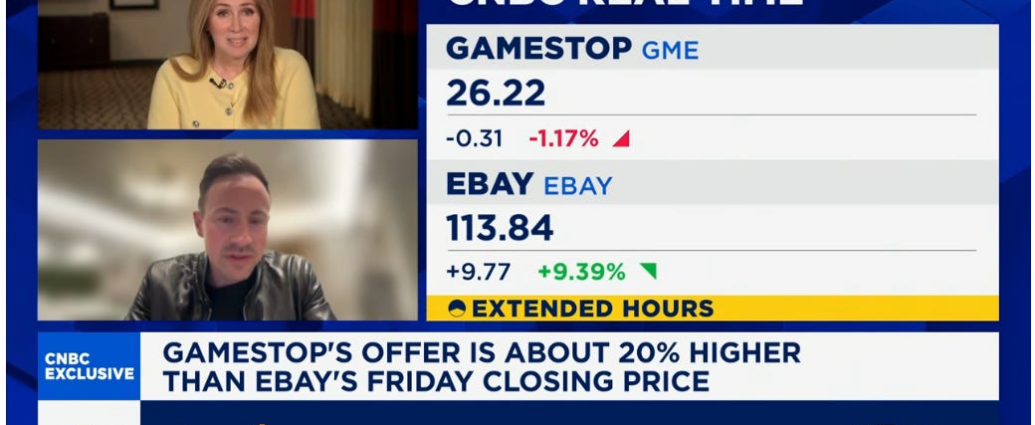
During times of turbulence and uncertainty in the markets, many investors turn to dividend-yielding stocks. These are often companies that have high free cash flows and reward shareholders with a high dividend payout.

Benzinga readers can review the latest analyst takes on their favorite stocks by visiting Analyst Stock Ratings page. Traders can sort through Benzinga’s extensive database of analyst ratings, including by analyst accuracy.

Below are the ratings of the most accurate analysts for three high-yielding stocks in the materials sector.

Avient Corp (NYSE:AVNT)

  • Dividend Yield: 3.09%
  • Keybanc analyst Aleksey Yefremov downgraded the stock from Overweight to Sector Weight on March 4, 2026. This analyst has an accuracy rate of 64%
  • Wells Fargo analyst Michael Sison maintained an Overweight rating and raised the price target from $42 to $47 on Feb. 13, 2026. This analyst has an accuracy rate of 64%.
  • Recent News: On April 27, Avient promoted Giuseppe Di Salvo to CFO.
  • Benzinga Pro’s real-time newsfeed …

Full story available on Benzinga.com

This post was originally published here

Robinhood Markets Inc. (NASDAQ:HOOD) is pivoting from a volatile trading app to a recurring-revenue powerhouse, driven by a subscription tier that Cathie Wood‘s Ark Invest likens to the revolutionary impact of Amazon Prime.

The ‘Amazon Prime’ Of Finance

While Robinhood’s first-quarter results revealed softer transaction revenues due to weak trading activity, Wood’s Ark Invest urges the market to look past cyclical volume.

The real catalyst is Robinhood Gold, a $5-per-month subscription tier rapidly becoming the gateway to the company’s broader financial ecosystem.

According to a recent Ark Invest newsletter, “Parallels with Amazon Prime are instructive.” Just as Amazon.com Inc.‘s (NASDAQ:AMZN) Prime utilized free shipping to become the “gravitational center” of Amazon’s operations, Gold is designed to maximize platform adoption.

Ark notes it aims to transform “intermittent brokerage users into high-frequency financial users,” shifting Robinhood toward a lucrative recurring revenue model. Currently, Gold subscriptions generate approximately $100 million in annualized recurring revenue.

data-variant=”card”
data-news-mode=”manual”

This post was originally published here
The markets are mispricing the impact of escalating geopolitical tensions and rising macro risks, according to Peter Schiff, who suggests buying the dip in precious metals.

In a Monday post on X, Schiff said, “gold is down over $100 and silver is down over $2.50” as conflict with Iran intensifies, oil prices surge, bond yields climb, and equities weaken.

He framed the selloff as a disconnect, telling investors to “take advantage of their ignorance and buy the dip.”

Gold, Silver Fall Despite “Safe Haven” Status

Gold and silver, traditionally seen as safe-haven assets, have come under …

Full story available on Benzinga.com

This post was originally published here
By JBizNews Desk | May 5, 2026

The U.S. housing market is once again feeling the pressure of global instability, as mortgage rates climbed above 6.5% this week, reversing recent declines and tightening affordability for millions of Americans amid rising bond yields triggered by escalating tensions in the Middle East.

The average rate on a 30-year fixed mortgage rose to its highest level in over a month, tracking a sharp move in the 10-year Treasury yield, which climbed to around 4.45% following renewed investor concern over inflation tied to surging oil prices. The shift underscores how quickly geopolitical developments can ripple through domestic financial conditions.

Housing economists say the timing is particularly challenging. After months of gradual improvement, the housing market had begun showing early signs of stabilization, with buyers cautiously returning and sellers adjusting expectations. The latest rate increase threatens to stall that momentum.

“This is exactly the kind of shock the housing market didn’t need,” said Lawrence Yun, Chief Economist at the National Association of Realtors, who noted that higher borrowing costs can quickly sideline potential buyers. “Affordability remains the biggest constraint.”

The connection between global conflict and mortgage rates runs through the bond market. As oil prices rise, investors worry about inflation, prompting them to demand higher yields on Treasury securities. Mortgage rates, which are closely tied to the 10-year Treasury, move in tandem.

That dynamic is already affecting buyer behavior. Mortgage applications have shown signs of slowing, according to industry data, while refinancing activity — which had picked up modestly in recent weeks — is expected to decline again.

For homeowners, the impact is immediate. A half-percentage-point increase in mortgage rates can add hundreds of dollars to monthly payments on a typical home loan, further stretching budgets at a time when home prices remain elevated in many markets.

Builders are also watching closely. Higher rates can dampen demand for new construction, potentially slowing development activity just as the industry works to address a long-standing housing shortage. Robert Dietz, Chief Economist at the National Association of Home Builders, said rising rates “directly impact buyer traffic and sentiment.”

At the policy level, the Federal Reserve now faces a more complicated backdrop. While inflation had been trending lower, the surge in energy prices could reverse that progress, making it harder for policymakers to justify rate cuts in the near term.

“Energy shocks are notoriously difficult for central banks,” said Diane Swonk, Chief Economist at KPMG, noting that the Fed may need to remain cautious even if other parts of the economy show signs of cooling.

Despite the headwinds, some analysts argue that structural demand for housing remains strong, supported by demographics and limited supply. That could provide a floor for the market, even as affordability challenges persist.

Looking ahead, the trajectory of mortgage rates will largely depend on developments in the Middle East and the bond market’s response. If tensions ease and yields stabilize, rates could drift lower again. But if oil prices continue to rise, the housing market may face renewed strain.

For now, buyers and sellers alike are navigating an environment where global events — not just local conditions — are shaping the cost of homeownership in real time.

© JBizNews.com. All rights reserved.

Waterloo, Ontario — May 5, 2026 — Once written off as a fallen smartphone giant, BlackBerry has staged a remarkable quiet comeback, with its QNX embedded software now powering safety-critical systems in more than 275 million vehicles worldwide. The milestone, confirmed by Counterpoint Research and highlighted in recent earnings, is turning heads on Wall Street and in the auto industry as the shift to software-defined vehicles accelerates and BlackBerry emerges as a hidden powerhouse in one of the most critical sectors of the global economy.

QNX powers safety-critical software across automotive, medical, industrial, rail and robotics markets. This broad reach is the foundation of BlackBerry’s revival. In the automotive sector, QNX runs real-time operating systems in advanced driver-assistance systems, infotainment, and safety features. The same technology is used in medical devices that require fail-safe operation, industrial control systems that cannot afford downtime, rail signaling and braking systems, and robotics platforms that demand deterministic performance. The diversification means BlackBerry is no longer dependent on a single industry cycle — it has built a resilient, high-margin software franchise that spans multiple mission-critical domains where reliability is non-negotiable.

The numbers tell the story of a dramatic turnaround. QNX delivered record quarterly revenue of $78.7 million in the fourth quarter of fiscal 2026, up 20% year-over-year, according to the company’s earnings. For the full fiscal year, the division contributed significantly to BlackBerry’s total revenue of $549 million, with strong gross margins and a royalty backlog that has swelled to approximately $950 million. CEO John Giamatteo declared the company is “no longer in transition,” signaling that the long restructuring is finally paying off and setting the stage for sustained growth in the high-margin automotive software market.

The economic impact is substantial. Ten of the top 10 global automakers and 24 of the top 25 electric vehicle manufacturers rely on QNX. As cars become rolling computers, the demand for reliable, safety-certified embedded software is exploding. BlackBerry’s technology is now a foundational piece of the software-defined vehicle revolution, helping manufacturers reduce development costs, accelerate time to market, and meet stringent safety standards required by regulators worldwide. The same underlying technology is being adopted in hospitals, factories, rail networks and robotic systems, creating multiple high-value revenue streams that are far less cyclical than traditional hardware businesses.

The growth comes at a pivotal moment for the auto industry. Global vehicle production is shifting toward connected and autonomous features, driving massive demand for embedded software. BlackBerry’s QNX platform has added 100 million vehicles since 2020, a testament to its entrenched position. Recent design wins, including partnerships with BMW for next-generation software-defined vehicles and Volvo for software-defined audio solutions, underscore the momentum. A leading Chinese EV maker also selected QNX for its D19 electric SUV, which entered mass production earlier this year with over-the-air update capability, further expanding BlackBerry’s global footprint.

For investors, the resurgence is starting to show in the numbers. BlackBerry returned to GAAP profitability for eight consecutive quarters, with adjusted EBITDA expanding and the company guiding for double-digit revenue growth in fiscal 2027. The QNX backlog and expanding non-automotive applications — including robotics, medical devices, and industrial IoT — position the company for sustained growth even as the broader tech sector faces headwinds from geopolitical tensions and the fuel-price crunch affecting airlines. The high-margin nature of the QNX business provides a buffer against cyclical downturns in vehicle sales, making BlackBerry an increasingly attractive play in the software-defined mobility space.

Yet the comeback is not without challenges. BlackBerry still faces competition from in-house solutions developed by automakers and alternative platforms. Royalty revenue is tied to vehicle sales, which can fluctuate with economic cycles. Overhead costs have limited free cash flow, though the high-margin nature of the QNX business provides a buffer. Analysts note that while the 275 million vehicle milestone is impressive, converting the backlog into consistent revenue growth will be key to sustaining investor confidence and driving further stock appreciation.

The broader economic implications are significant. As software becomes the backbone of modern mobility, companies like BlackBerry that provide mission-critical, safety-certified platforms are gaining strategic importance. The QNX success story highlights how legacy tech names can reinvent themselves in the AI and software-defined era, creating high-value intellectual property that powers everything from everyday commuting to autonomous trucking. This shift is also creating new revenue streams for BlackBerry, with the software division now representing a growing share of the company’s overall business and contributing to stronger balance sheet metrics.

BlackBerry’s transformation is a reminder that even companies once left for dead can find new life in the hidden layers of the digital economy. With QNX now embedded in more than a quarter of a billion vehicles on the road today — and expanding into medical, industrial, rail and robotics markets — the quiet comeback is finally turning heads and generating real revenue at a time when the auto industry is undergoing its most profound shift in decades. The milestone adds to the weekend’s heavy slate of breaking business news, from airline collapses driven by the fuel-price crunch to conglomerate earnings and OPEC+ production decisions. Markets will be watching closely when trading resumes Monday for any signs of how BlackBerry’s automotive software momentum is being priced into the stock and broader tech indices.

JbizNews- Desk – Tech / Automotive Software

Governor Gavin Newsom (D-CA) criticized President Donald Trump and his handling of the Iran war on Sunday amid Spirit Aviation Holdings Inc.‘s (OTC:FLYYQ) grounding of its fleet over the weekend.

‘Affordability Is A Hoax,’ Says Newsom

In a post on the social media platform X on Monday, Newsom’s official Press Office handle quoted a post by NBC News, which shared that Spirit decided to cease operations because of geopolitical factors leading to increased fuel prices. “Wow. Trump destroyed America’s largest low cost carrier. Affordability is a hoax!” the post said.

data-variant=”card”
data-news-mode=”manual”

>


Read Also:

Delta Airlines Cancels Several Flights Amid Crew, Scheduling Changes, Considers Scrapping Free Food Policy On Board: Report

This post was originally published here
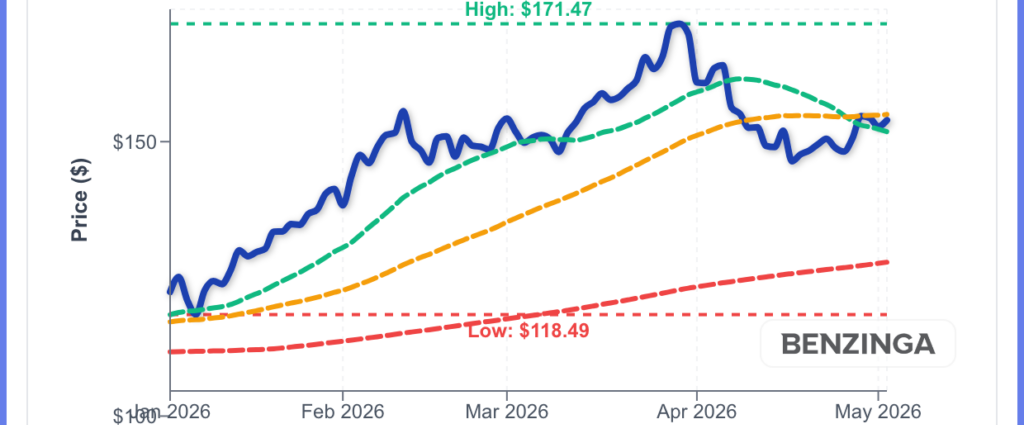
Roundhill Investments has filed to launch the Roundhill Magnificent Seven Plus ETF. This fund would pair the dominant mega-cap tech stocks with a slate of newer AI and space contenders, according to a filing.

The proposed product is expected to trade under the ticker name MAGP. The expense ratio and official launch date have yet to be announced. As with all ETF filings, the fund remains subject to regulatory approval.

What’s Inside MAGP

The ETF Tracker reported Monday that Roundhill has filed to launch the $MAGP Roundhill Magnificent Seven Plus ETF.

The proposed ETF will track a basket of 11 companies. This would include the so-called “Magnificent Seven” — Alphabet Inc (NASDAQ:GOOGL) (NASDAQ:GOOG), Microsoft Corp (NASDAQ:MSFT), Amazon.com Inc (NASDAQ:AMZN), Meta Platforms Inc. (NASDAQ:

Full story available on Benzinga.com

This post was originally published here
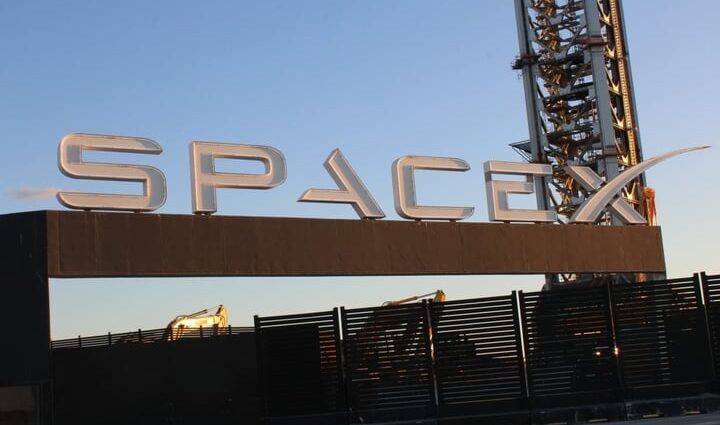
President Donald Trump has voiced his astonishment at the market’s resilience amid the ongoing war with Iran, contrary to his expectations of a significant downturn.

At the Small Business Summit on Monday, Trump said that he had assumed a 25% market slump as a result of the conflict with Tehran. He rationalized that the decline would have been “worth it” to counteract the risk of a nuclear-armed Iran.

Trump stressed that the Iranian regime should have been toppled “47 years ago”, a task that should have been executed by “many presidents or other countries.” Despite the war, he underscored that markets are hitting “new highs.”

Trump Stunned By Market Strength

Trump’s surprise at the market’s resilience echoes his comments to CNBC last month. He stated, “If you would have told me that the Dow is almost at 50,000, I’m looking at your screen right now, and that oil is at 90 instead of 200, I would have been frankly surprised.”

He further noted the adaptability of the market, …

Full story available on Benzinga.com

This post was originally published here

Tesla Inc. (NASDAQ:TSLA) CEO Elon Musk‘s $1 trillion pay package and ambitious 10 million active Full Self-Driving (FSD) subscriber goal could face possible hurdles as EU regulators have reportedly expressed concern about the technology following its approval.

Emails Express Concern Over FSD

According to a Reuters report on Tuesday, citing emails it accessed, regulators in the Netherlands, as well as Scandinavian countries like Sweden, Denmark, Norway and Finland, have flagged concerns about the technology’s safety in icy road conditions, as well as its tendency to speed up and its ability to circumvent the prevention of phone use.

Tesla did not immediately respond to Benzinga‘s request for comment.

The regulators also raised concerns about Tesla asking its supporters to urge the regulators to approve the technology in the region, the report said. A committee is set to hear from Dutch officials from the Netherlands Vehicle Authority (RDW) about the reasons why the Supervised FSD technology was approved.

For an EU-wide approval, the technology …

Full story available on Benzinga.com

This post was originally published here

A Peter Thiel-backed startup, Panthalassa, has secured $140 million in a funding round aimed at propelling its AI-powered sea technology.

Led by Thiel, the funding round witnessed participation from a mix of new and returning investors such as John Doerr, Marc Benioff‘s TIME Ventures, Max Levchin‘s SciFi Ventures, and Founders Fund. The funds will be channeled towards the completion of Panthalassa’s pilot manufacturing facility near Portland.

Founded in 2016, Panthalassa is working on a technology that merges wave power generated by floating orbs with onsite AI computing. The systems transmit data via low-Earth-orbit satellites. The Oregon-based startup has spent nearly a decade developing technologies in power generation, propulsion, autonomous operations, and computing.

Its co-founder and CEO, Garth Sheldon-Coulson, said that the company has developed offshore technology to harness high-energy waves into reliable, clean power, with Ocean-3 pilots launching this year and commercial rollout planned for 2027.

Meanwhile, Thiel said, “Extra-terrestrial solutions are no longer science fiction. Panthalassa has opened the ocean frontier.”

data-variant=”card”

This post was originally published here

In today’s rapidly changing and fiercely competitive business landscape, it is vital for investors and industry enthusiasts to carefully evaluate companies. In this article, we will perform a comprehensive industry comparison, evaluating Micron Technology (NASDAQ:MU) against its key competitors in the Semiconductors & Semiconductor Equipment industry. By analyzing important financial metrics, market position, and growth prospects, we aim to provide valuable insights for investors and shed light on company’s performance within the industry.

Micron Technology Background

Micron is one of the largest semiconductor companies in the world, specializing in memory and storage chips. Its primary revenue stream comes from dynamic random access memory, or DRAM, and it also has minority exposure to not-and or NAND, flash chips. Micron serves a global customer base, selling chips into data centers, mobile phones, consumer electronics, and industrial and automotive applications. The firm is vertically integrated.

Company P/E P/B P/S ROE EBITDA (in billions) Gross Profit (in billions) Revenue Growth
Micron Technology Inc 27.20 8.97 11.24 21.0% $18.48 $17.75 196.29%
NVIDIA Corp 40.51 30.66 22.53 31.11% $51.28 $51.09 73.21%
Broadcom Inc 81.19 24.69 29.68 9.12% $11.15 $13.16 29.47%
Advanced Micro Devices Inc 130.86 8.84 16.13 2.44% $2.86 $5.58 34.11%
Texas Instruments Inc 48.02 15.24 13.90 9.35% $2.42 $2.8 18.58%
Analog Devices Inc 72.58 5.74 16.71 2.46% $1.52 $2.04 30.42%
Qualcomm Inc 18.11 6.51 4.10 13.57% $2.82 $5.7 5.0%
Marvell Technology Inc 53.31 10 17.37 2.79% $0.75 $1.15 22.08%
Monolithic Power Systems Inc 112.46 21.02 25.87 4.95% $0.21 $0.41 20.83%
NXP Semiconductors NV 27.80 6.72 5.85 10.69% $1.7 $1.79 12.2%
ON Semiconductor Corp 351.86 5.23 7.01 2.33% $0.45 $0.55 -11.17%
GLOBALFOUNDRIES Inc 42.61 3.12 5.57 1.68% $0.73 $0.51 0.0%
Astera Labs Inc 164.96 25.28 42.39 3.41% $0.07 $0.2 91.77%
Credo Technology Group Holding Ltd 98.93 17.96 31.31 10.03% $0.16 $0.28 201.49%
Tower Semiconductor Ltd 110.74 8.30 15.58 2.78% $0.2 $0.12 13.69%
First Solar Inc 13.66 2.30 4.20 5.62% $0.51 $0.49 11.15%
MACOM Technology Solutions Holdings Inc 132 16.17 21.43 3.64% $0.07 $0.15 24.52%
Lattice Semiconductor Corp 6279 24.07 33.18 -1.08% $0.01 $0.1 24.16%
Average 457.56 13.64 18.4 6.76% $4.52 $5.07 35.38%

Full story available on Benzinga.com

This post was originally published here

In today’s fast-paced and competitive business landscape, it is essential for investors and industry enthusiasts to thoroughly analyze companies before making investment decisions. In this article, we will conduct a comprehensive industry comparison, evaluating Amazon.com (NASDAQ:AMZN) against its key competitors in the Broadline Retail industry. By examining key financial metrics, market position, and growth prospects, we aim to provide valuable insights for investors and shed light on company’s performance within the industry.

Amazon.com Background

Amazon is the leading online retailer and marketplace for third party sellers. Retail related revenue represents approximately 74% of total, followed by Amazon Web Services (17%), and advertising services (9%). International segments constitute 22% of Amazon’s total revenue, led by Germany, the United Kingdom, and Japan.

Company P/E P/B P/S ROE EBITDA (in billions) Gross Profit (in billions) Revenue Growth
Amazon.com Inc 32.54 6.62 3.97 5.43% $59.58 $94.06 13.63%
MercadoLibre Inc 46.03 13.62 3.18 8.62% $1.07 $3.78 44.56%
eBay Inc 25.25 11 4.37 11.31% $0.77 $2.29 14.97%
Coupang Inc 184.18 7.92 1.09 -0.56% $0.17 $2.54 10.92%
Dillard’s Inc 15.12 4.84 1.31 10.66% $0.3 $0.72 -3.03%
Global E Online Ltd 82.96 5.83 5.92 6.69% $0.13 $0.15 28.05%
Macy’s Inc 8.24 1.04 0.23 11.04% $0.9 $2.97 -1.14%
Ollie’s Bargain Outlet Holdings Inc 21.20 2.65 1.92 4.6% $0.13 $0.31 16.82%
Kohl’s Corp 5.96 0.39 0.10 3.13% $0.39 $1.85 -4.15%
Savers Value Village Inc 58.93 2.93 0.80 5.28% $0.07 $0.26 15.59%
Hour Loop Inc 48.80 12.27 0.60 -8.96% $-0.0 $0.03 3.03%
Average 49.67 6.25 1.95 5.18% $0.39 $1.49 12.56%

Full story available on Benzinga.com

This post was originally published here
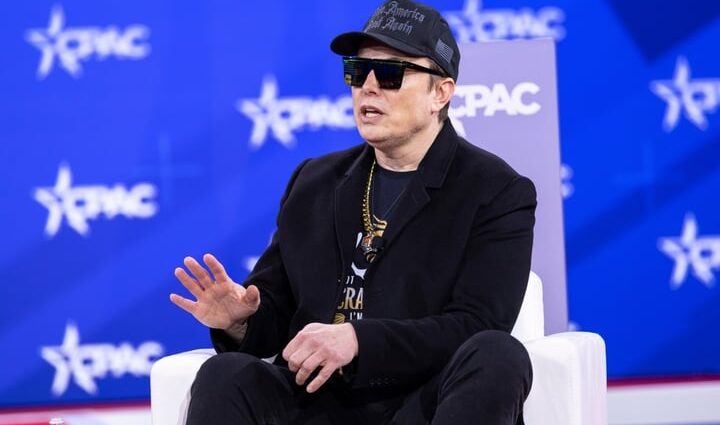
The most oversold stocks in the financial sector presents an opportunity to buy into undervalued companies.

The RSI is a momentum indicator, which compares a stock’s strength on days when prices go up to its strength on days when prices go down. When compared to a stock’s price action, it can give traders a better sense of how a stock may perform in the short term. An asset is typically considered oversold when the RSI is below 30, according to Benzinga Pro.

Here’s the latest list of major oversold players in this sector, having an RSI near or below 30.

South Plains Financial Inc (NASDAQ:SPFI)

  • On April 28, South Plains Financial reported mixed first-quarter financial results. Curtis Griffith, South Plains’ Chairman and Chief Executive Officer, said, “We delivered solid first quarter results driven by strong profitability, improving credit quality, and continued discipline across our balance sheet.” The company’s stock fell around …

Full story available on Benzinga.com

This post was originally published here

As artificial intelligence (AI) fuels a massive memory storage shortage, CNBC’s Jim Cramer says top storage stocks still have massive upside, even if their valuations seem stretched.

Chasing The AI Memory Boom

Despite staggering year-to-date gains across the sector, Cramer believes the explosive rally in memory suppliers is far from over.

In a recent X post, he highlighted Western Digital Corp. (NASDAQ:WDC), SanDisk Corp. (NASDAQ:SNDK), and Seagate Technology Holdings PLC (NASDAQ:STX) as prime beneficiaries of an accelerating AI hardware rotation.

“Memory shortage stocks have to go to a higher place,” Cramer declared. Emphasizing the intense momentum behind the trade, he added, “It’s very difficult to imagine it, but stocks do gallop to where they should be… WDC, SNDK, STX, will be overheated until they get to where they have to go.”

Full story available on Benzinga.com

This post was originally published here

Celanese Corporation (NYSE:CE) will release earnings for its first quarter after the closing bell on Tuesday, May 5.

Analysts expect the Irving, Texas-based company to report quarterly earnings of 88 cents per share. That’s up from 57 cents per share in the year-ago period. The consensus estimate for Celanese’s quarterly revenue is $2.35 billion (it reported $2.39 billion last year), according to Benzinga Pro.

On April 15, Celanese declared quarterly dividend of 3 cents per share.

Shares of Celanese fell 0.7% to close at $68.74 on Monday.

Benzinga readers can access the latest analyst ratings on the Analyst Stock Ratings page. Readers can sort by stock ticker, company name, analyst firm, rating change or other variables.

Let’s have a look at how Benzinga’s most-accurate analysts have rated the company in the …

Full story available on Benzinga.com

This post was originally published here

Lattice Semiconductor (NASDAQ:LSCC) released first-quarter financial results and hosted an earnings call on Monday. Read the complete transcript below.

This content is powered by Benzinga APIs. For comprehensive financial data and transcripts, visit https://www.benzinga.com/apis/.

View the webcast at https://edge.media-server.com/mmc/p/o73e9jtw/

Summary

Lattice Semiconductor Corp reported a strong Q1 2026 with revenue of $170.9 million, marking a 42% year-over-year growth, driven by momentum in data center AI applications.

The company announced a planned acquisition of AMI, aiming to create a comprehensive secure management and control platform, enhancing long-term growth opportunities.

Guidance for Q2 2026 indicates revenue of $185 million at the midpoint, representing nearly 50% year-over-year growth, with EPS expected to grow by 80% year-over-year.

Operational highlights include a reduction in channel inventory from three months to close to two months, and a strategic focus on compute and communications markets.

Management expressed confidence in sustained above-market growth, highlighting strong demand trends across AI servers, networking, and industrial automation, with a robust backlog extending into 2027.

Full Transcript

OPERATOR

Ladies and gentlemen, greetings and welcome to The Lattice Semiconductor first quarter 2026 earnings conference call. At this time, all participants are in the listen only mode. A brief question and answer session will follow the formal presentation. If anyone requires operator assistance during the conference, please signal an operator by pressing Star and zero on your telephone keypad. As a reminder, this conference is being recorded. It is now my pleasure to introduce your Host for today, Mr. Rick Mushe, Vice President of Investor Relations. Please go ahead.

Rick Mushe (Vice President of Investor Relations)

Thank you Operator and good afternoon everyone. With me today are Ford Tamer, Lattice CEO Lorenzo Flores, Lattice’s CFO and Sanjoy Maite, AMI CEO will provide a financial and business review of the first quarter of 2026, an overview of the AMI acquisition and the business outlook for the second quarter of 2026. Both a copy of our earnings press release and the press release announcing our planned acquisition of AMI can be found at our Company website in the Investor Relations section at latticemi.com I would like to remind everyone that during our conference call today we may make projections or other forward looking statements regarding future events or the future financial performance of the Company. We wish to caution you that such statements are predictions based on information that is currently available and that actual results may differ materially. We refer you to the documents that the Company files with the SEC, including our 10-Ks, 10-Qs, and 8-Ks. These documents contain and identify important risk factors that could cause the actual results to differ materially from those contained in our projections or forward looking statements. This call includes and constitutes the Company’s official guidance for the second quarter of 2026.. If at any time after this call we communicate any material changes to this guidance, we intend that such updates will be done using a public forum such as a press release or publicly announced conference call. We will refer primarily to non GAAP financial measures during this call. By disclosing certain non GAAP information, Management intends to provide investors with additional information to permit further analysis of the Company’s performance and underlying trends for historical periods. We provided reconciliations of these non GAAP financial measures to GAAP financial measures that can be found on the Investor Relations section of our website@latticemi.com lastly, we’ve streamlined our financial reporting to better align with our strategic focus. Beginning this quarter, we’ll break out revenue across two primary end markets, compute and Communications and industrial and embedded. Our consumer business is now included within the Industrial and embedded end market. For comparability, we’ve recast all prior period results so you can make a direct apples to apples comparison with that I’ll turn the call over to our CEO Borg Tamer.

Ford Tamer (CEO)

Thank you Rick and welcome everyone to our first quarter earnings call. Lattice has delivered an excellent start to 2026 with results that underscore both strong market tailwinds and our disciplined execution against a clear strategy. Our first quarter performance exceeded expectations and our second quarter outlook reflect our expected continued momentum across the business. This is the seventh earnings call since I joined Lattice and I hope we have now demonstrated that we consistently say what we do and do what we say and these positive factors in aggregate provide the foundation for our proposed acquisition of AMI. This acquisition positions Lattice to create the industry’s most comprehensive secure management and control platform and enables us to deepen our customer relationships and expand our long term growth opportunity. Now turning to our results and outlook, revenue for the first quarter was $170.9 million representing 42% year over year growth with strength across all end markets. Our compute and communications end market achieved record revenue driven by continued momentum and data center AI application. In Q1, 62% of our revenue came from compute and communications products. With expanding opportunities ahead, as Rick highlighted in the safe harbor, we have now merged our industrial and automotive end market with our consumer end market into what we now term Industrial and Embedded. The revenue from our Industrial and Embedded end market grew more than 20% sequentially, reflecting improving market conditions and expanding adoption of Lattice solutions. As importantly, along with increased consumption channel inventory reduced from three months last quarter to close to two months of inventory on hand and we expect this trend to continue to under two months and Q2. As we anticipated, profitability grew faster than revenue. With EPS up 86% year over year, these results demonstrate the operating leverage in our model and our ability to scale efficiently. As revenue accelerates, demand trends continue to build across AI servers, networking, industrial automation and emerging physical AI applications. We are seeing accelerated bookings which now support a strong backlog that extends well into 2027. We’re also witnessing improved customer visibility and healthy design win momentum across our FPGA portfolio. Taken together, we’re confident that we’re in the early innings of a month to year growth cycle and in our ability to deliver sustained above market growth for the foreseeable future. Our results also highlight the progress we’ve made in evolving Lattice into a system level solutions company. Customers increasingly value Lattice not just for low power programmable hardware, but for complete solutions spanning connectivity, security, management and control. As system complexity increases, particularly in AI driven and advanced computing architectures, our customers are giving their highest priority to platforms that reduce integration risk, shorten development cycles and enable faster deployment at scale. These trends continue to expand Lattice’s role within customer systems, increase attach rates and drive higher value per design. We also continue to benefit from our everywhere companionship strategy, positioning Lattice broadly across the ecosystem. Rather than competing with CPUs, GPUs, or other processors, our low power FPGAs enable and enhance them, providing secure boot power sequencing, platform management, I O aggregation, sensor bridging and control. This approach allows Lattice to participate across hyperscale data centers, communication infrastructure, industrial automation, aerospace and defense, automotive, medical and emerging physical AI applications while remaining silicon agnostic and ecosystem neutral. Looking to the second quarter, our revenue guidance of $185 million at the midpoint represents nearly 50% year over year growth. This underscores our confidence in the accelerating momentum of the business. Our Midpoint eps outlook of $0.44 reflects roughly 80% year over year growth. It highlights the powerful operating leverage in our model and differentiated products we bring to market. We maintain a disciplined capital strategy and believe we’ll be able to consistently drive earnings growth that significantly outpaces revenue growth and we are committed to continue to do so. Turning now to the planned acquisition of AMI we announced earlier today, we are excited to have signed a definitive agreement to acquire AMI, a leader in firmware, orchestration and system level manageability. The combination of Lattice’s low power programmable hardware was AMI’s industry leading solutions including BIOS, BMC and Platform Security create the industry’s most complete secure management and control platform. Together we’ll enable customers to accelerate development, simplify system integration and bring increasingly complex platforms to market faster across AI servers, advanced compute, communication infrastructure and industrial applications. Strategically, this acquisition represents a pivotal milestone in advancing Lattice long term growth strategy. AMI’s firmware is expected to remain processor and silicon agnostic, preserving open ecosystems and customer choice, while lattice FPGAs provide a complementary hardware foundation, reinforcing our everywear companionship strategy. We expect this transaction to be accretive to gross margin, free cash flow and EPS on a non GAAP basis. It also supports our trajectory toward exceeding a $1 billion annual revenue run rate by the end of 2026. We look forward to welcoming the talented AMI team to Lattice and expect this combination to strengthen our system level roadmap and long term growth profile significantly. Looking forward, we’re encouraged by the continued durability of demand across our end markets, the depth of customer engagement and the expanding role Lattice plays in next generation system with a differentiated strategy, a scalable financial model and an increasingly complete platform spanning hardware, firmware, security, manageability and control. We are confident that Lattice is exceptionally well positioned for the future. With that, I’ll turn the call over to Lorenzo for a comprehensive review of our first quarter results.

Lorenzo Flores (CFO)

Lorenzo thank you Ford and good afternoon everyone. We will begin with an overview of our first quarter, 2026 financial performance and our second quarter outlook, followed by an overview of our planned AMI acquisition. With a quarter this good and guidance this strong, it is worth repeating some of what Ford said. Revenue reached $170.9 million, growing 42% year over year and 17% quarter over quarter. Earnings performance was even stronger as Q1 non GAAP EPS demonstrated the leverage in our model. EPS grew more than 80% year over year to 41 cents, a 30% increase quarter over quarter and above the high end of our guidance. We expect Q2 to continue this growth trend and I’ll detail our guidance in a few moments. Back to Q1 revenue growth was driven by a record performance in compute and communications, up 86% year over year and 15% sequentially. We continue to benefit from strong data center growth as Ford told you. Additionally, our industrial and embedded end market grew 21% quarter over quarter, primarily driven by increased demand in factory automation, robotics and medical applications. Q1 non GAAP gross margin was a little better than expected at 70% up 60 basis points quarter over quarter and 100 basis points year over year. Our gross margin continues to reflect the value and differentiation our products provide for our customers. Non GAAP operating expense was $60.8 million, up roughly 8% sequentially and 18% on a year over year basis. Much of the sequential increase is from performance based bonuses and commissions. As our revenue and profitability are exceeding expectations. We also continue to invest in order to capitalize on our near and long term opportunities. Our Q1 non GAAP operating margin expanded 370 basis points to 34.4% and our EBITDA margin increased 310 basis points to 39.6%. Both were a little better than expected. Q1 cash flow was impacted by last year’s annual bonus payout as well as revenue linearity in the quarter associated with our rapid growth. GAAP net cash flow from operating activities for the first quarter of 2026 was 50.3 million compared to 57.6 million in Q4. Free cash flow trended with operating cash flow in Q1 free cash flow was $39.7 million, down from $44 million in Q4. We expect a strong recovery of cash flow as we continue to grow. During Q1 we repurchased $15 million of stock. We ended the quarter with $140 million in cash and no debt. Now for our guidance, we are targeting closing the AMI acquisition in Q3. So this guidance reflects expectations for Lattice stand alone in Q2 2026. We expect revenues to grow in the range of $175 million to $195 million at the midpoint of this range. This is almost 50% growth from Q2 25 and 8% over Q1. We expect gross margin to be 70% plus or minus 1% on a non GAAP basis. We expect non GAAP operating expense to be between 64 and $67 million. Most of the growth in OPEX will be in R and D and reflects disciplined investments to drive long term sustained revenue growth. We expect income tax rate for Q2 to be between 4% and 6% on a non GAAP basis. We anticipate non GAAP EPS to be in the range of $0.42 per share and $0.46 per share. At the midpoint of this guidance, we expect that we would again exceed 80% year over year earnings growth as we continue to demonstrate the leverage in our model. Turning now to the AMI transaction, I am just as excited as for our Board of Directors and our leadership team that we have entered into a definitive agreement to acquire ami. AMI is a leader in platform firmware, secure boot device management and system control software. This acquisition represents a strategic expansion of Lattice’s capabilities to deliver system level solutions, further accelerating our growth. The total consideration of the deal is expected to be $1.65 billion with $1 billion of cash and $650 million of equity. This is approximately 5.4 million shares. Based on the closing price on May 1, we expect the acquisition to be equally compelling from a financial perspective. With ami, we expect our revenue to exceed an annual run rate of $1 billion by the end of this year. We anticipate AMI’s software centric asset light model will further enhance Lattice’s already strong business model. We expect that the transaction will be immediately accretive to gross margin, free cash flow and EPS on a non …

Full story available on Benzinga.com

This post was originally published here

Apple Inc. (NASDAQ:AAPL) is exploring potential partnerships with Intel Corp. (NASDAQ:INTC) and Samsung Electronics Co. Ltd. (OTC:SSNLF) to manufacture its processors in the United States, according to a report.

The talks are part of the company’s effort to diversify its chip supply chain beyond its reliance on Taiwan Semiconductor Manufacturing Co. Ltd. (NYSE:TSM), according to a Bloomberg report.

Early-Stage Talks, Site Visits

Apple executives have reportedly visited a Samsung facility being built in Texas and also had early conversations with Intel about using its foundry services. None of the talks has produced orders, and the work is still described as preliminary.

While these moves could provide Apple with additional manufacturing flexibility, the company is said to have concerns about adopting non-TSMC production technologies, particularly around reliability and the ability to scale output efficiently.

The report said Apple’s internal discussions are still in an early phase.

data-variant=”card”

Full story available on Benzinga.com

This post was originally published here

Shares of Sterling Infrastructure Inc (NASDAQ:STRL) rose in pre-market trading after the company reported better-than-expected first-quarter financial results and raised its FY26 guidance above estimates.

Sterling Infrastructure reported quarterly earnings of $3.59 per share which beat the analyst consensus estimate of $2.01 per share. The company reported quarterly sales of $825.675 million which beat the analyst consensus estimate of $603.577 million.

Sterling Infrastructure shares jumped 22.5% to $648.37 in pre-market trading.

Here are some other stocks moving in pre-market trading.

Gainers

  • 3 E Network Technology Group Ltd (NASDAQ:MASK) gained 69% to $2.45 in pre-market trading after the company announced it signed a 1.3 million convertible notes agreement with an institutional investor.
  • Sadot Group Inc (NASDAQ:SDOT) gained 60.3% to $0.42 in pre-market trading after dipping 45% on Monday.
  • Backblaze Inc (NASDAQ:BLZE) rose 41.4% to $6.56 in pre-market trading after the company reported better-than-expected first-quarter financial results and raised its FY26 sales guidance above estimates.
  • Inno Holdings Inc (NASDAQ:INHD) gained 21.6% to $2.14 in pre-market trading. Inno Holdings shares jumped around 14% on Monday after the company announced a year-over-year increase in its second-quarter financial results.
  • Regentis Biomaterials Ltd (NYSE:RGNT) rose 17.3% to $3.11 in pre-market trading after falling 8% on Monday.
  • EverQuote …

Full story available on Benzinga.com

This post was originally published here

By JBizNews Desk
TEHRAN — May 5, 2026

Iran’s President Masoud Pezeshkian has sharply confronted the country’s military leadership over Monday’s renewed missile and drone strikes on the United Arab Emirates, calling the attacks an act of “madness” carried out without the civilian government’s knowledge — and urgently seeking a meeting with Supreme Leader Mojtaba Khamenei to demand an immediate halt, according to a report by Iran International.

The disclosure lays bare a deepening fracture at the top of Iran’s wartime power structure, raising fresh questions about who is actually directing the conflict — and whether any civilian leader retains the authority to stop it.

“Completely Irresponsible”

Exclusive information obtained by Iran International points to a growing clash between Iran’s moderate president and the country’s military leadership over Monday’s escalation in the Persian Gulf. According to sources familiar with Tehran’s deliberations, Pezeshkian expressed strong anger at actions by the Islamic Revolutionary Guard Corps, led by Ahmad Vahidi, describing missile and drone strikes on the United Arab Emirates as “completely irresponsible” and carried out without the government’s knowledge or coordination.

Pezeshkian is said to have described the IRGC’s approach to escalating tensions with regional countries as “madness,” warning of potentially irreversible consequences. Amid a worsening situation and the risk of the country sliding back into full-scale war, Pezeshkian has requested an urgent meeting with Mojtaba Khamenei to press for an immediate halt to IRGC attacks on Gulf states and to prevent further escalation.

Sources close to the presidency say Pezeshkian is deeply concerned about potential international reactions and believes the country cannot withstand a new full-scale war. He has warned that continued unilateral attacks could trigger heavy U.S. retaliation against critical energy and economic infrastructure — an outcome he reportedly said could lead to widespread destruction and an irreversible collapse in livelihoods.

The IRGC’s Growing Grip

The confrontation reflects a structural crisis that has been developing since the killing of Supreme Leader Ali Khamenei on February 28, when U.S. and Israeli strikes launched the current conflict. According to Iran International, the IRGC has effectively assumed control over key state functions, with IRGC commander Ahmad Vahidi reportedly insisting that under wartime conditions, all critical and sensitive positions must be chosen and managed directly by the Revolutionary Guard until further notice.

Pezeshkian has repeatedly sought an urgent meeting with Mojtaba Khamenei but has been unable to establish contact. Instead, a “military council” made up of senior IRGC officers now controls access to the center of power, preventing government reports from reaching Mojtaba and effectively isolating the new Supreme Leader from the elected government.

IRGC commander Ahmad Vahidi is now reportedly making military and political decisions alongside Supreme Leader Mojtaba Khamenei. Parliament Speaker Mohammad Bagher Ghalibaf and Foreign Minister Abbas Araghchi cannot make decisions without the IRGC’s approval, according to reports from the Institute for the Study of War and U.S. intelligence assessments.

This is not the first time Pezeshkian has tried to rein in the military. A week into the war, Pezeshkian apologized for Iran’s attacks on Gulf states, promising to end the attacks unless strikes against Iran originated from those countries. He was swiftly criticized by the IRGC and hardliners, forcing him to walk back his position.

What Sparked the Latest Escalation

The renewed attacks on the United Arab Emirates came as President Trump launched Operation Project Freedom — a U.S. military initiative to escort commercial vessels out of the Persian Gulf through the Strait of Hormuz. Iran’s IRGC warned that any ships attempting to transit the strait “will face serious risks, and violating vessels will be stopped with force.”

The UAE reported missile and drone strikes originating from Iran, following IRGC claims it had blocked U.S. naval access to the strait. A large fire broke out at the Fujairah Petroleum Industries Zone after an Iranian drone strike, with three Indian nationals reported injured. The UAE Ministry of Education ordered nationwide remote learning through Friday as a precaution.

According to Iran International, Pezeshkian is expected to emphasize — if he can secure the meeting — the need for immediate diplomatic engagement, arguing there remains a narrow window to prevent further escalation and return to negotiations.

A Government in Name Only

Reuters reports that Iran’s traditional centralized leadership model has fractured, with authority increasingly concentrated among senior IRGC figures and security bodies. Mojtaba Khamenei, who assumed leadership after his father’s death, is said to play a more limited role, largely endorsing decisions made by military leadership.

Sources cited by Reuters indicate that this shift has already affected Iran’s diplomatic responsiveness, with delays in negotiations attributed to the new power structure.

For the outside world trying to negotiate an end to the conflict, the picture emerging is stark: Iran’s elected president is calling the military’s actions madness — and cannot get a meeting to say so.

JBizNews Desk

Advanced Micro Devices Inc. (NASDAQ:AMD) is preparing to report first-quarter earnings on Tuesday. Investors are weighing whether its AI-fueled stock rally reflects genuine long-term growth or expectations that may have outpaced near-term financial reality.

AMD Earnings Preview: AI Ambitions Fuel Investor Optimism

On Monday, Futurum Group Chief Market Strategist Shay Boloor described AMD as one of the market’s most compelling rerating stories.

He noted that the company is shifting from a CPU-focused growth narrative toward becoming a broader AI infrastructure contender.

“I think Q1 should be strong,” Boloor said on X, while cautioning that AMD’s last month’s rally suggests investors may already be pricing in future AI success before substantial revenue fully arrives.

AMD shares have surged 55.12% over the past month, according to Benzinga Pro.

data-variant=”card”
data-news-mode=”manual”

>


Read Also:

Lisa Su Hosts Howard Lutnick As Commerce Department Highlights ‘Gold Standard’ American Tech Stack: AMD CEO Appreciates The ‘Open Dialogue’

This post was originally published here

Tesla Inc.‘s (NASDAQ:TSLA) cumulative sales in multiple European markets showed growth in April as the Elon Musk-led EV maker charts a path back from sales declines.

Tesla Posts Positive Sales Growth In Most Markets

The automaker posted sales growth in markets like France, the Netherlands, Denmark and Sweden, but it fell in countries like Italy, Spain and Portugal, according to a report by Reuters on Tuesday. Sales grew 112% in France, while the Netherlands recorded a 23% growth. While Scandinavian nations Sweden and Denmark recorded a 111% and 102% growth, respectively, the report said.

data-variant=”card”
data-news-mode=”manual”

>


Read Also:

Tesla Rivals Geely, BYD Report Double-Digit Profit Decline In First Quarter 2026 Amid Revenue Shortfall, Foreign Exchange Volatility

This post was originally published here

GameStop Corp. (NYSE:GME) CEO Ryan Cohen‘s behavior and bizarre answers raised concerns as he discussed the company’s $56 billion unsolicited bid to acquire eBay Inc. (NASDAQ:EBAY).

Cohen’s distracted, seemingly confused demeanor during the 16-minute CNBC interview on Monday left viewers and hosts perplexed. The CEO called the bid “an opportunity to build a much larger business,” but his lack of eye contact and rapidly changing facial expressions added to the strangeness of the interview.

Cohen’s Awkward Answers

When host Andrew Sorkin asked Cohen to explain the $16 billion gap in proposed financing and the acquisition price for eBay, the CEO responded, “It’s on our website…It’s half cash, half stock.” When pressed again for a detailed answer for viewers, Cohen replied, “We’ll see what happens.”

Sorkin questioned whether there have been direct talks with the company and what progress has been made so far. Cohen answered with a “No.” After a long gap, he added: “We’re just starting.”

Becky Quick took over from Sorkin and precisely asked again where the rest of the money would come from, Cohen snapped, “I don’t understand your question,” followed by an awkward silence. After telling Quick to refer to the website for details, Cohen said the company could issue new stock.

data-variant=”card”
data-news-mode=”manual”

>


Read Also:

This post was originally published here
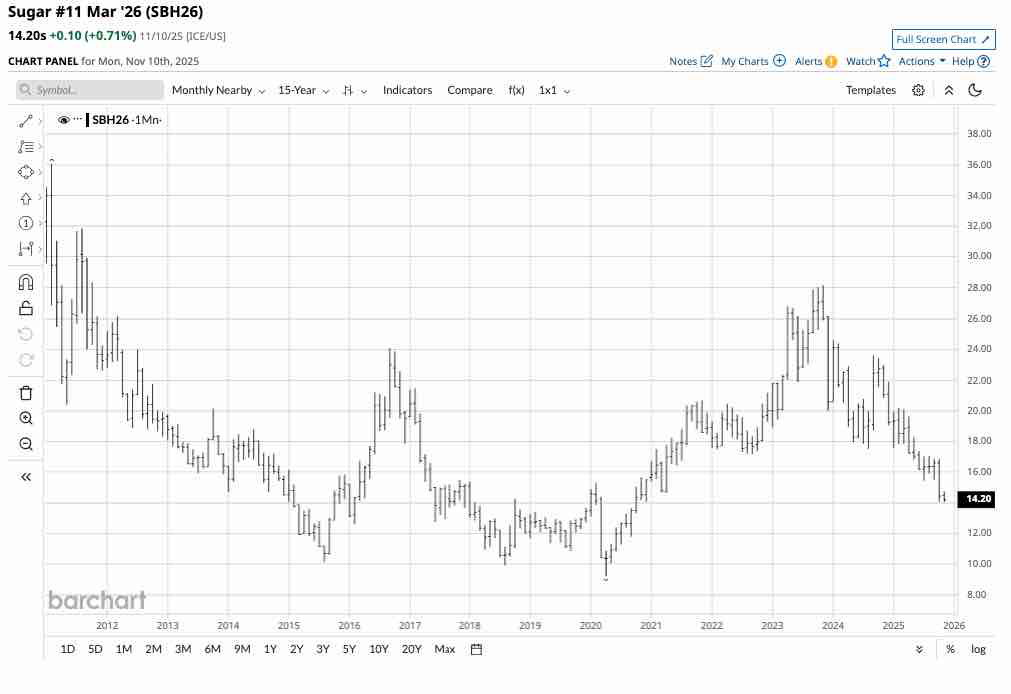

By JBizNews Desk | May 5, 2026

The federal government is offering something most small business owners rarely get access to — practical, high-level business training typically reserved for larger companies — and it is happening online this week at no cost.

The U.S. Small Business Administration, in partnership with the America’s Small Business Development Center Network, has launched the National Small Business Week 2026 Virtual Summit, a free two-day event running May 5–6 from 11 a.m. to 6 p.m. Eastern.

For everyday business owners, the value is immediate and practical:

  • Save hours every week by learning how to use AI to handle emails, admin work, and repetitive tasks
  • Increase revenue opportunities by understanding how to position your business for funding and growth
  • Avoid costly mistakes by learning how fraud actually targets small businesses — and how to protect against it
  • Hire smarter and retain better employees without needing a full HR department
  • Operate more efficiently by adopting tools and systems used by larger, more sophisticated companies
  • Make better decisions faster with clearer data, insights, and structured thinking
  • Upgrade your marketing without big budgets using practical digital and content strategies
  • Gain access to top-tier corporate expertise from companies like Google, Amazon, Visa, and Paychex — without paying thousands
  • Learn without shutting down your business — fully online, flexible, and designed for real schedules

The entire summit is online, allowing business owners to join from anywhere — without travel, cost, or stepping away from daily operations. For many, that alone removes the biggest barrier to gaining this kind of knowledge.

The program brings together major corporate partners including Visa, Google, Amazon, T-Mobile, Verizon, Paychex, TriNet, Meta, Block, Fiserv, Grasshopper Bank, Lockheed Martin, and ZenBusiness — a level of access that would typically cost thousands of dollars at private conferences or consulting engagements.

More importantly, the content is built around real operational challenges — not theory.

Sessions from Visa focus on protecting businesses from fraud and improving access to capital. As digital threats grow more sophisticated and lending standards tighten, understanding these areas can directly impact a company’s stability and ability to grow.

Artificial intelligence is another central focus. Google’s sessions are designed for business operators, not developers, showing how widely available tools can reduce administrative workload and improve efficiency — allowing small teams to operate at a much higher level without increasing headcount.

Workforce strategy is also a key theme. Sessions from Paychex and TriNet address hiring, compensation, and retention — ongoing challenges for small businesses competing in a tight labor market.

Other sessions focus on resilience and growth, including business continuity strategies from T-Mobile and financial positioning insights from Grasshopper Bank, which breaks down what lenders actually look for when evaluating businesses.

For marketing and customer growth, sessions from Amazon and America’s SBDC provide practical, low-cost strategies to expand reach and attract customers without relying on large budgets or outside agencies.

SBA Administrator Kelly Loeffler framed the broader opportunity, noting that policy shifts and economic conditions are creating new openings for small businesses. “Through tax cuts, deregulation, and fair trade, Main Street is positioned for another record year in 2026 — and the SBA will continue to support their comeback with training, capital, and contracting,” she said.

The summit is open to both established and aspiring business owners and is designed to deliver insights that can be applied immediately.

Registration is free at sba.gov/national-small-business-week/virtual-summit, with sessions running throughout both days.

The event is already underway. It ends May 6.

For business owners, the decision is simple: take advantage of access that is rarely this broad, this practical, and this easy — or miss it.

JBizNews Desk

With U.S. stock futures trading higher this morning on Tuesday, some of the stocks that may grab investor focus today are as follows:

  • Wall Street expects Pfizer Inc. (NYSE:PFE) to report quarterly earnings at 72 cents per share on revenue of $13.79 billion before the opening bell, according to data from Benzinga Pro. Pfizer shares rose 0.3% to $26.38 in after-hours trading.
  • Pinterest Inc. (NYSE:PINS) reported better-than-expected financial results for the first quarter and issued a strong revenue forecast for the second quarter. Pinterest posted first-quarter revenue of $1.01 billion, beating analyst estimates of $966.25 million, according to Benzinga Pro. The …

Full story available on Benzinga.com

This post was originally published here

Shopify Inc. (NASDAQ:SHOP) will release earnings for its first quarter before the opening bell on Tuesday, May 5.

Analysts expect the Ottawa, Canada-based company to report quarterly earnings of 33 cents per share. That’s up from 25 cents per share in the year-ago period. The consensus estimate for Shopify’s quarterly revenue is $3.09 billion (it reported $2.36 billion last year), according to Benzinga Pro.

On Feb. 11, Shopify reported better-than-expected fourth-quarter revenue and also authorized a $2 billion stock buyback.

Shares of Shopify fell 0.1% to close at $127.55 on Monday.

Benzinga readers can access the latest analyst ratings on the Analyst Stock Ratings page. Readers can sort by stock ticker, company name, analyst firm, rating change or other variables.

Let’s have a look at how Benzinga’s most-accurate analysts have rated …

Full story available on Benzinga.com

This post was originally published here

The CNN Money Fear and Greed index showed a decline in the overall market sentiment, while the index remained in the “Greed” zone on Monday.

U.S. stocks settled lower on Monday, with the Dow Jones index falling more than 550 points during the session after an Iranian drone strike on a UAE oil facility sent Brent crude above $114 a barrel, increasing expectations of a Federal Reserve rate hike by March 2027.

In earnings, Norwegian Cruise Line Holdings Ltd. (NYSE:NCLH) posted upbeat earnings for the first quarter, but lowered its FY2026 forecast. Tyson Foods Inc. (NYSE:TSN) posted better-than-expected earnings for the second quarter on Monday.

On the economic data front, U.S. factory orders …

Full story available on Benzinga.com

This post was originally published here

Altimeter Capital has sold its Microsoft Corp. (NASDAQ:MSFT) holdings to aggressively fund positions in AI hardware giants like Nvidia Corp. (NASDAQ:NVDA) and SK Hynix, signaling a strategic rotation from software into the booming compute and memory supercycle.

Shifting Capital On AI Supercycle

Despite praising Microsoft’s leadership, Altimeter CEO Brad Gerstner explained, in a conversation with CNBC, that allocating capital in today’s market requires strict prioritization. With 80% of Altimeter’s capital now deployed in memory, logic, and compute, the firm had to pull funds from elsewhere.

“You have to make choices in this market. We only have so much capital,” Gerstner said. He noted that Microsoft was investing “a little less aggressively in capex” to drive future AI growth, while the broader market holds lingering “skepticism about software today.”

The pivot has already paid off. Gerstner pointed out that the stocks Altimeter rotated those dollars into, specifically memory manufacturer SK Hynix, have performed exceptionally well, making the rotation a highly profitable move.

data-variant=”card”
data-news-mode=”manual”

>


Read Also:

This post was originally published here

The yield on 30-year U.S. Treasury bonds has climbed above the key 5% threshold, levels not seen in nearly two decades. This has rekindled fears that government borrowing costs could spiral into a self-reinforcing shock, with traders bracing for a quicker surge as debt-service pressures intensify.

Schiff Warns of Faster Surge in Long-Term Yields

In Monday’s post on X, market commentator Peter Schiff warned that the pace of yield increases could accelerate significantly. He said, “The move from 5% to 6% will be much quicker than the move from 4% to 5%, and the move from 6% to 7% will be quicker still.”

Concerns Over Debt, Economic …

Full story available on Benzinga.com

This post was originally published here
Apple Inc. (NASDAQ:AAPL) asked the Supreme Court of the United States to halt a contempt ruling as it escalates its legal battle with Epic Games over App Store payment rules that could reshape the global app economy.

Apple Seeks Emergency Stay In Epic Games Case

On Monday, Apple filed an emergency request seeking a stay of a lower court decision that found the iPhone maker in contempt for failing to comply with a prior injunction in its dispute with Epic Games, reported The Hill.

“A stay is now needed before Apple is forced to litigate its commission rate under an erroneous and prejudicial contempt label—in proceedings that could reshape the global app market—before this Court can consider whether to grant review,” the company said in its filing.

Epic Games CEO Criticizes Apple

Epic Games CEO Tim Sweeney criticized Apple following its Supreme Court filing in the ongoing App Store legal battle, warning it could influence global regulation of app commissions.

In posts on X, Sweeney said Apple’s filing “threw a grenade into world app market,” arguing it effectively acknowledges that regulators worldwide are monitoring the case to determine acceptable commission rates outside the United States.

He also …

Full story available on Benzinga.com

This post was originally published here

Sen. Bernie Sanders (I-VT) on Monday accused oil companies of profiting from the war in Iran amid an oil and gasoline price surge in the U.S.

Ripping Off Americans

Sanders, in a post on X, drew comparisons between crude oil and gasoline prices from 2026 and 2011. The Vermont independent outlined that oil prices on Monday were around the $105/barrel mark, while gas cost $4.46 per gallon in the U.S.

data-variant=”card”
data-news-mode=”manual”

>


Read Also:

Congressman Buys Defense Stocks As Middle East Tensions Continues: Here Are The Companies

This post was originally published here

Delta Air Lines Inc. (NYSE:DAL) has reportedly canceled several flights amid changes to its schedule, as well as personnel, while also considering a possible end to free food on its flights.

Delta Cancels Flights

The airline canceled about 500 flights since Friday, according to a Business Insider report on Monday, which cited an internal memo from the airline. The flight cancellations come as the company’s pilots are taking on fewer extra flights, with acceptance rates tanking to 2% from 37%, leading to staffing woes, the report said.

Delta then adopted the 23.M.7 system, which isn’t intended for consistent use and reportedly incentivizes pilots to take on unstaffed trips, but can lead to gaps elsewhere, the report said. The memo cited by Business Insider said that the system was “being used 10 to 15 times more than last year.”

Delta has been increasing pilot reserves and accelerating pilot hiring, according to a statement by a spokesperson for the airline cited in the report.

No More Free Food?

The airline will also stop …

Full story available on Benzinga.com

This post was originally published here

By JBizNews Desk | Tuesday, May 5, 2026

The U.S. Department of Justice is escalating its crackdown on healthcare fraud with the launch of a new multi-district enforcement unit targeting some of the fastest-growing fraud hotspots in the country, with Silicon Valley’s digital health sector now firmly in focus.

The newly formed West Coast Health Care Fraud Strike Force brings together the DOJ’s Fraud Division with U.S. Attorney’s Offices in the Northern District of California, the District of Arizona, and the District of Nevada, marking a significant expansion of federal enforcement efforts aimed at protecting taxpayer-funded healthcare programs.

Colin McDonald, Assistant Attorney General for the DOJ’s Criminal Division, said the initiative is driven by “a significant and accelerating increase in healthcare fraud across these regions, including sophisticated schemes leveraging technology platforms and complex billing structures.” He added that enforcement would be aggressive, warning that “no scheme is too complex, no network too large, and no individual beyond the reach of accountability.

The new strike force builds on a national model that has already delivered substantial results. Federal prosecutors note that existing Health Care Fraud Strike Force operations have charged more than 6,200 defendants nationwide, involving over $45 billion in fraudulent billings to Medicare, Medicaid, and private insurers. Officials say the West Coast expansion reflects both the scale of the threat and the need for more targeted, data-driven enforcement.

Silicon Valley Under Intensified Scrutiny

Federal authorities are placing particular emphasis on Northern California, where technology-driven healthcare fraud has become increasingly prominent. Prosecutors say digital health platforms, telemedicine providers, and online prescribing operations have created new opportunities for abuse.

Craig H. Missakian, U.S. Attorney for the Northern District of California, said “Silicon Valley has emerged as a focal point for innovative healthcare delivery—but also for schemes that exploit that innovation to defraud public programs.” He emphasized that the strike force is designed to combine prosecutorial expertise with advanced data analytics to detect and dismantle these operations.

Recent cases illustrate the scale and complexity of the problem. Federal prosecutors secured convictions against executives of a digital health company accused of orchestrating a scheme exceeding $100 million, involving fraudulent prescriptions and improper distribution of controlled substances through online platforms. Authorities say such cases highlight how rapidly evolving technologies can be misused to bypass traditional safeguards.

Arizona and Nevada: Expanding Fraud Networks

The inclusion of Arizona and Nevada reflects what federal officials describe as a geographic shift in fraud activity, with networks increasingly migrating into states with rapidly expanding healthcare systems and Medicaid programs.

In Arizona, federal prosecutors have pursued some of the largest healthcare fraud cases in recent years. Two owners of a wound care company were sentenced to lengthy prison terms after pleading guilty to a scheme exceeding $1 billion in fraudulent billing tied to Medicare and Medicaid. Authorities seized more than $100 million in assets, including cash, luxury vehicles, and precious metals.

In a separate case, federal officials charged an overseas-based billing operator with orchestrating a scheme involving dozens of treatment clinics and hundreds of millions of dollars in alleged fraudulent claims. The case underscores the global nature of modern healthcare fraud, with networks operating across borders while targeting U.S. programs.

Officials say Nevada has also seen an uptick in fraud activity, particularly involving billing irregularities and misuse of telehealth services.

Multi-Agency Enforcement Power

The strike force will be staffed by specialized prosecutors from the DOJ’s Health Care Fraud Section, working in coordination with multiple federal and state agencies. Investigative partners include the Federal Bureau of Investigation (FBI), the Department of Health and Human Services Office of Inspector General (HHS-OIG), and the Drug Enforcement Administration (DEA), along with state-level enforcement bodies.

Scott J. Lampert, Acting Deputy Inspector General at HHS-OIG, said “recent enforcement actions have uncovered increasingly sophisticated schemes designed to appear legitimate while exploiting patients and inflating claims at scale.” He noted that enhanced coordination between agencies is critical to identifying and disrupting these operations more quickly.

Senior administration officials have publicly backed the initiative, framing it as part of a broader effort to combat fraud, waste, and abuse in federal programs. Policymakers say healthcare fraud not only drains taxpayer resources but also undermines trust in the healthcare system.

Implications for the Healthcare Industry

The launch of the strike force sends a clear signal to healthcare providers, digital health companies, and billing operators across the western United States: regulatory scrutiny is intensifying, and enforcement actions are likely to accelerate.

For companies operating in these sectors, the heightened focus translates into increased compliance requirements and greater legal risk. Industry analysts warn that businesses—particularly those leveraging telehealth, remote prescribing, and third-party billing services—may face more frequent audits, investigations, and enforcement actions.

Investors are also taking note. The expanded enforcement environment could influence valuations, due diligence processes, and deal timelines in the rapidly growing digital health sector.

At the same time, officials stress that the initiative is intended not only to prosecute wrongdoing but also to protect legitimate providers and ensure that healthcare resources are used appropriately.

What Comes Next

With data-driven enforcement, multi-agency coordination, and a clear mandate to pursue complex and large-scale fraud schemes, the West Coast Health Care Fraud Strike Force represents a significant escalation in federal oversight.

As enforcement activity ramps up, companies across the healthcare ecosystem—from startups to established providers—will need to reassess compliance frameworks and operational controls.

What comes next: With fraud networks evolving and expanding, federal authorities are signaling a sustained and aggressive enforcement posture, positioning the new strike force as a central tool in protecting billions in healthcare spending and reshaping compliance expectations across the industry.

By JBizNews Desk | Monday, May 4, 2026

Bank stocks moved higher Monday as rising interest rates improved the sector’s earnings outlook, reinforcing investor confidence that financial institutions stand to benefit from a prolonged period of elevated borrowing costs.

Shares of major U.S. banks advanced as Treasury yields climbed, widening net interest margins—the difference between what banks earn on loans and pay on deposits. This dynamic remains a key driver of profitability in a higher-rate environment.

Jamie Dimon, CEO of JPMorgan Chase, has emphasized that “a disciplined approach to managing interest rate exposure can position banks to perform well even in a more challenging economic environment.” His comments reflect broader industry sentiment that higher rates, while presenting risks, also create meaningful opportunities.

The current environment is particularly favorable for large, well-capitalized banks with diversified revenue streams. These institutions are better equipped to manage deposit costs and maintain lending activity, allowing them to capture the benefits of higher yields.

At the same time, investors are rotating into financial stocks as expectations for delayed Federal Reserve rate cuts take hold. The shift underscores the perception that banks are among the relative winners in a “higher-for-longer” rate scenario.

Mike Mayo, banking analyst at Wells Fargo, said “banks are in a stronger position than they were in previous cycles, with improved capital levels and more disciplined risk management, which allows them to benefit from higher rates.

However, the outlook is not without risks. Higher interest rates can also strain borrowers, particularly in segments such as commercial real estate and consumer credit. As borrowing costs rise, the risk of loan defaults increases, which could offset some of the benefits from wider margins.

Credit quality remains a key area of focus. While current levels of delinquencies are relatively contained, analysts are closely monitoring for signs of deterioration, especially if economic growth slows.

Deposit dynamics are also evolving. Banks are facing increased competition for deposits, with customers seeking higher yields on savings. This pressure can lead to rising deposit costs, narrowing margins over time if not managed carefully.

Despite these challenges, the sector’s overall position remains strong. Capital levels are robust, and regulatory frameworks have strengthened since previous financial crises, providing a buffer against potential shocks.

Additionally, banks are continuing to invest in technology and efficiency improvements, aiming to reduce costs and enhance customer experience. Digital banking platforms and data analytics are playing an increasingly important role in maintaining competitiveness.

For investors, the sector offers a mix of income and potential upside, particularly if rates remain elevated and economic conditions remain stable.

What comes next: The trajectory of bank stocks will depend on the balance between higher earnings from elevated rates and potential risks from credit deterioration, making upcoming earnings reports and economic data critical for assessing the sector’s outlook.

JBizNews Desk

By JBizNews Desk | Monday, May 4, 2026

Ocean freight prices are climbing sharply across global trade routes as shipping carriers struggle to expand capacity fast enough to meet rising demand, tightening supply chains and increasing costs for businesses worldwide.

Container rates have surged in recent weeks, particularly on key routes from Asia to North America and Europe, as a combination of strong shipping demand, port congestion, and limited vessel availability creates a renewed imbalance in global logistics.

Vincent Clerc, CEO of A.P. Moller-Maersk, said “global container demand continues to outpace available supply, and that imbalance is driving significant rate increases across major shipping lanes.

Industry data shows freight rates rising at their fastest pace in months, reversing a period of relative stability and signaling that supply constraints are intensifying again. Carriers have attempted to deploy additional vessels and optimize existing routes, but executives say capacity expansion is being limited by infrastructure bottlenecks, port delays, and equipment shortages.

A key issue is the availability of containers and efficient turnaround times. Congestion at major ports is delaying the return of empty containers, creating shortages in critical export hubs and further tightening capacity. At the same time, longer transit times are effectively reducing available fleet supply.

Peter Sand, Chief Shipping Analyst at Xeneta, noted that “carriers are in a stronger pricing position as capacity remains constrained, leaving shippers with fewer alternatives and less negotiating power.

Carriers are also exercising greater discipline in managing capacity, prioritizing profitability after several years of volatile earnings. This has resulted in tighter control over available space, limiting the ability of the market to quickly absorb demand spikes.

For businesses, the impact is immediate. Higher freight rates are increasing landed costs, squeezing margins, and forcing companies to reconsider pricing, sourcing, and inventory strategies. Importers, particularly small and mid-sized firms, report difficulty securing space at predictable rates, leading to shipment delays and higher operating costs.

The surge in shipping costs is also feeding into broader inflation pressures, particularly in goods-heavy sectors where transportation represents a significant portion of total expenses.

Analysts warn that without a meaningful increase in capacity or a slowdown in demand, elevated freight rates could persist into peak shipping seasons, prolonging the strain on global trade.

What comes next: With capacity tight and demand holding firm, ocean freight markets are entering another volatile phase—one where pricing power remains with carriers and businesses must adapt quickly to rising costs and limited shipping flexibility.

JBizNews Desk

American automakers are being squeezed by a rare and brutal convergence: a 50% U.S. tariff on imported aluminum, a major domestic supplier still recovering from two fires, and a war in the Middle East that has disrupted global aluminum supply chains and sent prices sharply higher. The combined pressure is adding billions of dollars in costs to an industry already navigating a difficult market, and consumers buying new vehicles may ultimately pay the price.

The three biggest U.S. automakers have warned that commodity inflation tied to the Iran war will cost them about $5 billion this year, as the conflict squeezes supplies of aluminum, plastics and other inputs and raises the prospect of higher vehicle prices. 

The Iran War’s Role

The closure of the Strait of Hormuz has made a bad situation significantly worse. Nine percent of the world’s seaborne aluminum transits the Strait of Hormuz annually, and the collapse of shipping through the waterway has created an immediate supply shock for the metal, forcing producers worldwide to scramble for alternative sources at premium prices. 

Aluminium Bahrain — known as Alba, which operates the world’s largest single-site aluminum smelter with annual capacity of 1.6 million tonnes — declared force majeure on deliveries and cut output by 19%, citing its inability to load shipments through the effectively closed Strait of Hormuz. Qatalum, the Qatar-based joint venture between Norsk Hydro and Qatar Aluminium Manufacturing, announced a controlled production shutdown following natural gas shortages caused by Iranian strikes. 

At the outbreak of the Iran conflict on February 28, three-month LME aluminum futures jumped as much as 10% by mid-March. Guillaume Osouf, principal analyst at CRU, warned that “a prolonged conflict will likely drastically change our market outlook for the rest of the year due to the lasting impact this will have on global supply.” 

The Novelis Fire That Started It All

Even before the Iran war, Ford Motor was already dealing with a supply chain crisis of its own. Multiple fires at a facility owned by Novelis — Ford‘s primary aluminum supplier — knocked a critical hot mill in Oswego, New York offline for months. Ford incurred a $2 billion headwind from those supply disruptions, on top of a roughly $2 billion hit from tariffs in 2025, which nearly doubled the company’s projections from as recently as October, according to President and CEO James Farley. 

The Novelis Oswego plant is the largest domestic aluminum rolling facility in the U.S. and supplies aluminum sheets critical for vehicle production — especially for Ford trucks like the F-150. Ford is Novelis‘s largest customer because of its trucks’ aluminum-heavy bodies. The supply disruptions forced Ford to warn that production could drop by up to 100,000 F-Series pickup trucks, potentially costing the company as much as $2 billion. 

F-150 sales were down 16% year over year in the first three months of 2026 as a direct result of the inventory shortage. 

The Tariff Problem

With the domestic Novelis plant sidelined, Ford and other automakers were forced to import aluminum from overseas — only to run straight into the Trump administration’s 50% tariff on imported aluminum. Novelis tried to offset lost production by sourcing aluminum from its plants in South Korea and Europe, but the imported metal is subject to a 50% duty, compounding the financial damage for automakers. 

Ford petitioned the Trump administration for temporary tariff relief, at least until the Oswego plant returns to full production. The administration rejected the request. Ford CFO Sherry House said the company still expects to face a $1 billion tariff impact in 2026 even with offsets in place. “There will be tariffs and premium freight associated with that supply continuity of aluminum until we can get the Novelis hot mill back up and running sometime between May and September,” House said. 

A Gradual Path to Recovery

Novelis confirmed it expects its damaged hot mill to resume production by the end of the second quarter of 2026. The rest of the Oswego facility has continued operating without disruption since November, including cold mill, heat treatment production, and automotive finishing and shipping. 

The broader pressure on American manufacturers extends well beyond automakers. Higher aluminum costs flow through to aerospace, defense, food and beverage packaging and appliances — and American firms now pay substantially more for the metal than competitors in other markets, putting them at a significant competitive disadvantage. 

For Ford and its rivals, the road back to normal aluminum costs runs through two separate bottlenecks: a plant in Oswego that must fully restart, and a strait in the Middle East that must reopen. Until both happen, the squeeze on the auto industry — and the consumers who buy its vehicles — will continue.

By JBizNews Desk | May 4, 2026

© JBizNews.com. All rights reserved. This article is original reporting by JBizNews Desk. Unauthorized reproduction or redistribution is strictly prohibited.

On Monday, Ameresco (NYSE:AMRC) discussed first-quarter financial results during its earnings call. The full transcript is provided below.

Benzinga APIs provide real-time access to earnings call transcripts and financial data. Visit https://www.benzinga.com/apis/ to learn more.

View the webcast at https://edge.media-server.com/mmc/p/gg877j2t/

Summary

Ameresco reported a 14% year-over-year revenue growth in Q1 2026, despite adverse weather conditions impacting some facilities.

The company announced a $400 million strategic investment from HASI in its biofuels business, creating a joint venture named Neogenics Fuels.

Leadership changes include promotions of Nicole Bulgarino and Lou Maltezzos to co-presidents, and the appointment of Mike Bakkett as CEO of Neogenics Fuels.

The company has a strong project backlog, with a 20% increase to $2.8 billion and total backlog reaching $5.3 billion.

Ameresco’s future outlook includes leveraging new partnerships and investments to drive growth, particularly in the biofuels and data center spaces.

Full Transcript

OPERATOR

Thank you for standing by. My name is Jordan and I’ll be your conference operator today. At this time I’d like to welcome everyone to the Q1 2026 Ameresco Inc. Earnings Conference Call. All lines have been placed on mute to prevent any background noise. After the speaker’s remarks, there will be a question and answer session. If you’d like to ask a question during this time, simply press STAR followed by the number one on your telephone keypad. If you’d like to withdraw your question, press STAR one again. Thank you. I would now like to turn the call over to Lela Dhillon, Chief Marketing Officer. Please go ahead.

George Sakellaris

Thank you and good afternoon everyone. We appreciate you joining us for today’s call. Our speakers on the call today will be George Sakellaris, Ameresco’s Chairman and Chief Executive Officer Mike Bakas, who will become the CEO of Neogenics Fuels Nicole Bulgarino and Lou Maltezzos, newly appointed co Presidents of Ameresco and Mark Chiplock, Chief Financial Officer. In addition, Josh Prue, our Chief Investment Officer, will also be available during Q and A to help answer questions. Before I turn the call over to George, I would like to make a brief statement regarding forward looking remarks. Today’s earnings materials contain forward looking statements including statements regarding our expectations. All forward looking statements are subject to risks and uncertainties. In particular, some of the commentary is predicated on the expected closing of the Neogenics Fuels transaction. Please refer to today’s earnings materials, the safe harbor language on slide 2 of our supplemental information and our SEC filings for a discussion of the major risk factors that could cause our actual results to differ from those in our forward looking statements. In addition, we use several non GAAP measures when presenting our financial results. We have included the reconciliations of these measures and additional information in our supplemental slides that were posted to our website. Please note that all comparisons that we will be discussing today are on a year over year basis unless otherwise noted. I will now turn the call over to George George thank you Lila and good afternoon everyone. I am pleased to report that we had a solid start to the year with the Ameresco team delivering 14% revenue growth despite experiencing adverse weather conditions impacting several of our RNG facilities. New business also remained Quite strong with 20% growth in awarded backlog against a backdrop of significant activity, especially with the federal government. We also announced several important corporate actions which we have taken to better position ourselves for substantial future growth opportunities while also maximizing shareholder value. Today, after the market closed we announced the signing of a transformational agreement with hasi for a $400 million strategic investment in our biofuels business. This agreement will create a newly formed joint venture named Neogenics Fuels. Ameresco has been a leader in the biofuels industry for the last 25 years. When completed, this transaction will enable us to monetize a portion of the $1.8 billion enterprise value that we have created in our biogas business. Of the $400 million commitment from HASI, 300 million will be directly invested in Neogenics Fuels to drive business growth and the $100 million will be direct compensation to Ameresco for the existing business which will be used for strategic opportunities, working capital and deleveraging throughout the year. I would like to turn the call over to Mike Backas, a member of of my management team for nearly 30 years and who will become Chief Executive Officer of Neogenics Fuels to comment on this exciting transaction.

Mike Bakas

Mike thank you George. Good afternoon everyone. First and foremost, I very much appreciate the confidence and trust that George and HASI leadership have bestowed on me to take the helm of what we see as a transformative business. As many of you are aware, I have been leading Ameresco’s biogas business since the founding of the company, helping to create one of the country’s largest greenfield developers of biogas projects. We are thrilled to be taking the next step in this evolution along with our long term partner HASI with the creation of Neogenics Fuels which will be 70% owned by Ameresco and 30% by Hassi. As part of the transaction, Ameresco will contribute its operating biogas assets along with one of the most robust development pipelines in the industry. The organization will be staffed by Ameresco’s seasoned team of biogas veterans. Both Ameresco and Hassi recognize a tremendous opportunities to deliver resilient energy and biofuel solutions while building the foundation for renewable molecules and next generation drop in fuels of the future. This transaction represents a combination of Ameresco’s proven history and expertise in successful Biogas development with HASI’s deep sector financial knowledge and scalable capital platform. We see this partnership as positioning Neogenics to to become a global industry leader in the next generation of fuels as our addressable market continues to expand. As noted, we have a signed agreement and expect a timely close to the transaction. George, I’ll turn the call back to you.

George Sakellaris

Thank you Mike. We are very excited about this transaction which I believe not only recognizes the tremendous tangible value of our energy assets but also positions Ameresco to better drive long term profitable growth. Also during the quarter we strengthened our corporate structure to position us to fully execute on our great growth opportunities. We recently promoted proven leaders Nicole Bulgarino and Lou Maltedros to co presidents of Ameresco and Peter Grisakis to Chief Operating Officer. Lou and Nicole both came to Ameresco 22 years ago with our successful excellent solutions acquisition. As co presidents, Nicole and Lou will work closely with me on Ameresco’s continued growth strategy while at the same time maintaining clear and distinct areas of operational focus. The easiest way to understand the operational alignment is to look at our current project business which is split evenly between energy infrastructure and building efficiency. Nicole is responsible for the energy infrastructure half of the business while continuing to guide the company’s federal solutions business. Lou focuses on the building efficiency side, overseeing the core non federal projects. Now I will ask each of them to comment on some of the market dynamics in their respective areas.

Lou Maltezzos (Co-President)

Nicole thank you George and good afternoon everyone. Ameresco’s federal business continues to be a core strength of the company. We see strong demand across our traditional federal programs including energy efficiency infrastructure modernization with long term ESPC and design build work. Ameresco’s military and civilian federal government customers remain focused on upgrading buildings, improving reliability, reducing life cycle cost and hardening critical facilities and I am pleased to note a nice uptick in federal government proposal activity over the last year. Ameresco’s long standing relationships, technical expertise and proven execution track record position us well to continue delivering strong results in this important market. In parallel, we are seeing great demand for our energy infrastructure solutions. We have built a strong pipeline of large and complex projects including transformational data center opportunities. This activity is being driven by growing demand for on site reliable power solutions where access to utility power is constrained or delayed. We are approaching this market with discipline, focusing on larger experienced developers and projects where Ameresco’s behind the meter capabilities can provide clear value while still disciplined. In that in what we advance, we are encouraged by the quality and the scope of opportunities we are pursuing and how they are progressing. I will now turn the call over to gleam. Thank you Nicole. It’s been a very exciting time for our project business with our long history and expertise in providing building efficiency solutions for many of our customers, energy represents one of their single largest operating expenditures. More and more our customers are experiencing spiking electricity prices leading to heightened interest in energy efficiency solutions. In addition to these challenges, many customers have older, often outdated buildings with limited capital budgets to pursue new construction. So upgrading their existing facility is not only the best economic option, but it’s often their only option. The cost savings generated from our energy efficiency upgrades can then be reinvested in a laundry list of facility improvements, all done by Ameresco. As electricity prices rise, energy efficiency investments drive much faster returns, allowing our customers to tackle more and more improvements. This enables Ameresco to execute larger, more comprehensive projects. As one of the largest energy services companies in North America, Ameresco should be a main beneficiary of increasing energy costs for years to come. I’ll now turn the call back over to George for a few brief comments before Mark covers our financials.

George Sakellaris

Thank you Lou. Before we turn to the financials, I want to step back and connect the themes you have heard over the last few minutes. We see the creation of Neogenics fuels with HASI as a clear validation of the scale and value we have created in our biofuels platform, while also bringing in a strong long term partner and incremental capital to accelerate the next phase of growth. At the same time, the leadership updates we announced reflect the depth of our bench and our focus on continuity and execution as we scale positioning Mike to lead Neogenics Fuels and elevating Nicole and Lu as Co President to sharpen execution across our energy infrastructure and building efficiency business. Together we see these actions strengthening our operating model, enhancing our ability to deploy capital and talent where returns are most attractive, and keeping Ameresco firmly on the same strategic path, delivering durable growth while creating long term shareholder value. With that, I will turn it over to Mark to walk through the quarter’s financial results and guidance reflecting the Neogenics Huels transaction.

Mark Chiplock (Chief Financial Officer)

Mark thank you George. We had a solid start to the year with total revenue of $401 million up 14% year over year, reflecting broad based growth across our core businesses and led by continued strength in projects in O and M. Project revenue increased 16% to $291 million driven by solid execution across federal and key geographies as well as continued demand for both building efficiency and energy infrastructure solutions. Importantly, business development activity remained very strong. Awarded project backlog grew 20% to $2.8 billion with over half a billion dollars of new awards during the quarter bringing our total project backlog to $5.3 billion. We continue to see a healthy pipeline of opportunities and strong proposal activity, particularly in the federal market. Energy asset revenue grew 7% to $61 million supported by the continued expansion of our operating portfolio. We did see some weather related impacts at certain RNG facilities during the quarter, but the underlying performance of the portfolio remains strong. Our operating energy asset base now stands at 838megawatts with 568megawatts in development and construction, positioning us well for continued long term growth. As we continue to scale this platform, we’re increasingly focused on both the operational performance and and the capital efficiency of our asset strategy. In line with that strategy and as George highlighted, we entered into an agreement to sell a 30% equity interest in our biofuels business. Of the $400 million commitment from HASI, $300 million will be directly invested in Neogenics Fuels to drive business growth and $100 million will be direct compensation to Ameresco for the existing business which will be used for strategic opportunities, working capital and deleveraging throughout the year. This transaction implies a post money enterprise value of approximately $1.8 billion and recognizes the tremendous value embedded within our energy asset portfolio. In addition, it will allow us to retain control of the platform and bring in a trusted partner to help fund future growth which will allow us to continue scaling the business in a capital efficient manner. Turning back to the financials, O and M had another strong quarter with revenue up 22% driven by the continued additions of new long term contracts. Our long term O and M backlog now exceeds $1.5 billion, reinforcing the visibility and durability of this revenue stream. Gross margin of 14.1% reflects project mix along with the impact from adverse weather conditions at certain RNG sites. We continued to make targeted investments in people, project development and execution capabilities to support future growth. These investments drove operating expenses to $46 million during the quarter. Net interest and other expenses were slightly higher than expected, driven primarily by $1.8 million of non cash mark to market impact and approximately $1 million in foreign exchange losses. Net loss attributable to common shareholders was $18.3 million with a GAAP EPS loss of $0.35 per diluted share and non GAAP loss per share of $0.33. …

Full story available on Benzinga.com

This post was originally published here

Paramount Skydance (NASDAQ:PSKY) held its first-quarter earnings conference call on Monday. Below is the complete transcript from the call.

This content is powered by Benzinga APIs. For comprehensive financial data and transcripts, visit https://www.benzinga.com/apis/.

View the webcast at https://edge.media-server.com/mmc/p/r43swb5e/

Summary

Paramount Skydance reported strong Q1 2026 results, highlighting nearly doubling their film slate and achieving financial goals, driven by top creative talent and operational transformation.

The company is focused on integrating platforms and leveraging AI for efficiency, with significant updates to its streaming services expected by mid-2026.

Paramount Skydance is progressing on a major transaction with Warner Bros. Discovery, aiming to finalize by September 2026, enhancing their competitive position in global media and entertainment.

UFC partnership has exceeded expectations, with significant viewer engagement and contribution to advertising revenue, attracting a younger audience.

Management emphasized a strategic focus on quality content and technology investments, while maintaining flexibility with content licensing, including partnerships with platforms like Netflix and Prime Video.

Full Transcript

Krista (Conference Operator)

Good afternoon. My name is Krista and I’ll be your conference operator today. I would like to welcome everyone to Paramount’s first quarter 2026 earnings conference call. At this time, all lines have been muted to prevent any background noise. After the speaker’s remarks, there will be a question and answer session. If you would like to ask a question during this time, simply press Star followed by the number one on your telephone keypad. And if you’d like to withdraw your question, please press star one again. I would now like to turn the call over to Kevin Crichton, Paramount’s EVP of Corporate Finance and Investor Relations. You may now begin your conference call.

Kevin Creighton

Good afternoon and thank you for taking the time to join us for the Paramount Q1 2026 earnings call. I’m Kevin Creighton, EVP of Corporate Finance and Investor Relations. Joining me today is our Chairman and Chief Executive Officer David Ellison, our Chief Financial Officer Dennis Janelli, and our Chief Strategy and Operating Officer Andy Gordon. As a reminder, we will be making forward looking statements today that involve risks and uncertainties. Our remarks will also include non-GAAP financial measures. Reconciliations of these measures can be found in our earnings letter or in our trending schedules which contain supplemental information. These can be found on our investor relations website.

David Ellison (Chairman and Chief Executive Officer)

I’ll now turn it over to David Ellison for a few brief remarks before we take analyst questions. Thanks Kevin and good afternoon everyone. As you’ve seen in our first quarter results and most recent shareholder letter, we’re off to a strong start in our first full year as Paramount Skydance. The the progress we’ve made in just nine months is a testament to the amazing team we’ve assembled that has worked tirelessly and with great conviction to deliver on all areas of our business. We are executing deliberately against our priorities and seeing tangible results, attracting top creative talent, nearly doubling our film slate, delivering shows audiences love and green lighting dozens of new and returning series while achieving our financial goals. At the same time, we are transforming how we operate, unifying platforms, data and workflows and embedding advanced technology to drive efficiency, better serve our partners and elevate the overall consumer experience across the business. We are getting things done and it’s translating into real momentum. As a storytelling company, our top priority is and always will be delivering great films and television series from the world’s leading creators that resonate with broad global audiences. Recent highlights include Scream 7, which became the highest grossing installment in the franchise’s 30 year history, Landman, now the most watched series in Paramount Plus history and the continued strength of CBS, which has 13 of the top 20 primetime series, including all four of the top new series, an achievement no broadcast network has matched since the early 1990s on streaming and sports engagement remains strong with more than 10 million households watching over 100 million hours of UFC programming on Paramount Plus and CBS Sports delivering the most watched final round of the Masters in over a decade. These are just a few examples of the progress and growth taking place company wide. As I mentioned, we are also making meaningful strides improving our products to deliver more dynamic personalized experiences and superior monetization. New features such as enhanced mobile experiences, short form video and more advanced recommendations are helping us to better serve consumers. We’re also leveraging AI powered capabilities across the businesses including our Agentic Data Warehouse and Precision Plus our targeted and optimization platform, to move faster and operate with greater effectiveness and support of our advertising partners. While there is still significant work ahead, we remain confident in our strategy and the trajectory we are on. Finally, we continue to make steady progress towards completing the Warner Bros. Discovery transaction, which we believe will accelerate our transformation, strengthen our competitive position and enhance our ability to help shape the next era of entertainment. To date we have satisfied our US HSR obligations and there are no statutory impediments remaining and we continue to advance through European and other international regulatory approvals, several of which have already been secured. Earlier in April, we announced a broad syndication of the PIPE equity commitments to strategic investors, underscoring continued investor confidence, secured $10 billion in permanent financing and syndicated the remaining $49 billion of our bridge to a group of leading banks and institutional lenders. Additionally, on April 23, WBD shareholders voted to approve the transaction. We’re pleased with the momentum and will continue to take the necessary steps to bring this deal to completion. At every stage we remain guided by our strong conviction that the combination of these two iconic companies and their extraordinary teams will create a leading global media and entertainment company powered by storytelling and accelerated by technology that strengthens competition, better, serves the creative community and delivers even more compelling stories to audiences worldwide. We’re excited for all that’s ahead and look forward to the opportunities it will create. And with that, I’ll turn it back over to Kevin for your questions.

Kevin Creighton

Thanks David. Just a quick note before we open the line giving the pending transaction for WBD. We won’t be taking questions on the deal today beyond what we wrote in the shareholder letters. With that, Krista, we’ll go ahead and open up the line.

Krista (Conference Operator)

Please. Thank you. If you would like to ask a question, please press Star one on your Telephone keypad. To withdraw your question again, press Star one. We do ask that you limit yourself to one question. For any additional questions, please re queue. And your first question comes from Sean Difley with Morgan Stanley. Please go ahead.

Sean Difley (Equity Analyst)

Great. Thanks very much. I was hoping you could comment on business transformation early learnings as you converge your tech stacks between Paramount plus and Pluto and any things that you could apply to a larger asset base and then broadly how you see AI transforming the business. You mentioned on the ad tech front, but anything else that you think is notable to call out?

Andy Gordon (Chief Strategy and Operating Officer)

Yeah, sure. No, no, absolutely. So what I would say in terms of early learnings is really our ability to execute and move quickly in regards to the transformation. We’re on track, as we discussed previously, to really consolidate our three streaming services into one unified platform by really the middle of this year. Those learnings are going to be crucial as we get into basically the transaction with WBD. I think if you look at our ability to execute on our cost saves and efficiencies, we’ve had great learnings there and I think we’ve been delivering on what we said we were going to do regarding plan. So I do believe that what we’ve been executing at Paramount will be a good kind of accelerant in learning for everything we’re doing. WBD getting more specific into that. As Kevin said, we’re going to kind of stay a little bit away from the transaction today given we’re obviously still in the middle of the process. I’ll turn it over to Andy if there’s anything you want to add to that. Yeah, I would just say what we’re learning also is as we integrate BET plus Pluto and Paramount into one tech stack, it’s going to accelerate our ability to do the same when we close WBD and in particular when you see the consumer product that comes out this summer, I think you’ll be pretty pleased about how they all function together and create a better experience both for the free consumers on the fast channel business of Pluto, but also on the paid subscription businesses of Paramount both ad-supported and ad-free. So we’re pretty excited about what we’re doing and look to dive into more specifics on in terms of what we’re seeing on the platforms we’re operating. As we said, we remain on track for convergence. That obviously has significant benefits across personalizations and recommendations. You know, on the front end, we’re modernizing the consumer facing technology to create more dynamic personalized experiences. As of April, you’re able to see obviously short form video Clips, servicing trailers, sports highlights and library content in a curated, more personalized feed. We’re working on enhanced personalization across discovery including AI driven artwork. We’re also focusing on building other mobile optimized experience like live stats for live sports. All of these are really designed to deepen engagement across the platform for Pluto. Basically this summer Pluto is going to get the most significant update really since the inception of the platform. Other areas you’re really seeing us really utilize technology is across our tech and product org. Approximately 80% of our engineering organization is using code assisted technology which is driving meaningful production gains and really cutting approval times by more than in half. So again it’s really accelerating how we work across the business and these investments all support our long term D2C growth and are foundational to where we’re taking the business. And again, these are all great learnings that will prepare us for the transaction at the end of the third quarter. The only thing I’d add around AI transformation is we’re spinning up pods to go after AI based workflows in the back office. So think finance, HR operational functions and we’re really enabling both on the Paramount side and we think this sets us up for the combination people to go after AI based workflows and efficiency in the back office and we see that’s going to be a real benefit and so we’re doing that today with the teams that David talked about and that will set us up well in the future as well. Yeah, just one more thing to add is on Oracle Fusion, our ERP system, we made a major milestone in the first quarter with the remainder of that transformation to the Oracle Fusion system for Paramount standalone by early 27. So again that puts us in a much better spot as part of the closing of Warner Bros. Discovery as well.

Kevin Creighton

Great. Thanks Sean. Appreciate the question.

Jessica Reif Uhrlich (Equity Analyst)

Krista. Next question …

Full story available on Benzinga.com

This post was originally published here

On Monday, OSI Systems (NASDAQ:OSIS) discussed third-quarter financial results during its earnings call. The full transcript is provided below.

This transcript is brought to you by Benzinga APIs. For real-time access to our entire catalog, please visit https://www.benzinga.com/apis/ for a consultation.

The full earnings call is available at https://edge.media-server.com/mmc/p/esihax8t/

Summary

OSI Systems achieved a fiscal Q3 record with revenues of $453 million and non-GAAP earnings per diluted share of $2.60, despite challenging year-over-year comparisons.

The company reported strong security revenues, excluding Mexico, with a 25% year-over-year growth, and the optoelectronics and manufacturing division also saw a 10% increase.

A significant backlog of approximately $1.9 billion was noted, driven by a Homeland Defense award valued at around $235 million.

Operating cash flow was $14 million in Q3, but post-quarter collections of $74 million from Mexico are expected to boost Q4 cash flow.

The company maintained its fiscal 2026 guidance for revenues and non-GAAP earnings per share, despite potential impacts from the DHS shutdown and Middle East conflicts.

Management highlighted the potential for future growth in security solutions for upcoming major events and continued investments in R&D to foster innovation.

Full Transcript

OPERATOR

Ladies and Gentlemen, thank you for standing by. At this time, I would like to welcome everyone to the osi Systems Inc. Third quarter 2026 conference call. All lines have been placed on mute to prevent any background noise. After the Speaker’s remarks, there will be a question and answer session. If you would like to ask a question during this time, simply press STAR followed by the number one on your telephone keypad. If you would like to withdraw your question, press star one again. Thank you. I will now turn the conference over to Alan Edrick, the Chief Financial Officer. You may begin.

Alan Edrick (Executive Vice President and CFO)

Thank you. Good afternoon and thank you for joining us. I’m Alan Edrick, Executive Vice President and CFO of OSI Systems, and I’m here today with AJ Mehra, OSI’s President and CEO. Welcome to the OSI Systems Fiscal 2026 third quarter conference call. We are pleased that you can join us as we review our financial and in our operational results. Before we discuss these results, I would like to remind everyone that today’s discussion will include forward looking statements and the Company wishes to take advantage of the safe harbor provisions of the Private Securities Litigation Reform Act of 1995 with respect to such forward looking statements. All forward looking statements made in this call are based on currently available information and the Company undertakes no obligation to update any forward looking statements based upon subsequent events, new information or otherwise. We will also reference both GAAP and non-GAAP financial measures. Applicable reconciliations are available. In today’s earnings release, we delivered solid third quarter financial results, setting fiscal Q3 records across multiple metrics. Despite facing the most challenging year over year comparison of fiscal 2026 primarily driven by our Mexico contracts, the Company’s revenues reached a fiscal Q3 record of $453 million million and non GAAP earnings per diluted share set a fiscal Q3 record of $2.60 per share. Importantly, excluding revenues generated by the large Mexico security contracts in both periods, security revenues grew 25% year over year. Our optoelectronics and manufacturing division also performed well, posting 10% growth and a Q3 record for that division. Bookings were strong with a 1.3 book to bill ratio driven by both security and opto, resulting in a record backlog highlighted by the previously announced Homeland Defense Award, about which AJ will provide more information shortly. On the cash side, we generated $14 million in fiscal Q3 operating cash flow despite limited collections in the quarter on the receivables in Mexico. Shortly after quarter end we collected approximately $74 million of the largest Mexico receivable, a strong start to Q4 cash flow. Before diving more deeply into our financial results and discussing our outlook for fiscal 26, I will turn the call over to AJ for our business and operational discussion.

AJ Mehra (President and CEO)

Thanks Alan and thank you everyone for joining us today. I’m pleased to be here to discuss our third quarter results for fiscal 2026. We delivered another quarter of solid execution and ended the quarter with a backlog of approximately 1.9 billion, the highest in the company’s history. We remain focused on execution, leveraging our strengths in key markets and utilizing our global operating model. As we finish Q4 and head into fiscal 2027, let’s turn our businesses to discuss Q3 performance in more detail, starting with security. As expected, Q3 performance was up against difficult year over year comparisons, primarily due to our Mexico programs transitioning from significant product sales to long term related service and support revenues. Despite that, Security performed well with solid bookings, top line growth and operating margin expansion. Furthermore, we continue to be very active with customers across aviation, ports and borders and defense related applications. Bookings were highlighted by a sizable award from Homeland Defense of an Undefinitized contract action or UCA with a not to exceed value of approximately 235 million for the production and integration of Homeland Defense over the Horizon Radar Transmit subsystem. We continue to build strong traction with our RF engineered solutions and are hopeful that there may be additional opportunities in this area of future business. In addition, these capabilities position us well to further support more Golden Dome initiative, the US Initiative to create an Integrated Missile Defense System. As you know, we are a participant in the 151 billion SHIELD IDIQ which we announced last quarter and we look forward to the opportunities that may arise from this initiative. During Q3, we also received several international awards for cargo and vehicle inspection systems and airport screening solutions. In addition, we were an integral part of the security at the Milan Winter Olympic Games, providing our products to screen participants, officials, fans as well as their baggage and cargo. Towards the latter half of Q3, we began to see initial impacts from conflict in the Middle East. Certain programs activities have been delayed by factors such as logistic constraints, travel restrictions and heightened security protocols. Certain customers in the region are facing pressure from disruptions tied to the conflict. If the situation persists, we could see further impact on the timing of order intake and project completion timelines. That said, once the region stabilizes, we could potentially see even stronger demand for security solutions in the us. The order activity for security products was impacted during the quarter by the shutdown at DHS which delayed the procurement of our products and services to support US Border initiatives. Now that the shutdown has ended, we are hopeful for order patents to normalize over the coming weeks and months and I want to emphasize here that these are timing related dynamics rather than changes in the underlying demand. In the US we’re also excited about the potential of our security solutions for high profile upcoming events such as the FIFA World Cup 26 soccer tournament and the 2028 Olympics. Furthermore, in the US the roughly 1 billion outlined in the One Big Beautiful Bill for NII equipment remains a significant growth opportunity. And of course during the shutdown the spending resulting from this bill was delayed in Q3. Turning to optoelectronics and manufacturing, Q3 performance was again strong as revenues increased 10% year over year with the book to bill ratio well exceeding one. In March, Opto received a $40 million award for the electronic sub assemblies from a medical OEM, a significant award in a division where most orders are under 5 million customers continue to value a vertically integrated model and global manufacturing footprint as it diversify supply chains and launch new products. A global manufacturing footprint across Malaysia, Indonesia, India, Canada, Mexico, the UK and the US Allows us to offer customers attractive combinations of value and scalability. Opto’s backlog remains at record levels, providing great long term visibility across aerospace, defense, medical, industrial and other end markets. And finally, our healthcare division which continues its path of improving operations and focusing on new product development in Q3 health care was adversely impacted by order timing, most notably in the US Resulting in lower sales and profitability. On the flip side, we did see growth in the EMEA region during the quarter. As you may know, healthcare’s products generally carry the highest contribution margins at osi, so even modest revenue growth has an outsized impact on profitability. Looking at OSI systems overall, our financial position remains strong. The robust and growing backlog year to date, cash flow generation and a healthy balance sheet give us continued confidence in the company’s prospects. In addition to large program opportunities highlighted earlier, we remain focused on increasing our mix of recurring revenues through expanded service and support agreements. As always, I would like to thank our employees, customers and stockholders for the continued support and dedication. With that, I will turn the call over to Alan to discuss our financial results in more detail before we open the call for questions. Thank you.

Alan Edrick (Executive Vice President and CFO)

Well, thank you aj. Now let’s review in greater detail the financial results for Q3. Let’s begin with a look into our revenues by Division security. division revenues in Q3 came in at $319 million million, driven by higher service revenues and increased contribution from the RF business, which has been effectively integrated into our overall operations and increased aviation product revenues.. As expected, revenues from our large Mexico security contracts decreased to 11 million in Q3 fiscal 26 from 69 million in Q3 of the prior year. Excluding the Mexico contracts, securities revenues surged 25% year over year, reflecting healthy growth across the broader security portfolio. Fiscal Q4 is expected to experience a reduced revenue impact from Mexico in comparison to Q3, with the magnitude of this headwind expected to largely roll off as the company enters fiscal 27. Our Opto electronics and manufacturing division had another excellent quarter. Opto sales, including Intercompany, increased 10% year over year to $111 million million, a new Q3 …

Full story available on Benzinga.com

This post was originally published here

Vertex Pharmaceuticals (NASDAQ:VRTX) held its first-quarter earnings conference call on Monday. Below is the complete transcript from the call.

This transcript is brought to you by Benzinga APIs. For real-time access to our entire catalog, please visit https://www.benzinga.com/apis/ for a consultation.

Access the full call at https://event.choruscall.com/mediaframe/webcast.html?webcastid=fH9sLE8H

Watch the full earnings call below:

Summary

Vertex Pharmaceuticals reported Q1 2026 total product revenue of $2.99 billion, reflecting an 8% year-over-year increase, driven by growth across its portfolio, particularly from new disease areas.

The company’s strategic focus includes expanding its cystic fibrosis (CF) treatments, progressing its nephrology franchise, and advancing its pipeline with multiple regulatory submissions and trials in areas such as sickle cell disease and beta thalassemia.

Vertex Pharmaceuticals reiterated its 2026 revenue guidance of $12.95 to $13.1 billion, with significant contributions expected from non-CF products like Casgevy and Journavix.

Operational highlights include the rapid regulatory submission for Povi in IGAN and label expansions for ALIFTREC and Trikaftor, enhancing patient eligibility and market reach.

Management emphasized the potential for its renal franchise to rival CF in size, with promising interim results for Povi in IGAN and planned studies in other B-cell mediated diseases.

Full Transcript

OPERATOR

Good day and welcome to the Vertex Pharmaceuticals first quarter 2026 earnings call. All participants will be in a listen only mode. Should you need assistance, please signal conference specialist by pressing the star key followed by zero. After today’s presentation there will be an opportunity to ask questions. Please note this event is being recorded. I would now like to turn the conference over to Ms. Susie Lisa. Please go ahead.

Susie Lisa (Senior Vice President of Investor Relations)

Good evening all. My name is Susie Lisa and as the Senior Vice President of Investor Relations, it is my pleasure to welcome you to our first quarter 2026 financial results conference call. On tonight’s call, making prepared Remarks, we have Dr. Reshma Kewalramani, Vertex’s CEO and President, Charlie Wagner, Chief Operating Officer and Chief Financial officer and Duncan McKechnie, chief commercial officer. We recommend that you access the webcast slides as you listen to this call. The call is being recorded and a replay will be available on our website. We will make forward looking statements on this call that are subject to the risks and uncertainties discussed in detail in today’s press release and in our filings with the securities and Exchange Commission. These statements including without limitation, those regarding Vertex’s marketed medicines for cystic fibrosis, sickle cell disease, beta thalassemia and moderate to severe acute pain. Our pipeline and Vertex’s future financial performance are based on management’s current assumptions. Actual outcomes and events could differ materially. I would also note that select financial results and guidance that we will review on the call this evening are presented on a non GAAP basis. I’ll now turn the call over to Reshma. Thanks Suzy. Good evening all and thank you for joining us on the call today. Vertex is off to a terrific start in 2026, which we see as a year defined by execution. Q1 revenue growth was strong across the portfolio as we reach more patients with more products and delivered total product revenue of 2.99 billion, reflecting 8% growth year on year. Importantly, we achieved key commercial milestones for each of the newer products since launch through end of Q1, Aliftrek exceeded 1 billion in cumulative revenue, more than 500 people have initiated their Kashgevi treatment journey and over 1 million prescriptions have been written for Journavix. Another highlight in Q1 was that products from the new disease areas, namely Kashevi and Journavix, drove approximately 25% of total product revenue growth. Execution in R and D was equally strong with multiple regulatory submissions recently completed and more anticipated. Combined with rapid progress across clinical trials and important advancement in research, let me spotlight a few accomplishments. First on POVI. The interim analysis results from the Phase 3 Rainier study in IGAN on efficacy and safety from top to bottom were sparkling and and further fueled our enthusiasm for POVI as a potentially best in class BAF April inhibitor. I was exceptionally pleased with the rapidity and quality of the recently submitted BLA filing for POVI in Igan. Indeed, at 27 days from database lock to regulatory submission, this was the fastest submission in Vertex history. Equally notable is the urgency with which the POVI primary membranous nephropathy and the POVI Myasthenia gravis programs are advancing in Membranous. The Phase two study has been fully enrolled and the Phase three program has already initiated. In addition, the Phase two Proof of concept Myasthenia gravis trial is underway. Second on Kasgevi I’m also very pleased with the rapidity and quality of this SBLA submission for Kashgevy in 5 to 11 year olds with sickle cell disease or beta thalassemia. The Kashgevi filing has been granted a Commissioner’s National Priority Voucher Review reflecting the importance of treating this younger age group before some of the most serious complications of the disease can begin. Overall, Vertex continues to extend its leadership in cf, drive growth with new product launches while building out our next disease area franchise in nephrology, accelerate programs in mid and late stage development and advance the earlier stage R and D pipeline. Tonight I’ll limit my R and D comments to CF as well as the pipeline programs with the most significant new information to share. Certain renal programs POVIne Myasthenia gravis and zamilacel in type 1 diabetes starting with CF.4 quick R& D updates for this quarter we recently reached a significant milestone in the US with label expansions for both ALIFTREC and trikaftor. With this expansion, patients with a clinical diagnosis of CF who have at least one variant in the CFTR gene they that is responsive based on clinical and or in vitro data are now covered by the ALIFTREC and Trikafta labels, reinforcing the impact of these medicines regardless of the location of the variant in the CFTR protein. This is a significant expansion of eligibility that reflects decades of investment, effort and a relentless pursuit of the science. It is also a great example of innovation using using results from clinical trials complemented by in vitro data to expand the benefit of Vertex CFTR modulators to about 95% of people with CF, including those with rare and even N of 1 genotypes. As we expand the ALIFTREC and Trikafta labels to additional mutations. We’re also expanding the labels to younger patients. We will soon submit for approval for ALIFTREC in patients 2 to 5 years of age, where you may recall our pivotal trial demonstrated of a remarkable 65% of children reaching normal levels of CFTR function, and we also plan to submit for Trikafta in children 1 to 2 years of age in the near term. In addition, we continue to advance our Next Generation 3.0 CFTR modulators, including VX828, which is currently in a study of patients with CF. We are on track to complete the study and share results in the second half of this year. Following closely behind VX828 in the family of Next Gen 3.0 are VX581 and VX272, both of which are currently in the clinic in Phase 1 Healthy Volunteer Studies. As we have consistently said, if it is possible to do better in cf, we’re committed to being the ones who do so. And finally, on VX522, the MRNA therapy we’ve been developing for people who produce no CFTR protein and therefore cannot benefit from our modulators. We we previously disclosed tolerability issues in this program. Despite actions we have taken in the trial to overcome these issues, we have not been able to do so and as such we have chosen to discontinue the program. Given this early termination, we will not be able to assess the efficacy or full safety of VX522. We will be working with CITES to close out the study in the coming weeks, moving on to our renal franchise, which continues to make quick progress and is rapidly establishing itself as Vertex’s fourth franchise along cf, heme and pain. In total, we have four programs in mid and late stage development in renal POVI in Igan, POVI in primary membranous nephropathy, Enoxaplin in AMKD and VX407 in 80 PKD. Tonight I’ll cover the first three programs starting with POVI and Igan recall. POVI’s differentiated potential best in Class profile stems from its specific design as an engineered tachy fusion protein with binding affinity, potency and PK properties that deliver optimal dual BAF April inhibition. The dual inhibition and engineering advantage is evident in both the interim analysis data of the Rainier study where we saw rapid, deep and sustained improvement in proteinuria, a favorable safety profile and consistency across all subgroups, as well as in three Key patient dosing benefits once monthly dosing, small volume and subcutaneous administration via an auto injector. Overall, the phase three interim analysis data represent a home run in terms of study design, execution and the results with POVEY achieving statistically significant and clinically meaningful results across all primary and secondary endpoints. Patients in this trial received excellent standard of care with high rates of background medicines including the highest rates of of SGLT2s seen in any IGAN study. Baseline characteristics were well matched to real world IGAN patients in terms of age, renal function and degree of proteinuria. In addition, as a measure of study quality, it’s important to look at discontinuations. In this study, treatment discontinuations were low and trial discontinuations were even lower at a rate of 1.5% in the placebo group and 0.8% in the POVI group. To replay the top line primary and secondary efficacy results for the primary endpoint, POVI achieved a 52% reduction from baseline in peritoneuria as measured by 24 hour UPCR. That’s a 49.8% reduction versus placebo. For the first secondary endpoint, POVI treatment led to a 77.4% reduction from baseline in serum GDIGA1 levels. That’s a 79.3% reduction versus placebo for the second secondary endpoint. Of those patients with hematuria at baseline, 85.1% of POVI treated patients achieved hematuria resolution which is a 61.7% reduction versus placebo. In addition, 42.2% of patients reach the exploratory endpoint of 24 hour UPCR of less than 0.5 grams per gram, an important clinical threshold. These are remarkable results and particularly noteworthy considering that at the time of the interim analysis, patients had received just 36 weeks of POV treatment. On safety, POV was generally safe and well tolerated. The majority of adverse events were mild to moderate and there were no serious adverse events related to pov. Importantly, in terms of infections, most were mild to moderate. The rate of SAEs of infection was low at 0.5% observed in both the placebo and POV groups. There were no opportunistic infections and no discontinuations related to POV overall, including no discontinuations due to infections. Lastly, on antidrug antibodies or adas, adas were observed as expected with biologics but had no impact on povi’s efficacy or risk profile. We look forward to sharing more details of the interim analysis results and anticipate doing so at upcoming medical meetings this fall. Shifting to POVI and primary membranous nephropathy I am pleased to share we have completed enrollment of the Phase 2 portion of the Olympus Phase 2.3study and have already initiated the Phase 3 portion ahead of our previously announced Mid2026 goal and finally on POVI as part of its pipeline in the product potential for B cell mediated diseases beyond renal I’m also pleased to share that the Phase two proof of concept study of POVI in generalized myasthenia is underway. This is a 30 patient study of people with GMG evaluating both the 80 and 240 mg dose for 12 weeks with the primary endpoints of safety and the percent change from baseline in IgG at week 12. The rationale for studying POV and myasthenia is compelling and it’s a serious B cell mediated disease with high morbidity affecting approximately 175,000 people in the US and Europe. There is high unmet need as current therapies have meaningful limitations, which means there’s room for improved efficacy, a better benefit risk profile and more patient friendly dosing and administration, which we have discussed in the context of IGAN as being critically important when considering a chronic biologics market. We believe povi’s mechanism of action, striking at the heart of autoantibody production with an engineered protein format provides best in class promise in myasthenia and we are excited to develop this opportunity. Shifting back to renal to finish up with enoxaplin in Apol1 mediated kidney disease or AMKD. First on amplitude, the pivotal phase 3 study of primary AMKD, that is to say patients with two Apol1 variants for nurture kidney disease and no other renal related comorbidities. We are on track to conduct the interim analysis which occurs after 48 weeks of treatment, and to share data from this Cohort in early 2027. If positive, we will be poised to file for potential accelerated approval in the US thereafter. Second, on amplified our Phase 2b study of enoxapline in separate populations, patients with 2 APOL1 variants, modest peritoneuria and no other kidney disease and patients with two APOL1 variants, moderate to severe peritoneuria and a second disease, type 2 diabetes that could impact the kidney. These two populations are not being studied in amplitude. We recently completed enrollment in the Amplified study which is a study of 13 weeks in duration. Given the clear differences in these populations, we made the decision early on to study them in separate trials. Emerging data in the field confirm the wisdom of this decision. We are excited to learn from the Amplified study and look forward to sharing results in the second half of this year. Finally, on type 1 diabetes, a reminder that Zamylacel has very strong clinical results to date, as detailed in last year’s New England Journal of Medicine. Among patients who received a full dose and had at least one year of follow up, 10 out of 12 patients who were insulin free. These results are unprecedented and are particularly noteworthy given that these patients are those with 20 plus years of type 1 diabetes, undetectable endogenous insulin production at baseline, taking 40 plus units of exogenous insulin per day and with two or more severe hypoglycemic events per year despite best available care. You may recall that in the second half of last year we paused dosing of the phase 1, 2, 3 study in order to conduct a manufacturing analysis which we have now completed. I am pleased to report that dosing in the study has resumed and multiple patients have been dosed with dosing now restarted. We will update you in the coming months on the revised timelines for study completion and regulatory filings. With that, I’ll turn the call over to Duncan for for a commercial update.

Reshma Kewalramani

Thanks very much Reshma. I’ll start with cf, which continues to perform very well year over year. Revenue growth was 6% globally, balanced nicely between US growth of 5% and international growth of 8% in quarter one. Global growth reflects continued ALIFTREC uptake as its once daily dosing and improved sweat chloride profile continue to resonate with the clinical and patient communities. As mentioned, a Liftrek has now surpassed $1 billion in cumulative global revenue since its approval in the U.S. in late December 2024 and Europe in July 2025. Outside the U.S. we have signed reimbursement agreements in 11 countries for ALIFTREC in quarter one alone, building on the access generated in the second half of last year. The tremendous scientific and regulatory achievements represented by the label expansions for elliftrek and Trikafta also also represent a meaningful incremental commercial opportunity of approximately 800 people in CF who are newly eligible in the U.S. this broad labeling is one of several key CF growth drivers for the remainder of 2026, along with the global rollout of a LiftRec treating younger patients and expanding into additional geographies. We have worked closely with the CF population for two decades and remain focused on continuing to serve the CF community and and expand our leadership across all genotypes, age groups and geographies shifting to heme. The rollout of Kashgevi continues to gather momentum across all three regions and I’m pleased to highlight another significant commercial milestone. Since launch, over 500 patients have now initiated the Kashgevi treatment journey. Hundreds have had their first cell collection and many patients have had their cells edited and are ready for infusion. During the first quarter we delivered $43 million in Kashgevi revenue. Importantly, we worked on securing a pricing agreement for Kashgevi in Germany in quarter one and are currently working through the implementation steps. This is a historic moment and we’re excited that German patients with sickle cell disease and TDT may soon be benefiting from long term access to Kashgevi at a sustainable price. Overall, we are very encouraged by the robust flow of patients in the US in in Europe and the Middle east moving from referral to cell collection and infusion. First quarter revenue reflects expected variability quarter to quarter as patients choose the timing for their infusion that suits them best for the full year 2026. The Kashgevi Outlook is very promising as we have built our ATC network, secured reimbursements …

Full story available on Benzinga.com

This post was originally published here

On Monday, Aviat Networks (NASDAQ:AVNW) discussed third-quarter financial results during its earnings call. The full transcript is provided below.

This transcript is brought to you by Benzinga APIs. For real-time access to our entire catalog, please visit https://www.benzinga.com/apis/ for a consultation.

The full earnings call is available at https://edge.media-server.com/mmc/p/9inczpqi/

Summary

Aviat Networks reported Q3 fiscal 2026 revenues of $100 million, a decrease from $112.6 million in the same period last year, impacted by project pushouts in the Middle East.

The company is optimistic about future growth due to increased visibility in U.S. markets, particularly in multi-dwelling units (MDU) and utility sectors driven by AI and broadband programs.

Gross margins were 29.3% GAAP and 29.4% non-GAAP, down from the previous year, mainly due to volume and product mix; however, margins are expected to recover in Q4.

Aviat Networks has lowered inventories by $4 million and improved its balance sheet by reducing unbilled receivables and accounts payable, signaling better cash management.

Fiscal 2026 guidance has been adjusted to revenues between $428 million and $440 million and adjusted EBITDA between $35 million and $40 million, factoring in geopolitical uncertainties.

Full Transcript

OPERATOR

Good Afternoon. Welcome to Aviat Networks’ third quarter fiscal 2026 earnings call. Currently, all participants are in a listen only mode. A question and answer session will follow the formal presentation. Please note this conference is being recorded. I will now turn the conference over to your host, Mr. Andrew Fredrickson, Vice President, Corporate Finance. Thank you, You may begin.

Andrew Fredrickson (Vice President, Corporate Finance)

Thank you and welcome to Aviat Networks’ third quarter fiscal 2026 results conference call and webcast. You can find our press release and updated investor presentation in the IR SECtion of our website at www.aviatnetworks.com along with a replay of today’s call. With me today are Pete Smith, Aviat’s President and CEO, who will begin with opening remarks on the Company’s fiscal quarter, followed by Andy Schmidt, CFO, to review the financial results for the quarter. Pete will then provide closing remarks on Aviat’s strategy and outlook followed by a question and answer session. Jonana Mikulenka, Aviat’s Chief Accounting Officer, is also with us on the call. As a reminder, during today’s call and webcast, management may make forward looking statements regarding Aviat’s business, including but not limited to statements relating to fiscal guidance, financial projections, business drivers, new products and expansions, and economic activity in different regions. These and other forward looking statements reflect the Company’s opinions only as of the date of this call and webcast, and involve assumptions, risks and uncertainties that could cause actual results to differ materially from those statements. Additional information on factors that could cause actual results to differ materially from the statements expressed or implied on this call can be found in our most recent filings with the SEC. The Company undertakes no obligation to revise or make public any revision of these forward looking statements in light of new information or future events. Additionally, during today’s call and webcast, management will reference both GAAP and non GAAP financial measures. Please refer to our press release which is available in the IR SECtion of our website at www.aviatnetworks.com and financial tables therein, which include a GAAP to non GAAP reconciliation and other supplemental financial information. At this time I would like to turn the call over to Aviat’s President and CEO Pete Smith.

Pete Smith (President and CEO)

Thanks, Andrew and good afternoon. Let’s review the Highlights from the third quarter Total revenues of $100.0 million Adjusted EBITDA of $4.4 million Non GAAP EPS of $0.06 Lowered inventories by $4.0 million versus the December quarter Maintained a trailing twelve month book to bill ratio greater than 1.0 Quarterly results were impacted by the conflict in the Middle east where we saw certain project pushouts and unfavorable end of quarter demand shifts and several tier one customers totaling approximately $9 million in revenue. Now let me talk more about our end markets and key developments in the U.S., we see reason for optimism in the quarters ahead as we gain increased visibility on timing of our multi dwelling unit or MDU opportunity, growing demand from utilities as they invest to meet increased power demand from artificial intelligence build outs and the nearing arrival of the Broadband Equity Access and Deployment or BEAD program on the MDU. We have increased confidence in the level of commitment to this project from our Tier one customer and we believe that we have secured a favored position as the supplier of choice. This is translating to increased visibility on timing for the markets we have won and opening the door to additional market areas for deployment for the projects in progress. We have installations occurring now and through the rest of Q4. These are still relatively small and we expect a larger step up during fiscal 2027. As the aviation installations progress and we compete for additional markets related to the MDU opportunity, we are seeing more prospects to provide services and other value added solutions to our Tier one customer. Overall, we are feeling better about this opportunity today than at any other previous point and believe we will have meaningful revenue contribution from this project in fiscal year 2027. Further, we have validated our next generation offering in this area should subscriber growth materialize. We anticipate demand for this next gen product in fiscal year 2028. Private networks remain Aviat’s largest segment today and within private networks, utilities are Aviat’s second largest customer group in this segment. Aviat has been strategically focused on growing our presence and offerings with utilities over the last several years with product innovations like our Ultra High powered 11 GHz radio and the 2024 acquisition of 4RF Networks. Even prior to the demand brought on by artificial intelligence and data center buildouts, there was a growing need for increased investment in America’s grid from a modernization and reliability standpoint. Today, the outlook for Aviat’s utilities is quite robust. Recent industry reports suggest that utilities will deploy 1.4 trillion on capital spending plans over the next five years. This forecast is up over 20% versus a year ago. Approximately half of this spend will go towards transmission and distribution where Aviat’s network hardware is critical for smart grid connectivity and management, substation monitoring and security, crew communications and wildfire detection. Power generation has become the primary constraint and a fundamental determinant of growth for artificial intelligence or AI. This build out of the grid lifts the importance of Michelin critical communication and Aviat is well positioned to capture increasing share of demand in this market. The utility segment is approaching 10% of our overall business. Our funnel of opportunity is strong and the discussions we are having with many of the largest utilities in the US signals that this growth opportunity will remain for several years ahead. Lastly, on the BEAD program, our customers continue to signal that purchase orders related to the program should begin in mid to late calendar 2026. This is consistent with the message we have told investors for approximately a year now. However, as final approvals are made, the set of opportunities is beginning to take shape. 46 of the 56 states and territories have signed have signed their final award agreement. The total funding for the approved deployment spend to date is approximately $20 billion. The size of Aviat’s opportunity depends on the allocation of BEAD funds towards fixed wireless access, which in our estimation stands between 10 and 15% of the award dollars. The allocation of funds to wireless has been increasing over time. Feedback from four of our wireless Internet service provider customers who have all won bead deployment projects signal that calendar 2027 will likely see the largest ramp purchase orders for Aviat, but we still remain very early in the fund deployment life cycle and will provide updates as available. Aviant stands at the ready to assist all of its customers with bid opportunities that, thanks to its Build America Buy America certifications, our E Commerce Aviat Store presence and our leading position in serving rural broadband needs. Apart from these growth drivers, we’ve invested in our roadmap. We’ve taken our North American all indoor radio to international markets. We are also bringing PasserLink radios to North America in early fiscal 2027. Both these represent installed base opportunities for an addressable market of over $250 million. I will now turn the call over

Andy Schmidt (Chief Financial Officer)

to Andy to go through the financial results. Thanks Pete and good afternoon everyone. Before going through the financial results, I would like to briefly introduce Joanna Mikolenka, who joined Aviat in January as our Chief Accounting Officer. She brings with our over 30 years of of accounting experience, including previously serving as Chief Accounting Officer and and Corporate Controller at other public companies. She’s already making a great impact to the overall Aviat team and will help us to achieve our goals. Welcome Janana. Now I’ll review some of our key fiscal 2026 third quarter results. Please note that the detailed financials can be found in our press release and all comparisons discussed are between the third quarter of the fiscal year 2026 and the third quarter of fiscal year 2025, unless otherwise noted. For the third quarter, we reported total revenues of 100 million as …

Full story available on Benzinga.com

This post was originally published here

Wall Street’s first prediction market ETFs were set to debut this week, but the Securities and Exchange Commission has paused the rollout and asked for more disclosures.

The delay hits as Robinhood Markets (NASDAQ:HOOD) prints record prediction market revenue, signaling investor demand for the same boom these ETFs are trying to package.

ETF issuers Roundhill Investments, Bitwise and GraniteShares filed in February for more than two dozen funds combined.

The 75-day window that lets ETFs go live automatically was due to expire this week, and Bloomberg ETF analyst James Seyffart had said last week the launches looked imminent.

Two Dozen Funds In Limbo

The three issuers have filed for more than …

Full story available on Benzinga.com

This post was originally published here

On Monday, Backblaze (NASDAQ:BLZE) discussed first-quarter financial results during its earnings call. The full transcript is provided below.

Benzinga APIs provide real-time access to earnings call transcripts and financial data. Visit https://www.benzinga.com/apis/ to learn more.

The full earnings call is available at https://events.q4inc.com/attendee/290886121

Summary

Backblaze reported a strong Q1 2026 with $38.7 million in revenue, up 12% year-over-year, and B2 cloud storage growing 24%.

The company is seeing significant growth from AI-related customers, with a 76% increase in AI customer usage year-over-year.

Backblaze is focusing on the NEO cloud market, estimating a $14 billion opportunity by 2030, and has secured multiple six, seven, and eight-figure deals.

The company introduced new B2 pricing effective May 1, expected to positively impact revenue and margins.

Guidance for full-year 2026 revenue has been raised to $161.5 million to $163.5 million, with an adjusted EBITDA margin guidance increase to 23-25%.

Full Transcript

Abby (Conference Operator)

Ladies and Gentlemen, thank you for standing by. My name is Abby and I will be your conference operator today. At this time I would like to welcome everyone to the Backblaze first quarter 2026 earnings call. All lines have been placed on mute to prevent any background noise. After the speaker’s remarks, there will be a question and answer session. If you would like to ask a question during this time, simply press followed by the number one on your telephone keypad. If you would like to withdraw your question, press star one again. Thank you and I would now like to turn the conference over to Mimi Kong, Head of Investor Relations. You may begin.

Mimi Kong (Head of Investor Relations)

Thank you. Good afternoon and welcome to Backblaze’s first quarter 2026 earnings call. On the call with me today are Gleb Budman, Co Founder, CEO and Chairperson of the Board, and Mark Sweden, Chief Financial Officer. Today, Backblaze will discuss the financial results that were distributed earlier. Statements on this call include forward looking statements about our future financial results, the impact of our go to market transformation, sales and marketing initiatives, cost saving initiatives, results from new features, the impact of price changes, our ability to compete effectively and manage our growth, and our strategy to acquire new customers, retain and expand our business with existing customers. These statements are subject to risks and uncertainties that could cause actual results to differ materially, including those described in our risk factors that are included in our most recent quarterly report on Form 10Q and our other financial filings. You should not rely on our forward looking statements as predictions of future events. All forward looking statements that we make on this call are based on assumptions and beliefs as of today and we undertake no obligation to update them except as required by law. Our discussion today will include non GAAP financial measures. These non GAAP measures should be considered in addition to and not as a substitute for our GAAP results. Reconciliation of GAAP to non GAAP results may be found in our earnings release which was furnished with our Form 8K filed today with the SEC. You can also find a slide presentation related to our comments in the webcast which will also be posted on our Investor Relations page after the call. Please also see our press release or presentation for definitions of additional metrics such as NRR gross customer retention rates and adjusted free cash flows. We will be participating in the Needham Technology Media and consumer conference on May 12th in New York. I hope to see many of you there. Thank you for joining us and I will now like to turn the call over to Cliff.

Cliff

Thank you Mimi and thank you everyone for joining us today. Q1 was a strong quarter. We beat revenue and adjusted EBITDA guidance, ending the quarter with 38.7 million in revenue up 12% year over year with B2 growing 24%. We more than doubled our average sales deal size and drove 72% year over year growth in our 50k port plus ARR cohort. As we continue to move up market and we are on track for our first full year of free cash flow positivity as a public company, what excites Me Most about Q1 goes beyond the numbers. AI is making storage increasingly important and our organization is gelling and executing better than ever to capture that opportunity. This is evidenced by more than 1/3 of all new bookings coming from AI and the number of AI customers using our platform growing by 76% year over year. We entered 2026 saying we would build a more scalable, more predictable growth engine that serves the AI opportunity. Q1 started to show what that looks like in AI. We are seeing demand from two parts of the market. One is companies building the infrastructure and tools that enable AI. The other is companies using that infrastructure to bring AI into products and workflows. We are winning in both. On the infrastructure side, there is a major re platforming happening in the market for the first time in about two decades. The traditional hyperscalers are not the only place companies are building, they’re also building on the Neo clouds. Synergy Research estimates that the NEO cloud market was $25 billion in 2025 and growing to about 400 billion by 2031. In order for these Neo clouds to support their customers AI workflows, they need to offer cloud storage. Some Neo clouds have offered cloud storage built on Flash. It was fast and it worked. But as these platforms have scaled and AI workloads have grown, the economics have become increasingly difficult. Flash is now about 10 times more expensive per terabyte than hard drives. It works well for use cases requiring the lowest latency for smaller data sizes, but becomes unsustainable as at an exabyte scale. As a result, NEO Clouds are now actively looking to introduce a cost efficient hard drive tiered time flash to manage both performance and economics across their infrastructure. At Backblaze, we built an Internet scale file system to optimize performance per dollar out of hard drives and thus believe Backblaze is ideally positioned to provide exactly what these Neo clouds need. We’ve seen support for that belief not only from the multiple signed Neo clouds where we provide this for them already, but also the active engagement we’re having with many of the top neoclouds. We estimate our opportunity to support neoclass at $14 billion by 2030, and with the success we’re seeing, we are aligning resources internally behind that opportunity. In addition to neopods, we’re seeing a significant opportunity for us supporting other AI infrastructure. For example, we are also seeing strong demand from companies supplying large data sets into the AI ecosystem because they need a place to store large data sets efficiently but also be able to move them where they need to go rapidly. One recent example is a training data provider serving AI use cases that selected V2 to store large volumes of video data. A hyper growth company, it was experiencing rate limits and bandwidth constraints with its existing provider and needed a solution that could scale quickly. Backblaze won on both economics and technical fit. The deal closed in just 11 days at nearly a million dollars of arrangement, underscoring how quickly these companies move when infrastructure becomes a constraint and how well Backblaze is suited to the infrastructure side of the AI opportunity. The other part of the AI market we’re seeing is companies using infrastructure like ours to bring AI into their products. As AI models move from text to multimodal, incorporating video, audio and images, the volume of data required to train and run those models grows by orders of magnitude. This is not a future trend, it’s happening now and it’s creating significant and growing need for storage that can handle it economically and at scale. With the generative AI customers we have today, we are finding that price and performance get us in the door, but it is the experience that keeps them and grows them transparent pricing, responsive support and a team that works with them rather than just selling to them. These customers are scaling fast and they do not have time to manage infrastructure problems with Backblaze. They don’t have to. A good example from Q1 is an AI powered video creation company that selected B2 to store data used to train its models. The customer had been running into cost and performance issues with its existing provider. The platform was difficult to manage and the economics were not working at its scale. Backblaze offered the best performance per dollar and a platform that was easy to use and easy to scale. The initial deployment represents nearly half a million dollars of ARR and creates a clear path to expand into higher performance workloads over time. These customer wins are just examples of where we won in Q1 and are reflective of opportunities we have in pipeline going forward. It’s clear that whether customers are building AI infrastructure or using AI in their products, they are scaling fast, the data is growing exponentially and they need infrastructure that is performant, open and cost efficient at scale. That is the moat we have spent 19 years building and AI is making it more valuable, not less, to be the leading storage platform for AI. We are also meeting developers where they already work. We are embedding backwards into the AI ecosystem by integrating directly into the tools developers already use. For Hugging face, which has 13 million users and over 2 million models, we shipped a tool that lets teams store and share model caches on B2 for ComfyUI, which recently raised at a $500 million valuation. We built a plugin to support generative AI workflows for cvat, which is used by tens of thousands of computer vision teams. B2 is now integrated as a backend for training Data and for MLflow, the most downloaded tool for taking AI projects from lab to production. With 60 million monthly downloads. B2 has now been added as an integrated artifact store. So the AI opportunity is making what we do increasingly critical. We’re also stepping up to meet it. A year ago we began a meaningful transformation of our go to market organization focused on three things increasing awareness, driving greater pipeline consistency and expanding revenue within our installed base. In Q1, we delivered progress on all three. On awareness, the Flamethrower startup program is gaining real traction. We have now welcomed approximately 100 companies in under three months, half the time it would typically take. We’ve been added to the A16Z Founder Resource Program, the Launch Startup Showcase and the Startup Grind Conference, all of which expand our reach with venture backed startups. On pipeline consistency, we have completed our core Go to Market systems upgrade, giving our team better visibility and a stronger foundation for a faster, more disciplined revenue motion. And within our installed base, pipeline sourced from existing customers has nearly doubled year over year, reflecting our growing ability to land and expand with our customers. To accelerate this next phase, we welcomed Anush Kumar as our Chief Revenue Officer. Anush has scaled go to market for cloud infrastructure and enterprise storage at NetApp, VMware, Red Hat and SUSE. He brings the pipeline discipline and execution rigor this phase of our growth requires and we believe his leadership will be a meaningful complement to the upmarket momentum we have already built. We also saw encouraging new customer momentum during the quarter across a range of data intensive use cases that included a healthcare data company who selected us for disaster recovery, a cloud gaming platform that chose B2 to store video across multi cloud environments, and an audio streaming platform migrating from self managed infrastructure to B2. These wins reinforce a broader point. Backwave is winning where data is valuable, active and operationally important and this is why I am excited about the opportunity ahead. The shift to multimodal AI is driving exponential data growth and the need for high performance, yet cost efficient storage has never been greater. The customers who are choosing Backblaze are exactly the kinds of customers that compound with us over time. We are stepping up to this opportunity with an up level team, a go to market transformation well underway and a platform we have spent nearly two decades building and optimizing. AI is making everything we have built more valuable and we are becoming the storage infrastructure that powers the AI economy. With that, I’ll turn it over to Mark.

Mark Sweden (Chief Financial Officer)

Thank you Gleb and good afternoon everybody. Our first quarter results reflect the strategy that we have been executing against. We exceeded the top end of both revenue and adjusted EBITDA guidance. Our Q1 outperformance reflects stronger sales execution and the EBITDA demonstrates the operating leverage in the model. Let me walk through the quarter and then cover our outlook. We finished Q1 with revenue of $38.7 million above the high end of our guidance of 38 million. The beat was broad based across both V2 cloud storage and computer backup, with B2 remaining the primary growth driver. B2 cloud storage grew 24% year over year to 22.4 million and ARR grew 28% year over year, reflecting the underlying strength and momentum of the business. The Q1 revenue outperformance was driven by higher customer data consumption on the B2 cloud platform and computer backup coming in slightly more favorable than our forecasted decline on bookings. which primarily affect revenue in future quarters. We closed multiple large deals for a strong quarter. We made several updates this quarter to improve the calculations of our ARR and RPO metrics. I will briefly walk through those changes as I cover the results. ARR increased by more than $5 million sequentially to $158 million with B2 growing 28% year over year. This quarter we updated our ARR methodology to improve comparability across periods and the change is defined in the earnings presentation posted on our Investor Relations website. Under both the new and previous methods, the sequential ARR improvement is approximately $5 million. We ended the quarter with 187 customers contributing over $50,000 in ARR, up 51% from a year ago reflecting continued strong progress upmarket. We also updated our RPO methodology this quarter and described the change in our earnings presentation. The change is aligned to our peer group and RPO is now a more important metric as we continue to move upmarket, signing both annual and multi year customer commitments. Under the updated methodology, RPO increased by $6 million sequentially and by $31 million from the prior year period. Our gross customer retention metrics remain very healthy with customers continuing to use both our B2 and computer backup solutions for nine years on average beginning this quarter. Our reported net revenue retention reflects an in quarter methodology which we believe provides a more current view of our customer expansion and retention trends. In B2, net revenue retention was 110% up from 105% a year ago, reflecting continued expansion within the customer base as a consumption business. V2 benefits from both the organic customer data growth and the cross sell upsell sales motion. Q1 gross margin was 61% versus 56% in the prior year. The year over year improvement shows strong operating leverage continuing to kick in as we tightly manage costs and also from the extension of the useful life of our fixed assets. Total operating expenses were $29 million in Q1, roughly flat compared to Q4 and improved by approximately 600 basis points from the prior year as a percentage of revenue, reflecting strong operating leverage. As we maintain our focus on Cost Management, Q1 adjusted EBITDA was $10 million or 26% of margin, up from $6 million or 18% in the prior year reflecting strong operating leverage as revenue scales sequentially. Margin declined modestly from 28% in Q4, primarily reflecting the one time benefits we referenced in our last earnings call. Adjusted free cash flow was negative $1.8 million in Q1, reflecting earlier payments in the quarter. We are also pulling forward a portion of 2027 CAPEX into 2026 in response to strong demand signals. Even with that pull forward, we …

Full story available on Benzinga.com

This post was originally published here

On Monday, Allison Transmission (NYSE:ALSN) discussed first-quarter financial results during its earnings call. The full transcript is provided below.

This transcript is brought to you by Benzinga APIs. For real-time access to our entire catalog, please visit https://www.benzinga.com/apis/ for a consultation.

View the webcast at https://edge.media-server.com/mmc/p/k2c6e7qr/

Summary

Allison Transmission reported a 4% year-over-year decrease in first-quarter net sales to $733 million, largely due to a strong prior year period.

The company’s Defense end market showed significant growth with a 64% revenue increase, contributing positively to overall performance.

The Allison Off Highway business unit generated $673 million in sales, driven by strong demand in mining and construction markets.

Allison Transmission is focused on realizing $120 million in annual run-rate synergies from the integration of its business units.

The company reaffirmed its full-year 2026 guidance, expecting consolidated net sales between $5.575 billion and $5.925 billion, and adjusted EBITDA margins in the range of 27% to 29% over the next few years.

Management emphasized the importance of disciplined execution and synergies to drive future margin improvements and underscored strong cash flow and capital allocation towards debt reduction and shareholder returns.

Full Transcript

OPERATOR

Good afternoon. Thank you for standing by. Welcome to Allison’s first quarter 2026 earnings conference call. My name is Shamali and I will be your conference call operator today. At this time, all participants are in a listen only mode. After prepared remarks, Allison executives will conduct a question and answer session and conference call. Participants will be given instructions at that time. As a reminder, this conference call is being recorded. If anyone should require operating assistance during the conference, please press Star 0 on your telephone keypad. I would now like to turn the conference call over to Jackie Bowles, Executive Director of Treasury and Investor Relations. Please go ahead. Jackie.

Jackie Bowles (Executive Director of Treasury and Investor Relations)

Thank you. Shamali. Good afternoon and thank you for joining us for our first quarter 2026 earnings conference call. With me this afternoon are Dave Graziosi, our Chair, President and Chief Executive Officer Scott Mel, our Chief Financial Officer and Treasurer Fred Boley, Allison’s Chief Operating Officer and Allison Transmission Business Unit Leader and Craig Price, Allison Off Highway Business Unit Leader. As a reminder, this conference call, webcast and this afternoon’s presentation are available on the Investor relations SECtion of allisontransmission.com A replay of this call will be available through May 18th. As noted on slide 2 of the presentation, many of our remarks today contain forward looking statements based on current expectations. These forward looking statements are subject to known and unknown risks, including those set forth in our annual report on Form 10K for the year ended December 31, 2025. Should one or more of these risks or uncertainties materialize or should underlying assumptions or estimates prove incorrect, actual results may vary materially from those that we express today. In addition, as noted on slide three of the presentation, some of our remarks today contain non GAAP financial measures as defined by the SEC. You can find reconciliations of the non GAAP financial measures to the most comparable GAAP measures attached in this appendix to the presentation and to our first quarter 2026 earnings press release. Today’s call is set to end at 5:45pm Eastern Time. In order to maximize participation opportunities on the call, we’ll take just one question from each analyst. Please turn to Slide 4 of the presentation for the call agenda. During today’s call, Dave Graziosi will provide a business update and briefly review the company’s performance. Scott Mel will then discuss Allison’s segment reporting structure and Further review Allison’s first quarter 2026 financial performance and Allison’s full year guidance update prior to commencing the Q and A. Now I’ll turn the call over to Dave.

Dave Graziosi (Chair, President and Chief Executive Officer)

Thank you. Jackie, Good afternoon and thank you for joining us. Please turn to Slide 5 of the presentation for our first quarter business update. First, I want to recognize and thank our global employee base for all the work done so far this year. Our teams have been working diligently on integration and value capture within both Allison business units. Our execution has tracked closely with our planning and the integration process is proceeding in a disciplined and structured manner. Having said that, it has not been without a tremendous amount of effort by the Allison teams to arrive at where we are today. As our teams more closely coordinate efforts, we are beginning to see the initial phases of synergy realization take shape across several key areas and expect to begin to see financial benefits later in 2026. It’s been encouraging to see the groundwork laid prior to the transaction translate into real momentum and reaffirmed guidance in achieving our target of 120 million of annual run rates synergies. We remain confident in our acquisition thesis, accelerating sales growth through the strategic combination of the two business units, strengthening our localized production footprint and generating sustainable cost reductions that enhance long term shareholder value. Allison’s reach is now greatly expanded with our global operations, allowing for more localized production and opportunities for cost reductions. By leveraging increased purchasing scale and utilizing manufacturing in best cost countries, we expect to drive value creation and margin improvement across our business. I want to give another welcome to our new colleagues around the world and thank you for all that you do. It’s been a productive first quarter and exciting times for Allison as we enter this new chapter. Moving now to a brief update on first quarter sales, performance and end market outlooks for both of our business units, please turn to slide 6. Starting with our legacy Allison Transmission business first quarter net sales were $733 million a year over year decline of 4% when compared against a robust first quarter of 2025 for the North America on Highway end market. We continue to view the truck market with cautious optimism. Although order trends have shown strength and implies slight ramp throughout the year, we believe there is still uncertainty surrounding geopolitical impacts, including tariffs and final rulings on emissions regulations that are hindering end users new vehicle purchasing decisions. Continuing with the Allison Transmission business unit, the Defense end market had an extremely strong first quarter with revenue up 64% year over year. We continue to see strength from international customers primarily in track programs with both legacy and new products, including our 3040 MX cross drive transmission. We hold a favorable outlook for the Defense end market as national security becomes even more relevant to nations around the world, leading to increased budgets and new programs being funded. Please turn to Slide 7. The Allison Off highway business unit generated $673 million of sales in the first quarter with continued growth in the mining end market driven by elevated commodity prices including gold, copper and rare earth minerals. The construction and material handling end market also performed in the first quarter as global construction markets are seeing steadier investments and positive developments, particularly in Europe in the agriculture end market. While commodity prices remain a driving factor, there are early positive indicators in certain sub segments and regions, for example the low horsepower market in India, but overall a fairly muted environment even prior to the start of the conflict in the Middle East. On that topic, the conflict in the Middle east currently has undetermined impact and implications, both favorable and unfavorable for multiple end markets across Allison business units. While the duration of the conflict remains uncertain, we have not seen any material disruption to our business at this time. We recognize the potential for indirect impacts across our supply chains, energy markets and and broader macroeconomic conditions, and our teams are actively monitoring and maintaining close coordination. In summary, integration is progressing as expected and value capture is materializing. End markets, although impacted by uncertainty in some aspects, are steady if not showing signs of recovery. To everyone across our organization, thank you for the extraordinary commitment, resilience and teamwork you’ve shown. Your efforts have laid a strong foundation for Allison’s futures. To our investors, we are confidently positioned to unlock meaningful synergies, accelerate growth and create lasting value. Now I’ll pass the call over to Scott for a review of Allison’s segment reporting structure, first quarter 2026 financial performance and full year guidance update.

Scott Mel (Chief Financial Officer and Treasurer)

Scott, thank you Dave and thanks to those of you joining us on the call. Please turn to slide 8 of the presentation. Before we begin with segment and consolidated results, I want to quickly go over some housekeeping items and outline our new reporting structure. First quarter results now include segment reporting for Allison Transmission, Allison off highway and Allison Central Group. The Allison Transmission Business unit is the company’s legacy business excluding certain costs now accounted for within the Allison Central Group, while the Allison Off Highway Business unit reflects the business acquired from Dana at the beginning of the year. Allison Central Group is a centralized cost center which includes certain functional costs that support the Company’s global operations. Now on the left hand side of Slide 8, we provide sales, operating profit and adjusted EBITDA by segment. Segment operating income flows over to the consolidated table on the right with further detail down to net income and non GAAP financial measures of adjusted diluted EPS and consolidated adjusted ebitda. Please note that first quarter gross profit in the Allison off highway segment was negatively impacted by approximately $76 million of one time acquisition related purchase price accounting items on a consolidated basis. First quarter net income decreased year over year to $112 million driven by the addition of costs from the Allison off highway business unit including approximately $76 million of expenses related to the stepped up basis in inventory and incremental depreciation expense related to the stepped up basis in fixed assets and an additional $22 million of intangible asset amortization expense. The year over year decrease in net income was also driven by higher interest expense net along with approximately $17 million of one time acquisition related integration expenses. Moving down to per share earnings, first quarter diluted EPS was $1.33 when excluding the effect of non cash, non recurring, infrequent or unusual items. Including the costs associated with the acquisition of the Allison off highway business unit. Adjusted net income and adjusted diluted EPS were $216 million and $2.57 per share respectively. As a reminder, reconciliations for non GAAP financial measures can be found in the appendix of the first quarter earnings presentation and earnings press release. There will also be more detail provided in our 10Q to be published later this week. Please turn to Slide 9 of the presentation. First quarter adjusted diluted EPS of $2.57 increased 6% year over year and we expect the acquisition of the Allison off highway business unit to be accretive to earnings on a full year basis. Adjusted EBITDA for the first quarter was $362 million, increasing 22% year over year with adjusted EBITDA margin at 26% reflecting disciplined execution across our business units despite the less than ideal operating environment. As we have discussed previously, we believe that improving end market conditions in both business units will have a favorable impact on margins. Our value capture and synergy realization will also provide an uplift to our margins with our target for adjusted EBITDA margin in the 27 to 29% range. Cash generation continues to be a key attribute of Allison with the ability to generate substantial cash flow while successfully integrating the Allison off highway business unit and navigating uncertain end market environments including geopolitical policies and conflicts. Now I will briefly highlight our capital allocation priorities. We continue to invest for long term and sustainable growth across our business units with new products and initiatives targeting identified growth opportunities. We are also focused on debt reduction to achieve our near term leverage targets and while simultaneously returning capital to shareholders through share repurchases and our quarterly dividend. At the bottom of the slide you can see how we allocated capital in the first quarter during the quarter we repaid $150 million of the $300 million …

Full story available on Benzinga.com

This post was originally published here

Tactile Systems Tech (NASDAQ:TCMD) reported first-quarter financial results on Monday. The transcript from the company’s first-quarter earnings call has been provided below.

This content is powered by Benzinga APIs. For comprehensive financial data and transcripts, visit https://www.benzinga.com/apis/.

The full earnings call is available at https://edge.media-server.com/mmc/p/jb5atvev/

Summary

Tactile Systems Tech reported Q1 2026 revenue of $75.3 million, a 23% year-over-year increase, with lymphedema revenue at $62.2 million and airway clearance revenue at $13 million.

Gross margins improved by 250 basis points to 76.5%, and adjusted EBITDA rose to $3.7 million, indicating strong operational execution and margin expansion.

The company updated its full-year 2026 revenue guidance to $360-$368 million, reflecting confidence in commercial execution and the inclusion of revenue from the Lymphotek acquisition.

Tactile Systems Tech accelerated its AI platform for Medicare prior authorization, demonstrating operational agility and readiness for new Medicare requirements.

Management expressed confidence in strategic initiatives, such as the launch of next-generation AfloVest and integration of Lymphotek’s technology, aimed at driving long-term growth.

Full Transcript

Sam Bensinger (Investor Relations)

Good afternoon and thank you for joining the call today. With me from Tactile’s management team are Sherry Dodd, Chief Executive Officer, and Elaine Berkemeyer, Chief Financial Officer. Before we begin, I’d like to remind everyone that our remarks and responses to your questions today may contain forward looking statements that are based on the current expectations of management and involve inherent risks and uncertainties. These could cause actual results to differ materially from those indicated, including those identified in the Risk Factors SECtion of our Annual report on Form 10K as well as our most recent 10Q filing to be filed with the SECurities and Exchange Commission. Such factors may be updated from time to time in our filings with the SEC, which are available on our website. We undertake no obligation to publicly update or revise our forward looking statements as a result of new information, future events or otherwise. This call will also include references to certain financial measures that are not calculated in accordance with Generally Accepted Accounting Principles or GAAP. We generally refer to these as non-GAAP financial measures. Reconciliations of those non-GAAP financial measures to Most comparable measures calculated and presented in accordance with GAAP are available in the Earnings Press release on the Investor Relations portion of our website. With that, I’ll now turn the call over to Sherry.

Sherry Dodd (Chief Executive Officer)

Thanks. Good afternoon everyone and welcome to our first quarter 2026 earnings call. Here with me is Elaine Berkemeyer, our Chief Financial Officer.

Elaine Berkemeyer (Chief Financial Officer)

Thanks, Sherry. Unless noted otherwise, all references to first quarter financial results are on a GAAP and year over year basis. Total revenue in the first quarter increased by $14 million, or 23% to $75.3 million by product line. Sales and rentals of lymphedema products, which includes our Flexitouch, Entre, Nimble and lymphotex systems, increased $11.7 million, or 23% to $62.2 million, and sales of our airway clearance products, which includes our AfloVest system increased $2.3 million, or 22% to $13 million. Growth was broad based and reflected strength across both volume and revenue per unit, including higher shipments, strong collections and a favorable mix across payer and product categories. Continuing down the P and L Gross margin was 76.5% of revenue compared to 74% in the first quarter of 2025. The increase in gross margin was attributable to primarily to lower manufacturing costs, stronger collections and favorable product and payer mix reflected in our revenue. Importantly, these improvements reflect structural enhancements in the business rather than temporary cost actions. First quarter operating expenses increased $9.3 million, or 19% to $59.1 million. The change in GAAP operating expenses reflected a $5.2 million increase in sales and marketing expenses, a $1 million increase in research and development expenses, and a $3 million increase in reimbursement, general and administrative expenses. As we discussed previously, we are annualizing investments made in 2025 while continuing to invest in IT infrastructure and automation to support long term growth. Despite these ongoing investments, operating loss decreased $3 million to 66% to $1.5 million. Interest income decreased $0.2 million or 26% to $0.7 million due to our decreased cash position. Interest expense decreased $0.4 million or 93% to $28,000. Income tax expense was $0.9 million compared to an income tax benefit of $1.1 million. Net loss decreased to $1.2 million or 41% to $1.8 million or $0.08 per diluted share compared to $3 million or $0.13 per diluted share. Adjusted Earnings Before Interest, Taxes, Depreciation, and Amortization (EBITDA) increased to $3.7 million compared to an adjusted Earnings Before Interest, Taxes, Depreciation, and Amortization (EBITDA) loss of $0.3 million in the prior year, with margin expanding to 4.9% from negative 0.4% reflecting a meaningful improvement in operating leverage. With respect to our balance sheet, we had $75 million in cash and cash equivalents and no outstanding borrowings at quarter end. This compares to $83.4 million in cash and no outstanding borrowings as of December 31, 2025. The change in cash during the quarter primarily reflects the LymphaTech acquisition share repurchases and normal seasonal items such as bonus payments. We continue to see improvement in working capital efficiency, including a meaningful reduction in days sales outstanding. Turning to review of our 2026 outlook for the full year 2026, we are raising our guidance and now expect total revenue in the range of 360 to $368 million, representing growth of approximately 9% to 12% year over year. This guidance assumes both our lymphedema and airway clearance businesses will grow in a similar overall range, with airway clearance growing modestly faster. The increase in guidance is driven by three primary factors. First, we continue to expect strength in the commercial execution across the business. Second, we have included the contribution from lymphoteg. Third, we have incremental early confidence in how the Macs are navigating the new prior authorization requirements we discussed on our last call. More broadly, we believe underlying demand remains durable and our tools and processes designed to support prior authorizations are tracking well against plan. While prior authorization approval data is still early and continuing to take shape, our outlook appropriately reflects discipline until we have a longer track record of consistent outcomes for modeling purposes. For the full year 2026, we expect our GAAP gross margins to be 76% to 77%, our GAAP operating expenses to increase 10 to 12% year over year. The increase relative to our prior outlook reflects one time acquisition and legal related costs, net interest income of approximately $3 million, a tax rate of 28%, and a fully diluted weighted average share count of approximately 22 to 23 million shares. We continue to expect to generate adjusted Earnings Before Interest, Taxes, Depreciation, and Amortization (EBITDA) of approximately 49 to $51 million in 2026. This outlook reflects the annualization of 2025 investments and continued strategic investments in 2026 which we believe are important to support long term growth and operating leverage. Our adjusted Earnings Before Interest, Taxes, Depreciation, and Amortization (EBITDA) expectation assumes certain non cash items including a stock compensation expense of approximately $9 million, intangible amortization of approximately $3.6 million, depreciation expense of approximately $3.2 million, litigation related expenses of approximately $1 million and one time acquisition related and integration cost of $1.3 million. With that, I’ll turn the call back to Sherri for some closing remarks. Sherry thank you Elaine.

Sherry Dodd (Chief Executive Officer)

We are encouraged by a strong balanced start to the year and the trajectory of our business. Our Q1 results demonstrated broad based performance and reflect disciplined execution, improving productivity from a fully built commercial organization and the increasing benefits from investments we have made in technology and infrastructure. As we look ahead, our focus remains on the fundamentals that matter most expanding access to care, innovating across our product portfolio and enhancing lifetime patient value. While we remain mindful of near term adjustments related to Medicare prior authorization. Ultimately, we believe this change reinforces our emphasis on clinical rigor, access, durability and long term reimbursement stability and we are well positioned to navigate it. We are operating from a position of strength supported by a resilient balance sheet, multiple growth levers in motion and a clear strategy to translate consistent execution into sustained growth over time. With that operator, we’ll now open the call for questions.

OPERATOR

Thank you. We will now be conducting a question and answer session. If you would like to a question,sk a question, question, please press Star one on your telephone keypad. A confirmation tone will indicate your line is in the question queue. You may press Star two if you would like to remove your question from the queue. For participants using speaker equipment, it may be necessary to pick up your handset before pressing the star keys again. That is Star one to ask a question and our first question will come from Ryan Zimmerman with btig.

Ryan Zimmerman (Equity Analyst)

Good afternoon and congrats on a nice start to the year here. I want to ask about some of the dynamics that are starting to occur in second quarter. Sherry, I think you called out some pull forward dynamic with lymphedema sales ahead of 2Q. And so one I think if I look at the beat versus where you’re raising guidance came in, there’s about a $1.7 million difference there. I just want to understand if that was the pull forward effect. And then just anecdotally kind of what you’re seeing with the Macs in 2Q, how they’re responding to this, how physicians …

Full story available on Benzinga.com

This post was originally published here

Firefly Aerospace (NASDAQ:FLY) released first-quarter financial results and hosted an earnings call on Monday. Read the complete transcript below.

Benzinga APIs provide real-time access to earnings call transcripts and financial data. Visit https://www.benzinga.com/apis/ to learn more.

View the webcast at https://edge.media-server.com/mmc/p/j83wnajm/

Summary

Firefly Aerospace reported record quarterly revenue of $81 million, with significant contributions from its Blue Ghost lunar lander and Electra spacecraft programs.

The company announced a new partnership with Nvidia to enhance its Ocula Lunar Imaging Service, enabling faster data processing in cislunar space.

Firefly Aerospace secured agreements with the US Space Force for the space-based interceptor program and continued progress on its reusable Eclipse rocket.

The company is scaling up its infrastructure, including expanding clean room facilities, to meet the increasing demand for lunar missions and other space ventures.

Management reiterated the 2026 revenue outlook of $420 million to $450 million, supported by strong demand signals from NASA and national security sectors.

Full Transcript

OPERATOR

Greetings. Welcome to The Firefly Aerospace First Quarter 2026 Financial Results Conference Call. At this time all participants are in a listen only mode. A question and answer session will follow the formal remarks. To ask a question during the session, you will need to press star 11 on your telephone. You will then hear an automated message advising your hand is raised to withdraw your question. Please press star 11 again. Please note this conference call is being recorded. I will now turn the conference over to Michael Sheets, Firefly Director of Investor Relations. Michael, you may begin.

Michael Sheets (Director of Investor Relations)

Thank you operator. Hello there and may the Fourth be with you. I’m Michael Sheets and welcome to Firefly’s first Quarter Financial Results Call. I’m pleased to be joined on the call by CEO Jason Kim and CFO Darren Ma as we report for the period ending March 31, 2026. Today’s call will include forward looking statements including, but not limited to, statements the company will make about its future financial and operating performance, growth strategy and market outlook. Actual results may differ materially from those contemplated by these forward looking statements. Factors that could cause the actual results and trends to differ materially are set forth in our annual and quarterly reports filed with the SEC. Firefly assumes no obligation to update any forward looking statements which speak only as of their respective dates. Also in this call we will discuss both GAAP and non GAAP financial measures. A reconciliation of GAAP to non GAAP measures is included in the first quarter 2026 earnings release. Unless otherwise stated, financial information referenced in this call will be non-GAAP. Our earnings press release, SEC filings and a replay of today’s call can be found on our investor relations websiteat investors.fireflyspace.com Now I’ll turn the call over to Jason.

Jason Kim (Chief Executive Officer)

Thank you Michael and Welcome to our first quarter 2026 earnings call. Firefly opened the year with strong execution and increasing momentum driven by major government programs that align directly with our core capabilities. We delivered record quarterly revenue of $81 million. The acceleration of the Artemis program combined with NASA’s moon base initiative calls for monthly robotic lunar landings and reinforces the demand signals we’ve been building toward. Our early investments to scale Blue Ghost production and our milestone as the first commercial company to land on the Moon successfully position us to be a critical commercial partner as NASA expands lunar operations. With three additional missions ahead, we’re already executing toward the goal. We also advanced our Ocular Lunar Imaging Service through a new partnership with NVIDIA, enabling on orbit processing for faster, more actionable data in cis-lunar space on the National Security Front Firefly subsidiary Saitek secured an agreement with the US Space Force to support the space based interceptor program under Golden Dome. We are concurrently delivering and improving the value of our AI enabled data processing through the US Space Force’s operational forged missile defense system within launch. The capacity constrained market is driving increased demand for Alpha following its successful return to flight. We also completed the Victus DM responsive launch demonstration and made steady progress on our reusable Eclipse rocket in the first quarter. The pace of change in the space economy is accelerating and Firefly is scaling up our existing revenue generating capabilities to meet the demand across every line of business for those new to Firefly. We are a space and defense company delivering innovative hardware and software to perform the hardest missions in space for national security, exploration and commercial technology. Our hardware is represented by four revenue generating products, our Blue Ghost Lunar Landers, Electra Satellite orbiters, Small lift Alpha rockets and Medium lift Eclipse rockets. Firefly’s software Portfolio falls under SciTech’s AI enabled defense systems which are proven in national security operations. The industry tailwinds behind artificial intelligence and data centers are fueling operational realities for our company as we deliver crucial no fail systems in support of the US and our allies. We are meeting the US Government’s call for commercial investment, speed and scale in defense and exploration. Our advanced technology products and funding of infrastructure include upgrades and expansion of Firefly’s co located spacecraft and rocket factories, clean rooms and test ends as well as our data centers and classified facilities. Now, turning to our business updates in the first quarter we completed new milestones across each of our product lines and services. The Lunar Opportunity is here. Recent milestones including the NASA moon base event, Artemis 2, successful lunar orbit and our Blue Ghost moon landing and surface operations ignited the industry and the world. The Moon is now a permanent destination. NASA’s moon based plan represents a dramatic acceleration of the Artemis program with a detailed pathway to irregular cadence emissions to the surface and persistent support from satellites in lunar orbit. Our prior growth strategy was to extend from one moon landing a year to multiple a year and now we have an amplified demand signal from NASA. The agency’s objective is to provide monthly robotic landings on the Moon’s surface starting next year, as well as larger lander missions to support the required lunar infrastructure for a permanent presence. The first two phases of the NASA Moon base architecture taking place over the next seven years represents a $20 billion program with multiple shots on goal opportunities for Firefly. When you combine Blue Ghost, the only commercial lander to operate successfully with our Electra spacecraft, we provide the ideal system to deliver and support many of the payloads and capabilities needed such as navigation, orbital communications, surface observation, power infrastructure, exploration drones, rovers, cargo and support systems for humans on the Moon. The Moon is a vastly untapped resource and Firefly is the tip of the spear in the routine deliveries and services that NASA needs to support a permanent presence on the Moon. Last week we heard NASA Administrator Isaac Mims request in a Congressional hearing to template Blue Ghost and launch with frequency. As stated earlier, we are already building towards this. In the first quarter we made significant progress on our new clean room which is four times the size of our existing clean room. This enables a production line of lunar landers for frequent missions. We are leveraging our vertical integration to scale up while also investing in our Blue Ghost supply chain. We are working closely with each major supplier to ensure they are ramping up with us through through long term agreements and strategic inventory in place to ensure quality, schedule and quantities of delivery. Meanwhile, assembly of our Blue Ghost lander and Electra orbiter is well underway for Blue Ghost Mission 2 and we’re on track to complete assembly and payload integration this summer. We named Blue Ghost Mission 2 riders to the dark as our team charges toward another historic milestone, conducting the first American landing on the Moon’s far side carrying both NASA and commercial payloads. We are making progress on our additional lander contracts with the blue Ghost Mission 3 Preliminary Design Review complete which verifies the vehicles designed to deliver payloads to the Moon’s Gruitheisen domes. The team is now preparing to complete the critical design review for Mission 3 while also getting ready to complete the preliminary design review for Blue Ghost Mission four to the Moon’s south pole. Moving to Electra we’re pleased to add NVIDIA as another Firefly partner with our first collaboration included as part of our Ocularr Lunar Imaging Service, NVIDIA’s Jetson module was embedded in the high resolution Lawrence Livermore National Laboratory telescopes and delivered to Firefly spacecraft facility for integration on our Electra Orbital Vehic. This Electra will first serve as a transfer vehicle and communications relay for Blue Ghost and then begin our Oculus service to support advanced lunar surface mapping, mineral detection and reconnaissance for five years in lunar orbit. Our Ocular data will be rapidly processed onboard Electra and autonomously transmitted back to Earth utilizing the NVIDIA Jetson module. Combined with Firefly scitech enabled AI software. This allows Firefly to mitigate downlink constraints from the Moon by processing data on orbit before it is transmitted to Earth as real time actionable insights for government and commercial customers. Firefly’s AI software will further enable advanced space domain awareness Our AI algorithms and data fusion technologies are already proven in critical national security missions in Earth orbit. Our software will enable Electra to leverage multiple data feeds on board to more accurately track objects and provide timely situational awareness of space operations occurring in the cislunar domain. These capabilities are transferable to Electra’s upcoming Space Domain Awareness mission for the Defense Innovation Unit Sinequan project. This mission also incorporates high resolution Lawrence Livermore National Laboratory telescopes just like the ones enabling our Oculus service. After completing the critical design review for the mission, the team has begun building and testing ELECTRO flight hardware. Additionally, in the first quarter, Firefly completed critical Electra test milestones for Blue Ghost Mission 2, including separation testing to demonstrate Electra’s mechanisms that will deploy the European Space Agency’s Lunar Pathfinder satellite following a separation from our Blue Ghost lander. This further highlights Electra’s ability to operate and deploy critical high mass payloads across cislunar space. The team also completed the initial interoperability testing to ensure our Electra orbiter communicates with Blue Ghost on the Moon’s far side and acts as a backup communications relay for NASA’s Lucy Night payload. This enables NASA’s radio telescope to operate for up to two years on the surface even without direct line of sight to Earth. This relay service on Electra is the pathway to our commercial offering, delivering alternative communications options that reduce blackout periods and strengthen connectivity for multiple future lunar missions for Firefly and our customers. As we saw at the recent space symposium event, there is growing demand for Electra’s robust capabilities combined with our AI powered software to support dynamic space operations for national security, space exploration and international missions. The demand includes space maneuverability to novel orbits, deorbit services for multiple spacecraft, and long haul communications. At the symposium, US Space Force Major General Purdy further emphasized the need for enhanced national security capabilities in cislunar space, including transportation, communications and navigation systems beyond Earth orbit. Once deployed, those assets require protection and continuous monitoring, which is best done from the moon as the ultimate high ground. Our electric vehicles are well positioned to enable these missions with high thrust, precision SPECTRE engines, ample fuel and payload capacity, and AI software. As General Saltzman said in his April 30 congressional testimony, speed, scale and clear demand signals are critical and Electra positions us to capture that with responsive on orbit capability. We’ll continue to scale up our Electra production line as demand steadily increases. Moving to our Saitek software offerings under our spacecraft business, we are pleased to be selected by the US Space Force to support the space based interceptor program under Golden Dome. In a Space Force press release just a week ago, this program was announced to develop a space based missile defense interceptor system that will demonstrate capability integrated into the golden dome architecture. By 2028. Space Force awarded a select group of companies including Firefly subsidiary SciTech with contracts totaling up to $3.2 billion. This critical program will enable next generation space based tracking and advanced interceptors integrated with artificial intelligence to counter the maneuverability and lethality of threats. As the prime contractor, we continue to execute on the operational US Space Force Forge system providing a modernized AI enabled missile warning and tracking architecture. We’re rapidly processing vast amounts of data from satellites across all orbits from LEO to MIO to GEO to deliver high quality mission critical information to our warfighters to defend against threats. After the Space Force operationally accepted our Forge system last year, in the first quarter we were awarded a 109 million dollar engineering change proposal to accelerate and expand data center delivery. This critical system processed thousands of threats in the first 30 days of the Iran conflict to help protect our war fighters. The team further completed the interim ground readiness review for the Space Development Agency. As part of our role in delivering the mission management and data fusion ground components for the proliferated warfighter Space architecture satellite constellation tranche 1 tracking layer. More recently, the Air Force Research Laboratory awarded us a contract to support development of the advanced algorithm R and D and verification architecture by implementing deep learning and advanced AI algorithms on small size, weight and power processors. This capability supports enhanced target detection, tracking and custody and is conducive to future on orbit processing missions. Last week we also heard Chairman of the Joint Chiefs of Staff General Kaine underscore in a congressional hearing the urgent need for critical investments in space based command and control, artificial intelligence and advanced surveillance and reconnaissance. This capability counters modern multi domain threats where operations are coordinated and synchronized across air, land, sea, space and cyber domains. Our proven AI software and …

Full story available on Benzinga.com

This post was originally published here

BWX Technologies (NYSE:BWXT) released first-quarter financial results and hosted an earnings call on Monday. Read the complete transcript below.

This transcript is brought to you by Benzinga APIs. For real-time access to our entire catalog, please visit https://www.benzinga.com/apis/ for a consultation.

The full earnings call is available at https://edge.media-server.com/mmc/p/7xp2ev8c/

Summary

BWX Technologies reported a strong start to 2026 with a 26% revenue increase, 11% of which was organic, a 14% rise in adjusted EBITDA, and a 22% growth in earnings per share, all surpassing expectations.

The company’s backlog reached $8.7 billion, up 77% year-over-year, supported by robust bookings in government and commercial sectors, providing clear visibility for future growth.

BWX Technologies announced the acquisition of Precision Components Group to expand its US commercial nuclear manufacturing capacity, with plans to establish a greenfield plant in Mount Vernon, Indiana.

Government operations saw a 4% revenue increase, driven by strong bookings and operational efficiencies, with a segment backlog approaching $7 billion.

Commercial operations exceeded expectations with a 121% revenue increase, driven by robust growth in commercial nuclear and medical sectors, and contributions from Connectrix.

The company increased its 2026 revenue guidance to at least $3.75 billion, with adjusted EBITDA guidance raised to $650 million to $665 million.

BWX Technologies plans to focus on margin expansion, cash generation, and capturing new high-value contracts across defense and commercial nuclear markets.

Management expressed confidence in meeting or exceeding medium-term financial targets and highlighted the importance of local manufacturing capacity in the US for future growth.

Full Transcript

OPERATOR

Ladies and gentlemen, welcome to BWX Technologies’ first-quarter 2026 earnings conference call. At this time, all participants are in listen only mode. Following the company’s prepared remarks, we will conduct a question and answer session and instructions will be given at that time. I would now like to turn the call over to our host, Chase Jacobson, BWXT’s vice president of Investor Relations. Please go ahead.

Chase Jacobson (Vice President of Investor Relations)

Thank you. Good evening and welcome to today’s call. Joining me are Rex Jebeden, President and CEO, and Mike Fitzgerald, Senior Vice President and CFO. On today’s call, we will reference the first quarter 2026 earnings presentation that is available on the Investors section of the BWXT website. We will also discuss certain matters that constitute forward looking statements. These statements involve risks and uncertainties including those described in the safe harbor provision found in the investor materials in the Company’s SEC filings. We will frequently discuss non GAAP financial measures which are reconciled to GAAP measures in the appendix of the earnings presentation that can be found on the Investors section of the BWXT website. I would now like to turn the call over to Rex.

Rex Jebeden (President and CEO)

Thank you Chase and good evening to all of you. We had a great start to 2026 with very strong first quarter results. Revenue grew 26%, 11% of which was organic adjusted, EBITDA grew 14% and earnings per share grew 22%, all ahead of expectations. Outperformance in the quarter was driven by improved throughput, favorable pacing of work and exceptional operational execution across our business lines. We ended the quarter with a backlog of 8.7 billion, up 77% year over year and 19% sequentially supported by robust bookings in government and consistent backlog and commercial, providing clear visibility to future growth. Demand for commercial nuclear power components and services continues to accelerate across the U.S. canada and Europe as projects launch. We believe that localized manufacturing capacity will increasingly differentiate bwxt, making the establishment of US Commercial manufacturing footprint to complement our Canadian operations a strategic priority. To that end, in April we announced the acquisition of Precision Components Group pcg, a U S based manufacturer of complex heat transfer components for the US naval and commercial nuclear markets. With two facilities in more than 400 highly skilled employees, PCG represents our first step toward building domestic US commercial nuclear manufacturing capacity. While most of PCG’s current revenue and backlog is related to cable programs, its facilities have immediately available capacity that we intend to utilize for the commercial market with products such as reactor internals, pressurizers, heat exchangers and reactor head assemblies. Beyond the PCG acquisition, we intend to expand our US Commercial manufacturing footprint, likely with a greenfield plant at our Mount Vernon, Indiana site on the Ohio River. This facility will be capable of producing larger heavy nuclear equipment including steam generators and reactor pressure vessels. Ultimately, our goal is to build scalable US Commercial nuclear manufacturing operations that can serve US and global SMR and large reactor projects. By adding domestic capacity, we are positioning BWXT to meet rising commercial demand while creating meaningful synergies with our existing US Operations. Beyond commercial power, we are making disciplined growth investments across the portfolio, supporting existing businesses, adding new technologies and capabilities, and pursuing opportunities in advanced nuclear and other national security applications. Turning to segment results and market outlook Government operations revenue was up 4% and adjusted EBITDA was up 1% in the quarter, slightly ahead of our expectations. We had strong bookings including 1.4 billion from the second portion of the pricing agreement for naval reactors awarded last year and long lead material procurement contracts for out year production. This led to segment backlog of nearly 7 billion, up 25% sequentially and 93% year over year. In naval propulsion. We are driving operational efficiencies in our plants which contributed to our good margin performance in the quarter. We anticipate continued revenue growth with a steady pace of Virginia class production, growth in the Columbia class and early work on the next board class ship set. The President’s FY27 budget request supports these programs and shipbuilding generally, further reinforcing our confidence in longer term growth rates and special materials. Our legacy programs delivered solid results and our Defense Fuels Enrichment and HPDU programs are progressing in line with early program schedules specific to Defense fuels enrichment. We completed construction of the Centrifuge Manufacturing Development facility earlier in the year and have begun prototyping the first units in April. We engaged with the NRC regarding our plans to build an H and U enrichment facility in Irwin, Tennessee. This engagement is an important milestone as it creates alignment with regulators in the NRC approval process for our new large HPDU contract. We are organizing the supply chain and preparing for construction of the new facility in Jonesboro, Tennessee. That program will ramp through 2026 and continue over the next several years before transitioning to commissioning and production. The growth potential in special materials is exciting and we continue to pursue new scopes with existing customers and evaluate entry points to new markets. Technical Services has delivered strong equity income growth over the past few years with multiple strategic wins. We are pursuing new opportunities in the DOE market and in other new markets with the next wave of contract awards expected over the next 12 to 18 months. Moving to Microreactors and advanced nuclear fuels. The market is evolving rapidly in land based defense, commercial and space markets. We continue to see strong demand across the board including for TRISO fuel for demonstration reactors and future commercial projects with multiple reactor developers. Of note, Kairos, with whom we have a collaboration agreement on TRISO, recently began construction of its Hermes 2 reactor for Google in Oak Ridge, Tennessee. Finally, we are continuing our close engagement with the army on the Janus program. Turning now to commercial operations Results in the quarter were well ahead of our expectations. Organic revenue grew 39% and total revenue rose 121% with robust double digit growth in commercial, nuclear and medical and contribution from Connectrix. While the outperformance was partially due to timing of outage work and progress on large component manufacturing. We also improved operational performance with accelerated throughput and reduced lead times following an 85% increase in backlog in 2025. Backlog was flat sequentially in the first quarter but still up 33% year over year, supporting our expectation for low teens organic growth in commercial power this year the outlook for new build nuclear projects remains very positive. Notably, the US and Japan announced plans to invest up to 40 billion to build up to 3 GW of GE Hitachi SMRs in the southeastern United States. Our role as the reactor vessel supplier on the first GE Hitachi BWRX300SMR in Canada puts us in a good competitive position for these future projects given BWX Technologies’ industrial scale and engineering and design capabilities. Customers are increasingly coming to BWXT to supply critical nuclear components for their current and future SMR and large scale nuclear projects which should lead to further backlog growth over the next 12 months. Connectrix continues to exceed the acquisition business case, having delivered another very strong quarter. A key highlight in the quarter was Conetrix being selected as the design and fabrication partner for a UK Tritium loop facility which will be the world’s largest and most advanced tritium fuel cycle facility. This presents an entry point for engineering, services and specialty equipment manufacturing in the exciting nuclear fusion market. With that, I will now turn the call over to Mike.

Mike Fitzgerald (Senior Vice President and CFO)

Thanks Rex and good evening everyone. I’ll begin with total company financial highlights on slide 4 of the earnings presentation. First quarter revenue was $860 million up 26% year over year with 11% organic growth. Strong performance in commercial operations was complemented by steady growth in government operations. Adjusted EBITDA was $148 million, up 14% year over year, driven by robust growth in commercial operations and modestly higher government operations. Partially offset by higher corporate expense relative to an unusually low level in last year’s first quarter. Adjusted earnings per share were $1.12, up 22% reflecting strong operating performance and approximately $0.08 of higher non operating contributions. Our adjusted effective tax rate for the quarter was 15.8%, benefiting from timing of stock compensation. Our updated full year tax rate guidance of less than 21.5% is modestly higher than last year’s rate, reflecting strong growth in international earnings, mainly from Canada. First quarter free cash flow was $50 million, a strong result for what is typically our seasonally weakest quarter. Reflecting solid earnings and effective working capital management, capital expenditures in the quarter were $43 million. We continue to expect our full year capital expenditures to be around 6% of sales. However, it is possible that CAPEX may exceed that level in future periods as we advance targeted growth investments including expansion of US Commercial nuclear manufacturing capacity and advanced nuclear and fuel capabilities. Given the significant business we expect to capture, we are carefully balancing these strategic investments with our financial return metrics as we evaluate the numerous growth initiatives across the business. Moving to the Segment Results on Slide 6 In government operations, first quarter revenue was up 4% with growth in special materials and naval propulsion offsetting lower microreactor volumes. Adjusted EBITDA in The segment was 118 million, up 1%, resulting in an adjusted EBITDA margin of 20.4% as better revenue, solid operating performance and timing of technical services income benefited margin. Given first quarter performance, we now expect government operations margins to exceed 19% for the year. Turning to commercial operations, revenue was up a robust 121%, including 39% organic growth, reflecting increases in both commercial power and medical and contribution from Connectrix. Growth exceeded expectations due to increased throughput on large commercial nuclear component projects mainly associated with a Pickering life extension and better than expected performance from Conetrix. Adjusted EBITDA in The segment was $36 million, up 162% from last year. Adjusted EBITDA margin in the quarter was 12.9%, with higher sales and strong execution offsetting the impact of growth investments as we continue to scale the business. Turning to our 2026 guidance on Slide 7 and 8 of the earnings presentation, which I will note does not include contribution from the recently announced PCG acquisition. We expect revenue of at least $3.75 billion, up high teens compared to 2025. In government operations, we expect low teens growth with over half coming from the defense fuels and HPDU contracts. In commercial operations, we increased our revenue growth expectation to approximately 30% driven by low teens growth in commercial power, high teens medical growth and a full year of contribution from Conetrix which as mentioned has outperformed our expectations to date. For adjusted EBITDA. We are increasing the guidance range by $5 million on each end resulting in revised adjusted ebitda guidance of $650 million to $665 million. Regarding the cadence of operating earnings, we continue to expect our full year results will be slightly more back half weighted than usual with about 55% of full year EBITDA anticipated in the second half and we expect second quarter EBITDA to be roughly in line with to slightly below first quarter levels. These assumptions lead to non GAAP earnings per share guidance of $4.60 to $4.75 with the increase driven by higher operating earnings. We expect free cash flow of $315 million to $330 million inclusive of mid to high teens operating cash flow growth supporting continued reinvestment and long term shareholder value creation. Regarding the recently announced acquisition of PCG, the business generated approximately $125 million of revenue with low double digit EBITDA margins in 2025 and we anticipate mid single digits revenue growth in 2026. The acquisition, which will be included in our commercial operations segment is expected to close in the second half of the year. As such, our annual financial guidance does not include contributions from PCG at this time. Overall, we’re off to a strong start in 2026. Our robust backlog provides us great visibility for the remainder of the year allowing us to focus on margin expansion, cash generation and capturing new high value contracts across the defense and commercial nuclear markets. With that, I will turn it back to Rex for closing remarks.

Rex Jebeden (President and CEO)

Thank you Mike. It is an exciting time at bwxt. We are delivering on our commitments to customers and shareholders and driving value through process optimization, technology adoption and disciplined growth investments. Our 2026 guidance supports meeting or exceeding the medium term financial targets we introduced at our Investor Day in February 2024. We look forward to providing an update at our next Investor Day this fall. As I wrote in a recent Washington Times op ed, BWXT is not betting on a horse, we are betting on the race. We participate across the nuclear value chain in defense and commercial markets and as a merchant supplier and a technology provider enabling us to win across a broad range of competitive outcomes. We have record backlog, unprecedented demand and the financial strength to continue investing for growth. We intend to build on our market leading position in nuclear solutions for defense and commercial nuclear markets, thereby Driving long term shareholder value. And with that, we look forward to your questions.

OPERATOR

We will now begin the question and answer session. Please limit yourself to one question and one follow up. If you would like to ask a question, please press star one to raise your hand. To withdraw your question, press star one. Again, we ask that you pick up your handset for better sound quality when asking question to allow for optimum sound quality if you are muted locally. Please remember to unmute your device. Please stand by while we compile the Q&A roster. Our first question comes from Matt Akers from BNP Paribas. Please go ahead.

Matt Akers (Equity Analyst)

Hey, good afternoon guys. Thanks for the question. I may have missed this, but did you say how much you’re planning to pay for pcg? And then I guess another question on the sort of footprint build-out. As you mentioned, this is sort of the first step toward building out the footprint and sort of how should we think about the remaining steps? Is it more kind of …

Full story available on Benzinga.com

This post was originally published here

Fabrinet (NYSE:FN) reported third-quarter financial results on Monday. The transcript from the company’s third-quarter earnings call has been provided below.

This content is powered by Benzinga APIs. For comprehensive financial data and transcripts, visit https://www.benzinga.com/apis/.

The full earnings call is available at https://edge.media-server.com/mmc/p/j8jygw47/

Summary

Fabrinet reported record revenue of $1.214 billion for Q3 FY2026, a 39% year-over-year increase, driven by strong performance in telecom and interconnect revenue.

The company is actively working on narrowing the supply-demand gap in Datacom due to component shortages, with expectations for improvement over time.

Fabrinet has made strategic progress, including starting shipments for two Datacom transceiver programs to a hyperscale customer and preparing to ramp multiple merchant transceiver programs.

Non-optical communications also saw significant growth, with high-performance computing revenue up 25% from Q2, and the company is expanding its manufacturing capacity to meet demand.

Fabrinet made a minority investment in Raytech Semiconductor to enhance its capabilities in the co-packaged optics (CPO) space, positioning itself for future growth in advanced optical technologies.

The company expects Q4 revenue to be between $1.25 billion and $1.29 billion, with continued margin pressures due to FX headwinds and ramp costs, but remains optimistic about long-term growth.

Full Transcript

OPERATOR

Good afternoon. Welcome to Fabrinet’s financial results conference call for the third quarter of fiscal year 2026. At this time, all participants are in a listen only mode. Later, we will conduct a question and answer session and instructions on how to participate will be provided at that time. As a reminder, today’s call is being recorded. I would now like to turn the call over to Gaura Tumadanian, Vice President of Investor Relations. You may begin.

Gaura Tumadanian (Vice President of Investor Relations)

Thank you Operator and good afternoon everyone. Thank you for joining us on today’s conference call to discuss Fabrinet’s financial and operating results for the third quarter of fiscal year 2026 which ended March 27, 2026. With me on the call today are Seamus Grady, Chairman and Chief Executive Officer and Chavez Vera, Chief Financial Officer. This call is being webcast and a replay will be available on the Investor section of our website located@investor.fabrinet.com during this call we will present both GAAP and non GAAP financial measures. Please refer to the Investors section of our website for important information including our earnings press release and investor presentation which include our GAAP to non GAAP reconciliation as well as additional details of our revenue breakdown. In addition, today’s discussion will contain forward looking statements about the future financial performance of the company. Forward looking statements are subject to risks and uncertainties that could cause actual results to differ materially from management’s current expectations. These statements reflect our opinions only as of the date of this presentation and we undertake no obligation to revise them in light of new information or future events, except as required by law. For a description of the risk factors that may affect our results, please refer to our recent SEC filings, in particular the section captioned Risk Factors in our Form 10Q filed on February 3, 2026. We will begin the call with remarks from Seamus and Chava, followed by time for questions. I would now like to turn the call over to Fabrinet’s Chairman and CEO Seamus Grady.

Seamus Grady (Chairman and Chief Executive Officer)

Seamus thank you, Gaura Good afternoon everyone and thanks for joining our call. Today we delivered an outstanding financial performance in the third quarter along with several notable achievements that we believe can extend our strong growth Trends into the fourth quarter and fiscal year 2027. Revenue is above our guidance range at a record $1.214 billion, with year over year growth accelerating to an impressive 39%. Record non GAAP EPS of $3.7 also exceeded our guidance range, reflecting continued excellent execution. Looking at our quarter by product area, Optical Communications revenue growth increased to 35% from a year ago. This was driven by 55% year over year growth in telecom revenue, which was fueled by strong growth in a wide range of products within telecom datacenter. Interconnect revenue grew a robust 90% from a year ago and 38% from Q2 and we believe strong longer term Data Center Interconnect (DCI) growth trends remain firmly intact. This remarkable telecom performance more than offset softer than expected Datacom revenue, which grew 4% year over year but declined 6% from Q2. Underlying Datacom demand remains exceptionally strong. In fact, demand during the quarter far exceeded what we were able to ship, meaning our reported revenue does not fully reflect the true momentum of the business. Right now demand is outpacing the broader supply of certain components and we are actively working to narrow that gap. While we expect the supply demand imbalance to persist into the fourth quarter, we remain optimistic that supply conditions will improve over time. The strong demand we are seeing today positions us well as that improvement unfolds. As we have outlined, our Datacom strategy is to continue supporting the strong demand trends we are seeing with our largest customer while actively expanding into new high growth channels such as direct engagement with hyperscalers and partnerships with merchant vendors. With that in mind, we are happy to report that we have made meaningful tangible progress on both fronts. First, we’re excited to share that we have successfully completed qualification and have already begun shipping two Datacom transceiver programs directly to a hyperscale customer with initial ramp starting in the fourth quarter. We expect volumes to ramp steadily throughout fiscal 2027 with these programs becoming a meaningful contributor to our Datacom revenue over time. Second, building on the groundwork laid over the last several quarters, we are on track to qualify and ramp multiple merchant transceiver programs, including several for data center scale out applications with existing and new customers. We expect production to begin in the second half of the calendar year, aligning with the early part of fiscal 2027 with additional ramps progressing into the second half of the fiscal year. We expect this combination of hyperscale and merchant program wins to further diversify our Datacom revenue and provide multiple new growth vectors in the new year and beyond. In non optical communications, revenue jumped 52% year over year and 8% sequentially from Q2. This growth was driven primarily by high performance compute revenue which continues to ramp as we support our customers transition to their latest product generation. At the same time, we are seeing encouraging traction beyond the current ramp with new program wins and expanded scope across additional products that we will be manufacturing to support their accelerated computing infrastructure. We’re also increasing capacity to align with the customer’s ambitious growth plans, reflecting a deepening and increasingly strategic relationship. Automotive revenue moderated in the third quarter as anticipated with revenue decreasing modestly from Q2. This decline was more than offset by continued growth in industrial laser revenue which was up 9% from a year ago and 7% from Q2. An important area of strategic focus for us over the past several years has been CO packaged Optics or CPO. In this space we are deepening our engagement with customers across the CPO ecosystem including optical components, external laser source pluggables as well as other integrated precision optical packaging solutions. Building on our long standing silicon photonics expertise. CPO relies heavily on advanced semiconductor packaging technologies and we have been actively investing to expand our capabilities in this area with a focus on scalable, high quality manufacturing processes and broader system level integration. This includes leveraging and extending our in house silicon photonics expertise while also partnering with key technology providers to enhance our ability to deliver more integrated end to end manufacturing solutions. With that backdrop, we have made a minority investment in Ray Tech Semiconductor Semiconductor, a Taiwan based provider of advanced wafer level packaging technologies. As an ecosystem partner. We already serve a number of common customers and expect this collaboration to further strengthen our capabilities and extend our offering. This investment supports our continued evolution from silicon photonics into more advanced packaging and integration solutions, reinforcing our role as a key manufacturing partner within the CPO ecosystem. Looking at our business as a whole, we are very excited by both the number and size of customer engagements for our advanced manufacturing services. The breadth and depth of these projects provides us with significant opportunities to demonstrate our differentiation and expertise that we’ve established as a key enabler for the success of our customers. Most Advanced Products as you know, we have been expanding our capacity to support our accelerating growth trends. We continue to make progress in the construction of Building 10, which will add 2 million square feet to our current 3.7 million square feet of space. With plans to be fully completed around the beginning of the new calendar year, we are on track to have a portion of building 10 ready by next month consistent with what we described last quarter. In addition to that, with our accelerated construction timeline, we now expect to commission an additional floor in this five storey structure by the end of September, with the rest of the building still scheduled to be completed by January. Beyond Building 10, we have sufficient land available at our campus in Chonburi for two additional buildings of more than 1 million square feet each. While this means we expect to have ample capacity available for the next several years, we continue to think ahead. In that context, we have recently acquired a building and land in the Nawanakhore Industrial Estate in Thailand not far from our Pinehurst campus. We have already begun renovations to make the existing 200,000 square foot building a world class clean room factory with sufficient space on the 8 acre site for additional expansion at a later time. In summary, our success in the third quarter extends well beyond our strong financial performance. We are particularly encouraged by the multiple new growth vectors we are adding across our Datacom business, while our diversified telecom portfolio continues to show solid momentum and our non optical communications segment expands further. This combination of execution and strategic progress reinforces our confidence in sustaining our growth trajectory, extending our leadership position in the fourth quarter and carrying that momentum into fiscal year 2027. Now I’d like to turn the call over to CHABA for more details on our third quarter results and our outlook for the fourth quarter.

Chavez Vera (Chief Financial Officer)

CIABA thank you Seamus and good afternoon everyone. We delivered another record breaking performance in the third quarter of fiscal year 2026. Revenue of $1.214 billion exceeded our guidance range, with revenue growth accelerating to a remarkable 39% from a year ago and 7% from the prior quarter. Strong execution and FX evaluation tailwinds led to non GAAP EPS of $3.72 that also exceeded our guidance range. Turning to revenue by Market in the third quarter, optical communications revenue was $889 million with revenue growth accelerating to 35% from a year ago and 7% from Q2. Within optical communications, telecom revenue was a record $628 million, climbing 55% from a year ago and 13% from Q2. Within telecom, revenue from Data Center Interconnect Modules or DCI jumped to $197 million, growing 90% from a year ago and 38% from the second quarter. Datacom revenue of $260 million increased 4% from a year ago, but moderated 6% from Q2 due to broadening component and material supply constraints in the quarter. Turning to non optical communications revenue reached $326 million, growing 52% year over year and 8% sequentially from Q2. This strong performance was once again driven primarily by continued momentum in our HPC program which delivered $107 million in revenue, up 25% from Q2. Automotive revenue declined slightly as anticipated to $115 million while industrial laser revenue increased to $44 million. As I discussed, the details of our P and L all expense and profitability metrics will be presented on a non GAAP basis unless otherwise Noted gross margin in the third quarter was 12.1%, a 10 basis point improvement from a year ago and a 30 basis point decline from Q2. As anticipated primarily due to foreign exchange headwinds. We continue to demonstrate operating leverage with operating expenses declining to 1.4% of revenue. This resulted in an operating margin of 10.7%, a 50 basis point improvement from a year ago and 20 basis point decline from Q2. Interest income was $7 million and we saw a foreign exchange evaluation gain of $7 million in the quarter. Our effective GAAP tax rate for the quarter was 6.7%. We expect our tax rate to moderate in Q4 resulting in a mid single digit effective GAAP tax rate for the year. Net income was a record $135 million or $3.72 per diluted share. Turning to our balance sheet, we ended the third quarter with cash and short term investments of $946 million, down $16 million from the end of Q2. Operating cash flow for the quarter was $53 million. Capital expenditure spending of $64 million reflects continued accelerated construction of Building 10 as well as capacity expansions to support the rapid growth across the business. As a result, free cash flow was an outflow of $11 million in the quarter. Before getting into our guidance, I want to provide some additional color on our recent capital allocation decisions. As Seamus mentioned, we have made a minority investment in Ray Tech Semiconductor Semiconductor to support our efforts in advancing manufacturing solutions for CPO. In April we completed a private placement of approximately $32 million for 20 million shares of Ray Tech Semiconductor, representing approximately a 14% position. This investment deepens our partnership and supports our joint efforts toward bringing CPO technology to market at scale. Early in the fourth quarter, we expect to complete the purchase of an 8 acre campus in Nawanakhore Industrial Estate, Thailand. Located approximately 15 minutes from our Pinehurst campus, the Nawanakhore facility currently consists of a 200,000 square foot building with additional space on the site for future expansion. We have already initiated minor renovations to support world class green room manufacturing capabilities and we expect to begin utilizing the space early next quarter. The total purchase price of $11 million will be reflected in our fourth quarter financials. With our very strong balance sheet, we are well positioned to deploy capital efficiently, support our growth initiatives and continue to generate superior returns while remaining committed to returning surplus cash to shareholders through our share repurchase program. In the third quarter we did not repurchase a meaningful number of shares. However, our share repurchase program remains active and we ended the quarter with approximately $169 million available under our current authorization. Now turning to the details of our guidance, we expect revenue in all major product categories to increase in the fourth quarter despite a broader supply constrained environment with Datacom growth expected to be more measured as we continue to navigate component availability that is not keeping pace with strong demand. At the same time, we are excited by the number of new customer programs coming online, which we expect will contribute more meaningfully to our performance in fiscal year 2027 than in the fourth quarter. With that backdrop, we expect total revenue to be in the range of 1.25 to $1.29 billion, representing year over year growth of approximately 40%. At the midpoint, we expect gross margin dynamics to be similar to Q3 with continued operating leverage as top line growth continues. As a result, we expect non GAAP EPS to be in the range of $3.72 to $3.87. In summary, our third quarter results were exceptional with record revenue and earnings that exceeded our guidance. As growth continued to accelerate, we also made strong progress against our longer term strategic priorities, establishing additional vectors of sustainable growth that we expect to begin contributing as early as the fourth quarter, positioning us to extend our strong track record into fiscal 2027 and beyond. Operator, we are now ready to open the call for questions.

OPERATOR

Thank you ladies and gentlemen. To ask the question, please press START 11 on your telephone, then wait for your name to be announced. To withdraw your question, please press Star one one again. Please stand by while we compile the Q and A roster. Thank you. And our first …

Full story available on Benzinga.com

This post was originally published here

Inspire Medical Systems (NYSE:INSP) released first-quarter financial results and hosted an earnings call on Monday. Read the complete transcript below.

Benzinga APIs provide real-time access to earnings call transcripts and financial data. Visit https://www.benzinga.com/apis/ to learn more.

Access the full call at https://edge.media-server.com/mmc/p/rm8dfkqw/

Summary

Inspire Medical Systems reported a 1.6% increase in first-quarter revenue to $204.6 million, despite challenges related to coding and reimbursement uncertainties and the Wiser program, which negatively impacted revenue by approximately $20 million.

The company is revising its full-year revenue outlook to $825 million to $875 million, citing ongoing coding and reimbursement challenges as well as the Wiser program impact, with a total estimated adverse impact of $120 million to $150 million for the year.

Inspire Medical Systems is focused on improving the coding and reimbursement process, providing proactive education, and increasing its field reimbursement team to support patient access and minimize disruptions.

Operationally, the company is prioritizing revenue-generating activities, maintaining disciplined cost management, and making targeted investments in long-term growth areas such as marketing, R&D, and operational efficiencies.

Management mentioned that Medicare has created a C code for Inspire 5 procedures, and commercial payers are maintaining CPT code 64568, but challenges remain with coding and reimbursement consistency.

The company expects sequential improvement in revenue and adjusted operating income in the second half of the year, with the fourth quarter expected to be the strongest.

The company continues to monitor the impact of GLP1 therapies on patient behavior and revenue, although the primary focus remains on resolving coding and reimbursement issues.

Full Transcript

OPERATOR

Good afternoon. My name is d’Alem and I’ll be your conference operator today. At this time I’d like to welcome everyone to the Inspire Medical Systems’ first quarter 2026 conference call. All lines have been placed on mute to prevent any background noise. After the speakers’ remarks, there’ll be a question and answer session. I’ll now hand the conference over to your first speaker, Esgi Yaja, the Vice President of Investor Relations at Inspire. You may begin the conference.

Esgi Yaja

Thank you d’Alem, and thank you all for participating in today’s call. Joining me are Tim Herbert, Chairman and Chief Executive Officer, and Matt Osberg, Chief Financial Officer. Earlier today we released financial results for the three months ended March 31, 2026. A copy of the press release is available on our website. On this call, management will make forward looking statements within the meaning of the federal securities laws. All forward looking statements, including without limitation those relating to our operations, financial results and financial condition, investments in our business full year 2026 financial and operational outlook and changes in market access in different aspects of coding or reimbursement are based upon our current estimates and various assumptions. Forward looking statements involve material risks and uncertainties that could cause actual results or events to materially differ. Accordingly, you should not place undue reliance on these statements. For a discussion of these risks and uncertainties. Please see our filings with the securities and Exchange Commission, including our periodic reports on Form 10-K and 10-Q, as well as the Form 10-Q which we filed this afternoon with the SEC for the quarter ended March 31, 2026. Inspire Medical Systems disclaims any intention or obligation, except as required by law, to update or revise any financial projections or forward looking statements, whether because of new information, future events or otherwise. This conference call contains time sensitive information and speaks only as of the live broadcast today, May 4, 2026. With that, it is my pleasure to turn the call over to Tim Herbert.

Tim Herbert (Chairman and Chief Executive Officer)

Tim thank you Esgi and thanks everyone for joining us today on the call. Today I will start by providing some key takeaways of our first quarter results including an update on coding and reimbursement. I will also provide some insight into our revised outlook for the year and we’ll then turn it over to Matt who will provide additional insights on our first quarter and full year financials. We will then open up the call for questions. First, I want to highlight how pleased we are with the team’s execution in the first quarter despite challenges related to coding and reimbursement uncertainty as well as the Wiser program. The organization delivered revenue growth and improved adjusted operating income and operating cash flow compared to the prior year period. In this environment, it is critical that we focus on the factors within our control. Our first quarter results demonstrate this as well as our focus on prioritizing revenue generating activities and maintaining disciplined cost management while continuing to make targeted investments to support long term growth. We believe these actions position the company well both in the near and long term. As we progress through the first quarter, we saw many developments with respect to coding and reimbursement and we are diligently working to establish a consistent methodology to coding of the Inspire 5 procedure. In the short term, the long term solution is to establish a new CPT code for a single lead Inspire system. This is a long process and if approved, we expect this new CPT code to become effective on January 1, 2028. Therefore, we are establishing short term remedies for the various payers to bridge until the new CPT code is in place. For centers concerned with the Inspire 5 reimbursement, we have inventory of Inspire 4 which has proven itself to be an extremely effective therapy with clear coding and reimbursement. As for coding for Inspire 5 Systems, we are working with physicians, centers and payers to establish clear and consistent coding and reimbursement guidelines and there was progress in the first quarter for Medicare patients. The Centers for Medicare and Medicaid Services or CMS announced the creation of a C code to be used with Inspire 5 procedures and the Medicare Administrative Contractors or Macs are beginning to incorporate the C code into their local policies. This provides a reliable solution for hospitals and ambulatory surgical centers and importantly, the facility payment is equal to the Inspire 4 CPT code 64582. Staying with Medicare for Physicians currently the MACs lists the Inspire 4 CPT Code 64582 without the use of a modifier. As such, the majority of Medicare cases this year have been billed without the use of a modifier and we will continue to monitor this throughout the year. At this point, the commercial payers continue to list CPT code 64568 for Inspire 5 procedures. There is guidance provided by societies including a non binding newsletter from the American Hospital association recommending the use of an unlisted CPT code (specifically 64999), specifically 64999. However, the use of of an unlisted code requires manual reviews and additional support from centers. Because of of this, many centers and payers may be reluctant to adopt the use the use of of this unlisted code. The good news for commercial payers is each case is prior authorized meaning the billing code is approved in the prior authorization before the procedure, significantly reducing payment uncertainty for the center. Medicare Advantage is managed by commercial payers and we recommend consistent coding practices as defined by the payer and Medicare Advantage patients are also prior authorized. Although challenging, there has been progress in coding and reimbursement and we’ve seen initial billing practices being established by physicians and and centers in response to the changes in coding. However, we recognize that significant uncertainty remains and we will continue to support our customers as they navigate the path forward. This coding uncertainty has adversely impacted the number of patients in the pipeline, including the number of prior authorizations submitted to commercial payers as we moved through the first quarter. We expect this trend to reverse and improve in the remainder of the year as we continue to support prior authorizations and build confidence in the coding processes and guidelines. To further support patient access to therapy, we are increasing our assistance to customers by providing additional proactive education relating to prioritization and billing processes and we are adding to our field reimbursement team. Our goal is to provide as much clarity to our customers as possible to mitigate disruptions to patient access to care. Switching to the Wiser Program Wiser is a government initiative requiring AI reviewed prior authorization for Medicare cases and six pilot states and the program kicked off in mid January of 2026. During the first quarter, the Weiser program created prior authorization delays for traditional Medicare procedures in the six Weiser states resulting in a headwind to our first quarter revenue. As we continue to gain experience working with the new systems in these states, we anticipate the headwinds to abate in the remainder of the year. With the ongoing coding and reimbursement challenges and the Wiser program impact, we are revising our full year revenue outlook in light of our lower revenue outlook and as we demonstrated in the first quarter, we will continue to be disciplined with our spending and focus on prioritizing revenue generating activities while still making progress. Long term Growth Investments in addition to enhancing our support to customers for proactive education and assistance with prior authorization and billing processes, we are also prioritizing projects to drive and improved patient care pathway, enhanced marketing effectiveness, improved digital product experience, continued R and D for new product development and operational efficiencies, we believe that these projects in these areas can begin to deliver returns in the second half of 2026 and accelerate in 2027. We continue to remain focused on our commitment to put the patient first and deliver strong patient outcomes. We continue to believe that there is a large untreated population of people struggling with sleep apnea that can benefit from Inspire therapy and we continue to be encouraged by the strong adoption of Inspire 5 and the positive data we continue to collect at the upcoming Sleep Conference in Baltimore. In June, we will be presenting the full results from the Inspire 5 trial conducted in Singapore. While we have previewed some of the early data points including inspiratory overlap, this is the first time we will be showing the full trial results including the ability of the new accelerometer based sensing technology that and the safety and efficacy of the Inspire 5 implant. Additionally, the Inspire Adhere trial trial is now complete. The data from the 5,000 patient cohort will be presented at the Sleep conference. This is a real world cohort demonstrating the effectiveness of Inspire as it is delivered today and builds upon our previous safety and efficacy trials. We will further highlight the effects of Inspire therapy on cardiovascular outcomes, utilizing a large claims database to retrospectively examine incident cases of cardiovascular disease after Inspire implantation as compared to a matched group of patients receiving CPAP therapy and those not receiving treatment at the sleep conference. We will present this study on the cardiovascular outcomes along with two other independent studies using two different claims databases to compare the use of various claims databases in the demonstration of improved cardiovascular and respiratory outcomes associated with Inspire therapy. In addition, a third independent study from Virginia Commonwealth University was just published in a peer reviewed journal. The data demonstrated that the Inspire patient cohort had significantly lower odds of stroke, myocardial infarction, atrial fibrillation, acute heart failure, acute respiratory failure and hospitalization, to name a few, with at least two years follow up. These strong results suggest Inspire provides systemic cardiovascular and respiratory health benefits and reduces healthcare burden compared to cpap. We expect further studies to support these findings. We are happy to report that the Predictor manuscript manuscript has been accepted by your major medical journal and we look forward to the publication in the coming weeks. As you are aware, Predictor manuscript is the 600 patient study we conducted to demonstrate alternative screening options to replace the drug induced sleep endoscopy or DICE procedure procedure for a large subset of eligible patients, improving the patient experience and reducing the timeline to implant. Last but not least, last month we published our 2025 patient experience report patient experience report. Highlighted in the report is a continued improvement in our revision and explant rates, which were 1.7% and less than 1%, respectively, for full year 2024. In summary, we remain focused on providing the best therapy solution for patients and helping our customers navigate what we believe will be a temporary market disruption related to coding and reimbursement and the wiser program. We are actively addressing the challenges posed by this disruption and we remain excited about our product and the market opportunity to improve the lives of our patients as we’ve already done for over 135,000 patients since our inception. We will continue to take actions to position the company for long term profitable growth and we believe that we have the right strategies in place to drive long term stakeholder value. I’ll now turn the call over to Matt for his review of our financial performance.

Matt Osberg (Chief Financial Officer)

Thank you Tim and good afternoon everyone. First, I’ll begin with a review of the first quarter results and then follow with commentary on our outlook for the remainder of 2026. Revenue increased 1.6% to $204.6 million, primarily driven by increased market penetration. As Tim mentioned, in the first quarter we experienced disruption related to coding and reimbursement challenges and the Wiser program and we estimate that these items adversely impacted revenue by approximately $20 million. Operating margin and adjusted operating margin improved, primarily driven by gross profit expansion. Due to a higher sales mix of Inspire 5 systems, the effective tax rate increased to 571.2% primarily driven by tax shortfalls related to our stock based compensation which were created by a decline in our stock price at award vesting date compared to the stock price at grant date. Additionally, in the prior year period we maintained a full valuation allowance against federal and state deferred tax assets. The adjusted effective tax rate which removes the impact of stock based compensation was 25.7%. As we mentioned on our fourth quarter call, as we are in a situation where our pretax income is relatively small base, certain discrete tax charges can have a material impact on our tax rate. Due to the fact that we have a significant amount of stock based compensation outstanding and due to the volatility of our stock price, the tax impact of stock based compensation on our effective tax rate can be material and could have significant variability from year to year. We expect the tax impact from stock based compensation will be concentrated in the first quarter of the year as that is when the majority of our vesting of our RSUs and PSUs occur. Diluted EPS was a loss of $0.39 and adjusted diluted EPS was $0.10. For the quarter. Our adjusted EBITDA margin, which excludes the impact of stock based compensation improved 100 basis points to 17.5%. Turning to cash flow and the balance sheet operating cash flow was $12.8 million for the quarter, an improvement of $20 million compared to the first quarter of the prior year, primarily driven by improved working capital partially offset by higher net loss in the current period. Our balance sheet remains strong with no debt and $400 million in cash and investments at the end of the quarter. Our strong cash position allows us to remain focused on making investments to drive profitable growth. We ended the quarter with 284 U.S. territories and 288 U.S. field clinical representatives. We are being strategic in our approach to territory management and optimizing our model through targeted territory consolidation. We hired 13 field clinical reps in the quarter and are now at our goal of one territory manager to one field clinical rep. Turning now to our 2026 outlook, we are revising our full year revenue outlook to be in the range of $825 million to $875 million. This range incorporates updated assumptions of the expected impact on our full year results from continued coding and reimbursement uncertainty and the Wiser program. As I mentioned, our first quarter revenue was adversely impacted by coding and reimbursement challenges and the Wiser program by an estimated $20 million. We expect the adverse impact of these items to increase to approximately $40 million to $50 million in the second quarter as …

Full story available on Benzinga.com

This post was originally published here

On Monday, ON Semiconductor (NASDAQ:ON) discussed first-quarter financial results during its earnings call. The full transcript is provided below.

This transcript is brought to you by Benzinga APIs. For real-time access to our entire catalog, please visit https://www.benzinga.com/apis/ for a consultation.

View the webcast at https://edge.media-server.com/mmc/p/62mp4a93

Summary

ON Semiconductor reported Q1 2026 revenue of $1.51 billion, with non-GAAP EPS of $0.64, both exceeding guidance midpoints.

The company experienced strong growth in AI data centers, automotive, and industrial segments, with AI data center revenue projected to double in 2026.

Gross margin expanded to 38.5%, marking the third consecutive quarter of improvement, and is expected to continue growing throughout the year.

Strategic initiatives include ramping Trio products across automotive and AI applications, with significant design wins in these areas.

Management highlighted a positive demand environment, with signs of recovery across key markets and ongoing investments in power and sensing technologies.

Full Transcript

OPERATOR

Good day and thank you for standing by. Welcome to the ON Semiconductor first quarter 2026 earnings conference call. At this time all participants are in a listen only mode. After the speaker’s presentation there will be a question and answer session. To ask a question during this session you will need to press star 11 on your telephone. You will then hear an automated message advising your hand is raised to withdraw your question. Please press star 11 again. Please be advised that today’s conference is being recorded. I would now like to hand the conference over to your speaker today, Parag Agarwal, Vice President of Investor Relations and Corporate Development. Please go ahead.

Parag Agarwal (Vice President of Investor Relations and Corporate Development)

Thank you. Daniel Good after and thank you for joining ON Semiconductor’s first quarter results conference call. I’m joined today by Hassan Al Khoury, our President and CEO and Thad Trent, our CFO. This call is being webcast on the Investor Relations section of our website@www.onsemi.com. a replay of this webcast along with our first quarter earnings release will be available on our website approximately one hour following this conference call and the recorded webcast will be available for approximately 30 days following this conference call. Additional information is posted on the Investor Relations section of our website. Our earnings release and this presentation includes certain non GAAP financial measures. Reconciliation of these non GAAP financial measures to the most directly comparable GAAP financial measures and a discussion of certain limitations when using non GAAP financial measures are included in our earnings release which is posted separately on our website in the Investor Relations section. During the course of this conference call, we’ll make projections or other forward looking statements regarding future events or the future financial performance of the company. We wish to caution that such statements are subject to risks and uncertainties that could cause actual events or results to differ materially from projections. Important factors that can affect our business, including factors that could cause actual results to differ materially from forward looking statements, are described in Our most recent Form 10K, Form 10-Qs and other filings with the securities and Exchange Commission and in our earnings release for the first quarter, our estimates or other forward looking statements might change and the Company assumes no obligation to update forward looking statements to reflect actual results, change assumptions or other events that may occur except as required by law. Now let me turn it over to Hassan.

Hassan Al Khoury (President and CEO)

Hassan thank you Parag Good afternoon to everyone on the call and thank you for joining us. This quarter marks a clear inflection point for onsemi. Improving demand signals, accelerating AI data center growth and sustained gross margin expansion demonstrate that the structural changes we made over the past several years are now translating into tangible financial results. We delivered revenue of $1.51 billion and non GAAP diluted earnings per share of $0.64, both above the midpoint of guidance. Driven by growth in AI data center, we expanded gross margin for the third consecutive quarter to 38.5% while returning meaningful capital to shareholders as volumes recover and new products ramp. Our focused portfolio and lean cost structure are driving the operating leverage we designed this model to deliver. Turning to the demand environment, we saw a clear improvement as the quarter progressed with strengthening order patterns and an increase in short lead time orders. Taken together, these signals give us confidence that this cycle has found its low point and we are now on a path to recovery. On the new products front, our execution on Treo continues to accelerate as the platform moves from product proliferation into ramping revenue and design wins. In the first quarter, revenue increased more than two and a half times sequentially and we saw broader adoption across high volume automotive, industrial and AI applications with Treo design wins supporting the transition to software defined vehicles. Programs in our funnel include zonal architectures built on 10BASE-T1S paired with smart FETs, auto ADAS park assist system using ultrasonic sensing, power management for AI client platforms and inductive position sensing for humanoids and advanced automation use cases. These wins reinforce Trio’s penetration as customers move to a more centralized compute model with zonor for a scalable software architecture and require a faster time to market. Our Trio based driver ICs and inductive position sensing combined with our Gallium Nitride products deliver high power density, efficiency and ease of use in humanoid applications, AI data centers and automotive. Our overall GAN Solutions design funnel which includes vertical GaN now exceeds $1.5 billion supported by a rich product portfolio spanning 40 to 1200 volts. 10 products already sampling with another 20 sampling in the second half of 2026. With a balanced model that combines internal GAN development and foundry partnerships, we have a differentiated roadmap and resilient supply chain that positions us to begin ramping in these markets with revenue starting in 2027. Diving deeper into automotive in the first quarter we began production shipments of our trio based 10BASE-T1S Ethernet solutions for a leading North American customer’s next generation zonal architecture. The platform integrates more than 30 trio devices enabling in zone connectivity. Higher energy costs are accelerating EV demand with cost optimized EV platforms driving increased adoption of IGBT based traction inverter solutions. Our latest generation IGBTs deliver a compelling balance of performance efficiency and cost complementing our silicon carbide wins, particularly in front axle applications. During the quarter, we were awarded a new IGBT based traction inverter program with a North American OEM that is transitioning to direct semiconductor sourcing as the industry transitions to 900 volt EV architectures led by Chinese OEMs. We are the preferred power solution and are already in production at customers in their next generation of EV platforms, enabling flash charging and higher efficiency for a longer drive range. Our China automotive revenue grew year over year in Q1 despite a decline in the China passenger vehicle market of 6% for the same period. Our silicon carbide share of new EV models deployed at the 2026 Beijing Auto show in April is approximately 55%. Recent expanded collaborations with Geely and NIO highlight our role in enabling these customers to scale globally with their next generation 900 volt platforms. The latest reports from the China association of Automobile Manufacturers highlight continued strength in new energy vehicle exports in the first quarter, supporting our view that EV adoption is extending beyond the China domestic market. With ongoing fuel supply disruption and elevated energy costs, we expect demand for high efficiency EV platforms and silicon carbide content to remain durable, supporting long term growth opportunities for onsemi in automotive power globally. Turning to AI data centers, our revenue grew more than 30% quarter over quarter, nearly double our expected growth rate entering the quarter driven by a broader adoption across the PowerTree. With multiple XPU vendors and all the leading hyperscalers looking ahead, we now expect our AI data center revenue to double year over year in 2026. As the only broad based US power semiconductor supplier, ONSEMI continues to build a leading position in AI data centers across the full set of power capabilities required to modernize the PowerTree, including high voltage conversion, intelligent power stages, protection and control and system level integration from the grid to the processor. As policymakers push for greater transparency in the US Data center energy use, it reinforces a trend we have been aligned with for some time. Onsemi’s power portfolio helps hyperscalers overcome power density and efficiency constraints, reducing losses from the grid to the processor. We are engaged with all major power supply vendors serving every major AI hyperscaler with flex power. For example, our partnership now spans more than 30 active programs across intermediate bus converters, power supplies, battery backup, super capacitors and next generation 800-volt DC architectures. The AI halo effect continues to drive incremental demand in adjacent infrastructure markets, particularly energy storage systems, as rising energy costs and declining battery prices accelerate. Project economics Driven by our differentiated SIC hybrid modules. We are seeing renewed growth in our string ESS and microgrid business globally from China to North America. We now expect to outpace the power semiconductor growth for this market in 2026 with more than 40% revenue growth year over year and a market share approaching 60% and are now ramping revenue for a large US OEM’s microgrid deployment. Our announcement with Sanang Electric highlights our hybrid power integrated modules combining ElitSiC technology and FS7 IGBTs enabling higher efficiency and higher power density for utility scale solar inverters and liquid cooled energy storage platforms. These solutions deliver the best system level electrical and thermal performance and reinforce our position as a technology partner of choice as customers scale next generation renewable and storage deployments. Turning to sensing, we are delivering a multimodal sensing capability that customers can deploy across industrial autonomous automotive sensing and emerging robotics applications. We secured a meaningful design win with a leading global robotics platform where our high resolution image sensor and indirect time of flight technology were selected to enable reliable depth perception and navigation in autonomous systems. Our roadmap spans complementary modalities including high resolution imaging depth and other sensing approaches like short-wave infrared (SWIR) that are designed to work together with automotive grade reliability and long lifetime performance. As we move forward, we are encouraged by improving market conditions and the momentum we are seeing across our highest value applications. Our continued evolution towards a product and solution centric portfolio combined with disciplined investment decisions and our fabright actions is strengthening our operating model and enhancing margin durability. We are executing a clear strategy with deeper customer intimacy and a portfolio aligned to the most important long term power and sensing transitions. This positions us well to deliver sustainable growth, expanding profitability and long term value creation.

Thad Trent

I’ll now turn it over to Thad to give you more details on our result and guidance for the second quarter. Thanks Hassan the improving market conditions are coming through in our financial results and outlook. As demand visibility improves this year, we expect the impact of the structural changes we have made to become increasingly visible in our results. With a leaner cost structure, a more focused portfolio and differentiated power and sensing investments, we have built a model that delivers strong operating leverage with incremental revenue driving expanded margins, earnings and free cash flow in the first quarter, Order patterns and improving backlog visibility indicate that we are moving away from the bottom of the cycle and we are on a path to recovery. We delivered revenue of $1.51 billion better than normal seasonality and non GAAP earnings per share of 64 cents, both above the midpoint of our guidance. We expanded non GAAP gross margin for the third consecutive quarter to 38.5% and we expect sequential gross margin expansion throughout the year and we returned $346 million to shareholders through Opportunistic share repurchases representing nearly 160% of free cash flow. Q1 revenue was $1.51 billion, down 1%, versus the fourth quarter and up 5% year over year. As expected, there was roughly $50 million of planned non core exits in the quarter. Turning to the end markets, Automotive revenue was $797 million in the first quarter, roughly flat quarter over quarter and grew nearly 5% year over year, marking the first year-over-year growth after seven quarters of decline. We continue to see stabilization in the automotive market and we now believe we’re shifting to natural demand. China Electric vehicle programs continue to outperform other regions driven by a strong export market. Industrial revenue was $417 million, down 6% sequentially but ahead of our expectations. We saw broad based strength across our traditional industrial business for the second consecutive quarter, partially offset by the typical Chinese New Year seasonality. Our AI Data center business is accelerating with Q1 revenue growing more than 30% quarter to quarter and doubling year over year reflecting platform ramps and expanding engagement across the PowerTree. We expect our 2026 AI data center revenue to double compared to full year 2025. For the first quarter. Total revenue for the other category was $299 million and increased 3% quarter over quarter due to AI data center strength. Looking at the first quarter split between the business units, revenue for the Power Solutions Group (PSG) was $737 million, an increase of 2% quarter over quarter and 14% year over year. Revenue for the Analog and Mixed Signal Group (AMG) was $540 million, a decrease of 3% quarter over quarter and 5% year over year. Revenue for the Intelligent Sensing Group OR ISG was $246 million, a 5% decrease quarter over quarter and a 1% increase over the same quarter last year. Moving to gross margin in the first quarter, GAAP and non GAAP gross margin of 38.5% increased sequentially in a seasonally down quarter. The improvement in gross margin is a result of the structural changes we have made over the last several years that have improved our manufacturing performance. Manufacturing utilization increased sequentially to 77% as we ramped production quickly to respond to stronger demand signals in the quarter. In Q2 we expect utilization to be flat to up slightly given the improving demand outlook and our ongoing FABRITE actions. We expect sequential gross margin expansion throughout the year. GAAP operating expenses were $637 million including $329 million in restructuring expenses. Non GAAP operating expenses were $294 million, a decrease of 7% from Q1 2025 driven by cost optimization actions. The GAAP operating margin for the quarter was negative 3.5% and non GAAP operating margin was 19.1%. Our The GAAP tax rate was 26.2% and non The GAAP tax rate was 15%. The diluted GAAP loss per share was $0.08 and non GAAP earnings per share was $0.64. The GAAP diluted share count was 394 million shares and non The GAAP diluted share count was 396 million shares. We opportunistically purchased $346 million of shares at an average price of $60.54. Turning to the balance sheet, cash and short term Investments was approximately $2.4 billion with total liquidity of 3.9 billion including $1.5 billion undrawn on a revolver. Cash from operations was 239 million and free cash flow was $217 million. Capital expenditures were $22 million or 1.4% of revenue. Inventory increased by $60 million to 201 days from 192 days in Q4. The sequential increase was a result of higher internal loadings and customer commitments. This includes 75 days of strategic inventory which is down from 76 days in Q4. As we continue to deplete this inventory over the next two years. Excluding the strategic builds, our base inventory Distribution inventory was flat at 10.8 weeks. Looking forward, let me provide the key elements of our non GAAP guidance for the second quarter of 2026. As a reminder, today’s press release contains a table detailing our GAAP and non-GAAP guidance. We anticipate Q2 revenue will be in the range of 1.535 billion to $1.635 billion. We expect to exit an incremental 30 million to 40 million of non core revenue in the second quarter. Excluding these exits, our revenue is expected to increase approximately 7% at the midpoint and be above seasonal. Our non-GAAP gross margin is expected to be between 38 and 40% which includes share-based compensation of $6 million. Non GAAP operating expenses are expected to be between 287 and $302 million and which includes share-based compensation of $28 million. We anticipate our non-GAAP other income to be a net benefit of $6 million. With our interest income exceeding interest expense, we expect our non-GAAP tax rate to be approximately 15% and our non-GAAP diluted share count is expected to be approximately 394 million shares. …

Full story available on Benzinga.com

This post was originally published here

On Monday, Paymentus Holdings (NYSE:PAY) discussed first-quarter financial results during its earnings call. The full transcript is provided below.

Benzinga APIs provide real-time access to earnings call transcripts and financial data. Visit https://www.benzinga.com/apis/ to learn more.

Access the full call at https://edge.media-server.com/mmc/p/xzfeec5r/

Summary

Paymentus Holdings reported a record first-quarter revenue of $358.4 million, marking a 30.2% year-over-year increase, with an adjusted EBITDA of $42.4 million, reflecting a 41.5% growth.

The company announced the launch of Billio, an AI Native Service Commerce platform, and Bill Wallet, which are expected to transform service interactions and enhance long-term growth potential.

The full-year 2026 guidance was raised, with expected revenue between $1.425 billion and $1.44 billion, and adjusted EBITDA between $165 million and $172 million, reflecting continued confidence in business growth and strategic execution.

Full Transcript

OPERATOR

Good day and welcome to the first quarter 2026 Paymentus Holdings Earnings conference call. At this time all participants are in a listen only mode. After the speaker presentation there will be a question and answer session. To ask a question during the session you will need to press star 11 on your telephone. You will then hear an automated message advising your hand is raised to withdraw your question. Press star 11 again. Please be advised that today’s conference is being recorded. I would now like to hand the conference over to your speaker, Mr. David Hanover, investor Relations. Please go ahead.

David Hanover (Investor Relations)

Thank you. Good afternoon. Welcome and thank you for joining the webcast to review our first quarter 2026 results. Our earnings release documents are available on the investor Relations section of the paymentus.com website. They include the earnings presentation that we’ll make reference to during this webcast. This webcast is being recorded. I hope everyone’s had a chance to review those documents. Our Founder and CEO Dushan Sharma will make some opening remarks before Sanjay Khara, our cfo discusses the details of the first quarter and our guidance. Following our prepared remarks, we’ll take questions. Let me just remind you that we will make forward looking statements within the meaning of the Private Securities Litigation Reform act of 1995 and we refer to non GAAP financial measures during the webcast. Forward looking statements are based on management’s current expectations and assumptions that are subject to risks and uncertainties. Factors that may cause our actual results to differ materially from expectations are detailed in our earnings materials and in our SEC filings that are available on both the SEC and our websites. Information about non GAAP financials, including reconciliations to us GAAP can also be found in our earnings materials that are available on the website. With that, I’d like to turn the webcast over to Dushan Sharma. Dushan thanks David. We had a tremendous start of 2026 with record revenue and a strong growth exceeding our CAGR model across all key metrics. We believe these results underscore the durability and long term growth potential of our business model. That strength is driven by our platform, our ecosystem, our expertise and scale, our quality of service with support, security, availability and compliance frameworks along with a broad and continuously evolving innovation framework. In addition to our very strong financial results, we also announced an important product launch today that we believe will transform how service providers interact with their customers. Today’s agenda will proceed as follows. First, I’ll provide a brief overview of our results. Sanjay will then provide a detailed financial review and discuss our outlook and I’ll then come back and discuss the strategic product announcement we have made today. We’ll then answer any questions. Let me start with financial highlights as shown on slide 3, first quarter revenue was a record $358.4 million, an increase of 30.2% year over year. At the same time, Contribution profit was $109.7 million, up 25.2% year over year. Adjusted EBITDA was a record $42.4 million in the quarter, representing 41.5% growth year over year and a 38.7% margin. Once again, a majority of our year over year growth in contribution profit fell to our bottom line and we exceeded the rule of 40 for the quarter, again coming in at 64 versus 61 in Q4. This reflects our team’s solid execution and our focus on delivering consistent revenue growth alongside high quality earnings. These results are exciting for multiple reasons. Let me speak to two that will likely be on top of mind. First, they speak to the vertical diversification and our enhanced pricing strategy over the years whereby the impact of elevated Energy price index on our numbers has been materially reduced. Second, as we have shared in the past, we operate on a 2 fiscal year horizon. Therefore, this outperformance is not just about 1/4. It actually gives us confidence and additional visibility for the rest of the year and when combined with our backlog and bookings, we are also feeling good about 2027 with our additional visibility. Now on to our business Results on Slide 4, we continued our strong momentum in the first quarter with robust bookings and a very substantial pipeline. We also continue to expand and diversify our customer base by signing new clients in several industry verticals including Utilities, Insurance, Telecommunications, government Agencies, Property Management, Consumer Finance, Banking, Education and health care. Complementing this, we signed channel partners in Education and telecommunications verticals and likewise, onboarding of a substantial backlog remains a priority for us. Our team continues to demonstrate solid execution when it comes to onboarding activities. We also saw better than expected seasonal performance in the first quarter, largely from the large cohort of new customers that we added in the second half of last year. In addition, during the first quarter we onboarded clients throughout multiple verticals including utilities, consumer finance, government agencies, telecommunications, banking, insurance and education. With that, I’ll turn it over to Sanjay to review our financial results in more detail.

Sanjay Khara (Chief Financial Officer)

Thanks Dushan and thank you all for joining us today. Before I discuss our first quarter results and outlook, I’d like to remind everyone that the financial results I’d be referring to include non GAAP financial measures our Q1 press release and earnings presentation includes reconciliations of these non GAAP financial measures to their corresponding GAAP measures. Both of these are available on our website. Turning to slide 5 we delivered a strong start to the year with the first quarter results that came in much stronger than we had anticipated. Driven by higher transaction activity from both new and existing bidders. This helped drive strong double digit growth for revenue contribution profit adjusted EBITDA. This, combined with our strong bookings, sizable backlog and strong pipeline at quarter end supports our positive outlook for 2026. Our first quarter 2026 results included revenue of 358.4 million, contribution profit of 109.7 million and adjusted EBITDA of 42.4 million. On a rule of 40 basis, we came in at 64, which we consider a solid result and a record for the company. We are encouraged by this achievement, especially given the macro backdrop we are operating in. I’d like to also call out that we saw a sequential acceleration in the year over year growth rate for the number of transactions, revenue and contribution profit despite tough year over year comps and a challenging macroeconomic environment. Moreover, the sequential growth rate we saw for all of these three metrics in Q1 was greater than the sequential growth rate we saw during the same period last year. Simply put, both our annual and sequential growth rates accelerated in Q1 2026, boosting our confidence for the full year 2026 outlook. I’ll discuss the drivers of our outperformance and strong business momentum behind them shortly. These strong results also enabled us to once again exit the quarter with a much stronger cash position and gave us the flexibility to allocate capital with a continuous focus on longer term growth which also contributed to robust bookings. Now let’s review our first quarter financials in more detail. As I mentioned earlier, first quarter 2026 revenue was 358.4 million, up 30.2% year over year. This growth was largely driven by the launch of new billers over the past year as well as increased same store sales from existing billers. We also processed a higher number of transactions during the first quarter reaching 203.4 million, up 17.4% year over year. Our average revenue per transaction increased by approximately 11% to $1.76 in the first quarter compared to $1.59 in the prior year period. Continuing our robust trend of double digit annual growth rate of revenue per transaction over the past seven quarters. This was mainly due to the biller mix or more specifically the large enterprise billers that we launched during the second half of 2025 with higher average payment amounts. The first quarter guidance we previously provided did consider some of the anticipated upside from large enterprise accounts, but as you can see it still exceeded our expectations. First quarter 2026 contribution profit increased to 109.7 million up 25.2% year over year. This increase also reflected the launch of new billers and higher transactions from existing billers. Contribution margin was 30.6% for the first quarter compared to 31.8% in the prior year period. The year over year reduction reflects the increased mix of large high volume enterprise billers in our growing customer base. This change in contribution margin was largely offset by by a year over year reduction in operating expense margin which resulted in a record adjusted EBITDA margin of 38.7%. This is consistent with our continued focus on profitability. Contribution profit per transaction for the quarter was $0.54, an improvement from $0.51 from prior year period, demonstrating our ability to expand market share without sacrificing comparable contribution profit per transaction. As we have noted before, variables that are outside our control such as an increase in average payment amount or changes in the payment mix can affect contribution profit on a quarter to quarter basis and therefore we treat this as a secondary metric while our gross revenue and adjusted EBITDA remain primary metrics. First quarter 2026 adjusted gross profit was 92.4 million, up 27.3% year over year and ahead of our contribution profit growth rate as we achieve operational economies of scale. As we anticipated the first quarter 2026 non GAAP operating expenses increased 16.3% year over year to $53 million. This increase was primarily due to higher sales and marketing expenses. You may notice our OPEX year over year growth rate increased this past quarter. This is a positive leading indicator for our business as it means we are aggressively converting our substantial pipeline to bookings. We expect to make similar investments throughout the year as we continue to execute our go to market strategy, calibrate operating expenses with contribution profit expansion and deploy our growing cash balance to support further organic growth. These expectations are already incorporated into our guidance which I’ll review in More detail shortly. First Quarter 2026 Non GAAP net income was 26.9 million or $0.21 per share compared to Non GAAP net income of 17.6 million or $0.14 per share in the prior year period, reflecting an annual EPS growth rate of 50%. This EPS incorporates a non GAAP tax rate of 25%, which is based on our current expectation of our long term projected tax rate and is also reflected in our 2026 guidance. First quarter 2026 adjusted EBITDA increased 41.5% to 42.4 million compared to 30 million in the prior year period. Adjusted EBITDA also represented a record 38.7% of contribution profit, an annual improvement of 450 basis points compared to 34.2% in the prior year period. We believe the stronger adjusted EBITDA margin demonstrates the inherent operating leverage we have in the business. Please note our incremental adjusted EBITDA margin was approximately 56% related to this. Once again, we also exceeded the rule of 40 for the quarter, coming in at 64, a record. Now I’ll discuss our balance sheet and liquidity position on Slide 6. We ended the first quarter with total cash and cash equivalents of 342.1 million compared to 324.5 million at the end of 2025. The 17.6 million sequential increase was primarily comprised of 30.5 million of cash generated from operations, partially offset by 9.4 million used in investing activities primarily for capitalized software and 3.3 million spent in net settlement of employee RSUs. The company does not have any debt free cash flow generated during the quarter was 20.9 million. This was primarily driven by strong adjusted EBITDA in the quarter, offset by investments in working capital, primarily in accounts receivable. Driving organic growth continues to be our primary focus. Having said that, our strong cash position enables us to maintain financial flexibility to keep room for working capital investments as we scale. In addition, our ample liquidity allows us to explore attractive M and A opportunities that may arise in order to expand our growth prospects. Our day sales outstanding at the end of the first quarter was 29, comparable to 28 days at the end of the prior quarter and much better than our expected range. Working capital at the end of the first quarter was approximately 365.4 million, an increase of approximately 6.7%. Sequentially, we had 129.3 million diluted shares outstanding during the first quarter, pretty much comparable to the prior quarter. Now I’ll turn to slide 7 to discuss our second quarter and full year 2026 raised guidance for revenue contribution profit and adjusted EBITDA. Before discussing full year guidance, I want to mention that we are continuing to follow the same prudent approach to guidance that we have followed for the past three years, which has proven to be successful for us as shown on the slide. For Q2.26 we expect revenues in the range of 340 to to 350 million, contribution profit in the range of 108 to 111 million and adjusted EBITDA in the range of 38 to $40 million. On a rule of 40 basis for the second quarter of 2026, our guidance implies a range of 51 to 55 for the full year 2026, we now expect revenue in the range of 1.425 billion to 1.44 billion, an increase of 2.3% from midpoint of our previous guidance. This guidance now represents a 19.7% annual growth at midpoint and 20.4% annual growth at the high end. Contribution profit in the range of 450 to 457 million, up 1.5% from midpoint of our previous guidance and now representing 17.4% annual growth at midpoint and 18.3% annual growth at the high end. Adjusted EBITDA in the range of 165 to $172 million, up 4% from midpoint of our previous guidance and now representing 22.6% annual growth at the midpoint and 25.2% annual growth at the high end and a non GAAP tax rate of 25% on the Rule of 40 basis, our guidance implies a range of 53 to 56 for the full year 2026. During our past few earning calls, we provided long term growth targets for both revenue and adjusted ebitda, our two primary financial metrics. We stated that our goal was to grow revenue at approximately 20% and grow adjusted EBITDA between 20 to 30% the full year. Updated 2026 guidance range we have provided today reflects the expected achievement of these long term targets. In summary, we are very pleased with our strong start to 2026, reflecting the continued momentum we’ve shown across the past several quarters. During this time we have consistently demonstrated our ability to generate profitable growth. This enabled us to end the first quarter with a substantial backlog and pipeline. Given our solid footing and strong visibility, we continue to believe we are well positioned for further growth in 2026 and beyond. Thank you everyone for your attention today and now I’ll turn it back to Dushant for final remarks before we open up the call for questions.

Dushan Sharma (Founder and CEO)

Thanks Anjay. After seeing the impact of our state of the art platform and the ecosystem on the broader service economy, we find ourselves at an exciting juncture similar to what we experienced at our inception as we looked at the economy. Broadly, we realized that almost all investments in commerce have gone towards product or retail commerce with a focus on how to sell more to customers and having them check out quickly. This product commerce paradigm is also retrofitted in service commerce, which at its core is not transactional but instead relational. This mismatched paradigm has left service commerce to lag behind as enterprises spend millions of dollars on a myriad of mismatched components and tools. At Paymentus Holdings we realized that to truly solve the issue, we needed to bring about a paradigm shift with a full stack Purpose built AI Native Platform with Service Native components Even before our ipo. Employing our proactive …

Full story available on Benzinga.com

This post was originally published here

Grapevine, TX — May 4, 2026

GameStop Corp. today formally launched an unsolicited $56 billion takeover bid for eBay Inc., offering $125 per share in a 50-50 mix of cash and stock in a move designed to create a powerful new competitor to Amazon in the online marketplace space.

The proposal, submitted in a letter to eBay’s board over the weekend and confirmed in major coverage today, comes from GameStop CEO Ryan Cohen — the activist investor who also serves as the company’s largest shareholder. GameStop has already accumulated roughly a 5% stake in eBay and secured debt financing commitments, including approximately $20 billion from TD Bank, to support the deal.

In the letter, Cohen made clear that GameStop is prepared to take the bid directly to eBay shareholders if the board does not engage constructively, signaling a potential hostile takeover path. “This combination would create a formidable platform that leverages GameStop’s retail expertise and eBay’s global marketplace scale to better compete in today’s e-commerce landscape,” Cohen stated in remarks tied to the announcement.

The cash-and-stock offer represents a significant premium and would transform the two companies into a unified force focused on expanding eBay’s reach, enhancing seller tools, and integrating GameStop’s community-driven retail model. Industry analysts view the move as an ambitious attempt to revitalize both brands by combining eBay’s auction and fixed-price marketplace with GameStop’s loyal customer base and turnaround playbook under Cohen’s leadership.

GameStop, which rose to prominence during the 2021 meme-stock frenzy, has been repositioning itself under Cohen as a technology-forward retailer. The eBay bid marks its most aggressive expansion yet, aiming to challenge Amazon’s dominance by creating a more dynamic, seller-friendly alternative with stronger community engagement and diversified revenue streams.

eBay has not yet issued a formal response beyond acknowledging receipt of the proposal, but the unsolicited nature of the offer has already sparked intense debate in corporate boardrooms and among investors. If successful, the deal would rank among the largest retail and e-commerce mergers in recent years.

GameStop emphasized that the transaction would be financed through a combination of cash on hand, new debt, and stock issuance, with the company expressing confidence in its ability to execute the integration swiftly.

JbizNews will continue to monitor developments from GameStop’s $56 billion unsolicited bid for eBay and provide ongoing coverage of this high-stakes takeover battle and its implications for global e-commerce.

JbizNews Desk

By JBizNews Desk | May 4, 2026

Wall Street reversed sharply Monday, as a sudden escalation in the U.S.-Iran conflict wiped out recent gains and sent investors fleeing risk assets, with surging oil prices and rising bond yields amplifying fears that inflation pressures could return just as markets had begun stabilizing.

The Dow Jones Industrial Average dropped 557 points, or 1.13%, closing at 48,941.90. The S&P 500 fell 0.41% to 7,200.75, while the Nasdaq Composite slipped 0.19% to 25,067.80, showing relative resilience as mega-cap technology names helped limit deeper losses. The Russell 2000 declined 0.60%, reflecting heightened pressure on smaller, rate-sensitive companies. Meanwhile, the 10-year Treasury yield climbed to 4.438%, underscoring a renewed selloff in bonds as investors recalibrated expectations around inflation and Federal Reserve policy.

The market’s turn came after officials in the United Arab Emirates confirmed that Iranian missiles had been intercepted — the first such incident since last month’s ceasefire. The development immediately reignited concerns that the conflict could broaden across the region, particularly around critical energy infrastructure and shipping routes.

Investors reacted swiftly. Risk assets sold off across the board, while commodities — particularly oil — surged on fears of supply disruptions. The possibility of instability in the Strait of Hormuz, which handles roughly 20% of global oil flows, became the central focus of trading desks.

Energy stocks surged in response, making the sector the clear outperformer of the day. West Texas Intermediate crude rose 4.39% to $106.42 per barrel, while Brent crude jumped 5.8% to $114.44. The move lifted major energy names, with APA Corporation gaining nearly 4%, Diamondback Energy rising close to 3%, and Marathon Petroleum advancing about 2% as investors rotated into companies directly benefiting from higher oil prices.

Across the broader market, however, selling was widespread. Only Energy and Technology sectors managed to close in positive territory, while economically sensitive sectors bore the brunt of the decline. Materials fell 1.62% and Industrials dropped 1.02%, reflecting growing concern that rising input costs and supply chain disruptions could weigh on corporate margins if the conflict persists.

Within the Dow, losses were led by consumer and industrial names. Home Depot fell 3.50%, Nike dropped 2.95%, and Boeing declined 2.64%, as investors priced in the potential impact of higher fuel costs and slowing global demand. By the end of the session, just seven of the Dow’s 30 components finished in positive territory, highlighting the breadth of the selloff.

Corporate developments added another layer to Monday’s volatility. Norwegian Cruise Line Holdings fell 6.5% after issuing weaker-than-expected forward guidance, citing higher fuel costs and disruptions tied to Middle East tensions. Travel and leisure stocks, which are particularly sensitive to geopolitical instability and energy prices, were among the hardest hit.

At the same time, pockets of strength emerged in earnings-driven names. Palantir Technologies rose 2.3% ahead of its earnings release, with analysts projecting significant growth driven by artificial intelligence demand and government contracts. Berkshire Hathaway edged higher after reporting strong results, with its cash reserves climbing to nearly $397 billion, reinforcing Warren Buffett’s cautious but opportunistic stance in an uncertain environment.

After the close, Pinterest delivered a standout performance, reporting revenue of $1.01 billion — well above expectations — and sending shares surging more than 17% in after-hours trading. Meanwhile, biotech firm Rallybio Corporation jumped 47.4% during the session after announcing a $50 million payment, marking one of the day’s most significant individual stock gains.

The impact of the geopolitical shock extended beyond equities and into the broader economy. Mortgage rates climbed back above 6.5%, tracking the rise in Treasury yields and tightening financial conditions for American households. The move underscores how quickly global events can feed into domestic borrowing costs, particularly in interest rate-sensitive sectors like housing.

Despite the sharp selloff, underlying corporate performance has remained strong. With roughly 63% of S&P 500 companies having reported earnings, blended growth stands at 27.1%, providing a solid фундамент for equities. However, Monday’s session highlighted a critical reality: even robust earnings may not be enough to offset the impact of escalating geopolitical risk, particularly when it intersects with energy markets.

Looking ahead, markets face a series of key tests. Earnings from Palantir, Advanced Micro Devices, Arm Holdings, and Paramount Skydance are expected in the coming days, while Friday’s U.S. jobs report will provide insight into whether economic momentum is holding up amid rising uncertainty.

For now, the message from Wall Street is clear. As long as tensions in the Middle East continue to escalate and oil remains volatile, markets are likely to remain on edge — with energy stocks standing as the market’s only consistent refuge in an otherwise fragile environment.

© JBizNews.com. All rights reserved. This article is original reporting by JBizNews Desk. Unauthorized reproduction or redistribution is strictly prohibited.

SanDisk Corp. (NASDAQ:SNDK) shares rocketed roughly 81% in April, dwarfing NVIDIA Corp.’s (NASDAQ:NVDA) modest 1.8% gain and delivering more than 45 times the return of the AI chip king, according to Benzinga Pro data.

The move highlights a sharp rotation inside the AI trade: investors are not walking away from Nvidia, but they are aggressively bidding up the memory side of the AI stack as NAND pricing and data center demand reset higher.

The Setup

The setup is straightforward: Nvidia remains the dominant force in AI accelerators, with unmatched scale, software lock-in and data center momentum.

But SanDisk has emerged as the purest way to play the storage shortage triggered by AI workloads, and …

Full story available on Benzinga.com

This post was originally published here

ADC Therapeutics (NYSE:ADCT) held its first-quarter earnings conference call on Monday. Below is the complete transcript from the call.

This transcript is brought to you by Benzinga APIs. For real-time access to our entire catalog, please visit https://www.benzinga.com/apis/ for a consultation.

Access the full call at https://app.webinar.net/9g7e18bVQx8

Summary

ADC Therapeutics SA reported first quarter 2026 net product revenues of $20 million, reflecting a 15% increase from the previous year, primarily due to quarter-to-quarter variability in customer ordering.

The company is focused on advancing its strategic initiatives, particularly around its drug Zenlonta, with multiple clinical trials expected to yield data within 2026 and 2027, potentially expanding its market reach into earlier lines of therapy.

ADC Therapeutics SA reduced operating expenses by 13% compared to Q1 2025, maintaining a healthy cash balance of $231 million, which supports a cash runway into 2028.

The company anticipates significant revenue growth starting in 2027, contingent upon positive clinical trial outcomes and subsequent regulatory approvals and compendium listings.

Management expressed confidence in Zenlonta’s potential to reach peak annual revenues of $600 million to $1 billion in the US, assuming successful trial outcomes and regulatory milestones.

Full Transcript

OPERATOR

Good morning ladies and gentlemen and welcome to The ADC Therapeutics Q1 2026 earnings conference call. At this time, all lines are in listen only mode. Following the presentation, we will conduct a question and answer session. If at any time during this call you require immediate assistance, please press star zero for the operator. This call is being recorded on Monday, May 4, 2026. I would now like to turn the conference over to Nicole Riley, Head of Investor Relations and Corporate Communications. Please go ahead.

Nicole Riley (Head of Investor Relations and Corporate Communications)

Thank you operator. Today we issued a press Release announcing our first quarter of 2026 financial results and business updates. This release and the slides we will use in today’s presentation are available on the Investors section of the ADC Therapeutics website. I’m joined on today’s call by our Chief Executive Officer Amit Malik. who will discuss our operational performance and recent business highlights, followed by our Chief Financial Officer Pepe Carmona. who will review our first quarter of 2026 financial results. We will then open the call to questions. Before we begin, I would like to remind listeners that some of the statements made during this conference call will contain forward looking statements within the meaning of the safe harbor provisions of the U.S. Private Securities Litigation Reform Act of 1995. These forward looking statements are subject to certain known and unknown risks and uncertainties and actual results, performance and achievements could differ materially. They are identified and described in the accompanying slide presentation and in the Company’s filings with the SEC, including Form 10-K, 10-Q, and 8-K. ADC Therapeutics is providing this information as of today’s date and does not undertake any obligation to update any forward looking statements contained in this conference call as a result of new information, future events or circumstances. Except as required by law, the Company cautions investors not to place undue reliance on these forward looking statements. Today’s presentation also includes non-GAAP financial reporting. These non-GAAP measures should be considered in addition to and not in isolation or as a substitute for the information prepared in accordance with GAAP. You should refer to the company’s first quarter of 2026 earnings release for information and reconciliation of historical non-GAAP measures to the comparable GAAP financial measures. I will now turn the call over to our CEO Amit Malik..

Amit Malik (Chief Executive Officer)

Amit thank you Nicole. We continue to make good Progress in the first quarter of 2026 as we advance towards multiple important milestones for Zinlanta over the remainder of the year, beginning with the expected Lotus 5 top line readout in the second quarter. From a commercial perspective, we continue to focus on execution and delivering on our commercial strategy maintaining Zinlanta as a differentiated treatment option for third line plus DLBCL patients. First quarter net product revenues were $20.0 million as compared to the prior year’s first quarter net product revenues of $17.4 million. The increase was driven primarily by normal quarter to quarter variability in customer ordering, with underlying demand broadly stable. Looking toward the second line plus setting where we believe the largest growth opportunity lies for Lotus 5, our phase 3 confirmatory trial of Zinlanta plus Rituximab, we expect to share top line data before the end of June, potentially bringing us another step closer to providing this combination to significantly more patients. While this timeline is rapidly approaching, I do want to highlight that we are currently still blinded to the Data. Turning to Lotus 7, we expect to complete enrollment of approximately 100 patients at the selected dose level of Zinlanta plus Clocitumab in the second quarter with full data anticipated by year end in indolent lymphomas. We continue to anticipate data publication between the end of 2026 and mid-2027 from the multicenter investigator initiated trials of Zinlanta in combination with rituximab to treat relapsed or refractory follicular lymphoma and of Zinlanta as a monotherapy to treat relapsed or refractory marginal zone lymphoma, we continue to pay close attention in the quarter to managing our cost base and optimizing our balance sheet on a non GAAP basis. We reduced our total operating expenses by 13% versus Q1 2025 and we ended the first quarter of 2026 with a healthy cash balance of $231 million. This maintains our expected cash Runway at least into 2028, enabling us to deliver against our strategy. We are building off the well established role of Zinlanta as a single agent therapy in third line plus dlbcl.

Amit Malik (Chief Executive Officer)

Whereas Inlanta has a profile of rapid, deep and durable efficacy as well as manageable safety with simple and convenient administration, we believe the relative stability we’ve seen in net product revenues over multiple quarters demonstrates that Xenlanta has a clear place in this market. This is just a starting point as we believe in the potential for Xenlanta to reach significantly more patients by expanding use into earlier lines of therapy in DLBCL and into indolent lymphomas. The data we’ve seen across these settings so far have been consistently encouraging with the potential to be highly differentiating through expansion into these settings in DLBCL and into indolent lymphomas. We are confident that Zinlanta has the potential to reach peak annual revenues of $600 million to $1 billion in the US assuming both compendia listing and regulatory approval. The upcoming Lotus 5 trial readout, if positive, will begin to unlock the value of our life cycle management efforts within the company.

Amit Malik (Chief Executive Officer)

Taken together with the upcoming data expected …

Full story available on Benzinga.com

This post was originally published here

Shark Tank star Kevin O’Leary isn’t hunting for the small equity business in 2026. The TV personality has firmly turned toward what he sees as the ultimate commodity of the current tech revolution – the physical infrastructure required to keep it going.

When Geopolitics Meet Finance

O’Leary’s key domestic project is the Stratos Project in Box Elder County, Utah. Spanning 40,000 acres, the site is designed to reach 9 GW of power—a figure the Wall Street Journal put as “equal to more than 20% of all data-center capacity currently operating in the U.S.”

Yet to avoid straining the national grid, O’Leary proposes burning natural gas on-site via the Ruby pipeline. The first phase would target 3GW, at a cost of roughly $45 billion.

“I think we’re in a competition with the Chinese on economic superiority and military superiority,” he noted, reasoning that the motivation is as much geopolitical as it is financial.

North of the border in his native Canada, O’Leary is doubling down with a proposed $70-billion, 7.5-gigawatt AI data center campus in Alberta. However, despite being exempt from provincial environmental impact assessment, the project still faces numerous local permits, including approval from the First Nation.

“The minute we get the permit, that triggers a whole bunch of other activities in terms of how we finance it, when we start engineering, design, everything …

Full story available on Benzinga.com

This post was originally published here

On paper, this should have been a clean win. Oil prices surged on geopolitical tensions around the Strait of Hormuz. Energy stocks looked like the obvious beneficiaries. And Exxon Mobil Corp (NYSE:XOM)—one of the world’s largest producers—should have been front and center.

Instead, the stock fell 9% in April, its worst month in a year.

That disconnect points to a bigger issue: higher crude prices don’t automatically translate into higher oil stock returns.

The Rally That Gave Back Gains

According to an April 29 note from JPMorgan, the energy trade has been more volatile than it appears. The firm said sector performance has “swung wildly” this year. Energy is still the top-performing sector year-to-date, up 26%, but has fallen since the market low—”effectively wiping out most of its …

This post was originally published here

SpaceX is in the hot seat after around 80 South Texas residents filed a lawsuit in the U.S. District Court for the Southern District of Texas, alleging that repeated sonic booms and shockwaves from Starship testing over the past two and a half years have damaged their homes.

In the complaint, filed in Brownsville, Texas, the residents allege damage linked to 11 Starship-related test flights carried out from April 2023 through October 2025, Reuters reported. 

The lawsuit describes exposure to “extraordinary amounts of acoustic energy, including noise, vibrations, and sonic ⁠booms.” 

Benzinga reached out to SpaceX and attorneys for the plaintiffs for comment.

The filing argues SpaceX did not sufficiently evaluate how these tests could affect nearby homes and kept moving forward even with what the plaintiffs describe as “foreseeable, yet inadequately modeled, peril.” It also alleges SpaceX proceeded with “conscious indifference to the rights, safety, or welfare of others, including plaintiffs.”

The complaint …

Full story available on Benzinga.com

This post was originally published here

Bill Ackman’s $5 billion Pershing Square IPO almost flopped on day one last week, but the billionaire is already deploying the cash into an AI trade led by Meta, Alphabet and Uber.

Pershing Square USA (NYSE:PSUS) closed 18% below its $50 IPO price on April 29. Ackman blamed the drop on his decision to give retail investors their full requested allocation, leaving many holding more shares than they could afford to settle.

He said those forced sales drove the day-one slump, and bought 500,000 PSUS shares plus 800,000 of asset manager Pershing Square Inc. (NYSE:PS) himself the next day.

The Financial Times attributed the slump to weak investor demand, with the combined listing raising $5 billion against an initial $10 billion target and well below the $25 billion Ackman sought in a pulled 2024 attempt.

Ackman told CNBC this morning that the closed-end fund …

Full story available on Benzinga.com

This post was originally published here

IREN Limited (NASDAQ:IREN) shares climbed on Monday. This move follows a massive power milestone in Texas and heavy investor positioning.

The Nasdaq is down 0.38% while the S&P 500 has shed 0.48%.

Sweetwater 1 Hits Grid Milestone

The company announced the successful energization of its 1.4 gigawatt (GW) Sweetwater 1 data center site. This connects the high-voltage substation to the ERCOT grid. This site serves as a foundation for the broader 2GW Sweetwater campus.

CEO On Infrastructure Execution

Management credited the “disciplined execution” of their vertically integrated model. Co-CEO Daniel Roberts stated, “Delivering Sweetwater 1 substation energization on schedule reflects our disciplined execution, the strength of our …

Full story available on Benzinga.com

This post was originally published here

Six months ago, the most powerful banker in America walked onto a quarterly earnings call and used a word that doesn’t usually come up when bank CEOs talk to Wall Street: cockroaches.

It was Oct. 14, 2025. JPMorgan Chase (NYSE:JPM) had just taken a $170 million hit from the bankruptcy of Tricolor Holdings, a subprime auto lender that, as it later emerged, had been making car loans to borrowers without credit scores or, in many cases, driver’s licenses. A few weeks earlier, an auto-parts maker called First Brands had collapsed under what investigators believe was an opaque borrowing scheme involving as much as $2.3 billion in undisclosed loans. The Department of Justice opened a criminal probe.

Then Jamie Dimon said the line that would echo across Wall Street for the rest of the year: “My antenna goes up when things like that happen. And I probably shouldn’t say this, but when you see one cockroach, there are probably more. Everyone should be forewarned on this one.”

More Credit Issues?

It was vintage Dimon — direct, memorable, and just a little bit alarming. The comment got picked up everywhere. Howard Marks, the Oaktree Capital co-founder famous for his memos on credit cycles, wrote an entire November note titled “Cockroaches in the Coal Mine” riffing on Dimon’s framing. The word stuck. 

He backed it up with a real-world view of where things were headed: “We’ve had a credit bull market now for the better part of since 2010. These are early signs there might be some excess out there. If we ever have a downturn, you’re going to see quite a few more credit issues.”

For investors, it landed at exactly the wrong moment. Bank stocks had been on a tear. Private credit — the world of non-bank lenders making loans to mid-sized companies …

Full story available on Benzinga.com

This post was originally published here

Zoom Video Communications Inc. (NASDAQ:ZM) shares gained 3.25% at $106.80 on Monday. The Nasdaq rose 0.22% and the S&P 500 gained 0.07%.

• Zoom Communications stock is challenging resistance. Why are ZM shares at highs?

AI-First Strategy Gains Momentum

The upward trend reflects confidence in Zoom’s pivot toward an AI-first ecosystem. Russell Dicker, a former Microsoft Corp. (NASDAQ:MSFT) veteran, recently joined as chief product officer to oversee this transition. Dicker noted, “With AI embedded across the platform, we have the opportunity to simplify how work gets done.”

Capturing the Business of One

On …

Full story available on Benzinga.com

This post was originally published here

Tesla Inc. (NASDAQ:TSLA) CEO Elon Musk threatened OpenAI’s Sam Altman and Greg Brockman two days before their trial began, warning they would become “the most hated men in America” if they refused to settle.

Musk sent the message on April 25 to gauge interest in a settlement, according to a court filing made Sunday.

When Brockman replied suggesting both sides drop their claims, Musk fired back: “By the end of this week, you and Sam will be the most hated men in America. If you insist, so it will be.”

OpenAI’s lawyers want the text entered into evidence as Brockman takes the stand Monday. The filing says the message tends to prove Musk’s motive and bias, and that his motivation for the lawsuit is to attack a competitor.

Kalshi …

Full story available on Benzinga.com

This post was originally published here

By JBizNews Desk | Monday, May 4, 2026

Retail stocks came under pressure Monday as fresh data and company signals pointed to early signs of softening consumer spending, raising concerns about demand sustainability heading into the critical summer season.

Shares of major retailers declined as investors reacted to a combination of slowing foot traffic, increased promotional activity, and shifting consumer behavior. The emerging trend suggests that while overall spending remains positive, consumers are becoming more selective, prioritizing essential goods over discretionary purchases.

Executives across the sector are beginning to acknowledge the shift. Brian Cornell, CEO of Target, said in recent remarks that “consumers are still spending, but they are making more deliberate choices, focusing on value and essentials rather than discretionary items.

That change in behavior is forcing retailers to adjust strategies. Companies are increasing discounts and promotional efforts to maintain sales volumes, particularly in categories such as apparel, home goods, and electronics. While these measures can support revenue, they often come at the expense of profit margins.

The pressure is especially visible in inventory management. After a period of aggressive restocking to meet earlier demand, many retailers now find themselves holding excess inventory in certain categories. Clearing that inventory requires price cuts, which further compress margins and weigh on earnings expectations.

Neil Saunders, managing director at GlobalData Retail, said “the consumer is not pulling back entirely, but the shift toward value-driven spending is creating a more challenging environment for retailers to sustain profitability.

Macroeconomic factors are playing a key role. Elevated interest rates have increased borrowing costs for households, while inflation—though easing—continues to affect purchasing power. These pressures are particularly impactful for middle- and lower-income consumers, who are more sensitive to price changes.

Credit trends are also being closely watched. Rising credit card balances and higher delinquency rates in some segments suggest that certain consumers are relying more heavily on credit to maintain spending levels, a dynamic that may not be sustainable over time.

At the same time, the labor market remains relatively strong, providing a partial cushion. Continued job growth and wage gains are supporting overall consumption, but analysts note that these factors may not fully offset the impact of higher living costs and interest rates.

Retailers are responding with a mix of caution and adaptation. Many are tightening cost controls, refining product assortments, and investing in data-driven strategies to better align with changing consumer preferences. E-commerce platforms and loyalty programs are also being leveraged to drive engagement and sales.

However, the outlook remains uncertain. If consumer confidence weakens further or economic conditions deteriorate, the retail sector could face a more pronounced slowdown.

What comes next: Investors will be closely watching upcoming earnings reports and consumer data for confirmation of whether the current softness is a temporary adjustment or the beginning of a broader demand slowdown that could reshape the retail landscape through the remainder of 2026.

JBizNews Desk

By JBizNews Desk | Monday, May 4, 2026

Dubai International Airport — the world’s busiest airport for international passengers — suffered one of the steepest traffic collapses in its history in March, as the Iran war shut down Gulf airspace, forced repeated evacuations and slashed passenger volumes to levels not seen since the depths of the COVID-19 pandemic. The airport is now ramping back up, but the damage to one of the region’s most critical economic engines has already been done.

Dubai Airports released its first-quarter traffic figures on May 4, showing the airport handled 18.6 million passengers in the first three months of 2026 — a 20.6% decline year over year. The damage was heavily concentrated in March: passenger traffic that month fell 65.7% to just 2.5 million, an extraordinarily steep drop for a hub that had been on course to handle nearly 100 million passengers for the full year.

Cargo volumes also fell sharply, dropping 22.7% to 399,600 tonnes in the first quarter, while aircraft movements declined 20.8% to 88,000.

What Happened

The collapse unfolded quickly after the U.S. and Israel launched strikes against Iran on February 28. Dubai International Airport was impacted by retaliatory Iranian strikes that forced the airport to be evacuated. A travel advisory from Dubai Airports warned passengers not to travel to the airport unless they had received a confirmed departure time directly from their airline. Nearly 4,000 flights in and out of DXB were cancelled in the days immediately following the outbreak of conflict, according to FlightAware.

The airport suspended operations again on March 7 following additional Iranian drone strikes. As of the end of March it remained in limited operation due to ongoing security concerns.

Paul Griffiths, CEO of Dubai Airports, described the period as “unprecedented” for a global hub like DXB. “International transfer traffic through the Middle East accounts for a major share of global air travel, with 22.4 million annual passenger journeys flowing through DXB,” he said. “Maintaining smooth operations here is critical to keep global journeys moving.”

Despite the disruption, Dubai Airports said it supported the movement of six million passengers, over 32,000 aircraft movements and 213,000 tonnes of essential cargo from the start of the conflict on February 28 through April 30 — a logistical effort Griffiths said sharpened the airport’s ability to adapt at pace.

The Broader Aviation Toll

DXB was far from alone in absorbing the blow. Regional aviation hubs in Abu Dhabi, Dubai, Doha and Bahrain typically process around 526,000 passengers per day combined, but that number plummeted as airspace closures grounded flights across the region. Emirates, Etihad Airways and Qatar Airways saw their daily flight operations fall to a fraction of normal levels by mid-March, according to Flightradar24 data.

The World Travel & Tourism Council estimated the conflict was costing the Middle East travel and tourism industry approximately €515 million per day. Analysts at Tourism Economics warned that inbound arrivals to the Middle East could decline between 11% and 27% year over year in 2026 — a swing of 23 to 38 million fewer international visitors compared to pre-war forecasts, representing a loss of $34 billion to $56 billion in visitor spending.

Signs of Recovery

The most significant development in aviation came Sunday — the same day Dubai Airports released its first-quarter data. The United Arab Emirates lifted all flight restrictions put in place since the start of the Iran war, with the country’s General Civil Aviation Authority announcing that all air operations had returned to “normal status” in UAE airspace. The authority said the decision followed a comprehensive assessment of operational and security conditions in coordination with relevant authorities.

The ramp-up is being supported by coordination across the oneDXB network, including Emirates and flydubai, as well as service partners and air traffic control. India remained DXB’s largest market in the first quarter with 2.5 million passengers, followed by Saudi Arabia at 1.3 million, the UK at 1.2 million and Pakistan at 918,000. London was the busiest city destination.

Just months ago, Dubai International was targeting 99.5 million passengers for the full year of 2026 — a figure that would have made it the first airport in history to approach 100 million passengers annually. That milestone is now firmly out of reach. Whether the airport can salvage its position as the world’s dominant international hub will depend on how quickly the Iran war ends and how fast nervous travelers return to the Gulf.

— JBizNews Desk

© JBizNews.com. All rights reserved. This article is original reporting by JBizNews Desk. Unauthorized reproduction or redistribution is strictly prohibited.

U.S. stocks traded mostly lower midway through trading, with the Dow Jones index falling over 400 points on Monday.

The Dow traded down 0.90% to 49,052.82 while the NASDAQ fell 0.48% to 24,994.93. The S&P 500 also fell, dropping, 0.50% to 7,194.07.

Leading and Lagging Sectors

Energy shares jumped by 0.8% on Monday.

In trading on Monday, materials stocks fell by 1.3%.

Top Headline

Norwegian Cruise Line Holdings Ltd (NYSE:NCLH) posted upbeat earnings for the first quarter, but lowered its FY2026 forecast.

Norwegian Cruise Line reported quarterly earnings of 23 cents per share which beat the analyst consensus estimate of 14 cents per share. The company reported quarterly sales of $2.331 billion which missed the analyst consensus estimate of $2.357 billion.

The company also cut its FY2026 adjusted EPS guidance from $2.38 to $1.45-$1.79.

Equities Trading UP
           

  • CNS Pharmaceuticals Inc (NASDAQ:CNSP) shares shot up 298% to $9.19 after the company announced …

Full story available on Benzinga.com

This post was originally published here

Audax Private Debt has wrapped up a $1 billion continuation vehicle for private credit, with Pantheon, a global credit secondaries solutions investor serving as the lead investor.

The new fund, Audax Direct Lending Solutions Fund I CV, was formed to purchase a mix of first-lien, senior secured loans and related equity co-investments that previously sat in Audax Private Debt’s Direct Lending Solutions Fund I, according to a press release. That earlier fund collected $1.65 billion in commitments and closed in January 2019. Pantheon led and structured the CV transaction.

“We believe this transaction underscores the strength and stability of the DLS I portfolio, our commitment to underwriting discipline, and our longstanding credit-first approach, which have contributed to our performance across market and economic cycles,” noted Kevin Magid, CEO of Audax Private Debt.

“It also speaks to our ongoing efforts to deliver flexibility to our investors and optimize …

Full story available on Benzinga.com

This post was originally published here

RLJ Lodging (NYSE:RLJ) released first-quarter financial results and hosted an earnings call on Monday. Read the complete transcript below.

This content is powered by Benzinga APIs. For comprehensive financial data and transcripts, visit https://www.benzinga.com/apis/.

View the webcast at https://edge.media-server.com/mmc/p/vs5hudrt/

Summary

RLJ Lodging reported a strong start to 2026, with a 4.8% RevPAR growth in Q1, outperforming the industry by 100 basis points, driven by urban markets and recent renovations.

The company achieved high single-digit EBITDA growth, margin expansion, and significant non-room revenue growth, emphasizing ROI initiatives and conversions.

RLJ Lodging remains optimistic about future performance, citing strong business travel demand, especially in technology and finance sectors, and expects continued growth despite macroeconomic uncertainties.

Strategic capital allocation includes completing major renovations and conversions, with a focus on ROI-driven projects, and maintaining a strong balance sheet by addressing debt maturities through 2029.

Management noted significant events like the World Cup and America’s 250th anniversary as potential tailwinds for urban market performance in 2026.

Full Transcript

OPERATOR

Greetings and welcome to the RLJ Lodging Trust first quarter 2026 earnings conference call. At this time, all participants are in a listen only mode. A brief question and answer session will follow the formal presentation. If anyone should require operator assistance during the conference, please press Star 0 on your telephone keypad. As a reminder, this conference is being recorded. It is now my pleasure to introduce your host, John Paul Austin, Director of Investor Relations, RLJ Lodging Trust. Thank you sir. You may begin.

John Paul Austin (Director of Investor Relations)

Thank you operator. Good morning and welcome to RLJ Lodging Trust’s 2026 first quarter earnings call. On today’s call, Leslie Hale, our President and Chief Executive Officer, will discuss key highlights for the quarter. Nikhil Bala, our Chief Financial Officer, will discuss the Company’s financial results. Tom Bardinette, our Chief Operating Officer, will also be available for Q&A. Forward looking statements made on this call are subject to numerous risks and uncertainties that may lead the Company’s actual results to differ materially from what has been communicated. Factors that may impact the results of the company can be found in the company’s 10-Q and other reports filed with the SEC. The company undertakes no obligation to update forward looking statements. Also, as we discuss certain non-GAAP measures, it may be helpful to review the reconciliations to GAAP located in our press release. Finally, please refer to our schedule of supplemental information which includes pro forma operating results for our current hotel portfolio. I’ll now turn the call over to Leslie Hale.

Leslie Hale (President and Chief Executive Officer)

Thanks John Paul Good morning everyone and thank you for joining us today. We are encouraged to see the lodging industry off to a strong start this year benefiting from the underlying strength of fundamentals with the acceleration of business transient demand, being a key driver. We are particularly pleased with our first quarter results as our urban centric portfolio outperformed the industry. Our favorable footprint with exposure to many top performing markets such as Northern California and South Florida among others allowed us to capture the broad based momentum in all segments of demand. Along with the ramp from our recent high impact renovations and conversions driving solid results ahead of our expectations. During the first quarter we achieved RevPAR, growth of 4.8% outperforming the industry by 100 basis points. We delivered robust non room revenue growth which exceeded our REVPAR performance by more than 300 basis points and we drove high single digit year over year EBITDA, growth and margin expansion. We also advanced our conversion pipeline and addressed all of our maturities through 2029. Our solid first quarter performance demonstrates the momentum in our urban markets and the growth embedded in our portfolio. While the ongoing execution of Our capital allocation and balance sheet initiatives position us to continue to drive outperformance relative to the industry and create long term shareholder value. Turning to our operating results, our first quarter RevPAR, growth of 4.8% was balanced between occupancy and ADR gains. Trends improved sequentially throughout the quarter with RevPAR, in February and March achieving healthy year over year growth of 6% and 9% respectively. Following January’s RevPAR, decline, both February and March were aided by a robust calendar of events as well as the favorable timing of holidays which bolstered demand. We were pleased to see this positive momentum carry into April. Our urban markets have been consistently performing well, disproportionately benefiting from positive trends across all demand segments. We were pleased to see our urban footprint outperform the broader industry urban markets with a number of our markets delivering high single digit RevPAR, growth. Notably, Northern California achieved outstanding RevPAR, growth of 27%, benefiting not only from the super bowl and the favorable shift of the RSA Conference to March this year, but also from the continued expansion of of the AI industry which is driving significant corporate investment and business travel demand broadly across this market. In addition to a better overall environment, New York City, was another noteworthy market during the quarter with our properties achieving over 8% RevPAR, growth driven by healthy corporate and leisure transient demand, a favorable events lineup and the ramp of our high occupancy renovations that we completed last year. As it relates to segmentation, business travel saw robust growth during the first quarter with our business transient revenues growing by 9% which was largely demand driven with room nights increasing by nearly 700 basis points. The momentum in business travel accelerated throughout the quarter underpinned by strong growth in business investment driven by AI related spending as well as record corporate profits. This is specifically fueling the ongoing strength in sectors such as technology, finance, aerospace and life sciences which is amplifying overall business travel (BT) demand. Leisure trends were strong across our portfolio with revenues growing by 5%. Demand remained resilient and we were encouraged to see rate growth of 3%. The leisure segment benefited from a compressed spring break as well as elevated demand at a number of our hotels as winter storms across the country drove additional leisure travel during peak season. Our urban leisure once again saw stronger relative performance as our hotels and live workplace submarkets are capturing robust demand around sports, concerts, dining, festivals and entertainment. Importantly, our geographically diversified portfolio continues to benefit year after year from the rotation of signature events within our footprint relative to our group segment, even with difficult comparisons from the inauguration in D.C. and the Austin Convention center booking trends remained healthy evidenced by our in the quarter for the quarter revenue pace increasing by 900 basis points and ADR increasing by 3% over last year. We were especially pleased to see a meaningful pickup in group bookings for the second quarter which saw pace improve by 400 basis points. We are encouraged by the increasing share of corporate bookings within our group mix which has positive implications for ADR and out of room spend. Our portfolio also generated outsized non room revenue growth of 8.2%, once again underscoring the momentum behind our ROI initiatives and the investments we have made in expanding ancillary revenue channels. These initiatives allowed us to increase our total revenues by 5.4%. This top line growth combined with disciplined cost management and a lean operating model contributed to our significant EBITDA, outperformance relative to our initial expectations and our margins expanding by 45 basis points over the prior year. Now, turning to capital allocation, our transformative renovations from last year as well as our completed conversions are delivering tangible results and contributed meaningfully to our outperformance relative to the industry. This is demonstrated by our four major renovations at high occupancy hotels completed last year achieving 9% RevPAR, and 10% EBITDA, growth during the quarter. Our conversions continue to deliver solid results with our seven completed conversions generating EBITDA, growth of 16%. Additionally, we made further progress towards our Renaissance Pittsburgh conversion and remain on track to relaunch the property under Marriott’s autograph collection. This summer we advanced preparation of our conversion of the Wyndham Boston Hotel which will join Hilton’s Tapestry collection, and we are on pace to begin construction later this year and we look forward to announcing our next conversion in the coming quarter. Collectively, these capital allocation initiatives supported by our strong balance sheet, position us for multiple years of growth in 2026 and beyond. Looking ahead, we recognize that the macro environment remains uncertain, driven by an evolving geopolitical backdrop which is giving rise to shorter booking windows and limiting visibility beyond the near term. To date, however, we have not observed a noticeable impact on our results. Our first quarter outperformance on both the top and bottom line is encouraging and we believe the setup continues to favor urban markets for the remainder of the year, supported by sustained strength in business, transient and robust demand for urban leisure experiences, trends that should disproportionately benefit our portfolio overall. We had already anticipated these healthy trends in our original guidance for the remainder of the year. However, given the current uncertainty, we will continue to monitor any shifts in demand. Our outlook assumes the continuing broad based strength in business travel (BT) supported by healthy corporate profits and growth across a number of industries, reinforcing our view that the recovery in this segment has further room to grow the resiliency of leisure demand and expectations for continued rate growth as we approach the peak summer travel season, especially in our urban markets which have an extensive lineup of events, sports, concerts and entertainment A positive group pace for the remainder of the year with ADR demonstrating pricing power and our expectations that even with a shortened booking window we will continue to see strong in the quarter for the quarter bookings a favorable footprint to capture upcoming catalysts including the World cup and America’s 250th anniversary the ongoing momentum in Northern California across all demand segments further validating the sustainability of this market’s recovery. Continued growth of non room revenues from our ROI initiatives as well as tailwinds from the ramp of our four significant renovations completed last year and our recently completed conversions which are well positioned to drive multiple years of growth. Our strong results are a direct outcome of the strategic repositioning of our portfolio over the past several years through asset recycling, targeted acquisition and high impact conversion. As we look ahead, we remain cautiously optimistic about the long term durability of the demand trends we are seeing and believe our well positioned portfolio will support continued strong relative performance and the creation of long term value for our shareholders. With that I will turn the call over to Nikhil.

Nikhil Bala (Chief Financial Officer)

Thanks Leslie to start, our comparable numbers include our 92 hotels owned at the end of the first quarter. Our reported corporate adjusted EBITDA and AFFO include operating results from all sold hotels during RLJ’s ownership period. Our first quarter results came in ahead of our expectations with Occupancy increasing by 2.6% to 70.8%, average daily rate increasing by 2.1% to $210 and our RevPAR of $149 increasing by 4.8% versus the prior year. Fundamentals strengthened throughout the quarter following January’s 1.9% RevPAR decline with growth accelerating to a robust 6.1% in February and 8.9% in March. These healthy trends carried into April which achieved preliminary RevPAR growth of approximately 4%. During the quarter we saw meaningful strength within our urban markets which achieved 4.4% RevPAR growth outperforming STR’s comparable markets by 110 basis points. This growth was broad based and balanced between approximately a 2 point increase in occupancy and a 2 point increase in ADR. Our strong urban portfolio performance was bolstered by double digit RevPAR growth in markets such as South Florida which grew RevPAR by approximately 10% and Houston and Denver which each achieved 14% RevPAR growth, additionally demonstrating that our portfolio benefits from seven days a week demand both weekdays and weekends saw mid single digit RevPAR growth. Our urban markets benefited from improvements in all segments of demand, notably business travel. The acceleration in BT demand that we are seeing has positive implications for the momentum in out of room spend which was evident in the robust growth of 8.2% in our non room revenues that we saw during the first quarter. We were especially pleased to see the strong revenue growth come on the heels of the robust 7.2% growth we achieved during the prior quarter. Our non room revenues generate strong margins which improved by 130 basis points during the quarter, underscoring the success of our ROI initiatives aimed at profitably growing food and beverage reconcepting underutilized spaces and growing other ancillary revenues. Overall, non room revenue growth led our first quarter total revenues to grow by 60 basis points ahead of our RevPAR growth. Turning to bottom line results, total operating expenses were up 2.1% on a PER occupied room basis, underscoring the benefits of our lean operating model and our disciplined approach to managing costs which allowed for strong flow to the bottom line. Although energy expenses were elevated due to the winter storms as well as disruption in the energy markets due to the war, these were more than offset by improvements in fixed costs driven by a double digit decline in property insurance due to a favorable renewal last year and other cost control initiatives. During the first quarter our portfolio achieved Hotel EBITDA of $89.9 million representing year over year growth of $6.1 million or 7.2% and Hotel EBITDA margins of 26.4% which expanded by 45 basis points over the prior year. These results translated to adjusted EBITDA of $80.9 million and adjusted FFO per diluted share of $0.33 for the first quarter with respect to our balance sheet. As previously announced, during the first quarter we executed a series of refinancing transactions which expanded our undrawn capacity by $500 million and created additional flexibility. We intend to use the additional capacity created by these refinancings to pay off our $500 million senior notes that mature on July 1 this year. Following this payoff, we will have no maturity due until 2029 and our weighted average maturity will be over four years. Our balance sheet remains well positioned with over $950 million of liquidity, including undrawn capacity of $600 million on our corporate revolver, 84 of our 92 hotels unencumbered by debt, an attractive weighted average interest rate of 4.6% and 75% of debt either fixed or hedged. We ended the first quarter with $2.2 billion of debt. In addition to proactively addressing our maturities, we continue to demonstrate our steadfast commitment to returning capital to shareholders by paying an attractive and well covered quarterly dividend of $0.15 per share. Now, turning to our full year outlook, we are pleased with the strong start to the year. At the same time, we remain mindful of the uncertainty in the overall macro environment. We have incorporated our strong first quarter outperformance into our revised guidance while keeping our expectations for the remainder of the year unchanged from our prior outlook for 2026. We now expect Comparable RevPAR growth to range between 1.5% and 3.5%, Comparable Hotel EBITDA between $356 million and $380 million, Corporate Adjusted EBITDA between $324 million and $348 million and Adjusted FFO per diluted share to be between $1.29 and $1.45. Our outlook assumes no additional acquisitions, dispositions or balance sheet activity beyond what has been completed to date. We continue to estimate capital expenditures will be in the range of $80 million to $90 million, cash GNA will be in the range of $32.5 million to $33.5 million and expect net interest expense will be in …

Full story available on Benzinga.com

This post was originally published here

Bitmine Immersion Technologies (NYSE:BMNR) acquired 101,745 Ethereum (CRYPTO: ETH) last week, pushing total holdings to 5.18 million tokens worth $12.1 billion.

Bitmine Now Holds 4.29% Of Total ETH Supply

Bitmine’s 5.18 million ETH represents 4.29% of Ethereum’s total 120.7 million supply, making it 86% of the way to the “Alchemy of 5%” goal in just 10 months. 

The company also holds 200 Bitcoin (CRYPTO: BTC), $200 million in Beast Industries, $83 million in Eightco Holdings (NASDAQ:ORBS), and $700 million cash for total crypto and cash holdings of $13.1 billion.

Bitmine has staked 4.36 million ETH worth $10.2 billion at $2,336 per coin, more than any other entity in the world. 

At full scale, projected ETH …

Full story available on Benzinga.com

This post was originally published here

Blackstone Inc. (NYSE:BX) and Goldman Sachs Group Inc. (NYSE:GS) are committing a combined $450 million to a new $1.5 billion joint venture with Anthropic that will deploy the Claude maker’s AI models directly inside mid-sized companies.

The deal, announced Monday, lands as Anthropic eyes a public listing as soon as this year.

Spending On Large Language Models Up 15-Fold

Anthropic, Blackstone and Hellman & Friedman are each anchoring the deal at $300 million apiece.

Goldman Sachs is putting in $150 million, with General Atlantic, Leonard Green, Apollo Global Management, GIC and Sequoia Capital filling out the consortium.

The new firm will embed Anthropic engineers directly inside customers to design and maintain AI deployments.

Initial target sectors include healthcare, manufacturing, financial services …

Full story available on Benzinga.com

This post was originally published here

12:29 PM EDT • Monday, May 4, 2026

Sugar futures climbed sharply to a one-month high on Monday as investors aggressively unwound bearish short positions amid tightening supply expectations and direct spillover from elevated crude oil prices tied to geopolitical tensions in the Strait of Hormuz.

As of 11:35 AM EDT, the front-month NY Sugar #11 (May 2026 contract) was trading at 15.18 cents per pound, up approximately +1.7% on the day. The move marks the highest level since early April, recovering sharply from recent lows near the 13.20–13.50 cent range and reversing weeks of net-short speculative positioning that had built up during a period of expected global surpluses.

The primary catalyst is the surge in energy markets. With Brent crude holding near $109–110 per barrel and WTI around $101, Brazilian sugarcane mills — which account for roughly 40% of global sugar exports — are shifting more cane crush toward ethanol production. Ethanol has become significantly more profitable than sugar given high gasoline prices, reducing near-term sugar output and tightening the 2026/27 global balance faster than expected. This energy-driven diversion is a classic flex in Brazil’s dual sugar-ethanol market and has already prompted major analysts to revise forecasts downward.

Firms including Green Pool Commodity Specialists and Czarnikow have trimmed projected surpluses or widened deficit estimates for the new season, citing the ethanol shift and stronger biofuel demand. The result has been a rapid unwind of speculative shorts, with open interest data showing notable position covering that has amplified the technical rally and pushed prices through recent resistance levels.

While the longer-term outlook still anticipates large sugarcane crops later in the season from Brazil and other producers, the immediate supply squeeze — combined with the oil linkage — is dominating market sentiment and creating strong upward momentum in the soft commodity.

Additional photorealistic image of sugarcane harvesting (illustrating the real-world supply dynamics in Brazil’s fields that are driving today’s ethanol diversion and sugar rally):

Photorealistic documentary-style photograph of sugarcane harvesting in a vast Brazilian plantation at harvest time. A large modern mechanical harvester is actively cutting tall, dense rows of bright green sugarcane stalks in the foreground, kicking up light dust and debris, while a few field workers with machetes are visible in the mid-ground on a smaller plot. Expansive green fields stretch to the horizon under a bright blue sky with scattered white clouds. Golden natural sunlight, highly detailed textures on leaves, soil, machinery, and human figures, realistic shadows and depth of field, sharp focus, cinematic yet natural lighting, no text, logos, or watermarks, ultra-realistic like a National Geographic field photo.landscape

Traders will now watch for any further developments in the Middle East, weekly Brazilian crush and production reports, ethanol parity levels, and the Brazilian real’s strength for continued direction. A sustained rally in energy prices could keep sugar supported in the near term, while any easing of Hormuz tensions might temper the ethanol incentive and cap the upside.

JBizNews Commodities Desk | Real-Time Update • May 4, 2026 • 11:35 AM EDT

Tel Aviv — May 4, 2026 — Elon Musk, CEO of Tesla, SpaceX, and xAI, is set to visit Israel next month to headline the Smart Mobility Summit 2026, a high-profile gathering focused on autonomous vehicles, artificial intelligence, and next-generation transportation infrastructure. The visit, scheduled for May 18 at Expo Tel Aviv, marks the revival of plans that were postponed earlier this year due to the Iran conflict and represents a significant boost for Israel’s position as a global innovation hub in mobility and AI technologies.

The announcement was confirmed by organizers of the International Smart Mobility Summit, who revived the event after its original March date was scrapped amid regional security concerns. Musk is expected to deliver a keynote address and engage directly with Israel’s top tech leaders, government officials, and executives from the country’s booming autonomous-driving and AI sectors. Topics will include autonomous vehicles, AI integration in public and private transit, smart infrastructure, and innovation in electric mobility — areas where Israel has established itself as a world leader through companies like Mobileye (an Intel subsidiary) and a deep ecosystem of startups.

The economic implications are substantial. Israel’s tech sector already contributes nearly 20% of the country’s GDP, with autonomous driving and AI representing key growth engines. Musk’s presence is seen as a powerful endorsement that could accelerate foreign investment, partnerships, and talent retention at a time when the country is grappling with a high cost of living that has fueled emigration concerns among skilled workers. Tesla already has a growing presence in Israel through its energy and charging infrastructure, while Starlink — SpaceX’s satellite internet service — recently launched commercial operations in the country, providing critical connectivity in both civilian and strategic contexts.

Musk’s visit comes against a complex geopolitical backdrop. The trip was originally discussed during a call with Israeli Prime Minister Benjamin Netanyahu late last year, and its rescheduling signals confidence in the current ceasefire and a desire to strengthen bilateral tech ties despite ongoing regional tensions. Israeli officials, including Transportation Minister Miri Regev and the head of the National AI Headquarters Erez Askal, have been actively courting Musk’s involvement. His appearance is expected to draw major international attention and could open doors for deeper collaboration between Tesla’s Full Self-Driving (FSD) technology and Israel’s world-class autonomous vehicle testing ecosystem.

For the global auto and tech industries, Musk’s trip underscores the accelerating race toward software-defined vehicles and AI-powered mobility. Tesla’s autonomous driving ambitions have faced regulatory hurdles worldwide, but Israel offers a uniquely advanced testing ground with supportive policies and a dense concentration of AI talent. Analysts say the summit could yield new partnerships or licensing deals that benefit both Tesla and Israeli firms, potentially creating thousands of high-skill jobs and positioning Israel as a key node in Musk’s global mobility strategy.

The timing also aligns with broader business trends. As the fuel-price crunch continues to hammer airlines and traditional transportation models, demand for electric and autonomous solutions is intensifying. Musk’s visit could highlight opportunities for Tesla to expand its energy storage and charging network in Israel while exploring how Starlink can support connected vehicle infrastructure in remote or high-security areas.

Israeli tech leaders view the visit as more than symbolic. With emigration of skilled engineers rising due to cost-of-living pressures, high-profile engagements like this help reinforce Israel’s appeal as a place where cutting-edge innovation still thrives. The summit is expected to attract hundreds of executives, investors, and policymakers, creating a platform for deal-making that could translate into tangible capital inflows and technology transfers.

Musk has a history of engagement with Israel. He has previously met with Netanyahu, visited the country, and expressed support for Israeli innovation. His companies have also faced scrutiny and boycotts in some quarters over geopolitical stances, making this high-visibility trip a notable step in rebuilding or expanding those relationships.

Markets will be watching closely when trading resumes Monday for any reaction in Tesla shares, Israeli tech indices, or related stocks in the autonomous driving space. The visit adds to a weekend packed with breaking business developments, including the ongoing Iran diplomatic standoff, Fed Governor Michael Barr’s private credit warning, Warren Buffett’s caution on speculation, and the dollar’s 10% slide pushing up consumer costs.

For Israel’s economy and the global tech community, Elon Musk’s upcoming trip is more than a conference appearance — it is a high-stakes signal of continued investment and collaboration in one of the world’s most dynamic innovation ecosystems.

JbizNews- Desk – Tech / Mobility

Xanadu Quantum Technologies (NASDAQ:XNDU) shares are trading sharply lower on Monday. The sell-off follows the company’s filing of a resale prospectus with the U.S. Securities and Exchange Commission.

The registration covers the potential sale of up to 293,655,720 Class B subordinate voting shares by selling securityholders.

Details of the Resale Filing

The filing includes 254.7 million shares issuable upon the conversion of Class A multiple voting shares. It also registers 27.5 million PIPE shares from private placements entered into on Nov. 3. Additionally, the prospectus covers 157,960 shares issuable upon the exercise of warrants issued to the Royal Bank of Canada.

Proceeds and Selling Holders

Xanadu stated it will not receive proceeds from secondary sales. “We …

Full story available on Benzinga.com

This post was originally published here

Chevron (NYSE:CVX) released first-quarter financial results and hosted an earnings call on Friday. Read the complete transcript below.

Benzinga APIs provide real-time access to earnings call transcripts and financial data. Visit https://www.benzinga.com/apis/ to learn more.

The full earnings call is available at https://event.webcasts.com/starthere.jsp?ei=1740948&tp_key=b288c096d9

Summary

Chevron Corp reported first-quarter 2026 earnings of $2.2 billion or $1.11 per share, with adjusted earnings of $2.8 billion or $1.41 per share, despite a $360 million charge related to legal reserves.

The company emphasized its disciplined execution despite geopolitical tensions, maintaining strong production and refining operations, with US production over 2 million barrels per day and significant integration benefits across its value chain.

Chevron maintains its 2026 guidance unchanged, expecting 7-10% production growth and consistent capital spending, while continuing to execute strategic projects in Venezuela and optimizing global supply chains.

Share repurchases were consistent with guidance at $2.5 billion, and the company anticipates improvements in working capital in the second half of the year, driven by commodity prices.

Management reiterated the importance of maintaining capital discipline, strong cash flow, and consistent shareholder returns, with a focus on long-term resilience and strategic growth opportunities, particularly in the Permian and Venezuela.

Full Transcript

OPERATOR

Good morning, my name is Katie and I will be your conference facilitator today. Welcome to Chevron’s first quarter 2026 earnings conference call. At this time, all participants are in a listen only mode. After the speaker’s remarks, there will be a question and answer session and instructions will be given at that time. If anyone requires assistance during the conference call, please press star then zero on your touchtone telephone. As a reminder, this conference call is being recorded. I will now turn the conference call over to the head of Investor Relations of Chevron Corporation, Jeanine Wei. Please go.

Janine Wei

Thank you, Kayte. Welcome to Chevron’s first quarter 2026 earnings conference call and webcast. I’m Janine Wei, Head of Investor Relations. Our Chairman and CEO Mike Wirth and CFO Eimear Bonner are on the call with me today. We’ll refer to the slides and prepared remarks that are available on Chevron’s website. Before we begin, please be reminded that this presentation contains estimates, projections and other forward looking statements. A reconciliation of non GAAP measures can be found in the appendix to this presentation. Please review the cautionary statement and additional information presented on slide 2. With that now I’ll turn it over to Mike.

Mike Wirth (Chairman and CEO)

All right, thanks Janine, and welcome to your new role. This quarter, Chevron delivered solid performance driven by disciplined execution and a resilient portfolio. Despite market volatility and heightened geopolitical tensions, our people remain focused on safely delivering the reliable energy the world needs. Our approach remains consistent. Maintain capital and cost discipline, generate strong cash flow and deliver superior shareholder returns. Chevron’s fundamentals are strong. We have a world class portfolio and upstream assets with peer leading cash margins. And we’re carrying strong momentum into the second quarter with US production over 2 million barrels of oil equivalent per day, Gorgon and Wheatstone LNG running at full rates, TCO producing above 1 million barrels of oil equivalent per day and US refineries operating at record crude throughput. The unique combination of Chevron’s industry leading refining complexity and our diverse waterborne equity crudes from TCO, Guyana, Permian, Venezuela and Argentina creates opportunities for value capture through integration. Our high quality upstream and downstream portfolios delivered significant integration benefits during the quarter. We maintained strong supply into tight markets and maximized margins across products including fuel oil, sulfur and other secondary products which saw significant price dislocations. We continue to optimize flows across our value chains to maintain high utilization and reliable supply into the market. In the second quarter, we expect global equity crude throughput to more than double to year over year to 40% in Asia. We anticipate over 80% refinery utilization moving to Venezuela. We continue to leverage our deep expertise and long standing position to create an option for the future. Two weeks ago we announced an asset swap with PDVSA. The agreement increases our position in the Orinoco Ayacucho 8 expands our continuous acreage position with PetroPiar offering operating and development synergies along with long term growth potential and optionality. Petroindependencia is a joint venture we’ve been in for more than 15 years where we’ve increased our equity stake to 49%. Current operations are running smoothly. We’re still in debt recovery mode and expect Venezuela to continue to represent 1 to 2% of cash flow from operations. This transaction is expected to improve resource depth and integration upside supporting potential growth into the future. Now over to EMER to discuss the financials.

Eimear Bonner

Thanks Mike for the first quarter, Chevron reported earnings of $2.2 billion or $1.11 per share. Adjusted earnings were $2.8 billion, or $1.41 per share. Included in the quarter was $360 million. Charge related to legal reserve foreign currency effects decreased earnings by $223 million. Organic capex was $3.9 billion this quarter, consistent with historical capex trends of lighter spending in the first half of the year. Inorganic capex was approximately $200 million. We expect to finish within full year. Capital guidance adjusted first quarter earnings were $440 million lower than last quarter. Adjusted upstream earnings increased due to higher realizations, lower depreciation, depletion, and amortization and favourable operating expenses and tax impacts. Adjusted downstream earnings decreased primarily due to unfavourable timing effects which were partly offset by higher refining margins. Unfavourable timing effects totalled around $3 billion for the quarter, reflecting a steep rise in commodity prices in March. The effect was evenly split between inventory valuation and mark to market accounting. On paper derivative positions linked to physical cargoes. We anticipate approximately $1 billion of the paper positions to unwind in the second quarter, with the majority of related cargoes delivered in April. Looking forward, we would expect additional timing effects when prices are rising and further unwinds when prices are falling. Chevron generated cash flow from operations, excluding working capital of $7.1 billion in the quarter. This includes unfavorable impacts from special items and timing effects totaling approximately $3 billion. Adjusted free cash flow was $4.1 billion for the quarter and included a $1 billion loan. Repayment from TCO. Share repurchases were $2.5 billion in line with guidance, working capital was impacted by sharp commodity price increases as well as a build in inventory. Consistent with historical trends, we expect an increase in working capital in the first half of the year and a release in the second half, the extent of which will be primarily driven by prices. Over the period. More than $5 billion in commercial paper was issued to manage liquidity and general business needs. About half has already been paid down in April and we expect these short term balances to climb further throughout the second quarter. First quarter 2026 oil equivalent production increased by approximately 500,000 barrels per day compared to the first quarter of 2025. This reflects the integration of legacy Hess assets in addition to continued organic growth across the portfolio. The conflict in the Middle east had a limited impact on production in the quarter. With less than 5% of our portfolio located in the region in the partition zone, we’re operating at near minimum rates to manage storage in the Eastern Mediterranean. Both Tamar and Leviathan are operating at full capacity. During the quarter, we continued to execute key expansion projects, completing the offshore scope for both the Tamar optimization project and the Leviathan Third Gathering Line. Let me close by reinforcing that. Despite changes in the external environment, we’re executing our plan with discipline, consistent with our long standing financial priorities. This disciplined approach gives us resilience during periods of volatility and the ability to invest and return cash to shareholders through the cycle, all while ensuring we maintain a balance sheet built for the long term. Chevron business is Strong and our 2026 guidance is unchanged. Capital spending and production outlooks are consistent with previous guidance and we’re on track to deliver our 3 to 4 billion dollars structural cost reduction target by year end. This consistency underpins our 2030 targets announced in November, including over 10% growth in adjusted free cash flow and earnings per share and 3% improvement in ROC, all at $70. Brent, these aren’t aspirational goals. They’re grounded in assets that are operating today, a more efficient organizational model and continued capital discipline. I’ll now hand it off to Janine.

Janine Wei

Okay, that concludes our prepared remarks. Thank you, Mike Emer As a reminder, additional guidance can be found in the appendix of the presentation as well as in the slides and other information that’s posted on chevron.com we’re now ready to take your questions. We ask that you please limit yourself to one question and we’ll do our best to get all of your questions answered. Katie, please open the lines.

OPERATOR

Thank you. If you have …

Full story available on Benzinga.com

This post was originally published here

By JBizNews Desk | Monday, May 4, 2026

Global trade is beginning to slow as shipping delays intensify and transportation costs climb, disrupting business operations and forcing companies to absorb higher expenses across already strained supply chains.

From manufacturers waiting on critical inputs to retailers struggling to keep shelves stocked, companies are reporting longer lead times, missed delivery windows, and rising uncertainty in fulfilling customer demand. The disruption is being driven by a renewed combination of port congestion, container shortages, and elevated fuel costs, tightening global logistics networks at a critical moment.

Ngozi Okonjo-Iweala, Director-General of the World Trade Organization, warned that “persistent logistics disruptions and rising trade costs are acting as a drag on global growth, particularly as businesses rely on predictable supply chains to operate efficiently.

The operational impact is becoming increasingly visible. Businesses are being forced to adjust production schedules, delay shipments, and carry higher inventory levels to buffer against unpredictability. These changes are not only increasing costs but also reducing efficiency and profitability.

Across major shipping hubs in Asia, Europe, and North America, congestion has returned, extending vessel wait times and reducing schedule reliability. As a result, companies are finding it harder to plan, forecast, and execute on time-sensitive orders.

John Denton, Secretary-General of the International Chamber of Commerce, said “when supply chains become unreliable, businesses are forced to operate defensively—holding more inventory, paying more for logistics, and ultimately passing those costs through the system.

Freight costs are adding further pressure. Ocean shipping rates have risen sharply in recent weeks, driven by strong demand and constrained capacity. For many businesses, particularly those operating on thin margins, the increase is forcing difficult decisions around pricing, sourcing, and order volumes.

Small and mid-sized businesses are among the most exposed. With limited negotiating power and less flexibility in their supply chains, many are being forced to either raise prices or absorb losses, both of which carry long-term consequences.

The ripple effects are extending beyond individual companies. Higher shipping costs are feeding into broader inflation, while slower trade flows are beginning to weigh on overall economic momentum.

Analysts warn that if disruptions persist, the cumulative impact could deepen, affecting hiring, investment, and expansion plans across multiple sectors.

What comes next: With supply chains tightening again and shipping costs rising, businesses are entering a more defensive phase—one where operational resilience, cost control, and supply chain flexibility will be critical to navigating the months ahead.

JBizNews Desk

Tyson Foods (NYSE:TSN) reported second-quarter financial results on Monday. The transcript from the company’s second-quarter earnings call has been provided below.

Benzinga APIs provide real-time access to earnings call transcripts and financial data. Visit https://www.benzinga.com/apis/ to learn more.

Access the full call at https://events.q4inc.com/attendee/759959591

Summary

Tyson Foods reported second quarter sales of $13.7 billion and an adjusted operating income of $497 million, indicating strategic success and momentum in their diversified protein-centric approach.

The company highlighted strong performance in its chicken segment with a 12.2% margin, driven by operational excellence and strategic customer partnerships, while genetics improvements are expected to further enhance future performance.

Prepared Foods saw a 4.8% sales increase with a 14% margin, gaining market share across several categories and benefiting from disciplined execution and innovation.

Beef segment faced challenges due to cattle cycle volatility but is expected to improve with footprint optimizations, while pork benefited from stable operations and balanced supply-demand dynamics.

The company raised its AOI guidance for the year, indicating confidence in continued robust demand for high-quality protein and operational improvements, despite external market pressures.

Full Transcript

OPERATOR

Good morning and welcome to the Tyson Foods second quarter 2026 earnings conference call. All participants will be in a listen only mode. Should you need assistance, please signal a conference specialist by pressing the Star key followed by zero. After today’s presentation there will be an opportunity to ask questions. To ask a question, you may press Star then one on your touchtone phone. To withdraw your question, please press Star then two. Please note this event is being recorded. I would now like to turn the conference over to John Cottle, vp, Investor Relations. Please go ahead.

John Cottle (Vice President, Investor Relations)

Good morning and welcome to Tyson Foods second quarter fiscal year 2026 earnings conference call. On today’s call, Tyson Foods President and Chief Executive Officer Donnie King, Chief Financial Officer Curt Callaway and Chief Operating Officer Devin Cole will provide prepared remarks. Following the prepared remarks, we will have a Q and A session. We have also provided a supplemental presentation which may be referenced on today’s call and is available on Tyson’s investor Relations website and via the link in our webcast. During today’s call we will make forward looking statements regarding our expectations for the future. These forward looking statements made during the call are provided pursuant to the safe harbor provisions of the Private Securities Litigation Reform Act of 1995. Forward looking statements include all comments reflecting our expectations, assumptions or beliefs about future events or performance that do not relate solely to historical periods. These forward looking statements are subject to risks, uncertainties and assumptions which may cause actual results to differ materially from our current projections. Please refer to our forward looking statement disclaimers on Slide 2 as well as our SEC filings for additional information concerning risk factors that could cause our actual results to differ materially from our projections. We assume no obligation to update any forward looking statements. As we mentioned last quarter segment results are presented on a segment operating income level and will be discussed on an adjusted basis. The primary difference between segment operating income and the method used in previous quarters is that we no longer allocate corporate expenses and amortization down to the segment level. We have recast previously reported quarterly results for the previous three fiscal years to reflect the new format. The segment change has no impact on consolidated historical US GAAP financial results. The recast financial information is accessible through the Events and Presentation section of the Company’s investor relations website at ir.tyson.com Please note that references to earnings per share, segment operating income, operating income and operating margin in our remarks are on an adjusted basis for our fiscal periods unless otherwise noted. For reconciliations of these non GAAP measures to their corresponding GAAP measures Please refer to our earnings press release now. I will turn the call over to Donnie.

Donnie King (President and Chief Executive Officer)

Thank you John and thanks to everyone joining us today. Overall, I’m pleased with our performance in the second quarter and we are raising our AOI guidance for the year to incorporate better performance year to date and continued confidence in the future of our business. I’d like to reinforce what we’re building at Tyson, a diversified protein centric company positioned to capture growing demand for high quality protein. Animal protein remains top of mind for consumers and continues to gain momentum as a foundational part of a healthy diet. We are directly tied to and stand to benefit from this long term trend. We’re focused on disciplined execution, a diversified multi protein portfolio and a balanced approach to capital allocation. Our scale and operating capabilities support cash generation across cycles enabling us to reinvest in the business, reduce leverage over time and return capital to shareholders consistent with our capital priorities. We remain committed to our long term strategy that creates value for customers, consumers and shareholders and will continue to be transparent with our investors along the way. Our shift to segment operating income is working as intended. This change empowers our business leaders to pursue volume growth and enhance their decision making based on a more direct view of the impacts of those decisions without corporate expenses and amortization which are more fixed in nature. As stated previously, we will continue to focus on reducing spending and maximizing efficiencies in our corporate functions and see more Runway with both initiatives. Let me tell you more about the quarter and Devin and Kurt will elaborate. Our second quarter results with $13.7 billion in sales and $497 million in adjusted operating income demonstrate that our strategy is working and is gaining momentum for both Tyson Foods and and our customers. We remain focused on continuous improvement and our team is energized by the opportunities ahead within chicken. We delivered another impressive quarter with $523 million in segment operating income at a 12.2% margin while navigating a more normalized commodity environment and typical Q2 seasonality. Strong execution on the controllables and more efficient marketing and promotional spend drove improved performance. Demand remains robust and our customer centric approach is working. Overall, year over year chicken volume was up 1.7% with retail and food service volumes growing nearly three times faster than total volume, reflecting momentum with our strategic customers. Importantly, these results were not driven by broad price increases with base pricing being slightly lower in the quarter, but rather we saw improvements in product mix and executed well operationally. Our end to end chicken business, including our chicken genetics business, is performing at a high level as we continue to deliver on our commitments, but we see ample opportunities for more improvement and growth. This is another example of how our chicken business is outperforming compared to a commodity chicken business. Moving to prepared foods segment operating income increased to $352 million even as commodity costs were higher year over year and our margin expanded to 14% reflecting strong demand share gains and disciplined execution. Sales grew 4.8% and volume grew 0.4%. Importantly, we continue to drive innovation and our brands are winning in the marketplace. In Q2, we gained share in volume, dollars and units. Our brand strength and focus on customer relationships, along with improved promotional efficiency and targeted MAP investments are delivering strong return on investment. Turning to beef, our segment results reflected the expected volatility in the cattle cycle. We successfully completed the previously announced strategic decision to optimize our manufacturing footprint. As a result, our second quarter results reflect only a portion of these operational adjustments, which are intended to improve utilization and strengthen our cost position. Importantly, we’re staying focused on the levers we can control plant utilization, operating discipline, customer mix and execution, and we expect the benefits from these actions to build as we move through the year. Our outlook for the remainder of the year implies lower losses in the back half than the front half of the year. We continue to expect results below historical margin levels until cattle supplies normalize. Our pork segment performed well in a stable operating environment. All parts of the pork value chain, from hog supply pork production through retail and food service customers are in relative balance, allowing for more predictable and stable operating margins. Pork’s relative value to beef is likely to benefit revenue for the balance of the year. Finally, our international segment continued its momentum and had another good quarter. As we’ve discussed, there is increasing demand for protein, which helps us drive strong revenue and cash flow even through economic ups and downs. We also benefit from being a producer of several different animal proteins as the timing of these cycles can vary. This trend insulates us from an otherwise fragile macro environment. Consumer confidence recently fell to a record low while inflation is still elevated more than 3%. At the same time, food service traffic rebounded in the second quarter, reinforcing the value of our diversified portfolio across retail and food service. We also benefit from our scale as we can provide lower unit costs, better service levels and maintain a healthy market share as we produce approximately 1 in 5 pounds of US chicken, beef and pork. Our long history and strong position in the marketplace solidifies our business for the long run. Protein continues to be a priority for consumers. As a leading animal protein provider, we are well positioned to meet this demand with products that deliver complete nutrition, including all nine essential amino acids. This, along with our shift to simple ingredients like those found in your pantry, is resonating and gaining traction with consumers. Together, these factors support stronger returns through disciplined investment, expanding profitability and consistent cash return to shareholders. Consumers are choosing protein and they’re leaning into brands they trust for quality, taste and convenience. That plays directly to Tyson Foods strengths where we’re winning in chicken and prepared foods, driving share, volume and margin. According to Nielsen data, total food and beverage category retail volume declined 1% with dollars up 1.7% over the 13 weeks ending in March. In contrast, our Tyson retail branded products, which includes our national and regional brands, grew by 2.3% in volume and 3.6% in dollars, outperforming the broader categories. We are also winning in digital across key retailers. Our digital dollar growth is materially stronger than in store performance, reflecting our ability to compete and win in omnichannel shopping. A few examples include Tyson branded value added chicken up 6.5%, Adele’s dinner sausage increased by 9.7%, Hillshire lunch meat grew by 7.6% and Wright and Jimmy Dean bacon increased by 6.8%. Our Hillshire snack combos have also achieved double digit growth. In addition to the volume growth, all five categories grew dollars and share, reinforcing that we’re winning with consumers while improving the quality of our growth. We’re also performing well in food service with volume growth of 60 basis points. In terms of how we’re driving innovation in our portfolio, we are using AI driven insights that sharpen how we identify emerging preferences and translate them into action. This enables us to bring on trend consumer led products into the marketplace. In practice, the integration of AI allows us to better connect what consumers are telling us with what shows up on shelves and menus. The capability is accelerating our innovation pipeline, improving decisions around distribution and pricing and strengthening the effectiveness of marketing and new customer acquisition. One example of this is in our Jimmy Dean brand. Using these insights, we’re pioneering the next wave of higher protein breakfast. Our recent launch of a Jimmy Dean protein breakfast platform is off to a phenomenal start bringing higher protein versions of consumer traditional favorites like sandwiches and bowls that are showing stronger velocity and consumer takeaway. We’re pairing those core items with innovation like Jimmy Dean high protein waffles that is the new and incremental to our prepared foods business. Early consumer responses have been very positive and it’s bringing new and younger consumers to the brand. We have already begun to capture meaningful share at retail and we see a compelling Runway to build on this momentum. As we expand distribution and continue to innovate, our retail performance remains superior to that of our primary competitors in comparable business segments across the industry. Over the past 12 months, our prepared foods retail business has driven strong gains in volume, market share and profitability, outpacing our peers. However, our valuation continues to reflect discount relative to those peers. Investors who recognize the value today will benefit the most. This is why Tyson Foods is uniquely situated for success in today’s environment. Demand for our products continues to grow and we’re well positioned to capture this momentum. While some companies face challenges in generating demand, our share gains demonstrate both our strength and our expectation for further growth, an essential driver of our ongoing success. Our protein centric offerings combined with disciplined capital allocation enable us to capitalize on the opportunities that stem from strong performance and allow us to continue to thrive in the Marketplace. As a 90 year old American company, we provide trust and consistency across cycles. As you’ve heard us say many times, we’re not standing still. Overall, these strengths allow us to deliver lasting value to our customers, consumers, team members and shareholders. Looking ahead, the opportunities before us are more promising than ever and I’m very confident in our portfolio and in our strategy. With that, I’ll turn it over to Devin to take you through the segments in more detail.

Devin Cole (Chief Operating Officer)

Thank you Donnie and good morning. In the second quarter our team made progress toward our strategic objectives. We remain committed to holding ourselves accountable to our customers and consumers expectations. Now let’s review our segment performance. Prepared Foods delivered a strong quarter with sales up 4.8% versus last year and volume up 0.4%. Segment operating income was 352 million, up 7% year over year and margin expanded to 14%. Reflecting continued progress on our multi year plan to enhance profitability, we gained share in volume, dollars and units in the quarter. Volume share was up 70 basis points and dollar share was up 50 basis points driven by strong protein demand and our disciplined execution with notable wins in bacon, lunch, meat, dinner, sausage and snacking. Volume growth reflects distribution gains, innovation and improved promotional efficiency supported by targeted MAP investments as consumers prioritize convenient, nutritious, high protein solutions. Looking ahead, we expect continued growth in segment operating income for the full year and remain well positioned in this business for the long term. In chicken we delivered segment operating income of 523 million and a margin of 12.2% despite a more normalized pricing environment and the typical seasonality we see in Q2, sales were up 3.5% year over year driven by favorable mix and volume growth. With total chicken volume up 1.7%, retail and food service volumes grew nearly three times faster than total volume, reflecting strong consumer demand and momentum with our strategic customers. Our diversified pricing strategies and improved mix kept average selling prices stable even as base pricing was down. That stability and our bottom line results were driven by a better product mix tied to strategic customer growth and stronger operational performance. Execution continued to improve across the controllables live performance yield, asset utilization, labor productivity and end to end supply chain discipline, supporting our sixth consecutive quarter of year over year volume and net sales growth and reinforcing the consistency and predictability of our chicken business. We also wanted to highlight the success we are seeing in our chicken genetics business which is competing at a high level again. This has been driven by the hard work of our genetics and live production teams. Alongside family farmers who are the best at what they do, this business is delivering meaningful sustainable results and creating real economic value for our customers. Combined with our shift toward a more value added product mix, our strategic customer alignment and our chicken genetics business differentiates Tyson from commodity chicken competitors and strengthens the value proposition we deliver to customers and shareholders. Growth was strong across retail and food service with nearly all sub channels delivering positive volume growth. We are strengthening service and quality with our strategic customers while continuing to expand our value added and premium portfolio to meet demand for convenient high quality options. Taken together, our strategic customer partnerships and disciplined execution are strengthening our chicken business model. As it becomes more consistent and predictable, we see more Runway ahead in our beef segment. We remain committed to disciplined execution and the actions within our control as we operate in a dynamic market environment. Beef sales increased slightly in the second quarter compared to the prior year. Our updated operational footprint is aligning with lower cattle availability and we are seeing the benefits of a higher capacity utilization. While the quarter included variability in industry conditions, we believe the harvesting plan adjustments better position us to compete effectively this year and over the long term with the right size production footprint. We expect to see increasing benefits from these actions in the coming quarters. Segment operating income declined compared to the prior year as higher cattle costs more than offset higher cutout values even as consumer demand remains strong. As we navigate the current cycle, we remain …

Full story available on Benzinga.com

This post was originally published here

BrightSpring Health Services (NASDAQ:BTSG) on Friday reported strong first-quarter results and increased its full-year guidance.

The home health care service provider reported first-quarter adjusted earnings of 39 cents per share, beating the analysts’ estimate of 31 cents.

Sales jumped 35.6% to $3.61 billion, surpassing the consensus of $3.39 billion. Adjusted EBITDA of $190 million rose 44.8% compared to $131 million a year ago.

BrightSpring Health Services increased its fiscal 2026 sales guidance from $14.45 billion-$15 billion to $14.73 billion-$15.23 billion compared to the consensus of $14.85 billion. Total Adjusted EBITDA is expected to be …

Full story available on Benzinga.com

This post was originally published here

Editor’s Note: This article has been updated to correct the name of QNX’s president.

BlackBerry Ltd. (NYSE:BB) no longer sells the phones that once defined its brand, but its software story is getting harder for investors to ignore.

The company’s QNX technology now runs quietly inside 275 million vehicles, making BlackBerry far more relevant than many consumers realize, The Wall Street Journal reports.

Profitability Turnaround

Last month, BlackBerry posted its fourth straight profitable quarter, marking its first such streak in about a decade. That gives the turnaround story more weight beyond nostalgia for its keyboard-phone era.

The company reported fourth-quarter revenue of $141.7 million, topping guidance. QNX revenue reached $65.8 million, while Secure Communications revenue came in at $67.3 million.

QNX Momentum

CEO John Giamatteo said QNX continues to win business with automakers and suppliers. The company’s royalty backlog grew to about $865 million, signaling stronger future revenue potential.

Hidden Auto Play

QNX powers safety-critical software across automotive, medical, industrial, rail and robotics markets. “On a car, you’ll never see QNX’s logo,” said QNX President John Wall, The Wall Street Journal added. “What you will see …

Full story available on Benzinga.com

This post was originally published here

A Wall Street Journal investigation published Sunday found that just 0.1% of Polymarket accounts have taken home 67% of all profits on the platform, while more than 70% of users have lost money.

The analysis covered 1.6 million accounts dating back to November 2022, with the bottom 10% of traders down an average of $4,000 each. A typical user is somewhere between $1 and $100 in the red.

The numbers echo a recent academic study finding that 68.8% of Polymarket users lost money, with the top 1% capturing 77% of gains.

Kalshi shows similar patterns.

Spokeswoman Elisabeth Diana told the Journal there are 2.9 unprofitable users for every profitable one, based on data from the past month.

Kalshi Pushes Back On The Framing

Kalshi co-founder Luana Lopes Lara fired back on X, rewriting the WSJ’s headline herself: “People win more on prediction markets than sportsbooks and equities.”

Diana also …

Full story available on Benzinga.com

This post was originally published here

Hess Midstream (NYSE:HESM) released first-quarter financial results and hosted an earnings call on Monday. Read the complete transcript below.

Benzinga APIs provide real-time access to earnings call transcripts and financial data. Visit https://www.benzinga.com/apis/ to learn more.

Access the full call at https://edge.media-server.com/mmc/p/ozzfui9j/

Summary

Hess Midstream reported solid operational performance and achieved its guidance despite severe winter weather impacting the first quarter of 2026.

The company completed a $60 million share and unit repurchase and increased its distribution by 2% for Class A shares.

Throughput volumes were lower due to winter weather but are expected to grow for the rest of the year, with a minor impact from planned maintenance in Q2.

Capital expenditures were reduced by a third to approximately $100 million for 2026, with adjusted free cash flow guidance increased to $910-$960 million.

Net income for Q1 2026 was $158 million, with adjusted EBITDA at $300 million, slightly down from Q4 2025 due to weather-related lower revenues.

The company remains focused on safe, reliable operations and leveraging infrastructure for significant free cash flow, supporting shareholder returns and debt reduction.

Hess Midstream expects to maintain its financial strategy with conservative leverage targets and a focus on incremental shareholder returns and debt repayment.

The company reported a strong performance in terminaling revenues due to tariff adjustments, expecting stability for the remainder of the year.

Management emphasized ongoing operational collaboration with Chevron and a strategic focus on optimizing efficiencies and productivity in the Bakken.

Full Transcript

OPERATOR

Good day ladies and gentlemen and welcome to the first quarter 2026 Hess midstream conference call. My name is Kevin. I’ll be your operator for today. At this time, all participants are in a listen only mode. After the speaker’s presentation, there will be a question and answer session. To ask a question during the session, you’ll need to press star 11 on your telephone. You will then hear an automated message device and your hand is raised to withdraw your question. Please press star 11 again. Please be advised today’s conference is being recorded for replay purposes. I would now like to turn the conference over to Jennifer Gordon, Vice President of Investor Relations. Please proceed.

Jennifer Gordon (Vice President of Investor Relations)

Thank you Kevin. Good morning everyone and thank you for participating in our first quarter earnings conference call. Our earnings release was issued this morning and appears on our website, www.hessmidstream.com. Today’s conference call contains projections and other forward looking statements within the meaning of the federal SECurities law. These statements are subject to known and unknown risks and uncertainties that may cause actual results to differ from those expressed or implied in such statements. These risks include those set forth in the risk factors SECtion of Hess Midstream’s filings with the SEC. Also on today’s conference call, we may discuss certain GAAP financial measures. A reconciliation of the differences between these non GAAP financial measures and the most directly comparable GAAP financial measures can be found in the earnings release. With me today are Jonathan Stein, Chief Executive Officer and Mike Chadwick, Chief Financial Officer. I’ll now turn the call over to Jonathan Stein.

Jonathan Stein (Chief Executive Officer)

Thanks Jennifer. Welcome everyone to our first quarter 2026 earnings call. Today I will discuss our first quarter performance and outlook for the remainder of the year and then I’ll hand the call over to Mike to review our financials. In the first quarter, we continued to execute our operational priorities and deliver our financial strategy. We delivered solid operational performance and achieved our guidance which included the impact of severe winter weather in January and February. In March we completed an accretive $60 million share and unit repurchase on the public, our sponsor, and last week we increased our distribution 2% or approximately 8% on an annualized basis for Class A shares. This increase included our targeted 5% annual increase for Class A shares and a distribution level increase following our repurchase that maintains our total distributed cash on a lower share and unit count. Turning to our results, during the quarter, throughput volumes averaged 430 million cubic feet per day for gas processing, 119,000 barrels of oil per day for crude terminaling and 115,000 barrels of water per day for water gathering. In line with our guidance, throughput volumes were down compared to the fourth quarter, primarily due to severe winter weather in January and February, partially offset by recovery in March as well as capture of additional third party gas volumes. Consistent with our annual guidance, we continue to expect volumes to grow the rest of the year, excluding the impact of planned maintenance at Tioga Gas Plant in the second quarter. That is expected to reduce volumes by 5 to 10 million cubic feet per day for the quarter. Turning to Hess Midstream’s capital program in the first quarter, we safely brought online the second of two new compressor stations after completing it in the fourth quarter of 2025. In the first quarter, capital expenditures were $10 million seasonally lower than the fourth quarter of 2025 as severe winter weather restricted activity levels. We expect our capital spend to be seasonally higher in the second and third quarters as we continue to execute our program, including completion of greenfield high pressure gathering pipeline infrastructure that we started in 2025. However, with the second compressor station online and reflecting Chevron’s strategy to adopt longer laterals which reduces well connect CapEx for Hess Midstream, we have now reduced our 2026 estimated capital expenditure by a third to approximately $100 million. As a result of this reduction and together with the deferral of cash taxes, we are increasing our 2026 adjusted free cash flow guidance to 910 to $960 million, reflecting a 20% increase year over year. At the midpoint, Hess Midstream remains a leader in shareholder cash returns with one of the highest free cash flow yields across our peer set. In summary, we remain focused on executing safe and reliable operations while leveraging our historical investment in existing infrastructure to continue generating significant adjusted free cash flow, allowing us to equally provide returns to our shareholders through growing distributions and incremental share repurchases while simultaneously continuing to reduce our debt leverage. With that, I’ll hand the call over to Mike to review our financial performance for the first quarter and guidance.

Mike Chadwick (Chief Financial Officer)

Thanks Jonathan and good morning everyone. Today I’ll discuss our financial results for the first quarter of 2026 and provide an update on our second quarter financial guidance and outlook for 2026. Turning to our results for the first quarter of 2026, net income was $158 million compared to approximately $168 million in the fourth quarter of 2025. Adjusted EBITDA for the first quarter of 2026 was $300 million compared with $309 million in the fourth quarter. The decrease was primarily due to lower revenues primarily caused by severe winter weather in January and February, total revenues, including pass through revenues decreased by approximately 15 million, resulting in segment revenue changes as follows. Gathering revenues decreased by approximately 14 million. Processing revenues decreased by approximately 6 million, while terminalling revenues increased by approximately 5 million. Total cost and expenses excluding depreciation and amortization. Pass through costs and net of our proportional share of LM4 earnings decreased by approximately $6 million, primarily from lower seasonal maintenance and lower third party offloads, resulting in adjusted EBITDA for the first quarter of 2026 of $300 million. Our gross adjusted EBITDA margin for the first quarter of 2026 was maintained at approximately 83% above our 75% target, highlighting our continued strong operating leverage. First quarter of 2026 capital expenditures were approximately $10 million, significantly lower than in the fourth quarter of 2025 as severe winter weather limited activity. Net interest excluding amortization of deferred finance costs was approximately $53 million, resulting in adjusted free cash flow of approximately $237 million, an increase of 14% from the fourth quarter of 2025. We had a drawn balance of 343 million on our revolving credit facility at the end of the first quarter of 2026. For the second quarter of 2026, we expect net income to be approximately $150 million to $160 million and adjusted EBITDA to be approximately flat with the first …

Full story available on Benzinga.com

This post was originally published here

Palantir Technologies Inc. (NASDAQ:PLTR) reports first-quarter earnings after the bell today.

Palantir has routinely beaten earnings estimates, which explains the 96% chance Polymarket gives it of topping the $0.28 non-GAAP consensus.

The more interesting action is on Kalshi, where traders are betting on which words Alex Karp will say on the 5:00 p.m. ET call.

What Kalshi Predicts

“Foundry” is at 99%. Foundry is Palantir’s commercial data and analytics platform, the software that paying enterprise customers actually use.

“Warp Speed” is at 93%. Warp Speed is Palantir’s manufacturing operating system, with a cohort that now spans Anduril Industries, L3Harris Technologies Inc. (NYSE:LHX), Shield AI, Saronic and Epirus.

It is the centerpiece of Palantir’s reindustrialization pitch and a recurring Karp set piece.

“USDA” is at 80%. Palantir signed a $300 million blanket purchase agreement with the Department of Agriculture on April 22 to implement the “One Farmer, One File” program. Fresh, named, and exactly the kind of …

Full story available on Benzinga.com

This post was originally published here

The Marzetti (NASDAQ:MZTI) reported third-quarter financial results on Monday. The transcript from the company’s third-quarter earnings call has been provided below.

This transcript is brought to you by Benzinga APIs. For real-time access to our entire catalog, please visit https://www.benzinga.com/apis/ for a consultation.

Access the full call at https://edge.media-server.com/mmc/p/h7f8qyxz/

Summary

The Marzetti successfully completed the acquisition of Bachan’s, a growing Japanese American barbecue sauce brand, enhancing their portfolio and growth potential.

Consolidated net sales declined 1% to $453 million, while adjusted net sales decreased 0.91%. However, the company achieved a record third-quarter gross profit of $107.2 million.

The Foodservice segment saw a 1.8% growth in adjusted net sales, driven by strong demand from national chain restaurant customers.

The company anticipates future growth from new product introductions and continued expansion in both retail and foodservice segments.

Management remains optimistic about the integration of Bachan’s and the potential for further acquisitions in the authentic flavors space.

Full Transcript

Dede (Conference Call Facilitator)

Good morning. My name is Dede and I will be your conference call facilitator today. At this time I would like to welcome everyone to the Marzetti company’s fiscal year 2026 third quarter conference call. Conducting today’s call will be Dave Szeczynski, President and CEO, and Tom Pigott, CFO. All lines have been placed on mute to prevent any background noise. After the speakers have completed their prepared remarks, there will be a question and answer session. If you would like to ask a question during this time, simply press Star 11 on your telephone keypad. If you would like to withdraw your question, please press Star 1 again. Thank you. And now to begin the conference call, here is Dale Ganobc, Vice President of Corporate Finance and Investor Relations for the Marzetti Company.

Dale Ganobc (Vice President of Corporate Finance and Investor Relations)

Good morning everyone and thank you for joining us today for the Marzetti Company’s fiscal year 2026 third quarter conference call. Our discussion this morning may include forward looking statements which are subject to the safe harbor provisions of the Private Securities Litigation Reform act of 1995. These statements are subject to a number of risks and uncertainties that could cause actual results to differ materially from and the Company undertakes no obligation to update these statements based upon subsequent events. A detailed discussion of these risks and uncertainties is contained in the Company’s filings with the SEC. Also note that the audio replay of this call will be archived and available on our website investors.marzetti company.com later today for today’s call, Dave Szeczynski, our President and CEO, will begin with an update on our Bachanz acquisition that was successfully completed on Friday, May 1, along with a business update and highlights for the quarter. Tom Pigott, our CFO, will then provide an overview of the financial results. Dave will then share some comments regarding our current strategy and outlook. At the conclusion of our prepared remarks, we’ll be happy to respond to any of your questions. Once again, we appreciate your participation this morning. I’ll now turn the call over to the Marzetti Company’s President and CEO, Dave Szeczynski.

Dave Szeczynski (President and CEO)

Dave thanks Dale and good morning everyone. It’s a pleasure to be here with you today as we review our third quarter results for fiscal year 2026. I would like to start today’s call by providing you with some insights specific to our acquisition of Bachan’s, the fast growing Japanese American barbecue sauce brand known for its delicious authenticity clean label products. I’m happy to share that in advance of last week’s closing of the transaction, we have been collaborating closely with the Bachan’s team on our future plans for the business. Everything we’ve learned has made us even more convinced about what a great addition this is to our family of brands. Since our announcement, the Bachan’s business has continued on a path of strong growth, with Circana’s data for the quarter ending March 31st showing strong sales growth of over 25% and TDPs up over 50%. This growth has resulted in share gains for Bachan’s in the barbecue sauce category, positioning them as the second leading retail brand. Consumers love both the brand and the products, as evidenced by its broad usage across a wide variety of proteins, food types and meal occasions. We believe this brand has tremendous potential and is the perfect fit for our S.O.S. portfolio. Our thoughtful plans for the Bachon’s integration are fully on track. They will remain based in California with their very strong team retained to lead the business. We are also delighted that Bachan’s founder Justin Gill has agreed to continue working with us on product development and marketing strategy. At the same time, we are developing plans to provide this team with the opportunity to draw from Marzetti’s resources, including our go to market capabilities, culinary expertise, procurement capabilities and supply chain expertise to support both their continued growth and cost synergies. Over time, we anticipate additional opportunities for Bachan’s to more fully leverage Marzetti’s supply chain network. We believe our light touch integration approach will allow Bachan’s to continue its strong growth trajectory and we look forward to a bright future with the Bachan’s team. This acquisition strategically expands our portfolio of leading sauces, dressings and DIP brands that now represent two thirds of our consolidated net sales. It also specifically strengthens our portfolio of sauces which alone account for nearly 40% of our consolidated net sales. In the era of M&A and GLP-1s, we believe consumers will continue to seek flavor enhancements for their meals. We believe our deep culinary expertise and focused scale in these categories positions us well to support the continued growth of Bachan’s as well as our other brands. Moving on to the Marzetti Company’s results for our fiscal third quarter which ended March 31, consolidated net sales declined 1% to $453 million, excluding non core sales attributed to the temporary supply agreement or TSA. Adjusted net sales decreased 0.91% to 452 million. Despite the lower sales, we were pleased to report record third quarter gross profit of 107.2 million, an increase of 1.2% driven by our cost savings programs in Our retail segment net sales declined 3.2% while volume measured in pounds shipped declined 5.6%. Our category leading frozen bread brands were a bright spot as sales of our New York Bakery frozen garlic bread products continued to grow and increased market share. While sales of our sister Schubert dinner rolls benefited from the pull forward of demand due to the earlier Easter holiday, these sales gains were more than offset by the impacts of category softness and reduced sales into the Club Channel. We have initiatives in place with our Club Channel partners to pursue future growth for both our Chick-fil-A sauces and Olive Garden dressings. Circana’s scanner data for the quarter ending March 31 showed sales of our core brands and licensed items up 2/10 of 1%. In the frozen garlic bread category, our category leading New York bakery brand grew sales 4.4% adding 260 basis points of market share for a category leading share of 46.7%. In the frozen dinner roll category, our own sister Schubert’s brand and our licensed Texas Roadhouse brand combined to grow 10.1% for a category leading market share of 61%. In the shelf Stable Sauces and condiments category, sales of our licensed Chick Fil a sauces grew 4.4% resulting in a 5 basis points growth of share. In the crouton category, our branded croutons added 40 basis points of market share for a category leading 28.5%. In the Foodservice segment. Excluding the non core TSA sales, adjusted net sales grew 1.8% while volume measured in pound shipped improved 0.81%. In addition to the benefit of inflationary pricing, the increase in foodservice segment net sales reflects increased demand from several of our core national chain restaurant customers. We were pleased to report record third quarter gross profit of $107 million with reported gross margin of 50 basis points. Our focus on supply chain productivity, value engineering and revenue management all remain core elements to further improve our margins and financial performance. I’ll now turn the call over to Tom Pigott, our CFO for his commentary

Tom Pigott (Chief Financial Officer)

on our third quarter results. Tom? Thanks Dave. Overall, the company delivered improved gross profit performance despite a modest decline in revenue. In addition, investments were made to Support future growth. Third quarter consolidated net sales decreased by 1% to $453.4 million. The revenue performance was primarily driven by a decline in core volume and product mix of 120 basis points. This decline was partially offset by net pricing which was accretive by by approximately 30 basis points. Despite the decline in revenue, consolidated gross profit increased by $1.3 million or 1.2% versus the prior year quarter to $107.2 million and reported gross margin expanded by 50 basis points. The gross profit growth was driven by our productivity program where we benefited from cost savings across a number of areas including procurement, manufacturing, value engineering and distribution. This quarter marked the 11th straight quarter of gross margin improvement versus the prior year. This accomplishment is a reflection of the many cost savings initiatives, network restructuring programs, revenue growth management projects and the ongoing pricing net of commodities management program that the company has successfully implemented. Selling general and administrative expenses grew $5.4 million or 9.5%. The increase was primarily driven by a net increase in acquisition related costs, higher IT expenses and personnel related costs. As we invested to support continued growth, consolidated reported operating income decreased $3.3 million. The gross profit growth was offset by the higher investments made in SG&A. Our tax rate for the quarter was 23.3% versus 20.7% in the prior year quarter. We estimate our tax rate for the fourth quarter fiscal 26 to be 23%. Third quarter diluted earnings per share decreased $0.14 or 9.4% to $1.35 driven by the reduced operating income and higher tax rate. Turning to the balance sheet and cash flow, the company had strong cash flow generation during the quarter and year to date. Operating cash flow is up over $55 million versus the prior year. Year to date payments for Property additions totaled $54.6 million. For the full year fiscal 26. We are forecasting total capital expenditures of $80 million. We will continue to invest in both cost savings projects and other manufacturing improvements as well as the Atlanta facility we acquired to support future growth. In addition to investing in the business, we also return funds to shareholders. Our quarterly cash dividend of $1 per share paid on March 31 represented a 5% increase from the prior year’s amount. Our enduring streak of annual dividend increases stands at 63 years as we’ve completed 3/4 of the year. We are pleased to report growth across a number of metrics in a difficult operating environment. Reported and adjusted net sales increased 2.2% and 0.9% respectively. Reported and adjusted gross margin reflected increases of 40 and 80 basis points, respectively. Reported operating income was flat while adjusted operating income increased 1%. In addition, operating cash flow grew by 32%. We finished the quarter with a debt-free balance sheet and over $218 million in cash. As was previously announced, we closed on the $400 million acquisition of Bachan’s on May 1. The transaction was funded by a $200 million term loan and cash on the balance sheet. The interest rate on the debt is currently less than 5%. The company’s strong cash generating capabilities and low debt levels put us in a position to continue to invest further growth and return funds to our shareholders. So to wrap up my commentary, our results demonstrate strong execution across a number of areas and we continue to invest to support the future growth of our business and return funds to our shareholders. I’ll now turn it back over to Dave for his closing remarks. Thank you.

Dave Szeczynski (President and CEO)

Thanks Tom. Going forward, the Marzetti Company will continue to leverage the combined strength of our team, our operating strategy and our balance sheet in support of the three simple pillars for our growth plan to 1 accelerate core business growth 2 to simplify our supply chain to reduce our cost and grow …

Full story available on Benzinga.com

This post was originally published here

AMC Entertainment Holdings Inc (NYSE:AMC) shares are trading higher on Monday. The surge comes just one day before the theater giant reports its first-quarter earnings on Tuesday.

Netflix Partnership Hits High Gear

The rally follows a Saturday announcement from CEO Adam Aron regarding a landmark deal with Netflix Inc (NASDAQ:NFLX).

Aron revealed the streaming giant authorized a wide global release for Greta Gerwig’s Narnia on Feb. 12.

Crucially for investors, the film will carry a traditional 49-day exclusive theatrical window.

Aron noted on X, “It should not be lost on anyone the significance of Netflix trying …

Full story available on Benzinga.com

This post was originally published here

This week, the Bank of Japan wrecked havoc on the foreign exchange market. What’s the Yen Carry Trade, how does an intervention work, and what does it all mean?

Yen Carry Trade – A Massive Money Printer

Years ago, a massive money printer emerged out of Japan. It was called “The Yen Carry Trade”, and it provided trillions of dollars of capital that would flow into US Treasuries, stocks, and other financial assets.

To deal with the enormous economic pain that Japan was suffering after the 1990 bubble burst, the Bank of Japan took its overnight interest rate to 0.0%, and from 2016-2024, even negative.

Japanese overnight interest rate, 1990-present

Remember, the central bank’s overnight interest rate is the price of money. In this case, they made the Yen not just free, but for a brief period, they were paying you to take out Yen loans.

It worked.

Trillions of dollars worth of Yen-denominated loans were taken out. But due to the historically easy monetary policy of ZIRP/NIRP, people didn’t want to hold onto a currency whose value was being crushed. Therefore, people immediately sold the Yen they had just gotten and bought dollars.

Overnight rate versus JPY/USD exchange rate

This selling pressure, coupled with poor economic growth and easy monetary policy, led to an immense amount of weakness for the Yen. In the past 15 years, the Yen has lost 49% of its value versus the dollar.

Taking out Yen loans at 0%, buying dollars and just waiting for the currency to weaken (which already would have yielded a positive return), was not enough-

Investors took out JPY at 0%, sold the Yen/bought dollars, then put those dollars into positive yielding instruments like US Treasuries, Mortgage Backed Securities, and even stocks. Not only were they making money from the dollar strengthening (meaning over time, fewer dollars would be required to pay their Yen loan back), but they also had a positive return from the dollar investment into bonds, stocks, etc.

What could go wrong?

The Problem

There was one small problem- the Yen couldn’t be allowed to weaken too much, or else Japan would suffer from the problem of domestic inflation given their reliance on food and energy imports.

This wasn’t too much of a concern for much of the last two decades (as GDP, inflation and wages were occasionally even negative), …

Full story available on Benzinga.com

This post was originally published here

By JBizNews Desk | Monday, May 4, 2026

U.S. automakers are once again confronting a tightening global supply chain, as rising shipping costs, renewed parts shortages, and geopolitical disruptions begin to squeeze production just as the industry had started to stabilize.

Executives across the sector warn that a new wave of constraints—particularly in aluminum, semiconductors, and wiring systems—is extending lead times and forcing manufacturers to slow or adjust assembly lines. The pressure is being felt unevenly but is broad enough to impact output forecasts for the remainder of the year.

Mary Barra, CEO of General Motors, said the company continues to navigate “an environment where supply chain volatility remains a persistent challenge to both production consistency and cost control.” Her comments reflect a growing concern among automakers that the fragile equilibrium reached in late 2025 is beginning to unravel.

At the center of the disruption is a renewed strain on industrial inputs. Aluminum prices have climbed amid constrained global supply, while semiconductor availability—once improving—has tightened again as demand from artificial intelligence infrastructure and defense sectors accelerates. John Murphy, senior auto analyst at Bank of America, noted that “competition for key components is intensifying, and autos are no longer first in line for supply.

Shipping bottlenecks are compounding the issue. Congestion at major ports in Asia and Europe has increased transit times, while higher fuel costs continue to drive up freight rates. Vincent Clerc, CEO of A.P. Moller-Maersk, warned that “global logistics networks are tightening again faster than expected, particularly across key export hubs.

Automakers are responding by diversifying suppliers and expanding domestic sourcing, but executives acknowledge these strategies take time and come with higher costs. Reconfiguring supply chains—particularly for complex components—requires new contracts, regulatory approvals, and capital investment, limiting how quickly companies can adapt.

The financial impact is already materializing. Industry analysts estimate that rising input and logistics costs could add billions in expenses across major manufacturers this year. Companies with less pricing power may face margin compression, while others are expected to pass costs on to consumers.

That shift is likely to hit buyers at a sensitive moment. Vehicle affordability has already been strained by elevated interest rates, with monthly payments near record levels. Further price increases could dampen demand, particularly in mid-market segments.

There are early signs of that pressure emerging. Dealers report slower showroom traffic in certain regions, even as inventory levels remain uneven. The combination of high prices and economic uncertainty is prompting some consumers to delay purchases.

Still, automakers remain committed to long-term investments, particularly in electric vehicles and advanced manufacturing. However, executives caution that continued instability in supply chains could slow production ramp-ups and delay broader industry transitions.

What comes next: With supply chains tightening again and demand showing signs of strain, the auto industry is entering another volatile phase—one where cost discipline, pricing strategy, and supply security will define winners and losers through the rest of 2026.

JBizNews Desk

By JBizNews Desk | May 4, 2026

Wall Street opened the first trading session of May under a cloud of geopolitical tension, corporate drama, and war-driven commodity pressure, leaving the major indexes split as investors weighed conflicting signals from the Strait of Hormuz, a bombshell takeover bid from a former meme stock, and fresh earnings pain in the travel sector. The week began with stocks mixed and oil prices surging as Wall Street monitored the latest developments in the U.S.-Iran conflict, with conflicting reports of an Iranian attack on a U.S. warship . Iran’s Navy said it blocked warships from entering the zone, while a separate report said two missiles struck a U.S. vessel near Jask Island — neither account independently confirmed. U.S. Central Command denied any ships were hit, stating that no U.S. Navy ships had been struck. Adding to the market pressure, the yield on the 10-year U.S. Treasury note is trading at 4.39%, with bonds selling off this morning and reversing some of yesterday’s rally . The Federal Reserve held interest rates steady at its most recent meeting, and traders now expect the Fed to remain on hold until 2027 , further narrowing the horizon for rate relief. Meanwhile, gold pulled back and crude surged as investors repositioned around the war’s latest chapter.

The Indexes

The S&P 500 slipped 0.18%, the Dow Jones Industrial Average lost 0.40%, and the Nasdaq edged up 0.04%. The Russell 2000 gained 0.46%. 

Oil & Commodities

West Texas Intermediate crude rose 1.2% to $103.20 per barrel, while Brent crude climbed 2.2% to $110.50.  The renewed spike follows the latest Hormuz incident reports. The International Energy Agency has characterized Iran’s closure of the Strait of Hormuz as the “largest supply disruption in the history of the global oil market,” disrupting roughly 20% of global oil supplies. 

Silver futures are down 2.68% to $74.39 per ounce, while gold futures are down 1.40% to $4,579.60. 

GameStop (GME) & eBay (EBAY) — The Day’s Biggest Story

The market’s most-talked-about story this morning has nothing to do with the war. GameStop is proposing to buy eBay for about $56 billion in cash and stock, a bold attempt by Ryan Cohen to take over a storied e-commerce name several times larger than the gaming retailer itself.  The offer of $125.00 per share — comprising 50% cash and 50% GameStop common stock — represents a 46% premium to eBay’s unaffected closing price on February 4, 2026, the day GameStop started accumulating its position.  GameStop has secured an initial, non-binding “highly confident letter” from TD Bank to provide about $20 billion of debt financing. 

Shares of eBay climbed roughly 6% after the market open Monday to just over $110, well below GameStop’s $125 offer, suggesting investors are skeptical the deal will close. GameStop fell about 1% Monday to $26.30 per share.  Ryan Cohen told the Wall Street Journal he is prepared for a proxy fight and will take the offer directly to shareholders if eBay’s board resists.

Norwegian Cruise Line Holdings (NCLH) — Earnings Miss and Outlook Cut

Norwegian Cruise Line Holdings cut its annual profit forecast on Monday, as the cruise operator battles surging fuel costs linked to ongoing tensions in the Middle East, as well as tepid demand for its sea voyages. Shares slumped 6% in premarket trading and have fallen nearly 16% so far this year.  Norwegian now expects adjusted profit for fiscal 2026 to be between $1.45 and $1.79 per share, compared with its prior forecast of $2.38 per share.  The company cited mounting crew airfare costs and logistics disruptions directly tied to the war, along with weakened consumer appetite for European itineraries.

Tesla (TSLA) — FSD Milestone

Tesla‘s Full Self-Driving (Supervised) fleet has surpassed the 10-billion-mile mark, according to the automaker’s updated safety page. CEO Elon Musk previously set that threshold as the data milestone needed for “safe unsupervised” driving.  The announcement added a positive undertone to Tesla shares as investors tracked the autonomous driving program’s progress.

Tanker Shipping — The Breakout Trade

Beyond oil stocks, the sharpest beneficiary of war-driven shipping disruption has been crude tanker freight. The Breakwave Tanker Shipping ETF (BWET) has surged more than 600% year-to-date as war and disruption in key maritime corridors drive shipping rates sharply higher. The U.S. Oil Fund (USO) is up close to 90% this year, and the SPDR Energy Select Sector ETF (XLE) is up over 23%, but those moves appear modest next to the freight futures spike. 

The Bigger Picture

The S&P 500 had its best month in nearly six years in April, even as oil prices surged back above $100 per barrel and bond yields climbed. The 30-year fixed mortgage climbed to 6.3%, tracking rising Treasury yields, which have been pushed higher by oil-driven inflation concerns.  For now, equity markets appear willing to look past the war, but this morning’s unconfirmed missile reports are a reminder that the situation can reprice the entire market in minutes.

© JBizNews.com. All rights reserved. This article is original reporting by JBizNews Desk. Unauthorized reproduction or redistribution is strictly prohibited.

By JBizNews Desk
Monday, May 4, 2026

China has taken an extraordinary step that could mark a turning point in how the world’s two largest economies wage economic war on each other. For the first time, Beijing has formally ordered Chinese companies to defy U.S. sanctions — a move that puts China’s entire banking sector and business community on a collision course with Washington and signals a new phase in the geopolitical fallout from the Iran war.

China ordered companies in the country not to comply with U.S. sanctions on five domestic refiners linked to the Iranian oil trade, deploying a blocking measure introduced in 2021 that was aimed at protecting its firms from foreign laws it deemed unjustified. The refiners — including Hengli Petrochemical (Dalian) Refinery Co., which was sanctioned last month, and several other privately-owned processors — had been facing asset freezes and transaction bans.

China has ordered companies to defy U.S. sanctions for the first time, a step that threatens to put its banking sector into the crosshairs of competition between the world’s largest economies. The decision, announced Saturday, risks becoming a watershed moment. While China has often railed against unilateral sanctions, it has in the past quietly allowed companies to comply with them to avoid blowback on its own economy and preserve access to the U.S. financial system.

What Beijing Actually Did

China’s Ministry of Commerce issued a formal injunction stating that the U.S. measures “shall not be recognized, implemented, or complied with.” The ministry said the U.S. measures unlawfully restrict normal trade with third countries and breach international norms. “The Chinese government has consistently opposed unilateral sanctions that lack authorization from the United Nations and a basis in international law,” the department said.

The legal mechanism Beijing used carries teeth beyond a simple policy statement. The injunction allows the refineries to seek compensation in Chinese courts from any entity that complies with the U.S. sanctions — including domestic actors such as banks, investors and downstream customers that have ceased dealings, as well as foreign firms with a presence in China. Analysts at Eurasia Group said the move signals Beijing is taking a more assertive approach to countering sanctions, adding that by activating its blocking measures for the first time since adopting the rule in 2021, China is demonstrating a lower threshold for deploying its legal and regulatory toolkit.

Why Hengli Matters

The decision to defend Hengli specifically marks an escalation in the scale of U.S.-China friction over Iranian oil. China has long been the single largest buyer of Tehran’s oil shipments, many of them arriving indirectly through private refiners and then processed into gasoline, diesel and other products. Chinese customs data do not reflect that trade, with the last official shipment recorded several years ago. Before Hengli, Washington’s efforts to cut off Tehran’s oil revenue had targeted smaller Chinese companies and facilities. Hengli, by contrast, is representative of the most modern of China’s private refiners, with a sprawling oil-processing and chemicals complex in the northeastern province of Liaoning.

The Banking Risk

The most consequential risk from Beijing’s move is not to the refiners themselves — it is to China’s banking system. The refineries primarily work with Chinese banks that have not yet been directly sanctioned, analysts at Eurasia Group led by Dominic Chiu wrote in a note. “If the U.S. extends secondary sanctions to those institutions, or major state-owned entities, Beijing would likely respond with more forceful countermeasures,” the analysts said.

That escalation path — from refiner sanctions to bank sanctions to full-scale financial warfare — is exactly what has kept Chinese companies compliant with U.S. restrictions in the past. By crossing that line now, Beijing is betting that the economic and geopolitical stakes of the Iran war justify a direct confrontation with Washington’s sanctions architecture for the first time in history.

The Diplomatic Timing

The decision lands at a delicate moment. The sanctions and Beijing’s response come just weeks before an expected and long-awaited meeting between President Donald Trump and Chinese President Xi Jinping. While the blocking measure is not likely to derail the summit, Washington’s reaction to it will indicate whether the matter escalates further, according to Eurasia Group analysts.

For American businesses with operations in China, for global banks with exposure to Chinese financial institutions, and for any company caught between the world’s two largest economies, Monday’s announcement is a warning: the rules of economic engagement between Washington and Beijing just changed — and nobody yet knows where the new lines are drawn.

— JBizNews Desk

© JBizNews.com. All rights reserved. This article is original reporting by JBizNews Desk. Unauthorized reproduction or redistribution is strictly prohibited.

By JBizNews Desk
Monday , May 4, 2026

Robinhood Markets (HOOD) has fallen 53% from its highs of the past year, leaving investors to wrestle with a classic question: is this the kind of sharp pullback that creates a generational buying opportunity, or is the stock a classic value trap hiding deeper structural problems?

The brokerage, once the poster child for retail trading enthusiasm during the 2021 meme-stock frenzy, now trades at levels that look compelling on the surface. Yet the recent sell-off has been driven by more than just market volatility. Robinhood’s first-quarter 2026 results showed a clear slowdown in growth, particularly in its once-lucrative cryptocurrency business, raising questions about the sustainability of its business model in a more mature and regulated environment.

The Numbers Behind the Decline

Robinhood reported crypto revenue of $134 million in the first quarter of 2026 — a 47% drop from the same period a year earlier. That decline was the main culprit behind the stock’s post-earnings sell-off, with shares dropping more than 8% in extended trading following the report. Overall revenue growth slowed significantly, and while the company remains profitable, the pace of expansion has clearly cooled from the breakneck levels seen in previous years.

The stock’s 53% drawdown from its 2025 peak has left it trading at roughly $73–75, a level that some analysts view as attractive given the company’s still-growing user base and expanding product offerings. Others see it as a warning sign that the easy-growth phase is over and that competition from traditional brokers and newer fintech players is intensifying.

Why the Stock Has Fallen

Several factors have converged to pressure Robinhood’s valuation. The post-2021 normalization of retail trading volumes has reduced transaction-based revenue. Regulatory scrutiny has increased across the industry, with the Securities and Exchange Commission and other bodies tightening rules around payment for order flow — Robinhood’s core revenue engine. Meanwhile, the cryptocurrency market, which once drove explosive growth for the platform, has entered a more mature and less volatile phase, leading to the sharp drop in crypto-related revenue.

At the same time, Robinhood has been expanding into new areas such as retirement accounts, credit cards, and international markets. These initiatives are promising but have yet to fully offset the slowdown in the company’s traditional brokerage business.

The Bull Case: Once-in-a-Decade Opportunity

Proponents argue that the current valuation represents a compelling entry point. Robinhood still commands a massive retail user base and has successfully transitioned from a pure commission-free trading app to a broader financial services platform. If the company can continue to monetize its users through higher-margin products and international expansion, the stock could deliver substantial upside from current levels.

Analysts who see it as a buy point point to the company’s path to sustained profitability, its strong brand recognition among younger investors, and the long-term growth potential of retail investing as a secular trend. At current prices, the stock is trading at a discount to its growth potential, they say, making it a potential once-in-a-decade opportunity for patient investors.

The Bear Case: Value Trap

Skeptics counter that the stock is cheap for a reason. The decline in crypto revenue highlights the platform’s heavy reliance on volatile revenue streams. Regulatory risks remain elevated, and competition from established players like Charles Schwab, Fidelity, and newer fintech entrants is only increasing. If Robinhood cannot diversify its revenue mix quickly enough or if retail trading volumes remain subdued, the company could struggle to justify even its current valuation.

Some analysts have lowered price targets in recent weeks, citing slower growth and the risk that the stock could remain range-bound for an extended period. In this view, the 53% drop is not a buying opportunity but a reflection of fundamental challenges that have yet to be fully resolved.

The Road Ahead

The market for Robinhood’s shares will ultimately be decided by how successfully the company executes on its diversification strategy and how the broader retail investing environment evolves. With the stock down more than 50% from its highs, the debate between “once-in-a-decade opportunity” and “value trap” is as sharp as ever.

For investors watching the fintech space, Robinhood remains one of the most watched names. Whether the current valuation represents a bargain or a trap will depend on the company’s ability to prove that its growth story is far from over.

— JBizNews Desk

© JBizNews.com. All rights reserved. This article is original reporting by JBizNews Desk. Unauthorized reproduction or redistribution is strictly prohibited.

Top Wall Street analysts changed their outlook on these top names. For a complete view of all analyst rating changes, including upgrades, downgrades and initiations, please see our analyst ratings page.

  • Morgan Stanley analyst Nigel Dally downgraded Prudential Financial Inc (NYSE:PRU) from Equal-Weight to Underweight and slashed the price target from $106 to $92. Prudential Financial shares closed at $98.62 on Friday. See how other analysts view this stock.
  • Baird analyst David Rodgers downgraded Alexandria Real Estate Equities, Inc (NYSE:ARE) from Outperform to Neutral and cut …

Full story available on Benzinga.com

This post was originally published here

L.B. Foster (NASDAQ:FSTR) released first-quarter financial results and hosted an earnings call on Monday. Read the complete transcript below.

This transcript is brought to you by Benzinga APIs. For real-time access to our entire catalog, please visit https://www.benzinga.com/apis/ for a consultation.

Access the full call at https://edge.media-server.com/mmc/p/zt5gytqb/

Summary

L.B. Foster reported robust Q1 2026 financial performance with a 23.9% increase in net sales, primarily driven by a 38.4% growth in the rail segment.

The company achieved a significant improvement in profitability, with EBITDA up 183% and gross margins improving by 60 basis points to 21.2%.

Strategic focus remains on organic growth within the precast concrete business, with capital investments targeted to support this area.

Despite a seasonal increase in total debt by $16.9 million, the company reduced its overall debt by $22.8 million compared to last year, improving its leverage ratio to 1.2 times.

Management reaffirmed its full-year financial guidance, expressing optimism for continued growth, supported by a strong order intake in April and a robust bidding environment.

Full Transcript

OPERATOR

Good day and thank you for standing by. Welcome to the Q1 2026 LB Foster Earnings Conference call. At this time, all participants are in a listen only mode. After the speaker’s presentation, there will be a question and answer sess. To ask a question during the session, you will need to press star 11 on your telephone. You will then hear an automated message advising that your hand is raised to withdraw your question. Please press star 11 again. Please be advised that today’s conference is being recorded. I would now like to hand the conference over to your first speaker today, Lisa Durante, Director of Financial Reporting and Investor Relations. Please go ahead.

Lisa Durante (Director of Financial Reporting and Investor Relations)

Thank you operator. Good morning everyone and welcome to L.B. Foster’s first quarter of 2026 earnings call. My name is Lisa Durante, the company’s Director of Financial Reporting and Investor Relations. Our President and CEO Jon Castle and our Chief Financial Officer Bill Tallman will be presenting our first quarter operating results, market outlook and business developments this morning. We’ll start the call with John providing his perspective on the company’s first quarter performance. Bill will then review the company’s first quarter financial results. John will provide perspective on market developments and company outlook in his closing comments. We will then open up the session for questions. Today’s slide presentation along with our earnings release and financial disclosures were posted on our website this morning and can be accessed on our Investor Relations page at lbfoster.com our comments this morning will follow the slides in the earnings presentation. Some statements we are making are forward looking and represent our current view of our markets and business today. These forward looking statements reflect our opinions only as of the date of this presentation and we undertake no obligation to revise or publicly release the results of any revisions to these statements in light of new information, except as required by securities laws. For more detailed risks, uncertainties and assumptions relating to our forward looking statements, please see the disclosures in our earnings release and presentation. We will also discuss non-GAAP financial metrics and encourage you to carefully read our disclosures and reconciliation tables provided within today’s earnings release and presentation as you consider these metrics. So with that, let me turn the call over to John.

Jon Castle (President and CEO)

Thanks Lisa and hello everybody. Thanks for joining us today for our first quarter earnings call. I’ll begin with slide 5 covering the key drivers for our results of the quarter. As you can see from earnings release, we carry positive momentum generated at the end of last year into the first quarter, delivering strong results across the board. Robust sales growth in Q1 was as expected of 23.9% over last year. The growth was highest in the rail group which was up 38.4% over last year with all business units delivering significant improvements. Sales for infrastructure segment were also up 5.9% driven by continuing demand on our precast concrete business. The strong sales growth translated into significant improvement in profitability, with EBITDA up 183% over last year. Improved profitability was realized within our margins with gross profit up 27.5% and gross margins improving 60 basis points to 21.2%. We also continue to leverage our operating structure with SG&A as a percent of sales declining 240 basis points compared to last year. Our normal working capital cycle increased total debt $16.9 million during the quarter as we prepared to support our customers construction season. However, disciplined capital allocation approach reduced total debt $22.8 million compared to last year, coupled with significant improvement in profitability during the quarter. Our gross leverage was cut in half from 2.5 times last year to 1.2 times at quarter end. So in summary, we’re really pleased with the strong start to the year and we remain optimistic about our prospects for continued progress in 2026. I’ll cover the market outlook and our financial guidance for the year after Bill runs through the financial details for the quarter. Over to you Bill.

Bill Tallman (Chief Financial Officer)

Thanks John and good morning everyone. I’ll begin my comments on Slide 7 covering the consolidated results for the first quarter. Reconciliations for non GAAP information and other financial details are included in the appendix of the presentation. Net sales for the quarter were $121.1 million, up 23.9% over last year, primarily due to the strong growth in the rail segment. As a reminder, last year sales in rail were weaker than normal due to a pause in government funding programs that delayed customer project work. As John mentioned, the consolidated gross profit was up 27.5% in the quarter, with gross margins improving 60 basis points to 21.2%. Both segments realized double digit increases in gross profit in the quarter, highlighting the broad improvement realized in our results. I’ll provide more color on segment sales and margins later in the presentation. SG&A expenses totaling $23 million were up $2.1 million or 9.9% compared to last year. The primary driver was higher employment costs, including a $1.2 million increase in incentive compensation expense with the improved results in Q1 compared to last year. This year’s incentive expense also includes $0.7 million in accelerated stock compensation expense associated with annual incentive plan grants awarded to retirement eligible employees. Despite the higher expenses year over year, The SG&A percent of sales improved 240 basis points to 19%. EBITDA was $5.2 million, up 183% versus last year driven by the sales growth and improved gross profit. First quarter cash flow improved over last year with operating cash flow favorable 15.7 million million on improved profitability and lower working capital needs. And lastly, consolidated orders and backlog were both lower compared to last year, 4.7% and 11.7% respectively. I’ll cover segment specific drivers later in the presentation. The financial profile of Our results on slide 8 highlights the seasonality in the business over the last three years. We’re entering the construction season for our customers, which typically translates to higher sales and profitability. During our second quarter third quarters last year, First quarter sales were unusually low due to a pause in government funding impacting rail demand early in the year. These delays were resolved throughout 2025 resulting in an unusually strong fourth quarter last year. So while 2025 looks relatively normal compared to the averages, the quarterly splits last year were far from normal. This year’s first quarter results represent a typical level of demand and we expect the phasing of business to follow a more normal pattern in 2026. I’ll cover the segment specific performance on the next couple of slides starting with rail on slide 9, first quarter revenues were 74.8 million, up 38.4% compared to last year’s soft start primarily in rail products. The improvement was strongest for Rail products with sales up 40.8% due to higher demand for rail distribution and transit products. Global Friction Management sales were up 39.5% as this growth platform continues to perform well. Technology, services and solutions sales were also up 29.1% due to short term project work. In our UK business, rail margins of 21.6% were down 70 basis points driven primarily by unfavorable sales mix with the higher rail distribution volumes this year. Turning to rail orders and backlog, Q1 orders were down 3.2% due to lower orders for Friction Management after a very strong level attained last year. Rail product and TS and S orders were relatively flat compared to last year and the rail backlog was up 11.3% due to a large multi year order secured in our UK business late last year. Turning to Infrastructure Solutions On Slide 10, net sales increased $2.6 million or 5.9%. The improvement was realized in precast …

Full story available on Benzinga.com

This post was originally published here

Axsome Therapeutics (NASDAQ:AXSM) held its first-quarter earnings conference call on Monday. Below is the complete transcript from the call.

This content is powered by Benzinga APIs. For comprehensive financial data and transcripts, visit https://www.benzinga.com/apis/.

View the webcast at https://event.choruscall.com/mediaframe/webcast.html?webcastid=tczjFX9Q

Summary

Axsome Therapeutics Inc reported strong financial growth, with total revenue for their three marketed products reaching $191 billion, a 57% increase year-over-year.

The company received FDA approval for Ovelity for treating agitation in Alzheimer’s disease, marking a significant milestone.

The company expanded its sales force and improved coverage for their products to support continued growth.

Forward-looking statements highlight the planned expansion of their pipeline, including new trials and submissions for regulatory approval.

Management expressed confidence in achieving robust growth and updated peak sales estimates, forecasting Ovelity to potentially generate at least $8 billion in annual revenue.

Operating expenses increased due to product launch preparations and sales force expansion, but the company expects revenue growth to outpace these costs.

Axsome Therapeutics Inc ended the quarter with $305 million in cash, supporting operations into cash flow positivity.

Full Transcript

OPERATOR

Good morning and welcome to Axsome Therapeutics Inc first quarter 2026 earnings conference call. My name is Kevin and I’ll be your operator for today’s call. At this time all participants are in listen only mode. Later there will be a question and answer session and instructions will be given at that time. Please note this call is being recorded. I will now turn the call over to Ashley Dong, Senior Director of Investor Relations. Ashley, please go ahead.

Ashley Dong (Senior Director of Investment Relations)

Thank you. Good morning and thank you for joining Axsome Therapeutics Inc’s first quarter 2026 earnings conference call. With us today are Dr. Ario Tabuto, our Chief Executive Officer, Nick Pizzi, our Chief Financial Officer and Ari Maisel, our Chief Commercial Officer, who will begin our call with prepared remarks. Mark Jacobson, our Chief Operating Officer and Hunter Murdock, our General Counsel will also be available for Q and A. Please note that today’s discussion includes forward looking statements regarding our financial performance, commercial strategy and operational plans, including research, development and regulatory activities. These statements are based on current expectations and assumptions and are subject to risks and uncertainties that may cause actual results to differ materially. Please refer to our SEC filings, including our quarterly and annual reports, for a description of these and other risks. You are cautioned not to rely on these forward looking statements which are made only as of today and the company disclaims any obligation to update such statements. And with that, I’ll hand it over to Ariel.

Ario Tabuto

Thank you Ashley and good morning everyone. In the first quarter of 2026, Axsome delivered strong year over year growth and execution across the business. This performance was driven by our commercial products and the advancement and expansion of our R and D pipeline which is now composed of six innovative, potentially first in class or best in class product candidates. Starting with our commercial business, total revenue for our three marketed products was $191 billion representing year over year growth of 57% driven by Ovelity and Cenozzi with contribution from Simbravo. Building on the strong clinical profile of our marketed products in the quarter, we substantially expanded the sales force for Ovelity, finalized plans for the expansion of the Simbravo sales force and increased covered lives and quality of coverage for all of our marketed products. These initiatives will support continued strong revenue growth of the base business this year and beyond. Last week we received FDA approval of availability for the treatment of agitation associated with Alzheimer’s disease, an indication which received FDA Breakthrough Therapy designation and priority review. This approval introduces a first in class treatment option for this highly prevalent, debilitating and critically underserved neuropsychiatric condition. As such, it marks an important milestone for the millions of patients living with Alzheimer’s disease, their families and their caregivers. Ovelity has now been approved in two indications that received FDA Breakthrough Therapy designation and were granted FDA Priority Review. The approval in Alzheimer’s disease agitation combined with the health of the MTD business and the recent augmentation of the Ovelity commercial infrastructure provide us with a clear line of sight to Ovelity’s market potential. ARI will provide an update to our peak sales estimate for the Ovelity franchise based on these developments. The approval in Alzheimer’s disease agitation is a testament to our research and development productivity. Since the start of this year we have continue to advance and expand the rest of our industry leading pipeline with a focus on developing first in class and best in class products. On the regulatory front. Following the FDA approval of Ovelity last week, we are pleased to share that we have submitted Our NDA for AXS12 for the treatment of cataplexy and narcolepsy. Clinically, our ongoing trials continue to progress and we will be starting multiple phase 3 trials within the next few months. Finally, we recently expanded our pipeline further with the addition of AXS20, a potentially first in class pre phase 3 PDE10A inhibitor for schizophrenia and Tourette Syndrome. I will discuss each of these developments in detail later in the call. All in all, Axsome is advancing the commercialization of three differentiated marketed medicines across four highly prevalent indications, as well as an innovative pipeline of potentially first in class and best in class medicines that includes six product candidates targeting 10 different highly burdensome conditions in psychiatry and neurology. Looking ahead, Axsome is well positioned to realize robust growth driven by execution across our commercial portfolio, the long term ability in Alzheimer’s disease agitation and the advancement of the rest of our neuroscience pipeline. With that, I’ll hand the call over to Nick to review our financial results for the quarter.

Nick Pizzi (Chief Financial Officer)

Thanks Dario and good morning everyone. Our financial performance in the first quarter was strong with our three commercial products delivering continued double digit revenue growth. Total revenue for the quarter was $191.2 million, a 57% increase compared to 1Q25. We expect revenue growth to continue in 2026. Ovelity achieved net product revenue of $153.2 million in the quarter, up 59% compared to the first quarter of 2025. The Cenosi net product revenue for the quarter was $33.9 million, a 34% increase compared to the first quarter of 2025. Cenosi revenue consisted of $32.6 million in net product sales and $1.3 million in royalty revenue associated with CECenosi sales in out licensed territories. Net sales for Simbravo were $4.1 million in the quarter. Ovelity and CENOS gross to net Discounts for the first quarter of 2026 were both in the low to mid-50s range. We anticipate the gross and net discounts for both products to improve throughout the year consistent with prior year trends. Cimbravo gross net discount for the quarter was in the high 70% range and we continue to expect it to remain elevated over the near term as access continues to evolve and awareness continues to build. Turning now to expenses, total costs of revenue were $14.7 million compared to $9.8 million for the first quarter of 2025. Our research and development expenses were $52.7 million in the quarter compared to $44.8 million for the first quarter Of 2025. The increase in R and D spend primarily reflects a one time acquisition related expense booked in the quarter. Our selling, general and Administrative expenses were $185 million for the quarter compared to $120.8 million for the first quarter of 2025. The increase was primarily driven by the acceleration of prelaunch activities for Ovelity in Alzheimer’s disease agitation and commercialization activities for Ovelity which included the National Direct to consumer advertising campaign and Salesforce expansion along with commercial activities for some Bravo. Net loss for the quarter was $64.5 million or $1.26 per share compared to a net loss of $59.4 million or $1.22 per share for the first quarter of 2025. The $64.5 million net loss in the quarter includes $23.4 million in stock based compensation expense. Our balance sheet remains strong. We ended the first quarter with $305 million in cash and cash equivalents compared to $323 million as of the end of last year. Our overall financial performance reflects continued top line revenue growth and improving operating leverage driven by disciplined commercial execution. We anticipate that our current cash balance is sufficient to fund our operations into cash flow positivity based on our current operating plan. And with that I’d like to turn the call over now to Ari who will provide additional details on the key drivers behind our medicines and the broader commercial performance of the business.

Ari Maisel (Chief Commercial Officer)

Thank you Nick the first quarter of 2026 was a pivotal period for Axiom’s brand reflected an ongoing demand for our medicines, meaningful improvements in payer coverage and salesforce expansion activities. Our promotional efforts across HCP and patient audiences, combined with a broadening commercial infrastructure will support Axome sales objectives throughout 2026. Starting with Ovelity, more than 223,000 prescriptions were written in the quarter, representing 35% year over year growth and remaining consistent with the prior quarter. By comparison, the antidepressant market grew 1% year over year and declined by 1% compared to Q4 2025. Ovelity performance in the quarter was highlighted by a continued shift toward earlier line use, with first line first switch prescriptions increasing to 56% of overall demand. Primary care adoption also expanded in the quarter, now representing 35% of total ovelity prescribers. These trends reflect meaningful improvements in market access over the last two years, broadened awareness of the brand driven by our national direct to consumer campaign and our concentrated effort in expanding use among primary care providers, a key driver of earlier line utilization and an important foundation to support early trial in connection with the upcoming Alzheimer’s disease agitation launch. Additionally, more than 5,500 new prescribers were activated in the quarter, bringing the total number of unique prescribers for Ovelity since launch to approximately 60,000. We continue to make important progress with formulary access for Ovelity. Commercial coverage is at 78% and alongside Medicare and Medicaid coverage at 100%. Total coverage is now at 86% of all lives across channels, establishing a strong foundation of access for Ovelity in advance of the launch in Alzheimer’s disease agitation. We expect both the quantity and quality of coverage to continue to expand and improve. Ovelity’s growth to date in the depression market continues to reflect its compelling clinical profile highlighted by rapid and durable symptom improvement and a distinctly favorable safety and tolerability profile. Last week’s FDA approval of Ovelity as a treatment for agitation associated with dementia due to Alzheimer’s disease is a significant advancement for patients and a major milestone for the brand. We are very pleased with the product label which provides compelling clinical information regarding Ovelity’s impact on agitation for Alzheimer’s patients. Ovelity is a first in class treatment for this patient population demonstrating rapid and durable symptom improvement with a favorable safety and tolerability profile. Ovelity is the only approved treatment for Alzheimer’s disease agitation with efficacy on symptom relapse death demonstrated in long term trials in a short term study. The most Common adverse reactions were dizziness and dyspepsia and only 1.3% of patients discontinued treatment due to an adverse reaction, the same rate as placebo in market research. HCPs rate ovelity’s clinical profile in Alzheimer’s disease agitation as highly compelling from both an efficacy and safety perspective with clear potential for first line use in appropriate patients. We are expanding the all validity sales team to approximately 630 representatives enabling Axome to reach 68,000 HCP targets across primary care, psychiatry, neurology and geriatric specialists who treat both MDD and Alzheimer’s agitation patients across community and long term care settings. Our expansion efforts are substantially complete, positioning us well for the commercial launch in June. We believe Ovelity has the potential to play a significant role in the treatment of Alzheimer’s agitation and together with the MDD indication further broadens its use across serious neuropsychiatric conditions. Ovality’s expanded sales force and strong foundation of coverage position the brand to drive growth across both indications throughout the second half of 2026. Taking into account the recent label expansion in Alzheimer’s disease agitation, the clinical profile in this indication, the health and trajectory of the MDD business and recent investments in our sales infrastructure, we are now able to update our peak sales outlook for the product. We now believe Ovelity has the potential to generate at least $8 billion in annual revenue at peak with approximately equal contribution from each indication over the extended life of the product. We see a clear path to achieving this growth potential supported by the underlying fundamentals of the business as we continue to scale. Turning now to Simbravo, more than 17,000 total prescriptions were written in the quarter representing 36% growth versus Q4 2025. More than 5,000 new patients started Simbravo treatment in the quarter. Neurology specialists accounted for approximately 60% of total writers in the quarter with primary care representing approximately 32%, an increase from 20% in the first quarter of launch. While headache specialists will remain a critical prescriber segment for Simbravo, the increase in primary care prescribing is an encouraging signal of Simbravo’s potential and reinforces the early experience with Simbravo as a safe and tolerable acute migraine treatment that provides fast migraine pain improvement sustained through 24 and 48 hours. Based on Simbravo’s growth within its launch year and increasing demand for education of the only branded multi mechanistic acute migraine treatment in the market, we are increasing the Simbravo sales team by approximately 50 representatives. Our expanded Simbravo sales force of 150 representatives will support broader reach in the primary care market while deepening engagement with headache specialists and neurologists throughout the country. We are also pleased to announce a major commercial payer contract for Simbravo, effective this month, securing coverage for approximately 17 million lives. The agreement reflects Simbravo’s compelling clinical profile and its potential to address the needs of patients with inadequate response to triptans. Overall payer coverage for Simbravo is approximately 57%, representing 56% in the commercial channel and 57% in government channels. We expect coverage for Simbravo to expand and evolve throughout 2026 and finally, in Q1, approximately 54,000 Cenoze prescriptions were written, representing 16% year over year growth and a 3% decline sequentially. By comparison, the wake promoting agent market grew 1% year over year and declined by 5% versus Q4 2025. Nearly 500 new clinicians prescribed Cenozy in the quarter, bringing the total cumulative prescriber base to more than 16,500 since launch. Payer coverage for Cenozy remains steady at approximately 83% of lives covered across channels. Overall, the first quarter of 2026 was marked by significant progress across Axome’s commercial business, including strong demand for our products, key advancements in market access, launch preparations for ovality and Alzheimer’s disease agitation, and disciplined organizational growth designed to maximize the potential of our singular CNS portfolio. Looking ahead, ACSUM is well positioned to deliver on our commercial objectives across our innovative portfolio through the balance of the year. We look forward to sharing our continued progress with you over the coming months. I will now turn the call back to ARIO to discuss our singular CNS pipeline.

Ario Tabuto

Thank you Ari. I will now touch on recent developments and upcoming milestones for the rest of our pipeline, starting with AXS12. As I mentioned, we recently submitted our NDA for AXS12 for the treatment of cataplexy in patients with narcolepsy. Narcolepsy is a rare and debilitating neurological condition that affects approximately 185,000 people in the U.S. we are excited by the potential of AXS12 to provide a new and differentiated treatment option to patients living with narcolepsy. We look forward to announcing the FDA’s decision on the acceptance of the filing. Beyond AXS12 and narcolepsy, we are also developing the full suite of clinical programs in our leading neuroscience pipeline. Starting with AXS05. We we are on track to initiate a pivotal phase 2.3trial in smoking cessation this quarter. Moving on to Solriamfetol, our phase three programs for this molecule continue to progress. These include adhd, binge eating disorder, MDD with symptoms of excessive daytime sleepiness and excessive sleepiness, and shift work disorder for adhd. We are on track to initiate two pediatric phase three trials, one in children and one in adolescents this quarter. For mdd, we recently initiated the Clarity study, a phase three double blind placebo controlled randomized withdrawal trial. In the trial, patients who achieve a sustained response during the open label period will be randomized to continue Solrian Vetol or switch to placebo. The primary endpoint of that trial is is time to relapse the depressive symptoms with binge eating disorder. Our Engage Phase 3 double blind randomized controlled trial is …

Full story available on Benzinga.com

This post was originally published here

Palantir Technologies Inc. (NASDAQ:PLTR) shares are gaining momentum Monday. Investors are positioning themselves ahead of the company’s first-quarter 2026 earnings release after the closing bell.

Bullish Expectations For Q1

Wall Street expects revenue of $1.54 billion and earnings per share of 27 cents. Palantir has beaten EPS estimates for three consecutive quarters.

Wedbush analyst Dan Ives maintains an Outperform rating and a $230 price forecast. In a recent note, Ives called current revenue estimates “beatable.” He expects “another robust quarter” driven by the company’s Artificial Intelligence Platform …

Full story available on Benzinga.com

This post was originally published here

The United Arab Emirates (UAE) has been in talks with the U.S. about the possibility of establishing a currency swap line, as revealed by the Middle East nation’s trade minister.

On Monday, Thani Al Zeyoudi, the UAE’s Trade Minister, unveiled the ongoing discussions during a conference in Abu Dhabi on Monday. Al Zeyoudi said, as per Reuters, that the U.S. “swap policy” is currently limited to a small group of only five countries, and is part of ongoing discussions with an elite set of partners.

The minister highlighted that the currency swap line is a reflection of the significant level of trade and investment between the two countries, making such an arrangement necessary.

However, he gave no further details on the discussions or any timeline for a possible currency swap agreement with the U.S.

The UAE has exited OPEC and OPEC+ effective May 1.

data-variant=”card”
data-news-mode=”manual”

>


Read Also:

Russia Says UAE’s OPEC Exit Could Trigger Oil Glut And Price Drop— But Not Until This Happens

This post was originally published here

(Editor’s note: The headline and story has been updated to include Anthropic’s announcement)

Anthropic has sealed a joint venture with several top Wall Street firms, including Blackstone (NYSE:BX) and Goldman Sachs (NYSE:GS), the companies announced on Monday.

The companies did not disclose financial details on the deal. However, Anthropic, Blackstone, and Hellman & Friedman are expected to be the main investors, each contributing about $300 million, the Wall Street Journal earlier reported.

Goldman Sachs is also expected to be a founding investor, with a contribution of around $150 million, as per the report. Other firms, including General Atlantic, are part of the deal, bringing the total expected investment to about $1.5 billion.

The investors aim to establish a company that will act as a consulting arm for Anthropic. This new entity will help businesses, including the private-equity firms’ portfolio companies, integrate AI …

Full story available on Benzinga.com

This post was originally published here

Krystal Biotech (NASDAQ:KRYS) reported first-quarter financial results on Monday. The transcript from the company’s first-quarter earnings call has been provided below.

Benzinga APIs provide real-time access to earnings call transcripts and financial data. Visit https://www.benzinga.com/apis/ to learn more.

View the webcast at https://www.webcaster5.com/Webcast/Page/3018/53916.

Summary

Krystal Biotech Inc reported Q1 2026 net revenue of $116.4 million, marking a 9% sequential growth and a 32% year-over-year increase, driven by strong sales of Vyjuvec, particularly in Europe and Japan.

The company maintained a gross margin of 95% and recorded its 11th consecutive quarter of positive EPS, with net income of $55.9 million.

Krystal Biotech Inc highlighted the progress of its pipeline, including two upcoming registrational study readouts expected in 2026 and additional pipeline advancements, particularly in CF and Haley-Haley disease.

The company is actively expanding Vyjuvec’s market presence, planning launches in Italy and Spain in the latter half of 2026, with ongoing pricing negotiations in Germany and France.

Management expressed confidence in their strategic positioning and financial health, supported by a robust cash position exceeding $1 billion, enabling continued pipeline development and market expansion.

Full Transcript

OPERATOR

Thank you for standing by and welcome to the Krystal Biotech Inc first quarter 2026 conference call. this time, all participants have been placed on a listen only mode. After the speaker’s presentations, there will be a question and answer session. As a reminder, today’s conference is being recorded. I would now like to hand the conference over to your host, Stephane Paquette, Vice President of Corporate Development. Please begin.

Stephane Paquette (Vice President of Corporate Development)

Good morning and thank you all for joining today’s call. Earlier today we released our financial results for the first quarter of 2026. The press release is available on our website at www.krystalbio.com. we also filed our earnings 8K and 10Q with the SEC earlier today. Joining me today will be Krish Krishnan, Chairman and Chief Executive Officer Suma Krishnan, President of Research and Development Duran Gooks, Executive Vice President and General Manager for Europe Christine Wilson, Senior Vice President and head of U.S. commercial and Kate Romano, Chief Accounting Officer. This conference call will and our responses to questions may contain forward looking statements. You are cautioned not to rely on these forward looking statements which are based on current expectations, using the information available as of the date of this call and are subject to certain risks and uncertainties that may cause the company’s actual results to differ materially from those projected. A description of these risks, uncertainties and other factors can be found in our SEC filings. With that, I will turn the call over to Krish.

Krish Krishnan (Chairman and Chief Executive Officer)

Good morning. It’s now been 10 years since we founded Crystal and in that time we have worked to change the lives of DEB patients globally for the better, while building a durable, fully integrated company with the financial strength to continue delivering value for both patients and shareholders. We have done this with discipline. We’ve not accessed the capital market since 2022. 2022 is six years from when the company was founded. We maintain a strong balance sheet and we continue to generate meaningful operating leverage. Yet more importantly, somewhat ironically, we believe the next 12 to 24 months represent one of the most exciting periods in Crystal’s history. We are positioned for two registrational readouts this year and two more next year. I sincerely want to thank our employees for the dedication and execution that have brought us to this point. Now turning to Vyjuvec, we delivered another quarter of global revenue growth with net revenue of $116.4 million in the queue. This brings cumulative net Vyjuvec revenue since launch to more than $846 million. We are particularly pleased with this performance which represents a 9% sequential growth versus 4Q 2025 despite a higher than usual level of insurance changes, which happens, by the way, not just to us but many biotech commercial companies. In one queue. Gross margin was 95% and we delivered our 11th consecutive quarter of positive EPS outside the U.S. we’re still early in the Vyjuvec launch in Europe and Japan and I’m pleased with the progress overseas. We’re also working to add two additional major European markets, Italy and Spain, later this year. Laurent and Christine will provide more detail on Vysuvec Commercial Dynamics and the opportunity ahead in a moment. FDA has now granted Platform Technology Designations to both KB 407 for CF and KB 111 for Haley Haley. This is in addition to receiving the same designation for Our NK program, KB801 last year. These designations have a profound implications for Crystal at the program level. These designations allow us to streamline our interactions with the agency and our development plans. We’ve already seen the benefits with KB801 as the designation allowed us to rapidly advance KB801 into a registrational study. The platform implications are also powerful. These designations bring a compounding advantage. Each developmental milestone on our pipeline strengthens our collective regulatory data set and reduces development risk, cost and time for the next program we bring to the clinic. This advantage is presently unique to Crystal and one we intend to leverage to its full potential. You’ll hear more about our development plans from Sooma. I’ll now turn it over to the team to provide details on the commercial launch and the clinical pipeline.

Laurent

Laurent thank you Krish. We are very encouraged by the progress we are seeing outside the United States, where Vyjuvec is beginning to establish itself as an important new treatment option for DEB patients in key international markets. When we think about the international launch, the story is not just one of geographic expansion. It is a story of building trust across cultures with physicians, with treatment centers, with payers, and ultimately with the entire EB community who have been waiting for new options. There are nuances in every country we launch, and sometimes within a country by region. That said, across Europe and Japan we are seeing strong word of mouth and increasing engagement from key centers, that is Raising awareness of Vyjuvec and helping translate physician interest into real patient demand. Importantly, our prescriber base continues to broaden. This gives more patients the opportunity to start treatment closer to home while also creating a more durable and resilient foundation for the launch. We estimate that more than 140 DEB patients have been prescribed Vyjuvec across Germany, Japan and France. We believe this reflects both strong execution by our international team and growing physician confidence in Vaijuvec in the early launch market. This early momentum is also beginning to Show Financials European market plus Japan contributed to $28.9 million in net revenue, demonstrating the meaningful role these regions can play in the growth of Vyjuvec over time. Looking ahead, our focus is clear. We are working to deepen penetration in our current launch market, secure positive access and reimbursement outcomes, and expand it to additional major European markets. In Germany and France, pricing negotiations remain ongoing. We continue to expect a decision in Germany in the second half of 2026. In France, we continue to expect a decision in 2027 which would further support broader access and reimbursement stability. We are also advancing discussions with reimbursement authorities in Italy and are actively preparing for potential launch in the second half of 2026 pending the outcome of those negotiations. And in Spain, I’m pleased to report that our discussions with authorities have accelerated. Based on our latest interactions, we now see a potential opportunity to launch in Spain in the second half of the year, again pending the outcome of negotiations. In the interim, we are also responding to opportunities to start patients on Vyjuvec through early reimbursement access pathways. Overall, we are very encouraged by the early tractions we are seeing internationally. The launch is progressing market by market, physician by physician and patient by patient. We remain focused on disciplined execution of our global commercialization strategy and on bringing Vyjuvec to more BEB patients around the world. I will now hand the call off to Christine to share updates on Vijuvec launch in the U.S. christine, thank you Laurent.

Christine Wilson (Senior Vice President and Head of U.S. Commercial)

Our team has been making great progress in recent months, building on our leadership position and delivering transformational outcomes for patients across the United States. Strong salesforce execution is expanding our community reach and allowing us to meet patients wherever they seek care, whether that is at the center of Excellence with a pediatric dermatologist or in a family practice office in the community. By bridging this gap, we have now been able to secure over 695 reimbursement approvals for DEB patients nationwide. Even as access teams were navigating a higher volume of insurance switchovers, upstream demand metrics are even better, with over 60 new prescribers in the first quarter and over 570 unique prescribers since launch, underpinning a strong patient approval outlook for the rest of the year. Net Vyjuvec revenues for the United States were $87.5 million for the quarter. Revenues were impacted by insurance switchovers in the quarter, which are now behind us as well as the start stop treatment cadence characteristics of a patient population shifting towards maintenance treatment regimen. With Vyjuvec now on the market in the United States for nearly three years, a growing number of patients have been able to achieve dramatic and transformational wound closure outcomes. Patients have been able to take control of their disease and their lives, opening up new opportunities and autonomy never before possible. These quality of life gains made possible by the robust efficacy and safety profile of Vyjavac are deeply motivating and the foundation for the long term trust based relationships we are building with the DEB patient community. These improvements are also a natural and anticipated evolution of the launch as patient motivations and support needs shift to reflect their newfound autonomy. This is where the flexibility of Vyjuvec administration and last year’s label updates are especially valuable, providing patients with the option to self administer or receive nurse support where and when they want it. To this end, we have launched patient support initiatives to communicate and educate around recent Vyvac legal updates which provide greater administration flexibility and help DEB patients and their families conveniently integrate Vyjuvec into lifelong wound healing routines as part of their standard of care. Our goal is to establish long term relationships with Vyvac patients, ensuring ongoing connectivity and ease of use throughout throughout their lifelong treatment journey, skin cells do turn over and wounds eventually reopen, particularly as patients get more active. As patients transition into these start and stop phases, we are focused on enabling timely access to Vyjorvec whenever it is needed. This focus is driving continued assessment of our infrastructure to better support patients where they are in their journey and to further enhance the ease of delivering Vyjavec across the United States. At the recent American Academy of Dermatology Conference, key opinion leaders underscored their appreciation for Vyjavec and the positive outcomes achieved by their treated patients in a patient population where prior to Vyjavec’s approval there were no treatment options beyond palliative wound care, Vyjuvec represents a meaningful advancement and fueling an increased focus on the long term clinical and quality of life benefits that that might come with long term Vyjuvec therapy. As we progress in our launch, we are excited about the opportunity ahead. There are still hundreds of known diagnosed patients we hope to bring to therapy and many more not yet identified that we believe could benefit from Vyjuvec. By driving new patient starts and maximizing convenience for patients already on therapy, we see an opportunity to deliver significant growth in the years ahead. With that, I’ll Turn the call over to Suma to share the latest on our development pipeline.

Suma Krishnan (President of Research and Development)

Summa thank you Christine and good morning everyone. I am excited to share that we are faced with two registrational study readouts expected later this year and two more in 2027. With respect to the ophthalmology registrational readouts this year, we are excited to announce the completed enrollment in our registrational study evaluating KB803 for the treatment and prevention of corneal abrasions in DEB patients. A total of 16 patients were enrolled in the study. IOLITE study is randomized intra patient double blind decentralized placebo controlled study with crossover design in which patients are randomized one to one to receive KB803 three times weekly for 12 weeks followed by placebo three times weekly for 12 weeks or vice versa. The primary efficacy endpoint, the change from baseline in the average number of days per month with symptoms will be assessed at 24 weeks, putting us on a path for a readout in the fourth quarter of this year. This is an exciting milestone for our team and the many dead patients suffering from ocular complications of this terrible disease. Our second registration study evaluating KB801 for the treatment of neurotropic keratitis is also progressing well. Our focus here is operational, supporting our trial sites, expanding our network and driving enrollment. This is an eight week study. We expect to enroll 60 patients and are on track for a data readout later this year. We are moving quickly on our broader pipeline as well, including the initiation of two open label studies evaluating repeat dose KB407 and KB111 which we expect to read out later this year based on FDA interactions. We are initiating an open label single arm study to evaluate safety of repeat dose KB407 for 24 weeks in 5 patients with CF who are ineligible for, do not tolerate or do not benefit from modular therapy dosing …

Full story available on Benzinga.com

This post was originally published here

Norwegian Cruise Line (NYSE:NCLH) held its first-quarter earnings conference call on Monday. Below is the complete transcript from the call.

This content is powered by Benzinga APIs. For comprehensive financial data and transcripts, visit https://www.benzinga.com/apis/.

The full earnings call is available at https://event.choruscall.com/mediaframe/webcast.html?webcastid=nrlnZej1

Summary

Norwegian Cruise Line reported a mixed financial performance for Q1 2026, with net yield down 1% but adjusted EBITDA exceeding guidance at $533 million.

The company is undertaking significant strategic initiatives, including cost reductions in SG&A by $125 million annually and optimizing its revenue management and marketing systems.

Future outlook includes challenges due to geopolitical tensions and internal missteps, particularly in Europe, leading to a reduced full-year guidance with net yields expected to decline by 3 to 5%.

Operational highlights include the christening of Norwegian Luna and the upcoming opening of Great Tides Water Park, expected to drive demand in 2027.

Management emphasized the focus on internal improvements, leveraging strong brand assets, and reducing leverage as top priorities, despite a challenging macroeconomic environment.

Full Transcript

OPERATOR

Good morning. Welcome to the Norwegian Cruise Line holdings first quarter 2026 earnings conference call. My name is Rob and I’ll be your operator at this time. All participants are in listen only mode. Later, we’ll conduct a question and answer session and instructions for the session will follow at that time. If anyone should require operator assistance during the conference, please press Star zero on your touchstone telephone. As a reminder to all participants, this conference call is being recorded. I’ll now turn the conference over to your host, Sarah Inman. Ms. Inman, please proceed.

Sarah Inman

Thank you and good morning everyone. Thanks for joining us for our first quarter 2026 earnings call. I’m joined today by John Chidze, Chairperson and CEO of Norwegian Cruise Line holdings and Mark Kempa, Executive Vice President and Chief Financial Officer. As a reminder, this conference call is being simultaneously webcast on the company’s investor relations website. We will be referring to a slide presentation during this call which can also be found on our website. Both the conference call and presentation will be available for replay for 30 days following today’s call. Before we begin, I would like to cover a few items. Our Press release with first quarter 2026 results was issued this morning and is also available on our investor relations site. This call includes forward looking statements that involve risks and uncertainties that could cause our actual results to differ materially from such statements. These statements should be considered in conjunction with the cautionary statement contained in our earnings release. Our comments may also reference non GAAP financial measures. A reconciliation to the most directly comparable GAAP financial measure and other associated disclosures are contained in our earnings release and presentation. Unless otherwise noted, all references to 25 and 26 net yield and adjusted net cruise cost, excluding fuel per capacity day are on a constant currency basis and comparisons are to the same period in the prior year. With that, I’d like to turn the call over to John.

John Chidze (Chairperson and CEO)

Thanks everyone for joining the call. It’s my pleasure to be joined by Mark today as we discuss our first quarter results. I’ve now been in the seat for roughly three months. I’m going to start the call by spending a few minutes covering what I’m seeing so far across the business and then we’ll update you on the actions we are taking to position the business for long term success. It has been a very active start. I have spent a meaningful amount of time meeting with various stakeholders including shareholders, travel partners, guests and team members, listening carefully to their perspectives on the business. Our proactive work this quarter is setting the tone for the remainder of 2026. My key focus is on driving sustainable improvement at NCLH and that starts with disciplined execution, operational rigor and a clear focus on the fundamentals. I continue to believe that NCLH is a special company with strong brands, world class assets and dedicated guests. This was especially evident at the christening of Norwegian Luna that was held about a month ago. The excitement on board from travel partners and guests was palpable at Great Stirrup Cay. We witnessed the significant progress being made on the island, particularly at the Great Tides Water park which remains on track to open later this summer. This water park will be a demand driver moving into 2027. It will elevate the island’s offerings and enhance the guest experience. Experiencing our newest ship and upgraded private island amenities firsthand brought to light the strength of our brands and the size of the opportunity ahead of us. It also reinforced my view that cruising remains one of the most attractive propositions in travel. Day in and day out, we offer a differentiated vacation experience across multiple destination, focusing on convenience and quality to deliver enhanced value for our guests. As cruising continues to benefit from healthy industry fundamentals, including record passenger volumes and encouraging indicators of both repeat and first time cruise demand, I am confident in the industry’s long term trajectory. We are focused now more than ever on where we need to enhance operations so that NCLH can capitalize on these broader industry trends from a position of strength. To that end, I now have a good sense of the core areas where we will be dedicating the most focus to drive the most meaningful impact in the near term. Since stepping into the CEO role in February, one of my top priorities has been strengthening our internal culture across the organization. This includes building a greater sense of urgency, sharpening accountability in fostering a one team mindset across our operational segments. Of course strategy matters, but my turnaround experience has reinforced that culture is essential to improving how we operate, how we make decisions, how we deliver results and the speed at which we do it. We are already taking steps to build and enhance a cohesive culture, including our recently completed search for a new Chief People Officer whom we expect to officially welcome to the team soon. On the cost side, we are working efficiently and effectively to optimize our SGA structure, streamline the organization and better align resources with the areas that matter most to drive performance and long term value creation. While ship operating costs have remained relatively consistent over the past several years, we see a meaningful opportunity to reduce shoreside cost. As part of that effort, we are streamlining the shoreside organization and making targeted role and position adjustments to improve efficiency and better align resources. As a result, we expect our salary and benefits costs to decrease by approximately 15% on an annualized basis. Actions like these are never easy, but are intended to better align resources, improve productivity and strengthen execution across the business. As part of these efforts, we are also exploring additional opportunities to improve efficiency in our operating model and drive incremental savings over time. For example, we have started to pilot select offshoring initiatives across different areas of the company. These efforts are in their early stages and we are testing and learning as we go. We plan to utilize this lever as we move ahead, expanding upon and scaling our efforts where and when appropriate and most beneficial to the business. We are also taking a hard look at other spend across the business, including marketing and advertising, and we see an opportunity to not only improve effectiveness but also efficiency from a marketing perspective. Our focus is on correcting missteps we have made in recent years as we enhance our ability to target the right consumer with the right message through the right channels, while ensuring that our spend is translating into demand returns. In line with this focus, we are planning to reduce our marketing spend in 2026 while sharpening the effectiveness of that spend. As a result of the marketing spend reductions as well as organizational optimizations, we expect to reduce our SGA by $125 million on an annualized basis. These are long term structural actions that we believe will help offset near term pressures and position the business for stronger performance over time. Beyond this, we have been evaluating our bundled AIR program through the same lens of discipline and return on investment, and we have continued to make targeted changes to improve economics. In many cases, this program has effectively served as a promotional tool but hasn’t always delivered returns commensurate with its cost. We will continue to assess these offerings to ensure they remain commercially sound while offering convenience to our guests. I am confident in the efforts underway to capitalize on opportunities we are identifying on the cost side, and while the revenue side of the equation is more complex, I recognize that it undoubtedly represents our greatest opportunity from a revenue management perspective. As you know, this is not a function that changes overnight, but we are actively taking steps to strengthen it. To that end, we recently implemented Phase one of a new revenue management system, and while its capabilities are meaningfully stronger than our prior tools, its effectiveness will depend on correctly calibrating the underlying data, refining and turning it to better align with our deployment. A system like this is also only as strong as the people using it, and we are continuing to build out the team and capabilities needed to fully leverage it. We are also continuing to refine and tune the system to better align with our deployment. Additionally, for revenue management to be effective, we need to generate stronger demand at the top of the funnel. As clearly evidenced by our shortfall in occupancy for this year. Our marketing function has not been operating as effectively as it needs to and we have to get those fundamentals right in order to drive demand more consistently and and put ourselves in a better position to optimize pricing. As I mentioned earlier, we have had missteps over the last few years where we were not consistently and effectively speaking to our core customer. We were not always putting the right commercial support behind the itineraries we were trying to fill and our marketing was not as demand generative as it needed to be. To address that, we are looking to bring in new leadership and marketing at NCL and better align that function with revenue management, deployment and sales. This work is critical and will strengthen the business over time, but it may result in some near term variability in top line performance as we work through these initiatives. While we’ve identified key internal priorities and are making progress addressing areas of underperformance, the external operating environment has turned more challenging. We entered the year behind our ideal booking curve in certain areas and recent geopolitical developments have added pressure to an already challenged backdrop, particularly in our European market this summer and demand for close in bookings. Rest assured, we are monitoring this closely and making adjustments to our business model when and where needed. I want to be clear, while the macro environment continues to rapidly shift and evolve beyond our control, many of the issues we are addressing are internal and fixable. They come back to execution, alignment and discipline. As I noted at the outset of this call, Mark will go into our guidance for the year, but we recognize that our 2026 outlook is below expectations. We are not satisfied with that and I know our shareholders aren’t either. I stepped into this role to address these issues and we are here to do just that with the support of our talented team. We have the assets, we have the brands and now we have the focus. Our job is to execute better, operate with more discipline and build a stronger, more cohesive organization. While progress will take time, I am confident we are moving in the right direction to deliver stronger, more sustainable performance over time. With that, let me turn it over to Mark.

Mark Kempa (Executive Vice President and Chief Financial Officer)

Thank you John and good morning everyone. I’ll begin with our first quarter results on Slide 6 which were in line with our expectations. Net Yield in the first quarter was down 1% which is above our guidance adjusted Net cruise cost ex fuel of $168 was slightly better than guidance, declining 1% driven by strong cost controls which ultimately drove adjusted EBITDA of 533 million exceeding our guidance. Lastly, adjusted net income for the quarter benefited from below the line foreign currency exchange and was 108 million or an adjusted EPS of 23 cents. Turning to slide 8, you can see our second quarter and full year guidance. Our outlook reflects an extremely challenging backdrop for the balance of the year. Keep in mind our prior guidance did not include any impacts from the disruptions in the Middle east which is creating incremental headwinds including pressure on the top line and higher fuel expense. These external pressures are occurring as we continue to calibrate our revenue management system, improve commercial execution including marketing and demand generation, and work through the impact of entering the year behind our targeted booking curve. As a result, we are reducing our full year guidance for net yield, adjusted EBITDA and adjusted earnings per share. Starting with net Yield in the second quarter, we expect a decline of 3.6%. This reflects pressure mainly on our European sailings, which represent approximately 26% of our deployment in the quarter as well as weaker than anticipated domestic demand as consumers reevaluate travel plans. In the current macroeconomic environment. Looking to the full year, we expect net yields to decline 3 to 5%. This updated guidance reflects both the impact of the macroeconomic environment and the extent to which those pressures have compounded the execution and commercial challenges already facing our business. In terms of pacing through the quarters, we currently expect the third quarter to be significantly weaker than the second quarter, reflecting our greater exposure to Europe, which represents approximately 38% of our deployment in the quarter and as well as continued softness in markets such as Alaska, which we discussed last quarter. Looking to the fourth quarter, we are assuming the consumer environment remains pressured, although net yields should improve from Q3, supported in part by the opening of Great Tides Water park at Great Stirrup Cay by the end of the third quarter. Moving to Cost John discussed earlier in the prepared remarks, we have made great strides to take quick and decisive action on the cost management side of the equation. I will go into this in a bit more detail, but we now expect our adjusted NCCX fuel to be approximately flat for the full year and up 1% in the second quarter due to the timing of certain costs. Moving to fuel, we now expect fuel expense to be approximately 800 million based on the current spot prices. However, fuel expense would be approximately 6% lower if rates were based on the forward curve as a result of softer than expected top line performance and higher fuel costs partially offset by better cost performance. We are reducing our full year adjusted EBITDA guidance to between 2.48 and 2.64 billion and our adjusted EPS guidance to between $1.45 and $1.79. We recognize these results are significantly below expectations. That said, we have moved quickly to focus on what we can control, particularly on the cost side which I will detail on slide 9. We have taken swift action within SGA to drive efficiencies and identify savings. To start, we are taking steps to optimize our organization and reduce our marketing spend which combined are expected to generate annualized run rate savings of 125 million in 2026. These efforts will result in an expected approximate 2 percentage point reduction in adjusted net cruise cost ex fuel. Unfortunately, a meaningful portion of these savings is being offset by incremental direct costs related to the conflict in the Middle east, including higher crew airfare and increased logistics costs. Together, these impacts represent an approximate 1% increase in adjusted net cruise cost ex fuel. As a result, we now expect full year adjusted net cruise cost ex fuel to be approximately flat for the year. The important point to keep in mind is that while these savings are being partially offset by war related impacts in 2026, the actions we have taken are structural in nature. On a run rate basis, we expect to carry these savings forward and see a benefit in adjusted net cruise cost ex fuel as we move into 2027. As shown on slide 10. These actions position us to keep adjusted net cruise cost ex fuel sub inflationary and in fact 1% or lower in 2026 for a third straight year despite the current macroeconomic headwinds while also meaningfully exceeding our cumulative three year savings target of 300 million. We are now approaching 400 million in savings between our shipboard efforts over the last three years. Combined with our recent shoreside cost savings. We expect these actions to continue to benefit the business over time, supporting margin expansion as top line performance begins to recover in 2027. It’s also important to note that our work here is not done. We continue to see additional savings opportunities across the business both within SGA and on the shipboard side and we expect to build on these efforts going forward. The reduction in our 2026 adjusted EBITDA outlook has also impacted our expected year end net leverage. Reducing net leverage remains our top financial priority and we remain confident that leverage will improve over the coming years as earnings grow, capital spending moderates and cash flow strengthens as we turn around the business turning to Slide 11 our gross new build and growth CapEx detail highlights that we are beginning to move beyond a period of elevated capital spending. Over the last several years, we have invested heavily in our fleet, adding two to three ships annually and driving strong capacity growth, with capacity days expected to increase 7% in 2026. We will continue to take delivery of new ships over the next two years with two ships in 2026 and another two in 2027 beginning in 2028 and 2029, however, that pace moderates meaningfully with only one ship scheduled for delivery in each of those years. As a result, we expect Gross New build and growth capex to decline by nearly 1 billion per year, which should materially improve free cash flow generation. We view this as an important inflection point for the business and a meaningful opportunity to accelerate deleveraging. Also important to note, as shown on Slide 12, our debt maturity profile remains manageable with no significant debt maturities until 2030. That gives us added financial flexibility and supports our ability to focus on deleveraging over the next several years. With that, I’ll turn it back to John for closing remarks.

John Chidze (Chairperson and CEO)

Thanks, Mark. Before we open the line for …

Full story available on Benzinga.com

This post was originally published here

U.S. stocks traded lower this morning, with the Dow Jones index falling more than 150 points on Monday.

Following the market opening Monday, the Dow traded down 0.36% to 49,321.96 while the NASDAQ slipped 0.02% to 25,109.76. The S&P 500 also fell, dropping, 0.09% to 7,223.30.

Leading and Lagging Sectors

Consumer discretionary shares jumped by 0.4% on Monday.

In trading on Monday, energy stocks fell by 1%.

Top Headline

Tyson Foods (NYSE:TSN) posted better-than-expected earnings for the second quarter on Monday.

The company posted adjusted EPS of 87 cents, beating market estimates of 78 cents. The company’s sales came in at $13.653 billion versus expectations of $13.611 billion.

Equities Trading UP
           

  • CNS Pharmaceuticals Inc (NASDAQ:CNSP) shares shot up 319% to $9.69 after the company announced a $22.5 million private placement of 650,000 shares at $2.30 …

Full story available on Benzinga.com

This post was originally published here

By JBizNews Desk | Monday May 4, 2026

GameStop has made an unsolicited $56 billion offer to acquire eBay, the online marketplace giant, in what would rank as one of the most stunning corporate takeover attempts in recent retail history — and a dramatic signal that CEO Ryan Cohen is done playing defense.

GameStop has built a roughly 5% stake in eBay and is offering $125 a share in cash and stock, Cohen told the Wall Street Journal in a direct interview Sunday. The offer represents a premium of about 20% to eBay‘s last closing price on Friday. “eBay should be worth — and will be worth — a lot more money,” Cohen said. “I’m thinking about turning eBay into something worth hundreds of billions of dollars.”

GameStop said in a news release that it submitted a non-binding proposal to buy 100% of eBay at $125 per share in cash and stock, split 50/50. The offer also represents a 46% premium to eBay’s closing price on February 4 — the day GameStop first began buying eBay stock. 

The Financing Behind the Bid

The sheer scale of the deal — eBay carries a market value of roughly $46 billion, nearly four times GameStop’s own $12 billion market cap — immediately raised questions about how Cohen plans to pay for it. He has lined up a multi-layered financing structure.

Cohen told the Wall Street Journal that GameStop has secured a commitment letter from TD Bank to provide about $20 billion in debt financing for the deal.  GameStop also holds about $9 billion in cash on its balance sheet.  To bridge the remaining gap, GameStop could seek support from external investors, including Middle Eastern sovereign wealth funds, according to people familiar with the matter. 

In its news release, GameStop said it expects to deliver $2 billion in annualized cost reductions within the first 12 months of closing the deal, including $1.2 billion in cuts from sales and marketing at eBay, $300 million from product development, and $500 million from general and administrative expenses. Cohen would become CEO of the combined company. 

Markets React

The news sent both stocks sharply higher. GME shares jumped more than 9% in after-hours trading, while eBay shares climbed between 10% and 15%, in a market reaction that recalled the 2021 short squeeze that briefly made GameStop a Wall Street obsession. 

The deal would combine GameStop’s collectibles expertise and growing cash war chest with eBay’s 130 million active buyers and global payments infrastructure — a combination Cohen argues could directly challenge Amazon’s dominance in the broader marketplace economy.

Cohen’s Expansion Play

The bid is the clearest expression yet of a strategic pivot Cohen has been building toward since early 2026. In January 2026, Cohen told the Wall Street Journal he was actively scouting deal targets in the consumer and retail sector as part of a plan to scale GameStop far beyond video games and collectibles.  His compensation package reinforces the ambition: it includes a performance-based stock option award valued at roughly $35 billion if fully earned, structured in nine tranches tied to escalating milestones, with the most demanding targets requiring GameStop to reach a $100 billion market cap. 

What Happens If eBay Says No

Cohen said he is prepared to run a proxy fight and take the offer directly to eBay shareholders if eBay’s board is not receptive. “There is nobody who is more qualified, based on my experience, to run the eBay business,” he told the WSJ. 

eBay had not responded to requests for comment as of Sunday evening. GameStop, eBay and TD Bank did not immediately respond to Reuters’ requests for comment.  Whether eBay’s board engages or resists, the proposal has already reshaped how Wall Street thinks about both companies — and about what Ryan Cohen is actually building.

— JBizNews Desk

© JBizNews.com. All rights reserved. This article is original reporting by JBizNews Desk. Unauthorized reproduction or redistribution is strictly prohibited.

As of May 4, 2026, three stocks in the health care sector could be flashing a real warning to investors who value momentum as a key criteria in their trading decisions.

The RSI is a momentum indicator, which compares a stock’s strength on days when prices go up to its strength on days when prices go down. When compared to a stock’s price action, it can give traders a better sense of how a stock may perform in the short term. An asset is typically considered overbought when the RSI is above 70, according to Benzinga Pro.

Here’s the latest list of major overbought players in this sector.

Avanos Medical Inc (NYSE:AVNS)

  • On April 14, Avanos Medical announced a going-private deal. American Industrial Partners will buy the medtech company in an all-cash transaction at an enterprise value of approximately $1.272 billion. The company’s stock gained around 78% over the …

Full story available on Benzinga.com

This post was originally published here

Within the semiconductor space, Texas Instruments Inc. (NASDAQ:TXN) is riding the coattails of a massive sector-wide rally to post a staggering 61.94% year-to-date gain.

As investors scramble to identify the true beneficiaries of the artificial intelligence (AI) boom, TXN’s stock has officially joined the top tier of Benzinga Edge’s momentum rankings.

Surging Momentum Meets Price Trend Strength

The stock’s recent breakout is heavily underscored by its Benzinga Edge’s Stock Rankings. TXN boasts a near-perfect momentum score of 91.86, a metric that measures the stock’s relative strength based on price movement patterns and volatility over multiple timeframes.

Additionally, the stock’s quality score—which evaluates historical profitability and operational efficiency—stands at an impressive 92.13. Texas Instruments is also showing distinctly positive upward price trends across short, medium, and long-term horizons. Furthermore, it carries a solid growth score of 75.05.

Benzinga Edge's Stock Rankings for TXN.

data-variant=”card”
data-news-mode=”manual”

This post was originally published here

Transamerica Structured Index Advantage® Income Annuity (TSIA Income) adds new options to help create protected, nonreducing* lifetime payments with flexibility to support evolving retirement and legacy goals

BALTIMORE, May 4, 2026 /PRNewswire/ — Transamerica today introduced TSIA Income, a new registered index-linked annuity (RILA) designed to help individuals create protected lifetime income while remaining connected to market opportunity and maintaining flexibility as retirement needs evolve.

As responsibility for retirement income continues to shift to individuals, many Americans are looking for ways to turn savings into predictable, reliable payments. TSIA Income is designed to help address this challenge by providing guaranteed lifetime income, offering a dependable stream of payments while still allowing for flexibility and continued participation in market opportunities.

“Today’s retirees want confidence their income can last, along with flexibility as their needs evolve,” said Liza Tyler, head of Annuity Solutions at Transamerica. “As more Americans recognize the value annuities can offer in helping turn savings into protected income, TSIA Income represents the next evolution of Transamerica’s annuity offerings—combining protected lifetime income with added flexibility that gives people greater control over when income begins and how they plan ahead.”

As an added benefit, Transamerica now offers Performance Lock+ at no additional cost on all new and existing Transamerica registered index‑linked annuity (RILA) contracts. Performance Lock+ provides added flexibility by allowing clients to lock in Index Account Option gains during a Crediting Period and move those gains into a Performance Lock Account, helping to protect progress along the way. Clients also have monthly opportunities, prior to the Allocation Anniversary, to re‑enter their original Index Account Option, giving advisors and investors greater control as market conditions and goals evolve.

TSIA Income offers multiple ways to tailor how and when lifetime income begins, including:

A no explicit fee income option
TSIA Income includes a no explicit fee RILA income option, designed for investors who want protected lifetime income in a cost-efficient way. Income can begin immediately or be deferred, with Rider …

Full story available on Benzinga.com

This post was originally published here

Twist Bioscience (NASDAQ:TWST) released second-quarter financial results and hosted an earnings call on Monday. Read the complete transcript below.

This content is powered by Benzinga APIs. For comprehensive financial data and transcripts, visit https://www.benzinga.com/apis/.

Access the full call at https://edge.media-server.com/mmc/p/epdbxrqp/

Summary

Twist Bioscience reported a 19% year-over-year revenue growth for Q2 2026, reaching $110.7 million, marking the 13th consecutive quarter of sequential revenue growth.

The company highlighted its semiconductor-based DNA synthesis platform as a key competitive advantage, enabling cost-effective synthesis and rapid product innovation.

Twist Bioscience announced collaboration with Amazon Web Services for AI-powered drug discovery, showcasing its DNA synthesis and protein solutions capabilities.

The company is on track to achieve adjusted EBITDA breakeven in Q4 2026, with a focus on expanding gross margins and disciplined investment in growth opportunities.

Management noted strong growth in DNA synthesis and protein solutions, particularly driven by AI-enabled drug discovery, while NGS applications grew 12% year over year.

Full Transcript

OPERATOR

Welcome to Twist Bioscience 2026 Second Quarter Financial Results Conference Call. At this time all participants are in listen only mode. After the speaker’s presentation there will be a question and answer session. To ask a question you will need to press star 1-1. In the interest of time we ask that you please limit yourselves to one question. Also note this call is being recorded. I would like to turn the call over to Angela Bidding, SVP of Corporate Affairs. Please go ahead.

Angela Bidding (SVP of Corporate Affairs)

Thank you Operator Good morning, everyone. I would like to thank you for joining us for Twist Biosciences conference call to review our fiscal 2026 second quarter financial results and business progress. We issued our financial results press release before the market and it is available at our website at www.twistbioscience.com. with me on the call today are Dr. Emily Leproust, CEO and Co Founder of Twist, Adam Lapidus, CFO of twist and Dr. Patrick Finn, President and COO of Twist. Today we will discuss our business progress, financial and operational performance as well as growth opportunities. We will then open the call for questions. We ask that you limit your questions to only one and then re queue. As a courtesy to others on the call, this call is being recorded. The audio portion will be archived in the Investor section of our website and will be available for two weeks. During today’s presentation we will make forward looking statements within the meaning of the US Federal securities laws. Forward looking statements generally relate to future events or future financial or operating performance. Our expectations and beliefs regarding these matters may not materialize and actual results and financial periods are subject to risks and and uncertainties that could cause actual results to differ materially from those projected. These risks include those set forth in the press release we issued earlier today as well as those more fully described in our filings with the securities and Exchange Commission. The forward looking statements in this presentation are based on information available to us as of the date hereof and we disclaim any obligation to update any forward looking statements except as required by law. We’ll also discuss adjusted ebitda, a financial measure that does not conform with Generally Accepted Accounting principles. Information may be calculated differently than similar non GAAP data presented by other companies when reported. A reconciliation between GAAP and non GAAP financial measures will be included in our earnings documents which can be found on the Investor section of our website. With that, I will now turn the call over to our CEO and co Founder Emily La Proust.

Emily La Proust (CEO and Co-Founder)

Thank you Angela and good morning everyone. Twist Bioscience delivered another strong quarter and extended our track record of consistent execution, posting our 13th quarter of sequential revenue growth we have outperformed the broader life science tools market with a model that scales efficiently and drives increasing value creation. Twist Bioscience Core Technology Advantage is a semiconductor based DNA synthesis platform that provides a structural advantage in cost, scale and speed that feeds into every product and service we offer. The same platform also enables a highly efficient new product introduction engine, allowing us to rapidly translate customer demand into scalable offerings and continuously expand our portfolio. As we increase volume on the silicon chip, we expand our wallet share, accelerate product innovation and further strengthen our competitive advantage. The model works exactly as designed. We have delivered sustained revenue growth, expanded gross margin above 50 percent, invested strategically to drive continued return on that investment, and we remain firmly on track to achieve adjusted ETA breakeven in the fourth quarter of fiscal 2026. Focusing on our results for the second quarter of fiscal 2026, we grew total revenue to $1.7 million, up more than 19% year over year. DNA synthesis and protein solutions grew 28%. Powered by continued strength in AI enabled drug discovery, NGS applications grew 12% year over year and 9% sequentially. Diving deeper into DNA synthesis and protein solutions, we continue to see robust growth. Last month Amazon Web Services announced Twist Bioscience as a wet Lab partner for Amazon BioDiscovery, its AI powered drug discovery application. This is an exciting validation of our DNA synthesis, protein solutions and biologics capabilities. In advance of the launch, Twist Bioscience has been working with AWS team for several months providing wet lab services for the application’s scientific launch partners including Memorial Sloan Kettering Cancer center and the Gray Lab at Johns Hopkins University. The objective for researchers using Amazon BioDiscovery is to deploy AI models to design and optimize antibody candidates faster. We’re here to support them with products and services that accelerate that pathway. By staying in close contact with our customers, we identified this emerging category of AI enabled drug discovery early and invested ahead of the market acceleration with increasing adoption across pharma, dry lab and big tech companies. Importantly and on balance, the growth of AI enabled drug discoveries complements our work with customers pursuing traditional drug discovery, which remains a robust area of our business. Regardless of approach. Our customers for DNA synthesis and protein solutions are all working through the same fundamental design, build, test, learn cycle. What differs is how they execute against that framework. There is no one size fits all model. Each program is tailored to the customer, scientific approach, resources and stage of discovery. What remains constant across every engagement is the Foundation Twist Bioscience Silicon platform, which enables cost effective synthesis of hundreds of thousands of unique sequences. In parallel, that unique and preparatory capability is what makes speed at scale possible? No matter where the customer enters the workflow, no two orders are identical, so we see consistent patterns in how these campaigns are structured on Slide 6. To give you some context, one example is our work with Memorial Sloan Kettering and Amazon, where the team ordered approximately 100,000 specific DNA sequences as a pooled library. This approach is highly efficient precisely because of how our platform is built. Pooled DNA can be manufactured collectively rather than individually cloned and processed, driving down cost per sequence dramatically. And with this DNA provider, we can deliver hundreds of thousands of specific sequences pooled at speed and scale. Once at the pool, DNA either twists other customers, then screens that library to identify promising candidates, selects the most relevant sequences, and advances those into individual synthesis, protein expression, and characterization. Through iterative cycles, this process yields validated antibody leads. The second model involves customers ordering hundreds to thousands of gene fragments and executing downstream workflow internally. Here again, TWIST Platform delivers an edge in the ability to synthesize diverse sequence sets quickly and at accessible cost, meaning customers can explore broader design spaces. In these cases, customers convert fragments into clonal genes, express proteins, and perform characterization assays within their own laboratories. Others choose to start further downstream, purchasing clonal genes or antibodies and binding proteins such as IgG, ScFv, DHH, and others to focus their internal efforts on functional characterization and validation. Even at this entry point, the advantage traces back upstream. The parallel synthesis capability underpinning our platform ensures the sequences they receive reflect the speed at scale. That alternative cannot match. We have a growing segment of customers. We rely on TWIST as an end to end partner in these engagements. We handle DNA synthesis, clonal gene constructions, protein expression, and characterizations. Our platform’s ability to run large, complex sequence sets in parallel accelerates every stage of that workflow, and we deliver high quality experimental data that enables customers to focus on critical analysis, decision making, and iterative design. We also have a number of customers who give us a biological target and ask us to do all of the work through in vivo, in vitro, and our AI ML discovery approaches. Across all of these models growth scales with the scope and complexity of the workflow, ranging from smaller exploratory programs to multimillion dollar discovery efforts. Our role is to provide flexibility across the spectrum. Because our platform was purse built for parallel synthesis at scale, we can meet customers where they are. Whether they need a pool libraries of hundreds of thousands of sequences or a fully managed discovery program, we support them as their research advances. On Slide 7, you’ll see our portfolio for DNA synthesis and protein solutions serving customers across the biological continuum. Building on our success in serving therapeutic discovery customers, in February we licensed the BBODY Bispecific platform to expand our capabilities in this rapidly growing modality. We now enable high throughput discovery in bispecifics, an area that has historically been limited by scale. We have already received our first orders for this platform with a robust funnel. Looking Forward moving to slide 8 and NGS growth re accelerated in the second quarter our NGS tools business remains a durable and growing part of the portfolio with particular strengths in oncology diagnostics. We operate at a critical part in the workflow between the sample and the sequencer. Where our products support precision and customization at scale, our target enrichment and laboratory preparation solutions deliver the uniformity and on target performance required for high sensitivity applications. This is especially relevant in the continuum of cancer care on slide nine where we are seeing increasing adoption in commercial diagnostic tests including initial momentum in molecular or minimal residual disease or mrd. These applications demand extremely high accuracy and reproducibility faster on times and our chemistry is well aligned to these requirements. Specifically on slide 10, as MRD testing transitions from early clinical adoption into scale deployment across oncology diagnostics, the technical and operational requirements become significantly more demanding. These assays are pushing the limit of sensitivity, often requiring detection of variant at extremely low allele frequencies. That places a premium on panel design as well as the entire workflow to ensure uniform coverage and reproducibility across run. In this environment, success depends on the ability to deliver highly customized target enrichment panels, library preparation enabled by novel enzymes as well as the buffer, be, gdi, umis and other components optimized for specific indications and evolving clinical needs. Equally important is speed. As these tests move into broader clinical workflows, laboratories and diagnostic developers need rapid turnaround on panel design, synthesis and deployment to support asset development timelines and commercial scale. Up at wiz, we combine high super DNA synthesis with precision probe design and manufacturing at scale, enabling fast, reliable delivery of customized panels with consistent performance characteristics that allows our customers to move quickly from development to validation commercialization without compromising on data quality and importantly securing and future proofing their stable supply chain for bespoke or tumor informed MRD panels. Like all of our NGS panels, this is a consumable driven workflow that scales with test volume supporting recurring revenue as these applications expand. This time I’d like to turn the call over to Paddy to expand further on our growth initiative around the coming product offering.

Paddy

Thank you Emily. Halfway through our fiscal year, the results are strong and we believe the road ahead is stronger. Everything we do in protein solutions and AI enabled discovery runs on one foundation, our DNA synthesis platform. It’s a structural advantage for cost, scale and speed. Full stop. And we continue to advance and strengthen this platform to enhance customer experience even more. Today we accept the vast majority of DNA sequences as we know we can manufacture them. We have an algorithm embedded in our e-commerce system to inform a customer immediately if they have uploaded a sequence that may be difficult to manufacture. This notification improves the user experience for customers as some sequences present manufacturing challenges Repeat regions hairpins extreme GC content Three years ago we accepted about 96% of clonal genes and could manufacture about 97.5% of clonal genes and about 98% of DNA sequences more broadly, including oligopools, DNA libraries, gene fragments. Today we accept about 97% of clonal genes and can manufacture approximately 98.5% of clonal genes, about 99% of DNA requests more broadly. That’s not theoretical capability, that’s production reality at scale. We routinely deliver clonal genes and fragments up to 5,000 base pairs, oligopools up to 300 bases, multiplex gene fragments up to 500 base pairs across a …

Full story available on Benzinga.com

This post was originally published here

By JBizNews Desk
Monday, May 4, 2026

Anthropic is in advanced talks to invest $200 million in a new private-equity-backed venture that aims to accelerate the adoption of its artificial intelligence tools across enterprise customers, according to people familiar with the matter. The proposed venture is expected to raise around $1 billion in total and would include participation from major private equity firms such as General Atlantic, Blackstone, and Hellman & Friedman.

The initiative is designed to function as a consulting and implementation arm, helping portfolio companies of these firms integrate Anthropic’s AI technologies, including its Claude chatbot and coding tools, into business operations. The move represents a significant step in Anthropic’s push to expand beyond consumer-facing applications and capture a larger share of the enterprise AI market.

The Deal That Set the Tone

The year opened with a signal that the market had decisively turned. Shares of Chinese AI chip designer Shanghai Biren Technology closed up 76% on their Hong Kong debut in January — the financial hub’s first listing of 2026. The retail portion of the offering was subscribed more than 2,300 times, underscoring intense investor appetite for China’s homegrown technology sector.

Zhipu, one of China’s so-called “AI tigers” and a firm OpenAI itself identified as a serious competitor, followed shortly after — becoming the first major Chinese large language model company to go public through an IPO. The stock rose 13% on debut, valuing the Beijing-based startup at around HK$4.3 billion.

Why Anthropic, and Why Wall Street Now

The concentration of AI investment interest in this new venture is not accidental. It reflects a structural shift driven by the growing demand for practical AI deployment in traditional industries. Private equity firms, which control trillions of dollars in assets and thousands of portfolio companies, are looking for ways to unlock productivity gains through AI. Anthropic’s Claude model has gained traction for its strong performance in enterprise settings, making it an attractive partner for these firms seeking to differentiate their portfolio companies.

The venture would allow Anthropic to monetize its technology at scale while leveraging the distribution networks and operational expertise of established private equity players. For the PE firms, the partnership offers a way to embed cutting-edge AI capabilities directly into their investment strategies, potentially driving higher returns across their holdings.

More Than a Technology Investment

The pitch extends beyond a simple technology licensing deal. The new venture is expected to function as a full-service implementation partner, helping companies integrate Anthropic’s tools into their core operations. This approach addresses one of the biggest barriers to AI adoption in traditional industries: the gap between advanced models and practical business application.

Banks and law firms report surging demand for advice on data governance, intellectual property, and cross-border regulation related to AI deployments. The venture would position Anthropic and its private equity partners at the center of this growing ecosystem.

The Road Ahead

The market for enterprise AI solutions is being shaped by three competing forces, according to analysts: the rapid advancement of foundational models, the need for practical implementation expertise, and the capital and distribution power of private equity. For now, those forces appear to be aligning in Anthropic’s favor.

For businesses and investors watching the AI sector, the message from this potential venture is clear: Anthropic is no longer just building powerful models. It is positioning itself as a key enabler of AI transformation across the broader economy.

— JBizNews Desk

© JBizNews.com. All rights reserved. This article is original reporting by JBizNews Desk. Unauthorized reproduction or redistribution is strictly prohibited.

GameStop Corp. (NYSE:GME) has launched a historic $56 billion takeover bid for e-commerce giant eBay Inc. (NASDAQ:EBAY), setting the stage for a dramatic corporate battle as CEO Ryan Cohen threatens a hostile approach if the board refuses to engage.

A ‘Massive’ David vs. Goliath Play

The video game retailer announced a formal proposal to acquire 100% of eBay for $125.00 per share, evenly split between cash and stock.

Chief Market Strategist Shay Boloor highlighted the staggering scale of the David-and-Goliath bid, pointing out that the offer is “massive relative to GameStop’s ~$12B market cap.”

GameStop has already quietly built a 5% economic stake in eBay over the past three months and secured up to $20 billion in third-party acquisition financing from TD Securities to make the math work.

data-variant=”card”
data-news-mode=”manual”

>


Read Also:

Ryan Cohen Is The Next Warren Buffett? Michael Burry Thinks So

This post was originally published here

Pinterest, Inc. (NYSE:PINS) will release earnings for its first quarter after the closing bell on Monday, May 4.

Analysts expect the San Francisco, California-based company to report quarterly earnings of 22 cents per share, down from 23 cents per share in the year-ago period. The consensus estimate for Pinterest’s quarterly revenue is $968.12 million (it reported $854.99 million last year), according to Benzinga Pro.

On March 3, Pinterest announced a significant $1 billion strategic investment from Elliott Investment Management.

Pinterest shares gained 2.9% to close at $20.22 on Friday.

Benzinga readers can access the latest analyst ratings on the Analyst Stock Ratings page. Readers can sort by stock ticker, company name, analyst firm, rating change or other variables.

Let’s have a look at how Benzinga’s most-accurate analysts have rated the …

Full story available on Benzinga.com

This post was originally published here

Superior Gr of Cos (NASDAQ:SGC) released first-quarter financial results and hosted an earnings call on Monday. Read the complete transcript below.

This content is powered by Benzinga APIs. For comprehensive financial data and transcripts, visit https://www.benzinga.com/apis/.

View the webcast at https://event.choruscall.com/mediaframe/webcast.html?webcastid=8WHfrg1X

Summary

Superior Gr of Cos reported a 3% increase in first-quarter revenue, with a gross margin improvement of 30 basis points and EBITDA rising to $4.8 million from $3.5 million last year.

Branded Products, the largest segment, saw a 5% revenue growth driven by volume gains, while Healthcare Apparel also grew 5%, aided by a new leadership strategy.

Contact Centers experienced an 8% revenue decline due to prior client attrition, but sequential improvement was noted, and the opportunity pipeline remains strong.

The company maintains a strong balance sheet with $23 million in cash and expects further growth across all segments, projecting 2026 net sales of $572 million to $585 million and EPS of $0.54 to $0.66.

Management expressed confidence in navigating uncertain environments, with a focus on execution, AI implementation, and potential M&A opportunities in Contact Centers.

Full Transcript

OPERATOR

Good morning and welcome to the Superior Gr of Cos First Quarter 2026 Conference Call with us today are Michael Benstock, Chief Executive Officer, and Mike Kempel, President and Chief Financial Officer. Jake Himmelstein, President of the Company’s Branded Products segment, will join today’s call for the Q and A session. As a reminder, this conference call is being recorded. This call may contain forward looking statements regarding the Company’s plans, initiatives and strategies and the anticipated financial performance of the Company including but not limited to sales and profitability. Such statements are based on management’s current expectations, projections, estimates and assumptions. Words such as expect, believe, anticipate, think, outlook, hope and variations of such words and similar expressions identify such forward looking statements. Forward looking statements involve known and unknown risks and uncertainties that may cause future results to differ materially from those suggested by the forward looking statements. Such risks and uncertainties are further disclosed in the Company’s periodic filings with the Securities and Exchange Commission, including but not limited to, the Company’s most recent Annual report on Form 10-K and quarterly reports on Form 10-Q. Shareholders, potential investors and other readers are urged to consider these factors carefully in evaluating the forward looking statements made herein and are cautioned not to place undue reliance on such forward looking statements. The Company does not undertake to update the forward looking statements except as required by law. And now I’ll turn the call over to Michael Benstock.

Michael Benstock (Chief Executive Officer)

Thank you Operator. Good morning and thanks everyone for joining us. We had a good start to the year. First quarter revenue was up 3%, gross margin rate improved by 30 basis points, SG&A came down as a percent of sales by nearly a full point and EBITDA increased to $4.8 million from $3.5 million last year. EPS was $0.06 compared to a $0.05 loss in the first quarter of 2025. What I’m pleased with is that the improvement didn’t come from just one place. We saw progress across the business and that tells us the work we’re doing is starting to show up in a mean that the environment is still uncertain, including the added uncertainty around the Iran conflict. But we’re staying focused on execution and we’re encouraged by what we’re seeing. Overall, the company is in a strong position. We have a broad business mix, good customer relationships and supply chain flexibility. Those are all important in a market like this and that gives us confidence in our underlying strategies. Starting with branded products which is our largest segment, revenue grew 5% year over year for the second quarter in a row driven by volume gains within existing customer accounts. We also improved gross margin and held SG&A near 27% of sales which helped EBITDA grow nicely versus last year. Our pipeline and backlog remains strong and we’ll keep investing in sales, talent and technology to support growth in this part of the business. Moving to Healthcare Apparel, I want to welcome Chris Hein who recently joined us as President of that segment. Chris has deep multichannel apparel experience and a strong history of building successful teams and driving results. We’re excited to have him with us and look forward to what he brings to the business. In healthcare apparel, revenue grew 5% versus last year’s first quarter. That was driven by volume growth in existing wholesale accounts and continued progress in direct to consumer. Mike will discuss in more detail our lower EBITDA for the quarter. We continue to see good potential in the segment and are focused on improving execution from here with new strategies and leadership in place. Turning to Contact Centers, revenue was down 8% versus the first quarter 2025 mainly because of prior year client attrition. On the other hand, revenue did improve sequentially from the fourth quarter, helped by existing customer expansion. The Opportunity pipeline is still at a historical high and with easier comparisons ahead, we’re focused on converting the pipeline into year over year growth. We also made real progress on the cost side with SG&A down more than 200 basis points as a percent of sales compared to the year ago quarter. This reflects the benefits of last year’s cost reduction work, including our continued focus on implementing AI and other technologies. As a result, Contact Center’s EBITDA was down only slightly year over year, but the margin rate improved which should help profitability going forward. We also maintained a strong balance sheet which gives us the flexibility to keep investing where it makes sense while also repurchasing shares when we see the opportunity. So overall this was a solid start to the year. We’re encouraged by the progress we made and we think the work underway across the business is putting us in a better position as we move through the year. With that, Mike will walk you through the first quarter financial results and then we’ll open it up for questions.

Mike Kempel (President and Chief Financial Officer)

Thank you Michael and thanks everyone for joining us today. We grew consolidated revenue by 3% in the first quarter to $141 million. As we have mentioned before, our business is typically back half weighted with sequential improvement through the year and that’s reflected in our 2026 guidance looking at the segments branded products, our largest segment grew 5% year over year to $91 million. Healthcare apparel, our second largest segment also grew revenue by 5% to $29 million. Contact centers revenue declined 8% year over year as anticipated to $22 million. But we did see improvement sequentially from the fourth quarter and we expect that to continue as the …

Full story available on Benzinga.com

This post was originally published here

Fabrinet (NYSE:FN) will release earnings for its third quarter after the closing bell on Monday, May 4.

Analysts expect the company to report quarterly earnings of $3.56 per share, up from $2.52 per share in the year-ago period. The consensus estimate for Fabrinet’s quarterly revenue is $1.19 billion (it reported $871.8 million last year), according to Benzinga Pro.

On Feb. 2, Fabrinet reported second-quarter earnings of $3.36 per share, which beat the consensus estimate of $3.25.

Fabrinet shares gained 3.4% to close at $706.53 on Friday.

Benzinga readers can access the latest analyst ratings on the Analyst Stock Ratings page. Readers can sort by stock ticker, company name, analyst firm, rating …

Full story available on Benzinga.com

This post was originally published here

Wall Street is bracing for a leadership transition. As Jerome Powell’s term as a Fed Chairman ends on May 15, the market is starting to adjust to a new leadership, likely under Kevin Warsh.

Historically, changing the guard triggers market anxiety, as investors fear a shift in the “reaction function” of the world’s most powerful central bank.

While volatility seems inevitable as markets “test” the new Chair, research suggests investors are pricing in the inherited environment rather than the man behind the desk. However, historical data suggests that significant market underperformance typically accompanies these transitions.

The Replacement Illusion vs. Macro Reality

Dr. Dejan Kovač, a Harvard postdoc fellow, analyzed Fed transitions over the last 50 years. He looked at data from the Burns-to-Miller handover in 1978 to Powell’s arrival in 2018. The period following these transitions is clear – markets, on average, underperform by 7.7 percentage points in the year following a leadership change.

However, Kovač’s study also reveals a replacement illusion. After controlling for macro factors like CPI, the Fed Funds rate, …

Full story available on Benzinga.com

This post was originally published here

During times of turbulence and uncertainty in the markets, many investors turn to dividend-yielding stocks. These are often companies that have high free cash flows and reward shareholders with a high dividend payout.

Benzinga readers can review the latest analyst takes on their favorite stocks by visiting Analyst Stock Ratings page. Traders can sort through Benzinga’s extensive database of analyst ratings, including by analyst accuracy.

Below are the ratings of the most accurate analysts for three high-yielding stocks in the information technology sector.

Amdocs Ltd (NASDAQ:DOX)

  • Dividend Yield: 3.52%
  • Stifel analyst Shlomo Rosenbaum maintained a Buy rating and cut the price target from $97 to $88 on Feb. 4, 2026. This analyst has an accuracy rate of 63%
  • Wolfe Research analyst George Notter downgraded the stock from Outperform to Market Perform on Nov. 13, 2025. This analyst has an accuracy rate of 82%.
  • Recent News: On March 23, Amdocs announced the appointment of Shimie Hortig to the board of directors upon Shuky Sheffer’s retirement as …

Full story available on Benzinga.com

This post was originally published here

Advanced Micro Devices Inc. (NASDAQ:AMD) shares are trading lower Monday as investors exercise caution ahead of the company’s first-quarter 2026 earnings report.

The stock faced downward pressure during premarket action, following a period of broader tech sector profit-taking.

Earnings Expectations Loom

The semiconductor giant is scheduled to release its first-quarter results on Tuesday. According to analyst estimates, the market anticipates earnings per share of $1.24. Revenue expectations currently sit at $9.88 billion.

Analyst Price Forecasts

On May 1, RBC Capital maintained a Sector Perform rating on AMD. However, the firm notably raised its price forecast to $325.00. The …

Full story available on Benzinga.com

This post was originally published here

Top Wall Street analysts changed their outlook on these top names. For a complete view of all analyst rating changes, including upgrades and downgrades, please see our analyst ratings page.

  • BTIG raised the price target for Brightspring Health Services Inc (NASDAQ:BTSG) from $55 to $65. BTIG analyst David Larsen maintained a Buy rating. Brightspring Health shares closed at $52.58 on Friday. See how other analysts view this stock.
  • Needham raised Celcuity Inc (NASDAQ:CELC) price target from $122 to $157. Needham analyst Gil Blum maintained a Buy rating. Celcuity shares closed at $125.65 on Friday. See how other analysts view this stock.
  • Piper Sandler raised price target for Essex Property Trust Inc (NYSE:ESS) from $275 to $310. Piper Sandler analyst Alexander Goldfarb upgraded the stock from Neutral to Overweight. Essex Property Trust shares closed at $263.35 on Friday. See how other analysts view this stock.
  • HC Wainwright & Co. raised the price target for Corcept Therapeutics …

Full story available on Benzinga.com

This post was originally published here

Top Wall Street analysts changed their outlook on these top names. For a complete view of all analyst rating changes, including upgrades, downgrades and initiations, please see our analyst ratings page.

  • Piper Sandler analyst Alexander Goldfarb upgraded Essex Property Trust Inc (NYSE:ESS) from Neutral to Overweight and raised the price target from $275 to $310. Essex Property Trust shares closed at $263.35 on Friday. See how other analysts view this stock.
  • Stifel analyst W. Andrew Carter upgraded SiteOne Landscape Supply, Inc. (NYSE:SITE) from Hold to Buy and maintained the price target of $157. SiteOne …

Full story available on Benzinga.com

This post was originally published here

Top Wall Street analysts changed their outlook on these top names. For a complete view of all analyst rating changes, including upgrades, downgrades and initiations, please see our analyst ratings page.

  • Mizuho analyst Dan Dolev initiated coverage on Federal National Mortgage Association (OTC:FNMA) with an Outperform rating and announced a price target of $10. Federal National Mortgage shares closed at $8.15 on Friday. See how other analysts view this stock.
  • Piper Sandler analyst Yasmeen Rahimi initiated coverage on First Tracks Biotherapeutics Inc (NASDAQ:TRAX) …

Full story available on Benzinga.com

This post was originally published here

On CNBC’s “Halftime Report Final Trades,” Jim Lebenthal, partner at Cerity Partners, named Apollo Global Management, Inc. (NYSE:APO) as his final trade.

Apollo-managed funds, on April 27, acquired the Interiors Business Group of Forvia SE (OTC:FURCF) in a carve-out transaction. Deal terms remain undisclosed.

Kevin Simpson, Capital Wealth Planning founder and CIO, picked Archer-Daniels-Midland Company (NYSE:ADM) ahead of quarterly earnings.

ADM said it will release first-quarter financial results on Tuesday, May 5. Analysts expect the company to report quarterly earnings at 66 …

Full story available on Benzinga.com

This post was originally published here

Hedge funds are rapidly dialing back their exposure to U.S. technology stocks, marking the most aggressive pullback in over a decade, according to market commentary from The Kobeissi Letter.

Largest Two-Week Reduction in Years

In a Sunday post on X, the letter stated that hedge funds have recorded their biggest two-week reduction in U.S. information technology exposure in the past 10 years, excluding the extraordinary volatility seen during the meme stock frenzy in early 2021.

The letter said the shift was “driven by long sales outpacing short covers at a ratio of 1.5 to 1.” It marked the move as profit-taking, with funds “cashing-in massive profits in tech.”

Sell-Off Mirrors Michael Burry Move

The trend aligns with …

Full story available on Benzinga.com

This post was originally published here

On CNBC’s “Mad Money Lightning Round,” Jim Cramer recommended buying RTX Corp (NYSE:RTX), saying it is a “monster” right here.

“It’s down a lot. It makes no sense,” he added. “It’s because there’s not enough aircraft servicing, because people feel that people aren’t going to fly anymore. Wrong!”

RTX, on April 30, raised its quarterly dividend from 68 cents to 73 cents per share.

Aurora Innovation, Inc. (NASDAQ:AUR) is a “worthy” spec, Cramer said. “I’m not sure …

Full story available on Benzinga.com

This post was originally published here

Pfizer Inc. (NYSE:PFE) will release earnings for its third quarter before the opening bell on Tuesday, May 5. Analysts expect the pharmaceutical company to report quarterly earnings of 72 cents per share. That’s down from 92 cents per share in the year-ago period.

Benzinga Pro puts the consensus estimate for Pfizer’s quarterly revenue at $13.8 billion. Pfizer reported $13.71 billion last year.

With the recent buzz around the company, some investors are eyeing potential gains from its dividends. Currently, Pfizer has an annual dividend yield of 6.53%. That’s a quarterly dividend amount of 43 cents per share ($1.72 a year).

To figure out how to earn $500 monthly from PFE, we start with the yearly target of $6,000 ($500 x 12 months).

Next, we divide this amount by Pfizer’s $1.72 dividend: $6,000 / $1.72 = 3,488 shares.

So, an investor …

Full story available on Benzinga.com

This post was originally published here

A Spirit Aviation Holdings Inc. (OTC:FLYYQ) fan kicked off a crowdsourcing endeavor to buy the budget airline operator after it ceased its operations as creditors refused to support a government-backed $500 million rescue plan.

Green Bay Packers Models

Hunter Peterson, a fan of the airline, kicked off the fundraiser as a joke, according to a Business Insider report on Sunday, which has since gathered steam. The official website, dubbed “Spirit 2.0,” shared that over $88,071,428 had been unverified pledges had been made to the fundraiser before it crashed.

data-variant=”card”
data-news-mode=”manual”

>


Read Also:

Sean Duffy Says Spirit Collapse Was ‘Self-Made,’ Rejects Iran War Blame

This post was originally published here

Expanded suite designed to support the savings goals and retirement readiness of Canadian employees 

TORONTO, May 4, 2026 /CNW/ – Today, SLGI Asset Management Inc. (“Sun Life Global Investments”) announced the expansion of its Granite solutions with Sun Life Granite Index+ Target Date Funds (Granite Index+). As the largest Canadian-based target date fund manager,1 Sun Life Global Investments is responding to the growing demand for more differentiated target date funds that support long‑term retirement outcomes for Canadian plan members.

Sun Life Granite Target Date Funds, a flagship retirement solution for more than 15 years, were built for Canadian employers who want a highly diversified solution and believe active management adds value over time. As Canadians’ financial needs have evolved, Granite Index+ was introduced to offer another choice: a simpler, predominantly passive option that still provides broad diversification and access to private markets, at a competitive fee. Together, the Granite lineup gives employers more flexibility to choose a default solution that fits their plan’s goals, governance model and fee budgets.

“We’re seeing the needs and preferences of Canadian employers evolve, and we’re focused on creating solutions that meet them where they are,” said Anne Meloche, Head of Institutional Business, Sun Life Global Investments. “With target date funds serving as the default choice for 81% of workplace plans,2 it’s critical that companies have options that align with their investment preferences, fee budget and fiduciary responsibilities to better support their members being retirement ready.”

Redefining the retirement landscape with resilient portfolios

Granite Index+ is managed by the Canadian-based …

Full story available on Benzinga.com

This post was originally published here

U.S. stock futures were lower this morning, with the Dow futures falling around 200 points on Monday.

Shares of Norwegian Cruise Line Holdings Ltd (NYSE:NCLH) fell in pre-market trading following first-quarter results.

Norwegian Cruise Line reported quarterly earnings of 23 cents per share which beat the analyst consensus estimate of 14 cents per share. The company reported quarterly sales of $2.331 billion which missed the analyst consensus estimate of $2.357 billion.

The company also cut its FY2026 adjusted EPS guidance from $2.38 to $1.45-$1.79.

Norwegian Cruise Line shares dipped 4.9% to $17.89 in pre-market trading.

Here are some other stocks moving lower in pre-market trading.

  • Xanadu …

Full story available on Benzinga.com

This post was originally published here

By JBizNews Staff

May 4, 2026

WASHINGTON — Senate Minority Leader Chuck Schumer (D-NY) is intensifying calls for a comprehensive nationwide ban on prediction markets trading by lawmakers, congressional staff, and executive branch officials, just days after the U.S. Senate unanimously approved a sweeping self-imposed prohibition on its own members and personnel.

The Senate’s action on April 30, 2026, marked a rare moment of bipartisan unity as senators passed a resolution by voice vote that immediately bars senators, their staff, Senate officers, and other chamber officials from participating in prediction markets such as Polymarket and Kalshi. The measure amends Senate rules and took effect without delay, addressing growing concerns over insider trading and conflicts of interest in the rapidly expanding sector.

Chuck Schumer, who strongly supported the resolution, described the move as a “no-brainer” during floor remarks and urged House Speaker Mike Johnson and the Trump administration to follow suit without hesitation. “We must never allow Congress to turn into a casino where members representing the public can gamble on wars or economic crises or elections,” Schumer declared. “That would destroy the very principle of representative government. Just the possibility that members could have their votes influenced because of betting is reason enough to prohibit members from meddling in the prediction markets.”

The resolution was introduced by Sen. Bernie Moreno (R-OH) and amended by Sen. Alex Padilla (D-CA). It specifically prohibits any agreement, contract, or transaction that provides for purchase, sale, payment, or delivery based on the outcome of future events — language directly targeting event contracts on platforms like Polymarket and Kalshi.

Prediction markets have experienced explosive growth in recent years, with trading volumes reaching billions of dollars annually. These platforms allow users to bet on a wide array of outcomes, including U.S. elections, Federal Reserve interest rate decisions, legislative votes, corporate earnings reports, and even geopolitical events such as international conflicts. Proponents argue that prediction markets serve as efficient tools for aggregating information and forecasting real-world probabilities. However, critics — including many in Congress — warn that government insiders with access to non-public or classified information could exploit these markets for personal gain, eroding public trust and potentially distorting market integrity.

Recent high-profile incidents have fueled the urgency. Reports emerged of users profiting hundreds of thousands of dollars by accurately predicting U.S. military actions, prompting suspicions of insider trading. One notable case involved a U.S. soldier allegedly using classified intelligence related to operations in Venezuela to win nearly $410,000 on Polymarket. Such episodes have drawn scrutiny from regulators and lawmakers alike, highlighting the thin line between legitimate forecasting and unethical advantage-taking.

Chuck Schumer’s push extends beyond the Senate. In a statement issued Sunday, May 3, he explicitly called on the House of Representatives and the Trump administration to enact identical restrictions for House members, staff, and executive branch officials. “Speaker Johnson should immediately do the same thing in the House and prohibit House members from playing around in prediction markets as well,” Schumer said. He further emphasized that the administration — particularly one he described as showing an “affinity to corruption and self-dealing” — must apply the same standards to prevent any perception of impropriety.

The Senate ban aligns with broader bipartisan efforts already underway. Senators including Todd Young (R-IN) and Elissa Slotkin (D-MI) have introduced legislation aimed at restricting the use of insider information by all federally elected officials and government employees in prediction markets. These proposals go further than the current Senate rule, seeking to impose federal-level prohibitions and enhance oversight by the Commodity Futures Trading Commission (CFTC).

Industry players have responded positively to the Senate’s decision. Both Polymarket and Kalshi publicly praised the resolution, with Kalshi CEO Tarek Mansour stating support for the ban and noting that his platform had already taken proactive steps to restrict certain congressional accounts. Polymarket similarly expressed willingness to assist in enforcement efforts, signaling a cooperative stance as the sector faces increasing regulatory pressure.

This development echoes ongoing debates over congressional stock trading. While the STOCK Act of 2012 imposed disclosure requirements and insider trading prohibitions on lawmakers’ securities transactions, prediction markets present unique challenges due to their event-driven nature and potential for rapid, high-stakes bets on policy outcomes. Unlike traditional stocks, prediction market contracts can directly tie to legislative or executive actions that lawmakers help shape.

Critics of broader bans argue that overly restrictive rules could stifle innovation in financial derivatives and reduce the informational value these markets provide to the public. Supporters, however, maintain that protecting the integrity of representative government outweighs such concerns. With prediction markets now a multi-billion-dollar industry influencing everything from election betting to economic forecasting, the Senate’s move could set a precedent for wider regulatory reforms.

Analysts predict that if the House and executive branch adopt similar prohibitions, it could significantly impact market liquidity on politically sensitive contracts while prompting platforms to strengthen self-regulation and compliance measures. The CFTC continues to monitor the space closely, with ongoing discussions about whether certain event contracts involving elections, wars, or death should face outright bans.

As momentum builds for expanded restrictions, the fast-growing event-contracts sector faces a pivotal moment. JBizNews will continue monitoring this story for its implications on market liquidity, regulatory oversight in financial derivatives, platform operations, and the evolving relationship between Washington insiders and emerging betting technologies.

— JBizNews Desk

By JBizNews Desk | Monday, May 4, 2026

The little booklet that Cuba’s socialist government has relied on for more than six decades to feed its people is running out of both pages and purpose. Across Havana, state-run bodegas that once anchored daily life are now largely empty, and the ration system known as “la libreta” has been reduced to a handful of basics — split chickpeas, limited sugar, and little else. In its place, essential goods are increasingly priced in U.S. dollars, a currency out of reach for much of the population.

José Luis Amate López, a bodega clerk in central Havana, said demand has collapsed alongside supply. His store, which serves roughly 5,000 residents, has had virtually nothing to sell for weeks. “No Cuban can truly survive on the products from the ration book anymore,” he said.

The erosion of the ration system is now one of the clearest signs of a broader economic breakdown in a country of nearly 10 million people, where fuel shortages, power outages, and inflation have become part of daily life. Wages paid in Cuban pesos continue to lose purchasing power, leaving households increasingly dependent on external support.

The numbers underscore the strain. Ana Enamorado, 68, said her April ration amounted to little more than split chickpeas and two pounds of sugar. Her combined salary and pension total roughly 8,000 pesos — about $16 a month. Meanwhile, a carton of eggs can cost nearly half that amount, with basic staples like meat and cornmeal consuming what remains. “There’s hardly anything in the ration book,” she said. “We’re practically living off air.”

Even bread, once one of the most protected items in the system, has become a symbol of decline. Lázaro Cuesta, 56, said daily portions have been cut in half while prices have surged more than tenfold. “And the quality is worse,” he added, reflecting a broader frustration shared across long lines that form daily outside distribution points.

For those without access to remittances, the situation is particularly severe. Roughly 60% of Cubans receive financial support from relatives abroad, but Rosa Rodríguez, 54, is not among them. Earning the equivalent of about $8 a month, she said choices between basic goods have become unavoidable. “If you buy beans, then you can’t buy sugar,” she said, describing a system where survival increasingly depends on trade-offs rather than stability.

Economists point to structural failures at the core of the crisis. William LeoGrande, a professor at American University, said the government no longer has the financial capacity to sustain the ration system at scale. Supplies now arrive sporadically, he noted, while inflation continues to erode purchasing power following the government’s 2021 currency unification effort. “They simply don’t have the money to do it anymore,” he said.

The strain is visible inside the bodegas themselves. Shelves once stocked with yogurt, pasta, and soap now sit bare, with faded posters listing goods that have effectively disappeared. The gap between policy promises and daily reality has become a source of public cynicism — and increasingly, quiet frustration.

At the same time, the shift toward dollar-based pricing has widened inequality across the island. Access to food is no longer defined solely by citizenship, but by whether a household has access to foreign currency. Those with relatives abroad can still navigate the system; those without face growing scarcity.

Officials have discussed moving toward a model that subsidizes individuals rather than goods — a shift that could ease pressure on state finances — but implementation has lagged. For now, the ration book remains in place, though its role has fundamentally changed.

For many Cubans, “la libreta” is no longer a guarantee of survival. It is a reminder of a system that once was — and of the widening gap between state support and everyday reality.

— JBizNews Desk

© 2026 JBizNews.com. All rights reserved.
This content is original reporting by JBizNews Desk. Unauthorized use, reproduction, or distribution, in whole or in part, without prior written permission is strictly prohibited.

By JBizNews Desk | Monday, May 4, 2026

Russia’s wartime economic boom is over. The surge in military spending that briefly supercharged growth in 2023 and 2024 has given way to stagnation, a cratering oil revenue base and a population increasingly forced to pay for a war through higher taxes and rising prices. Four years into the invasion of Ukraine, analysts and international institutions are now asking not whether Russia’s economy is slowing — but how hard the landing will be.

After two years of expansion exceeding 4% annually, Russia’s GDP growth slowed to around 1% in 2025 and is expected to hold near that level in 2026, with any meaningful recovery unlikely before 2027. The International Monetary Fund forecasts growth of just 1.0% this year.  The Bank of Finland puts the picture more bluntly, warning that Russia has hit the limits on economic growth imposed by the war, constrained to annual growth rates near its long-term potential of around 1%, with recession now a very real possibility. 

Oil Money Has Collapsed

Energy revenues have been the financial backbone of Russia’s war effort — and they are crumbling. In January 2026, Russia’s state revenues from taxing the oil and gas industries fell to 393 billion rubles — down from 587 billion rubles in December and from 1.12 trillion rubles in January 2025, the lowest level since the COVID-19 pandemic, according to Janis Kluge, an expert on the Russian economy at the German Institute for International and Security Affairs. 

In February 2026, Russia’s oil export revenues collapsed a further $1.5 billion month-on-month to $9.5 billion — the lowest level since the invasion began — driven by a 9.2% drop in seaborne export volumes, according to the Kyiv School of Economics KSE Institute. Urals crude averaged just $42.8 per barrel that month, still trading below the European Union’s revised price cap. 

For the first time since the pandemic, Russia collected less budget revenue in 2025 than originally planned. Revenues projected at 40.3 trillion rubles came in closer to 36.6 trillion rubles — a shortfall driven by weaker oil prices and Western sanctions that have forced Moscow to offer steep discounts on its crude. 

Taxing Ordinary Russians to Fill the Gap

With oil income falling short, the Kremlin has turned to its own citizens. Russia raised its VAT rate from 20% to 22% starting January 1, 2026, while pulling far more small businesses into the tax net by lowering the annual revenue threshold for mandatory payments from 60 million rubles to 10 million rubles. New levies on finished electronic goods including laptops and smartphones are also planned. 

The impact on everyday Russians has been immediate. Food prices rose 21% in early 2026, services climbed 14%, and fuel prices increased 11% following refinery disruptions. In 2025, Russian revenues fell 24% to $111 billion, leaving a large hole in government finances filled by increasing taxes on consumers. 

Russia’s 2026 federal budget dedicates 16.8 trillion rubles to defense and national security, 7.1 trillion rubles to social policy, and 3.9 trillion rubles to debt servicing — a combined 27.8 trillion rubles out of total planned expenditures of 44.1 trillion rubles. That leaves just 16.3 trillion rubles for the entire civilian economy, including healthcare, education and infrastructure. 

The Central Bank Is Caught in the Middle

The Bank of Russia has been cutting rates aggressively to try to stimulate a slowing economy, but remains deeply constrained. On April 24, 2026, the Bank of Russia cut its key rate by 50 basis points to 14.50% — its eighth consecutive cut since departing from a record high of 21%. The bank maintained its 2026 GDP growth forecast at just 0.5% to 1.5%, noting the economy slowed in the first quarter of 2026 partly due to the shock of the new tax changes. 

Bank of Russia Governor Elvira Nabiullina warned that Russia is facing a labor shortage for the first time in its modern history, with unemployment at a historic low of 2%. The lack of available workers has forced employers to raise wages to compete for staff, driving up production costs and adding to inflationary pressure. “This is a new reality for the government and for business alike,” Nabiullina said. 

Corporate bankruptcies in Russia have jumped 20% this year as soaring interest rates and liquidity shortages push firms closer to financial ruin. 

Sweden’s Intelligence Warning

The strain is severe enough to have drawn a rare public assessment from a Western intelligence agency. Sweden’s Military Intelligence and Security Service said Russia has been manipulating its economic data to hide the real state of its economy, and is likely suffering from higher inflation and a larger budget deficit than it is communicating. Thomas Nilsson, head of MUST, warned that “the Russian economy can only go on one of two scenarios: long-term recession or shock. In either case, it will continue on a downward trajectory towards financial disaster.” 

What Comes Next

Kluge of the German Institute for International and Security Affairs said the Kremlin is clearly worried about the overall budget balance because the economic downturn is coinciding with war costs that are not decreasing. “Give it six months or a year, and it could also affect their thinking about the war,” he said. “I don’t think they will seek a peace deal because of this, but they might want to lower the intensity of the fighting.” 

For now, the Strait of Hormuz crisis has handed Moscow an unexpected lifeline — higher global oil prices are temporarily easing budget pressure. But analysts are unanimous that this does nothing to fix the deeper structural rot underneath.

— JBizNews Desk

© JBizNews.com. All rights reserved. This article is original reporting by JBizNews Desk. Unauthorized reproduction or redistribution is strictly prohibited.

Billionaire entrepreneur Mark Cuban is sounding the alarm on the future of enterprise artificial intelligence (AI), warning that fragmented AI models from tech giants like Microsoft Corp. (NASDAQ:MSFT) and Alphabet Inc. (NASDAQ:GOOG) (NASDAQ:GOOGL) will create overwhelming corporate complexity and turn business scale into a massive liability.

‘Walled Garden’ Dilemma

In an assessment of the current AI landscape, Cuban cautioned that the fierce competition among foundational tech giants is creating an unsustainable, highly fragmented environment for large corporations.

“Every LLM is a walled garden in a race to beat the hell out of the next foundational model,” Cuban stated. He noted that corporate IT departments will face relentless stress deciding when to adopt, run parallel, or abandon these rapidly shifting technologies.

Because these distinct models do not seamlessly integrate, Cuban offered a blunt forecast: “In the next 5 years enterprise AI is going to be a mess, with all the different implementations and flavors and sources and models.”

This post was originally published here

With U.S. stock futures trading mixed this morning on Monday, some of the stocks that may grab investor focus today are as follows:

  • Wall Street expects Tyson Foods Inc. (NYSE:TSN) to report quarterly earnings at 78 cents per share on revenue of $13.61 billion before the opening bell, according to data from Benzinga Pro. Tyson Foods shares fell 0.3% to $63.50 in after-hours trading.
  • Analysts are expecting Williams Companies Inc. (NYSE:WMB) to post quarterly earnings at 62 cents per share on …

Full story available on Benzinga.com

This post was originally published here

U.S. stock futures mostly advanced on Monday, as President Donald Trump announced “Project Freedom” to guide ships of neutral countries stranded in the Strait of Hormuz out of restricted waters.

S&P 500 futures gained 12.25 points, or 0.17%, to 7,270.25 and Nasdaq 100 futures advanced 100.25 points, or 0.36%, to 27,936.00 as of 2:11 a.m. EST, while futures tied to the Dow Jones Industrial Average eased 16 points, or 0.032%, to 49,630.00.  

data-variant=”card”
data-news-mode=”manual”

>


Read Also:

Sean Duffy Says Gas Prices Could Drop Fast If Strait Of Hormuz Reopens: ‘You’ll See Prices Come Down…Immediately’

This post was originally published here

The CNN Money Fear and Greed index showed almost no change in the overall market sentiment, while the index remained in the “Greed” zone on Friday.

U.S. stocks settled mixed on Friday, with the S&P 500 settling at a fresh record high level during the session.

Crude oil prices fell on Friday as Iran routed a fresh Hormuz reopening proposal through Pakistani mediators.

In earnings, shares of Apple Inc. (NASDAQ:AAPL) gained more than 3% after the company posted better-than-expected fiscal second-quarter earnings and revenue. Atlassian Corp. (NASDAQ:TEAM) shares surged almost 30% after the company reported better-than-expected third-quarter financial results. Exxon Mobil Corp. (NYSE:XOM) reported better-than-expected results for the first quarter.

On the economic data front, the ISM manufacturing PMI came in unchanged at 52.7 …

Full story available on Benzinga.com

This post was originally published here

A fresh debate over the state of the U.S. economy is gaining traction on social media, after Anthony Pompliano declared a “manufacturing boom” underway, while The Kobeissi Letter is fueling renewed concerns that underlying stagflation pressures may be building.

Manufacturing Momentum Picks Up

In an X post on Sunday, investor and commentator Pompliano pointed to what he described as a “manufacturing boom” underway in the United States.

Supporting the view, the latest data showed the U.S. manufacturing sector continued to expand in April, with the ISM Manufacturing PMI holding steady at 52.7, matching March’s reading and marking a fourth consecutive month of growth.

The New Orders Index rose to 54.1, while production and supplier deliveries remained in expansion territory. However, employment and inventories stayed in contraction, highlighting ongoing labor market softness despite broader economic momentum.

data-variant=”card”
data-news-mode=”manual”

>


Read Also:

GameStop Proposes To Acquire eBay For $55.5 …

This post was originally published here

Macro investor and the founder and CEO of Azuria Capital LLC, Otavio Costa, is slamming the Federal Reserve‘s latest inflation narrative, accusing the central bank of using curated data to justify premature interest rate cuts while actual living costs continue to soar.

‘Useless’ Metric

The controversy centers on the St. Louis Fed’s recent promotion of the Trimmed-Mean PCE inflation rate—a metric closely associated with former Fed Governor Kevin Warsh. Data released for March 2026 showed this measure ticking up only slightly to 2.36%.

However, critics argue this alternative measure of core inflation intentionally masks the reality of surging prices by stripping out extreme price fluctuations from the data.

“The St. Louis Fed now posting Kevin Warsh’s useless inflation metric,” Costa stated recently on social media. “That’s how far these guys have to go to justify cutting rates while inflation is picking back up.”

Costa highlighted a stark market divergence to prove his point: while the trimmed-mean metric paints a picture of stabilizing prices, the broader commodities sector is experiencing a massive upward spike.

By actively ignoring volatile categories—which invariably affect essential consumer goods—critics argue the metric fails to reflect the true economic pressures facing everyday households.

Full story available on Benzinga.com

This post was originally published here

Demand for used EVs surged in the U.S. as gas prices continue to rise amid the U.S.-Israel and Iran war, with sales seeing double-digit increases on the used market.

A Surge In Demand

Used EV sales jumped nearly 28% in March this year, CNBC reported, citing data from Cox Automotive on Sunday. One of the reasons outlined is the end of leases for EVs, which has led to an influx on dealership lots, according to analyst Joseph Yoon from market research firm Edmunds, cited in the report.

data-variant=”card”
data-news-mode=”manual”

>


Read Also:

Gavin Newsom Slams Trump’s ‘Iran War Tax’ As California Gas Price Breaks $6/Gallon Threshold

This post was originally published here

Palantir Technologies Inc. (NASDAQ:PLTR) will release earnings for its first quarter after the closing bell on Monday, May 4.

Analysts expect the Aventura, Florida-based company to report quarterly earnings of 28 cents per share. That’s up from 13 cents per share in the year-ago period. The consensus estimate for Palantir’s quarterly revenue is $1.54 billion (it reported $883.86 million last year), according to Benzinga Pro.

On April 28, Cleveland-Cliffs signed a three-year partnership with Palantir to deploy AI across its operations and commercial functions.

Shares of Palantir gained 3.6% to close at $144.07 on Friday.

Benzinga readers can access the latest analyst ratings on the Analyst Stock Ratings page. Readers can sort by stock ticker, company name, analyst firm, rating change or other variables.

Let’s have a look at how Benzinga’s most-accurate …

Full story available on Benzinga.com

This post was originally published here

Denmark’s temporary halt on new grid connections for data centers underscores how soaring AI and cloud infrastructure demand is forcing even renewable-rich nations to reconsider energy priorities.

Denmark’s Grid Strain Forces Data Center Pause

Denmark has paused new grid connection agreements after requests surged far beyond available capacity, CNBC reported on Monday.

State-owned grid operator Energinet said roughly 60 gigawatts of projects are awaiting access — dramatically above the country’s peak electricity demand of about 7 gigawatts.

Data centers account for nearly a quarter of pending requests, intensifying concerns over whether critical infrastructure, local industries and public services could face tougher competition for electricity.

data-variant=”card”
data-news-mode=”manual”

>


Read Also:

US Utility Spending To Hit $1.4 Trillion By 2030 As AI, Data Centers …

This post was originally published here

Ford Motor Co. (NYSE:F) CEO Jim Farley says making vehicles more affordable must become a priority for the auto industry, arguing that Ford is already preparing lower-priced models as new-car costs strain U.S. households.

Farley Says Ford Must Lower Prices

In a CBS News interview on Friday, Farley was asked whether Americans can afford new cars today. “Some Americans can,” he said. “But we need to do a great job as a brand and as an industry to make our vehicles more affordable. I think you’re certainly going to see that at Ford over the next couple of years.”

Farley said Ford wants to offer more new models at about $40,000 or less. “Most of our new models are going to be more affordable versions,” he said, adding that Ford will offer more choices, “around $40,000, less than $40,000.” He said the challenge is building them in America while …

Full story available on Benzinga.com

This post was originally published here

By JBizNews Desk | Monday, May 4, 2026

OPEC+ voted Sunday to increase oil production by 188,000 barrels per day starting in June — a slightly smaller hike than the month before and one analysts largely view as a symbolic move to signal stability rather than a meaningful fix to a global oil market still reeling from the closure of the Strait of Hormuz.

The decision was reached during a virtual meeting of seven participating countries — Saudi Arabia, Russia, Iraq, Kuwait, Kazakhstan, Algeria and Oman — convened to review global market conditions following the shock departure of the United Arab Emirates from the group.  It was the cartel’s first meeting since the UAE‘s exit, which became effective May 1 after nearly six decades of membership. The UAE had been the group’s third-largest oil producer behind Saudi Arabia and Iraq. 

The 188,000 barrel-per-day figure is essentially the prior 206,000 barrel increase minus the UAE‘s approximate 18,000 barrel-per-day share — meaning the remaining members are continuing on the same trajectory, just without their former partner’s contribution. 

A Gesture, Not a Solution

The market’s reaction was muted — and for good reason. Analysts described the increase as largely symbolic, aimed at signaling political cohesion after the UAE’s departure rather than delivering any meaningful expansion of real supply. In practice, many Middle Eastern OPEC+ members face serious geopolitical and technical constraints that make rapid export increases difficult, especially with the Strait of Hormuz still effectively closed. 

Brent futures settled near $108 a barrel on Friday, easing from recent four-year highs, as oil prices have increasingly looked past the UAE’s exit and focused instead on diplomatic signals around the Iran war. Both WTI and Brent remain roughly 78% higher than where they started 2026. 

The cartel reiterated its commitment to full compliance with the Declaration of Cooperation, saying the voluntary output adjustments could be returned gradually depending on evolving market conditions. 

The UAE’s Departure Changes the Math

The most consequential development from Sunday’s meeting was not the output decision itself but rather what the meeting confirmed: OPEC+ is now operating without one of its most influential members. The UAE‘s departure represents the most significant exit in the coalition’s history and further erodes OPEC+’s ability to influence global oil prices — a power already under pressure from the continued rise of U.S. shale production. 

Abu Dhabi National Oil Company — known as ADNOC — has announced plans to award approximately $55 billion in contracts between 2026 and 2028 as it pursues an accelerated production and strategic expansion strategy outside of OPEC+ constraints. 

What This Means for Consumers

The bottom line for everyday Americans and global consumers is straightforward: Sunday’s announcement does almost nothing to ease the energy crisis. Rising diesel, gasoline and jet fuel costs are already beginning to change consumer behavior, and analysts warn that demand destruction could escalate as global inventories are depleted, raising the risk of a broader economic slowdown. 

The real variable that would move prices remains the Strait of Hormuz — and whether President Trump‘s “Project Freedom” operation, launched Monday, can begin restoring commercial shipping through the world’s most critical oil chokepoint. Until that happens, no OPEC+ output decision is large enough to close the gap left by a waterway that normally carries one fifth of the world’s daily oil supply.

— JBizNews Desk

© JBizNews.com. All rights reserved. This article is original reporting by JBizNews Desk. Unauthorized reproduction or redistribution is strictly prohibited.

A surge in capital expenditure related to artificial intelligence could enhance earnings per share estimates for the S&P 500 in the years 2026-27, according to short-seller Jim Chanos.

AI Capex Could Boost S&P 500 EPS

A significant rise in AI-related capital expenditure (capex) is expected to elevate S&P 500 earnings per share (EPS) estimates.

Chanos highlighted that the accounting practices for AI investments create a disparity between immediate revenue and profit recognition and the capitalization of costs. This discrepancy is anticipated to result in a profits “magic” during periods of increased capital spending, Chanos added.

The boost in EPS estimates stems from the way AI-related …

Full story available on Benzinga.com

This post was originally published here

Equity ETFs tied to the S&P 500 Index attracted massive inflows last week, as investors poured billions into broad U.S. equity exposure despite a noisy macro backdrop.

In a post on X, The ETF Tracker wrote, “Here is where ETF investors put the most of their money last week.”

S&P 500 Giants Lead The Charge

The iShares Core S&P 500 ETF (NYSE:IVV) topped the inflow charts, pulling in $7.08 billion in capital. This was followed by inflows of $5.36 billion in Vanguard S&P 500 ETF (NYSE:VOO) and $ 4.46 billion in SPDR S&P 500 ETF Trust (NYSE:SPY).

These three inflows imply roughly $16.9 billion combined for the week. The ETF Tracker attributed the data to ETF Central.

All three ETFs track the S&P 500 Index. VOO is the biggest among …

Full story available on Benzinga.com

This post was originally published here

Norwegian Cruise Line Holdings Ltd. (NYSE:NCLH) will release earnings for its first quarter before the opening bell on Monday, May 4.

Analysts expect the Miami, Florida-based company to report quarterly earnings of 14 cents per share. That’s up from 7 cents per share in the year-ago period. The consensus estimate for Norwegian Cruise Line’s quarterly revenue is $2.36 billion (it reported $2.13 billion last year), according to Benzinga Pro.

On March 2, Norwegian Cruise Line reported fourth-quarter results that topped earnings expectations but missed on revenue and included a cut to its full-year 2026 adjusted profit outlook.

Shares of Norwegian Cruise Line gained 3.5% to close at $18.81 on Friday.

Benzinga readers can access the latest analyst ratings on the Analyst Stock Ratings page. Readers can sort by stock ticker, company name, analyst firm, rating change or …

Full story available on Benzinga.com

This post was originally published here