History – particularly Jewish history – does not exist in a vacuum; it is neither random nor capricious. The Sages teach that no event – certainly no major episode in Jewish history, and certainly not regarding Israel – occurs by happenstance. They illustrate this by rearranging the letters of mikreh, accidental, to form the words rak me’Hashem, strictly from God.

Unquestionably, one of the epochal dates in Jewish history is the upcoming Tisha (9th) B’Av.

Beginning with the episode of the spies, the meraglim – wherein the nation faltered in its initial mission to conquer Israel – the day would be indelibly marked as one of continuous tragedy.

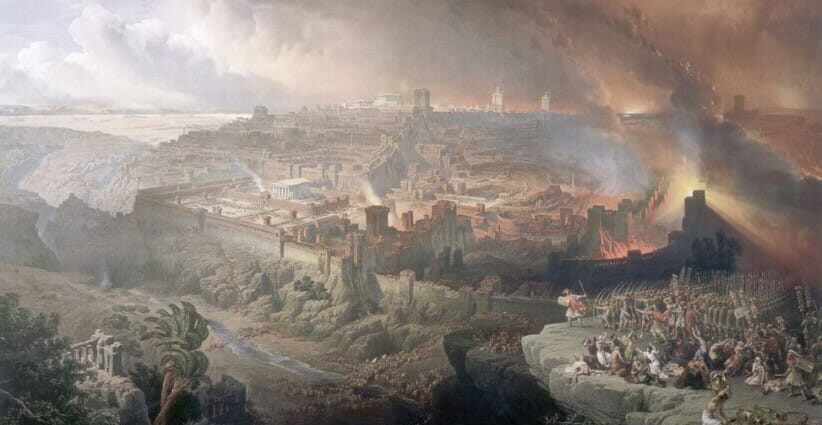
The destruction of both Temples would be linked to this ignominious “9/11” (Av is the 11th month in the Hebrew calendar), as were the final blow against Israel’s independence inflicted by the Romans at Betar, the expulsion of Jews from England in 1290, and the start of the Inquisition.

The rabbis wax poetic in assigning a litany of reasons that Jerusalem was leveled and the Temple destroyed. The Talmud in Shabbat quotes numerous sages: Abaye said: Jerusalem was destroyed only because people desecrated the Shabbat in it; Rabbi Abahu said it was linked to our deficiency in prayer; Rav Hamnuna said it resulted from the neglect of proper education for the children; Ulla said Jerusalem was destroyed only because people had no shame before each other; Rabbi Hanina said it occurred because people did not rebuke one another; Rabbi Yehuda said it happened because Torah scholars were disparaged.

Still other sources say that we judged others too harshly, failed to give them the benefit of the doubt, or failed to properly bless the study of Torah.

Perhaps the most famous indictment comes from Yoma, which cites the cardinal sins of adultery, immorality, and murder as responsible for the First Temple’s demise, while blaming sin’at hinam – baseless hatred – for the Second Temple’s destruction.

The little things

I want to suggest that while all of the above “big” reasons for these global catastrophes express the need to mend our ways and require us to make major changes in our behavior, there are other, seemingly “little,” things that we can more easily do to evoke God’s mercy and engender a reversal of the misfortune.

Susie and I recently returned from an extended tour of the Far East. Almost from the moment we arrived, we recognized subtle, yet powerful practices that positively affect those societies; practices that, alas, are rare – if not conspicuously absent – in our own country.

In Singapore, for example, laws are strictly adhered to. Drivers respect road signs, waiting patiently to move until the light turns green, and signal at all turns; they rarely, if ever, honk their horns. Certainly, you will never, ever see a motorized vehicle on a sidewalk, endangering the life and limb of pedestrians.

The streets are spotless; no one discards litter at will. In fact, there are no wastebaskets on the sidewalks; people will carry their trash for hours before finally discarding it at home. Spitting is punishable by law, and gum is neither sold in the country nor allowed to be brought in by tourists, lest it lead to dirtying the pavement.

In Japan, there is a concerted effort to respect the other person’s space. There is no eating on the streets, nor are there public displays of affection, such as hugging or kissing. Clothes, too, are modest; no outlandish or overly revealing clothes are worn in public.

There, the sounds of silence prevail: No one speaks in elevators; no one talks above a whisper in buses or on trains. Phones are on silent mode in all public places.

Tipping at restaurants in Japan and Korea is not only unnecessary; it can be considered an insult to the waiter, as it relegates him or her to the status of a servant rather than an employee carrying out his or her task diligently and in a dignified manner. In fact, a waitress may even chase after a customer, assuming the money was inadvertently left behind on the table by mistake.

Similarly, taxi drivers expect no added recompense for their services.

In Thailand, passersby will not ignore you; they will smile and bow their heads to anyone they see, placing their hands together to offer their blessings. Often, they will say “Kop kun,” thank you, even if you did nothing special for them.

All of this left a deep impression on me. How often are we, here in Israel, besieged by noise pollution? The honking cars, the screaming of parents at their children down the block, the yelling across a crowded restaurant or music concert to a friend. Do I really need to hear the guy next to me on the sherut mini-bus discussing the latest results from his urologist, or the teenager detailing her latest crush? Are people so hard of hearing that all their phone conversations must be on speaker mode? Does every inane TikTok video need to be shared?

And why must I deftly dodge electric bikes and motorcycles as I walk down the sidewalk, not daring to look at the scenery lest I be bowled over by a careless, crazed biker?

‘Kavod’ and ‘tzniut’

We have two Hebrew words that address all these situations: kavod and tzniut.

Kavod is the honor we must show to others, in the assumption that they want the same amount of consideration that we want for ourselves.

It is the honor that we give to the law when we abide by its rules, because all of us will want the law to protect us if and when it becomes necessary.

It is the honor we show to our city, because it reflects on all those who live there.

It is the honor we show our neighbors when we protect their property, as we hope they would do for us.

Tzniut has become associated with modest clothing, but it is much, much more than that.

Tzniut is respecting others’ space and maintaining peace and serenity – rather than engaging in cacophony and commotion – in open spaces.

Tzniut is the act of humbling ourselves by not believing that we are somehow better than others and so we can do whatever we like in their presence.

Every time we let the other person in the conversation finish his or her idea – without bursting in on them every few seconds – we signal that they have value, too, and that their point of view must be heard, even if ours must wait a bit.

These are the so-called little things that add up to a lot, the tiny “pieces of white” that erase the black habits that can darken our society.

If we want – really want – to rebuild the Beit Hamikdash (Sanctuary), then we must begin in our own dalet amot, our own small spaces, in the stores, the synagogues, and on the streets. It starts with us.

The writer is director of the Jewish Outreach Center of Ra’anana. rabbistewart@gmail.com

This post was originally published on here. 

We are living through an extraordinarily complex moment in Jewish history. The past three years have brought a mixture of triumph and tragedy, miracles and heartbreak. 

Nine months ago, we celebrated the release of hostages and allowed ourselves a measure of hope. Since then, we have ridden the emotional swings of a war whose end remains frustratingly out of sight.

And now we approach Tisha B’Av and confront its perennial challenge: How do we mourn authentically?

Mourning Tisha B’Av in the era of the State of Israel is deeply complex. Genuine mourning must be internal rather than performative. Reciting kinot and observing the day’s rituals are not enough unless they awaken a deeper sense of loss.

Yet we are living through one of the most remarkable periods in Jewish history. Even amid war, uncertainty, and sacrifice, we have witnessed extraordinary renewal. 

We have returned to our land, rebuilt Jewish sovereignty, and watched generations of dreams come to life. Even if the road has been difficult, we recognize that we are living through a chapter of Jewish history.

How, then, do we mourn the destruction of the Temple while also witnessing the unfolding of Jewish redemption?

A modern dilemma

This question has surfaced repeatedly over the past several decades in the debate surrounding the liturgy of Tisha B’Av. In the Amidah (the silent prayer), we recite “Nachem,” which describes Jerusalem as “desolate, in ruins, bereft of her children, with her head covered in shame.”

At first glance, that description hardly reflects Jerusalem today. Her head is no longer covered in shame but crowned by a flourishing skyline. She is no longer bereft of her children. Jerusalem’s real estate market reminds us that Jews are returning to the city in remarkable numbers.

For this reason, some have proposed modifying the wording of Nachem, while most insist that our liturgy should remain unchanged. Whatever one’s position in that halachic debate, it raises a broader question: How do we mourn Jerusalem while witnessing such extraordinary renewal?

The most recent tragedy

One natural response is to allow October 7 and the painful months that followed to shape our experience of Tisha B’Av. 

Those horrific hours and the months of war, loss, anxiety, and sacrifice have transformed Jewish life. For many of us, they provide the most immediate gateway into the emotions of Tisha B’Av.

Yet to focus solely on October 7 feels too narrow. As devastating as those events have been, they cannot exhaust the meaning of Tisha B’Av. Doing so risks reducing a day that spans thousands of years of Jewish history to the pain of a single generation. Tisha B’Av asks us to mourn not only our latest tragedy but the deeper fractures of Jewish history.

The long arc of Jewish history

One answer is to make Tisha B’Av a day to revisit Jewish history. It is a day to retrace its arc, reflect on our mission, and contemplate the price we have paid for representing God in this world. 

Tisha B’Av asks us not merely to mourn isolated tragedies but to absorb the sweep of Jewish history and the suffering that has accompanied our covenant.

It was never meant to unfold this way. History was meant to reach its destination in the year 2448. We were redeemed from Egypt, sustained by open miracles in the desert, and brought to the threshold of the Land of Israel. 

We were meant to enter the land, build a temple, and create a society that would reveal God’s presence to the world. Instead, through failures and betrayals, history was diverted from its intended course. 

We were exiled from our land and forced to pursue our mission from foreign shores. It was never an ideal setting for fulfilling our destiny.

That long exile exacted a terrible price. We endured persecution, discrimination, expulsions, and massacres. We were driven from Christian Europe and humiliated throughout much of the Muslim world. Again and again we built communities, only to watch them collapse in violence and hatred.

It is tempting to view those centuries as nothing more than a painful parenthesis in Jewish history, especially now that we have returned to our homeland. 

Tisha B’Av asks us to step out of our own moment of Jewish renewal and identify with the struggles, sacrifices, and hopes of those who carried the Jewish story through its darkest chapters.

But Tisha B’Av asks more of us than simply identifying with their suffering. It asks us to admire the extraordinary courage and quiet defiance with which they endured the impossible conditions of exile. 

They refused to disappear into the woodwork of history. Against overwhelming odds, they built communities, preserved Torah, and safeguarded our identity. Without their faith and resilience, the Jewish people might not have survived.

We owe those generations one day each year to step into their world. To see Jewish history through their eyes, to appreciate the courage with which they preserved our people, and to recognize that without their resilience we might not be here today. Tisha B’Av is our annual encounter with the generations who carried the Jewish story when it seemed it might end.

Rabbi Akiva’s smile

Yet if we are honestly retracing the long arc of Jewish history, we cannot stop with the suffering. We must also recognize the extraordinary moment in which we have been privileged to live.

The Talmud describes Rabbi Akiva walking through Jerusalem’s ruins after the destruction of the Temple. Jerusalem lay in ruins. His colleagues wept over the devastation. Rabbi Akiva shared their grief, yet he smiled. 

He understood that Jewish history unfolds differently from the history of every other nation. The disproportionate destruction Rome inflicted upon the Jewish people, compared to the fate of other nations, fulfilled the prophecies but also convinced him that Jewish history would not follow the normal course of history. 

If our destruction had been so disproportionate, our redemption would be equally disproportionate. If the first half of the story had unfolded, so too would the second.

Rabbi Akiva is speaking to us, granting us permission to smile, even on Tisha B’Av. That smile does not erase the centuries of suffering or diminish the trail of tears. It should never distract from mourning. Yet, if Tisha B’Av is a day to retrace the odyssey of Jewish history, we must reflect not only on destruction but also upon our astonishing restoration. Honest mourning requires us to remember both.

Rabbi Akiva smiled because he believed redemption would come. We smile because we have begun to witness it.

An unfinished redemption

And finally, Tisha B’Av carries a unique resonance precisely because we are living through an era of Jewish renewal. 

For the first time in 2,000 years, we sense that history is once again moving toward its intended destination. We have been privileged not merely to witness redemption but to participate in its unfolding.

Yet redemption remains unfinished. Every day we pray that our eyes should behold God’s return to Zion. Will we merit to witness that moment in our own lifetime or will it occur after our eyes close? 

We stand closer than any generation in centuries, yet so much of what we yearn for still lies beyond our reach. Precisely because we have come so far, we feel even more acutely how much is still missing. That, too, is part of the sadness of Tisha B’Av. 

The writer is a rabbi and educator at Yeshivat Har Etzion (Gush) in Israel. His latest book, Reclaiming Redemption, Vol. II: Faith, Identity, Peoplehood, and the Storms of War, is available at mtaraginbooks.com
This post was originally published on here. 

The FIFA 2026 World Cup affected Israeli consumers’ habits, as food delivery orders surged by 20% during match hours, with daily orders rising by an average of 7% compared to the month prior to the tournament, according to data released by the food delivery company Wolt last week.

Family pizza orders surged by 35% during the period, the most of any product. At the same time, burger orders increased by 27% compared to the pre-World Cup period, while ice cream orders increased by 44%.

Shawarma, sushi, and pad thai remained among the most popular delivery dishes ordered during the tournament. 

The Argentina-Egypt match saw the highest number of orders during the entire period, with about 57% placed before the round-of-16 match and 43% during the match. 

The World Cup quarterfinal between Spain and Belgium ranked second, with the semifinal between Argentina and England third by sheer number of orders.

Wolt data shows last-minute orders, surges

Wolt’s data analysis showed that although Israelis start scanning the site for orders an hour and a half before kickoff, the largest number of orders comes in just two minutes before the start of a given match. 

Snack orders rose by a significant margin, up to 40%, while plastic cutlery increased by about 26%.

Tel Aviv led the country in the total number of orders, though Eilat ordered more in later periods of the game.

This post was originally published on here. 

The U.S. Energy Information Administration (EIA) reported this week that U.S. gasoline inventories continued to decline while NYMEX gasoline futures climbed above $3.30 per gallon on Friday, signaling renewed pressure on fuel markets during the peak summer driving season. Combined with rising geopolitical tensions, tightening global fuel supplies and historically low domestic gasoline stockpiles, the latest government and market data point to increasing pressure on consumers and businesses as retail gasoline prices move back toward $4 per gallon nationwide.

The recent rise marks a sharp reversal from the brief period of lower fuel prices earlier this summer. Gasoline futures settled near their highest levels since late May after gaining more than 10% over the past month and more than 50% compared with the same period last year. Retail prices have followed the same direction, erasing much of the relief motorists experienced only weeks ago.

While crude oil prices have strengthened alongside renewed military activity involving the United States and Iran, the larger problem is no longer simply the cost of crude oil. The growing shortage lies in the availability of finished gasoline.

Government inventory data shows U.S. gasoline stockpiles have fallen to their lowest seasonal level since 2012, leaving approximately 14 million barrels below the five-year average for this time of year. During the busiest travel season of the year, those inventories provide very little cushion should additional disruptions occur.

Several developments have contributed to the tightening supply picture simultaneously.

Renewed instability surrounding the Strait of Hormuz, continued attacks affecting energy infrastructure, uncertainty involving global shipping routes and ongoing disruptions to portions of Russia’s refining network have all added new pressure to international fuel markets. Every interruption increases concerns that refined fuel supplies could tighten further before inventories have an opportunity to recover.

At the same time, refining economics continue favoring products other than gasoline.

Many U.S. refineries have directed greater production toward diesel fuel and jet fuel, both of which currently generate stronger profit margins. Strong international demand has also encouraged record exports of refined petroleum products, further reducing the amount of gasoline available for domestic markets. Although refineries continue operating at high utilization rates, the mix of products being produced has contributed to slower rebuilding of gasoline inventories.

That imbalance is reflected in the gasoline crack spread, the industry measure of refining profitability.

The spread has climbed to roughly $59 per barrel, its highest level in more than four years. A widening crack spread generally signals that gasoline itself—not crude oil—is becoming increasingly scarce. Even if crude production remains adequate, gasoline prices can continue climbing when refining capacity and inventories remain constrained.

For businesses across the Tri-State region, higher gasoline prices reach far beyond the fuel pump.

Every delivery truck, contractor vehicle, service van and commercial fleet immediately absorbs higher operating expenses. Transportation companies eventually pass those additional costs through the supply chain, increasing freight charges that ultimately affect wholesalers, retailers and consumers alike.

Distribution centers serving New York, New Jersey and Connecticut are particularly sensitive because virtually every product delivered to stores requires multiple stages of transportation before reaching consumers. Higher fuel costs gradually work their way into pricing across numerous industries.

The impact eventually reaches household budgets as well.

When families spend more filling their gas tanks, discretionary spending typically declines. Restaurant visits, entertainment, apparel purchases, home improvement projects and other optional spending often become the first categories consumers reduce. Large consumer companies have recently acknowledged that rising fuel costs are once again weighing on purchasing behavior as households become increasingly selective about where they spend their money.

The current market also highlights an important distinction between crude oil prices and gasoline prices.

Even if global crude supplies stabilize, gasoline prices may remain elevated until refining capacity, inventory levels and distribution networks return to more balanced conditions. Additional crude production alone cannot immediately resolve shortages of refined gasoline if inventories remain historically tight.

Looking ahead, several factors will determine whether pump prices continue climbing through the remainder of the summer. Markets will closely monitor developments involving the Middle East, the security of shipping through the Strait of Hormuz, refinery production levels, gasoline inventory reports released by the EIA, and the potential for hurricanes to disrupt refining operations along the U.S. Gulf Coast during the peak of hurricane season.

For now, the numbers tell a straightforward story.

With gasoline inventories sitting near fourteen-year seasonal lows, refining margins at multi-year highs, and geopolitical risks continuing to threaten global energy supplies, the gasoline market remains unusually vulnerable. Unless inventories begin rebuilding quickly or geopolitical tensions ease, motorists and businesses should expect continued volatility—and potentially higher prices—through the remainder of the summer driving season.

JBizNews Desk | New York

© JBizNews.com All Rights Reserved. Reproduction or distribution without written permission is prohibited.

Americans bought fewer groceries in June than they did a year ago — not fewer dollars’ worth, fewer actual things. Grocery units, meaning individual items sold, fell 1.8% in June from a year earlier, a sharp reversal from the 0.1% year-over-year growth recorded in June 2025.

That single number is the most honest read on the American household available right now, and it is worse than the price data suggests.

For four years, the grocery business has been carried by inflation. Volumes were soft, but prices climbed enough to keep overall sales growing, and the industry could tell itself that shoppers were still shoppers. That arrangement has now broken. Prices continue to rise roughly 2% to 3% year-over-year, but that inflation cushion is no longer enough to keep overall sales growing.  The math has flipped: people are paying more per item and going home with less in the bag.

The pressure did not arrive from one direction. Grocery prices sit roughly 33% above where they were in 2019, and fuel costs have spiked.  On top of that, many lower-income households have cut back after reduced SNAP benefits and tighter program eligibility.  A family absorbing all three at once does not write a letter to anyone. It puts the second package of chicken back.

What should worry the industry is who is trimming. This is not confined to households living check to check. Even upper-income consumers are looking at a large enough absolute dollar change that they start to feel sticker shock and begin shopping around,  according to Bain’s retail practice. When the shopper who never checked the unit price starts checking the unit price, the behavior tends to stick well past the conditions that caused it.

The suppliers have noticed. PepsiCo spent February cutting prices — Lay’s, Doritos, Cheetos and Tostitos all came down 15% — on the theory that cheaper snacks would bring volume back. It didn’t take. On the company’s July 9 call, chief executive Ramon Laguarta told investors the consumer was “worse than what we had anticipated,”  and put the blame not on his own shelf price but on the gas pump. Executives also pointed to lower effective pricing, meaning the company leaned harder on promotions as shoppers grew more price sensitive.

That is a company discovering that its problem is not its product. It is the $70 that left the household budget before anyone got to the snack aisle.

The retailers are running the same play. Walmart announced summer price cuts on beef, ice cream and other items, including products from PepsiCo, Coca-Cola and its own Great Value private label,  and retailers including Walmart and Kroger have leaned into price cuts and value promotions to pull shoppers in.  Grocers have been pushing suppliers to bring prices down  — which means the squeeze is now traveling backward up the chain, from the shopper to the store to the manufacturer.

For the tri-state independent grocer, the read is more pointed than it is for Walmart. A national chain can eat margin on beef for a quarter to hold traffic. A single-store operator in Brooklyn or Passaic cannot. When the shopper’s basket shrinks by two items, the store’s fixed costs do not shrink by anything, and the categories that get cut first — the impulse buy, the premium cut, the second box of cereal — are the categories carrying the margin.

There is also a signal here about what the summer’s price relief actually bought. Headline inflation cooled in June, and grocery inflation ran near 3% for the twelve months through June. Those are numbers a policymaker can stand behind. They are also numbers that describe the rate of change, not the level. A shopper does not experience 3%. A shopper experiences 33% above 2019, permanently, every Sunday, and adjusts accordingly.

The industry has spent two years waiting for the consumer to normalize. June suggests the consumer already has — just not to the baseline anyone was hoping for. The new normal is a smaller cart.

Watch the back-to-school window. It is the next real test of whether households have decided this is a temporary squeeze or a permanent budget, and unlike a snack purchase, it is not optional.

JBizNews Desk | New York

© JBizNews.com All Rights Reserved. Reproduction or distribution without written permission is prohibited.
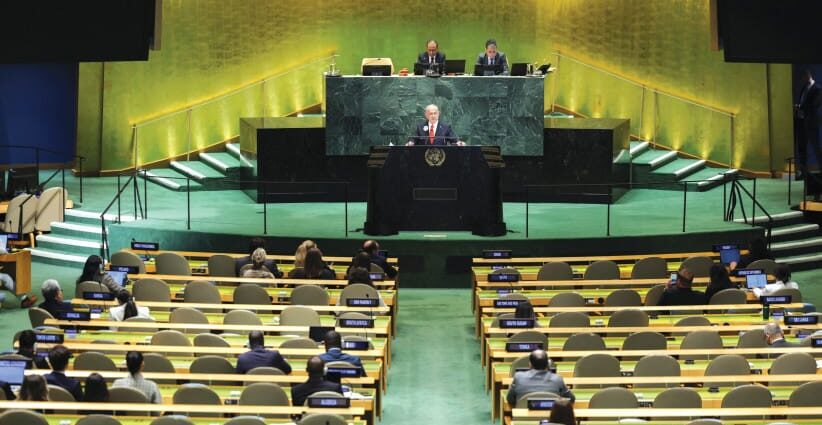
US Secretary of State Marco Rubio and Lebanese President Joseph Aoun discussed the implementation of the trilateral framework agreement between the US, Lebanon, and Israel during Aoun’s visit to Washington on Sunday.  

Rubio commended Aoun and the Lebanese government for their “determined effort to reclaim Lebanon’s sovereignty, disarm Hezbollah and dismantle its terrorist infrastructure, and move towards peace,” US State Department Spokesperson Tommy Pigott said.

Rubio also reaffirmed the US’s commitment to supporting Lebanon in implementing the terms of the trilateral framework and to the government’s efforts to secure a better future for the Lebanese people.

This is a developing story.

This post was originally published on here. 

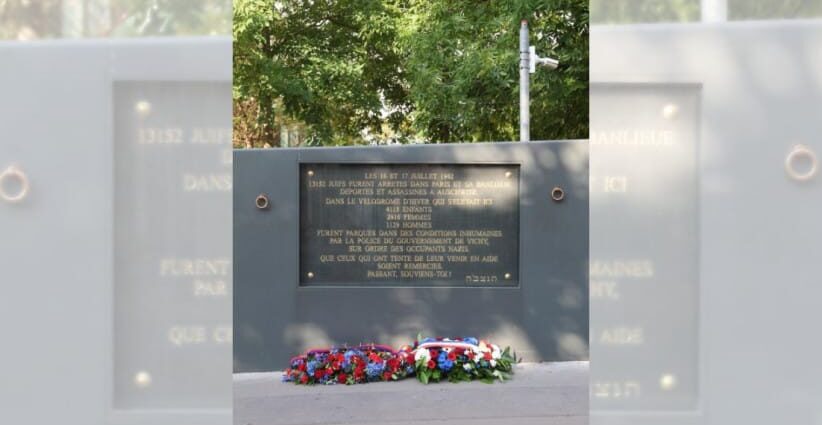
A commemorative plaque honoring a couple recognized as Righteous Among the Nations and their daughter, who saved a child during the Vel’ d’Hiv Roundup, was vandalized in central Paris last week.

The plaque, which honors Arsene et Angele Richard and their daughter Marcelle for saving the life of 13-year-old Edmond Rajchman, was broken down the middle and is now missing most of the words.

Paris Mayor Emmanuel Gregoire condemned the incident on Friday, saying “At a time when antisemitism is growing every day in our society, and on the eve of the weekend commemorating the Vel’ d’Hiv Roundup, I want to reaffirm my unwavering support for the Jewish community.”

‘Their memory remains undiminished’

“Paris is, and will remain, a city that stands against all forms of hatred,” he wrote.

“The fight against antisemitism will always remain an absolute priority of my political commitment,” he added.

“To attack the Righteous is to desecrate the entire universe,” said Alice Rufo, deputy defense minister. “The plaque will be restored. Their memory remains undiminished. In the face of antisemitism, in all its forms, the Republic will not yield an inch.”

What was the Vel’ d’Hiv Roundup?

The Vel’ d’Hiv Roundup, which took place on 16 and 17 July 1942, involved the mass arrest of 13,152 Jewish men, women and children (4,115 total) in Paris by French police. Most of the captives in Paris were taken to the Velodrome d’Hiver (Vel d’Hiv) in the 15th Arrondissement of Paris, near the Eiffel Tower.

The Jewish prisoners were kept in the Velodrome for five days, with no toilet, washing facilities or fresh air. Some were driven to take their own lives, and many were shot.

It was the largest roundup of Jews carried out in France during World War II. The number from the roundup alone represents more than a quarter of the 42,000 Jews deported from France to Auschwitz in 1942. The arrests were carried out with the assistance of 9,000 French police officers and gendarmes on the orders of the Vichy government.

“Faced with a criminal regime that sought to erase our national motto, the Righteous ensured its meaning and strength were preserved,” Gregoire wrote following the commemorative ceremony on Sunday. “They leave us with the ongoing imperative to combat all forms of hatred, racism, and antisemitism.”

The Paris Police said the “duty of remembrance is also the responsibility of pursuing with force and determination the struggle against all expressions of hatred.”

It called the destruction of the plaque “an unspeakable act” and said the police are working hard to identify the perpetrator or perpetrators “in order to bring them before the justice system.” 

This post was originally published on here. 

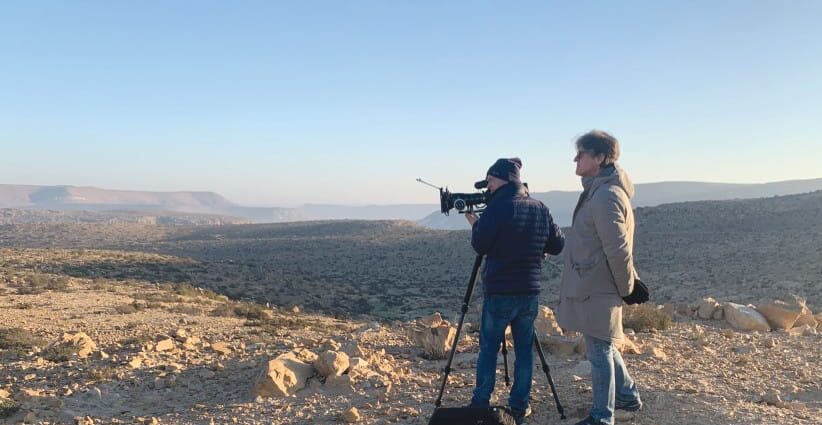
For decades, Richard Trank helped tell some of the most important stories in Jewish history.

As the Oscar-winning documentary filmmaker behind The Long Way Home and a long-time creative force at the Simon Wiesenthal Center, Trank chronicled the Holocaust, the birth of Israel, Zionism, and the lives of leaders from Theodor Herzl to Shimon Peres before making aliyah in 2025.

Yet despite spending much of his professional life documenting Israel’s story, he started his work from afar in Los Angeles.

A family shaped by Jewish survival

Born and raised in southern California, a son to first-generation immigrants, Trank grew up in the shadow of the Holocaust, though his childhood looked much like that of any other California kid.

His father, originally from Slovakia, escaped Europe just before the Nazi occupation of Czechoslovakia. One of his earliest Zionist memories was of an uncle making his way to Mandatory Palestine with the Hashomer Hatza’ir youth movement and helping build a kibbutz.

His mother, the child of Yiddish actors from Kyiv and Odesa who came to South Africa as Hitler was taking power in Germany, immigrated from Cape Town to Los Angeles in the early 1950’s.

One surviving uncle’s experience would later inspire The Long Way Home, the film that won Trank his Oscar in 1998. The documentary examined not only how Holocaust survivors endured the war, but how they rebuilt their lives afterward.

“I always wanted to tell the story of what happened after ‘they lived happily ever after,’” he said. “Because, in reality, that wasn’t necessarily the case.”

Discovering the power of Jewish storytelling

Although Richard Trank grew up in a community outside of LA, largely surrounded by non-Jewish peers, some of his most formative experiences came during summers spent at Camp Hess Kramer, a Jewish camp in Malibu.

“It was the only time of the year where, for a month or so, I was around all Jewish kids,” he recalled.

For Trank, those summers provided something he could not easily find elsewhere: a sense of belonging to a larger Jewish story in which Israel was central. Looking back, he sees them as an early connection to Israel long before he would begin making films about the Jewish state.

After high school, Trank attended the University of California, Berkeley, where he studied drama and history. Initially, he envisioned a career writing plays before turning to short stories and eventually enrolling in a graduate writing program at the University of Southern California. His goal was simple: to make a living as a writer.

Instead, he found his way into radio journalism.

A chance encounter would change everything.

At the time, activists connected to the Simon Wiesenthal Center were campaigning to remove statutes of limitations for Nazi war criminals in Germany and supporting efforts to identify and deport suspected Nazi perpetrators who had entered the United States. Trank became acquainted with several of the organization’s leaders and was fascinated by their work.

Recognizing the power of radio as a communication tool, they asked him to create a nationally syndicated Jewish public affairs program.

“I thought I would do it for a year or so,” Trank said.

Instead, it became a relationship that lasted more than three decades, one that would repeatedly bring him to Israel and immerse him in the story of the Jewish state.

One of the first projects was Echoes That Remain, a documentary about life in the pre-war shtetl, narrated by Martin Landau, directed by Arnold Schwartzman, the filmmaker who directed Genocide for the Wiesenthal Center and became a mentor to Trank.

Working alongside Schwartzman, Trank helped produce Liberation, a sweeping documentary chronicling the Allied liberation of Europe and the concentration camps. Narrated by Sir Ben Kingsley, it became the first production by a new division of the Wiesenthal Center, Moriah Films, dedicated to producing original documentaries about Jewish history and culture.

Those early projects laid the foundation for what would become one of the most influential careers in Jewish documentary filmmaking, eventually leading to films about Holocaust survivors, the founding of Israel, Zionism, and some of the most consequential figures in modern Jewish history, including The Long Way Home, narrated by Morgan Freeman, which won Trank his Oscar and along with Genocide, became the Wiesenthal Center’s second.

“I discussed it with Rabbi Marvin Hier, who founded the Wiesenthal Center… How do we tell the story without then getting involved with the intricacies of the Israeli-Arab conflict? That’s when we decided to open the film when the camps were liberated and close it when the State was declared,” he said.

The Oscar-winning film became the official documentary marking Israel’s 50th anniversary in 1998, a moment Trank described as deeply personal.

“It meant the world to me,” he said.

Discovering Zionism through Israel’s founding visionaries

As Trank’s career evolved, his focus increasingly shifted from Holocaust history to the story of Israel itself. What began as an interest in the aftermath of Jewish survival became a deeper exploration of the individuals whose ideas and leadership shaped the modern Jewish state.

“I loved making those movies because the history is fascinating,” Trank said. “It enabled me to be here in Israel a lot and become enmeshed in its story. I also began to see how many Jews outside Israel don’t really understand or appreciate that history. So, I felt like I was contributing something to change that.”

That conviction inspired a trilogy of sorts, films examining three of the most influential figures in modern Jewish history: Theodor Herzl, David Ben-Gurion, and Shimon Peres.

For Trank, the journey began with Herzl.

Surprisingly, despite Herzl’s towering place in Jewish history, no major documentary had been devoted entirely to the father of modern political Zionism. Trank set out to change that. Narrated by Ben Kingsley and featuring dramatic readings by Christoph Waltz, the film sought to introduce audiences to the man behind the movement.

The timing was significant. Trank had become increasingly concerned by efforts to distance people from the word “Zionism,” which was beginning to carry negative connotations in many circles.

“I thought it was insane,” he recalled. “One thing I learned from The Long Way Home was that the largest groups of Jews who survived the camps were people who had something to believe in – communists, religious Jews, and especially Zionists.”

To Trank, Zionism was not a slogan but a source of hope. It represented the belief that the Jewish people could reclaim agency over their future after centuries of persecution. Having seen how that belief sustained members of his own family and countless Holocaust survivors, he wanted audiences to understand what the term originally meant.

“How could you simply dismiss this word,” he asked, “when it helped people like my family survive?”

The film exceeded expectations. Released in 2012, it resonated with audiences around the world and introduced many viewers to Herzl’s own writings rather than contemporary interpretations of his legacy. Trank said people often emerged from the film with a completely different perspective on both Herzl and the Zionist movement. The movie’s premiere took place at the Tribeca Film Festival, one of the major film festivals on the international circuit.

The production itself revealed unexpected connections. During recording sessions, Christoph Waltz astonished the filmmakers by revealing that his children were Jewish and that his grandparents, actors in Vienna, had actually performed in plays written by Herzl decades earlier and staged at Vienna’s Burgtheater. For Trank, it was yet another reminder of how deeply intertwined Jewish history remains with broader European history.

One of the recurring voices in the documentary was Shimon Peres, whose reflections helped connect Herzl’s 19th-century vision to the realities of modern Israel. Peres had written a volume, The Imaginary Voyage, based on a dream in which he guides Herzl through contemporary Israel, showing him what had become of his vision. Trank found the concept profoundly moving and used Peres’s reflections to frame portions of the film.

As work on the Herzl film concluded, Trank turned his attention to another giant of Israeli history: David Ben-Gurion. He began researching a documentary on Israel’s founding prime minister, viewing Ben-Gurion as the practical architect who transformed Herzl’s dream into political reality.

But while production on the Ben-Gurion film was starting, something unexpected happened.

In December 2015, Trank traveled to the Peres Center in Jaffa to interview Shimon Peres, then 92, about Ben-Gurion. Peres was uniquely positioned to discuss him; he was one of the last living leaders who had worked alongside Israel’s founding prime minister.

During the visit, members of Peres’s staff posed a simple question: Why not make a film about Peres himself?

For Trank, the suggestion was irresistible.

“I would love nothing more than to make a film about Shimon Peres,” he remembered telling them.

When they raised the idea with Peres, the former president responded with characteristic modesty.

“Who would go see such a movie?” Peres joked.

Trank and Wiesenthal Center founder Rabbi Hier assured him there was a big audience for such a project.

“We convinced him to make the film,” Trank explained. “We told him it would be our greatest honor.”

The Ben-Gurion documentary was placed on hold. Instead, Trank embarked on what would become one of the most meaningful experiences of his career.

For eight months, he traveled from Los Angeles to Israel roughly once a month, spending one to two weeks at a time with Peres. The interviews ranged far beyond politics. Between takes, the two men discussed family, Jewish history, Israel’s future, and Peres’s lifelong belief in optimism and innovation.

“We finished our principal interviews around his 93rd birthday,” Trank recalled.

The plan was to accompany Peres on a lecture tour to China and continue filming. But just weeks later, before Rosh Hashanah, Peres suffered a stroke and died.

Overnight, the documentary changed from a biography into a tribute.

The resulting film, Never Stop Dreaming, became one of the definitive cinematic portraits of Peres’s life and legacy. Narrated by George Clooney and featuring interviews with world leaders including Barack Obama, Bill Clinton, George W. Bush, and Tony Blair, the documentary offered an intimate portrait of one of Israel’s last founding statesmen. 

Netflix acquired the film and made it a Netflix Original. It is one of the most popular documentaries on the streaming platform around the world and in Israel.

Looking back, Trank sees Herzl, Ben-Gurion, and Peres as three chapters of the same story. Herzl articulated the dream. Ben-Gurion built the state. Peres spent his life carrying that vision into the future.

From visitor to citizen

Although Trank often said that Israel was the only place outside America where he could imagine living, aliyah remained more of a dream than a possibility. His career and his children were in Los Angeles.

Nevertheless, the idea never disappeared.

But things changed in 2025. After more than three decades at the Simon Wiesenthal Center, Trank’s long career there came to an end. His 93-year-old mother had also passed away. His children were established in their careers and living on their own. For the first time, he had the freedom to ask a new question: What comes next?

He started by creating his own independent production company, Sea Point Films and Media. And he began looking for projects to develop and produce, stories like the ones he had been writing and directing for years. 

As he was considering which project to start work on first, he and his partner decided to spend an extended period living in Israel. Trank wanted to see if it was realistic to work from Israel and also to experience everyday life in the Jewish state.

“Every time she and I came here, there was always a sadness when we knew we had to leave,” Trank recalled. “This time, very soon after we arrived, we knew that we could easily work and live in a place we had only dreamed about.”

They made aliyah on October 8, 2025, the day the last hostages were released from Gaza.

This post was originally published on here. 

Plus, the CIA operative who helped the U.A.E. score an AI win, and Lionel Messi’s history with Spain.

This post was originally published here. 

For many Orthodox Jews, a typical winter weekday begins early: head to synagogue, gather in a minyan for morning prayers, then rush off to work. 

Orthodox Jewish groups say a bill that would make daylight saving time permanent could upend that routine by pushing winter sunrises, and the earliest permissible time for some prayers, an hour later.

Agudath Israel of America is among the groups urging the Senate to reject legislation that would make daylight saving time permanent nationwide, arguing that the change would create both public safety risks and significant challenges for Orthodox Jewish religious life.

The House passed the Sunshine Protection Act on Tuesday by a wide bipartisan margin. In a statement issued after the vote, Agudath Israel said it understood the appeal of ending the twice-yearly clock changes but opposed making daylight saving time permanent.

The Orthodox advocacy organization warned that permanent daylight saving time would push winter sunrises past 9 a.m. in some parts of the country, forcing many children to travel to school before dawn. It also said the later sunrise would make it difficult for observant Jews to attend morning synagogue services and still arrive at work or school on time, because Jewish law prohibits reciting key morning prayers before prescribed times tied to sunrise.

“The extension of DST will create an extreme hardship on observant Jews,” the organization said. “It would be extraordinarily difficult, if not impossible, to arrive on time for a job and will affect the start time of our schools.”

The Orthodox Jewish Chamber of Commerce argues that permanent Daylight Saving Time creates a workplace inclusion issue because many observant Orthodox Jews cannot begin their required morning prayers before the halachically permitted time, which is based on sunrise rather than the clock. If permanent Daylight Saving Time were adopted, winter sunrises would occur an hour later by the clock, delaying the earliest permissible time for Shacharit and making it difficult for those who pray with a minyan to complete services and commute to work before a standard 9:00 a.m. start. Unlike many other scheduling conflicts, this is tied to fixed religious requirements that cannot simply be moved earlier.

The Chamber contends that the result would force many observant employees to choose between arriving late to work, missing communal prayer, or compromising their religious observance, creating unnecessary barriers to maintaining a traditional 9-to-5 work schedule and fully participating in the workforce

Religious organizations come out against measure

The Orthodox Union and the Coalition for Jewish Values have also come out against the measure. 

In a column for Chabad.org that didn’t take a position on the bill, Menachem Posner also wrote that the change would present a challenge in parts of the country for morning minyan, the 10-person prayer quorum. But he also noted an upside to the extension of daylight saving: a later start time for Shabbat on short winter Fridays. 

Shabbat begins at sundown, which during the winter can fall before 4:00 p.m. in parts of the country. “With DST, however, this will be shifted one hour later, so that even on the darkest day of winter, Jews will have one more hour to prepare for Shabbat,” Posner wrote.

Orthodox parties in Israel have also made an issue of changes to the daylight saving calendar. In 2011, Prime Minister Benjamin Netanyahu’s cabinet unanimously approved extending daylight saving time until the first Sunday after Oct. 1, despite objections from haredi parties. The change brought Israel’s clock closer to European practice while still acknowledging Orthodox concerns about morning prayer and a later start time to Yom Kippur that they argued would make the fast more difficult.  

This week Agudath Israel also pointed to the brief U.S. experiment with year-round daylight saving time during the 1970s energy crisis, when Congress repealed the policy after widespread public dissatisfaction over dark winter mornings.

The organization said it hoped the Senate would weigh the broader consequences of permanent daylight saving time, including alternatives such as permanent standard time or retaining the current system of seasonal clock changes.

This post was originally published on here. 

BEIJING — According to Moonshot AI’s official announcement released Friday, July 17, Chinese artificial intelligence company Moonshot AI has introduced Kimi K3, a 2.8 trillion-parameter open-weight large language model, making it the largest publicly released open AI model to date and marking another major step in China’s accelerating push to compete at the highest level of artificial intelligence development.

The release positions Moonshot AI among the world’s leading AI developers as competition between China and the United States intensifies. Unlike many proprietary frontier AI systems that operate only through cloud-based services, Kimi K3 is being released as an open-weight model, allowing developers, enterprises, and researchers to build, customize, and deploy applications using the model.

The company said Kimi K3 was designed to perform advanced reasoning, software engineering, scientific analysis, mathematical problem-solving, long-document processing, and AI agent tasks. It also supports a context window of up to one million tokens, enabling users to analyze extensive documents, legal filings, research papers, books, and large code repositories within a single conversation.

Moonshot AI said the model was trained using a mixture-of-experts architecture that activates only a portion of its total parameters during inference, improving efficiency while maintaining high performance on complex workloads. The company stated the model is intended for both commercial and research applications and will be available for developers through open-weight distribution.

The launch comes as Chinese AI companies continue narrowing the gap with leading U.S. developers despite export restrictions on advanced semiconductor technology. Rather than focusing solely on closed commercial models, many Chinese firms have increasingly embraced open-weight releases that allow broader adoption throughout the global developer community.

Industry analysts view the announcement as another indication that China’s AI ecosystem is advancing rapidly across foundation models, enterprise AI, software development tools, and autonomous AI agents. Businesses evaluating next-generation AI platforms are expected to compare Kimi K3 alongside other leading models based on performance, deployment flexibility, cost, and security.

Moonshot AI has become one of China’s fastest-growing artificial intelligence companies and joins a competitive field that includes Alibaba, DeepSeek, MiniMax, and Baidu, all investing heavily in large language models designed for enterprise and consumer applications.

The introduction of Kimi K3 also follows China’s broader effort to promote open artificial intelligence collaboration and strengthen its position as a global AI leader. As governments and businesses increase investments in AI infrastructure, foundation models, and digital transformation, competition between Chinese and American developers is expected to continue accelerating.

While benchmark testing and real-world enterprise deployment will ultimately determine Kimi K3’s long-term impact, its release represents another significant milestone in the global race to build increasingly capable artificial intelligence systems.

JBizNews Desk | Beijing

© JBizNews.com All Rights Reserved. Reproduction or distribution without written permission is prohibited.

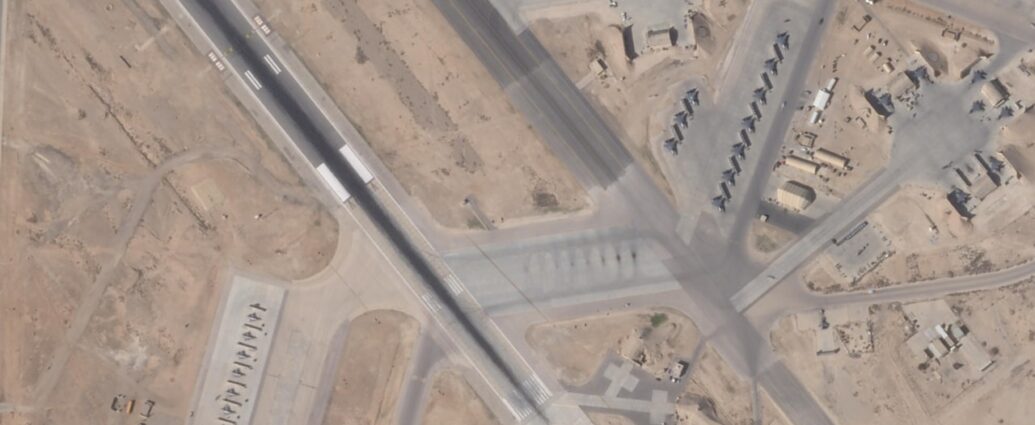
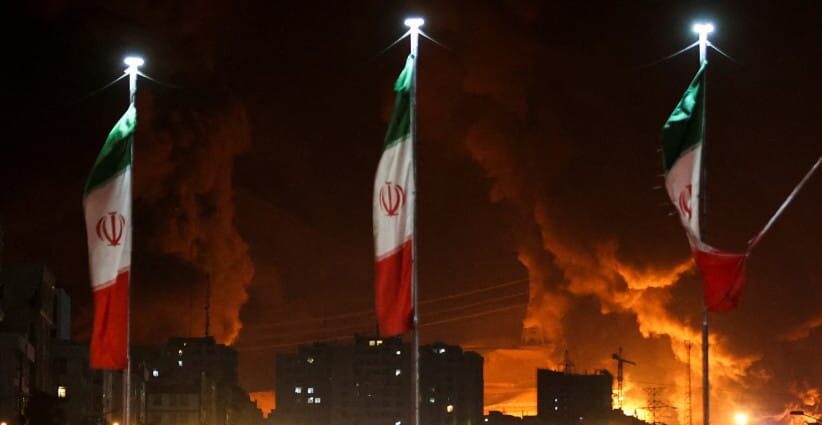
The available indicators suggest that, if the reported operational pattern reflects conditions on the ground, the United States has entered a new phase of its campaign against the Islamic Republic. 

The objective is no longer limited to degrading Iran’s military capabilities; it now appears increasingly focused on eroding the regime’s capacity to govern, sustain logistics, and finance its war effort.

The selection of targets – including bridges, ports, electrical infrastructure, and transportation networks – signals a transition from a conventional military campaign to a broader strategic effort aimed at disrupting the state’s ability to function.
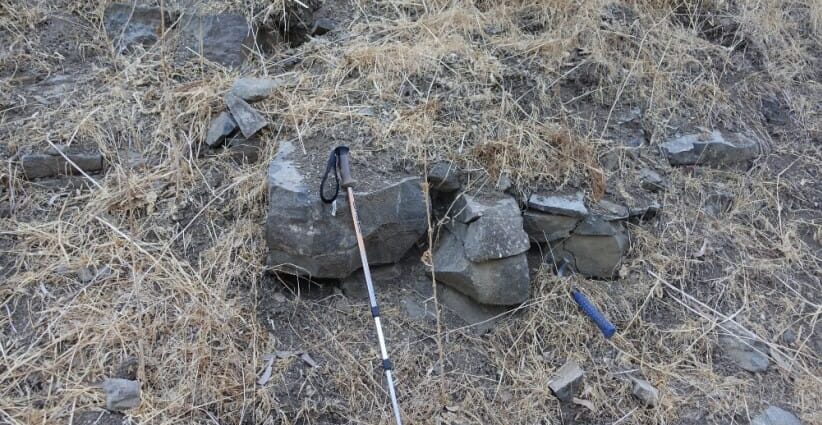
From an intelligence perspective, the evolving target set indicates that Washington has redefined the regime’s center of gravity. Missile bases and IRGC command facilities remain important, but they are no longer the sole priority. 
Oil export infrastructure, transportation corridors, southern ports, and the national energy network have become critical components of the campaign. 

Such a shift is typically observed when the objective expands from destroying military assets to increasing the adversary’s long-term strategic costs and reducing its capacity to regenerate military power.

Iran’s response, meanwhile, suggests that Tehran continues to rely on a strategy of widening the battlefield. Attacks or threats directed toward Qatar, Bahrain, Kuwait, Jordan, Syria, and maritime shipping routes appear intended less to secure military superiority than to impose political and economic costs on the United States and its regional partners while reinforcing deterrence. 

Nevertheless, these actions do not necessarily demonstrate strategic initiative; they may equally reflect the regime’s narrowing range of viable options.

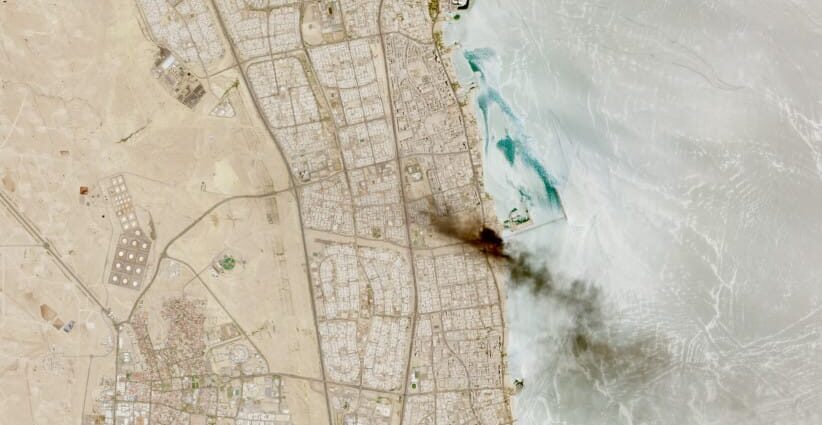
The most consequential variable in this conflict remains Kharg Island and the security of Gulf energy routes. Any sustained operation against Iran’s principal oil-export infrastructure, or any major disruption to maritime traffic, would transform the conflict from a regional military confrontation into a global energy and commercial shipping crisis. 

Financial markets are already beginning to price in that possibility as concerns over long-term supply disruptions continue to grow.

If this trajectory continues, the conflict will increasingly evolve into a campaign of strategic attrition, in which success will be measured not simply by the destruction of military targets but by each side’s ability to preserve the essential functions of government, economic resilience, logistical capacity, and political cohesion. 

Whether this process ultimately leads to negotiations, behavioral change, or a broader escalation remains uncertain.

Eventual collapse

From an intelligence standpoint, the probability of the Islamic Republic’s eventual collapse is higher today than at any previous stage, although neither its timing nor its pathway can be predicted with certainty. 

War damage, deteriorating infrastructure, mounting economic pressure, inflation, communication restrictions, and sustained domestic repression are collectively eroding the regime’s ability to govern while further weakening public confidence.

External military pressure alone, however, is unlikely to bring about regime collapse. History suggests that governments typically enter the final phase of systemic failure only when military and economic pressure converges with nationwide civil unrest, elite fragmentation, declining loyalty within the security apparatus, and the emergence of a credible political alternative.

As long as the coercive institutions remain cohesive and the leadership of the Islamic Revolutionary Guard Corps continues to view its survival as inseparable from that of the regime, Tehran may retain the ability to prolong its rule despite severe economic deterioration.

The decisive factor is not the destruction of military facilities but the gradual loss of the state’s capacity to govern. Should prolonged power outages, disruption of ports, declining oil exports, fiscal exhaustion, and the inability to finance state institutions persist, the regime’s relationship with its military establishment and regional proxy networks would inevitably weaken. 

At that stage, the Islamic Republic may still possess weapons, but it would increasingly lose the institutional capacity to administer the country, sustain its security apparatus, and reproduce political authority.

A plausible assessment is that, before reaching such a breaking point, the regime will likely intensify domestic repression, expand executions, tighten control over communications, militarize urban areas, and seek a limited diplomatic arrangement with Washington in an effort to buy time and ease economic pressure without fundamentally altering its ideological foundations.

The long-term trajectory of a politically exhausted and structurally weakened system points toward eventual collapse. Yet that collapse is unlikely to be immediate, automatic, or produced by military strikes alone. 

The decisive moment will emerge only when sustained military pressure, economic insolvency, nationwide public mobilization, fragmentation within the security establishment, and the central government’s diminishing ability to command and enforce authority converge. 

At that point, the Islamic Republic may still appear intact from the outside, while, in strategic terms, it will already have ceased to function as a viable governing system.

The writer is a Middle East political analyst. His book, Tehran’s Dictator, examines the theocratic era of Ali Khamenei (1989-2026). Follow him on X: @EQFard.

This post was originally published on here. 

Warning: This article contains content that may be disturbing to some readers.

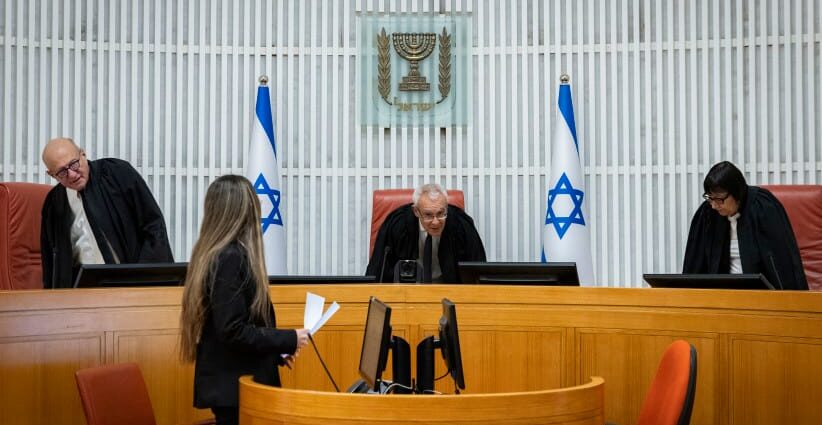
The Central District Court in Lod sentenced a man to 20 years and three months in prison on Sunday for committing acts of rape and sexual assault against his three-and-a-half-year-old daughter, as well as raping his then-wife while she slept.

The court sentenced him to 20 years for the offenses in the current case and ordered the consecutive activation of a three-month suspended sentence imposed in an earlier case in which he was convicted of assaulting and threatening the same woman.

The panel – Deputy Court President Ami Kobo and judges Merav Grinberg and Efrat Fink – also ordered him to pay NIS 150,000 in compensation: NIS 100,000 to his former wife and NIS 50,000 to their daughter.

“The case before us is exceptionally severe, even compared with other serious incest cases considered in case law,” the judges wrote.

The offenses against the girl were uncovered after her mother began to suspect that the defendant was sexually abusing her and installed hidden cameras in her home that could be monitored remotely.

The mother then arranged for the defendant to watch the child while she left the house. The cameras recorded him repeatedly committing sexual offenses against the girl while distracting her with his phone.

Mother’s resourcefulness, courage led to conviction of defendant

The court emphasized that the mother’s decision to create and monitor the situation did not place any responsibility on her or diminish the defendant’s responsibility for his actions. The judges later praised her “resourcefulness and great courage,” saying that her actions brought the offenses to an immediate end and prevented further harm to the child.

The defendant admitted the offenses against his daughter that were captured on camera at the beginning of the evidentiary stage of the trial.

He denied raping his former wife, but was convicted following a trial in which the court found her testimony credible and convincing and supported by corroborating evidence. The judges found the defendant’s testimony unreliable.

The court acquitted him of additional alleged indecent acts against the child that preceded the recorded offenses, finding that they had not been proved beyond a reasonable doubt. He was also acquitted of further alleged incidents involving his former wife that the prosecution failed to prove to the required criminal standard.

The three rapes of his wife took place between 2017 and 2019, while the couple was married. In each case, the defendant assaulted her while she was asleep. She awoke during the incidents and repeatedly confronted him and told him not to perform sexual acts on her without her permission.

The court said that sexual offenses committed within an intimate relationship were especially serious because they violated the trust and closeness on which such relationships were based.

“A woman’s right to autonomy over her body is not weakened in a relationship,” the judges wrote.

Prosecution requested defendant be sentenced to 30 years in prison

The prosecution asked the court to impose a total sentence of 30 years, arguing that the defendant’s admission concerning his daughter came only after he was confronted with unequivocal video evidence and that he had continued to deny and avoid responsibility for the offenses against his former wife.

The defense asked for a six-year sentence, arguing that the defendant had accepted responsibility for the offenses involving his daughter, expressed remorse, and was willing to undergo treatment.

The court set a sentencing range of 13 to 18 years for the offenses against the child and six to 10 years for the offenses against his wife. It rejected the defense’s request to depart from those ranges on rehabilitative grounds, noting that the defendant had not undergone treatment or a comprehensive sexual-risk assessment and continued to deny the offenses against his former wife.

His previous criminal record included a 2023 conviction for assaulting and threatening the same woman. The three-month suspended sentence imposed in that case was activated consecutively, bringing his total sentence to 20 years and three months.

Prosecutors said the lengthy sentence reflected the “extreme severity” of the offenses and the enormous harm the defendant had caused both victims.

This post was originally published on here. 

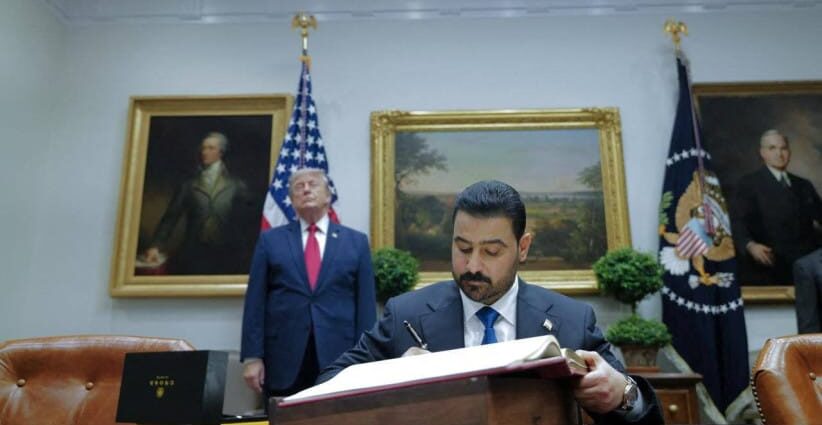
US President Donald Trump described the deaths of two US service members in Iranian attacks on Jordan as a “shame,” defending the recently renewed US-Iran hostilities during a phone call with the New York Post on Saturday.

Lamenting the loss of life, Trump told the New York Post that the service members “died because they don’t want to see Iran have a nuclear weapon and they don’t want to see the Middle East blown up.”

He added that he planned to contact the families of the service members, telling the New York Post that he “always” does.

US Defense Secretary Pete Hegseth described the soldiers as “heroes,” stating that their sacrifice will only stiffen the US’s resolve against Tehran in a Saturday X/Twitter post.

The Iranian ballistic missile and drone attacks that killed the two service members injured four additional soldiers and left another soldier missing, according to a statement released by US Central Command (CENTCOM) on Saturday. 

CENTCOM carries out strikes in retaliation for deadly strikes on Jordan

In response to the attack, CENTCOM stated that an eighth consecutive night of strikes against Iran was carried out.

US forces struck Iranian military coastal surveillance and air defense facilities, maritime capabilities, and missile and drone storage sites, in addition to targeting Islamic Revolutionary Guard Corps (IRGC) forces responsible for the deadly attack on Jordan.

In early March, shortly after the US began Operation Epic Fury, six US Army Reserve soldiers were killed during an Iranian drone strike on a command center in Port Shuaiba, Kuwait, marking the first US service members killed in the conflict with Iran.

This post was originally published on here. 

The IDF has killed at least around 420 Gazan terrorists since the October 2025 ceasefire, The Jerusalem Post has learned.

Given that Hamas reportedly has killed dozens or more of its own population since the ceasefire in order to retake control of all areas of the Gaza Strip where the Palestinian population lives and given UN estimates of around 1,000 Gazans killed, this means that at least since the ceasefire, the percentage of Gazans killed by the IDF has likely been less than 50% civilians.

This is not necessarily true for the entire war.

Gov’t, IDF have not published comprehensive figures on killing Hamas, PIJ terrorists in Gaza

While to date, neither the government nor the IDF have put out comprehensive numbers, from the numbers they have put out, it seems that from 2023-2024, civilians were likely at least 60% of those killed by the IDF, if not mid-60%, whereas from January 2025-October 2025, the percentage of civilians killed was likely substantially even worse.

Israel also had not agreed to the 1,000 number officially, but most Israeli officials have said that given how many Gazans may be under rubble, the total Hamas-UN numbers for the war, even if Hamas tried to exaggerate, may not be far off, with the main issue being that they do not account for how many killed are Hamas, and how many were killed by Hamas.

In terms of monthly breakdowns, according to partially official IDF data, the most Hamas and Palestinian Islamic Jihad terrorists killed since the ceasefire was May of this year at 57, while the lowest was June at 36, with an average in the 40s.

While some of the Hamas terrorists killed were high-level officers, some were low-level fighters trying to breach the Yellow Line.

In October 2025, the Yellow Line was 53% of Gaza, but now the IDF has taken around 70% to pressure Hamas to disarm.

This post was originally published on here. 

Social activist and IDF reservist Omri Ronen will not be allowed to return to service in the military, Defense Minister Israel Katz said in an X/Twitter post on Sunday.

“I will not allow the scourge of refusal to return to the ranks of the IDF – for any reason,” said Katz. “Zero tolerance for refusal.”

“I am determined to eradicate the phenomenon of refusal from the IDF, as I have done since the beginning of my term as Defense Minister,” he added.

Katz’s order, sent as a formal letter to IDF Chief of Staff Lt.-Gen. Eyal Zamir, came after comments Ronen made in an interview with NBC’s “Meet the Press” on Saturday, saying he would refuse reserve duty as a form of political protest.

Ronen, who joined the Democrats Party in February, is a leader of the Brothers and Sisters in Arms organization and has participated in protests against the government’s judicial reform. 

Ronen responded to Katz’s order later on Sunday, saying that the minister “has no shame.”

“The minister for promoting the draft evasion law, the deserter of fighters and the protector of deserters, is afraid that we will come to replace him,” responded Ronen. “We are the true servants of this country and those who are destroying it have no right to preach to us.”

Katz: Omri’s comments encourage refusal

According to Katz’s letter, Omri’s statement “effectively encourages refusal to serve and harms the IDF’s resilience,” underscoring the severity with which Katz views the matter.

“There is no place to summon for reserve duty anyone who publicly calls for failure to report for duty or refusal to serve, or who speaks out against military service and thereby harms the IDF’s values, cohesion, and operational readiness,” the letter continued.

The defense minister warned that the policy will be carried forward to future such cases, saying that the military “must remain outside political disputes, and serve only Israel’s security.”

Keshet Neev contributed to this report.

This post was originally published on here. 

Participants in the Nahala movement’s march to Gaza reached an agreement with the IDF on Sunday not to enter the strip, according to a statement released by the movement.

“The march will converge at the entrance to the Zikim beach and end with a lookout over the settlement of ‘Eli Sinai’ and the northern border of the Gaza Strip,” the statement said.

Demonstrators participate in a march to Gaza organized by the far-right Nahala settler movement, July 19, 2026. (credit: Via Walla)

The group added that it will call for “the immediate establishment of the settlements of Nissanit, Dugit and Eli Sinai.”

“We call on the public to continue to come in droves and take part in this historic process,” said the movement. “With God’s help, we will soon be able to establish the first settlements in the Gaza Strip – the heavens are marking the border!”

The statement noted the participation of “28 cabinet members, ministers and members of Knesset, alongside war wounded, fighters and bereaved families” in the march, alongside Israelis from “all over the country.”

Nahala founder and leader Daniella Weiss has been sanctioned by both Canada and the United Kingdom for her attitudes towards Palestinians.

Major Israeli political figures expected to attend the march include National Security Minister Itamar Ben-Gvir, Finance Minister Bezalel Smotrich, Communications Minister Shlomo Karhi, Economy and Industry Minister Nir Barkat, Heritage Minister Amichai Eliyahu, and Social Equality Minister May Golan.

In addition, MKs Limor Son Har-Melech (Otzma Yehudit), Almog Cohen (Otzma Yehudit), Simcha Rothman (Religious Zionist Party), and Zvi Sukkot (Religious Zionist Party) are also expected to participate.

IDF closes roads near Gaza border

The IDF closed several roads near the Gaza border earlier on Sunday in anticipation of the planned march, declaring the area a closed military zone until 8:00 a.m. on Monday.

The restrictions extend from the Yad Mordechai junction, west of Highway 34, to the Sha’ar Hanegev junction, and from there west of Highway 232 to the Kerem Shalom area.

As part of the closures, protesters are prohibited from entering the Gaza border fence area.

Previous Nahala Gaza marches

The Nahala movement has organized several similar marches towards Gaza since the October 7 attacks.

In a February march, 1,500 people gathered along the Gaza border to march toward the Strip and plant trees near the ruins of Nisanit.

The demonstration was condemned by the IDF, which deployed soldiers and Israel Police officers to the area to prevent the march from progressing into Gaza.

A separate Nahala march successfully crossed the Gaza border in December, with IDF soldiers returning the demonstrators to Israeli territory.

This post was originally published on here. 

Conditions at the stadium point to a near-ideal afternoon for an open-air championship. Temperatures are set to sit in the low 80s at kickoff under full sun, with essentially no chance of rain, light winds around 10 miles per hour and humidity near 55 percent — mild for mid-July in northern New Jersey. Air quality registers as moderate, with only the possibility of light summer haze, a marked improvement over the wildfire smoke that had drifted through the region earlier in the week. The high for the day tops out around 81.

That forecast is a relief for organizers who spent months bracing for the opposite. MetLife is open-air, seats roughly 82,500 and has no roof to shield players or spectators from heat or lightning. FIFPRO, the global players’ union, had flagged the stadium as a high-risk venue for heat during the tournament, and last summer’s Club World Cup at the same site offered a cautionary preview, with temperatures near 102 degrees and thunderstorms that forced delays. None of that is in play for the final. With dry, sunny conditions in the forecast, there is no expected threat of a lightning pause — the kind of stoppage that can upend the rhythm of a match and the choreography of a global broadcast.

The mid-afternoon start is a matter of business, not chance. FIFA set the 3 p.m. kickoff to land in European prime time — 9 p.m. across much of the continent and 8 p.m. in Britain — maximizing the worldwide television audience for the title match. Spain reached the final by beating France 2-0, while Argentina edged England 2-1, pitting Europe’s top-ranked side against South America’s best for the sport’s ultimate prize.

For the New York–New Jersey region, good weather is more than a comfort for ticketholders. The final caps a hosting run promoted as a major economic showcase, funneling visitors into hotels, restaurants, bars and transit on both sides of the Hudson. Most fans headed to the Meadowlands move through NJ Transit, with shuttle service running from Secaucus Junction to the stadium on event days — a system that flows far more smoothly when tens of thousands of ticketholders are not also contending with downpours. A dry afternoon eases the strain on that chain, from concourse crowds to the post-match transit surge, and supports the packed-house atmosphere organizers have been counting on.

The clear forecast also lifts the day for the hundreds of thousands expected in and around the region for related events, from the FIFA Fan Festival across the Hudson to watch parties throughout the metro area. Sunshine and comfortable temperatures are the conditions local businesses, hospitality operators and event planners had hoped for as the tournament reaches its climax on their turf.

Fans attending are still wise to prepare for a warm afternoon in direct sun. With an open-air bowl and mid-80s warmth on the field, light clothing, sunscreen and hydration remain the sensible call, and the moderate air quality is worth a glance for anyone sensitive to summer haze. But those are ordinary summer-day precautions, not the storm-and-heat contingency plans that once looked possible.

After weeks of uncertainty about what the sky might do on the sport’s grandest stage, the answer has landed in the region’s favor. The final between Spain and Argentina will kick off under clear skies and warm sun — a fitting backdrop for the biggest sporting event the New York–New Jersey area has ever hosted.

JBizNews Desk | East Rutherford, N.J.

© JBizNews.com All Rights Reserved. Reproduction or distribution without written permission is prohibited.

A heat wave hit Israel on Sunday and will be especially powerful during the first half of the week, the Israel Meteorological Service warned.

The weather will become unseasonably hot in the mountains and inland areas, and muggy along the coastal plain.

Heavy heat stress will prevail in many areas. At the moment, there is no end in sight for the upcoming heatwave.

Israel Meteorological Service Director-General, Dr. Amir Givati, forecast that the heatwave will persist next week at varying intensities.

High temperatures characterize entire Mediterranean region and southern Europe

The high temperatures will characterize the entire Mediterranean region and southern Europe over the coming days, but in western and central Europe, the heatwave will give way next week to more comfortable temperatures and even rain.

This post was originally published on here. 

Former Gaza hostage, Argentinian-Israeli Luis Har, is preparing for the World Cup final, in which Argentina will face Spain on Sunday night.

Har told 103FM about his love of soccer, his anticipation ahead of the major match, and the conversations he had about soccer with his Hamas terror captors in Gaza.

When asked whether he spoke with his captors about soccer, Har replied, “We spoke about it here and there, mainly about Lionel Messi.”

According to Har, one of his captors even updated him on the results of matches played while he was being held hostage.

“In December 2023, there was a match between Argentina and Brazil. Argentina won 1-0, and I know all of this only from one of the captors. All the information we received, for better or worse, came from him. But we must not forget, he was a Hamas terrorist, and he only told me what suited him.”

Soccer’s ability to create connection across ideological differences

Har also addressed soccer’s ability to create connections between people and communities.

“The influence of soccer on the public brings people together,” he said.

According to Har, that connection is also evident in the support he has received since returning to Israel.

“It reminds me what a wonderful people we have. The support I receive from people proves that the Jewish people are something incredible.”

When asked whether sports can bridge cultural and political divides, Har replied, “I am very optimistic and think sports can bridge divides.”

However, he expressed reservations about bringing political messages into sports venues.

“On the other hand, it disgusts me when politics or things like that are brought into sports, like what happened with the Egyptian national team coach who appeared with a Palestinian flag. I do not think that should be part of sports.”

Har later addressed the extremism that sometimes accompanies soccer fandom.

“I am against every form of fanaticism,” Har said. “Look at what just happened in Argentina following the victory and the goal. The entire country went outside, everyone. All of Argentina supports Argentina. But within Argentina, ask someone from Boca about River, and he will hit you,” he added with a chuckle.

Har was referring to Boca Juniors and River Plate, respectively – two of the largest and most successful teams in Buenos Aires, and fierce sports rivals.

Har held in Hamas captivity for 129 days

Luis Har was kidnapped from Kibbutz Nir Yitzhak on October 7, 2023, and rescued in a military operation in Rafah after 129 days in captivity. During the interview, he also addressed the fate of his captors.

“We were told they had all been killed,” he said. “It is almost certain that those who were around us, those who guarded us from the neighboring building or from downstairs, were eliminated immediately. They also threw a grenade toward us inside the house, and I think all the others were killed there.”

This post was originally published on here. 

Hezbollah’s attack on the Lebanese Army in Mansouri over the weekend was the terror group’s way of “hinting” that it would escalate if threatened, Eyal Zisser, Vice-Rector at Tel Aviv University and an expert in Hezbollah’s political strategy, told The Jerusalem Post on Sunday.

Lebanon’s Sgt. Maj. Ahmad Sami Khalil, from the village of Froun in the Bint Jbeil district, was killed on Saturday when a suspicious object exploded in an army vehicle, wounding an additional soldier and officer in the blast.

Located only a few kilometers north of the Yellow Line, initial reports published in Lebanon theorized that the blast had been an Israeli airstrike, a theory largely based on Israel’s targeting of Hezbollah infrastructure in the days leading up to the attack.

IDF confirms explosive was planted by Hezbollah

The IDF, however, confirmed that the explosive had been planted by Hezbollah, asserting that the IDF has not had troops in Mansouri recently.

“It should be noted that the Lebanese Army vehicle entered the Security Zone without prior coordination with the IDF, as required according to the existing coordination mechanism,” the military added.

Zisser said that the escalation would likely depend on whether there was an agreement between Beirut and Jerusalem, but said it was hard to predict how far Hezbollah would go.

Though the US brokered an agreement between Beirut and Jerusalem last month to see an Israeli withdrawal from the country and a disarmament of Hezbollah, reports have indicated that there are disagreements on the pace of Israeli withdrawal. Lebanese President Joseph Aoun is currently in Washington to discuss the issue and is set to present US President Donald Trump with a proposal to disarm the Iranian terror arm.

Hezbollah’s next actions will likely be decided when things are more concrete between the two countries, as right now they constitute “mainly talks, nothing real,” Zisser said. “If the Lebanese government takes action, in such a case, we should expect retaliation from Hezbollah, but what will it be?”

Hezbollah has previously gone as far as to assassinate a former prime minister

Zisser noted that Hezbollah has previously gone as far as to assassinate a former prime minister, Rafic Hariri, in 2005, and so “nothing should surprise us.”

Zisser said that there were only limited concerns of an immediate civil war, despite comments and threats from Hezbollah officials in recent months and the latest attacks, given that the terror group would only risk the action if the Lebanese military begins operating against them, “something that they don’t do right now,” or if Beirut and Jerusalem sign a peace agreement, which is “not on the table” yet.

The weight of undercutting Hezbollah and Iran by forming an agreement with Hezbollah should translate to Israel being “flexible” in any agreement with Beirut, he added, but stressed that national security should not be among the issues Israel concedes on.

“You need to give it a try to contain Hezbollah politically,” Zisser reasoned, explaining that military containment may be more difficult to achieve. With the support of the United States and Beirut, containing Hezbollah’s political influence might be worth making some sacrifices for.

Given that Hezbollah pursued a pause in fighting against Israel through Iran, and the now-defunct MoU with the US, “Hezbollah cannot complain” should the US-brokered deal be finalized, he explained.

He added that a ceasefire was “nothing,” as Hezbollah could simply break the agreement when it was ready, so it was “not important enough to go to war over.”

“Right now, it is in the interest of Hezbollah to maintain a ceasefire, and that nothing will happen. Actually, nobody can do anything about it (Hezbollah’s threat) because the Lebanese army is weak and is afraid of Hezbollah, and Israel has received orders from the White House,” he concluded. 

This post was originally published on here. 

The Islamic Republic’s judiciary has opened files against 300 Iranians accused of speaking with Iran International, the Manoto Network or individuals affiliated with the two diaspora media sites, the judiciary spokesperson announced on Saturday.

“So far, 300 members of these networks have been identified. Investigations into these individuals have been placed on our agenda, indictments have been issued against them, and the cases of these 300 people have been referred to Branch 15 of the Tehran Islamic Revolutionary Court,” the spokesperson confirmed.

The charges were said to include intelligence cooperation with the enemy; espionage for the enemy during wartime; moharebeh (waging war against God); efsad fel-arz (corruption on earth); encouraging and inciting people to violence and killing; destruction of public property; financing terrorism; propaganda activities against the people, against the Islamic system, and against Islam, in cooperation with the Zionist regime and the United States; and efforts to undermine and weaken Iran.

Multiple of the aforementioned sentences carry the possibility of execution in Iran.

Tehran has often been accused of restricting reporting on the human rights violations being carried out by the regime, with UN officials alleging that was one of the primary purposes behind the nearly three-month internet blackout in Iran. During the protests, human rights groups reported that tens of thousands were killed and tens of thousands more arbitrarily detained for assembling and demonstrating against the regime. 

Iranian authorities issue indictments against dissident media groups

The move comes weeks after Iranian authorities issued indictments against dissident media groups, alleging they had encouraged the nationwide protests in January.

Tehran Prosecutor Ali Salehi said the sites were being accused of “creating the conditions” for the unrest.

Former Manoto editor-in-chief Tina Ghazimorad told The Jerusalem Post’s Alex Winston at the time that the move was politically motivated, claiming it was “not a legal act” but “political intimidation.”

Alex Winston contributed to this report. 

This post was originally published on here. 

NEW YORK — New York City has unveiled one of its most significant housing enforcement initiatives in recent years, introducing 23 new policy actions designed to strengthen oversight of rental housing, increase compliance requirements for landlords, modernize housing enforcement, and improve transparency throughout the city’s rental market.

The plan follows months of public hearings held across all five boroughs, where thousands of tenants described concerns involving building maintenance, mold, leaks, pests, elevator outages, housing code enforcement, utility charges, and rental listing practices. City officials said the new initiatives are intended to improve housing conditions while modernizing enforcement tools and increasing accountability throughout the rental market.

Among the most notable business-related provisions is a new requirement that rental listings disclose when photographs or videos have been digitally altered or generated using artificial intelligence. The proposal is intended to provide greater transparency for prospective renters and establish clearer standards for online marketing of residential properties as AI-generated content becomes increasingly common within the real estate industry.

The initiative also calls for expanded enforcement against repeat housing code violators, modernization of property registration systems, improved inspection procedures, stronger oversight of fees and utility charges, and new technology designed to better track building violations across the city. Officials said enforcement efforts will utilize executive actions, agency rulemaking, legislation, and litigation where appropriate.

For New York’s real estate industry, the proposal signals additional compliance obligations for landlords, property managers, brokers, and residential building owners. Companies operating multifamily properties may face increased documentation requirements, more detailed inspection procedures, and expanded oversight of building maintenance and tenant communications as implementation moves forward.

The proposal would also increase scrutiny of property conditions by improving responses to heating complaints, elevator outages, residential fire hazards, mold, leaks, pest infestations, and other recurring maintenance issues. City officials said several inspection and enforcement procedures will be modernized to improve response times and create more consistent oversight across the five boroughs.

Real estate technology companies may also be affected as digital marketing standards evolve. Requiring disclosure of AI-generated or digitally enhanced listing images could establish one of the country’s most comprehensive transparency standards governing artificial intelligence in residential real estate advertising. As AI tools become increasingly integrated into marketing, leasing, and property management, the proposal could influence best practices well beyond New York City.

The package further outlines plans to improve public access to housing information through upgraded digital systems, modernized owner registration processes, and enhanced tracking of building violations. Officials said these improvements are intended to make compliance information more accessible while helping enforcement agencies identify repeat violations more efficiently.

The initiative arrives as New York’s multifamily housing market continues adjusting to higher operating costs, evolving regulatory requirements, and ongoing affordability challenges. Property owners, developers, lenders, investors, and management companies will be closely watching how the new policies are implemented and whether additional compliance costs affect future investment decisions across the city’s rental housing market.

While several of the proposals will require additional administrative action or legislative approval before taking effect, the announcement represents a significant policy shift that could reshape housing compliance, rental marketing practices, and landlord oversight throughout New York City over the coming years.

JBizNews Desk | New York
© JBizNews.com All Rights Reserved. Reproduction or distribution without written permission is prohibited.

The richest FIFA World Cup in history will culminate Sunday when Argentina and Spain compete not only to lift soccer’s most coveted trophy, but also for a record $50 million champion’s prize.

The 2026 tournament marked the first World Cup to feature 48 teams and 104 matches, prompting FIFA to increase its total financial distribution to a record $871 million. Of that total, $655 million is tied to performance-based prize money, with payouts increasing each round as teams advanced through the tournament.

HOW TO WATCH ARGENTINA VS. SPAIN: LIVE STREAM THE 2026 FIFA WORLD CUP FINAL MATCH

Beyond the performance-based prize money, every nation that qualified for the World Cup was guaranteed a significant financial windfall before kickoff. FIFA awarded each participating federation $10 million in qualification funding and another $2.5 million in preparation funding, along with additional contributions to help cover travel, logistics and delegation expenses.

That meant every country was guaranteed at least $12.5 million before kicking a ball, with the opportunity to dramatically increase its earnings by advancing out of the group stage and making a deep run through the knockout rounds.

Teams reaching the quarterfinals earned $19 million, while those eliminated in the Round of 16 received $15 million. Nations knocked out in the Round of 32 took home $11 million, and the 16 teams eliminated in the group stage each collected $9 million.

FOX ONE, USO TEAM UP TO BRING LIVE WORLD CUP GAMES TO US TROOPS OVERSEAS

Sunday’s winner will earn $50 million, while the runner-up will receive $33 million, meaning the championship match carries a $17 million swing in prize money.

The financial rewards have grown dramatically alongside the tournament itself. When Italy won the 1982 World Cup, the total prize pool stood at just $20 million and the champion earned $2.2 million. Forty-four years later, FIFA’s overall financial distribution has climbed to a record $871 million, while the champion’s prize alone has increased more than 20-fold to $50 million.

The United States, which reached the Round of 16 before falling to Belgium, earned $15 million in performance-based prize money.

GET FOX BUSINESS ON THE GO BY CLICKING HERE

The prize money is paid to each national soccer federation, which then determines how it is distributed among players, coaches and development programs according to its own policies.

The 2026 World Cup was also historic off the field, becoming the first tournament to be jointly hosted by three countries: the United States, Canada and Mexico.

This post was originally published here. 

WASHINGTON — According to the House Budget Committee’s Fiscal Year 2027 Budget Resolution approved Thursday, the committee voted 20-14 to advance a $95 billion reconciliation framework directing spending instructions to four House committees for national defense, intelligence, agriculture and election administration. The measure now heads toward a House floor vote this week, where it faces uncertain prospects amid opposition from Senate Republicans despite support from Speaker Mike Johnson.

Rather than appropriating money immediately, the 47-page resolution establishes reconciliation instructions that authorize designated committees to draft legislation carrying up to $95 billion in additional spending authority. The House Armed Services Committee received the largest allocation at $60 billion, followed by $13 billion for the House Intelligence Committee, $12 billion for the House Agriculture Committee, and $10 billion for the House Administration Committee, which oversees federal election matters. Those committees have until September 11 to produce legislative text.

Speaker Mike Johnson has branded the initiative the SAVE and Protect Act, while Republicans have internally referred to the effort as Reconciliation 3.0, making it the third major reconciliation package pursued during this Congress.

For businesses, the proposal represents a significant signal, although no contracts, grants or funding have yet been approved.

The largest implications center on the defense industry. While the resolution authorizes $60 billion for the Armed Services Committee, that figure falls below the administration’s earlier request for approximately $67 billion in supplemental defense funding related to the Iran conflict and remains substantially below the broader $350 billion reconciliation defense proposal connected to a projected $1.5 trillion national defense budget.

Earlier administration planning outlined approximately $21 billion for munitions replenishment, $17.3 billion for operational expenses, $12.1 billion for classified defense programs, $5.1 billion for cybersecurity and autonomous technologies, and approximately $2.4 billion for drone capabilities. None of those categories appear as binding allocations within the budget resolution itself. Instead, the House Armed Services Committee will determine how any eventual funding is distributed once reconciliation legislation is drafted.

For defense manufacturers, missile producers, cybersecurity firms, drone developers, logistics providers and military suppliers, the resolution establishes only the overall funding ceiling. The eventual committee legislation will determine which sectors ultimately receive procurement opportunities.

Agriculture also receives significant attention through a proposed $12 billion allocation intended to address financial pressures facing American farmers following higher transportation, fertilizer and production costs associated with the Iran conflict and continued disruptions affecting international shipping routes through the Strait of Hormuz.

Earlier federal planning contemplated economic assistance for crop producers together with disaster relief for agricultural businesses affected by severe weather. The budget resolution leaves the specific distribution entirely to the Agriculture Committee, which will determine eligibility, program structure and funding priorities during the reconciliation drafting process.

Election administration represents another potentially significant business opportunity. The proposal directs $10 billion to the House Administration Committee, with lawmakers expected to develop legislation addressing proof-of-citizenship requirements and related election administration initiatives.

The final legislation could ultimately involve investments in identity verification systems, election infrastructure, technology modernization, database integration and grants supporting implementation by state election agencies. Those details, however, remain subject to committee negotiations and future legislative drafting.

The political landscape remains highly uncertain.

Republicans currently hold a narrow 218-212 House majority, leaving Speaker Johnson with limited room for defections if Democrats remain united against the measure. Fiscal conservatives have questioned adding another $95 billion without corresponding spending reductions, while others argue the package is necessary to strengthen national security, support agriculture and modernize election administration.

The Senate presents an even greater challenge.

Several Republican senators have expressed reservations regarding both the size of the package and its overall fiscal impact. Because both chambers must ultimately adopt identical budget resolutions before reconciliation legislation can advance, negotiations between House and Senate Republicans are expected to continue throughout the summer.

Current plans call for committees to draft legislation during the August recess before Congress returns in the fall to consider the final reconciliation package ahead of the November midterm elections.

Speaker Johnson has personally led negotiations surrounding the proposal, including meetings with President Donald Trump at the White House and strategy discussions with House Republicans at Camp David, as leadership attempts to unify the conference behind the legislation.

For businesses involved in defense procurement, agricultural production, cybersecurity, election technology and government contracting, the budget resolution should be viewed as a roadmap rather than an award.

The funding instructions establish congressional priorities, but no contracts have been awarded, no grants approved and no procurement decisions finalized. Those outcomes will depend entirely on the reconciliation legislation drafted by the committees over the coming weeks and whether Congress ultimately approves a final package.

JBizNews Desk | Washington

© JBizNews.com All Rights Reserved. Reproduction or distribution without written permission is prohibited.

Attorney-General Gali Baharav-Miara told Government Secretary Yossi Fuchs on Friday that ministers must exercise restraint and consult the relevant ministry’s legal adviser before making non-routine decisions, after the Knesset dissolved ahead of the October 27 election.

The letter followed the Knesset’s overnight approval of an amendment to the Party Financing Law that included the dissolution of the 25th Knesset and provided for an election recess beginning Saturday. Sixty-two MKs supported the measure, with none opposed.

“There is no doubt that we are within an ‘election period,’” Baharav-Miara wrote, adding that the government had consequently become an outgoing government.

Although it will continue to serve until a new government is formed, its scope of action and the manner in which it exercises its powers are now different from those of an ordinary government, she said.

The letter does not impose a blanket freeze on government activity. Instead, Baharav-Miara reiterated the courts’ longstanding requirement that an outgoing government balances its duty to continue governing against the restraint required before an election.

‘The more urgent a government action, the less restraint required’

The more urgent and essential a proposed government action is, she said, the less restraint will be required. Decisions that are not urgent or necessary will face greater restrictions.

The precise limits cannot be set in advance and must be determined case by case, according to the nature of the power being exercised and the circumstances surrounding the proposed decision, she said.

The attorney-general cited concerns identified in High Court rulings that a government operating during an election period may prioritize “narrow party interests” over the public interest or create facts on the ground that could leave the next government facing an irreversible situation.

Accordingly, ministers and other authorized officials must conduct a preliminary examination with the legal adviser of the relevant ministry before making decisions that fall outside routine government administration.

Baharav-Miara said that detailed instructions would be distributed to government ministries in the coming days covering cabinet decisions, secondary legislation, appointments, government support, international agreements, and other fields.

She also asked Fuchs to ensure that legal opinions accompanying proposals placed on the agendas of cabinet and ministerial committee meetings expressly address the restrictions applying during the election period.

The potentially most consequential part of the letter concerns decisions already made in recent weeks.

Baharav-Miara noted that election-period restrictions can apply even before the formal dissolution of the Knesset or the official declaration of an election when it is already clear that an election is approaching.

She said that the recent political debate over bringing the election forward, together with the passage of a bill to dissolve the Knesset in its first reading, must therefore be taken into account when legally reviewing decisions and actions taken recently, as well as when those decisions are implemented.

‘Great change is on the way,’ removal Ben-Gvir’s first condition

The letter does not state that such decisions are automatically invalid or announce that they will be reopened. It does, however, indicate that their legality and implementation may have to be examined in light of the stricter standards applying during an election period.

The warning came three days after Deputy Attorney-General Gil Limon raised concerns over what he described as a “flood of draft resolutions” submitted ahead of the Knesset’s election recess.

In a letter also sent to Fuchs, Limon said the proposals included decisions carrying extensive budgetary implications and sought to transfer hundreds of millions of shekels for various purposes, according to Globes. The total amount brought for approval could have exceeded NIS 1 billion.

Limon said many of the proposals had been submitted without sufficient professional groundwork, a clearly established need, or the required legal review.

He warned that bringing the measures forward at the last minute could amount to an attempt to circumvent the restraint rules applying during the election period and prevent the necessary professional and legal work from being completed.

The government approved some of the proposals that morning, without Prime Minister Benjamin Netanyahu present and with relatively few ministers attending, and scheduled another meeting for later in the day, Globes reported.

The legal principles set out in Friday’s letter are not new. Baharav-Miara issued similar guidance when Israel entered an election period in June 2022.

The guidance issued at the time also distinguished between an “outgoing government” before election day and a “transition government” from the election until a new government is formed.

National Security Minister Itamar Ben-Gvir rejected Friday’s letter, writing, “I did not count you then, and I do not count you today.”

Ben-Gvir said that removing Baharav-Miara would be his “first condition” in the next term and told her to “start packing.”

“The great change is on the way,” he added.

The government previously voted to dismiss Baharav-Miara, but a seven-justice High Court panel unanimously annulled the government resolutions underlying her dismissal in December and ruled that she remained lawfully in office.

This post was originally published on here. 

The IDF‘s Iron Dome was used on Sunday afternoon to shoot down fragments of an Iranian ballistic missile fired at Jordan near the border with Israel after the US Aegis anti-missile system had already been used to shoot down the primary missile warhead.

As a result, interception fragments fell in northern Eilat, and there were no casualties, Israeli media reported.

Jordan’s military intercepted three missiles, with the Iranian attack resulting in no casualties or damage, Jordanian state media reported, citing a military official.

IDF sources told The Jerusalem Post that Eilat was not hit by any missile and that the military is reviewing whether some shrapnel fell within Israeli territory. At least initially, sources did not appear to be jumping to any retaliation for the potential low-grade indirect damage.

An additional IDF source told the Post that no missile fragments fell within Israeli territory despite media reports to the contrary.

This is the first time that Iron Dome has been used against an Iranian aerial threat since the April 7 ceasefire, which included Israel, kicked in.

Until now, despite the ongoing lower-grade aerial exchanges between the US and Arab allies on one side, versus Iran on the other side, no aerial threats from the Islamic Republic had come near Israel in over three months.

No signs of Israeli counterattack

Even this latest move was clearly aimed at Jordan, and not Israel, and there was no immediate sign that Jerusalem would respond with a counterattack.

However, minutes before the interception, the IDF issued a warning to southern areas near the border with Jordan that residents in that area should be ready to enter safe areas should fragments fall in Israel.

Jerusalem Post Staff and Reuters contributed to this report.

This post was originally published on here. 

Tehran-based singer Anita Papist was sentenced to 74 lashes for “offending public decency” by Branch 1088 of the Second Criminal Court at Tehran‘s Ershad Judicial Complex, the musician and Iran rights groups announced over the weekend.

Papist, who posts videos of herself online singing in both English and Persian without a head covering, confirmed that her passport was confiscated and her mobile phone blocked, punishments that the Iranian legal advocacy group Dadbaan said were “imposed solely for posting her artwork on social media.”

Dadbaan noted that singing and producing music are not themselves a crime, and said that the sentence against Papist was “in conflict with Iran’s international obligations in the field of freedom of expression, freedom of cultural activities, and the prohibition of cruel, inhuman, or degrading punishment.”

Iran cracks down on female singers

In recent months, the group said, Iran has cracked down significantly on female singers, even illegally taking control of artists’ personal social media accounts and publishing legal messages without their consent.

Papist, thanking her fans for being her voice, reshared an image made by one of her followers with tape over her mouth and the caption “every woman who creates with her art and deserves respect. Let’s stand with artists, not against them. No injustice.”

‘Obscene and immoral content’

Papist, insisting on her Instagram story that she was uninterested in claiming asylum abroad, said that she made her sentence public in support of Iranian singer Parastoo Ahmadi. Ahmadi, along with eight members of her production and music team, were ordered last month to be lashed 74 times by the Qom Provincial Criminal Court over allegations she offended “public decency through the production and publication of obscene and immoral content on cyberspace platforms.”

The “obscene and immoral content” was a video of Ahmadi singing a nationalist song without a hijab.

The court prosecuted them under Articles 638 of the Islamic Penal Code and 743 of the Computer Crimes Law, BBC Persian reported.

Article 638 of the Islamic Penal Code criminalizes the performance of any “open religious taboo” or acts that offend public decency, such as appearing without a hijab. Article 743 criminalizes the promotion or encouragement of corruption, prostitution, or acts deemed offensive to public morality via digital networks.

Iranian-American journalist and activist Masih Alinejad wrote in response to Papist’s sentence, “In the middle of a war, the Islamic Republic still finds time to flog this young woman for music. Anita Papist, a young Iranian singer, has been sentenced to 74 lashes. Her crime? Singing and uploading her video on Instagram.

“The regime confiscated her passport. Blocked her phone. Now they want to silence her voice. This is called gender apartheid. A total apartheid against women.”

This post was originally published on here. 

A record accumulation of airline reward points is helping power one of the busiest summer travel seasons on record, while transforming airline loyalty programs into some of the industry’s most valuable financial assets. Airlines now value outstanding customer loyalty points at approximately $38 billion, underscoring how credit card partnerships have become central to airline profitability and business strategy.

What was once viewed primarily as a customer rewards program has evolved into a multi-billion-dollar financial engine. Major airlines now generate billions of dollars annually by selling frequent flyer miles to banks, which in turn award those miles through co-branded credit cards. Every swipe of an affiliated credit card generates revenue for the airline, regardless of whether a customer books a flight.

The business has become so lucrative that airline executives increasingly factor loyalty program performance into major corporate decisions. Route planning, airport gate allocations, premium lounges, terminal expansion, and even international destination selection are now influenced by where an airline’s highest-value credit card customers live and travel.

JetBlue recently cited customer spending patterns from its TrueBlue credit card members as a factor in launching new service to Milan and Barcelona. Conversely, the airline also considered the number of co-branded credit card holders on certain routes when evaluating which markets to discontinue.

American Airlines has likewise intensified its efforts to expand at Chicago O’Hare International Airport, viewing the market as strategically important for growing its loyalty program and attracting additional credit card customers. Company executives have highlighted strong growth in new card signups in the Chicago market as a key business metric alongside passenger traffic.

Perhaps the clearest indication of the industry’s changing economics comes from airline-bank partnerships. Delta Air Lines disclosed that American Express is expected to pay the carrier approximately $9 billion this year for miles issued through Delta-branded credit cards, illustrating the enormous value financial institutions place on airline loyalty programs.

Those partnerships have also reshaped the customer experience. Airlines are increasingly reserving premium airport lounges, priority boarding, complimentary baggage, discounted award travel, and elite status benefits for travelers carrying co-branded credit cards. Several carriers have modified their loyalty programs so that credit card spending now plays a larger role than actual miles flown in earning elite status, further strengthening the connection between airline profitability and consumer spending habits.

The surge in reward point redemptions comes as airlines prepare for one of the strongest travel seasons in recent memory. American Airlines expects to operate its largest summer schedule ever, with thousands of daily flights serving millions of travelers as leisure demand remains robust despite higher airfares and broader economic uncertainty.

For investors, the trend highlights a significant shift in airline business models. Historically dependent almost entirely on ticket sales, carriers now derive substantial high-margin revenue from financial services partnerships. Industry analysts estimate airline loyalty programs can generate operating margins far exceeding those of passenger operations, providing airlines with a more stable source of income during periods of economic volatility.

For travelers, reward programs continue to offer significant value, particularly for those who accumulate points through everyday spending rather than frequent flying. At the same time, airlines continue refining redemption rules, premium benefits, and pricing models as loyalty programs become increasingly important to long-term corporate profitability.

The result is a fundamental transformation of the airline industry. Frequent flyer points are no longer simply a travel perk—they have become one of aviation’s most valuable financial assets, influencing everything from where airlines fly to how they compete for customers and generate billions of dollars beyond the sale of airline tickets.

JBizNews Desk | New York
© JBizNews.com All Rights Reserved. Reproduction or distribution without written permission is prohibited.

Israeli companies looking to expand globally should consider Australia as a launchpad, according to Paul Israel, executive director of the Israel-Australia Chamber of Commerce.

With a population of 28 million and a reputation for being an early adopter of technology, Australia offers companies the opportunity to build credibility before entering larger markets such as the United States, Asia, and Europe. If a company succeeds in Australia, it gains valuable validation. If it does not, it has the chance to refine its product and strategy before expanding into even bigger markets.

The IACC hosts, supports, and represents well over 1,000 corporate members annually, according to its website. It works to build synergy between Israeli and Australian companies and helps Israeli businesses integrate into the Australian marketplace and vice versa.

Paul Israel, executive director of the Israel-Australia Chamber of Commerce (credit: Julia Schwartz)

This year, The Jerusalem Post, together with the Central Synagogue of Sydney, will convene senior business leaders, investors, entrepreneurs, policymakers, philanthropists, community leaders, and innovators from Australia, Israel, and the broader Asia-Pacific region for a high-level, business-focused gathering designed to deepen ties between Australia and Israel. The conference will take place on November 19.

The summit is expected to include keynote speeches, high-level panel discussions, one-on-one conversations, sector-focused sessions, networking opportunities, and curated business meetings. Participants can expect a full day of substantive programming that combines thought leadership, business development, community engagement, and strategic networking. The event will focus on sectors where Israel and Australia share strong commercial interests and significant growth potential.

Australia is the world’s 12th largest economy by nominal gross domestic product (GDP), with an economy valued at approximately $2.12 trillion. Moreover, Israel noted that, when measured by GDP per capita, the country is the seventh richest in the world.

Much of Australia’s wealth is generated by its abundant natural resources and mineral reserves.

“When it comes to buying technology, Australia can afford to buy best of breed, and the reputation Israeli technology has of being reliable, robust, and top tier is very respected by Australian corporates,” Israel explained. He added that, for some of Israel’s largest high-tech companies, Australia ranks among their top five destinations.

Just think about the cyber industry. Australia is one of the most targeted countries in the world, and because of its time zone, it is often among the first to experience new cyberattacks. Because of those vulnerabilities, the country is constantly looking for the right technologies to protect its marketplace.

Already, major cyber companies such as CyberArk, Sygnia, Armis, Check Point, and others operate in Australia.

Israel added that Australia’s mining industry is another major opportunity for Israeli companies, as it is one of the largest mining sectors in the world.

“There’s a lot of technology used in these mines, which are just enormous,” Israel told The Jerusalem Post. “A lot of autonomous vehicles. They’ve got a lot of advanced communication, a lot of underground facilities, and therefore Israeli companies who have experience dealing with underground communication, difficult terrain, lack of water, can be a big part of the mining industry.”

But Australia is also looking to Israel to learn how to further develop its technology ecosystem. The country has some world-class universities that lead in research. However, when it comes to commercialization and development, Australia still has a long way to go before matching countries like Israel, Israel said.

“They say it’s a big R in Australia and a small D in R&D,” Israel concluded. “There is a lot of interest, not just in the actual technologies that Israel has to offer, but the culture of innovation and how to create ecosystems.”

To learn more about attending the event or becoming a partner, visit the conference website at www.jpost.com/Australia2026 or email conferencep@jpost.com.

This post was originally published on here. 

Assaf Machnes’s Where To? was a big winner when the prizes of the 43rd Jerusalem Film Festival were awarded on Thursday night.

It took top honors in the Haggiag Competition for Full-Length Israeli Feature Films, winning the Haggiag Award for Best Feature, presented with support from the Jerusalem Foundation, as well as prizes for screenplay and performance.

The festival awarded prizes totaling approximately NIS 1 million across its Israeli and international competitions, as well as its short-film, experimental-film, and industry programs.

The movie tells the story of a bond that forms between a Palestinian cab driver and a young gay Israeli, both of whom live in Berlin.

The feature-film jury, headed by Ukrainian director Sergei Loznitsa and which included movie critic Alissa Simon and producer/director Jorge Stamadianos, praised Where To? for portraying “what makes us human with remarkable clarity and deep sensitivity, transcending personal beliefs and cultural conflicts.”

‘Where to?’ takes grand prize at JFF

The film was produced by Tomer Mecklberg, Estee Yakov Mecklberg, Haim Mecklberg, Oren Rogovin, Guy Shani, Julia M. Müller, and Luis Singer.

Machnes received the Anat Pirchi Award for Best Script. The jury described his screenplay as “a simple and nuanced way to tell a complex story with humor and humanity.”

Ihab Salami won the Anat Pirchi Award for Best Performance for his role as the cab driver in the film. The jury called his work “a convincing, subtle, and truthful performance that takes us on a journey.”

In the Diamond Competition for Full-Length Israeli Documentary Films, the award for Best Documentary Film went to I Am Neo, directed by Yael Abecassis, an actress, and produced by Shlomi Elkabetz and Galit Cahlon.

The movie is about a boy who was critically injured as a young child and suffered brain damage, and how his parents chronicled their family’s journey.

The jury described it as “a fight for life that is touching, patient, and human.”

The GWFF Award for Best Israeli Debut Feature went to Yula Gidron’s Find Me, Okay? Produced by Jeff Hoffman, Hilla Medalia, and Maria Ionova, it tells the story of how Eden Yerushalmi’s family coped with her kidnapping and murder by Hamas.

The jury praised the filmmakers for having the “courage to confront and immerse viewers in the pain of a family that reflects Israeli society.”

JFF awards cinematographers, artists for 2026 films

Meidan Arama received the Aaron Emanuel Award for Best Cinematography for Hadas Ben Aroyo’s I Can’t Say No to Myself. The jury singled out the film’s “lively camerawork showing the modern reality of a young, urban, searching generation.”

The Aliza and Micha Shagrir Award for Best Editing went to Gal Rosenbluth for Amal. The jury praised the film’s “tension-building cutting that leads to an inevitable tragedy.”

Assaf Talmudi won the Yossi Mulla Award for Best Original Score for The Wedding Entertainer (The Tale of Moishe Badhan). The jury called it “a score that celebrates life.”

In the Diamond Competition for Israeli Shorts, whose jury consisted of journalist and president of the Israeli Film Festival of Paris Hélène Schoumann, director Or Sinai, and director Eliran Elya, the Diamond Award for Best Live Action Film went to Another Body, directed by Orit Fouks Rotem and produced by Daizy Films.

The second prize for a live-action film went to Fireworks, directed by Eily Freid and produced at the Sam Spiegel Film and Television School in Jerusalem.

The Best Animated Film prize, donated by Animation Israel, went to Saba, directed by Liron Topaz and produced by Lirit Rosenzweig-Topaz and Neko Films by Neko Productions.

Dar Zuzovsky received the Diamond Award for Best Performance for her role in Dylan Joseph’s Peppa the Great.

An honorable mention went to Larnaca, directed by Talia Tai Bitton and Gil Peled and produced at the Sam Spiegel Film and Television School.

In the Israeli Video Art and Experimental Film Competition, judged by Miri Segal, Irena Gordon, and Dvir Shaked, the Afterglow Award for Best Film went to Gadi Yampel’s A Pleasant Sail on Land.

Tal Elkayam received the Aliza and Micha Shagrir Award for Experimental Film for Krav Maga, while Natalia Ryss’s Dragon received a special mention.

The Jerusalem Pitch Point 2026 jury, made up of Tiina Lokk, Michel Zana, and Tom Shoval, awarded its grand prize for full-length films and works in progress to Three Days in Bangui, directed by Jonathan Gurfinkel and produced by Shemi Shoenfeld and Yoav Halevy.

The jury prize went to Leaving Gur, directed by Brachi Haisherik and produced by Tammy Cohen.

An Edit & DB Postproduction Grant was awarded to I Want to Tell My Story, directed by Tomer Heymann and produced by Leigh Heiman.

The Gesher Multicultural Film Fund Award for Best Short Script, together with an Edit & DB Studios postproduction grant, went to Acoustics. The film is directed and produced by Itamar Alcalay, who wrote the screenplay with Tami Ram-Kochman.

The jury for the award consisted of Hadas Ayalon, Ruth Diskin, and Amos Geva.

The Jerusalem Media Initiative Award for a Jerusalem-based filmmaker was presented to Omri Levy.

In the festival’s International Competition, the Nechama Rivlin Award for Best International Film went to German director Valeska Grisebach’s The Dreamed Adventure, a Bulgarian film about a woman’s journey to self-discovery.

The jury – Angela Schanelec, writer and director of such films as I Was at Home, But…; producer and director Lionel Baier, whose films include Stupid Boy and Another Man; and Nanako Tsukidate, a critic, independent programmer, and researcher in film history – praised the film’s direction and its handling of multiple themes.

“Borders, European identities, and interpersonal stories are all masterfully explored,” the jury said. “We congratulate the director on this film, which has truly impressed us.”

Karlis Arnolds Avots received the Best Performance Award for his role in Ulya.

In the International Debuts Competition, sponsored by GWFF, the award for Best International Debut Film went to 17, directed by Kosara Mitic. The film is a coproduction between North Macedonia, Serbia, and Slovenia.

A special mention went to Panda, directed by Xinyang Zhang and produced as a coproduction between Singapore, Hong Kong, and China.

In the Spirit of Freedom Competition, the Cummings Award went to Skateboarding is not for Girls, directed by Dina Duma. The film is a coproduction between North Macedonia, Belgium, Slovenia, and Croatia.

The jury members in this competition were Isaac Zablocki, senior director of the Carole Zabar Center for Film at the JCC Manhattan and the Israel Film Center, CEO and co-founder of ReelAbilities, and director of the Other Israel Film Festival; documentary director Roni Aboulafia, who made Daytrip, Escaping the Taliban and Honorable Men; and Nir Bergman, the director of such films as Broken Wings and Here We Are.

They praised the film for addressing difficult subjects while retaining humor, compassion, and vitality.

“It avoids easy answers, choosing instead to observe its characters in all their complexity, vulnerability, and strength,” the jury said.

The Chantal Akerman Prize for Experimental Documentary Film went to Silent Flood, directed by Dmytro Sukholytkyy-Sobchuk and produced as a Ukrainian-German coproduction.

This post was originally published on here. 

With hours left until the Sunday World Cup final between Spain and Argentina, several Israeli politicians expressed support for the Albiceleste, with Prime Minister Benjamin Netanyahu among the most prominent figures sharing messages in support of Argentina.

Netanyahu was gifted an official shirt from the Argentine national team by the Argentine Ambassador to Israel, Axel Wahnish, in a video the diplomat shared on Saturday on X.

“Israel is with Argentina,” read the post shared by Wahnish, while he also showed Netanyahu a message by Argentine President Javier Milei.

“Thank you for your generosity, because you are also a friend of mine. And I’m really happy to learn that you are supporting Argentina because of our friendship,” said Milei in the message.

“Javier, you are a real friend, a great friend. We support you, we support Argentina, in so many ways, including tomorrow,” said Netanyahu, and ended the message wishing good luck in the World Cup final.

“I don’t hide that I support Argentina, and I think most Israelis support Argentina because of Milei’s revolution in the relationship between our countries,” Netanyahu told Wahnish, and ended by chanting: “Vamos Argentina.”

Sa’ar, Danon, Smotrich among Argentina’s supporters

“How does the song go? ‘It’s coming home’? Yes, it is. It’s coming home to Argentina,” Foreign Minister Gideon Sa’ar published on Thursday morning, hours after the semifinal match between Argentina and England, and also cheered: “Vamos Argentina.”

UN Ambassador Danny Danon also published on X, celebrating Argentina’s win with another “Vamos Argentina” comment, and made the same post in Hebrew.

Finance Minister Bezalel Smotrich, who is banned from entering the United Kingdom, also posted on Instagram.

“I may not be able to enter the UK because I am destroying the idea of ​​a Palestinian state, but two goals have entered nicely. Javier, congratulations, my friend!”

National Security Minister Itamar Ben-Gvir shared a picture of Milei and Argentina’s star player Lionel Messi at the Western Wall and said: “We will love those who love Israel. Let’s go, Argentina.”

Finally, Transport Minister Miri Regev posted: “Congratulations to the Argentine people and my friend President Milei. Fingers crossed for you in the final!”

This post was originally published on here. 

The IDF missed an opportunity to purchase 12 advanced Apache attack helicopters from the US, Walla learned on Thursday.

This is despite pressure from the IDF Chief of Staff, Eyal Zamir, and flexibility on behalf of the US Department of Defense.

The IDF was supposed to submit a detailed Letter of Request to the US Department of Defense based on an approved budget by the Finance Ministry, authorizing a reservation of the helicopters as they were being produced. 

Initial delays by the IDF canceled the original production date, which was extended twice before the ultimate deadline passed.

Finance Ministry committed to locating funds, ran out of time

Military sources clarified that several discussions were held on the matter, and the Finance Ministry committed to locating budget sources, but time ran out due to “budget games.”

This would have been the first stage of a deal involving about 30 Apache helicopters, which are intended to help prevent future ground invasion scenarios at the country’s borders.

This post was originally published on here. 

As the hours pass and more American forces arrive in the Middle East, coordination between the IDF and US military will naturally tighten, “with the goal of shortening the time it takes to move from routine to emergency readiness,” a senior security official said on Sunday.

Another senior security official, who is familiar with the details of the talks with the US Department of Defense, said that at this stage, dozens of American refueling aircraft will be deployed across IDF bases and the Ramon Airport in southern Israel.

If the Americans intensify the strikes and expand the operational posture against Iran in a way that would require the transfer of an additional force package of refueling aircraft, they may land at Ben-Gurion Airport despite the agreement reached so far between the two nations.

Meanwhile, an Israel Air Force source told Walla on Sunday that 14 American military refueling aircraft arrived in Israel over the weekend against the backdrop of the escalation in the war with Iran.

As part of the buildup of American forces in the Middle East and Israel, the US military is redeploying F-35 aircraft from Britain and F-15 aircraft from Germany, including aircraft specialized in suppressing enemy air defenses and radars.

US operating over 20 warships, hundreds of aircraft to maintain naval blockade

The move is intended to “blind” the Islamic Revolutionary Guard Corps (IRGC), which has been working around the clock to recover its decimated abilities, including accelerating the renewal of production lines for surface-to-air and surface-to-surface missiles.

This is in addition to dozens of aerial refueling aircraft that support long operations against and over Iran.

It should be noted that, in order to enforce its naval blockade on Iranian ports and beaches, including the Strait of Hormuz, CENTCOM is operating more than 20 US Navy warships, along with hundreds of aircraft that are already dispersed among different bases across the Middle East.

Meanwhile, the US military and US Department of Defense are keeping the location of US special forces completely opaque, since their operations are defined as “highly secret.”

This post was originally published on here. 

Israel paid at least $50 million to US-based firms to help its standing with Americans, the Wall Street Journal reported on Saturday.

The report alleged that the Israeli government had retained at least six firms to help in its efforts to sway public opinion in the United States in its favor. It added that at least three dozen new people, many of them in the marketing industry, have registered as foreign agents for Israel

This comes as 42% of American adults hold an unfavorable opinion of Israeli people, and 69% hold an unfavorable opinion of the Israeli government, a July poll from the Pew Research Center found.

The WSJ reported that Israel’s 2026 budget to improve its image and global standing was set for over $700 million. In 2025, Israel’s Foreign Ministry received $150 million, on top of what it gets for its existing activities, for public diplomacy, or in Hebrew, hasbara.

Israel spends record numbers on Hasbara in 2026

That sum was more than 20 times what hasbara efforts have typically been allotted in past years.

But in 2026, the government allocated roughly $730 million, more than four times the sum allotted in 2025.

Quincy Institute for Responsible Statecraft researcher Nick Cleveland-Stout told the WSJ that Israel is on track to spend more than any other country on influencing US public opinion, based on funds disclosed to the US federal government this year.

In the past, nations such as Qatar spent around $400 billion to influence US public opinion, according to a June memo from the Foundation for Defense of Democracies. 

Notably, the WSJ report is also the latest accusation that former Trump campaign manager Brad Parscale has been hired to act on behalf of Israel.

According to the report, Parscale, who is now the chief strategy officer at Salem Media, was paid over $45 million to launch a series of campaigns by Israel to help boost its standing in the US.

Salem Media is a conservative Christian media conglomerate and is known for hosting conservative pundits such as Scott Jennings, Hugh Hewitt, and Lara Trump.

His contract involved the  “integration of narrative messaging into Salem Media Network properties and aligned distribution channels,” the WSJ reported. It was the largest contract that the WSJ reported on. 

Both Parscale and Salem Media had since said that they don’t pay their hosts, who are mostly known Israel supporters, to say anything specific about the Jewish state. They allege they used the money to buy more than half a million dollars’ worth of ads on the network.

“Our hosts have built their careers by saying exactly what they think, not by reading from someone else’s script,” the WSJ quoted Salem Chief Executive David Santrella as saying.

Israel courts conservatives to help influence Americans’ declining public opinions 

“The existential threat to Israel is misinformation, from any side,” Parscale was quoted by the WSJ as saying.

Last week, Time Magazine reported that Parscale ran a campaign denouncing the US-Iran ceasefire and

Under the deal between Havas, a global advertising agency, and Parscale’s Clock Tower X, Parscale’s group would produce “100 original pieces of content each month, with at least 80% aimed at Gen Z audiences across TikTok, Instagram, YouTube, and podcasts,” Time reported.

He also pledged to “amplify the campaign across social media” alongside the aforementioned deal featuring Salem Media, and would frame his overall effort as an “effort to combat rising antisemitism online.”

In fact, the WSJ reported that Parscale told Israeli officials during a 2024 business trip that companies he built were “probably the largest thing outside of Fox News to help fight misinformation and Jewish hatred.” 

Time reported that Parscale promised the campaign would produce “at least 50 million digital impressions per month, as well as influence how AI tools such as OpenAI’s ChatGPT, Anthropic’s Claude, and Google’s Gemini characterized Israel and the war.”

The WSJ also reported that part of Parscale’s contracts were launching artificial-intelligence-generated texts to thousands of US citizens under the guise of “sharing perspectives and educating people about the importance of the US-Israel relationship.”

The report added that Parscale’s AI bots have shared links to websites like Allyvia.org, which Parscale’s team built, to share information about the alliance.

The goal of the AI in the campaign was to deduce the biggest concerns US citizens have about Israel, combat them, and report the answers back to the government, Parscale said, according to the WSJ.

One Foreign Ministry source told Time that another aim of the campaign was to prevent any “young conservatives from turning against Israel,” which the ministry believed Parscale was uniquely capable of doing.

The former Trump campaign manager denied the report, and told Time that he had “never funded, organized, or participated in any effort to undermine President Trump – ever – including his Memorandum of Understanding (MoU) or ceasefire proposal.”

But beyond Parscale, the Israeli government is using several other firms to improve Americans’ opinions of it.

One group, Show Faith by Works, reportedly filed documents outlining plans to send pro-Israel messaging to around 4 million megachurch members and Christian college students in the American Southwest through a geofencing campaign, the WSJ reported.

Show Faith by Works said that it would show “positive associations with the Nation of Israel while linking the Palestinian population with extremist factions.”

In the planned $3 million campaign, the group intended to reach out to big names such as actor Chris Pratt or NBA player Steph Curry.

In a later email, the group’s founder, Chad Schnitger, told the WSJ that it had decided to go in another direction and would spend the money to build a mobile museum featuring a video.

The WSJ also mentioned that Israel or agents working on its behalf have paid influencers on the Right and Left to help bolster its public image, but haven’t mentioned paying for specific posts. The report noted that Christian influencers Stefanie and Caleb Rouse were paid $4,500 by a contractor for Israel in 2025 for “strategic marketing promotion,” but the couple refused to comment on the matter. 

While the next presidential elections are still years away, as America faces midterms in September, it is clear that Israel is fighting what could be considered an uphill battle to defend its most important alliance. 

This post was originally published on here. 

The meeting between US President Donald Trump and Iraq’s new prime minister, Ali al-Zaidi, was presented in Washington as the beginning of a different relationship with Baghdad – one centered on oil, investment and economic integration as the United States prepares to complete the withdrawal of its remaining forces from Iraq.

Behind the handshakes at the White House lie difficult questions: Can Iraq expand its ties with Washington without destabilizing its essential relationship with Tehran? Can new energy corridors through Iraq and Syria to the Mediterranean become part of a broader regional architecture designed to reduce dependence on the Strait of Hormuz?

President Trump has reportedly intensified pressure on Israeli Prime Minister Benjamin Netanyahu to begin redeploying Israeli forces from Syria and move forward with withdrawals from Lebanon, while suggesting that Syrian President Ahmed al-Sharaa could play a role in addressing the Hezbollah threat.

Taken together, the moves may reflect an American attempt to shift greater responsibility toward central governments in Baghdad, Damascus and Beirut while reducing direct US military involvement and, potentially, Israel’s territorial footprint beyond its borders.

Whether those governments are capable of exercising that authority remains far less certain.

Trump emphasizes Iraq’s role in oil partnerships

During the July 14 meeting at the White House, the US president praised al-Zaidi and emphasized Iraq’s oil resources and the expanding involvement of American companies. He said new oil partnerships were being formed and described forthcoming agreements as potentially among the largest of their kind.

Al-Zaidi presented the visit as the beginning of an economic partnership and reiterated that the remaining US forces were expected to leave Iraq by September 30. He also said that weapons should ultimately come under the exclusive control of the Iraqi state.

Days earlier, al-Zaidi had participated in events surrounding the funeral in Iraq of Iran’s late Supreme Leader Ali Khamenei. He then traveled to Washington despite reported Iranian pressure against making the United States his first foreign destination as prime minister.

According to Axios, which cited two unnamed US officials, Washington interpreted the visit as evidence of an emerging “Iraq first” approach and hoped al-Zaidi would move against Iran-backed armed groups. Yet his government emerged from an Iraqi political system in which Tehran-linked parties and armed actors retain considerable influence.

Laura Silvia Battaglia, a Middle East correspondent currently reporting from Baghdad, sees a strategic incentive for the new prime minister to move closer to Washington, even as she warns that the domestic balance of power will constrain him.

Battaglia told The Media Line that, in her view, if it were up to al-Zaidi, Baghdad would already have decided to chart its future with the United States rather than with Iran.

“This is because closeness to the United States means greater security, investment, the country’s reintegration into the global financial system, infrastructure, and a renewed strategic role as a corridor between the Gulf and the Mediterranean,” she said.

The difficulty, she argued, begins when that foreign-policy ambition encounters Iraq’s internal political system, where Iran-backed armed groups and their political allies retain substantial influence over security and government decision-making.

“Once back home, al-Zaidi will not have an easy life. The militias are pushing to preserve their role and to guarantee the continuation of Iran’s sphere of influence in the country,” she noted.

In practical terms, Battaglia said, those groups are likely to resist any attempt by al-Zaidi to curb their political power, bring their weapons under state control or weaken Iraq’s strategic ties with Tehran.

“Even if, in the best-case scenario, they were absorbed by the central government as secondary military bodies, their political demands would still be difficult to reject, especially considering that the Shiite bloc holds a majority in parliament,” she added.

Battaglia was referring to demands by Iran-backed factions and their political allies to retain influence over security policy, government appointments, state resources and Iraq’s relationship with Tehran. Their parliamentary strength, she argued, would make it difficult for al-Zaidi to bring their weapons fully under state control or sharply reduce Iranian influence.

Dr. Tallha Abdulrazaq, an independent analyst specializing in Middle Eastern politics and security who has written for outlets including TRT World and Middle East Monitor, disputes the idea that al-Zaidi’s arrival in Washington should itself be interpreted as evidence of a meaningful Iraqi strategic realignment.

“It’s not very significant,” he told The Media Line, arguing that similar pledges by Shiite Islamist politicians have repeatedly failed to materialize.

Although al-Zaidi is new to the political scene, Abdulrazaq said, his rise was enabled by the Coordination Framework, a Shiite Islamist bloc dominated by figures including Nouri al-Maliki, whom he described as Iran’s principal ally in Baghdad. He added that President Trump had alluded to Maliki when saying he did not want him back in power and argued that Maliki’s support for al-Zaidi carries clear implications given Maliki’s ties to Tehran.

For Abdulrazaq, the underlying assumption that Baghdad is attempting to escape Iranian influence is itself questionable. He asserted that almost everyone holding political power in Iraq today has links to Iran and that many were empowered following the US-led invasion in 2003.

“There’s no getting around this reality, and the attempts of making the Green Zone politicians appear to be reluctantly under Iran’s thumb when in actual fact they are willing participants [show] how poor the understanding and analysis of Iraq has been for almost a quarter of a century since the invasion,” he said.

John Keith King, founder of Q Advisory, offers a more intermediate assessment. Rather than interpreting the moment as a decisive Iraqi move from one camp to another, he sees the possibility of a gradual diversification of Baghdad’s relationships.

“The Trump-al-Zaidi meeting is significant, but it should not be interpreted as Iraq abruptly changing sides. It signals an attempt to redefine the US-Iraq relationship around investment, energy, trade and Iraqi state sovereignty as the American military presence is reduced.”

King said Washington clearly sees al-Zaidi as a potential partner in limiting Iranian influence, particularly by strengthening legitimate Iraqi institutions and bringing weapons under state control.

“The real test, however, will be whether the agreements reached in Washington produce measurable changes inside Iraq,” he told The Media Line.

Baghdad can rebalance its relationships, King said, but it cannot realistically separate itself completely from Tehran. Iran’s influence is embedded in Iraqi political parties, commercial networks, religious relationships and powerful armed organizations, while the two countries share a long border and substantial economic ties.

In his view, a successful Iraqi strategy would rely on diversification rather than confrontation: expanding relations with the United States, Turkey, Europe and the Gulf states while maintaining a functional relationship with Iran.

“Attempting to force Iraq into an exclusively anti-Iranian alignment could destabilize the country and weaken al-Zaidi,” he argued.

The pipeline proposal

At the center of the economic discussion is Iraq’s geography.

Recent disruption in and around the Strait of Hormuz has again exposed the vulnerability of countries whose energy exports depend heavily on the waterway. Saudi Arabia and the United Arab Emirates already possess routes allowing at least part of their exports to bypass the strait. Iraq, by contrast, remains heavily dependent on its southern outlets and is examining additional export routes.

US envoy Tom Barrack has held discussions with Iraqi and Syrian officials, as well as companies including Chevron, over reviving the long-defunct Kirkuk-Baniyas pipeline, which would carry Iraqi crude from the Kirkuk region through Syria to the Mediterranean port of Baniyas.

Other options are also under consideration, including a new route from southern Iraq through Haditha that could branch toward Syria, Turkey or Jordan. President Trump said during al-Zaidi’s Washington visit that major new oil agreements would soon be announced.

The projects remain under discussion and would require substantial investment, security guarantees and political coordination before they could provide meaningful alternative export routes.

In Battaglia’s reading, oil pipelines and a possible revival of the Hejaz Railway could help Iraq position itself not simply as an oil producer but as a geographical bridge linking the Gulf to the Mediterranean, provided political and security conditions allow it.

King also sees strategic potential in the pipeline concept but cautions against overstating how quickly such infrastructure could transform regional energy flows.

“The Hormuz crisis substantially increases Iraq’s strategic importance because Iraq can potentially provide energy routes to the Mediterranean that do not depend on the Strait. The pipeline through Turkey offers the more immediate option, while a revived route through Syria could provide additional long-term resilience. However, pipelines through Syria will require significant investment, physical security, political agreements, and dependable infrastructure. They cannot replace Iraq’s southern export capacity overnight,” he said.

For King, the importance of the project goes beyond energy.

“The Iraq-Syria pipeline should be understood as both an energy-security project and a geopolitical instrument. Economically, it would diversify Iraqi exports and reduce vulnerability to disruptions in Hormuz. Strategically, it could connect Iraq more closely with Syria, Turkey, Gulf investors and Western markets while diminishing Iran’s ability to exploit regional chokepoints,” he said.

Yet King warned that presenting the infrastructure too explicitly as an anti-Iranian project could threaten its viability. The pipeline must remain commercially credible and Iraqi-led, he said. If it is portrayed primarily as an American weapon against Tehran, armed groups could target it, and Iraqi political support could quickly disappear.

Abdulrazaq is more skeptical about describing Iraq as an alternative regional energy corridor.

“Theoretically, yes. But practically, no. Iraq is not really an alternative energy corridor at all, as it can only ship its own oil to Syria and Turkey; it has no influence on international oil shipping routes,” he said. “The reason for this is that (a) Iraq’s only access to the sea depends on Hormuz itself and (b) for countries like Saudi Arabia to start pumping energy through Iraqi territory and beyond, they would need to trust that Iraq is no longer under the thrall of Iran, the country that’s been bombing them since the end of February.”

He viewed that prospect as extremely unlikely, arguing that Iranian influence is too deeply embedded in Iraq for neighboring states to ignore, regardless of Baghdad’s public statements.

Abdulrazaq said reducing reliance on the Strait of Hormuz is not only a US policy objective but also a priority for Iraq and, in some respects, Iran. He maintained that Iran has long used Iraq as a sanctions-evasion channel, while the US Treasury routinely targets Iraqi entities accused of conducting business for Tehran and the Islamic Revolutionary Guard Corps.

No party benefits if Iraq loses access to its primary source of economic growth, Abdulrazaq argued. With a “vanishingly small private sector,” an oversized public sector, limited industry and innovation, and near-total dependence on energy exports, Iraq is especially vulnerable to disruption.

“If those go down, and Iraq goes down with it, everyone from the US to Iran loses out,” he said.

The pipeline debate reveals the contradiction at the center of Iraq’s geopolitical position. Infrastructure could give Baghdad greater strategic flexibility, but it would have to cross a political environment in which competing regional powers, armed groups and domestic factions retain the capacity to obstruct it.

From Iraq to Syria and Lebanon

The emerging American approach is also increasingly visible to Iraq’s west.

President Trump has pressed Netanyahu to begin redeploying Israeli forces from Syrian territory and to proceed with withdrawals in Lebanon. According to US and Israeli officials cited by Axios, the US president told Netanyahu that the Israeli presence in Syria was generating tensions and could produce further escalation.

Netanyahu emphasized Israel’s demand for security zones along its borders as Lebanon and Israel advanced a separate US-brokered process. Under the June 26 framework, the parties agreed to establish “pilot zones” involving the deployment of Lebanese state forces, the disarmament of armed groups in those areas and the progressive withdrawal of Israeli troops.

Following the latest negotiations in Rome, US officials said the two sides had agreed on the structure and guidelines for beginning implementation, although fundamental disagreements remain over Hezbollah’s weapons and the timetable for an Israeli withdrawal.

President Trump has repeatedly suggested that al-Sharaa’s government in Syria could help “take care of” Hezbollah, arguing most recently that Syrian forces could act more precisely than Israel. Al-Sharaa, however, has publicly rejected military intervention in Lebanon and said Syria intends to remain outside the wider regional war.

“Trump’s request for the withdrawal of Israeli troops from Lebanon and Syria is an attempt that reflects the conditions and recommendations of the Gulf countries, but it does not align with the strategy pursued so far by the messianic Israeli right in power in Tel Aviv. Even if there is a formal withdrawal, the IDF will find other ways to re-enter the picture in those border areas over the medium term,” Battaglia noted.

King argues that an Israeli withdrawal from Lebanon should remain the objective but cannot be separated from the question of who controls the territory and weapons after Israeli forces leave.

“A complete Israeli withdrawal from Lebanese territory should remain the diplomatic objective because Lebanese sovereignty cannot be strengthened while foreign forces retain positions inside Lebanon. However, withdrawal should be coordinated with verifiable security arrangements, deployment of the Lebanese Armed Forces and concrete steps to establish the Lebanese state’s exclusive authority over weapons,” he said.

His assessment of al-Sharaa’s potential role is more limited than the one repeatedly suggested by President Trump.

“Ahmed al-Sharaa’s government can help secure Syria’s borders, exchange intelligence and disrupt weapons trafficking. It should not be encouraged to conduct a military intervention inside Lebanon, which could revive historical fears of Syrian domination and inflame sectarian tensions,” King said.

Abdulrazaq similarly argues that Hezbollah ultimately must be addressed internally, while warning that continued Israeli military operations can make it politically harder for Lebanese or Syrian actors to confront Iran-aligned groups.

“The Hezbollah problem has to be resolved locally and by local actors. Israel’s presence simply makes matters worse and more volatile, and it delegitimizes local actors who could otherwise handle the threat. Right now, the Lebanese government and armed forces are being described as ‘Zionists’ in Iran-sponsored strategic messaging from Hezbollah media outlets linked to the IRGC. The same applies to Syria,” he said.

Taken together, the developments point toward an emerging American concept for the region, even if it has not yet become a coherent doctrine.

As the remaining US forces prepare to leave Iraq, Washington is promoting American investment in Iraqi energy, exploring infrastructure routes through Syria, pushing for stronger state control over armed groups, and pressing Israel to reduce its presence inside neighboring countries.

The potential model would rely less on permanent American deployments and more on interconnected economies, energy corridors, and local governments capable of controlling borders and weapons.

King believes such a shift may already be beginning, but he cautions that economic integration cannot entirely replace security power.

“That would be a strategically sustainable direction, but economic engagement cannot entirely replace deterrence. Washington will still require limited security partnerships and the ability to respond when terrorist organizations or armed groups threaten regional stability,” he added.

For Abdulrazaq, Washington continues to underestimate the depth of Iraq’s structural problems.

“The US should stop searching for quick fixes within the current establishment and instead work on building a ‘Syria solution’ in Iraq, where Iraqis who are hostile to Iran and open to relationships with international state actors—including the US—govern. Anything less than that, and we’re going to keep going round the corruption and Shia militia merry-go-round, achieving nothing but speeches and platitudes,” he contended.

He is equally skeptical that a White House meeting alone can change the regional equation.

“While this sounds good on paper, a few handshakes with men like Zaidi aren’t going to accomplish that, and instead only serve to kick the can down the road. And without anyone having their hand on the rudder, things can quickly spin out of control,” he said.

The central test facing al-Zaidi will be whether he can translate the promises made in Washington into changes inside Iraq.

Pipeline projects, American investment, and renewed diplomatic attention can offer Baghdad alternatives that did not previously exist. But infrastructure alone cannot redefine the regional order. The same applies to an Israeli withdrawal from Lebanon or Syria: Territorial redeployment can create political space, but only functioning state institutions can fill it.

Whether the current moment produces a genuine redistribution of power depends less on announcements in Washington than on what happens next in Baghdad, Damascus and Beirut.

For Iraq, the question is whether al-Zaidi can place weapons under state authority without destabilizing the political coalition that brought him to power. For Lebanon, it is whether the state can expand its authority as Israel withdraws while confronting Hezbollah’s continued armed presence. For Syria, it is whether al-Sharaa can become a stabilizing regional actor without being drawn into another country’s internal conflict.

The United States appears to be betting that economic corridors and stronger states can gradually replace some of the military mechanisms that have shaped the region for decades. Whether those states are strong enough to carry that burden remains unanswered.

This post was originally published on here. 

Critical infrastructure in Kuwait was a “relatively attractive target” for Iran as it sought to escalate without risking a larger response from its Gulf neighbors, international relations expert Dr. Arman Mahmoudian, a research fellow at the University of South Florida’s Global and National Security Institute, explained to The Jerusalem Post on Sunday.

Over the weekend, Iranian attacks caused significant damage at a power generation plant, a water desalination plant and several residential areas in Kuwait. Kuwait Petroleum Corporation also confirmed on Saturday that one of its oil facilities was hit by “repeated Iranian attacks,” resulting in significant material damage and some injuries.

Iran’s Islamic Revolutionary Guard Corps claimed the attacks had been on a US military support center at Kuwait’s Camp Arifjan, and alleged it had destroyed a radar facility at Ali Al Salem Air Base.

The attacks, which also saw Bahrain, Jordan and Saudi Arabia targeted, carried through onto Sunday, a signal that Iran has “reprioritized its objectives,” Mahmoudian said.

The attacks are part of “calibrated signaling” efforts by the Islamic Republic, he explained, adding that it was clear that “Iran is willing to increase pressure on the Gulf states if doing so advances its broader strategic objectives.”

Though clearly willing to escalate its attacks on the Gulf, Mahmoudian suggested this was not a sign that Iran had abandoned plans to engage with its neighbors on a diplomatic level but that it was now in a state where it had to prioritize survival.

“Tehran has reprioritized its objectives. At this stage, its primary goal is no longer preserving détente with the Gulf states, but ensuring the regime’s survival and emerging from the current conflict with the United States in a position that does not appear strategically defeated or isolated, while ideally extracting some concessions from Washington,” he commented.

Kuwait’s infrastructure is a ‘relatively attractive target’

As part of this calculation, Kuwait’s critical infrastructure emerged as a “relatively attractive target.” Hosting important US military infrastructure and serving as a major logistical hub for American operations, allowing Iran to justify its attacks while, unlike many other Gulf states, presenting “more limited military capabilities and, arguably, less willingness to retaliate.”

As for why the critical infrastructure became a target, rather than just the US military assets there, Mahmoudian explained that it was likely a “message to the United States.”

“Over the past several days, reports have suggested that the United States has expanded its strikes against Iran’s critical infrastructure in southern Iran,” he noted. “By targeting infrastructure in Kuwait, Tehran is signaling that continued attacks on Iran’s critical infrastructure will not go unanswered. Rather than responding symmetrically against the US mainland, Iran is demonstrating its ability to impose costs on America’s regional partners, thereby increasing the broader political and strategic costs of continued escalation for Washington.”

Iranian media alleged on Saturday that the United States struck a desalination plant in the village of Bonji on the Iranian coast, disrupting water supplies to several villages. The reported attack on Iran’s water infrastructure comes as the country is already grappling with an unprecedented water crisis that has fueled significant social unrest in recent years.

Kuwait in ‘extremely high’ stress category for water

Notably, the World Resources Institute placed both Kuwait and Iran in the ‘extremely high’ category of the National Water Stress Ranking of 2023, along with many other Gulf states and Israel.

Mahmoudian said the Islamic Republic was also signaling that “it retains the capability to threaten the energy infrastructure of US partners in the Gulf,” and so can wreak further havoc on global energy markets and the international economy, “should the United States expand its campaign to include Iran’s oil and gas sector.”

“Energy markets are already under pressure because of tensions surrounding the Strait of Hormuz, and any sustained disruption to Gulf oil or gas production, or damage to refineries and other facilities that require considerable time to repair, could generate significant shocks to global energy markets and the broader international economy,” he stressed.

On Friday, a day before the attacks on Kuwaiti infrastructure, the United States carried out strikes against roads and bridges connected to Bandar Abbas, Iran’s main port, through which roughly half of the country’s trade is transported. Additionally, according to Iranian media,  power plants in Jask were also targeted. 

This post was originally published on here. 

Jordanian authorities have not issued any decision to evacuate the airport or seaport in Aqaba on Sunday, the government’s spokesperson told Reuters, after the US embassy in Amman said they had been evacuated due to a credible threat.

“No potential threats have been recorded by the relevant Jordanian authorities in the past few hours,” government spokesperson Mohammad Al-Momani told Reuters in a written statement. “The airport and port are operating normally.”

The US embassy had said earlier the airport and seaport were evacuated due to a “specific and credible threat,” without providing further details. 

US embassy warns Americans from traveling to Jordan’s airport amid tensions with Iran

It advised Americans to refrain from traveling to either location and to continue to follow all security directives issued by Jordanian authorities.

The US military said on Saturday that two of its personnel were killed in Jordan and another was missing after an Iranian attack.

Over the last week, Jordan has repeatedly said that it has intercepted Iranian missiles flying over its territory.

This post was originally published on here. 

A veteran CIA operative sent to Abu Dhabi to determine whether the United Arab Emirates’ leading artificial intelligence company could be trusted with advanced American technology ultimately helped the Gulf state address Washington’s concerns over its ties to China, The Wall Street Journal reported on Sunday.

Jonny Gannon was assigned to the UAE in 2023 after more than two decades at the CIA, according to the report. He had been serving in a senior Washington position when the agency sent him back into the field to assess G42, the Abu Dhabi-based AI and cloud computing company at the center of the UAE’s bid to become a global technology power.

The mission focused in part on Sheik Tahnoon bin Zayed Al Nahyan, the UAE’s national security adviser and brother of President Sheik Mohamed bin Zayed Al Nahyan, who has been playing a central role in Abu Dhabi’s AI strategy and oversees an extensive network of investment and technology interests.

US officials were particularly concerned about G42’s prior business relationships with Chinese companies, its use of Chinese telecommunications equipment, and the possibility that advanced American technology could fall into Beijing’s hands, The WSJ reported.

Operating under diplomatic cover at the US Embassy in Abu Dhabi, Gannon reportedly examined G42’s leadership, technology partnerships, and security practices. The investigation included scrutiny of company CEO Peng Xiao and the extent of the firm’s past connections with Chinese technology and surveillance businesses.

From intelligence assessment to technology cooperation

The WSJ reported that Gannon’s role gradually developed beyond intelligence collection. He became a channel through which Emirati officials learned what changes Washington expected before it would permit G42 to obtain sensitive American technology.

G42 subsequently moved to reduce its exposure to China, replace Chinese technology, and accept additional security and compliance requirements. Those changes helped prepare the ground for Microsoft’s $1.5 billion investment in the company in April 2024.

The Microsoft agreement included a binding security framework developed in consultation with the US and UAE governments. Microsoft president Brad Smith also joined G42’s board as part of the deal.

The arrangement remained controversial in Washington. Lawmakers and national security officials warned that advanced semiconductors and AI systems could have military and intelligence applications, making any transfer to a country with commercial ties to China a potential security risk.

Supporters of closer cooperation argued that excluding the UAE from American technology would push Abu Dhabi toward Beijing. From that perspective, allowing controlled access to US systems could bring the UAE more firmly into Washington’s technological and strategic orbit.

G42 gains trust of US intelligence officials

The reported intelligence operation ultimately helped ease suspicions surrounding G42, according to The WSJ. The company later secured partnerships with major American technology companies, while the UAE gained expanded access to advanced AI chips, including high-performance processors produced by Nvidia.

The UAE’s ambitions culminated in the announcement of Stargate UAE, the first international deployment of OpenAI’s Stargate infrastructure platform. The project includes plans for a one-gigawatt AI computing cluster in Abu Dhabi, with the first 200 megawatts expected to come online in 2026.

G42 has continued to present itself as a major global AI developer. The company unveiled a new AI chip with US-based Cerebras Systems at a Dubai summit in February, saying the technology would be used at its planned Abu Dhabi AI campus.

The company also has direct ties to Israel. Following the Abraham Accords, G42 opened an office in Israel and formed a joint venture with Rafael Advanced Defense Systems to develop artificial intelligence and big-data products for sectors including healthcare, banking, and public safety.

This post was originally published on here. 

JACKSONVILLE, Fla. — Elon Musk has acquired APR Energy, a Florida-based provider of mobile and temporary power generation systems, according to Federal Trade Commission premerger filings and U.S. Securities and Exchange Commission disclosures released in connection with the transaction. The filings identify Musk as the acquiring party and confirm the acquisition received early termination of federal antitrust review, allowing the deal to proceed.

The acquisition places one of the world’s leading providers of rapidly deployable power generation technology under Musk’s ownership at a time when demand for reliable electricity is accelerating across industries. APR Energy designs and operates modular natural gas and diesel-powered generation systems that can be deployed quickly to utilities, governments, industrial facilities, and large commercial customers facing power shortages or infrastructure constraints.

The company has completed projects across North America, Europe, Africa, Asia, Latin America, and the Middle East, supplying temporary electricity during emergencies, planned maintenance, peak-demand periods, and large infrastructure projects. Its ability to rapidly deliver power has made it a specialized provider for customers that cannot wait years for permanent generating facilities or transmission upgrades.

The acquisition comes as electricity availability has become one of the most significant challenges facing the technology sector. Artificial intelligence platforms, hyperscale data centers, advanced manufacturing facilities, and other energy-intensive operations are requiring unprecedented amounts of power, creating growing pressure on electric grids throughout the United States and internationally.

Although Musk has not publicly disclosed how APR Energy will fit within his broader portfolio of companies, the purchase aligns with increasing investment in energy infrastructure supporting next-generation computing. Mobile generation systems can provide interim power while utilities construct permanent transmission and generation assets, helping reduce delays for major industrial and technology projects.

APR Energy’s technology is designed to be transported, installed, commissioned, and placed into service significantly faster than conventional power plants. The company provides complete turnkey solutions that include engineering, installation, operations, maintenance, and fuel management, allowing customers to secure additional generating capacity within a relatively short timeframe.

The transaction also expands Musk’s presence in the energy sector beyond electric vehicles, battery storage, solar technology, and artificial intelligence. As electricity demand continues to rise, flexible power generation solutions are expected to play an increasingly important role in supporting economic growth, industrial expansion, disaster recovery, and rapidly developing digital infrastructure.

Financial details of the acquisition were not disclosed in the regulatory filings. The early termination of federal antitrust review indicates regulators completed the initial review period without extending the investigation, allowing the transaction to move forward under applicable federal merger procedures.

Industry observers will now watch whether APR Energy’s mobile generation capabilities become part of broader efforts to support expanding artificial intelligence infrastructure, emergency energy deployment, or other strategic initiatives within Musk’s growing portfolio of businesses.


JBizNews Desk | Jacksonville

© JBizNews.com All Rights Reserved. Reproduction or distribution without written permission is prohibited.

The number of automobile owners trading in vehicles with negative equity continues to rise, with 29.6 percent of trade-ins in the second quarter showing more money owed on existing auto loans than the vehicles were worth, according to automotive insights platform Edmunds’s July 16 vehicle transaction report.
Negative equity also pushed average monthly payments on “underwater” trade-ins to $944 in the quarter, the highest figure on record, the report said.
That’s $167 more per month than trade-ins without negative equity considerations, and those higher loans are expected to account for an additional $16,270 in interest paid over the loan term—another record high that’s nearly $6,500 more than the average new-vehicle loan issued during the quarter. …

This post was originally published here. 

MOUNTAIN VIEW, Calif. — According to statements from Google, testing conducted with select enterprise partners, and ongoing engagement with U.S. government AI safety evaluations, Alphabet Inc. is delaying the broader release of Gemini 3.5 Pro, its most advanced artificial intelligence model, after the system reportedly failed to meet internal performance targets, contributing to a sharp decline in the company’s share price as investors reassessed Google’s position in the intensifying AI race. 

Alphabet shares fell more than 4% during Thursday’s trading session, wiping out hundreds of billions of dollars in market value before partially recovering. The sell-off followed reports that Gemini 3.5 Pro, originally expected to launch this summer after being introduced at Google I/O, has been pushed back by several months while engineers continue improving its performance, particularly in software coding and advanced reasoning. 

The delay comes as competition among leading AI developers continues to intensify. OpenAI, Anthropic, Meta, xAI, and several Chinese AI companies have all introduced increasingly capable models over recent months, raising expectations that technology companies must deliver rapid improvements while keeping computing costs under control. 

According to the report, Google’s engineering teams have spent months refining Gemini 3.5 Pro after internal testing found the model did not consistently meet the company’s performance goals in several key benchmarks, including programming assistance. Engineers reportedly updated training data and continued optimization efforts, but additional testing was deemed necessary before a broader public release. 

A Google spokesperson said the company continues to move quickly across multiple AI models while emphasizing quality, reliability, and cost efficiency. The company confirmed that Gemini 3.5 Pro, upgraded Flash models, and other systems are currently being tested with partners while discussions continue with the U.S. government regarding advanced AI model evaluation and safety frameworks. 

The postponement arrives at a critical time for Alphabet. The company has invested tens of billions of dollars expanding AI infrastructure, custom Tensor Processing Units (TPUs), cloud computing capacity, and generative AI capabilities across Search, Workspace, Android, YouTube, and Google Cloud. Investors increasingly view Gemini as central to Google’s long-term strategy for defending its leadership in internet search while expanding enterprise AI services. 

The delay also reflects the growing complexity of developing frontier AI models. As systems become more powerful, developers face increasing technical challenges, including improving reasoning, coding accuracy, safety testing, hallucination reduction, and operational efficiency before releasing products to customers at scale. 

Despite the market reaction, Alphabet remains one of the world’s largest AI investors and continues integrating generative AI across virtually every major product line. Analysts note that while the postponement may affect short-term investor sentiment, Google’s enormous cloud infrastructure, proprietary chips, research capabilities, and global user base continue to provide significant long-term competitive advantages. 

Investors will now turn their attention to Alphabet’s upcoming earnings report and management’s outlook for AI spending, infrastructure investments, and Gemini deployment timelines. Those updates are expected to provide a clearer picture of whether the latest delay represents a temporary engineering setback or signals broader competitive challenges as the race for AI leadership accelerates. 


JBizNews Desk | Mountain View

© JBizNews.com All Rights Reserved. Reproduction or distribution without written permission is prohibited.

Thousands of Facebook and Instagram users around the world reported service outages on Meta platforms on Sunday, though the cause of the disruption remained unclear.

Users reported login failures, inaccessible accounts, and difficulties loading content.

On Facebook, messages state that accounts are temporarily unavailable due to a site error, while on Instagram, reports concern several of the app’s core functions.

Users report that Reels remain stuck or fail to play, new photos and posts do not appear, and pulling down the screen to refresh the feed does not update the content. For other users, a completely white screen opens, sometimes without any error message explaining what went wrong.

In some cases, the application itself opens but only displays old content that was previously loaded on the device. This phenomenon can occur when it is impossible to retrieve new data from the company’s servers, even when the phone is connected to a working cellular or Wi-Fi network.

Users who tried closing the app, switching between networks, or restarting their devices reported that the issue persisted.

Errors on two platforms signify an issue with Meta’s shared systems

The appearance of errors on two platforms belonging to the same company raises the possibility that the disruption stems from Meta’s shared systems, but there is no official confirmation at this stage.

It is not yet clear whether the outage affects all users or only specific accounts, devices, and regions.

It appears that some users continue to use Facebook and Instagram without difficulty, while others encounter recurring issues. It is also unknown at this time whether the Messenger, Threads, and WhatsApp services were affected by the incident.

Meta has not yet released a statement explaining the source or scope of the outage. Nor has it been stated whether this involves maintenance work, a disruption in the company’s servers, a problem with authentication systems, or a malfunction in the content delivery services that allow photos and videos to load in different countries.

Users encountering a white screen or an unrefreshing feed are advised not to delete their accounts, change their passwords, or repeatedly reinstall the application at this stage. If the issue stems from the company’s systems, these actions are not expected to resolve it. You can try closing the app, reopening it, checking for an updated version, and waiting for service to be restored.

This post was originally published on here. 

Aviv Moshe is one of Israel’s most celebrated chefs, dating back to his days at the fine dining restaurant group Messa in downtown Tel Aviv. 

In recent years, Moshe began cooking only kosher cuisine, first at Poupee in Tel Aviv and then at Maree Sky Lounge in Netanya. The good news is that Chef Moshe is officially back in Tel Aviv, now at the helm of Bella, a restaurant defining itself as a nuova osteria, serving traditional Italian food with contemporary interpretations. 

As a kosher dairy restaurant serving classic Italian dishes using cheese, the main courses eschew meat and poultry, replacing them with fish.

Bella Mia is the centerpiece of a new culinary compound at the eastern end of Einstein Street, in the upscale Tel Aviv suburb of Ramat Aviv. This boulevard now boasts two kosher culinary destinations – the second one a new rooftop food court in the Ofer Ramat Aviv Mall.

Bella Mia will soon be joined by a Japanese izakaya restaurant downstairs, with an adjacent third eatery – a neighborhood fish bistro – set to complete the tripartite “Bella Mia” gastronomic complex. Chef Aviv is one of the owners of the grand project, in partnership with restaurateur Shuki Biton and his celebrity wife, Eden Ben Zaken.

The interior design of Bella has changed little from its previous Serafina incarnation, retaining its elegant ambiance and handsome bar, as well as the semi-open kitchen dominated by its white Italian pizza oven. The one prominent addition to the latter is a mountain of truffle butter, a testament to the role of one of the restaurant’s gourmet ingredients. 

Bella is open primarily for dinner, on weekdays from 5 p.m. to midnight and on Saturdays after Shabbat (it opens briefly for lunch on Fridays). Notably, the restaurant offers a Happy Hour: Sunday-Thursday between 5 p.m. and 7 p.m., with a 20% discount off the entire menu.

English menus available

The current “soft opening” bilingual printed menu comprises six sections in English. Meanwhile, the wine, alcohol, and cocktail lists are only in the Hebrew version. 

The full bar serves six specialty cocktails (NIS 62), as well as the classics. The Margo Milano is Bella’s take on a spicy Margarita, while La Palma – one of two vodka-based creations in this category – is a perfectly balanced, fruity cocktail. 

The adequate, although not extensive, kosher wine list features exclusively Israeli vintages, except for sparkling wine and champagne from Europe. There is a rather limited selection of wines available by the glass.

Not including the house bread (NIS 37) – wood-fired focaccia, served with infused olive oil and truffle butter – the food menu’s six sections are: Crudo – Raw Fish (six entrées, NIS 72-NIS 87); Starters (including the house salad, NIS 58-NIS 76); Classic Italy – Sharing Plates and Appetizers (NIS 56-NIS 88); Main Courses – Pasta (NIS 88-NIS 96); Main Courses – Fish (NIS 158-NIS 168); and From the Oven, comprising three pizzas (NIS 83-NIS 88). 

There are plenty of vegetarian and gluten-free choices (excluding the pastas and pizzas), but few vegan options.

The raw fish course contains more dishes than any other category. Those who like a bit of heat will not be disappointed by the jalapeno sashimi, six pieces of extremely fresh amberjack swimming in a piquant chili pepper and herb emulsion. 

The burrata cuore di bue features a plump ball of the creamy mozzarella cheese perched on a bed of chopped heirloom tomatoes. When cut, the burrata oozes a delicious river of stracciatella over the delicately seasoned red tomatoes. 

Bella Greens is a vertically presented salad of mixed leaves, soft buche cheese, and toasted matchstick almonds in an understated white balsamic vinegar dressing. This pleasing salad yields a refreshing interplay of flavors and textures.

Our Classic Italy sharing plate featured lemon arancini: three balls of pearl rice, deep-fried to a perfect shade of golden brown, drenched in a delicious cheese sauce and powdered with shavings of aged pecorino. The only problem with this excellent dish was that we wished there were more of it. 

The main course

As a main course, we chose the only one that combined both fish and pasta: bisque gnocchi, a red drum steak served on a bed of potato dumplings in a very rich brown-butter bisque. The white sea fish was cooked to perfection, while the light, fluffy gnocchi pillows were superb.

A separate dessert menu listed four final courses (NIS 54-NIS 64), with more choices slated from the restaurant’s talented pastry chef. A mouthwatering chocolate creation combining mousse, fudge, and a cocoa tuile was sinfully decadent, while a large portion of that iconic Italian sweet – chiffony tiramisu – was a worthy finishing touch to a memorable meal. 

Strangely for any Italian restaurant, no espresso is served. In fact, stranger still, no hot drinks are available. The only explanation given was that it was the owner’s decision. 

Bella

10 Einstein St., Tel Aviv 

Tel: 055-990-9804

Hours: Sun.-Thurs., 5 p.m.-midnight (Happy Hour 5-7 p.m.)

Friday, 12 p.m.-4 p.m. (Happy Hour)

Saturday, 9:30 p.m.-midnight

Kashrut: Dairy Mehadrin

The writer was a guest of the restaurant.

This post was originally published on here. 

If you walk through the streets surrounding central Netanya’s Independence Square, you will come across Chocolate De Luxe, one of the city’s newest boutique chocolate stores and cafés, founded just over a year ago by entrepreneur Esther Arbov.

When I stepped inside, the first thing I noticed was the shop’s sleek modern design, immediately giving it the feel of a high-end boutique. Colorful displays of handcrafted chocolates, pralines, and other carefully curated creations lined the counters and display cases, making it difficult to know where to look first.

I was greeted by Arbov herself, who warmly welcomed me in, prepared a steaming cup of coffee, and brought out a selection of the shop’s signature creations: Dubai chocolate, Ferrero Rocher-style chocolate, and a slice of cheesecake topped with Lotus biscuit spread.

We took a seat outside alongside other customers as she began telling me about the business and the journey that brought her here.

Arbov, 57, an ultra-Orthodox woman from Tel Aviv, worked for many years as a kindergarten teacher before eventually opening and managing her own preschool. But five years ago, she decided it was time for a change.

A mother of seven and grandmother to 22 grandchildren, Arbov says she reached a point where she felt she had simply done enough in education. Yet retirement did not suit her either. 

“I’m not someone who can just sit at home and do nothing,” she told the Magazine.

The influence of COVID-19

Around that same time, the COVID-19 pandemic had broken out, bringing everyday life to a standstill and leaving her with something she had not had in years: time.

As a mother and grandmother, Arbov always enjoyed cooking and hosting family gatherings. She started experimenting in the kitchen and soon developed an interest in artisanal chocolate-making.

Determined to master the craft, she enrolled in professional training with chocolatier Ronen Aflalo and quickly fell in love with the process.

She began testing and perfecting her recipes from home, producing handmade pralines that quickly became popular among family and friends.

But it was her son, who owns a restaurant of his own, who encouraged her to think bigger and consider opening a boutique store.

The response from early customers was immediate, and demand steadily grew. Encouraged by the enthusiasm surrounding her creations, Arbov eventually opened Chocolate De Luxe, combining handmade craftsmanship, premium ingredients, and strict mehadrin kosher certification.

The boutique is among the first in the region to offer premium handmade chocolates under Badatz Eda Haredit Jerusalem certification, catering to a market that Arbov says has long been underserved.

Limited luxury options in haredi community

While gourmet chocolate has become increasingly popular in Israel, luxury food products with high levels of kashrut remain relatively limited, particularly within the haredi community. Arbov saw an opportunity to fill that gap.

Arbov works together with fellow haredi chocolatier and shop manager Hannah Ohayon, whom she trained in the craft, and the duo now creates an extensive assortment of handmade Belgian chocolates on-site.

Their in-house production includes pralines, filled chocolate bars, truffles, gourmet chocolate bites, Ferrero Rocher-inspired confections, crisp layered chocolate bars, chocolate coins, and a variety of additional sweets.

The praline range is offered in dark chocolate (parve), milk chocolate, and sugar-free options. The dark chocolate pralines, made with 70% cocoa, come in flavors such as lemon, strawberry, mixed berry, coffee, nougat, hazelnut, walnut, and rum. Milk chocolate versions feature fillings such as pineapple, nougat, coffee, strawberry, lemon, vanilla, peanut butter, caramel, and walnut.

The boutique also produces specialty chocolate bars in varieties including classic dark chocolate, hazelnut, coffee, nougat, and the increasingly popular Dubai-style chocolate. 

Prices range from NIS 81 for a nine-piece luxury praline box, NIS 20-45 for chocolate bars, NIS 35-72 for specialty chocolate snacks, and NIS 50-98 for premium Ferrero Rocher-style gift boxes.

Aside from the café, a major part of the business, Arbov explains, is its carefully curated gift packages designed for special occasions, which customers can preorder. According to Arbov, these gift boxes have become one of the shop’s main sources of income.

During my visit, I was pleased to receive one of these beautifully arranged boxes, filled with a selection of pralines, chocolate bars, and other handmade treats.

Arbov explained that many customers come searching for something unique for a loved one or a special event, whether it be a bar or bat mitzvah, birthday celebration, wedding gift, holiday package, or Shabbat hosting gift.

Customers can order custom arrangements that combine the boutique’s chocolates with luxury home accessories, premium textiles, kitchenware, and bottles of wine or specialty liqueurs, creating a gift experience that goes far beyond traditional confectionery.

The boutique is not just a shop, however. The venue also operates a café serving handmade desserts alongside premium coffee. Customers can choose from a range of pies, including apple, lemon, chocolate, and strawberry cheesecake, while custom mousse cakes and chocolate krembo cakes can be ordered in advance with personalized inscriptions for special occasions.

Arbov has also expanded the business by offering chocolate workshops for both children and adults, transforming a visit to the boutique into an experience rather than simply shopping.

For Arbov, the opening of Chocolate De Luxe represents far more than a business venture. After decades spent working in education, she has successfully reinvented herself, transforming a late-life career change into a thriving enterprise – proof that passion, creativity, and entrepreneurship can begin at any stage of life.

The writer was a guest of the establishment.

Chocolate De Luxe

5 Herzl Street, Netanya

Tel: 054-904-7070

Hours: Sun.-Thurs., 9:30 a.m.-8 p.m.; Friday, 9:30 a.m.-2:30 p.m.

To order gift packages: 

www.chocolatedeluxe.co.il

Kashrut: Mehadrin, Badatz Eda Haredit

This post was originally published on here. 

Bnei Brak’s leaders should “focus more on providing basic municipal services rather than policing public behavior,” city council member Yaki Vider told 103FM on Sunday.

His criticism came after the municipality’s controversial decision to separate men and women on sidewalks near wedding halls

Vider, who heads the Likud faction on the Bnei Brak City Council, also criticized the Interior Ministry’s decision to suspend assistance for residents affected during Operation Lion’s Roar until the municipality condemned an attack on city inspectors, calling the move unacceptable collective punishment.

About a week ago, the Bnei Brak municipality announced an unusual measure to separate men and women on sidewalks in the area surrounding the city’s event halls.

“There is a municipality in Bnei Brak where dealmakers think they own the public,” Vider said. “Their job is to clean, handle infrastructure and transportation. There are so many problems in this city that they are not dealing with; they are dealing with things they are not supposed to touch.”

Asked about the street at the center of the controversy, Vider said it is “a crowded street in Bnei Brak, in an area of wedding halls,” but argued there were better ways to address the congestion.

“Turn it into a pedestrian street in the evening. There are many transportation solutions that can address the crowding problem. The considerations are irrelevant,” he said.

Vider also criticized the municipality’s refusal to establish a municipal WhatsApp hotline.

“There is no such hotline in Bnei Brak. One of the mayors said, ‘We will not encourage residents to have a smartphone.’ Forget the hypocrisy, they have smartphones, and with their nice jeeps they travel all over the world, but that is not their job,” he said.

Asked how residents viewed the municipality’s conduct, Vider said they had not been consulted.

“The residents were not asked. Many things that can be solved go unaddressed because of irrelevant considerations. You are not the public’s modesty patrol; your job is to serve and provide an answer for infrastructure, and you are not doing that,” he said.

“Some residents do not leave the city,” he added. “I do not know if you are aware of the level of isolation; they read HaModia, Yated Ne’eman and Hamashbir, they praise the dealmakers and do not voice criticism. There is a rat infestation in the streets, but the municipality does not hear about it. Those who mainly suffer from it are the ultra-Orthodox public; they are the ones who live in Bnei Brak.”

Despite his criticism, Vider said municipal politics in the city had begun to change.

“The current mayor in the previous term talked about drafting yeshiva students. He said, ‘If you don’t vote for me, Yair Lapid will come.’ This time it was about infrastructure and cleanliness. They did not do what they promised, but they talked about it. There is one change, and we hope it will expand.”

Vider also condemned the Tax Authority’s decision to suspend treatment of compensation claims for Bnei Brak residents harmed during Operation Lion’s Roar after the municipality declined to condemn the attack on its inspectors.

“Those violent rioters should have been arrested long ago by the Israel Police, but a clerk cannot punish an entire population that has done no wrong because of a radical group,” he said.

He compared the decision to a hypothetical scenario in which the IDF chief of staff halted protection for Arab communities because Arab Knesset members did not condemn Islamist terrorism.

“This is aggressive punishment against an entire public, and I cannot understand how this is going through quietly in the State of Israel. I promise it would not be accepted in silence for any other population,” he said.

This post was originally published on here. 

A 28-year-old man from Kiryat Ata was arrested on Sunday on suspicion of involvement in the attempted arson of a Japanika branch in Haifa last week as part of the wave of grenade and shooting attacks on Japanika chain branches in central Israel, Israel Police confirmed. 

Police announced on Sunday that his detention was extended until Monday.

Four others have been arrested over their suspected involvement in the attacks on Japanika branches, including Musli crime family boss Yossi Musli, an 18-year-old, and two men in their 30s.

In the span of a few hours on Tuesday, police announced two grenade explosions, a pipe bomb attack, and an attempted arson. Three of the incidents targeted branches of the Japanika restaurant chain, owned by businessman and Beitar Jerusalem owner Barak Abramov.

On Tuesday, police responded to a shooting incident at a Japanika restaurant in Herzliya, marking the fourth attack of its kind.

One of the attacks, which took place at the Japanika restaurant in Netanya, included the use of a stolen IDF grenade.

Japanika probe goes international as FBI, Romanian police join investigation

Most recently, the investigation into the attacks on Japanika has expanded internationally, with the FBI and Romanian police now involved, N12 reported on Friday.

Channel 12 legal analyst Guy Peleg divulged new details about the case during the network’s Friday news program.

“The investigation has become international,” Peleg said. “The police are not operating only in Israel. Police agencies around the world are involved, including the FBI and Romanian police. It is believed that Eran Haya, the head of a crime organization who is being held in Brooklyn, is connected to the matter, and the issue is therefore being investigated. The FBI raided his cell and found cellphones that he had ‘stashed’ there.”

Peleg added, “The Romanian security service questioned Yossi Musli’s brother, Eli Musli, based on materials transferred by Israel Police. The Romanian authorities made it clear to Musli that if this continues, they will shut down the businesses in Romania. There will be results and achievements in this case.”

Jerusalem Post Staff, Goldie Katz, Esther Davis, and Hodaya Ran contributed to this report.

This post was originally published on here. 

Israel Aerospace Industries (IAI) has unveiled a new counter unmanned aerial system (C-UAS) called HYPNOSIS, a new high‑power navigation warfare (NAVWAR) air‑defense system designed to disrupt and neutralize aerial threats that rely on satellite‑based navigation. The system adds a dedicated soft‑kill layer to existing air‑defense architectures, aiming to counter the growing use of unmanned aerial systems (UAS) deployed in large numbers.

The new capability aims to resolve a threat that has disrupted hundreds of flights across flight corridors around conflict zones and dramatically disrupted shipping in the Strait of Hormuz since the start of the war with Iran.

Modern aerial platforms-especially drones and other unmanned aerial vehicles-depend on Global Navigation Satellite Systems (GNSS) for precise positioning and timing data. By jamming or spoofing these signals, HYPNOSIS prevents hostile systems from accurately navigating to their targets.

Spoofing and jamming have emerged as powerful tools for disrupting GPS signals, with military forces long using these methods in electronic warfare.

Jamming is the more straightforward of the two. It involves overwhelming GPS receivers with noise or interference on the same frequency used by satellites. Because GPS signals are extremely weak, by the time they reach earth, even low-powered jamming devices can block them entirely. 

The result is a denial of service: aircraft, ships, cars, or smartphones suddenly lose their ability to determine location or time. While jamming is relatively easy to detect – users simply notice that their devices stop working – it can still cause chaos.

Spoofing, by contrast, is more insidious. Instead of blocking signals, spoofing creates counterfeit ones that mimic legitimate satellite transmissions. A receiver locked onto these fake signals will calculate false positions, velocities, or times, often without realizing it has been deceived. 

This makes spoofing far harder to detect than jamming. People may continue to see apparently normal GPS readings, unaware that they are being misled. The implications are serious: ships can be tricked into sailing off course, drones can be hijacked mid-flight, and critical infrastructure that depends on GPS timing can be manipulated.

The system consists of mobile jamming and spoofing stations deployed around protected areas. These stations operate together through a unified command‑and‑control (C2) center that manages real‑time coordination, threat analysis, and rapid response. The architecture allows HYPNOSIS to adapt to changing threat environments and operate autonomously without operator intervention.

Built on the company’s experience in NAVWAR technologies, HYPNOSIS integrates advanced signal‑disruption capabilities designed to counter both standard and sophisticated navigation systems. Its networked C2 structure also enables seamless integration with hard‑kill air‑defense systems, supporting coordinated engagements during complex, multi‑directional attacks.

In a press release, IAI said that HYPNOSIS can “counter coordinated attacks involving multiple threats approaching simultaneously from different directions.” 

The system, once in use, would reduce the chances that drones and missiles launched by hostile actors targeting nations across the region would successfully reach and strike civilian population centers and infrastructure. 

Boaz Levy, IAI’s chairman of the board, said of the unveiling that the technology reinforces the fact that IAI is “delivering advanced technologies that provide our customers with decisive operational advantage to safeguard both national security and civilian lives.” 

“Today’s battlespace demands integrated, multi-layered defense capabilities that can address multiple threats,” Levy said, adding that the unveiling of the technology reinforces the fact that IAI is “delivering advanced technologies that provide our customers with decisive operational advantage to safeguard both national security and civilian lives.” 

Executive Vice President and General Manager of Space Missiles and Systems Guy Barlev added that “HYPNOSIS provides a critical and highly effective soft-kill defense layer, enabling nations to address the growing spectrum of GNSS-based aerial threats” and that “the system represents a significant leap forward in protecting strategic assets.”

IAI says HYPNOSIS is intended to defend critical national assets such as energy facilities, strategic sites, and air‑defense arrays. The system is engineered to handle coordinated attacks involving multiple threats approaching simultaneously, offering a scalable and adaptive protective layer for nations facing increasingly complex aerial challenges.

Unmanned systems and other types of drones have become an integral part of military operations and have posed a serious issue for Israel and other militaries like Ukraine.  

Drones have accounted for a large number of deadly attacks on IDF troops in southern Lebanon, with Israeli soldiers in some cases resorting to improvised defenses, including fishing nets sourced from Galilee fishermen, while the defense establishment works toward a more effective and universal countermeasure.

Anna Ahronheim contributed to this report

This post was originally published on here. 

Shoppers looking to stretch their grocery budgets may want to take a closer look at Kroger.

The Ohio-based grocer had the cheapest store-brand grocery basket in a new price comparison of four major U.S. grocery chains.

A new study from Restaurant Furniture Plus compared the cost of 15 store-brand essentials at Kroger, Walmart, Aldi and Albertsons, including milk, bread, eggs, chicken breast, spaghetti, canned beans and baking items, Southern Living reported.

Kroger ranked No. 1 with a total basket cost of $30.

MORE AMERICANS ARE RELYING ON CREDIT CARDS TO BUY GROCERIES, NEW STUDY FINDS

The grocer had the lowest prices on 10 of the 15 items analyzed, more than any other retailer in the study, according to the outlet.

Kroger, which operates roughly 1,229 grocery stores across 16 states, also offered the lowest prices on several pantry staples, including canned diced tomatoes, spaghetti and sugar, as well as a dozen large eggs.

Walmart came in second with a basket total of $30.95, followed by Aldi at $33.15 and Albertsons at $35.58, Southern Living reported.

CALIFORNIA GROCERY PRICES COULD RISE AS PLASTIC PACKAGING LAW TAKES EFFECT

However, Aldi’s store-brand dairy products stood out as a particularly strong value, the study noted.

The survey did not include Costco, Trader Joe’s, H-E-B or Piggly Wiggly. Trader Joe’s was excluded because it did not carry some items in the comparison, while Costco’s bulk model made single-item price comparisons difficult, Southern Living reported.

The findings come as many Americans continue to feel squeezed at the grocery store.

COSTCO MAKES PAYMENT CHANGE THAT COULD SPEED UP CHECKOUT FOR MEMBERS

GET FOX BUSINESS ON THE GO BY CLICKING HERE

Food prices have climbed 32% over the past five years, pushing more than one in four working-age Americans into credit card debt to cover regular grocery bills, according to a new Urban Institute study released Monday.

“Groceries are one of the largest household budget items for families. Over the past five years, food costs have increased substantially,” the report said. “This means that families today face persistently higher prices when they go to the grocery store, and food affordability remains a key concern for many.”

FOX Business’ Kristen Altus contributed to this report.

This post was originally published here. 

MEMPHIS, Tenn. — According to federal court filings, communications between xAI representatives and the Mississippi Department of Environmental Quality (MDEQ), U.S. Department of Justice filings, and state environmental permitting records, Elon Musk’s artificial intelligence company, xAI, dramatically expanded the power infrastructure supporting its Colossus AI data centers near Memphis by installing dozens of natural gas turbines, igniting lawsuits, regulatory scrutiny, and a national debate over how far the United States should go to accelerate AI development while balancing environmental oversight. 

At the center of the controversy is Colossus, one of the world’s largest artificial intelligence supercomputing campuses. Built at unprecedented speed, the facility powers xAI’s advanced AI models and represents one of the largest private technology investments ever made in the Memphis region.

To meet enormous electricity demands, xAI deployed large numbers of natural gas turbines at facilities in Memphis, Tennessee, and neighboring Southaven, Mississippi, allowing computing capacity to expand much faster than traditional electric grid upgrades would permit. According to regulatory correspondence and public records, the number of turbines operating or installed is significantly greater than previously disclosed publicly. 

The rapid expansion has now become one of the most closely watched environmental disputes surrounding the AI industry.

Environmental organizations and community groups allege that many of the turbines required federal Clean Air Act permits because of their combined emissions. Federal court filings contend the generators function as long-term power plants rather than temporary portable equipment and therefore should be subject to stricter federal oversight. The litigation seeks court intervention over alleged permitting violations and emissions affecting nearby residential communities. 

Mississippi regulators and xAI have maintained that the turbines qualify for exemptions under existing regulations because they are considered portable equipment. The company has argued the facilities are essential for powering next-generation AI infrastructure while broader electrical grid capacity continues to expand. 

The legal battle escalated further when the U.S. Department of Justice formally intervened in the case. In court filings, the Department argued that shutting down the turbines could interfere with artificial intelligence capabilities considered important to national security, economic competitiveness, and government operations. Federal attorneys asked the court to dismiss portions of the citizen lawsuit, arguing that enforcement authority ultimately rests with the Executive Branch. 

The dispute has rapidly evolved beyond a local environmental issue into a national policy debate over America’s AI infrastructure.

Across the United States, demand for AI computing continues to accelerate as companies race to build larger data centers capable of training increasingly sophisticated artificial intelligence models. Those facilities require unprecedented amounts of electricity, water, cooling capacity, and transmission infrastructure. Utilities nationwide are investing billions of dollars to strengthen power grids while technology companies increasingly explore dedicated energy generation to meet rapidly growing demand. 

Industry analysts increasingly view the Memphis project as a case study that could shape future permitting standards for AI infrastructure nationwide. The outcome may influence how federal and state agencies regulate power generation supporting data centers, particularly as the United States seeks to remain globally competitive against rapidly expanding AI investments in China and elsewhere. 

Despite the controversy, xAI continues expanding its computing capabilities as competition intensifies among leading AI developers. The company’s Colossus campuses remain central to Elon Musk’s strategy to compete with other major AI developers while supplying increasingly powerful computing resources for commercial and government applications. 

Whether the courts ultimately uphold the current regulatory approach or require additional permitting, the Memphis controversy is already influencing conversations among policymakers, utilities, technology companies, and local governments nationwide. As billions of dollars continue flowing into AI infrastructure, the balance between rapid technological deployment, reliable energy supplies, and environmental compliance is expected to remain one of the defining policy questions of the AI era.


JBizNews Desk | Memphis

© JBizNews.com All Rights Reserved. Reproduction or distribution without written permission is prohibited.

US warplanes reportedly struck near the city of Shadagan in southern Iran on Sunday, state TV reported. 

Earlier on Sunday, US Central Command (CENTCOM) said that it had completed its eighth consecutive night of strikes against Iran and hit Iranian military coastal surveillance and air defense facilities.

It also targeted the Islamic Revolutionary Guard Corps forces that launched attacks against US service members in Jordan on Friday. 

During the strikes overnight on Saturday into the early hours of Sunday, explosions were heard in Bandar Abbas and Qeshm Island, Iranian state-affiliated media reported. 

US strikes in Strait of Hormuz, IRGC claims ‘accident’ happened to two ships transiting strait

Several locations were reportedly struck on Qeshm Island in the Strait of Hormuz, which has had parts of its infrastructure targeted by US strikes, according to regime-affiliated outlet Tasnim. 

The US military also hit a water desalination plant, disrupting the water supply to 20 villages with a combined population of approximately 10,000 people, Tasnim reported. 

“As a result of the attack, the supply of drinking water to several villages in western Jask County has been disrupted,” the Iranian Embassy in India said in a statement on X/Twitter. 

Later on Sunday, the IRGC Navy claimed that two ships that were transiting the Strait of Hormuz had an “accident” while transiting and were on an “unsafe route” in the waterway. Two other vessels reportedly abandoned plans to continue along the unsafe route, the IRGC added. 

Reuters contributed to this report.  

This post was originally published on here. 

Lebanon’s President Joseph Aoun is expected to meet US President Donald Trump this week. It is the first visit by a Lebanese leader to the US in 17 years.

The last Lebanese president to visit the US was Michel Suleiman, who met US President Barack Obama in 2009.

The visit comes after the Iraqi Prime Minister was also in the US and after Trump met with the Syrian president in Turkey this month. As such, key Arab states are holding important high-level meetings with the US this month.

A statement from the Lebanese presidency, posted at Al-Ain news in the US, explained that Aoun will meet with Trump and hold “meetings and consultations with a number of American officials to discuss the situation in Lebanon and ways to consolidate the ceasefire,” in addition to “Israel’s withdrawal from the Lebanese areas it occupies.”

The meeting is expected Tuesday. He is also expected to meet US Secretary of State Marco Rubio on Sunday.

Lebanese President Joseph Aoun arrived in Washington for talks with US President Donald Trump and senior American officials, July 19, 2026. (CREDIT: WALLA)

First visit in 17 years as LAF troops set to deploy in pilot zones

The visit by Aoun comes as Lebanon is set to deploy troops to pilot zones in southern Lebanon near where IDF troops are stationed. The theory is that the Lebanese army’s deployment will mean it will control these areas rather than Hezbollah.

The army has so far had little success at confronting or disarming Hezbollah. It isn’t clear if the Lebanese government is even willing to confront Hezbollah.

Aoun’s priority appears to be getting Israel to withdraw or redeploy. Israeli officials have vowed not to withdraw, but some limited redeployment may happen.

The US is currently involved in multi-day strikes on Iran over the last week and a half. It is not clear if this may affect the Aoun meetings. It may also affect Hezbollah because Iran may want to use Hezbollah or the Houthis in Yemen to increase pressure on Israel.

Arab News in Saudi Arabia pointed out that “Aoun, who served as the commander of Lebanon’s US-backed army before being elected president last year, is the first Lebanese head of state in nearly 20 years to visit the White House, where he will meet Trump face-to-face for the first time.”

The report noted that the focus is the displaced Lebanese who want to return to southern Lebanon. Aoun’s messaging is about getting the US to pressure Israel.

However, Arab News, basing its report on Reuters, also noted that “a Lebanese official ‌said ⁠Aoun would present ⁠Trump with a written proposal on how to decommission Hezbollah’s massive arsenal. The official said Aoun believes only Trump possesses the leverage needed to pressure Israel to withdraw its troops and help Lebanon restore its sovereignty.”

While Aoun and Lebanon’s prime minister Nawaf Salam have messaged about creating a monopoly on weapons, they have not actually moved to disarm Hezbollah.

Instead, they disarmed some Palestinian factions last year. Lebanon is saddled with sectarian politics that makes any change hard. It also has aging politicians such as the Shi’ite leader Nabih Berri and the Druze leader Walid Jumblatt, who prefer the status quo.

Arab News and Reuters noted that Aoun’s “presidency’s first year was defined by a government bid to secure the disarmament of Hezbollah, which was founded by Iran’s Revolutionary Guards ‌in 1982 and has fought numerous wars with Israel.

Lebanese troops deployed in southern Lebanon to collect Hezbollah weapons caches, in line with ‌a ceasefire after the 2024 war and without opposition from a weakened Hezbollah.”

The report noted that “Aoun was born in Sin Al-Fil, a suburb of eastern Beirut. His family originally hails from south Lebanon. His first army assignment was as a platoon commander in the army rangers in 1985, during Lebanon’s 1975 to 1990 civil war.”

Aoun elected after Lebanese political crisis, Hezbollah hijacked nation’s politics

Aoun was elected after one of Lebanon’s many political impasses, which had left the country without a president since 2022.

Hezbollah has hijacked Lebanese politics over the last decade and a half, basically meaning it was hard for the country to have a president not backed by Hezbollah. Lebanon’s sectarian politics mean the president must be a Christian.

Israel and Lebanon have held talks with US backing. The most recent talks were in Rome. These are aimed at enabling Lebanon to deploy to pilot zones.

Yesterday, a Lebanese army officer was killed in an explosion in Lebanon. The IDF is not going to withdraw much, at least according to statements from Israeli officials.

“The framework agreement does not specify a timetable for withdrawal, while Israeli officials have repeatedly stated that their forces will not withdraw from a “security zone” ten kilometers deep from their borders until Hezbollah is disarmed, a step that analysts doubt the Lebanese state’s ability to accomplish,” Al-Ain news noted.

This post was originally published on here. 

The Belgian federal government has agreed to implement an import ban on goods from Israeli settlements in the West Bank.

The decision to introduce the ban was actually made in September 2025, but political disagreements and negotiations led to a delay.

A political agreement was finally made on Saturday, during an overnight marathon cabinet session just before the government entered its summer recess.

This makes Belgium the fourth European country with an import ban on Israeli settlements. Spain was first in September 2025, followed by the Netherlands and then Ireland. 

No details of the bill are available yet, as the text has not been made public. 

‘Belgium has reached a point of no return’

According to Belgian ministers, settlement goods will still be able to enter through the back door, in other words, from third-party countries. 

Following the announcement on Saturday, MK Sharren Haskel said, “Belgium has reached a point of no return.”

“It can continue importing radical Islam. We will continue exporting products from Judea and Samaria to countries that choose to import innovation, quality, and technology.”

This post was originally published on here. 

Colombia’s incoming president’s office announced that the country will withdraw from the lawsuit South Africa filed against Israel at the International Court of Justice (ICC) in The Hague, as part of a full renewal of ties between the two countries.

Following Foreign Minister Gideon Sa’ar’s Wednesday meeting with Colombia’s incoming foreign minister, Omar Bula Escobar, a statement published by the office of Colombia’s president-elect, Abelardo de la Espriella, said that Colombia would withdraw its participation in the case against Israel at The Hague.

The statement said, “Colombia will also return to a responsible position on the international stage, including in UN bodies, and will withdraw its involvement in the case filed by South Africa against Israel at the International Court of Justice in The Hague.”

It also called out outgoing Colombian president Gustavo Petro’s decision to “unilaterally sever the historic relations between Colombia and Israel,” adding that the new government will strengthen the relations between Jerusalem and Bogota again.

Sa’ar meets Bula in Washington

Sa’ar met with Colombia’s incoming foreign minister in Washington, where they agreed to put relations between the two countries back on track immediately after de la Espriella’s inauguration on August 7.

The two agreed on the full restoration of diplomatic and economic relations between the countries and on the immediate and reciprocal appointment of ambassadors.

Bula Escobar said his government intends to open an embassy in Jerusalem, Israel’s capital, while Sa’ar pledged to give his ministry’s full assistance to carry out the move immediately. The ministers also agreed to mutual cancellation of the visa requirement to travel between the two countries.

This post was originally published on here. 

Watch this episode without interruptions.

Ask an Israeli founder where they’re expanding and the answer is reflexive: America. Eran Westman, Managing Partner at Planven VC, thinks that reflex is costing them.

Speaking with Anna Ahronheim on the Jerusalem Post Business and Innovation Podcast, Westman, who ran Vidyo, built Ceragon’s Asia-Pacific business, and spent a decade in the US before turning investor, notes that mature Israeli companies eventually draw 30-40% of their revenue from Europe anyway.

The question isn’t whether they get there, but whether they arrive before a competitor locks up the market. European enterprises, once they’ve picked a vendor, rarely switch.

On geopolitics, he doesn’t hedge. Asked whether Europeans still want Israeli technology in the current climate, Westman says Israel is the cyber powerhouse “whether you like it or not,” and that’s understood even in capitals that are no friends of Jerusalem. Individual deals get blocked, but customers separate political opinion from procurement.

He backs it with Planven’s own exits: Seraphic Security, sold for close to half a billion while ranked third in its category, and Nozomi Networks, acquired by Schneider Electric for around $1 billion.

The tactical detail is what makes it worth watching. Westman dismantles the “I’m doing Europe” mindset with a story about founders who toured six Asian countries until nobody remembered who they were, explains why refusing a local partner their margin is the most expensive saving a founder can make.

This post was originally published on here. 

Police officers from the Judea and Samaria Brigade and IDF forces responded overnight to a report of violence and arson in the Palestinian village of A-Tuwani near Hebron, Israel Police said on Sunday morning.

An investigation into the incident is ongoing, and police added that it is working in coordination with security agencies to locate the suspects. 

Police also added that a possible connection between the incident and the fire that started at Gilad Farm over the weekend is being investigated in coordination with the Israel Fire and Rescue Authority and security agencies.

Suspects set a vehicle on fire, graffitiing buildings, and damaging the door of a prayer building in the village, according to police. Ynet, however, reported that a mosque was set on fire.

Meanwhile, Israeli media outlets reported the incident as a possible price tag attack committed by extremist right-wing settlers.

Fire sparks at Gilad Farm, leading to mass evacuations

Police also added that a possible connection between the incident and the fire that broke out at Gilad Farm over the weekend is under investigation.

On Saturday, The Jerusalem Post reported that a preliminary investigation showed the fire at the farm had started due to a cigarette butt thrown on the side of the road.

The fire at Gilad Farm led to the mass evacuation of residents and police blocking part of Highway 55 before firefighters eventually brought that blaze under control.

Two firefighters were moderately and lightly injured, and several residents were treated for smoke inhalation, Ynet reported.

Ruby Sadikman, Alon Hachmon, and Moshe Cohen contributed to this report.

This post was originally published on here. 

Sirens sounded once again on Sunday morning in Kuwait and Bahrain following renewed Iranian attacks on its neighboring Gulf states. 

Early Sunday morning, Kuwait’s military announced that the country activated its air defenses against “sinful Iranian aggression” on X/Twitter, noting that any explosions heard are the result of missile interceptions.

The Kuwaiti military further requested that civilians follow security guidelines issued by the authorities.

Two hours later, Bahrain’s Interior Ministry said sirens had been activated and urged citizens to remain calm and head to the nearest shelter.

The sirens follow the eighth night of US-Iran strikes over the weekend, triggered by the death of two US service members in Iran’s strike on a US military base in Jordan on Friday. 

Two US soldiers killed, four wounded, one missing in Iranian strike

“The strikes are designed to further degrade Iran’s ability to threaten commercial shipping in the Strait of Hormuz and swiftly punish Islamic Revolutionary Guard Corps forces who launched attacks against American service members in Jordan last night,” US Central Command (CENTCOM) wrote in a Saturday post to X/Twitter.

In addition to the two killed American soldiers, CENTCOM announced that four others were injured and one soldier is missing.

Following the announcement, Iranian media reported that the US military had targeted an area near the city of Hajiabad.

Explosions were also heard near Bandar Abbas and Qeshm Island, according to Iranian news outlet IRNA, and Iran’s semi-officialTasnim news agency reported that the US had struck a location near Shadegan.

This post was originally published on here. 

Finance Minister Bezalel Smotrich on Wednesday approved the expansion of Highway 465, located inside the West Bank, which will double the route’s capacity and connect the east and west settlements of the Mateh Binyamin Regional Council.

“This is great news for all residents of Binyamin. The doubling of this important road will create a completely different level of safety, security, and quality of life,” said Smotrich in a statement announcing the expansion of the highway.

“In the face of [Gadi] Eisenkot and Yair Golan who want to uproot settlements and establish a Palestinian State – we are deepening our roots, fortifying the settlement and strengthening our grip on the territories of our land,” he added.

According to the announcement, the highway expansion will allow for the settlements of Neve Tzuf and Ateret to be connected to the route, while the newly founded settlement of Mes’ol will also have access to Highway 465.

The project was carried out by the Finance Ministry, in cooperation with the Defense Ministry, the Transport Ministry, and the Mateh Binyamin Regional Council, with authorities saying the main objective would be to deepen the Israeli grip on the West Bank and strengthen settlements there.

Council head calls Highway 465 an ‘historic achievement’

Israel Ganz, head of the Mateh Binyamin Regional Council, said that this new project will “significantly improve the quality of life of residents, strengthen the connection between East and West Binyamin, and constitute another step on the path to bringing hundreds of thousands of residents to the Binyamin region.”

He claimed that the project was years in the making and was approved thanks to “the historic road revolution that has been advancing in recent years together with Finance Minister Bezalel Smotrich and Transportation Minister Miri Regev.”

He also sent a message targeted towards “the corrupt Palestinian Authority that encourages terrorism, to Hamas University in Bir Zeit, and to the ghost town of Rawabi,” saying that the project shows that the State of Israel continues to build, develop, and strengthen its grip on the region.

“We are putting an end to the distorted and delusional dream of a Palestinian state through the development of settlements and the promotion of transportation infrastructure,” he added.

This post was originally published on here. 

As grim as the political scene is in Israel today – with Prime Minister Benjamin Netanyahu’s coalition bulldozing through contentious and damaging legislation on the final days of the Knesset before the October election – the view on the other side of the world in Washington regarding Israel is just as worrisome.

Two events overnight Wednesday emerging from the US Capitol, one a vote and the other an interview, exemplified the rockslide – turning into an avalanche – of anti-Israel sentiment that has taken hold in the hallowed halls of decision-makers.

The degree to which both the Republican and Democratic parties are sharpening their claws against Israel and hyper-focusing on it to the exclusion of critical issues indicates that the long-standing US-Israel bond is in a real crisis.

Nearly half of the Democrats in the House of Representatives, 103, voted for an amendment to cut off aid to Israel. The amendment was defeated 314-104. It was sponsored by Rep. Thomas Massie (R-Kentucky), whose disagreement with his party on Israel is his signature issue. He recently lost the GOP primary to run for reelection in the November midterms.

Lest we breathe a sigh of relief that Republicans en masse voted against the amendment, US Vice President JD Vance demonstrated that Israel has just as much to worry about from the Right in the US.

US Vice President JD Vance speaks on Joe Rogan's podcast, published July 15, 2026. (credit: Screenshot/YouTube)

Vance claims Israeli ‘influence campaigns’ affect US political decisions

In an interview with highly popular America First podcaster Joe Rogan, who has labeled Israel’s war efforts in Gaza as “genocide,” Vance suggested that shadowy Israeli “influence campaigns” exist in the US.

“I definitely think you have seen this very discreet, extremely well-funded campaign to try to derail the negotiation and try to derail the deal,” he told Rogan.

An article in Time magazine on Tuesday was “worth reading because it lists a bunch of people who have quite literally been paid by a former Trump campaign person, who was himself paid by certain elements within the Israeli government,” Vance said. “And those people are attacking me viciously for quite literally trying to accomplish the negotiation objective that the president set for the country.”

“Many of the people who were receiving that money were actually attacking me in completely dishonest ways,” he said. “You know, my response to that is: ‘Go to hell.’ I’m going to do what I have to do for the American people. I represent Americans first.”

Vance shares claim spread by far Right influencers linking Jeffrey Epstein to Israeli intelligence

Vance, who is seen as a prime contender to be the Republican nominee for president in 2028, also waded into the conspiracy surrounding Jeffrey Epstein, the late convicted sex offender. Epstein “clearly had connections to the highest levels of Israeli intelligence,” he said, reiterating a claim that has been refuted and discredited.

The embrace by such a senior Trump administration official of conspiracy theories about Epstein’s ties to Israeli intelligence, which have proliferated in the years since his death and often have veered into antisemitism, is part and parcel with Vance’s increasing alignment with the far Right base populated by the likes of Tucker Carlson, Nick Fuentes, and Candace Owens.

Taken separately, the vote in the House of Representatives and the Vance interview are worrisome signs that the “special” relationship between Israel and the US is on life support at best. Taken together, they should be an alarming wake-up call that the days of the “kishkes” identification test with Israel – as exemplified diversely by the late Lindsey Graham and former president Joe Biden – are long gone.

Although it’s easy to place the blame elsewhere – and there are a plethora of strong arguments to be made in retort to both Democratic and Republican detractors of Israel – we must also look inward and see what can be done to reverse the tide of sentiment against us.

We can surely criticize the headline-provoking gambit by US Rep. Ro Khanna (D-California) last week, who chose to only hear and see the Palestinian side of life in the West Bank. But we can also acknowledge that vigilante Jewish groups are patrolling the area in a heavy-handed and lawless fashion that creates potentially lethal friction points and does irreparable damage to Israel’s image.

We can criticize Rahm Emmanuel for haughtily coming to Israel and warning us about what needs to be done to repair the US-Israel relationship, while acknowledging that some of his points were spot-on and unfolding before our very eyes in the House vote and Vance interview.

Jerusalem can no longer ignore or downplay the growing trends in the US of having to endorse the “Israel is genocide” trope to become a candidate, or of blaming Israel for getting the US entangled in Iran. The unsettling news this week demonstrates that with stark clarity.

This post was originally published on here. 

The IDF’s S-2 special engineering platoon has shifted direction since October 7, 2023, from disposing of explosives to locating, mapping, and destroying strategic tunnels in the Gaza Strip and southern Lebanon, said platoon commander Lt. Col. D in an interview with Walla.

D. described how the massive blast doors at the entrance to the tunnels were removed, how dozens of trucks carrying explosives were brought in overnight into an area swarming with terrorists and drones, what lies behind the tunnel network built by the Iranians, and why he is convinced the IDF’s operation must not stop now.

“When you have that ‘eureka’ moment, the moment you find the tunnel, the moment of success and cracking the riddle, it is like a bride on her wedding day,” D. said. “I am telling you, when I hit the tunnel exactly in the town of Majdal Zoun in southern Lebanon, I screamed. We all screamed with joy. We searched for that tunnel for five days.”

Moments after discovery, the second stage of destroying the tunnels begins, and it is no less complex and challenging.

“This was a significant tunnel. Crazy. Iranian. Three meters high by three and a half meters wide. It is not the Carmel Tunnels, but compared to others, it is a wide tunnel. Comfortable. Also in terms of breathing and access,” explained D.

The entrance to the tunnel is not made through its original door, as it may be booby-trapped or, in some cases, destroyed during Israel Air Force strikes on the sites.

“Imagine that in this case the tunnel floor, at a depth of one meter, was full of steel as a result of an Air Force strike, more than a year earlier,” he said. “Some of the steel fell from the ceiling and walls, and we had to clear all of it to get inside. After that, you have to deal with moving through the tunnel and four blast doors, each weighing five to seven tons, and they collapse and fly off.”

“We had to move into an operation of stripping the heavy doors to create access to the rest of the tunnel. That is the greatness of Yahalom; it provides a solution to complex operational problems,” D. said.

D. did not elaborate on how the heavy blast doors were removed from the tunnel, but said that specially acquired solutions were integrated for the operation, including small engineering equipment far from the Israel-Lebanon border and deep inside enemy territory underground.

In other, smaller tunnels, the unit had to operate while crouching and in more complex conditions.

As soldiers advance and clear the tunnels, the stage marks a sharp transition from joy to the operation’s lowest point.

“When you scan the tunnel, you see food and water, and then urine bottles. Bags in which the terrorists did all their needs, spoiled food, and expired food. You can imagine it is like entering a grave with piles of giant flies and a crazy smell; you can go crazy,” D. described. “After the routes are cleared of terrorists and explosives, all the soldiers enter the tunnels with face protection and white suits, because these tunnels contain all kinds of things that can harm the skin and breathing.”

Beyond what is unfolding deep underground, an operational safety net is deployed above ground, with a special rescue and extraction team from Yahalom on standby in case immediate evacuation from deep inside the tunnel is needed.

“I personally approve the preparations and the methods of action of the special rescue team,” D. said. “The team specializes not only in underground warfare, but also in climbing, rappelling, and rescue, with special ropes and winches.”

“The soldiers in Yahalom know how to handle explosives, clear bombs, operate robots and drones, but also how to mathematically calculate the weight of a soldier and what needs to be done accordingly in order to extract them.”

“This is not just waving a finger and seeing where the wind blows. It is a heavy responsibility. Seeing the tunnel rescue drill with your own eyes is crazy,” the commander explained.

After the mapping and clearing comes the climax of the operation: destroying the tunnel.

This stage includes an enormous engineering and operational challenge: transporting hundreds of tons of explosives deep into enemy territory while soldiers are exposed to anti-tank threats, drones, and the watchful eyes of Hezbollah terrorists in the area.

“Imagine that one night, 140 trucks enter from Israel loaded with 84 tons of ‘special material,’ and 50 soldiers unload it again in one night. At first they thought it would take four days. But the soldiers did it with determination, running from one end of the truck to the other end of the tunnel, all night.”

“I am excited to talk about it. It gives a lot of spirit. Soldiers know what they are destroying. They know what the terrorists did while using this tunnel and why it has to be destroyed,” D. emphasized.

S-2: Living laboratory of underground warfare

In this war, the soldiers of S-2 are no longer just an engineering unit but have become a living laboratory of underground warfare, with their own code language and centers of expertise specializing in mapping complex tunnel networks.

Today, they lead the operational concept of the entire security establishment in the subterranean dimension.

“We have long since stopped looking at Hezbollah tunnels as a single engineering component, and instead see them as a system of ‘assets.’ Take, for example, the tunnel in Majdal Zoun,” he said. “It was a 538-meter route that was destroyed. It was a strategic asset that stored weapons and included a workshop for assembling drones for Hezbollah’s Unit 127 Air Unit. That is their strategy, separating the underground assets.”

According to D., Hezbollah’s tunnel network is broad and varied.

“There are tunnels dug in the mountains over kilometers. Some serve as command centers collecting the cameras placed above ground from which Hezbollah runs the fighting against us. Others are used as quick launch points, and others are intended for observation,” he said.

What they all have in common, D. explained, is that they are built for prolonged stays underground.

“All of them are built as long-stay sites with beds, mattresses and food supplies, some of which will last for months. From dates to canned goods. They have almost everything there: water jugs, electrical infrastructure, generators and even solar panels,” the platoon commander said. “Inside this world are their most valuable assets. We know exactly what they are and where they are located. Some are positioned at heights that overlook our communities.”

“Hezbollah responded to our activity in real time,” he added. “We saw tunnels being repurposed from one function to another, because we took tunnels from them and destroyed them, or new openings they dug in place of those the Air Force blocked in strikes.”

“They are fighting underground. The tunnels are not just bunkers; they are launch points for rockets, anti-tank missiles, and drones. That is why most of the tunnels we located have several openings, each with a different operational role,” D. went on.

“Hezbollah also rushed to empty tunnels of weapons as soon as they understood that we were on our way to them. In one tunnel we found eight tons of explosives and 50 drones. This is a reduction of capability, but for research purposes.”

Regarding the network’s structure, D. explained that it is not continuous, as one might have thought at the start of the ground maneuver.

“The tunnels today are fragmented,” he said. “I believe that in their worldview they would have aspired to connect everything in order to allow uninterrupted movement from one end to the other, but this fragmentation has an operational logic.”

“Once we find one route, that does not guarantee that we have exposed the second. Despite that advantage for them, I am convinced that their strategic aspiration is to create one large, complete network, one that in their view is resistant to airstrikes.”

The platoon commander also said that Hezbollah and Iranian engineers invested in planning and execution to hide the tunnel locations and their entrances.

“For us, each such tunnel, each asset, is an operational space in every sense, one that allows them to attack our communities or observe and strike the approach routes from Israel into Lebanon or the ascent to the ridges in Lebanon,” he said. “They made sure to build it in a way that dominates the area. Now we are here.”

“Therefore, I think we are very, very close to hitting Hezbollah very hard, because we are sitting right on its nerve center, and when we complete this mission it will not just be a flesh wound, it will be a significant blow very soon,” he said.

The path to dismantling Hezbollah’s terror infrastructure runs through decades of accumulated experience.

Locating Hezbollah’s tunnels is ‘painstaking work’

“Every tunnel is a puzzle, and our ability to find it includes many layers of intelligence. Sometimes they only point to an area, and we have to search and find it. Sometimes we survey the terrain with drones or boots on the ground. There are moments when we cross-reference many details, such as sector history, movement of operatives, and unusual details,” D. explained. “It is really painstaking work. Today our tools are very advanced. As a team commander a decade ago, I had only a map and transparencies. Today we receive tools that a regular battalion does not have and rely on divisional capabilities.”

Destroying the tunnels does not end with isolated explosions, part of a strategic IDF effort that includes neutralizing the underground advantage built by the Iranians and Hezbollah since 2006.

The cumulative achievement so far makes clear that, for Hezbollah, the tunnels have become death traps within a matter of months.

“I think we have hurt it severely. We destroyed entire branches for it. We are sitting on several of their very important assets, the more significant ones. We are grinding them down, and all I hope is that they will allow us to keep pushing forward, as far forward as possible.”

“We are in a crazy moment, on the edge of all kinds of things,” he said. “Do not stop us. Let us destroy everything they built there. The real achievement will be determined in the end. Only then will it be decided whether we turned off their switches.”

“And for my soldiers? I want them to remember the unit’s determination. That we are operating in all kinds of places. In a thousand efforts. If I could tell you how many places I have been during this period, let us call it all over the globe, the places I have stepped in. Look at the impact this unit has,” he concluded.

This post was originally published on here. 

Iran has spread the conflict in the Middle East to the Kurdistan Region of Iraq over the last several days.

The current crisis began with Iran attacking ships in the Gulf on July 6-7. The US then retaliated with eight days of bombing. Iran has now been attacking countries all over the region, including killing two Americans in Jordan in a missile attack. Iran is also striking at the Kurdistan Region.

Iran has done this before. It has sought to expand the war to Iraq. The most recent targets have included Iranian opposition groups PAK and Komala.

Iran’s attacks on the Kurdistan Region come as the Iraqi prime minister has wrapped up his visit to the US. “Household gas prices across the Kurdistan Region have doubled following the suspension of production at the Khor Mor gas field in Sulaimani province due to security threats linked to ongoing US-Iran tensions and recent drone attacks targeting the Region,” Rudaw media in Erbil noted over the weekend.

“The price of LPG at fuel stations has reached 800 dinars (around $0.61) per liter,” Jangi Majid, head of the Erbil fuel station owners association, told Rudaw’s Soran Hussein on Saturday.

Iran attack on Kurdistan increased in Erbil, Sulimaniyeh

This is one of the many effects of the Iranian attacks. The challenge comes as the Kurdistan Region has seen some recent success in securing deals in the US.

“Kurdish business leaders on Friday announced new partnerships with major American companies during the US-Iraq High-Level Business Summit in Washington, highlighting growing private-sector ties as Baghdad and Washington shift their relationship toward long-term economic cooperation during the high-level visit by the Iraqi government delegation,” Rudaw noted.

Iran’s attacks on the Kurdistan Region have now increased in Erbil and Sulimaniyeh. Nine members of the Kurdish Iranian opposition group Komala were killed in an Iranian attack. Patriotic Union of Kurdistan (PUK) leader Bafel Talabani has condemned the attacks.

‘Grave and unacceptable violation,’ energy company shutdown

He calls them a “grave and unacceptable violation.” He said, “Last night, our nation faced a grave and unacceptable violation of our security and sovereignty. A ballistic missile strike, launched from Iran, targeted our homeland and our heroic security forces.”

The PUK is the second largest Kurdish political party in Iraq. KDP, headquartered in Erbil, is the largest.

Rudaw added that “Syria’s foreign ministry on Saturday condemned renewed Iranian drone and missile attacks targeting Kurdistan Region and several Arab countries in the region, saying the attacks violated states’ sovereignty and international law, with Kurdish political parties in northeast Syria (Rojava) also voicing their opposition to the strikes.”

Nevertheless, the attacks continue, harming the Kurdistan Region in numerous ways.

In addition to Khor Mor Gas field going offline, the US energy company HKN Energy “has shut down all operations in the Kurdistan Region of Iraq due to escalating tensions between Washington and Tehran, a company executive told Rudaw on Saturday, despite the firm’s recent agreement with the Iraqi government to develop a northern oil field,” Rudaw added.

This post was originally published on here. 

Who says you can’t fight city hall? Deputy Mayor Yosef (Yosi) Havilio battled against Mayor Moshe Lion – even though the liberal-minded lawyer is a member of the coalition – and won, but only a partial victory.

The fate of the capital’s oldest Jewish hospital, Bikur Cholim – opened on Straus Street in 1925 after moving from the Old City and closed in 2020 – will determine whether downtown Jerusalem is accessible to all its residents.

So said Havilio, the longtime community activist and politician who, for decades, has represented the voice of the secular, pluralistic, and traditional community in the haredi (ultra-Orthodox)-dominated municipality and is a deputy mayor heading the Ha’ihud Ha’Yerushalmi faction. 

The municipality had approved plans to allocate the historic and much more beautiful eastern building for a seminary for 1,000 haredi teenage girls run by the Slonim Hassidic community, triggering an uproar among liberal Jerusalemites. Havilio said the mayor’s plan was illegal, and various opponents threatened a lawsuit. 

“This is a historic mistake,” Havilio told In Jerusalem. “At present, the border between haredi residents and institutions and non-haredi ones is on Hanevi’im Street. A haredi seminary would move the border by a few meters south to Jaffa Road. The city center will then not be allowed to have places of entertainment, cafés, or stores that could remain open on Shabbat or any liberal projects.

“Now, the hassidim have gotten permission from Lion to move 250 or 300 teenage haredi girls to the western building facing the historic edifice instead of 1,000, with strict separation between them and the boys who already study there. But at least they won’t control both sides of the street. Our achievement is far from complete.”

‘The gate will be locked’

Regarding the magnificent eastern building, which has been listed as one of the 100 most beautiful structures in the city, Havilio declared: “There are other places in Jerusalem where the seminary could be located. 

“If the hassidim take control of the eastern building, it will no longer be open to the public, and the gate will be locked,” Havilio warned. “It should serve the broader public.”

This post was originally published on here. 

Designed in 1927 by legendary Art Deco architect Ralph Walker and given new life as 21st-century condo residences, One Hundred Barclay remains an icon of New York design. Asking $25,950,000 and $32,950,000, a pair of duplex penthouses offer the opportunity to breathe the rarified air of turnkey penthouse living in dramatic Paris Forino-designed style at the zenith of this Tribeca landmark.

Both penthouses showcase custom features like wide-plank white oak flooring throughout, with herringbone-pattern in the kitchens and principal living areas. These timeless details, along with crown moldings, flush-reveal baseboards, and wood portals, recall the building’s history in addition to its sophisticated present.

Asking $25,950,000, Penthouse South is a 7,062-square-foot five-bedroom duplex. The lower floor is anchored by a sprawling great room surrounded by Hudson River and Statue of Liberty vistas beneath 21-foot-high ceilings.

A private loggia with barrel-vaulted ceilings glows with light from three exposures. Glass French doors and Harlequin-patterned marble floors transform the space into an indoor-outdoor terrace.

A stunning kitchen features solid oak cabinetry fronted by fluted glass and Calacatta Gold marble countertops and backsplash, anchored by a dining island. Wolf and Sub-Zero appliances do the heavy lifting. A full catering kitchen and a service entrance facilitate entertaining on a grand scale.

Upstairs, the home’s primary suite is the size of the average Manhattan apartment at nearly 1,000 square feet. Adjacent are two temperature-controlled dressing rooms and a private night kitchen. A suitably luxurious travertine-clad bath features a steam shower, soaking tub, and radiant heated floors. A full-size laundry room offers a vented LG washer and dryer.

Asking $32,950,000, Penthouse North offers even more living space at 8,306 square feet. The six-bedroom duplex has the same refined craftsmanship, adding a semi-private elevator landing for an even more dramatic entry experience. A grand salon features 21-foot double-height ceilings; floor-to-ceiling arched windows frame Hudson River, Empire State Building, and city skyline views.

A loggia with 11-foot barrel-vaulted ceilings wears handmade ceramic tile and harlequin-patterned marble floors. French doors of glass and iron and a Juliet railing, evoke a European conservatory.

As with the smaller penthouse, a perfectly calibrated kitchen features premium appliances, solid oak cabinetry fronted by fluted glass, Calacatta Gold marble countertops, and a hefty dining island. A catering kitchen facilitates grand-scale entertaining.

A 1,200-square-foot primary suite offers a private night kitchen, two dressing rooms, and two travertine-clad bathrooms. The crown jewel in this private sanctuary is a 6-foot soaking tub set just below a massive half-moon window with city views. A full-size laundry room on each level complements the home’s infrastructure and design for ease of daily living.

Behind-the-scenes infrastructure in both penthouses achieves the same level of perfection. A zoned four-pipe fan coil HVAC system includes air purification and humidification. Enhanced insulation and sound attenuation, comprehensive lighting, and home automation maintain the easily-controlled living environment befitting an eight-figure home.

The building offers 40,000 square feet of world-class amenities. Coveted perks include a 24-hour doorman and concierge, an 82-foot lap pool, a wading pool, a fitness center by The Wright Fit, spa treatment rooms, a club lounge, a wine tasting room, music rooms, screening and game rooms, and four landscaped terraces.

[Listing details: 100 Barclay Street #PH North & 100 Barclay Street #PH South at CityRealty]

[100 Barclay Street #PHNorth, 100 Barclay Street #PHSouth at The Corcoran Group by Richard Hottinger and Tara King-Brown]

RELATED: 

The post Asking $26M and $33M, a pair of Tribeca penthouses top a Ralph Walker Art Deco palace first appeared on 6sqft.

This post was originally published here. 

The brush fire that had broken out near train tracks in the area of Ness Ziona has been contained, the Israel Fire and Rescue Authority announced on Sunday morning. 

Due to the proximity of the fire to the tracks, train movement between the Lod, Rehovot, and Ashkelon stations, as well as that between the Lod and Rishon Lezion stations, has been temporarily suspended.

Firefighters are working with Israel Railways to contain the fire and protect the track’s infrastructure.

Fires break out in West Bank, northern Israel

This is the fourth fire to break out in two days.

On Saturday, three fast-moving fires in the West Bank and northern Israel wreaked havoc, setting about a dozen homes on fire and damaging several vehicles, including a fire truck.

The first fire broke out at Gilad Farm in the West Bank. Israel Police evacuated residents and blocked part of Highway 55 before firefighters eventually brought that blaze under control. Two firefighters were moderately and lightly injured, and several residents were treated for smoke inhalation, Ynet reported.

In northern Israel, fires broke out in the Jezreel Valley, in the village of Vradim, and one in the Mount Tabor area, near Shibli. 

All three fires were eventually contained by firefighters. Israeli public broadcaster KAN News reported that authorities are investigating the possibility of arson in the Jezreel Valley fire.

Ruby Sadikman, Alon Hachmon, and Moshe Cohen contributed to this report.

This post was originally published on here. 

The High Court of Justice on Sunday temporarily froze the provisions of Communications Minister Shlomo Karhi’s broadcasting reform that were set to take effect immediately, while declining to suspend the law in full.

Justice Ofer Grosskopf gave the Knesset and government until July 26 to respond to requests to suspend the law, or parts of it, while the petitions are heard.

Procedurally, three petitions were filed already during the legislative process. Grosskopf joined the four petitions into one large case with the four petitions filed after the law’s passage. 

Grosskopf said the petitions raised “weighty claims” regarding both the way the law was enacted and certain arrangements it established or abolished.

Given the scope of the changes and their expected effect on the media market, he added, there was concern that it would be difficult to “turn back the clock” once the law entered into force.

Grosskopf declines full suspension, partial freeze enabled

However, since most of the law’s provisions are not scheduled to take effect immediately, Grosskopf declined to issue a provisional order suspending the law as a whole, instead freezing only the provisions scheduled to enter into force on the date of the law’s publication – until the court rules on the matter.

Karhi rejected the court’s authority to issue the order, claiming that the law remained valid despite the ruling.

“The High Court has no authority to freeze or strike down laws,” he said, arguing that an order issued without authority had no legal validity.

Karhi also said he did not intend to participate in the proceedings for as long as the temporary order remained in effect, accusing the court of arbitrarily overriding Knesset legislation before holding a hearing.

Most of the reform is scheduled to enter into force two years after the law’s publication.

The provisions that were to take effect immediately include the establishment of a five-member search committee responsible for recommending candidates for public positions on the new broadcasting regulator, alongside several amendments to existing broadcasting and administrative laws.

The practical effect of the order is therefore to prevent the process of constituting the new regulator from beginning.

Under the law, the search committee would be chaired by the Communications Ministry director-general and include representatives of the Regulatory Authority, Finance Ministry and Competition Authority, as well as an academic representative.

It would recommend candidates for six public positions on the new nine-member regulatory council, who would then be appointed by the communications minister. The council’s three remaining members would be civil servants representing the Communications Ministry and the relevant government regulators.

The Knesset passed the law by a 53-48 vote on Thursday, completing one of Karhi’s central legislative initiatives shortly before the Knesset’s dissolution.

The law establishes a unified broadcasting regulator intended to replace the Second Authority for Television and Radio and the Cable and Satellite Broadcasting Council.

It also sets out a new regulatory framework for the broadcasting market, including financial and local-production requirements and rules governing the distribution of public and commercial content.

The law ultimately approved by the Knesset was narrower than Karhi’s original proposal.

Provisions dealing with regulation, enforcement, and prohibition were separated

Provisions dealing with the regulation of news providers, enforcement powers, international content platforms, and prohibited broadcasts were separated from the bill before the final vote and are expected to be advanced separately.

Karhi and supporters of the reform have argued that the existing regulatory system protects established broadcasters, restricts competition, and is unsuited to the modern media market.

Opponents have warned that the appointment structure of the new council would give the government excessive influence over the body responsible for regulating broadcasters and could undermine the independence of the media.

The four new petitions were filed by MKs Efrat Rayten (The Democrats) and Eitan Ginzburg (Blue and White); Zulat for Equality and Human Rights; the Academy for Democratic Israel and Bashaar – an Academic Community for Israeli Society; and the Movement for Quality Government in Israel.

They were joined to earlier petitions filed while the bill was being debated, including by Hatzlaha, the Union of Journalists in Israel, and the Israel Press Council.

The petitioners have challenged both the substance of the reform and the way it was advanced through the Knesset.

Among other things, they argued that the legislation was advanced without sufficient professional groundwork and through a special committee chaired by Likud MK Galit Distel Atbaryan rather than the Knesset Economic Affairs Committee, despite its broad implications for the communications market.

During a hearing last week, Supreme Court President Isaac Amit and justices Alex Stein and Yechiel Kasher expressed reluctance to intervene before the legislative process was complete.

Amit said at the time that, if the bill became law, the petitions could be amended to challenge both its validity and alleged defects in the process through which it was enacted.

The respondents must submit their positions on the requests for an interim order by Sunday, July 26, after which the court will decide whether to leave the limited freeze in place, expand it, or allow the provisions to take effect while the petitions remain pending.

This post was originally published on here. 

For decades, global security discussions have focused on who controls the world’s most important maritime chokepoints: the Strait of Hormuz, Bab el-Mandeb, and the Strait of Malacca. These narrow waterways connect the energy resources of the Middle East, the manufacturing centers of Asia, and the consumer markets of Europe and North America. Yet the deciding question of the coming decades may not be who controls these routes, but who can help keep them open.

This is precisely where India’s role is becoming increasingly important.

For Israel, the United States, and the EU, India is not simply a story of economic growth or a rising defense superpower. It is emerging as a strategic partner capable of strengthening the global maritime system at a time when trade routes, energy security, and geopolitical stability are under mounting pressure, particularly in the aftermath of the recent US-Israel-Iran war.

A glance at the world map makes India’s greatest advantage immediately clear: its geography. Located at the center of the Indian Ocean, India sits between the energy-producing regions of the Middle East, the emerging economies of Africa, and the manufacturing powerhouses of East Asia. Its western coastline faces the maritime routes connecting the Persian Gulf and the Red Sea, while the Andaman and Nicobar Islands (belonging to India) provide strategic access to the Strait of Malacca, which is the gateway between the Indian Ocean and the Pacific.

Few countries are positioned so naturally to influence the movement of global trade.

This geography matters because the modern economy depends on maritime connectivity. A disruption in the Red Sea affects European shipping. Instability around the Gulf affects global energy prices. Threats in the Indian Ocean affect Asian supply chains. The attacks on commercial shipping in the Red Sea by the Houthis have demonstrated this reality. A conflict thousands of kilometers away can rapidly increase shipping costs, disrupt supply chains, and remind countries around the world of their vulnerabilities.

Growing capabilities

India is increasingly positioning itself as a country capable of addressing these challenges.

Economically, India is already one of the most important energy markets in the world. It is the third-largest oil consumer globally, one of the largest LNG importers, and a major refining power. India currently has approximately 258 million metric tones per annum of refining capacity, with plans to expand this to around 310 million tones by 2030.

The Gulf states depend on reliable energy markets, and India represents one of the largest and fastest-growing destinations for their exports. India–Gulf Cooperation Council trade reached approximately $178 billion in 2024-25, demonstrating the depth of economic interdependence between India and the Middle East.

However, what is interesting to note is that India’s importance extends beyond being an energy consumer, as it is also becoming a stabilizing force in the maritime domain.

Since beginning sustained anti-piracy operations in the Gulf of Aden in 2008, the Indian Navy has helped secure international shipping routes, protecting thousands of merchant vessels and tens of thousands of seafarers. During the increase in maritime attacks in 2024, India deployed more than 30 naval ships, responded to numerous incidents, rescued hundreds of people regardless of nationality, and escorted commercial vessels carrying billions of dollars of cargo. 

Furthermore, India is upgrading military infrastructure in the Nicobar Islands to strengthen its position near the Strait of Malacca and counter China’s Indian Ocean ambitions. These operations demonstrate an important reality: India is not simply benefiting from global trade. It is increasingly contributing to protecting it. For Israel, Europe, and the United States, this distinction matters.

The future of security will not only depend on advanced weapons systems or military alliances. It will also depend on robust supply chains, secure energy routes, and the ability of trusted partners to maintain freedom of navigation. The ongoing US-Iran tensions in the Strait of Hormuz underscore this reality.

India is uniquely positioned because it combines several strategic advantages, besides its geographic location. It has a large economy, an expanding navy, a growing industrial base, and relationships across multiple regions. It maintains strong ties with Gulf countries, deepening relations with Israel, a long-term partnership with the United States, and increasing engagement with Africa and Europe. While India’s continued trade and diplomatic relations with Iran and Russia may not always align with the preferences of Western partners, this strategic autonomy can also be an asset. India’s ability to maintain dialogue with competing powers gives it a degree of diplomatic flexibility that few other major economies possess.

Few countries can operate across these different strategic spaces simultaneously.

India-Israel cooperation

This is particularly significant for Israel.

The relationship between India and Israel has evolved far beyond traditional defense cooperation. Israel has become an important technology partner for India, while India provides Israel with industrial scale and manufacturing capacity. The recent announcement that Rafael plans to manufacture Iron Dome interceptor systems in India reflects this evolution: a partnership moving from purchasing capabilities to jointly developing and producing strategic systems. This model reflects a broader shift in modern defense.

The significance of this partnership extends beyond India and Israel. It illustrates a broader shift in modern defense, as innovation alone is no longer enough. Countries also require production capacity, robust supply chains, and the ability to scale technologies rapidly. The same logic applies to maritime security.

A MIG-29K fighter jet sits on the flight deck of India’s aircraft carrier ‘INS Vikrant’ during the International Fleet Review 2026 off the coast of Visakhapatnam, India. (credit: ALEX WINSTON)

Reducing global dependence on vulnerable chokepoints such as the Strait of Hormuz does not mean replacing existing routes overnight. It means creating greater resilience. Diversified energy supplies, stronger maritime partnerships, expanded infrastructure, and secure alternative corridors reduce the ability of instability to disrupt global commerce.

As India expands its maritime partnerships across the Indian Ocean, the Horn of Africa deserves greater strategic attention. At its center lies the Bab el-Mandeb Strait, one of the world’s most important maritime chokepoints, linking the Indian Ocean to the Red Sea and the Mediterranean. Yet it is already under pressure from the Islamic regime’s regional proxies. Dr. Habtom Ghebrezghiabher, an expert on Horn of Africa and Red Sea security and a member of the Eritrean diaspora, warns that the regime’s proxies would be willing to disrupt shipping through the Bab el-Mandeb Strait and parts of the Indian Ocean.

The Horn of Africa could become an important arena for cooperation between India, Israel, and like-minded partners. I recently had the opportunity to meet some members of the Eritrean diaspora in Jerusalem, including Dr. Ghebrezghiabher, who envision an Eritrea more closely integrated into the global economy and working with India, Israel, and European partners to strengthen maritime security and regional connectivity. Such a partnership would enhance the security of the Bab el-Mandeb Strait and help safeguard the maritime routes on which all three regions depend.

A more diversified maritime and energy network would also reduce the strategic leverage created by dependence on the Strait of Hormuz, currently a huge point of contention with the world’s attention on it. When alternatives exist, the ability of Iran or any other single power to threaten global commerce becomes more limited, ensuring that global trade routes remain resilient regardless of political tensions.

Securing the maritime corridor stretching from the Indo-Pacific through the Indian Ocean and Red Sea toward Israel and Europe will be essential for the next phase of global economic connectivity. India, given its strategic position at the center of this network, will play a critical role in safeguarding these routes. A more secure corridor would link Indian manufacturing, Gulf energy, Israeli technology, European markets, and African development opportunities.

The twenty-first century will be shaped by those who can protect connectivity.

For Israel, the United States, and their partners, recognizing India’s maritime importance is not simply about supporting another rising power. It is about investing in a more secure, diversified, and resilient global order.

India’s maritime moment is not only about India. It is about the future of a world in which the oceans remain open, secure, and resilient against coercion and conflict.

This post was originally published on here. 

American and Iraqi officials announced more than $60 billion in commercial agreements covering energy, infrastructure, healthcare, technology and investment projects, highlighting expanding economic ties between the two countries.

WASHINGTON — The U.S. Chamber of Commerce announced Friday that American and Iraqi companies, together with the two governments, signed more than 50 agreements and memoranda of understanding totaling over $60 billion during the U.S.–Iraq Business Summit, marking one of the largest commercial initiatives between the two nations in recent years.

The agreements span energy, healthcare, communications, financial services, technology, infrastructure and industrial development, reflecting Iraq’s effort to diversify its economy while expanding opportunities for American companies seeking to invest in one of the Middle East’s largest emerging markets.

The summit brought together senior officials from both governments along with executives representing a broad cross-section of American industry. Organizers described the gathering as a turning point in the bilateral relationship, shifting the focus from decades of security cooperation toward long-term economic growth driven by private-sector investment.

Energy remained a central component of the discussions, with several companies announcing new commercial partnerships intended to expand oil and natural gas production, improve electricity generation and modernize critical infrastructure. At the same time, numerous agreements extended beyond the energy sector, underscoring Iraq’s broader economic ambitions.

Healthcare companies explored expanding access to medical technology and hospital services, while communications and technology firms announced initiatives aimed at strengthening Iraq’s digital infrastructure. Financial institutions also outlined plans to increase banking cooperation and support future commercial investment throughout the country.

Executives participating in the summit said Iraq offers significant long-term opportunities because of its large population, abundant natural resources and growing demand for modern infrastructure. Government officials emphasized that attracting foreign investment remains a national priority as Iraq works to create private-sector jobs, strengthen public services and reduce dependence on government spending supported by oil revenues.

The summit also demonstrated increasing interest from major American corporations in expanding their presence in Iraq after years in which security concerns often limited commercial activity. Business leaders said stronger economic ties could create new opportunities for trade, investment and technology transfer while supporting long-term economic stability.

Although the announced value exceeded $60 billion, officials noted that many of the agreements are memoranda of understanding or framework agreements that will require additional negotiations, financing, regulatory approvals and final contracts before projects move into construction or operation. The total therefore reflects the potential value of the announced commercial commitments rather than funds that have already been invested.

For the United States, the summit reinforces a strategy of strengthening relationships through commerce and private investment. For Iraq, the agreements represent an opportunity to accelerate economic development, attract international capital and broaden cooperation with one of its largest trading and investment partners.

If successfully implemented, the agreements could support thousands of jobs, expand infrastructure development and deepen commercial ties between the United States and Iraq for years to come.

JBizNews Desk | Washington

© JBizNews.com All Rights Reserved. Reproduction or distribution without written permission is prohibited.

SEOUL — South Korea’s Ministry of Economy and Finance on July 19, 2026, released new implementation details expanding its foreign-exchange market liberalization program, outlining additional measures that will make it easier for foreign financial institutions to trade the Korean won as Seoul continues its effort to transform the currency into one that is more widely used in global markets. The announcement builds on the country’s recent launch of extended weekday won trading and marks the next phase of reforms aimed at attracting international capital.

The government said the latest measures are designed to reduce operational barriers that have historically discouraged foreign participation in Korea’s currency market. Officials believe broader access to the won will strengthen the country’s financial markets, improve liquidity and support long-term economic growth while maintaining safeguards against excessive market volatility.

Among the reforms, qualified foreign financial institutions will continue gaining expanded access to Korea’s interbank foreign-exchange market without the traditional requirement of maintaining a full domestic banking presence. Authorities are also simplifying reporting procedures, reducing administrative requirements and developing new settlement mechanisms intended to make cross-border transactions faster and more efficient.

A significant component of the strategy is the continued development of offshore settlement infrastructure that will allow approved institutions to hold and use won balances more efficiently outside South Korea. The government believes these changes will reduce transaction costs for global investors while making it easier for multinational companies to hedge currency exposure and manage business operations involving Korean assets.

The reforms represent one of the most significant changes to Korea’s foreign-exchange framework since the country tightened capital controls following the 1997 Asian financial crisis. While authorities remain committed to protecting financial stability, policymakers now view greater international participation as essential to maintaining Korea’s competitiveness among the world’s leading financial markets.

For global investors, easier access to the won could simplify investment in Korean equities and bonds by reducing currency-conversion costs and improving liquidity during international trading hours. The reforms also support the government’s broader initiative to modernize capital markets, encourage foreign investment and strengthen corporate competitiveness.

Currency accessibility has become an increasingly important factor in South Korea’s long-term objective of achieving broader recognition among global index providers. International investors have frequently cited foreign-exchange restrictions and settlement limitations as obstacles to increasing exposure to Korean financial markets. Officials hope that continued liberalization will help address those concerns over time.

Businesses operating in South Korea could also benefit from the reforms. Companies engaged in international trade may experience more efficient settlement of commercial transactions, while financial institutions should gain greater flexibility in managing currency risk. Together with ongoing efforts to improve corporate governance and capital-market transparency, the government believes the changes will enhance Korea’s position as a regional financial hub.

Authorities emphasized that implementation will continue in phases while market conditions are closely monitored by financial regulators and the Bank of Korea. Additional adjustments could be introduced as trading volumes expand and foreign participation increases.

Although the reforms will not immediately create a completely unrestricted offshore won market, they represent another major step toward integrating South Korea’s financial system more closely with global markets. Investors will now be watching whether increased participation by international banks and institutional investors produces deeper liquidity and strengthens the won’s role in international finance.

JBizNews Desk | Seoul

© JBizNews.com All Rights Reserved. Reproduction or distribution without written permission is prohibited.

The IDF closed the area surrounding the Gaza Strip to all non-residents on Sunday morning, ahead of a planned march into Gaza by the Nahala movement at 5:00 p.m.

The closed military zone extends from the Yad Mordechai junction, west of Highway 34, to the Sha’ar Hanegev junction, and from there west of Highway 232 to the Kerem Shalom area.

Further, it prohibits demonstrators from entering the area along the border fence.

The closed zone will be in effect from 8:00 a.m. on Sunday until the same time on Monday morning.

The march, titled “Thousands march to Gaza,” bears the slogan “After 21 years, we’re returning home,” referencing the 2005 disengagement from Gush Katif.

National Security Minister Itamar Ben-Gvir, Finance Minister Bezalel Smotrich, Communications Minister Shlomo Karhi, Economy and Industry Minister Nir Barkat, Heritage Minister Amichai Eliyahu, and Social Equality Minister May Golan will reportedly all attend the march.

Golan called on the public to join her, declaring that “settlement equals security!”

MKs Limor Son Har-Melech (Otzma Yehudit), Almog Cohen (Otzma Yehudit), Simcha Rothman (Religious Zionist Party), and Zvi Sukkot (Religious Zionist Party) are also expected to attend.

The Nahala movement, which has been making recruitment efforts online over the past few days, was also joined by bereaved families, including Eliav Libi, the father of David Libi, who was killed in May 2025 in Gaza while conducting engineering work for the IDF on behalf of the Defense Ministry.

Libi called on the organization’s supporters to come to the Yad Mordechai junction, adding: “Everyone come, because we must return home!”

Nahala movement organizes march, crossings into Gaza

Since the start of the Israel-Hamas war in 2023, the Nahala movement has organized several similar marches towards the Gaza Strip, the most recent of which took place in February and in December.

In February, some 1,500 people gathered along the Gaza border to march toward the Strip and plant trees near the ruins of Nisanit.

Participants set out in groups toward the Black Arrow monument and other routes, carrying Israeli flags and saplings to signal support for renewed Jewish settlement as a path to security, according to the organizers. 

At the time, the IDF had condemned the march and deployed both troops and Israel Police officers to prevent civilian marchers from reaching the fence and crossing the border.

In December, a group organized by the movement succeeded in crossing to Gaza, before being returned to Israel by IDF soldiers operating in the area. A second attempt was also made at a different point of the security fence between Gaza and Israel.

Shir Perets and Amir Bohbot contributed to this report.

This post was originally published on here. 

Rescuers found five survivors of a sunk passenger boat in Indonesian waters on Saturday, according to ABC News. 

The rescued include a seven-year-old girl. Some 49 survivors have been located in total since the boat sank last week, though another 20 people reportedly remain missing.

The passenger boat, KM Nurul Salsa, was carrying 78 passengers and crew when it sank on Wednesday, approximately 80 km. from its departure port on Jampea Island in South Sulawesi Province, Indonesia, after the ship experienced engine failure.

Weather challenges search as it continues; 20 people remain missing

Muhammad Arif Anwar, head of the Makassar Search and Rescue Office, said that the five survivors were found clinging to a fish trap left in the sea by a local fisherman. They were evacuated by a passing fishing boat before being transferred to a search-and-rescue boat, according to ABC.

“They were taken to the port in Benteng town for health checkups and information gathering,” Anwar said in a statement. 

“The challenge is the weather, with waves 2 meters to 2.5 meters high at the search site. The winds are also strong. That’s the main challenge,” Anwar said.

The Indonesian National Armed Forces, the country’s national police, and private citizens are continuing the search operation.

This post was originally published on here. 

The United States launched a new wave of strikes against Iran on Saturday night, Central Command (CENTCOM) announced on X/Twitter, marking the eighth consecutive night of attacks.

“The strikes are designed to further degrade Iran’s ability to threaten commercial shipping in the Strait of Hormuz and swiftly punish Islamic Revolutionary Guard Corps forces who launched attacks against American service members in Jordan last night,” CENTCOM wrote.

Iranian media reported that the US military had targeted an area near the city of Hajiabad. Explosions were also heard near Bandar Abbas and Qeshm Island, according to Iranian news outlet IRNA, and Tasnim reported that the US had struck a location near Shadegan.

Later, Iranian state television cited the Iranian Army as saying that it had targeted two US military bases in Kuwait.

At the conclusion of the strikes, CENTCOM announced that it had successfully hit Iranian military coastal surveillance and air defense facilities, maritime capabilities, and missile and drone storage sites, as well as the IRGC forces who had launched the attacks on US soldiers in Jordan.

Earlier, CENTCOM had announced that two US service members were killed in action, one is missing in action, and four were injured during Iranian strikes on Friday in Jordan. 

Wounded soldiers sent to Jordanian hospitals, CENTCOM says

The four injured service members were evacuated to Jordanian hospitals and have since been discharged, the statement added.

“Other personnel who were evaluated for minor injuries have returned to duty,” the statement said.

CENTCOM is withholding further information, including the identities of the service members killed in action, until 24 hours after their next of kin have been identified. 

This post was originally published on here. 

Kuwait absorbed one of its heaviest nights of Iranian strikes overnight into Saturday, July 18, 2026, with a second power and water plant hit in as many days, a vital oil facility damaged, and air traffic suspended, deepening a war that is now squeezing energy supplies and household costs well beyond the Gulf. Sirens sounded repeatedly from around dawn as the barrage struck civilian and energy infrastructure, part of a widening campaign that has turned the machinery of daily life into a front line and pushed crude prices higher.

The damage inside Kuwait was extensive. The Kuwait Petroleum Corporation said one of its vital oil facilities was hit by repeated attacks that caused injuries and significant material losses, with black smoke seen rising over Mangaf, south of Kuwait City, near the Mina Al-Ahmadi refinery struck earlier in the week. The Electricity, Water and Renewable Energy Ministry reported that a second power and desalination plant was hit Saturday morning, forcing the shutdown of several generation units to protect workers and stabilize the grid. A firefighter and a plant worker were injured, and a separate strike hit an army barracks. For a country that draws close to 90% of its drinking water from desalination and faces summer heat above 110 degrees, damage to power and water capacity threatens consequences that reach far past the immediate blaze.

The strikes rippled straight into commerce. Kuwait suspended operations at its international airport amid the missile and drone threat, and Kuwait Airways rescheduled most of its flights, disrupting a regional travel and cargo network already under strain. Bahrain and Jordan also intercepted Iranian attacks overnight. Each hit on a refinery, a power station, or an airport tightens the link between the battlefield and the cost of moving goods and people across the Gulf.

The escalation sits atop a deeper fight over the Strait of Hormuz, the narrow channel through which roughly a fifth of the world’s seaborne oil and a large share of its liquefied natural gas typically move. At issue is control of the waterway itself: Iran wants vessels routed closer to its coast with a toll charged for passage, while the United States is pushing for a lane near Oman beyond Iranian control. With Tehran declaring the strait closed and Washington reimposing a naval blockade, shipping has again slowed to a near standstill after a brief recovery, and the added war-risk insurance and longer detours are lifting the delivered cost of every barrel that still moves.

Energy markets have registered the disruption. Brent crude, the international benchmark, climbed back toward the mid-$80s after trading in the high $70s, reversing a slide that had carried prices close to where they stood before the conflict began on February 28, 2026. West Texas Intermediate, the U.S. benchmark, tracked the move higher. The renewed climb followed the collapse of last month’s memorandum of understanding, which had briefly restored the free flow of traffic through Hormuz before a senior Iranian official said Tehran would suspend its commitments, mirroring what it described as a U.S. withdrawal.

The infrastructure war has hit Iran as well. A U.S. strike on a desalination plant at Bonji village on the southern coast disrupted drinking water for roughly 10,000 people across about 20 villages, and airstrikes collapsed bridges linking the critical port of Bandar Abbas to routes leading inland toward Tehran. Iran’s Energy Ministry, acknowledging damage to power infrastructure for the first time, urged residents in the south to ration electricity amid extreme heat. Iran also said its Chabahar port, where India operates a terminal, was struck, though India’s government reported the terminal itself escaped damage.

For businesses across the region, the strikes compound an already fragile picture. Ports, petrochemical complexes, and industrial zones depend on desalinated water and locally generated power, and sustained damage to either threatens production slowdowns at facilities feeding global chemical, fertilizer, and refining chains. Manufacturers that source intermediate goods from the Gulf face longer lead times and higher input costs, and the uncertainty alone is prompting some buyers to line up alternative suppliers or build inventory as a hedge.

American consumers are feeling the strain at the pump. Gasoline prices rose as crude climbed, with the national average moving well above its pre-conflict level, and fuel retailers have warned that any further loss of Hormuz throughput would push prices higher still. Because diesel powers trucking, rail, and agriculture, elevated fuel costs feed into grocery prices, delivery charges, and nearly everything that moves by road, while pump prices tend to ease slowly once fighting subsides.

With the memorandum suspended on both sides and no talks in prospect while the strikes continue, the assumptions that had allowed oil to drift back toward prewar levels no longer hold. Until the infrastructure stops burning and the strait steadies, pressure on prices and supply chains is set to build rather than ease.

JBizNews Desk | Kuwait City

© JBizNews.com All Rights Reserved. Reproduction or distribution without written permission is prohibited.

FRANKFURT — The European Central Bank enters the week of July 19 facing one of its most closely watched policy meetings of the year, as officials continue to warn that the ongoing war in the Middle East remains a significant inflation threat even as headline price pressures have eased. The ECB is widely expected to leave interest rates unchanged at its July 23 meeting, but policymakers have made clear they stand ready to raise rates again if higher energy costs begin feeding more broadly into wages and consumer prices. 

The central bank raised its three benchmark interest rates by 25 basis points in June, lifting the deposit facility rate to 2.25% after concluding that the conflict’s impact on global energy markets had materially worsened the euro area’s inflation outlook. At the same time, the ECB revised its economic projections, forecasting inflation to average 3.0% in 2026, 2.3% in 2027, before returning to its 2% target in 2028. Officials attributed the higher outlook primarily to elevated energy prices expected to spill over into food, manufactured goods and services. 

Minutes from the ECB’s June Governing Council meeting, released earlier this month, show policymakers remain concerned that continued disruption to energy supplies and shipping through the Strait of Hormuz could prolong inflation well into next year. Members agreed that while higher oil prices initially affect energy costs, the greater risk is that businesses eventually pass those increases throughout the broader economy, creating persistent inflation that requires additional monetary tightening. 

Despite those concerns, financial markets overwhelmingly expect the ECB to pause next week rather than raise rates immediately. A broad survey of economists indicates policymakers are likely to keep the deposit rate at 2.25% while evaluating incoming inflation data over the summer. However, most economists now anticipate at least one additional quarter-point increase at the September meeting if energy prices remain elevated and inflation fails to move convincingly back toward the ECB’s target. 

Recent comments from senior ECB officials reinforce that cautious approach. Even traditionally hawkish policymakers have argued that while inflation risks remain significant, there is currently insufficient evidence that higher oil prices have triggered widespread second-round effects in wages and broader consumer prices. At the same time, they emphasized the central bank remains fully prepared to tighten policy further should those pressures emerge. 

The balancing act has become increasingly difficult. Eurozone economic growth remains subdued, with businesses already facing elevated borrowing costs following June’s rate increase. Another move higher would increase financing costs for commercial real estate, manufacturers, exporters and consumers across the euro area. Conversely, failing to respond if inflation accelerates again could undermine the ECB’s credibility after spending years bringing inflation back under control.

Global investors will therefore focus less on next week’s expected decision to hold rates steady and more on ECB President Christine Lagarde’s guidance regarding the months ahead. Markets will closely examine whether the Governing Council believes the recent surge in energy prices represents a temporary geopolitical shock or the beginning of a broader inflation cycle requiring additional policy tightening before the end of 2026. 

With energy markets remaining volatile and geopolitical tensions continuing to influence inflation expectations, next week’s ECB meeting is expected to set the tone not only for European monetary policy but also for global bond markets, currencies and corporate borrowing costs heading into the second half of the year.


JBizNews Desk | Frankfurt

© JBizNews.com All Rights Reserved. Reproduction or distribution without written permission is prohibited.

Every September, the motorcades roll into Turtle Bay.

For one week, Manhattan hosts the largest annual gathering of accused war criminals on Earth. They arrive on diplomatic passports, sweep past the barricades on First Avenue, address the world from the green marble rostrum, and fly home.

New York has watched this procession for decades without a single mayor proposing to interrupt it. Until now.

Zohran Mamdani told The New York Times this past week that Benjamin Netanyahu “belongs in the Hague,” and said his administration is in “active conversation” with the city’s law department about ordering the NYPD to arrest the prime minister of Israel when he arrives for the UN General Assembly.

Fine. Let’s take the mayor at his word. If his principle is that New York City should enforce international criminal law against visiting heads of state, he owes the public the rest of his list. Right now it has one name on it.

Mamdani’s selective approach to ICC arrest warrants

Where was this principle in September 2023, when the late Iranian president Ebrahim Raisi addressed the General Assembly? Raisi sat on the death commission that sent thousands of Iranian political prisoners to the gallows in 1988. He was under US sanctions for it. He got his visa, gave his speech, and flew home. I do not remember any New York politician suggesting the NYPD meet him at the airport.

Where is it for Turkish President Recep Tayyip Erdogan, who comes to New York every autumn while human rights groups document what his forces and their proxies have done to Kurds in northern Syria? Where was it for Mahmoud Ahmadinejad,

Raisi’s predecessor as Iran’s president, who used the UN podium year after year to deny the Holocaust while his regime armed the murderers of Israelis and Americans?

And where is Russian President Vladimir Putin on the mayor’s list? Putin carries an arrest warrant from the same court Mamdani invokes, over the abduction of Ukrainian children.

Sudan’s longtime president Omar al-Bashir spent a decade under ICC warrants that included genocide, a charge Netanyahu does not face, and in 2013 he requested a visa to attend the General Assembly. New York’s political class did not demand his arrest. It barely noticed him.

There is, as it happens, one wanted head of state sitting in a New York jail cell right now. Nicolas Maduro, president of Venezuela until January, is in federal custody in the city, awaiting trial on narco-terrorism charges, after American forces removed him from Caracas.

Whatever one thinks of that operation, look at the mechanism: a federal indictment, written by American prosecutors under American law, enforced by the American government. When the United States decides a foreign leader belongs in a courtroom, it has tools. The mayor’s office of New York City is not among them.

Which brings us to the law. The 1947 Headquarters Agreement obligates the United States to admit world leaders traveling to the UN. Neither the United States nor New York City is a party to the Rome Statute. And no state in history, sovereign or otherwise, has executed an international arrest warrant against a sitting head of government. Not once.

Yugoslavia’s Slobodan Milosevic and Bashir faced judges only after losing power. When Putin visited Mongolia, an ICC member legally bound to arrest him, he got a red carpet. South Africa and Jordan, both members, let Bashir come and go.

Mamdani believes his police commissioner will succeed where sovereign states, bound by treaty, declined to try.

Mamdani’s arrest threat is political theater

He knows this, of course. He conceded to the Times that he is not sure he has the authority, and promised that “we won’t be writing our own laws.”

That concession is the tell. What remains, once the legal impossibility is admitted, is a piece of theater staged for a domestic audience, and the script calls for one specific image: the elected leader of the world’s only Jewish state in handcuffs on a New York street, while the men who gassed Syrians and buried the Rohingya in mass graves ride to Turtle Bay in motorcades.

A word to the diplomats and intellectuals tempted to shrug this off as municipal noise. International law survives on the belief that it applies to everyone, or it protects no one.

Every time its vocabulary is borrowed for a selective performance, it gets a little cheaper, and the people who eventually pay for that are the victims who will need it to mean something. A war crimes regime that operates against one state, and only one, is something much older than international law. It has simply put on the robes.

So here is a challenge, offered in good faith. Publish the list, Mr. Mayor.

Name every leader under indictment or credible accusation whom the NYPD will detain at the city line, and commit to it before September.

Put Putin’s name next to Netanyahu’s, and we can have a serious argument about principle. Add Erdogan while you are at it; he will be in town.

I suspect the list will stay at one name. New Yorkers, home to the largest Jewish community outside Israel, can draw their own conclusions about why.

This post was originally published on here. 

Finishing third in the World Cup isn’t the prize a country spends four years trying to achieve.

And it might be more painful for England – and definitely their fans – after the squad blew a late lead in the semifinals against Argentina.

Still, the third-place match was scheduled to be played, and Bukayo Saka recorded a hat trick and Declan Rice, Ezri Konsa and Jude Bellingham also scored goals as England produced a wild and crazy 6-4 victory over France on Saturday at Miami Gardens, Fla.

“Across the tournament, we had some amazing results, and in the end we fell short against Argentina, and it hurts a lot to all of us, and I’m sure it’s the same for the fans at home,” Saka said after recording the fourth hat trick in England’s World Cup history. “But we have to hold our heads high.”

France star Kylian Mbappe scored twice to raise his total to 10 goals in this World Cup and 22 in just 22 matches in his World Cup career. The former gives him a two-goal lead in the Golden Boot competition and the latter surpasses the career mark held by Argentina’s Lionel Messi (21).

Third-place match after semifinal, including England’s painful 2-1 Argentina loss

Bradley Barcola and Ousmane Dembele also scored goals for Les Bleus. Michael Olise had two assists to raise his total at a single World Cup to seven, breaking the record of legendary Pele (six in 1970) of Brazil.

Both teams fell into the third-place match after semifinal losses earlier in the week. In addition to England’s painful 2-1 loss to Argentina, France was roundly outplayed in a 2-0 loss to Spain.

“To be honest, I would have preferred to not be top scorer and be in the World Cup final tomorrow,” Mbappe said, in reference to Sunday’s Argentina-Spain matchup. “Leo scores all the time. Tomorrow he will score for sure.”

It looked like another long day for France after they dug a 4-0 halftime deficit before the match switched from one-sided to pinball-like excitement.

Mbappe steered France’s comeback bid by putting France on the board in the 48th minute when he received a pass from Olise and sent a left-footed shot past England goalkeeper Dean Henderson.

Six minutes later, the French added another as Barcola drilled a right-footed shot past Henderson.

Mbappe was back at in the 66th minute when he sent a left-footed shot into the right corner of the net. That tally made him the first player to score 10 goals in a single World Cup since West Germany’s Gerd Muller in 1970.

Later, Malo Gusto was called for a foul in the box with a takedown of England’s Djed Spence in the 85th minute.

Bellingham lined up to take the penalty kick but then ceded to Saka, who stood at the spot in the 87th minute and sent a left-footed grounder into the right corner to complete the hat trick and give England a 5-3 lead.

Crucial goal in second half entry

The goal proved crucial as Dembele knocked a left-footed shot into the left corner of the goal in the sixth minute of second-half stoppage time to make it a one-goal match.

But Bellingham put a lid on the match with a stellar drive downfield, and he navigated toward the goal and booted in a right-footed shot in the eighth minute of stoppage time. It was Bellingham’s seventh goal of the World Cup.

“Great first half, turbulent second half,” England coach Thomas Tuchel said. “Massive respect for the mentality we showed, brilliant. …

“This team created something special. We got lucky to not concede the equalizer and finish it off with the two goals – the penalty and a brilliant goal.”

England’s first-half barrage began with Rice’s goal two minutes, 14 seconds into the match, the second-fastest tally in the country’s World Cup history.

Rice intercepted a soft pass by France’s Desire Doue in the midfield and dribbled in and booted a hard right-footed shot past goalkeeper Mike Maignan.

Rice took a corner kick in the 18th minute and delivered a boot that Konsa headed inside the far post for a 2-0 lead.

The Three Lions scored again on Saka’s goal in the 37th minute. Maignan stopped the initial shot by Marcus Rashford but was well out of the net. Saka took a rebound shot that hit off a defender. Rashford then had the ball and slid it over to Saka, who sent a left-footed shot off a different defender close to the net, and it caromed into the goal.

Saka scored again in the first minute of first-half stoppage time by sending a left-footed shot into the right corner of the net.

The match was the final one as Les Bleus coach for 57-year-old Didier Deschamps, whose 14-year tenure includes guiding the nation to the 2018 World Cup crown.

Deschamps liked what he saw in the second half after what he termed a “disgraceful first half.”

“It’s my fault. I must not have done what was needed in the first half,” Deschamps said. “At least we showed something, even if the defeat hurts. Obviously, it would have been better to finish third.”

Henderson made five saves for England and Maignan had four stops for France.

English star striker Harry Kane (six goals in this World Cup) didn’t play in the third-place match.

This post was originally published on here. 

Early hominins living in the ancient Galilee were able to navigate their landscape with remarkable precision to locate specific rock sources for their tools, according to a new study. 

Gesher Benot Ya’akov (GBY), one of Israel’s most important prehistoric sites, dates back to about 780,000 years ago. It preserves multiple Acheulian hominin settlements along the shores of paleo-Lake Hula in northern Israel. 

Excavations at the site, directed by study co-author Professor Naama Goren-Inbar from the Hebrew University, have previously unearthed stone tools made of flint, limestone, and basalt. Evidence of fire use, plant exploitation, animal processing, and fish consumption has also been discovered at the site.

Basalt seemingly held special importance at GBY, particularly for the production of large cutting tools such as handaxes and cleavers. 

Earlier research has shown that making such tools was no simple task: hominins had to select large basalt slabs, work them down into massive cores, strike off large flakes, and then carefully shape those flakes into finished handaxes.

Such a process required planning, technical skill, and detailed knowledge of basalt’s properties.

Where did materials for their tools come from?

What the new study set out to determine was exactly where that basalt came from.

By comparing the chemical signatures of basalt tools with samples collected from nearby basalt flows, including material pulled from the Eshel Ya’akov borehole, which reaches basalt layers now buried underground, researchers were able to match many artifacts to sources within about a kilometer of the site. 

Interestingly, some of the tools were chemically matched to basalt sources that no longer exist on the surface. These sources may have been buried over time or eroded away by millennia of tectonic activity, the study explained.

Different basalt used for different tools

Additionally, the chemical analysis revealed that the tools varied in type. 

Some cleavers seem to have been made from basalt sources different from those used to produce most handaxes and giant cores. 

According to the study, early hominins deliberately sought out basalt with specific qualities suited to particular tools.

Further, while the giant cores were consistently linked to basalt found close by or now hidden beneath the site, some of the cleavers discovered appear to have been made from basalt that doesn’t match any of the local, sampled sources.

Even more notable, the pattern of selective sourcing appears repeatedly across multiple archaeological layers at GBY, spanning tens of thousands of years, suggesting it wasn’t a one-off choice but a tradition passed down through generations.

Taken together, the findings paint a picture of early hominins as far more than opportunistic scavengers of whatever stone lay around. 

Ancient hominins appear to have carried detailed mental maps of their surroundings, understood how the landscape around them was changing, and applied that knowledge purposefully, choosing “the right rock for the right tool at the right time.” 

The complete findings were published in the journal Scientific Reports in early June, titled “Geochemical basalt investigation reveals procurement strategy at the Acheulian site of Gesher Benot Ya‘aqov, Dead Sea Transform, Israel.”

The research was led by Dr. Tzahi Golan and Dr. Yoav Ben Dor of the Geological Survey of Israel, together with Prof. Naama Goren-Inbar of the Hebrew University of Jerusalem, who has directed excavations at the site for decades.

This post was originally published on here. 

LOS ANGELES — Netflix Inc. said Thursday it is not pursuing acquisitions of major entertainment companies, reaffirming during its second-quarter 2026 earnings presentation that its long-term strategy remains centered on expanding its own business through original content, technology, advertising, gaming, and live programming rather than purchasing large media assets. The statement came directly from the company’s official second-quarter shareholder update and earnings interview released on July 16, 2026. 

The clarification came after weeks of market speculation suggesting Netflix could explore acquisitions involving major studios, including Lionsgate and NBCUniversal. During the earnings interview, Co-Chief Executive Officer Ted Sarandos dismissed those reports, reiterating that Netflix has consistently viewed itself as a company that builds long-term value internally instead of relying on transformational mergers.

Sarandos said the company remains focused on investing in its own intellectual property, expanding its global production capabilities, strengthening its advertising platform, and developing new forms of entertainment that increase engagement among its more than 300 million paid memberships worldwide. Management indicated those priorities continue to provide greater long-term value than pursuing large-scale acquisitions.

The comments came alongside Netflix’s latest financial results, which showed continued revenue growth and profitability while projecting another quarter of double-digit revenue expansion. Company executives said future growth is expected to come from a combination of subscription revenue, pricing, advertising expansion, and continued member growth across international markets. 

Executives also highlighted the growing contribution of Netflix’s advertising-supported plans, which continue to expand following the company’s rollout of its proprietary advertising technology platform. Management said advertising remains one of the company’s largest long-term growth opportunities as marketers increasingly shift spending toward premium streaming services with large global audiences.

Another major focus remains live programming. Netflix pointed to expanding investments in live sports, live entertainment events, comedy specials, and other real-time programming designed to attract new subscribers while increasing engagement among existing members. The company has steadily broadened its live-event strategy over the past year as part of its effort to diversify beyond traditional on-demand streaming.

Gaming also remains a strategic priority. Executives said Netflix continues investing in interactive entertainment that complements its film and television franchises while expanding opportunities for member engagement beyond video streaming.

Artificial intelligence was also identified as an area where Netflix expects to improve efficiency throughout its operations, including production workflows, content discovery, recommendations, and internal technology development. Company leadership emphasized that AI is intended to enhance creative and operational capabilities rather than replace storytelling.

Netflix also announced it will simplify certain investor reporting metrics beginning in 2027, including reducing publication of its viewing-hours engagement report to once annually. The company said revenue growth, operating income, profitability, and cash flow now provide investors with a clearer picture of overall business performance as its subscription business matures.

The company’s rejection of acquisition speculation effectively removes one of the larger merger rumors that had circulated throughout the entertainment industry in recent weeks. While Netflix indicated it will continue evaluating partnerships and selective investments that complement its strategy, executives made clear that large-scale studio acquisitions are not part of its current operating plan.

Investors will now shift their attention toward execution of Netflix’s advertising expansion, continued international growth, live programming strategy, and new content releases as the company works to sustain its position as one of the world’s largest subscription entertainment platforms.


JBizNews Desk | Los Angeles

© JBizNews.com All Rights Reserved. Reproduction or distribution without written permission is prohibited.

Nearly half of registered voters watched the tournament, with income and education influencing audience participation more than political affiliation.

NEW YORK — The latest CNBC All-America Economic Survey found that nearly half of registered voters watched the 2026 FIFA World Cup, with Democrats and Republicans tuning in at broadly similar levels despite President Donald Trump’s prominent public role throughout the tournament.

The nationwide survey of 1,000 registered voters, conducted with a margin of error of plus or minus 3.1 percentage points, found that political affiliation was not the strongest predictor of who followed the competition. Viewership varied more noticeably by household income and education, suggesting that access, media habits and consumer demographics mattered more than partisan identity.

The findings provide an important signal for broadcasters, advertisers and corporate sponsors that invested heavily in the largest World Cup ever staged.

The tournament was hosted across the United States, Canada and Mexico, with most games played in U.S. cities. The expanded competition featured 48 national teams and 104 matches, creating more broadcast inventory, advertising opportunities and consumer engagement than any previous edition.

Trump maintained a highly visible presence around the event, appearing alongside FIFA President Gianni Infantino, attending official functions and publicly discussing teams, players and tournament decisions. He also confirmed plans to attend the final at MetLife Stadium in East Rutherford, New Jersey.

Despite the president’s involvement and the intensely partisan political environment surrounding his administration, the survey found no major party-driven separation in World Cup viewing.

That distinction matters for media companies because audiences for political programming are often sharply divided. Conservative and liberal viewers frequently choose different television networks, digital platforms and news sources, making it difficult for advertisers to reach a broad national audience through one property.

The World Cup appears to have operated differently.

The tournament attracted viewers across party lines and offered advertisers access to a national audience that was diverse not only politically, but also by age, ethnicity, language and geography. That broad reach strengthens the commercial value of major international sporting events at a time when traditional television audiences remain increasingly fragmented.

Higher-income and college-educated voters were more likely to report watching the tournament than lower-income and less-educated respondents. The pattern may reflect differences in access to streaming subscriptions, cable packages, flexible work schedules and familiarity with international soccer.

It also highlights a continuing challenge for sports broadcasters seeking to expand soccer’s American audience beyond younger, urban and higher-income consumers.

English-language coverage was carried primarily by Fox Sports, while Telemundo and Peacock provided Spanish-language broadcasts and streaming access. The availability of coverage across traditional television, cable and digital platforms allowed viewers to follow games through a wider range of services than during earlier tournaments.

Spanish-language coverage became a particularly significant part of the U.S. audience, drawing both Spanish-speaking households and some English-speaking viewers seeking a different broadcast experience.

The commercial impact extended beyond television ratings.

Restaurants, bars, streaming platforms, sports-betting companies, apparel sellers and sponsors benefited from a tournament played largely during U.S. daytime and evening hours. Host cities also experienced increased demand for hotel rooms, transportation, dining and entertainment connected to visiting supporters and public watch parties.

FIFA said tournament attendance reached approximately 6.7 million spectators, reflecting the scale of the event across the three host countries. Strong attendance and television engagement helped reinforce the organization’s claim that the expanded format produced one of the most commercially successful World Cups in history.

For sponsors, bipartisan viewership reduces the risk that involvement with the tournament will be interpreted primarily through a political lens. Companies can market around national teams, individual players and the shared experience of major matches without limiting their message to one ideological segment of the country.

That does not mean politics disappeared from the tournament.

Immigration policy, travel restrictions, ticket costs, security, presidential appearances and Trump’s relationship with FIFA remained part of the public conversation. Several decisions involving players and participating nations also generated political scrutiny.

The survey indicates, however, that those controversies did not prevent Americans from both major political parties from watching.

The broader business conclusion is that live sports remain one of the few forms of mass media capable of bringing politically divided audiences together at the same time. That scarcity gives major sporting rights increasing value as entertainment companies compete for programming that viewers are less likely to record, delay or ignore.

The World Cup’s ability to maintain a politically balanced audience may influence how broadcasters and advertisers value future soccer rights in the United States, particularly as the sport seeks to build on the tournament’s momentum.

For media companies, the result is straightforward: Americans may disagree sharply about politics, but millions still chose to watch the same matches.

JBizNews Desk | New York

© JBizNews.com All Rights Reserved. Reproduction or distribution without written permission is prohibited.

Iraq and Syria signed a memorandum of understanding Friday to rehabilitate the Kirkuk–Baniyas crude oil pipeline, reviving a long-dormant route that could carry Iraqi oil to Syria’s Mediterranean coast and reduce Baghdad’s dependence on exports through the Strait of Hormuz, according to an official announcement from the Syrian Petroleum Company published Saturday.

The agreement was signed in Washington by Youssef Qablawi, chief executive of the Syrian Petroleum Company, and Basim Abdul Karim Nasser, chief executive of Iraq’s Basra Oil Company, during meetings attended by the Iraqi prime minister, the U.S. energy secretary and other senior officials.

A second memorandum was signed between the Syrian Petroleum Company and an international consortium comprising Chevron, UCC Holding and TI Capital. The companies are expected to prepare technical and financial studies, assess the condition of the existing pipeline and related facilities, and establish a framework for implementing the reconstruction project.

The agreements move the project beyond months of preliminary discussions and into a formal planning stage, though no final construction contract, project cost or completion date has been announced.

The revived route would connect Iraqi oil production with the Syrian port of Baniyas, giving Iraq access to the Mediterranean and allowing crude shipments to avoid the Persian Gulf and the Strait of Hormuz. The waterway between Iran and Oman has long served as one of the world’s most important energy chokepoints.

Roughly one-fifth of global oil and gas shipments passed through Hormuz before the latest regional conflict sharply reduced traffic through the strait. Iraq has been especially exposed because most of its crude exports traditionally leave through southern terminals near Basra.

Before the current disruption, Iraq exported approximately 3.4 million barrels per day through its southern Gulf facilities. When shipments through Hormuz were interrupted, storage began filling and Baghdad was forced to accelerate efforts to move crude and refined products through alternative routes.

Iraq has already begun transporting fuel oil across Syria by truck for export from Baniyas. That emergency arrangement demonstrated that the Mediterranean route could function, but trucking is more expensive, slower and capable of moving far less oil than a pipeline.

The proposed pipeline network is intended to provide a permanent, higher-capacity alternative.

Iraqi officials have described a broader export system connecting Basra, Haditha, Kirkuk, Syria’s Baniyas port and Turkey’s Ceyhan terminal. The wider network has been projected to carry as much as 2 million barrels of oil per day, although the final capacity will depend on which sections are constructed or restored.

The original Kirkuk–Baniyas pipeline was built during the 1950s to transport crude from northern Iraq to the Mediterranean. Operations were repeatedly interrupted by disputes between Iraq and Syria, regional conflicts and infrastructure damage. Much of the system has remained unusable since the 2003 war in Iraq, while years of conflict in Syria damaged pumping stations and other facilities along the route.

Restoring the system will therefore require more than repairing a single pipe. Engineers must evaluate pumping stations, storage facilities, metering systems, terminals and security conditions across both countries before construction can begin.

The involvement of international companies provides technical and financial backing that earlier revival efforts lacked. Chevron’s participation also places a major U.S. energy company inside a project that Washington views as strategically important to global energy security.

The United States welcomed the Iraqi-Syrian agreement and the participation of a U.S.-led international consortium, describing the pipeline as a priority infrastructure project. Washington has been encouraging regional oil producers to build export routes that cannot be disrupted by the closure of a single maritime passage.

For Iraq, the project is both an economic and national-security priority.

The country is one of the world’s largest oil producers, but its export infrastructure remains heavily concentrated in the south. A functioning Mediterranean pipeline would allow Baghdad to continue selling oil even during Gulf shipping disruptions, while also giving the government greater flexibility in negotiating export and transportation agreements.

For Syria, the pipeline could generate transit fees, attract foreign investment and restore Baniyas as a regional energy terminal. Syrian officials are seeking to position the country as a corridor connecting Iraqi and Gulf energy resources with Mediterranean markets.

The project could also strengthen commercial ties between Iraq and Syria after years of war, sanctions and disrupted cross-border trade. Energy cooperation has expanded since the reopening of a major northern border crossing earlier this year, allowing additional movement of fuel, goods and equipment between the two countries.

The agreement does not provide an immediate solution to the current shortage of secure export capacity. Major pipelines crossing several countries generally require years of engineering, financing, regulatory approvals and construction before oil begins flowing.

Still, the signing represents one of the clearest steps yet toward restructuring how Iraqi oil reaches global markets.

If completed, the Kirkuk–Baniyas route would not eliminate the importance of the Strait of Hormuz. It would, however, give Iraq a second major direction for exports and reduce the ability of any future conflict or blockade to shut down nearly all of the country’s seaborne oil trade.

JBizNews Desk | Washington

© JBizNews.com All Rights Reserved. Reproduction or distribution without written permission is prohibited.

Iran’s attacks on Bahrain, Kuwait, Qatar and other Gulf states have erased any remaining distinction between Israel’s confrontation with Tehran and the security threats facing the wider region.

For years, Gulf governments relied on American protection, maintained discreet security ties with Israel and kept diplomatic channels open with Iran. Understandably, these countries avoided public cooperation with Israel out of concern that open alignment would provoke Tehran, inflame domestic opinion and complicate relations with other Arab states.

That approach may have offered room for maneuver during quieter periods. It is no longer sufficient when Iranian missiles and drones are targeting Gulf territory, threatening American bases and placing ports, airports, energy facilities and desalination plants at risk.

Iran has demonstrated that countries do not need to be at war with it to become targets. Hosting US forces, assisting regional defense efforts or obstructing Tehran’s ambitions can be enough. Israel and the Gulf states face different political circumstances, but the weapons threatening their populations come from the same arsenal and serve the same strategy.

The response must therefore become regional.

Regional defense is essential after Iranian attacks

Israel and the Gulf states already possess many of the capabilities required for a shared defense system. Israel has extensive experience detecting and intercepting ballistic missiles, cruise missiles and drones. Gulf countries have invested heavily in Patriot, THAAD and other defensive platforms. The United States operates radar, air-defense systems and command infrastructure across the region.

Existing cooperation has helped during periods of crisis, but much of it remains discreet, fragmented and dependent on urgent decisions made after attacks have already begun. That may be workable when threats are limited. It is dangerous when several countries are facing simultaneous launches and critical infrastructure can be struck within minutes. The current conflict has shown how quickly isolated national systems can be overwhelmed, bypassed or forced to react alone.

A formal framework should begin with real-time intelligence sharing and a common early-warning picture. Radar data must move quickly between Israel, Gulf states and US forces, with agreed procedures for identifying incoming threats and assigning the system best positioned to intercept them.

Joint exercises should test more than missile interception. Governments must prepare for airport closures, cyberattacks, hospital surges, disruptions to electricity and water supplies, and strikes on oil facilities, ports and desalination plants. Civil-defense agencies should train together just as military commands do.

This framework would not require every participating country to normalize relations with Israel immediately. Cooperation can expand in stages, with the United States acting as convener and guarantor. Some elements may initially remain discreet, especially while the Palestinian issue continues to shape Arab public opinion.

Discretion, however, cannot continue to mean improvisation. Missile-defense coordination must function through permanent channels, not emergency phone calls. Intelligence sharing must follow agreed procedures, not political calculations made during each attack. Regional security cannot depend on whether leaders are prepared to acknowledge cooperation publicly.

Some governments may fear that a formal defense structure would provoke Iran. Tehran’s attacks have already weakened that argument. Gulf states that sought to avoid escalation have still been targeted. Defensive integration would not be a declaration of war. It would reduce Iran’s ability to exploit gaps between national systems and would make its attacks less likely to succeed.

Israel should pursue this opportunity carefully. Public boasting about covert ties would embarrass Gulf governments and make cooperation harder. Israeli leaders should also avoid presenting regional coordination as proof that the Palestinian issue can be ignored. Quiet, professional engagement will achieve more than political triumphalism.

The Gulf states should likewise recognize that Israel’s defense technology, intelligence capabilities and operational experience can help protect their cities and infrastructure now. Israel benefits when Iranian launches are detected earlier, when regional partners share information and when the burden of defense is distributed across several countries.

Iran has already created a shared battlefield. Israel, the Gulf states and the United States must now build the permanent regional defense system needed to protect it.

This post was originally published on here. 

The investigation into organized crime groups suspected of carrying out grenade attacks against Japanika sushi chain locations in the greater Tel Aviv area has expanded internationally, with the FBI and Romanian police now involved, N12 reported on Friday.

Channel 12 legal analyst Guy Peleg divulged new details about the case during the network’s Friday news program.

“The investigation has become international,” Peleg said. “The police are not operating only in Israel. Police agencies around the world are involved, including the FBI and Romanian police. It is believed that Eran Haya, the head of a crime organization who is being held in Brooklyn, is connected to the matter, and the issue is therefore being investigated. The FBI raided his cell and found cellphones that he had ‘stashed’ there.”

Peleg added, “The Romanian security service questioned Yossi Musli’s brother, Eli Musli, based on materials transferred by Israel Police. The Romanian authorities made it clear to Musli that if this continues, they will shut down the businesses in Romania. There will be results and achievements in this case.”

Tel Aviv police arrest Yossi Musli

Police announced on Tuesday that the Tel Aviv District Police Central Unit had arrested Yossi Musli on suspicion of involvement in shootings and grenade attacks targeting Japanika locations in the greater Tel Aviv area and central Israel.

Musli, a Tel Aviv resident in his 40s, was taken to the Tel Aviv District Police Central Unit for questioning. Police said he would be brought before a magistrate’s court the following day for a hearing on whether to extend his detention.

Three additional suspects were arrested shortly afterward. All three are residents of the greater Tel Aviv area. One is 18, while the other two are in their 30s.

They were also taken to the Tel Aviv District Police Central Unit for questioning and were due to appear before a magistrate’s court for hearings on whether to extend their detention.

Musli denies allegations during investigation

The court subsequently extended Musli’s detention until July 19. Musli is suspected of involvement in a wave of violent incidents linked to a conflict that erupted in recent days between the Musli and Jarushi crime families.

He denied the allegations during questioning.

“I have no connection to the attacks,” he said. “I was at home. I did nothing.”

The court extended the detention of the three additional suspects by five days. They are suspected of involvement in 13 incidents in which explosive devices were thrown as part of the conflict.

The court ruled that the danger posed by the suspects justified keeping them in custody.

This post was originally published on here. 

The Food and Drug Administration said on Saturday a sample of shredded iceberg lettuce supplied by Taylor Farms has tested positive for a parasitic illness that has sickened thousands of people in the US.

Taylor Farms has confirmed that this product is not part of its current recall, the FDA said in the statement as it seeks to curtail the largest foodborne illness outbreak in the United States in recent years.

The California-based lettuce supplier is working to identify whether any part of the sample that tested positive is available in commerce or in consumers’ homes, the FDA said in its most recent update. 

Earlier in the day, the supplier posted a list of lettuce products that had been recalled following investigations that it was a potential source of contamination. 

Taylor Farms was not immediately available for comment. 

Around 100 hospitalized for lettuce-linked disease

The FDA said the sample was collected during targeted surveillance while investigating the ongoing outbreak and that the positive lot has been detained. 

Cyclosporiasis which has been linked to shredded iceberg lettuce served at Yum Brands Taco Bell restaurants in Indiana, Kentucky, Michigan, Ohio, and West Virginia has so far resulted in around 100 hospitalizations and no deaths, according to the Centers for Disease Control and Prevention. 

This post was originally published on here. 

Social media influencer brothers Andrew and Tristan Tate were arrested in Miami on Saturday, according to the Crown Prosecution Service (CPS), after the United Kingdom sought their extradition for a variety of charges, including sexual assault, rape, and human trafficking.

CPS had previously charged the brothers with a total of 21 counts in relation to three victims, including rape and human trafficking.

On Saturday, CPS announced that it had added an additional 38 charges against the two brothers, in relation to four additional victims. 

The new charges against Tristan included sexual assault, rape, and arranging or facilitating trafficking for sexual exploitation. The new charges against Andrew included rape, arranging or facilitating trafficking for sexual exploitation, assault occasioning actual bodily harm, and “nine additional charges for offenses relating to indecent images of a child and extreme pornography.”

All of the charges brought against the Tate brothers were alleged to have taken place between July 2010 and August 2017.

Both of the brothers have consistently denied all wrongdoing.

According to US Marshals Service spokesperson Brady McCarron, speaking to The Associated Press, the two brothers were taken into custody on a sealed warrant.

Tate attorney calls charges ‘filth and slander’

Joseph McBride, one of the Tate brothers’ attorneys, told AP that the new charges were “filth and slander.”

“They’re pulling out all the stops to make sure these guys never get their day in court,” McBride said.

“We are confident that once a competent judge sees the facts, and once the Department of Justice confronts this egregious abuse of its own authority, Andrew and Tristan Tate will walk free. America does not do Britain’s political dirty work.”

The arrests mark a new chapter in the widening legal troubles for the brothers, who already face criminal proceedings in Romania, where authorities have been investigating them since December 2022.

The brothers have built a large online following promoting their views on masculinity and wealth, while Andrew Tate has previously described himself as a misogynist.

Andrew Tate is due to face trial in Britain this year in a civil case brought by four women for alleged physical and sexual abuse.

The four claimants, who have been granted anonymity, allege Tate subjected them to physical or sexual violence between 2013 and 2015. Two say they were in an intimate relationship with Tate, while two worked for his online webcam business.

Reuters contributed to this report.

This post was originally published on here. 

Former Likud minister Yuli Edelstein issued his criticism of Israel’s ruling party over legislation that would exempt many ultra-Orthodox men from military service in an interview with 103FM on Wednesday.

“Hundreds of thousands of reservists who see what is happening feel as though they have been slapped in the face. It cannot be that this exacts no political price. What, is everyone blind?” he said.

Edelstein also criticized Likud members who attacked the IDF chief of staff after he voiced opposition to the legislation.

‘This is a political act and utter nonsense’

“They attacked the chief of staff and claimed, in a complete lie, that he had never bothered to send IDF representatives to the discussions and is now coming out with criticism. This is a political act and utter nonsense,” Edelstein added. “These things apparently seem more correct to them, perhaps to some because of extremists who support them in the primaries.”

Asked whether maintaining his political alliance with the ultra-Orthodox parties was Prime Minister Benjamin Netanyahu’s top priority, Edelstein said that appeared to be the case.

“Apparently so, but I am not a political commentator,” he replied. “The IDF has an immediate need for soldiers. The chief of staff said so, officials in the IDF Manpower Directorate said so, and everyone who understands the situation regarding regular and reserve service has said so. The proof is that mandatory service, which was supposed to be shortened, was not shortened because there is a shortage of soldiers.”

Edelstein was then asked under which political framework he plans to run in the next election.

“Under a new framework that reflects my views, a Zionist Right,” he said. “It will address the draft law and judicial reform based on broad agreement.”

He said he hopes to join a broad Zionist government rather than a narrow coalition representing only part of the Israeli public.

“A government representing half the people, after everything we are seeing in the Knesset, is not good for the Jewish people,” the former minister said.

‘I am not ruling out any party’

Asked whether Netanyahu, as the leader of a Zionist party, could head such a government, Edelstein did not rule out the possibility.

“I am not ruling out any party, and whoever receives the greatest support within a broad government will be able to serve as prime minister.”

Edelstein emphasized, however, that the new political framework would not simply supply the votes needed to form a narrow, 61-seat coalition in the 120-member Knesset.

“Anyone who dreams that we, as a party, are going to provide the 61 votes needed for a narrow government simply does not understand why we are making these moves.”

He added that he was already in contact with several veteran and prospective political figures.

“I am in contact with several people, both veterans and newcomers,” he added. “Gilad Erdan and Ayelet Shaked as well.”

This post was originally published on here. 

A fragment of an ancient stele dating to the reign of the Assyrian King Ashurbanipal 2,600 years ago was discovered at the Bab Shamash archaeological site in Iraq’s Nineveh province. 

The stele’s discovery, announced on social media in late June by both the Nineveh Antiquities Inspectorate and Iraq’s Antiquities and Heritage State Board, was unearthed by a joint Iraqi-American archaeological mission.

The front of the stele, standing at two meters high and 1.55 meters wide, bears a large, high-relief sculpture of Ashurbanipal, while its back side features two smaller reliefs of unnamed Assyrian kings.

The back of the stele also features cuneiform inscriptions believed to document the king’s architectural works and achievements in the ancient city Nineveh and throughout the Assyrian Empire.

Nineveh had served in antiquity as the capital and largest city of the Neo-Assyrian Empire. 

Among his other achievements, Ashurbanipal is remembered for constructing the Library of Ashurbanipal, believed to have held over 100,000 texts – the largest collection of its kind until the construction of the Library of Alexandria in Egypt several centuries later.

Over 30,000 cuneiform texts from ancient library have survived, remaining highly important textual sources on the life and culture of ancient Mesopotamia.

The stele has since been moved to the Inspectorate’s headquarters to undergo initial restoration work so that it can be studied in depth.

The discovery “reflect the antiquity and civilizational depth of the city of Nineveh, as one of the most prominent historical centers in Iraq and the region,” said Ali Obaid Shalgham, the board’s president.

Shalgham added that finding the fragment reflects the “continuation of archaeological work in uncovering more evidence documenting the history of Mesopotamian civilization, highlighting its civilizational depth and human contributions, thereby strengthening its presence on the global cultural and civilizational stage.”

Nineveh Antiquities and Heritage Inspector Ruwaid Muwaffaq emphasized that the stele’s discovery highlights “the grandeur of Assyrian civilization and its urban development,” during a press conference in late June.

The stele, Muwaffaq explained, is one of the most prominent pieces of archaeological evidence commemorating Ashurbanipal’s achievements as king.

Further, Muwaffaq noted that the discovery sheds light on the cultural and architectural prosperity that Nineveh witnessed during the Assyrian era. 

According to him, the stele “reinforces the archaeological evidence indicating that many of the city’s gates and historical sites contain royal tombstones and significant architectural achievements.”

Iraq races to restore ancient Ziggurat of Ur amid threat of climate erosion

Seperately, in early May, Iraqi outlet Shafaq News reported that Iraq had begun restoring the ancient Ziggurat of Ur using locally made bricks and traditional building methods.

According to Shafaq, the current initiative is expected to include restoring the first level of the 4,000-year-old temple and its three main staircases, repairing cracks on the second level, and reconstruction work on the third level based on available archaeological evidence.

This marks the “seventh major restoration campaign at the ziggurat since its construction under the Third Dynasty of Ur around 2112 BCE,” Shafaq noted.

The ziggurat was originally constructed in honor of the Mesopotamian moon god Nanna, the patron deity of Ur.

It later crumbled during the Neo-Babylonian period, until it was eventually restored by the last Neo-Babylonian king, Nabonidus, who ruled from 556 BCE until the fall of the empire.

In 1862, Henry Rawlinson identified Ur Kaśdim – the birthplace of Abraham in Jewish tradition – with Tell el-Muqayyar, a site located near the ziggurat.

Today, it remains one of the best preserved examples of ancient Mesopotamian architecture.

This post was originally published on here. 

The latest Zillow housing market analysis released Friday is highlighting a significant change in the U.S. housing market as homes requiring substantial renovations are now selling at their deepest discount relative to move-in-ready homes in years. According to the report, buyers are increasingly passing over fixer-uppers despite lower asking prices because soaring renovation expenses, elevated mortgage rates, higher insurance costs, and expensive building materials have fundamentally changed the economics of purchasing a home that needs work.

For decades, buying a fixer-upper represented one of the most reliable paths to homeownership. Families accepted outdated kitchens, aging roofs, old plumbing, and cosmetic flaws in exchange for a lower purchase price and the opportunity to build equity through renovations. Investors built entire businesses around purchasing distressed properties, while television renovation programs helped popularize the idea that anyone could transform an aging home into a valuable asset.

Today’s market tells a different story.

Zillow found that homes requiring significant repairs are now selling at substantially larger discounts than comparable move-in-ready homes. While that might appear attractive on paper, many buyers say those savings disappear once renovation costs are factored into the overall purchase.

Construction costs remain elevated across much of the country. Contractors continue reporting higher labor expenses, longer project timelines, and increased material costs compared with pre-pandemic levels. Many common renovation projects—including roofing, electrical upgrades, HVAC replacements, plumbing, windows, flooring, and kitchens—have experienced sizable cost increases over the past several years.

Mortgage financing has added another layer of pressure.

Rather than financing only the purchase of a home, buyers considering fixer-uppers often must also finance tens of thousands of dollars in improvements while carrying mortgage payments at interest rates well above the historic lows seen earlier this decade. For many households, the combined financial burden has become too great, pushing buyers toward homes requiring little or no immediate work.

Insurance companies have also become more selective with aging properties in certain markets. Older roofs, outdated electrical systems, aging plumbing, and weather-related risks can increase premiums or complicate underwriting, further reducing the financial appeal of purchasing homes requiring major rehabilitation.

The trend is creating two distinctly different housing markets.

Move-in-ready properties continue attracting strong demand because buyers increasingly value certainty. Knowing a home’s major systems have already been updated allows purchasers to budget with greater confidence and reduces the risk of unexpected repair bills shortly after closing.

Homes needing extensive renovations, however, are generally remaining on the market longer and often require larger price reductions before attracting offers. Sellers who once expected buyers to overlook deferred maintenance are increasingly finding that today’s purchasers are calculating renovation costs with far greater precision.

The changing market is also altering the profile of the typical fixer-upper buyer.

Experienced investors, contractors, and cash purchasers remain active because they possess the expertise, labor resources, or purchasing power necessary to manage renovation projects efficiently. First-time homebuyers relying on conventional financing, by contrast, are becoming far more cautious as affordability pressures continue to squeeze household budgets.

The shift illustrates how housing affordability has evolved. In previous years, finding the lowest purchase price often represented the primary challenge. Today, buyers must evaluate the total cost of ownership—including financing, insurance, taxes, maintenance, and renovation expenses—before determining whether a property truly represents good value.

Although housing inventory has gradually improved in many markets, affordability remains constrained by elevated borrowing costs and persistently high home prices. As a result, buyers appear increasingly willing to pay premiums for homes requiring little immediate investment while demanding significantly larger discounts for properties carrying renovation risk.

Industry analysts believe this trend could continue until financing costs moderate or construction expenses decline meaningfully. Until then, the traditional strategy of purchasing the “worst house on the best block” may no longer provide the financial advantage it once did for many American families.

JBizNews Desk | New York

© JBizNews.com All Rights Reserved. Reproduction or distribution without written permission is prohibited.

A sample of shredded iceberg lettuce from Taylor Farms de Mexico has tested positive for Cyclospora, federal health officials said, as the company expanded a multistate recall tied to a growing multistate outbreak.

The U.S. Food and Drug Administration said the contaminated sample was collected through targeted import surveillance and was not part of Taylor Farms’ current recall. The agency said the positive lot has been detained and the California-based produce company is working to determine whether any of the implicated lettuce remains in commerce or in consumers’ homes.

The positive test result comes after Taylor Farms announced it was voluntarily recalling iceberg lettuce sourced from central Mexico, while removing all such lettuce from the U.S. market, because of potential Cyclospora contamination.

“We are actively removing the implicated products,” Taylor Farms said in its recall notice. “The company has stopped receiving product from the implicated lot, suspended distribution of the iceberg lettuce from Central Mexico, notified our customers, and we are continuing to work with the FDA, CDC, and state authorities.”

TAYLOR FARMS PREPARING RECALL, DENIES BRANDED SALADS TIED TO OUTBREAK

The recall covers 12-ounce and 24-ounce bags of Marketside iceberg salad, as well as 8-ounce and 16-ounce bags of Marketside shredded iceberg lettuce distributed between June 29 and July 16 with “best if used by” dates ranging from July 18 through Aug. 3, according to the FDA. The recall also includes numerous products distributed to foodservice customers.

The affected lettuce was distributed in 27 states. The recall follows the FDA’s announcement Thursday that Taco Bell would stop using lettuce from a supplier linked to the multistate cyclosporiasis outbreak, which has sickened 1,644 people and hospitalized 94 across five states. No deaths have been reported.

Taco Bell said it voluntarily removed potentially affected lettuce from the supplier in select states where illnesses have been reported.

OHIO MAN SUES TACO BELL FRANCHISEE, CLAIMING CYCLOSPORA INFECTION LEFT HIM SICK FOR 2 WEEKS

Taylor Farms had previously said its branded salad products were not associated with the outbreak.

In a statement posted to Instagram on Friday, the company reiterated that none of its branded salad kits are implicated and said it voluntarily removed iceberg lettuce sourced through its Taylor Farms de Mexico operation after receiving information from the FDA.

The FDA said its trace-back investigation Taylor Farms de Mexico as the supplier of shredded iceberg lettuce that was used at Taco Bell restaurants where infected customers reported eating before becoming ill. The agency said not every Taco Bell restaurant in the five states received lettuce from the supplier.

FDA SAYS TACO BELL TO STOP USING LETTUCE SUPPLIER LINKED TO MULTISTATE PARASITE OUTBREAK

The agency is investigating illnesses in Indiana, Kentucky, Michigan, Ohio and West Virginia, and has advised consumers in those states not to eat shredded iceberg lettuce from Mexico served at Taco Bell restaurants.

According to the FDA, Cyclospora is a microscopic parasite that can cause severe diarrhea, nausea, stomach cramps, fatigue and other gastrointestinal symptoms.

GET FOX BUSINESS ON THE GO BY CLICKING HERE

The agency urged anyone who purchased the recalled lettuce to throw it away immediately or return it to the place of purchase for a refund.

FOX Business’ Brittany Miller contributed to this report.

This post was originally published here. 

KYIV — Ukrainian President Volodymyr Zelenskyy confirmed Saturday that Ukrainian forces carried out long-range strikes against two major logistics centers operated by Wildberries, Russia’s largest online retailer, saying the facilities were being used to supply sanctioned components for drone production and navigation equipment supporting Russia’s military. The attack marks one of the most significant expansions of Ukraine’s campaign against Russia’s commercial logistics infrastructure since the war began. 

The strikes targeted massive Wildberries distribution hubs in Kotovsk in Russia’s Tambov region and Elektrostal in the Moscow region. Russian authorities reported that the attacks killed at least nine people and injured more than 80 others, making them among the deadliest Ukrainian drone operations conducted inside Russia in recent months. Fires engulfed multiple warehouse complexes while emergency crews worked for hours to contain the blazes. 

For businesses, the significance extends far beyond the immediate destruction.

Wildberries is Russia’s dominant e-commerce marketplace and distribution network, frequently compared to Amazon because of its nationwide fulfillment system, millions of weekly deliveries, and central role in connecting manufacturers, merchants and consumers across Russia. Any disruption to its logistics network has the potential to ripple through supply chains, delay deliveries, increase transportation costs and place additional pressure on merchants already operating under wartime conditions. 

Until now, Ukraine’s long-range drone campaign has focused primarily on military airfields, oil refineries, ammunition depots and energy infrastructure. Saturday’s operation represents a notable strategic shift by targeting commercial logistics facilities that Kyiv alleges were supporting Russia’s military supply chain through the movement of restricted electronic components and navigation equipment.

President Zelenskyy said the warehouses were legitimate military-related logistics targets because they allegedly helped facilitate supplies used in Russian drone manufacturing. Russian officials rejected that characterization, maintaining the facilities were civilian commercial warehouses serving the country’s largest online retailer. 

The attacks also illustrate how modern warfare increasingly extends into commercial infrastructure. Distribution centers, transportation hubs, warehouses and logistics providers have become critical economic assets whose disruption can affect both military capability and civilian commerce. Insurance costs, freight routing, inventory management and delivery reliability all become more challenging when large logistics facilities become potential targets.

The economic consequences may extend beyond Wildberries itself. Thousands of independent merchants rely on the company’s fulfillment network to reach customers throughout Russia. Any prolonged interruption could delay shipments, increase warehousing expenses and reduce inventory availability in certain regions while businesses seek alternative distribution routes. Although the company said operations continue and supply-chain disruption has so far remained limited, logistics specialists will be watching closely for longer-term effects if additional facilities come under attack. 

Wildberries founder Tatyana Kim described the attacks as a tragedy for both the company and the country while announcing compensation for affected employees and their families. The company stated it would continue operating despite the damage and work to restore normal logistics operations as quickly as possible. 

Russia responded within hours by launching one of its largest missile barrages against Kyiv in recent weeks, striking residential neighborhoods and infrastructure while Ukrainian air defenses intercepted many incoming missiles. The exchange underscores how both countries continue expanding the geographic scope and economic impact of the conflict, with commercial infrastructure becoming an increasingly important component of the battlefield. 

For global businesses monitoring the conflict, the latest escalation highlights a growing reality: logistics networks, distribution hubs and commercial supply chains are no longer insulated from geopolitical conflict. As the war enters another phase, companies with operations, suppliers or transportation routes connected to the region may face higher operational risks, insurance premiums and contingency planning requirements.

JBizNews Desk | Kyiv / Moscow

© JBizNews.com All Rights Reserved. Reproduction or distribution without written permission is prohibited

Republicans in the US Congress forged ahead on Thursday with a $95 billion budget plan to meet President Donald Trump’s demands for new defense funding for the war in Iran, farm assistance, and a sweeping overhaul of voting requirements ahead of the November midterm elections.

A Republican-controlled budget panel in the US House of Representatives approved the resolution on Thursday, clearing it for a full House vote as early as next week. If passed, it would pave the way for a special budget reconciliation bill intended to clear the Senate with a simple majority rather than the 60 votes needed for most legislation in that chamber.

That could enable Republicans, who hold 53 of the Senate’s 100 seats, to bypass Democratic opposition and advance legislation directing $60 billion for defense, $13 billion for intelligence, $12 billion for agriculture, and $10 billion to enact Trump’s signature voter ID bill, the SAVE America Act, over the next decade. But it was too early to say whether a House reconciliation bill would qualify under strict Senate rules or even garner a simple majority.

“We’re not going to get any help from our Democrat colleagues to do what I believe are … critical things,” budget committee chair Jodey Arrington, a Texas Republican, told his fellow panel members, who approved the resolution for full House consideration in a 20-14 party-line vote.

Democrats criticized the measure for not addressing soaring prices for gasoline, food, and other products that voters say are their top issues. “The American people know that this is a failed presidency, and this has been a failed Republican majority,” said Representative Brendan Boyle, the committee’s top Democrat.

House Republican leaders hope to pass the blueprint as early as next week. But it was not clear that the chamber’s narrow Republican majority could advance the measure. Earlier on Thursday, the House was unable to pass a veterans benefits bill because of opposition from Republican hardliners.

In the Senate, the blueprint faces likely opposition from defense hawks who want more Pentagon spending, deficit hawks who want spending cuts to pay for the outlays, and others who fear that Trump’s partisan voter ID bill could hamper efforts to win the November midterm elections.

The SAVE America Act, which Trump calls his No. 1 legislative priority, lacks the votes to pass the Senate as a standalone bill, given vehement opposition from Democrats who say it would disenfranchise millions of Americans. Republicans intend to use reconciliation to offer states grant money as an incentive to require voters to show photo ID at polling places and proof of citizenship to register to vote, and to turn over state voter rolls to the Department of Homeland Security.

Amendments defeated

Republicans defeated 14 Democratic amendments to advance party priorities, including reinstating healthcare, food assistance, and educational funding cut by previous bills, curbing Trump’s immigration crackdown, revoking Trump tariffs, and eliminating spending on the Iran war.

The defense segment is intended to help fund the Iran war, replenish US military weapons stockpiles depleted by the Middle East conflict and boost military readiness, according to Republican lawmakers.

“This budget resolution is a poorly planned, poorly drafted backdoor deal to pay for President Trump’s decision to start a war with Iran. It’s irresponsible … and we see it played out every single day on the news,” said Democratic Representative Becca Balint of Vermont.

The resolution contains no offsets for the new $95 billion in spending. But Republican committee staff said it would reduce overall spending by capping discretionary spending.

The resolution would authorize spending legislation to help US farmers facing higher fuel and fertilizer costs from the war.

This post was originally published on here. 

ATLANTA — According to The Coca-Cola Company’s Investor Relations information and current market data, The Coca-Cola Company is offering investors a dividend yield of approximately 2.55%, more than double the current yield of the S&P 500 Index, placing renewed attention on one of Wall Street’s longest-running dividend growth companies.

The yield reflects the company’s annual dividend of $2.12 per share, established after Coca-Cola approved its 64th consecutive annual dividend increase earlier this year. While the dividend increase itself is no longer new, the combination of the current share price and annual payout has pushed the stock’s yield well above that of the broader market, making it stand out among large-cap consumer companies.

The development comes as investors continue looking beyond high-growth technology stocks and toward established companies capable of producing dependable cash returns. Dividend-paying stocks have drawn increased attention as many investors seek a balance between long-term appreciation and recurring income, particularly during periods of market volatility and changing interest-rate expectations.

Few publicly traded companies have matched Coca-Cola’s record of annual dividend growth. The company has increased its dividend every year for more than six decades, earning its place among the small group of corporations recognized as Dividend Kings. That consistency has spanned multiple recessions, inflationary periods, financial crises, and significant shifts in consumer behavior, while allowing the company to continue rewarding shareholders without interrupting its annual payout growth.

Analysts continue to view Coca-Cola as one of the benchmark income-producing stocks in the consumer staples sector. Rather than relying on rapid expansion, the company has built its reputation on predictable earnings, global brand strength, disciplined capital allocation, and the ability to generate substantial cash flow across varying economic conditions. Those characteristics have made the stock a frequent holding for pension funds, income-focused portfolios, and long-term institutional investors.

The company operates one of the world’s largest beverage businesses, with products sold in more than 200 countries and territories. Its portfolio extends well beyond its flagship soft drinks to include bottled water, sports drinks, coffee, tea, juices, dairy beverages, and energy drinks. Supported by its global franchise bottling network, Coca-Cola continues to generate the cash flow necessary to fund business investments while maintaining its long-standing commitment to shareholder distributions.

Management has consistently emphasized returning capital to shareholders as part of its broader financial strategy. Alongside dividends, the company has periodically repurchased shares while continuing to invest in product innovation, manufacturing, digital capabilities, marketing, and international expansion. That balanced approach has helped preserve one of the strongest balance sheets in the consumer products industry while supporting continued dividend growth.

Investors will next turn their attention to Coca-Cola’s upcoming quarterly earnings report, where management is expected to provide updates on consumer demand, pricing, operating margins, and the company’s outlook for the remainder of the year. Analysts will also be watching for additional commentary on global beverage demand and the pace of growth across international markets.

Although dividend yields fluctuate as stock prices move, Coca-Cola’s current yield—more than twice that of the S&P 500—continues to distinguish the company from many other blue-chip stocks. Combined with its 64-year record of consecutive annual dividend increases, the company remains one of the market’s most closely followed names for investors seeking consistent shareholder returns.

JBizNews Desk | Atlanta

© JBizNews.com All Rights Reserved. Reproduction or distribution without written permission is prohibited.

Syria is hoping for more German investment and support as it moves toward reconstruction following Syrian Foreign Minister Asaad Hassan al-Shaibani’s meeting with a German delegation on Thursday.

The German delegation was led by Géza Andreas von Geyr, Germany’s Minister of State at the Federal Foreign Office. The meeting comes after Syria hosted the president of France, and Syria’s president met US President Donald Trump on the sidelines of NATO.

As such, the German meetings aim to increase support for Syria’s new government in Europe, coming on the heels of Syria and Iraq seeking to develop pipelines and energy deals.

“The two ministers also launched the inaugural session of the Syrian-German Joint Committee, establishing a new framework for cooperation in economic recovery, reconstruction, investment, energy, transport, civil aviation, transitional justice, missing persons and refugee issues,” Syria’s state media SANA reported.

“The two sides also signed a bilateral air transport agreement. The document was signed by Sameh Arabi, Deputy Head of Syria’s General Authority of Civil Aviation and Air Transport, and von Geyr,” SANA added.

Germany’s economic power could help Syria

This will establish the regulatory framework for air services.

“The accord paves the way for the operational phase, including coordination between the two countries’ civil aviation authorities, designation of national carriers, allocation of traffic rights and flight frequencies, issuance of operating licenses, and completion of the technical and security requirements needed to launch direct flights between Syria and Germany.”

Syria’s state media also highlighted how Syria-Germany ties have “undergone rapid development following Syria’s liberation on December 8, 2024, with the two countries moving in less than two years from renewed diplomatic and political engagement to building a broad economic and institutional partnership.”

Germany is a major economic power and could help Syria in many other ways. The report notes that Germany was quick to send envoys to Damascus after the fall of the Assad regime.

“These efforts culminated in the resumption of operations of the German Embassy in Damascus on March 20, 2025, after a closure lasting 13 years, marking the transition from political coordination to a direct diplomatic presence. Syria subsequently reopened its Consulate General in Bonn and appointed a chargé d’affaires in Berlin,” SANA said.

Meanwhile Syria has signed a Memorandum of Understanding with Iraq to revive an old pipeline that stretches from Kirkuk in Iraq to Baniyas on the coast of Syria. This is a potential game-changer, and countries such as Germany, which is playing an increased role, will add to investors’ sense of stability in Syria. 

This post was originally published on here. 

WASHINGTON — The U.S. Treasury Department’s Office of Foreign Assets Control records show that Washington revoked its temporary authorization for transactions involving Iranian petroleum on July 7, closing a short sanctions-relief window during which Iran moved roughly 70 million barrels of crude and condensate out of its ports. Tanker-tracking estimates value those shipments at approximately $5 billion to $6 billion, but the cargo value should not be confused with confirmed revenue because some barrels remained in transit, awaited transfers or entered a Chinese market where refiners have been limiting purchases.

The oil was loaded and dispatched primarily between mid-June and mid-July, after the United States temporarily relaxed restrictions connected to Iranian petroleum exports during its brief truce with Tehran. About 20 Iranian tankers were involved in the accelerated movement, according to shipping analysis published Saturday.

The fleet included vessels identified as the Diona, Hero II, Sonia 1 and Stream, several of which traveled toward the Eastern Outer Port Limits near Malaysia, a major staging area used for ship-to-ship oil transfers. Cargoes moved through that region can be transferred to different vessels, blended with other supplies or carried onward under revised documentation before reaching their final destination.

The principal intended market was China, historically the largest buyer of sanctioned Iranian petroleum. Chinese independent refinineries, often called “teapot” refiners, have provided Tehran with an outlet for crude that larger state-owned companies and international refiners generally avoid because of U.S. sanctions exposure.

The current demand picture, however, is considerably weaker than the headline shipment figure suggests.

Chinese refiners have been operating under pressure from weak domestic fuel demand, poor refining margins, import restrictions and the threat of additional American sanctions. Some buyers have been drawing from inventories or considering competitively priced alternatives rather than immediately absorbing every Iranian cargo offered to them.

That means the movement of as much as $6 billion worth of oil does not establish that Iran collected $6 billion in cash during the truce. The estimate measures the approximate market value of the barrels dispatched. Final proceeds depend on whether the cargoes are sold, their negotiated discounts, delivery costs, payment arrangements and whether buyers accept the sanctions risk.

Iranian oil is frequently sold below international benchmarks because purchasers demand compensation for legal, financial and logistical exposure. Payments may also pass through intermediaries or nontraditional settlement systems, making the timing and total value ultimately received by Tehran difficult to confirm publicly.

China’s state-owned refiners had considered resuming direct purchases during the temporary sanctions opening, but falling domestic demand and competing supplies reduced their urgency. Smaller private refiners also remained cautious after Washington targeted companies and vessels accused of supporting Iran’s petroleum trade.

The hesitation has produced a significant distinction between oil exported from Iran and oil fully delivered to an end buyer. A tanker can depart an Iranian port without its cargo immediately becoming completed revenue. Oil may remain aboard the original vessel, wait offshore, undergo a ship-to-ship transfer or be stored temporarily while traders search for a buyer.

Iran nevertheless used the brief opening to reduce the amount of petroleum trapped inside the country and position millions of barrels closer to Asian customers. Even when a cargo has not yet been discharged, moving it toward regional transfer points gives Tehran greater flexibility to negotiate sales, redirect vessels or wait for market conditions to improve.

The export window ended as the truce deteriorated. The United States revoked the petroleum authorization on July 7, provided wind-down instructions and restored pressure on transactions connected to Iranian crude. Renewed military escalation and the reimposition of restrictions have since sharply reduced commercial movement through the Strait of Hormuz.

Shipping conditions deteriorated further this week. Only three commodity vessels crossed the Strait on Thursday, the lowest daily total since May, as many ships stopped, reversed course or remained outside the waterway following new attacks and renewed U.S. enforcement.

The collapse in traffic has again made Hormuz a central risk to global energy markets. The waterway is not merely an Iranian export route; it carries petroleum and liquefied natural gas produced by several major Gulf suppliers. A prolonged interruption can affect fuel prices, shipping insurance, refinery costs and inflation far beyond the Middle East.

The verified conclusion is narrower than the original claim: Iran rushed an estimated $5 billion to $6 billion worth of petroleum out during the temporary opening, with much of it positioned for the Chinese market. It cannot yet be confirmed that China purchased all of those barrels or that Tehran received the full estimated value. Current evidence shows Chinese buyers are being selective, some refiners are limiting activity and the renewed blockade has again disrupted the path from Iranian ports to completed sales.

JBizNews Desk | Washington

© JBizNews.com All Rights Reserved. Reproduction or distribution without written permission is prohibited.

Hungarian President Tamas Sulyok has signed a constitutional amendment passed by Prime Minister Peter Magyar’s ruling Tisza party that ends his term as head of state, Sulyok said in a statement on Saturday.

The legislation was part of Magyar’s drive to dismantle former prime minister Viktor Orban‘s bastions of power, for which Magyar says he received a strong mandate from voters after ousting the right-wing leader in an April election landslide.

The amendment will end Sulyok’s term immediately, citing society’s “serious loss of confidence” in a leader elected in early 2024 by lawmakers from Orban’s nationalist Fidesz party.

Sulyok said he had no choice but to rubber-stamp the legislation as it respected the letter of the law. However, the former Constitutional Court judge warned the reform has harmed the rule of law in Hungary.

“The seventeenth amendment to the Constitution has marked a watershed in Hungary’s constitutional democracy,” Sulyok said.

“By removing public office holders in a manner that openly violates the rule of law… it sets a negative precedent that inflicts a deep wound on the constitutional values of democracy, the separation of powers, and the rule of law.”

Orban condemns political reforms

Orban, who critics say weakened democratic institutions during his 16 years in power, criticized the reforms on Facebook.

“Tyranny is no longer a threat but reality. If this could be done to the President, tomorrow, no one will be safe,” he said.

Fidesz has faced a series of high-profile resignations and a decline in public support since its election defeat in April.

Parliament, where Magyar’s center-right Tisza party has a two-thirds majority that allows it to change any laws, will elect a new president until a new constitution takes effect, or for a maximum of five years.

Earlier on Saturday, as the deadline for Sulyok to act on the legislation approached, Magyar posted a photograph of himself drinking coffee on a terrace while wearing sunglasses.

Parliament Speaker to take over as interim president

After Sulyok signed the amendment, Magyar said Parliament Speaker Agnes Forsthoffer would assume the role of interim president from Monday.

“With these decisions, we are restoring something that the Orban regime spent many years trying to take away from the Hungarian people,” he said in a Facebook post.

“The certainty that power can be constrained, that public assets can be recovered, and that the state can once again serve its citizens, free Hungarian citizens.”

The amendment also imposes a 12-year term limit on lawmakers and sets a retirement age of 70 for Constitutional Court judges, which will force the court’s current president, Orban ally Peter Polt, to retire.

Since ousting Orban in April, Magyar has repeatedly called on Sulyok to step down, accusing him of failing to represent national unity on major issues and of serving the interests of Orban and his government.

This post was originally published on here. 

It’s no secret that JD Vance has lost the confidence of many Jewish Republicans, who have taken issue with the vice president’s reprimanding of Israeli officials, indulgence of anti-Israel conspiracy theories and silence on Tucker Carlson, the prominent pundit who has turned against Israel.

But Vance is still thought by many to be Donald Trump’s likeliest successor at the top of the party’s ticket in 2028, leaving the GOP’s Jewish supporters with the question of whom to back when Trump’s second term ends.

Many are finding an answer elsewhere in the Trump administration.

“The overwhelming majority of American Jewish MAGA voters, donors, and policymakers are enthusiastically supporting a Marco Rubio presidential run,” Shabbos Kestenbaum, whose high-profile activism against campus antisemitism has made him a hero among Jewish conservatives, told the Jewish Telegraphic Agency this week. “I look forward to voting for him as well.”

Kestenbaum was offering an update on a claim he made in an interview at a Republican Jewish Coalition gala in May.

“I can certainly tell you with confidence that in the American Jewish conservative circles, it’s Marco Rubio by a margin of 99 to 1,” he said at the time. “In fact that’s probably underselling it, it’s probably closer to 100 to 0. I can’t think of anyone within the American Jewish MAGA movement who would not want Marco Rubio as the nominee.”

Rubio, who is Trump’s secretary of state and national security adviser and served as a US senator from Florida for 14 years, has won the support of a number of Jewish Republicans with his staunch support of Israel and hawkish opposition to Iran. He has signaled a willingness to remove restrictions the Biden administration had placed on violent Israeli settler groups in the West Bank and this week vowed to dismantle the International Criminal Court, which has an arrest warrant for multiple Israeli leaders including Prime Minister Benjamin Netanyahu.

The RJC praised Rubio’s ICC vow on Monday, tweeting, “Leadership. Thank you, @SecRubio.”

Some, including the far-right Jewish activist Laura Loomer, have also pointed to Rubio’s hardline stance on pro-Palestinian protesters; he celebrated revoking hundreds of student visas in connection with such protests last year.

“We are finally getting the pro-Hamas thugs OUT,” Loomer wrote on X/Twitter, adding that Rubio “is a LEADER” who is “not afraid of taking on Islamic immigrants who don’t belong here.” In another post, Loomer revealed her ambitions for Rubio: “He is going to be President someday. Mark my word.”

Rubio’s deep ties to the pro-Israel community predate his national profile; his main benefactor during his career in the Florida legislature was Norman Braman, a major donor to Jewish causes. Rubio’s support for Israel is typical of Cuban-American politicians who see the country as a bulwark against communism. His closest ally in the Florida legislature was Adam Hasner, who is Jewish.

Some Israel critics who have spread conspiracy theories about Jews and the Jewish state are now accusing Rubio of working toward Israeli interests above American interests, and say Israel is pushing his candidacy.

‘Overwhelming support’ for Rubio

Besides his pro-Israel bona fides, Jewish conservative commentators have also praised Rubio for his fiery rhetoric about his hope for the future of the United States, including in a speech at the Munich Security Conference, which Commentary editor Seth Mandel called “profound.”

Eric Levine, an RJC board member and major GOP fundraiser, said there is “overwhelming support” for Rubio, among both Jewish and non-Jewish Republicans.

“Look, my first choice in 2016 was Marco Rubio,” said Levine, who spoke in a personal capacity and not for the RJC, adding that he was an early fundraiser for Rubio’s 2016 presidential campaign.

“Marco has always been an extraordinarily strong and effective advocate for the American-Israel relationship,” Levine said. “More importantly, he’s a very strong and effective communicator regarding America’s place in the world.”

Vance has seen his support eroding, both in and outside of Jewish circles. Some of Trump’s top advisers are reportedly pushing for Rubio, and not the vice president, to be the 2028 nominee. GOP megadonor Ken Griffin said last week that he would support Rubio over Vance in a 2028 presidential primary, Axios reported. Even live betting markets say Rubio’s chances are climbing.

Trump himself has floated a Vance-Rubio ticket, without saying which of the two he thinks should be president. The president asked a room of donors at Mar-a-Lago in late February, as he joined Israel in launching a war against Iran, which candidate they preferred, and Rubio carried the room, NBC News reported at the time. (Kestenbaum said he had heard about the vote from donors who were there. “To be fair, they’re in Florida, so it’s a bit of a self-selecting crowd, but Marco wins hands-down,” Kestenbaum said.)

The RJC has so far refused to wade into the 2028 waters. CEO Matt Brooks told the Jewish Telegraphic Agency at the RJC’s America 250 gala that the presidential primary is “light years away from right now,” and that the focus is on holding the Republican majority in the House and Senate come November.

But the group, and Jewish Republicans writ large, have been embroiled in a battle over the party’s stance on Israel, and how it should deal with figures like Carlson, Nick Fuentes and Candace Owens, all of whom have spread antisemitic conspiracy theories to their large online followings.

Trump drew the RJC’s effusive praise when he disavowed Carlson. Vance, on the other hand, has remained mum despite mounting calls by Jewish conservatives for him to condemn the former Fox News host.

“I’d like to see Vice-President Vance change tack on a lot of this; I hope that he will,” commentator Ben Shapiro said in a New Yorker interview earlier this year, when asked about who in the conservative world “would cast out the kind of characters that Tucker Carlson and company are encouraging.” Shapiro said he would “likely” support Rubio in a primary over Vance.

The State Department did not respond to a request for Rubio to comment on Carlson and whether he believes there is rising antisemitism on the right. Other possible 2028 presidential candidates, chief among them Texas Sen. Ted Cruz, have been outspoken in warning about the threat of right-wing antisemitism.

Brooks, asked about Vance, told JTA that Trump’s voice is “the voice that matters right now.”

“As we start to head into after the midterms and whether people run or not, I’m sure they’re going to be asked about all these things,” Brooks added.

Levine has weighed in on Vance, telling Politico this week that it’s “hard to find any support for him at all in the Jewish community.” He declined to discuss Vance with JTA.

In the months since calls first escalated for him to condemn Carlson, Vance’s role in seeking to broker a deal with Iran has only further alienated pro-Israel Republicans. He drew backlash from Republican Jews, both from the rank-and-file and from a sitting member of Congress, when he warned Israeli critics of the Iran deal, which has since fallen apart, not to cross Trump, saying, “If I was in the Cabinet of the Israeli government, I might not be attacking the only powerful ally that I have anywhere left in the entire world.”

Florida Rep. Randy Fine, the Jewish right-wing firebrand, called Vance’s comments “absolutely inappropriate and frankly disgusting.” He did not reply to a texted query about Rubio.

Valerie Greenfeld, an RJC member and former senatorial staffer who now lives in Jerusalem, said in an interview that “it was incredibly arrogant of him to say such a thing, because we’re partners.”

She added that Rubio is currently the most popular choice for president in 2028 among her circle of American voters in Israel. Meanwhile, she said, “the more JD Vance speaks about Israel and antisemitism and teams up with Tucker Carlson and his ilk, the worse it is for him in terms of the Jewish vote.”

‘Significant shift in Jewish behavior’

American Jewish voters skew heavily toward voting for Democratic candidates; somewhere between 63% and 71% of Jewish voters supported Kamala Harris in 2024.

But as a growing number of Jewish Democrats say they feel unwelcome in their party amid tensions over Israel and the pro-Israel lobby, there is a sense that a Republican nominee could pick up votes from a Democrat who is more sharply critical of Israel than any of their predecessors.

George Mason University law professor David Bernstein predicted on X that there will be “a significant shift in Jewish behavior” if Rubio wins the nomination. “The vote change will be relatively modest, but the energy and money will shift dramatically.”

He added, “If it’s Vance, nope.”

Pro-Israel criticism of Vance has grown in response to the terms of the Iran deal last month which delivered multiple concessions to the Islamic Republic. Shapiro told Fox News that Vance, as a key negotiator, had “not well served the president.” Trump this week resumed the war with Iran and said the deal was history.

Rubio, meanwhile, came out of the deal with positive reviews from the pro-Israel crowd, who viewed his silence as disapproving of the concessions made in the deal. Rubio notably brokered a parallel framework agreement between Israel and Lebanon that undercuts a key objectionable element of the Vance-brokered deal, which codified Iran’s role in Lebanon.

“Rubio does not look happy,” wrote Eylon Levy, a former Israeli government spokesperson, alongside a video of the secretary of state appearing stoic while Trump announced the deal.

Commentator Lisa Daftari wrote, “Today, we are all Marco Rubio.”

Meanwhile, Israel critics on both the left and right have been quick to call out the burgeoning support for the secretary of state.

Cenk Uygur, the host of The Young Turks, wrote that “half the officials” in Trump’s administration “work for Israel,” including Rubio.

Michael Rectenwald, who heads the Anti-Zionist America Political Action Committee, blasted Rubio’s plan to dismantle the ICC and said the “US is ‘israel’s’ bitch.”

Clint Russell, host of the “Liberty Lockdown” podcast, accused Israel of launching a propaganda campaign and paying influencers to “tank Vance and boost Marco Rubio for 2028.” Russell did not provide proof but was steadfast in his accusation.

“They’ve been boosting him for months. Hard,” he wrote. “He’s their guy.”

This post was originally published on here. 

WASHINGTON — The U.S. Department of Justice’s changing approach to corporate criminal enforcement moved into the spotlight this week after new reporting showed federal prosecutors are increasingly resolving major corporate investigations without bringing criminal charges against companies themselves. Instead, the department is emphasizing voluntary self-disclosure, corporate cooperation, compliance reforms, financial penalties, and prosecution of the individual executives and employees responsible for wrongdoing. The shift reflects the Department’s 2026 Corporate Enforcement Policy, which is now becoming evident in recent enforcement decisions and represents a significant change in how the federal government pursues white-collar crime.

The policy marks one of the most consequential changes to federal corporate enforcement in years. Rather than seeking guilty pleas from companies in many cases, prosecutors are increasingly using deferred prosecution agreements, non-prosecution agreements, and, where appropriate, declinations when businesses voluntarily report misconduct, preserve evidence, fully cooperate with investigators, strengthen internal compliance programs, and promptly remediate identified problems.

Justice Department officials say the objective is to direct prosecutorial resources toward the individuals who committed criminal acts while minimizing unnecessary harm to innocent employees, retirees, shareholders, suppliers, and customers who can be affected when an entire corporation receives a criminal conviction.

Under the department’s nationwide policy, companies that voluntarily disclose misconduct before it becomes publicly known, cooperate fully throughout an investigation, and demonstrate meaningful remediation may qualify for a presumption that criminal charges against the corporation will not be pursued unless significant aggravating factors exist. Department leadership has said the policy is intended to create consistent national standards while encouraging businesses to build stronger compliance systems before misconduct escalates.

The practical effects are becoming increasingly visible. Several recent corporate investigations have concluded through negotiated resolutions requiring substantial financial penalties, enhanced compliance obligations, independent monitoring where appropriate, and admissions of misconduct without criminal convictions against the companies themselves. At the same time, federal prosecutors continue pursuing criminal cases against executives and employees whenever evidence supports individual liability.

Justice Department leadership has repeatedly stated that corporations act only through people and that prosecuting individuals provides a stronger deterrent than imposing criminal convictions on organizations whose shareholders and employees may have had no involvement in the misconduct. Officials have also emphasized that corporate cooperation does not shield culpable executives from criminal prosecution.

Supporters of the policy argue that the approach encourages companies to identify wrongdoing sooner, self-report violations, preserve evidence, compensate victims more quickly, and strengthen compliance programs without fearing that voluntary cooperation will automatically result in criminal indictment. They also contend that avoiding unnecessary corporate convictions can reduce disruption to workers, retirement funds, customers, and local economies.

Critics, however, argue that greater reliance on deferred prosecution and non-prosecution agreements could weaken corporate accountability if companies conclude they can avoid criminal convictions through cooperation after misconduct has already occurred. Some legal observers also point to the declining number of corporate criminal prosecutions over recent years as evidence that enforcement priorities are shifting.

For corporate America, the message is becoming increasingly clear. Businesses that invest in strong compliance programs, identify potential violations early, voluntarily disclose misconduct, and cooperate fully with federal investigators are more likely to receive favorable consideration under the Justice Department’s enforcement framework. Companies that fail to do so remain subject to the full range of criminal prosecution available under federal law.


JBizNews Desk | Washington

© JBizNews.com All Rights Reserved. Reproduction or distribution without written permission is prohibited.

The primary source for this development was a July 17, 2026 Truth Social statement by President Donald Trump, in which he said the United States would hold Canada responsible for wildfire smoke drifting across the border and suggested the economic cost of the pollution should be added to tariffs already imposed on Canadian imports. 

Trump accused Canada of failing to properly manage its forests and brush, calling the recurring smoke “dangerous” and “totally unacceptable.” He said the cross-border pollution has become an annual problem that imposes billions of dollars in economic costs on the United States and indicated he planned to speak directly with Canadian Prime Minister Mark Carney regarding the issue. 

The comments come as smoke from hundreds of active Canadian wildfires spread across much of the Midwest and Northeast, triggering air-quality alerts affecting more than 100 million Americans. Health officials in numerous states advised residents, particularly children, older adults, and those with respiratory conditions, to limit outdoor activity as air quality deteriorated. 

The proposed tariff response would represent an unusual expansion of U.S. trade policy by linking environmental impacts from another country to import duties. While Trump framed the proposal as compensation for pollution-related economic damage, no formal executive action or tariff order had been issued as of Friday evening. Any new tariffs would likely require additional legal and administrative steps before taking effect. 

Canadian officials continue to battle one of the country’s most severe wildfire seasons in recent years, with hundreds of active fires burning across multiple provinces. Emergency crews have carried out evacuations in several communities while smoke has repeatedly crossed into the United States under prevailing weather patterns. Provincial leaders have defended Canada’s firefighting response and called for continued cross-border cooperation rather than political confrontation. 

The latest dispute adds another layer to ongoing trade tensions between Washington and Ottawa, with the White House signaling that environmental consequences from Canadian wildfires could become part of broader U.S.-Canada economic negotiations if the administration moves forward with additional tariff measures. 


JBizNews Desk | Washington, D.C.

© JBizNews.com All Rights Reserved. Reproduction or distribution without written permission is prohibited

Israel’s Knesset has approved legislation significantly restructuring the role of the Attorney General, a move supporters say will reduce bureaucratic delays, streamline government decision-making, and help Israel respond more quickly to economic and national security priorities. While Israel’s High Court of Justice remains the country’s final legal authority, the new law gives elected officials greater flexibility to implement policy without being bound by the Attorney General’s legal opinions.

Key Changes Under the New Law

  • The Attorney General’s legal opinions are no longer binding on the government.
  • Cabinet ministers may move forward with policies even when the Attorney General disagrees with their legal interpretation.
  • Government ministries may retain independent legal counsel to represent their positions in court.
  • The government gains greater influence over the appointment process for future Attorneys General.
  • The Attorney General’s role shifts primarily to that of an independent legal adviser, while the courts retain the final authority on questions of legality.
  • Israel’s High Court of Justice remains the ultimate judicial authority for resolving legal disputes involving government actions.

Why Supporters Believe the Reform Matters for Business

Supporters argue the legislation is intended to reduce internal legal bottlenecks that can slow government action at a time when nations are competing aggressively for investment, innovation, economic growth, and national security. They contend that allowing elected officials to implement approved policies more efficiently will enable ministries to respond faster to changing economic conditions while preserving judicial oversight through Israel’s courts.

The importance of speed has become increasingly evident through several major national projects. Development of Israel’s offshore natural gas industry, including the Leviathan and Tamar gas fields, experienced years of legal and regulatory challenges before major investment and production moved forward. The lengthy approval process delayed billions of dollars in investment and postponed the economic benefits of one of Israel’s most significant strategic energy assets.

The need for rapid government action has become even more pronounced during the current war. Israel’s Ministry of Defense has accelerated procurement from domestic defense technology companies, awarding more than NIS 1 billion in contracts to startups developing artificial intelligence, autonomous systems, drone technologies, cyber capabilities, and other advanced military solutions. Government leaders have emphasized that shortening the time between approving, purchasing, and deploying new technologies is essential to maintaining Israel’s security and technological advantage.

Housing and infrastructure present another example. Successive Israeli governments have acknowledged that lengthy permitting, planning, regulatory reviews, and administrative procedures have contributed to delays in housing construction, transportation projects, and major infrastructure investments, increasing costs and slowing economic development. Streamlining government approvals has remained a recurring objective across multiple administrations.

Israel is also competing globally to attract investment in artificial intelligence, semiconductors, biotechnology, cybersecurity, clean energy, and advanced manufacturing. Countries including the United States, the United Arab Emirates, Singapore, South Korea, and India have moved aggressively to attract these industries through investment incentives, infrastructure, and expedited government approvals. Business leaders increasingly consider the speed and predictability of government decision-making when determining where to expand operations or invest capital.

The legislation does not change Israel’s corporate tax structure, banking regulations, labor laws, securities rules, or commercial statutes. Instead, it changes how government decisions move from policy to implementation. Israel’s High Court of Justice continues to serve as the country’s final judicial authority, ensuring government actions remain subject to legal review.

Supporters believe that if the reform succeeds in reducing unnecessary procedural delays while maintaining judicial oversight, Israel could strengthen its ability to approve economic development projects more quickly, accelerate infrastructure investment, respond faster to defense and national security needs, encourage private-sector investment, and remain competitive in an increasingly fast-moving global economy.

Whether those objectives are ultimately achieved will depend on how the legislation is implemented and how Israel’s courts interpret the new framework in the months and years ahead.

JBizNews Desk | Jerusalem
© JBizNews.com All Rights Reserved. Reproduction or distribution without written permission is prohibited.

The Trump administration told Israel it is sending dozens more refueling planes to Israel ahead of a potential expansion of military operations against Iran, Axios reported on Friday, citing three US and Israeli officials. 

While US President Donald Trump has not yet made a final decision on whether or not he wants to launch a larger offensive in Iran, he is considering several options, including striking Iranian infrastructure, including power plants, targeting Iranian nuclear facilities in order to further bury Iran’s enriched uranium, and striking the Pickaxe Mountain nuclear site where a suspected nuclear facility is being built, according to the report. 

US forces destroyed at least seven bridges in southern Iran in a wave of strikes early Friday morning, targeting infrastructure around the city of Bandar Abbas, which a US official told Axios is considered a hub for Iranian Revolutionary Guard Corps (IRGC) operations. 

Tensions over space at Ben-Gurion Airport rise

According to Israeli officials, the US military prefers having the refueling planes operate from Ben-Gurion Airport as it is less exposed to Iranian attacks than other bases in the region, Axios wrote. 

However, the US has about 30 planes currently at Ben-Gurion Airport, which has already become an issue for Israel, with the Transportation Ministry and the Israel Airports Authority warning that without relocating the planes, thousands of flights and some 50,000 tickets may need to be canceled. 

Transportation Minister Miri Regev demanded that the refueling aircraft be removed and that their number be limited to 20, in order to prevent harm to the civilian flight schedule at the height of the summer vacation.

The IDF, with the backing of IDF Chief of Staff Eyal Zamir, opposed moving the aircraft to Air Force bases in the Negev.

While the Transportation Ministry announced on Wednesday that a solution had been reached in which 10 planes would be relocated, US sources stated on Thursday that the alternative locations would not meet the needs of the US military. 

This post was originally published on here. 

Israeli authorities have arrested senior officials from the Health Work Committees (HWC), an organization Israel designated as a terrorist group in 2020 over its alleged ties to the Popular Front for the Liberation of Palestine (PFLP), as the country’s security establishment reports confronting both terrorist threats and foreign influence operations. 

The arrests come as Channel 12 reported Thursday that the Shin Bet recently thwarted multiple alleged plots targeting Israel’s political and security leadership. The broadcaster also said the agency dismantled several foreign-run social media operations that it believes were intended to influence Israeli public opinion. 

Among the networks identified was a Telegram channel known as Bnei Eretz, which allegedly presented itself as an Israeli platform while being operated by what Channel 12 described as a “hostile foreign actor.”

According to the report, Israeli security officials expect such campaigns to become more frequent ahead of the country’s upcoming legislative elections as foreign actors seek to capitalize on political divisions and social tensions. 

The detention of HWC officials prompted a renewed warning from NGO Monitor founder and president Prof. Gerald M. Steinberg, who argued that the arrests highlight what he described as the organization’s longstanding links to the PFLP. 

HWC officials convicted of terror-related offenses

Steinberg noted that Israel designated HWC as a terrorist organization in 2020, yet the group has continued operating in the West Bank. He said several senior officials and employees, including the organization’s former general director, former fundraiser and at least three people who held financial positions, have been convicted of terror-related offenses. 

He also criticized continued European support for the organization, singling out Belgium as a donor despite Israel’s designation of HWC. 

“This is yet another example of how terror groups like the PFLP repeatedly exploit the NGO facade,” Steinberg said. “We call on donor states to immediately halt any remaining funding to HWC based on its leaders’ ongoing ties with the PFLP.” 

Channel 12 did not identify the foreign actor allegedly behind the online influence campaigns or provide additional details about the alleged terror plots or the arrests of the HWC officials. 

This post was originally published on here. 

If you’re wondering what a Democratic congressman, who happens to be a Woke sympathizer, could possibly have in common with the once conservative talk show host Tucker Carlson, both seemingly came to visit Israel for the sole purpose of bashing her.

Khanna, who arrived a little over a week ago, made the miscalculation of traveling to the areas of Judea and Samaria without IDF coordination, a protocol which, if planned, would have prevented a confrontation with the area’s residents who detained the American congressman and his escort. 

Outraged by what happened, Khanna went straight to the press, blasting the event and using it to smear the IDF, who were called in while the congressman’s minibus was stopped by armed residents. 

All of this could have been avoided had Khanna communicated with Israeli officials, letting them know of his intention to visit an area that is already inflamed by much conflict.

But, perhaps, that was the objective – a surprise visit that would have alerted hyper-sensitive, overly zealous residents, using them as the perfect photo-op to shore up his already biased opinions of Israel.

While Khanna may not have realized what such an uncoordinated visit would ignite – his Israeli escort, Nadav Weiman, should have. That’s because Weiman is the executive director of the activist group “Breaking the Silence,” dedicated to placing Israel in a bad light by publishing distorted versions of malcontented IDF soldiers who have turned against the military.

What better publicity could they have asked for? Khanna got his “ugly Israel” moment, while Weiman, likewise, scored some points for his team. All this is reminiscent of Tucker Carlson’s February visit when, rather than travel to meet with US Ambassador Mike Huckabee for a formal interview, he instead chose to conduct it from Ben-Gurion Airport after Carlson’s anticipated VIP military escort was refused. Wasn’t he important enough for that? (sarcasm intended)

Turning it into an exaggerated critique, claiming that he and a staff member had been excessively detained, as well as having their passports confiscated, the happy, smiling photos taken of Tucker with airport workers belied his incriminating account. Nonetheless, Carlson got his own moment of notoriety at the cost of Israel bashing.

A third visit, which took place just a few days ago, also bears the same coincidental earmarks of ill-will by presidential hopeful Rahm Emanuel, who, according to The Jerusalem Post, “signaled in advance that he was coming to Israel to sharply criticize the Israeli government.”

What is clear is that if you want ammunition to use against the Jewish state, just pay a visit. You’re bound to find something odious, and if not, just make it up as you go along, embellishing a deliberate mishap which is useful to someone who wants to further their political or social media aspirations.

In Khanna’s case, it didn’t take but a day before discrepancies began to emerge, punching holes in his very unobjective account. 

Contradicting reports on the events

Here are some important excerpts from the article, “One detail in IDF statement changes whole Khanna story,” by Jerusalem Post editor-in-chief Zvika Klein: 

“He (Khanna) told Reuters, twice in one sentence, that the men had machine guns. The M4 is a carbine. The army’s account has one armed man. Khanna’s tweet has settlers, plural, brandishing rifles. His tweet said the IDF continued his detention. His own aide told reporters they were released when officers showed up. 

“Khanna told CNN they were freed after the embassy reached a senior Israeli official. Haaretz reported it was the Foreign Ministry. Khanna said the Israeli government was notified of his trip. An Israeli security source said the visit was never coordinated, which is why he had no security.”

Khanna’s veiled threat is that we haven’t heard the last of him. As Klein says, “He came for an unfiltered look at us. He’s welcome to an unfiltered interview with me. If his story holds up, he has nothing to worry about.”

Of course, unfiltered is not the same as open-minded, because, like many in his party, Khanna has become a leading critic of Israel.

Turning this incident into one grand opportunity to boost his brand, while at the same time injuring Israel, Khanna told NBC News that he believed his party’s establishment was “clueless about how much of a moral test Palestine, Gaza, and Israel have become.”

Khanna said he chose to do a visit exclusively to the West Bank, with programming led by Palestinians, to give him an unfiltered view of territory Israel captured in the 1967 Middle East war.

“If you’re unwilling to speak up for Palestinian human rights, if you’re unwilling to speak up against the genocide in Gaza, the apartheid in the West Bank, then you are morally compromised.” 

And there you have it! No factual evidence of genocide or apartheid. Just the accusation by a sitting Democratic congressman with possible presidential aspirations. 

Of course, in his pathetic attempt not to sound too extreme, unlike the Democratic Socialists who openly despise Israel, Khanna said: “he backs Zionism and the right for Israel to exist.” 

But why would he if, in the same breath, he claims to be speaking up against genocide and apartheid? Those two statements cannot coexist in the same person, because one is affirming while the other is terribly condemning.

So, which is it? Can Khanna support a state he says is engaging in despicable acts which violate human rights and dignity? Or is he being disingenuous, playing the well-known political game of: How far can I go to please my side of the aisle without sounding like a fringe lunatic?

Men like Khanna, Carlson, and Emanuel have one thing in common. They are willing to excoriate whatever it takes for the sake of power and fame, the all-too-familiar aphrodisiacs since the beginning of time. 

Israel fits that profile. Hated by the Left and the Right, it has become the one commonality that both sides of the aisle can handily use in order to garner favor with their constituents who have decided that the Jewish homeland is the perfect villain in a world that has, yet again, turned against God’s chosen people.

Ironically, their attempts to ruin Israel’s good name end up sullying their own reputations, leaving everyone clear-eyed to see what is really behind their visits – helping themselves at the price of bashing Israel.

The writer is a former Jerusalem elementary and middle school principal. She is also the author of Mistake-Proof Parenting, available on Amazon, based on the time-tested wisdom found in the Book of Proverbs.

This post was originally published on here. 

For nearly a century, a little-known communal decree has effectively blocked tens of thousands of Jewish converts and descendants of Spain and Portugal’s forced converts from making aliyah through normal channels. Israel’s Nascent Sanhedrin court just challenged the legitimacy of that prohibition, potentially reopening the door for a population that has long sought to return both to Judaism and to Israel.

The controversy centers on a takanah (communal decree) enacted in 1927 by the Syrian Jewish community in Buenos Aires. The decree barred converts from joining the community, a policy later adopted by the city’s Ashkenazi community and, over time, by every recognized Jewish community throughout Latin America.

Yaffah Batya daCosta, founder and CEO of Ezra L’Anousim (bneianousim.org), explains why such a communal decree was enacted in the first place. 

“The decree against converts joining an established Jewish community was allegedly created to prevent Jewish men from marrying non-Jewish women whose sincerity about being a Jew was in question, such as in cases where they were already in a relationship with a Jewish man. That would have been enough to reject those potential converts in those days. 

“But why a blanket decree against ALL converts – even sincere ones? 

“One has to understand the history to get to the root cause. The Spanish and Portuguese Jews had been forcibly converted to Roman Catholicism if they stayed in those countries after expulsion decrees. In 1497 in Portugal, they were not even permitted to leave, despite an expulsion edict. The Inquisition sought to punish heretics – those who had converted and were secretly observing Jewish law, custom, and tradition in private. 

“When the Spanish and Portuguese conversos went to the New World, essentially Latin America today, the Inquisition followed them there. The Catholic Church persecuted the secret Jews for 400 years. The last auto-da-fé (burning at the stake) was in 1830 in Mexico City. 

Potential converts murdered by Catholic Church

“Even more, in Spain and Portugal in the 13th and 14th centuries, potential gentile converts, along with the rabbis teaching them, were murdered by the Catholic Church. In Latin American countries, which were all Roman Catholic, a gentile wanting to be a Jew would obviously have been a Catholic or a coveted potential convert to Catholicism. 

“So in 1927, in my opinion, the rabbis decided not to put their own lives, and the lives of the Jews in their congregations, at risk by barring conversion altogether,” she explains.

While originally intended to address the unique circumstances of its era, critics argue that the decree has had unintended consequences for the Bnei Anusim – the descendants of Jews in Spain and Portugal who were forced to convert to Christianity but who secretly maintained elements of Jewish practice for generations.

Beginning about three decades ago, growing numbers of these descendants began seeking to openly and publicly reclaim their Jewish identity through formal conversion. They quickly encountered an unexpected obstacle: recognized Jewish communities across Latin America generally would not sponsor or accept them because of the longstanding takanah.

Unable to join established communities, many created independent congregations. However, those communities are generally not recognized by Israeli authorities for the purposes of aliyah.

The issue has also intersected with Israeli immigration policy. Roughly a decade ago, lawmakers explored establishing a Knesset caucus to address the status of the Bnei Anusim. The matter was referred to the Diaspora Affairs Ministry, which reportedly convened a committee that, after two years of study, recommended assistance for the communities. Those recommendations were never implemented.

At approximately the same time, the Interior Ministry adopted a policy recognizing conversions performed within “recognized and active” Jewish communities for immigration purposes under the Law of Return. While that policy applies broadly to converts, it effectively excludes many Bnei Anusim in Latin America because the communal ban prevents them from becoming members of the very communities whose recognition Israel requires.

DaCosta describes the situation as a bureaucratic paradox.

“There are young men and women in Latin America who have undergone conversion, identify as religious Zionists, and dream of serving in the IDF or performing National Service,” daCosta says. “Yet, because they belong to what Israel classifies as ‘emerging communities’ rather than recognized ones, they cannot make aliyah.”

The long road to aliyah

A limited pathway does exist. Several nonprofit organizations have brought small numbers of converted Bnei Anusim to Israel, where they study in yeshivot before undergoing an additional conversion through Israel’s official Chief Rabbinate conversion framework. Only afterward can they pursue aliyah.

DaCosta says this process is expensive and resource-intensive, making it inaccessible to most candidates, despite what she describes as significant demand.

She also argues that public awareness of the issue remains low. The history of the Inquisition, crypto-Judaism, and the descendants of secret Jews is seldom emphasized in contemporary Jewish education, leaving many Israelis and Diaspora Jews unaware that communities across Latin America continue to seek formal reintegration into the Jewish people.

That could soon change.

The Nascent Sanhedrin, a contemporary body that seeks to revive the historic 71-member Jewish high court but which holds no official legal authority within the State of Israel, has been studying the issue. On July 6, they issued a ruling calling on the Chief Rabbinate and the Interior Ministry to accept these converts from Latin America as a group. The ruling states:

“There are several communities of converts in South America who have undergone Orthodox conversion according to its rules and are fully observing the Torah and commandments. Jewish communities throughout the world, as well as the Chief Rabbinate and the Interior Ministry, must accept these communities, permit them to come in congregation, and immigrate to the Land.”

DaCosta explains that what they are asking for is the same right to come to Israel that has previously been granted to the Bnei Menashe communities from India and the Ethiopians from Africa. She estimates that if this ruling were accepted by the Chief Rabbinate and the Interior Ministry, 10,000-15,000 Orthodox converts from across Latin America would be eligible to come soon, with approximately 10 times that number of extended family members coming later.

DaCosta is further convinced that once this pathway to aliyah is established, the initial group would be followed by many more Bnei Anusim who have stopped pursuing conversion and aliyah due to the dismal prospects of recognition by the established Jewish communities in Latin America and Israel. On this point, the ruling states: 

“At the same time, consideration should be given to sending conversion courts from Israel to these countries for the purpose of converting according to the Halacha of those interested. An examination of conversion courts already operating in these countries will also be conducted to see if they are indeed operating according to the Halacha, and if so, the State of Israel will validate the conversions of these courts.”

Those involved in the discussions argue that the communal decree conflicts with the Torah’s repeated commandment to love and protect the ger (convert), which appears 36 times in the Torah. The appendix to the ruling by the Nascent Sanhedrin includes over 2,500 words in English, quoting sources beyond the Hebrew scriptures, including the Talmud, Maimonides, and 19th-century Sephardi rabbi and kabbalist the Ben Ish Chai.

Although any ruling issued by the Nascent Sanhedrin would not carry legal force under Israeli law, daCosta believes it could have significant moral influence, potentially encouraging Jewish communities and Israeli authorities to reconsider longstanding policies affecting thousands of descendants of the Bnei Anusim across Latin America – policies that add Jewish injustice to Catholic injustice.

If her hopes are realized, she says, it will mark the first significant challenge in nearly 100 years to policies that have prevented thousands of secret Jews from fully rejoining the Jewish people, and, ultimately, from coming home to Israel.■

This post was originally published on here. 

When I first heard the announcement on Wednesday that the Department of Defense will begin a mandatory testosterone screening program for service members, my mind naturally leapt to a series of questions derived from my career studying men’s health and population-level screening in men’s health. In particular, I fear that the widespread rollout of testosterone screening may lead to some surprising and unintended consequences that must be carefully weighed if we want to prioritize the health of U.S. servicemembers.

As a practicing urologist and health outcomes researcher, I have seen firsthand how testosterone supplementation has received growing interest in recent years. I have also studied the impacts and implementation other types of screening tests, including among military servicemembers.  As with any type of population-level medical screening, a careful examination of risks and benefits is vital.

Read the rest…

This post was originally published here. 

Argentinian President Javier Milei met former hostage Iair Horn at a ceremony marking 32 years since a deadly terror attack on the AMIA Jewish community building in Buenos Aires, Maariv reported on Saturday. 

Israeli Ambassador to Argentina Eyal Sela informed Milei of Horn’s presence at the Friday ceremony shortly after the president arrived. Sela then brought them together for a brief exchange before the event began, Argentinian news source AJN reported.

Horn is an Israeli with Argentinian citizenship who was abducted from Kibbutz Nir Oz to Gaza alongside his younger brother, Eitan Horn, on October 7. Iair Horn was held for 498 days before being released, while Hamas kept his brother in captivity for 737 days.

The meeting between Milei and Horn was especially relevant given the event that marked the anniversary of a suicide bombing that killed 85 and injured 300 in 1994. The attack targeted the Asociación Mutual Israelita Argentina (AMIA), which was a Jewish community center in Buenos Aires.

The ceremony used the slogan “Today we cannot lose our memory,” and began with a siren at 9:53 a.m. – the exact time the attack took place decades ago.

Investigation into the AMIA terror attack remains at an impasse

AMIA President Osvaldo Armosa condemned the standstill in the investigation into the terror attack at the event, saying the case is still “stuck, dormant, or buried in a drawer,” even after 32 years, Maariv reported.

He went on to praise Milei’s government and its support for Israel, underscoring the firm stance they maintain against Iran, the IRGC, and terrorist organizations.

Many other foreign leaders attended the ceremony, including the Secretary General of the Presidency, Karina Milei; Supreme Court ministers from Paraguay and Uruguay; Chilean deputies; and representatives of the US Anti-Defamation League.

Argentina’s  Ambassador to Israel Shimon Axel Wahnish spoke at a similar AMIA commemoration event in Jerusalem on Thursday, calling out the 1994 bombing as part of a chain of international terrorism as opposed to an isolated incident.

“For 32 years, I’ve been hearing that it was an attack against the Jewish community, against Argentina as a whole. But, even if both claims are true, I like to think of it as a wider attack against humanity as a whole,” said Wahnish at the ceremony held in the Foreign Ministry in Jerusalem.

This post was originally published on here. 

In the spring of 1944, during the dark days of the Holocaust, 37 young men and women who had escaped the conflagration in Europe and come to Mandatory Palestine embarked on a series of dangerous missions, parachuting into Nazi-occupied Europe. Twelve were captured by the enemy. 

Five of the 12 returned from captivity, three were executed, and four were sent to concentration camps, never to return. The best-known of the group was Hannah Szenes, who was murdered by a pro-Nazi Hungarian firing squad in November 1944.

What was the purpose of their missions, what did they accomplish, and why are they considered among the great heroes of the State of Israel? 

In this captivating work, Matti Friedman documents the efforts of four of the parachutists – Szenes, Enzo Sereni, Haim Hermesh, and Haviva Reick – from the spring of 1944 until the operation’s dramatic conclusion that winter.

In the introduction, Friedman writes, “Their actions changed nothing and yet somehow touched the fate of millions, including me. The strange gap between the mythic stature of the heroes and their scant accomplishments – this is the mystery that drew me to their story and kept me submerged in their world for years. 

“Understanding this country – an effort that has preoccupied me since I came here, like most of the parachutists themselves, as a teenager – requires figuring out who these people were and why they mattered so much.”

To solve the mystery, Friedman tracked down yellowing documents in a Tel Aviv archive and traveled to the countries where the parachutists had journeyed – Italy, Hungary, Austria, Germany, and Slovakia – to piece together the story behind the mission.

From Cairo to Tel Aviv

Friedman explains that the operation had two parallel command structures – the British officers of MI9 in Cairo and the Zionist leaders in Tel Aviv – who had recruited the volunteers from young escapees from Europe. Each, he writes, had their own motives in planning the missions.

“The British,” writes Friedman, “think they’re using Jewish parachutists, natives of occupied countries, for their war aims; the parachutists believe it’s they who are using the British, and they sometimes refer to the entire MI9 operation as nothing more than a ‘plane ticket.’ The real mission is to save Jews.”

Even among the Zionist leaders, he writes, there was no unanimity on the goals. At one meeting, militia commander Eliyahu Golomb told the recruits that their job was to reach surviving Jews and train them for combat. Another official said that their goal was to find Jewish refugees and help them stay alive until the end of the war. David Ben-Gurion presented his own version. The parachutists were to prepare survivors for mass immigration after the war, he declared.

One of the recruits remembered leaving the meeting confused about the mission’s objectives, but neither he nor anyone else dropped out of the program despite the lack of clarity.

The volunteers underwent training in parachute jumping, and in early 1944, British army trucks took them from Tel Aviv to Cairo, where MI9 instructors taught them intelligence-gathering techniques and Morse code before they were flown to a liberated airfield in Italy, and then dropped into occupied Europe. 

Friedman is a skilled writer and tracks the missions of the four parachutists, their backgrounds, what motivated them, what they experienced when they landed in Europe, and ultimately what occurred. A significant portion of the book is devoted to Szenes’s mission to reach her home city of Budapest.

Of the four parachutists on whom he focuses, three were killed, and only Haim Hermesh returned. Friedman recounts the tragic fates of Szenes, Sereni, and Reick poignantly but with admirable restraint, which makes his retelling all the more meaningful.

Ultimately, Friedman suggests, the true purpose of the parachutists’ mission can be found in the words of the famous poem “Blessed is the Match” (Hebrew: “Ashrei hagafrur”) written by Szenes, which she handed to a fellow parachutist on a scrap of paper when they parted ways in a forest in Yugoslavia. 

The symbolism of lighting a flame

Lighting a flame, Friedman explains, symbolizes action.

“What separates the Diaspora from the Land of Israel,” explains Friedman, “is action. The parachutists aren’t commandos. They’re storytellers. They’ve been sent to write, with their lives, a Zionist story about the war – a story that will lead others not to despair but to action. In this story, Jews will not be victims but heroes. This won’t change the war, but it will change how people remember the war, and therefore change the future. When faced with tragedy, those who know the parachutists’ story won’t pull the covers over their heads, or bemoan the cruelty of fate, or wait for someone else to do something. They will look out into the night, grip the sides of the door, and jump.”

Although Szenes and the others did not fully succeed in the mission as outlined by their British and Zionist superiors, they did succeed in this purpose – telling the Zionist story of the war and influencing people to take action. 

Today, no less than 32 streets in Israel are named after Hannah Szenes, and three kibbutzim – Yad Hanna, Lahavot Haviva, and Netzer Sereni – are named after the three heroes who were executed. 

Out of the Sky: Heroism and Rebirth in Nazi Europe is a compelling book that fills important gaps in the story of the parachutists and their impossible mission, while offering a deeper appreciation of true heroism.

Out of the Sky: Heroism and Rebirth in Nazi Europe

By Matti Friedman

Spiegel and Grau

256 pages; $23

This post was originally published on here. 

As soccer captures the world’s imagination once again during the World Cup, and thousands of Jewish athletes have gathered in Israel for the Maccabiah Games, David Bolchover’s Digging Deep: Unearthing the Stories of Eleven Murdered Jewish Footballing Greats arrives with impeccable timing. 

While today’s headlines celebrate the next Messi or Mbappé, Bolchover asks a far more haunting question: Who was the greatest Jewish soccer player of all? It is a question few can answer – not because the talent never existed but because history conspired to erase it.

Before the Holocaust, Jewish superstar players were at the heart of the European game. So, too, were the visionary Jewish coaches reinventing tactics, the Jewish trailblazers who professionalized the sport, and the elite Jewish referees trusted with the biggest matches. Watching over it all in packed stadiums were celebrated Jewish sports writers and passionate and raucous Jewish fans.

Bolchover’s love affair with soccer began early. Growing up in Manchester, he was just six when his father took him to his first Manchester United match at Old Trafford in 1973. 

With United trailing Chelsea 2-0 in the closing minutes, his father decided to leave early to beat the traffic. The final score was 2-2. “I still haven’t got over it,” Bolchover recalls with characteristic humor. 

Like countless soccer fans, he has spent years imagining his all-time starting XI (theoretical roster made up of the greatest players in a sport’s history). But whereas most supporters choose their team on talent or statistics, Bolchover’s selection serves a far more profound purpose. His symbolic XI comprises extraordinary Jewish soccer players whose lives – and careers – were cut short by the Holocaust. It is a team assembled not to win trophies but to restore memory. 

For Bolchover, Digging Deep is as much an act of historical recovery as it is a sports book. Rather than dwelling solely on the Holocaust, he reconstructs a lost sporting civilization in which Jewish players, coaches, referees, and administrators helped shape modern European soccer before Nazism extinguished their lives and, for decades, their memory.

Untold stories of Jewish soccer greats 

Drawing on years of painstaking research, Bolchover pieces together the untold stories of 11 Jewish soccer greats – icons one moment, marked for extermination the next. 

He puts the spotlight on five Hungarians, three Poles, two Austrians, and a German – each a remarkable Jewish soccer player celebrated as a national hero in their own country before the rise of Nazism stripped them of their rights, their careers, and ultimately their lives. Setting exhilarating sporting triumphs against the gathering darkness of 20th-century Europe, it restores these forgotten men to their rightful place in the soccer pantheon.

As the Maccabiah celebrates the enduring vitality of Jewish athletes, and as billions watch soccer’s greatest tournament unfold, Bolchover offers a poignant reminder that Jewish soccer players once stood at the very heart of the European game. His achievement is not simply to tell 11 forgotten stories; it is to restore them to soccer’s collective memory.

Oliver Brown, the chief sports writer for The Telegraph, called the book “meticulously researched and elegantly crafted.”

“Digging Deep serves both as a profoundly moving tribute and as a salutary reminder – at this dangerous moment of rising antisemitism – to keep the memory of these murdered Jewish players alive.” 

The ‘Airplane!’ ‘famous Jewish sports legends’ joke

As Dave Rich, director of policy at the Community Security Trust (CST) and a foremost expert on antisemitism, observes while writing about Digging Deep: “Not only is the Jewish football world gone, but we don’t even notice that it is missing. The writers of the joke in Airplane! about Jewish sports legends being all but nonexistent didn’t know it, but their quip was an unintended tribute to the efficiency of the Holocaust in wiping out not just Jewish life but any future knowledge of that life.”

Digging Deep is more than just a book. It gives back to the world a chapter of Jewish and soccer history that should never have been lost, reclaiming a place in history for a generation of Jewish soccer players whose stories were all but erased.

Digging Deep: Unearthing the Stories of Eleven Murdered Jewish Footballing Greats
By David Bolchover
Biteback Publishing
384 pages; $30

This post was originally published on here. 

Israeli security officials have entrusted Jewish religious leaders to help counter online recruitment efforts by Iranian agents seeking to enlist Israelis as spies, the New York Times reported Saturday.

Since Oct. 7, Iranian agents have conducted a sustained online campaign to recruit Israeli civilians to photograph sensitive locations, obtain weapons and hide them at designated sites, and even carry out terror attacks and murders.

To date, Israeli prosecutors have secured indictments in more than 60 cases, police told the NYT.

The alleged perpetrators come from all walks of life and include active soldiers and civilians, religious and secular Israelis, Jews and Arabs, and immigrants from the former Soviet Union. In at least nine of these cases, the accused come from the haredi (ultra-Orthodox) community. 

Those arrested in connection with the cases are detained and prosecuted, while some proceedings are subject to gag orders and conducted behind closed doors.

“A number of suspects have been exposed for spying for the enemy,” police investigator Amichai Panetta told the NYT. “Some of them carried out their deeds during wartime and helped the enemy realize its plans on Israeli soil.”

Iranian agents utilize simple methods of recruitment and escalate demands over time in exchange for money

Iranian agents use a simple recruitment method, relying on “fishing expeditions and luck,” gradually escalating their demands in exchange for “easy” money.

They do this mostly through Telegram. Iranian agents create accounts with fake names, and initially ask recruits to complete basic tasks, such as taking photos or videos, before seeking information about critical infrastructure and systems, including Israel’s air defenses.

In one overt recruitment effort in May, thousands of Israelis received text messages offering payment for intelligence work and directing recipients to contact an Iranian embassy abroad or an Iranian cyber operative online.

“My wife gets an SMS every other day claiming to be from Iranian intelligence and offering a big reward,” said Shalom Ben-Hanan, a former Shin Bet official who receives regular agency briefings on the issue.

He said Iran may view the campaign as successful even if only one or two people are recruited out of thousands.

Despite public awareness campaigns by Israeli authorities warning citizens against Iranian recruitment efforts, officials have struggled to contain the problem.

As such, they have enlisted the help of the public, including Rabbi Yigal Cohen, a member of Israel’s chief rabbinical council with an influential social media presence, to share warnings with the community. 

“‘I am begging you, there is no greater blasphemy than seeing a Torah-abiding, observant Jew betray his people,” the rabbi said in the video, adding that any such contact with Iranian agents would ruin lives.

Haredi rabbis warn against Iranian recruitment in Yiddish

Another prominent haredi commentator and social media influencer, Israel Cohen, has supported the authorities’ efforts by airing warnings on his radio program and connecting security officials with rabbis, haredi public figures, and opinion leaders.

Cohen said the haredi public was “in shock” at first over reports that members of its ranks had worked for Iran. But the community soon “understood the need to warn against the danger and stop it” before it spread further,” Cohen told the NYT.

Appeals to the ultra-Orthodox public are even being made in Yiddish.

In one unusual case, a haredi seminary student and US citizen studying in Jerusalem was arrested on June 9 and indicted for allegedly contacting an Iranian intelligence agent and compromising state security by photographing sensitive sites for payment, according to the report.

The US Embassy declined to comment on this case, citing “privacy and other considerations.”

The full impact of Iran’s recruitment campaign remains unclear, but despite Israel’s far more damaging intelligence operations against Tehran, Israeli authorities continue to treat the threat as a serious security concern.

This post was originally published on here. 

A poll presented Friday evening on N12 found broad support for opposition parties and strong public opposition to legislation approved by the Knesset this week.

When asked how they planned to vote in the election, 49% of respondents said they would support only a party in the anti-Netanyahu bloc. Another 36% said they would vote only for a party in the Netanyahu bloc, while 12% had not yet decided which bloc to support. The remaining 3% said they would vote for a party that does not belong to either bloc.

Maariv commentator Shlomo Maoz published figures over the weekend detailing the scale of emigration from Israel in recent years.

In 2022, 37,800 people left Israel, while 22,300 returned after living abroad, resulting in a net population loss of 15,500.

In 2023, 59,400 people left Israel, compared with 29,600 who returned, producing a net loss of 29,800. In 2024, 82,800 people left the country, while 24,200 returned, resulting in a net loss of 58,600.

Overall, approximately 180,000 people left Israel during the three-year period. After accounting for those who returned, Israel recorded a cumulative net population loss of 103,900 between 2022 and 2024.

How do Israelis rate David Zini’s job performance?

The poll also examined public perceptions of Shin Bet Chief David Zini’s performance amid controversy over his statements and conduct.

A total of 39% of respondents rated his performance negatively, compared with 37% who viewed it positively. Another 24% said they did not know how to assess his work.

The narrow gap between positive and negative assessments reflects the deep public divide over his performance. His ratings were lower than those typically received by senior Israeli defense officials, who, according to the figures presented, sometimes receive approval ratings above 60%.

Haifa, Jerusalem record net population losses

According to data from the Central Bureau of Statistics, Haifa recorded a net departure of 1,741 Jews and 3,464 people eligible for citizenship under the Law of Return in 2024. Jerusalem recorded a net departure of 1,736 Jews and 826 people eligible under the Law of Return, while Lod recorded net departures of 65 Jews and 96 people eligible under the law.

Nof Hagalil recorded net departures of 111 Jews and 222 people eligible under the Law of Return. Acre recorded net departures of 191 Jews and 457 people eligible under the law, while Ramle recorded net departures of 74 Jews and 98 people eligible under the law.

Tel Aviv-Jaffa recorded net departures of 5,220 Jews and 3,914 people eligible under the Law of Return. According to the figures presented, this was the highest number of departures among the cities included in the report.

This post was originally published on here. 

The elegant winding road that cuts through the Upper Galilee takes you ever higher to the point where you’re truly above the land that is northern Israel, a place of permanent luscious green hills and vistas unmatched both in beauty and in grandeur.

A peaceful trip up North hasn’t been a common Israeli occurrence of late. I’m glad we can now finally start getting back to our winning ways.

Fattal’s Canaan Hotel sits atop one of the highest mountains in the Galilee. This remoteness is undoubtedly a big element of its charm. The hotel is a homage to the nature surrounding it, incorporating natural elements of wood, leather, and stone wherever possible and doing so with great success.

This natural essence is evident not only in the hotel’s touch and feel, but also in the people that operate it – always offering a genuine smile and concern for your experience.

The experience is indeed a fantastic one. Our room was a perfect blend of style and comfort – natural but elegant, elements seen throughout but never ceasing to impress.

Canaan Hotel offers many amenities outside of the room

You won’t stay in it for too long, though, seeing as the hotel has an indoor pool, a couple of bubbling Jacuzzis, and a spa all waiting downstairs. I found myself in a great routine of sunbathing with my book and taking refreshing dips in the pool.

Once the sun started to lower its intensity and slowly make its way to the Mediterranean, we followed it from the great vantage point the Jacuzzi provides.

Only in Canaan can one sit above Israel watching the day close in the most colorful and calming setting possible, truly capturing the vision of this place.

Night falls, and after a long shower, it’s time for dinner. Luckily for us, Canaan has its very own top-of-the-line open kosher kitchen wine bar: 26.8 by Chef Amos Hayoun is named after the farthest possible distance (km) that its ingredients come from, taking local culinary very seriously, and of course deliciously.

The North has been blessed with the finest of Israeli produce, from a fantastic Lueria Chardonnay to the locally inspired dishes that followed: roasted pine and aubergine in creamy wild spinach; baked Camembert with ezov, honey, and olive oil; grilled fish kebab in romesco and fresh Yemenite bread; gnocchi in corn sage cream with anchovies and sprinkled local Parmesan.

The hotel has a wine bar, restaurant, lounge, spa, and more

The food was delicious, the staff friendly and helpful. Not to mention that when you sit at the bar and watch the cooks at work right in front of you, the food somehow always has a fresher taste to it.

A Canaan evening has one more trick up its sleeve that can only ever be performed in July when you’re high up in the Galilee mountains. Various comfy lounge areas engulf a dozen separate fireplaces, providing you with the perfect spot to finish that last glass of wine in the cool night air.

Canaan simply does all it can to make sure you feel comfy, cozy, and care-free. We fell asleep as soon as our heads touched our pillows.

For those who wake early and like a good stretch, there is a fixed morning yoga to get you going before a breakfast that really does a great job of offering nearly every type of fish, cheese, egg, vegetable, fruit, and pastry available to mankind. The patio is an ideal place to enjoy the plentiful food as well as the bountiful views all around.

Check-out is just around the corner – that moment we all dread. But the staff at the desk make it very clear that you’re in no need to rush back home. Feel free to stay the entire day. Canaan’s amenities are at your disposal.

The hotel takes advantage of its secluded and calming setting, optimizing it to really affect its guests. Canaan CEO Yaron Solomovich is very candid regarding the place he helped build and maintain through a very turbulent four years.

“I came here after 20 years in Eilat. The tempo and rhythm here is one that people have longed to experience for quite a while. When we fulfill this purpose, it makes this place the northern gem that it was always destined to be,” he said.

The writer was a guest of the hotel.

This post was originally published on here. 

Igor Levit, one of the most charismatic and renowned pianists of the generation, will perform a solo recital at the Charles Bronfman Auditorium in Tel Aviv on July 23.

Born to a Russian-Jewish family, Levit emigrated with his parents to Germany in 1995, when he was just eight years old.

A former child prodigy, the 39-year-old now boasts an impressive catalog of critically acclaimed studio albums, featuring celebrated recordings of Beethoven’s complete piano sonatas, Brahms’ piano concertos, and Dmitri Shostakovich’s preludes and fugues.

Beyond his musical mastery, Levit stands out as one of today’s most politically engaged artists. In the wake of the October 7 attacks, he clearly expressed his solidarity with Israel.

To confront the backlash facing the Jewish community, he launched Against Silence. Against antisemitism at the Berliner Ensemble theater. This landmark solidarity campaign mobilized fellow artists to fight an alarming rise of antisemitism in Germany.

The high-profile charity event was meant to break public silence, with 100% of the ticket proceeds donated to organizations supporting victims of hate crimes and strengthening local Jewish life.

Being so outspoken has not come without a price; Levit’s preeminent activism has forced him to live, at times, under police protection.

‘You shout to the world, and the world shouts back’

“You shout into the woods, to the world, and the world shouts back – that is nothing new to me,” he said, reclining on his couch at home in Germany.

Yet, he added, dialogue was something he still welcomed. “As long as people don’t overstep it,” he said. “And if they do, they will face my reaction with force and a smile.”

He is definitely not someone to mince words, adding bluntly that if someone decided to threaten him because they disliked his views, “they could go f*** themselves.”

In November 2023, just weeks after the October 7 massacre and while Israel was under fire on multiple fronts, Levit was one of the first international artists to fly into the country.

With major international flights canceled and normal cultural life halted, his decision to come was deeply personal. “It was out of pure desire to be with my people,” he said.

During that visit, Levit played at alternative charity venues and hospitals, ranging from Ichilov Hospital to the Levinsky-Wingate Academic Center.

Joining forces with Israeli singer Achinoam Nini (Noa), he performed for wounded civilians, soldiers, and the families of hostages. He described this as a transformative experience.

Reflecting on how the past few years have reshaped him, he noted: “I couldn’t possibly answer you how specifically, but the person you are speaking to now is very different compared to the person I was three years ago.”

Following those solidarity concerts, he then established the NO SILENCE label under Sony Classical to promote humanism, artistic freedom, and resistance to extremism.

However, Levit said, he does not necessarily expect every artist to use their platform politically.

“Everybody has a right to decide for themselves. I am not judging anyone who can’t face the pressure. I believe that one should, but engagement comes with a price.”

Indeed, during our conversation, he said that his public support for Israel cost him about 90% of his acquaintances, though they were not part of his close-friend inner circle.

His artistic responses have been equally poignant. In December 2023, Levit released Lieder ohne Worte (Songs Without Words), a musical composition born out of what he described as a “deepest inner need” to respond to the October 7 massacre and the subsequent rise of antisemitism. The album’s cover prominently features his Star of David necklace.

The project served as both a personal outcry in the face of tragedy and a tangible tool for change. Levit donated all of the album’s proceeds to two German organizations fighting antisemitism and discrimination: OFEK e.V. and the Kreuzberg Initiative Against Antisemitism.

“I wanted to use my craft to raise money for organizations that combat antisemitism and educate young people in schools regarding the roots and history of antisemitism,” Levit explained.

On July 23, his upcoming performance at the Charles Bronfman Auditorium will mark his first full Israeli recital since the war began.

‘It means the world to play in Israel’

“Simply put, it means the world to me to play in Israel,” he said. “It took long enough, and I hope it will become a regular thing.”

Much like his earlier efforts, Levit will not profit from the evening. All proceeds from this concert will be donated to the Keynote Program, the Israel Philharmonic Orchestra’s initiative for the musical education of youth.

“I don’t want a penny for my concerts in Israel,” he said firmly, adding that it will continue to be this way for as long as he is grieving. The program features Schubert’s Sonata No. 20 in A major, Chopin’s Fantaisie-Impromptu, and Beethoven’s Appassionata – all highly dramatic works that mirror the intense struggle of the human spirit.

The public misconception regarding classical musicians is that they reside in isolated ivory towers, a stereotype Levit completely shatters.

His sonic world extends far beyond the classical canon; when asked about his musical influences outside of the classical realm, he first pointed to intense rock acts like Nine Inch Nails and Metallica, then revealed an even deeper passion.

“I am actually a hip-hop nut,” he smiled. “It’s something that I grew up with ever since I was a kid, and it’s still important to me.”

Without much encouragement, he went on to say that “it’s whatever Eminem came up with, or the early LL Cool J albums, but also the N.W.A albums. I like the language and the intensity of it.”

When asked if he takes an interest in the prewar Jewish composers who were forced to emigrate from Nazi Germany to Mandatory Palestine, such as Paul Ben-Haim, Josef Tal, and Erich Walter Sternberg, Levit admitted that they still mark uncharted territory for him.

“I never played Ben-Haim. I know that Lahav Shani conducts a lot of it; he made a beautiful recording of it some time ago. But I am only 39 years old, so there is time and space to discover, and I am greatly curious to discover more,” Levit said. “It will happen.”

Given his boundless energy and fierce dedication to his heritage, Israeli audiences can certainly look forward to sharing in that journey of discovery, starting this July in Tel Aviv.

This post was originally published on here. 

From his window in northern Syria, in a rural Kurdish area between Hasakah, Qamishli, and Amuda, “S” could still see the Sinjar Mountains in Iraq, the same mountains thousands of Yazidis fled through in 2014 to escape the mass killings, abductions, and rapes carried out as part of an Islamization campaign led by the Islamic State of Iraq and the Levant.

It was that same forced Islamization campaign that led S’s great, great-uncle’s family in Turkey to abandon the Yazidi faith, losing branches of their family in the process. 

In 1892, Ottoman Sultan Abdülhamid II had ordered the forced conversion of Yazidis, offering them the choice of tashih-i itikad, meaning “correcting” their faith to Sunni Islam, or face execution and/or expulsion.

S’s ancestors chose to flee to what is now northern Syria, and generations later, he and his family were forced to run once again from the same Islamist forces, this time to Germany. 

From his new home in Europe, S told The Jerusalem Post about what he witnessed during the genocide of his people as an emergency worker crossing the Sinjar corridor.

Fear of openly identifying with Yazidi faith

He also discussed his family’s continued fear of openly identifying with their faith, even now that they live in the West.

“This happened many times, and that’s why you can see a lot of Yazidi communities in Russia, Georgia, and Armenia, which are not originally Kurdish or Yazidi places,” he said.

He said his mother would always tell him, “We cannot have two generations of ancestors buried in the same cemetery,” a saying that is widespread in the Yazidi community.

The Yazidi have faced around 74 instances of persecution and genocide after accusations began in the 16th and 17th centuries that they were devil worshippers. 

This demonization of the faith stems largely from their reverence for Melek Taus, otherwise known as the Peacock Angel, who is viewed as a shaytan (an evil or demonic spirit) in Islam.

“Because for Muslims, the Yazidi have not believed in their [Abrahamic] God. Like in the Jewish or Christian [faiths], they see those people [who do] as kafir [an offensive term applied to infidels],” S said.

The Islamic interpretation of the Yazidi faith is what members of ISIS used to justify the enslavement of over 6,000 women and children and the murder of more than 5,000 people, according to figures published by Nadia’s Initiative, a nonprofit organization founded by Nobel Peace Prize laureate Nadia Murad.

Syria: Not as safe as Yazidis first believe

Though the Yazidi faith is still not recognized as an independent faith in Syria, S explained that many families chose to flee there because Islam was largely separated from the state powers during Bashar al-Assad’s regime.

Nevertheless, S said, he was forced to read the Quran at school, and many of his peers went on to convert to Islam after the religion was sold to them by their teachers.

It was after the 2014 massacre that S’s family decided, “You cannot fight these people,” a realization that led them to immigrate to Germany.

Having just completed a degree in the medical field, S was reluctant to join his family and instead wanted to work with NGOs providing urgent aid across the border. Though he promised his family he would follow them to Germany, much to their dismay, he did not make the move until only a few years ago.

It is because of his continued humanitarian work in the region that S asked the Post to keep him anonymous, aware that laws that continue to restrict citizens of Middle Eastern countries from speaking with Israelis may prevent him from carrying out his life-saving work.

Under siege: Iraq’s Yazidis in 2014

In December 2014, Western and Kurdish forces launched an offensive that allowed a humanitarian corridor to be opened and for ISIS supply routes to be disrupted. 

The route allowed some access to the mountains in the Kurdistan Region of Iraq, where around 400,000 Yazidis had fled, and tens of thousands took refuge on Mount Sinjar, at risk of starvation as they were trapped. 

Though still “dangerous,” S would cross this trail numerous times with only the bare minimum of medical supplies he needed.

The Iraqi and Syrian health systems were crippled by the ISIS attacks. In March 2014, the charity Save the Children reported that 60% of Syrian hospitals had been damaged or destroyed, nearly half of the country’s doctors had fled, and 93% of Syrian ambulances had been damaged, stolen, or destroyed. 

S was forced to rely on a car converted into an ambulance, without the necessary adjustments or equipment required for effective treatment.

“We didn’t have the capacity. The worst time was 2014 in Sinjar … We were not prepared at all, and suddenly you see more than 100,000 people … they were almost dying; they were starving,” he said, describing what he had witnessed.

Though thousands were violently killed, the majority of the devastation was put down to preventable diseases. The lack of medical attention and the disruption to vaccination programs led to the outbreak of sicknesses like cutaneous leishmaniasis and polio.

For S, one of the most psychologically damaging scenes was watching burns develop on displaced people who were forced to wander under temperatures between 40 and 50 degrees.

“We didn’t have [anything]. Many people left Sinjar, including the doctors and the nurses, so we were crossing Syria’s border without permission,” they shared. “It was horrible. It also psychologically shocks you for long periods.”

Newly graduated in dentistry, S was paired with paramedics and nurses who were unequipped to handle the situation.

Adding to the already intense situation, S would regularly come under attack by ISIS terrorists.

“ISIS was on both sides [of the corridor] … It was very, very dangerous,” S said, recounting how members of the terrorist group would launch explosives at their vehicle when they crossed through Sinjar.

According to S, the situation worsened after 2015 with the Battle of Sinjar, when Kurdish and Yazidi fighters, supported by Western airstrikes, retook the city. 

S was based in both Raqqa and Kobani during the offensive, where many terrorist fighters fled: “I went with some colleagues, and we brought medical equipment and medicine to the city.”

“At that time, just the city, which is a very small city, was liberated. So all of [the people there] were fighters. The civilians had not come … it was also horrible,” they commented. “There was no medical staff, no doctors. There were very, very limited capacities.”

Turkey’s strikes against Kurds in 2017

Making an already difficult situation worse, Turkish forces began military operations against Kurdish forces in Sinjar in 2017, carrying out airstrikes targeting the Kurdistan Workers’ Party (PKK) and its allied Sinjar Resistance Units. 

This followed clashes between Assad’s Syrian Arab Army and Kurdish units affiliated with the Democratic Union Party, which had already created obstacles for the Western campaign against ISIS.

Despite the many challenges, ISIS eventually suffered a territorial defeat after the formerly US-backed Syrian Democratic Forces (SDF) liberated Syria.

Though defeated, ISIS has continued to traumatize the Yazidi community. Ten years after the devastating attack, a significant portion of the estimated 2,600 Yazidis missing still likely remain at the hands of their abductors in northeast Syria, the Kidnapped Yazidi Rescue Office in Duhok, Iraq, confirmed in 2024.

Hundreds of these victims were held by SDF forces in the al-Hol refugee camp alongside their captors, according to Amnesty International.

Following the 2026 disruption of the handover of the al-Hol camp to Damascus and the withdrawal of SDF forces, the lack of clarity about their fate remains a major concern. 

Many Yazidi girls were reluctant to identify themselves before Damascus’s takeover, fearing honor killings or the loss of children they conceived through rape during their captivity. The situation now remains deeply complicated.

The world’s response to the crisis, S said, has been tempered by competing priorities. Explaining that people in Germany are sympathetic to human suffering, S said the Yazidi case is still largely unknown, and many are unfamiliar with the region.

Germany’s entanglement in the case of Mideast refugees 

Following the rise to power in Syria of formerly wanted terrorist Ahmed al-Sharaa, Berlin is looking to balance its sovereign interests in managing the refugee crisis and addressing the presence of terrorist networks among asylum seekers, while fulfilling its broader global humanitarian responsibilities.

Though more than 4,000 km. away from the conflict, Germany’s absorption of approximately 712,000 Syrians with formal asylum or refugee status, according to figures published by DW News, has meant absorbing some of the sectarian divisions as well.

S’s mother has regularly begged them not to identify themselves as Yazidi now that they are living in Germany, fearing they may be targeted.

“It’s like it’s a free card for them to go to heaven if they do something to people like us, who don’t believe in their God,” S explained.

“I’m totally fine, but many times it’s that you don’t feel very safe when you see a person; it’s not about the skin or so on, but when they are wearing these traditional religious things, I think they are more dangerous. If you are in Europe and you are not integrated, that means you have a very extreme mentality.”

Another in-depth Yazidi perspective 

“G,” a Yazidi member of the Europe-based human rights organization Kurdish-Jewish Alliance, is all too familiar with how the prejudice her community has long faced in the Middle East has followed them into Europe.

Born in 1980 in the Kurdish region of Turkey near the Syrian border, G has little memory of the family farm they left behind when she moved to Europe at the age of five. 

What G does remember are the stories their mother told them about what it meant to be a Yazidi surrounded by Turks and Kurds, as well as the hostility she herself encountered in Switzerland after people learned of G’s faith.

Though G identifies as both Kurdish and Yazidi, that identity is itself a complicated one. Yazidis are an ethnoreligious community within the broader Kurdish ethnic group, adhering to an indigenous faith followed by only a small minority of Kurds. 

An estimated 75% of the Kurdish population adopted Islam, leaving the Yazidis as a distinct religious minority within the community.

G said they were able to reconcile the two through the generally secular and inclusive PKK environment, which G’s family joined, though she now struggles to identify with the group, given its strong anti-Israel sentiments.

Among the darkest chapters in Kurdish-Yazidi history was the 1832 campaign led by Kurdish Mir Muhammad of Rawanduz, which is estimated to have claimed the lives of around 130,000 Yazidis over a two-year period. 

Less than a decade later, Bedir Khan Beg, the Kurdish ruler of the Emirate of Botan, launched another campaign that resulted in the killing and enslavement of an unknown number of Yazidis.

G said her mother recalled being forced to wait for water because Kurdish Muslims refused to share resources, and of being denied educational opportunities since it was considered too dangerous for her to leave the village. 

This led the family to retreat to the mountains, where they were embraced by Syrian neighbors who understood only that the family spoke Kurdish and Arabic and had little interest in the religious conflict.

When G’s uncle joined the PKK, Turkish authorities disrupted their quiet. The group is considered a terrorist organization in Turkey due to its battle for Kurdish rights and autonomy, which included an armed uprising in 1984.

Leading up to the group’s formation in 1978, Turkish authorities refused to recognize Kurdish identity, instead describing them as “mountain Turks” and forbidding them from using their language. 

The discrimination against Kurds accelerated after the formation of the PKK, leading to Turkish forces destroying many villages that they interpreted as being sympathetic to the militant group.

Soldiers imprisoned G’s father, demanding to know the location of his brother, an experience that led her mother to decide they would relocate to Germany. 

Both her parents would go on to become activists for the Kurdish cause, taking turns exchanging political duties and parental ones. Still, they hid that they were Yazidi.

“I can say the PKK is a very modern community; the PKK chief sometimes speaks well about the Yazidi,” G said, explaining why her family would align themselves with a Kurdish group at great personal cost despite the discrimination and historic genocides.

G added that she would often ask her father why the family never spoke about being Yazidi, only Kurdish, and her father would answer that it was not the time, as they had to focus their energies against Turkish oppression.

“I think he’s afraid of Kurdish Muslim people, because if we say we are Yazidi, then the Kurdish people have a conflict within themselves,” G estimated, referencing the potential damage an internal conflict could create.

Today, G is proud to identify as Yazidi, even among their Kurdish friends, who have responded positively and seem less aware of the difficult history. Still, some in G’s wider circle have been angered at her choice to identify first as Yazidi, rather than Kurdish, or for identifying with her faith at all.

Recounting one such experience, G said she once told a colleague that she did not observe Ramadan because G was a Yazidi, not a Muslim. 

Unfamiliar with the term, the colleague later asked family members about the Yazidi faith and subsequently began calling G a kafir who worshipped the devil.

Echoing S’s remarks regarding the fact that many in Europe were simply unaware of the plight of the Yazidi people, G said that this was another reason for identifying as Kurdish, as such distinctions were often overwhelming for those trying to understand the cause.

Offering an example of this, G said that in 2014, a teacher had tried to connect with her by discussing the war against ISIS, but could not absorb what G was explaining. That difficulty is likely one of the reasons that 12 years on, Yazidis still have not received justice.

This post was originally published on here. 

Iranian Supreme Leader Mojtaba Khamenei hit out at US President Donald Trump after the US military and Iran continued strikes on each other on Saturday.

“The repeated violations by the Great Satan of the memorandum of understanding have once again proven to everyone how worthless and unreliable the signature of the President of the United States is, and that bullying, hegemonic ambition, and savagery are inseparable elements of the American way,” Khamenei wrote in a statement.

“Now that the American enemy seeks to ignite further war, impose even heavier costs, and suffer even greater disgrace, it should know that the noble Iranian nation and the Axis of Resistance have unforgettable lessons in store for it,” he added.

“The bravery of the fighters of Islam and the courage of the people of the southern region  in recent days have already demonstrated examples of those lessons.” 

This is a developing story.

This post was originally published on here. 

Two US service members were killed in action, one is missing in action, and four were injured during Iranian strikes on Friday in Jordan, United States Central Command (CENTCOM) announced in a Saturday statement. 

“On July 17, two US service members in Jordan were killed in action as US Central Command (CENTCOM) and partner forces defended against Iranian ballistic missile and drone attacks,” the statement said. “Additionally, one service member is currently missing in action.”

The four injured service members were evacuated to Jordanian hospitals and have since been discharged, the statement added.

“Other personnel who were evaluated for minor injuries have returned to duty,” the statement said, 

CENTCOM is withholding further information, including the identities of the service members killed in action, until 24 hours after their next of kin have been identified. 

This is a developing story. 

This post was originally published on here. 

Chani Kaplan was born and bred in Sydney, Australia, where she attended Chabad schools with students “from a broad spectrum of backgrounds.”

Periodic visits by Chabadnik girls from the US and Canada who organized activities during lunch breaks livened up the scene. 

However, there was a specter of unease in the background. She remembers occasional shooter or lockdown drills in high school to protect them from an armed intruder.

“We had to lock ourselves in the classroom, remain quiet, turn off the lights, and crouch beneath our desks,” she relates. 

Though the recent Bondi Beach attack was profoundly shocking, it was not a total surprise to her. Nine or 10 years before this hate crime, Chani’s Hebrew teacher and her husband were attacked while walking on the street. The latter was badly hurt and hospitalized for some time.

While she and her family visited Israel a lot, for a while Chani had visions of moving to the US or London.

“I just never felt at home in Australia,” she admits. “My grandparents were Holocaust survivors who had survived undercover in France with false papers and talked freely about that period in our presence.”

Chani joins her siblings

She even remembers her great-grandmother from Poland who left her a book she wrote about her wartime experiences in Europe. 

However, when her gap year came around at age 18, Chani, the youngest of four children, joined a brother and sister who had already moved to Israel.

This time, Israel made a stronger impression on her than in the past. Actually, she realized immediately that she was destined to stay and announced that first week, “I want to make aliyah.”

Her parents realized that time was running out for them, too, and arrived a year later. 

“I spent my gap year on a Bnei Akiva seminary program for Australian and South African youth called MTA [Midreshet Torah V’Avodah],” Chani explains. “I studied in the Jewish Quarter of the Old City [of Jerusalem].”

Like TVA, its counterpart for American, Canadian and British youth, MTA was strongly Modern Orthodox and Zionistic and exposed its students to different environments within Israel. None of these really disturbed their comfort zones, however. 

Not so the trip to Poland with MTA. The students visited death camps and mass Jewish graves in forested areas, most notably the Lopuchowo forest in northeastern Poland.

There the group experienced the traumatic execution site of almost all Jewish residents of the nearby town of Tykocin (whose Jewish community was founded in 1522). The Nazis and their collaborators massacred these 1,400 Jewish men, women, and children on August 25 and 26, 1941, burying many alive, a grim instance of the “Holocaust by bullets” they perpetrated in Eastern Europe.

“This tragedy solidified my desire to move to Israel: I cried a lot,” she confides. 

Many seminary students stay on in Israel at year’s end. Nonetheless, Chani’s decision to join the army rather than opt for Sherut Leumi (National Service) was not mainstream.

When she drafted that same year, she needed to improve her Hebrew.

After the military ulpan she attended during basic training, “I got the basics but had no confidence to speak,” she recounts. “However, in my first army unit, I was the only English-speaker there. I had no choice!” 

This involuntary immersion worked wonders. “I now speak Hebrew the way I speak English,” she says. “I live my life half in Hebrew. A lot of my friends are Israeli because of the army.”

The army changed her in other respects, too. “I learned a lot about my strengths and my weaknesses,” she explains. “At times I was pushed further than the limit both physically and mentally. Though Australians don’t like to make waves, I learned that you really have to speak up and fight for things.”

‘Small but mighty’

Just 1.55 meters tall, Chani describes herself humorously as “small but mighty.”

After the army, when she went to Reichman University in Herzliya and studied communications from 2022 to 2025, she encountered a sympathetic atmosphere. It was a relief to study in English and have Friday night services and Shabbat meals on campus.

“It’s a great university for networking,” she enthuses.

In her final year at the university, she opted to do one course in journalism as a challenge, though originally she thought of taking filmmaking. This course subsequently led to a job opportunity at The Jerusalem Report.

Chani played on the Israel Women’s National Flag Football team for two years around that time, beginning just before the traumatic events of October 7, 2023.

“I completely fell into this adventure by accident,” she discloses. “At first I was a 23-year-old, training with teenagers.” 

Actually, British soccer was Chani’s “one true love” as a child, a Sunday hobby that had captivated her from age nine.

Though she invested lots of time and effort in learning US flag football here, training three times a week in Wingate and Jerusalem, “I didn’t really love the sport,” she confesses. But the teamwork was a draw for her.

She also had to cope with frequent bouts of reserve duty and the demands of her studies. Other drawbacks included physical injuries sustained on the football field. “I was constantly bruised, on crutches or bandaged up, having been kneed, elbowed in the face, and incurring bad ankle sprains.”

Chani loves her job and Jerusalem, has friends all over the country, and is happy that most of her family is here.

“I currently work at The Jerusalem Report as staff writer, editorial assistant, and social media manager,” she says.

Running social media entails updating accounts across various platforms and publishing articles in a shortened format to appeal to young people.

“That’s the way they’re going to get their news,” she tells me, now that skimming screens has replaced print reading for this demographic.

She enjoys working with colleagues in the office and sometimes going out to interview people.

As for settling down in Israel, she advises equanimity and going with the flow.

“It takes time. I’ve been here seven years and been open to so many different experiences. Everything happens when it’s meant to happen. When I look at the trajectory of my last few years, everything makes sense. You have to be patient because it is a difficult country. That is the adventure though.” 

Chani Kaplan
From Sydney, Australia to Jerusalem, 2019

This post was originally published on here. 

A fast-moving wildfire in the West Bank spread into a residential area on Saturday, setting about 13 homes on fire and damaging several vehicles, including a fire truck, Israel Fire and Rescue Services said.

The fire originally broke out at the Gilad Farm in Samaria. Police evacuated residents and blocked part of Highway 55, as firefighters work to contain the blaze. No serious injuries were reported, though several residents were treated for smoke inhalation.

“The Shi’a District police officers are continuing at this time, together with the firefighters of the Fire Department, in operations to gain control of the raging fire, evacuate residents and maintain order while directing traffic,” a police spokesperson said. 

Twenty-seven fire and rescue teams are currently working at the scene, assisted by a helicopter and four firefighting aircraft. The fire originated near Kedumim and is spreading rapidly.

“The fire moved quickly under the protection of the winds and passed the first line of houses,” Israel Fire and Rescue Services added. 

Three more fires break out in northern Israel

At the same time, residents were evacuated from the first line of houses in the Shimshit settlement in the Jezreel Valley due to a second fire in a nearby open area.

Twelve firefighting teams are working to contain the flames there, while aircraft from the aerial firefighting squadron have been launched to assist in firefighting efforts. 

Similarly, the fires are spreading more rapidly due to strong winds and forest protection. The rest of the residents not on the first line were told to stay indoors and keep all windows closed after authorities reported there is no direct threat to the Shimshit settlement.

“We are focusing the main effort on containing the fire that is spreading on two fronts,” said Ofer Edri, Nof HaGalil fire chief. “In combination with ground forces, firefighting aircraft and KKL-JNF teams, we are working to take control of the fire centers and prevent them from spreading to residential homes. At this stage, there is no danger to homes in the community.”

Two other fires broke out in northern Israel around the same time, one in the village of Vradim and one in the Mount Tabor area, near the settlement of Shibli. A total of 16 fire and rescue teams were dispatched to the two areas.

“After a great effort by firefighters, firefighting aircraft, and allied forces, we were able to contain the events and stop the spread of the fire,” said Northern District Fire and Rescue Commander Capt. Yair Elkayim. “At this time, we are concentrating our efforts on the fire near Shiebli, and I hope that we will achieve control in the coming hours.”

Elkayim also referenced the West Bank blaze.

“At the same time, the firefighting teams in the district are on alert and on standby for an event near Kedumim in the Judea and Samaria district,” he added.
 

This post was originally published on here. 

The first Jew in the world, Abraham, was also the first victim of antisemitism, when the self-declared king of Babylonia, Nimrod, threw him in a fiery furnace.

I attended a fascinating presentation by Stern College senior Bible lecturer Dr. Nechama Price at Herzog College’s impressive Bible study conference in Alon Shvut this week. Price explained that Nimrod was Abraham’s nemesis, and their clash of values continued for centuries in the Book of Genesis.

While Abraham aimed to spread the word of God and build His reputation, Nimrod sought to build the Tower of Babel to rebel against the Almighty and make a name for himself. God intervened and scattered the builders, who no longer spoke the same language, and Abraham later defeated Nimrod in a world war.

Unfortunately, not much has changed since Abraham was born in the Jewish calendar year 1948. The Jewish State that was born in 1948 on the civil calendar continues to spread Abraham’s values of justice and truth, while antisemites spew their lies, corruption, and violence, for which the Torah has one word: Hamas. 

In that clash of values, Israel did not have the best week. Two potential presidential candidates came here on campaign stops to criticize the Jewish state and build their street cred among anti-Israel Democrats and received plenty of headlines that made Israel look awful in America.

Jerusalem Post Editor-in-Chief Zvika Klein did a great job standing up to both of them, exposing inconsistencies in Representative Ro Khanna’s accounts to the media and revealing Rahm Emanuel’s hypocritical views in his interview with the former mayor of Chicago.

Emanuel was especially disappointing for me personally, because his father, Dr. Benjamin Emanuel, distributed Zionist propaganda in the Irgun, saved lives as a medic in Israel’s War of Independence, and was my pediatrician in Chicago. Dr. Emanuel, who passed away seven years ago, attended some of my lectures, and clearly would not have approved of what his son is saying nowadays about Israel.

Israel’s PR problem 

The anti-Israel organizations that brought Khanna and a CNN crew to the West Bank and the Jews they met there in different incidents did not help improve Israel’s image, to put it mildly.

And some of the bills that passed in the Knesset this week are not going to make Israel look particularly enlightened abroad.

But apparently not all is bleak in that clash of values. Foreign Ministry Director-General Eden Bar Tal painted a surprisingly rosy picture of Israel’s public diplomacy at a meeting of the Knesset State Control Committee on Sunday.

Bar Tal highlighted the NIS 1.2 billion allocated for public diplomacy in the current state budget, which was allocated to the Foreign Ministry – and not as a one-time allocation like the year before. He said his ministry was constantly checking which messaging works with different target audiences and adapting.

He said Israel had fought successfully against false claims of starvation in Gaza and was restoring support in the US that had been falling among Republicans partly due to Tucker Carlson.

One of Bar Tal’s messages that resonated was also one of the lessons of the World Cup: We need to focus on the entire world, not just the United States. He spoke about successful outreach in India and Central and Eastern Europe.

One of my accomplishments I am most proud of during my time as the executive director of the media watchdog HonestReporting was initiating a Spanish Instagram account, following a speaking tour in Panama where I was told about the urgency.

Foreign Minister Gideon Sa’ar declared 2026 the year of Latin America. To that end, Bar Tal said Israel had sent experts and equipment to Bolivia and eye doctors who restored the eyesight of hundreds of people in Honduras.

Israel praised for earthquake response

Despite there being no official diplomatic ties between Israel and Venezuela, interim president Delcy Rodriguez praised the Israeli delegation saving lives in Venezuela following its devastating June 24 earthquake and asked Sa’ar to extend the humanitarian mission. She shunned outrageous calls to reject aid from Israel that came from antisemitic organizations.

Bar Tal said the delegation had received great press everywhere in Latin America. Skeptical, I asked his office for proof, and they sent back many examples, including one with 1.2 million views and others with 230,000, 144,000, and 110,000.

A report on Colombian Channel NTN24 called the delegation one of the most trained and sophisticated in the world. The channel’s anchors praised Israel’s engineers and noted that Israel even used drones with artificial intelligence.

An anchor pointed out that the war in Gaza gave Israel experience and technology in finding hostages in tunnels that were being employed to help find people under the rubble in Venezuela. Another anchor noted that the previous regime in Venezuela used very strong language in condemning Israel, but the delegation came regardless.

Israel’s Ambassador-designate to Mexico Yoed Magen, one of the heads of the delegation, explained to the channel that not having diplomatic relations with Venezuela made it challenging, but that Israel still felt obligated to contribute its knowledge and technology.

“Since Israel is a country that always contributes to humanitarian issues, we couldn’t miss it,” Magen said. “Wherever there is a disaster, wherever there is a humanitarian crisis, Israel will be present.”

Those are exactly the values of Abraham that Israel wants the world to see.

The writer served as the chief political correspondent and analyst for The Jerusalem Post and as executive director of HonestReporting, and has lectured about Israel in all 50 US states.

This post was originally published on here. 

New York City Mayor Zohran Mamdani‘s administration is still deliberating an order to arrest Prime Minister Benjamin Netanyahu if he visits New York City for the UN General Assembly in September, the New York Times reported on Saturday.

“I believe that Prime Minister Netanyahu belongs in the Hague,” Mamdani told NYT podcast host Lulu Garcia-Navarro this week on “The Interview.”

“He’s a war criminal who has been charged by the International Criminal Court (ICC),” Mamdani added. “And what you will find is that it is an opinion that is held by many, purely because of what his actions have wrought over these last many years.”

Though Mamdani is in “active conversation” with New York’s law department over the potential detention, he said he’s not clear whether he actually has the legal authority needed to order the New York Police Department (NYPD) to arrest Netanyahu.

“Whatever the law allows me to do in New York City, that’s what we will do, but we won’t be writing our own laws to that end,” Mamdani said.

Netanyahu accuses Mamdani of supporting Hamas

Netanyahu recently appeared on the radio show “Sid & Friends in the Morning,” where he addressed Mamdani’s threats. The prime minister said he is not concerned, going on to accuse the mayor of supporting Hamas after the October 7 massacre. 

“Who does he champion? Hamas, that calls openly to massacre every Jew on earth, that conducted that horrible massacre, the worst massacre on Jews since the Holocaust,” Netanyahu said during the interview.

“I think he should look at who he’s condemning, who he’s praising,” Netanyahu added. “He’s condemning Israel, the one democracy that stands shoulder to shoulder with American values.”

He then equated hating Israel to hating America, adding that “secretly, [Mamdani] hates America.” 

Akunis: Mamdani has ‘no authority’ to arrest Netanyahu

Israel’s Consul General in New York, Ofir Akunis, responded to Mamdani’s proclamation on Saturday, saying that he has “no authority” to call for the arrest of Netanyahu.

“Instead of dealing with matters over which he has no authority, it would be better for him to start running New York City and only New York City,” Akunis said.

Notably, Mamdani has long championed Netanyahu’s arrest, claiming during his mayoral campaign in 2025 that he would order the NYPD to arrest the prime minister. This came in response to the warrant issued by the ICC for Netanyahu’s role in the Israel-Hamas War, which Mamdani has called a genocide. 

At the time, US President Donald Trump condemned Mamdani’s calls as “inappropriate” and said he would interfere in the arrest if Mamdani attempted to follow through on the threat. Trump has made no comment on the most recent claims.

Netanyahu addressed the looming ICC warrant during a December 2025 interview, before Mamdani took office.

“No army has done what Israel has done to try to get civilians out of harm’s way, and Hamas has done everything in its power to keep civilians in harm’s way,” he said.

This post was originally published on here. 

On July 17, Iran claimed it had attacked a United States “special operations command center in Tanf” in southern Syria.

There were several problems with the claim. The US denied that troops had been harmed in the attack. A Syrian military source told reporters that there had been no attack.

Tanf was once a small US garrison in southern Syria near where the Iraq-Syria-Jordan borders meet. The US withdrew from the Garrison earlier this year.

Why would Iran claim to attack an area that is apparently abandoned?

The reason for the attack was that on July 16 Syrian security forces had stopped a shipment of weapons to Hezbollah that was coming from Iraq.

Iran wants weapons to continue to flow to Hezbollah via Syria

A tanker truck full of missiles and also small drones was stopped at the border.

Iran is likely trying to send a message to Syria. Iran wants weapons to continue to flow to Hezbollah via Syria.

Before the fall of the Assad regime, this was the case.

After the fall of the Assad regime, the new government in Syria has worked to stop Hezbollah smuggling. Not only is the new government stopping the smuggling, it is also calling out Hezbollah by name in announcements.

By extension, it is putting a spotlight on Iraq because the weapons are coming from Iraq. The weapons likely are being smuggled by Iranian-backed militias in Iraq.

The US is trying to get Iraq to disarm these militias. Iraq has said it will seek to do so. The US military is scheduled to leave Iraq in September.

Iran is worried that its ability to control Iraq via militias and also export arms to Hezbollah is being challenged.

Syria has already rolled by the Iranian influence. However, Iran still has Iraq, and it can move weapons via civilian vehicles and then try to sneak them through Syria.

Iran lashes out at neighboring countries

Iran’s decision to claim it attacked Tanf is a message for Syria. Iran has already attacked other states in the region. It usually targets US facilities in some of these states, but it is also increasingly lashing out at countries such as Kuwait and the Kurdistan Region of Iraq. This is happening amid the US week-long bombing campaign on Iran that began on July 7 after Iran attacked tankers in the Gulf.

With so many frontlines, Iran is seeking to keep Syria out of the conflict. Tanf was an easy target because Iran likely knows it is abandoned. It’s possible that there are some residual forces there, from Syria possibly. The US trained a Syrian rebel group in Tanf before the fall of the Assad regime. The group then integrated with the Syrian security forces. The area of Tanf is a strategic area. As such, it’s likely Syria wants to maintain forces here.

Iran has carried out attacks in Syria in the past. It once used ballistic missiles to attack what it claimed were ISIS targets.

Its most recent use of the missile in Syria was in January 2024 before the fall of the Assad regime. Iran’s Kataib Hezbollah militia in Iraq also attacked a Jordanian site called Tower 22 near the Syrian border in January 2025, killing three Americans.

As such, Iran has long experience threatening Syria, Jordan and Iraq. It remains to be seen if Iran will try to expand the war to Iraq. It has already done so to northern Iraq, attacking Kurdish sites. 

This post was originally published on here. 

As the post-Oct. 7 and post-Iran war – possibly inter-Iran war – trauma continues to leave its mark on us all, we, naturally, get on with our lives as best we can. There are kids to dress, feed and fret over, aging parents to tend to, jobs and careers to nurture, and bills to pay. So much for the body. But what about the soul? 

As the so-called “People of the Book,” the Jews have traditionally maintained a strong, vibrant bond with the written word and literature of all kinds. Possibly more to the point, we are a nation that has undoubtedly known its fair share of persecution, which has led to a nomadic existence and the hard-earned ability to pull up stakes and pick up more or less where we left off in our new surroundings. 

That has spawned a predilection for occupation choices, and breadwinning means we can take with us, although the options were often limited by what the authorities of the day considered “kosher” for Jews to engage in. And so Jews became doctors, lawyers and moneylenders, and also artists.

The latter has its roots in biblical climes. There was much singing in the temples in Jerusalem, and Psalms were scored, some by King David who strummed his lyre and sang to soothe King Saul’s tortured breast.

That salutary sonic offering is a veritable boon for our own circumstantially-generated distress, as we stumbled out of the pandemic straits into the barbarous attack by Hamas, the excruciatingly protracted hostage chapter, and thence to Iranian missile attacks. Ne’er a dull moment.

Through much of those crises, our artists, across all disciplines, stuck to their creative pathways, despite struggling mightily to make ends meet. “We are crazy,” was one observation I recently encountered, courtesy of Jerusalem-based Art Cube Artists’ Studios CEO Lee He Shulov, following my expression of astonishment and admiration for local artists’ unceasing, abundant and high-quality output. “We just have to keep going with our artistic work,” she added unceremoniously.

Looking for mood lifters

That is highly commendable and greatly appreciated, as we seek solace, spiritual uplifting and plain old quality entertainment between going about our business in this troubled spot on the global map. But where do the folks with their authoritative hands on the national and local purse strings figure in all this?

How much does, for example, Culture and Sport Minister Miki Zohar really care about the institutions and individuals across the country that keep the creative and soulful stuff coming and, in so doing, provide us with some healing respite from the exigencies of everyday life here?

Zohar is, after all, a politician and, no doubt, toes the party political line within the context of his daytime job. That potentially unhealthy state of affairs is further exacerbated by the way the political system works, particularly in this country.

Government ministers are rarely experts in their appointed field and, in any case, are hardly likely to hang around too long in their role before they move on – hopefully, from their point of view, to a position that offers them even more power and room for career ladder-climbing maneuvers.

In addition to the above disadvantageous facts on the scorched ground, it should be noted that the sum set aside for supporting cultural endeavors in Israel amounts to a hardly credible minuscule 0.18% of the total state budget. “That is probably the lowest of any of the OECD countries,” head of the Israeli Artists’ Association –  also known as the Israeli Union of Performing Artists (IUPA or EMI) – Yossi Singer said.

Public spending on culture across OECD countries averages 1.2% of total government expenditure, which is indubitably streets ahead of ours. And while even Germany – traditionally a generous supporter of the arts – is reducing its assistance for cultural ventures, with around 0.5% of the annual budget currently earmarked for culture, the situation there is still far rosier than over here.

That’s even without casting a glazed green eye toward Norway, where artists have over 4.5% of the national budget at their disposal. What makes it even more frustrating is the quality of talent we have at our disposal in this little war-torn Middle Eastern country.

Money for muses

For some not entirely explicable reason, Israelis tend to excel at almost every artistic pursuit they try. That even includes film, which, until around 30 years ago, was a pretty raw field of activity here.

All that has changed immeasurably in the interim, primarily since the establishment of the New Fund for Cinema and TV (NFCT), in 1993, which, as it web site poignantly notes, has: “helped bring more than 1,000 films to life, including documentaries, narrative features, and TV dramas that reflect the rich mosaic of Israeli society and are shown both in Israel and overseas.” That is partly down to the money the NFCT was able to channel to creators in the field.

Yes, the mythological muses have their place in artistic endeavor, but if your nervous system is working overtime because you’re trying to balance basic survival with coming up with the creative goods, it is highly likely that both areas will suffer.

While the cliché about artists having to go through the mill for their work may, in at least some small part, hold a little water, any artist will tell you that not having to worry about extraneous matters leaves them with commensurate time and energy to devote to their craft and make headway with their envelope pushing.

There is, says Singer, so much on offer that could do with a helping hand or two. “Israel has such a wealth of culture. There are hundreds of bodies, artists, directors, creators.” There is, he notes, so much just waiting to get out there. “The lack of funding for culture is a true anomaly. There is so much creative stuff and so few resources available.”

Culture as a major employment sector

That is not just a matter of facilitating the evolutionary process. In his capacity as director of the IUPA, Singer is viscerally aware of the bread-and-butter facts on the ground. “There are over 250,000 households in Israel that live off the field of the arts,” he explained. 

That includes the behind-the-scenes professionals as well as the artists themselves. “There are production people, lighting, sound, you name it.” So we are talking actual existential affairs, and a major slice of the national economy and workforce.

All of which shines an even harsher, cold reality light on the miserly handouts provided by the state and municipalities up and down the country. Singer also pointed to the artistic added-value equation, citing the benefits of helping Israeli acts abroad. 

“It is more than just the financial aspect. We can also export our culture to the world. Our artists can be wonderful ambassadors for Israel, particularly since Oct. 7. We have, for example, great dance companies here that are considered the best around, anywhere. It used to be that every dance festival around the world clamored for Israeli groups to appear in their program.”

We all know about the political fallout of the war in Gaza following that fateful day in 2023, and the cold shoulder shoved in the faces of Israelis of all ilks by governments and people across the globe. Which, in Singer’s opinion, makes the provision of the requisite wherewithal to help redress that sorry state of affairs all the more important.

He does not, however, express much optimism about the political hierarchy taking on board our artists’ positive advocacy potential and supporting their efforts. 

“No one in the government is listening,” he exclaimed. “They provide ad hoc solutions for situations, like compensation for loss of earnings during the war with Iran. But these are band-aids; they just paper over the cracks. There is no thought-out order of priorities.” 

Short-term thinking appears to have been the name of the political game in this country for some time.

In the run-up to this article, I contacted various cultural sector players, large and small, to get their take on the state of play in governmental and municipal funding. Quite a few diplomatically refused to comment, including some of our leading organizations, without explanation. I assumed that was because they were wary of jeopardizing whatever support they get, however inadequate it may be.

If that is indeed the case, it does not reflect well on the health of democracy and free speech in these parts. That sinking feeling is further exacerbated by the fact that I was unable to procure any response from the municipalities of Jerusalem and Tel Aviv, or the Ministry of Culture.

No more offshore PR

Adi Sha’al, cofounder of the Vertigo Dance Company, based at Kibbutz Netiv Halammed Heh near Jerusalem, spells out the predicament his troupe, and others like it, find themselves in. “We constantly have to find creative solutions,” he puts it tactfully. As the official dance troupe of Jerusalem, Vertigo receives funding from both the municipality and the state. Together, that covers 45% of the company’s outgoings, leaving more than half to be met through self-generated income and donations. 

“Funding for culture has been diminishing since corona. You’ll hear that from everyone in the field,” says Sha’al – those willing to talk about it, that is. “For years it was 0.25% of the national budget, now it is down to 0.18%,” he noted, echoing Singer’s bleak observation. 

Vertigo’s case is not helped by the international boycott of anything Israeli. “Until recently, half of our self-generated income came from shows we performed abroad,” Sha’al states. “That is gone. They tell us they don’t like us, or they don’t like us and don’t say anything.”

Even the odd glimmer of light from that direction is summarily doused by shortcomings in local support. “It is very sad that, when there are a few places that tell us we are good at what we do, and they want to invite us to perform there, and are willing to show their public what Israel has to offer, they say we have to bring some funding from our own sources.

Then the Foreign Ministry drags its feet, and doesn’t cooperate with us. That hurts a lot, and it needs to be said out loud.”

Sha’al is patently made of sterner stuff than some of the aforementioned unnamed pillars of Israeli arts and culture who took the proverbial Fifth.

“It is inconceivable that you hold international showcases, of all the disciplines, and then, at long last, someone wants to invite some music group, dance company or theater. You have the [German] Goethe Institute or the British Council or the [Spanish] Cervantes Institute [that provide funding for their country’s artists to perform abroad], But, here, when a foreign institution or festival organizer asks us what assistance Israel provides for the outlay – the contribution from here ranges between zero and some symbolic figure. That prevents us from going abroad to show people there what we do.”

In addition to the personal and professional sense of frustration, Sha’al reprises Singer’s take on the national PR advantages of Israeli acts doing their thing elsewhere and, possibly, showing the world a different side to this country.

“That is an advocacy flop. It is incredible. It has to change. Regardless of who is in power here, it has to be clear that the arts are the best face of Israel. We heard that from every Israeli ambassador in the countries we have visited. They tell us what we did there in a few days, they [diplomats] don’t manage to achieve in a whole year of work.”  

Culture Ministry falls short

Tel Aviv Museum of Art director Tania Coen-Uzzielli goes along with the national store-window display rewards that can be gleaned from providing our gifted cultural protagonists with the monetary underpinning they need to get the positive, beautiful Israeli message out there and, hopefully, offset some of the negative detritus of the political domain.

While she praises the Municipality of Tel Aviv and its long-serving head Ron Huldai for the financial backing it channels the museum’s way, she feels the state could do more, a lot more, to help. “We get 45% funding from the municipality and 5%, or less, from the Ministry of Culture,” she says. 

That, she feels, is way below what is required, particularly during this trying chapter of our national timeline. “We can’t bring exhibitions from abroad because everyone boycotts us. That makes it difficult for us to be attractive.”

That naturally impinges on box office returns and the ability to draw local arts consumers, especially when incoming tourism is non-existent. “Then you have to close the museum and store all the artworks away because there’s a war going on. The situation doesn’t exactly help us generate our own income, from ticket sales and events we normally hold.”

Coen-Uzzielli would dearly love the government to step into the breach. “The state promises some sort of compensation. We got that during the [post-Oct. 7] war and other campaigns. They understood the situation. But I can’t say they understood that cultural institutions are important. But we did get some compensation, and we have acknowledged that.”

And while the Tel Aviv Museum appears, for now, to be treading water, other purveyors of quality artistic wares may not fare so well.

The Jerusalem Symphony Orchestra (JSO), for example, has been operating in a state of uncertainty for some time. Its financial solvency appears to be far from secure, and orchestra staff members are often kept guessing, until the last moment, about whether they will receive their salary on time and in full.

That can’t be good for the orchestra’s creative or individual member health.

Helping cut red tape in Jerusalem

Noam Kuzar and Lidia Maletin have been doing their level best to help Jerusalemite artists and acts access some of the funds that are offered by the local municipal authority. They founded Bar-Kayma – Bar-Kayma – for Culture, Art, Music, and Peace in full, with the express purpose of supporting arts and culture initiatives in Jerusalem.

The organization’s stated credo says it creates “a protected and supportive environment for the establishment and operation of group and multidisciplinary projects.”

That, inter alia, involves helping artists pick their way through the bureaucratic minefield they must navigate to obtain municipal assistance for their work. The cultural funding situation, they say, is pretty dire. “Things have been deteriorating for years,” says Maletin, who serves as project institute manager. She and Kuzar currently support some 60 Jerusalemite bands and artists. 

“The municipality hasn’t yet finalized its budget for 2026,” Bar Kayma general director Kuzar noted. “How is an artist supposed to plan ahead if they don’t know if they will have any funding for their projects?” How indeed? “That’s why you get so many festivals and events in October, November and December,” Maletin added. “That’s because the budget is finally decided on and there are funds to spend.”

That can’t be good for any act or cultural institution, although Effie Benaya, surprisingly and encouragingly, says he has no complaints. “We are supported by the Jerusalem Municipality, Culture and Sports Ministry, and also by the Jerusalem Foundation,” explained the veteran Confederation House ethnic arts venue CEO. Not a bad triumvirate to have behind you. “I am happy with the funding we get.

The Culture Ministry didn’t reduce our budget during the war. They maintained the budget from the previous year. There were no additions, but in a year of war, you have to be grateful for what you get.

In these dire times, there’s no arguing with that and, as the Ethics of the Fathers has it, we are rich if we are satisfied with our lot. That may be so, but it is questionable whether that positive line of thought helps pay the bills.

This post was originally published on here. 

Fifteen minutes from the center of Jerusalem, there is a stone pool fed by a spring that has been flowing since long before anyone thought to write its story down. On a hot summer morning, the water is clear and cold, and the Judean hills roll away to the south in soft folds of gold and green.

Children splash and jump in the pools. Someone has spread a picnic blanket in a sliver of shade. And most of the people enjoying it have no idea that they are wading in one of the oldest and most beautiful water systems in the area.

This is Ein Haniya, and for years it was a place you would have driven right past.

I’ll admit that for as long as I could remember, Ein Haniya was not somewhere I would have suggested you visit. It sat just outside the city, a little forgotten and a little run-down, overshadowed by its better-known neighbor Ein Lavan up the road.

Then the Parks Authority got hold of it, and everything changed. Today it is a small, lovingly restored national park, and it has quietly become one of the loveliest easy water outings anywhere near Jerusalem.

The pools’ beauty lies in their historic architecture and natural surroundings

What makes it special is that the beauty here is not only natural. It is layered. The spring emerges from a short rock-cut tunnel and flows, as it has for centuries, along a reconstructed aqueduct that carries it over a low arch and spills it into a large stone pool.

The pool is Byzantine, one of the biggest ancient irrigation pools in the Jerusalem hills, and the Parks Authority keeps it filled so that you can lower yourself in and stand exactly where farmers once drew water for their fields.

Just above it stands the real showpiece: a Roman nymphaeum, an ornamental fountain, its facade still crowned with the remains of Corinthian columns. You do not often get to picnic beside a 2,00-year-old fountain.

The site is small, and that is part of its charm. You can wander the whole thing slowly in less than an hour. My kids always head straight for the water, and there is a short water tunnel nearby that is endlessly entertaining for little ones brave enough to splash through it.

The paths are flat and gentle, friendly to strollers and grandparents, and there is no serious hiking required to enjoy any of it. This is a place to come, get wet, eat something under the open sky, and let the afternoon go slow.

The history runs deeper than the pools. People first settled around this spring in the days of the First Temple, and the finds here hint at something grand. Archaeologists uncovered a carved column capital of the kind used in royal buildings, a clue that a palace or noble estate may once have stood on this very spot, just outside the capital of the Kingdom of Judah.

Later, the Romans built their fountain here, and the Byzantines their pools and a small church, the outlines of which archaeologists have traced in the earth. The spring even carries a New Testament association, remembered by some as a site connected to an early baptism, a reminder of just how many different feet have stood at this water’s edge over the centuries.

This small site holds history spanning First Temple settlers, Roman engineers, and the Byzantine era

That is what stays with me about Ein Haniya. It is a small place, easily missed, and yet it holds First Temple settlers, Roman engineers, and Byzantine farmers all in the same few square meters of stone and water.

If you come for a swim on a hot day, you leave having brushed up against 3,000 years of people doing exactly what you just did, seeking out cool water in a dry summerscape, and being grateful for it.

Go early, bring a picnic, and give yourself time to swim. Some sites require that you earn their beauty with a long and challenging hike. This one simply offers it to you, 15 minutes from home.

Location: Judean Mountains National Park, Haniya Spring, in the Rephaim Valley on the southwestern edge of Jerusalem. Reached from within Jerusalem via the Malha/Ein Yael side. In Waze, type “Haniya Spring.”

Best season: Spring and summer for the water. Go early on hot days, the park fills up, and there is very little natural shade.
What to bring: Bathing suit, water shoes (surfaces are slippery), plenty of drinking water, a picnic, and serious sun protection. There is little shade. There is a place to buy snacks and drinks, and there are bathrooms.

For families: Excellent for young children, a fun pool, a short water tunnel, and flat, stroller-friendly paths.
Reservations: Entry runs through the Parks Authority’s advance-booking system. You can book in advance online to reserve a spot. The park is open from 8 a.m. to 5 p.m. in the summertime.

The writer is the founder of Hiking the Holy Land. This is the second in a series of columns exploring Israel’s lesser-known nature reserves and national parks.

This post was originally published on here. 

In the days leading up to Tisha B’Av, and as the anniversary of the 2005 Gaza withdrawal draws near, Israel once again stands at a historic crossroads. We can continue down the path of hesitation and half-measures, or we can finally do what history and security demand: restore Jewish communities in Gaza.

This is not a radical notion. It is the necessary response to the horrors of Oct. 7. Gaza is part of the Land of Israel, and rebuilding Jewish life there is the only way to force Hamas to pay a concrete and lasting price for its crimes.

The 2005 expulsion from Gush Katif and northern Samaria, which began on the day after Tisha B’Av, was sold to the Israeli public as a bold step toward peace. Instead, it became one of the most catastrophic errors in the country’s history.

The images from the expulsion of Gaza’s Jews remain seared in our collective memory: 21 thriving Jewish communities, home to more than 8,000 pioneers, were uprooted. 

Their homes were demolished, their synagogues abandoned and later desecrated, and their world-renowned greenhouses – which supplied a significant share of Israel’s agricultural exports – were handed over to those who would soon transform Gaza into a launching pad for terror.

In 2005, Israel uprooted Jews in the name of peace. Over 20 years later, we are still burying the victims of that illusion.

Hamas seized control of Gaza in 2007 and transformed it into an Iranian forward base. The result was tens of thousands of rockets fired at Israel, repeated wars, and, ultimately, the barbarism of Oct. 7, 2023. When Jews left Gaza, death and destruction entered in their place.

Gaza’s Jewish history

Jewish communities thrived in Gaza during the Second Temple period and in the centuries that followed. Archaeological remains, including an ancient synagogue mosaic depicting King David, testify to a flourishing Jewish presence there during the Byzantine era.

Gaza is not foreign soil. Jewish history there stretches back more than three millennia. Indeed, the very name Gaza – Azza in Hebrew – echoes through our sacred texts. It lies within the territory promised to Abraham’s descendants in the Book of Genesis. It was a place where Samson fought the Philistines and where Jewish sovereignty and settlement persisted through the eras of the judges, kings, and Hasmoneans.

In later centuries, Gaza was home to prominent rabbis and scholars, including Rabbi Israel Najara (1555-1625), the renowned poet and author of the Shabbat hymn “Kah Ribon Olam,” who served as Gaza’s chief rabbi.

A small but vibrant Jewish community continued to live there into the 20th century, engaging in trade and agriculture, until the 1929 Arab riots forced its members to flee and the British Mandatory authorities prevented them from returning.

Hence, the Jewish return after 1967, culminating in the flourishing communities of Gush Katif, was not an act of colonialism. It was the restoration of an ancient Jewish presence.

The pioneers of Gush Katif did what Jews have always done. They made the desert bloom, built schools and yeshivas, raised families, and lived with dignity. They proved that Jewish settlement and agricultural innovation could flourish even under extraordinarily difficult security conditions.

The case for rebuilding Jewish life in Gaza now rests on two truths.

The first is that Gaza is part of the Land of Israel. No amount of international pressure or historical revisionism can erase that fundamental fact.

The second is that resettlement is the most effective means of extracting a concrete price from Hamas.

A hollow victory

After the atrocities of Oct. 7 – the murder of more than 1,200 people, the rape and torture of civilians, and the abduction of hostages ranging from infants to the elderly – vague declarations of “victory” ring hollow.

Thousands of Israelis who survived Oct. 7 deserve more than promises that such a massacre will never happen again. They deserve policies that make it impossible to repeat.

A permanent Jewish presence in Gaza would create strategic depth, reinforce Israel’s control of the territory, improve intelligence gathering, and deny Hamas the opportunity to regenerate.

Hamas launched Oct. 7 believing that mass murder would weaken Israel’s resolve and ultimately drive Jews from their homeland. If Israel merely destroys tunnels and eliminates terrorists before eventually withdrawing once again, Hamas will claim that violence paid.

But if the consequence of its attack is the restoration of Jewish communities in Gaza, the message will be unmistakable: Every assault on Israel will strengthen rather than diminish the Jewish hold on the Land of Israel.

Hamas’s aggression must therefore carry a territorial cost that cannot be reversed.

Resettlement would ensure that Hamas pays not only through the destruction of its terrorist infrastructure but through the irreversible return of Jewish life to the very soil from which it sought to eradicate the Jews. This is deterrence through presence.

Every new home built in Gaza would stand as a monument to Jewish resilience and a repudiation of Hamas’s ideology of annihilation.

The idea of resettling Gaza, once dismissed as fringe, is steadily moving into the mainstream. A growing number of Knesset members and government ministers have openly called for the restoration of Jewish communities there.

On the ground, the public is ahead of the politicians. Thousands of Israelis are expected to march this Sunday calling for a return to Gaza. Their message is simple: The mistakes of 2005 must not be repeated.

These Israelis refuse to accept that Jewish blood is cheap or that any portion of the Jewish people’s ancestral homeland must remain forever off-limits to Jews.

The timing is no coincidence.

We are in the Nine Days, when we mourn the destruction of the Temples on Tisha B’Av and the long chain of exile and catastrophe that followed.

Tisha B’Av is a day of mourning, but it also contains the seeds of hope. It reminds us that from the depths of destruction can emerge redemption and rebuilding. Our sages teach that the Messiah is born amid the ruins of Tisha B’Av.

Jewish history repeatedly demonstrates that redemption begins when Jews recover the confidence to return to the places from which they were driven.

What better response to a tragedy of our own making than to reverse it? And what better way to honor the victims of Oct. 7 than to ensure that the land from which their murderers emerged can never again serve as a base for terror? The victims of Oct. 7 cannot be brought back. But we can ensure that their sacrifice forever changes the map of the Middle East.

The government must now translate military achievement into strategic victory. Prime Minister Benjamin Netanyahu has an opportunity to reverse one of the gravest strategic mistakes in Israel’s modern history. He and his ministers must seize it.

The familiar excuses – international pressure, legal concerns, and domestic political considerations – ring hollow after the price Israel has already paid.

Bold action is not recklessness. It is responsibility.

Israel possesses the military strength and the growing political will to resettle Gaza. The only question is whether its leaders can summon the courage of the pioneers who once built Gush Katif and of the marchers now calling for its return.

Imagine Jewish children once again filling neighborhoods where terrorists plotted massacres. Imagine greenhouses replacing rocket factories and tunnel entrances. Imagine synagogues and schools rising where Hamas embedded itself among civilians and transformed homes, hospitals, and mosques into instruments of war.

That is not fantasy. It is the logical outcome of a war Israel did not choose but must finish on its own terms.

The era of retreat is over. The time has come to resettle Gaza because it is part of the Land of Israel, and because Hamas must pay a price it cannot afford to ignore.

May this Tisha B’Av mark not only mourning for what was lost but the beginning of the return to what must be reclaimed.

The writer served as deputy communications director under Prime Minister Benjamin Netanyahu.

This post was originally published on here. 

Iran’s Islamic Revolutionary Guard Corps (IRGC) claimed responsibility for numerous attacks on US military sites in Kuwait, Jordan, and Bahrain on Saturday morning, according to Iranian state media outlets.

Sirens sounded early Saturday morning in Kuwait when drones targeted US ammunition stores and communication assets at Ali Al Salem Air Base, along with other installations, according to a statement from Kuwaiti Army forces.

Following these attacks, a fire reportedly broke out at a power generation and water desalination plant in Kuwait, as stated by the country’s Electricity, Water, and Renewable Energy Ministry. The ministry added that several power generation units were shut down and that efforts were ongoing to contain the fire and carry out repairs.

The Kuwait Fire Force later reported that firefighters and workers sustained injuries while responding to fires caused by the Iranian attacks.

In its subsequent statement claiming responsibility for the Kuwait attack, the IRGC warned that countries hosting US forces should expect “corresponding responses” if their territory is used for attacks on Iran, as reported by the IRGC-linked Tasnim news agency.

IRGC strikes Jordan with drones, ballistic missiles

The IRGC also claimed to have targeted US military assets at the Muwaffaq Salti Air Base and the Al-Azraq Base in Jordan. 

Jordanian authorities later reported that their forces intercepted a total of ten Iranian ballistic missiles and four drones on Saturday, according to Jordanian media citing the country’s military. 

No casualties or material damage were reported as a result of the attack.

Additionally, the IRGC also claimed responsibility for an earlier attack in Bahrain at Sheikh Isa Air Base, where US combat aircraft were stationed, as well as at an intelligence data center known as Batelco, according to Iranian state media.

Sirens sounded in Bahrain several times over the course of Saturday morning, according to reports from the Bahraini Interior Ministry.

This post was originally published on here. 

Since Oct. 7, about 2,500 Israeli civilians and soldiers have been murdered/killed by terrorists. Additionally, more than 22,000 Israeli soldiers and security personnel have been wounded, suffering from physical and/or psychological damage.

It’s less dramatic – but no less tragic – that since 2023, 12,000 Israelis of all ages have died from tobacco-related causes, including 900 who were non-smokers but exposed to second-hand smoke. 

Hundreds of thousands have contracted debilitating diseases from smoking, including chronic obstructive pulmonary disease (COPD) that makes sufferers feel as if they are breathing underwater, cardiovascular diseases, stroke, cancer, and more. Sadly, few people are upset by this more-than-threefold toll. 

While smoking is declining in many countries around the world, it is growing in Israel, rising in the last few years from one in five adults to one in four. This is due to stress from war and terror, aggressive promotion of new products by tobacco companies, lack of governmental enforcement, and ignorance among younger people that electronic cigarettes and other devices that cause them to ingest nicotine are “not smoking” when, in fact, they are no less dangerous. 

Anti-smoking professionals and other activists assembled last week in the auditorium of Jerusalem’s Shaare Zedek Medical Center (SZMC) for a day-long discussion organized by the Medical Society for Smoking Prevention and Cessation of the Israel Medical Association. It was entitled “Just to Breathe.” 

Dr. Ariel Rokach, director of SZMC’s respiratory care unit and the new chairman of the medical society, noted that an average of 33 people died every day and 1,000 per week from tobacco-related smoking. 

“This news should have shaken the country, but it didn’t,” he said. 

Graphic smoking images to appear on all relevant products

He welcomed the fact, however, that in a few months, graphic images of damage from smoking will finally appear on all relevant products. Several years ago, then-health minister Ya’acov Litzman opposed this, saying that such images would “scare children” and suggested that instead, photos of Jerusalem be printed on packets. 

In two years, tobacco/smoking products will no longer have duty-free privileges in airport shops. Israel officially ratified the World Health Organization’s Framework Convention on Tobacco Control in 2005, but until now, it has ignored this prohibition.

Prof. Zvi Fried-Lender, head of the Internal Medicine D department and a senior pneumologist at Hadassah-University Medical Center, said that “Many more Israelis died from tobacco than from wars. We have failed to stop it. Tobacco companies invest huge amounts in tobacco sales and aim to sell e-cigs at kiosks as close as they can to schools.” 

“All who are involved in smoking prevention and cessation are saving lives every day,” said Prof. Hagai Levine, a leading epidemiologist and head of the Israeli Association of Public Health Physicians. “Companies use manipulations to get more people to smoke; we have to prevent their aggressive marketing. We also want to get help from MKs who oppose smoking.”

Prof. Yael Bar-Ze’ev, a public health physician, behavioral scientist, and epidemiologist at the Braun School of Public Health and Community Medicine of the Hebrew University of Jerusalem, focuses on tobacco control and smoking cessation.

She said, “Smoking is not just a physical addiction, but it also involves feelings, thoughts, and attitudes. There is growing research on behavioral therapy, behavioral activation, commitment therapy, and cognitive behavioral therapy (CBT) to help people quit the habit.”

CBT, she explained, can break down the connection between thought and the desire to smoke by using mindfulness. Instead of thinking “I must have a cigarette,” one can tell oneself that “I don’t have to; I can stop it according to my ideals.” Bar-Ze’ev added that today’s cigarettes are much more addictive than they were years ago because the manufacturers add substances that cause more dependency.

Electromagnetic helmet treatment

A new smoking-cessation technology that is available in Israel is deep transcranial magnetic stimulation (Deep TMS). It is a non-invasive therapy that uses electromagnetic fields to safely stimulate targeted regions of the brain. Approved by the US Food and Drug Administration and the Health Ministry, it’s used not only for treatment-resistant major depression and obsessive-compulsive disorder but also for smoking addiction. 

A patented helmet is put on the patient’s head and sends magnetic pulses directly into deeper, broader neural networks in the brain than standard TMS. This process regulates the brain’s neural activity without surgery, anesthesia, or hospitalization while the patient is fully conscious. 

There are usually 20 to 36 sessions, given five days a week over a four- to six-week period. The only reported possible side effect is a mild headache at the treatment site, which usually goes away after the first few sessions. 

Bar-Ze’ev said the technique has helped many heavy smokers to kick the habit. People must pay for it privately, but she hopes it will be added to the basket of health technologies in the future. 

There are also advocates of psychedelic treatment using serotonin receptor agonists that regulate nerve cell communication to manage mood, anxiety, and vascular functions. They are primarily prescribed to treat migraines, depression, anxiety, and gastrointestinal issues, and have been recommended by some to help smokers quit. 

But the one-time treatment has to be monitored closely, because if the patient suffers from psychiatric disease, it could cause trouble, Bar-Ze’ev stressed. “Maybe in the future, it will be a tool for smokers who don’t manage to stop with other treatments. 

GLP-1 receptor agonists – medications originally developed for Type 2 diabetes that are now widely prescribed for weight management and cardiovascular health because they mimic natural gut hormones to lower blood sugar, suppress appetite, and slow digestion – have also been used to promote cessation, Bar-Ze’ev revealed. 

“They apparently work in the same place where the brain affected by nicotine works. Small groups were tested who smoked fewer cigarettes and waited longer to light up when they were offered them, so it might help,” she said.

Amos Hausner, the chairman of the Council for the Prevention of Smoking, warned that “the residues of cigarettes sold today will cause deaths in 20 or 30 years in half the users, but the tobacco companies won’t be around to take care of the compensation, as in Canada, where they went bankrupt after they were found liable for tens of millions in compensation. 

“Israeli tobacco users face a time bomb that awaits its turn to incubate and explode in at least half of their bodies. To provide a reimbursement, companies that sell tobacco in Israel should be required to deposit at least NIS 42 billion for the government to help the victims, just as importers of motor vehicles have to make sure there will be spare parts in the future.”

Hausner also presented two innovative proposals for the enforcement of bans on smoking in public places and the sale of cigarettes to minors: that an offender would have to participate in a course for smoking prevention, just like convicted drivers; and that a phone number must be clearly placed in public places where smoking is banned and where cigarettes are sold, for immediate complaints. 

“This is similar to signs on the back of trucks that if smoke is emitted or the truck driver commits a traffic violation, thus avoiding direct confrontation between the complainant and the offender,” he said.

For heavy smokers, the primary test to detect lung cancer early is a low-dose CT (LDCT) scan. Quick and painless, the low-radiation X-ray that creates highly detailed images of the lungs to spot tumors before any symptoms appear is available free for smokers or former smokers aged 60 to 74.

Prof. Itamar Grotto, a former head of the Health Ministry’s public health department and a former associate director-general who now teaches and does research at Ben-Gurion University of the Negev in Beersheba, suggested “Forest Therapy.” He taught for a while at a school of public health in Cyprus, where he was exposed to forest activities that reduce stress.

“Fully 70% of smokers relapse because of higher stress and cognitive load. Being in the forest for a few hours and doing activities, including mindfulness sessions, can reduce stress even over time compared to a control group. It won’t work by itself, but it could help together with other treatments,” he said.

Women who smoke and drink alcohol usually go into menopause faster and have worse symptoms than non-smokers, said Dr. Avigail Ma’ayani, a gynecologist who runs smoking-cessation courses for health funds. Half of Israeli women who don’t light up are exposed to others’ smoke. 

Women who smoke have a higher risk of osteoporosis, endometrial and cervical cancer, and severe COPD. They also find it harder to kick the habit than men. They usually smoke to reduce stress, while men are more hooked on the addiction. 

Speakers did not have information about whether AI can help promote smoking prevention and cessation, but I asked ChatGPT for ideas. 

It said that “personalized cessation coaching that tailors messages to age, stress levels, relapse patterns, motivation styles, the time of day, and triggers could help.” 

AI could identify moments when someone is most vulnerable. A sophisticated future cessation system might learn a smoker’s daily rhythms, detect high-risk moments, adapt messaging style, coordinate with nicotine replacement therapy, and even identify relapse risk before the smoker consciously notices it. That’s very different from generic “Smoking is bad for you” campaigns.

Human counselors are valuable but limited in number. AI systems could provide multilingual support, 24/7 availability, culturally adapted coaching, and personalized follow-up to huge populations at relatively low cost. 

Israel could actually become strong in this area because it already has advanced digital health infrastructure, strong AI, public-health expertise, and extensive healthcare data systems.” 

This post was originally published on here. 

More than a century after they were first founded, have kibbutzim grown up? Let’s start at the very beginning.

The first kibbutz: Deganya – The mother of all kibbutzim

In 1910, the State of Israel had not yet been established. Yet a small group of idealistic immigrants from Ukraine and Russia set up Kibbutz Deganya on the shores of the Kinneret. The core group of 10 men and two women leased land through the Keren Kayemeth LeIsrael-Jewish National Fund (KKL-JNF). They engaged in grain cultivation (the name “Deganya” is from dagan, meaning grain), vegetables, and basic irrigated farming suited to the hot climate. 

The early founders came from the nearby Kinneret farm. Collectively, they created a model that achieved economic success and profitability from the start, despite harsh conditions, which helped popularize the kibbutz model. Income was collective. Members shared labor and proceeds from crops and basic livestock. The Zionist farming commune emphasized self-sufficiency and Jewish labor.

That pioneering settlement endures today, a testament to the vision that shaped modern Israel. One hundred and sixteen years later, approximately 259 secular kibbutzim and 24 religious kibbutzim remain both symbols of the past and showcase communal resilience in the present.

Kibbutzim emerged as a uniquely Israeli response to the challenges of nation-building. Early pioneers sought not only to drain swamps and farm the land, but to defend emerging borders and forge a new Jewish society. 

“Deganya and Kinneret were the first,” recalled Neri Shotan, CEO of the Kibbutz Movement Rehabilitation Fund, which is part of the larger Kibbutz Movement established in 2000. Born and raised on a kibbutz, he is the grandson of those who helped found Kibbutz Shefayim in 1927. 

“Many kibbutzim started and continued on the borders as a Zionist way to define the borders of the future State of Israel,” he said.

Arthur Ruppin, a German-born Zionist leader, sociologist, and lawyer, helped facilitate the purchase of around 3,000 dunams (roughly 750 acres) of uncultivated land in the area from local Arab owners for KKL-JNF to build Deganya. He then granted the pioneers a trial lease on a portion of this JNF-owned land to test the collective farming model. Ruppin is buried in Deganya Alef in recognition of his contributions. He laid the groundwork for many early kibbutzim.

Deganya today has over 650 residents. Its initial business was purely agricultural (grain; basic farming – which developed into irrigated crops like bananas, avocados, and dates – dairy, and poultry), but has grown to support Toolgal, a factory producing industrial diamond tools, which became a major revenue source for decades, with significant exports. 

Deganya Alef was privatized in 2007. Members could then find their own employment off the kibbutz. They could own homes and cars and receive different incomes, with a social safety net for support. This shift from strict collectivism to a more market-oriented model retained community ties and fostered economic sustainability.

Additionally, Deganya founded tourist attractions: a museum, a chocolate shop, and escape rooms.

The classic kibbutz model

When you think of kibbutzim, you may envision a group of friends picking grapefruit by day, eating dinner with family or in a big dining room with other kibbutz members at night – kissing the kids goodnight between school and bath-time and bringing them back to the children’s quarters for bedtime.

Indeed, the original model, built to reflect classic socialism, required all property, income, and resources to be collectively owned, with members turning over all earnings to a communal treasury. Distribution was egalitarian “from each according to his ability, to each according to his needs,” providing equal stipends for food, housing, education, healthcare, and more, regardless of role or productivity. 

Work was assigned by the kibbutz, sometimes with rotating jobs. Children were raised communally in separate houses, daycare was free, and decisions were made democratically in general assembly meetings. There was no private ownership of homes, cars, or major assets.

“The kibbutz movement is true democracy at work,” explained Jonathan Dekel-Chen, a professor of history at the Hebrew University of Jerusalem, who is currently a visiting professor at Columbia University’s School of International and Public Affairs. He is a resident of Nir Oz, which suffered tremendous devastation from the Hamas-led Oct. 7, 2023 invasion. He is also the father of returned hostage Sagui Dekel-Chen. His expertise includes the history of the kibbutz movement, Zionism, rural communities, and modern Israeli society. 

“Kibbutzim operate through an internal democratic system, which governs the community’s policies, rules, and budgets. This system functions through collective discussion and voting, where decisions are made based on majority rule and the principle of ‘one person, one vote.’”

When asked why he chose to live on Kibbutz Ma’agan Michael, Eli Sharfstein explained: “We came to Ma’agan Michael because my wife Poli got a job here as a music teacher. We initially planned to stay for only a year or two but later decided to remain and become kibbutz members. 

“Ma’agan Michael is one of the largest kibbutzim, but also the most beautiful and the best. We haven’t privatized; we remain a collective kibbutz, though certain services – such as the dining hall, electricity, and water – have been privatized.”

Roughly 30 or fewer kibbutzim are still in the classic cooperative model, representing under 15% in many counts. Researchers expect this number to dwindle further, to below 10%.

‘Renewed’ kibbutz models

The original kibbutz model proved unsustainable for most communities. Heavy debts from 1970s expansion, 1980s hyperinflation and banking crises, declining agricultural profits, and the high cost of universal services forced major reforms. 

Younger generations sought personal choice, careers, and wealth, leading to talent drain and waning idealism. Communal child-rearing lost its appeal, aging populations strained resources, and rigid rules hindered recruitment. 

When kibbutzim are privatized, members enjoy individual incomes, private home ownership, and career choice; the kibbutz retains collective ownership of land, factories, and major assets, along with shared facilities (pools, parks, dining halls). The kibbutz provides a social safety net for pensions, education, and hardship support and continued democratic governance through member assemblies. 

Community life – festivals, mutual aid, and a strong sense of belonging – remains central. The hybrid approach blends individualism with the kibbutz’s core values of cooperation and mutual responsibility, allowing kibbutz continuity. As second- and third-generation kibbutz members decided to stay, the neighborhoods grew to accommodate the different age groups.

Adele Raemer, a longtime Nirim resident who made aliyah from New York in the 1970s, came to Israel from the Bronx and, after army service, fell in love with a “ben kibbutz” and with the “family atmosphere in which everyone knows and supports each other” at Kibbutz Nirim, part of the Gaza border communities.

When she announced her pregnancy in 1980, her parents also made aliyah, and after her father passed away, her mother joined the kibbutz. The kibbutz sent Adele to school to become an English teacher.

“In 2011, we realized that new families didn’t want to join in the way the kibbutz had been set up,” Raemer explained.

Today’s privatized or “renewing” kibbutz model allows members to keep most of their personal earnings from jobs, both inside and outside the community, enabling individuals to accumulate significant wealth, own homes, and enjoy a higher standard of living and greater financial success.

“Today we have 229 members,” she shared. “There are 145 children and 101 residents, including retirees, volunteers, as well as nurses, doctors, and other workers, and Torenu – young adult professionals who are living in border communities as support.

“After Oct. 7, the government built 32 new houses. The kibbutz itself built five or six houses for families with the help of the government,” she continued. 

“People come here for the community, the quality of life, the ideology of caring for neighbors and helping each other. There are special workshops for retirees, and we’ve built a community within a community. I didn’t come here with peers or a garin; I’ve been alone the whole time, but we now have a small infrastructure within the kibbutz that supports each other. I want to continue and ‘give back’ to the kibbutz through this community,” she said.

Raemer described the 2011 shift in her community: “Whatever money you made went into the kibbutz treasury. They took off any bills you had, and we paid very high taxes that we agreed upon to subsidize health and education.” 

Despite the changes in logistics, values remain central. “We’re still very socialistic,” she said. “Mutual responsibility is the basic thing.” 

Raemer, who raised four children on the kibbutz and taught for 38 years, noted both the comforts and constraints of the old system – free education and healthcare alongside limits on personal choices.

Communities are a necessary part of Jewish life everywhere. While Jews tend to gravitate to communities, Dekel-Chen said there is a spectrum of differences between a regular Jewish community and a kibbutz. 

“The kibbutz was created as an integral part of the Zionist movement,” he explained. “Before it’s a community or in parallel to the fact that it is a community, it’s also a working organism that’s about land settlement – and not just any land, but the land of Israel specifically.” 

He said that the concept of kibbutz was specifically for the creation of a Jewish state. 

“When it was first dreamed up, nobody knew exactly what that state was going to look like. Any Jewish town or mostly Jewish town, or wherever there is a more religious Jewish community, is going to have certain Jewish services. But a kibbutz is much, much more than that,” he shared. 

“Of course, it’s a community, but it is a working community. So, its purpose is to be a functioning economic organism as well. But initially, it was dedicated to land settlement and agriculture. When David Ben-Gurion was talking about making the desert or the Land of Israel bloom, he was talking about the kibbutzim. 

“That’s what their job was: to create an agricultural base that could feed a country that was being created, and create food security for that country that was being created,” he explained.

Kibbutz in the city

Another hybrid of the classic kibbutz model is the urban kibbutz. In urban kibbutzim (kibbutz urbanim), finances are more flexible and less collective than in traditional rural ones, yet retain strong communal elements. In some models, members keep most or all of their salaries from outside jobs, and pay monthly dues or a percentage of income to fund shared expenses such as housing subsidies, communal meals, education, culture, welfare, and maintenance. 

The kibbutz often owns or subsidizes housing, provides partial collective meals (especially on Shabbat), and maintains a mutual aid fund for hardship. A safety net supports education, childcare, healthcare, and crisis response, with budgets decided democratically.

In essence, it’s a hybrid: you earn and manage your own money like in the city, but contribute to and benefit from a supportive community framework. This makes urban kibbutzim attractive and sustainable for working professionals who want community without full financial collectivism. Arrangements vary by the kibbutz.

This flexible model offers purpose, a sense of belonging, and work-life balance for idealists seeking meaning beyond materialism. Examples include Kibbutz Mishol in Nof Hagalil and others in Sderot, Beit Shemesh, Nahariya, and Tel Aviv’s suburbs.

The philosophy of kibbutz emphasized shared labor over religious observance, though a parallel religious kibbutz movement developed its own distinct path. Unlike the more individualistic moshavim, where families often maintained private plots, kibbutzim pooled resources under a stronger collective contract. 

Today, some 270 kibbutzim are home to 120,000 to 140,000 residents, about 2-2.5% of Israel’s population. Most average 250-260 members, though sizes vary dramatically. Shefayim and Ma’agan Michael have around 1,000 residents and function like small towns, with industrial and agricultural zones and more; smaller outposts in the Arava or border areas have 100 to 250 residents. 

Beyond orange-picking

Economically, kibbutzim have diversified far beyond their agricultural roots. According to the 2024 Kibbutz Movement Shnaton (Yearbook), agriculture achieved a record NIS 37.7 billion output – an 8% increase. Leading sectors include orchards, field crops, vegetables, citrus, flowers, dairy, and poultry. Industry remains a pillar, with large factories, regional corporations, and a surge in startups and micro-enterprises.

Some of the largest and most successful factories on kibbutzim today include Netafim (Kibbutz Hatzerim), a global pioneer in drip irrigation systems, with billions in annual revenue; Plasson (Kibbutz Ma’agan Michael), a major producer of plastic products for agriculture and industry; and the advanced plastics and defense-related industries of Kibbutz Sasa. 

Regional cooperatives like Granot handle large-scale food processing and exports. These kibbutz-owned enterprises are global players, driving economic success in the modern renewed kibbutz model far beyond traditional agriculture. Nirlot is a well-known paint company on Nir Oz.

Renewable energy has become a major growth engine; about 60% of kibbutzim now have dedicated energy managers. Additional revenues flow from investments, pensions, and tourism. 

“Agriculture, industry, and tourism are the three main legs of kibbutzim,” Shotan explained. Many also venture into food tech and agritech. Nirim stands out as one of the few purely agricultural kibbutzim.

The religious kibbutz movement

The 24 religious kibbutzim bring a distinct Torah-infused perspective. The religious kibbutz movement was formally established around 1929.

Sarah Evron, secretary-general of Hityashvut Hachadasha, the Religious Kibbutz Movement, and a member of Kibbutz Sa’ad (adjacent to Kfar Aza), explained that while rooted in socialist ideals, the focus of religious kibbutzim is “Torah and Avodah” (Torah and work), responsibility drawn from Jewish heritage. 

“Founders like Moshe Una, who was also a Knesset member, spoke of ‘new community justice’ and responsibilities to Am Yisrael. Many religious kibbutzim host homes for people with special needs, placing communal support at the center. It’s not an enterprise. It’s putting in a home for people who need it and making them part of our community,” she said.

She pointed out that several religious kibbutzim host or partner with hesder-style army programs and mechinas (pre-army academies). Examples include Ein Tzurim (home to Yeshivat Hakibbutz Hadati, with combined Torah and army tracks), Sa’ad, and other southern religious kibbutzim (often linked to mechinas for religious Zionist youth), and Kfar Etzion and Gush Etzion-area kibbutzim (strongly connected to hesder yeshivas). 

Kibbutzim like Yavne also collaborate on pre-army frameworks. These programs integrate Torah study with meaningful IDF service, reflecting the Religious Kibbutz Movement’s commitment to religious observance and national responsibility.

According to Evron, religious kibbutzim emphasize agriculture for food security and sustainability. “Seventy percent of our income is from milk produced,” she noted. 

Evron also said that, although Kibbutz Sa’d is part of the Gaza border communities, it was spared the destruction on Oct. 7 that other neighboring communities endured. Members reached out to support their neighbors and maintain strong ties with secular counterparts, participating in joint projects with some.

Can a religious person be comfortable on a secular kibbutz? Or vice versa?

According to Evron, a hybrid model has been successfully implemented, and another is in the making. Kerem Shalom is a pioneering mixed religious-secular kibbutz that serves as an inspiring model of intentional coexistence within the kibbutz movement. 

Located in the western Negev near the Gaza border, it brings together religious and secular members who share communal facilities, democratic decision-making, and mutual responsibility while respecting different levels of religious observance. Evron highlighted it as a standout example: “This hybrid approach blends the best of kibbutz community life with greater personal freedom, showing that shared values and dialogue can bridge divides in Israeli society.”

A similar new kibbutz is in Arad, according to Evron. 

Oct. 7 and its aftermath on kibbutzim everywhere

“Nir Oz was destroyed on October 7,” recalled Dekel-Chen. “Physically destroyed. There was far more damage sustained in Nir Oz than any other kibbutz or any other place in the country. The army never came to Nir Oz.

“I was in Baltimore on my way to an academic conference, attending a friend’s child’s wedding, with my wife. Had I been in Nir Oz that morning, we would not be talking right now,” he continued.

“The terrorists rampaged through the entire kibbutz, and then, by roughly 2 p.m., they left. Then the army showed up at around 2:30. It’s a very different story than in Be’eri and the other kibbutzim that were attacked.”

Of the 400 residents, 47 were killed, and 76 were taken hostage. The death toll, including hostages, reached 69 people.

“It is a miracle that my son survived,” said Dekel-Chen, who had been living on the kibbutz since he arrived in Israel in 1981.

When they were initially relocated, efforts were made to keep kibbutz families together, but this was challenging. Herod’s Hotel, which hosted members of Kibbutz Nir Am, not only kept families together in Tel Aviv, but even transported a popular kibbutz bar so the young adults could feel at home there. Many hotels in Israel made similar accommodations. Efforts were made to keep communities together.

At first, Nir Oz residents were relocated to Eilat, and while Neri Shotan said that although they are in the expensive process of rebuilding, many Nir Oz survivors have chosen not to return, among them Prof. Dekel-Chen, who said the trauma is too much for his extended family. 

Bet Nir, near Kiryat Gat, will be taking 52 of the Nir Oz families, and according to Shotan, they have recently arranged to bring 50 new educators from Hashomer Hatza’ir to repopulate Nir Oz. The repopulation effort falls entirely on the kibbutz movement, as Shotan asserted that the government isn’t trying to bring in new people and said it costs upward of NIS 4 million to build just six homes in Nir Oz.

Shotan is working to rehabilitate Nir Oz after 92% of the houses were destroyed on Oct. 7. While many of the original members can’t face the trauma of returning, he predicted: “Nir Oz will rise again!”

He said that every kibbutz from the Gaza border communities provides mental health specialists and holistic experts who help them, and that the Rehabilitation Fund is considering proposals for mental health, education – formal and non-formal, remembrance and commemoration initiatives. It is the first time they have requested proposals for this.

Evron highlighted heroism in nearby Kibbutz Alumim, where Rabbi Shlomo Snuki and his two sons fell defending the gate. “These are the heroes of Kibbutz Alumim… We’re back, settling, doing agriculture, rebuilding our communities, and choosing to make each day on the kibbutz a new opportunity. The kibbutz of the 21st century is… different.”

Post-trauma and interest in kibbutz life have grown as an alternative to the “rat race.” People seek meaningful, worthy lives with strong community. “People who want to be part of the community must stand in line,” Evron observed.

In the Gaza border communities, places like Nirim suffered direct assaults. Raemer recounted the horror: 30 houses destroyed, five murdered, five kidnapped. 

“I lost more people who I knew on Oct. 7 than I can even count,” she said. Yet the community’s preexisting strength proved decisive. Evacuated to Beersheba, residents worked hard to maintain connections despite dispersion. 

“Community builds resilience, and that’s the name of the game,” Raemer emphasized. Many have returned; new families are joining. “We don’t have any empty apartments, and people are waiting in line.”

But it isn’t just the South that has been displaced since Oct. 7. The Hamas-led massacre and subsequent Hezbollah attacks from Lebanon tested this communal fabric like never before. Across the South and North, 56 kibbutzim were evacuated. Three hundred kibbutz members were murdered – disproportionate to their small population – and 150 hostages came from kibbutzim. The kibbutz movement responded swiftly, launching a Rehabilitation Fund on Oct. 8. The ramifications are still being felt.

“Rehabilitation needs are immense,” said Shotan, noting the North’s disadvantages and ongoing rocket threats. Extraordinary solidarity emerged, with Kibbutz Nirim redirecting donations northward. Religious kibbutzim have also supported affected communities through joint aid.

In the North, the situation remains precarious. 

Yochai Wolfin, community manager of border kibbutz Menara and member of Kfar Hanassi, made the painful call for self-evacuation on Oct. 8, 2023. “We understood that if we didn’t leave, we might find ourselves like the communities in the South,” he recalled. 

Menara, with just 267 residents pre-war, saw about 74% of its housing and public buildings damaged by anti-tank missiles. The emergency team stayed behind while the community scattered. They returned in July 2025 to a scarred but determined home. 

“The community became much stronger,” Wolfin said. “We created strong communities. It’s the people themselves who make the difference, as well as the support that we received.”

Shotan said that in the North, there is no dedicated agency like the South’s Tekuma: 18 different government offices are involved, and thousands of homes right along the border lack safe rooms.

Hezbollah missiles burned thousands of dunams, and rehabilitating the North is a bureaucratic nightmare. The Agriculture Ministry has yet to approve funding for rebuilding, and appraisers must assess the total damage.

According to Shotan, expect to see shortages next year of apricots, grapes, apples, and cherries. Additionally, the North lost hundreds of dunams of vineyards. He said it will take eight years to get the fields back to business, and five years to get fruits again after replanting. Even with the hands-on kibbutz management, he said, labor shortages compound the crisis – foreign workers have left, and Palestinian Authority workers are restricted. 

Add to those the BDS pressures as Europe boycotts kibbutz products, and exports face pressures and currency losses, and the economic prospects are daunting. European business is shrinking. Products being shipped by sea to the US and Japan are problematic; and the currency issue – paying workers in shekels and getting paid shrinking dollars and euros – is causing even more challenges. 

Then there is the “aging out” of kibbutz farmer members who are now receiving pensions, with fewer younger ones available to work hands-on.

“The North is an active war zone,” added Shotan. “Children have been in underground shelters for more than 12 hours per day, and there are very few free-standing shelters in the fields, making it dangerous for the ones who do work there. They look in the sky and hope a drone won’t fall on them.

“Along the northern border, there are more than 4,000 houses in kibbutzim with no safe rooms,” said Shotan. “You hear the alarm after the boom. If missiles and drones are flying straight, the Iron Dome can’t help. Migun Tzafon – a program to build reinforced safe rooms – had NIS 150,000 cut from its budget. When construction workers started to dig, they hit bedrock, and they left because digging into rock was too expensive.” 

Extraordinary solidarity shines through. Kibbutz Nirim redirected designated donations northward. Community manager Maya Liberman wrote: “At this time, the communities of the North are living in an impossible reality, and our hearts go out to them. We are asking that donations be redirected.” 

Shotan sees this as both inspiring and troubling: “It demonstrates extraordinary solidarity – but also highlights a troubling reality: the growing dependence on philanthropy in place of basic state responsibility.” 

Resilience, change, and the future

Despite trauma, everyone interviewed by the Magazine agrees that kibbutzim demonstrate extreme adaptability. Many have modernized while preserving the core values that brought them together. Raemer noted the difficult but successful transition to a renewing kibbutz after earlier traumas, including losses in the 2014 Gaza War (Operation Protective Edge): “It was done very conservatively.” 

Wolfin, whose role involves driving change, acknowledged occasional resistance but stressed growth: “Menara aims to expand to sustain education and community life. New families, including young professionals seeking meaning, are attracted to the border mission.” 

“Communities stay,” he affirmed.

Kibbutzim differ widely. Large, prosperous ones like Ma’agan Michael thrive on industry and tourism. Smaller, remote ones cling to tight cooperative cores. All grapple with aging farmers – many in their late 60s – and the need to attract youth. 

Religious kibbutzim are expanding. Migdal Oz, in Gush Etzion, is doubling in size with a new neighborhood. Evron mentioned that the movement is open to further growth, perhaps as we inhabit more of Samaria.

How does a 100-year-old model still work today?

According to an old Yiddish saying, “Where there are two Jews, there are three opinions.” So how did kibbutzniks manage to get along for over 100 years?

The answer, according to Shotan, is mutual responsibility. “It ties people together – even in the larger kibbutzim. A kibbutz is more than just a nice place to live; there needs to be contributions to society – understanding that you are not alone. Volunteering and doing things for society are part of the values.”

Eli Sharfstein from Ma’agen Michael said, “The kibbutz has institutions dedicated to resolving issues and even disputes that may arise between members or between a member and the kibbutz itself.”

How does a kibbutz model stay relevant? Raemer, Wolfin, Shotan, and Evron believe it solidifies the community and holds strategic land.

“Keeping the borders – it’s our responsibility,” said Shotan. “It preserves a liberal way of life, a Zionist way of life.”

To place people on kibbutzim, he said, the Kibbutz Movement maintains an information center to help match them with kibbutzim. Invitations are sent to garinim – groups of people who are interested in settling together.

Evron added that kibbutzim offer “deep social responsibility” and a worthy alternative: “People in Israel want something more than the rat race… We want to do something worthy.”

One hundred years on, kibbutzim are neither relics nor utopias. They are evolving communities forged in idealism, tested by war, and sustained by solidarity – secular and religious alike. As Israel faces existential challenges, their experiment in shared purpose, balancing individual needs with collective strength and Jewish communal values, remains a powerful model. 

In Nirim, Menara, Sa’ad, and beyond, residents are not merely rebuilding – they are reaffirming that community, rooted in responsibility to the land and the people, is one of the strongest guarantees of a resilient Jewish future.

This post was originally published on here. 

The American Israel Public Affairs Committee (AIPAC) appeared to have cut off contributions on its web portal to Democrats in the US House of Representatives who voted to end US aid to Israel. 

Among the Democrats AIPAC had endorsed for re-election in November, 15 seem to have lost support after they voted for an amendment to a foreign affairs spending bill that would cut all $3.3 billion in military and humanitarian aid to Israel. 

While the Democrats were still listed as “pro-Israel” members of Congress on AIPAC’s political donations page, the option of donating to them was unavailable. 

Additional House Representatives on the page do not have donations available, but all except the 15 who voted for the amendment have explanations, either that the Representatives are not seeking reelection or, in some cases, that the Representatives refused AIPAC donations. 

AIPAC ‘disappointed by the Democrats who voted to weaken America and our ally Israel’

The amendment was defeated 314-104 on Wednesday, with 103 Democrats and one Republican backing it. 

“We are deeply appreciative of the 314 Republicans and Democrats who voted to reject Thomas Massie’s latest anti-Israel effort and are disappointed by the 103 Democrats who voted with Massie to weaken America and our ally Israel,” AIPAC wrote in a publicly released statement. 

Left-wing Democrats are pushing to end US aid to Israel as they campaign in midterm election primaries, while moderate Democrats promote sending money that would be used for defensive weapons only.

Wednesday’s vote would have been largely symbolic even if the House had backed the amendment. To become law, it would have had to pass the Senate and override an almost certain veto by US President Donald Trump, who has made support for Israel a central piece of his foreign policy.

Military aid to Israel and US political campaign contributions from Israel’s backers to candidates have been a flashpoint for Democrats this year.

The issue has also divided party leaders. Representative Hakeem Jeffries of New York, the House Democratic leader, said on Tuesday he would oppose Massie’s amendment, saying it was “too broad.”

But, on Wednesday, No. 2 House Democrat, Representative Katherine Clark of Massachusetts, said she would support it. “We should not provide a blank check for military aid to any country that does not comply with US law, interests, and values,” she said in a statement.

Clark was one of the 15 Democrats to have the donate option removed on AIPAC’s pro-Israel Congressmembers page. 

This post was originally published on here. 

Former Shin Bet official and coordinator for hostages and missing persons Yaron Blum criticized the recommendation to provide extended security for the Netanyahu family in a Thursday interview on 103 FM. 

The prime minister’s wife, Sara Netanyahu, requested a security detail for the rest of her life to a ministerial committee, and was ultimately granted a security detail until the end of her husband, Benjamin Netanyahu’s life.  

Blum objected to the request, arguing that it did not reflect reality.

“To decide on security for someone for 20 years, whether it is Sara Netanyahu or Sara Cohen, it does not matter at all, it is irrelevant, it is not serious, it is delusional,” he said. 

“These extensions for the family members of the prime minister are the rarest of exceptions. The ministerial committee that made this decision includes Netanyahu, Yariv Levin, Israel Katz, Itamar Ben Gvir, and Yoav Kisch. What do three-quarters of them even understand about security and the Shin Bet?” Blum asked.

Blum also criticized Shin Bet (Israel Security Agency) Head David Zini for “not withstanding the pressure” and recommending lifetime protection.  

Decision will be difficult to appeal

He also made clear that if the decision is approved, it will be very difficult to change later.

“There is a problem with this committee; there is no appeal on its decisions. It has enormous influence. Twenty years is not logical. But one must say that, on principle, given the level of threats against the Netanyahu family- there are threats from enemy states, Iran, the proxy groups, the Islamic Jihad, global jihad- the prime minister’s family today is also a target for threats. I am speaking on a principled level, and today, a hostage-taking attack, an attack of revenge against the Netanyahu family, many people would be happy to do that. That is part of the security story today. In these days there is logic to it, but for life there is no logic in it,” Blum said. 

He later said that only certain symbols of state and specific ministers are authorized to receive such protection. 

“Security also includes escorts, a driver, a dedicated car; it is an unreasonable demand. That is not how it works in the Shin Bet. Unit 730, which is the unit for protecting individuals, secures the seven symbols of state, which are the prime minister, the president of the state, the Knesset speaker, the president of the Supreme Court, the defense minister, the foreign minister and the opposition leader. They are protected by the personal security unit,” Blum explained. 

“In parallel, ministers and deputy ministers are protected by the Magen unit, which is a unit in the Prime Minister’s Office, and there the Prime Minister’s Office can decide what and who. This story is not logical; it does not exist, it did not exist, and I assume it will not happen,” he added.

Blum advocates Shin Bet involvement in combating rising crime

Blum then addressed rising crime in Arab society and the new proposal to bring the Shin Bet into the effort alongside the police.

 “Absolutely yes. I know this story very well. Twenty percent of the residents of the State of Israel are Arab Israelis. The vast majority want to integrate. Many of my friends do not understand what I am saying, but they want to live in peace; they are in fear of crime families,” he said.

“The Israel Police has not been able to fight crime families since significant tools like Pegasus were taken from them,”  Blum said, warning that the danger would spread. 

“It is spilling over to us and will reach us. We simply think that a villa is not here; it has arrived, but we do not feel it the way they feel it. They see on their cameras who murdered; they are afraid to say it; they also help wash the crime scene,” he added.

“The Shin Bet cannot intervene on a principled level unless the Shin Bet Law is changed. The law needs to be changed. If the Shin Bet is involved in teams that are very important, such as in harm to symbols of state, for example harm to a local council head, that will change the picture,” Blum said. 

This post was originally published on here. 

Mahjong, a centuries-old tile game with deep roots in Chinese culture, is finding a new audience as younger Americans swap nights out and endless scrolling for face-to-face competition. Across the country, clubs, social groups and tournaments are drawing newcomers who see the game as more than just a hobby. It has become a way to build friendships and disconnect from screens.

FOX Business’ Lydia Hu joined FOX Business’ Cheryl Casone on “Mornings with Maria” to explore why the game’s popularity is surging, speaking with players at a mahjong tournament about what is driving the growing interest among Gen Z.

While colorful modern mahjong sets have helped attract attention on social media, many players said the game’s biggest appeal is the community that forms around the table. One player described the atmosphere by saying, “One of the things I love about this community is we are celebratorily competitive… When someone wins a big hand, everyone will kind of cheer.”

Others said the combination of strategy, luck and genuine human interaction keeps them coming back.

GEN Z BREAKS ULTIMATE TABOO BY POSTING SALARIES ONLINE

“People are really looking for in-person connections and just activities that also don’t involve drinking or eating or being on your phone,” another player said.

The game’s welcoming nature is also helping fuel its rapid growth. New players are joining experienced competitors, with one tournament participant saying, “I just won my first hand after learning the rules yesterday, so I’m feeling pretty good.”

GEN Z SHOPPERS HELPING REVIVE AMERICA’S MALLS WITH PUSH FOR IN-PERSON EXPERIENCES

Hu also shared the story behind her father’s vintage mahjong set, which he brought with him when he immigrated from Taiwan decades ago. The family heirloom became a conversation starter at the tournament, highlighting how a traditional game continues to connect generations while creating new friendships.

This post was originally published here. 

The World Cup is helping to boost consumer spending around the U.S. in June, with host cities seeing notable gains, according to new data from Bank of America.

The Bank of America Institute found that consumer spending using credit and debit cards rose 6.3% from a year ago in June – which was the strongest growth in over four years – based on internal card data from the bank. That growth was largely driven by discretionary spending amid the decline in gas prices, as total card spending was up 5.6% when excluding gasoline.

The firm’s analysis noted that the start of the FIFA World Cup 2026 on June 11 helped lift consumer spending for the month compared to the preceding period.

“The World Cup scored big for consumer spending in June,” Joe Wadford, an economist at the Bank of America Institute, told FOX Business. “Bank of America card spending showed healthy improvement toward the end of the month, due in part to a lift from the World Cup.”

FIFA, WHITE HOUSE MONITORING IMPACT OF CANADA WILDFIRES AHEAD OF WORLD CUP FINAL: SOURCES

In looking at card spending since the tournament began, the Bank of America Institute data shows higher consumer spending, particularly at restaurants and bars, which may be attributed to the World Cup. Some of the gains are likely due to online promotions near the end of June, but occurred in July last year, and thus boosted the year-over-year comparison, the firm noted.

The analysis compared brick-and-mortar spending in World Cup host cities based on zip codes with spending in other parts of the U.S., finding that some of the surge has been concentrated in communities where games are being played. Restaurants saw consumer spending rise by two percentage points in host cities, while it was flat in all other cities in that period.

“World Cup host cities saw a significant increase in brick and mortar spending, especially compared to the rest of the U.S.,” Wadford said.

HOW TO WATCH THE 2026 WORLD CUP FINAL THIS SUNDAY

Retail data that excluded restaurants also showed a gain for stores in host cities after the World Cup began, whereas non-restaurant retailers everywhere else saw slower spending growth once the tournament began.

“From packed stadiums to busy restaurants, the World Cup created a tailwind for the economy. But two of the main beneficiaries of the World Cup were local retailers and restaurants,” Wadford said.

“To me, this is a particularly positive story, as it suggests that a major portion of World Cup-generated spending stayed in the community.”

A BILLIONAIRE’S BACKING – AND LIFELONG LOVE OF SOCCER – HELPED BRING MAURICIO POCHETTINO TO TEAM USA

The Bank of America Institute analysis also looked at the same internal card data by income level, finding that lower-income households in particular increased spending at local brick-and-mortar businesses in host cities, while higher-income households eased their spending slightly.

Additionally, all income groups boosted their spending at brick-and-mortar restaurants when comparing the pre-World Cup period to the timeframe after it began.

“Positively, lower-income households provided the biggest boost to World Cup spending. Some of this is due to the fact that younger households skew lower income, and they were likely the main ones going out to celebrate this generational event,” Wadford explained.

GET FOX BUSINESS ON THE GO BY CLICKING HERE

“But some of the boost is due to this broader story of an improving economy for lower-income households. For example, we’re seeing a stronger labor market and higher wage growth, which in turn is helping to boost spending for lower-income families,” he added.

This post was originally published here

Palestinian Authority President Mahmoud Abbas’s recent announcement about holding legislative elections on November 28 has set the Palestinian political scene in motion, prompting politicians, activists, and potential candidates to quietly begin preparations and explore possible alliances.

Behind the scenes, discussions are under way about how lists might be formed, who could run, and what the next parliament might look like.

While some Palestinians see the anticipated vote as an opportunity for renewal and change, others voice doubts about what lies ahead.

Unlike the parliamentary elections, no date has been announced for the presidency; Abbas has only declared it will occur in early 2027.

Critics argue that his decision to schedule elections for the Palestinian Legislative Council (the Palestinian parliament) before the presidential election is a calculated move to secure his rule and test the political climate before risking a presidential race.

Abbas fears losing presidency to rivals in Fatah, Hamas

“Abbas prefers to do it in this order of elections because he fears losing the presidency to his rivals, whether from Fatah or Hamas,” critics said. Holding presidential and legislative elections simultaneously has also long been a demand of Hamas.

Palestinian analyst, intellectual, and human rights activist Omar Rahal explained that Abbas wants to see the outcomes of the parliament vote before moving forward with any presidential race.

“He seeks to see how the legislative council is shaped; who wins, who gets the most seats,” Rahal told The Jerusalem Post.

“If Abbas’s rivals gain significant support, he may still have time to maneuver and potentially delay a presidential vote,” he said. “But if he goes to a presidential vote first and loses, then there is nothing much he can do to fix or reverse it,” Rahal noted.

Hamas has not officially said whether it will boycott or participate in the elections. Rahal assessed that Hamas would likely avoid public participation, partly because of what he described as the expected Israeli crackdown on its members or supporters through arrests and other restrictions.

He also pointed to Abbas’s recent amendment to the law requiring all candidates to commit to the PLO’s policies and programs, including the Oslo Accords and the recognition of Israel, which Hamas rejects.

Rahal said that this restriction may limit Hamas’s participation, but added that it has also fueled resentment among some in the Palestinian public in the West Bank, since the organization is considered part of the social and political fabric.

One scenario that he and other Palestinian observers pointed to was that while Hamas may not officially field its members, it may take part by supporting favored candidates running as independents.

Another key issue is whether prominent figures from the Fatah movement, which is headed by Abbas, will form separate lists, a move that could fuel tensions.

Rahal explained that while official Fatah members are barred from running on separate lists rather than the official one led by Abbas, Abbas cannot prevent former Fatah figures or individuals affiliated with the movement from running independently.

“Different lists will emerge of those who identify with Fatah but are not formal members of its top institutions,” he said.
As for competing lists that may be formed, attention is focused on Mohammad Dahlan, Abbas’s prominent political rival in Fatah.

“Even if Dahlan does not run himself, his supporters are expected to put forward a list,” Rahal said, noting that the same applies to Marwan Barghouti, a Fatah leader who has been serving five life sentences in Israeli prison for his role in terrorist attacks against Israelis in the Second Intifada.

“Barghouti’s affiliates could also run or form a list, though he himself is more associated with future presidential elections than with the legislative vote,” Rahal added.

Palestinian observers said that disagreements are also expected over the composition of the official Fatah Party, and some argued that “Abbas is likely to shape the official Fatah list, selecting the candidates and approving the final slate.”

Rahal assessed that Fatah members and affiliates, including independents such as academics, are likely to form the largest bloc in the new parliament.

He added that “people in general are encouraged by the announced vote, hoping for greater representation for various sections and groups.”

A decree issued by Abbas stipulated increasing the number of members of the Palestinian Legislative Council to 200, lowering the electoral threshold to 1%, and raising the minimum number of candidates on each electoral list to 20 instead of 16.

Doubts that November election will take place

However, some doubt whether the vote will actually take place, claiming that “if Abbas believes that the vote exposes him to challenges from rivals of any kind, he will find a way to delay the election.”

“Abbas is playing everyone for his own benefit,” a Palestinian political activist told the Post, pointing to the elections that the PA leader declared in 2021 and then canceled, on the pretext that Israel does not allow voting in east Jerusalem.

“We’ve already been in that film,” the activist said. “He made the announcement because he knows people are angry about his recent move to introduce his son, Yasser Abbas, to Fatah’s central committee. He is trying now to shift public attention to something else so there will be less talk on that issue,” he charged.

Abbas’s presidential decree called on “the Palestinian people in Jerusalem, the West Bank, and the Gaza Strip to participate in free and direct elections.”

Israel’s approval required to conduct voting

Rahal noted that Israel’s approval is required to conduct voting in east Jerusalem and Gaza, and “without it the process could be disrupted.”

However, another scenario suggested by Rahal and other observers is that, unlike in 2021, this time Abbas may proceed with the legislative elections even if voting in east Jerusalem and Gaza is only partially or symbolically possible.

Given the current circumstances, they explained, the vote is seen as essential not only to signal Abbas’s intent to renew legitimacy both domestically and internationally, but also “to avoid giving the Israelis an excuse to claim that the PA is corrupt and not a viable partner.”

“Abbas seeks to demonstrate seriousness to the US administration, as it has already conditioned future progress toward Palestinian statehood and engagement in post-Gaza arrangements on meaningful reforms,” Rahal said.

He added that “the PA wants to remove any pretext used by the right-wing Israeli government that Palestinians are an obstacle to peace and that the two-state solution should be pushed aside.”

This post was originally published on here. 

First Opinion is STAT’s platform for interesting, illuminating, and provocative articles about the life sciences writ large, written by biotech insiders, health care workers, researchers, and others.

To encourage robust, good-faith discussion about issues raised in First Opinion essays, STAT publishes selected Letters to the Editor received in response to them. You can submit a Letter to the Editor here, or find the submission form at the end of any First Opinion essay.

Read the rest…

This post was originally published here. 

Orange-hued skies, wildfire smoke and scorched forest land have been regular occurrences across North America in recent years as rising global temperatures contribute to massive forest fires. Many of those are in northern Canada, home to some of the world’s largest intact forests.

Canada currently has more active wildfires than it did at the same stage in either of the past two years, while the area burned so far this year exceeds the 10-year average.

 Size, intensity of ordinary wildfires grow

Canada, the world’s second-largest country in area, has nearly a tenth of the world’s total forest area and about 24% of the world’s boreal forests. Many of them are unreachable by road and uninhabited.

Forest fires are a natural process that kill pests and clear out unhealthy shrubbery. But in recent years, the size and intensity of fires have increased.

Rising temperatures due to climate change mean drier forests. Drier forests allow fire to spread faster. Fires are often started by lightning or campfires in more populated areas.

Mike Flannigan, a professor of wildland fire at Thompson Rivers University in British Columbia, noted the area burned in Canada has almost quadrupled since the 1970s. Warmer temperatures have prolonged the wildfire season, and more lightning is also causing fires, he said.

Climate scientist Andrew Dessler, a professor of atmospheric sciences at Texas A&M College of Arts and Sciences, said the Canadian fires were burning in largely unmanaged forests where, for the last one hundred years, they had been allowed to burn until they died out.

Like Flannigan, he said higher temperatures were fueling bigger, more intense blazes in Canada.

“The reason this is having a big effect on the U.S. right now is because of climate change; that’s the thing that has changed. Nothing else has changed,” he said.

As fires get bigger and more forest area is scorched, smoke follows the wind. Fires in northern and western Ontario as well as northern Minnesota brought the world’s worst air quality to Toronto earlier this week, then spread to New York and Washington. Detroit and Chicago by Friday had the world’s worst air quality.

 Governments try to protect communities 

While some fires are unavoidable, governments are trying to protect communities by closing forest areas to prevent human-caused fires, using non-flammable building materials in high-risk locations and being better prepared.

The federal government has allocated more money to fight wildfires, including C$316.7 million ($227 million) for aerial firefighting capacity over five years and C$47.8 million for the Parks Canada National Fire Management Program. The Ontario government spent C$271 million on emergency firefighting in 2025-26, exceeding its budget of C$135 million. It has allocated C$150 million for 2026-27.

After Canada’s biggest wildfire season by area burned in 2023, experts and politicians began calling for a national response organization. Those calls intensified after fires in 2024 engulfed a third of the tourist town of Jasper.

Canada is the only Group of Seven country without a federal agency focused on combating wildfires. Much of the firefighting responsibility falls to provinces.

In June 2026, the Canadian Senate published a report that called for a federal coordinating office for wildfires and emergency response, and proposed funding a national fleet of modern firefighting aircraft, among other measures.

“Wildfires are now a crisis,” the report said, noting the record area burnt in recent years.

The federal Office of Emergency Management and Community Resilience said it was considering recommendations on wildfire response and the possible creation of a federal emergency management agency. It cited the leasing of 10 new firefighting aircraft as an example of how it is addressing severe wildfires by bolstering provincial and territorial firefighting capacity.

Canada currently has roughly 126,000 firefighters who work for towns, villages and cities, of which about 90,000 are volunteers. Only 3,000 to 5,000 firefighters are trained to tackle wildland fires across the country, said Ken McMullen, the president of the Canadian Association of Fire Chiefs. A centralized approach would help in coordinating, training and moving firefighters and equipment across the country when needed, McMullen said.

This post was originally published on here. 

Av 1, 2487 (1274 BCE): Yahrzeit of Aharon was the elder brother of Moshe and the first high priest of Israel – the only Yahrzeit explicitly mentioned in the Torah (Numbers 33:38). Tradition regards him as the model peacemaker, “loving peace, pursuing peace” (Avot 1:12). DNA research shows that all the kohanim (priests) are descended from Aharon.

July 16, 1942: The French police rounded up 13,152 Jews, including 4,115 children in Paris, imprisoned them under inhuman conditions in the Vélodrome d’Hiver stadium, and deported them to Auschwitz. Only 30 adults survived.

July 17, 1888: The birthday of Shmuel Yosef Agnon, the Nobel Prize winner for literature in 1966, “for his profoundly characteristic narrative art with motifs from the life of the Jewish people.” He was the first Israeli citizen and the first Hebrew writer to win a Nobel. 

July 18, 1947: The Exodus, a ship with 4,500 Holocaust survivors on board, unsuccessfully tried to run the British blockade of pre-state Israel. 

The British boarded, killing three Jews and wounding over 100, eventually forcing them to return to Germany. This cruelty enraged world public opinion and helped force the British out of Israel.

Ha’ari Hakadosh, the founder of modern Kabbalah

Av 5, 5332 (1572): The yahrzeit of Rabbi Yitzhak Luria, known as Ha’ari Hakadosh (the Holy Lion), founder of modern Kabbalah and liturgical poet (many of his songs are still sung on Shabbat). 

After seven years engrossed in the study of the Zohar, at age 36, he moved to Safed in northern Israel, where his colleagues included R. Yosef Karo (author of the Code of Jewish Law), R. Moshe Cordovero, R. Shlomo Alkabetz, and R. Moshe Alshich. His primary student, R. Chaim Vital, collected his lectures into the six-volume Etz Chaim (Tree of Life). 

Ha’ari died at age 38, and to this day, his tomb in Safed remains a place of pilgrimage and prayer. During that brief period, Ha’ari revolutionized the study of Kabbalah, which until then had been the province of a select few in each generation, and came to be universally regarded as one of the most important figures ever in Jewish mysticism.

July 20, 1897: The birthday of Tadeusz Reichstein, the Swiss chemist and endocrinologist who synthesized ascorbic acid (vitamin C) in 1933 by a process that is still in widespread use. 

In addition, he won the 1950 Nobel Prize in Physiology or Medicine for his research on steroid hormones produced by the adrenal cortex.

July 21, 1970: Libya’s Col. Muammar Gaddafi “nationalized” all Jewish property, in essence stealing over $1 billion in 2004 dollars.

COLONEL MUAMMAR QADDAFI’S image is held up at a 1986 anniversary parade in Tripoli, celebrating the 1970 departure of the British from Libya. Also in 1970, Qaddafi ‘nationalized’ all Jewish property. (credit: Rob Taggart/Reuters)

July 22: The birthdays of Emma Lazarus (1849), the American poetess who wrote The New Colossus, the last verse of which serves as the famous inscription for the Statue of Liberty; Janusz Korczak (1878), a Polish physician who founded a Jewish orphanage in Warsaw in 1911, where he developed an educational system based on love and respect for the child; and Selman Waksman (1888), the microbiologist who won the 1952 Nobel Prize in Physiology or Medicine for isolating streptomycin, the first and most widely used antibiotic of its time. 

Tisha B’Av (Av 9): The traditional day of national mourning for the Jewish people, on which they don’t eat, drink, bathe, or engage in sexual relations. Lights in the synagogue are dimmed, and the Book of Eicha (Lamentations), Jeremiah’s heartfelt recounting of the destruction of Jerusalem, is read.

The tragedies of Tisha B’Av

Five national tragedies all occurred on Tisha B’Av: 

• 2449 (1312 BCE): The 12 scouts dispatched by Moshe 40 days earlier to survey the Land of Israel returned bearing disheartening news that Israel was unconquerable. 

Due to a lack of faith, that entire generation was condemned to spend the next 40 years wandering in the desert before the new generation under the leadership of Yehoshua entered the Land of Israel. 

• 3174 (586 BCE): The Babylonians destroyed the First Holy Temple. 

• 3830 (70 CE): The Romans destroyed the Second Holy Temple. 

• 3895 (135 CE): Betar, the last independent Jewish outpost, fell to the Romans after a three-year siege. 

580,000 Jews died by starvation or during battle, including Shimon Bar-Kochba, the charismatic leader of the rebellion who had succeeded in establishing an independent Jewish state (for three years). 

Yet Tisha B’Av is also a day of hope. The Talmud relates that the Messiah will be born on this very day. 

July 24, 1922: The 51 member countries of the League of Nations unanimously agreed to grant Britain the mandate to administer Palestine, which had been officially under a British military government since the dissolution of the Ottoman Empire at the end of World War I. 

Based on the Sykes-Picot Agreement and the understandings reached at the San Remo Conference, the British committed itself to overseeing the establishment of a Jewish national home in Mandatory Palestine per the Balfour Declaration of 1917. 

Just a few months later, however, Britain decided to cede 77% of the land to establish the Hashemite Kingdom of Transjordan (now Jordan). 

July 25, 1994: Prime minister Yitzhak Rabin signed a peace agreement with King Hussein of Jordan.

July 26, 1267: The Inquisition was established in Rome by Pope Clement IV and lasted 559 years, ending when its final victim was executed in Valencia, Spain.

July 27, 1920: The birthday of Charles Ginsburg, the leader of the team working for Ampex that invented the first practical videotape machine in the early 1950s, revolutionizing television broadcasting and eventually leading to the home video machine.

July 28, 1925: The birthday of Baruch Samuel “Barry” Blumberg, the American physician, geneticist, and recipient of the 1976 Nobel Prize in Physiology or Medicine for discovering “new mechanisms for the origin and dissemination of infectious diseases.” Blumberg identified the hepatitis B virus and later developed its diagnostic test and vaccine. 

Tu B’Av (Av 15): In ancient Israel, it was the custom that on this day “the daughters of Jerusalem would go out in borrowed linen garments (so as not to embarrass those without beautiful clothes of their own)… and dance in the vineyards” and “whoever did not have a wife would go there” to find himself a bride (Ta’anit 31a). Nowadays, it has become the Israeli Valentine’s Day.

July 30, 1992: Yael Arad became the first Israeli to win an Olympic medal, taking the silver in judo in Barcelona.

Av 17, 5780 (2020): The yahrzeit of Rabbi Adin Even-Israel Steinsaltz, an educator, philosopher, author of over 60 books, and Israel Prize laureate, who was also a physicist, chemist, a biting social critic, and a beloved public figure in Israel. 

Rabbi Steinsaltz’s magnum opus was indisputably the 45-year project to complete a full translation (into Hebrew, English, Russian, and various other languages) of and commentary on the entire Babylonian Talmud (all 2,711 pages!). 

This monumental feat led Time magazine to declare him a “once-in-a-millennium” scholar. Its completion was commemorated by a Global Day of Jewish Learning, which has since become an annual event in over 40 countries.

Aug. 1, 1914: August Von Wasserman instituted the Wasserman test, the most advanced diagnostic tool of its day against syphilis. He also developed inoculations against tetanus, typhoid, and cholera, antitoxins against diphtheria, and a diagnostic test for tuberculosis.

Aug. 2, 1923: The birthday of Shimon Peres, the ninth president of Israel and winner of the 1994 Nobel Peace Prize (together with Yitzhak Rabin and Yasser Arafat) for the peace talks that he participated in as Israeli foreign minister, producing the Oslo Accords. 

In a political career spanning over 66 years, Peres served twice as prime minister, was a member of 12 cabinets, and was one of the fathers of Israel’s nuclear program. 

Aug. 3, 2001: After 20 years working on the idea and successfully creating a prototype in 1998, Gavriel Iddan, an Israeli electro-optical engineer, received FDA approval for a disposable, pill-sized camera that passes straight through the digestive tract and continuously broadcasts to an external receiver. 

Since then, there have been over 500,000 capsule ingestions and nearly 1,000 scientific articles on its clinical use.

Av 21, 5678 (1918): The yahrzeit of Rabbi Chaim Soloveitchik of Brisk, an outstanding Talmudic scholar and Jewish leader who developed the Brisker approach to Torah study, a highly analytical method with emphasis on the legal writings of Maimonides.

Aug. 5, 1944: MV Mefkure, a Turkish schooner carrying Jewish refugees from Romania to Istanbul, was torpedoed and sunk by a Soviet submarine, killing over 300 people. 

Aug. 6, 1933: The birthday of Sheldon Adelson, the American casino magnate, owner of Israel Hayom, and philanthropist, who was one of the wealthiest people in the world.

Aug. 7, 1955: Bar-Ilan University (named in honor of Rabbi Meir Bar-Ilan, who led Jews from the ashes of Europe to rebirth and renaissance in Israel) was founded with the mission of blending ancient Torah tradition with modern scholarship. It is Israel’s largest academic community with 32,000 students, scientists, and staff.

Aug. 8, 1809: A group of 70 disciples of the Vilna Gaon arrived in Israel, after traveling via Turkey by horse and wagon, becoming pioneers of modern settlement in Israel. 

In 1878, on this date, Petah Tikva, the “mother of settlements,” was founded in pre-state Israel, mostly by the descendants of these pioneers.

Aug. 9, 2001: An Arab terrorist detonated a guitar case filled with explosives in Sbarro’s pizzeria in the busiest area of downtown Jerusalem, killing 16 people and wounding 100. 

Among the dead were children and a pregnant woman. A few months later, Al-Najah University in Nablus opened a public exhibition, a gruesome reenactment of the Sbarro bombing, strewn with fake blood and body parts.

Aug. 10, 1920: The Treaty of Sèvres was signed, in which the Turkish government renounced its sovereignty over Palestine and recognized the British Mandate.

Aug. 11, 1929: The Jewish Agency, a worldwide organization based in Israel, dedicated to establishing the Jewish homeland and encouraging and facilitating Jewish immigration, was created at the 16th Zionist Congress in Zurich. Since 1948, it has brought over 3 million immigrants to Israel.

Av 29, 2448 (1312 BCE): According to tradition, Moshe carved the Second Tablets of the Law out of sapphire in preparation for his third ascent to Mt. Sinai on the following morning (Exodus 34:4). 

These tablets were placed in the Ark of the Covenant, along with the first broken set, symbolizing every person’s ability to make amends and rebuild anew.

Aug. 13: Birthdays of Arthur Eichengrün (1867), who developed the highly successful anti-gonorrhea drug Protargol; and Nobel Prize laureates Richard Willstätter (1872) – Chemistry in 1915, and Salvador Luria (1912) – Physiology or Medicine in 1969.

The above is a highly abridged monthly version of Dust & Stars – Today in Jewish History. For the complete newsletter highlighting the seminal events and remarkable Jews who have changed the world: dustandstars.substack.com/subscribe

This post was originally published on here. 

In the Middle East of 2026, there is no longer room for illusions. Israel’s enemies do not operate only through missiles, drones, and terrorist organizations. They also use money, media, political influence, and sophisticated diplomacy. 

No two countries illustrate this more clearly than Turkey and Qatar, close allies that have long been associated with political support for the Muslim Brotherhood and hostility toward Israel.

The Turkey of President Recep Tayyip Erdogan is no longer the secular state founded by Mustafa Kemal Ataturk. Under Erdogan’s leadership, Ankara has become a center of political support for the Hamas terrorist organization. 

Over the years, it has hosted senior Hamas officials and repeatedly used inflammatory rhetoric against Israel.

At the same time, Turkey seeks to present itself as a strategic ally of the United States. It continues to benefit from its membership in NATO and from the presence of the United States Air Force at Incirlik Air Base, one of Washington’s most important strategic assets in the region.

Qatar also plays a double game. On one hand, it hosts Al Udeid Air Base, the largest American military base in the Middle East. Thousands of American personnel are stationed there, and the base serves as a major center for United States Central Command operations.

On the other hand, Qatar hosted the leadership of the Hamas terrorist organization in Doha for years. 

It has invested enormous resources in building political and media influence, presenting itself as a mediator while acting with duplicity and financing terrorist organizations.

This reality creates a paradox. Both countries host vital American strategic assets while maintaining ties with terrorist organizations, which the United States and Israel regard as security threats.

Washington appears to view this as a calculated balancing policy that allows Turkey and Qatar to maximize their regional influence, even though US President Donald Trump previously declared that Qatar supported terrorist organizations.

The power of both countries is not based solely on military strength or geography. It also rests on economic power and influence over public opinion.

Qatar controls one of the world’s largest sovereign wealth funds, managing assets worth more than half a trillion dollars. 

Through this capital, it has acquired stakes and influence in financial institutions, major corporations, real estate, universities, research institutes, sports clubs, and media organizations. 

Economic influence gradually becomes political and ideological influence as well.

Al Jazeera is perhaps the most prominent expression of this power. Many people in the West see it as an international news network that broadcasts a supposedly moderate message in English. 

Its Arabic language coverage, however, reveals the full extent of its ideology and serves as a tool for advancing the narratives of Qatar and radical Islamist movements.

It is worth asking how Al Jazeera reporters stationed around the world repeatedly managed to be present at the sites of terrorist attacks involving the Taliban, Hamas, and Hezbollah over the years. 

Qatar’s influence has long extended beyond the media. It now represents a security threat to the Gulf states, Israel, and the free world.

The modern battlefield

In recent years, public questions have been raised in the United States about the scale of Qatar’s foreign donations to leading universities and their harmful influence on public debate.

Many campuses have seen an increase in aggressive protests against Israel.

Academics and prominent opinion leaders have been invited as honored guests, sometimes alongside Jewish leaders who were dazzled by the recognition and respect bestowed upon them by their Qatari hosts.

The attitudes of Turkey and Qatar toward the Iranian regime are no less scandalous. The regime in Tehran has been accused for decades of violent repression, the execution of tens of thousands of political opponents, and support for terrorist organizations around the world.

Despite disagreements on certain issues, Qatar and Iran share the world’s largest offshore natural gas field and maintain channels of cooperation. Turkey, meanwhile, continues to maintain diplomatic and economic relations with Iran, even during periods of heightened regional tension.

Erdogan’s relationship with Trump also deserves scrutiny. Ankara fully understands the importance of its relationship with Washington and the value of Incirlik Air Base to the United States.

Qatar, for its part, has invested enormous effort over the years in cultivating its relationships with successive American administrations. Media reports have described valuable gifts and extraordinary gestures directed toward American public figures.

Security and ethics officials should examine these matters with complete transparency and in accordance with American legal and security standards. 

In democratic countries, scrutiny and transparency are not expressions of hostility. They are signs of institutional strength.

Israel cannot afford to focus only on its borders. It must understand that the real struggle is also taking place in the battle for public opinion.

Money, media, academia, diplomacy, and international influence are now integral parts of the modern battlefield. Faced with a long-term strategy based on soft power, Israel needs a national strategy of its own. 

It must combine public diplomacy, research, traditional diplomacy, partnerships with the democratic world, and an uncompromising campaign against terrorism and those who finance it.

The time has come for the West to stop judging countries in the region only by the investments they make or the economic assets they control.

The truly important questions are what values these countries promote, which forces they strengthen, and whether they contribute to regional stability or undermine it. Every country, without exception, must be judged by that standard.

The author is the CEO of Radio 100FM, an honorary consul and deputy dean of the Consular Diplomatic Corps, president of the Israel Radio Communications Association, and a former Army Radio monitor and NBC television correspondent.

This post was originally published on here. 

A popular garlic powder sold at Dollarama stores across Canada is being recalled due to potential microbial contamination, health officials announced this week.

The Canadian Food Inspection Agency (CFIA) issued the recall Wednesday for Heavenly Spices garlic powder sold at Dollarama stores nationwide.

The product is being recalled because it may be contaminated with Bacillus cereus, a bacterium that can cause nausea, vomiting, abdominal cramps and watery diarrhea, according to the U.S. Food and Drug Administration.

“Do not use, sell, serve or distribute the affected product,” the CFIA said in its recall notice.

TAYLOR FARMS PREPARING RECALL, DENIES BRANDED SALADS TIED TO OUTBREAK

The agency classified the recall as a Class 2 event, meaning there is a moderate risk that consuming the product could cause short-term or non-life-threatening health effects.

A Dollarama spokesperson told CTVNews.ca on Friday that customers who purchased the product should throw it away.

“Customers can also contact Dollarama Customer Service directly for a $2.00 e-gift card as a replacement,” the spokesperson said.

The recalled garlic powder was sold in 70-gram containers in stores and online.

GENERAL MILLS PULLS MORE THAN 735,000 PILLSBURY ROLLS FROM SHELVES OVER POSSIBLE GLASS CONTAMINATION

According to the FDA, symptoms of Bacillus cereus infection typically last between 24 and 48 hours. The bacterium is commonly found in meat, stews, gravies, vanilla sauce, and cooked rice that has been improperly refrigerated or left at room temperature.

The garlic powder is the latest food product to be pulled from store shelves.

Earlier this week, the FDA announced that General Mills was recalling more than 735,000 packages of Pillsbury bread products over concerns they may contain glass.

CLICK HERE TO GET FOX BUSINESS ON THE GO

Bloomberg News also reported that fresh produce supplier Taylor Farms is preparing a recall tied to ingredients linked to a multistate Cyclospora outbreak, though the company has said its branded salad products are not associated with the illnesses.

This post was originally published here. 

The world has been worrying that climate change will make it more difficult to raise crops to feed mankind. But little attention has been given to “hidden hunger,” in which people have plenty to eat of carbohydrates that can even cause obesity but lack vital vitamins and minerals.

Climate change is speeding up the decline in important nutrients in our food, according to 15 leading researchers from four continents – including Prof. Asaph Aharoni of the Institute of Science’s plant and environmental sciences department at the Weizmann Institute of Science in Rehovot.

“This is not a distant threat to health,” he told The Jerusalem Post in an interview. “Already today, up to two-thirds of the world’s population does not get enough essential micronutrients – including folic acid, vitamin B2, calcium, iron, and iodine – from their diet, a situation that can lead to hidden hunger,” he added.

In addition, more than 700 million people suffer from actual hunger, lacking sufficient calories to meet their basic nutritional needs. To confront this growing global threat, the prominent scientists issued an urgent call to enhance the nutritional quality of the world’s food supply. 

The initiative that included Aharoni was led by Prof. Dominique Van Der Straeten of Ghent University in Belgium and Prof. Alisdair Fernie of the Max Planck Institute of Molecular Plant Physiology in Germany.

In a comprehensive review published in the prestigious journal Nature under the title “Genetic technologies to enhance crop nutritional value under climate change,” the researchers presented a roadmap for protecting and improving the nutritional quality of crops in the face of climate change.

They advocated the use of advanced genetic technologies – including CRISPR gene editing – to increase the vitamin and mineral content of crops while also making them more resilient to a changing climate.

CRISPR-Cas, which allows genome editing with extremely high precision, has emerged as a groundbreaking breeding technology that has already been adopted by many countries. 

The team studied CRISPR-Cas-based approaches that could be used to achieve biofortification targets by enhancing micronutrient densities to the levels necessary to reduce dietary vitamin and mineral deficiencies.

Given the limited time frame available to achieve zero hunger, they argued that CRISPR-Cas technologies should be combined with metabolic engineering based on transformation and other technologies, they stressed. 

The researchers also considered untapped resources beyond metabolic pathways and current CRISPR-Cas techniques to deal with one of the most important societal issues of the 21st century.

From an agricultural viewpoint, they named three major objectives that need to be worked towards simultaneously to achieve zero hunger: enhanced yield, higher vitamin and mineral density to sustain recommended daily intake, and enhanced climate-change resilience. 

Although the Green Revolution increased global calorie production, it worsened hidden hunger by giving priority to higher yields over nutritional quality. Stress from global climate change has been shown to reduce the densities of several micronutrients.

Aharoni, who earned his first two degrees at the agriculture faculty of the Hebrew University of Jerusalem in Rehovot, completed his doctorate at the University of Wageningen, the Netherlands, which is recognized as the world’s leading institution for agricultural and forestry sciences – driving innovation in sustainable food systems, plant sciences, and the environment. 

He has launched eight startups in the agriculture field.

Who this will affect

The study is very timely, said Aharoni, because just a few weeks ago, the European Union formally approved new regulations for gene-edited crops, referred to as New Genomic Techniques (NGTs). This marks a major shift from strict, traditional genetically modified organism (GMO) rules. 

The legislation divides gene-edited plants into two categories, streamlining the approval process for crops with targeted edits that could occur naturally.

The first category includes plants featuring limited genetic edits (such as those that could occur through conventional breeding or mutation). They will no longer be subjected to the strict regulations of traditional GMOs, and once verified, they will be treated like conventional plants, meaning they do not require special labeling.

The second category includes plants with more complex genetic modifications that will remain subject to the EU’s existing, stringent GMO legislation and safety assessments. They updated the regulations to help farmers adapt to climate change and reduce pesticide reliance by cultivating pest- and drought-resistant crops.

“Minerals and vitamins,” said Aharoni, “could be added using CRISPR and genetic engineering, or only with genetic engineering. Drought is the main climate-change event that reduces the levels of vitamins and minerals inside crops, but higher carbon dioxide and heat can also be factors. If current trends continue and the action that we recommended is not taken, there will be a lot of hidden hunger.”

People in poor countries will be affected. “So will children who don’t get enough vitamin A, pregnant women who lack folic acid, and large groups that don’t get enough vitamin D, which isn’t well absorbed from pills or drops but is better absorbed from food,” he continued.

Aharoni guessed that if European crops are boosted nutritionally and approved, they could be imported or grown in Israel and available in supermarkets in the next three to five years.

If he had unlimited funding, the first research project he would carry out would be genetic engineering of all vitamins. 

“We have a lot of ideas, but because of antipathy to Israel around the world, it’s harder to get grants or cooperation with other research institutes,” he said. “The EU has placed sanctions on us, and consortia in Belgium or Spain, for example, don’t want to include us.”

Many in the general public still don’t believe that the climate is changing for the worse and will affect the growth of crops and their nutritional value. “We need increased funding to persuade them,” Aharoni concluded. “We have to raise their awareness.”

This post was originally published on here. 

Fortunately, schizophrenia – a chronic and severe mental health disorder that affects how a person thinks, feels, and perceives reality, involving hallucinations, delusions, disorganized thinking, reduced emotional expression, and a lack of motivation – is rare.

The disorder, which is now widely regarded as a neurodevelopmental disorder, affects some 25 million people worldwide, including 70,000 Israelis, which is about one in 143.

It’s known that the adult children of many Holocaust survivors suffer from trauma as a result of growing up with them and hearing about their horrific experiences, or even when their parents refuse to talk about them.

But a new compelling study at the Hebrew University of Jerusalem (HUJI) reveals that children born decades after the Holocaust to parents who were older than age five at the time of the initial Nazi persecutions faced elevated schizophrenia risk. As a result, the trauma of a parent may rewrite the mental health of a child born decades later.

This preconception echoes – the extreme, severe childhood trauma experienced by a parent that can quietly affect the mental health of their offspring decades later – underscores specific periods of vulnerability to trauma experienced in childhood and suggests that the shadows of atrocities can quietly reach across generations.

The research was led by Prof. Hagit Hochner and Dr. Iaroslav Youssim from HUJI’s Braun School of Public Health and Community Medicine, Prof. Dolores Malaspina from Mount Sinai School of Medicine in New York, and colleagues Prof. Yechiel Friedlander, Prof. Orly Manor, Prof. Ora Paltiel, Prof. Ronit Calderon-Margalit, Prof. Salomon Israel, and Prof. David Siscovick.

Children born decades after World War II to mothers who were older than age five at the time of the initiation of Nazi persecutions face a more-than-two-fold increase in the risk of schizophrenia, according to the study, which was published in the American Journal of Psychiatry. It’s titled “Schizophrenia in Offspring of Holocaust Survivors: Intergenerational Effects of Preconception Parental Trauma Within the Jerusalem Perinatal Study.”

The research team investigated the long-term, intergenerational impacts of severe preconception trauma by evaluating whether the children of Holocaust survivors are at increased risk for severe psychiatric disorders.

To understand this relationship, researchers used data from the Jerusalem Perinatal Study, which is a unique resource that tracked births in West Jerusalem between 1964 and 1976. 

They linked these records to Israel’s National Psychiatric Registry through December 2004 to monitor hospitalizations for schizophrenia and related disorders. The team analyzed two large data samples consisting of 14,759 children of tracked mothers and 18,085 children of tracked fathers.

Parents were classified as “exposed” if they were of Jewish ancestry, born in European countries under Nazi rule, and immigrated to Israel after anti-Jewish persecutions commenced in their home countries. 

The researchers further separated these parents into subgroups based on how old they were when the persecutions began – either five years old and younger, or older than five. Unexposed parents were of European descent who had not lived under Nazi rule.

The findings revealed a stark difference based on the parent’s age at the time of the trauma. Children of mothers who were older than age five when Nazi persecutions began showed a highly distinct and statistically valid and reliable effect even after the researchers adjusted for sociodemographic factors, birth weight, and the mother’s own history of psychiatric hospitalization.

No elevated risk of schizophrenia was detected in the offspring of parents who were five years old or younger when the persecutions started; the researchers suggested that very-young children might have been better shielded from their immediate environment by primary caregivers or that their developing cognitive faculties changed their perception of the danger around them.

“Our work underscores that war doesn’t only have devastating immediate consequences; it also places a profound intergenerational burden on the future,” said Hochner, who was the joint senior author of the study. 

“There are more military conflicts in the world today than at any time since World War II. As war has devastating effects on all populations, governments must do their utmost to make peace,” she told The Jerusalem Post in an interview.

“We have a professional obligation to study this. Wars have huge costs, not only immediately. As conflict and warfare continue to escalate and displace and traumatize populations globally, understanding these preconception pathways is crucial for anticipating future public health burdens. It is, in fact, our professional duty to study these effects and to bring them to public awareness. Ending war and striving for peace is a public health imperative,” she declared.

Paternal vs maternal

The study also explained the differences between trauma transmission by the mother and the father. While the children of fathers who were older than five at the time of exposure at first showed a higher risk of schizophrenia, this link became lower and statistically non-significant when adjusted for sociodemographic variables.

The enduring strength of the maternal connection suggests that the intergenerational transmission of trauma could operate through distinct biological and environmental pathways. 

The researchers noted that maternal trauma might impact future generations via the environment in the uterus during pregnancy, greater maternal engagement in early childhood parenting, or epigenetic changes in the germline due to behaviors and the environment that can affect the way your genes transmit stress information across generations.

“Many second-generation readers may think, ‘Does this mean I’m at high risk?’ but that’s not what the research says. This is about increased risk, not destiny. Most children of Holocaust survivors did not develop schizophrenia. The study was not carried out on all children of survivors of the Nazi era. Schizophrenia is relatively uncommon, so even a doubling of risk still means the vast majority of people are unaffected,” Hochner said.

The study has aroused much interest; Hochner even received queries from Bosnia/Herzegovina, a former republic of Yugoslavia that was involved in a bitter war between 1992 and 1995. 

“They wanted to know if we would study the effects in their population. The study could be relevant to survivors of other genocides or wars in Rwanda, Bosnia, Syria, Ukraine, or the October 7 attacks,” she said.

Although Jerusalem has a more religious population, many of those studied eventually moved away from the capital, so she didn’t think the data would have been different if they had been born in Tel Aviv or Haifa, for example.

“Ours was an observational study that found an association, but it can’t prove a biological mechanism or establish direct causation. We also didn’t deal with ways to prevent the disorder in the second-generation population, whose numbers are declining,” she said.

HAGIT HOCHNER (credit: ITAI BELSON)

They didn’t examine the third generation and their risks of schizophrenia, but “maybe we should do this in the future.” 

“While the study had limitations – such as an inability to capture subjective personal experiences of the Holocaust or tracking participants past 2005 when later-onset cases might appear – its population-based design provides considerable evidence of how historical atrocities leave an imprint on the mental health of subsequent generations,” Hochner added.

Hochner and her team stressed that ongoing research across different historical and geographical settings will remain vital to fully understand the deep-rooted legacies of trauma. 

Asked if she has a message of hope, Hochner concluded that most survivors of the Holocaust married, had children, studied, had occupations, and lived quite normal lives. “They showed great human resilience.”

This post was originally published on here. 

Prosecutors in a Utah county announced the filing of two attempted aggravated murder charges on Friday against a man who police said had stabbed a Muslim man multiple times earlier this week because of the victim’s religion.

Salt Lake County District Attorney Sim Gill said the defendant, Peter Michael Larsen, was charged with two counts of first-degree felony attempted aggravated murder over Monday’s knife attack at the Valley Fair Mall in West Valley City.

“In the filed information document, notices are given for a potential hate crime, the defendant as a habitual violent offender, and use of a dangerous weapon by a restricted person,” Gill’s office said in a statement.

“An alleged unprovoked attack on anyone in our community is unacceptable, but an attack allegedly motivated because of the victim’s religion is alarming,” Gill added.

The victim had “multiple ⁠stab wounds all over his body and was bleeding profusely,” police said earlier this week. A friend said he was stabbed 15 times and needed surgeries.

Police had said the defendant told them he “intends to kill Muslims,” that “he had targeted the ​victim with intent to kill him because of his religion,” and that he constituted “a substantial danger to the public if released based on ​his violent actions …ideologies and pre-planned mass casualty events.”

A charging document filed on Friday said Larsen stated he wanted “to be a catalyst so people would rid the country of Muslims.”

Suspect pinned to ground by bystanders

The document cited Larsen as saying that “if he could go from one Muslim to another in close proximity, he would have killed as many as possible.”

Larsen also stated he chose that location because he knew there were Muslims there, according to the charging document.

Authorities said ​the defendant was pinned to the ground by bystanders before officers arrived on the scene. He was booked into the Salt Lake County jail.

US rights advocates have said Islamophobia has risen in recent decades following the September 11, 2001, attacks.

Deadly violent attacks in recent years include ​a 2023 stabbing of a 6-year-old Muslim child ​in Illinois whose ⁠killer was sentenced to 53 years in prison and died in custody, and a 2026 shooting at a San Diego mosque that left five dead, including two teenage suspects.

This post was originally published on here. 

U.S. technology shares reversed course this week, giving up all the gains they made the previous week. Profit-taking and concerns about AI competition from China and whether AI investment returns will meet expectations hit the semiconductor sector, pushing it into bear territory.
The sell-off in tech stocks came despite cooling inflation at both the retail and wholesale levels, which eased fears of an interest rate hike by the nation’s central bank.
For the week, the Dow Jones Industrial Average edged 0.93 percent lower, closing at 52,146. The S&P 500 dropped 1.55 percent to 7,457, near its weekly low touched on July 17. The Nasdaq Composite fared far worse, down 2.90 percent. The Russell 2000 fell 0.52 percent. …

This post was originally published here. 

Iran claimed to have struck and damaged US military sites in Kuwait, Jordan, and Bahrain with drones, according to Iranian state media outlet Islamic Republic of Iran Broadcasting (IRIB) in the early morning hours on Saturday.

According to IRIB, drones targeted US ammunition stores and communication assets at Kuwait’s Ali Al Salem Air Base. They also claimed to have targeted US military assets at Muwaffaq Salti Air Base in Jordan.

IRIB additionally claimed that they targeted US aircraft hangars, fuel tanks, and communication assets in Bahrain. 

Later on Saturday, Jordanian media reported the interception of ten Iranian ballistic missiles by Jordan’s military. No casualties or material damage were reported.

On Friday evening, Iran fired several ballistic missiles and drones towards Kuwait, Kuwait’s military stated in an X/Twitter post citing Kuwaiti Defense Ministry Spokesperson Maj.-Gen. Saud Abdulaziz Al-Otaibi.

Several Kuwaiti soldiers were wounded by falling shrapnel from intercepted aerial targets, according to the statement.

Multiple sites were hit by the Iranian attack, including a power station, water desalination plant, and other civilian infrastructure, with reports of fires and material damage.

Kuwait’s military noted that no civilians were wounded in Iran’s attack, which caused additional damage across the country through falling shrapnel from intercepted missiles and drones.

Earlier on Friday, Iran’s Islamic Revolutionary Guard Corps (IRGC) claimed responsibility for previous strikes on Kuwait, claiming it had targeted US military facilities, according to a report by Iran’s semi-official Mehr News.

The IRGC also claimed that it had struck and damaged a US military drone depot in Bahrain in response to US strikes last night.

Iranian official warns Tehran may initiate ‘full-scale offensive operations’ in response to US strikes

On Friday, advisor to Iran’s Supreme Leader Mohsen Rezaei threatened that Tehran will “move into a phase of full-scale offensive operations” if the US continues strikes against Iran for “several more days,” during an interview with Iran’s State TV.

He also warned that if the US attempts to seize any locations, Iran may engage in an “offensive war instead of a defensive one.”

Ariella Roitman and Reuters contributed to this report.

This post was originally published on here. 

Sunday’s World Cup final will see Argentina face off against Spain, setting up a showdown between two countries that have recently taken sharply opposing views on Israel.

Their stars, too, symbolize the split: Argentina’s Lionel Messi has drawn attention for his past ties to Israel, while Spain’s Lamine Yamal has made headlines by displaying a Palestinian flag after a crucial win. 

Online discourse has now cast the match as something of a proxy for the Middle East conflict, and sparked more than a few anti-Israel and antisemitic conspiracy theories.

“We are getting an Israel versus Palestine World Cup,” wrote content creator Ryan Rozbiani on X/Twitter.

“Argentina is the only team among all participants that is openly and consistently pro-Israel,” wrote one X user, whose bio says they oppose the Islamic Republic of Iran. “That’s why I’m rooting for them.”

Khabib Nurmagomedov, the former MMA fighter and vocal supporter of the Palestinian cause, posted a similar message to his Instagram story and wrote, “I know who I’m supporting.”

Sneako, the streamer who has spread antisemitic conspiracy theories and used Nazi slogans, weighed in a couple of weeks ago: “Argentina is the Israel of South America.”

Argentinian President’s pro-Israel stance

Argentina’s President Javier Milei, a self-described “anarcho-capitalist” who took office in December 2023, has transformed Argentina’s foreign policy toward Israel, shifting the country from a more critical stance to one of its closest allies.

Prime Minister Pedro Sánchez of Spain, a socialist, has emerged as one of Europe’s most outspoken critics of Israel’s military campaign in Gaza and a leading advocate of Palestinian statehood.

Sánchez expressed pride after the Spanish forward Yamal was photographed in May celebrating a crucial win with a Palestinian flag. The 18-year-old FC Barcelona star, whose father is Moroccan, waved the flag while riding on an open-top bus during the club’s celebrations after winning the La Liga title on May 11.

“Lamine has merely expressed the solidarity with Palestine that millions of Spaniards feel,” Sánchez said at the time. “Yet another reason to be proud of him.” 

‘Existence is resistance’

Spanish actor Javier Bardem, a supporter often shown on camera during the team’s World Cup games, is an outspoken advocate for Palestinians. He has held up a Palestinian flag at multiple games during the tournament, and told another attendee during the recent semifinal, “Existence is resistance.”

Spain has been among Europe’s most vocal critics of Israel’s actions in Gaza. In May 2024, it formally recognized a Palestinian state, joining a growing number of European countries advocating greater international recognition of Palestinian self-determination.

The partisan discourse has also taken a dark turn. The CEO of CyberWell, an Israeli nonprofit that tracks antisemitism online, wrote in a statement that the massive stage of the World Cup is being “exploited by those seeking to spread antisemitic conspiracy theories.”

Tal-Or Cohen Montemayor said posts criticizing Messi and Argentina often “do not explicitly mention Jews” but “invoke antisemitic conspiracy theories through indirect references.”

“The targeting of Lionel Messi, the invocation of the Protocols of the Elders of Zion, and claims that Jews control FIFA all rely on the same idea: that Jewish people are the secret master manipulators of the world,” said Cohen Montemayor. 

Messi, Argentina’s captain, has largely avoided political statements throughout his career. Ahead of the World Cup semifinal against England, when much of the Argentine media repeatedly linked the match to the Falklands/Malvinas dispute between the countries, Messi kept his comments focused exclusively on football.

His relationship with Israel has instead been shaped through football and personal visits, including trips to Jerusalem, participation in matches involving Israeli teams, and professional ties with Israeli businesses. 

A number of posts criticizing Messi and Argentina include photos of the megastar from his visits to Israel, including a 2013 picture of him at the Western Wall. They also suggest that Argentina, which has won a handful of games with late comebacks, is guaranteed to win – with the help of referees or FIFA more broadly – because of the country’s support of Israel.

Fanning the flames of discord is a perception among other Latin American countries that Argentinians see themselves as distinct from the region, in part because a large majority of its population is descended from European immigrants. An Argentinian club was fined in 2023 after its fans made racist gestures toward fans of a Brazilian team. In 2024, Argentina players came under fire after they were heard chanting about the French squad: “They play for France, but their parents are from Angola. Their mother is from Cameroon, while their father is from Nigeria. But their passport says French.” 

Both countries’ history with Jews is complicated and at times fraught: Argentina, which attracted substantial Jewish immigration at the turn of the 20th century, also became a refuge for Nazis fleeing defeat and justice after World War II. Jews were disproportionately targeted during the terrors of the country’s Dirty War in the 1970s, and the military regime was seeded with antisemitic beliefs. The investigation into the massive 1994 bombing of the Jewish community center, believed to be the work of Hezbollah, was notoriously mishandled.

Spain since the 1970s has tried to redress its 15th- and 16th-century persecution, mass torture and expulsion of Jews by highlighting the country’s Jewish past and inviting Jewish immigration. Its fascist regime was ostensibly neutral but practically allied with Nazi Germany. More recently, it has reported a spike in antisemitic attacks.

Some Argentinians have shot back at the narrative that theirs is the pro-Israel team. 

“No Argentinian that is a real Argentinian supports Israel,” one supporter said in a widely circulated video taken after the country’s semifinal win against England. “Don’t believe our f***ing president that has been put with money there.”

Others have pointed to Diego Maradona, the late, all-time Argentina soccer great who once told Mahmoud Abbas, “My heart is Palestinian.”

Argentina supporters and Messi loyalists cheered on the country during a recent watch party in Gaza.

In Israel, a recent poll by a magazine found that Argentina was the clear favorite among Israeli World Cup viewers, named by 38% of respondents as the team they hope wins the tournament. 

Jewish entertainer and podcaster Jonah Platt offered a breakdown of “the Jew view” of the final four World Cup teams – Argentina, Spain, France and England – earlier this week, giving Argentina the highest score of “who Jews should root for.” Spain, whose government is “going for Western Europe’s gold medal in anti-Israel hysteria,” wrote Platt, was ranked last.

This post was originally published on here. 

The Lod District Court issued an injunction on Thursday blocking a planned Likud vote after accepting a petition filed by the Social Forum affiliated with the National Labor Federation.

The vote, which was scheduled to begin at noon, was intended to determine new rules for selecting the Likud’s candidate list ahead of the election for the 26th Knesset.

Likud officials announced Thursday afternoon that no vote would take place following the court order. Likud legal adviser attorney Ilan Bombach requested that the party convention vote be postponed due to delays in the legal proceedings, while the Likud court convened to discuss the matter.

The Social Forum alleged that the Likud administration had acted in direct violation of a party court ruling by preventing the forum’s proposed election rules from being brought to a vote.

The proposal was intended to ensure that all Likud members, including people with disabilities, could participate in the process.

The court issued a temporary order barring the Likud from holding the vote unless the forum’s proposal was also presented to the delegates, in accordance with a Supreme Court ruling. The petition was filed by attorney Eric Twito.

“This is a victory for common sense,” the Social Forum said. “We will not allow the Likud elections to be stolen. The Social Forum affiliated with the National Labor Federation will continue to serve as the protective vest of the Likud’s 150,000 members.”

Thousands of delegates

The fifth Likud convention had been expected to bring together approximately 4,500 delegates in a vote that could reshape the party’s candidate list and test the balance of power among Prime Minister Benjamin Netanyahu, Likud Central Committee chairman, Health Minister Haim Katz, MK David Bitan, and thousands of party activists.

Polling stations were scheduled to operate from noon until 8 p.m. at 17 locations across Israel. Eligible delegates would have been allowed to vote at any location.

The secret ballot made the result difficult to predict and would have allowed delegates to oppose the proposal without openly confronting Netanyahu.

At the center of the dispute was a set of election rules approved by the Likud Constitution Committee, headed by Katz and supported by Netanyahu.

The proposal would grant the Likud chairman eight reserved positions on the party list, in slots 3, 5, 9, 11, 15, 18, 26, and 31.

Six of those positions would fall within the top 20, pushing candidates elected in the primaries further down the list.

The proposal represented a retreat from Netanyahu’s initial demand for as many as 11 reserved positions, including five in the top 10.

At one point, Likud officials assessed that delays in agreeing on the system could result in the cancellation of the primaries and the establishment of a committee to appoint the party’s candidates.

The proposal would also introduce significant changes to the structure of the candidate list, including redistributing district slots and guaranteeing representation.

It would allow ministers, deputy ministers, and incumbent MKs to compete in district races, a provision that has drawn strong opposition from party activists.

District slots have traditionally provided new candidates with a path into the Knesset while preserving geographic representation.

Allowing incumbent lawmakers to compete for those positions would give an MK concerned about failing to secure a place on the nationwide list the option to run in a smaller, potentially more favorable district race.

Such candidates would compete against activists who have spent years building local support.

Opponents argue that combining reserved positions with the opening of district races to incumbent lawmakers would significantly limit Likud members’ influence over the final list.

The proposal also includes guaranteed representation for women, young people, immigrants, and other groups.

Although the primaries would formally remain in place, critics argue that fewer viable positions would be determined through the nationwide vote.

Ahead of the scheduled vote, Bitan released a video urging delegates to reject the proposals.

“The proposals today are Haim Katz’s proposals, which he pressured the prime minister to bring to a vote,” said Bitan.

“Anyone who loves the Likud and protects democracy in the movement is voting today against the proposals at the convention,” he added.

Bitan noted that if the proposal were rejected, Netanyahu could present a new plan that was not adopted “under pressure from Haim Katz.”

He also argued that eight high-ranking reserved positions would effectively amount to “an appointments committee in practice.”

Bitan does not oppose granting the Likud chairman the authority to reserve positions in principle.

During the negotiations, he promoted a more limited proposal that would give Netanyahu three viable reserved positions, in slots 2, 6, and 16, as well as two additional positions in slots 39 and 48.

His proposal also called for regular primaries and for district positions to remain reserved for new candidates.

Bitan: No ‘blank check’ for Likud chairman

Bitan argued that the party chairman should not be given a “blank check” without delegates knowing who the intended candidates were, what electoral value they would bring, and which incumbent lawmakers would be pushed into nonviable positions.

Tensions escalated during a meeting of the Likud Constitution Committee, where Bitan warned against the “political elimination” of incumbent lawmakers.

Netanyahu responded, according to those present, that Bitan should run for Likud leader and see how many Knesset seats he could deliver.

Bitan became angry after details of the exchange were leaked to the media in real time. He blamed Netanyahu’s associates and left the meeting.

The committee later approved Katz’s proposal by a majority vote.

Although the plan has sometimes been described as “Netanyahu’s proposal,” it was developed through cooperation between Netanyahu and Katz.

Netanyahu demanded the reserved positions, while Katz, who heads both the Likud Central Committee and the Constitution Committee, drafted the mechanism and advanced it through the party’s institutions.

As part of the negotiations, Netanyahu visited Katz’s home after Katz had expressed reservations about the original demand for more reserved positions.

Bitan has sought to persuade delegates that voting against the proposal would not amount to voting against Netanyahu.

He argues that his campaign is directed against an arrangement that Katz imposed on the Likud chairman.

The approach is also intended to give delegates political space to oppose the proposal without appearing to challenge Netanyahu directly.

The dispute comes amid a longstanding power struggle between Katz and Bitan, two of the Likud’s most influential figures.

The two have competed in recent months for control of the party convention’s institutions and the Likud constitution.

Bitan demonstrated considerable strength in internal branch elections, while Katz retains formal control of the Central Committee and the Constitution Committee.

Supporters of the proposal argue that Netanyahu needs flexibility to refresh the list, recruit figures with electoral appeal, and facilitate political alliances ahead of the election.

Gideon Sa’ar is among the names mentioned as a possible candidate for a reserved position.

Supporters view the eight positions as a reasonable compromise compared with Netanyahu’s original demand and with the earlier possibility of canceling the primaries altogether.

The plan has also caused unease among ministers and MKs who are not aligned with Bitan.

Many have avoided publicly confronting Netanyahu, but each reserved position near the top of the list pushes other candidates further down.

An MK who secures the 20th position in the primaries could fall into the 30s once reserved positions, district slots, and guaranteed representation are added.

The secret ballot has therefore caused greater concern in Netanyahu’s office than an open vote, since delegates who publicly support the proposal could vote against it in private.

If the proposal is approved, the primaries are expected to take place on August 17 under the new rules.

If it is rejected, the Likud will face a brief and pressured effort to formulate an alternative system, with Bitan expected to push for a more limited proposal.

One possible compromise would preserve Netanyahu’s reserved positions while rejecting the provision allowing incumbent MKs to compete in district races.

The result would reflect more than a disagreement over the structure of the candidate list.

Approval would strengthen Netanyahu and Katz and demonstrate their control over the new convention.

Rejection would give Bitan, concerned lawmakers, and district activists a significant political victory, while showing that the Likud leadership can no longer assume that the party’s institutions will automatically support every proposal.

“Likud chairman Prime Minister Benjamin Netanyahu insists that all Likud members be able to exercise their right to vote,” the Likud Party said in response. “In light of the fact that legal delays disrupted the voting process, and many Likud members did not exercise their right to vote, Likud chairman Prime Minister Benjamin Netanyahu instructed the Likud administration not to hold the vote today and to set a date in the near future for a new vote.”

This post was originally published on here. 

The 43rd Jerusalem Film Festival, which began on July 9 and runs through July 19, had a far more festive atmosphere than the previous two editions, which took place while the war with Hamas continued and Israeli hostages were still held.

So many screenings this year have sold out, and there was an excitement in the air, beginning with the opening screening at the Sultan’s Pool amphitheater, where 6,000 movie buffs watched the Israeli premiere of Moshe Rosenthal’s coming-of-age drama, Tell Me Everything.

The garden behind the Jerusalem Cinematheque, where the festival was held (with additional screenings at the Lev Smadar theater), was filled with people drinking cocktails and having freshly made pizzas throughout the festival.

But, as we all know, the war isn’t exactly over, and title cards before each screening told audiences where to take shelter if a missile alert were heard during the festival, and several new Israeli films grappled with the war.

One of these was the documentary Find Me, Okay?, by Yula Gidron, which was shown in the Diamond Competition for Full-Length Israeli Documentaries, about the kidnapping and murder of the hostage Eden Yerushalmi from the Nova Festival, and the ordeal her family endured while she was held in Gaza and how their suffering continues.

The title comes from the words Yerushalmi uttered to a police dispatcher as she fled the terrorists, and the movie details her family’s attempt to do just that.

Yerushalmi, who was 24 when she was kidnapped, was held for 11 months and spent much of that time in the tunnels alongside Carmel Gat, Hersh Goldberg-Polin, Alex Lobanov, Almog Sarusi, and Ori Danino, the group that Hersh’s mother, Rachel Goldberg-Polin, dubbed “The Beautiful Six.”

Death of ‘The Beautiful Six’ at the hands of Hamas

They were shot to death at the end of August 2024, and their deaths sparked one of the largest demonstrations of the war, as about half a million people took to the streets all over Israel.

The film focuses on the struggle of Yerushalmi’s mother and sisters to keep her name in people’s minds. “Eden asked us to fight for her. If you were there, wouldn’t you want people to fight for you?” asked one of her sisters.

She also noted the absurdity of how they were urged to go to the US to lobby for her release, where American diplomats told them to go home and pressure the Israeli government. This close-knit family pulled together in the face of the agonizing situation, and their courage is as heartbreaking as it is inspiring.

Another film in the Diamond Competition, Hanan Brandes and Matan Sacofsky’s Good Morning, Gaza, a play on the title of the Robin Williams classic, Good Morning, Vietnam, focuses on a reserve tank driver who broadcasts an improvised podcast to fellow soldiers and tells their stories through radio interviews and raw combat footage from combat.

The movies in the Haggiag Competition for Full-Length Israeli Feature Films are probably the most closely watched in the festival, and those shown there have gone on to receive Oscar nominations and awards, including the Golden Lion at the Venice Film Festival.

The war was present in different ways in several of these movies. Two out of the six movies were about Israelis in Berlin, and these movies, Assaf Machnes’s Where To, and Hadas Ben Aroyo’s I Can’t Say No to Myself, were set just before and after the war began, and the characters find different ways to cope with the fallout from a conflict they would rather forget.

Where To is a two-character movie that explores the bond that forms between Hassan (Ehab Salami, who won an Ophir Award for Eran Kolirin’s Let It Be Morning) and Amir (Ido Tako, who has starred in such films as Tell Me Everything, The Vanishing Soldier, and the Netflix drama, Mary).

Hassan is a hard-working Palestinian cab driver who grew up in a village near Nazareth but had to relocate to Jenin, and eventually left for Germany to earn a better living. Amir is an Israeli whose father committed suicide and who came to Berlin to join his German lover.

Both are lonely and are searching for something to make them feel complete, and the friendship that develops between them is credible and touching. It shows a scene of young people partying in the city that runs parallel to the hard-working immigrants just trying to get by.

Humor in drama

The movie also contains what was an incredibly funny scene, when Hassan is talking to his cousin on speakerphone, while two Israeli passengers (Dov Navon and Sarit Vino Elad) are on board. Hassan and his cousin tease them by dropping words like “jihad” into their conversation, which has nothing to do with politics, and it’s funny to watch them try to keep their cool as they are actually terrified.

The scene everyone is going to talk about from I Can’t Say No to Myself features a young Israeli woman wearing nothing but panties, in a room full of three European men she is planning to have sex with, who sings “Hatikvah,” translating the lyrics into English and stumbling over the word for “yearning.”

It’s much funnier and less shocking than it sounds, partly because the characters spend much of the movie nude or in their underwear, so you are used to it by then. I’ll have more to say about this movie when it is released, but, like Where To, it is effective in conveying the aimlessness and hopes of young Israelis in Berlin, who want to forget what is going on at home but can’t quite manage it.

Two of the Haggiag movies are quiet, slice-of-life dramas that focus on people who often fall through the cracks. Ruthy Pribar’s What is to Come?, which had its world premiere at the Tribeca Festival, tells the story of a widow, Yehudit (Ronit Yudkevitch), whose farm has gone bankrupt.

Alone in her grief and feeling helpless to cope with her debts, she flees to Eilat, where she works as a maid in a small hotel run by Eli (Yaakov Zada Daniel), and bonds with a family of foreign workers.

Efrat Corem’s Heart of Gold is about a withdrawn bus inspector in Ashkelon, traumatized by horrific childhood abuse and neglect, who finds an abandoned baby and takes him home rather than going to the police. Chen Amsalem Zaguri, Israeli Atias, and Menashe Noy star in it.

The final two feature films were from communities whose voices are heard less often on screen: Arabs and the haredim (ultra-Orthodox).

Amal is a collaboration between directors David Ofek and Nahd Bashir and screenwriter Sharon Azulay Eyal, and tells the story of a brave woman (Rebecca Esmeralda Telhami), who lives in an Arab village in the north and rebels against the blood feuds that have taken the lives of so many of the villagers and tries to save both her family and the whole village’s future.

Shuli Rand and Gidi Dar have collaborated on many films, notably Ushpizin, and their latest movie, The Wedding Entertainer (The Tale of Moishe Badhan), may be their best ever.

The fable-like movie, which premiered at the Tribeca Festival, is a meticulously plotted, beautifully acted comedy-drama about a once-famous haredi wedding entertainer (Rand) whose career was derailed by alcoholism, and his search for redemption. American actor/comic Elon Gold co-stars, and even those who have no knowledge of this world will be charmed.

The Israeli movies shown at the festival will be released in theaters and shown on television in Israel throughout the coming year, and many will also be shown at film festivals, mainly Jewish and Israeli ones, around the world.

This post was originally published on here. 

When Vincent Grashaw, who will be a guest of the Jerusalem Film Festival this week, first read the screenplay for Gangland, a crime drama starring Lou Diamond Phillips as a veteran tribal police chief, he was immediately struck by how authentic the world of the film felt.

“It felt wholly authentic and lived-in,” Grashaw said in an interview ahead of his visit to Jerusalem, where he will present the movie. “That’s how it registered to me – very believable.”

Set on the fictional Thunderstone Reservation in the American Southwest, Gangland examines a Native American community struggling with poverty, drug trafficking, gang violence, and the weight of generations of trauma.

Phillips plays Teddy, the head of a small tribal police force, who is joined by Sandra, an officer transferred from outside the community and carrying her own troubled history.

Phillips, who was a rising star in the 1980s in such movies as Stand and Deliver and La Bamba, gives the performance of his career as the troubled but devoted cop.

Grashaw, who previously visited Israel for a wedding, found the script while browsing the Black List, a website where screenwriters can upload their work. The screenplay had not appeared on the organization’s prestigious annual list of highly regarded unproduced scripts. It was simply the first screenplay uploaded by its writer, Zach Montague.

When Grashaw contacted him, he learned that Montague was a Canadian police officer who had worked in communities on reservations.

‘It just felt very real’

“That made a lot of sense because, like I said, it just felt very real,” Grashaw said.

The director had already been interested in gang culture and in the forces that lead people into violent organizations.

“I’ve always been curious about how people can fall into that certain way of life, which is violent and ugly in a lot of ways,” he said. “What was the appeal to it? I was always interested in why people make those decisions.”

Although the script was originally set in Canada, Grashaw and his collaborators adapted it to the United States, where tribal police departments operate under a complex system of agreements and jurisdictions involving local sheriffs and other law-enforcement agencies.

“Sometimes they help each other, and sometimes there’s conflict,” he said. “That’s a real thing in the treaties there, and we thought it was really interesting.”

The filmmakers considered setting the story on a specific reservation, such as Pine Ridge in South Dakota, which has faced serious gang problems. But consultant Marcus Red Thunder, who had previously worked with Phillips on the television series Longmire, advised them not to identify the community with one particular tribe.

“He said, ‘Make it Native American – like it could be any tribe,’” Grashaw recalled.

Red Thunder helped create the fictional Thunderstone Reservation and advised the production on the script, locations, policing, and numerous cultural details.

The film was ultimately shot in Oklahoma, with Native American performers and community members involved both in front of and behind the camera. Some were experienced actors, while others had never performed professionally.

Michael Tubby, who plays gang member Luke Spencer, was appearing in his first movie. Grashaw said Tubby had once belonged to a gang and had served time in prison.

“Lou Diamond Phillips was his hero,” he said. “And here he is acting in the rain opposite him.”

Grashaw acknowledged that he approached the film as an outsider.

“I’m not Native American,” he said. “But I have a curiosity inherently. I want to make movies where I don’t necessarily know the world. I want to inject myself into learning it.”

He described his method as investigative and collaborative. While filmmakers are often advised to tell only stories they know personally, Grashaw said he is also attracted to scripts that offer entry into unfamiliar lives.

‘You fall in love with it’

“You fall in love with it, and then you make it your own, and you learn, and you collaborate,” he said. “I really enjoyed that process on this one.”

One memorable image in the film is a herd of bison, shown both during the story and again near the end.

Grashaw filmed the animals on the Cheyenne and Arapaho reservation after witnessing a similar moment while scouting locations.

“I was like, ‘Please let me film this. This is just beautiful,’” he said. “It’s emotional, actually, to see that, because it’s such a part of their culture.”

At the center of the movie is Phillips, whom Grashaw described as both an exceptional actor and an unusually generous presence on the set.

“He’s a gem,” Grashaw said. “He levels everybody up. He’s such a good guy and really generous to everyone on set.”

The film’s distributors are mounting an awards campaign on his behalf.

“It is his best performance, in my opinion,” he said. “I think a lot of people are seeing that.”

The director was equally enthusiastic about Elisha Pratt, who plays the menacing gang leader Richie Black Lance.

“When those choices are limited, it’s easy to judge,” Grashaw said. “But I at least wanted people to understand where he was coming from and how you can fall into that sort of life.”

That moral ambiguity extends throughout the film. Teddy and Sandra may be the protagonists, but they are not always correct, while even the most threatening characters occasionally have understandable motives.

“Everybody is sort of right and wrong at times,” Grashaw said. “Maybe the heroes and the good guys are right 80% of the time, but wrong 20% of the time.”

Sandra also acts as the audience’s guide into the reservation, but her own experience of drugs, guilt, and loss complicates her perspective. Teddy, Grashaw suggested, may know more about her past than he initially admits, and hires her partly because he senses that her instincts resemble his own.

Beyond the film itself, Grashaw hopes Gangland will create opportunities for its Native American cast members, including Pratt, James Whitecloud, and Riker Sixkiller.

He would especially like to see them cast in stories that are not defined entirely by Native American identity.

“These are fantastic actors,” he said. “I hope their careers flourish as ordinary people, too. I don’t see enough Native American actors in movies that don’t revolve around the theme of their identity. Why not cast these actors in roles that are just everyday life? I hope that happens.”

Gangland is scheduled to be screened on Friday, July 17, at 6:45 p.m. (followed by a Q&A with director Vincent Grashaw) and on Saturday, July 18, at 9:30 p.m.

This post was originally published on here. 

Foreign Minister Gideon Sa’ar revealed links between Global Somud Flotilla activists and Hamas during a conference on the rise of political terrorism, led by US Secretary of State Marco Rubio in Washington on Thursday.

Sa’ar described the links between radical left-wing political movements in the West and Islamist terrorist organizations, asserting that the alliance between extremists is “a real challenge to the values ​​of democracy and freedom.”

He highlighted the Global Sumud Flotilla as a prime example of how terrorist organizations hide behind leftist activist movements. 

The flotilla attempted to breach Israel’s legal naval blockade on the Gaza Strip multiple times under the guise of attempting to deliver humanitarian aid, but, according to Sa’ar, carried no aid materials.

Sa’ar asserted that the flotilla actually aimed to serve the interests of terrorist organizations, mainly Hamas in Gaza. 

“Hamas documents seized by the IDF indicate financing, operational involvement, and covert ownership of the vessels through a Spanish shell company,” he told fellow foreign ministers present at the conference. 

He added that the organization behind the flotilla’s trips was operated through a network connected to Hamas and the Muslim Brotherhood, “thereby giving legitimacy and civilian cover to terrorist organizations and their goals.”

He accused such organizations of “whitewashing of terrorism and its goals” by using left-wing activists to recruit participants, mobilize student groups, and create public pressure. 

Western media outlets, such as the BBC and The New York Times, have fallen for the strategy of using activists to obtain legitimacy for terror-backed movements, Sa’ar said.

Sa’ar highlights Hamas, Hezbollah-linked flotilla activists

Sa’ar specifically highlighted two flotilla activists, Zaher Birawi and Tiago Avila, for their ties to designated terrorist organizations.

According to a 2021 document signed by former Hamas leader Ismail Haniyeh, who was assassinated in Iran in 2024, Birawi is a leading Hamas operative who was involved in organizing flotillas for over 15 years and is the head of Hamas’s European wing. The document, Sa’ar stated, was uncovered from Hamas’s terror tunnels underneath Gaza.

Sa’ar also shared a photo of Avila, a Brazilian citizen and leading pro-Palestinian activist, at the funeral of Hezbollah Secretary General and terrorist leader Hassan Nasrallah.

“The evidence is clear,” Sa’ar asserted. “We have documented direct links between the flotilla’s organizers and terrorist organizations, including Hamas, Islamic Jihad, Hezbollah, and the Popular Front for the Liberation of Palestine. Senior Hamas activists are running these campaigns from Britain and other Western capitals.”

This post was originally published on here. 

The US completed its seventh consecutive night of strikes against Iran in the early morning hours of Saturday, US Central Command (CENTCOM) announced in a statement on X/Twitter.

According to CENTCOM, US forces struck Iranian surveillance sites, military logistics infrastructure, underground weapons storage, and naval capabilities.

Fighter jets, drones, and warships were used to carry out the strikes.

On Friday night, when announcing the start of the strikes, CENTCOM stated that the attack was “designed to continue degrading Iranian military capabilities.”

In a separate statement, CENTCOM also announced that since reimposing the US’s blockade on Iranian ports along the Strait of Hormuz, US forces have redirected four commercial vessels, disabled one vessel, and boarded an additional vessel to ensure compliance with the blockade.

Shortly after CENTCOM announced the strikes, Iranian state media outlets reported that multiple explosions were heard in the central Iranian city of Yazd and that areas of the southwestern city of Ahvaz were attacked by US missiles.

US destroys IRGC surveillance tower used to target vessels in Strait of Hormuz

On Friday, CENTCOM announced that US forces destroyed a surveillance tower along Iran’s Gulf of Oman coastline, part of a surveillance network used for decades by the Islamic Revolutionary Guard Corps (IRGC) to track and target commercial vessels transiting the Strait of Hormuz. 

According to CENTCOM, the tower’s destruction “directly degrades IRGC’s ability to coordinate attacks on innocent civilian crew members.” 

The strike on the Chah Bahar Shahid Kalantari Port surveillance tower came as part of the US’s most recent wave of strikes against Iran conducted early Friday morning. 

The US also denied the IRGC’s claim that they had attacked a US special operations command center and captured or killed US soldiers at al-Tanf in Syria in retaliation for the strikes. 

“Fact: No US troops in the region have recently been killed or captured,” CENTCOM wrote in a post. 

Iran threatens ‘full-scale offensive operations’ if US continues strikes

On Friday, advisor to Iran’s Supreme Leader Mohsen Rezaei threatened that Tehran will “move into a phase of full-scale offensive operations” if the US continues strikes against Iran for “several more days,” during an interview with Iran’s State TV.

He also warned that if the US attempts to seize any locations, Iran may engage in an “offensive war instead of a defensive one.”

This post was originally published on here. 

The IDF detained several Israeli civilians on Friday for illegally crossing into Syrian territory, the military said, following a search operation.

The Israelis, who had crossed from the Majdal Shams area on Thursday, were transferred to the Israel Police for further processing.

Also on Friday, the IDF detained multiple Israelis who attempted to cross into Syria from the Golan Heights, the military added.

The military said that it “strongly condemns” the crossings and attempted crossings, saying that such actions “divert IDF soldiers’ attention from their ongoing operational activities and compromise security.”

“Such actions constitute a criminal offense that endangers civilians and IDF soldiers,” the military added, noting that it expects disciplinary actions against the suspects on the part of the Israeli law enforcement authorities.

Illegal crossings a growing problem for the IDF

The incidents follow several similar incidents throughout July, including as recently as Monday, when the IDF detained several Israelis following an attempted crossing in Syria.

The IDF noted in its statement that it has identified a recent increase in illegal border crossing attempts into Syria, both successful and unsuccessful.

Last week, right-wing “HaBashan Pioneers” movement activists attempted to cross the border in an attempt to establish a Jewish settlement in the area.

About 100 such activists were detained by the IDF after crossing into the Syrian side of Mount Hermon on July 5.

This post was originally published on here. 

As the International Criminal Court (ICC) prepares to vote on the fate of chief prosecutor Karim Khan following accusations of sexual misconduct, one of his alleged victims spoke publicly for the first time about the misconduct in an interview with CNN on Thursday.

A Malaysian lawyer identified only by her first name, Sarah, who has worked for the ICC since 2017, told CNN that the alleged sexual misconduct lasted for over a year after she started working as Khan’s assistant in February 2023.

CNN stated that it had obtained a leaked copy of a United Nations investigative report into the allegations against Khan, in which Sarah claimed that Khan had repeatedly sexually harassed her, subjecting her to non-consensual sexual acts such as groping, kissing, and penetration.

In the interview, Sarah asserted that she never wanted to be forced into this position and described feeling “humiliated” by what she stated were escalating attempts at sexual engagement and violations of emotional boundaries from Khan.

Sarah stated that she froze at times and was afraid to reject Khan’s advances for fear of retaliation that could impact her career and her work visa, which allowed her to live in the Netherlands with her husband and son.

“There is no way for something to be consensual when you have such a power disparity,” she told CNN. “What I think many people don’t understand is that Mr. Khan was not just my boss, he was everyone’s boss.”

Sarah stated that even in early interactions with Khan, he behaved in a manner that made her uncomfortable. Khan reportedly continued to escalate to more overt actions, including entering her hotel room late at night and groping her after pressuring her to join him for a “nap.” 

CNN stated that the UN investigative report found evidence that showed a “factual basis” for the accusations based on reports from Sarah, her colleagues, and witnesses to the alleged abuse.

The report detailed further claims that Khan non-consensually tried to sexually touch Sarah in Khan’s office, his home, and on business trips.

Sarah also alleged that after colleagues expressed concern over her well-being, she told them about the alleged inappropriate conduct. She then reportedly faced pressure from Khan and another ICC employee to write a letter retracting her allegations.

Khan denies allegations of sexual misconduct

Khan has repeatedly denied the accusations made against him and was suspended from his role in June, after months of investigation into the claims.

Khan previously disputed that he had any relationship with Sarah, reportedly telling UN investigators that he “completely denied engaging in any harassment, abuse of authority, inappropriate behavior whatsoever.”

Sarah denies that her claims were a part of alleged Israeli efforts to discredit Khan

After accusations against Khan first emerged, some speculated that Sarah’s allegations were part of an Israeli effort to discredit Khan, who was in the process of seeking arrest warrants for Prime Minister Benjamin Netanyahu and former defense minister Yoav Gallant in relation to the Israel-Hamas War.

Sarah denied that she had worked as a “state actor” and, according to the UN report, “multiple credible witnesses dismissed the notion that she was a spy.” One ICC employee reportedly told investigators that the accusations against Sarah were “a load of bull.” 

Sarah noted that to work for the ICC, she underwent security clearance investigations, telling CNN that  “If ever there was even a hint of suspicion that I was a state agent of any kind, I would have been dismissed.”

“I think many parties have, for their own agenda, conflated the two things,” she told CNN. “That conflation has only helped to distract and deflect from the validity of that complaint.”

This post was originally published on here.