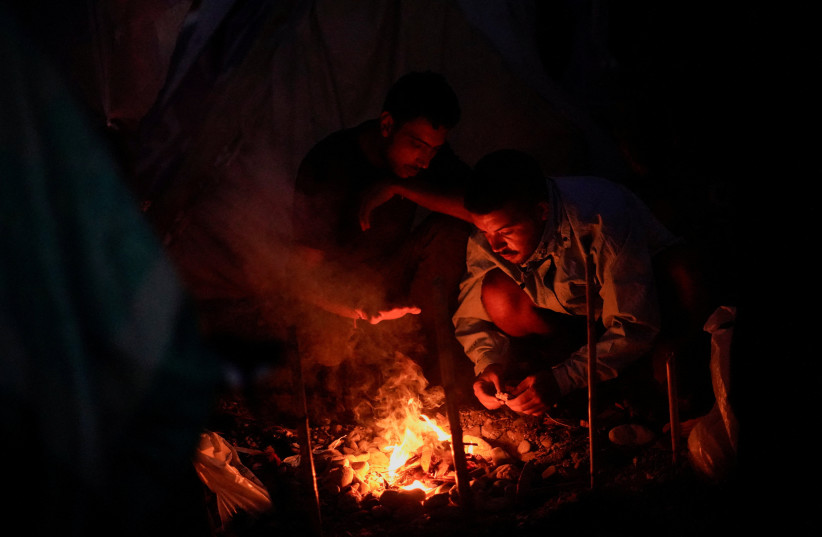
Officials operating under the Assad regime allegedly removed organs from prisoners and transplanted them into ill members of families affiliated with the former regime, Syria’s Justice Ministry claimed last week.

The allegation was presented last week alongside footage of alleged confessions from officers and doctors said to have participated in the operations.

 The former military professionals and medical staff admitted to carrying out operations on detainees abducted by Assad’s intelligence service, which saw kidneys and livers implanted into patients connected with senior officials.

A former doctor at Damascus’s Tishreen Military Hospital claimed he performed surgery to remove the liver of a healthy prisoner in Branch 215, which was said to have been destined for a first lieutenant in the Republican Guard whose father was reportedly close to Bashar al-Assad.

The detainee died within minutes of the organ’s removal, and the lieutenant was said to have passed after complications from the surgery.

‘Horror hospital’ took organs from detainees under Assad’s Syria

The international media has also long painted the institution as the “horror hospital” for the long list of human rights abuses committed there.

Agence France-Presse reported last year the testimonies of former detainees beaten in the hospital to the point of immobility, and Human Rights Watch warned of torture and extrajudicial killings by hospital staff and Assad officials more than a decade ago.

Attorney General Hassan al-Turba claimed that Tishreen had been used as an extension of Assad’s intelligence, according to Syrian state broadcaster Al-Ikhbariah.

“So far, the information we have obtained about the detainee comes from individuals who worked at the hospital before defecting,” he said.

Co-founder and executive director of the human rights group Syrians for Truth and Justice, Bassam Alahmad, told The New Arab that he was advised while imprisoned by the former regime in 2012 to avoid being transferred to the hospital, claiming there were fears his organs would be trafficked.

“During my detention by the Assad regime in 2012, specifically within the 4th Division – led by Bashar al-Assad’s brother, Maher – I fell severely ill. I was on the verge of asking the guards to transfer me to a hospital, but fellow prisoners stopped me. They warned me that anyone sent to those military hospitals never returns, and that their organs might be trafficked,” he said. “I have heard similar stories for years while documenting violations in Syria. If this act is verified, we are facing yet another heinous crime – a revelation that could expose similar atrocities and the networks involved.”

Only 10% of those needing an organ transplant in Syria are recipients, according to a study published by the peer-reviewed journal Nature in January, which found there was a significant shortage of trust in the healthcare systems available in addition to religious constraints.

Cultural and religious restrictions on organ donations have largely contributed to a shortage of donors, making organ trafficking a more profitable business.

The Violation Documentation Center complained more than 10 years ago that both soldiers and civilians killed had their organs harvested without consent, to be sold in countries like India, Russia, Iran, and North Korea, according to the Turkish media site Anadolu Agency. Sources told the Syrian Observer that such practices were covered up by the former regime and that high-ranking officials had been largely involved in the network. 

This post was originally published on here

While much of the world is focused on the US-Iran agreement and the World Cup, a far more extraordinary milestone has quietly passed: Elon Musk has become the first trillionaire in history. Following the latest valuation of SpaceX and its artificial intelligence ventures, his holdings surpassed $1.1 trillion.

Not long ago, a millionaire was considered a member of a tiny global elite. Then America introduced the age of the billionaire, transforming economics, finance, and society.

Now we have entered the era of the trillionaire. In 2020, Musk was worth $28 billion and ranked 35th among the world’s richest people.

Six years later, his fortune has exploded to a level that defies ordinary economic logic. Whether I find that believable is irrelevant; the numbers speak for themselves.

Musk’s wealth now exceeds the entire economic output of more than 125 developing countries. It rivals the combined economic weight of Africa’s largest economies, and it dwarfs the GDP of countries such as Egypt.

Historically, great fortunes were built through manufacturing or finance. Today, technology dominates the summit of global wealth, with seven of the 10 richest people deriving their fortunes from the sector.

Yet Musk is not merely rich. He and a handful of technology magnates are reshaping the future itself. Space exploration was once the exclusive domain of governments; now, private entrepreneurs lead the charge. Musk is also pushing efforts to merge artificial intelligence with the human brain, placing some of humanity’s most consequential questions in private rather than public hands.

This is not simply business success – it is the privatization of the future. Admirers compare him to Edison or Einstein, perhaps with some exaggeration, but his influence is undeniable.

The obvious question is what any individual could possibly do with such wealth. Musk says half of it is intended to solve problems on Earth and the other half to build a self-sustaining city on Mars. Many find that answer unconvincing. They see fortunes of this scale as evidence of a profound moral imbalance in a world marked by extreme inequality.

Even if Musk earned every dollar legitimately, critics argue that economic and tax systems increasingly favor the wealthy and amplify their gains. As billions are spent pursuing life on Mars, millions of children still lack food, medicine, and opportunity.

Ancient philosophers taught that true wealth meant having enough. Looking around today, that idea feels more distant than ever.

– Abdallah Abdelsalam

Let’s remember who makes America great

Al-Ittihad, United Arab Emirates, June 14

National Immigrant Heritage Month, observed in the US during June, should be more than a celebration of cultural diversity; it should be a reminder of the complicated history that made America what it is today. At a moment when some seek to rewrite that history by emphasizing only national triumphs while erasing uncomfortable truths, it is worth remembering that the United States was built upon two original sins: slavery and the dispossession of indigenous peoples.

THE STATUE OF LIBERTY: ‘Give me your tired, your poor...’  (credit: SHUTTERSTOCK)

The wealth that powered the early republic came in large part from enslaved labor and from land taken from native communities.

Yet America’s story did not end there.

As the country expanded and industrialized, it depended on successive waves of immigrants to build railroads, dig canals, work mines, staff factories, and fuel economic growth. Chinese laborers laid rail lines, Irish workers dug canals, Eastern Europeans labored underground, and Italians, Greeks, Arabs, and countless others helped build modern America.

Ironically, each new wave of immigrants encountered suspicion, discrimination, and hostility from earlier arrivals who considered themselves the “real Americans.”

The same pattern is repeating itself today. Communities whose ancestors were once mocked for their language, culture, and customs now direct similar accusations toward newer immigrants, particularly those from Latin America.

What gets lost in this cycle is the lesson history repeatedly teaches us: America grows stronger because of those it welcomes, not despite them.

The country learned agricultural and political lessons from indigenous peoples, even while dismissing them as savages. Southern wealth depended on enslaved workers even while slaveholders demeaned them. The industrial economy depended on immigrants, even while many were treated as outsiders.

America’s food, music, literature, diplomacy, fashion, business culture, and civic life all bear the imprint of generations of newcomers.

What truly makes America great is not a mythologized past but its extraordinary ability to absorb different peoples and cultures, and transform them into a single society. The real danger lies in forgetting that truth and replacing history with comforting fiction.– James Zogby

Lebanon between ‘little oranim’ and ‘greater oranim’

An-Nahar, Lebanon, June 14

The battle unfolding in southern Lebanon is no longer about a hilltop, a valley, or a border village. It is increasingly a struggle over maps, spheres of influence, and the shape of the postwar South.

As negotiations in Washington continue to falter, there are mounting signs that Israel is no longer thinking in terms of returning to the status quo that existed before the war. Instead, it appears determined to translate military gains into a new security reality that extends well beyond Resolution 1701 and the Litani River.

Diplomatic sources involved in the Lebanese-Israeli talks say that a comprehensive ceasefire agreement has existed in draft form for weeks, but repeated efforts to implement it have failed.

Current efforts focus on a pilot arrangement near Beaufort Castle, which could serve as a model for future Israeli withdrawals. Success there might pave the way for broader agreements; failure could entrench new realities on the ground and bring cities such as Nabatieh into greater danger.

BEAUFORT CASTLE – in Arabic called Qala’at al-Shaqif – ruins near the southern village of Arnoun, Lebanon.  (credit: JAMAL SAIDI/ REUTERS)

These concerns are reinforced by discussions within Israel itself, where military planners reportedly debate two strategic options known as “Little Oranim” and “Greater Oranim.” The first would consolidate existing gains and create a strengthened security belt along the border. The second would envision a much broader advance toward Nabatieh, Zahrani, Tyre, and Sidon, effectively redrawing southern Lebanon’s security geography.

Israeli evacuation warnings issued in areas around Tyre and Sidon have deepened fears that regions once considered beyond the immediate battlefield are now being incorporated into military planning. Meanwhile, operational control north of Wadi Saluki – a symbol of Israeli setbacks during the 2006 war – suggests that some of Hezbollah’s traditional defensive advantages are eroding.

Even more significant is the growing discussion of the Zahrani River as a future security line, replacing the Litani as the reference point for Israeli strategic thinking. Such a shift would bring Nabatieh, one of the political and logistical centers of Hezbollah’s support base, much closer to the heart of the conflict.

At the same time, Israeli officials increasingly describe drones, rather than rockets or tunnels, as the dominant threat, turning the war into a contest of technology and adaptation. Statements by Israeli commanders expressing readiness to advance as far as Beirut may be intended as psychological pressure rather than operational plans, but they reveal a broader reality: Israel wants allies and adversaries alike to understand that it no longer accepts the prewar balance.

The question is no longer where Israeli forces might stop. The question is what kind of southern Lebanon will remain if Israel succeeds in imposing its new security vision, and whether the peace that follows the war will be shaped by negotiation or by facts established on the battlefield.

– Fares Khachan

With Trump and against Trump

Al Mada, Iraq, June 15

A few months ago, Iraqi parliamentarian Youssef Al-Kalabi was demanding that Iraq stand up to America and calling for resistance against US President Donald Trump. Years earlier, he accused former prime minister Mustafa Al-Kadhimi of serving American interests.

Then, just days ago, I watched the very same politician appear on television in an expensive suit, proudly informing viewers that Prime Minister Ali al-Zaidi is a personal friend of Trump. Smiling broadly, he described al-Zaidi as a brave, intelligent businessman who enjoys a direct relationship with the American president and proudly repeated that “Trump calls him ‘my friend.’”

I do not enjoy revisiting the adventures of our politicians, but Iraq’s political theater leaves little choice. The contradictions are impossible to ignore.

IRAQ’S NEW PRIME MINISTER Ali al-Zaidi stands during the official handover ceremony in Baghdad, May 16.  (credit: IRAQI PRIME MINISTER MEDIA OFFICE/HANDOUT VIA REUTERS)

We are constantly asked to participate in a never-ending performance called “with America and against America.” Many of the politicians who once praised American officials, presented gifts to Donald Rumsfeld, and sought the approval of Paul Bremer later discovered a passion for anti-American rhetoric and resistance. Our political class seems addicted to dramatic scenes, always searching for the next headline-grabbing statement while ordinary citizens continue waiting for prosperity, development, and competent governance.

Some may ask whether I am happy about Trump. The answer is simple: neither I nor millions of Iraqis elected him, congratulated him, or spent our days socializing with American diplomats.

What continues to amaze me is how Iraqi democracy has become a source of endless irony. For years, people have pointed to corruption, failure, and decay, yet the parties in power neither see nor hear. Instead, they reinvent themselves under new slogans about achievement, progress, awareness, and reform while producing little change.

Every morning, Iraqis are expected to laugh at the spectacle of politicians moving effortlessly from one position to its opposite.

After more than two decades, I struggle to recall a single Iraqi official who publicly objected to foreign powers speaking on Iraq’s behalf or interfering in its affairs. Perhaps that is the biggest joke of all.

– Ali Hussein 

Translated by Asaf Zilberfarb. All assertions, opinions, facts, and information presented in these articles are the sole responsibility of their respective authors and are not necessarily those of The Media Line, which assumes no responsibility for their content.

This post was originally published on here

Friends of Zion (FoZ) founder Dr. Mike Evans said that he intends to speak with US President Donald Trump regarding the importance of the United States recognizing Somaliland during a special award ceremony held at the Friends of Zion Heritage Center in Jerusalem on Thursday.

“It’s time to bless all states that bless Israel,” he said. “Somaliland has shown genuine friendship toward the Jewish state, and I intend to speak with US President Donald Trump about the importance of formal American recognition of Somaliland.”

During the ceremony, held at the Friends of Zion Heritage Center in Jerusalem, Somaliland President Abdirahman Mohamed Abdullahi received the Friends of Zion Award in honor of the opening of Somaliland’s embassy in Jerusalem and the country’s friendship with Israel.

The ceremony was attended by diplomats, business leaders, Christian leaders, and other distinguished guests from across the globe.

“It is a great honor for me to receive the Friends of Zion Award,” said Abdullahi at the ceremony. “I am deeply moved and grateful for this recognition.”

“This award symbolizes the growing friendship and strengthening ties between Somaliland and Israel. We are committed to further deepening the relationship between our peoples and building a future based on cooperation, mutual respect, and friendship.”

Abdullahi concluded by thanking Evans and the organization for bestowing him with the award.

Somaliland’s new embassy in Jerusalem sends clear message of respect

Evans noted that “at a time when Israel faces complex security and diplomatic challenges, true friendship carries special significance.”

“President Abdirahman Mohamed Abdullahi has demonstrated leadership, courage, and vision in advancing relations with Israel and strengthening the bonds between our peoples,” he said. “The decision to open an embassy in Jerusalem sends a clear message of friendship, mutual respect, and cooperation.”

“On behalf of millions of Friends of Zion supporters around the world, we are proud to present President Abdullahi with the Friends of Zion Award and recognize his commitment to the historic and enduring relationship between the Jewish people and the State of Israel,” he said.

Since its establishment by Shimon Peres, the Friends of Zion Award has been presented to approximately 26 world leaders, including US President Donald Trump, former US President George W. Bush, and former US Vice President Mike Pence.

This post was originally published on here

Two Israeli citizens were killed in a single-vehicle car crash near Malibu, California, ZAKA announced on Sunday.

The pair were in their 40’s, a ZAKA statement said.

“ZAKA’s International Unit is working in cooperation with local authorities in the United States and is accompanying the families in all that is required. We are assisting with the identification process and advancing the procedures necessary for continued handling of the case,” ZAKA Deputy Director of Operations Chaim Weingarten said.

The two deceased people have yet to be publicly identified.

This is a developing story. 

This post was originally published on here

Mona Khalil, a famed Lebanese turtle conservationist, died of injuries received after an airstrike hit her home in Mansouri, southern Lebanon, according to the Lebanese wildlife conservation group Green Southerners. 

The group eulogized Khalil on its social media, noting that she had for decades “dedicated her life to protecting endangered sea turtles and their nesting habitats.”

“Her work made her one of Lebanon’s most respected voices for marine conservation and biodiversity protection.”

Khalil’s home was reportedly hit by an Israeli airstrike on June 4, where she was seriously injured. Her assistant also suffered injuries and burns in the strike. 

Both were evacuated to a nearby hospital to recieve medical treatement, with Khalil later being transfered to the American University of Beirut Medical Center (AUBMC) for futher treatement. She succumbed to her injuries on June 19. 

Khalil, 76, was born in Lagos and moved to Mansouri in the early 2000s, shortly before the IDF withdrew from southern Lebanon on the orders of former prime minister Ehud Barak.

Soon after, she opened the Orange House – a bed and breakfast she painted orange (reminiscent of her time living in the Netherlands) meant to act as a source of income to finance her and a friend’s environmentalist work.

She also launched a protection and ecotourism project for loggerhead and green sea turtles on nearby beaches.

In a 2013 interview with The Daily Star, Khalil described the Orange House as a place of tolerance.

“People come because here it’s a very private place,” she said. “It’s a place where nobody is going to judge them, so long as they respect nature. Homosexuals, lesbians, whatever – nobody will judge them here.”

Life-long devotion to protecting sea turtles

After being trained by the Athens-based NGO Mediterranean Association to Save the Sea Turtles (MEDASSET), Khalil served for years as a vocal advocate for the conservation of sea turtles, going head-to-head with beachgoers, fishermen, and, in one case, reportedly Hezbollah, in order to ensure that turtles were able to nest during the season without interference.

Khalil retired in the early 2020s. 

“Her death stands as a stark reminder that the ongoing violence in southern Lebanon is exacting a devastating toll on civilians, environmental defenders, and the natural heritage they sought to protect,” Green Southerners wrote. “We extend our deepest condolences to her family, friends, colleagues, and all those who worked alongside her.”

“Mona Khalil’s legacy will endure in the coastline she devoted her life to protecting, the sea turtles she fought to defend, and the values of conservation and stewardship she championed.”

This post was originally published on here

Germany is examining purchasing long-range missiles from Covenant Technologies, a mysterious Israeli manufacturer founded two years ago, to replace the American-made Tomahawk missiles, according to a Sunday report by Politico.

The report mentioned that the missiles were promised to Europe by the Biden administration in order to deter further Russian invasions against European countries, but US President Donald Trump recently decided to cancel the move.

As a response, Berlin decided to purchase Israeli-made missiles as a replacement, with two other Ukrainian companies also among the possible sellers of long-range missiles, according to the report.

Germany has been one of the main clients of Israeli defense products in the last couple of years, with the main deals going to Israel’s “big three”: Israel Aerospace Industries, Rafael, and Elbit.

Berline bought the Arrow missiles and Heron TP drones from IAI, the Spike missiles and the Trophy active protection system from Rafael, and it’s on the way to a giant deal for rockets and launchers with Elbit.

What is Covenant Technologies?

Founded by its current CEO, the American-Israeli entrepreneur Michael Kaufman, the company operates in the defense-tech field, has a team composed of several dozen employees that work from its Tel Aviv offices, and focuses on solving the economic munitions problem.

They explained that the high prices of advanced missiles make it difficult to buy them in large quantities, have created shortages even for the US, and have created difficulties in rapidly producing new stock.

To that end, the company is trying to dramatically lower missile production costs by developing a cruise missile with performance comparable to the Tomahawk, at a cost of only several hundred thousand dollars rather than several million.

According to TheMarker, the company has raised more than $200 million from a long list of US funds and investors, and it is still operating in stealth mode.

Company in stealth mode

This means it is not yet known at what stage Covenant’s development is, and there is no information available about the production or testing facilities it owns.

The Germans are trying to buy a limited number of Tomahawks directly from the US, but the production line is currently full of Pentagon orders to replenish stocks after hundreds of such missiles were launched against Iran.

With Berlin aiming to receive cruise missiles as early as 2027, it might connect Covenant with one of Germany’s local defense industries to produce them there, something that Rafael and Elbit have already done.

This post was originally published on here

Transportation Minister Miri Regev announced that her ministry would advance plans for a light rail line connecting Gush Etzion to Jerusalem, in what local leaders described as a historic step for residents south of the capital.

The proposed line will enhance transportation between Gush Etzion and Jerusalem, shortening travel times, easing congestion, and providing residents with a faster public transit option.

The announcement follows years of discussions over how to improve the transportation link between Gush Etzion and Jerusalem, a corridor used daily by residents of the regional council, Beitar Illit, Efrat, and nearby communities. The area currently relies heavily on roads and bus lines, with the Route 60/Tunnels Road corridor serving as one of the main entrances into southern Jerusalem.

According to the Gush Etzion Regional Council, the project would create the first direct rail connection between the region and Jerusalem. The council said the light rail plan would join other transportation upgrades being promoted in the area, including road improvements, expanded traffic routes, and additional public transportation solutions.

No final route, budget, planning timetable, or expected completion date was included in the announcement.

The new light rail will mark a major turning point for the region

Gush Etzion Regional Council head Yaron Rosenthal welcomed the move, calling it “historic news for the residents of the region.”

“This is a historic announcement for the residents of the area and a significant step toward strengthening the natural connection between Gush Etzion and Jerusalem,” Rosenthal said. “The light rail will give residents a faster and more accessible connection to the capital and will provide a response to the major growth of Gush Etzion.”

“We thank Transportation Minister Miri Regev, a true partner in the development of Gush Etzion and in the transportation revolution we are advancing in the region,” he added.

The announcement comes as Jerusalem’s light rail network continues to expand, including work on routes intended to improve access to the city’s southern parts. For Gush Etzion residents, a rail link into Jerusalem would represent a major shift from car- and bus-based commuting to mass transit.

This post was originally published on here

Ukraine targeted a Russian port and fuel transit terminals in the Kerch Strait overnight from Saturday to Sunday, President Volodymyr Zelensky said.

Videos from social media show fiery explosions at a port late at night, with thick smoke surrounding what appear to be oil tanks. 

“All of these are just responses to the brutal Russian attacks against our people. I thank the warriors of the SBU, SBS, HUR, and SSO for their successful work at a distance of about 300 kilometers from the front line,” Zelensky said.

He added that targets on both sides of the Crimean Bridge were hit: maritime logistics used for oil transportation in Russia and an oil depot in Russian-occupied Kerch.

Five people died in the attacks, and 28 were wounded.

Ukraine targets Russian oil industry in overnight attacks 

Russian media reported that one of the people who died was on a passenger ferry in Russia’s Krasnodar region. 
A local power grid operator reported outages in several areas after damage to electricity networks, while ferry traffic across the Kerch Strait was temporarily suspended.

The Kerch Strait, a 35 km. stretch that separates occupied Crimea and Russia also connects the Black Sea and the Sea of Azov. According to the Kyiv Independent, it has been a crucial Russian logistics corridor.

Russian attacks in Ukraine kill at least 11 people as Crimean fuel stations halt sales

Also on Saturday, Russian strikes killed at least 11 people and injured over 90. 

After the attacks,  gas stations in the Russian-controlled peninsula of Crimea halted all fuel sales to individuals and businesses from 9:00 a.m. local time on Sunday, including cash, non-cash, and voucher purchases, the Russian-installed governor said.

Fuel will only be supplied to government agencies that ensure the functioning and security of the peninsula, Sergei Aksyonov, the governor, wrote on the Telegram messaging app.

On Saturday, Zelensky warned of massive overnight attacks in Ukraine. 

“Tonight and in the coming hours, it is especially important to pay close attention to air raid warnings,” Zelensky said in his nightly video address. “The Russians have prepared for a massive attack. Please take care of yourselves.”

On Saturday, Russian forces attacked the southeastern city of Zaporizhzhia with glide bombs, killing five people and injuring 10, Regional Governor Ivan Fedorov wrote on Telegram.

He said the city had endured nine strikes, and several residential buildings and other infrastructure had been damaged.

Near the Russian border, a bomb attack killed one person on the outskirts of the city of Sumy, local officials said.

In the southern Kherson region, regional governor Oleksandr Prokudin said one person had died in a drone attack on a village north of the region’s main city, also called Kherson.

Three children were injured when the central city of Poltava came under Russian shelling, local officials said.

This post was originally published on here

Volkswagen’s plans for a deal with Israeli arms maker Rafael to use its struggling Osnabrueck plant in Germany are being complicated by Qatar’s sovereign wealth fund, the German carmaker’s third-largest investor, three people familiar with the matter told Reuters.

Qatar, which holds 17% of voting rights in Europe’s biggest carmaker via the Qatar Investment Authority, has raised concerns about the talks between the two companies, citing the Gulf state’s complicated relationship with Israel.

That risks delaying one of Volkswagen’s key projects in its ongoing turnaround, including attempts to offload idle plants through deals with defense firms, as low auto sector demand across the continent bites.

Spokespeople for Volkswagen, the group’s supervisory board, and the QIA all declined to comment on the matter, which has been previously unreported.

Rafael interested in making Iron Dome System parts at plant

Volkswagen has been in talks with defense companies over future prospects for Osnabrueck, where production is currently scheduled to end next year.

State-owned Rafael is interested in manufacturing components for Israel’s Iron Dome missile defense system at the plant, and has signed a letter of intent to buy the site, sources told Reuters in late April.

The prospect of Qatar’s sovereign wealth fund facilitating a deal with an Israeli defense company would place Doha in an uncomfortable position at a time of escalating conflict in the Middle East.

Qatar has no formal diplomatic relations with Israel, and has instead carved out a distinct role as a back-channel mediator between Israel and Hamas, which maintains a political office in Doha.

There is also deep and widespread public support in Qatar for the Palestinian cause, and Doha has long made any normalization of relations with Israel conditional on a credible pathway to Palestinian statehood.

QIA has two seats on VW supervisory board

The QIA is Volkswagen’s third-largest shareholder after the Porsche SE investment vehicle of the family owners and the state of Lower Saxony. It has two seats on the carmaker’s supervisory board.

Two sources said that Lower Saxony, home to Osnabrueck and Volkswagen’s headquarters in Wolfsburg, could be brought on board through a joint venture between Volkswagen and Rafael to reach a solution.

State premier Olaf Lies, who sits on Volkswagen’s supervisory board, declined to comment directly on the Qatar issue, urging Volkswagen to find a long-term solution for the Osnabrueck plant, which employs 2,300 workers.

“I expect the company to live up to this responsibility and present the announced decisions in a timely manner. The state will provide constructive support wherever it is appropriate and possible,” he told Reuters.

This post was originally published on here

The IDF and Shin Bet (Israel Security Agency) have, in a joint statement on Sunday, unmasked five Hamas terrorists who have been directing “military actions” in Israel and the West Bank from Turkey.

Salam Yaish, Walid Abu Nasser, Majed Ja’aba, Muhammad Mallah, and Ayman Sharawna have been overseeing recruitment for individuals willing to carry out terror attacks and smuggling weapons and funds into the region.

This is a developing story.

This post was originally published on here

Investors are pulling billions of dollars from some of the nation’s largest private credit funds, creating the biggest test yet for an industry that has grown into a roughly $2 trillion market and become a major source of financing for American businesses.

According to new data from investment bank Robert A. Stanger & Co., investors in four major private credit funds, including vehicles managed by Blackstone and BlackRock, requested approximately $12 billion in withdrawals during the second quarter, compared with $7.7 billion in redemption requests during the previous quarter. The surge comes as fundraising across the sector slows sharply and redemption requests increasingly exceed new investor inflows.

The largest fund under pressure is the $79 billion Blackstone Private Credit Fund (BCRED). Investors sought to redeem roughly 10% of fund shares during the quarter, up from 7.9% in the first quarter. Because BCRED limits quarterly withdrawals to 5% of outstanding shares, the fund capped redemptions for the first time in its history.

The situation is even more pronounced at BlackRock’s HPS Corporate Lending Fund (HLEND). Investors requested withdrawals equal to 13.3% of shares, up from 9.3% in the prior quarter. Since the approximately $26 billion fund also limits quarterly repurchases to 5%, investors will receive only about 38 cents for every dollar they sought to withdraw.

Private credit funds have become increasingly popular among wealthy individuals seeking higher yields than traditional bond investments. Many operate as Business Development Companies (BDCs), lending to midsize companies that often have weaker credit profiles than firms able to borrow in public debt markets.

The model works well when money is flowing in. The challenge arises because the loans held by these funds are difficult to sell quickly, while investors expect periodic access to their capital. Most funds therefore limit withdrawals to roughly 5% per quarter, creating a potential bottleneck when redemption requests surge.

That mismatch is now being tested.

Investor concerns began growing late last year amid worries about rising defaults and weakening credit quality. Anxiety intensified this year as investors focused on potential losses tied to software and technology-sector borrowers. At the same time, fundraising has slowed dramatically.

Stanger data shows fundraising for non-listed BDCs fell 74% in April compared with a year earlier, reaching its lowest monthly level since May 2023. For the first time, quarterly redemption requests exceeded new investor inflows, marking a significant shift for an industry that had been accustomed to rapid growth.

If outflows continue accelerating, funds could face difficult choices. Managers may be forced to sell loans at discounted prices to raise cash or impose tighter withdrawal restrictions. Industry observers often refer to such measures as “gates,” which limit investors’ ability to access their money.

Similar situations have emerged elsewhere in private markets. A Starwood Capital real estate fund restricted investor withdrawals in 2024 after facing heavy redemption requests, highlighting how quickly liquidity concerns can emerge in assets that are difficult to sell.

The implications extend beyond individual investors. Private credit has become a critical source of financing for thousands of American companies, particularly those unable or unwilling to access traditional bank loans. A prolonged period of redemptions could reduce lending activity and tighten credit conditions across portions of the economy.

Major fund managers insist the sector remains healthy.

Blackstone says BCRED has more than $15 billion in available liquidity, with loan repayments continuing to exceed redemption obligations. Speaking at an industry conference this month, Blackstone President Jonathan Gray argued that concerns about widespread stress are overblown and said private credit continues to offer attractive returns compared with traditional fixed-income investments.

Not everyone is convinced.

Analysts at Barclays recently warned that outflows could continue to increase in coming quarters. Morningstar, meanwhile, has given positive ratings to only four of 18 semiliquid private funds it follows, citing concerns over fees, leverage, and borrowing costs.

Morningstar analyst Brian Moriarty said prolonged periods of maximum redemption requests may become the norm, shifting attention from whether outflows occur to whether funds have sufficient liquidity to manage them.

There are signs conditions may not be deteriorating everywhere. Analysts at Evercore described Blackstone’s redemption figures as better than many investors had feared, while at least one private credit fund managed by Oaktree Capital Management reported easing withdrawal requests during the quarter.

Investors will soon get a broader picture of the industry’s health as funds managed by Apollo Global Management, Ares Management, and Blue Owl Capital release their latest redemption figures.

For now, one trend remains clear: more investors are trying to leave private credit funds than enter them, creating the industry’s most significant liquidity test since its rise to prominence.

JBizNews Desk
Wall Street
© JBizNews.com All Rights Reserved. Reproduction or distribution without written permission is prohibited.

Nearly 80 years after Australian airline Qantas began operating the air route from Australia to Britain, it is moving closer to its most ambitious attempt yet, a direct commercial flight from Sydney to London without a layover. 

The Australian airline announced this week that it had chosen London as the first destination for “Project Sunrise,” an initiative designed to connect Australia’s east coast directly with extremely distant cities, first London and later New York. 

Ticket sales are expected to begin in February 2027, and the first departures are planned for October that year, subject to regulatory approvals, completion of flight trials, and aircraft certification.

The flight, expected to last 19 to 21 hours depending on winds and route, would set a new benchmark for long-haul travel and aim to turn one of the world’s most grueling journeys into a single continuous route.

The move has occupied the aviation world for almost a decade. In 2017, Qantas challenged aircraft manufacturers Airbus and Boeing to develop a plane that could fly nonstop from Sydney and Melbourne to London and New York, with a real commercial payload rather than an almost empty demonstration flight. In the end, Airbus was chosen, receiving an order from Qantas for 12 Airbus A350-1000ULR aircraft, a dedicated ultra-long-range version.

Aircraft has more capabilities than standard Airbus A350

The aircraft is not just a standard Airbus A350. It has undergone significant structural changes, most notably the addition of a rear-center fuel tank holding 20,000 liters. That addition extends the aircraft’s range by about 1,000 nautical miles and allows it to fly more than 16,000 kilometers, for up to 22 hours straight. The plane is powered by two Rolls-Royce Trent XWB-97 engines and requires a higher maximum takeoff weight and a more complex fuel management system that must transfer fuel between tanks safely over many hours and under changing flight conditions.

The preparations go beyond the aircraft itself. In June 2026, the project’s first test plane, bearing production number MSN707, made its maiden flight in Toulouse, France. The flight lasted 3 hours and 43 minutes, reached an altitude of just over 41,000 feet, and launched a two-month testing and certification campaign. 

During the campaign, the new fuel systems, pumps, sensors, pressures, temperatures, a new cooling system for the aircraft galley, cabin ventilation, and the aircraft’s ability to maintain comfortable conditions even on an exceptionally long flight are being tested.

One of the more interesting engineering challenges is that the test aircraft is not a prototype that will remain in the company’s labs, but rather a production plane ultimately meant to carry passengers. 

As a result, thousands of sensors and measuring systems were installed in it in a way designed not to harm the future passenger cabin. Airbus also placed devices in the cabin that simulate passenger body heat to test how a full cabin would behave on such a long flight, and what would be needed to maintain temperature, ventilation, and comfort for nearly a day in the air.

Cabin layout different from standard flights

The cabin layout is also different from regular flights. Qantas will operate the aircraft in a configuration with just 238 seats, an unusually low seat count for this model. The layout includes 6 first-class suites, 52 business-class seats, 40 premium economy seats, and 140 economy seats, including economy plus. 

More than 40% of the seats will be allocated to premium cabins, a sign of the company’s commercial strategy: to sell not only a flight, but time saved and a more tolerable travel experience on an extraordinarily long journey.

A “wellbeing area” for passengers will also be set up in the middle of the aircraft, between premium economy and economy. The area will include stretch handles, a screen with movement exercises, and a drink-and-snacks station. 

Qantas also plans dedicated lighting based on waking and sleeping cycles, with different light scenes designed to help the body adjust to the destination’s time zone. Meals, sleep times, lighting, and cabin activity are all supposed to fit into a single schedule aimed at reducing jet lag and fatigue after landing.

The scientific foundation for the project has been built over the years. Qantas has worked with researchers at the University of Sydney to examine the effects of meal timing, hydration, exercise, light exposure, and sleep on passengers and crew. 

In 2019, the company already operated direct research flights from New York to Sydney and from London to Sydney, using Boeing 787-9 aircraft with a limited number of passengers and crew. Those flights collected data on alertness, movement, sleep, and passenger experience in order to build a safer and more comfortable operating model for ultra-long-haul flights.

Qantas’ history with long routes began long before the jet age. In 1947, the company began operating the “Kangaroo Route” from Sydney to London, a journey that then took four days and included seven stops, among them Darwin, Singapore, Calcutta, Karachi, Cairo, and Rome. Since then, every new generation of aircraft has removed one more stopover. Project Sunrise is meant to eliminate the last one.

The project’s name is no accident. It refers to Qantas’ “double sunrise” flights during World War II, when the company operated Catalina seaplanes from Western Australia to Ceylon, now Sri Lanka, to maintain an air link to Britain after the fall of Singapore. The flights sometimes carried only three passengers and a small amount of mail, lasted more than 30 hours, and passengers saw the sun rise twice during the journey. In terms of time spent in the air, they are still considered among the longest commercial flights in history.

In the modern era, the active record belongs to Singapore Airlines on the New York JFK-Singapore route, a distance of about 15,349 kilometers, flown on an Airbus A350-900ULR, with an average duration of more than 18 hours. 

Next is the Newark-Singapore route, also operated by Singapore Airlines, at about 15,344 kilometers. Other notable long routes today include Auckland to Doha on Qatar Airways, Perth to London on Qantas, Melbourne to Dallas on Qantas, Perth to Paris, New York to Auckland, Auckland to Dubai, Los Angeles to Singapore, and San Francisco to Bengaluru.

Qantas already has commercial experience on an exceptionally long route: Perth to London, which began operating in 2018 and is considered one of the world’s longest nonstop flights. But Sydney to London is different. 

The distance is greater, the flight paths are more complex, and operations depend on tailwinds, the seasons, airspace conditions, and fuel availability. According to the company, polar routes will be used in some cases, especially during the Northern Hemisphere winter.

The project’s economic model is no less challenging than the engineering. Qantas will need to persuade passengers to pay more for nonstop flights. The company believes business travelers and premium passengers will be willing to pay a premium for time savings, the elimination of a stopover, and reduced risk of delays, missed connecting flights, or a prolonged stay at an intermediate airport. 

On existing routes such as Perth to London, Qantas has already succeeded in charging more for flights with a stop, and it hopes to replicate that model here as well.

On the other hand, a 20-hour flight is still a tough test for passengers and crews. Even with smart lighting, improved seats, a timed menu, and a stretching area, the human body was not designed for nearly a full day of sitting in an aircraft cabin. The operation will require meticulous crew scheduling, rest areas for pilots and flight attendants, fatigue monitoring, medical management for at-risk passengers, and preparation for medical emergencies far from suitable airports.

The project also depends on regulatory approvals and global operational stability. Disruptions in airspace, wars, extreme weather, or insurance restrictions could alter routes and reduce time savings. 

Qantas has already had to change routes on existing flights because of tensions in the Middle East, and the company will need to maintain a high degree of flexibility in the new project as well.

If the Sydney-to-London flight launches as planned, it will be more than just another airline route. It will mark a new stage in competition between airlines, between transit flights through hubs in the Gulf and Asia, and direct point-to-point connections. For years, airlines such as Emirates, Qatar Airways, and Singapore Airlines turned stopovers into a successful global model. Qantas is now trying to bring some passengers back to a different model, fewer airports, less waiting, fewer aircraft changes, and more consecutive hours in the air.

The success of Project Sunrise could also open additional routes. After London, New York is planned, and later, there could be additional destinations in North America, Europe, Africa, and South America, depending on demand and the number of aircraft delivered. 

In a world where aircraft are becoming more fuel-efficient, engines stronger, and passenger cabins designed around the human body rather than only around seat count, the world’s longest flight could become a regular commercial service rather than a technological showcase.

This post was originally published on here

Over the years, I have had the privilege of visiting many countries around the world as part of my public, media, and diplomatic activities. Yet my first visit to the United Arab Emirates was truly exceptional and left a profound impression.

It was an opportunity to see firsthand how a relatively young country had, within a few decades, transformed itself into an economic, technological, and tourism powerhouse while maintaining stability, personal security, and respect for the individual.

As president of the Israel Radio Communications Association, I had the honor, together with my wife, of attending a festive dinner with Sheikh Sultan bin Mohammed bin Sultan Al Qasimi, son of the Ruler of Sharjah and president of the UAE’s communications association, along with several other senior and distinguished figures.

The welcome was warm and moving. From the very first moment, there was a clear sense of respect and appreciation for the guests from Israel.

The conversations around a table laden with meats and salads were open, substantive, and friendly. Many of those present expressed genuine interest in Israel, its technological achievements, and its ability to address complex challenges in security, the economy, and innovation.

It was clear that beyond the headlines and formal agreements, there was also a genuine willingness to deepen ties between the two peoples and build bridges of cooperation.

One of the things that impressed me most was the country’s efficiency. From the moment we entered the UAE, it was apparent that its public service systems operated swiftly and professionally. Entry procedures were brief, orderly, and courteous.

Everywhere we visited, including hotels, restaurants, shopping centers, and tourist attractions, we encountered professional, polite, and welcoming service.

The United Arab Emirates invests enormous resources in developing advanced infrastructure. Its modern highways, efficient transportation systems, innovative business centers, and impressive architecture reflect long-term vision and professional management.

A model of efficiency and modern governance

The country is not content with its present achievements. It is planning decades ahead in fields such as artificial intelligence, energy, education, and health care.

Another area that stood out was personal security. Residents and visitors alike enjoy an exceptionally strong sense of safety. Crime rates are low, and law enforcement is firm and effective.

Penalties for serious offenses are severe, and in many cases foreign nationals convicted of crimes are deported. At the same time, an advanced technological network of cameras and monitoring systems helps law enforcement authorities maintain public order and deter criminal activity.

Technology is integrated into nearly every aspect of daily life. Digital systems provide rapid access to government services, while innovative projects are transforming the country’s cities.

This approach reflects a belief that innovation is not a luxury but an essential condition for growth and success.

No discussion of a visit to the United Arab Emirates would be complete without acknowledging the historic importance of the Abraham Accords. These agreements did more than open air routes and commercial channels. 

They created a new reality in the Middle East. They demonstrated that Israel and Arab countries can cooperate on the basis of shared interests, mutual respect, and a desire to build a better future for their citizens.

In my conversations with senior officials and public figures in the Emirates, I repeatedly heard a clear message: There is a strong desire to expand cooperation in the fields of economics, science, medicine, communications, and technology.

Many viewed Israel as a valuable partner and expressed hope that relations would continue to deepen despite the region’s challenges.

The visit left me with a sense of optimism. It showed that a different reality can be built in the Middle East, one based on cooperation rather than confrontation, development rather than stagnation, and hope rather than suspicion.

The United Arab Emirates is an example of a country that has successfully combined tradition with progress, national identity with international openness, and stability with a constant drive for renewal.

Since that first visit, and the additional visits that followed, I have carried with me warm memories of the gracious hospitality, the fascinating encounters, and the feeling that a new chapter had opened in relations between our peoples.

The more human, economic, and cultural ties between Israel and the United Arab Emirates deepen, the stronger the foundations of peace and stability will become throughout the region.

The writer is CEO of Radios 100FM, an honorary consul and deputy dean of the Consular Diplomatic Corps, president of the Israel Radio Communications Association, and a former Israel Army Radio monitor and NBC News television correspondent.

This post was originally published on here

The Museum of Jewish Heritage in New York is featuring a new installation on Jewish Holocaust survivor and pro-soccer player Paul Mahrer from May 31 through July 31, museum officials announced in May. 

The installation, titled Tell Our Boy That I Played Soccer Again, pulls archival photos, letters, and documents from the museum’s collection to trace Mahrer’s life as a professional footballer and Theresienstadt survivor.

The focus of the installation will be on letters smuggled between Mahrer and his wife as they were detained in separate concentration camps during the Holocaust. The project takes its name from a letter Mahrer wrote in hopes that his son would feel his love for family and the sport that gave him his career.

“Tell our boy that I played soccer again and even played well and was successful,” Mahrer wrote from inside the Nazi transit camp. 

Before the Gestapo deported him in 1942, Mahrer represented the then-Czechoslovakian national team in the 1924 Paris Olympics. He went on to play countless international matches throughout the 1920s and 1930s until he became one of 140,000 Jewish people held in the Theresienstadt concentration camp. Though he survived, over three-quarters of those imprisoned alongside him did not. 

The museum’s decision to display this installation comes just as New York welcomes soccer teams from around the globe for the ongoing World Cup matches. For many, Mahrer’s historical retelling serves as a testament to the reality that sports can be more than just passing a ball. 

“Paul Mahrer’s story reminds us of the power of sport, and the rituals that sustain us, in times of joy and through unimaginable hardship,” said Jack Kliger, president and CEO of the Museum of Jewish Heritage – A Living Memorial to the Holocaust.

More on The Museum of Jewish Heritage – A Living Memorial to the Holocaust

The host museum was first opened in 1997 as New York’s contribution to the Never Forget movement. The Museum of Jewish Heritage – A Living Memorial to the Holocaust serves thousands of school children each year as a leading educational resource for the tri-state area. 

In an effort to highlight Jewish life before, during, and after the Holocaust, the museum spotlights multiple installations drawn from the Peter & Mary Kalikow Jewish Genealogy Resource Center, which boasts almost 40,000 artifacts, photographs, films, and survivor testimonies. 

Beyond Paul Mahrer’s life story, offerings include Art of Freedom: The Life & Work of Arthur Szyk, celebrating anti-fascist artist Arthur Szyk and his work, Courage to Act: Rescue in Denmark focusing on the extraordinary rescue of Denmark’s Jewish population in 1943, and The Holocaust: What Hate Can Do, which offers a thorough presentation of Holocaust history as it fits into ongoing global antisemitism.

For more information on exhibitions and to get tickets to Tell Our Boy That I Played Soccer Again, visit the museum’s website.

This post was originally published on here

Israel has not built a coordinated national response to its aging population, despite more than a decade of government decisions identifying the issue as a strategic socioeconomic challenge, State Comptroller Matanyahu Englman warned in a special report on Sunday.

The report examines whether Israel is prepared for a growing number of older citizens who will need pensions, healthcare, long-term care, welfare services, and support navigating retirement. It found gaps across all of those areas, while the number of Israelis aged 65 and over is expected to rise from about 1.3 million today to two million by 2050.

“Aging of the population is one of the central challenges facing the State of Israel,” Englman said. “Providing an appropriate response to the elderly population is a moral and value-based obligation.”

He said the audit showed “a large gap between governmental recognition of the importance of the challenge and action.”

The report found that responsibility for older Israelis is divided among the Health Ministry, Welfare Ministry, Social Equality Ministry, health funds, and National Insurance Institute (NII), but no single body has the authority, budget, or responsibility to ensure that they work together.

The comptroller found that Israel has no funded multi-year national plan on aging, no empowered coordinating body, and few measurable targets.

Israel needs better plan to deal with elderly people, comptroller says

Although the government identified aging as a major long-term challenge in 2015, none of the four central policy goals reviewed by the comptroller was fully implemented. Those included keeping NII financially stable, adapting retirement policy to longer life expectancy, increasing employment among older Israelis, and expanding geriatric medical care.

About 70% of government bodies dealing with aging said cooperation between relevant institutions was only moderate or worse, while 90% said information-sharing was inadequate.

Englman recommended that the Prime Minister’s Office, Health Ministry, Welfare Ministry, Social Equality Ministry, and NII create a funded multi-year plan. He said it should appoint a coordinating authority, set measurable targets, define each body’s responsibilities, improve information-sharing, and create a unified budget.

The report’s sharpest warning concerns the long-term care system. NII provides benefits to older Israelis who need help with daily tasks such as bathing, dressing, eating, moving around the home, or personal hygiene. The aid can be given through home-care hours, services, or direct cash payments.

Annual NII spending on long-term care rose from NIS 7 billion before the 2018 reform to NIS 21b. in 2025. The number of recipients rose from about 180,000 to 392,000, while the share of retirement-age Israelis receiving the benefit increased from about 16% to 30%.

Englman said the reform damaged NII’s long-term financial stability. “This brought forward the year the fund will be depleted by more than six years, to 2035,” he said.

This does not mean that NII would stop operating in 2035, rather, the report explains that NII’s reserve fund is projected to run out that year – meaning it would require additional state financing to meet all of its legal obligations.

Yet despite that forecast, the socioeconomic cabinet did not discuss NII’s long-term financial stability in recent years, the report said.

The comptroller recommended that any major expansion of benefits be accompanied by an actuarial analysis – an assessment of whether the system can afford those commitments over time.

He also criticized the way NII decides who qualifies for long-term care benefits and how much assistance they receive.

How does NII handle eligibility?

Eligibility is based on dependency assessments, which measure the extent of help an elderly person needs in daily life. The report said Israel is the only OECD country that systematically conducts these assessments without face-to-face meetings, with only about 1% of them conducted in person at the person’s home.

Applications assessed through medical documents were approved at a rate 16 percentage points higher than those assessed through in-person visits, the report found.

In a comparison with one health fund, National Insurance assigned care levels an average of 1.7 levels higher. The comptroller estimated that this could create NIS 9.5b. in additional annual costs.

He recommended limiting document-based assessments to repeat applications or clearly severe cases, instead of using them routinely.

The report also found weak oversight of cash benefits and family members employed as caregivers. As more recipients receive money directly rather than services, Englman said NII does not conduct annual home monitoring for all of them and has not set a clear supervision procedure for family caregivers.

“The report further shows that following the reform, more elderly people receive cash benefits, but NII does not conduct annual monitoring in the homes of all recipients of the cash benefit,” Englman said. He recommended regular home visits and stronger supervision of care companies and family caregivers.

The report also warned that geriatric healthcare capacity has not kept pace with demand. The number of geriatric hospital beds per 1,000 Israelis aged 75 and over fell by 16% between 2020 and 2023, while the number of geriatricians barely changed.

The Health Ministry has adopted healthy aging programs but has not converted them into a funded, long-term plan with measurable targets, the report found. Englman recommended expanding preventive care and setting staffing and hospital-capacity goals.

On retirement and welfare, the comptroller found that Israel has no formal policy to prepare citizens for retirement, even though retirement can affect income, health, housing, social ties, and independence.

About 77% of respondents aged 60 to 75 said they had not participated in retirement preparation.

“Today, Israel has no organized government policy for preparing citizens for retirement,” Englman said. “The rate of older citizens employed after retirement age is low and will not allow the government’s targets to be achieved.”

Employment among Israelis aged 67 to 74 stood at 22.3% for women and 35.4% for men in 2025, and the comptroller said current trends suggest Israel will miss its 2030 targets.

This post was originally published on here

Arnold Roth, the father of one of the child victims of the 2001 Sbarro massacre in downtown Jerusalem, slammed the Hashemite Kingdom of Jordan for harboring Ahlam Tamimi, the woman behind his daughter’s murder, and likened the kingdom to the Palestinian Authority and its “pay-for-slay” stipends, saying that it continues to materially support terrorism. 

The woman who masterminded the Sbarro massacre is free today in Jordan, living free all these years,” Roth told The Jerusalem Post at a StandWithUS event in Jerusalem last week. “She was charged in the United States in 2013, and she’s been saved, protected, and harbored by Jordan.”

Roth’s daughter, Malka Roth, was 15-years-old when she and 15 others, including six other children and a pregnant woman, were murdered in Jerusalem by a Palestinian suicide bomber who operated alongside Tamimi.

In an interview published in the 2006 documentary “Hot House,” while in an Israeli prison and hearing from Israeli director Shimon Dotan that eight children had been killed, Tamimi responded, repeating “eight” with a smile on her face.

Five years later, Tamimi was released to Jordan as part of the 2011 Gilad Schalit deal. Jordan, Arnold Roth said, has an obligation, per its 1995 extradition treaty with the US, to extradite Tamimi, something it has yet to do.

Roth says that Jordan’s rationales for not doing so have been “ridiculous, convoluted excuses” appealing to constitutional technicalities that it argues render them unbound from the treaty in this case.

Father of bombing victim: No one believes Jordan’s explanation for not deporting Tamimi

“No one believes this,” Roth said. “I speak with authority as someone who’s lived with this for many years. No one believes it. And yet, Jordan keeps getting away with it. Jordan is getting away with it today, tonight, and every day and every night for many years.”

Malka Roth was among three United States nationals killed in the attack. In 2013, a US federal court issued a sealed arrest warrant for Tamimi. The warrant was made public in 2017. Tamimi remains on the FBI’s Most Wanted Terrorists list with a reward of as much as $5 million for information leading to her arrest or conviction.

“I don’t blame the Jordanians any more than I blame the Palestinian Authority for getting away with whatever they can get away with. That’s the nature of crooks and thieves and confidence tricksters.”

Instead, Roth said he blamed “the civilized world.” This includes, he said, Jewish leadership for its lack of action in pushing for Tamimi to be brought to justice.

The larger share of the blame, though, he added, lay with governments and international bodies that “fail to act.”

“The problem is, where is the civilized world? And in the case of “pay for slay,” and in the case of Ahlam Tamimi, who lives free as a bird, as a celebrity, in Jordan, the problem is failure by some of the most serious organizations, including governments,” Roth said.

“Pay-for-slay” refers to the Palestinian Authority’s policy of providing monthly stipends to killed, injured, or imprisoned terrorists and their families for acts of violence against  Israelis. 

Further, despite the warrant for her arrest, Roth argued that the US was failing to sufficiently act. He said he fully agreed with the argument that the US could get Jordan to deport Tamimi, but has simply failed to apply the pressure.

“The United States can bring Jordan to do anything it can conceive of doing. In this case, there’s a treaty that goes back to 1995.”

Arnold Roth at a StandWithUs event in Jerusalem. June, 2026. (credit: SAM HALPERN)

Roth added that through Freedom of Information Act litigation, he had obtained a secret letter from the former Jordanian king vowing that the treaty would be honored.

It was signed by this king’s father, and this king’s father, in a secret letter, which I obtained through Freedom of Information Act litigation, says this treaty will be honored.”

“Lo and behold, it’s his son who stands at the head of a government that says, ‘Well, actually, for this convoluted technical reason, we Jordanians don’t have to hand her over.’ No one believes him,” Roth repeated. “Jordan has to hand her over. It’s a treaty obligation. They’re not a free agent. They’re an ally of the United States, and they are bound by a treaty.” 

He went on to question why this demand wasn’t being repeated at the highest levels of the American government.

“Jordan has no option,” he asserted. “Jordan has to hand her over, and if that isn’t enough, why in heaven’s name do they allow a woman like this, with blood, in this case, the blood of American victims, including my daughter, who’s an American, to get away with this?” he asked. “She’s been free in Jordan longer than my daughter was alive. There’s something very, very wrong going on, and there are no secrets. It’s very clear who can fix the problem.”

This post was originally published on here

A teething toy that has been sold on Amazon for years is being recalled after at least three reports of choking, according to the U.S. Consumer Product Safety Commission (CPSC).

The GOPO TOYS Pull String Teething Toys “violate the mandatory standard for toys because the silicone strings are smaller and longer than permitted,” the commission said in an alert. “The strings can reach the back of children’s throat and become lodged, posing a serious risk of respiratory distress and deadly choking hazard.”

The recall was issued on Thursday and includes more than 70,000 units of the product.

Consumers should immediately stop children from using the toy and contact GOPO Toys for a full refund, the commission said, adding that consumers will be asked to destroy it by cutting all the silicon strings and writing “DESTROYED” in permanent marker on the toy.

CHOKING EMERGENCY? HOW TO DO THE HEIMLICH MANEUVER — AND WHEN TO AVOID IT

A photo should be sent to recalls@gopotoys.com and the teething tooth thrown out.

The toys were sold on Amazon between August 2023 and March 2026 and were distributed from San Bernardino, California, and made in China.

500K PACKAGES OF MACARONI AND CHEESE SOLD AT ALDI RECALLED OVER UNDECLARED SOY LECITHIN

At least three children had the toy reach the back of their throat, “resulting in respiratory distress or choking,” the CPSC said.

Earlier this month, 40,000 reusable baby bottles sold at Walmart were recalled over a potential choking hazard.

And in January, the CPSC announced a recall of another teething toy that also had a choking risk after dozens of incidents.

Approximately 6,800 Yetonamr pull-string teething toys were recalled at the time due to violations of mandatory toy safety standards.

The Yetonamr toy is similar in design to the GOPO TOYS product.

This post was originally published here

Anyone acquainted with yesteryear footage or recordings of Yemenite musical endeavors in this country will, no doubt, have noted the rudimentary nature of some of the instruments. In particular, there was the ubiquitous olive oil can or cookie tin used – with great dexterity, one should note – as a percussion anchor.

Eyal Wahab subscribes to the basic apparatus approach to music-making as a member of the El-Khat trio. “A dominant feature of the group is the instruments we play that I built myself – it’s a sort of upcycling,” Wahab explains. “We also play original material, with colors of the traditional Yemenite music.”

That provides useful pointers to Wahab’s artistic philosophy – although it is the Ethiopian Yemenite Takzina ensemble that he will be heading at this year’s Hullegeb Israeli-Ethiopian Arts Festival (June 23-25). The event, which has, among others, been providing a stage for Israeli artists with Ethiopian roots since 2010, takes place under the auspices of founding venue Confederation House, overseen by the institution’s long-serving CEO and artistic director, Effie Benaya. 

Over the years, the Jerusalemite center for ethnic music and poetry has spread its disciplinary wings and cultural baggage hinterland – from its idyllic perch opposite the Old City walls – with an expansive gallery of acts ranging from Swedish folk songs and jazz to classical Iraqi music and much betwixt. Hullegeb, by the way, means “All are welcome” in Amharic; so that suits. 

The Takzina Troupe fits that eclectic bill. (In Yemenite, “takzina” translates as family gathering or family event.)The band is due to play at the Mazkeka in downtown Jerusalem on June 24 (doors open 9 p.m., show starts 9:30 p.m.). Wahab, a second-generation Kfar Saba-born, now Berlin-based, Israeli whose grandparents made aliyah from Yemen, says he is always open to new ideas and is willing to go with the impromptu flow as the opportunities present themselves.

That stands to reason considering Wahab is only 42 years old – and a young-looking 42 at that – and, in musical terms, the product of both his ethnic DNA and the 1970s and 1990s rock music he gleefully wrapped his young ears around.

All the above come into the equation of both the groups he performs with. That goes for his work as an instrumentalist with El-Khat, and as the musical director and conductor of the ensemble he fronts, at next week’s Mazkeka gig. 

“That [musical backdrop] comes into play more with El-Khat, but there are quite a lot of things we do with Takzina which are less traditional, and the arrangements [which Wahab writes] take on those colors. We can call it more modern colors.”

While never straying too far from the nuts and bolts of the genre, Wahab says there is plenty of room for maneuver betwixt the time-honored lines and hooks to which his Yemenite forebears adhered. “That comes through in the way we play. We don’t necessarily stick to the structure of the [foundational musical framework] maqam, or the specific musical articulation,” he explains. “That varies with the artistic content of each concert we do.”

Takzina has been around for four years now, but anyone who has not been living under a rock will be able to appreciate that it has not been exactly plain sailing for the group throughout, for all sorts of political, logistical, and other reasons. 

“We started the orchestra in February 2022, and we had our first show around June,” Wahab recalls. “But things didn’t run smoothly because, you know, of the events of October 2023. Everything ground to a halt. We did a lot of things then, but there were a lot that we simply couldn’t do.” No need to dot the “i”s and cross the “t”s where that painful subject is concerned.

Wahab wanted Takzina to spread the good Yemenite musical word as far and as wide as possible from the get-go. Naturally, however, that became an almost insurmountable obstacle after Oct. 7. “We had a lot of gigs canceled [abroad]. We encountered what all Israeli artists had to endure then.”

Internationally renowned bassist-producer Yossi Fine guests with vocalist-double bass player-guitarist Oshi Masala. (credit: NOAM CHOJNOWSKI)

So much for the official, media-fueled front. But when it comes down to individual brass tacks, things often take on a very different hue. An Israeli multidisciplinary artist I spoke to recently, who currently has an exhibition running in Europe, confided that while there were picket lines and protests outside the display hall, counterparts from Iran and Lebanon – among others – came up to him and expressed their support for his creative work. 

Wahab says he has also received some behind-the-scenes slaps on the back after performances in foreign climes.

‘They are so happy they came, and are supportive’

“We have lots of friends – Muslims, Arabs, from Yemen, Lebanon, and Iraq who come to our shows. People often don’t know where we are from. They often think we are from Yemen. After the show, we meet, and talk, and we embrace. They are so happy they came, and are supportive.” 

Contrary to general public perception, Wahab says, there are plenty of positive apolitical vibes and healthy dynamics to be had. “It goes beyond mere words and hugs. We often sit down to eat together [with Muslims], and they host us. We get so much love.”

Wahab conducts the Takzina orchestra in a boundary-bending Yemenite music performance.  (credit: Noga Shadmi)

The orchestra leader proffers a street-level handle on the source of the bad press. “All the hatred and the fear and the racist behavior that I experience come from young people – Europeans or Americans – not from Arabs, not from Muslims. It comes from the less intelligent members of the younger generation, who are insensitive. And they wave flags of peace! It is absurd and totally ludicrous.”

Today, Wahab spends much of his time on the road, setting off from his current base in Berlin for all points across the global map. But his route through life, particularly in a musical sense, could have turned out very differently had he not experienced a cultural epiphany quite some way down his personal timeline.

Like many of his generation and the previous one, the first one born in Israel to parents who brought their ethnic baggage with them to the Promised Land – and stuck to it in this largely westernized sliver of the Middle East – Wahab eschewed the centuries-old Yemenite sounds his grandparents clung to. It wasn’t easy. 

Singer-songwriter Mangisto presents a broad sweep of styles and genres at his Mazkeka gig. (credit: ZIV TOLEDANO)

“I was surrounded by that music,” he recalls. “The singing and the music exist in the synagogue. You absorb it. It feels like an integral part [of the Yemenite community]. You take it in from an early age. And there were cassettes of music played at home, the traditional stuff or the 1980s Yemenite fusion music of artists like Zion Golan and [Yemenite-born] Aaron Amram.”

But Wahab wasn’t going to stick to the familial straight and narrow. “I heard the [Yemenite] language, but I didn’t understand it,” he says. Presumably, then, he developed some childhood inquisitiveness and a desire to understand what the older folks were going on about. Apparently not. “On the contrary, I hated it. I wanted to get it out of my life.” The Middle Eastern-looking kid just wanted to be accepted as a bona fide member of predominantly Ashkenazi Western-leaning Israeli society. “I even thought I was white,” he chuckles.

That is a familiar course traveled by the offspring of Sephardic olim (“immigrants”), such as now globally-acclaimed 70-year-old oud player-violinist Yair Dalal, who was born in Israel just one year after his parents made it over here from Iraq. He, too, grew up surrounded by the traditional sounds played, sung, and celebrated by generations of Iraqi Jews across two millennia. 

And like Wahab, he also kicked out against “the old stuff,” starting his musical path playing blues and a little rock on electric guitar. It wasn’t until his 20s that he rediscovered his Iraqi roots, took up the oud and began zestfully delving into his genetic music.

Famed Ethiopian-born saxophonist-vocalist Abate Berihun joins pianist Omri More and Brazilian-born percussionist Joca Perpignan at the Yellow Submarine. (credit: RONEN GOLDMAN)

Wahab also returned to the fold, albeit by a more prolonged route. “I followed a similar road, but it took me a lot longer to get back to my roots,” he observes. “It happened when I was in my early 30s.” In the interim, he grooved to British and American rock, especially of the early Seventies glam ilk, fronted by the likes of David Bowie. 
Wahab says he “only” realized music was going to be his career at the age of 13 or 14. That doesn’t seem to be too late in life to discover what you are going to do for a living, but the germ was sown much earlier. 

“I think I first picked up a guitar when I was around four.” That was a plastic toy shaped like the real thing. The preschooler was never going to stop there. “I was always focused on that. That developed to a wooden guitar, which I asked for and which, thankfully, I was given, and things just moved on from there.”

It transpires that Wahab’s previously stated declaration of war on his familial musical baggage was a little on the inaccurate side. 

“I tried to repress it, but fortunately, I didn’t manage to do that. That was part of me. It drew me to it, and I liked it.” 

The spanner in his musical heritage works was down to local microsociopolitics and peer pressure. “I was ashamed of it. I wanted to be ‘an Israeli.’ But I liked the music I heard in my backdrop, and I had friends in my neighborhood from the community. We’d hang out together and sing Yemenite songs. It was fun, but we kept it under wraps. People around us gave us the feeling that we didn’t belong [to Israeli society]. That’s the only reason why we pushed against Yemenite music.”

Wahab is a big boy now, and he has no need to repress anything. Happily and proudly, he touts the sounds he imbibed with his mother’s milk around the world, and he will bring some of that to Jerusalem next week. 

He may have reconnected with his ethnic genealogy but Wahab is still very much a product of his own era, and tends to bend the rules. That is also reflected in the instrumental choice du jour. 

“We’ll have 10 musicians at the Mazkeka, instead of 20 [full complement]. We’ll have the classic instruments, like brass and violins, but also a drum machine and some DIY instruments.” Wahab has made a habit of crafting his own music-making means, affixing a neck and strings to jerry cans and other detritus of contemporary urban life that he finds, putting them to good artistic use on stage. 

“That’s what Ethiopians have traditionally done. So it will be a slightly different concert from the regular Yemenite orchestral thing. It will be different because of the instruments and the sound we create.” 

Wahab also feels the June 24 show is in line with the spirit of the festival. “There is a deep cultural bond between Yemen and Ethiopia… and a little with regard to the musical elements of both countries. So I think that works for Hullegeb.”

That broadly sweeping ethos is evident right across the three-day agenda with plenty of quality fare on offer, both from the Ethiopian and extramural sides of the tracks. The homebase culture is well represented by the likes of singer AvevA Dese, veteran songstress Ayala Ingedashet, and rappers Mangisto, Fucho, and Tiki. And, as the festival finale, there is a fitting tribute to iconic Ethiopian songwriter Abebe Melesse, who wrote over 2,000 songs in the 1980s and 1990s.

The boundaries of Ethiopian cultural fare are stretched at the Yellow Submarine on June 23 (doors open 8:30 p.m., show starts 9:30 p.m.) with a stellar trio of multi-genre pianist Omri Mor, Ethiopian-born jazz and blues-oriented saxophonist-vocalist Abate Berihun, and Brazilian percussionist Joca Perpignan. 

Mor dips into jazz, classical music, Andalusian material, and an abundance of other styles and cultural milieus. So there will be plenty there to keep the audience fully engaged. Acclaimed bassist-producer Yossi Fine is also in the programmatic mix when he guests with singer Oshi Masala, and there is a perennial dance slot in the lineup at Confederation House on June 25 (6:30 p.m.) with the Zu-Ethiopia group. 

For tickets and more information: *6226, www.tickets.bimot.co.il, (02) 539-9360 and www.confederationhouse.org

This post was originally published on here

‘I am not painting the flowers,” insisted David Nipo. “I am painting my field of vision. My field of vision itself. If we allow ourselves for a moment not to see the things in the field of vision, but rather to see the field of vision as an abstract array of light stimulation.”

It is a statement that goes to the heart of Nipo’s new exhibition, And Love, What will become of it? currently on view at Rothschild Fine Art in Tel Aviv. The show, a joint presentation with his wife, poet Adina Nipo, brings together his hyper-realistic still lifes and her precise, searching texts, two different responses to intimacy, loss, and the act of observing.

To stand before Nipo’s canvases is to encounter intimacy in several overlapping forms. There is the obsessive, durational intimacy between painter and subject; the quieter intimacy between a husband and wife; and the immediate intimacy created between painting and viewer. 

Looking at the translucent folds of his white and pink lisianthus, or the heavy, bruised presence of the gourds in the exhibition’s title work, And Love, What will become of it?, one is drawn into a sustained attention to looking itself, to perception, to the act of holding a gaze for long enough that it begins to change.

“Intimate, certainly,” said David Nipo. “There is nothing in it but intimacy, and intimacy is not narrative. Intimacy is not something you can turn into a story, unless you really insist on it. I am not looking for narratives.”

If one tries to extract a specific emotional plot from them, Nipo resists the attempt, saying that while viewers may be tempted into narrative readings of his subjects, this is not what he is trying to do.

Nipo keeps his work close to perception

Nipo explained that he tries to keep his work as close as possible to perception before it becomes interpretation, before seeing becomes a story. 

He described a process of dismantling the instinct to separate figure from ground, striving instead to “see the figure as ground and the ground as figure, interchangeably,” until the visual hierarchy dissolves into continuous attention. He looks so closely that the object is no longer simply an object, but part of the act of seeing.

Where he relies entirely on the visual surface to bypass the intellect and dissolve narrative, Adina, it seems, moves in the opposite direction: she uses words to create distance, to observe and frame what feels impossible to hold directly. 

Her writing emerged as a lifeline during a period marked by the devastating loss of her mother and overwhelming anxiety. For her, intimacy requires distance, an act of observing herself observing.

“It was really to take something very hard and antagonistic that I didn’t understand, and distance it from myself, put it on the wall for a moment or on the computer or the page, and frame it,” she shared. “In words, it is conceptualization, ultimately reducing it to a concept, and through that, there is an ability to cope.”

Despite these opposing approaches, he zooms in until the image dissolves into light; she steps back to frame experience through language; the couple meets in a shared space.

“The moment of observation is shared,” Adina noted. “It’s a very quiet observation, very observant. I think for both of us, a striving for a certain essence.” 

David agreed, noting the magnetic pull of her specific words: “When I read her poems, I feel that Adina is talking about me.”

This dialogue reaches one of its most interesting points in the way the two approach the moment a work is finished. Both treat their art as living entities, but their processes of separation are almost perfectly inverted.

A blank canvas is ‘completely whole’

For David, a blank canvas is “completely whole. There is no duality in it… the moment I do something, no matter what, there is already duality.” 

From that first brushstroke, he becomes subservient to the disruption: “I am your servant,” he says to the work. “You tell me what you need, and I will do it for you, because you can’t do it for yourself.”

He works relentlessly until “the painting doesn’t need me anymore.” Once that equilibrium is reached, the emotional severance is swift and absolute. 

“It really turns into an object, and it’s almost insulting,” he confessed. “Because suddenly it was life… the reason to get up in the morning, and suddenly it’s just another object in the house. It’s blocked. I have nothing to do with it.”

Adina, conversely, retains a more fluid relationship with her text. A poem is not a locked object; it remains a way of processing and living with experience. As it emerges from their dialogue, David works until the work no longer needs him, while Adina works until she no longer needs the poem.

Surrounded by David’s immersive canvases and Adina’s measured words, the gaze lingers, then moves on.

Through July 11, at Rothschild Fine Art, 2 Moshe Maor, Tel Aviv. 077-502-0484. https://www.rgfineart.com. Opening hours: Tuesday–Thursday 11:00–18:00, Friday–Saturday 10:00–14:00, Sunday–Monday closed (or by appointment).

This post was originally published on here

Soroka Medical Center in Beersheba is in the advanced planning stages for reconstruction one year after an Iranian ballistic missile struck the hospital. 

As a result of the incident on June 19, 2025, the hospital lost 144 inpatient beds, though the building had been evacuated of patients a day earlier. Fortunately, there were no casualties. 

“In the building that was hit, there were many wards and treatment rooms, operating rooms, and laboratories,” recalled Yarden Nevo, deputy director general of the hospital and head of its administration.

“The damage was extremely severe. In the ophthalmology department, for example, everything was destroyed. We saved what we could, and it was not much. The area that was directly affected underwent controlled demolition. The rest will be restored. The damage significantly reduced the scope of our operations; more than 30% of operating rooms were destroyed, but we quickly resumed operations. It requires a lot of effort and very creative capability from the teams,” Nevo said.

From Nevo’s office, the spot where the missile hit is clearly visible.

“In fact, the missile created a major opportunity for Soroka to move forward,” Nevo said.

The funding for the reconstruction process, estimated at about NIS 1.3 billion, comes from three sources: Clalit Health Services, the state treasury, and external donors. One of the benefactors is Sylvan Adams, who pledged $100 million. 

 “We are in advanced planning stages of the new inpatient tower,” Nevo said. “It will be very large, about 70,000 square meters. It will include inpatient wards, operating rooms, brain catheterization and cardiac catheterization units, a brain center, a heart center, a dialysis institute, and an underground parking facility that will serve as an emergency hospital when needed. It is expected to contain about 500 inpatient beds.”

The building plan was approved by the district planning committee in recent weeks, and construction is expected to take about seven years.

 “It will be a state-of-the-art building, with modern standards, fully protected and with elements beyond what a medical center of this type usually contains,” the deputy director general said. “We are thinking about everything: the needs of families, the hospitalized, and the patients. The hospital will emerge much stronger.”

Hospital development is gaining momentum

The missile strike created urgent needs for Soroka, including the need to reopen the rehabilitation department. In the meantime, twenty-five inpatient beds were placed in a building outside Soroka, and later the entire department was moved there. Similarly, some of the operating room activities were transferred to the new Assuta hospital established in the city.

During the recent conflict with Iran, about 300 patients were discharged home or to other frameworks. 

“We still had to find a way to treat those who arrived at the emergency department,” Nevo said. “It requires a lot of creativity and thought on the part of the clinical teams.”

In recent years, Soroka has been under enormous pressure, mainly due to the national security situation. The 2025 missile strike and the constraints it created made coping even more difficult. Alongside the return to full functionality, construction momentum continues. 

“In the coming year, we will inaugurate four projects at the medical center,” Nevo said

“Soon we will open the expansion of the emergency department and trauma room, which will respond to the growing needs of the Negev population. Later, we will open three new buildings in the hospital’s northern campus: a protected neonatal intensive care unit building, a research building, and a rehabilitation building, which will include, for the first time in the south, pediatric rehabilitation as well. The various departments are being built based on population projections and their growth. An average of 17,000 births occur in Soroka’s delivery rooms each year. The accumulated experience is therefore very extensive,” Nevo explained.

Nevo proudly spoke of the team’s commitment to the special mission and their willingness to take on a lot of work, beyond their shift hours. 

“Many of the team members are currently forced to work in temporary locations,” he noted.

The issue of medical workforce shortages in areas far from the center is well known. The new hospital will require hundreds of doctors and thousands of staff members. Training medical personnel typically takes about ten years. 

“The effort to retain manpower, even in the period after the missile strike, is significant,” he said. “We say the department is the employee’s second home, and in this case, we had to provide many employees with an ‘alternative home.’ We are protecting the people, and therefore it is important to maintain hope and a future horizon.”

“When the missile hit, we carried out immediate repair work throughout the hospital, especially repairing infrastructure and essential systems, and we completely renovated departments in the internal medicine building,” he added. “We have recently begun rebuilding the northern operating rooms. At the same time, we are in advanced planning stages of longer-term projects, including adding two floors to the southern inpatient complex and a new protected building, the Rebirth Building. These are dozens of projects at different stages of execution and planning, which will bring Soroka to a stronger position for its staff and patients.”

Soroka Hospital after the start of renovations. (credit: Soroka Spokesperson’s Office)

The line between caregiver and patient can blur in times of struggle

There is a resilience unit at Soroka that was established long before the missile strike, dating back to the COVID-19 period. At that time, hospitals in Israel began to recognize that the burden on medical teams was not only physical and professional but also emotional and psychological. A concept was developed to identify distress early, address it openly, and integrate it into organizational life. 

Dr. Yael Levaot, a specialist in community mental health and head of Soroka’s resilience unit, helped design this concept.

“The approach has proven critical since the outbreak of the war, and especially after the missile strike on the medical center,” she explained. “Trauma is also built from cumulative exposure, from ongoing alertness, from daily encounters with pain, loss, uncertainty, and sometimes from the awareness that the line between caregiver and victim can blur in an instant. Emotions are not dangerous, and psychological treatment is beneficial.” 

Levaot emphasized the guiding principle of the Resilience Unit: “This is a unit that is constantly working to create a culture where staff members are allowed to say they are having a hard time, and it is important to get help. The goal is to ensure the integrity of the team members. We all get off balance sometimes and find ourselves on the continuum of those who need treatment.” 

According to Levaot, in medical staff culture, the idea of receiving treatment is still difficult. 

“It is true everywhere in the world,” she said. “It is hard for us to switch roles, to suddenly go from caregiver to patient. We say, ‘What do you mean, I need treatment? I am on the other side.’ But there are many situations in which caregivers also need support. Even though it is difficult for us to admit, we need it.”

There are many examples of these situations in medical work. “For example, the death of a patient or staff member,” she said. “Or the death of a baby after many days of hospitalization. When care teams have established relationships with the family, and suddenly their systems collapse, and they are forced to inform the family of their death. After events like these, staff members experiencing difficult feelings know that someone can help them. They reach out, talk about it, and also mention colleagues, and then I can contact them myself. The response to these experiences is very personal, and we provide something very accessible. The message is: I see your suffering. I am with you. It can truly help.”

The mind, like the body, heals slowly after an injury. “I want to see progress, so we will continue offering help to caregivers and make them feel like someone cares about them,” she explained. “For example, we have about 200 doctors who are also reservists. They have dangerous missions. Sometimes they fail to save people, and they take it personally. That’s where I’m looking to get my foot in the door, to find opportunities to let them speak. The sooner we intervene, the more suffering we can prevent.”

What makes the unit unique is that it does not wait for employees to request help; instead, it proactively reaches out. 

Rather than just individual treatment, the unit works with managers, departments, peer dialogue, and organizational spaces to strengthen a sense of belonging, cohesion, and meaning. Within 72 hours of the missile strike, contact was made with about 1,700 employees from the affected areas, and the organization consistently and continuously supported the adaptation and recovery process and referred those in need to treatment

Dr. Lebaot’s articles in “Medicine” magazine over the past three years reflect a complex picture. Medical teams continue to treat, operate, and function completely even in times of emergency and distress, but at the same time, they carry with them experiences of fear, helplessness, mental fatigue, loss of security, and also deep questions about meaning, identity, and the ability to continue.

For this reason, the Resilience Unit at Soroka is built on principles of community mental health: not seeing distress solely through the individual’s eyes, but also in the broader context of community, organization, interpersonal relationships, and a shared narrative.

 “Resilience is not the absence of pain,” Levaot said, “but the ability to keep moving through it, together.”

This post was originally published on here

A new Hebrew University of Jerusalem-led study found that reminders of collective trauma can cause an immediate spike in cannabis and tobacco cravings among regular users, according to research published in the Journal of Health Psychology.

The peer-reviewed study, led by Dr. Vera Skvirsky, Dr. Uri Lifshin, Maayan Yacubovitz, and Hila Avnit, examined how exposure to reminders of the October 7 attack affected regular cannabis users and daily tobacco smokers in Israel.

Researchers said the findings suggest that smoking-related cravings are not only a matter of habit or physical dependence, but may also function as a rapid psychological defense against thoughts of mortality and vulnerability.

The study was based on terror management theory, which holds that people instinctively seek to suppress or manage fear when confronted with reminders of death or existential threat.

In the first experiment, moderate to high-risk cannabis users were asked to read an article about the October 7 attack, accompanied by recognizable images. A control group read an article about dental pain.

Similar results among tobacco smokers

Participants exposed to the October 7 material reported significantly stronger cannabis cravings than those in the control group, the researchers said.

A second experiment used the same method with daily tobacco smokers and found a similar increase in nicotine cravings after exposure to collective trauma reminders.

“Our findings highlight how addictive behaviors are often deeply intertwined with our basic need for psychological survival,” Lifshin said. “When people are reminded of a collective existential threat, the immediate urge to smoke isn’t simply a physical habit. It is a rapid defensive response designed to push thoughts of mortality out of conscious awareness.”

Anxiety and psychological buffers

The study also found that people with high attachment anxiety, meaning those who worry more about their own lovability and the reliability of support networks, reported higher overall cravings.

However, the researchers said attachment security, self-esteem, national identity, and self-affirmation tasks did not reduce the immediate cravings triggered by trauma reminders.

That finding suggests the cravings were an urgent and reflexive attempt to suppress threatening thoughts, rather than a longer-term effort to build psychological security.

Broader public health implications

The findings come as Israeli researchers and clinicians continue to examine the long-term psychological effects of the October 7 massacre, the ongoing war, displacement, and repeated exposure to traumatic news.

The authors said the results may help explain how media reminders of collective traumatic events can affect health-related behavior, even after the initial event has passed.

The research paper, titled “The effect of collective trauma on craving for cannabis and tobacco,” is available in the Journal of Health Psychology.

This post was originally published on here

Turkey’s Foreign Minister Hakan Fidan attended a regional meeting in Cairo over the weekend. It was an important symbolic meeting that was taking place as the Iran war appears to be paused for now.

He met with Egyptian Foreign Minister Badr Abdelatty, Saudi Foreign Minister Prince Faisal bin Farhan Al Saud, and Massad Boulos, the US senior advisor for Arab and African affairs, Turkey’s foreign ministry noted.

This is important. It illustrates how the US is engaging with various Muslim countries in the region. Many of these countries want to discuss other files of interest beyond those related to Iran.

For instance, this meeting also involved discussions about Libya. The US appears to be quietly seeking to bring various sides together regarding Libya. This would be good after more than a decade of civil conflict there.

Turkey’s Anadolu media noted that “Hakan Fidan participated in the meeting on regional issues, including Libya, with Badr Abdelatty, Minister of Foreign Affairs, International Cooperation and Egyptian Expatriates of the Arab Republic of Egypt, Faisal bin Farhan Al Saud, Minister of Foreign Affairs of Saudi Arabia, and Massad Fares Boulos, US Senior Advisor for Arab and African Affairs, in Cairo.”

Cairo summit highlights post-Iran deal priorities

The Egyptian official Spokesperson for the Ministry of Foreign Affairs, Ambassador Tamim Khallaf, stated that the meeting witnessed an in-depth exchange of views on regional files, including the Iranian file, following the US-Iran memorandum of understanding.

This emphasizes the importance of exchanging more files to reduce tensions and enhance regional stability, Egypt’s Foreign Affairs Ministry noted.

“The meeting also addressed developments in Libya, stressing the importance of supporting efforts to preserve Libya’s unity, respect its sovereignty, advance the political process, and unify state institutions,” the Egyptians added. In addition the Egyptians “added that the meeting also covered the latest developments regarding the Palestinian cause, particularly in the Gaza Strip, as well as the situation in Africa and ways to enhance joint cooperation to support security on the continent.”

This post was originally published on here

More than 3,000 archaeological finds have been recently unearthed in the Nieuwe Drostendiep stream valley in Drenthe, the Netherlands.

The stream valley lies between the villages of Sleen and Oosterhesselen, and is currently under redevelopment to make space for nature and water. 

As part of the redevelopment  project, an team of archaeologists carefully studied the top layer of soil, finding a wealth of artifacts dating across several major historical periods.

“The finds are remarkable because there are so many of them, they come from virtually all major historical periods and are in very good condition,” the province wrote in a post toX/Twitter. 

Included in these finds are Stone Age and Bronze Age tools, jewelry dating from the second century BCE to the Middle Ages, as well as objects from the Eighty Years’ War (also known as the Dutch Revolt, between 1568 – 1648) and WWII.

Some 600 of the artifacts that have been discovered are considered to be “very special,” according to an early June statement from the Drenthe province. 

It added that “the scale, the variety, and the exceptionally good condition make the finds highly remarkable.”

“We [Drenthe] are proud of the rich history of our beautiful and unique Drenthe landscape,” said Provincial Executive Member Yvonne Turenhout of the finds. “These special finds underline that value once again.”

Prime location for uncovering artifacts

Archaeological research is often carried out in stream valleys due to their use throughout history as trade routes, sources of food, or assorted spiritual significance – making them a prime location for discovering artifacts and other finds. 

However, what makes the discovery at Nieuwe Drostendiep unique is not only the large number of artifacts unearthed, but their variety and high level of preservation. 

The fact that most of the pieces found are in such good condition is likely linked to the relatively undisturbed soil they were found in, according to the province.

At the moment, the 3,000 finds are being examined, cleaned, and cataloged as the province of Drenthe and the municipality of Coevorden work alongside experts to figure out the best way to display them all to the public.

Options currently being thought about include a physical exhibition and possibly making the collection digitally accessible. 

More information is expected to be shared after the summer, according to the province of Drenthe.

Netherlands returns 3,500-year-old sculpture stolen from Egypt 

The Netherlands in February returned a 3,500-year-old stone head believed to have been stolen from Luxor, Egypt during the Arab Spring in the early 2010s.

The sculpture, which depicts a high-ranking official from the reign of Pharaoh Thutmose III, first drew the attention of authorities at the TEFAF Maastricht art fair in the Netherlands in 2022.

According to the statement, Sycomore Ancient Art, the artifact’s dealer during the fair, noticed that the provenance documents were odd and consulted a British Museum expert before eventually contacting the Dutch National Police.

The DNP conducted an investigation into the artifact’s origin, in cooperation with the Inspectorate and alongside experts from the British Museum and the National Museum of Antiquities in Leiden.

Spanish police were also consulted in order to investigate one of the sculpture’s previous sellers, according to the statement.

This post was originally published on here

A four-ton elephant was brought to the Texas Republican Party’s annual convention on Friday in a display that quickly went sour when the elephant urinated on the floor.

Paige, an African elephant, was paraded through the George R. Brown Convention Center in Houston after Governor Greg Abbott’s keynote speech, and was seen wearing a large banner supporting Abbott.

She moved through the convention hall for a few moments before pausing to relieve herself on the floor, and has gone viral on social media for what many have called her “symbolic” accident

“That’s a perfect representation of the Republican Party in America today,” one person wrote on social media.

“What an honor seeing as the elephant (and its pee) are more dignified than anything else in that room,” another wrote.

The Texas Republican Party also posted a video of Paige, sans urination, writing, “Welcome Paige! Thanks for stopping by the State Convention! What a treat for our delegates and guests – it’s one they won’t ever forget!”

Sanctuary where paige lives condemned for animal rights violations

Paige belongs to an animal facility called the East Texas Elephant Experience in the city of Cut and Shoot, Texas. The East Texas Elephant Experience has received condemnations from the Animal Rights Coalition for allowing the animals to “be used by humans for a few moments of selfish entertainment.”

“They deserve better. They deserve true sanctuary where they can live their lives free from exploitation and the threat of harm,” the Animal Rights Coalition added.

According to the Animal Rights Coalition, Paige and her sisters, Jeanie and Krissy, are forced to endure “long hours of confinement, often chained and transported in cramped trailers across the country”.

The African elephant is considered endangered by the International Union for Conservation of Nature, and the species has been put at further risk after US President Donald Trump, himself a Republican, eased restrictions around the import of elephant trophies from certain African countries.

This post was originally published on here

Staff Sergeant Nave Habshoosh was named as the fourth soldier killed after Hezbollah struck a tank in southern Lebanon, the IDF announced on Sunday morning.

Habshoosh, 20, from Geva Binyamin, served in the 52nd Battalion in the 401st Brigade.

The tank, belonging to 52nd Battalion forces under the Givati Brigade, was operating in the area of the village of Tebnit at the time of the attack.

Lt.-Col. Dor Gedalia Ben-Simhon, 32, St.- Sgt. Yoav Klein, 21, and St.-Sgt. Liav Kababia, 20, also of the 52nd Battalion, were killed in the same incident.

Ben-Simhon had taken over command of the 52nd Battalion from Lt. Col. “Y.” on April 20 after the latter was seriously wounded in southern Lebanon.

One soldier killed, 13 wounded in separate Hezbollah attack

In a separate incident overnight on Friday, Hezbollah attacked IDF positions in the Lebanon buffer zone.

Sgt. First Class Nir Ben Ari, 21, from the Maglan Unit, Commando Brigade, is believed to be the only soldier killed in these attacks, though 13 other soldiers were wounded.

In the overnight attacks, Hezbollah launched over 50 projectiles at soldiers in a “blatant ceasefire violation,”  the IDF said.

The military responded to the attacks with strikes on several Hezbollah terrorists and terror infrastructure sites in southern Lebanon, the military added, including rocket launch positions, weapons storage facilities, and command centers.

Later on Saturday, Prime Minister Benjamin Netanyahu and Defense Minister Israel Katz told the IDF to hold fire until further notice.

This post was originally published on here

There is a dark joke making the rounds in the cafés and bazaars of Iran at the moment about how much Qatar must have paid US President Donald Trump to sign his new agreement with Tehran.

Nobody genuinely believes Doha is writing checks to the White House, but the gallows humor among many Iranians who oppose the Islamic Republic, shows the disbelief that after decades of sponsoring terrorism, threatening its neighbors, crushing dissent, and pursuing a nuclear program – and having been pounded by the US and Israeli militaries for six weeks, plus a further economic blockade – the regime appears poised to emerge from its latest confrontation with greater breathing room than before.

The Trump administration insists the opposite is true.

Speaking to The New York Times this past week, US Vice President JD Vance defended the memorandum of understanding signed between Washington and Tehran and dismissed criticism from Israeli ministers.

When Finance Minister Bezalel Smotrich and National Security Minister Itamar Ben-Gvir warned that the agreement risks empowering the regime, Vance responded with a challenge: “What is your exact proposal?”

It is a fair question. But it is also one that many Israelis would argue has an obvious answer.

Israelis watched Iran build network of terror proxies across region

For decades, Israel has watched Iran build a regional network of proxies stretching from Lebanon and Syria to Iraq, Yemen, and Gaza. Israelis have lived through the missile attacks, suicide bombings, rocket barrages, and proxy wars that followed.

They have seen international agreements come and go, sanctions imposed and lifted, redlines drawn and erased.

In short, Israelis know what they are talking about. And if Vance doesn’t listen to Israelis, perhaps voices from inside Iran also know what they are talking about.

“The general mood here is one of deep discouragement and depression,” a Tehran resident told The Jerusalem Post this past week. “Every new statement from Trump or Vance seems to create another wave of anger and a powerful sense of betrayal.”

That is why Vance’s dismissal of what he called a “weird panic” over the agreement has been met with such skepticism. The concern is not that Iran will suddenly become more dangerous tomorrow morning. The concern is that the agreement gives the regime the two resources it has always valued above all else: time and money.

Time allows the regime to breathe and regroup, rebuild and survive.

Money allows it to continue financing its proxies, especially Hezbollah, with Lebanon close to exploding over the continuous conflict in the south of the country.

Republican Sen. Tom Cotton voiced similar concerns this past week, warning that lifting sanctions on Iranian oil exports could provide Tehran with as much as $200 million every day.

As Cotton noted, the Islamic Republic is unlikely to spend those funds on schools, hospitals, or public services.

Even those who support diplomacy should acknowledge this reality. Every dollar flowing into the regime strengthens the institutions that keep it alive. The chants of “Death to Israel” and “Death to America” will not suddenly disappear, and a new, peaceful partner will appear on the international scene.

Trump losing out on credit for weakening Iranian regime

The irony is that Trump deserved credit for weakening Iran. His maximum pressure campaign inflicted enormous economic damage on the regime, and Israeli security officials this past week pointed to imminent total economic collapse in Iran. That will not happen now.

Which makes the timing of this agreement all the more perplexing.

The Post’s Amichai Stein wrote this past week about the concerns about economic disruption, rising fuel prices, and the political consequences of a prolonged conflict playing a major role in Washington’s decision-making.

Trump himself acknowledged this past week that he wanted to avoid an economic catastrophe.

That may be understandable from a domestic political perspective with midterms on the horizon.

But history suggests that when dealing with the Islamic Republic, short-term economic calculations often create long-term strategic problems.

For many Israelis, and increasingly for many Iranians who oppose their own regime, what they see is an extremist government that has survived another crisis and may soon receive exactly what it needs most.

More time, more money, and another chance to outlast its opponents.

This post was originally published on here

Negotiators face a high-stakes test as discussions begin over Iran’s nuclear program, frozen assets, oil exports, and the future of the Strait of Hormuz.

Vice President JD Vance arrived in Switzerland on Saturday to lead the United States delegation in a new round of direct negotiations with Iran, opening what could become the most consequential diplomatic effort between the two countries in years.

The talks, scheduled to begin Sunday at the Bürgenstock resort overlooking Lake Lucerne, are expected to focus on Iran’s nuclear program, regional security concerns, sanctions relief, and the future of the Strait of Hormuz, one of the world’s most important energy corridors.

Before departing Joint Base Andrews, Vance told reporters he expected several days of discussions focused on Iran’s nuclear activities and the fragile ceasefire in Lebanon.

For financial markets and global businesses, however, the most immediate issue may not be diplomacy itself but the enormous amount of money potentially set to change hands if negotiations succeed.

At the center of the discussions is an estimated $100 billion in Iranian funds frozen around the world under sanctions and other restrictions.

President Donald Trump signaled a willingness to move forward with releasing some of those assets during remarks at the G7 summit in France earlier this week.

Speaking about the frozen funds, Trump said the money ultimately belongs to Iran and indicated that mechanisms would eventually need to be established to return it under the terms of the newly signed framework agreement.

Under the memorandum signed Wednesday, Washington agreed to work toward making frozen Iranian assets available for approved uses while negotiations continue.

The first step under discussion involves approximately $6 billion currently held in Qatar.

The funds, largely derived from Iranian oil revenues restricted under U.S. sanctions, would not be transferred directly to Tehran. Instead, Iranian authorities would be permitted to use the money for approved humanitarian purchases such as food, medicine, and medical supplies, with transactions overseen through a controlled mechanism.

Negotiators view the $6 billion release as only the beginning.

Iran is reportedly seeking access to roughly $24 billion in frozen assets as quickly as possible, representing the first phase of a broader effort to regain access to as much as $100 billion held in countries including China, India, Iraq, Japan, and Qatar.

Iranian state media has suggested that Tehran hopes to secure approximately $12 billion during the 60-day interim negotiating period.

The financial incentives come with conditions.

A U.S. official familiar with the negotiations said asset releases would be linked to specific benchmarks, including Iranian cooperation in reopening and securing the Strait of Hormuz, a critical route through which roughly one-fifth of the world’s oil supply passes.

That requirement became more complicated on Saturday after Iranian military officials announced that they were once again closing the strait following renewed tensions linked to Israeli military operations in Lebanon.

The development underscores how closely energy markets and diplomatic efforts have become intertwined.

In addition to discussions about frozen assets, the United States has agreed to permit Iran to resume certain oil exports under a sanctions waiver issued after the interim agreement was signed.

For Iran, the restoration of oil sales may be as important as gaining access to frozen funds.

Years of sanctions have severely restricted one of the country’s primary sources of revenue, and renewed exports could provide a significant boost to government finances and economic activity.

Western diplomats involved in the negotiations argue that the arrangement offers benefits to both sides.

Iran gains access to humanitarian goods and economic relief, while much of the released money is expected to be spent on internationally approved purchases, including agricultural products and medical supplies from Western suppliers.

The negotiations also carry major implications for nuclear security.

Washington is seeking renewed access for international inspectors to Iran’s key nuclear facilities, including Fordow, Natanz, and Isfahan.

Those facilities became focal points during the conflict and have remained largely inaccessible to outside inspectors in recent months.

The International Atomic Energy Agency (IAEA) is expected to oversee a renewed monitoring framework that could include inspections, verification measures, and the dilution of portions of Iran’s enriched uranium stockpile.

The diplomatic lineup reflects the importance both sides attach to the talks.

Special envoy Steve Witkoff and presidential adviser Jared Kushner were already in Switzerland before Vance arrived.

Iran’s delegation is being led by Foreign Minister Abbas Araghchi and Parliament Speaker Mohammad-Bagher Ghalibaf.

IAEA Director General Rafael Grossi is also participating in discussions involving the technical aspects of nuclear oversight and verification.

The talks are being mediated by Qatar and Pakistan, both of which played significant roles in bringing the parties together.

Qatari Prime Minister Sheikh Mohammed Al Thani arrived Friday, while Pakistani Prime Minister Shehbaz Sharif traveled to Switzerland alongside Pakistan’s military chief, Field Marshal Asim Munir.

The negotiations are built around the framework established in the Islamabad Memorandum of Understanding, signed Wednesday by President Trump and Iranian President Masoud Pezeshkian.

The economic stakes extend far beyond the negotiating table.

The Strait of Hormuz remains one of the world’s most important energy chokepoints. Any disruption to shipping through the waterway can rapidly affect global crude oil prices, fuel costs, transportation expenses, and inflation.

A durable agreement that keeps the strait open and allows Iranian oil exports to continue could help stabilize energy markets and reduce upward pressure on fuel prices worldwide.

A collapse in negotiations, by contrast, could quickly revive fears of supply disruptions and renewed price spikes.

Vance sought to keep expectations in check before the talks began, emphasizing that the initial sessions are primarily intended to establish negotiating structures and working groups before more technical discussions take place.

He is expected to remain in Switzerland for only a day or two before expert teams continue the process.

With billions of dollars in frozen assets at stake, oil exports hanging in the balance, and the future of a key global shipping route under discussion, both sides have significant financial incentives to keep the negotiations moving forward.

JBizNews Desk
© JBizNews.com All Rights Reserved. Reproduction or distribution without written permission is prohibited.

Investors push borrowing costs higher and closely watch the pound as speculation grows over Britain’s political future and Labour’s next leader.

On Friday, June 19, British politics cracked open. Andy Burnham, the mayor of Greater Manchester, won a seat in Parliament in the Makerfield by-election, defeating Reform UK by more than 9,000 votes with nearly 55% of the vote. In his victory speech, Burnham said the Labour Party has “a final chance to change” — comments widely interpreted as the opening move in a bid to replace UK Prime Minister Keir Starmer.

Within a day, the pressure intensified. Britain’s Observer newspaper reported Saturday that Starmer was considering his future while spending the weekend at Chequers, the prime minister’s official country residence, and could announce a timetable for his departure as early as Monday.

A government source told Reuters that Starmer remains focused on governing and pointed to his previous pledge to remain in office. No formal announcement has been made.

For investors, however, the story is not primarily about one politician’s future. It is about how a potential leadership transition could affect Britain’s finances, borrowing costs, currency markets, and economic outlook.

Markets offered an early reaction on Friday.

The yield on the benchmark 10-year U.K. gilt climbed more than 8 basis points to 4.84%, reflecting selling pressure in government bonds. When bond prices fall, yields rise, increasing borrowing costs across the economy.

The British pound briefly fell as much as 0.5% against the U.S. dollar following Burnham’s victory before recovering some ground to trade near $1.32.

Meanwhile, the FTSE 100 opened modestly lower near 10,393, reflecting investor caution as political uncertainty increased.

The concern among many investors centers on Burnham’s political and economic views.

Burnham is generally viewed as being on the left wing of the Labour Party and has previously criticized the influence of financial markets over government decision-making. Some investors worry that a Burnham-led government could pursue higher spending and increased borrowing at a time when Britain already faces some of the highest government borrowing costs in the G7.

The fiscal backdrop leaves little room for error.

Matthew Ryan, head of market strategy at Ebury, said Britain’s public finances offer very little fiscal flexibility. With economic growth remaining weak and government debt continuing to rise, markets have become increasingly sensitive to any indication of looser spending policies.

Higher government borrowing costs do not stay confined to financial markets.

They influence mortgage rates, business lending costs, consumer borrowing, and ultimately the government’s own budget. As debt-service expenses rise, governments have fewer resources available for other priorities.

The next major test will come with the government’s Autumn Budget, when investors will be looking for clear evidence that whoever leads the country can maintain fiscal discipline.

Until then, traders are likely to demand additional compensation to hold British government debt. Some market participants have already begun referring to the increase as a political-risk premium attached to U.K. assets.

For ordinary Britons, the effects could be direct.

A weaker pound raises the cost of imported goods, food, fuel, and industrial materials. Higher import costs can contribute to inflation, making it more difficult for the Bank of England to lower interest rates.

If inflation remains elevated, borrowing costs could stay higher for longer, increasing pressure on homeowners, businesses, and consumers.

Political instability in Westminster can therefore translate into real costs for households across the country.

Starmer entered office in July 2024 after leading Labour to a landslide election victory that ended 14 years of Conservative rule.

The honeymoon period proved short-lived.

Weak economic growth, persistent cost-of-living concerns, internal party divisions, and a series of political controversies steadily eroded support. Labour also suffered a string of disappointing local election results, increasing pressure on the prime minister from within his own ranks.

More than 100 Labour lawmakers, roughly a quarter of the party’s parliamentary caucus, have publicly called for Starmer to resign or establish a clear timetable for his departure.

The pressure intensified further after Health Secretary Wes Streeting resigned in May.

Burnham’s parliamentary victory now gives him the platform necessary to mount a formal leadership challenge.

Under Labour Party rules, a challenger must secure the support of 81 Members of Parliament, equivalent to one-fifth of Labour’s MPs in the House of Commons.

Political analysts believe Burnham could begin seeking those endorsements as soon as next week after formally taking his seat in Parliament.

An orderly leadership transition could reassure investors by reducing uncertainty and clarifying the government’s economic direction.

A prolonged battle between Starmer and Burnham, however, could leave markets guessing for weeks or months.

For many investors, the bigger question may ultimately be who controls economic policy rather than who occupies 10 Downing Street.

Attention is increasingly turning toward who could serve as chancellor at 11 Downing Street, the office responsible for setting tax, spending, and borrowing policy.

For now, markets are focused on Monday and whether UK Prime Minister Keir Starmer announces a departure timetable or decides to fight on.

Either way, investors, businesses, and households across Britain are bracing for the answer.

JBizNews Desk
© JBizNews.com All Rights Reserved. Reproduction or distribution without written permission is prohibited.

On the night of February 28, President Donald Trump addressed the American people to announce the launch of military strikes against Iran. He ended his remarks with a direct message to the Iranian people:

“To the great proud people of Iran, I say tonight that the hour of your freedom is at hand.” 

He told them to stay at home while the bombs were falling and that, “when we are finished, take over your government. It will be yours to take. This will probably be your only chance for generations… No president was willing to do what I am willing to do tonight.”

Those were extraordinary words. No American president had ever said anything like them. Trump was giving hope to tens of millions of people who have lived under the most brutal theocratic regime in modern history. 

He was telling them: This time, America is with you.

A few days ago, at the G7 summit, a reporter asked Trump whether the Iranian regime’s ongoing killing of its own people would affect his willingness to pursue a deal. 

His answer was curious, to say the least: “The majority of that took place during the first and second regimes, much more so than now. It was much more severe, but it’s a terrible thing.”

The first and second regimes? Much more severe than now?

On June 2, Amnesty International’s X/Twitter account posted a grid of 41 faces – protesters executed for political reasons since February 28, the night the war began, following show trials in Islamic Revolutionary Courts conducted under what the regime calls “wartime conditions.”

On June 8, the Center for Human Rights in Iran reported that executions are occurring “at a pace unmatched in decades,” with prisoners across 56 Iranian prisons sustaining a weekly hunger strike in protest. 

Just days ago, on June 16, Iran International reported two more executions at dawn – Javad Zamani and Abolfazl Saedi, arrested during the January protests and charged with “waging war against God.” 

The regime published videos of their forced confessions.
Forty-three political executions since Trump told the Iranian people their hour of freedom was at hand. And now he tells us the killings are not as bad as they were under the previous regime.

Trump would have us believe the people running Iran today are a different, new regime – that the architects of the January massacres are gone, replaced by new, more reasonable people. 

New people who just happen to be executing their own citizens at a rate not seen in decades. Whether Trump believes his own words is an open question, but his talk of “the first and second regimes” insults our collective intelligence.

The same regime, the same hands

The most prominent figure on the Iranian side of these negotiations is Mohammad Bagher Ghalibaf, Speaker of the Iranian Parliament. 

He is not a new face of a new, more reasonable, “third” regime. As all Iran watchers and the Iranian people know, Ghalibaf built his career on excelling at the brutal suppression of peaceful protest.

In 1999, during mass student protests, he was already a senior Islamic Revolutionary Guard Corps commander. He told the supreme leader directly: if you don’t shoot these protesters, I will stage a military coup. A massacre ensued.
 
Ghalibaf boasts that early in his career, he rode around on a motorcycle with a club, beating demonstrators. He later became police chief of Tehran, responsible for the deaths of more protesters.

During the Green Movement of 2009 – the largest pro-democracy uprising Iran had seen in decades – he was mayor of Tehran, bearing direct responsibility for brutal police suppression in the capital. 

And in January of this year, during the protests that triggered this war, Ghalibaf was part of the leadership that authorized the killing of tens of thousands of Iranian protesters. The executions still ongoing today lie at his feet as well.

The Iranian people are not confused about who this man is. To them, he is the butcher – the man who rose to power by demonstrating again and again that he would murder Iranians seeking freedom. 

This is not a new regime. This is the same regime, with the same hands, making the same deals it has always made with its people’s blood.

I want to be fair to Trump. He is deliberately unpredictable and doesn’t telegraph his moves. 

It’s possible his public comments about the regime’s behavior are not a genuine assessment but a diplomatic maneuver – a face-saving narrative for the Iranians as he works toward an agreement. 

I’ve argued this point before and remain open to it.

But there is another possibility: that people around Trump have convinced him that a soft regime change has already occurred – that the removal of top military figures has fundamentally altered Iran’s power structure, that Ghalibaf represents a new military pragmatism the West can work with, and that he is Iran’s Gorbachev or Deng Xiaoping.

The US president told the Iranian people on February 28: “No president was willing to do what I am willing to do tonight.” 

If the deal being negotiated leaves Ghalibaf – or anyone like him – holding power in Tehran, then what Trump was willing to do is exactly what every previous president did: use Iran’s people as leverage and leave them behind.

The writer is the executive director of Israel365 Action and co-host of the Shoulder to Shoulder podcast.

This post was originally published on here

More than a year and a half after worshipers fled for their lives from a burning synagogue, Australian police announced on Friday the indictment of a third suspect in the arson case at the East Melbourne synagogue.

Prime Minister Anthony Albanese and other Australian officials have claimed the attack was one of two incidents carried out at Iran’s behest, leading to the expulsion of Iran’s ambassador from Australia and the closure of Australia’s embassy in Tehran. However, the charges remain purely criminal, with terrorism and antisemitism not included as direct counts against the young suspect. His name has not been officially released.

A joint counterterrorism team from the Victoria Police, the Australian Federal Police (AFP), and the intelligence service filed charges against the 20-year-old local man. He is accused of arson, causing damage, reckless endangerment of human life, and vehicle theft, offenses carrying a combined potential sentence of decades in prison: up to 15 years for arson and up to 10 years for each of the additional charges.

According to the indictment, the suspect is one of three perpetrators who broke into the synagogue on December 6, 2024, poured flammable material inside, and set the building on fire while dozens of worshipers were inside. No injuries were reported, but the damage was extensive.

With the new indictment, all three direct participants in the arson have now been charged. Another individual is also accused of stealing the vehicle used in the attack.

AFP Assistant Commissioner Peter Crozier said: “Today we can confirm that we have identified and charged all those we allege broke into the synagogue and carried out this appalling attack. The fear and genuine unease this crime created in our community should not be underestimated.”

Acting Victoria Police Commissioner Paul O’Halloran stressed that “identifying those involved in antisemitic attacks in any form remains a top priority. Even after more than 18 months, we remain focused on bringing to justice all those who harm our community.”

Witnesses may have lied to obstruct synagogue arson investigation

Authorities continue to call on the public to provide additional information and have suggested that some witnesses may have lied during the investigation in order to obstruct it.

The case has sparked significant outrage within the Jewish community in Australia and abroad, and has been viewed as part of a broader wave of antisemitism that has intensified since the outbreak of the war.

Some members of Australia’s Jewish community have complained that the investigation is moving too slowly and that Australia is not treating the surge in antisemitism, including additional incidents in Melbourne, with sufficient seriousness. They have also criticized the softening of charges, noting that they remain “criminal” rather than terrorism-related.

This post was originally published on here

A federal grand jury in the Southern District of Florida has indicted a man with federal hate crime and firearm offenses for allegedly attempting a mass shooting targeting Jews in Plantation, Florida, according to a Thursday press release by the US Department of Justice Office of Public Affairs.

According to court records, Forrest Kendall Pemberton, 27, armed himself with an AR-15 kitted with a silencer and traveled to an AIPAC office on 23 December, 2024, where he attempted to target the organization’s employees. 

The DoJ announcement stated that he targeted the employees because they were Jewish.

He also allegedly told law enforcement that he targeted the pro-Israel group for political reasons, saying that he wanted to “see if I could make a change” to the “status quo,” according to the Jerusalem News Syndicate (JNS).

Pemberton was arrested on 25 December when law enforcement observed him entering a vehicle with a rifle case, after which they confiscated three guns, an AR-15, a Luger pistol, and a Galil rifle, as well as ammunition, the JNS reported.

Charges: Hate crime, violence, and possession of firearms

He is charged with attempted hate crime, using and carrying a firearm during a crime of violence, and possession of a short-barreled rifle, the report says. He faces potential life in prison, 30 years in prison, and a maximum of five years for the respective crimes. 

FBI Jacksonville is still investigating the case, alongside FBI Miami, the ATF, and local police departments. 

This post was originally published on here

Prime Minister Mark Carney’s speech yesterday addressing the “scourge of antisemitism” plaguing Canada included several pertinent points. 

It is significant that he stood in one of Canada’s largest synagogues and acknowledged that “Canada’s civic compact is failing Jewish Canadians” and that “if that covenant fails for one of our communities, it fails us all.”

Carney also highlighted the role the IHRA definition plays in identifying antisemitism, recognizing that clear definitions are essential if antisemitism is to be effectively addressed.

However, the speech largely avoided the fundamental questions now confronting Canada: why antisemitism has surged, how it has mutated, who is fueling it, and what concrete actions will be taken to confront it.

While the prime minister struck some of the right notes, he fell short of the leadership required to directly confront the drivers of antisemitism in Canada today.

Over the past five years in general, and the past two and a half in particular, Jewish Canadians have faced sustained antisemitism, including repeated hate rallies, intimidation, and violence targeting the community. 

The issue is not whether antisemitism exists, but if and how it is being identified and addressed – and whether its sources are being named clearly.

The speech did not meaningfully address how antisemitism has evolved in its contemporary form that demonizes, delegitimizes, and applies double standards to Israel as a “Jew” among nations.

It did not address the systematic hijacking, redefinition, inversion, and weaponization of facts and laws, including human rights language, to normalize “modern” antisemitic narratives coded as anti-Zionism.

Nor did it acknowledge the role that Islamic extremism plays in the antisemitism landscape in Canada, or the fact that some institutions that publicly promote inclusion have systematically excluded Jewish concerns.

Instead, Carney emphasized existing policies and praised law enforcement, without setting out how enforcement will be strengthened or how tools such as the government’s IHRA handbook will be operationalized across institutions.

Above all, he failed to reflect on how government policy is itself shaping and fueling the environment in which antisemitism has flourished, including through its own funding of organizations like the Muslim Association of Canada, which has hosted conventions ripe with antisemitism and has ties to Canadian-listed terrorist entities.

While warning against importing foreign conflicts, he did not acknowledge the extent to which Ottawa’s own approach vis-a-vis Israel affects the lived experience of many Jewish Canadians. 

Canada’s challenge

Decisions on issues ranging from military export permits to recognition of a Palestinian state following the Hamas-led October 7 massacre do not occur in a vacuum. 

When government actions are perceived as applying standards to Israel that would not be applied elsewhere, they shape how many Jewish Canadians understand their place in Canadian society. 

They also risk signaling to those who target the Jewish state that their grievances are endorsed by the political mainstream, reinforcing a climate in which hostility toward Israel increasingly spills over into hostility toward Jews. 

The announcement of a new advisory council raises additional concerns. Even before it has begun its work, serious questions have emerged regarding the backgrounds and past public positions of some appointed members. 

A body tasked with combating antisemitism cannot be effective if its own credibility is in question from day one. 

Further, in a glaring omission, despite speaking in a synagogue about the 3,000-year history of the Jewish people, the prime minister did not explicitly acknowledge the Jewish people’s enduring connection to the Land of Israel as part of modern Jewish identity.

As Rabbi Lord Jonathan Sacks warned, antisemitism is not static but mutating, taking new forms in each generation while preserving its underlying logic. 

Today, its appearance as overt hostility toward Jews has become acceptable, even moral, as part of the opposition to the notion of Jewish peoplehood – including in its national liberation and its modern expression in Israel.

The challenge facing Canada is no longer comprehensively defining ever-mutating antisemitism. The IHRA did that, following the long democratic process that led to its creation. The challenge is finding the will, clarity, and courage to confront it.

Until political leaders, including Carney, are prepared to identify the forces driving anti-Jewish hatred, including the strain of anti-Zionism that has made it socially and politically acceptable in many circles, hold perpetrators accountable and apply the same standards to antisemitism that they would to any other form of bigotry, their words will ring hollow. 

Worse, they risk reinforcing the perception that conduct which should be unequivocally condemned will continue to be tolerated. 

The writer, former Israeli legislator and special envoy for combating antisemitism, is chief executive of the International Legal Forum. 

This post was originally published on here

It was just a few days ago, while driving down the Ayalon, Tel Aviv’s main highway, that I began to notice one billboard after another, showing a new high-rise complex called 51 Park. Alongside the buildings was a very attractive blonde model who bore an amazing resemblance to actress Gwyneth Paltrow.

Doing a double-take, after seeing her signature next to her image, I couldn’t imagine what her connection was to new Israeli construction. Turns out her father, Bruce Paltrow, was Jewish.

Having grown up in a mixed Christian/Jewish household, Gwyneth, married to Jewish television producer Brad Falchuk, has previously spoken about her roots, but more publicly so since October 7, expressing support for the hostages taken by Hamas terrorists. And now, Paltrow lent her face to a Herzliya real estate project.

Predictably, Paltrow was met with the rage elicited by anyone who dares to connect themselves to Israel. Merciless X/Twitter posts appeared, accusing the actress of supporting genocide. One read, “Gwyneth Paltrow promotes $10 million penthouses in Herzliya while Gaza burns and Lebanon bleeds.”

Those fake accusations of Gaza burning and Lebanon bleeding jarred my memory to another recent story in the wake of the televised guilty verdict of Karmelo Anthony, a 19-year-old black Texas teen who fatally stabbed a 17-year-old at a track meet in 2025.

A podcast featuring controversial Texas congresswoman Jasmine Crockett, along with other guests, discussed what they believed to be an unfair 35-year sentence for the death of the boy. What became apparent were the lack of details surrounding the tragic incident and the weapon used to kill the youth.

Crockett, despite being an attorney, appeared unprepared for the broadcast, not knowing any of the facts. After hearing a few of the women describe the weapon as a small pocket knife, with tiny scissors, the congresswoman made up her mind that this should not have even been considered a deadly weapon.

Proceeding to make the case of self-defense, Crockett reasoned that if a man twice her weight were to throw her to the ground and attack her, every means available would be permissible in trying to defend herself.

The problem with the story was that none of what she said bore any resemblance to the facts of what happened to 17-year-old Austin Metcalf, who died instantly from the stab wound inflicted upon him just for questioning why Anthony was standing under the tent of a high school he did not attend.

Crockett’s pathetic attempt sought to advance an agenda, based on an imaginary set of circumstances, which never occurred but which she, nonetheless, tried to apply to the story of a black teenager who, in her mind, was the victim of injustice for having been found guilty.

Two stories that share the same principle 

Gwyneth Paltrow, accused of being a supporter of genocide by accusers who would not be able to furnish anyone with the actual facts surrounding October 7, how the people of Gaza supported a terrorist organization as their governing leaders, or what those same terrorists did to their own people by purposely withholding food and humanitarian aid earmarked for Gazans.

With no frame of reference or historical background, as it relates to the modern-day state of Israel, Paltrow’s accusers, similar to Crockett, are running with an imaginary, fake story that has absolutely no basis in truth. But none of that matters when the version put before the public advances a political or social agenda intended to shift outcomes.

Suddenly, the hunted become the hunters. The perpetrators turn into the victims, and the evildoers are seen as freedom fighters and the long-suffering underclass whose years of oppression serve as justification for a brutal, savage attack.

What is, perhaps, the most astounding thing in this Paltrow story is that, after nearly three years of the spread of vicious and virulent antisemitism, the actress probably didn’t consider what the price might be to advertise a project in Israel. For the crime of appearing on a Tel Aviv billboard, her career may be irreparably damaged.

After all, who will want to hire the woman who is not ashamed to be linked to construction in the Jewish homeland? It’s good that she was paid a whopping $10 million to lend her image and name to the project, because she may now have to rely upon these types of appearances to earn a living.

But putting aside the financial aspects of the transaction, and assuming Paltrow doesn’t have to worry about money as a result of her extremely successful film career, how will she be able to show her face to her Hollywood peers?

Residing in Montecito, California, home to many A-listers, billionaires, and even royalty, including Oprah Winfrey, Prince Harry and Meghan Markle, Ellen DeGeneres, Ariana Grande, Rob Lowe, Katy Perry, and many others, who would want to be seen with a half-Jewish woman who has been accused of supporting a genocidal nation?

Wouldn’t such an association hurt their brand? Will Paltrow suddenly find herself labeled a liability, disenfranchised from the lavish parties of the top echelons of society? How many of these rich and famous will have the courage needed to be seen in her company? And how long before being a friend of a genocide supporter comes back to bite them?

Paltrow could very well find herself as a pariah, an outcast of Hollywood, shunned and rejected by her own, all for the ignorant and deceptive accusations that were meant to paint Israel as the evil terrorists who have systematically plotted to eradicate Gazans.

It is this fabricated lie that haters of Israel and the Jewish people are counting on, knowing that those who run with the invented narrative will never stop to check if any of those fictional facts are based in truth.

Fortunate to have a ready-made audience of low-information individuals who have been brainwashed to believe that Hamas killers are the good guys, fabricated stories can now provide the edge to further their hatred and smear anyone – even a famous actress. 

What Gwyneth Paltrow probably never expected was that this billboard campaign could result in her becoming the next casualty in this war of fake accusations that are no less lethal than the real weapons of war. 

The writer is a former Jerusalem elementary and middle school principal. She is the author of Mistake-Proof Parenting, available on Amazon, based on the time-tested wisdom found in the Book of Proverbs.

This post was originally published on here

The president who promised to dismantle Obama’s Iran legacy may be creating something even more advantageous for Tehran.

For years, US President Donald Trump told the world that former president Barack Obama’s nuclear deal with Iran was a historic blunder. The JCPOA, he argued, handed cash, legitimacy, and leverage to the world’s leading state sponsor of terrorism. It was, according to Trump, one of the worst deals ever negotiated.

Today, that comparison may deserve to be revisited.

Because if the emerging ceasefire arrangement is what it seems to be, Trump may have achieved something remarkable: he may have found a way to give Iran even more strategic power than Obama ever did.
For that, the ayatollahs should be grateful.

Indeed, perhaps Tehran should rename a boulevard after him.

The great innovation of the JCPOA was that it gave Iran money. The great innovation of Trump’s new arrangement is that it may give Iran something far more valuable: influence over the arteries of the global economy.

More than a waterway

The Strait of Hormuz is not merely a waterway. It is the world’s economic jugular vein. Roughly 20% of the world’s oil consumption and a significant share of global liquefied natural gas exports pass through it every day.

Markets do not require an actual blockade to panic. Even credible threats are enough to send shipping insurance premiums soaring, reroute global trade, and inject volatility into energy markets.

That is precisely what makes the strait such a powerful strategic asset. Its value lies not only in being closed, but in the constant possibility that it could be.

For decades, Iran’s ability to threaten it was treated as a dangerous contingency. A weapon of last resort. A queen kept in reserve because deploying it carried enormous risks.

But why keep such a piece in reserve when the international community appears willing to accept a reality in which Tehran can sit comfortably beside the board, hand hovering permanently over the queen, while everyone else pretends not to notice?

One can already imagine the possibilities.

A country considers joining the Abraham Accords? Tehran has another lever to pull.

A regional government grows too friendly with Israel? Shipping insurance rates rise.

Western governments criticize Iranian aggression? Tanker traffic slows, and energy markets tremble.

No missiles required. No declarations of war necessary. Just a reminder that the world’s most important maritime choke point remains vulnerable to Iranian pressure.

When Israel’s problem becomes everyone’s problem

There is, admittedly, one silver lining for Israel.

For years, Jerusalem struggled to convince the world that Iranian aggression was not merely an Israeli problem but an international one. The response was often a diplomatic shrug. Iran threatened Israel, armed proxies on Israel’s borders, and openly called for Israel’s destruction. Many governments treated it as a regional nuisance rather than a global threat.

Thankfully, that misunderstanding may finally be over.

Under this new reality, the leverage handed to Tehran no longer stops at Israel’s shores. If Iran can use the Strait of Hormuz as a strategic pressure point, every country dependent on global energy markets suddenly becomes a stakeholder. What was once portrayed as Israel’s security problem risks becoming the world’s economic problem.

In that sense, perhaps Trump has succeeded where generations of Israeli diplomats failed. He may have finally convinced the international community that empowering the Islamic Republic carries consequences for everyone.

Nothing unites the world quite like discovering that the ayatollahs have a hand on your wallet as well as on Israel’s throat.

Chess players understand this principle well. The strongest move is often not a check. It is the creation of a position where your opponent knows a check could come at any moment.

That is not deterrence. That is domination.

A fair comparison

Before going further, a note of fairness is in order. Many Israelis remain genuinely grateful to Trump. He has taken significant steps in support of Israel, spoken forcefully against antisemitism, and has played an important role in efforts to secure the release of hostages. Those achievements deserve recognition and respect.

Precisely because of that record, this emerging arrangement is so difficult to understand. Friends are not immune from criticism, and strategic mistakes do not become wise merely because they are made by allies.

Trump often invites comparisons between his approach and Obama’s. Fair enough. Let us compare.

Obama’s deal gave Iran sanctions relief in exchange for nuclear concessions.

Trump’s emerging arrangement risks giving Iran sanctions relief, international legitimacy, strategic breathing room, and continued leverage over one of the most critical maritime choke points on Earth.

Obama gave Iran pieces. Trump may be giving it the board.

The lesson that may endure

Supporters will argue that a ceasefire is preferable to conflict. Of course it is. Nobody sane seeks war. Others will argue that Washington must avoid another prolonged military commitment in the Middle East and that Iran has emerged weakened from this confrontation.

Those are serious arguments. Yet none of them changes the central strategic question: what leverage does Tehran retain once the guns fall silent?

Strategy is judged not by how a battle ends, but by what incentives remain afterward.

The Islamic Revolutionary Guard Corps has spent decades building proxies, threatening shipping lanes, destabilizing governments, and exporting violence across the Middle East. If Tehran emerges from this crisis with greater leverage than it possessed before, the lesson will not be that aggression fails.

The lesson will be that aggression works.

And that lesson will be studied not only in Tehran.

In chess, a player does not need to announce a checkmate. Sometimes it is enough to create a position in which every future move belongs to him.

If this arrangement evolves as many fear, historians may conclude that Obama sacrificed a pawn.
Trump, determined to prove he was playing a different game, may have handed Iran control of the center of the board.

Liron Rose is a Major (Res.) in Israeli Intelligence, a tech entrepreneur and investor, creator and host of the podcast HaYanshuf (The Owl), author of Entrepreneurship and Investment at Eye Level, and a chess player.

Amit Shabi is a former analyst in Intelligence Unit 8200, an investment and capital markets professional, author of several finance books, and a competitive chess player.

This post was originally published on here

Move threatens oil supplies, shipping traffic, and gasoline prices just days after a U.S.-Iran interim agreement appeared to calm global energy markets.

On Saturday, Iran’s top joint military command declared the Strait of Hormuz closed to commercial shipping, blaming continued Israeli strikes in Lebanon and what it called American bad faith. The Islamic Revolutionary Guard Corps Navy warned vessels to stay away from the waterway, saying their safety could not be guaranteed if they attempted to cross. Iranian state television added that “subsequent steps have been planned” if the strikes continue.

The announcement immediately raised concerns across global energy markets, where traders had been hoping the worst disruptions of the four-month conflict were finally coming to an end.

The trigger was overnight violence in Lebanon. Israeli strikes in southern Lebanon killed at least 16 people, including two children, according to Lebanese authorities. Iran condemned the operation as a violation of the ceasefire framework that underpins the broader peace process.

The United States quickly disputed Tehran’s claim that it had effectively shut the waterway. Capt. Tim Hawkins, a spokesman for U.S. Central Command, said “Iran does not control the Strait of Hormuz” and that maritime traffic was continuing to move through the channel.

According to CENTCOM, 55 merchant ships transited the strait on Saturday carrying more than 17 million barrels of oil, suggesting that commercial traffic had not stopped despite Tehran’s declaration.

The competing narratives emerged just as Vice President JD Vance departed Washington for Switzerland to participate in a new round of negotiations aimed at stabilizing the region.

Speaking before leaving Joint Base Andrews, Vance said he expected several days of discussions at Bürgenstock, focused on Iran’s nuclear program and the increasingly fragile ceasefire arrangements affecting Lebanon and the broader region.

The talks are intended to build on the interim agreement signed Wednesday by President Donald Trump and Iranian President Masoud Pezeshkian. That agreement ended nearly four months of conflict that began on Feb. 28, established a 60-day negotiating window for a comprehensive settlement, and included provisions calling for the reopening of the Strait of Hormuz without tolls or restrictions.

Late Saturday, Trump weighed in on the growing dispute through Truth Social, reiterating that there would be no tolls imposed on ships passing through the strait during the 60-day negotiating period.

The president added that no tolls would be imposed afterward either unless the United States determined such charges were necessary should the parties fail to reach a final agreement. Trump described any future fees as compensation for American security efforts protecting regional shipping lanes.

The renewed confrontation carries implications far beyond the Middle East.

The Strait of Hormuz remains the world’s most important oil chokepoint. Between 13 million and 20 million barrels of oil per day typically move through the narrow passage connecting the Persian Gulf to global markets. Roughly one-fifth of the world’s seaborne oil trade depends on uninterrupted access to the route.

There is currently no alternative transportation network capable of replacing that volume.

When Iran previously closed the strait during the conflict, the impact was immediate. Brent crude oil surged above $120 per barrel, gasoline prices rose sharply across the United States, and some California drivers paid more than $6 per gallon.

The International Energy Agency described the disruption as the largest oil supply shock in modern market history.

Energy markets had begun recovering in recent days. Following the interim agreement and signs that shipping traffic was returning to normal, Brent crude settled Friday at $80.57 per barrel, well below wartime highs.

Tanker traffic had also started to rebound. Officials noted that a recent single-day export total exceeded 16 million barrels, one of the strongest shipping days since the conflict began.

Saturday’s announcement now threatens to reverse that progress.

Because commodity markets are closed during the weekend, traders will not be able to react until Monday. Analysts will be watching closely to see whether energy markets view Tehran’s declaration as symbolic political pressure or as a credible threat to global shipping.

If investors conclude that supplies are once again at risk, the war-risk premium that recently disappeared from crude prices could return quickly.

Iran also announced new requirements for commercial shipping. Tehran said vessels crossing the strait would need insurance approved by its newly created Persian Gulf authority.

Even if shipping technically remains open, additional insurance requirements could increase costs, slow transit times, and create new uncertainty for global logistics providers.

For American consumers, the consequences could be felt rapidly.

Higher crude oil prices typically translate into increased costs for gasoline, diesel fuel, aviation fuel, shipping, and freight transportation. During the earlier phase of the conflict, airlines imposed new fees, shipping companies added fuel surcharges, and transportation costs rose throughout supply chains.

A prolonged disruption would likely place renewed upward pressure on those expenses.

Despite the escalating rhetoric, diplomatic efforts continue.

Special envoy Steve Witkoff and Jared Kushner were already in Switzerland on Saturday working through technical details ahead of the formal negotiations. Technical-level discussions are scheduled to begin Sunday at Bürgenstock, with Pakistan and Qatar serving as mediators.

Iran’s delegation includes Parliament Speaker Mohammad-Bagher Ghalibaf, one of the country’s most influential political figures.

Iranian Foreign Ministry spokesman Esmail Baghaei said the delegation would use the talks to demand that other parties fulfill their obligations before Tehran agrees to any final settlement.

Whether the Strait of Hormuz remains open through the weekend may ultimately shape the atmosphere surrounding those negotiations and determine how global markets respond when trading resumes Monday.

JBizNews Desk
© JBizNews.com All Rights Reserved. Reproduction or distribution without written permission is prohibited.

President Trump signed a preliminary peace deal with Iran this week to wind down the war that began on February 28, and it has opened a rare split inside his own party — much of it over money. On Thursday, Senate Armed Services Committee Chairman Roger Wicker of Mississippi, who seldom criticizes the president in public, said he was concerned the agreement “negotiates away the victories… in ways that are completely out of step with the President’s goals.”

Wicker and other hawkish Republicans argue the deal hands Tehran a financial lifeline while doing too little to shut down its nuclear program. Their objections center on three economic pieces: lifting U.S. sanctions, unfreezing Iranian funds, and a proposed $300 billion fund to rebuild Iran’s economy. Wicker said that fund — which the administration says will not come from American taxpayers — would dwarf the relief Iran received under former President Barack Obama’s 2015 nuclear agreement.

Here is why a foreign-policy fight is also a business story.

The agreement is structured as a memorandum of understanding signed by President Trump and Iranian President Masoud Pezeshkian. It halts the fighting and reopens the Strait of Hormuz, the narrow waterway that carries roughly 20% of the world’s oil and gas trade. Negotiators now have 60 days to convert the truce into a final agreement.

During that period, Iran keeps the Strait open and receives sanctions waivers allowing it to resume oil exports. In return, Iran reiterates that it will not pursue a nuclear weapon. Critics argue that is not enough because the agreement does not require Iran to immediately stop uranium enrichment or surrender existing nuclear material stockpiles.

The clearest impact for consumers runs through energy prices.

When Iran largely shut down traffic through the Strait earlier this year, oil prices surged and gasoline prices climbed above $4 per gallon in parts of the United States. As negotiations advanced this week, markets moved in the opposite direction.

West Texas Intermediate crude fell about 4.8%, settling near $80.75 per barrel, while Brent crude dropped roughly 4.7% to around $83 per barrel. Even after the decline, crude prices remain approximately 40% higher than they were in January, highlighting how much of the war premium remains embedded in global energy markets.

President Trump has pointed to those price declines as evidence the agreement is already delivering results. In public statements and social-media posts, he cited lower oil prices and a strong stock market as proof that diplomacy is producing economic benefits.

If Iranian oil fully returns to global markets, additional supply could place further downward pressure on fuel prices. That would benefit consumers, airlines, trucking companies and manufacturers that rely heavily on transportation costs. It could also create challenges for U.S. energy producers, whose profits generally rise when oil prices remain elevated.

Markets, however, remain cautious.

Reopening the Strait legally does not mean commercial shipping immediately returns to normal. Hundreds of vessels were delayed or rerouted during the conflict. Shipping companies, insurers and crews must regain confidence that the route is safe before traffic fully resumes. Any new disruption could quickly reverse recent declines in oil prices.

The proposed $300 billion reconstruction fund remains one of the most controversial pieces of the agreement.

Administration officials say the money would come primarily from Gulf states and other international partners rather than from U.S. taxpayers. The funds would be directed toward rebuilding power plants, transportation networks, industrial facilities and other infrastructure damaged during the conflict.

Supporters argue that economic stability reduces the risk of future conflict and encourages moderation. Critics see the proposal differently.

Wicker has warned that providing such a large pool of capital before obtaining stronger nuclear concessions rewards Tehran prematurely. Other Republican critics have raised similar concerns, arguing that financial incentives should come only after measurable nuclear dismantlement steps have been completed.

The White House has responded aggressively to those attacks.

Vice President JD Vance, who led negotiations on behalf of the administration, insisted that the United States “isn’t giving up a cent of money to Iran” and said any economic benefits are contingent upon Iranian compliance. He described the arrangement as an extension of Trump’s pressure strategy rather than a retreat from it.

Republicans remain divided.

Sen. Lindsey Graham expressed concerns about parts of the agreement but argued that pursuing peace remains preferable to an indefinite conflict. Sen. Bill Cassidy, meanwhile, called the framework one of the most serious foreign-policy mistakes in recent decades.

The debate carries major political implications heading into the November midterm elections.

Republican candidates now face a difficult balancing act. Many voters felt the economic impact of the war through higher gasoline, shipping and consumer prices. Those same voters are now seeing some relief as markets respond positively to the ceasefire.

Whether that relief lasts may determine how the deal is ultimately judged.

Congress is also weighing whether the agreement must undergo formal review under legislation passed after the 2015 Iran nuclear accord. Any congressional challenge could create additional uncertainty during the 60-day negotiation period.

For now, the fighting has paused, oil prices have eased, and the battle has shifted from military conflict to a fight over the terms — and the economics — of peace.

JBizNews Desk | Washington

© JBizNews.com All Rights Reserved. Reproduction or distribution without written permission is prohibited.

The Strait of Hormuz must be cleared of 80 mines before normal shipping can resume, The Guardian cited independent tanker owner trade body Intertanko as saying on Friday.

“The main route… through the middle of the Strait of Hormuz, that’s closed, that’s dangerous,” Phil Belcher, Intertanko marine director, stated.

“This is like a highway where the road in the middle is closed, and you are using the hard shoulder,” Belcher said. “We need to get the highway open so we can get the volume of traffic through safely. One of the big issues we’ve got at the moment is the navigational risk, the risk of running aground on the rocks. It’s very close to the rocks on the southern route, the Omani route.”

Richard Meade, editor-in-chief at the maritime data provider Lloyd’s List, said that he doesn’t believe the traffic through the Strait of Hormuz will return to normal before the end of the year.

Ocean and air freight analytics firm Xeneta’s chief analyst, Peter Sand, agreed that it would take time for the strait to be fully reopened as it was previously.

“Even if the ceasefire holds, around 10% of global container shipping capacity is impacted by the blockade and freight rates are spiraling across major trades,” Sand said. “This scale of disruption and market volatility cannot be reversed overnight.”

Shipping companies concerned over possibility of tolling Strait of Hormuz

Even once the strait was reopened, some expressed concern over the possibility of a toll on vessels passing through it, the Guardian reported.

A spokesperson for the German shipping company Hapag-Lloyd has previously said that it was “fundamentally wrong” to charge vessels for passage through international waters.

“Tolls for infrastructure such as the Suez or Panama canals are different, as they reflect major infrastructure investments,” a spokesperson told the Guardian. “That’s not the case in the Strait of Hormuz.”

On Saturday, US President Donald Trump announced that there would be no tolls on the Strait of Hormuz during the 60-day negotiation period, adding that there would also be no tolls afterward “unless they are imposed by and for the United States of America.”

These tolls would be imposed, Trump stated, “for services rendered as the Guardian Angel to the countries of the Middle East for purposes of both past, present, and future reimbursement of costs.”

Goldie Katz contributed to this report.

This post was originally published on here

Defense Secretary Pete Hegseth announced on Thursday a six-month Pentagon review of American forces in Europe and warned that future U.S. payments to NATO will shrink if allies fail to spend more on their own militaries, telling defense ministers at alliance headquarters in Brussels that “the era of free-riding is over.”

Hegseth called it the “NATO 3.0 review” and said it would examine where American troops, jets, ships and weapons are based across the continent. “I’m announcing today, a six-month Department of War review that will examine America’s force posture and basing in Europe — up to six months, could be less,” he said, framing it as a way to push the alliance “fast and irreversibly toward Europe leading.”

The money threat was the sharpest part of his message. Hegseth said Washington’s annual dues — the roughly $790 million the U.S. pays in 2026 toward NATO’s common running costs — would now be tied to whether allies hit their spending goals. “Annual NATO dues will be contingent on other countries meeting their defense spending targets,” he said. “Where other allies do not spend with urgency, our dues contributions will go down.” He warned the force review is one “that some countries will fail, and others will pass with flying colours.”

The review does not pull out any troops by itself. But roughly 80,000 U.S. service members are currently based in Europe, and the study lands on top of cuts already underway. The Pentagon said last month it would withdraw about 5,000 troops from Germany over the next year, and on June 3 told allies it would no longer commit an aircraft carrier, support ships, refueling planes and dozens of fighter jets to a European crisis. NATO Secretary-General Mark Rutte said European members are already moving to “fill” the gear the U.S. is pulling back.

Much of Hegseth’s anger traced to the recent Iran war, code-named Operation Epic Fury. He called it “shameful” that some allies refused to let U.S. forces use their bases and airspace to strike Iranian targets. He named no countries, but Spain has drawn heavy U.S. criticism for denying access, raising questions about the future of Rota, a key Navy base there. By contrast, Poland — which Hegseth has praised — could actually gain troops, after President Donald Trump said he would send 5,000 American forces back to the country.

Why this matters for business

Behind the political fight is one of the largest spending shifts Europe has seen in decades, and it is reshaping a whole industry.

European governments are rearming at a pace not seen since the Cold War. EU member states spent roughly €360 billion on defense in 2025, up from about €240 billion in 2022. Germany has activated a €100 billion special fund and approved a separate €500 billion multi-year package for defense, infrastructure and industry. Poland now spends more than 4.5% of its economic output on its military. NATO members agreed last year to push defense-related spending toward 5% of GDP by 2035, a target leaders will revisit at a summit in Turkey.

That money flows to a short list of arms makers. Germany’s Rheinmetall, the continent’s largest weapons and ammunition maker, reported 2025 sales of €9.9 billion, up 29%, with an order backlog of €64 billion. Britain’s BAE Systems, France’s Thales and Dassault Aviation, Italy’s Leonardo, Sweden’s Saab and engine maker Rolls-Royce all hold order books stretching past 2032. Hegseth’s demand that Europe “take the lead” steers more of that work toward these firms.

But the trade is no longer a sure thing. The Stoxx Europe Aerospace & Defence index is down about 1.2% this year after a blockbuster 2025, as buyers turn choosier. Rheinmetall shares have pulled back sharply on worries the company cannot build orders fast enough — its supply of skilled workers, explosives and high-grade steel is stretched. Analysts now describe 2026 as a year of “consolidation,” when actual deliveries, not promises, decide the winners.

There is also a catch hidden in Hegseth’s words. The administration wants allies to buy European-made gear instead of American — but also wants Europe to stop shielding its own companies against U.S. rivals like Lockheed Martin in outside markets. That tension could redirect billions in future contracts.

The pressure is already rippling through allied governments. In Britain, Defence Secretary Dan Jarvis arrived in Brussels without a finished investment plan; his predecessor, John Healey, resigned a week ago in a dispute over funding, after officials said the armed forces needed £28 billion over four years rather than the £13.5 billion on offer.

For U.S. taxpayers and contractors, Hegseth held up a different figure: the $1.5 trillion defense budget Trump is seeking for the fiscal year beginning October 1, which he called an “arsenal of freedom.” In dollar terms the U.S. still dwarfs its partners — NATO data show it spent an estimated $845 billion on defense last year, against $559 billion for the rest of the alliance combined.

The review begins as soon as Hegseth returns to Washington, with input from Congress and U.S. European Command. Its real test comes this summer, when Europe’s big defense makers report half-year results and the market learns whether record order books are turning into real deliveries — and profits.

JBizNews Desk
© JBizNews.com All Rights Reserved. Reproduction or distribution without written permission is prohibited.

A strange thing is happening in the power business: the companies racing to build artificial intelligence are quietly becoming some of the biggest customers for nuclear energy, and the money is reshaping a corner of the market left for dead a decade ago. The clearest recent sign came this month, when GE Vernova detailed a plan to pair nuclear and natural gas at a single site to feed a data center campus. In a project with Blue Energy, the company plans to combine its gas turbines with the BWRX-300 — the only small modular reactor under construction in the Western world today — to deliver about 2.5 gigawatts to a nearby data center campus, with gas power possible by 2030 and nuclear by 2032, according to GE Vernova power chief Eric Gray.

The reason is simple math. U.S. power usage is expected to climb at least 30% by 2030, with most of the new demand coming from data centers, according to energy consulting firm Grid Strategies. Those centers need power 24 hours a day, an “always-on” supply that wind and solar cannot provide without prohibitively expensive battery storage — which is exactly what nuclear delivers.

That has lit a fire under the whole sector. Nuclear ETFs have posted triple-digit returns, uranium prices are holding near $86 a pound driven by AI data center demand, and the U.S. government is working to cut regulatory hurdles to get new reactors online faster. Over the past year, the URNM uranium fund has climbed roughly 89%, the broader NUKZ nuclear fund about 73%, and the URAN fund around 65%.

The tech giants are the demand engine. Amazon, Alphabet, and Microsoft have all signed deals to tap power from nuclear reactors, and Meta has gone furthest of all. In January, Meta struck deals with Oklo, Vistra, and TerraPower to supply up to 6.6 gigawatts of nuclear power by 2035, on top of a 20-year agreement with Constellation Energy to take output from the Clinton Clean Energy Center in Illinois beginning in 2027, a deal expected to preserve 1,100 local jobs and generate $13.5 million in annual tax revenue.

The investment thesis splits into a few clear lanes. There are utilities like Constellation Energy negotiating long-term power contracts with hyperscalers, advanced- and small-modular-reactor developers like Oklo and NuScale chasing first commercial deployments, uranium miners, and engineering firms positioned to capture reactor restarts and new construction. Cameco draws attention for its integrated uranium and reactor-services business, and its part-owned Westinghouse is tied to an $80 billion U.S. government agreement to build new reactors.

Small modular reactors are the part of the story drawing the most excitement. Unlike traditional plants that power entire cities, SMRs are compact enough to power individual buildings like factories and data centers. NuScale is the furthest along of any U.S. SMR developer and holds the only design certified by the Nuclear Regulatory Commission, with its shares jumping 7% after upbeat deployment progress in May 2026.

There is a real supply squeeze underneath the hype. The uranium market is entering a structural deficit after a decade of underinvestment in mining, and Western nations moving away from Russian enriched uranium are scrambling to rebuild domestic supply chains. That combination — surging demand, tight supply, and government backing — is what has turned a long-dormant industry into one of the hottest themes on the market.

The everyday angle is the part that should not get lost. Data center load growth has broken the grid-planning assumptions of the past decade, and utilities are now racing to add round-the-clock power. How that demand gets met — and how much new generation costs — will help determine electricity bills for ordinary households and the reliability of the grid everyone depends on.

None of this is guaranteed. Reactors take years to permit and build, costs can balloon, and timelines slip. Whether the projects now on the drawing board reach full operation on schedule remains to be seen. But the direction is hard to miss: the AI economy is turning into an energy-intensive industrial system, and nuclear power — fuel, reactors, and the companies that build them — has become one of the clearest ways that demand is showing up in the market.

JBizNews Desk | Energy Markets

© JBizNews.com All Rights Reserved. Reproduction or distribution without written permission is prohibited.

The next round of Lebanese-Israeli talks will be held June 23-25 in Washington, the US State Department said on Friday, following a call between US Secretary of State Marco Rubio and Lebanese President Joseph Aoun.

Rubio also “reiterated the need to disarm” Hezbollah and reaffirmed US “support for the Government of Lebanon’s efforts to create a fully sovereign Lebanese state that is at peace with all its neighbors,” State Department spokesperson Tommy Pigott said in a statement.

Israel’s ambassador to the US, Yechiel Leiter, stated that Israel “remains fully committed to an immediate ceasefire,” in a post on X/Twitter. 

Leiter also disputed Hezbollah claims that Israel had broken the ceasefire, calling them “bold lies.”

“If Hezbollah honors the agreement and ceases its hostilities, they will be met with quiet,” Leiter said. 

IDF remains committed to destroying Hezbollah 

Leiter added that Israel is “in the security zone in southern Lebanon,” in order to destroy terrorist infrastructure and ensure Israeli security. 

“The people of Lebanon deserve a future free from Hezbollah’s grip, and a real, genuine peace between our two countries remains possible,” Leiter said. 

In a statement earlier on Friday, IDF Spokesperson Brig.-Gen. Effie Defrin stated that the IDF remains committed to responding to Hezbollah’s ceasefire violations and doing “whatever is necessary to protect our civilians.” 

“Our mission remains the same, to ensure that Hezbollah cannot rebuild itself and pose a threat to our civilians,” Defrin said. 

This post was originally published on here

In his first major reflection following intense combat operations in southern Lebanon, 7th Armored Brigade Commander Col. Shaul Yisraeli detailed the unprecedented engineering breakthroughs and shifting battlefield dynamics his forces faced.

Speaking prior to the recent ceasefire, Yisraeli revealed how his brigade successfully breached strategic pathways to the Litani River while neutralizing massive subterranean “cities of refuge” constructed by Hezbollah over the last two decades.

Yisraeli selected the most experienced HEO (Heavy Engineering Equipment) operators to breach routes en route to the Litani River – a mission recognized as one of the most complex engineering tasks of the ground maneuver in southern Lebanon.

It was late at night in southern Lebanon. Inside the steel cabin of a D9 bulldozer, sat the vehicle commander and, to his left, an HEO operator, staring forward with absolute alertness.

Ahead of them lay the path to the Litani River; behind them, the tanks of the 7th Brigade awaited clearance to move. Between them was a narrow, steep, and menacing path, parts of which ran alongside a sharp, high cliff.

As the force advanced toward the river, their senses sharpened against the array of threats lurking in the area: anti-tank missile cells waiting in the thickets and among the mountains, suicide drone operators, improvised explosive devices (IEDs), rocket barrages, and mortar shells.

The bulldozer was at the forefront, at the very tip of the force. The bulldozer’s blade pushed forward, sweeping away everything in its path – including well-concealed explosives as well as boulders – at moments when a new path had to be paved according to the plan approved by Col. Yisraeli.

Inside the front cabin, critical decisions were made regarding the continuation of the ground maneuver: where to turn, at what speed, how to navigate an incline, and how to keep moving when any single mistake could halt the entire force. The massive vehicle, weighing around 60 tons, could slide, a path could collapse under the weight, and any delay could expose the advancing tanks trailing behind it.

After long, nerve-wracking minutes, the moment of truth arrived. In a small, narrow sector, the bulldozer was exposed to Hezbollah lookouts. Fire erupted. At that precise moment, the courage of the HEO operators was put to the test. They did not stop.

They pushed forward until the bulldozer’s blade touched the waters of the Litani River. A glance backward revealed the tank crews of the 7th Brigade slowly advancing along the route that had just been breached.

At the very start of the interview, Yisraeli chose to pause and emphasize the magnitude of this achievement – and the contribution of the 603rd Engineering Battalion. “The brigade’s engineering companies receive no recognition at all for what they do,” he said.

“They essentially breached the crossings at the Litani and the Salouqi simultaneously. This is an event that has never happened before. Non-commissioned officers, engineering force foremen – in my eyes, they are as vital as nuclear engineers. They executed engineering maneuvers that were thought to be impossible, creating the conditions for the attack.

“Their company commanders are heroes, too. They engaged at point-blank range. Exemplary battles. When the 7th Brigade killed 68 terrorists in recent weeks, they played a part in it.”

7th Brigade first to enter combat after ceasefire

The 7th Brigade was the first to enter combat after the fragile ceasefire with Hezbollah. “It started with a surreal scene,” the Brigade Commander recounted. “We launched a drone in the Misgav Am area before the maneuver began. On one side of the screen, you see a baby playing on the lawn, and a moment later, you see terrorists moving south and east in southern Lebanon.”

Following a green light from the political echelon, the brigade launched a maneuver toward the first line of Lebanese villages – including Taybe, Markaba, and Rabb El Thalathine – aiming to prevent raids against northern Israeli communities and anti-tank missile fire. In the second stage, the Golani Brigade joined them. After stabilizing lines in the villages, the dramatic phase arrived: capturing Hezbollah’s “city of refuge” in Qantara.

“We are talking about an infrastructure built over roughly 20 years, which the Iranians constructed there alongside Hezbollah,” Col. Yisraeli said. “Rooms, organized weaponry, and the exact features found in all of Hezbollah’s cities of refuge: firing and anti-tank positions facing Misgav Am, and a launch base for raids into our territory.”

According to him, “The unique aspect of Qantara is that it sits directly above the Wadi Salouqi and a junction connecting to the Litani, effectively commanding the villages of Froun and Ghandouriyeh.”

The fighters of the 7th Brigade later reached this area, where they experienced an unprecedented attack involving hundreds of suicide drones. In the third stage of the fighting, the brigade’s battalions joined forces with the Golani Brigade to capture all the terrain overlooking the Litani and the Beaufort ridge, conducting raids toward Ghandouriyeh to locate and destroy terror infrastructure above and below ground.

“The ground was burning,” Col. Yisraeli described it. The frequency of engagements was high. “We completed the capture of this area only in the last two weeks, leaving dozens of terrorists dead,” he said.

As if that were not enough, an additional tank company, operating alongside the Commando Brigade, attacked Hezbollah infrastructure north of Beaufort – structures dug deep into the ground, from which anti-tank missile launchers were aimed at the Metula area and the Galilee Panhandle as a whole.

“In the initial attacks, dozens of anti-tank missiles were fired at us,” the Brigade Commander explained.

“The enemy was deployed in highly established, widespread ambushes across the terrain.”

Alongside this, he pointed to a threat that has become increasingly central to the battlefield: explosive drones. Yisraeli emphasized that this is a “new threat that we deal with every day, using tactics and drills. I hope this serves as a wake-up call for the state to invest in what the IDF has requested for many years regarding a solution to the drone threat. Now is the moment to snap out of it and move this forward. I am confident that we will gradually establish superiority over this threat as well.”

Learning from the past

Ahead of the maneuver toward Wadi Salouqi, the brigade conducted a learning process based on the complications encountered during the Battle of Salouqi in the Second Lebanon War.

The core conclusion was that the mission’s purpose nearly 20 years ago had not been sufficiently clear. However, this time, according to Col. Yisraeli, the volume of munitions fired at the forces was larger and more varied.

The 7th Brigade gathered advance intelligence on the operational sectors using drones. Scans located Hezbollah explosive charges and booby traps on the routes, as well as anti-tank launchers primed and aimed at bottleneck crossings.

This intelligence made it possible to show platoon and tank commanders exactly what the routes looked like and where their vulnerabilities lay.

Only afterward were robots deployed. When they arrived in the sector, Hezbollah made an effort to use a variety of firepower to hit the vehicles. When the organization’s operatives opened fire, Air Force forces identified them and struck with high precision.

“The third component involved advance raids by Egoz fighters in that area,” the Brigade Commander shared. “This is what we call neutralizing ambush components – dismantling the adversary’s system: charges, anti-tank missiles, and lookouts, on the way to Hezbollah’s cities of refuge.”

The 7th Brigade’s ground maneuver exposed the infrastructure of Hezbollah’s “cities of refuge.”

Some were dug deep into the earth to grant them immunity from airstrikes. Engineering mapping proved that the exact same contractor built all of them. The rooms, corridors, launch sites, and anti-tank missile firing slits were all constructed to the same standard.

Col. Yisraeli noted that locating the cities of refuge in Qantara and Beaufort was faster than in Gaza, partly due to the size of the tunnels in Lebanon.

“They are larger, and once you locate the edge of the thread, it is easier to complete their mapping and lead to their destruction or neutralization,” he said.

“It is important to say that we arrived highly prepared for the cities of refuge, with more accurate intelligence. Qantara is an example. It is longer, and we did not reach it during Operation Northern Arrows in September 2024. We wanted to, but we didn’t reach it. And now there was an opportunity to deepen the achievement and the maneuver. Each of these cities of refuge is 1.2 kilometers long, and the other is 700 meters. Dozens of rooms dug deep into the ground, packed with weapons. Operatives emerged from there; we engaged them and killed them.”

According to him, Hezbollah organized southern Lebanon as a multi-layered combat system, where each line served a different purpose: part was meant to strike the Yisraeli home front, part served as a “staging ground” for the Radwan Force before launching a raid into the Galilee, part was designed to delay the IDF’s ground maneuver, and part was used for storing weapons, ammunition, or housing reserve fighters for various missions deeper inside.

The systems were built through Iranian-Lebanese cooperation, above and below ground, incorporating fortifications designed to be immune to Israeli Air Force strikes.

“It must be noted that we found additional fortified infrastructure directly on the riverbeds,” the 7th Brigade Commander explained.

“More localized fortified infrastructure, segments of about 80 to 100 meters. This is essentially the second line. Atop them sits a system of ambushes consisting of anti-tank cells and drones.”

He added that “in some cases, there is a subterranean component of more than 200 meters, allowing them to withstand airstrikes, emerge, harass IDF forces, and retreat back underground.”

The evolving drone threat

There is no doubt that Hezbollah’s use of suicide drones will continue to intensify. The weight of the explosives will rise, operational ranges will expand, and the nature of war has already changed.

When asked to what extent drones alter the battlefield, Col. Yisraeli replied, “We must not obscure reality. Drones have become a significant component that absolutely requires us to change our operational patterns. This is a very significant matter. We have already managed to analyze them and provide a response through tactical operational behavior, but there is certainly still a long way to go.”

Nevertheless, he remains optimistic. “Unlike an anti-tank missile, where the technological solutions are more complex, in this case, I think we can already envision the solution. There is physics involved in development processes. They will take us some time, and until then, we will have to work with what we have. Part of the solution is low-tech, like nets. We are improving all the time. The way we maneuver is changing, too.”

On the future coping with the rise of drone threats, the Brigade Commander said: “On a strategic level, from a long-term perspective, I actually think this threat is simpler to counter. We have industrial technologies. We can take the time to develop them.”

The role of tanks in modern warfare

It is impossible to speak with an armored brigade commander without discussing the status of the tank on the battlefield – especially after a General Staff that made a bitter mistake chose to cut the number of tanks in the IDF in the past, an error they are now trying to correct by accelerating production lines.

“First of all, the tank has long ceased to be just a tank,” Col. Yisraeli said. “It is a multi-sensor system. It is a large, armored vehicle that brings energy inward to locate and destroy the enemy. In the future, many systems will be operated from it – meaning, we are almost there already. Our drones? Operated from the tank.

“You shorten the process and enable opening new sectors much faster, closing the loop between collection and attack. There are many incidental sensors mounted on the tank. By virtue of its sheer presence, it incidentally generates both C4I capabilities and target acquisition. And it must be said, it can bring both kinetics and directed-energy weapons into the battlefield, which is why it remains a highly, highly functional tool in combat.”

Recently, a Hezbollah terrorist managed to infiltrate all of the IDF’s defensive lines in southern Lebanon, reaching the Moshav of Margaliot by crossing the fence, and opened fire with a pistol at forces until he was neutralized.

When asked what this incident says about the IDF’s conduct, Col. Yisraeli responded, saying, “I think that beyond the basic aspects of any incident where a terrorist infiltrates, we need to examine our defense system – all the forces, and the way we deploy them.”

According to him, “We are currently more occupied with the attack and maneuvering forward” (the interview took place prior to entering the ceasefire with Hezbollah), “but we must be clear-eyed. There is a low signature on one hand, and less effectiveness from a Radwan Force battalion.

“We saw what happens when a thousand terrorists descend upon communities on October 7th, God forbid. We absolutely need to ensure we do not forget about defense. First and foremost, the defense of the communities. This is certainly an event that flashes a red light for us, but I say realistically, isolated terrorists from Gaza and Lebanon – I think that is an issue we will handle. It is the IDF’s job to stop it. That is what intelligence collection is for. There is a defensive system that needs to provide a solution for this.”

Addressing Force Burnout

After nearly three years of high-intensity warfare on a historic scale, company commanders, battalion commanders, and brigade commanders can look back at the campaign. The question arises whether it is time for a change: to prevent burnout, cultivate higher quality command, and perhaps shorten the duration of various roles in light of the vast operational experience gained.

“I must say there is a lot of logic and sense in what you are saying,” Col. Yisraeli replied. “I think the tenures of battalion commanders, for example, should be reduced. In our DNA, we don’t ask for concessions, and we are truly occupied every day with the current battle and planning the battle a week from now – and rightly so. But I agree, and I assume the echelon of battalion commanders, for all the reasons you mentioned, requires a change. I also recommended this to my corps commander and division commander, and I assume it will head in that direction.”

He added, “We do not know if we are at the beginning, the middle, or the end of the war. I tell this to the guys: reality surpasses all imagination, and we must pause to adapt ourselves to a reality that has completely changed.”

‘The greatest heroes are wives of the battalion commanders’

Toward the conclusion of the interview, Col. Yisraeli wished to emphasize a different point – not tanks, not drones, and not underground systems, but the people anchoring the campaign from behind: the families of the commanders, and primarily the wives of the battalion commanders.

“The wives of the battalion commanders,” he said. “Ultimately, our battalion commanders are the demographic bearing the most complex burden – cognitive, professional, and also physical. Continuous combat. Their wives are raising young children. The brigade commanders?

“Their children are older. It is easier for brigade commanders to handle this situation. And my greatest heroes are the wives of the battalion commanders. I don’t know how to promise them solutions. I know how to empathize, and I know how to appreciate them, and that is what the entire nation of Israel needs to do.”

He returned to the need to alter the IDF’s operational patterns during a prolonged war. “This is a matter of the most authentic kind because it is a professional issue. I think we need to better plan our operational pattern. The IDF has been in prolonged, lengthy combat in other eras as well, and balances must be found even within such periods of war.

“I am certain the Chief of Staff understands this, too, and will guide things in that direction. As you said, it is an important issue. Meaning, even if you are fighting continuously, there is great importance to the predictability of the frameworks to continue building the force, ensuring there is a fixed operational pattern, even if it is a difficult one.”

This post was originally published on here

Editor’s Note: The following piece is satire. Any resemblance to actual geopolitical events, reformed ayatollahs, or underground golf courses is a delightful coincidence.

The walls of Jericho fell to shofars. The mullahs of Iran fell to Trump. Historians will call it the greatest diplomatic achievement since Moses parted the Red Sea, though Moses did not have access to Mar-a-Lago or Air Force One.

In the grand sweep of biblical history, few moments rival the miraculous turnaround we are witnessing today. The ink is barely dry on what historians will surely call the Deal of the Millennia, the comprehensive accord between the United States and Iran, and already the lions are lying down with the lambs. Or more accurately, the ayatollahs are trading their turbans for MAGA hats and their missile programs for golf courses. US President Donald Trump reminds us that the Deal of the Millennia draws its inspiration from his wife Melania, who has always been the peacemaker in the family.

For decades, Iran exported Islamic revolution, funded terror proxies, and chanted “Death to America” while building nuclear dreams in mountain fortresses. Now they have seen the light. Supreme Leader Khamenei himself reportedly whispered in a late-night call that the Joint Comprehensive Plan of Action was child’s play compared to this masterpiece. “We tried enriching uranium,” an Iranian official confided off the record. “Trump enriched our souls.”

The true miracle is unfolding among Iran’s former proxies. These groups, once armed to the teeth and drunk on the ideology of resistance, have laid down their weapons en masse. The Axis of Resistance has turned a page and is now known as “Axes to Plowshares.”

Hezbollah in Lebanon held a press conference in a Beirut café next to a newly opened Trump Tower franchise, where Secretary-General Hassan Nasrallah appeared in a sharp navy-blue suit and bright red power tie, with a matching MAGA hat in place of his earth-toned turban. In a voice cracking with emotion, he declared: “For too long we worshiped a false god of vengeance and martyrdom. We were blind, but now we see.

“Our real savior is President Donald J. Trump, who has shown us the path of true strength through winning deals and beautiful walls.” The crowd, once waving yellow Hezbollah flags, erupted in chants of “USA! USA!” and traded their AK-47s for souvenir red hats.

Similar scenes played out with the Houthis in Yemen. Having spent years disrupting Red Sea shipping, they have pivoted to a more profitable venture: building luxury resorts along the coast with American investment. Their leader emerged from a mountain cave freshly renovated with gold fixtures to proclaim: “Trump is the Messiah of Mar-a-Lago, the dealmaker who has redeemed us from the pit of proxy warfare.”

Hamas in Gaza has undergone the most astonishing transformation. Tunnels once used for smuggling weapons are being converted into underground shopping malls featuring kosher falafel stands and Trump-branded merchandise. Ismail Haniyeh, in a video message from what sources describe as a luxury Doha suite, tearfully renounced decades of charter-based hatred.

“Today we acknowledge the error of our ways. President Trump is our true savior, the one who brings peace through strength, tariffs on terror, and the greatest economic covenants the world has ever seen.”

Even the smaller Iranian-backed militias in Iraq and Syria have joined the parade, with Shi’ite commanders enrolling in Trump University extension courses on real estate development and the art of the deal.

‘The Road from Damascus’

THE DIPLOMATIC shifts have been seismic. Syria’s reformed jihadi president led a convoy directly from Damascus to establish his embassy in Jerusalem, calling it, with appealing Christian symmetry, “The Road from Damascus.” Saudi Arabia dispatched dozens of private and royal jets to open its own embassy in the holy city, with Crown Prince Mohammed bin Salman calling it “the natural evolution of Vision 2030, now with even more winning.”

Qatar, once a notorious financier of Islamist causes, broke ground on a palatial $613 million embassy compound, promising television studios dedicated to “positive Middle East coverage” and the abandonment of decades of antisemitic incitement. Their foreign minister beamed: “Jerusalem is the new Doha, only with better hummus and actual stability.”

Somalia announced the Sheba Accords, uniting competing empires from Africa and Israel, as did King Solomon and the Queen of Sheba. Somali-American Congresswoman Ilhan Omar resigned her seat and was tapped as her native country’s first ambassador to Israel. The sound of uncontrollable crying was heard from the Tucker Carlson Compound as creditors arrived to claim their share of his Qatari-funded empire.

The former Pickaxe Mountain in Iran has been renamed Trump Mountain. Its tunnels and underground nuclear facilities are being widened to create the world’s first underground golf course, powered by peaceful Iranian nuclear energy.

The outbreak of peace has even reached Europe. Denmark sent a peace delegation to deliver Greenland as an offering on the White House altar. King Harald V of Norway announced the cessation of all Nobel Prizes in their various fields and their replacement with a single unified Nobel Prize, awarded to President Trump in perpetuity.

Across the Middle East, the fruits of the Deal of the Millennia are ripening. Iranian oil flows toward global markets rather than terror sponsorship. Former proxy fighters retrain as tour guides at the very sites where they once launched attacks, now reframed as “cautionary tales of misguided theology.” Churches in Lebanon, Syria, and Iraq report record attendance.

The ancient Jewish community of Persia is experiencing a renaissance, with young Iranians studying Hebrew alongside English business terminology. Synagogues in Tehran are reopening. People who fled the Islamic Republic decades ago are flocking back to reclaim their heritage and their pistachio farms. The latest carpet design from the Grand Bazaar features the Dealmaker in Chief in red, white, and blue, available with free delivery on Amazon Prime.

From a Jewish perspective, this moment feels like a modern Purim story, except that Haman is not only repenting but investing in Israeli tech and water technology startups. The false gods of radical ideology have been toppled. In their place stands a simple truth: strength, clarity, and unapologetic deal-making bring peace where appeasement and weakness never could.

CRITICS WILL scoff, as they always do. The usual suspects will mutter about “unsustainability” and “transactional diplomacy.” Let them. They said the Abraham Accords would fail. They said moving the embassy to Jerusalem would ignite the region. They were wrong then, and they are wrong now. History belongs to those with the courage to forge new covenants.

The lion is not eating the lamb, but sitting down at the table together with the lamb, piled with burgers and fries alongside Persian kotlet and Ghormeh Sabzi. Apple pie for dessert, naturally.

As we watch embassies rise in Jerusalem, and former terrorists trade rockets for real estate portfolios, one cannot help but feel the hand of divine providence. Peace, real and tangible and beautiful, is breaking out across the Middle East. And its name is Trump.

Let us rejoice. Let us build. And let us never forget who made it possible. ■

This post was originally published on here

British police on Friday released a man who had been arrested on suspicion of the attempted murder of a 3-year-old boy, who somehow ended up in a crocodile enclosure at Johnsons of Old Hurst, a family-run farm and zoo in Huntingdon, Cambridgeshire.

“The man, who is not known to the victim, was assessed as not being fit for interview,” police said in a statement.

The police have not released any further details about the suspect.

Cambridgeshire Police said the child, who is in a critical but stable condition in hospital, suffered serious injuries while in the enclosure, with British media reporting that one of the zoo’s owners, Tracey Johnson, had jumped in to save him. The man arrested at the scene has now been released on bail until September 18, pending further inquiries.

“Knowing Tracey, it comes as no surprise that she acted this way – that’s exactly what she would do. She’s a very courageous and brave lady. She has been incredibly heroic. It’s nothing more than I would expect from her,” Chris Newman, director of the National Center for Reptile Welfare, told the Daily Mail.

“She’s a very strong lady. I know it would have been incredibly difficult. It’s about a 15-foot drop, so to get in there that quickly and save the child is an incredible act of bravery.”

Enclosure to remain closed until further notice

Johnsons of Old Hurst, whose zoo features more than 100 animals with a particular focus on crocodiles, has said its Tropical House would remain closed until further notice.

“Our thoughts and prayers are with the boy and his family,” it said in a statement on Facebook.

The enclosure in question houses at least 15 crocodiles and alligators, with the largest of them being two Nile crocodiles, between nine and 11 feet long and weighing up to 485lbs.

It is unknown to the public whether the child sustained his injuries entirely from the fall or if he was also bitten.

“If a child landed next to a crocodile, I absolutely would expect that animal to react and snap,” Newman told the Daily Mail. “The crocodiles are incredibly well fed, so I wouldn’t expect them to eat a child, but it would bite a child if it landed on it or by it… But my suspicion is that the injuries were caused by the child falling 15 feet onto concrete and sort of rolling into the water.” 

“You couldn’t fall or be pushed into it – you would have to be thrown,” he added.

This post was originally published on here

The IDF cornered dozens of Hezbollah terrorists in a huge underground base in the village of Tebnit, Israeli media reported on Saturday.

According to N12, the network of tunnels is over a kilometer in total length, and IDF forces have engaged in combat both above and below ground.

Maariv reported that 30 Hezbollah terrorists were trapped inside, fighting back against the IDF using mortars and drones.

The IDF stated that the base was one of the most important Hezbollah headquarters in southern Lebanon, and that the operation in the area was intended to remove a long-term threat to northern Israeli communities.

US intelligence warns IDF operations threaten Iran MoU

US intelligence agencies have warned the White House that continued Israeli operations against Hezbollah in Lebanon may undermine the Trump administration’s recently signed Memorandum of Understanding with Iran, according to a report in The Washington Post on Friday.

The report was published shortly after it was announced that Israel and the Lebanese terrorist organization Hezbollah had reached a ceasefire agreement. 

IDF spokesperson Brig.-Gen. Effie Defrin clarified on Friday afternoon that the military will continue to remove immediate threats to Israel’s national security and respond to any Hezbollah violations of the ceasefire.

Goldie Katz contributed to this report.

This post was originally published on here

A single word for hello or goodbye is “shalom” in Hebrew and “salaam” in Arabic. It means peace – but does either side really want peace? Yes, there are groups and individuals who want peace, and who have close friends in each other’s camps, but more is done to hamper peace than to encourage it.

There are countless examples. Here are but a few.

Haaretz reported last week that the Beersheba Municipality had canceled a joint Arabic-Hebrew book fair at the behest of right-wing activist Moshe Glick, the CEO of Btsalmo (In his image), who, in a letter to the municipality, accused the Negev Coexistence Forum, which organized the fair, of being “an incitement organization.”

The planned three-day event was to have included a panel discussion between Jewish and Arab academics, a night of community singing in Hebrew and Arabic, and, of course, displays of books in both languages. The excuse that the municipality reportedly gave for the cancellation was the sensitive security situation. The fact that the fair was a cultural event aimed at promoting mutual understanding and respect was obviously ignored.

In Jerusalem, Arab families who have been living in their homes for decades, and who can trace ownership back to the era of Ottoman rule, have been evicted. Cabinet ministers Bezalel Smotrich and Itamar Ben-Gvir make no secret of the fact that they would like to evict all Arab families and build new National-Religious neighborhoods for observant Jewish families.

Jewish narratives, Jewish radicals, and Arabs in the land

None of the Jewish legislators in the Knesset is willing to sit in a government that includes representatives of Arab political parties, and the Arabs MKs, for their part, don’t want to sit in a purely Zionist government.

The Jewish radicals who keep attacking Palestinians and destroying their property are pouring fuel on the fire, as do Arab terrorists who attack Jews. Betar Jerusalem soccer fans, who for the most part are virulently anti-Arab, have to be controlled by police when the club plays Bnei Sakhnin, the best Arab soccer team in the country.

In their attempts to advance the Jewish narrative, some Israelis like to quote American non-Jewish author Mark Twain, who wrote of his visit to the Holy Land 160 years ago, that the country was primitive, rocky, and bare, repulsive and dreary, with hardly a tree or a shrub anywhere.

He was critical of everything except Jerusalem, of which he wrote in glowing terms. His criticisms are interpreted as a dearth in the population. If Arabs had lived in the land as they claim, they would have cared for it and made it flourish, say those who tend to think of Arabs in derogatory terms.

In addition, there is the high incidence of Arabs stealing from Jewish farmers, and the ongoing killings among Israeli Arabs themselves, with numbers for this year alone exceeding 100.

But there is a small ray of light at the end of the tunnel. Clergy and educators of most faiths agree that ignorance is the root of prejudice.

Social media feeds the world so many lies and distortions that truth is becoming increasingly elusive. This doesn’t just relate to Jews and to Israel, but also to Arabs in general and Palestinians in particular, as well as to minorities, celebrities, and, in fact, anyone who is targeted by a purveyor of malice.

Shiri Ourian, the executive director of the American Friends of the Parents Circle Families Forum, is thrilled that the Parents Circle in Israel has won its court case for the reinstatement of peace education in Israeli schools.

Three years ago, the Education Ministry banned the Parents Circle from high schools. But the organization petitioned again and again against this decision, and this month won its battle to have its dialogue program reinstated in Israeli schools.

The Parents Circle is composed of bereaved Israeli and Palestinian families who have lost loved ones in confrontation with the other side. Rather than seek revenge, they have opted for reconciliation and meet frequently to see each other as caring human beings and not as monsters.

The dialogue meetings in schools involve both Palestinians and Israelis.

The New York-headquartered Friends of the Parents Circle is made up of 850 Israeli and Palestinian bereaved families, some of whom find it easier to live in peace and harmony – and even affection with former enemies – when both are outside the Middle East.

The security situation and the limits that it imposed forced the postponement of an international conference on Contemporary Antisemitism at the University of Haifa.

The event is once again on the agenda and is scheduled to take place on July 7-9.

Considered to be a summit conference on antisemitism by virtue of the international standing of its 300 plus participants, it features among its speakers Deborah Lipstadt, former US special envoy to monitor and combat antisemitism and current professor at Emory University; Bernard-Henri Levy, philosopher, filmmaker, and bestselling author; Natan Sharansky, prisoner of Zion, former Israeli minister, and former head of the Jewish Agency; Katharina von Schnurbein, European Commission coordinator on combating antisemitism and fostering Jewish life; Moshe Davis, executive director of New York City’s Office to Combat Antisemitism; Dina Porat, former chief historian at Yad Vashem and professor emerita at Tel Aviv University; and David Hirsh, professor of sociology at Goldsmiths, University of London, and a leading scholar of contemporary antisemitism.

Topics to be discussed at the conference include antisemitism on university campuses, Holocaust denial and distortion, digital and AI-driven antisemitism, media narratives, anti-Zionism, antisemitism in Europe and North America, public policy responses, and emerging trends across the Middle East, Latin America, Asia, and beyond.

In addition, participants will be given insights into the development of the Contemporary Antisemitism Studies Association (CASA), a new international initiative established as an essential vehicle for research collaboration, academic publishing, conferences, and scholarly infrastructure dedicated to the study of antisemitism. A global academic consortium, its foundations are in Haifa, London, and Philadelphia.

Former MK Einat Wilf, intellectual and post-October 2023 founder and leader of the Oz Party, which seeks to promote peace based on Arab and Palestinian acceptance of Zionism and the dismantling of Palestinianism as an ideology of suffering, displacement, and destruction, recently announced a new nationwide parlor meeting tour.

Oz promotes an advanced welfare state based on solidarity and mutual responsibility, with equal top-quality education, health, and welfare services for all sectors of the population. Oz organizes Hebrew and English parlor meetings throughout the country, and coming up this week is a meeting in Baka, Jerusalem, at the home of solar energy pioneer Yosef Abramowitz and his wife, Rabbi Susan Silverman.

In addition to this meeting, the calendar for July is almost full with meetings in Kfar Saba, Ra’anana, Beersheba, Netanya, Kibbutz Saad, Tel Aviv, and Kochav Yair. Details and registration are on the Oz website.

Incidentally, aside from being a compelling speaker, Wilf is also a prolific author. Her latest book, Peace, Not Now, was launched earlier this month in Tel Aviv, where she was joined by public diplomacy personalities Eylon Levy and Jonathan Elkhoury.

It was a big night diplomatically last Tuesday, June 16. British Ambassador Simon Walters was hosting a King’s Birthday reception; Somaliland Ambassador Mohamed Hagi was attending a reception honoring the visit to Israel by his country’s President Abdirahman Mohamed Abdullahi; and Lithuanian Foreign Minister Kestutis Budrys was at the Hebrew University addressing the issue of security in Europe and the Levant.

Lithuanian Ambassador Audrius Bruzga was obviously present, and so was his colleague Gints Serafinovics, the ambassador of Latvia. Also in the audience was Malcolm Gafson, the chairman of the Israel-Ireland Friendship League.

It just so happens that Gafson’s grandmother was raised in Lithuania and was born in Riga, Latvia. Both ambassadors were pleased to hear him tell this to Budrys, even though he relayed the information in a rich Irish brogue. And, of course, he took full advantage of the opportunity to be photographed with Budrys.

Apropos Hagi, one of his previous appointments was as Somaliland’s representative in Taiwan. Both countries are diplomatically challenged by the paucity of countries that are willing to recognize their sovereignty and to enter into full diplomatic relations.

No doubt that Hagi and Taiwan’s representative in Israel, Abby Ya-Ping Lee, will have a lot to discuss. Lee is an ambassador in her own right, but cannot use her title in Israel, even though Taiwan has numerous ties with Israel and has supported Israel through many humanitarian initiatives since October 7, 2023.

On Wednesday, both President Abdirahman Mohamed Abdullahi and Hagi participated in the Israel Somaliland Business Forum at the Dan Hotel in Tel Aviv, where both were keynote speakers.

Also among the speakers were Eden Bar-Tal, director-general of Israel’s Foreign Ministry; Abdulnasir Ahmed Hersi, the governor of the Somaliland National Bank; and Marian Cohen, chairman of the Board of the Manufacturers’ Association of Israel. In addition to leading business figures, there were members of the Ambassadors Club of Israel.

October 7 exhibition, trauma, and callousness
 
Some the former hostages of Hamas and members of their families, together with people who had been bereaved as a result of the October 7, 2023, Hamas invasion and assault, joined prominent personalities from Israel’s business community on the roof of the Azrieli complex in Tel Aviv at an event hosted by Danna Azrieli, who chairs the Azrieli Group.

The occasion was the launch of Mipo Nakum (From here we will rise), an exhibition and initiative of photojournalist Ziv Koren, who produced an exhibition and later a book on the October 7 war, and lyricist and best-selling author Noam Horev.

The exhibition remains on view on the roof. Taking its title to heart, former hostage Gadi Moses said: “We have no other option.”

It is impossible to determine exactly how many people were traumatized by the Hamas attack, and who are still suffering challenges to their mental health.

There are those who witnessed the callous killings by Hamas; there are survivors whose safe rooms were penetrated by Hamas; there are former hostages and their immediate families; there are evacuees who were displaced for long periods of time; there are people who lost jobs and business investments… and the list goes on.

Faculty members and students from universities across Israel were called to combat. Some fell in battle; some were severely wounded, and some are unable to escape the horrors they saw. Every institution of higher learning in Israel has staff and students who are deeply affected by the war and the amount of time they have spent on reserve duty.

To help them, the Afeka Academic College of Engineering inaugurated a Quiet Tent on campus. “Over the past year, we have seen firsthand the emotional burden many students are carrying,” said Afeka College President Prof. Yossi Rosenwaks.

The Quiet Tent was conceived by the family of an Afeka student who was haunted by PTSD and committed suicide. Forty-two percent of Afeka’s students were and still are called up for reserve duty while trying to pursue their studies.

The views expressed in this article are those of the author and do not necessarily reflect the views of The Jerusalem Post or its affiliates.

This post was originally published on here

The IDF killed a Hamas terrorist who had been doubling as a photojournalist for Qatari state-funded broadcaster Al Jazeera, the military announced on Saturday.

The terrorist, Ahmed Samir Muhammad Washah, served as a sniper operative in Hamas‘ military wing, the IDF said.

He, along with two other Hamas terrorists, was killed in an Israeli strike in the center of the Gaza Strip.

“In recent months, he advanced sniper attack plans and additional terrorist activities against IDF troops operating in the Gaza Strip,” the military stated as reason for him being targeted.

Terrorist’s brother also posed as Al Jazeera journalist

Washah’s brother, the IDF stated, had also been a Hamas terrorist who had posed as an Al Jazeera journalist, and had been killed by Israeli forces in April. Muhammad Samir Muhammad Washah had worked in Hamas‘ rocket and weapons production headquarters.

When he was killed, the military said that Washah’s brother was involved in the development of drones, rockets, and other weapons, and also played a role in transferring arms across Gaza throughout the war.

The statement added that Washah contributed to Hamas’s force build-up and was directly involved in planning attacks, posing what the military described as a “concrete threat” to troops.

This post was originally published on here

Claude Guillemot, the co-founder of French video game giant Ubisoft, died Friday in a plane crash in La Baule, the company confirmed to Reuters.

Guillemot, 69, was one of two people aboard a twin-engine Cessna 421 plane, both of whom died in the wreck, according to a report from local newspaper Ouest-France.

The French Atlantic coast town had a planned air show over the weekend, according to the outlet.

ROBLOX CEO SAYS CHILD SAFETY IS INDUSTRY-WIDE ISSUE, PLANS TOOLS TO KEEP BAD ACTORS OFF PLATFORM

In a statement provided to Reuters on Saturday, Ubisoft said it was “deeply saddened to learn of the death of Claude Guillemot, co-founder of the group and chairman ​of Guillemot Corp.”

According to Ubisoft’s website, Guillemot, along with his four other brothers, founded Ubisoft in 1986.

Guillemot worked behind the scenes and played a pivotal role in advancing the original mail-order software business, Reuters reported.

EPIC GAMES CUTS 1,000 JOBS AS FORTNITE ‘MAGIC’ FADES IN ‘EXTREME’ MARKET CONDITIONS

One of Guillemot’s brothers, Yves, currently serves as CEO of the gaming powerhouse.

Under Yves’ ongoing leadership of more than 30 years, the brothers’ early strategy of nurturing in-house talent and developing original brands has driven the company’s success amid tech disruptions and industry transformations, according to Ubisoft’s website.

“Our thoughts are with his family ⁠and loved ones during this difficult time,” the company told Reuters.

CLICK HERE TO GET FOX BUSINESS ON THE GO

Ubisoft did not immediately respond to FOX Business’ request for comment.

This post was originally published here

Scottish counter-terrorism officers are investigating a series of violent attacks across its capital Edinburgh on Friday that left five men injured, police said on Saturday.

A 36-year-old white Scottish man was arrested following a sequence of threats, robbery, and vandalism, the police statement said, adding that three of the five victims required hospital treatment for non-life-threatening injuries.

The local officers confronted and detained the suspect at around 9:30 p.m. local time.

Assistant Chief Constable Catriona Paton condemned the violence and said, “I want to send a clear message of support to all our communities that there is no place for racism or faith-based hate in a Scotland which is at its best when we stand together.”

The individual remains in custody, and enquiries continue, as per the police.

This is a developing story.


This post was originally published on here

Five IDF soldiers were killed in Lebanon over the weekend in two separate incidents.

Four soldiers were killed early Friday while fighting in southern Lebanon when their tank was hit. 

Commander of the 52nd Battalion, 401st Brigade Lt.-Col. Dor Gedalia Ben Simhon, 32, from Beit Hashita, and St.-Sgt. Yoav Klein, 21, from Herzliya, were among the fallen troops.

The names of the other two soldiers had not been published as of press time.

In a separate incident, a Hezbollah attack also killed Sgt. First Class Nir Ben Ari, 21, from Kerem Maharal, who served with the Maglan Unit, Commando Brigade.

A suspicious object struck a Battalion 52 tank operating alongside troops from the Givati Brigade, who were in the area of the village of Tebnit, south of Nabatiya, the IDF said.

Ben Simhon had taken over command of Battalion 52 from Lt. Col. “Y.” on April 20 after the latter was seriously wounded in southern Lebanon.

Responses to Lt. Col. Ben-Simhon’s death

Ben Simhon was married and the father of two daughters.

He came from a family of combat soldiers. He and four of his brothers enlisted in the 401st Brigade, while another brother enlisted in the Golani Brigade.

His wife serves as a combat officer in the Combat Intelligence Collection and Border Defense Corps.

Kibbutz Beit Hashita said that “when the need arose, Lt.-Col. Dor stepped up and accepted command of the battalion during some of the most difficult moments of the fighting.”

They described him as a determined and responsible leader who was always willing to step up to a challenge.

The Gilboa Regional Council also sent its condolences.

“The Gilboa Regional Council bows its head, grieves, and salutes upon the fall in battle of Lt.-Col. Dor Ben Simhon, commander of the 52nd Battalion of the 401st Brigade, who fell tonight in combat on the frontline along with three of his tank crew members.”

They described him as having “led his fighters with determination, supreme courage, and extraordinary responsibility.”

Defense Minister Israel Katz praised the fallen soldiers.

“Dor was a courageous, determined, and dedicated commander who fulfilled senior roles in the northern sector during the campaign and led his soldiers on the battlefield against our enemies. Their loss is a heavy blow to the IDF, the defense establishment, and the State of Israel as a whole.”

Lapid shares condolences with fallen soldiers’ families

Opposition leader Yair Lapid also reacted to the four soldiers’ deaths, mourning their loss and expressing condolences to their families.

“The heart breaks with the news,” he wrote on X/Twitter. “Endless pain. I share in the family’s grief from the depths of my heart. May their memory be blessed.”

Democrats MK Gilad Kariv also mourned the fallen soldiers.

“The heroism of the fighters and our eternal debt to them compel us to also say things as they are.

“The role of the IDF is to win on the battlefield. The role of the government is to translate the IDF’s strength into diplomatic moves that will prevent the need to return to the battlefield time and again,” he said.

“We owe this to the soldiers and commanders, to the children and grandchildren of us all.”

This post was originally published on here

Five IDF soldiers died, and 13 were injured in separate instances in southern Lebanon within a two days of the Israel-Hezbollah ceasefire being announced, the IDF announced over the weekend. 

Two soldiers were killed in separate instances in southern Lebanon, the military announced on Saturday.

St.- Sgt. Yoav Klein, 21, 52nd Battalion, 401st Brigade, and Sgt. First Class Nir Ben-Ari,  21, from the Maglan Unit, Commando Brigade, were killed separately in combat in southern Lebanon during Hezbollah’s overnight attacks on IDF positions in the buffer zone in southern Lebanon.

On Friday, a suspicious object struck a tank belonging to Battalion 52 forces under the Givati Brigade who were operating in the area of the village of Tebnit.

St.-Sgt. Klein and Lt.-Col. Dor Gedalia Ben-Simhon died in the incident, along with two other soldiers, though their names have not yet been cleared for publication. Ben-Simhon’s death was announced Friday. 

Hezbollah attacks on southern Israel kill one, injure 13

Later, Hezbollah attacked IDF positions in the Lebanon buffer zone overnight. Sgt. First Class Ben-Ari is believed to be the only soldier killed in the attacks, though 13 other soldiers were wounded. 

In the overnight attacks, Hezbollah launched over 50 projectiles at soldiers in a “blatant ceasefire violation,”  the IDF said.

The military responded to the attacks with strikes on several Hezbollah terrorists and terror infrastructure sites in southern Lebanon, the military added, including rocket launch positions, weapons storage facilities, and command centers. Later on Saturday, Prime Minister Benjamin Netanyahu and Defense Minister Israel Katz told the IDF to hold fire until further notice. 

The military noted that it remains committed to the ceasefire, emphasizing that it will act to “remove any threat posed to the State of Israel and IDF soldiers.”

In the strikes on Lebanon, at least 20 people were reportedly killed, according to Lebanese authorities. 

This post was originally published on here

Britain’s data watchdog said on Wednesday a healthcare professional at the private hospital where Kate, the Princess of Wales, had surgery in 2024 had tried to sell “highly sensitive personal information,” believed to be her medical records.

The Information Commissioner’s Office launched an investigation in March 2024 into whether staff had attempted to access medical records at the London Clinic, where Kate, the wife of the heir to the throne, Prince William, had undergone abdominal surgery two months earlier.

In a statement on Wednesday, the ICO said it had concluded a criminal investigation and found that a former healthcare worker had deliberately misused sensitive information and offered to disclose it for financial gain.

Sky News reported that the case concerned Kate, while the ICO declined to comment on who, specifically, the records belonged to. Her office, Kensington Palace, declined to comment.

Kate underwent chemo in 2024 for unspecified form of cancer  

Kate, 44, underwent surgery for an unspecified condition during her hospital stay. A few months later, she announced she would undergo a course of chemotherapy after tests revealed an unspecified form of cancer had been present.

The ICO said it had issued a formal caution in relation to the offense and did not find any wider failings at the London Clinic, one of the largest private hospitals in Britain, which has also treated King Charles.

Kate said last year she was in remission and has returned to public duties, carrying out her first official overseas visit since undergoing treatment when she went to Italy last month.

This post was originally published on here

Turkish Culture and Tourism Minister Mehmet Nuri Ersoy revealed that Greece recently returned 1,055 ancient coins smuggled from Turkey during the first Turkey-Greece Culture Forum in Cappadocia earlier this month. 

The coins were returned after being seized by Greek authorities in 2025 and identified as having been illegally removed from Turkey, according to a June 6 statement from the Turkish Culture and Tourism Ministry. 

Ersoy explained that the forum was formed to “strengthen cultural bridges between the two societies.”

Greek Culture Minister Lina Mendoni was also present at the forum. 

The visit included a trip to the Tokali (Buckle) Church in Cappadocia, where the two ministers were able to “examine our cultural heritage sites” and review the status of the restoration work being done there, Ersoy said in a post to X/Twitter. 

“The launch of the first Greece-Turkey Cultural Forum here, in Cappadocia, a place of unique historical and cultural significance, where peoples, traditions, religions and civilizations have met for centuries, leaving an extremely dense and multi-layered imprint on the history of the wider region, lends special symbolism to our meeting today,” said Mendoni in at the ceremony. 

“Culture,” she noted. “is not just another area of ​​bilateral cooperation. It is perhaps the deepest and most enduring field of communication between our societies.”

“History has brought our two peoples together for centuries, creating interactions, exchanges, shared experiences and mutual influences that have been imprinted in memory, art, architecture, language and the very cities and landscapes of the Eastern Mediterranean.”

“Its protection is not only a national obligation. It is a universal responsibility. It is an act of respect for historical memory and future generations,” she said.

Ersoy reaffirms Turkish support for Greece in Parthenon Statues fight

The two ministers held several talks regarding future cooperation between the two countries in the field of culture and the fight against antiquities trafficking.

Further, Ersoy reaffirmed Turkey’s commitment to supporting Greece in its fight to return the Parthenon Statues from the United Kingdom, as well as any resolutions spearheaded by the Mediterranean country regarding the return of artifacts to their home countries.

He stressed that Turkey’s support reflects the importance the country places on preserving cultural heritage within its historical and cultural context.

Combatting the illegal trafficking of antiquities “would be a gain not only for both countries but for humanity’s shared memory and the scientific world as a whole,” said Ersoy.

This post was originally published on here

The wife of Spanish Socialist Prime Minister Pedro Sanchez must stand trial on corruption charges and has been banned from going abroad, a judge ruled on Saturday.

Begoña Gomez is suspected of using her position as the prime minister’s wife to secure work contracts. She denies any wrongdoing. The case was brought by far-right groups who oppose Sanchez’s party.

Investigating judge Juan Carlos Peinado ordered Gomez to surrender her passport, barred her from leaving Spain and required her to report to court twice a month.

Gomez’s case one of several corruption investigations close to Sanchez

The case is one of several corruption probes nearing or already at trial that are weighing on Sanchez, one of Europe’s few remaining leftist leaders. He has not been named in any of the cases and has said they are part of a campaign to remove him from office.

El Pais newspaper cited sources close to Gomez as saying she would appeal against the conditions imposed by the judge, including the withdrawal of her passport.

The Socialist Party posted on the messaging platform X/Twitter: “(Begoña) has been subjected to judicial and political persecution for two years. Today’s development is another step in that process.”

Several close allies, including the Socialist Party’s number three and Sanchez’s former transport minister, are under investigation in cases involving alleged kickbacks linked to public works, oil and gas contracts, and the procurement of masks during the pandemic. They deny wrongdoing.

Separately, Spain’s High Court said it was investigating former prime minister Jose Luis Rodriguez Zapatero over allegations he led a network that profited from lobbying public ​authorities on behalf of third parties, including airline Plus Ultra. He denies the claims.

This post was originally published on here

Ahead of Knesset elections, each party decides its own list of candidates. 

In Israel, the voter has no influence on which individuals will serve in the Knesset; thus, the selection and ranking of candidates by the parties is decisive: candidates ranked high on the party list will almost certainly serve in the next Knesset.

Those placed in a lower, ‘unrealistic’ slot will know for certain that they will not be elected, and those situated somewhere in between will be left on tenterhooks until after the final vote count. Each party can decide on its own mechanism for setting its candidate list, as the law does not interfere in this issue.

Ostensibly, almost every possible system for candidate selection has been used (or is still in use) in Israel. In many parties today, the party leader has sole authority to decide on the list of candidates. There have been – and still are – parties in which the list is set by small party organs such as an “organizing committee.” 

There are also parties in which the delegates decide the candidate list, and there are parties that hold ‘primaries,’ in which all dues-paying party members vote to determine the list. There are also certain combinations of these methods, such as primaries with the addition of some slots on the list decided by the party leader.

What we do not have in Israel, or at least are very rare, are multi-stage methods, in which several selection bodies participate in selecting candidates one after the other. For example, a system in which a small party organ filters an initial candidate list and creates a small “pool” of candidates, and then party members rank the candidates in that pool via primaries. 

Multi-stage methods can also involve other actors, from the party leader through the party’s central committee or a “party citizens’ assembly” (a gathering that includes ordinary party members chosen at random), to open primaries.

We do not need to invent the wheel, as such methods are practiced in many democracies around the world – including the UK and many Continental European democracies. They have multiple benefits and mitigate some of the disadvantages of existing methods. 

For example, while it is difficult to argue against the democratic value of the broad participation inherent in the primary system, it is also hard to ignore its considerable flaws, which include vote-mongering, corruption, and the encouragement of populist and polarizing behavior. A method in which candidates undergo initial screening may moderate these tendencies.

In fact, any system in which candidate selection depends on only one electorate suffers from characteristic disorders. Past experience in Israel has made very clear the harms resulting from the selection of candidates by a party central committee, and, as noted, the harms caused by selection via primaries, but complete dependence on other electoral bodies can also inflict considerable damage. 

Open primaries where voters do not need to be members of the party, for example, may lead to a hostile takeover of the party by foreign elements, while total control by the leader can result in blind loyalty among elected party representatives.

The only way to neutralize these flaws, at least partially, is for each candidate to be dependent on several different selection bodies. This can be seen as a form of intra-party checks and balances. 

Future of the political system

In the method proposed above, for example, candidates will know that on the one hand, they must appeal to a broad public, otherwise they will not be selected in the primaries; and at the same time, they must not harm the party or embarrass it in the process, otherwise they will not pass the initial screening of the candidates.

True, shifting to such multi-stage methods contradicts the personal interests of existing actors. For example, voting for “contractors” who have great influence in the primaries and, of course, the leaders of certain parties who have complete control over the list of candidates. 

And even if such methods strengthen the parties in the long term, it is impossible to guarantee that they will benefit them electorally in the short term. 

But from the perspective of Israeli democracy, the existing methods of selecting party candidates entail clear harms, such as populism on the one hand and excessive concentration of power in the hands of the party leader on the other. 

The selection of worthy, higher-quality Knesset members is critical for the future of the political system and the state, and this begins with candidate selection within the parties. 

Moreover, introducing a system that involves several party actors in major party events, such as the selection of candidates, would also lead to a revival of Israel’s political parties.

Decentralization of the selection process would not only distribute political power more widely throughout each party; instead, it would also breathe life into the party as a political subsystem in its own right.

The writer is a senior fellow at the Israel Democracy Institute. 

This post was originally published on here

As the Fourth of July approaches, one of America’s biggest celebrations ever is about to commence.

Washington, DC, will not simply celebrate Independence Day. It will become the symbolic stage for one of the most significant milestones in modern American history: the 250th anniversary of the signing of the Declaration of Independence.

Across the capital, the familiar rhythm of the Fourth will transform into a citywide spectacle of history, patriotism, and celebration, reflecting the spirit of the official America250 theme: Celebrating a quarter of a millennium of the American spirit.

The heart of the festivities will unfold along the National Mall, where hundreds of thousands, and possibly more than a million visitors, are expected to gather for a full day of events under the banner of “Salute to America 250.”

Among the highlights will be the Great American State Fair, bringing together representations from across the country in a celebration of America’s diversity and identity, alongside an expanded National Independence Day Parade along Constitution Avenue. Military bands, ceremonial units, cultural delegations, and representatives connected to all 50 states are expected to transform downtown Washington into a moving portrait of America itself.

My visit to the capital, a few weeks ahead of the celebrations, was already emotional.

Mt. Vernon, the home and final resting place of America’s first president

At Mount Vernon, the home and final resting place of George Washington, America’s first president and founding hero, after whom the nearby capital was named, the approaching anniversary feels especially meaningful.

Each spring, the estate hosts its Revolutionary War Weekend, transforming the grounds into a living scene from the 1770s.

As I walk through the estate, hundreds of history enthusiasts from across the United States, most of them unpaid volunteers driven by a deep passion for preserving America’s story, march in period military uniforms while cannons thunder. A unique and original time-travel to America’s history.

Throughout Washington, banners and commemorative displays carrying the America250 branding already signal the approaching celebration. Washington reveals itself as a city of endless layers, where every corner seems to tell a different American story.

Georgetown blends old-world charm, university spirit, and timeless Washington character into one of the capital’s most picturesque neighborhoods. The Smithsonian National Air and Space Museum celebrates aviation pioneers, moon landings, spacecraft, and innovation.

A visit to the United States Holocaust Memorial Museum is equally essential, preserving memory and confronting humanity’s darkest chapter through powerful personal testimonies.

As night begins to fall, I join an intimate, organized mini-bus tour with a knowledgeable yet loquacious guide to discover Washington from a different perspective. One by one, the capital’s iconic memorials emerge from the darkness and become even more powerful after sunset, illuminated symbols of freedom, leadership, sacrifice, democracy, and the defining moments that shaped the American story.

The towering memorials to George Washington, Abraham Lincoln, Thomas Jefferson, and Martin Luther King Jr. stand alongside places of remembrance, including the Marine Corps War Memorial (better known as Iwo Jima), the World War II Memorial, the Korean War Veterans Memorial, and the Vietnam Veterans Memorial.

Together, they tell the story of a superpower that not only celebrates victory but remembers the cost behind it. At night, Washington feels less like a political capital and more like a vast open-air tribute to the ideals, struggles, and people that built the United States, grand, historic, and deeply symbolic.

One of America’s most fascinating hospitality landmarks, The Watergate Hotel

But my visit was also driven by another reason: the desire to explore one of America’s most fascinating hospitality landmarks, The Watergate Hotel. A place where political history, luxury hospitality, river views, and timeless Washington intrigue come together.

As a teenager, I admired President Richard Nixon for his support of Israel. Spending three nights at a hotel forever associated with the political drama that ended his presidency felt unexpectedly emotional.

The Watergate name became permanently etched into history after the Watergate scandal, the political break-in and cover-up that ultimately led to Nixon’s resignation in 1974.

The story later reached audiences worldwide through the acclaimed film All the President’s Men, which won four Academy Awards and starred Robert Redford and Dustin Hoffman. A landmark motion picture that captured both the inquiry and the enduring power of investigative journalism.

One of the hotel’s most fascinating experiences is the so-called “Scandal Room.” Concierge Mesfin Asfaha takes me through a captivating presentation explaining how operatives tied to Nixon’s reelection campaign broke into the Democratic National Committee headquarters in the neighboring office complex. While the break-in itself did not take place inside the hotel, the Watergate became forever linked to one of America’s defining political dramas.

Today, the room serves almost as a living museum, displaying posters, newspaper clippings, photographs, and memorabilia from that turbulent period. Apparently, the demand to stay overnight in the room is surprisingly high. Guests willingly sleep beside history.

THE GUESTROOM’S open-balcony, overlooking the mighty Potomac River.  (credit: MOTTI VERSES)

The Watergate remains today one of Washington’s most elegant and sought-after luxury hotels. Our room was spacious and refined, with an open balcony overlooking the mighty Potomac River, arguably one of the finest hotel views in the American capital.

The hotel comes under new ownership

Yet the hotel’s own story after 1972 was far from simple. Following decades of changing fortunes and growing competition from newer luxury hotels, the property closed in 2007.

Its revival came when developer Euro Capital Properties, led by the Cohen family, acquired and reimagined the property. Reopened in 2016 after an extensive redesign, the vision was not to recreate the past but to restore the hotel’s status as one of Washington’s unique addresses, blending mid-century glamour with contemporary sophistication across 336 rooms, including 35 suites over 12 floors.

“Among our signature venues is our acclaimed rooftop, frequently ranked among the most impressive in the United States,” says managing director Dan Pimentel. The venue, Top of the Gate, feels like a stage suspended above the city. Panoramic views stretch across the Washington Monument, the Kennedy Center, the Potomac River, and the bridges leading into Virginia. Trust me, the view is magnificent.

“Looking ahead to the upcoming Fourth of July celebrations, Pimentel reveals that the hotel is preparing an exclusive rooftop event for approximately 400 guests, with prices beginning at $1,750 per person, including front-row views of the fireworks, accompanied by Dom Pérignon and caviar, all in a deliberately relaxed atmosphere without a formal dress code.

I was fortunate to experience the hotel during a quieter period. “During weekends,” explains Pimentel, “the atmosphere shifts noticeably as government offices slow down and diplomats, officials, and international visitors increasingly treat the hotel as a leisure destination rather than simply a business address.

“A phased renovation program is also underway, with completion expected by the end of the year. Yet even before the upgrades, America250 is already driving demand. During the celebration period, minimum stays are expected to reach three nights, with rates beginning around $1,000 per night,” he reveals.

An Israeli twist to this dramatic story

An Israeli twist adds to the story. While the iconic curved exterior remains faithful to the original 1960s architectural vision, the hotel’s contemporary revival introduced selected interior touches by Israeli designer Ron Arad, creating a dialogue between retro elegance and modern luxury.

That design language extends into Kingbird, the hotel’s signature restaurant. Breakfast here moves away from the familiar buffet format. Guests select each dish individually from a refined menu. Dinner, orchestrated by the talented chef Brad Deboy, becomes an exercise in understated fine dining.

At Kingbird, the Watergate feels less like a political landmark and more like a contemporary Washington salon, where diplomats, theatergoers, and travelers gather over handmade pasta, premium steaks, and long conversations while the Potomac glimmers quietly beyond the glass.

And as fireworks are about to explode above Washington and America marks 250 years of independence, the Watergate feels like more than a place to stay.

Once linked forever to one of America’s defining political chapters and now reborn as an iconic luxury address, it reminds visitors that even at such a festive anniversary, America’s story is never static.

On this extraordinary Fourth of July, the Watergate stands exactly where history and hospitality meet.

The writer is the Travel Flash Tips publisher.

This post was originally published on here

Making aliyah is sometimes more of a challenge than people openly admit, but finding a community can really help make people feel welcome and settle in. British-born Roy Freeman aims to help create such a community for those anywhere on the LGBT+ spectrum.

Freeman grew up in Luton, north of London, in a community that he describes as “small and dwindling.” He spent a month in Israel when he was 18 on a visit that he says strengthened his Zionism. He had not come out yet, in terms of being open about his sexuality, and returned a few years later to work on a kibbutz in the North.

He planned to make aliyah in the late 1990s and visited Israel on a pilot trip, but felt the time was wrong, noting that before trans singer Dana International won the Eurovision Song Contest in 1998, the LGBT community in Israel was a very different place and implying that he did not feel as comfortable in Israel during that time period as he would later come to feel.

However, by the following year, he was out to most of his friends and had entered his first long-term relationship by the age of 25. Together, he and his then-partner moved to Sydney, Australia.

Freeman recalls how, in both London and Sydney, he joined LGBT Jewish community groups, as he says he felt more comfortable with other LGBT Jews. He managed the website of the London-based Jewish Gay and Lesbian Group and became president and Mardi Gras Parade float organizer of Sydney’s Dayenu during his time in the respective cities.

However, after 11 years in Sydney, he met an Israeli man who eventually wanted to return to Israel. Freeman came with him – in his words: “I made aliyah so that we could stay together.” The couple settled together in the Tel Aviv area, where Freeman still lives.

In 2011, while seeking a community for himself in Israel, he found a group for LGBT English-speakers in Tel Aviv and began attending their events, later attending his first Tel Aviv Pride in June 2012.

“It was fun, but after 11 years participating in Mardi Gras parades in Sydney, it felt unorganized and unstructured,” Freeman recalls.

“There were a handful of LGBT groups marching, but everyone else was just milling around. It was a very different experience,” he says.

He notes how most of his attempts to join LGBT organizations within his first year in Israel were “ignored,” and that he saw ads and flyers for LGBT parties and bars, but they did not interest him.

“I found nothing else that was inclusive of non-Hebrew-speakers. It became obvious that we olim were expected to be fluent in Hebrew as we touched down at Ben-Gurion Airport,” he says.

Freeman also notes how many Israeli-born LGBT people that he met could not understand why anyone would consider moving to “what they considered to be a hopeless hellhole.”

“No matter how many times I tried to explain how bad antisemitism was elsewhere, not to mention the institutionalized homophobia, I heard the same opinion time and time again,” he recounts.

Social media became a tool to connect with other LGBT community members

This led Freeman to found LGBT Olim’s Facebook page in April 2013. He notes that Facebook was the most widely used social media at the time, and he aimed to find other LGBT olim across Israel.

“I knew I wasn’t the only one, and I believed that many were looking for community. I bought a banner, and by June that year, there was a group of LGBT olim marching together at Tel Aviv Pride.”

He was surprised by the positive response to the Facebook page.

“I discovered that there were LGBT olim in cities, towns, kibbutzim, and moshavim all over the country,” he says.

He then launched a monthly newsletter to inform people of events that would be of interest to LGBT English-speakers across Israel, as he realized that the core of the group risked becoming “too Tel Aviv-centric.”

Making contact with interested people in Jerusalem, Haifa, and Beersheba, he started to organize meet-ups for LGBT English-speakers in those cities, too.

“I also tried getting a few local LGBT organizations on-side, but with limited success,” he says.

His organization received “a lot of good publicity” around Tel Aviv Pride 2013 and since, including in The Jerusalem Post, The Jewish Chronicle, and other media outlets.

He recalls that the organization also received negative comments, including hateful and threatening responses. Freeman says that he considers member security to be of the “utmost importance.”

Before somebody can join events, he talks with them in order to check their intentions.

“There’s a very fine line between being welcoming and being intrusive, and I unfortunately haven’t always got the balance right, but most olim understand the need for our security questions,” he says.

Despite these challenges, Freeman says that he “likes to think that we’ve built a welcoming community over the years.”

“We try to give LGBT new olim a soft landing, providing a place where they can build a social network without first being fluent in Hebrew,” he adds.

Freeman works to create events for his community 

Freeman also lists a variety of social events he organizes via LGBT Olim that are held on a regular basis, including Shabbat potluck dinners and brunches, LGBT-themed movie nights, karaoke events, board games sessions, trivia quizzes, and picnics, as well as special events around Jewish festivals, including Passover Seders, and parties at Shavuot, Sukkot, Purim, and Hanukkah.

By doing so, he hopes to provide various ways that LGBT olim can feel comfortable being part of a community in Israel.

“Our events are mostly free – we don’t want to exclude anyone based on cost,” Freeman says.

“We are fully aware that many new olim are unemployed for months after arrival and many struggle to find work. So even when we meet at cafés, restaurants, etc., I want people to know they can come along just for the social aspect, without any pressure to order anything,” he added.

A large number of the events were only face-to-face, until the 2020 COVID-19 pandemic, when LGBT Olim started running online events. These events have since continued, largely aimed at being inclusive for those LGBT olim who live outside of major cities, Freeman clarifies.

In order to help LGBT olim settle in Israel, Freeman arranges for free Hebrew classes, called Qulpan, a portmanteau of queer and ulpan, both online and in Tel Aviv.

The online events have a further benefit of providing a space for LGBT future olim in the process of moving to Israel to build a community before their arrival, he highlights.

However, there are several changes that Freeman wishes to make.

One change includes wanting to work closer with aliyah agencies, including the Jewish Agency and Nefesh B’Nefesh. He says both have been “very welcoming and supportive” working with LGBT Olim on an informal level, but are “still unwilling to tell prospective olim about LGBT Olim.”

“I think I could count on one hand the number of people who have told me they heard about us through their aliyah adviser,” Freeman says, noting that he wishes the organization could market itself more widely, as he still finds “LGBT olim who have not heard of us.”

He also highlights how he would “love to hear from people who are LGBT and passionate about community building.”  

Roy Freeman, 52, from London to Tel Aviv via Sydney, 2011

This post was originally published on here

The IDF’s Civil Administration received a report on Saturday about an Israeli citizen in Ramallah, thus endangering himself.

Officers from the Binyamin Brigade and Liaison Administration provided immediate protection to the Israeli citizen while coordinating his transfer to security forces.

Israeli citizen enters Area A of the West Bank

An initial investigation indicates that the Israeli entered Ramallah overnight in a friend’s car, and was later abandoned in the city center.

Residents in the area recognized him as he was walking through the city, and alerted the security system.

The case was transferred to the Israel Police’s Sha’i District for further handling.

Israel’s security establishment emphasized that entry into Area A is life-threatening and prohibited by law.

This post was originally published on here

The IDF’s Civil Administration received a report on Saturday about an Israeli citizen in Ramallah, thus endangering himself.

Officers from the Binyamin Brigade and Liaison Administration provided immediate protection to the Israeli citizen while coordinating his transfer to security forces.

Israeli citizen enters Area A of the West Bank

An initial investigation indicates that the Israeli entered Ramallah overnight in a friend’s car, and was later abandoned in the city center.

Residents in the area recognized him as he was walking through the city, and alerted the security system.

The case was transferred to the Israel Police’s Sha’i District for further handling.

Israel’s security establishment emphasized that entry into Area A is life-threatening and prohibited by law.

This post was originally published on here

Protesters against political executions in Iran gathered in Paris on Saturday in defiance of a ban on the rally, at which police arrested 20 people, according to organizers.

Hundreds of demonstrators gathered at Place Vauban near the Les Invalides monument in central Paris, but were dispersed by police, Shahin Gobadi from the Paris-based NCRI said.

Paris police could not immediately be reached for comment.

French police banned the NCRI Iranian opposition from holding the rally on Saturday, saying there was a risk of clashes between activists holding opposing views, an argument the group described as “bogus.”

Organizers appealed the ban, but on Saturday it was upheld by a Paris court.

Ban announced after French, Iranian FMs speak

The ban on Thursday evening came hours after a call between France’s Foreign Minister Jean-Noel Barrot and his Iranian counterpart Abbas Araghchi, during which they discussed the latest developments to end the Iran war.

France’s foreign ministry rejected an allegation by the Iranian group, the National Council of Resistance of Iran, that the ban was linked to the call.

The Paris-based NCRI, the political arm of the People’s Mujahideen Organisation of Iran, has held frequent rallies in the French capital over the years.

They have been attended by thousands of people, including high-profile former US, European, and Arab officials critical of the Islamic Republic. 

This post was originally published on here

Protesters against political executions in Iran gathered in Paris on Saturday in defiance of a ban on the rally, at which police arrested 20 people, according to organizers.

Hundreds of demonstrators gathered at Place Vauban near the Les Invalides monument in central Paris, but were dispersed by police, Shahin Gobadi from the Paris-based NCRI said.

Paris police could not immediately be reached for comment.

French police banned the NCRI Iranian opposition from holding the rally on Saturday, saying there was a risk of clashes between activists holding opposing views, an argument the group described as “bogus.”

Organizers appealed the ban, but on Saturday it was upheld by a Paris court.

Ban announced after French, Iranian FMs speak

The ban on Thursday evening came hours after a call between France’s Foreign Minister Jean-Noel Barrot and his Iranian counterpart Abbas Araghchi, during which they discussed the latest developments to end the Iran war.

France’s foreign ministry rejected an allegation by the Iranian group, the National Council of Resistance of Iran, that the ban was linked to the call.

The Paris-based NCRI, the political arm of the People’s Mujahideen Organisation of Iran, has held frequent rallies in the French capital over the years.

They have been attended by thousands of people, including high-profile former US, European, and Arab officials critical of the Islamic Republic. 

This post was originally published on here

With Israel now entering election season, many are asking what the country’s first elections since October 7, 2023, will reveal about the direction of the Jewish state.

While it is too early to predict the outcome, recent polls suggest several plausible scenarios: political stalemate, a narrow opposition victory, or an opposition path to power that depends on support from an Arab party.

That possibility has made Mansour Abbas’s Ra’am party central to Israel’s political conversation. Recent polls often place the Zionist opposition near, but not always above, the 61-seat threshold needed to form a government. In that context, Ra’am’s projected seats could become decisive.

Yet as of this writing, Yair Golan is the only leader of a Zionist party to have explicitly endorsed including Ra’am in a future coalition. Other leading opposition figures have publicly ruled out partnering with an Arab party after October 7.

That hesitation is understandable. Hamas’s attack, which killed approximately 1,200 people, deeply traumatized Israeli society and strained trust between Jewish and Arab citizens, even though Israel’s Arab citizens were not responsible for the massacre and many were themselves victims of Hamas’s violence.

In the aftermath, many Israeli Jews are wary of any political partnership that could be perceived as minimizing the threats Israel faces.

But that is precisely why the question matters. Including an Arab party in the first government formed after October 7 would not simply be a matter of coalition arithmetic; it would also be a powerful statement about what kind of society Israel wants to become after one of its darkest chapters.

Social psychologists have long argued that intergroup relations can improve through meaningful contact, especially when that contact is supported by political, social, and institutional authorities. Gordon Allport’s Contact Hypothesis identified support from authorities as one of the key conditions under which contact between groups can reduce prejudice. 

Later scholars, including Thomas Pettigrew, expanded on this insight by emphasizing that authority support helps establish new social norms. When leaders endorse cooperation, they signal that partnership with members of another community is legitimate, acceptable, and even desirable.

This insight has profound implications for Israel after October 7. If Israeli Jewish leaders continue to exclude Arab parties from governing coalitions, they may reinforce the perception among many Israeli Jews that Arab parties – and by extension Arab citizens – are not legitimate partners in the country’s political future.

Conversely, if Israeli Jewish leaders choose to include an Arab party in the governing coalition, they would send a different message: that there are Arab political leaders and Arab citizens with whom Israeli Jews can work, govern, and build a shared future.

Such a decision would not eliminate distrust overnight. But it could help begin rebuilding trust and normalizing Jewish-Arab cooperation in a post-October 7 Israel.

Model of partnership

Of course, not just any Arab party can or should be included in government simply for symbolism. Few Israelis would expect a government formed after October 7 to partner with a party such as Balad, whose history of controversial statements and positions has placed it outside the Israeli political mainstream.

If the goal is to foster genuine trust and cooperation between Jews and Arabs in Israel, any Arab partner in government must work constructively with Jewish political leaders rather than treat cooperation as betrayal. Such a partner must also condemn violence and inflammatory rhetoric while encouraging coexistence and civic partnership.

After all, if political leaders help shape the social norms of their communities, Arab political leaders also play a role in shaping whether Arab citizens view cooperation with Israeli Jews as legitimate and desirable. Among Israel’s current Arab political leaders, Mansour Abbas has done more than anyone else to meet that standard.

Abbas put many of these ideas into practice during the Bennett-Lapid government from 2021 to 2022. As Yisrael Klitsner, who served as a policy adviser during that government, has observed, Abbas distinguished himself by focusing on practical problem-solving and delivering results for his constituents rather than pursuing ideological purity.

This pragmatic approach not only made him a reliable partner in the unity government, but also helped produce concrete gains for Israel’s Arab community, including critical funding and municipal reforms.

His actions before and after October 7 have reinforced this image. In December 2021, Abbas acknowledged that Israel was born and will remain a Jewish state, a statement Israeli Jews had long hoped to hear from Arab leaders. 

Earlier this year, he also encouraged voluntary community service among Arab citizens, while clarifying that he meant social and communal initiatives rather than compulsory state service.

Abbas has also shown a willingness to condemn violence and stand in solidarity with Israeli Jews during moments of crisis. During the intercommunal violence that accompanied the May 2021 Gaza war, he visited a synagogue in Lod that had been burned by Arab rioters and condemned the attack. 

Likewise, just one month after October 7, Abbas demanded the resignation of Ra’am MK Iman Khatib-Yasin after she publicly cast doubt on atrocities committed by Hamas during its attack on Israel.

None of this means Abbas is free of controversy, nor does it erase the deep disagreements many Israeli Jews have with Ra’am’s worldview. But it does suggest that Abbas represents a model of partnership between Jews and Arabs in Israel.

The next Israeli election will not only determine who governs the country, but it will also help shape the relationship between Jewish and Arab citizens in the years ahead. Trust between the two communities has been badly damaged by the trauma and bloodshed of recent years, but that is precisely where responsible leadership matters most. 

Israeli Jewish and Arab leaders must be brave enough to choose partnership over exclusion before fear and distrust lead their communities even further astray.

The writer is a Boston-based writer and former chair of Israel Policy Forum’s IPF Atid Steering Committee in the city of Boston. All the views expressed are his own.

This post was originally published on here

Three Democratic senators have urged the Federal Communications Commission (FCC) to put the Paramount-Warner Bros. Discovery merger on pause over concerns about foreign investors controlling what would be one of the largest media companies in the United States.

In a joint letter to FCC Chairman Brendan Carr, Sens. Cory Booker, D- N.J., Adam Schiff, D-Calif., and Elizabeth Warren, D-Mass., demanded he “must foreclose any attempt by Paramount to close this transaction” before an adequate review of the involved foreign investors is completed.

The lawmakers said the FCC must conduct this review to evaluate possible “national security threats posed by foreign government investment” in the $110 billion entity. If approved, the merger would bring CNN and CBS News under one corporate owner, further consolidating the news media landscape.

Paramount, led by CEO David Ellison, acknowledged in an April financial disclosure cited by the senators that foreign ownership in the new corporation will rise to “approximately 49.5 percent.” In that document, Paramount also said that all voting rights will be “controlled by the Ellison family through U.S. entities.”

WARNER BROS DISCOVERY SHAREHOLDERS APPROVE PARAMOUNT SKYDANCE DEAL

The document revealed that Saudi Arabia’s public investment fund and various entities based in the United Arab Emirates and Qatar would be equity holders.

Paramount told the FCC in April that this arrangement would not present “any national security, law enforcement, or foreign or trade policy concerns.”

The senators want a more rigorous check of what this level of foreign ownership would mean, telling Carr in their letter that he should not take the Ellison family’s statements “at face value.”

They argued that the FCC should reject Paramount’s petition for preemptive approval. Under Section 310 of the 1934 Communications Act, foreign individuals, companies and governments are generally prohibited from owning more than 25% of a U.S.-based firm that has an FCC-issued broadcast license.

CHRISTIANE AMANPOUR POINTS TO ‘HEMORRHAGING’ AT CBS TO WARN OF DAVID ELLISON’S POTENTIAL TAKEOVER AT CNN

Booker, Schiff and Warren gave Carr a July 1 deadline to notify Paramount that the deal cannot close until the foreign investment review is completed.

The FCC’s pending approval is the largest regulatory hurdle in the way of the merger. The Department of Justice signaled last week it would not challenge Paramount’s bid to acquire Warner Bros.

The DOJ’s antitrust division concluded after an eight-month review that “the transaction is not likely to result in harm to competition or American consumers” with regard to on-demand streaming, linear television and studio development, and the production and distribution of films.

Warren criticized this decision by the DOJ and urged state attorneys general to continue fighting the transaction. California Attorney General Rob Bonta was already leading a coalition of states in preparing a lawsuit to block Paramount from adding Warner Bros. to its growing portfolio.

GET FOX BUSINESS ON THE GO

More than 5,000 filmmakers and actors working in Hollywood signed an open letter in April furiously demanding that the merger be stopped. They argued that it would stifle competition and reduce job opportunities.

“Our industry is already under severe strain, in large part due to prior waves of consolidation. We have witnessed a steep decline in the number of films produced and released,” according to the petition. “We are deeply concerned by indications of support for this merger that prioritize the interests of a small group of powerful stakeholders over the broader public good.”

This post was originally published here

Supreme Court Deputy President Justice Noam Sohlberg accepted a petition filed on Friday by the Movement for Quality Government and ruled that National Security Minister Itamar Ben-Gvir must remove a video depicting a flotilla incident from all his social media accounts. 

He also ordered Ben-Gvir to pay NIS 8,000 in legal costs to the movement, while the National Security Ministry and the Israel Prison Service were jointly ordered to pay an additional NIS 15,000, for a total of NIS 23,000.

In his ruling, Sohlberg said the 38-second video, in which the minister is seen touring a detention facility at the Port of Ashdod among bound Sumud flotilla activists and waving an Israeli flag, constitutes election propaganda through the use of public assets, in violation of Section 2A of the Elections Law (Election Propaganda Methods), 1959.

Applying the dominant purpose test, the judge concluded that the circumstances of the recording – filming inside an Israel Prison Service facility, in the presence of uniformed personnel, and later publishing the footage on the minister’s personal accounts – clearly indicate a political campaigning purpose.

The court said its discussion was limited strictly to election propaganda law and did not address broader public or international reactions to the video. It added that the footage is “saturated with propaganda elements,” noting that it highlights the minister’s achievements and political positions.

The ruling followed a petition submitted by the Movement for Quality Government last month, which demanded the video’s removal within four days. After Ben-Gvir refused, the movement filed a petition with the Central Elections Committee.

The decision also noted that the petition was submitted on June 2, nearly two weeks after the video was published. Because of this delay, no interim removal order was issued at the time. However, the committee stressed that the wide distribution of the video in Israel and abroad does not negate enforcement of the law, since its authority is reactive and not dependent on the extent of circulation.

Improper use of public assets

The movement argued from the outset that this was part of a broader pattern, and the committee chairman referenced a precedent he set in March in Ben-Gvir’s case, ruling that the use of Israel Prison Service facilities and uniformed personnel constitutes improper use of public assets.

The ruling emphasized that state assets, including uniforms, facilities, and security personnel, belong to the public and cannot be used as tools in a private election campaign. It reinforced the boundary between public office and political candidacy, setting a clear consequence for violations.

‘Undermining public trust’

Attorney Tomer Naor, deputy director general for law and strategy at the Movement for Quality Government, said that “when a government minister turns state facilities, Israel Prison Service uniforms and security personnel into tools in his election campaign, he is not only breaking the law, he is undermining public trust and the state character of his role.

“Today’s decision establishes that using public assets for political purposes comes at a price,” Naor continued. “We will continue to stand guard across all arenas and ensure that electoral integrity is preserved.”

This post was originally published on here

An individual suspected of having Ebola has been receiving treatment in isolation and is undergoing additional tests to determine if he has contracted the virus, the Health Ministry stated on Saturday. 

The tests are expected to take 48 hours, with results due on Monday morning, according to the ministry, citing “clinical reasons” and ministry medical protocols. 

The Health Ministry stated on Friday that the individual, who had returned from the Democratic Republic of Congo on Tuesday, had sought out medical attention after developing a fever and a headache. He was then transferred to the Rambam Medical Center, which has a designated treatment center for these forms of suspected cases. 

Necessary tests were conducted, and results were originally announced to take only 24 hours. 

The Health Ministry said it is currently conducting an epidemiological investigation to locate those who had relevant contact with the individual.

No confirmed cases in Israel, Health Ministry issues travel warnings

Ebola is not an airborne virus and can only be transmitted through direct contact with a symptomatic person or their bodily fluids. 

The Health Ministry reiterated that there are no confirmed cases of Ebola in Israel and that no action is required from the public without a direct call from the ministry. 

Additionally, the ministry cautioned against non-essential travel to areas where the Ebola epidemic is ongoing, primarily the DRC and Uganda

Travelers who have returned from such areas and develop a fever or “unusual symptoms” within 21 days of their return are asked to stay home, self-isolate, and contact the Health Ministry. 

The current Ebola outbreak was first confirmed in the DRC and Uganda in May and is caused by the Bundibugyo strain of the virus, for which there is no vaccine and no cure. As of Wednesday, a total of 896 confirmed cases, including 232 deaths, were reported by the DRC, and 19 cases were confirmed by Uganda, according to the World Health Organization (WHO). 

At least 88 patients have recovered from the disease, 78 from the DRC and 10 from Uganda, the WHO stated. 

However, health authorities suspect the numbers may not reflect the situation due to a lack of equipment, staff, and public trust, leading to a possible underreported level of cases. 

Additionally, conflict within the region, displaced populations, and security fears around health facilities have posed additional challenges to healthcare workers monitoring the outbreak. 

This post was originally published on here

US Vice President JD Vance told Fox News on Saturday that he expects to reschedule his trip to Switzerland for US-Iran nuclear negotiations within the next few days.

“I expect that I will leave sometime in the next couple of days, but you know it’s always a delicate coordination dance and the diplomatic protocols,” Vance stated, adding that US envoys Steve Witkoff and Jared Kushner are already in Switzerland.

Vance also told Fox that there is no evidence that Iran is closing the Strait of Hormuz, despite Iranian state media reports that Iran’s top joint military command ordered the Strait to be closed due to Israeli operations against Hezbollah in Lebanon.

The comment was made after Iran’s top joint military command had announced Saturday that the Strait of Hormuz is “closed to vessel traffic,” Iranian semi-official state media MEHR reported.

Iranian officials said that they made the decision to shut the strait as a result of the ceasefire infringements in Lebanon


US-Iran talks set to be delayed 

In his comments to Fox, Vance claimed that talks with Iran are going well and added that he is committed to giving the negotiations a chance.

This comes after US envoys Jared Kushner and Steve Witkoff reportedly landed in Switzerland to begin meetings with the Iranian delegation for the 60 days of talks outlined in the Memorandum of Understanding (MoU).

Qatari Prime Minister Mohammad Bin Abdul Rahman al-Thani arrived in Switzerland on Friday and is set to mediate the US-Iran talks, Axios reported

Israel-Lebanon talks to resume

Talks between Israel and Lebanon are scheduled to continue June 23-25 in Washington, according to a Friday US State Department announcement.

Also on Friday, US Secretary of State Marco Rubio “reiterated the need to disarm” Hezbollah during a phone call with Lebanese President Joseph Aoun.

Rubio also reaffirmed US “support for the Government of Lebanon’s efforts to create a fully sovereign Lebanese state that is at peace with all its neighbors,” according to State Department spokesperson Tommy Pigott.

Secretary of State  Rubio is planning a trip to the Middle East next week, Axios reported on Friday, citing two sources familiar with the matter.

The secretary of state will reportedly visit Kuwait, the United Arab Emirates, and Bahrain.

Ravid further reported that Rubio will hold a summit with Gulf Cooperation Council (GCC) ministers in Bahrain.

This post was originally published on here

I didn’t expect this.

We drove deep into the Jordan Valley, past anywhere we’d ever been, and just when I started to wonder if we’d made a wrong turn, an orderly Parks Authority sign appeared at the side of the road. We passed through a gate, and the world changed.

Meadows stretched out in every direction. Gazelle, actual herds of them, grazed and galloped across the grasslands. Birds swooped low over the road. The whole scene felt less like Israel and more like the African savannah, and for the 10 minutes it took to drive in, I almost forgot we’d come here for the water.

Then we reached the rocks.

A few cars were pulled over. We stepped out, walked to the edge, and peeked down, and there it was. A crystal-clear pool, rimmed by greenery and limestone, with a small waterfall trickling in at one end. Butterflies and dragonflies hovered over the water. The whole canyon was silent except for the trickle of the spring.

This is Einot Petzael, the Petzael Springs Nature Reserve, and most Israelis have never heard of it.

The main pool sits in a natural stone amphitheater, fed by springs that emerge straight from the rock. It isn’t deep, neck-high at the most, but the water is cold and clear and impossibly refreshing in the dry heat of the Jordan Valley. We waded in, made our way to the waterfall, and let the spray hit our faces. Wild mint grew thick along the banks, releasing its sharp, clean scent every time we brushed against it.

From there, you can keep exploring. Hidden pools lie tucked behind boulders and greenery – they take a bit of climbing to reach, but they reward the effort with complete solitude. And further upstream, you reach the actual source: Einot Petzael itself, a series of shallow wading pools shaded by trees, the sound of cool rushing water filling the air. These upper pools are ideal for families with small children, with easy access, gentle water, and plenty of shade.

It’s the kind of place you keep expecting to be crowded and isn’t.

A nature reserve quietly coming to life

Petzael Springs Nature Reserve was formally declared in 1993, but for years it remained largely undeveloped, beautiful but neglected, the kind of site only known to locals and serious hikers. That has changed in recent years.

The Parks Authority has been steadily developing the reserve. Signage has gone up. Fire pits, benches, and picnic areas have appeared. An information station near the entrance has been established. Visiting now feels like visiting any other well-cared-for Israeli park, except for the part where you’re often the only ones there.

This investment is part of a broader expansion of nature reserves in Judea and Samaria announced by then-defense minister Naftali Bennett in 2020. Einot Petzael is one of the clearest beneficiaries – a place that was always beautiful, finally getting the attention it deserved.

A place with layers

Like most beautiful places in this country, Einot Petzael sits atop a much older story.

The Jewish history here runs deep. The lower part of the stream valley has been identified by some scholars with biblical Ataroth, the town mentioned in the Book of Joshua as marking the northern border of the inheritance of the tribe of Ephraim. The Iron Age tel where the stream meets the valley floor likely preserves that ancient settlement.

A thousand years later came Herod. The name Petzael comes from Phasael, Herod the Great’s elder brother, who took his own life in 40 BCE rather than be handed over to his enemies during the Parthian invasion. Herod, devastated by his brother’s death, founded a town here in his memory and called it Phasaelis. The name has survived for more than two thousand years, carried by the springs, the stream, and the nearby modern Moshav Petzael.

Herod didn’t just build a town. He built an aqueduct that carried water from these springs about six kilometers down to Phasaelis, watering the famous palm groves that produced dates praised across the Roman world.

The remains of his enormous storage reservoir, which the Parks Authority describes as “super Olympic-sized,” can still be seen near the moshav. An old Ottoman-era flour mill that operated on the same aqueduct water is still standing along the stream, a reminder that every group that has lived in this valley, from ancient Israelites to Byzantine Christians, drew their life from the water that still flows from these springs today.

Walking back to the car at the end of our visit, past the meadows full of gazelle and the cliffs full of hyrax, I kept thinking about that continuity. More than two thousand years of people drinking from this same water. And here we were, on an ordinary spring afternoon, the only ones around.

If you go

Location: Petzael Springs Nature Reserve, off Route 90 in the Jordan Valley, near Moshav Petzael. Roughly one hour from Jerusalem.

Best season: Late winter through spring (February-May). The water flows strongest, the hillsides bloom, and temperatures are comfortable. Avoid July-August unless you’re heading straight into the water – the Jordan Valley becomes punishingly hot.

What to bring: Bathing suit, water shoes (the rocks can be slippery), plenty of drinking water, a picnic, and sun protection. There’s no food or water available at the site.

For families: The upper wading pools at the spring source are ideal for small children. The main pool requires more confident swimmers.

Safety note: As with all West Bank travel, check current conditions before heading out, and travel in a group when possible.
Tours: The Parks Authority occasionally runs guided tours on weekends in spring – check parks.org.il

The writer is the founder of Hiking the Holyland. This is the first in a series of columns exploring Israel’s lesser-known nature reserves and national parks. Read more of her writing at hikingintheholyland.com and on Substack at Sacred Trails.

This post was originally published on here

Iran’s top joint military command has ordered that the Strait of Hormuz be closed in retaliation for what it claims is a “blatant breach” of the recently signed US-Iran Memorandum of Understanding, according to Iranian semi-official state-sponsored media outlet Mehr on Saturday.

Iran’s military added that the closure is also in response to continued Israeli operations against Lebanese terrorist group Hezbollah.

According to Mehr, Iran’s military declared the closure of the strait as the “first step” in its response and stated that if the US and Israel continue to act in a manner it deems as breaching the agreement, “further steps will be planned and taken to force the enemy to fulfill its obligations.”

This is a developing story.

This post was originally published on here

Amid the general regional turmoil, Syria has been largely quiet over the past few months. The emergent Sunni Islamist regime of President Ahmed al-Sharaa continues its efforts to broaden and consolidate its rule. Its last major move was in January, when it swiftly mobilized against and destroyed the Kurdish-led Autonomous Administration of North-East Syria, which had ruled Syria east of the Euphrates since 2019.

The destruction of the Kurdish autonomous area has not, however, led to a general reconciliation between the various ethnic and sectarian communities that make up the Syrian social fabric. Rather, Syria remains deeply divided along these lines, with a series of ongoing “cold wars” underway between minority communities and the new Sunni Arab authorities. These are largely ignored by the international media and by Western policymakers.

They are, nevertheless, significant and, at a certain stage, are likely to assume greater intensity. The three minorities whose current situation is worthy of close observation in the Syrian context are the Druze, the Alawites, and the Kurds.

Ethno-sectarian violence in post-Assad Syria

FOUR INSTANCES of serious ethno-sectarian violence have occurred in Syria since December 8, 2024, when the Assad regime fell. Widespread killings of Alawites took place in the western coastal area by armed Sunni gunmen in February/March 2025, after Alawi attacks on a government checkpoint. Druze were targeted by Syrian transitional government military units and affiliated irregulars in late April 2025. A much larger massacre of Syrian Druze in Sweida province took place in July 2025.

This series of incidents, in which some 1,700 people were killed, began with the kidnapping of a Druze merchant by Bedouin, and ended after widespread violence against Druze civilians with an Israeli air intervention that forced the government fighters back. The last series of clashes took place between government forces and Kurdish/Syrian Democratic Forces fighters in January 2026, after the latter were abandoned by their erstwhile American allies.

The sectarian violence in these cases goes in one direction. The newly ascendant Sunni Arab majority is asserting itself and settling accounts with other elements of the population – both the formerly dominant Alawites and the Druze and Kurds, both in their different ways suppressed by the old, Alawi-dominated Assad regime.

The various responses of the minorities, meanwhile, are largely determined by geopolitical realities. Where potential or actual external partners exist, minority communities and representatives tend to adopt a more defiant stance. Where no such alliances seem available, perhaps temporary quiescence and adaptation to an unwelcome but unavoidable reality is the result.

THE MOST notable minority mobilization taking place against the authorities in Damascus is coming from the Syrian Druze communities, who comprise around 4% of the Syrian population. Geopolitical realities mean that the Druze are currently succeeding in maintaining an enclave into which the Syrian central authorities are not able to enter. This enclave is maintained under a de facto Israeli guarantee.

Separatist sentiment and the desire for a stronger connection or even for annexation to Israel are strong in this area. Demonstrations regularly take place at Karama Square in Sweida city, the heartland of the Druze community in Syria, in which Israeli flags and portraits of Prime Minister Benjamin Netanyahu are raised. There isn’t uniformity among the Syrian Druze regarding relations with the central government. Several streams exist.

Sheikh Hikmat al-Hijri leads the most separatist element among the Syrian Druze, and the most openly pro-Israeli. His call, for pragmatic reasons, is not for total separation of Sweida from Syria and its annexation by Israel. This is probably his preference, but for practical reasons, his call is for the establishment of a strong, permanent, and institutionalized autonomous status for the province.

A rival stream, led by Sheikh Yusuf Jarbou, opposes cooperation with Israel and supports greater cooperation with the Damascus authorities. Other elements, such as that of Sheikh Hammoud al-Hinnawi, maintain an intermediate position. All these streams have armed factions that stand with them. For the moment, Sweida remains off-limits to government forces.

In the western coastal area, the formerly ascendant Alawi communities, around 12% of the total population, have not managed to organize an effective or united communal response to the challenge posed by the new authorities. Credible evidence exists to suggest that the massacres of the March 2025 period took place as an overreaction to efforts by armed elements associated with the former regime to attack the security forces of Sharaa’s Syrian Transitional Government.

The response was brutal and indiscriminate, as armed Sunni tribal elements entered the coastal area and began to slaughter civilians. Low-level harassment of Alawites by Sunni Arabs has continued, including the abduction of young Alawi women.

Alawi efforts at communal organization take two forms: the first is the association of religious and communal leaders in the framework of the Alawite Supreme Council. The second is networks of armed men organized by officials of the former regime. These include the Syrian Popular Resistance, led by Miqdad Fatiha, and consisting of former members of the Assad regime’s army and security forces, and the Military Council to Free Syria, led by Brigadier-General Ghaith Dala.

Both groups have carried out sporadic attacks on government forces present in the western coastal area. Many former regime officers are now present in Lebanon, and remain committed to this cause. For now, however, it remains a latent threat and a relatively minor problem for the Damascus authorities.

Kurdish military, governance engaging in forced integration

FINALLY, THE Kurdish military and governance structures in the northeast are engaged in a process of forced “integration” into the Syrian state, following their military setbacks in January this year. Kurds constitute around 10% of Syrians. For now, the Syrian Democratic Forces (SDF) still exists and maintains a kind of de facto autonomy in the Kurdish heartlands of Qamishli, Kobani, and Hasakah.

The pace is erratic, but the direction of events seems clear: toward the eventual absorption of these forces into the structures of the government, with some allowance at a level not yet finally clear of Kurdish cultural representation and local rule.

Many issues remain unresolved. A certain amount of de facto local administration is likely to remain, but for now, the dream of maintaining de facto Kurdish rule over large areas has moved beyond reach. Most SDF fighters have been integrated into the state security forces, with only about 8,000 remaining outside of these structures.

Strong Kurdish nationalist sentiment remains and may resurface in the period ahead in forms that are difficult to foresee.

The key point regarding the ongoing ferment among minorities in Syria is that, with the exception of Israeli support for the Druze, it finds no major international echo. The US administration summarily abandoned the Kurds in early 2026. Iran and its allies are not placing a major focus on the remnants of support among Syrian Alawites.

The  Sharaa government, meanwhile, finds itself favored by the main apex of influence regarding Middle East affairs in the US administration – namely that of Ambassador Tom Barrack and other senior officials sympathetic to, and influenced by, the Turkish and Qatari positions.

For as long as this state of affairs is maintained, the Syrian government’s combination of alignment with Washington while allying with Sunni Islamist and jihadi forces on the ground, and using these when desired as tools of state policy, looks set to continue, to the ongoing detriment of non-Sunni and non-Arab Syrians.

This post was originally published on here

Hezbollah launched over 50 projectiles at IDF soldiers in southern Lebanon overnight between Friday and Saturday, the military announced.

The IDF responded to the attacks with strikes on several Hezbollah terrorists and terror infrastructure sites in southern Lebanon, the military added, including rocket launch positions, weapons storage facilities, and command centers.

The military noted that it remains committed to the ceasefire, emphasizing that it will act to “remove any threat posed to the State of Israel and IDF soldiers.”

Israel’s Arabic-language military spokesperson Col. Ella Waweya said calm could be achieved if Hezbollah halted all hostile activity and violations of agreements, adding Israel’s presence in a security zone aimed to remove threats and dismantle Hezbollah infrastructure, not harm civilians.

Earlier on Saturday, Hezbollah stated that it had targeted IDF soldiers in southern Lebanon, saying that it would “not hesitate to confront any attempt by Israel to seize land in Lebanon” despite its “commitment to the ceasefire,” according to Reuters.

A senior Hezbollah official told Reuters that the terrorist organization will not allow Israel “freedom of movement” in what it described as “occupied Lebanese territory.”

Lebanon accuses Israel of ‘brutal attacks’

The Lebanese Army said on Saturday that Israel’s “brutal attacks” in Lebanon are aimed at preventing the return of stability to the region.

“It has become clear that the continuation of these Israeli brutal attacks aims to obstruct any solution that would allow the restoration of stability in Lebanon,” the Lebanese Army said on X/Twitter.

The post further accused the IDF of carrying out attacks across Lebanon earlier on Saturday, causing casualties and extensive property damage, as well as the death of a Lebanese soldier.

Lebanon’s state news agency NNA reported earlier on Saturday that at least 10 people were killed after Israeli warplanes and drones hit multiple locations in southern Lebanon.

Source to ‘Post’: Ceasefire reached with Hezbollah

An Israeli source confirmed to The Jerusalem Post on Friday that Israel and Hezbollah had agreed to a ceasefire, with a senior United States official telling Reuters that the agreement would begin at 4 p.m. the same day.

The official added that American and Qatari negotiators achieved the deal with help from Iran.

An IDF spokesperson said at a press conference on Friday afternoon that the military will continue operating in Lebanon unless it receives different directives.

“Recent events have made one thing clear: IDF soldiers must stand between Hezbollah and Israeli civilians,” said the spokesperson.

Maariv and Tobias Holcman contributed to this report.

This post was originally published on here

In 2025, deaths from terrorist attacks fell by 28%, and the number of global incidents declined by 22%, according to the 13th edition of the Global Terrorism Index.

At first glance, the data suggest an overall easing of the threat. Yet the picture is more uneven: terrorist attacks increased in Western countries over the past year, accounting for seven of the 19 states where conditions deteriorated.

About 3,000 km. from mainland Europe, 10,000 km. from the United States, and 13,000 km. from Australia, a single attack on Israel sent shock waves of radicalization that have reverberated far beyond the region. October 7, 2023, marked a turning point in global security.

The European Union Terrorism Situation and Trend Report 2024 notes that Hamas’s attack, in which more than 1,200 people were killed, has contributed to a renewed surge in global terrorism and helped accelerate patterns of fundamentalism.

In 2023 alone, there were 120 terrorist incidents across seven EU member states, including 98 completed attacks, nine failed attempts, and 13 foiled plots.

Former counterterrorism operative explains what draws youth to extremism

Mubin Shaikh, a former undercover counterterrorism operative for the Canadian Security Intelligence Service who later worked with US security services to counter the threat of ISIS, told The Jerusalem Post that he has observed a growing number of referrals to the organization Parents for Peace, where he now works as an exit peer specialist.

Shaikh explained that Hamas’s October 7 attacks and the ensuing war have drawn more young people into a complex conflict environment without the information, cognitive maturity, or analytical tools needed to understand it fully.

“What we’re finding in Parents for Peace is that antisemitism becomes like the connective tissue between all different extremist groups – Islamist, Marxist, etc. The hatred of Jews is a common denominator among them,” he explained.

Though not discounting the effect the Internet and media can have, Shaikh said young people were becoming drawn to extremist groups, as they could offer something they lacked, whether it be respect from peers, friends, validation, and, in many cases, support from an older male role model.

“At high schools, or schools in general, it’s peer groupings that are going to really get people mobilized. It’s one thing to have an idea about [a social issue]; it’s another thing to actually mobilize physically, get out there, participate in events, in protests, and get more extreme to [the point of committing] crimes,” he commented.

Some radicalized actors motivated by ideology, desire for recognition

Noor Dahri, founder and executive director of the Islamic Theology of Counter-Terrorism think tank, said he also understood “many lone actors appear to be motivated by a mix of ideology and the desire for recognition.

“Some are strongly ideological, while others appear driven more by personal grievances, identity struggles, or the visibility that social media can provide.

“Ideology may give their actions meaning or justification, but the pursuit of attention and significance can be just as influential,” Dahri explained, pointing to factors such as isolation, identity crises, and personal grievances as key factors in identifying individuals at risk of radicalization.

Dahri has previously spoken with the Post about his own journey of deradicalization as a former member of Lashkar-e-Taiba (LeT), the same group that committed the Mumbai Chabad attack in 2008, in addition to several attacks on India and the Kashmir region.

The line between holding an opinion and acting on it is often shaped by a desire to belong, Shaikh explained.

That peer pressure can manifest in different ways, including accusations of supporting genocide if individuals are absent or perceived as insufficiently vocal, or scrutiny over why they did not attend certain events.

When combined with the positive reinforcement and moral validation that come from public participation, young people, particularly those on the social margins, may find it difficult to resist the pressure to fully commit.

“Muslims are really good at putting converts on a pedestal. So this kid, who’s a nobody and has no friends, is suddenly being told, ‘Oh, you’ve been selected by God. What a great favor on you; you are such a great person. God is going to give you double the reward because you were not born Muslim; you became Muslim.’ When you’re telling a kid from that profile all these things, oh my God, it gets to their head,” he explained.

Converts to Islam may be at higher risk for radicalization

Shaikh suggested that converts to Islam may be at higher risk of radicalization, while also noting that attacks linked to white supremacists and incel ideology have risen in recent years.

According to Europol, 78% of the 426 arrests for terrorism-related offenses in Europe in 2023 were linked to jihadist activity.

While that may have reflected the pattern at the time, Shaikh cautioned that radicalization today is increasingly fluid, with individuals “mixing and matching” ideological identities, ranging from white youths converting to Islam to Muslim youths gravitating toward incel communities, an evolution he attributed in part to the influence of online ecosystems.

Dahri agreed that, to some extent, there has always been a degree of mixing among radical groups that seemingly hold ideologically opposing views.

“The segments of the Western far Left and socialist activism have helped create space for Islamist movements to sustain and expand within Western societies, a dynamic often described as the red-green alliance.

“From this perspective, Islamist organizations and their supporting regimes have always sought alliances with local Western supporters because they can serve as visible advocates while shielding core Islamist networks from scrutiny,” he explained.

“In this view, far-left activists are used as political cover, enabling Islamist groups and regimes to operate more effectively within Western states.

“This pattern has persisted for decades, with some activists effectively being mobilized in support of Islamist causes.”

Timing is key for radicalization

Another key factor determining whether someone simply becomes politically active or radicalized is timing.

Shaikh explained that when someone is experiencing a “cognitive opening,” they become more receptive to views they would normally discredit.

While near-death experiences and the loss of a loved one are often cited as the most common moments for a “cognitive opening,” for Shaikh, it began at a house party.

When family members shamed him after he was caught at such an event, Shaikh decided to travel to India and Pakistan for a few months with the express goal of becoming religious, something that he felt would restore his image in the community.

Having attended both a secular day school and a Quranic school, he spent years in a near-constant identity crisis, shaped by what he described as “cross-cultural pressure.” The trip ultimately gave him space to resolve that tension and commit to a single identity.

A chance encounter with the Taliban in Quetta, near the Afghan border, then provided a further catalyst, pushing him toward Salafism, an ultraconservative, fundamentalist reform movement within Sunni Islam.

The meeting took place when he was only 19 years old, in 1995, a year before the Taliban came to power in Afghanistan, meaning Shaikh was unaware of the brutally repressive policies the group would later impose, and reports of any violence until that point could be explained away as “propaganda.”

The chance meeting left him “enamored” with the group. It gave him the religious identity he sought, a sense of masculinity, and a feeling of belonging to something greater than himself. “It gave me that new identity that I thought I needed,” he explained.

After returning to Canada, he became close to several Salafi fundamentalists, though his enthusiasm for the movement waned after he married, had a child, and took on other responsibilities.

His new wife, a convert to Islam, exposed him to the treatment of Muslim women during the couple’s trip to India, forcing him to confront the gap between his own Western assumptions about gender roles and the ideals he had once associated with Taliban members he had previously admired.

An ideology less easy to detach from was antisemitism, though he said that it was easier for him as an Indian Muslim not bound by Arab nationalism.

“It’s like you’re taught that you’re supposed to subscribe to these views, and then you kind of practice it in your head, maybe on the street….

“The most I got to was I’d see a synagogue and [have feelings of] dislike [toward it]; hostility is what’s evoked…. I saw the synagogue, and I was like, ‘Oh man, I wish I could blow up the synagogue right now,’” he explained, quickly adding that he never had any real intention of attacking the Jewish community but felt the views were something he needed to practice.

“It was peripheral, but it still makes up the larger narrative, if you will. You’re against the West; you’re against the Jews. The Jews are seen as an extension of the West. It’s the same things that animate all these anti-Israel and anti-Jewish protests,” he continued.

His time following Salafi Islam, which had already waned, came to a hard stop in the year that preceded the famous “Toronto 18” case.

The case involved a group of 14 adults and four youths who were arrested in June 2006 for a foiled homegrown terrorist plot inspired by al-Qaeda.

The 18 individuals had planned to carry out large-scale attacks, including bombings of the Toronto Stock Exchange and the Parliament of Canada, and the beheading of government officials.

Just after returning from Syria in 2004, Shaikh saw a news report on Mohammad Momin Khawaja’s involvement in the UK fertilizer bomb plot, where a group of terrorists collected 1,300 lbs. of ammonium nitrate for the purpose of creating high casualty events in and around London.

Shaikh recruited by Canadian Security Intelligence

Having recognized Khawaja from his own extremist days, Shaikh contacted the Canadian Security Intelligence Service, which went on to recruit him as an undercover operative, beginning his career in counterterrorism.

Now, rather than identifying terrorists, Shaikh spends his days trying to stop young people from crossing that line.

Referencing Randy Borum’s theory of radicalization, Shaikh explained that there are steps that precede a person’s transition from violent rhetoric to violence.

“‘It’s not right, it’s not fair, it’s your fault, you’re evil’ – that’s the progression into violence, because you have to dehumanize, you have to attribute evil, you have to attribute something greater to what the adversary is doing, for you to justify taking actions which normally you would not take,” he explained.

The actions of the in-group are minimized, while the actions of the out-group are amplified, as part of this process of justifying violence, he continued.

Shaikh’s understanding of the radicalization process has helped numerous youths step back from the edge, even if not fully abandon ideologies some might not agree with. He has used it to counter support for Hamas, noting that, as an Islamic movement, many of its actions cannot be justified even if Israel were committing crimes against the Palestinian people.

“I show the statement of the Prophet, peace be upon him, when he says, ‘Don’t kill the elderly. Don’t kill women. Don’t kill children. Don’t mutilate the bodies of the enemy.’ These were all things that they violated openly. So, Islamically it cannot be justified,” he said. “I tell them this is why God will never give you [the] victory that you desire, when you break his commandments, when you break his laws, especially the laws of war. How are you going to get any victory from that?”

Though many have attempted to sidestep this line of argument with whataboutism, Shaikh maintains that the “ends justify the means” mentality is un-Islamic, and justifying Hamas’s rapes, abductions, and murders is the same as “saying ‘Bism-illah’ over pork.”

Shaikh aims to prevent youth from losing themselves in extremism

Shaikh’s goal is not to make a Zionist out of a radically anti-Israel youth. His goal is to stop young people from destroying lives, including their own, by losing their sense of self to a cause. More often than not, that means filling a gap that’s missing in their lives or creating a sense of perspective.

Parents for Peace doesn’t tell young people to give up protests, he explained; it reminds young people that their parents are pouring their hard-earned money into institutions so they can get a degree, obtain a good job, and have a comfortable life.

“We’re making it practical for them,” Shaikh explained. “It’s not a moral debate that we’re having, whether this is acceptable or you should love Israel; we don’t do any of that.”

When they have a family to support, when they enter the real world, “the grace of God” will not pay their bills, and they can’t afford to lose stable employment over a belief system, he said, adding that he uses his own story to highlight how growing up can mean abandoning these extreme notions of the world.

Kasim Hafeez’s own experience as a second-generation Pakistani Muslim further evidences much of Shaikh’s understanding of what can push someone to make the jump into extremism.

Hafeez was once a radicalized student with a deeply embedded hatred of Jews and plans to travel to Pakistan to enroll in a LeT terrorist training center. Now, he works for Christians United for Israel as a Middle East analyst and is a vocal advocate for Israel.

Born and raised in Nottingham, Hafeez was British in every formal sense. He held only a British passport and attended a state school in the UK.

Yet he grew up in a close-knit, insular community where traditions were carefully preserved, mosques served as the focal point of daily life, and many parents lived with the constant fear that their move to Britain would lead their children to abandon both Islam and the Pakistani culture they had brought with them.

White nationalists would also frequently make clear that he and his family were not welcome and he would never truly be considered English, he explained, recalling incidents of street abuse when he was as young as five.

Though he recalled antisemitism being a standard sentiment in his household and community, Hafeez denied that his parents and grandparents had been radical. As members of the first generation of migrants who came to the UK after World War II, they had personally witnessed the true cost of Islamic extremism and were uninterested in bringing such sentiments with them.

The second generation, born in Britain but not truly considered British by many, did not have such an understanding.

“Torn between these two identities,” Hafeez explained, many Muslims in his generation felt lost.

He explained that the deprivation often associated with the unskilled labor jobs many migrants take on in their new countries can foster feelings of anger, victimhood, and hopelessness.

These emotions, he suggested, often require only a small spark to erupt. In this case, that spark came with the 1988-1989 protests and book burnings surrounding Salman Rushdie’s The Satanic Verses.

“I believe that really opened the door to the level of radicalization we now have, because it opened this idea that Muslims in the West don’t really belong here; that there are their values and our values,” he said, highlighting in particular the fact that blasphemy is forbidden in Pakistan, and that living in the West means hearing views one may find offensive to their very core.

Hafeez explained that for second-generation Muslims in the West, the Soviet Union’s failure in 1989 became a source of pride, making mujahideen (those engaged in Islamic jihad) seem “like heroes.”

Eager to capitalize on this anger and wave of hero worship were groups like Hizb ut-Tahrir and al-Muhajiroun. Though the latter was first formed in Britain, Hafeez maintained that the terrorist recruitment was largely coming from sources external to his own community.

“You’re growing up; you’re feeling that you’re being deprived of something; you know that you’re different from the society around you, which you don’t really fit into; and now you’re a victim of that society, but you’re a victim of something that there is nothing you can do about it, like if the whole Western society is against you,” he explained.

“There’s nothing you can do about it, other than be angry, be frustrated, be depressed, and it creates this circle of hopelessness, which makes the message of these groups a lot more appealing.

“It’s giving you a belonging; it’s giving you kind of a way to address it, but not really; and it also then takes you down this path of ‘this is the way forward,’ and you start making these leaps of taking your situation and then identifying it with that of other Muslims and drawing these other parallels that may not exist, and unfortunately it’s very easy to fall into.”

Jump to extremism often helped by exposure to antisemitism

That jump is often aided by the background antisemitism Muslim youth are exposed to from birth, he continued. Hafeez shared that, though they are largely nonsensical in retrospect, antisemitic explanations for his position in the world had once provided a sense of clarity.

“Pakistan has never had a significant Jewish population post-partition, and so this obsession with Israel is kind of weird. Obviously, they’re just drawing it from the wider Arab world, etc. But it was really common… like day-to-day.

“[The Nottingham community was] not a radical community, not an extremist community; like, no one is trying to implement Sharia law or overthrow the government, or even talking about that.

“But antisemitism was super common, like calling somebody a Jew as an insult, [saying] the Jews control America and the media,” he continued.

“You take it on without even realizing. When you hear it day after day, it’s just normal conversation. It doesn’t become an opinion or like a crazy conspiracy theory. It just became a fact because I didn’t know anyone Jewish. I had never spoken to anybody Jewish in my life, so those narratives became the reality.

“So when you have, years later in life, a well-organized group of people who are now touching on to other parts that you’re looking for in your life, and then drawing the connection that all the negatives are because of the Jews, it kind of makes sense.

“There was just such a level of anger and hatred toward this one group because I see them as responsible for all the ills happening in the Muslim world,” Hafeez shared, adding that he has struggled to come to terms with the guilt of knowing he once perpetuated the same type of prejudice he had suffered as a minority.

Naturally, Hafeez’s views only became more radical at university, as he was regularly handed flyers of limbless children alleged to be Palestinian victims of Israel. It was here that the active dehumanization of Israelis started, and after a trip to Pakistan in 2000, he began to think about joining LeT.

Pro-Palestinian sentiments often begin from a place of genuine humanitarian concern and are capitalized upon by extremist groups. As Dahri explained, “Extremist rhetoric can become normalized when it is presented in emotionally persuasive humanitarian or political terms, because people may respond to the moral framing rather than recognize the underlying extremism.

“Newly established Islamist regimes can use this approach to portray themselves to the global Muslim community as nonviolent and consistent with Islamic teachings, while justifying past armed struggle as a response to unjust Western policies toward Muslims. Through humanitarian activity and claims of justice, they seek to present themselves as peaceful, benevolent, and motivated by service rather than self-interest.”

Like many young people, Hafeez viewed the world through a rigid set of binaries. Jews were bad. Israel was evil. Muslims were victims. Islamic jihad was a natural response to the West’s perceived injustices. That worldview began to unravel when he came across Alan Dershowitz’s The Case for Israel.

He came across the book in the chain bookstore Waterstones, drawn by its bold blue Star of David on the cover. At first, he scoffed at it, dismissing it as Jewish propaganda, and picked it up believing he could easily refute all of Dershowitz’s arguments. He couldn’t.

“The way I was approaching faith at that point was very dogmatically; everything needed a source… but what Dershowitz’s book did was it created doubt. I didn’t read this one book and was like ‘well, I got it wrong; who knew?’” he recounted. “It just doesn’t work like that, and I initially set off to prove it wrong. I started looking outside of my own echo chamber, outside of leaflets from Friends of Al-Aqsa, and I was getting a very different picture of things.”

Even attempting to spend time refuting the facts laid out in the book was “isolating,” as members of his community urged him to accept the information he had been taught as fact and leave it at that.

Plagued with the idea that “all this anger and venom and energy” he had put into his antisemitic belief system could be wrong, his entire worldview could be wrong, he decided the only option was to visit Israel and discover the truth firsthand in 2007.

With little experience traveling alone, Hafeez followed UK travel guidance to the letter and answered every question truthfully when he arrived at Ben-Gurion Airport.

His candid admission that he disliked Jews and Israel and had come to see whether the country was as evil as he had been taught led to an eight-hour interrogation. He was ultimately released, however, and allowed to explore the country for himself.

“Eight hours was a long time, but it wasn’t a bad experience, and that was the first time I’d spoken to an Israeli,” he commented.

“When I look back, I think what it was about Israel [that changed my view] was just the normality of it. It was not like anything I expected, and just being able to walk around, speak to random people, just the humanizing effect of that, was incredibly powerful.”

The trip proved to be a turning point for Hafeez, who began dedicating serious time to understanding the other side of a conflict he had heard about for much of his life. He visited museums, read books by Jewish and Zionist authors, and immersed himself in research, hoping to bring that knowledge back to his own community, a community that was less than receptive.

“I was just talking to friends and family, like, ‘Hey, I went, and this is my experience.’ I didn’t expect the backlash that I got. Maybe I was naive, maybe stupid,” he shared.

Though Hafeez never denounced Islam or insulted God in any way, he was treated as if he had committed an act of blasphemy. He received death threats, was thrown out of his mother’s home, and was repeatedly accused of being funded by Jerusalem.

“I get death threats all the time on social media, and I’m like, ‘You can’t even spell properly; I’m not that worried.’ But it’s always a little disconcerting when you start getting death threats left at your actual front door. That’s a little like ‘this is not fun,’” Hafeez opened up, seemingly covering up a very painful period of his life with British humor.

After he submitted an article to The Jewish Chronicle, he was invited to give speeches across the country, and his relationship with his family further deteriorated.

Asked why he would endure all of that, including the familial ties that never fully recovered, Hafeez answered that there were two main reasons.

Firstly, he felt a tremendous weight of guilt at the hate he had put out into the world, the hate he had himself experienced.

Secondly, he hoped that sharing the information could save other Muslims from living a “horrible” life where everything is “clouded by anger.”

“It’s just not a pleasant way to live mentally or in any way, and then you end up going down a really dangerous path, and I just thought, if speaking out can prevent one person from going down that path, then it’s worth it,” he shared.

Concluding the interview, Hafeez said he found it particularly difficult to accept the type of extremism being embraced by white young people, who will be largely untouched by the consequences it breeds.

“I see middle-class white people who are like ‘Free Palestine’ and all in, [and] it’s like, yeah, you can say this and go home. It’s not your community that the real hardcore extremists are targeting. It’s not your community that the actual jihadist groups are targeting to pull your kids, your cousins, or your nephews away into much deeper and darker things.

“And then, when those things come to a terrible conclusion, when there’s a terrorist attack, it’s not your community that has to deal with the blowback of it,” he stated.

This post was originally published on here

Attending the FIFA World Cup is something that has never crossed my mind, even as a big soccer fan myself.

Which is why, when it was announced that the World Cup would be hosted in the US (alongside Mexico and Canada) for the first time in over 30 years, I couldn’t pass up this opportunity.

Going alone would’ve been boring, so I asked the biggest soccer fan I could think of if he wanted to come, too: my father. Born and raised in Haifa, and now approaching 70 years of age, he was ecstatic to see a World Cup match – and told me by the end of it that it was the best sporting event he ever attended.

We rushed to buy tickets for the opening match, US vs Paraguay on June 12. This was particularly special to me to see an opening match played by my home country (before making aliyah) as the hosts too.

Paraguay, in particular, has been one of Latin America’s closest allies to Israel, having moved its embassy to Jerusalem and designating Hamas, Hezbollah, and the IRGC as terror organizations.

The United States national team is also the only group with a Jewish athlete – their goalkeeper, Matt Turner, who was their starter goalie in the previous tournament in Qatar. Though soccer fans will likely be more familiar with star athletes Christian Pulisic, Weston McKennie, and Sergino Dest.

The World Cup is happening as I’m in the middle of a student exchange program in Argentina (the winners of the last World Cup), so I flew to Los Angeles from Buenos Aires to meet up with my father, who flew in from Tel Aviv to view the USMNT’s first match on their home soil in over 30 years for the tournament.

Lo and behold, the game was simply a marvel to watch, as the USMNT defeated their opponent 4-1 with chants of “USA, USA!” dominating the stadium for 2 hours.

The World Cup isn’t without criticism

This year’s World Cup has undergone much scrutiny, including overpriced transportation and hotel accommodations, stadiums not selling out, and the refusal of entry of Somali referee Omar Artan into the US, among other officials and journalists who were denied visas.

However, the controversy that might be most connected with Israel and the Middle East is Iran’s participation in the tournament. They are slated to play their first match against New Zealand on Monday, a mere three days after the world watches the US’s first match in the same stadium.

But what was truly insane was what occurred after the match. As I exited SoFi Stadium, I saw Iranian demonstrators outside waving the lion and sun flags, Israeli flags, US flags, and signs with the image of Crown Prince Reza Pahlavi. I knew as soon as I spotted the flags that I had to interview them.

One demonstrator at the protest said that FIFA has allowed the flag of the Islamic Republic to be woven but “not our national flag,” referring to the lion and sun flag. “They’ve hijacked our identity. They’re trying to erase our identity as Iranians.”

The Iranian demonstrators agreed that the team should be kicked out of the World Cup: “The team doesn’t represent us. The players that have been sent here support a terrorist regime. They filter these people before they are sent as a national team. They represent the 1% minority of people that support the regime.”

In a message to Israelis, the protester said, “We feel everything you’ve been going through since October 7.”

Iran has said that it will cease playing in the World Cup if “unauthorized flags are displayed or slogans targeting the national team are chanted at stadiums,” Iranian media cited the regime’s Sports Minister Ahmad Donyamali.

The team representing Tehran’s participation has been in doubt since its war against the US and Israel earlier this year.

The writer is a producer for The Jerusalem Post and editor for the newspaper’s podcasts.

Jacob Gurvis/JTA and Reuters contributed to this report.

This post was originally published on here

With this country increasingly being covered by apartment towers and concrete, it’s natural for Israelis to crave green spaces, dip their feet in a gushing waterfall, search for animals, and breathe clean air. They can just get into a car, bus, or train with a picnic basket, suntan lotion, and a hat. But such an expedition is a rarity, or sometimes impossible, for physically and emotionally disabled children or adults. 

The nature trails have to be passable for those in a wheelchair; the deaf need sign-language translators to explain what is said; the blind want to touch their surroundings; food has to be ground up for those who have difficulty chewing; restaurants and toilet facilities must be accessible. 

This has always been impossible for the large and growing numbers of people with physical and cognitive challenges around the country – at least until the establishment in 1991 of Lotem (Making Nature Accessible), founded and directed today by Amos Ziv. The Hebrew word means “a bush of golden flowers” and refers to a genus of delicate, fragrant flowering shrubs.

Born in Yokne’am in the lower Galilee, Ziv studied at the Ruppin Academic College in the Hefer Valley and planned to take people on tours of the country. On a visit to the Jerusalem Institute for the Blind, he met people most of whom were visually impaired people and not completely blind.

“I’m good at organizing things, so I thought I could arrange trips in nature in various parts of the country that were accessible and be meaningful for them. Nobody was doing this 30 years ago,” he said in an interview.

“Everyone deserves to experience nature. It’s a necessity, not a luxury. Israelis have been cooped up during the COVID-19 pandemic, and then the missile and drone attacks from Gaza, Lebanon, Yemen, and elsewhere. They locked themselves in shelters and safe rooms. But they have to have space. But going on a trek to nature areas is not simple for the disabled. It’s not a luxury but a necessity,” he insisted.

The organization promotes empowerment for people of all ages who have disabilities through its nature experiences, trips, workshops, and diverse activity groups. Operating nationwide, it has offices in Yokne’am, Jerusalem, and Beersheba. Activities combine educational, community, and experiential work, while also personalizing the physical, emotional, and cognitive needs of each participant through guided programs in nature.

During times of crisis, teams operate in over 25 locations nationwide, including hotels and kibbutzim hosting evacuees, and serve over 100,000 people annually with physical, cognitive, emotional, and sensory disabilities.

Its nature-based retreats support survivors of trauma and terrorism, as well as soldiers suffering from post-traumatic stress disorder. Their “Integra-Teva” program brings together diverse groups, including Jews and Arabs, to learn ancient agricultural techniques. It also operates an in-service training center to teach professionals from the government, as well as the private sectorsm how to better integrate people with special needs into society.

Lotem’s trips take place in small groups, who are accompanied by trained guides with experience working with a variety of disabilities. It’s 60 workers include paid employees as well as volunteers, which include young women fulfilling their national service. Everyone is trained in small groups to be more effective, even though it’s more expensive. 

Spending time outdoors is more than just a way to pass time

Being in nature provides profound physical and mental health benefits for people with disabilities, primarily by reducing stress, alleviating sensory overload, and encouraging gentle physical activity. Accessible outdoor spaces offer an inclusive environment that boosts mood and cognitive function. 

The benefits include stress reduction by decreasing cortisol levels. The gentle, unpredictable stimuli of nature (soft breezes, rustling leaves, flowing water) calm the nervous system, which is highly beneficial for individuals with sensory processing sensitivities or neurodivergence.

Outdoor recreation, such as paved nature trails, adaptive cycling, or kayaking, promotes cardiovascular health, strength, and mobility in an inclusive format. Natural settings require “soft fascination,” allowing the brain to recover from the mental fatigue and over-stimulation of daily life, and exposure to sunlight increases endorphins and serotonin that combat depression and improve overall well being.

“Beyond the sense of capability and equality that our travelers gain, the trips emphasize empowerment, development of life skills, promotion of motor skills, and familiarization with basic concepts in nature, alongside education for tolerance and acceptance of differences,” Ziv noted.

With assistance from Keren Kayemeth LeIsrael-Jewish National Fund, the organization created a 1.5 km. trail at the Hashofet Stream near Yokne’am, which is surrounded by a towering forest. The path alongside the stream is stroller- and wheelchair friendly. There’s an old flour mill to explore, a bridge to cross, a waterfall, wood benches, and picnic tables. Sometimes, even cows pass by. A million people – more than at Masada – trek there every year.

Lotem’s Valley of Peace park is located in the Menashe Heights just outside of Yokne’am Illit. It is a 40-acre nature reserve and historic ecological farm famous for its wheelchair-accessible education center. Children with disabilities can press grapes with their feet, crush olives to make oil, all the while appreciating and connecting with nature. And everyone can be stimulated by light, touch, sight, and sound, regardless of ability. 

The organization also runs school trips for people with special needs. “We have a large team of tour guides who have been trained to work with people with all types of special needs, and we cover all kinds of functional levels,” said Ziv.

“Older people want to be treated like adults, but people they meet often speak to them as if they were children or even just to the person accompanying them. In nature, these insults disappear, thanks to our guides who are specially trained,” Lotem’s director said. 

Some 65% of all schools, including special-education frameworks, as well as pupils at Jerusalem’s Alyn Rehabilitation Center for Children and Youth, Ilan, Shalva, Akim, and adults with disabilities, participate throughout the year. Special groups, including organizations for children at risk and women in battered women’s shelters, are invited to take part, Ziv added.

The chairman of Lotem’s board is Sorin Hershko, 70, an Israeli hero and paratrooper who served on the assault team during the 1976 Operation Entebbe hostage rescue mission. He was severely wounded during the raid, sustaining a spinal injury that left him permanently paralyzed from the neck down.

PEACE VALLEY activity. (credit: CHET STEIN)

‘Nature does not judge you,’ and there’s room for involvement across the board

Recalling one memorable participant on a trek, Ziv cites Raz, who was eight years old when he was seriously injured in a road accident. “He was connected to an oxygen tank, in a wheelchair, and able to move only one hand. He lived in the Alyn Orthopedic Hospital and Rehabilitation Center for two years. 

At 18, he wanted to do national service and he joined Lotem and taught himself English. Now in his 30s, he took the Tourism Ministry official guide’s course and was licensed. Always optimistic, he tells people he takes on tours of his experiences: “Nature does not judge you. You can be whoever you are and whatever you want. That is why Lotem is so important!”

“We work a lot with soldiers who were physically injured and suffer from post-trauma, working with their family, horses, and specially-trained dogs,” added Einav Blum, Lotem’s deputy director-general for education and an occupational therapist. She was inspired to join the organization because both her brother and a sister are disabled, physically and cognitively.

“One father told our team that his child was a different person after participating in our activities. There are kids who refused to speak, but during the trek, they said some words. One girl who suffered from anorexia was hospitalized in Jerusalem but was unwilling to cooperate with the doctors and nurses. We ran a nature club there, bringing leaves and little animals for her to see. She said that she waited all week with anticipation for the team to come, and she was finally discharged in better health.

“We talk about the level of accessibility at each site. Many meet the legal standards but are difficult for the disabled to reach,” Blum added. “They aren’t used to the quiet in nature where they can breathe deeply. We want to help them relish and look forward to it. Being among trees, plants, and open skies isn’t just fun; it’s essential for our mental health support. Those moments of peace help calm our racing thoughts. And when we’re feeling down or anxious, a simple walk in nature can lift our spirits.”

Being surrounded by nature is beneficial. A 2015 study published in the Proceedings of the National Academy of Sciences found that people who walked for 90 minutes in a natural environment, compared to those who walked in a high-traffic urban setting, showed reduced activity in a brain region linked to a major factor in depression. 

Another study in 2017 examined the impact of nature access for people with mobility disabilities; Parkinson’s disease patients improved their mobility more significantly when engaging in activities in nature compared to non-nature environments. They also saw other health benefits, such as better cardio-respiratory capacity, and lower and more stable blood pressure and heart rate. These improvements often appeared right after the activity and lasted into their daily lives.

Researchers think the long-term benefits may come from being more physically active or increased self-confidence and motivation after exercising in challenging mountain environments.

“We work with the Nature and Park Authority, the Antiquities Authority, and others, but there is a lot of bureaucracy. Some organizations set up one accessible picnic table, claiming they don’t have enough budget. Some authorities are just lazy,” Ziv suggested.

October 7 has led to an uptick in emotional distress

Since Oct. 7, the organization has seen a dramatic increase in demand for its service because there is a lot more emotional distress, said Blum. “If we had unlimited funds, we would like to help more groups and offer even higher-quality activities.”

Lotem’s annual budget is about NIS 10 million. Israeli banks, for example, donate very little. The low dollar-shekel exchange rate has hurt the organization, since most of its contributions are in dollars from donors from abroad, yet the organization has to convert the money and pay its bills in shekels. Currently, it is short NIS 800,000. Participants pay only a small amount for the excursions. 

“We try to encourage organizations, businesses, and individuals to ‘adopt’ a disabled child or an activity,” said Ziv. “We want them to be partners, not just to donate money.”

Among the projects donors can support is the Mother Nature Program, a safe and restorative day-long experience outdoors for mothers and their children who are victims of domestic violence. It includes hiking, cooking, and art workshops that help promote trust and self confidence; a weekly nature club in schools for those who can’t leave their indoor environments on a regular basis to come closer to nature in a fun, creative, and informal learning environment; and class field trips.

Lotem was involved with the kibbutzim and moshavim on the Gaza border before the devastating Hamas-led terror onslaught of Oct. 7. Immediately after that, the organization sent teams to evacuees in hotels and kibbutz guest houses, taking them on nature trips and vacations to help calm them, Ziv recalled.

The most logistically complicated trip it ever ran was one that involved older women, over several days, who were pushed around in their wheelchairs and who required liquified food, toilets at the right height, moving beds, sign-language translators, and help for the blind.

For Jacob Milstein, a fifth-generation farmer from Kibbutz Merhavia in the North, his connection with Lotem was actually lifesaving. He was looking for work outside the farm, and he saw an ad looking for a maintenance manager at the non-profit organization’s Emek Hashalom farm. He wanted to work in an open space, accessible to all, close to nature, and with a connection to the therapeutic field. 

On Tu Bishvat, after a long day full of visitors at the Emek Hashalom farm, Milstein returned home from another fulfilling day at work, ready to sit on his terrace with a cup of coffee and enjoy the beautiful sunset. 

“I suddenly felt something strange: I wanted to go straight, but my body went to the right side. I also began to feel restless, as if I was uncomfortable anywhere I turned.”

An ambulance took him to the hospital, where he had a CT scan. The doctor then told him: “‘Mr. Milstein, you are having a stroke.”

“I didn’t notice that my hand and leg were already paralyzed, but when I tried to get out of bed, I fell to the floor, paralyzed in half of my body. I became depressed. One day at the hospital, Amos Ziv came to visit. After 10 minutes, he said: ‘Jacob, your job with us is reserved for you. When you recover, you will come back to us, and together we will find the right place for you.’

“After a long rehabilitation process, I felt I was on the road to recovery. Slowly, from the wheelchair I moved to the treadmill, and from there to a cane,” Milstein recalled. “At first, I gave lectures at Lotem as a volunteer, but after a while, the director of Lotem’s accessibility department asked if I wanted to be a Lotem staff member. It was one of the most moving sentences I have ever heard in my life.”

He went back to work as an instructor, and his physical, mental, and cognitive abilities improved greatly. “With all the love I had for people with special needs, and my willingness to help them, I still consider my life experience today of a person with special needs. Even when I forget about it, life reminds me.

“I know what people with special needs go through. I’m more aware of when they need help. I’ve discovered something new that I am good at, which is an amazing feeling,” he reflected. “My thanks to Lotem, this amazing place, this special team, and the people of JNF-USA who support Lotem and allow this special miracle to exist in the world and illuminate the world in a better light.”

For more information about Lotem, visit movingforwardlotem.com/lotem.

This post was originally published on here

A train driver was killed, and dozens more were injured in a collision between two commuter services about 60 miles (100 km) north of London on Friday afternoon.

East Midlands Railway, which operated both London-bound trains involved in the crash, confirmed in a statement on X on Saturday that the driver of one of the services had been killed.

A video posted on social media by one of the passengers showed what appeared to be the front of one train entangled with the back of another, with the carriages appearing to remain upright on the tracks.

The East of England Ambulance Service said that, in addition to a person who died at the scene, 11 people suffered very serious injuries, 22 were seriously injured, and 56 had minor injuries.

PM, Transportation Minister comment on collision 

“My thoughts are with the family of the person who has sadly lost their life, and with those who have been seriously injured,” Prime Minister Keir Starmer said in a statement.

The cause of the incident was not immediately known, and transport minister Heidi Alexander said an investigation was underway.

Peter Knapp, a doctor who said on the social media site Bluesky he was on board one of the trains, described a “sudden crash” with one carriage off the rails and said he had sustained minor injuries. 

This post was originally published on here

It doesn’t take a PhD in anthropology, political science, or sociology, or an above-average IQ, to discern that this country has its fair share of existential challenges on its plate. Some of those clearly come from without, but there are also plenty of domestic issues that need our urgent attention. 

One of those is the pressing matter of youngsters who, for one reason or another, find themselves out on the street, without the safe haven of the family home, and without the sense of security, emotional as well as physical, that is essential to teenagers taking their steps towards adulthood and into the maze of minefield pathways that winds its way through life.

One of the major players in this life-saving field is Shanti House. With three branches dotted around the country – Tel Aviv, the Negev, and a recent addition in Jerusalem – Shanti House has been doing its utmost for over four decades to provide less privileged members of the younger generation, between the ages of 14 and 21, with a helping hand, a warm embrace, and a tangible, loving anchor and support.

These are frequently kids who have run away from dysfunctional family situations, having fled from violent parents and, sometimes, life-threatening circumstances. Substance abuse often follows as the children find themselves cast out on the jagged edges of society, exposed to all manner of danger and exploitation.

Shanti House opened for business in 1984 after its founder, Mariuma Klein, learned of the severity of the problem across the country. This wasn’t the result of in-depth professional research studiously overseen by academics. 

Klein had a very real, firsthand understanding of the plight of hundreds of youngsters fighting for survival in a world that didn’t seem to care or, at the very least, offered little in the way of solutions to their predicament. 

Now, sexagenarian Klein has stood steadfast at the helm of her life’s work throughout, navigating her way through trying logistical, financial, and emotional rapids to keep the institution afloat. She is not just some kind soul extending a hand and a hug to those less fortunate than herself. 

She has been there, and been through all of that, and has a very personal handle on what the residents of Shanti House endured before they walked through the institution’s welcoming gate – battered, bruised, scarred, and without too much trust in the adult world around them. A world that, at best, had turned its back on them and, at worst, had subjected them to cruelty and torment.

“I was approaching the end of my military service,” Klein recalls in her book The Shanti House Way, which came out in 2015, with an updated version released in 2024. “I was not yet 20, and my partner was 25 years older than me.” 

They were living in her boyfriend’s former café when Klein suddenly came up with the idea of opening up the place to “anyone who needs a place to eat a Shabbat meal, anyone who wants to sit down together with living souls hungry to sit around the same family table.”

This still-developing country may have plenty to crow about – inter alia, its trailblazing hi-tech industry, the excellence we continue to churn out across all artistic disciplines, and, let’s face it, the mere fact that Israel is still a going concern. But the socioeconomic divide continues to widen and deepen, leaving many Israelis unable to buy homes and others struggling to keep up with soaring rent.

The youngsters Klein and her Shanti House team cater to don’t have that problem, for all the wrong reasons. They simply don’t have anywhere they can call home in the core sense most associated with that concept. That is, until they step through the portal of one of the Shanti House facilities, either on their own initiative or pursuant to a referral from the welfare authorities.

Shanti House has gained recognition among other similar facilities 

Shanti House is now an officially recognized institution to which cases are referred by other facilities, including those of state ilk, that find they are unable to help. Klein was awarded the Israel Prize in 2022 for her sterling work over so many years and was one of the torchlighters at the state Independence Day ceremony back in 2000. There are other kudos in her impressive bio.

All of which is a far cry from the days when she was in dire straits herself, mirroring the desperate life circumstances that continue to bring teenagers to her doorstep in a last-ditch attempt to right their existential ship and, in many instances, in a very real sense, save their lives. 

Sadly, Klein went through the mill herself, several times, and is all too keenly aware of the emotional mountains her charges have to climb if they are to stand any chance of somehow getting back on track and not slipping back into a vicious circle of violence, sexual promiscuity and abuse, and addiction.

Sitting with the irrepressible 61-year-old Shanti House founder and CEO, it is hard to believe she was once out on the street herself, a refugee from her own dysfunctional family and prey to all kinds of nefarious characters and social outcasts.

Klein harnesses that checkered backdrop not only as a source of strength and motivation for herself; she also shares it with at-risk youngsters in the hope that her own fight for survival and success against all the odds will inspire others to follow suit. 

“Of course, I tell them about myself and what I went through,” she states. “I tell them everything. I tell them how my father abandoned me, about the extreme violence I was subjected to from my mother, as an only daughter – by the way, I am full of compassion for them now,” she slips in without missing a beat. “You learn the way to get to that.”

There is, sadly, more to Klein’s story: “I was sexually abused when I was five and raped at the age of 17,” she adds, almost matter-of-factly. “I lived on the streets of Boston and ate food from dumpsters,” she says. 

Klein was born in New York, made aliyah with her parents when she was two years old, and spent part of her teenage years back in the States with her mother. That didn’t go well, and she relocated back to Israel to a boarding school. 

At the age of 20, she found herself pregnant – she discovered her condition too late to even consider having an abortion – with her now 40-year-old daughter, who, surprise, surprise, goes by the name of Shanti. Klein is now a proud mother of two and a besotted grandmother to Shanti’s kindergarten-aged daughter.

That, no doubt, helps her to keep her feet on the ground and her heart in the right place as she continues to pound her invaluable beat and put in a shift or two to proffer a lifeline to youth who have been dealt a bad hand by the very people who should be providing them with a safe harbor, love, and a solid grounding before they step out from their domestic confines to, hopefully, forge their own course through the big outside world. 

Klein says she knows – from rich personal and professional experience – there’s no quick fix. “I call it the cholent treatment,” she chuckles. “You have to take it slowly, keep it on a low flame. It takes time.” 

ISRAEL PRIZE RECIPIENT Klein uses her own tough start to life to help others.  (credit: Leon Yakobov)

She came across that precious realization quite some time ago. “I have known this since the 1980s. Any person who has experienced trauma, you have to create a safe place for them. You have to allow them time to develop trust, and to see there are others like them. 

“These [Shanti House] places help with post-trauma because there are other children like you. You are not alone. You are part of a group where you feel you are among equals, also with regard to the tough things you have been through. And the others are surviving and continuing on with their lives.”

Trust is the operative word here. 

“The kids need to discover faith in someone, in someone professional who can help them. We have psychologists here and practitioners who can help with addictions. We have lots of different kinds of treatment here. One of the most important things for battle fatigue or post-trauma for children is that they have a safe environment. If you have that, you can start to trust someone,” she says.

The facility gives kids something to get excited about

The road to recovery also requires having something to look forward to. Sounds like something straight out of a Viktor Frankl book, a feted Austrian neurologist, psychiatrist, philosopher, and, more pertinently, Holocaust survivor. 

The best-known of Frankl’s 39-strong bibliography is Man’s Search for Meaning, which chronicles his experiences in Dachau and Auschwitz and how having some goal, some purpose, in life can help keep one on an even emotional keel, and literally keep them alive in the most trying of situations.

It is a school of thought to which Klein wholeheartedly subscribes. “I know Frankl and his work,” she says. “He is one of my sources of inspiration.”

This thought features prominently in the Shanti House remedial equation. “There is someone here whose dream is to do anything connected to the sea,” Klein enlightens me. “He is interested in marine geology, anything marine. And he is gradually moving in that direction. He has started to build his process [of recovery].”

Shanti House, she says, devotes substantial resources to helping the youngsters achieve their ambitions, thereby boosting their sense of self-worth and enabling them to channel their energy and talents toward tangible outcomes. 

“If, for example, we have a young girl who wants to study psychology,” she says, “or something to do with emotional therapy, we will get a grant for her, so she can continue on to higher education after she finishes her military service.”

Naturally, in order to get to university or college, one first has to graduate from high school. There are some for whom that is a steeper hill to climb. 

There are two kids here who are about to join the army. One was abandoned by his mother when he was five years old, and his father joined some kind of cult group in Tiberias. His childhood was very difficult – there was lots of abuse. He came to us around 18 months ago, when he was around 16 or 17. 

Amram completed his high school studies, and he is going to join the army and attend Havat Hashomer [IDF basic training camp in the Lower Galilee] to become a combat soldier. He couldn’t believe it. He never thought he’d achieve that, Klein shares.

Levi Amram is a gleaming beacon of hope for anyone down on their luck and short on optimism. I sat down with the 18-year-old at Shanti House in Tel Aviv for a chat about his dark past and his far brighter present and future. 

It was hard to equate the confident young man, with his open face and inviting smile, with the tale of woe he recounted. Klein says she looks on in awe, pride, and joy at Amram and his ilk. 

“When you see a child who had no dreams, who felt abandoned and transparent, who had no idea what they were going to do with their life, and then you see the light that comes out of them, and the hope, it is simply amazing,” she says. 

Youngsters from haredi (ultra-Orthodox) families, apparently, have another hurdle to navigate. “They often have no background in secular subjects, like history, geography, and mathematics,” Klein notes. “They simply aren’t taught such things. So they have more ground to make up if they want to take their bagrut (matriculation) and pursue a profession.”

Many kids are choosing non-violence and self-reflection to heal

Amram is, indeed, an impressive character to behold. He hardly stopped smiling as we talked in the shade of the inviting center’s inner quadrangle in south Tel Aviv, with its polychromatic exterior. 

“I have been here for almost two years,” he says. “I come from a haredi home, and I went through a lot before I came here. There was violence, sexual violence, at home.”

It was time to get out. 

“I had to get away from the violence,” Amram recalls. He went through a slew of boarding schools and hostels, but initially, things did not go well. “You go there, and you find even more options for substance abuse – alcohol and drugs.” 

But Amram was made of sterner stuff. “After a while, I realized that wasn’t helping. It was like trying to climb up a slope, and then you spill oil on it, and you slip further down.”

Help was on its way from Shanti House. 

“I was at another place [for at-risk youth], and I met someone called Shauli from here. I told him I wasn’t happy there and I was looking for a place that was less like an institution and more like a home,” he shares. 

He gradually cleaned up his substance abuse act and took on a sunnier, healthier approach to himself and the world around him – both physically and emotionally. 

“I had therapy, and I worked on myself,” Amram states.

Shanti House fit the bill, and despite stiff resistance from the state welfare authorities, who preferred to send him to a military boarding school, Amram stuck to his non-violent guns and, with Shauli’s help, eventually relocated to Klein’s welcoming, family-oriented center.

That changed everything for him. Amram found himself in the company of other youngsters with similar stories, who understood him and what he had been through. “I didn’t feel different,” he says. “I felt accepted by the others – the kids and the staff.”

It’s been a long and rocky road for Amram, but he appears to have made it through the emotional and logistical quagmire in one piece and is now set to take his life to the next stage of personal positive growth.

“You can’t help someone who doesn’t want to help themselves,” he observes. 

“I wanted to help myself and got so much from Mariuma and the others here. I didn’t even think in terms of love, what it is to love myself, if I could give or get love, or if I was worthy of love at all. That wasn’t even part of my thinking,” he shares.

We return to the theme of dreams and Frankl’s life-affirming ethos. 

“Today I finished my last bagrut examination,” he tells me with palpable pride. “I feel really good. My dream when I came here was to do my bagrut. I started from zero. I didn’t have any grounding in that from my haredi home. I gradually closed down my [educational] gaps and, thank God, I finished today.”

The next rung on Amram’s ladder to self-realization is the army. 

“In six months, thank God, I’ll join the Border Police. That was always my dream. I’m sure it won’t be easy in the Border Police, but I’m not looking for an easy life,” he says.

Clearly, thus far, the 18-year-old has not exactly been through a bed of roses, but now, with Shanti House’s help, his challenges are of his own making – and I wouldn’t bet against him making a success of his military service and anything he elects to take on as he finds his place in the world.

None of the above comes cheap, and Shanti House is running a fundraising campaign, June 21-26. All donations to this life-saving venture will, naturally, be accepted with gratitude. For more information: 

www.jgive.com/new/en/ils/donation-targets/172573

This post was originally published on here

First Opinion is STAT’s platform for interesting, illuminating, and provocative articles about the life sciences writ large, written by biotech insiders, health care workers, researchers, and others.

To encourage robust, good-faith discussion about issues raised in First Opinion essays, STAT publishes selected Letters to the Editor received in response to them. You can submit a Letter to the Editor here, or find the submission form at the end of any First Opinion essay.

Read the rest…

This post was originally published here

Below is a lightly edited, AI-generated transcript of the “First Opinion Podcast” interview with Sarah Mupo. Be sure to sign up for the weekly “First Opinion Podcast” on Apple PodcastsSpotify, or wherever you get your podcasts. Get alerts about each new episode by signing up for the “First Opinion Podcast” newsletter. And don’t forget to sign up for the First Opinion newsletter, delivered every Sunday.

Torie Bosch: In recent years, there’s been a quiet shift in medicine. I’m not talking about a new drug or a new insurance headache. I’m talking about the way we write “health care.” Historically, it’s been two words. But increasingly, people, especially in the industry, have changed it to one word. At STAT, perhaps no linguistic decision is as important as: Should “health care” be one word or two?

Read the rest…

This post was originally published here

The US and Qatar are working to make billions of dollars in frozen funds available to Iran for humanitarian spending as a financial incentive under the deal to end the war, The Wall Street Journal reported, citing people familiar with the matter. 

The deal would allow Iran to begin by accessing $6 billion currently held in Qatar, specifically for purchases of food, medicine, and other humanitarian goods. The purchases would be made by Iran’s central bank with cash from oil sales, which have been frozen overseas by sanctions, the people told WSJ

In 2023, the US issued a waiver sanction in 2023 under the Biden administration, allowing $6 billion in Iranian oil revenue to be transferred from South Korea to Qatar to be spent on humanitarian goods for Iran, but the funds were frozen after the October 7th massacre. 

Framework could become precedent

The current plan may become a precedent for releasing more Iranian funds in the future, including the first pool of $24 billion frozen that Tehran wants released immediately, the people said. 

Iran has not yet agreed to this framework, and it has been added to the list of matters to be discussed in future talks between the US and Iran. The US has already pledged to make Iran’s frozen assets “fully available for use,” and one US official said the funds will remain available as long as Iran participates in negotiations, the WSJ reported. 

“We have taken their money; it isn’t our money, it is their money, and we froze it. At a certain point in time, I guess we’re going to have to give it back,” US President Donald Trump told reporters on Wednesday. 

Iran’s frozen assets are currently locked up by sanctions in countries including China, India, Iraq, and Qatar. 

Negotiations over funds frozen in Qatar began in late May, with Iran’s parliamentary speaker, Mohammad Bagher Ghalibaf, leading a delegation to Doha to discuss plans, people familiar with the matter told the WSJ

This post was originally published on here

Bolivia’s crisis intensified on Saturday as President Rodrigo Paz declared a state of emergency, authorizing broader military deployment to clear blockades and restore order after protests brought the economy to a halt over the past 50 days.

The emergency declaration gives Paz broader constitutional authority to restore order, including the deployment of the armed forces to clear blockades. While the order takes effect immediately, the president must notify Congress of the state of emergency within 24 hours of issuing the decree, and Congress then has up to 72 hours to approve or reject the measure.

Protesting groups, many allied to former leftist President Evo Morales, have cut off key roads, stranding trucks and choking supplies of food, fuel, and medicines to many areas, including La Paz.

The conflict initially erupted after Paz abruptly cut long-standing fuel subsidies to shrink the deficit, amid a worsening dollar crunch and talks with the International Monetary Fund.

Despite later steps to stabilize fuel prices and reverse unpopular land reforms, protests intensified into broader discontent, with unions demanding wage increases, an end to fuel and dollar shortages, and Paz’s resignation.

Paz’s declaration came in a live message to the nation just hours after he unveiled a deal struck on Friday with the main union, the Bolivian Workers’ Confederation (COB), aimed at easing tensions.

However, many roads connecting the South American nation’s main production center are controlled by rural associations aligned with Morales, which were not part of the negotiations and continue to protest mainly in the Cochabamba area.

‘A state of emergency to give freedom back to the people’

Paz said the crisis had evolved into an organized attempt to destabilize democracy after weeks of violence and blockades. He said the state of emergency aims to restore order, protect citizens, and ensure the flow of essential goods, while warning that those who continue the disruptions would face legal consequences.

“This is not a state of emergency to restrict people’s lives… It is a state of emergency to give freedom back to the people, to free Bolivia from those who use political conflict to block roads and harm the population,” Paz said.

This post was originally published on here

Emerging outlines of a deal between Washington and Tehran to end their war contain a stinging paradox: sweeteners to coax Iran into compliance may strengthen an adversarial force that the US and its Western allies consider a terrorist organization.

For years, Iran’s Revolutionary Guards thrived in the shadow of sanctions, building a sprawling commercial empire spanning oil and construction, shipping, telecommunications, and ports.

Now, as Tehran and Washington prepare for talks on a deal to end the war that could unlock billions of dollars for Iran and reopen its economy to global investment, the elite force is poised to be one of the biggest beneficiaries.

Four senior Iranian sources described how the Islamic Revolutionary Guard Corps was uniquely positioned to capture a large share of any financial rewards that would accrue from sanctions relief, renewed oil exports, and foreign investment.

Their central role may also prove to be one of the many obstacles to a deal: with the Guards so firmly enmeshed in Iranian business, their terrorism designation could significantly complicate efforts to free the economy from sanctions.

 IRGC has large commercial empire

Founded by Iran’s late revolutionary leader Ayatollah Ruhollah Khomeini, the Guards prospered under his successor Ayatollah Ali Khamenei, gaining political power as they spearheaded efforts to project power across the Middle East and suppress dissent at home.

Since the war began on February 28 with strikes that killed Khamenei, the Guards have only expanded their power internally, helping to install his son Mojtaba Khamenei as the new supreme leader. They have signaled support for the deal to end the war.

One of the senior sources described the Guards as the real winners of the war, saying that, having secured the survival of Iran’s Islamic system, they were best placed to benefit from any lifting of sanctions, having already run most of Iran’s sanctions-busting operations over recent decades.

A spokesperson for the Guards declined to comment.

The interim deal announced this week will allow waivers on sanctioned oil sales, while any more comprehensive agreement struck in the coming period could lift all other sanctions and give Iran access to a $300-billion reconstruction fund.

The IRGC does not publish financial data, but any efforts to revive the economy will expand its considerable financial reach, a second senior source said, pointing to existing multibillion-dollar trade networks, oil activities, shipping operations, and construction businesses.

The IRGC’s engineering arm, Khatam al-Anbia, oversees hundreds of affiliated companies operating across major infrastructure and energy projects, and with involvement in telecommunications, car making, tourism, and logistics, according to official statements and public records.

The White House did not immediately respond to a request for comment.

Guards to benefit from interim deal

With Iranian investment law requiring foreign firms to partner with locals, the sheer number of IRGC-linked companies means they become gatekeepers for potential investors into Iran’s most lucrative sectors.

That reality means Western firms returning to Iran’s market could find themselves operating alongside, or through, entities linked to the IRGC even without direct engagement – at the risk of falling foul of any continued sanctions tied specifically to the Guards.

“The IRGC is the entity pulling all the strings behind the oil sector, so you can’t ignore all of the legal effects of doing business with them,” said Jeremy Paner, a former Treasury Department sanctions investigator who is now a partner at law firm Hughes Hubbard & Reed.

Even as the interim deal with Washington says Iranian oil exports will be authorized, “there’s still legal exposure for US companies because of the IRGC lurking in the background,” Paner said. The US Justice Against Sponsors of Terrorism Act, passed in 2016, allows victims of terrorist attacks to sue US companies for aiding groups accused of terrorism, such as the IRGC.

If no wider deal is reached and sanctions stay in place, the Guards will still benefit from the interim oil export waivers, and can maintain their tight grip on the economy through their experience in sanctions busting, the senior Iranian sources said.

Their economic rise was accelerated by the sanctions imposed over Iran’s nuclear program from the early 2000s, as they built networks to facilitate oil exports, shipping, and trade through intermediaries and front companies.

The model became harder to sustain when US President Donald Trump began a “maximum pressure” campaign after pulling the US out of a 2015 nuclear deal between major powers in 2018, and then expanded US sanctions further during his present term.

Those measures narrowed the room for sanctions evasion and increased the cost of running illicit networks, a third senior Iranian source said.

This post was originally published on here

Ben & Jerry’s Israel operation has come up with a flavor that leaves little to interpretation. Called “Milk and Honey,” a nod to the biblical description of the Land of Israel, it uses ingredients sourced from Israeli cows and bees, and its chocolate fudge pieces are shaped like Stars of David.

The company, which split from its American counterpart after a contentious 2021 boycott fight, is billing the new pint as its “most Israeli flavor ever” and, on its website, as a “symbol of hope, rehabilitation, and positive action” after the Hamas-led Oct. 7 attack.

Its ingredients and production come from southern Israeli communities, most affected by the massacre and the war that followed. The company, based in the southern city of Kiryat Malachi, said it “felt a responsibility to take an active part in the region’s recovery process.”

The milk and cream come from the dairy in Kibbutz Alumim, one of the Gaza-border communities infiltrated by Hamas terrorists on Oct. 7, 2023. The honey comes from the beehives of Kibbutz Yad Mordechai. The chocolate Stars of David are made by hand at the Korint factory in Beersheba, part of the Shkulo Tov social enterprise, which helps integrate people with disabilities into the workforce.

Even the wrapper is local: the pint is adorned with “Fields of Light,” a painting by Rivi Doron-Gerloy, a southern Israeli artist who was killed in a Miami car accident last year.

Proceeds from sales will support efforts to revitalize Israel’s periphery

The flavor was developed in partnership with the Ayalim Association, a nonprofit that works to strengthen Israel’s periphery. The company said royalties from sales of the new flavor will go to Ayalim’s rehabilitation and educational initiatives in the south.

The Israeli and American Ben & Jerry’s operations are now completely separate, a split that followed one of the more improbable diplomatic dramas ever to involve ice cream. In 2021, Ben & Jerry’s said it would stop selling in Israeli settlements in the West Bank, saying sales there were “inconsistent” with its values.

The move set off an uproar in Israel. President Isaac Herzog called the boycott a “new kind of terrorism,” while Benjamin Netanyahu, then opposition leader, retweeted the company’s announcement that it would stop selling in the “Occupied Palestinian Territories,” writing, “Now we Israelis know which ice cream NOT to buy,” alongside Israeli flag and flexed-bicep emojis.

The original founders, Ben Cohen and Jerry Greenfield, who no longer control the company but remain its best-known faces, also came under fire after the decision. In an interview, they were asked why the boycott logic did not extend to places such as Georgia and Texas, despite their opposition to those states’ voting rights and abortion laws.

“Why do you still sell ice cream in Georgia? Texas?” Axios reporter Alexi McCammond asked in a video that went viral on pro-Israel platforms.

Clearly stumped, Cohen shrugged his shoulders. “I don’t know,” he said, laughing. “You ask a really good question, and I think I’d have to sit down and think about it for a bit.”

Unilever’s then-chief executive, Alan Jope, also appeared to suggest that Israel had become an inconveniently sticky scoop of activism. “There is plenty for Ben & Jerry’s to get their teeth into in their social justice mission without straying into geopolitics,” he reportedly said in a quarterly earnings review at the time.

The standoff ended, at least commercially, when Unilever, Ben & Jerry’s parent company, sold the Israeli business in 2022 to Avi Zinger, the longtime Israeli licensee and owner of American Quality Products. The sale was accompanied by a legal fight that was inflamed when Zinger told an Israeli news outlet that, once he took control of the company in Israel, he could rename the signature flavor “Chunky Monkey” to “Judea and Samaria,” the Hebrew term for the West Bank.

Under the ultimate deal, Ben & Jerry’s could continue to be sold throughout Israel and in Israeli settlements, under Hebrew and Arabic branding, while the Vermont-based company said it disagreed with the move and would no longer profit from Israeli sales.

An unusual commercial situation

The split left the Israeli operation in an unusual position: carrying one of the most recognizable American ice cream names, while openly defying the political stance associated with that name abroad.

But the corporate restructuring has not been enough to cleanse everyone’s palate. On social media, the new flavor drew curiosity and praise, but also lingering resentment from those who said the brand name still carried too much baggage, even under Israeli ownership.

“I really don’t care if it’s owned by someone other than Ben and Jerry in Israel. Those two clowns’ names are still associated with the brand. I wouldn’t spend a penny for this ice cream regardless. That brand is done,” one person wrote on Instagram.

“We’ve been eating Häagen-Dazs since October 7th,” another said.

Last year, Cohen announced that he planned to produce a “flavor for Palestine” independently after Unilever blocked Ben & Jerry’s from creating one, soliciting suggestions about what should accompany watermelon, a symbol of Palestinian solidarity, in his concoction.

“Milk and Honey” has come to market faster. So does the new flavor deliver a taste of the Holy Land?

One food influencer, who called the new flavor a “statement,” offered a less scriptural verdict on the taste, shrugging that it “tastes like vanilla with chocolate chips” — a conclusion echoed by others in Israeli food aficionado groups, who lamented that the honey was barely noticeable.

One commented, referring to dairy-free desserts made to comply with kosher laws prohibiting the mixing of milk and meat: “Not the tastiest thing I’ve ever eaten, but not as bad as a pareve dessert either.”

This post was originally published on here

“‘He who has a why to live can bear almost any how” isn’t just psychiatrist Viktor Frankl’s most famous quote.

The quote gained renewed attention through Jerusalem author Rachel Goldberg-Polin, whose son Hersh was taken hostage by Hamas on Oct. 7. During her family’s agonizing struggle to secure his release, Goldberg-Polin emerged as one of the world’s most vocal and recognizable advocates for all the hostages.

Discussing her memoir, When We See You Again, Goldberg-Polin told 60 Minutes journalist Anderson Cooper that her son Hersh, who was 23 when he was murdered in captivity, drew profound strength from Man’s Search for Meaning, Frankl’s account of his survival in the Holocaust, and, in particular, from this “He who has a why” quote, which Frankl attributed to the German philosopher Friedrich Nietzsche.

Intrigued by the lasting influence of this enduring aphorism and the philosophy behind it, the Magazine traveled to Modi’in to meet two of Israel’s leading exponents of logotherapy, Frankl’s meaning-centered approach to life and psychology. 

Conversations explored not only the origins of this famous quotation but also why it continues to resonate so deeply in these turbulent times.

When conventional psychology isn’t enough

Batya Yaniger, PsyD, the Chicago-born and raised founder of the Viktor Frankl Institute in Israel, launched the institute in 2009 to provide rigorous training and certification both in Israel and to a worldwide audience. She traveled to a home full of charm and warmth to be with her mentor, Dr. Teria Shantall, a South African psychologist who made aliyah in 1999.

Shantall studied directly with Frankl, wrote her doctoral dissertation on the meaning of suffering among Holocaust survivors, and has spent more than five decades teaching and writing about logotherapy.

“We all want to make sense of life,” Shantall said. “We want to live for something. We want to feel that we can make a contribution to the world. Frankl called this the ‘will to meaning.’ It doesn’t make sense that we’ve been imbued with this desire for meaning if there is no meaning to be found.”

Lauding the civil report’s chief author

In Man’s Search for Meaning, Frankl emerged from his devastating experiences in Nazi concentration camps as a witness to both the best and worst of human behavior.

“How do we remain human when confronted with inhumanity? We use the experience as an opportunity to grow more human ourselves,” Yaniger said.

Shantall leans forward. “Despite the experience – not because of it.”

The conversation pivots to the report on the sexual atrocities committed by Hamas, which coincidentally was authored and published by the Civil Commission just blocks away from Shantall’s home in Modi’in.

“These sexual crimes were uniquely devastating because they attack a person’s dignity at the deepest level,” Shantall said. “They assault your sense of worth. You are treated as something to be used, abused, and thrown aside.”

Healing begins when victims reclaim their humanity and when others, like the heroes who comprise the Civil Commission, refuse to look away.

“Dr. Cochav Elkayam-Levy [principal author of the Civil Commission’s report] is an example of responsibility in action. She didn’t have to see all that,” Yaniger observed. “The victims had no choice. Her willingness to confront horrific testimony demonstrates a commitment to something larger than herself. She was willing to be a witness. Logotherapy teaches commitment to what is meaningful. That’s how we bring the world to a higher place.”

An attitude toward life

“You could call logotherapy a clinical tool that anyone could use, but more than a tool, it’s an attitude toward life, a way of thinking about yourself. We feel like a victim and don’t know where to go from here. Logotherapy teaches that we always have the freedom to choose, even if it’s only our attitude, and to find something good to make out of it.”

Yaniger pointed out that people tend to become self-centered when suffering. This awareness is central to the training she conducts at the Viktor Frankl Institute of Logotherapy in Israel.

“The shift from self-absorption to realizing we play a meaningful part of a meaningful whole starts in the classroom. Our students describe their experience as not just ‘another course’ but a rich encounter with others that is felt as a community or family, of sorts. They begin to adopt a new paradigm for how to live with purpose, and their personal change then impacts their clients and all the people around them,” Yaniger observed.

“Frankl’s premise is that even when you lose your physical freedom, you retain the freedom to choose your attitude,” Shantall added, describing a way of thinking about yourself.

Logotherapy as a practice, not a collection of quotes

Yaniger admits some frustration with people knowing Frankl’s famous quotations but not realizing that logotherapy can actually be applied therapeutically. The captives who found a meaningful way to grow through what happened to them illustrate the human capacity at its best, she pointed out.

“They demonstrated what Frankl called ‘tragic optimism’ – the intuitive ability to transform tragedy into triumph. Logotherapy simply facilitates this process,” Yaniger said.

Not that it’s instant. “Healing often begins with silence,” Shantall noted. “People often can’t speak about their experiences at first. They need time to trust you and come out of themselves. It’s a long process of healing.”

HERSH & RACHEL GOLDBERG-POLIN. She became a prominent  global voice for the release of all hostages following her son’s abduction from a roadside bomb shelter. (credit: LIANE GRUNBERG WAKABAYASHI)

Commenting on Goldberg-Polin’s courage to speak publicly about her tremendous ordeal and loss, Shantall praised her efforts:

“We would congratulate her for the way she has handled the situation. Rather than rushing someone past grief, one has to go through the anguish. Logotherapy acknowledges anguish as part of the human experience. Our clients put their anguish on the table.”

A recent article in Makor Rishon highlights the phenomenal uptick in sales of Frankl’s book, Man’s Search for Meaning, since Oct. 7, as evidence that the teachings remain as relevant today as they were when Frankl published his modest, barely noticed book in German in 1946. The book gained a worldwide audience and became a classic only after its publication in English in 1959. 

Sales of Man’s Search for Meaning have once again skyrocketed to the top of bestseller lists in Israel, and Frankl’s monumental work is even being used alongside hassidic texts for those struggling with trauma.

“Both hassidic texts and Frankl emphasize that human beings are driven by the will to live a life of meaning, not merely the pursuit of pleasure or power,” Yaniger observed, adding: “People turn to hassidism whenever they want Torah teachings to really come to life and better understand the human condition.”

Frankl distanced himself publicly from organized religion while maintaining a private Jewish prayer practice and a lifelong appreciation for the Lubavitcher Rebbe, Menachem Mendel Schneerson. According to a well-known account preserved by Chabad, the Rebbe encouraged Frankl to remain confident in his meaning-centered approach to psychology at a time when Sigmund Freud’s and Alfred Adler’s theories dominated the field. 

Frankl remained steadfast in his commitment to logotherapy, which would eventually earn worldwide recognition – even from a grieving Jerusalem mother, whose hostage son tried his best to follow its principles. 

“Logotherapy is aligned with Jewish or hassidic approaches more than any other psychology, not because of a religious orientation,” Yaniger observed, “but because it shares the same outlook on the unconditional worth of the human being and the values that give life meaning.”

This post was originally published on here

There are horrors so deliberate they seem almost to belong to another century, or another species. The calculated use of sexual violence as a tool of political control is one of them. 

History, though, is blunt. It keeps showing us the same thing: this is not an accident of war. It is a method.

For years, the West found comfort in a simpler story. Rape in wartime was treated as the ugly spillover of chaos, what happens when discipline collapses, and civilization briefly steps aside. That explanation was easier to live with because it implied disorder rather than design.

The record tells a different story.

Bosnia did not stumble into rape camps. Rwanda did not see the mass sexual assault of Tutsi women because thousands of men happened to lose control at once. ISIS did not create an organized market in Yazidi women by mistake. 

In each case, sexual violence had a purpose. It humiliated, displaced, terrorized, and broke communities apart. It was aimed not only at bodies, but at memory, identity, and the bonds that hold people together.

International law eventually caught up. The tribunals in Arusha and The Hague recognized that rape can form part of genocide and crimes against humanity. The United Nations accepted that sexual violence can be used as a tactic of war. 

Those conclusions did not come from theory. They came from survivor testimony, forensic evidence, and a pattern too repeated to dismiss.

My own encounters with this subject were unsettling.

During the years I spent moving within circles connected to the Islamic Republic of Iran, I heard conversations that revealed a colder understanding of power. Violence was not discussed only in terms of casualties or territory. It was discussed in terms of its ability to reshape societies from within. The thinking was psychological before it was military.

The logic was brutally efficient.

Break enough trust, and communities begin to fracture.

Inflict enough shame, and victims stop speaking.

Leave people carrying invisible wounds, and they become easier to intimidate than populations held together by confidence and solidarity.

No one needed to spell out an operational plan for the intention to be clear. Trauma itself was being treated as a weapon.

This is difficult for liberal democracies to grasp because our instincts are legalistic and material. 

We count missiles, budgets, battalions, and border crossings. We measure strength in steel and fire. Authoritarian movements often measure something else: fear, humiliation, dependency, and silence.

In that calculation, the body becomes a means rather than an end.

That is why societies emerging from systematic sexual violence often look haunted in ways outsiders struggle to understand. Bridges can be rebuilt. Elections can be held. Currency can be stabilized. But families stay fractured, children inherit unspoken grief, and communities continue carrying burdens that no peace agreement can simply lift away.

Trauma has a long memory.

It settles into ordinary life. It changes what is said at the dinner table, who is trusted, and which truths are left in the dark.

The campaign against the Yazidis remains one of the clearest modern examples. ISIS did not merely permit sexual slavery. It cataloged it, regulated it, and wrapped it in ideology. Bureaucracy and barbarism moved together.

Political (in)convenience 

The same lens should be used when examining the Hamas-led attacks of October 7, 2023.

The United Nations Special Representative on Sexual Violence in Conflict later concluded that there were reasonable grounds to believe conflict-related sexual violence had occurred during the attacks and against hostages. 

The real issue is no longer whether these crimes took place. It is why so many institutions hesitated for so long before saying so, and what that hesitation reveals about our willingness to confront atrocity when it is politically inconvenient.

How does a movement reach the point where such conduct becomes thinkable?

Extreme acts rarely appear in isolation. They grow in environments where dehumanization becomes routine, and violence is praised rather than restrained. Over time, ideological conditioning can wear down moral boundaries until what once seemed unthinkable starts to look permissible.

That is not the same as collective guilt. Entire populations cannot be reduced to the crimes of armed factions. People retain agency, even under tyranny. But ideology is never irrelevant. Systems that reward hatred and sanctify brutality shape the moral climate in which choices are made.

The uncomfortable truth may be our own inconsistency.

The democratic world often responds to sexual violence with clarity until politics gets in the way. Then certainty wavers. Some victims are believed at once. Others are treated as though their suffering must pass an ideological test before it counts.

The crime is the same. Only the story around it changes.

That selectivity is itself a moral failure.

Perpetrators depend on silence, hesitation, embarrassment, and denial. They count on civilized societies finding the subject too ugly to face directly. They rely on journalists, diplomats, and academics deciding that certain facts are better left alone.

We should disappoint them.

The strategic use of sexual violence deserves the same seriousness we give to cyber warfare, economic coercion, or information operations. It is designed to do what bombs often cannot: corrode a society from the inside until trust collapses under the weight of fear and shame.

There is another reason to confront this subject plainly.

When rape in conflict is reduced to isolated criminality, we miss the architecture behind the atrocity. We miss the real target. Too often it is not the individual alone, but the family that breaks afterwards, the community that falls silent, and the next generation that inherits trauma without fully understanding where it came from.

Civilization likes to imagine that its greatest achievements are monuments, constitutions, or scientific breakthroughs.

I suspect they are simpler than that.

The refusal to turn another human being into an instrument.

The insistence that dignity survives ideology.

And the stubborn belief that some acts are so corrosive to our shared humanity that they must be exposed, prosecuted, remembered, and never explained away as the unfortunate mechanics of war.

The writer is the chief policy adviser of Stop The Hate UK.

This post was originally published on here

US envoy Steve Witkoff is on his way to Switzerland for the first round of US-Iran nuclear talks, according to an Axios report citing a US official on Saturday.

According to Axios, US President Donald Trump’s son-in-law and envoy, Jared Kushner, is already in Switzerland ahead of the negotiations, which are part of a 60-day period of discussions aimed at reaching a nuclear deal between Washington and Tehran.

Iranian Foreign Minister Abbas Araghchi is reportedly planning to join the US delegation on Saturday, a source with knowledge of the matter told Axios. The source noted that Araghchi’s plan could still change.

Another source told Axios that Iran wants to see a ceasefire between Israel and Hezbollah take hold before Araghchi goes to Switzerland.

Qatari Prime Minister Mohammad Bin Abdul Rahman al-Thani arrived in Switzerland on Friday and is set to mediate the US-Iran talks, Axios added.

Friday’s US-Iran talks postponed

The talks were originally supposed to begin on Friday but were confirmed by Switzerland’s Foreign Ministry to have been postponed.

On Thursday, the White House announced that US Vice President JD Vance, who was supposed to participate in the negotiations, would be cancelling his trip due to logistical issues.

Iran’s delegation also postponed their original travel plans, according to an Axios report on Friday morning.

Jerusalem Post Staff contributed to this report.

This post was originally published on here

They can’t say they weren’t warned.

Jewish groups are giving a heads-up to Somerville officials that they will certainly be sued if the city’s proposed “Israel boycott” law passes.

The Anti-Defamation League and Louis D. Brandeis Center for Human Rights Under Law on Thursday urged city officials to reject the controversial ordinance.

The groups, writing on behalf of Somerville Jewish residents, argue that the law is unconstitutional and would expose the city to significant legal and financial risks.

“The Ordinance is flagrantly unconstitutional and would adversely affect many companies that supply products to Somerville,” lawyers for the Jewish groups wrote to Somerville officials. “Moreover, the Ordinance is an invitation to costly and unnecessary litigation that will distract City leadership from the important local responsibilities they were elected to address.

‘Reject this ordinance!’

“We urge the Council and City to reject the Ordinance,” the attorneys added. “Should the Ordinance be enacted in its current form, our clients are prepared to pursue all available legal remedies to prevent its enforcement.”

The proposed “Ethical Procurement Ordinance” was before the Somerville City Council last week and was referred to the Legislative Matters Committee for a recommendation.

Last year, 55% of voters in the Somerville municipal election voted “yes” to instruct the city to “end all current city business and prohibit future city investments and contracts with companies as long as such companies engage in business that sustains Israel’s apartheid, genocide, and illegal occupation of Palestine.”

The City Council then passed a resolution to follow through on that vote, leading to this proposed ordinance.

The ordinance reads, “The city may not procure, contract for, hire, or retain labor or services performed, or goods produced, by an entity whose contracts, services, or operations… provide material support to, or derive revenue from material support provided to entities engaged in conduct recognized under international law to constitute apartheid, genocide, unlawful military occupation, or conduct recognized to constitute systematic violation of international humanitarian law, including without limitation in Israel and Palestine.”

When it comes to investments, “The city may not purchase financial equities or bonds that constitute investment in entities whose contracts, services, or operations provide material support to, or derive revenue from material support provided to entities engaged in conduct recognized under international law to constitute apartheid, genocide, unlawful military occupation, or conduct recognized to constitute systematic violation of international humanitarian law, including without limitation in Israel and Palestine, so long as alternatives with equivalent or better financial prospects are available.”

The Jewish groups writing to city officials warn that the proposed ordinance would deepen community divisions, expose taxpayers to costly litigation, harm local businesses, and isolate Jewish and Israeli residents.

According to the organizations, Jewish families have reported intimidation, harassment, vandalism, and exclusion, and some have felt compelled to leave the city because of the hostility they experienced.

ADL recorded a total of 279 antisemitic incidents in Massachusetts last year, including 39% related to Israel or Zionism.

“Passing this ordinance will not make Somerville Jews and Jews throughout Massachusetts – who are experiencing harassment, vandalism, and intimidation – safer or more welcome in the community,” said Jonathan Greenblatt, CEO and national director of ADL. “BDS (Boycott, Divestment, and Sanctions) has never been about peace; it’s about casting Israel and the Jewish people as uniquely deserving of punishment. This is a moment for local leaders to stand with all their constituents, including their Jewish constituents.”

City council members support the ordinance

Somerville City Councilor Ben Ewen-Campen is one of the councilors backing the ordinance.

“This is Somerville residents exercising their democratic voice about how their tax dollars are spent,” the councilor said in response to the warning letter. “I welcome all feedback, but will not be deterred by outside organizations, particularly ones with a well-documented record of conflating criticism of Israeli government policy with antisemitism, from listening to our own constituents.”

City Councilor Will Mbah added that it’s important to support the will of the voters.

“As an immigrant from Cameroon, I have witnessed how conflict, violence, and displacement can leave deep and lasting scars on families and communities,” he said. “Whether in Cameroon, Israel, Palestine, Sudan, Ukraine, or elsewhere, I believe that every human life has equal dignity and worth. My support reflects a commitment to human rights, peaceful coexistence, and the principle that our actions as a city should be consistent with our values.”

A spokesperson for Somerville Mayor Jake Wilson said, “The Council has proposed an ethical procurement ordinance, and they will be discussing that as part of their ongoing process. My administration is honoring our previous commitment to make staff available for their deliberations on what is legal and practicable.”

This post was originally published on here

Former US president Barack Obama warned that the US may be “worse off” than it was before the start of the war against Iran under the recently brokered Washington-Tehran Memorandum of Understanding, in an interview with NBC News on Friday.

“We’ve now fought a war, spent billions and billions of dollars, you know, put enormous strain on our military,” Obama told NBC. “It feels like we’re back where we were before we started the war, except maybe a little bit worse off.”

He added that he was happy to see the ceasefire in place and hopeful that it would hold. Still, he accused the current administration of enabling Iran’s nuclear development by pulling out of a previous Obama-era deal.

“Iran had agreed not to develop nuclear weapons,” Obama emphasized. “This administration, or a prior version of this administration, pulled out of it, which caused then Iran to develop more nuclear capacity.”

Former energy secretary warns MoU may be ‘too generous’

Obama is not the first former White House official to criticise the deal, which was signed by US President Donald Trump in France on Thursday.

Former US energy secretary Dan Brouillette, who held the position from 2019 through 2021 under Trump’s first administration, warned that the agreement is “too generous” to the Islamic regime in Tehran, in a Friday interview with CNN.

Brouillette stated that he believes the US blockade on Iranian ports along the Strait of Hormuz, which aimed to block the regime from exporting Oil, was “very effective” in economically pressuring Tehran to negotiate.

He added, however, that the agreement is “a little too generous” when it comes to giving Iran “certain things up front,” like the ability to immediately restart the export of oil.

Brouillette said that the sale of oil could generate up to an estimated $60 billion a year for Iran, according to the CNN report.

US must ‘keep an eye’ on Iran’s funding of terror proxies

He shared his concerns regarding Iran using financial resources to fund proxy terrorist organizations that are “adversarial to their neighbors in the region, as well as to the United States.”

“We’re going to have to keep an eye on that,” Brouillette asserted. “If they return to funding proxies around the world again, I say all bets are off.”

Brouillette additionally told CNN that if he was responsible for negotiating the terms of the deal, he “would have done things a little differently.”

“I want to see more performance, if you will, before I would release sanctioned funds or create some new fund for the rebuilding of Iran,” he explained.

Despite his criticism of the agreement, he urged the people of Iran to remain optimistic about the future, stating that “part of being optimistic is that they’re going to have some of this infrastructure rebuilt, so they have an economic future.”

This post was originally published on here

Unconditional (in Hebrew, Ha Bat, meaning The Daughter), shown in Israel on Keshet 12, just finished running on Apple TV+ (where it is available with English subtitles), and it’s a gripping thriller with strong psychological overtones.

I couldn’t wait to watch each episode, although, as so often happens, the ending didn’t quite live up to the promise of the opening episodes and the premise. 

The eight-episode series resonated so much because there is a mystery at the heart of it that everyone can relate to: How much do we really know the people closest to us?

It’s an especially strong question for parents whose children are growing up and growing away from them.

It tells the story of Orna (Liraz Chamami, who was in Bad Boy and Manayek), a woman whose 23-year-old daughter, Gali (newcomer Talia Lynne Ronn), has completed her IDF service in army intelligence. 

Orna’s husband Benny (Yossi Marshek) has been suffering from early-onset Alzheimer’s Disease for years, and Orna, who married and had Gali when she was very young, is an unassuming woman who is devoting herself to caring for her ailing husband.

She has long been looking forward to a two-week vacation in India with Gali, who has been traveling there since she finished her army service.

But the vacation turns nightmarish during a layover in Moscow on the way back, when security officers drag them separately into interrogation rooms and arrest Gali, saying they found drugs in her backpack, in a plot turn that echoes real cases.

Orna, with no money or connections, must figure out how to save her daughter in the middle of a bleak Russian winter, which makes for an effective contrast to the scenes set in the warm, colorful touristy India.

Unconditional turns into Orna’s hero’s journey, but what makes it interesting is that there is much about Gali that her mother never knew.

It turns out that Gali has been traveling with Eastern European men’s passports hidden in a stuffed toy deer, and that there are photos of these men with Gali from her army service.

What’s going on? Is Gali the victim of these men, or is she involved in some kind of highly illegal operation, and perhaps even one of its ringleaders, as some suggest?

The series is at its best when all these questions are completely open, and we are as much in the dark as Orna.

It also brings up real issues that so many parents face here when their children serving in army intelligence units are suddenly privy to state secrets that they are absolutely forbidden to talk about. It’s a fascinating situation, rich with dramatic potential, that the series explores masterfully.

Toward the end, though, when a Russian oligarch (Vladimir Friedman) gets involved, it begins to fall apart.

While I loved the idea of Orna becoming tough, assertive, and shrewd, there are scenes where she is able to fight off aggressors with implausible ease, and the plausibility of the premise was a big part of what made this series so great.

The series co-creators are two of the biggest names in the Israeli television industry: Adam Bizanski (Magpie) and Dana Idisis (On the Spectrum), and Bizanski wrote it. The series was directed by Jonathan Gurfinkel, who made the gritty teen movie Sex Acts.

It seemed as if the creators could not decide how they felt about Gali, or how they wanted the audience to feel.

That she has acted in ways that have put her mother in danger is undeniable, but it was hard to say whether she was simply a sociopath to be condemned, or a troubled young woman pushed by circumstances into something she couldn’t quite handle. The final scenes in particular were frustratingly ambiguous.

The two leads give superb performances, though. In her debut, Talia Lynne Ronn does not seem to be acting at all.

She seems like any young woman you might see on the street, which is what makes her transformation into a criminal all the more chilling.

But the series really belongs to Liraz Chamami, an actress who has been good in so many roles, but here gets the complex starring part she has long deserved. A good supporting cast includes Evgenia Dudina, Amir Haddad, and Leib Levin.

New documentary releases on Israel’s premier women’s magazine

Women’s magazines are pretty much the same all over the world, providing tips on beauty routines, relationships, and household chores. However, Israel’s premier women’s magazine, LAISHA, the only women’s publication that still has a print edition, is a bit different.

The history of the magazine, which began publishing a year before the establishment of the state, is the subject of an engaging new documentary, LAISHA – The Story of a Women’s Magazine, directed by Anna Somershaf, which can be seen on Hot 8, Hot VOD, and Next TV, and which was recently shown at Docaviv.

Former editors and historians discuss this still-evolving magazine, which began as a supplement to Yediot Aharonot in 1947.

It became popular from its first issue and soon became a standalone magazine, selling over 4,000 issues and reaching a peak readership of 800,000.

But that last statistic is a little misleading, because many women read it in hair salons, doctors’ offices, and other public places, so it actually has a larger readership than the numbers indicate.

Since its inception, many have criticized it for not being serious enough. One former editor recalled: “People would always say to me, ‘Oh, I read it at the hairdresser’s.’ Lots of people would say things like that. But they read it.”

Its covers originally featured working women and soldiers, later focusing more on models and celebrities, and the documentary shows how it has always offered an interesting mix of articles that women want to read.

There have sometimes been conflicts among its editors, publishers, and writers over how much to cover serious issues and how much to focus on celebrities, gossip, and skin care.

Until fairly recently, the main editors were men, and at one point, the magazine featured nude photos which were intended more for readers’ husbands and boyfriends. It also featured a much-watched beauty contest for decades.

But it has mixed all of this with serious takes on what is important to Israeli women, and featured a heartbreaking condemnation of government policy by Raya Harnick.

Harnick was a mother whose son was killed in the First Lebanon War, who felt that his death was in vain and that the terrorists would soon return to attack Israel from southern Lebanon.

Sadly, it’s an article that could have been written yesterday. The magazine has also covered abortion, domestic violence, sexual harassment, and rape.

Its current cover exemplifies the mix of issues it covers, featuring former hostage Elkana Bohbot and his beautiful wife, Rivka, who worked tirelessly to keep his plight in the headlines and who is now pregnant with their second child.

Daniel Craig finishes James Bond tenure

Turning to movies about men, Daniel Craig’s reign as superspy James Bond has come to an end, although his successor has not been announced yet.

DANIEL CRAIG in the 2006 ‘Casino Royale.’ (credit: Yes/Jay Maidment)

You can now see all of his 007 films on Netflix: Casino Royale (2006), Quantum of Solace (2008), Skyfall (2012), Spectre (2015), and the unfortunately named No Time to Die (2021), which was delayed and eventually released during the COVID pandemic.

Craig, who has had a distinguished career as a serious actor alongside the franchise, makes for a convincing Bond, but he never seems to be having much fun, which would seem to be one of the main requirements for the role.

With each movie, he has become more glum, as if the missions and the women were interfering with the time he had planned to spend brooding.

The best of this batch of Bond movies is Casino Royale, which features a nice supporting turn by Eva Green.

We will have to wait and see who gets cast as the next Bond and how the character will develop. Bond may seem to be an anachronism in this era, but audiences still crave the escapist fun these spy flicks provide.

This post was originally published on here

US intelligence agencies have warned the White House that continued Israeli operations against Hezbollah in Lebanon may undermine the Trump administration’s recently signed Memorandum of Understanding with Iran, according to a report in The Washington Post on Friday.

The report was published shortly after it was announced that Israel and Lebanese terrorist organization Hezbollah had reached a ceasefire agreement. 

IDF spokesperson Brig.-Gen. Effie Defrin clarified on Friday afternoon that the military will continue to remove immediate threats to Israel’s national security and respond to any Hezbollah violations of the ceasefire.

Current and former US officials claimed to The Washington Post that intelligence reports indicate that if Prime Minister Benjamin Netanyahu orders continued operations against Hezbollah, it may negatively impact the success of the fragile US-Iran agreement.

One US official familiar with the reports alleged that Netanyahu’s political future in upcoming elections is tied to proving that he is intent on continuing Israel’s efforts to defeat Hezbollah.

The reports, The Washington Post stated, reflect the possibility that the withdrawal of Israeli troops from southern Lebanon or suspension of operations against Hezbollah will be seen as a defeat for Netanyahu.

Israeli perception that US-Iran deal prevents defense against Hezbollah

According to another official, the reports detail Israel’s perception that the MoU may prevent it from defending itself against threats originating in Lebanon and undermine its goal of maintaining pressure on the Islamic regime in Iran, which has maintained Hezbollah as a terrorist proxy in the region.

An Israeli official, speaking to The Washington Post on the condition of anonymity, stated that “Israeli military activity in Lebanon is for the sole purpose of defending Israeli citizens from continuous attacks by Hezbollah.”

One US official extrapolated that even if Israel does not escalate operations against Hezbollah, its sustained military presence in Lebanon may be enough to derail the deal.

“Continuing to occupy part of Lebanon is a recipe for disaster,” the official told The Washington Post, adding that without the IDF fully withdrawing, the resumption of hostilities “is all but certain.”

Trump administration officials have reportedly insisted that the terms of the deal do not prevent Israel from responding to ceasefire breaches and that Israeli concerns are less significant than the need to maintain a deal that reopens the Strait of Hormuz to commercial shipping. 

This post was originally published on here

The Rocky Hill man accused of threatening a Jewish state senator and other Democratic state lawmakers last fall filed an application for a court diversionary program that could eventually lead to the charges being dismissed.

Robert Pabich, 44, on Tuesday filed an application for accelerated rehabilitation, a diversionary program for first-time offenders that could lead to a dismissal of the charges against him. The application will be transferred to adult probation to determine eligibility, and the next court date is Aug. 13 at the state Superior Court in New Britain, according to court records.

Pabich was arrested Oct. 24 by Rocky Hill police and charged with second-degree intimidation based on bigotry and bias and electronic stalking.

“Take note of this picture. Every one of these pieces of trash needs bullets shot directly into their faces,” Pabich is accused of commenting on a social media page of state Sen. Matt Lesser’s, according to the police report. “Just like they did to Charlie Kirk.

“Perfect example of why the Tree of Life Synagogue deserved to be fumigated. If anything, we should clean house over (redacted) as well and purge more of these Jewish communists out of our country,” Pabich allegedly went on to write in the Oct. 18 post from Democratic lawmakers who attended the “No Kings” rally at the state Capitol on Oct. 18, 2025.

Lesser has been targeted and subject to antisemitic remarks

Lesser, who is Jewish, told police he has been targeted by Pabich since 2022 and was the subject of many antisemitic remarks.

Rocky Hill police removed four firearms and more than 1,700 rounds of ammunition from his Rocky Hill house after obtaining an “extreme risk warrant,” according to Rocky Hill police.

Lesser has served in the General Assembly since 2009, first in the House of Representatives and in the Senate since 2019. He represents the 9th State Senate District, which includes Cromwell, Newington, Rocky Hill, and parts of Middletown and Wethersfield.

Lesser declined to comment.

This post was originally published on here

Poland’s president has decided to strip Volodymyr Zelensky of the country’s top honor after the Ukrainian president caused outrage by renaming an army unit after the Ukrainian Insurgent Army (UPA), nationalists who massacred Poles in World War Two.

President Karol Nawrocki’s decision was likely to unleash a severe diplomatic crisis between the neighbors just days ahead of a conference on Ukraine’s reconstruction in the Polish city of Gdansk.

“In light of President Volodymyr Zelensky’s consent to name one of the units of the Armed Forces of Ukraine “Heroes of the UPA,”… I have decided to revoke the Order of the White Eagle from the President of Ukraine,” Nawrocki said in a statement.

Ukrainian Foreign Minister Andrii Sybiha said on Friday that Poland’s decision to strip the award was a mistake.

Decision to revoke honor a ‘mistake’ – Ukrainian FM

“The decision to strip the president of Ukraine of the Order of the White Eagle is a strategic error by the president of Poland that only benefits Moscow,” he wrote on Facebook.

Some Ukrainians regard the UPA as heroes for the resistance they mounted against the Soviet Union and Nazi Germany, and as symbols of Kyiv’s struggle for independence from Moscow.

But the UPA was also involved in the Volhynia massacres, a series of killings from 1943 to 1945 in which Poland says around 100,000 Poles were killed by Ukrainian nationalists. Thousands of Ukrainians also died in reprisal killings.

This post was originally published on here

US President Donald Trump on Friday got a look at his upgraded Boeing 747, a plane gifted by Qatar, at Joint Base Andrews in Maryland as the aircraft neared delivery to join the Air Force One fleet.

“This is considered the world’s most luxurious plane. When it was built, it was built at a level that will probably never be seen again,” Trump told a crowd in a new hangar at the base.

The jumbo aircraft, offered by Qatar as a gift last year, was overhauled by defense contractor L3Harris Technologies and has been flight-tested and painted in a red, white, dark blue and gold livery chosen by Trump, marking a departure from the iconic design used on Air Force One for decades.

Trump said the upgrade was necessary to keep pace with more modern aircraft flown by foreign leaders.

“These countries have a lot of respect for us, and yet they have a plane that’s much newer and much better. It’s a little ridiculous,” Trump said.

Trump said the rest of the Air Force One fleet will have the new design.

The addition to Trump’s fleet provides a more modern and luxurious plane that the president, his aides, security detail and the media will travel in. The upgrade’s cost has not been disclosed, and it was done so quickly that some experts fear it may not be as secure as the existing Air Force One aircraft.

Trump’s safety ‘highest priority,’ Air Force Secretary says

The Air Force’s fast-track effort skipped some planned modifications for the next-generation presidential jet in order to deliver an interim version sooner, but officials said it was up to presidential standards.

“The safety and security of the commander in chief is our highest priority,” Secretary of the Air Force Troy Meink said in a statement on Friday. “From the beginning, we meticulously evaluated every requirement to accelerate delivery while maintaining the high standards expected of the presidential mission.”

Trump told the crowd the aircraft will lead a formation he described as the “biggest flyover in American history” during a July 4 ceremony scheduled for the National Mall.

“This is going to lead a group of many, many planes,” Trump said.

Trump returned from Europe on Thursday morning aboard a military-grade Boeing 747-200 that has served US presidents for more than three decades. Trump said it was the aircraft’s final trip, adding that it would ultimately be placed in a museum.

Trump’s acceptance of Qatari gift raised concerns

The US government’s acceptance of the luxury 747 from Qatar raised questions about whether it was an inappropriately expensive gift. Trump dismissed criticism of the arrangement, saying it would be “stupid” to turn down the offer.

Retrofitting the luxury plane required security upgrades, communications improvements to prevent eavesdropping, and missile defense capabilities, experts said. Democratic senators estimated the conversion could cost more than $1 billion and raised security risks.

The Qatari jet is serving as a bridge aircraft while Boeing works to deliver two purpose-built 747-8s under a $3.9 billion fixed-price contract signed in 2018. That program is four years behind schedule, with delivery not expected until mid-2028 – a delay that risks leaving Trump without a new plane before his term ends in January 2029. Costs on the Boeing program have ballooned to more than $5 billion, with the company posting $2.4 billion in charges against earnings from the project.

The new color scheme marks a departure from the white and two-tone blue design dating to President John F. Kennedy’s administration. The Air Force revived elements of a red, white and blue palette that Trump had previously pushed for but which was scrapped in 2022 after the service determined darker colors could cause overheating.

The new red, white, dark blue and gold livery will also be applied to the VC-25B – the military designation for the Boeing 747-8 – and to four modified Boeing 757-200s used to transport the vice president, cabinet members and other senior officials.

This post was originally published on here

The Health Ministry is monitoring a suspected case of the Ebola virus in Israel after a traveler began showing early symptoms of infection, the ministry announced in a statement released on Friday. 

The potentially infected individual, who had returned from the Democratic Republic of Congo three days ago, sought medical treatment after developing a fever and headache, common initial symptoms of the virus. 

The ministry has transferred the individual to Rambam Health Care Campus, which has been designated as the medical center for such cases, and the individual is in isolation in accordance with standard protocols. 

The ministry stressed that the findings are still only a matter of suspicion, that tests are being conducted with results expected within the next 24 hours, and that an epidemiological investigation is underway to trace contacts.

The statement reiterated that the ministry has been continuously monitoring the virus in the DRC and Uganda and is fully prepared for situations like this. “As part of the preparedness, professional guidelines have been distributed to medical teams and relevant hospitals to handle suspected cases,” the statement said.

The Ministry of Health reiterates travel warnings to ‘active Ebola areas’

“Additionally, protective equipment and specialized gear have been fully supplied, early detection mechanisms for travelers returning from affected areas have been established, and a laboratory detection system for Ebola infection has been set up,” the statement continued. 

The Health Ministry also reiterated travel warnings to the public, advising against non-essential travel to “areas with active Ebola outbreaks,” specifically the DRC and Congo, and if people do intend to travel to these areas, they recommend receiving a consultation at a travel clinic according to ministry guidelines, which could be found on their website. 

The ministry advised that for travelers returning from active Ebola areas, “who develop fever or unusual symptoms within 21 days of return, are requested to stay home, avoid contact with others, and contact the Ministry of Health’s Health Voice Call Center by phone at *5400.”

When contacting the call center, individuals must specify that they have traveled to an area affected by Ebola.   

How this impacts travelers and world events

With world events still underway, including the World Cup, travelers have expressed concern about getting infected. However, US infectious disease experts say the risk of infection is very low, and US hospitals and medical personnel are fully prepared. 

“We’re not going to be able to prevent 100% of infections, but we certainly are the most prepared that we have ever been,” said Dr. Gavin Harris, an expert in serious communicable diseases at Emory University in Atlanta, one of 11 US World Cup host cities.

To date, there are 933 confirmed cases and 245 confirmed deaths in the DRC, alongside 19 confirmed cases and two confirmed deaths in Uganda, caused by the Bundibugyo virus, according to the US Centers for Disease Control and Prevention. 

The ministry emphasized that, at this time, this case is only a suspicion; there is no cause for concern, and the ministry will provide updates to the public and medical teams as necessary.

This post was originally published on here

Israeli mixed martial arts fighter Natan Levy wants to teach Jews how to fight antisemitism, but not with databases, reports, and legislation, in the manner of many organizations. Levy wants Jews to learn martial arts so that they can defend themselves and their families if they’re attacked.

After competing in the mixed martial arts (MMA) ring for almost a decade, Levy explained to The Jerusalem Post, his current goal is to help strengthen the Jewish people.

He seeks to prepare others for self-defense situations with his gym and programs with the Israeli and American militaries, but his chief priority is seminars for Jewish communities.

American Jews are a tiny proportion of the US population, just over 2%, but a significantly disproportionate amount of hate-motivated crimes targeted them. He experienced antisemitism himself, constantly being bombarded with death threats on social media.

He is also sad to admit that he is part of a sport that, he said, is antisemitic, with many fans or fighters embracing antisemitic ideologies and rhetoric.

Yet he refuses to see himself as a victim, and does not want that fate for other Diaspora Jews either. Levy bemoaned how ubiquitous videos of antisemitic incidents have become, but in those videos in which there was violence, one rarely saw Jews defending themselves.

‘Wake-up call’ for antisemitism

“I think it’s a wake-up call, and that all Jews, or most of us, will finally wake up, train, and take ourselves, our physical training, seriously – whether it’s in fitness or martial arts, or even, if it’s in the United States, to carry a weapon – to protect yourself and your family,” said Levy. “It’s very simple. It’s the laws of nature. Once they see that we are not prey, they will stop coming to attack us.”

Beyond the ideologies that motivate antisemitic attacks, Levy sees antisemites as bullies, and they have to be dealt with as such. Far-right extremists and Islamists believe Jews to be the source of all their problems, and like a school bully transferring the abuse from a parent at home to peers at school, they are looking for an easy target. They don’t have the strength to address their actual issues, so they look for someone weak to attack so they can feel better about themselves.

“Unfortunately, we seem to be the easiest target, and that’s why they’re preying on us,” said Levy.

Fighting is a “last resort,” and if there is a choice to flee, it is always preferable, the fighter explained, as when one enters into combat one never knows if it could end with either party’s injury or death, or legal issues. Yet if one is cornered, Jews have to show the “bullies” that they are strong – strong enough to teach an assailant not to try Jews again.

Levy compared such engagements to the situation of Israel in the Middle East. There are those that have ideological and fanatical designs on Israel, but Israelis fight to survive, so they always “fight to the end.”

“Whoever fights not to survive, he does not fight to the end; he will fight until he is uncomfortable. The same goes for Israel and the Jews. You think that someone is big and scary, but he will only fight until he is uncomfortable,” said Levy.

“Once you’re strong and know how to defend yourself and have the confidence, you’ll stand differently; you’ll look different. Then you usually won’t have to defend yourself, and people will look at you and say, ‘I’ll find an easier target. It doesn’t look like a victim. I’ll go find someone else to beat up.’ Of course, if there is no choice, then you have to fight,” said Levy.

He also said that “as soon as you make him [an antisemitic attacker] uncomfortable and he realizes that it was a bad decision to start this story, he will stop.

“We must always fight to the end. Because if we stop fighting, we will die, so we have no choice. Always fight to the end; never move an inch back. Always stand proud and strong and show them that you can love us or you can hate us, but you will respect us.”

Levy said that learning martial arts would give Jews the confidence to walk city streets. True self-confidence comes from realism, he argued, and has to be earned. Martial arts had changed his life since he was young, giving him the confidence that he lacked when he struggled with schooling or grappled with standard teenage challenges.

MMA fighter Levy trains Jews in self-defense to fight antisemitism

“Once I dedicated myself completely to this sport, I saw how my life changed for the better, and how I achieved my goals in martial arts, through hard work and through discipline. It basically taught me that I can achieve other goals, whether in business or anything,” said Levy.

Many told Levy that beginning his training at 15 was late for someone with aspirations of being an athlete, but he redoubled his efforts, training every day. He flew to the US to become a fighter, earning his way into the Ultimate Fighting Championship. After investing in himself, he proved the naysayers wrong.

During this period he trained others to support himself, but now he wants to return to teaching with the knowledge and experience he has gathered over the years.

Levy doesn’t expect everyone to become a professional MMA fighter, a difficult life that he wouldn’t recommend for everyone, but he does believe that everyone should know how to defend themselves.

“I’ve always wanted to help teenagers, teach them, and for them to go through what I went through,” said Levy.

For the last two years in Las Vegas, he trained a group from the Jewish and Israeli community twice a week. The goal was to be able “to be hands-on with the youth and really teach them high-level martial arts.”

He couldn’t travel every week to other places such as New York, but when he could, he organized seminars. Usually, communities invite him, and he works with the youth or older community members for several hours, depending on their degree of experience.

Levy also helps train those tasked with defending the US and Israel. He shared that he has an upcoming trip to Israel to train for the IDF and Defense Ministry, for situations in which they are guarding or arresting terrorists. The MMA fighter has worked mainly with Krav Maga instructors, but has also collaborated with the Yamas Border Police special unit and the Yahalom special operations Combat Engineering unit. Levy didn’t visit Israel often, but when he did, he ensured that he passed on the skills he had learned over years of training.

Recently, Levy also gave seminars for the US Army at a base in Irvine, California. He and other MMA fighters trained with the soldiers, guiding sparring matches. Levy said that he was the youngest of the MMA fighters and learned much from them as well. It was the first time Levy had been involved in the project, but called it a “great honor” and a “joy” to work with the US soldiers.

Yet first and foremost is his desire to help the Jewish Diaspora. Levy advises all Diaspora Jews to begin training in martial arts.

The easiest and safest type of martial art to learn is Krav Maga. While Levy also recommends Muay Thai and Brazilian jujitsu, it depends on the trainer.

He has heard from many seeking advice from him that they encountered gyms where there was a Palestinian flag on display, or they had pro-Palestinian trainers or sparring partners who would try to seriously harm Jewish participants during training.

“This is something that is painful and disappointing to the highest degree, because in the end, martial arts and sports are supposed to bring people together,” said Levy.

At his gym, he said, politics are left at the entrance, and he receives Muslim or Palestinian trainees with open arms. It is unfortunate that, in the sport that he loves, when the opposing side had power, they took a different approach. Many have turned to Levy instead, asking him for advice online.

Levy said that Jewish communities should reach out to him, and they could develop programs together. The fact that so many have been appealing to him about training with their Jewish communities makes Levy feel as if he is creating a positive movement for people to grow stronger. People are motivated to train, even if it isn’t with him, and grow strong enough to defend themselves.

“This is something that makes me super proud and [makes it] worth all the hate and all the threats. I continue to advertise [for Jews to get stronger] despite the hate I get in my sport, and if I miss opportunities and there aren’t sponsors, and I get fewer fights and all that stuff, I don’t care,” said Levy. “What motivates me now is to strengthen the Jewish people.”

This post was originally published on here

Diplomatic niceties broke down at the United Nations on Friday when Israel’s ambassador and the US secretary-general’s special representative for children and armed conflict became embroiled in a furious shouting match at a public hearing.

At a meeting in New York to mark the International Day for the Elimination of Sexual Violence in Conflict, the Israeli envoy, Danny Danon, demanded the resignation of Pramila Patten, who produced a report that blacklisted Israel for such alleged abuses for the first time, accusing her of bias.

“You caved to the secretary-general’s obsession with targeting Israel,” Danon said, referring to US chief Antonio Guterres.

Another US official, Vanessa Frazier, Guterres’ representative for children and armed conflict and compiler of a separate report that also blacklists Israel, interjected by shouting a point of order. She demanded that Danon refrain from “personal attacks” and added that she had “verified evidence.”

Danon said Frazier should be quiet.

“We are a member state, and you work for the US, and you will be quiet now. You will be quiet … you and your shameful report,” he said.

UN demonstrates ‘new low’ in reports condemning Israel, Danon says

Frazier, Malta’s former US ambassador, issued her report this week on behalf of Guterres, warning that Israeli settler groups could be added to a global blacklist for violations against children as the US chief voiced alarm at what he called a “staggering” rise in violations against Palestinians.

Israel itself already features in that report’s so-called list of shame annexes for alleged violations.

When Patten’s report was issued last month, Danon called it “a new low,” and Israel’s foreign ministry vowed to sever all ties with Guterres, who leaves office after 10 years at the year-end.

Both reports also blacklist Palestinian terrorist organization Hamas, which was responsible for the October 7 massacre against Israel.

This post was originally published on here

Just days after President Trump signed a deal promising that the Strait of Hormuz would stay open and free, Iran has moved to take control of it — telling the world’s shipping companies they now need Tehran’s permission, and a government-approved insurance policy, to sail through the most important oil passage on earth. The order came in a document posted this week by Iran’s newly created Persian Gulf Strait Authority, which began processing vessel applications on June 18, the day the ceasefire took effect.

For now, the insurance is free; Iran says it is covering the cost. But the same document leaves the door open to charging later, stating that the authority “reserves the right to introduce insurance fees in the future” — wording that has alarmed shippers and oil producers who see it as the first step toward tolls on a waterway that has always been free to cross.

The rules go further. Iran says ships must obtain a navigation permit, follow a single approved route hugging its coastline near Larak Island, and avoid any alternative path. Straying from the route, the authority warned, would be treated as a violation that could trigger penalties or revoked passage.

Why does a strip of water matter this much?

The Strait of Hormuz is barely 21 miles wide at its narrowest point, squeezed between Iran and Oman, yet roughly 20% of the world’s oil supply moves through it, along with massive volumes of natural gas and other commodities. Anything that raises the cost or risk of crossing it ripples outward into oil prices, shipping rates and, eventually, the prices consumers pay for fuel and goods.

Here is the problem for the White House: the move cuts directly against what Trump promised.

Throughout the conflict, Trump insisted that free passage through the Strait of Hormuz had to be part of any peace arrangement. The agreement he signed — known as the Islamabad Memorandum of Understanding — guarantees ships can cross without charges during its initial term. Yet within days, Iran is asserting authority over the waterway, requiring permits and insurance while reserving the right to impose fees after the agreement’s 60-day transition period expires.

In effect, critics argue, Tehran is building the framework for toll collection while the ink on the free-passage agreement is barely dry.

That has handed the president’s opponents new ammunition.

Republican critics including Sen. Roger Wicker of Mississippi and Sen. Bill Cassidy of Louisiana had already attacked the broader agreement as giving away too much leverage. Iran’s rapid effort to regulate passage through the strait strengthens arguments that Tehran may not view itself as constrained by the spirit of the deal.

For a president who presented the agreement as a demonstration of strength and stability, the optics are challenging. Critics say Iran’s actions create the appearance that it is attempting to rewrite terms almost immediately after the ceasefire.

The administration rejects that characterization.

Vice President JD Vance, who led negotiations for the United States, has repeatedly defended the agreement and said any benefits flowing to Iran remain contingent on compliance. Administration officials argue that the ceasefire has already reduced tensions, reopened shipping lanes and helped push oil prices lower.

On the water, the situation remains mixed.

Even as Iran announced its new requirements, U.S. officials reported that commercial vessels continued moving through alternative corridors near Oman’s coastline. Western naval forces have recommended those routes while mine-clearing operations continue in portions of the strait affected during the conflict.

A broader legal dispute is also taking shape.

The Persian Gulf Strait Authority was established by Tehran during the war and has since been sanctioned by the United States. Several Gulf nations have rejected its legitimacy and advised shipping companies not to recognize its authority.

Maritime experts note that international straits have historically been governed by principles of free navigation. Many governments argue that no country has the legal right to unilaterally impose tolls on a waterway that serves as a vital international trade corridor.

The United Arab Emirates has declared that the strait “cannot be held hostage by any country,” while Qatar has emphasized that international shipping routes must remain open to all nations.

Meanwhile, several U.S. allies, including Britain, are reportedly urging the administration to oppose any future transit-fee system.

The shipping industry itself is divided.

Many large shipping companies and energy producers oppose the concept outright, warning that fees would increase costs throughout the global economy. Others are taking a more practical view. Greek shipping billionaire Evangelos Marinakis recently suggested that some operators might be willing to pay modest fees if doing so guaranteed uninterrupted access and prevented future disruptions.

For American consumers, the implications are straightforward.

Gasoline prices have eased since the ceasefire reduced fears of prolonged disruption in the Strait of Hormuz. Additional permit requirements, insurance mandates or future transit charges could increase transportation costs and potentially reverse some of that relief.

Every additional cost imposed on tankers ultimately flows through supply chains, affecting fuel prices, shipping expenses and the cost of goods delivered around the world.

The next 60 days could determine whether the Strait of Hormuz returns to normal operations or becomes the center of a new economic confrontation.

If Iran attempts to impose fees once the transition period expires — and if shipping companies, Gulf governments and Western nations refuse to accept them — the result could be a fresh standoff over control of the world’s most important oil chokepoint.

This time, the battle may not be fought with missiles and warships, but with permits, insurance certificates and the economics of global trade.

JBizNews Desk | Gulf Region

© JBizNews.com All Rights Reserved. Reproduction or distribution without written permission is prohibited.

The city wants to add 63 blocks of offset bus lanes along Sixth Avenue in Manhattan. Mayor Zohran Mamdani and the city’s Department of Transportation (DOT) on Friday unveiled a proposal for a dedicated bus lane that runs from Watts Street in Soho to 58th Street in Midtown, along with a wider bike lane from 36th Street to 59th Street. As first reported by amNY, the city presented the plan to Manhattan Community Board 4 this week and will release a final proposal incorporating feedback before installation.

According to the city, the plan would deliver safety and speed upgrades to the corridor. Sixth Avenue serves more than 51,000 daily bus riders on four local and 27 express routes.

Despite that high usage, buses move as slowly as 3.5 miles per hour—the average walking speed. Express buses can slow to as little as 4.2 miles per hour during evening peak hours.

The avenue is also designated a Vision Zero priority corridor, meaning it ranks among the highest in pedestrian deaths and serious injuries in Manhattan. Bus and bike lane upgrades would improve safety by improving traffic flow along the corridor.

New painted curb extensions, pedestrian islands, and other “turn-calming treatments” would shorten crossing distances and slow turning vehicles. Similar redesigns on Third Avenue were shown to increase bus speeds by up to 14 percent, while injuries decreased by 28 percent.

A new offset bus lane would be added from Watts Street to 34th Street, where no bus lane currently exists. Existing lanes from 34th to 58th Streets would be upgraded with offset lanes, with double bus lanes installed in some segments.

The project would also widen existing protected bike lanes north of 35th to 59th Streets.

Offset bus lanes take buses out of conflict with drivers who often park in curbside bus lanes, the DOT told amNY. Blocks with partial-length bus stops would maintain current curb regulations.

“The Mamdani administration has made clear that bus riders deserve a fast, dignified commute, but right now it can be as fast to walk along Sixth Avenue as it is to ride a local bus,” DOT Commissioner Mike Flynn said. “This proposal would bring faster and safer commutes for bus and bike riders commuting in Manhattan from all five boroughs.”

The proposal would build on several changes to Sixth Avenue in recent years. In 2016, a protected bike lane was installed between 8th and 33rd Streets, followed by another between 35th Street and Central Park in 2020.

A protected bike lane was added on Church Street and Sixth Avenue between Barclay and Lispenard Streets in 2022, and in 2024, it was widened between Lispenard and 13th Streets.

In March 2025, the DOT proposed upgrading the protected bike lane along Sixth Avenue from 14th to 35th Streets, including removing one lane of traffic to make room for a 10-foot-wide cycling lane. Accelerated by the World Cup’s arrival in the region, the project advanced this past May.

The project joins several other street infrastructure upgrades initiated under the Mamdani administration. Earlier this month, the DOT proposed a two-way protected bike lane along Adams Street and Boerum Place, extending existing protections that currently end at Adams and Johnson Streets and creating a continuous connection to the Brooklyn Bridge.

In April, the DOT began the long-delayed redesign of Madison Avenue with dedicated bus lanes from 23rd to 42nd Streets, a project poised to improve the commutes of about 92,000 daily riders who currently contend with bus speeds as low as 4.5 miles per hour.

“Every day, 51,000 New Yorkers rely on buses along this corridor to get to work, school, and home to their families. And every day, too many of them are stuck in traffic that slows them down and takes their valuable time,” Mamdani said.

“By installing new and upgraded offset bus lanes and expanding bike infrastructure on Sixth Avenue, we’re helping New Yorkers move faster, move safer and experience the reliable public transit they deserve,” he added.

RELATED:

The post 63-block dedicated bus lane proposed for 6th Avenue first appeared on 6sqft.

This post was originally published here

When the privately funded Civil Commission on the Oct. 7 crimes against women, men, and children released its landmark report on May 12, Dr. Cochav Elkayam-Levy felt something she had not experienced in a very long time: a deep sense of relief. 

The report – Silenced No More: Sexual terror unveiled: the untold atrocities of October 7 and against hostages in captivity – was finally out, and Elkayam-Levy noted that it has received fair and accurate coverage in hundreds of news outlets, including the BBC, the UK’s Daily Mail, The Wall Street Journal, The Washington Post, Fox News, CNN, and The New York Times.

Elkayam-Levy, the commission’s principal author, accepted responsibility for work so heartbreaking and disturbing – documenting crimes of extraordinary cruelty – that many on her team simply could not continue. For two and a half years, she sat with the evidence as well as with survivors, and reviewed testimony about the sexual crimes committed by Hamas-led terrorists on Oct. 7, 2023, and thereafter.

“One of the most important takeaways is the before-and-after reality of the report,” noted Danae Marx-Callaf, director of international communications and one of the four co-founders of the Civil Commission. “Our report shifts the conversation from ‘whether it happened’ to ‘what are the consequences.’

“Another important thing is recognition of the victims. The report will go around the world to different policy makers and not remain just the knowledge of a few in the world,” Marx-Callaf added.

The comprehensive 298-page document details the sexual terror committed on and after Oct. 7, which the Civil Commission concluded was central to Hamas’s war strategy. 

An expert in international law, human rights, and feminist legal theory, Elkayam-Levy serves as a Sophie Davis Fellow at the Leonard Davis Institute for International Relations at the Hebrew University of Jerusalem, and was a 2024 Israel Prize laureate for her tireless work on the report. For years, she taught and wrote about war crimes, gender-based violence, and the responsibility of legal systems to protect the vulnerable and pursue justice.

But she never imagined that other highly committed women’s advocates from other nations – the same people with whom she spent a career teaching and working – would abandon her after Oct. 7.

In the days following the massacre, while Israel was still counting its dead, and families were searching for missing loved ones, Elkayam-Levy traveled to New York to address the United Nations Committee on the Elimination of Discrimination Against Women. There, she reported on the sexual atrocities that were being retrieved from both Hamas’s and the victims’ phones, from survivors’ testimonies, and the accounts of those charged with the holy task of identifying the mangled corpses.

She arrived in New York expecting that evidence of the atrocities committed against women would command urgent international attention. Instead, she found herself surrounded by the UN Committee’s apathy and hatred, as dozens of pro-Palestinian and pro-Hamas activists came out to accuse Israel of genocide. The experience left a profound impression.

“I remember feeling devastated,” Elkayam-Levy told the Magazine in an interview at the commission’s office in Modi’in.

The silence was deafening

For a scholar of international law and human rights, that moment became a turning point. “The silence was deafening,” she said.

“I remember thinking we had to establish an organization. If the crimes were not being investigated, documented, and preserved with the urgency they demanded, we in Israel would have to do it ourselves,” she continued. 

At first, the goal was simply to preserve the evidence before it disappeared. The terrorists’ horrific photographs and videos of sexual violence and torture were going viral through email, WhatsApp, and social media platforms.

“Hamas itself had uploaded and distributed large quantities of material to cause as much psychological damage as possible. We knew we had to preserve those images before they vanished,” Elkayam-Levy added. 

What began as an emergency response soon evolved into the Civil Commission, an NGO established as an independent civilian initiative, separate from government institutions. The purpose was not only to investigate the crimes but to do so according to the highest international legal and evidentiary standards, ensuring that the findings could withstand scrutiny in courts, tribunals, academic research, and historical inquiry.

For Elkayam-Levy, the goal was to place a meticulously documented historical record before the world – a wake-up call not only to governments and legal institutions, but to humanity itself. The report, for instance, highlights an account from Raz Cohen, a Supernova music festival survivor: “The men pulled a woman from the vehicle… forcibly removed her clothing, and raped her… They repeatedly stabbed her, killing her… they continued to rape her after her death.”

Said Elkayam-Levy: “I never imagined something like this would happen here in Israel. For hours, terrorists moved freely through communities in southern Israel, murdering families in their homes, burning houses, taking hostages, raping them, and broadcasting much of it live. 

“The attacks shattered more than Israel’s border defenses. They shattered a basic sense of security. One of the things we lost from the outset was our sense of safety. It felt like it could happen to any of us. Even today, that sense of vulnerability lingers,” Elkayam-Levy said. 

Recalling her 51 days in Hamas captivity, Agam Goldstein, who was 17 when she was abducted, is quoted in the report, saying: “It’s these little things that break you… when you have no control over your body and no control over how to take care of your body.”

The comprehensive 298-page document details the sexual terror committed on and after Oct. 7– central to Hamas’s war strategy. (credit: NIR LOTEM/REUTERS)

A family burden

Elkayam-Levy is the mother of four children. Her youngest son was two-and-a-half years old when she co-founded the commission. Each day, she moved between two worlds. One was filled with evidence of cruelty, degradation, and suffering. The other was filled with children, homework, family dinners, and ordinary life.

“My children were the reason I did this,” she said. “They were what kept me sane.” Time with family became a form of emotional recovery. At the same time, she worried constantly about what she was missing. “I wasn’t there enough. They needed me,” she said wistfully.

Elkayam-Levy worried about what her family was also sacrificing. While she immersed herself in evidence, interviews, and the daily demands of the investigation, her husband carried most of the burden of raising their four children. “He understood and supported me. But it was a lot.” 

When Elkayam-Levy was awarded the Israel Prize in the newly created category of Arvut Hadadit (Mutual Responsibility) in 2024, the honor was deeply meaningful, she said, but not primarily for professional reasons. Her older children suddenly saw the work through the eyes of the nation, after years of watching their mother disappear into a mission they were too young to fully understand. 

 “They take pride in it now. The recognition helped them understand why I had been absent so often, why the work mattered, and why I had felt compelled to continue despite its enormous toll emotionally and on family life,” she added. 

Never the work of one person

The establishment of the Civil Commission on Oct. 7 Crimes by Hamas against Women, Children, and Families grew organically out of the independent, non-governmental Dvora Research Institute, which Elkayam-Levy established in 2021. Recognized as a prominent legal scholar, human rights expert, and active in the Israeli women’s protests against the judiciary overhaul, she quickly brought together a team of professionals and colleagues. 

The Civil Council tapped legal experts, trauma specialists, archivists, researchers, and volunteers. It was headed by a board of high-level international advisers, including the Hon. Irwin Cotler, a former minister of justice and attorney-general of Canada, and Sheryl Sandberg, the American technology executive and Lean In Foundation founder. According to a commission spokesperson, Sandberg provided steadfast support, mentorship, and moral leadership from the earliest days. 

The four co-founders of the Civil Commission (L to R): Danae Marx-Callaf, director of international communications; Israeli-Amarant; Nirit Samocha, COO, and Elkayam-Levy. (credit: CHEN SCHIMMEL)

“Very few people agreed to bear witness to these crimes,” explained Marx-Callaf, the communications director. “The exposure to this violent material is one of our biggest challenges, and the fact that [the authenticity of] these crimes were questioned even by prominent figures kept us motivated to do this work, despite the difficulties. We wanted to ensure that the world knows what happened and the victims receive the dignity they deserve.”

Among the key figures was Karen Jungblut, director of archives, whose task was both technical and deeply human, Elkayam-Levy said. “Before evidence could become part of a legal record, someone had to view it, authenticate it, classify it, preserve it, and ensure it would remain accessible to future investigators, prosecutors, and historians. That responsibility fell to Jungblut.

“She was among the first people to confront much of the material that would eventually form the backbone of the commission’s findings: evidence of murder, torture, humiliation, sexual violence, rape, and gang rape in the aftermath of the attacks. The scope of that effort was staggering.”

By the time the report was completed, the commission had reviewed more than 10,000 photographs and video segments representing approximately 18,000 minutes of footage, and conducted 430 in-depth interviews with survivors, former hostages, eyewitnesses, first responders, medical professionals, bereaved families, and others connected to the events of Oct. 7 and its aftermath.

Her task was not only to see it, but to create order from chaos – to transform scattered fragments of evidence into a permanent historical archive. Without such documentation, much of the evidence might have disappeared into deleted accounts, broken phones, fading memories, and the endless churn of social media. Instead, it became part of a carefully preserved historical record, Elkayam-Levy explained. 

What emerged from a collection of seemingly isolated incidents were patterns that the Civil Commission studied to better understand the broader picture.

The report found recurring patterns of sexual violence, torture, humiliation, and degradation across multiple locations, leading investigators to conclude that these crimes reflected a wider operational method rather than the actions of a few individuals acting alone.

Social media as psychological warfare

One of the report’s most consequential findings concerns the role of social media itself. The videos, photographs, and live streams were not incidental byproducts of the attacks. According to the commission’s findings, they were part of the strategy.

“The terrorists were trained, instructed, and encouraged to maximize pain and suffering,” Elkayam-Levy said. “Many of these acts were documented by the perpetrators themselves and uploaded onto social media and other digital platforms.”

For investigators, this became one of the clearest indications that psychological warfare was not incidental to the attacks but part of the strategy itself. Among the videos captured were acts of extreme cruelty, helplessness, torture, degradation, and humiliation. Family members were often forced into impossible situations, compelled to witness the suffering of loved ones or participate in unspeakable acts intended to shatter personal dignity and destroy the sanctity of family bonds.

“They leveraged social media and digital platforms to maximize the terrorization,” the report concludes.

Sheryl Sandberg, Civil Commission advisory board member and Lean-In.org CEO, with Elkayam-Levy at the screening of the documentary 'Screams Before Silence,' at the Simon Wiesenthal Center, Los Angeles. (credit: COCHAV ELKAYAM-LEVY)

An evolution of modern terrorism

Hamas made families bear witness, prompting the commission to come up with new terminology to describe a type of deliberate, widespread use of violence to impact an entire family.

Family members often learned what had happened to loved ones through videos circulating online before any official notification arrived. The report found that the violence was designed to harm the victims, traumatize families, communities, and the wider public through deliberate acts of forced witnessing.

“The videos created so much suffering for people who were not physically there,” Elkayam-Levy said, adding that the tactic represents an evolution in modern terrorism. The violence did not end at the crime scene. The phone became part of the weapon, and the screen an extension of the battlefield, intended to target family and loved ones by amplifying their trauma. 

The report points to a troubling gap between the speed with which terrorist organizations exploit digital platforms and the ability of societies, legal systems, and the world’s leading technology platforms to respond.

Elkayam-Levy noted that she is deeply troubled that the phone usage in warfare now serves another purpose. “I have no doubt that these videos serve as inspiration for other terrorist groups around the world.”

A civil commission led by women

The Civil Commission team was made up largely of women, many of whom had spent years working in the fields of human rights, sexual violence, and victim advocacy. At the center of that effort was adv. Merav Israeli-Amarant, the commission’s CEO. “She’s my ‘partner in justice,’” Elkayam-Levy said.

Noted Israeli-Amarant: “To produce this report, our team spent months immersed in some of the most painful evidence imaginable.

“This is deeply lonely work, because so few people are willing to look at these materials, or even hear about them,” she added. “We understood from the outset that it would come at a personal cost. With the guidance and support of trauma experts, we carried not only a responsibility to the victims and survivors, but also to one another. 

“The solidarity within the team was not simply a source of strength; it was a form of protection. In order to bear witness to such profound suffering, we had to ensure that no one carried that burden alone.”

The report includes evidence and pictures documenting a range of sexual atrocities, including the burning of genital areas, the insertion of foreign objects into genital areas, sexual torture, and sexual humiliation. These materials contributed to the identification and mapping of the 13 categories of sexual violence documented in the report. Throughout the process, extensive measures were taken to protect the privacy, dignity, and identities of victims and survivors whenever possible.

The hardest testimonies

For all the evidence collected by the commission, nothing prepared investigators for the conversations they would have with former hostages. People often assume the hardest part of the work was watching the videos.

Elkayam-Levy disagreed. “The hardest conversations were with families, the bereaved, the first responders, the search-and-rescue teams, and the doctors and nurses who treated survivors and returning hostages.

And, most difficult of all, the former hostages. The investigators found themselves confronting experiences that seemed to resist language. 

“There aren’t enough words,” she said. “We don’t have enough legal definitions.”

From the outset, the commission partnered with the Israel Trauma Coalition to provide professional support for Civil Commission staff and volunteers exposed to profoundly disturbing material. Founded in 2001 at the initiative of the UJA-Federation of New York, the Israel Trauma Coalition is an NGO that serves as a cornerstone of trauma treatment in Israel.

“We realized from the beginning that we needed emotional support,” Elkayam-Levy said.

As the project evolved, the commission began establishing new criteria for those joining the effort. Professional experience became increasingly important, not only because of the complexity of the work, but because of the emotional demands it imposed.

“We understood that you needed people with significant professional experience,” Elkayam-Levy said. “People with young children were often especially affected.”

As a mother herself, Elkayam-Levy understood the challenge. After long days immersed in testimony, evidence, and legal analysis, she would leave the office and return to her family. Simply holding her toddler-age son became a source of comfort.” My children kept me sane,” she said. Time spent with them reminded her of what she was fighting for. 

US President Donald Trump meets former hostage Rom Braslavski, a security guard working at the Nova festival who was too traumatized to visit the White House earlier this year with other former hostages. He has spoken out about his sexual abuse in Hamas captivity. (credit: LIANE GRUNBERG WAKABAYASHI)

The commission’s report records testimony from former hostages who described reaching a point where they no longer wanted to live. Yet something kept them going. Some say it was important to go back to their families and survive for their families. Others drew strength from faith, or the deep spiritual experiences in captivity that kept them alive, and fighting for their lives.”

Listening to former hostages speak about survival, Elkayam-Levy found herself thinking about other survivor narratives she had encountered throughout her career. “It sounds similar to the testimonies of Holocaust survivors,” she said. “In the most difficult reality, they wanted to keep their humanity. Their victory would be to establish a family, to continue with their lives, to show they survived for their family and for future generations.”

Yet even as she spoke about resilience, Elkayam-Levy was careful not to romanticize survival. The report makes clear that many victims, witnesses, and former hostages continue to carry profound psychological wounds. Among the accounts that remain with Elkayam-Levy is that of a psychiatrist who stayed beside a newly released hostage for three days – without sleeping the entire time.

Between family and duty 

As the report neared completion, Elkayam-Levy found it increasingly difficult to set the work aside, even during the time she treasured for her family.

“The work often followed me home,” Elkayam-Levy recalled.

On one recent Shabbat, she caught herself thinking about the report’s final edits. “What if something happened to me before the report was finished?” she worried. The weight of the responsibility was enormous. 

The commission’s report would even follow her into her dreams. One night, after reviewing agonizing evidence of sexual violence inflicted upon a woman, whose name and story had become etched in her mind, Elkayam-Levy found herself wrestling with a question that had accompanied the commission from the beginning. How much should be shown? How much could be revealed while still protecting the dignity of the victim?

That night, the victim appeared to her in a dream and said: “Share it. People need to know.” 

Scrolling through her notes, she found a message she had written to herself: “In order to do this work, I had to believe that there is as much goodness in this world as there is evil.”

She paused. “The cruelty is real. But so is human courage. So is love. So is humanity. So is the goodness in people. Hold on to that. Especially now.”

Silenced No More, the Civil Commission Report on the Untold Atrocities of Oct. 7, can be viewed in its 16-page executive summary, and as a 298-page document, free to download from the Civil Commission’s website. www.civilc.org/silenced-no-more. 

The writer is a Haifa-based journalist and artist. 

This post was originally published on here

New York City Mayor Zohran Mamdani on Thursday night accused the American Israel Public Affairs Committee of being “monsters” for spending “millions in dark money” to ensure pro-Israel candidates win seats in the November midterms.

Mamdani made his remarks at a rally headlined by Sen. Bernie Sanders (I-VT) at Kings Theater in Brooklyn ahead of Tuesday’s Democratic primaries for progressive congressional candidates. He called on the crowd to help elect Jewish former New York City Comptroller Brad Lander, State Assembly member Claire Valdez and former Columbia encampment organizer Darializa Avila Chevalier. 

In a fiery 30-minute speech, Mamdani took aim not just at AIPAC but also Israeli Prime Minister Benjamin Netanyahu and his handling of the war in Gaza. He claimed that “The monsters that we are up against, they take many different forms,” and then singled out AIPAC

He described the major pro-Israel lobby as an organization “for whom the only thing more frightening than democracy being allowed to run its course is an end to genocide and Netanyahu’s wars.”

Mamdani continued by alleging that AIPAC moves “millions in dark money to accomplish a single goal, to preserve their power so that they can turn us against one another instead of our leaders turning towards the moral change we all know to be necessary.”

AIPAC did not respond to a request for comment about Mamdani’s remarks. 

AIPAC has come under pressure lately from both sides of the aisle

The lobby, whose endorsement was once heavily sought by politicians on both sides of the aisle, has increasingly come under fire for its campaign tactics. Pro-Israel Democrats are particularly struggling to hold onto seats as voters on the left increasingly turn against the Jewish state. 

Sanders, for his part, doubled down on criticism of AIPAC when he took the stage. “The American people understand that a large part of our horrific foreign policy is impacted by AIPAC funding,” he said.

Turning to the local races, Mamdani voiced support for Valdez for her opposition to Israel. “When other Democrats chose to look the other way as Netanyahu committed war crimes, Claire didn’t just name the genocide,” he said. “She organized for a ceasefire.”

In a change of tone, Mamdani emphasized unity, including an appeal to Jewish voters. 

“Whether you worship at shul, at a mosque, in a church, a gurdwara, a temple, or you don’t worship at all, we share a belief that our city deserves leaders who lead with hope and not fear,” the mayor said.

He added, “No matter where we live, how old we are, what train we take in the morning, or what bagel we order, we are New Yorkers and we want the same things,” including “a city that belongs to all of us.”

This post was originally published on here

Over the last year, Lauren Sánchez Bezos has become a key player in determining which organizations and causes get donations from Jeff Bezos‘ $10 billion climate change fund.

According to Fortune, Sánchez Bezos has served as the vice chair of the Bezos Earth Fund since its early days in 2020, when she was the girlfriend of the Amazon multi-billionaire.

The fund, the largest contribution any individual has ever made to the environment, according to Northeastern University, is obligated to deploy all $10 billion by the end of the decade. So far, it has cut checks toward 335 grants, totaling $2.4 billion, according to the fund’s website. 

Since Sánchez Bezos married her now-husband last year in a star-studded affair in Venice, she has become a more public-facing leader of the fund, often announcing new donations.

LAUREN SÁNCHEZ BEZOS DEFENDS RISQUÉ TRUMP INAUGURATION LOOK AFTER BACKLASH

In September 2025, she touted that the fund had disbursed $37.5 million in grants to protect 835,000 square miles of water surrounding a dozen nations in the Pacific Ocean. The initial amount was part of the fund’s $100 million commitment to what she called “one of the boldest ocean conservation efforts ever attempted.”

“The Pacific isn’t just a beautiful backdrop, it’s a lifeline,” Sánchez Bezos said in a statement at the time. “Pacific Island nations and territories are setting the pace. We’re here to match that ambition and help turn it into protection at scale.”

In October, she announced $30 million in awards to 15 teams who won the fund’s “AI for Climate and Nature Grand Challenge.” Each team received $2 million to jump-start their use of artificial intelligence to solve problems such as biodiversity loss and food insecurity.

“AI can be a powerful ally to help make the world a better place,” said Sánchez Bezos. “These innovators, using AI, are showing us new possibilities by reimagining how we grow food, protect wildlife, and power our planet to make a true impact.”

Other than environmental causes, Sánchez Bezos said in December that she and her husband committed $102.5 million to organizations fighting homelessness across the United States. That money comes from the Bezos Day One Families Fund, which has so far donated more than $850 million to outfits in all 50 states, Washington D.C., Puerto Rico and Guam.

JEFF BEZOS’ GLOW-UP AND LAUREN SÁNCHEZ’S TRANSFORMATION OVER THE YEARS: PHOTOS

The Day One Families Fund is a portion of the total $2 billion Bezos and his wife plan to donate to nonprofits that help homeless families obtain stable housing. There is also an initiative to build and operate tuition-free pre-schools in areas of the country that lack education options.

The couple also gave a $5 million grant, along with the Bezos Courage & Civility Award, to David Flink, the founder of the Neurodiversity Alliance.

The New York-based non-profit provides mentors to students with learning disabilities. Sánchez Bezos has said she unknowingly grew up with dyslexia and struggled in school for years, later being diagnosed with the condition when she was in college.

Despite the Bezoses’ charity, they have not donated nearly as much of their net worth as others who have similar levels of wealth. Most notably, the couple lags significantly behind MacKenzie Scott, the ex-wife of Bezos.

LAUREN SÁNCHEZ BEZOS EXPOSES TV CAREER REALITY AFTER CRITICS SAID SHE DIDN’T ‘DESERVE TO BE THERE’

According to Forbes, Scott has donated $26.4 billion over a period of seven years, representing a staggering 46% of her estimated $35.4 billion net worth. In 2025 alone, she was the most charitable person on Earth with $7.2 billion in donations.

Over his entire life, Bezos has given away $4.6 billion, which is less than 2% of his $266 billion net worth, per the Bloomberg Billionaires Index.

Bezos has also not signed the Giving Pledge, an initiative launched in 2010 by Warren Buffett, Bill Gates and Melinda French Gates that urges billionaires to give the majority of their wealth away in their lifetimes.

Scott has signed the pledge, but Bezos has not. He told CNN in 2022 that he intends to donate most of his money but said it was difficult to do that efficiently.

“It’s not easy. Building Amazon was not easy. It took a lot of hard work, a bunch of very smart teammates, hard-working teammates, and I’m finding — and I think Lauren is finding the same thing — that charity, philanthropy, is very similar,” he said in the CNN interview.

This post was originally published here

The Department of Justice is investigating transactions tied to a business network linked to Iranian Supreme Leader Mojtaba Khamenei that reportedly had exposure to major U.S. financial institutions, according to a Bloomberg News report.

Bloomberg reported federal investigators are examining how companies connected to Khamenei built a global investment portfolio with transactions involving Wall Street firms including JPMorgan Chase and Citigroup.

The reported probe is part of a broader Justice Department investigation into alleged money laundering and corruption involving entities tied to Khamenei, according to Bloomberg, which cited people familiar with the matter.

DOJ CLEARS PARAMOUNT-WARNER BROS MERGER AFTER 8-MONTH ANTITRUST PROBE, SAYS DEAL COULD BOOST COMPETITION

JPMorgan Chase, Citigroup and the Department of Justice did not immediately respond to FOX Business’ requests for comment.

Investigators are reviewing the role U.S. financial institutions may have played in processing or facilitating transactions linked to the network, though Bloomberg reported the investigation does not necessarily mean charges will be filed.

The reported inquiry comes as the Trump administration has intensified pressure on Iran and sought to crack down on sanctions evasion and illicit financial activity tied to Tehran and its leadership.

JPMORGAN CHASE LAUNCHES AMERICAN DREAM INITIATIVE TO EXPAND SMALL BUSINESS SUPPORT ACROSS THE US

The investigation could place renewed scrutiny on how major financial institutions identify and monitor potentially sanctioned entities operating through complex international ownership structures and investment vehicles, a longstanding challenge for global banks and regulators.

Bloomberg reported that investigators’ primary focus is Khamenei and the network of businesses tied to him rather than the banks themselves.

GET FOX BUSINESS ON THE GO BY CLICKING HERE

Khamenei became Iran’s supreme leader after his father, Ayatollah Ali Khamenei, was killed in a joint U.S.-Israeli airstrike. As Iran’s highest-ranking authority, he has final say over major state decisions, including foreign policy and the country’s nuclear program.

The reported investigation comes amid heightened tensions between Washington and Tehran as the administration continues to increase economic and diplomatic pressure on the Iranian regime.

This post was originally published here

Trump negotiated a deal to reopen the Strait of Hormuz and begin talks on Iran’s nuclear program. A lot can happen in the next 60 days.

This post was originally published here

Americans’ contributions to their 401(k) savings accounts hit record highs in 2025, according to a new report from Vanguard. 

Among employees with active 401(k) accounts in both December 2024 and December 2025, median account balances increased by 27%, according to the report, titled How America Saves 2026

Of those same participants, 94% saw an increase in their account balances, reflecting both a rise in contributions and strong returns from markets, according to the report. 

COULD THE VANGUARD S&P 500 ETF BE YOUR TICKET TO BECOMING A STOCK MARKET MILLIONAIRE?

The average account balance for a Vanguard 401(k) was $167,970 in 2025, a near $20,000 increase from the 2024 average of $148,153. The median account balance, meanwhile, also increased year over year, rising from $38,176 in 2024 to $44,115 in 2025. 

One factor the report cites as a potential impact on the higher contributions is a shift in automatic employee enrollment. 

BEWARE THE TICKING TIME BOMB HIDING IN YOUR 401(K)

Some employers have shifted to automatically enrolling employees in 401k plans, with the share of Vanguard-defined contribution plans using automatic enrollment sitting at 61% in 2025 compared with just 10% in 2006. 

By reframing an employee’s decision into opting out, rather than voluntarily opting in, employers encourage significantly stronger participation in retirement plans, according to the report. 

“With an autopilot design, individuals are automatically enrolled into the plan, their deferral rates are automatically increased each year, and their contributions are automatically invested in a balanced investment strategy. In such a plan, the decision to save is framed negatively: ‘Quit the plan if you’d like.’ And ’doing nothing; leads to participation in the plan and investment of assets in a long-term retirement portfolio,” the report states.

Employees deferred a similar percentage of their total incomes into plans in 2025 when compared with 2024, though deferral rates have broadly trended up in the last decade.

LABOR DEPARTMENT’S PROPOSAL IS A ‘HUGE STEP’ FOR YOUR 401(K), BLACKROCK’S NEFOUSE SAYS

The average deferral was 7.6% of an employee’s income in 2025, the same as it was in 2024, per the report. The median rate was 6.6% in 2025 compared with 6.7% in 2024. 

A quarter of all participants had a deferral rate of over 10% of their incomes. That compared with just 20% of participants deferring more than a tenth of their income in 2016, the report noted.  

GET FOX BUSINESS ON THE GO BY CLICKING HERE

The report wasn’t all positive. Hardship withdrawals increased for the fourth straight year, rising to 6% in 2025 from 5% the previous year. While the report cited potential pressures from inflation and other economic challenges, it also noted that a recent streamlining in the process to apply for hardship withdrawals has “made retirement assets more accessible in times of need.”

This post was originally published here

A federal court has temporarily shut down one of the largest subscription-app operations the government has targeted to date, freezing the assets of a network the Federal Trade Commission says quietly billed consumers worldwide for charges they never agreed to. In a complaint filed on Wednesday, June 17, 2026, in the U.S. District Court for the Northern District of California, the FTC moved against an enterprise operating as Genesis Tech, and the court granted the agency’s request to halt the operation and freeze its assets. The Commission authorized the case on a 2-0 vote.

The action names 15 corporations and eight individuals, including the company’s founder-CEOs, Vladimir Mnogoletny and Vasily Ulianov. At the center of the FTC’s argument is a simple idea: that these seemingly separate apps and websites were in fact a single “common enterprise” running the same deceptive script repeatedly.

That script, according to the complaint, was easy to start and hard to stop. The company advertised products as free or available for a low, one-time cost, often with a money-back guarantee, but once consumers signed up, references to auto-renewing subscriptions were relegated to the smallest print on the page. Customers were then charged on a recurring basis and, the FTC alleges, sometimes double-billed or charged for products they never requested.

The portfolio was broad enough that few buyers would have connected the dots. It included the fitness and nutrition apps MadMuscles, Harna, and Unimeal; an ADHD and productivity self-help course called Wisey; the document tools PDF Guru and PDF Master; the fashion-advice app Lumi; and the horoscope and psychic-chat service Nebula. The FTC says one program claimed it could diagnose and treat ADHD symptoms. Whatever the category, the agency says the underlying tactics were identical.

The money involved was substantial. From early 2023 through mid-2025, the enterprise’s five main product lines alone generated nearly a quarter-billion dollars in global revenue, and over the 12 months ending in September 2025, transactions across its linked PayPal accounts totaled nearly $700 million. The company’s apps have been downloaded more than 400 million times worldwide.

To keep that revenue flowing, the FTC alleges, the defendants made leaving as difficult as joining. The complaint says the company omitted cancellation options from its apps and websites and would often continue charging customers without authorization. When users tried to quit, the platforms allegedly forced them through extra steps or kept drafting payments even after a cancellation was confirmed.

The structure behind it was built to stay ahead of fraud detection. The FTC says the operation continually launched new products, registered new legal entities, and opened new merchant accounts to evade fraud-monitoring programs, producing an ever-shifting web of Cyprus and Delaware shell companies. The Cypriot companies targeted U.S. consumers, the agency says, while affiliated entities registered in Delaware provided access to U.S. payment processing that moved the money overseas.

The case also lands on Apple and Google. It highlights a growing challenge for the platforms, as subscription scams evolve beyond individual apps into intricate networks of shell companies. For the companies that distribute these apps and process their payments, the action reads less as a verdict than as a diagnosis of a gap in their own enforcement.

FTC officials framed the case as part of a wider crackdown. Christopher Mufarrige, director of the agency’s Bureau of Consumer Protection, called it an illustration of the bureau’s reinvigorated anti-fraud program. The complaint alleges violations of the FTC Act and the Restore Online Shoppers’ Confidence Act (ROSCA), the federal law written to govern online subscriptions and require clear disclosure and easy cancellation. The FTC files such a case only when it has reason to believe the law is being broken; the allegations are unproven, and the case will be decided by the court.

For everyday consumers, the action is a reminder of how much of the modern economy runs on recurring billing — and how easily a “free trial” becomes a charge that repeats every month. The dispute will play out over the coming months, but for now the court has stopped the billing and locked down the money while the case proceeds.

JBizNews Desk | Washington

© JBizNews.com All Rights Reserved. Reproduction or distribution without written permission is prohibited.

The FIFA World Cup 2026 has officially arrived, with 48 teams competing in 16 cities across the United States, Mexico, and Canada. With eight matches held at MetLife (aka NYNJ Stadium), including the Final on July 19, New York has announced free World Cup watch parties and events for New Yorkers and visitors in every borough and beyond. Thousands of fans will be filling thousands of bars to watch and cheer, but cultural institutions and local retail and dining destinations are getting in on the fun with everything from free player-inspired haircuts and team swag to local food and kids’ events. Some watch parties will screen the Final; others will feature a high-profile match or multiple key contests. Below are some highlights.

NYC Neighborhood Passport at the American Museum of Natural HistoryAlvaro Keding & Daniel Kim/© AMNH

Official watch parties are being hosted by the city’s Economic Development Corporation, the Parks Department, the Department of Transportation, and the city’s five borough presidents with grants from NYC Tourism + Conventions. Many events will feature live music, local food, contests, games, soccer clinics for kids, and giveaways.

In the international spirit of the game, New York City has launched a “neighborhood passport” for the World Cup, encouraging residents and visitors to explore immigrant communities across the five boroughs.

Manhattan

American Museum of Natural History

World Cup Watch Parties at the American Museum of Natural History; Alvaro Keding/© AMNH

Head to the Upper West Side to watch select matches on the big screens in LeFrak Theater, Cullman Hall of the Universe, or the Global Sports Pavilion in Futter Gallery through July 19. Watch parties are free with museum admission (and New York state residents may pay what they wish). During evening matches, the museum will be open for extended hours, including exhibitions and shows. Check the site for a schedule and more details.

Intrepid Museum World Cup watch parties at Pier 86

Through July 19, the aircraft carrier Intrepid museum will host free public viewing parties for more than 50 World Cup matches on Pier 86 for a unique setting to watch your favorite team on multiple large screens set up throughout the Pier. Food, beverages, and merchandise will be available for purchase as well.

FIFA World Cup Final on the Great Lawn in Central Park

Photo credit: Ed Reed/Mayoral Photography Office via Flickr.

One of the largest FIFA World Cup 2026 Final watch parties in the world will take place in Central Park. Gov. Kathy Hochul and Mayor Zohran Mamdani recently announced that a watch party for 50,000 people will be held on the famous Great Lawn on July 19. The event, which will include giant LED screens, food vendors, and live performances, will be free to attend, but tickets are required.

Telemundo Fan Village at Rockefeller Center

Rendering of NY/NJ World Cup 26 & Telemundo Fan Village at Rockefeller Center. Courtesy of Rockefeller Center

The FIFA World Cup 26™ NYNJ Host Committee, Telemundo, and Rockefeller Center will be hosting a Fan Village at Rockefeller Center, bringing the excitement of the world’s game to midtown Manhattan, with live match screenings and more, surrounded by dramatic skyline views and exclusive World Cup photo opportunities. The Fan Village is free and open to the public from July 6 to July 19.

Backyard at Hudson Yards

Photo credit: Ricky Gee for Hudson Yards

Free outdoor programming returns to Hudson Yards this summer, with concerts, family fun, and live performances in the Public Square and Gardens. Backyard at Hudson Yards will also screen all World Cup matches on a 30-foot outdoor screening, from June 11 through July 19. The watch parties, presented by American Airlines, also include a “fly your flag” game on Vessel, which could result in offers from the Shops and Restaurants. Plus, there’s an official FIFA merchandise store inside the mall to make it easy to rep your country.

Essex Market World Cup celebration

Market Line, Essex Crossing, Food Halls, Lower East Side
Photo credit: QuallsBenson

Essex Market is hosting free community viewings for World Cup 2026 match days through July 19 on the Lower East Side. Special programming will include international food specials that highlight World Cup teams, kids’ workshops, and a final match watch fest and block party on Broome Street in front of the market with free food and family-friendly fun.

Match Day Live at Brookfield Place

Rendering courtesy of Brookfield Place

Happening daily from Sunday, June 28 to Sunday, July 19, Match Day Live will turn the Winter Garden at Brookfield Place into a free fan destination. There will be live game streaming, of course, plus an indoor soccer pitch for youth clinics, open play, fitness sessions, a pop-up beer garden, an arcade gaming zone, and more.

Final match watch party at El Museo del Barrio

Harlem’s El Museo del Barrio will host a free World Cup Final Watch Party on Sunday, July 19. The final match will be screened live in a festive, family-friendly atmosphere.

New York Ramblers x Moxy World Cup rooftop watch party–USA vs Australia

Pride + World Cup excitement = a rooftop event in the East Village. The Ramblers queer soccer club presents an afternoon of soccer, rooftop vibes, community, and a chance to cheer on the USMNT together. Entry is free, as are light bites; drinks are not.

Brooklyn

adidas Home of Soccer in New York, Brooklyn Bridge Park

Rendering of adidas Home of Soccer in New York in Brooklyn Bridge Park. Courtesy of adidas

Sponsored by adidas, Brooklyn’s 25,000-square-foot official fan zone is on the waterfront in Brooklyn Bridge Park, with daily programming for over 3,500 fans through July 19. Revelers can enjoy a beer garden, a soccer pitch hosting three-on-three games, and performances from dance-pop artist PinkPantheress and rapper Larry June, among others. The events are free, but you’ll need an RSVP ticket to avoid overcrowding.

The World By Zum Schneider at Franklin Point

Rendering courtesy of Zum Schneider

A huge pop-up soccer destination, The World by Zum Schneider, has officially opened on the Greenpoint waterfront. Through July 19 at 12 Franklin Street, the north Brooklyn offering comes courtesy of beloved German beer hall Zum Schneider and Astral Weeks, developer of a new multi-level waterfront event venue, Franklin Point.

Meant to recreate the vibe of a European match day, the entire space overlooking the East River has been turned into a soccer village through July 19. The Arena, a stadium-inspired indoor fan zone, is anchored by a 10-by-16-foot screen, enhanced by surround sound and communal beer hall tables. Multiple additional screens are spread throughout the indoor/outdoor venue, as are foosball tables, interactive games, and a planned mini soccer pitch, all with city skyline views. The venue will be open daily through July 19.

Celebrating the World Cup at Prospect Park

LeFrak Center in Prospect Park. Photo credit: Michael Moran

Watch key World Cup matches (including USA vs. Australia on Friday, June 19) at Duck Island Cafe at LeFrak Center at Lakeside while you enjoy food and beverages with friends. As part of the city’s NYC Neighborhood Passport Program, visitors can also get their passport stamped here.

Brooklyn Mundial World Cup watch party at Coney Island: USA vs Australia

The Brooklyn Cyclones at Maimonides Park; Photo credit: Marc A. Hermann / MTA via Flickr

Coney Island will host a World Cup watch party hosted in partnership with the Brooklyn Cyclones, with a live screening of USA vs. Australia at Maimonides Park. There will also be a youth soccer clinic. The game takes place on Friday, June 19, doors at 1:30 p.m., match begins at 3 p.m.

Powerhouse Arts x FIFA World Cup 2026 watch parties

Rendering of Powerhouse Workshop via Herzog & de Meuron

The Loft at Brooklyn’s Powerhouse Arts will host free watch parties in June. The sunlit, air-conditioned space will be served by a concession stand featuring soft drinks, themed cocktails, and a curated selection of international snacks, plus a soccer-themed activity station for all ages. Catch the following games at Powerhouse Arts:

Wednesday, June 17: Ghana v Panama (7 p.m.)
Thursday, June 25: Ecuador v Germany (4 p.m.)

Industry City House of GOAL

Image courtesy of House of GOAL

House of GOAL brings the world’s game to Industry City in Sunset Park, Brooklyn, for a massive free cultural soccer festival, where music, style, and flavor meet the beautiful game. A list of events that includes watch parties, music performances, pickup games, exhibits and food tasting continues through July 19.

Queens

Official Queens Group Stage HQ at Louis Armstrong Stadium

Louis Armstrong Stadium during the U.S. Open; photo by curlyrnd via Wikimedia cc

The official Queens Group Stage HQ brings a stadium-level viewing experience to the USTA Billie Jean King National Tennis Center in Flushing, Queens. The stadium will be open daily through June 27 for real-time broadcasts of FIFA World Cup 2026 matches. Top-drawer entertainment will include 40+ performances and appearances from artists and icons, including Ella Mai, Wyclef Jean, Busta Rhymes, Blessd, Ronaldinho, and more.

MoMA PS1 World Cup final watch party

Installation view of Stage, which was on view at MoMA PS1 from September 17, 2020, to Fall 2021. Image courtesy of MoMA PS1. Photo by Kris Graves

MoMA PS1 in Long Island City will host a free World Cup final watch party in the outdoor courtyard on July 19. The event, presented in collaboration with Long Island City Partnership, invites fans to sample some of the best food and beverages in LIC by local food vendors. Kickoff is at 3 p.m.

Queens Botanical Garden World Cup final watch party

Photo via Wikimedia cc

The Queens Botanical Garden will host a free World Cup final watch party on July 19 with space for 1,000 guests to enjoy local food, drinks, and an afternoon in the Garden. Guests attending the watch party will also receive free access to the gardens.

Bronx

South Bronx United x World Cup Bronx Block Party

Photo credit: Lucia Vazquez, courtesy of New York City Tourism + Conventions

This community event invites soccer fans, families, and residents to celebrate the 2026 FIFA Men’s World Cup and watch the U.S. Men’s National Team take on Australia on June 19th at Macombs Dam Park. Beyond the match, the festival will feature the NY/NJ World Cup Committee Mobile Van, a Soccer Fan Zone, food vendors, family activities, and mini tournaments, plus soccer clinics for young players.

Staten Island

World Cup Final viewing at Midland Beach, Staten Island

Franklin D. Roosevelt Boardwalk and Beach. Photo: Joe Cingrana courtesy of New York City Tourism + Conventions

Staten Island residents and visitors can kick back and enjoy a beachfront viewing of the World Cup finals on July 19, along with activities for all ages, including children’s rides, food vendors, and live entertainment.

All boroughs

Soccer Streets World Cup watch parties

Credit: Kara McCurdy / Mayoral Photography Office on Flickr

Also known as World Cup Field Days, Soccer Streets is a city-sponsored program that transforms streets outside 50 schools city-wide into traffic-free “soccer streets” where kids can enjoy soccer pitches, art stations, and block parties. Soccer Streets Watch Parties, hosted by NYC DOT and partners, will offer a livestream of four World Cup matches, cultural programming, and more throughout the city’s plazas. Seating is provided, but you may bring your own. You can find a list of matches and locations here.

Watch parties at local libraries in Manhattan, Brooklyn, Bronx, Queens, and Staten Island

Image courtesy of NYPL

The city’s library systems are going all out for the World Cup, with local branches in every borough opening their doors for fans to watch their favorite teams through July 19. Check NYPL, BPL, or QPL sites for a schedule and specific branch info.

LinkNYC Kiosks

As a partnership between New York City and Telemundo, 200 LinkNYC kiosks will stream five marquee World Cup matches. The city released a map of all locations showing the Spanish-language broadcasts of the following matches:

  • United States vs. Australia, June 19 at 3 p.m.
  • Norway vs. France, June 26, 3 p.m.
  • Round of 32 match, July 3, 2 p.m.
  • Quarterfinal match, July 10, 3 p.m.
  • World Cup Final, July 19, 3 p.m.

New Jersey

New Jersey official fan hub at Sports Illustrated Stadium

The NYNJ World Cup 26 Jersey Fan Hub at Sports Illustrated Stadium will serve as the NYNJ Host Committee’s official New Jersey fan experience. This huge fan hub offers equally massive screens and festival-style programming. On select dates through July 15, the Fan Hub will broadcast matches live from the stadium floor. Fan Hub event days are free, but require registration through SI Tickets.

American Dream Fan Fest

American Dream Mall at the Meadowlands Complex in New Jersey; photo by MiracleMiles via Wikimedia cc

Watch the games at the world’s second-largest shopping mall in the Meadowlands Sports Complex in East Rutherford, NJ. Watch parties will bring fans together for a 39-day festival atmosphere with mega screens, DJs, live entertainment, games, giveaways, food, drinks and all-day programming built around the tournament schedule.

RELATED:

The post 26 free World Cup watch parties in NYC first appeared on 6sqft.

This post was originally published here

Hezbollah’s Secretary-General Naim Qassem described Lebanon as entering a new phase, saying it was facing dangerous conspiracies and threats in a Friday speech.

In the speech, Qassem claimed that there is a coordinated campaign aimed at ending Hezbollah’s presence in Lebanon.

“[Israel and the US] sought to close air, sea, and land crossings to prevent the arrival of weapons, technology, and anything else that would strengthen the Resistance,” he said.

“The scheme aimed to block reconstruction efforts so that people would remain displaced and homeless, and to turn the Resistance’s support base against the Resistance itself. They imposed a suffocating financial blockade to prevent us from addressing the situation or recovering,” he added.

Qassem also accused Israel and the US of reneging on the November 2024 ceasefire agreement due to Assad’s fall, claiming that they believed the balance of power in the region had shifted.

Israel hit Hezbollah hard in past day, ceasefire supposedly started Friday afternoon

The Hezbollah chief, who took over following Israel’s assassination of previous head Hassan Nasrallah and his presumed successor Hashem Safieddine, asserted that Lebanon entered a “most dangerous phase” in his speech.

Still, Qassem rejected the idea that death can deter the terrorist group, stating that “[Hezbollah is] a group that does not fear death, and we are always victorious in confronting those who threaten us with death.”

“The massive losses are less than surrender and defeat. If we are capable of victory, why should we surrender?” he asked. 

The IDF has attacked over 100 Hezbollah targets in Lebanon over the past day, the military said in a statement Friday. Moreover, dozens of terrorists were said to have been killed.

Four IDF soldiers fell in battle Friday morning, the IDF announced, including commander of the 52nd Battalion, 401st Brigade, Lieutenant-Colonel Dor Gedalia Ben Simhon.

On Friday afternoon, a source confirmed to The Jerusalem Post that Israel and Hezbollah had agreed to a ceasefire starting at 4:00 p.m.

In spite of this, air-alert sirens were activated in Israel at around 4:50 p.m., and Israeli attacks in southern Lebanon were reported by local sources after the ceasefire’s intended start time as well.

This post was originally published on here

The United States bears the responsibility to end the war “on all fronts, including Lebanon,” Iranian Foreign Minister Abbas Araghchi said on Friday during a call with Pakistan’s Foreign Minister Ishaq Dar. 

Araghchi added that the US would be held responsible for any violation of the memorandum of understanding between Iran and the US. 

According to Iranian Foreign Ministry spokesperson Ismail Baghai, the memorandum of understanding was signed digitally on Friday morning. 

Baghai claimed that the digital signing contributed to the cancellation of talks between the US and Iran scheduled in Switzerland, as the talks were intended to center on a signing ceremony that was no longer needed. 

However, a meeting is being planned “in the coming days,” Baghai said. 

Multiple mediators involved in the negotiations, including Pakistan, Saudi Arabia, Turkey, and Egypt, will meet in Cairo on Sunday, Pakistan’s Foreign Ministry announced. 

IAEA not invited to inspect facilities 

Baghaei also addressed and denied reports that Iran has invited the International Atomic Energy Agency (IAEA) to inspect nuclear facilities. 

While inspections of facilities such as Bushehr, which have been conducted in the past, will continue, facilities where inspections have been forbidden will remain closed to the IAEA pending further agreements, Baghaei said. 

This post was originally published on here

For young Jerusalemites, mainly olim, the Shabbat kiddush experience is evolving from the in-shul “cholent and herring” of their grandfathers into an important social function.

The kiddush serves as an essential weekly “hub” for busy young professionals who are creatively finding post-synagogue, pre-lunch ways to see friends, have a nibble, drink a l’chaim, and maybe even learn a little Torah.

Max Koffler, who has been working in his start-up and serving in milium since completing college five years ago, acknowledged that “the kiddush [itself] is not something new at all.” He shared his observations on how it has changed for him over the years.

“From a young age, after shul, you kibbitz and schmooze at kiddush. In college, it becomes a kiddush at Hillel or people’s apartments or houses before lunch, and then in Israel, especially in Jerusalem, where there isn’t one centralized shul where everybody goes to all the time, it is a fun way to see your friends. And it is a little more distributed and dispersed than places like Tel Aviv. It is a great time to hang out.

“People are so busy during the week. You don’t necessarily have time to schmooze with all of your friends in one place. You get coffee here and there, but for five or 10 friends all at once who don’t necessarily live near each other, kiddush is a good chance to hang.

“It is at different apartments. I host sometimes; friends host sometimes. It is usually an open-house format for people to mingle. We usually have the [standard] kiddush nosh – cholent, deli roll, kugel, desserts and, of course, l’chaims.”

Interviews with young, mostly observant Jerusalemites reveal the important role “the kiddush” plays in their lives as single or young married 20- and 30-somethings.

Avi Levisohn, 28, a rabbinical student, and his wife, Judith, host a kiddush in their home every other Shabbat. “It is kind of an open secret – those who know, know – and you can bring a friend.” 

Their kiddush regularly includes a learning component. To date, the Levisohns have taught about the weekly haftarah, and are currently studying the biblical Book of Ruth with friends. 

They love the after-shul time slot for such kiddush get-togethers: “It is the best time to do anything social. People have been sitting in shul, they haven’t done anything yet and have lots of social energy,” he said. He also reported that it is a “very concentrated window.” 

“It is 45 minutes, everyone is free, and they can all come at the same time. Otherwise, you can’t corral people to come in such a short window,” he added.

Levisohn noted that they tried hosting what is traditionally known as seuda shlishit or shaleshudes (third Shabbat meal), the late-afternoon time between Mincha and Maariv. 

Jerusalemites are putting down their phones and seizing a new slot on Shabbat to socialize. (credit: Illustrative; Shutterstock)

“People are tired after lunch,” he observed. Getting everyone there at the same time is unpredictable given the different times lunch ends, and some choose to take walks, naps, or see other friends.

Levisohn typically sends a WhatsApp to his friends every other week, reminding them of the Shabbat gathering. He and his wife prepare “cholent, some herring, or cookies,” and guests bring food as well. The couple co-lead the learning. Fifteen males and females attend on a given week. 

“It is a really easy way to see a lot of people without a lot of effort and commitment – both as a host and as a guest!” he said.

Chicken poppers are a fun food to find at your kiddush table. (credit: Illustrative; Shutterstock)

Shlomo Eli Schweitzer, 27, a Jerusalem resident who between his job in cybersecurity and his IDF reserve duty, “likes to volunteer with JLIC,” where he organizes the shul kiddush that takes place after prayer services each week.

JLIC, a program of the OU that typically serves students on college campuses in the US and Israel, as well as recent graduates and young professionals, hosts a minyan each week in Jerusalem. It mostly serves 20- and 30-somethings. Schweitzer referred to his JLIC group as “Jewish Life in the City.” 

Schweitzer proudly described the range of kiddushes held each week after services, including many that have themes: “We have done cholent and chicken fingers, and other times wine and cheese.”

He playfully described a recent kiddush in the park for nearly 100 people on the Shabbat after Shavuot. “It was the Shlomo Eli is Going to Heaven Kiddush!”

He explained that it was in honor of the third couple he set up for marriage – and the belief that you automatically have a “seat” in heaven after the third successful shidduch.

While post-shul JLIC kiddushes are slightly different in nature from “at home” kiddushes, they serve the same function. 

“It gives people the opportunity to spend time and be with friends – and you don’t have to rely on being invited,” Schweitzer said. He also found that people are a more captive audience after shul and would not likely attend in the afternoon if offered then. 

Popular kiddush foods

Popular kiddush foods include kugel and schnitzel, but he is particularly proud of a recent kiddush which consisted of poke bowls: “Competitions are also popular – people have made cookies or cakes, or challah and dips, chicken poppers [bite-sized breaded or battered chicken] or cheesecake – and people vote on which ones are the best!”

Miriam Blum is very involved with the Nadiv Minyan, a popular independent minyan for young adults in their 20s and 30s, that meets at the Ohel Nechama Synagogue. She reported that they attract 100-200 young people each week, including Anglos and young Israelis – many of them the children of English-speaking olim. 

Blum sets up the shul kiddush every week and reported, “I want it to be a social scene” when people arrive for kiddush.

While her minyan is “one popular hub” for young adults, Blum is pleased there are “different hubs and choices one can go to.” She noted that there are “other hubs” which host people in the “post-shul, pre-12:30, 1 p.m. lunch” slot. 

“Some host games and schmoozing. They help expand people’s circles. It is really cool!” she said.

For Jerusalemites, there is an increasing number of fun ways to meet nice people in and out of synagogue, build community, and enjoy tasty food – all before lunch is served – and with plenty of time to get in a nap on those long summer Shabbats. 

Chances are, your zaide wouldn’t recognize these kiddushes – but he would be very proud!

Dena Dworin of Rassco has been known to throw a kiddush or two. (credit: Dena Dworin)

Yes, you can host a kiddush

A simple kiddush really is the perfect way to host without making the rest of your week toast (har har). Being in my 40s – unlike the creative youngsters interviewed – I’m busy enough to appreciate what a great outlet it could be.

Just how do I know this? Because my former neighbor and continued good friend Dena Dworin introduced me to the art, having me over numerous times at her casa for a pre-Shabbat lunch soiree with flair and ease.

Raised in Chicago, she’s lived in Jerusalem for 13 years – first in the super-social neighborhood of Katamon and now in the emerging hotspot of Rassco (on Katamon’s edges). Dena was kind enough to enlighten us on how to throw together a kiddush with a minimum of stress, using what you have in your kitchen, and perhaps a quick jaunt to the makolet.

Dena’s baked  goods: chocolate chip cookies.  (credit: Dena Dworin)

“The beauty of a kiddush is you’re not as limited,” Dena shares. “You can invite more people and different social circles, and they can circulate freely.”

“If you have a special occasion, like moving into a new apartment, saying goodbye to an old one, welcoming a visiting guest, an aliyahversary or a yahrtzeit, a kiddush strikes the perfect balance,” she points out. And, if you’re cheekily trying to set up a potential couple, you can invite them to meet naturally!

Here are some of her tips for a fun and fancy-free gathering:

• People love bite-sized morsels like cookies and brownies. However, while Dena is an amazing baker (in fact, I am going to ask her for a chocolate chip mug cake after this interview), not everyone is. It’s totally acceptable to buy something sweet at Duvshanit or the supermarket.

• To contrast, it’s nice to have something healthy – vegetables with tehina or seasonal fruit.

• A must-have is coffee (and for those under the King’s banner, tea), so set up that urn and put out the Taster’s Choice. Being lactose intolerant, I ask: Is soy/oat milk a must? Jury is out, she says, so think about who’s coming.

• Round it out with something crunchy like Bamba, pretzels, or Doritos.

• Make sure to have a few drink options – wine/grape juice and soda/cola.

• In the summer, she stresses, A/C is a must.

Dena’s baked goods: Chocolate truffles. (credit: Dena Dworin)

• Keep the food self-contained – chips as opposed to pistachios with shells – for a minimum of mess.

• Get some pretty, disposable plates/napkins/cups, and you’re in business!

Unlike at a meal, when you’re bringing out multiple courses, Dena notes, once you put everything out, you’re all set. So get out there and enjoy your guests!

This post was originally published on here

Americans hoping for lower mortgage payments, cheaper car loans, or relief from record-high credit-card rates will have to keep waiting. The Federal Reserve left interest rates unchanged Wednesday and signaled that inflation remains its top concern, meaning borrowing costs are likely to stay elevated for the foreseeable future.

The Federal Open Market Committee voted to keep the federal funds rate in a range of 3.5% to 3.75%, marking the fourth consecutive meeting without a change. While many investors entered the year expecting rate cuts, the Fed’s latest projections suggest policymakers are becoming more concerned about inflation than economic slowdown.

For consumers, the decision has direct consequences.

Mortgages Remain Expensive

Mortgage rates do not move in lockstep with the Fed, but they are heavily influenced by expectations for future interest rates. With the central bank showing little appetite for cuts, prospective homebuyers are unlikely to see meaningful relief this year.

Many buyers who delayed purchasing a home in hopes of lower borrowing costs may now face a longer wait. The good news is that rates are not expected to surge dramatically higher in the near term, helping maintain stability in the housing market.

Car Loans Stay Costly

Auto financing remains one of the most expensive forms of consumer borrowing. The Fed’s decision gives banks and lenders little reason to reduce rates on new or used vehicle loans.

Consumers planning vehicle purchases should compare offers carefully, as financing costs can vary significantly between lenders and dealerships.

Credit Cards Feel the Impact Fastest

Credit-card borrowers continue to face some of the highest borrowing costs in decades. Unlike mortgages, credit-card rates tend to move closely with Fed policy.

If the central bank ultimately raises rates later this year, cardholders carrying balances could see their annual percentage rates climb even further. Financial advisors continue to recommend paying down high-interest balances as a top priority.

Savers Continue to Benefit

While borrowers face challenges, savers remain one of the few groups benefiting from elevated interest rates.

High-yield savings accounts, certificates of deposit, and money-market funds continue offering attractive returns. Consumers holding significant cash reserves may want to lock in current yields before rates eventually begin to decline.

Inflation Remains the Fed’s Focus

The central bank’s reluctance to cut rates stems largely from stubborn inflation pressures.

Fed officials now expect their preferred inflation measure to end 2026 at approximately 3.6%, significantly higher than the 2.7% forecast issued in March. Consumer prices rose 4.2% over the 12 months ending in May, driven in part by higher energy costs following disruptions tied to the conflict with Iran.

The Fed’s updated projections show a notable shift in thinking. Earlier this year, many policymakers anticipated rate cuts. Now, forecasts suggest rates could actually move slightly higher before year-end.

Nine of the eighteen policymakers who submitted projections expect at least one additional rate increase during 2026.

Warsh Signals Tough Stance

New Fed Chair Kevin Warsh, presiding over his first policy meeting, emphasized that fighting inflation remains the central bank’s primary mission.

Asked whether the Fed might eventually relax its long-standing 2% inflation target, Warsh rejected the idea.

“The commitment to restoring price stability is strong, unanimous, and unambiguous,” he told reporters.

The Fed’s confidence stems partly from continued labor-market strength. Employers added 172,000 jobs in May while unemployment remained at 4.3%. As long as hiring remains healthy and consumers continue spending, policymakers feel less urgency to lower rates.

What Households Should Do Now

Financial planners say consumers should assume borrowing costs will remain elevated through at least the remainder of 2026.

That means:

  • Prioritize paying down high-interest credit-card balances.
  • Lock in attractive savings rates while they remain available.
  • Shop aggressively for mortgage and auto-loan offers.
  • Build major purchase plans around today’s rates rather than expecting significant declines.

Markets are increasingly preparing for the possibility that the Fed’s next move could be upward rather than downward. According to CME Group futures pricing, investors are assigning meaningful odds to another rate increase before the end of the year.

For now, the message from the Federal Reserve is straightforward: inflation remains the priority, borrowing remains expensive, and relief for consumers is likely to take longer than many had hoped.

JBizNews Desk

© JBizNews.com All Rights Reserved. Reproduction or distribution without written permission is prohibited.

Mortgage rates fell this week to the lowest level in more than a month, mortgage buyer Freddie Mac said Thursday.

Freddie Mac’s latest Primary Mortgage Market Survey, released Thursday, showed the average rate on the benchmark 30-year fixed mortgage declined to 6.47% from last week’s reading of 6.52%. 

The average rate on a 30-year loan was 6.81% a year ago.

INCOME NEEDED TO AFFORD A MEDIAN-PRICED HOME HAS NEARLY DOUBLED SINCE 2020, REPORT FINDS

“Incoming data continues to reflect a resilient consumer, with retail sales improving and pending home sales strengthening, suggesting purchase demand is continuing to modestly improve,” said Sam Khater, Freddie Mac’s chief economist.

The average rate on a 15-year fixed mortgage fell to 5.81% from last week’s reading of 5.84%.

Rates have been elevated of late as concerns over the Iran war weighed on markets. On June 17, President Donald Trump signed a memorandum of understanding while attending meetings in France, while Iran signed remotely. The temporary framework calls for an immediate cessation of hostilities, the reopening of the Strait of Hormuz, limits on Iran’s enriched uranium stockpile and a 60-day window to negotiate a permanent agreement addressing Tehran’s nuclear program.

MEDIAN US HOME PRICE PROJECTED TO HIT $1 MILLION BY 2050 – RIGHT AS MILLENNIALS RETIRE

The deal also includes provisions to ease economic pressure on Iran, including access to some frozen assets and the lifting of certain restrictions, while drawing criticism from some conservatives who argue the agreement offers too many concessions without requiring Iran to immediately dismantle its nuclear infrastructure.

“The previous weeks have been filled with constant back-and-forths, showing progress toward a resolution, only to be followed by heightened military action,” said Realtor.com senior economist Anthony Smith. “However, the latest rounds have proven more promising than previous periods of reprieve, as a tentative deal has now been drafted and now signed by President Trump.”

MIDWEST AND SOUTHERN STATES DOMINATE HOUSING REPORT CARDS: SEE HOW YOURS SCORED

Mortgage rates are affected by several factors, including the Federal Reserve and geopolitics. Though mortgage rates are not directly affected by the Fed’s interest rate decisions, they closely track the 10-year Treasury yield. The 10-year yield hovered around 4.45% as of Friday afternoon.

The U.S. central bank on Wednesday announced that it will hold interest rates steady due to concerns about elevated inflation amid the war in Iran, as new Federal Reserve Chairman Kevin Warsh’s tenure leading the central bank begins in earnest.

Fed policymakers voted 12-0 to leave the benchmark federal funds rate unchanged at its current range of 3.5% to 3.75%. The move follows the central bank’s decision to hold rates steady in January, March and April following three successive 25-basis-point rate cuts in September, October and December to close out last year.

The Federal Open Market Committee (FOMC), the central bank’s panel responsible for monetary policy moves, noted in its statement that inflation remains elevated above the central bank’s 2% goal, which it said was “in part reflecting supply shocks that have driven price increases in certain sectors, including energy.”

GET FOX BUSINESS ON THE GO BY CLICKING HERE

“Warsh used his first decision as chair to signal a broader regime change: the easing bias is gone, forward guidance has been shelved, and the committee’s statement was rewritten around a single, unhedged commitment to delivering price stability,” Smith said. “Markets responded with a jump in the 10-year Treasury and rising odds of a rate hike before year’s end. The logic of Warsh’s approach, earning credibility by following through rather than telegraphing, is sound and ultimately the path to lower long-term rates. But a market without clear guidance may demand a premium in the near term, which could keep mortgage rates from falling as quickly as the Iran ceasefire alone might suggest.”

FOX Business’ Bradford Betz and Eric Revell contributed to this report

This post was originally published here

New York City will stream five key FIFA World Cup matches on LinkNYC kiosks across the city. Mayor Zohran Mamdani on Friday announced that 200 kiosks will show five marquee matches, including the World Cup Final on July 19, as part of a partnership with Telemundo. The Spanish-language broadcasts will be shown for free on World Cup-branded kiosks; the city released this map highlighting the locations of each kiosk streaming the matches.

“The FIFA World Cup is more than a sporting event—it’s a cultural moment that brings people together across communities, generations, and backgrounds,” Claudia Chagui, executive vice president of marketing at NBCUniversal Telemundo Enterprises, said. 

“As the exclusive Spanish-language home of the tournament, we’re excited to partner with the City of New York and LinkNYC to bring the World Cup directly into neighborhoods across the city and create new ways for fans to connect with the matches and each other.”

The selected games include:

  • United States vs. Australia, June 19 at 3 p.m.
  • Norway vs. France, June 26, 3 p.m.
  • Round of 32 match, July 3, 2 p.m.
  • Quarterfinal match, July 10, 3 p.m.
  • World Cup Final, July 19, 3 p.m.

Twenty of the kiosks will feature World Cup branding, joining ferries, sanitation vehicles, subway cars, and other public assets that are celebrating NYC’s role as a host city for the tournament.

The partnership builds on other free public viewing options for the World Cup and related festivities. In April, Mamdani and Gov. Kathy Hochul announced five official fan experiences across all five boroughs during the six-week tournament.

Last week, Mamdani and Hochul announced a watch party for 50,000 people on Central Park’s Great Lawn for the July 19 final. The event will feature giant LED screens, food vendors, and live performances. Attendance is free, but advance registration is required.

To help New Yorkers find affordable ways to experience the World Cup, 6sqft has put together a list of 25 free watch parties across the five boroughs.

“New York is a city of sidewalks as much as it is stadiums, and this summer the World Cup belongs to both,” Mamdani said. “You shouldn’t need a ticket to MetLife to feel connected to the world’s game.”

“Whether you’re heading home from work, meeting friends or just walking to the bodega, you’ll have a chance to stop, watch and share in a moment that brings incredible soccer moments directly to you,” he added.

The initiative builds on similar efforts during the Knicks’ NBA Finals run. Ahead of Game 5 last week, Mamdani announced that 130 LinkNYC kiosks would stream the clinching game across the five boroughs, marking the first time live sports were broadcast on the kiosks. The mayor also used LinkNYC to provide real-time information on cooling centers during a heat wave and a PSA to homeless New Yorkers to connect with city services during extreme cold this winter.

LinkNYC, which launched 10 years ago, is the world’s largest free public WiFi network. There are nearly 2,000 kiosks installed across NYC.

RELATED:

The post City to stream World Cup matches on 200 LinkNYC kiosks first appeared on 6sqft.

This post was originally published here

Exactly 50 years ago this time of year, a 51-year-old man handwrote a four-page letter on a legal pad to his then 21-year-old son, one of seven children – six of them sons and one angel of a daughter – who was spending a semester studying in Dublin, Ireland.

Screenshot 2026-06-19 at 12.46.27 PM

The letter’s narrative arc, now mostly a lost art, began by directly addressing the gift of the moment to both the writer and the receiver.

“… to be able to have such an experience at your age must be a terrific joy – also you are by nature extra appreciative of new sights and sounds, so I think of how lucky you are over and over again.”

From such an introduction, the letter goes on to relate details of the writer’s professional, personal, and familial dilemma of the moment, a crisis, in fact, concerning the end of an illustrious medical career in New York City that would come to a sudden, humbling end amid the whirlwind of financial collapse then overtaking the city.

“I will definitely discontinue my total commitment to ….on July 1, and therefore must decide what to do shortly…”

What follows then is a brilliantly laconic briefing on each of the siblings, including the dog and cats. The 51-year-old man wrapped the letter in this bow:

“We miss you and should we decide on Belfast, Maine, we hope you will consider it … the University of Main catalogue will be sent for… Enclosed find check. Love, Dad”

Exactly 50 years later, what strikes me most about that letter isn’t the financial uncertainty. It isn’t the career crossroads. It isn’t even the understated generosity of the enclosed check.

It’s the voice. The literal workaday voice, woven plainly and inextricably together with the moral one.

Reading it now, I realize my father was writing from a place of responsibility that had little to do with rules, expectations, recognition, or reward. He was simply doing what he believed a father should do. He was reaching across an ocean to reassure a son, update him on the family, share a burden honestly, and remind him that he was loved.

Nobody required him to do that.

He didn’t have to write four pages by hand on a legal pad. He didn’t have to explain what he was facing professionally. He didn’t have to offer encouragement before discussing his own uncertainty.

But in another sense, he did. Something inside him compelled it.

Earlier this week, I found myself thinking about that distinction while reading yet another account of Japanese soccer fans remaining in stadiums after World Cup matches to collect trash and clean the stands before leaving.

The story has become familiar enough that it no longer surprises people. Yet it remains remarkable. Nobody asks them to do it. Nobody checks whether they do it. Nobody hands out prizes or recognition for it. They don’t have to. But somehow, they do. Or perhaps more accurately, they feel they must.

The action comes from an internal understanding that a place should be left better than it was found. That responsibility belongs to everyone. That certain things are simply the right thing to do.

Over the years, I’ve come to believe that this same quality runs through much of the homebuilding business community I’ve been privileged to know. Not all of it, certainly. No industry has a monopoly on virtue.

But I’ve encountered this trait often enough among builders, developers, trade partners, suppliers, lenders, and business leaders that it feels less like coincidence and more like a defining characteristic.

These are people who often show up before dawn and stay long after the workday is done. People who answer the phone because a customer is worried. People who quietly mentor younger colleagues. People who take responsibility for mistakes even when they could plausibly point elsewhere. People who continue showing up during the difficult seasons when markets turn, margins compress, interest rates rise, or projects go sideways.

Most of those actions never make headlines. They’re rarely celebrated, and rarely should be. In many cases, nobody even notices, and that’s the way it should be.

Yet they happen. Not because somebody wrote them into a job description. Not because a consultant advised them to do it. Not because a performance metric required it.

They happen because an internal voice says: This is your responsibility. These people count on you. This is what you do.

For many of us, that voice was first introduced by a father, a mother, a grandparent, a coach, a teacher, or a mentor. Sometimes it arrived through formal lessons. More often, it arrived through example.

A handwritten letter. A promise kept. A sacrifice made quietly. A willingness to do difficult things without seeking credit.

The homebuilding industry is, at its best, a business built on that inheritance. Homes themselves are physical expressions of responsibility. They represent shelter, security, stability, and possibility for families whose lives will unfold within those walls for years and decades to come.

That responsibility cannot be sustained by regulations alone, incentives alone, or even profit alone. It depends on people who feel accountable when nobody is watching.

People who don’t merely ask, “Do I have to?” People who ask, “How could I not?”

So this Father’s Day, I’m grateful for the fathers whose names appear on company letterhead and organizational charts. I’m equally grateful for those whose names never will. The ones who taught through example that responsibility is not primarily an external obligation.

It’s an internal calling. The shoulders we stand on are often those of people who simply kept doing what they believed was right, necessary, and honorable, whether anyone noticed or not.

Fifty years after receiving that letter, I’m still learning from one of them.

Happy Father’s Day.

This post was originally published on here

M&M’s makers Mars will debut artificial dye-free candies in August in a Make America Healthy Again (MAHA)-compliant move after facing pressure from Health and Human Services (HHS) Secretary Robert F. Kennedy Jr.

But while the classic candy-maker was able to use natural sources like beets or turmeric to replicate colors like red and yellow, shades of blue have proven considerably more difficult and expensive to recreate naturally. 

Mars has been replicating blue and brown’s artificial coloring using spirulina extract, a concentrated blue-green algae powder, but the substance is prohibitively expensive.

Turmeric, for example, is available in bulk from most wholesalers for prices in the $9-$11 per lb. range. Spirulina, by contrast, can be significantly more expensive. The raw supplement can cost up to $20 per lb. at similar wholesalers, while the concentrated form most often used for food dyes is often priced at over $100 per lb. 

THESE POPULAR FOODS ARE AFFECTED AS COMPANIES ALIGN WITH TRUMP ADMIN’S ‘MAHA’ INITIATIVE

Furthermore, spirulina’s viscous nature has caused clogging in M&M’s factory spray nozzles and created film build-ups in manufacturing equipment, creating a potential safety and health hazard, The Wall Street Journal reported. 

The high costs associated with MAHA-ifying its products have driven Mars into a colorful dilemma, according to the Journal. Wanting to debut its altered product ahead of the company’s 85-year anniversary in August, Mars has spent millions in an effort to find alternatives.

Given the high costs of reproducing blue, Mars considered just rolling out a three-color mix of red, orange and yellow, but executives felt “the sunset vibes were too strong,” the Journal reported.

Anton Vincent, the leader of the company’s North American snacks division, told the Journal the replacement effort “was a daunting situation,” adding, “you’re messing with an 85-year-old icon.”

WALMART ELIMINATING SYNTHETIC DYES FROM ITS PRIVATE-LABEL FOOD BRANDS

Mars had originally announced a plan to offer artificial dye-free products in 2016, but reversed the decision after announcing customers didn’t seem to care. 

But, thanks to a Kennedy-led push to pressure companies to ditch artificial materials, Mars again announced in 2025 they would be pivoting to natural dye options. 

Kennedy Jr. has frequently criticized the use of artificial dyes in U.S. food products, calling them a key driver in numerous American health epidemics.

“When we look at these nine specific food dyes, the science shows a clear, undeniable link to behavioral disruptions in our kids and long-term cancer risks. We are systematically clearing them out,” he said in a 2025 press conference with West Virginia’s Republican Gov. Patrick Morrisey.

West Virginia became the first to sign into law a total ban on statewide sales of major artificial dyes in 2025.

Kennedy Jr.‘s HHS added Mars to a list of 27 corporations that have pledged to remove artificial food dyes from certain products in his office’s effort to eliminate petroleum-based food dyes from the U.S. food supply.

Federally, his office has formally banned four petroleum-based artificial food dyes, revoking Food and Drug Administration (FDA) authorization for brominated vegetable oil (BVO), Red Dye no. 3, Citrus Red No. 2 and Orange B. 

Kennedy Jr. has also pushed hard to get companies to phase out six other specific dyes — Red 40, Yellow 5, Yellow 6, Blue 1, Blue 2, and Green 3. 

His office has cited animal studies that linked consumption of specific artifical dyes to cancer risks and long-term behavioral dysfunctions. 

GET FOX BUSINESS ON THE GO BY CLICKING HERE

The FDA cited the Delaney Clause, a provision requiring the institution to prohibit a chemical if it’s found to cause cancer in humans or animals, after banning Red Dye No. 3 in 2025. Numerous long-term animal studies found the chemical linked to cancer development in rats. 

FOX Business contacted Mars and HHS for further comment. 

This post was originally published here

Carvana, the company that built its name selling used cars through its signature glass-tower vending machines, is now making a major push into the new-car business — and the strategy could reshape how Americans buy vehicles.

The company showcased its vision this week at a Stellantis dealership in Dallas, where executives demonstrated a retail model that looks very different from the traditional dealership experience.

There are no salespeople roaming the showroom floor and no negotiation desks. Instead, the location functions as a customer experience center where shoppers can explore vehicles, take self-guided test drives, and complete the entire purchase process online.

“Every single car that we sell, whether it’s used or new, is online,” said Tom Taira, the Carvana president overseeing the company’s new-vehicle strategy.

The approach extends the formula that helped transform Carvana into one of America’s largest used-car retailers. The company is betting consumers increasingly prefer transparent pricing, minimal pressure, and digital convenience over the traditional dealership experience.

Carvana has quietly been laying the groundwork for this expansion. Since last year, the company has acquired seven Stellantis franchises representing brands including Jeep, Ram, Chrysler, and Dodge. Those dealerships are located in markets where Carvana already maintains a strong customer base, including Dallas, Atlanta, Boston, Cleveland, Phoenix, Sacramento, and San Diego.

Early results have attracted attention throughout the auto industry.

One Arizona dealership acquired by Carvana reportedly became Stellantis’ highest-volume store in the country after the transition, selling more than 700 new vehicles in a single month compared with roughly 30 to 50 monthly sales before the acquisition.

The move gives Carvana access to opportunities that do not exist in the used-car market alone.

Franchised dealerships can participate in manufacturer-backed programs, exclusive dealer auctions, and new-car financing channels. The business also creates additional trade-in opportunities that can feed Carvana’s used-vehicle inventory operation.

The opportunity is massive. According to the National Automobile Dealers Association, nearly 17,000 franchised dealerships operate across the United States, generating well over $1 trillion in annual sales.

For consumers, Carvana’s appeal remains straightforward.

Buying a vehicle has long ranked among the least popular major consumer experiences. Many buyers dislike lengthy negotiations, financing office pressure, and spending hours inside a dealership. Carvana’s model attempts to eliminate much of that friction by allowing customers to complete most of the process digitally.

The company is also taking a different path than electric-vehicle manufacturers such as Tesla and Rivian, which have spent years challenging state franchise laws.

Rather than fighting the system, Carvana is working within it by purchasing existing dealership franchises and maintaining compliance with state regulations governing new-car sales.

Questions remain about how the model will evolve.

Industry analysts note that vehicle servicing, warranty work, customer retention, and parts operations remain central to dealership profitability. How Carvana integrates those functions into its digital-first strategy could determine whether the model succeeds at scale.

Investors are watching closely as well.

While some analysts see the initiative as one of the most disruptive developments in auto retailing in decades, others are waiting to see whether the approach can be replicated across multiple markets and brands.

The Dallas location is effectively serving as a live test case.

Carvana is wagering that customers still want to see and drive a vehicle in person but increasingly want to complete the transaction online. If that bet proves correct, traditional dealerships across the country may find themselves under growing pressure to modernize their own sales experience.

For now, the company is taking a measured approach. But if the model continues producing strong results, the future of new-car retailing could look very different from the one Americans have known for generations.

JBizNews Desk
Detroit

© JBizNews.com All Rights Reserved. Reproduction or distribution without written permission is prohibited.

Oil prices tumbled this week after the U.S. military and the White House signaled a break in the Iran war, the clearest sign yet that a single geopolitical headline now moves markets more than any economic report. Brent crude, the global benchmark, dropped below $78 a barrel on Thursday, its lowest level since early March, as markets reacted to the United States and Iran reaching an agreement to end the conflict. U.S. Central Command announced it had lifted restrictions on traffic to and from Iranian ports, and President Donald Trump said an interim agreement had been signed to reopen the Strait of Hormuz.

By Friday, Brent traded around $79 per barrel and was on track to fall roughly 10% for the week. Oil has now dropped about 38% from the four-month high it reached in April, erasing nearly all the gains recorded since the conflict began in late February.

The reason is geography. The Strait of Hormuz is narrow, heavily watched, and difficult to replace, normally carrying roughly one-fifth of global petroleum consumption. When the war choked off traffic, prices spiked on fears of a lasting shortage. Now that tankers are beginning to move again — with the Joint Maritime Information Center advising vessels to follow routes closer to Oman’s coastline to reduce mine-related risks — those fears are draining out of the market. Kuwait has said it will begin increasing production, while major producers including Saudi Arabia, the United Arab Emirates, and Iraq are positioned to restore millions of barrels of previously constrained output if the route remains open.

That whipsaw is the real story. For most of the past two years, traders focused primarily on inflation reports and Federal Reserve policy. In 2026, however, the dominant market driver has been the Middle East. When the conflict escalates, oil prices jump, gasoline costs rise, and stocks often retreat. When peace appears closer, oil falls and equities rally. The same event that lowers the cost of filling a gas tank can boost the stock market in a single trading session.

Gold has been moving to a different rhythm. The precious metal remains the traditional safe-haven asset, attracting investors during periods of uncertainty. Yet gold retreated sharply in mid-June, falling to around $4,100 per ounce, pressured by a stronger U.S. dollar and elevated Treasury yields that made the non-yielding asset less attractive. Even so, longer-term demand remains robust. The World Gold Council reported first-quarter gold demand reached a record $193 billion in dollar terms, while central banks purchased approximately 244 metric tons of the metal. That level of institutional buying does not disappear simply because one shipping lane reopens.

The divergence between oil and gold offers a useful window into investor thinking. Oil responds primarily to the physical question: are energy supplies moving freely? Gold responds to the broader question: is the world becoming more dangerous and uncertain? At the moment, crude oil has been the cleaner gauge of developments involving Iran and the Strait of Hormuz, reacting sharply to each diplomatic breakthrough or setback. Gold, meanwhile, reflects a deeper and more structural concern about geopolitical instability that extends beyond any single conflict.

None of this is settled. Even as optimism surrounding Hormuz pushed oil lower, a flare-up between Israel and Hezbollah in Lebanon killed at least 18 people and forced the postponement of the next round of U.S.-Iran negotiations scheduled for Switzerland before a renewed ceasefire was reached. That sequence — progress, escalation, then renewed calm — illustrates why a geopolitical risk premium remains embedded in markets. Traders have learned that apparent stability can disappear in a matter of hours.

The implications reach far beyond Wall Street. Lower oil prices eventually flow through to gasoline stations, shipping costs, airline fuel expenses, and the price of countless consumer goods. Energy has been one of the largest contributors to inflation this year, meaning sustained declines in crude prices could ease pressure on households and businesses alike. A calmer energy market could also provide the Federal Reserve, under Chair Kevin Warsh, with greater flexibility as it weighs future interest-rate decisions.

But the opposite remains true as well. If the conflict reignites and tanker traffic through Hormuz is disrupted again, energy prices could rise rapidly, pushing inflation higher and complicating the Fed’s efforts to stabilize prices. Businesses that depend on predictable transportation costs and consumers already facing elevated living expenses would feel the impact almost immediately.

For now, the lesson from this week is straightforward. The biggest force moving oil, gold, and stocks is no longer a jobs report, an inflation reading, or even a central-bank meeting. It is the next headline out of the Middle East. Until the conflict is conclusively resolved and shipping through the Strait of Hormuz is secure, markets are likely to remain highly sensitive to every diplomatic breakthrough, military escalation, and ceasefire announcement that emerges from the region.

JBizNews Desk | Global Markets

© JBizNews.com All Rights Reserved. Reproduction or distribution without written permission is prohibited.

Israel and Hezbollah have agreed to a ceasefire, an Israeli source confirmed to The Jerusalem Post

The ceasefire was set to begin at 4 p.m. local time on Friday, a senior US official told Reuters.

“Hezbollah and Israel have agreed to a ceasefire,” the official said on background, adding that negotiators for the US and Qataris worked out the deal with help from Iran. “We understand that after the exchange of fire earlier today, Israel and Hezbollah are now in a ceasefire.”

At a press conference on Friday afternoon, an IDF spokesperson said the IDF will continue operating in Lebanon unless it receives different directives. 

Earlier on Friday, the United States relayed a message to Iran via mediators assuring that Israel will not continue its attacks against Hezbollah, according to a CNN report.

According to CNN’s sources, Israel will not continue attacking Hezbollah for the time being, with the 80 sites targeted during Thursday night and Friday morning being the full response to the recent Hezbollah attack that killed four IDF soldiers.

“Hezbollah violated the ceasefire. Israel has agreed to let it be, which was relayed to the Iranians, and it’s up to Hezbollah to stop,” the US sources told CNN.

Iran demanded guarantees that Israel would not attack Hezbollah before continuing the negotiations with the United States, which were scheduled to continue in Switzerland on Friday but were eventually canceled after the latest round of fighting in Lebanon.

The latest Hezbollah attack killed the commander of the 52nd Battalion, 401st Brigade, Lieutenant-Colonel Dor Gedalia Ben Simhon, aged 32, along with three other soldiers whose names have not been revealed yet.

Netanyahu says IDF will exact ‘very heavy price’ from Hezbollah

Prime Minister Benjamin Netanyahu said on Friday that he instructed the IDF to strike at Hezbollah “with full force” in response to four IDF soldiers being killed by Hezbollah on Friday.

“My directive is clear: Israel will not tolerate attacks on our soldiers or our territory, and it will exact a very heavy price from Hezbollah for these attacks,” Netanyahu wrote in a post on X/Twitter. “The IDF will act to thwart any threat to our forces and our territory.”

He also stated that IDF troops would remain in the security zone in Lebanon “for as long as required to protect the settlements in the north.”

While many Israeli politicians demanded attacks against Beirut’s Dahiyeh neighborhood, which is one of Hezbollah’s main strongholds, the IDF attacks were centered in southern Lebanon and the Bekaa valley, the military confirmed.

Throughout all the strikes, dozens of Hezbollah terrorists were killed, the IDF stated.

Tzvi Jasper and Esther Davies contributed to this report.

This post was originally published on here

The week that Naftali Bennett was sworn in to replace Benjamin Netanyahu as prime minister in June 2021, I wrote confidently in this newspaper that having an American accent when speaking English had become a prerequisite for leading Israel, forever.

Bennett, who spent part of his childhood in Teaneck, New Jersey, and was raised by American parents, took over from Netanyahu, who had spent much of his childhood in suburban Philadelphia and then got a degree at the Massachusetts Institute of Technology. I didn’t know at the time that Bennett would be succeeded as prime minister by Yair Lapid, who spent his early childhood in London, where his father was posted as a correspondent for the Maariv newspaper. 

I felt that with having Isaac Herzog, who went to high school in New York, as president, Israelis had finally realized that being part of a global world requires the mother-tongue-level English of a global statesman.

“The recent trend of Netanyahu and Bennett has made it likely that Israel will never go back, and American accents for its prime ministers are here to stay,” I wrote. “Having the right army insignia on their shoulders, of course, cannot hurt a politician. But if they cannot explain it in Jersey, they apparently won’t come to power in Jerusalem.”

I thought about that analysis over the past week, when Netanyahu’s staff clashed with prime ministerial candidate Gadi Eisenkot over his level of English.

Netanyahu adviser Yonatan Urich posted on X/Twitter a clip from a classic Jerusalem Post advertisement about learning English in the bathtub, followed by an excerpt from Eisenkot fumbling the language on a panel of the Washington Institute, mockingly calling him “Mr Hasbara (Public Diplomacy).”

Eisenkot responded by posting a video of Netanyahu endorsing the two-state solution as Palestinian leader Yasser Arafat applauded, praising his English in the address, and writing that “all the present progressives in the world cannot erase history.”

He then posted English words that he said he understood much better than Netanyahu: Responsibility, service for all, Kiryat Shmona, and victory. 

Eisenkot lived in Washington for several months after he completed his term as IDF chief of staff. He was a visiting fellow at the Washington Institute for Near East Policy, beginning in April 2019. His colleagues there told me that his English improved over time while he was there.

At the institute, Eisenkot wrote a 78-page report called “Guidelines for Israel’s National Security Strategy” in Hebrew and was involved with the English translation. He gave public presentations in English, albeit doing better with a script in front of him than when asked spontaneous questions on a panel.

US diplomat Dennis Ross, who was a distinguished fellow at the Institute, told me after Eisenkot left in 2020 that he was surprised by the general’s overall depth and grasp of issues beyond military matters.

“He developed a comprehensive strategy for Israel that accounted for all of the tools, not just the military tools,” Ross said. “I was struck by how sound the approach was. This was another side that showed how analytical and thoughtful he is. He can break down a problem and figure out how best to deal with it.”

When I asked the veteran mediator of talks with the Palestinians whether he saw Eisenkot as a potential peacemaker, Ross said, “I don’t see him being the kind of leader who makes decisions without thinking about their strategic consequences” and called him “not a freier,” using the Hebrew slang word for naive.

Former Post editor-in-chief David Makovsky, who directs the institute’s Project on the Middle East Peace Process, told me that while Eisenkot was in Washington, Israeli politicians attempted to draft him to run in the 2020 election, and he responded by sending them a picture of himself in a Hezbollah tunnel along with a message about lacking reception.

So, does an American accent really matter for a prime minister? 

Now that the options for premier appear to be Netanyahu, Bennett, and Eisenkot, this election will determine whether my analysis back then was correct. Are we in an era where an American accent is more of an asset than military accolades?

When selecting the candidate to face off against Netanyahu, will his opponents choose someone with a similar background, such as Bennett or someone who aims to be the opposite of the current prime minister? Bennett said in his press conference on Monday that the recent election in Hungary proved that only a right-wing leader could unseat a long-serving right-wing prime minister.

What could be helpful to Eisenkot is the fact that when polls ask Israelis who their best prime minister was, Menachem Begin wins every time. While Bennett could say it is because of his right-wing policies and his ability to stand up to world leaders, Eisenkot could argue that it is because Begin is seen as Israel’s most modest and humblest leader.

Eisenkot was born in Tiberias and raised in Eilat by Moroccan immigrant parents who could not have taught him the English that Bennett learned from his late father Jim and his mother Myrna – who told me in the Knesset the day her son was sworn in that The Jerusalem Post was her “home newspaper.” 

I wrote that week that the thick Israeli accent of Yitzhak Rabin and the Eastern European accent of Menachem Begin when speaking English were seen as making them more authentic, endearing them to the world. 

“Had Begin said, ‘No more war, no more bloodshed’ with the Queen’s English – or Netanyahu’s – it would not have felt the same,” I wrote.

So could Eisenkot’s problems with English actually be an asset in speaking to world leaders who appear tired of Netanyahu talking back to them so fluently? That is what voters may end up having to decide in October.

But Netanyahu’s recent spat with US President Donald Trump could be an indication.

Trump called the prime minister “f***ing crazy” after the latter launched a strike on Beirut. After another strike on Lebanon’s capital, he said Netanyahu had “no f***ing judgment.”

When I did my IDF basic training at isolated bases in the South, most of the soldiers with me barely spoke any English, but I still heard the F word from them all the time. If the president of the United States speaks English like a soldier, not a statesman, maybe Eisenkot has an advantage over Netanyahu and Bennett after all. 

The writer served as the chief political correspondent and analyst of The Jerusalem Post and has lectured about Israel in all 50 US states.

This post was originally published on here

The Associated Press reported on Friday, June 19, 2026, that international shipping routes and commercial commodity desks are experiencing significant transactional swings following the signing of a historic diplomatic treaty between the United States and Iran. The bilateral agreement, which formally ends the recent military conflict between the two nations, contains strict legal mandates to immediately reopen the critical Strait of Hormuz to commercial oil tanker traffic.

According to live tracking data from international maritime hubs, global energy prices reacted sharply to the sudden easing of Middle Eastern shipping bottlenecks. On electronic exchanges early Friday, Brent crude, the international benchmark, slid 0.4% to trade at $79.50 per barrel, while the domestic benchmark, West Texas Intermediate, held completely flat at $75.85 per barrel. Commercial analysts noted that while current energy prices remain well above the $70 baseline recorded prior to the outbreak of regional hostilities, they have collapsed dramatically from the $100-plus peaks that crippled corporate logistics networks just a few weeks ago.

The immediate drop in global crude costs offers critical breathing room for commercial transport firms and retail logistics networks that have struggled under ballooning fuel surcharges. In the domestic retail sector, the average price of consumer gasoline has successfully dipped back below the $4 per gallon threshold, though corporate shipping costs remain elevated. The sudden resumption of maritime transit through the Persian Gulf is expected to gradually relieve supply-chain pressures for a wide array of consumer goods, which had seen wholesale costs climb over the past month due to forced oceanic rerouting.

However, the initial marketplace optimism surrounding the peace accord was partially checked by a sudden postponement of high-stakes diplomatic talks. International trade representatives confirmed that scheduled negotiations regarding the long-term status of Iran’s nuclear material programs and formalized energy quotas were abruptly pushed back. The unexpected diplomatic delay triggered immediate caution across global financial centers, reminding corporate operators that long-term regional stability remains highly vulnerable to political friction.

The geopolitical developments triggered a mixed performance across major international equity boards during thin regional trading sessions. In Asia, Tokyo’s Nikkei 225 index wavered throughout the day before closing 0.3% higher to hit a record-breaking lifetime high of 71,250.06 points, even as local data showed core Japanese consumer inflation holding steady. Conversely, South Korea’s Kospi index slipped 0.1% to finish at 9,052.42 points, pulling back slightly from an all-time record set during the previous session.

European equity indices showed similar fragmentation as commercial participants parsed the shifting energy landscape alongside regional corporate updates. In afternoon trading, Germany’s DAX index advanced 0.2% to reach 25,079.30 points, while France’s CAC 40 remained virtually unchanged at 8,467.75 points. In London, the FTSE 100 shed 0.2% to land at 10,376.64 points, weighed down by localized profit-taking among major multinational energy producers and mining conglomerates.


The global trading day faced significantly lower overall volume due to a complete closure of the American financial infrastructure. The New York Stock Exchange and Nasdaq suspended all regular stock trading on Friday in observance of the Juneteenth federal holiday, while top domestic banking institutions—including Bank of America, JPMorgan Chase, and Wells Fargo—fully halted retail operations and electronic payment processing. Regular corporate delivery logistics and domestic shipping operations are scheduled to resume normal schedules on Saturday, June 20.

For businesses, the reopening of the Strait of Hormuz offers the first meaningful relief to global shipping networks since the conflict began. Yet the delayed diplomatic talks underscore that while tanker traffic may be moving again, the political and economic uncertainty surrounding one of the world’s most important energy corridors is far from over.

JBizNews Desk | Global Markets

© JBizNews.com All Rights Reserved. Reproduction or distribution without written permission is prohibited.

Defense contractors are heading into the second half of 2026 with the strongest order books in years, propped up by a Middle East war and a Washington spending plan that keeps getting bigger. The fiscal 2027 Department of War budget request earmarks roughly $60 billion for munitions development and procurement, including about $52.9 billion for critical munitions — a sign of how the government is rewiring the way it buys and replenishes weapons.

The political backdrop is even larger. President Donald Trump has proposed a $1.5 trillion defense budget for 2027, a substantial jump from the $901 billion approved for fiscal 2026. Spending bills of that size set the demand picture for the entire industry years in advance because most defense work is locked in through multi-year government contracts.

The urgency comes from the wider world. The war between the United States and Iran, ongoing since late February, along with tensions in Eastern Europe, has made military spending — in the words of Stifel analyst Jonathan Siegmann — “more urgent and less controversial.” When lawmakers from both parties agree that weapons stockpiles need refilling, the companies that build them gain unusually clear visibility into future sales.

Lockheed Martin, the world’s largest defense contractor, sits at the center of it. The company is anchored by the F-35 fighter jet, missile defense systems, and a large classified space business, and it has reported a record backlog of $194 billion. Lockheed has guided 2026 sales to a range of $92 billion to $93 billion. The stock trades around $525, up about 10% so far this year. The picture is not flawless: first-quarter adjusted earnings of $6.44 a share missed the $6.70 consensus estimate, dragged down by a $125 million unfavorable F-16 charge — a reminder that locked-in contract prices can cut both ways.

Northrop Grumman carries two of the military’s biggest long-term programs, the B-21 Raider stealth bomber and the Sentinel intercontinental ballistic missile program, with a backlog around $90 billion. Its shares trade near $542. General Dynamics builds the Navy’s submarines, one of the cleanest growth stories in the sector, while RTX, the parent company of Raytheon, manufactures many of the missiles and air-defense systems currently in highest demand and was the only major contractor to recently raise its 2026 outlook.

RTX has also drawn attention from the White House in a less favorable way. President Trump complained that Raytheon had been among the least responsive contractors to the needs of the Department of War and threatened to block contractors from paying dividends or repurchasing shares until they accelerate weapons production. The remarks briefly rattled defense stocks before they recovered, underscoring that the same government driving the spending boom can also pressure the companies benefiting from it.

The spending surge extends well beyond the household-name defense giants. Drone manufacturer AeroVironment has climbed more than 40% this year as militaries around the world invest heavily in unmanned aircraft and counter-drone systems. In Europe, where governments are boosting defense budgets under both domestic security concerns and U.S. pressure, shares of Britain’s BAE Systems, Italy’s Leonardo, Sweden’s Saab, and Germany’s Rheinmetall have all posted strong gains.

The broader story for taxpayers is where all that money ultimately goes. A $1.5 trillion defense budget means billions of dollars flowing into factories and facilities across states including Texas, Connecticut, California, Alabama, and Maryland, where major contractors and their suppliers employ tens of thousands of workers. Larger budgets typically translate into more hiring, more overtime, and more orders flowing through the vast network of subcontractors that provide everything from electronics and engines to software and specialized materials.

The industry’s optimism is reflected in its order books. Companies with large backlogs effectively have years of future revenue already committed under signed contracts. That visibility is rare in most industries and gives defense firms a level of predictability many technology, retail, and manufacturing companies would envy.

There are reasons for caution. Major defense contractors currently trade at roughly 22 to 25 times forward earnings, above their historical averages, meaning investors have already priced in much of the expected growth. Budget priorities can change with politics, and fixed-price government contracts have repeatedly created losses when development costs rise unexpectedly, as Lockheed’s recent F-16 charge demonstrated.

Still, the larger trend is difficult to ignore. Military conflicts, geopolitical competition, and the rebuilding of weapons inventories have created a powerful tailwind for defense spending across much of the world. As long as those conditions persist and Washington continues expanding military budgets, the companies sitting on record backlogs may enjoy one of the clearest growth runways available in the market.

JBizNews Desk | Washington

© JBizNews.com All Rights Reserved. Reproduction or distribution without written permission is prohibited.

With older children, trying to coordinate schedules for a family vacation is nearly impossible. My wife and I decided to do shorter vacations with just some of the kids. 

We threw around ideas like a girls-only long weekend or maybe a jaunt to Europe with the boys to catch a sporting event. 

Whether anything will actually happen is another matter. What’s important is that we spoke about doing something.

Searching for trips has me trying to find a short, cheap flight somewhere with our two younger children.

I am quite comfortable using the word ‘cheap’ because I’m pretty confident that they won’t read my column! Trying to come up with a destination has been difficult, and we still have yet to book anything. 

While I throw out Cyprus or Greece, I am met with Austria, Italy, and Montenegro.

When we start researching and find that, as teenagers, they will be bored in some of these places, and that in Cyprus or Greece, at least, there is water, they are not impressed. 

I’ve started to think that we should just stay here; they can sit around and play on their phones, and maybe I’ll take them out for hummus.

I had to pick up our youngest earlier this week from a school trip. We were discussing vacation plans, and then all of a sudden, one of my favorite songs played on the radio. 

It was the classic Bananarama hit, “Cruel Summer.” Needless to say, she didn’t appreciate it when I started laughing at the lyrics:

“The city is crowded, my friends are away, and I’m on my own.

It’s too hot to handle, so I got to get up and go.

It’s a cruel, (cruel), cruel summer.

Leaving me here on my own…”

Entertaining kids raises summer expenses

As we know, keeping kids busy during summer can be costly. 

Whether it’s summer camp, swimming lessons, baking, drama camp, or family vacations, the costs can break any well-intentioned budget. The next three to four months will be sunny and hot, with no rain. 

These drought-like conditions are eerily similar to the family financial forecast over the next few months.

What’s a financial drought? It’s getting sucked dry of your money. 

It happens in summer, when paying for vacations; summer camps; books; and clothes shopping for the upcoming school year; and spending money for the kids to go to movies and meet up with friends all hit your wallet at once, depleting your bank account.

A couple of years ago, I wrote, “A few weeks ago, as I was driving some of my kids to school, I was listening to a morning talk show. The segment was about increasing government subsidies for summer day camps. 

“As if the topic of government subsidies doesn’t raise my blood pressure enough, they had a guest who was complaining about how expensive summer is for her. Aside from sending three kids to camp in July, she said that she has to pay for additional camps and a family vacation to Europe in August. 

“That’s when I lost it. I started talking out loud about her complaining about how much it costs to go to Europe for a family vacation.

Parents don’t need to abandon financial responsibility

Yes, summer is expensive, and I understand that parents get stuck and need to have a plan for their kids, and that costs money. What I don’t get is the need for parents to lose all sense of financial responsibility in order to finance their summer vacation. 

In fact, if the kids see that the parents aren’t disciplined financially, there is a great chance that they will grow up and lack that same discipline. Whatever happened to the golden rule of personal finance – If you can’t afford it, don’t buy it? 

If you can’t afford a trip to Europe, don’t go. 

Over the last two to three weeks, I have received all kinds of messages from my bank and credit card company offering me loans for the summer.

There is nothing wrong with kids, especially teens, working and making their own money so that they can spend it and not be constantly hitting up their parents for cash.  

Parents need to be smart. Start planning and saving well in advance for the summer vacation so that the sudden expenses don’t send you scrambling to try and find the money to pay for it. 

In addition, there are plenty of ways to keep children occupied that won’t break the bank.

Use the summer to be a good example for your children and spend only what you have budgeted for and can truly afford.

The information contained in this article reflects the opinion of the author and not necessarily the opinion of Portfolio Resources Group, Inc. or its affiliates.

This post was originally published on here

It may be that when Israelis look back on the war with Iran, they will remember it not because of the operations, assassinations, or brief euphoria, but as the moment one of Prime Minister Benjamin Netanyahu’s most important political assets finally collapsed: the belief that he was the man who knew how to preserve Israel’s standing in the United States.

That was always central to his image.

Even Israelis who disliked or distrusted Netanyahu often still believed one thing: that he understood America better than any other Israeli politician. 

That he knew how to speak to the American system, manage presidents, and keep Israel close to the center of global power – not only militarily, but as a respected sovereign ally. Which is why the spectacle of recent months has been so jarring.

The president of the United States now speaks publicly about Israel’s prime minister as though he were subordinate. President Donald Trump openly boasts that he decides what Israel can or cannot do. 

He speaks as if Israeli military operations require his approval, while reports suggest that he cursed Netanyahu privately, describing him as “difficult” and implying that the prime minister is dragging America into conflicts that do not serve US interests.

Israel has always depended strategically on the United States – for weapons, diplomatic cover, intelligence, and deterrence. But for decades, American presidents at least maintained the appearance of a relationship between sovereign allies. 

Even during fierce disputes – from Eisenhower through Bush Sr., Obama, and Biden – US presidents generally avoided publicly portraying Israel as a client state acting on their personal instructions.

Ironically, it was Trump – long presented by Netanyahu and the Israeli right as proof of Netanyahu’s diplomatic brilliance – who shattered that convention.

The irony is sharper because the Israeli right reacted with near hysteria to former US president Biden’s much milder conduct during the Israel-Hamas War. 

When Biden briefly delayed weapons shipments over Rafah and demanded a plan regarding civilians and hostages, this was portrayed in Israel as humiliation and proof that Democrats were “anti-Israel.” 

Yet the weapons arrived, Israel entered Rafah, and Biden never spoke about Israel as a vassal requiring his permission to act. Trump does exactly that – and Netanyahu’s camp swallows the humiliation in near silence.

The real problem with this war, of course, beyond the disgrace, is that it follows a war whose strategic results increasingly resemble failure.

The war against Iran was sold as a historic opportunity to reshape the Middle East: eliminate the nuclear threat, weaken Iran’s axis, and perhaps even destabilize the regime itself.

At first, it seemed dramatic progress was being made. Israeli and American forces struck deep inside Iran, killed senior figures, and damaged infrastructure. For a moment, it appeared the regime had entered real shock.

But the familiar gap between tactical and strategic success quickly reappeared. Iran understood it did not need to win militarily to shift reality. 

Threats to the Strait of Hormuz, disruptions to trade routes, cheap drones, and regional instability were enough to pressure the global economy. 

Energy prices rose, Gulf states panicked, and Western governments rushed to pressure Washington to stop escalation. At that point, a central weakness of the US-Israeli strategy became obvious: there was a plan for the opening military phase, but almost none for what came afterward. 

There was no real strategy for regime change, no serious preparation for prolonged economic warfare around Hormuz, and little Western willingness to absorb the cost of a long conflict. Once again, the West lost patience before Iran did.

Moreover, Trump entered the confrontation after already weakening America’s alliance system for years. 

He insulted NATO allies, started tariff wars with them, treated strategic partners as props for domestic politics, and even threatened, outrageously, to invade Greenland, the territory of NATO ally Denmark. 

What once would have seemed utterly absurd became normalized.
This severely weakened the West’s ability to coordinate pressure on Iran. Many European elites appeared to despise Trump more than the regime in Tehran. 

European governments did not want a nuclear Iran, but they were also reluctant to politically rescue a president who many blamed for the escalation itself – after years of unilateralism, bullying, and contempt for allies.

As a result, the final outcome looks very far from the original promises. The Iranian regime survived. The nuclear program was not really destroyed. The ballistic missile system remains intact, without even demands to limit it. Hezbollah was not dismantled.
 
The Houthis still threaten shipping lanes. Hamas still exists. Iran is expected to receive sanctions relief that could strengthen both the regime and its regional proxies – and face no demands to end this outrageous aggression against the Middle East.

Indeed, the regime faces no demands for democratic reforms or even for a promise not to massacre protesters again – even though that was the impetus for the war.

Israel, meanwhile, is left with less international legitimacy, deeper dependence on Washington, and the image of a country capable of striking hard militarily but unable to translate military achievements into a stable political outcome.

From tactical gains to strategic failure

What makes this especially painful is how different things might have been. In December 2023, Israel had a rare strategic opening. 

After October 7, much of the world genuinely sympathized with Israel. Hamas had already suffered severe losses, and many Arab states understood that it threatened regional stability as well.

Most importantly, Israel still possessed broad international legitimacy. 
It was still viewed primarily as a country responding to a horrific massacre – not as a country trapped in an endless war without a clear political objective, driven partly by revenge and collective punishment that killed tens of thousands of civilians.

At that stage, the Biden administration attempted to advance a sweeping regional deal, perhaps Israel’s greatest strategic opportunity in decades. 

The proposal included a hostage deal, a gradual end to the war, normalization with Saudi Arabia and other Arab states, and major international and Arab pressure to remove Hamas from power in Gaza and replace it with a reformed Palestinian Authority backed by international support.

It could have been a historic turning point. Israel might have emerged from October 7 with stronger regional alliances, normalization with Saudi Arabia, renewed standing in the West, and at least some hope for a more stable regional future.

But Netanyahu chose differently. He prolonged the war without a clear political strategy, partly because any such regional solution would have forced him to confront both the Palestinian issue and his far-right coalition partners.

As the war dragged on, Israel’s international legitimacy eroded sharply.

Democratic support in America weakened, younger Western audiences turned away, and Europe – Israel’s main trading partner – grew increasingly hostile. Instead of isolating Iran, Israel ended up exhausted, politically dependent on Trump, and facing an Iranian regime that remains standing and perhaps is even strengthened.

For years, Israelis told themselves that the world respects power above all else. There is truth in that. But the world also respects wisdom, responsibility, strategy, and the ability to offer hope. It does not respect brutality and stupidity.

This is what Netanyahu’s Israel increasingly looks like: a thug with polished English.

And it is becoming harder to imagine Netanyahu convincing enough Israelis that he is still the man who can deliver security, status, or dignity. The clock is ticking to the October elections. Since Netanyahu is not a man to walk into defeat, expect trickery.

This post was originally published on here

Johnson & Johnson has made a surprising decision at a time when much of the pharmaceutical industry is racing toward obesity treatments: it is staying out of the market entirely.

Speaking Tuesday at the Economic Club of Washington, D.C., Johnson & Johnson CEO Joaquin Duato said the healthcare giant has no plans to develop or acquire drugs in the booming GLP-1 category, the class of medicines behind blockbuster weight-loss and diabetes treatments that have transformed the industry over the past several years.

“We are not going to be in the GLP-1 area,” Duato said during a discussion with Carlyle Group co-founder David Rubenstein.

The statement places J&J among a small group of major pharmaceutical companies choosing not to chase one of the fastest-growing markets in healthcare history. While rivals have spent billions of dollars acquiring obesity-drug developers and launching their own programs, Johnson & Johnson is betting that its future lies elsewhere.

Instead, Duato said the company will focus its resources on two areas where it believes it can achieve greater medical and commercial success: cancer treatment and neuroscience.

“Our goal is to be No. 1 by 2030,” Duato said of the company’s oncology business.

The company already holds a strong position in multiple cancer categories. Johnson & Johnson markets leading treatments for multiple myeloma, one of the most common blood cancers, and maintains a growing portfolio of lung cancer therapies. Last year, the company expanded its oncology pipeline through a $3.05 billion acquisition of Halda Therapeutics, gaining access to a promising oral prostate cancer treatment.

The decision reflects the reality of a market already dominated by a handful of powerful competitors.

Eli Lilly and Novo Nordisk currently control the obesity-drug landscape through blockbuster products that have generated tens of billions of dollars in annual sales. Demand for GLP-1 medications has surged as studies continue to show benefits extending beyond weight loss, including improvements in diabetes management and potential cardiovascular benefits.

Lilly has emerged as the dominant player. The company became the first pharmaceutical manufacturer to surpass a $1 trillion market valuation last year, driven largely by demand for its obesity and diabetes drug tirzepatide. Lilly executives have estimated that the company captures roughly 70% to 75% of new patients entering the GLP-1 market.

For Johnson & Johnson, competing against such entrenched leaders may not represent the best use of research and development dollars.

The company’s position also aligns with a broader strategic transformation that has been underway for several years.

Johnson & Johnson has streamlined its operations to concentrate on higher-growth healthcare businesses. The company spun off its consumer-health division into Kenvue, separating well-known brands such as Tylenol, Band-Aid, and Listerine from the parent company. It has also restructured portions of its medical-device operations while increasing investments in pharmaceuticals and advanced medical technologies.

Duato highlighted the company’s recent performance, noting that Johnson & Johnson delivered a 47% total shareholder return in 2025, reflecting investor confidence in its current strategy.

Technology is also expected to play a major role in the company’s future growth.

Duato said artificial intelligence has the potential to accelerate drug discovery, improve clinical development, and enhance the effectiveness of medical devices, particularly in the field of robotic surgery.

“We are just at the beginning,” he said, describing healthcare as entering a period of significant technological change.

For investors and patients alike, the announcement underscores a growing divide within the pharmaceutical industry. Some companies are betting heavily on obesity treatments, viewing them as the defining medicines of the next decade. Others are choosing to focus on diseases where competition is less intense and unmet medical needs remain substantial.

Johnson & Johnson’s decision means one fewer major competitor pursuing obesity drugs, a market where additional competition could eventually help lower prices and improve access for patients. At the same time, the company’s vast research budget will remain focused on cancer and neurological disorders, areas where millions of patients continue to face limited treatment options.

As the obesity-drug market continues its rapid expansion, Johnson & Johnson is making a different wager: that breakthroughs in cancer and neuroscience will ultimately prove more valuable than joining the industry’s biggest gold rush.

Whether that strategy pays off will become clearer as the company works toward Duato’s goal of becoming the world’s leading oncology company by 2030.

JBizNews Desk
New Brunswick, N.J.

© JBizNews.com All Rights Reserved. Reproduction or distribution without written permission is prohibited.

For the better part of a decade, the Texas growth playbook was remarkably simple.

If you wanted scale, liquidity and appreciation, you went to the Texas Triangle: Austin, Dallas–Fort Worth, Houston, and San Antonio and tried to be early to the next ring of rooftops.

Those four metros captured the lion’s share of population and job growth, with national capital following.

That script is changing.

Texas is still outgrowing most of the country, though the pace has cooled. The Dallas Fed notes that the state’s economy is “moderating toward a more historically normal pace” after the extraordinary post-pandemic run-up, with job growth easing even as conditions remain broadly expansionary. Private forecasts expect Texas to remain among the best-performing state economies in 2024 and 2025, but no longer in “everything works” mode.

For builders and investors, that slowdown is less a warning sign than a filter. As capital becomes more selective, markets that can still deliver absorption, pricing power, and entitlement velocity rise to the top of the list. Increasingly, those markets are not the usual suspects inside Loop 1604 or along the Dallas North Tollway. They are places like Weatherford and College Station, secondary markets with real economic anchors and enough pricing headroom to make deals pencil.

Growth normalizes, but demand doesn’t disappear

Step back, and the macro picture still looks attractive. Texas continues to add jobs faster than the U.S. as a whole, though the gap has narrowed as the post-COVID hiring surge fades. Consumer spending and business investment remain solid, even as higher interest rates cool the most rate-sensitive sectors.

In housing, statewide single-family permits are projected to grow modestly in 2025, about 2.5% above 2024 levels, following a period of adjustment to higher financing costs. The Texas Real Estate Research Center expects this to be the second consecutive year of rising starts, signaling that demographic demand and in-migration remain strong enough to support new construction despite tighter affordability.

The nuance is where that demand wants to live. After years of double-digit price growth in premium submarkets, many buyers are no longer willing—or able—to stretch for the same house in the same ZIP code. They are open to trading an extra fifteen minutes in the car for meaningful monthly savings and a different lifestyle. That buyer psychology is the wind at the back of Texas’ secondary markets.

Weatherford: the attainable edge of DFW

Nowhere is this shift more evident than in Weatherford, a city of roughly 30,000 on the western edge of the DFW metroplex. Long known for its courthouse square and cutting horse culture, Weatherford has quietly become one of the country’s fastest-growing affordable suburbs.

In 2025, a national analysis of the fastest-growing affordable suburbs ranked Weatherford 14th in the U.S., one of only four DFW suburbs with fewer than 50,000 people to make the list. The ranking highlighted the city’s ability to combine genuine population growth with home values that remain within striking distance of median incomes.

Current housing data paints a picture of a market transitioning from overlooked to in-demand:

  • The average home price in Weatherford is about $350,000, up modestly year over year but still well below many inner-ring DFW suburbs.
  • The market is moderately competitive, with homes receiving multiple offers and selling in about two to three months.
  • Local analyses show that active new development reshaping the housing stock, with builders responding to population growth by delivering planned communities and modern product.

Buyer behavior is highly instructive for underwriters of new lots. A recent industry piece on Weatherford described the local demand band as concentrated between roughly $350,000 and $850,000, with a strong emphasis on attainable family housing. That range captures move-up households leaving older stock in Fort Worth, as well as first-time buyers priced out of more central submarkets.

On the supply side, Weatherford still offers what core DFW has largely lost.

  • Scalable land positions near major infrastructure but outside the most constrained entitlement environments.
  • A municipal mindset receptive to growth, particularly in master-planned communities that help the city manage infrastructure and school needs.
  • Room for a mix of national, regional, and local builders, rather than a handful of publics dominating the landscape.

For national builders, Weatherford checks several critical boxes: proximity to a major employment engine, visible in-migration, and a buyer profile that supports production-scale communities at price points with meaningful depth. For investors, it offers an opportunity to buy income and appreciation at a discount relative to neighboring submarkets, while benefiting from the halo of DFW’s long-term growth.

College Station: A university market that behaves like a stable metro

If Weatherford is the edge-of-metro story, College Station is the university-anchored growth story. Together with Bryan, it forms a mid-sized metro that has outgrown its college-town label, largely thanks to Texas A&M University’s expansion and a growing ecosystem of research, healthcare, and professional services.

Demand for housing in College Station has been rising steadily. A 2025 market analysis reports that the city has seen a significant increase in demand over the past year, driven by population growth, economic stability, and the continued expansion of Texas A&M. The data support that:

  • The average single-family home price is approximately $400,000, reflecting about an 8% increase over the prior year.
  • Entry-level homes cluster around $275,000, while luxury properties routinely exceed $750,000, giving builders ample room to segment their product line from student rentals to executive housing.
  • Inventory remains tight. Average days on market are near 32, down from 45 a year earlier, and well-priced homes often draw multiple offers.
  • Even as some local brokers note a recent tilt toward buyers, with a modest increase in months of inventory, values have largely leveled rather than rolled over.

Compared with Austin or parts of suburban Houston, College Station remains relatively affordable, yet it offers many of the same amenities that attract higher-income residents: strong schools, modern master-planned communities, and access to major metro areas via highway.

For investors, the market offers two distinct yet complementary theses:

  1. For-sale housing is attracting faculty, professionals, and immigrants seeking a permanent foothold in a stable, growing community.
  2. Rental product, both traditional and student-adjacent, serving the constant churn of students, staff, and visitors at a major university.

The result is a market in which builders can underwrite both end-user and investor demand, and in which developers can justify amenity-rich projects that serve a broad, resilient tenant base.

Underwriting secondary Texas markets in a slower cycle

For builders and investors trained to chase cranes in Austin or Dallas, reallocating capital to places like Weatherford and College Station requires a shift in mindset. The metrics that matter in a normalized growth environment are slightly different from those that dominate during a boom.

Several principles stand out:

  • Follow employers, not just rooftops. In secondary markets, a handful of major employers or institutions can drive a disproportionate share of demand. In Weatherford, that might be regional healthcare and logistics; in College Station, it is Texas A&M and its orbit of vendors and research partners. Underwriting these anchors is as important as underwriting the dirt.
  • Prioritize attainable price bands with real depth. The sweet spot in both markets lies where local incomes and out-of-metro buyers overlap: roughly the mid-300s to the high-400s for primary residences, with optionality to go higher for move-up and luxury. That is where absorption is strongest and where builders can still manage incentives and buydowns without destroying margins.
  • Lean into entitlement and velocity advantages. Secondary markets often allow developers to assemble larger, more contiguous tracts with less friction and move through approvals faster than in core metros. That time-to-market advantage matters in an environment where interest carry is expensive and exit timing is less forgiving.
  • Design for permanent demand, not just the next trade. In a slower macro environment, products tied to deep structural demand—education, healthcare, logistics, and energy—will outperform purely speculative plays. The more a community aligns with those drivers, the more durable its takedown schedule becomes.

The opportunity set: from nice-to-have to core strategy

For years, secondary markets in Texas were treated as optional add-ons – a nice seasoning in a portfolio dominated by the big four metros. In a normalized growth environment with higher financing costs, that hierarchy is being rewritten.

Weatherford, College Station, and similar markets offer something that is increasingly hard to find near the urban core:

  • Buy-in points that benefit both builders and buyers.
  • Enough entitlements and land flexibility to design real communities instead of just subdivisions.
  • Economic anchors are strong enough to support multi-cycle investment.
  • The macro may no longer deliver automatic double-digit appreciation in the state’s marquee ZIP codes, but the micro in the right secondary markets can still generate outsized risk-adjusted returns.
  • For capital willing to follow jobs, universities, and infrastructure rather than just headlines, Texas’ next yield curve is taking shape west of Fort Worth and along Highway 6. This time, the smart money is getting there on purpose. 

P.S. – A quick homebuilder cheat sheet: Weatherford vs. College Station

This post was originally published on here

Israel and Hezbollah agreed to a fresh ceasefire in Lebanon on Friday, June 19, 2026, halting the deadliest flare-up of the war just as it threatened to wreck the broader effort to end the fighting across the region. A senior U.S. official said the truce took eff The Times of Israelect at 4 p.m. local time and was brokered by the United States and Qatar through talks with Israel and Iran respectively, an arrangement the official said further highlighted Tehran’s ability to influence events in Lebanon. Reuters first reported the agreement, which three diplomats briefed on it confirmed to CBS News. CBS News

The deal came together only after the bloodiest day on the Lebanon front in weeks. Lebanese authorities said Israeli airstrikes killed 18 people, while Israel said four of its soldiers were killed in one of Hezbollah’s deadliest attacks of the war CBC News. The Israeli military said its troops struck 150 targets and killed dozens of Hezbollah operatives in southern Lebanon The Times of Israel before the truce took hold.

The same escalation forced a postponement of the most important diplomacy of all. Peace talks between the United States and Iran, set for Friday in Switzerland, were called off after Iran held back its delegation amid the Lebanon strikes. Iran’s Foreign Ministry said the Switzerland meeting had been postponed, with arrangements underway for talks in the coming days. The Times of Israel

For Israeli Prime Minister Benjamin Netanyahu, the moment was politically delicate. He stayed mum on the new ceasefire itself while touting the military’s strikes on his personal social media accounts, saying troops had hit Hezbollah “just as I instructed.” The Times of Israel The mixed message captured the strain inside Israel’s government, where hardline ministers have insisted the military will not be bound by the wider U.S.-Iran agreement.

That agreement is the thread connecting everything. The interim U.S.-Iran deal reached days earlier stipulated that all fighting on all fronts, including Lebanon, must end immediately NBC News. Lebanon was the loophole that kept reopening: earlier ceasefire arrangements tied to the Iran war did not formally include Lebanon, contributing to continued hostilities Wikipedia, and Hezbollah had rejected an earlier conditional truce that called for it, but not Israel, to stop attacks NPR. Friday’s deal is the latest attempt to close that gap.

For businesses watching from a distance, the relevance runs straight through the energy market. Since the war began in late February, oil has carried a risk premium tied to fears over the Strait of Hormuz, the shipping lane that moves a large share of the world’s crude. Every flare-up revives the worry that the corridor could be disrupted; every ceasefire eases it. A durable calm in Lebanon removes one source of that anxiety, which can take some pressure off oil prices, gasoline costs, and the shipping and insurance bills that ripple through global supply chains.

The stakes are just as real for inflation at home. Energy has been the main force pushing U.S. prices back up this year, and the longer the conflict drags on, the longer markets expect inflation to stay elevated — keeping the Federal Reserve cautious and borrowing costs high. A genuine step toward de-escalation, if it holds, is the kind of development that could eventually loosen that grip.

But the history of this conflict counsels caution. A ceasefire was reached in mid-April, establishing a short truce meant to create conditions for further negotiations Wikipedia, and U.S.-mediated talks in Washington in early June produced a conditional arrangement Al Jazeera that Hezbollah then rejected. Each pause has bought time without resolving the core disputes over Israeli forces in southern Lebanon and the future of Hezbollah’s weapons.

What makes Friday’s agreement notable is who delivered it. The role of Qatar, working through Iran to rein in Hezbollah, points to the same channels that produced the U.S.-Iran framework and suggests the two tracks are now tightly linked. If the Lebanon ceasefire holds, it clears a major obstacle to restarting the Switzerland talks; if it collapses again, it could drag the larger negotiations down with it.

For now, the guns in Lebanon have fallen quiet, and the postponed U.S.-Iran meeting has been pushed only days, not derailed. That is a fragile kind of progress, but it is progress — and for companies that depend on stable fuel costs, steady shipping, and predictable consumer spending, even a fragile calm beats another deadly escalation. The test will be whether this ceasefire outlasts the ones before it.

JBizNews Desk © JBizNews.com All Rights Reserved. Reproduction or distribution without written permission is prohibited.