The Austin, Texas, region has seen its population grow rapidly over the last decade, with new data showing it added households at about four-times the pace of the nation as a whole.

Data from the National Association of Realtors showed that the metropolitan area encompassing Austin, Round Rock and San Marcos saw the number of households grow roughly 51% from 2014 to 2024.

The Austin region gained 357,000 households from 2014 to 2024, which brought the number of households in the region from 703,976 to 1,061,155 in that time. Over that same period, the number of households in the U.S. as a whole grew at a rate of about 13%.

NAR’s analysis found that household growth in the Austin metro area was driven across younger and older age groups.

ABBOTT UNVEILS 5-POINT PLAN TO OVERHAUL TEXAS PROPERTY TAXES, TARGETING RELIEF FOR HOMEOWNERS

The data showed that the share of households in Austin, Round Rock and San Marcos led by those under the age of 25 grew from 5.1% to 5.9% from 2014 to 2024. Among those between the ages of 25 and 34, the proportion rose from 21.1% to 21.7%.

“Households headed by people in their late 20s and 30s grew significantly,” wrote NAR senior economist and director of real estate research Nadia Evangelou. “Those are the classic years for household formation. That’s when people move for jobs, form families, and step into the housing market for the first time.”

She said that growth in those age groups can spur demand for rentals and starter homes, keeping entry-level housing demand very strong and competitive, while eventually boosting demand for move-up properties. 

MCMANSIONS BECOME FINANCIAL ‘LIABILITY’ AS BUYERS DITCH OVERSIZED HOMES

The youngest age cohort of those under 25 in particular played a role in driving an influx of new apartment buildings, which helped lower rental prices in the area.

Older age groups also saw their share of the Austin area household mix rise, with the share of those led by people aged 65 to 74 rising from 9.5% to 10.7% from 2014 to 2025, while those over the age of 75 rose from 5.6% to 7% in that period.

“The number of households headed by those 65 and older increased significantly over the decade, and their share of total households rose,” Evangelou said. “That tells us Austin isn’t just attracting younger workers, it’s also keeping residents as they age.” 

HOUSING MARKET COOLS AS PRICE GROWTH HITS SLOWEST PACE SINCE GREAT RECESSION RECOVERY

“That kind of growth creates steady demand for different types of housing: single-level homes, properties with less maintenance, and communities that allow people to age in place,” she explained.

With the growth in younger and older households, other age cohorts declined slightly. The share of households led by those between 35 and 44 was little changed, dipping slightly from 22.9% to 22.7%. Those between the ages of 45 and 54 fell from 19.2% to 17.7%, while the 55 to 64 age group declined from 16.6% to 14.2%.

The growth seen in Austin, Round Rock and San Marcos across different age groups helped keep demand strong for a variety of housing categories that cater to the needs of the disparate groups.

GET FOX BUSINESS ON THE GO BY CLICKING HERE

“When only one age group drives the market, demand tends to be concentrated in a single segment, demand tends to be concentrated in a single segment. But when young adults, families, and older households are all growing that the same time, housing demand becomes stronger across multiple price points and housing types,” Evangelou explained.

“Here is why: Starter homes remain in demand. Move-up homes stay competitive. Downsizing options matter more,” she added.

This post was originally published on https://www.foxbusiness.com/economy/texas-capitals-household-growth-surges-far-outpacing-national-rate

President Donald Trump said tax refunds this year will be substantially larger than ever before because of his signature “One Big Beautiful Bill,” which was passed last year.

Trump took to Truth Social to promote the expected refunds ahead of the 2026 filing season, arguing that some taxpayers could see more than 20% returned.

Taxpayers generally must file their 2025 federal returns by April 15, 2026, and if they file electronically with direct deposit, most refunds are issued within about three weeks after the return is processed, according to the IRS.

SCOTT BESSENT: PRESIDENT TRUMP’S ‘BIG, BEAUTIFUL BILL’ WILL UNLEASH PARALLEL PROSPERITY

“Tax Refunds this year, because of ‘THE GREAT BIG BEAUTIFUL BILL,’ are substantially greater than ever before,” Trump wrote. “In some cases, estimates are that over 20% will be returned to the Taxpayer.”

He pointed to provisions he said eliminate taxes on tips, social security benefits for seniors and overtime pay, while allowing interest deductions on car loans, among other measures.

“So, when you get your Tax Refund, think about what a wonderful President you have — NO TAX ON TIPS, NO TAX ON SOCIAL SECURITY FOR OUR GREAT SENIORS, NO TAX ON OVERTIME, INTEREST DEDUCTIONS ON CAR LOANS, AND MUCH MORE,” Trump continued. 

“Don’t spend all of this money in one place! President DJT.”

TRUMP SPEECH SPARKS OPTIMISM AS ‘GANGBUSTER’ ECONOMY FORECASTED FOR 2026

The White House has promoted the upcoming filing season as potentially the largest tax refund season in U.S. history, citing provisions in the One Big Beautiful Bill Act that affect 2025 tax returns filed in 2026.

A central goal of the bill was to extend and make permanent many tax cuts originally created under the 2017 Tax Cuts and Jobs Act, many of which were slated to expire at the end of 2025.

GET FOX BUSINESS ON THE GO BY CLICKING HERE

The legislation also included billions for the Pentagon and border security, deep spending cuts and changes to Medicaid.

The nonpartisan Congressional Budget Office estimated the package could add roughly $3.3 trillion to the federal deficit over a decade under current law projections.

On Sunday, White House Senior Counselor for Trade and Manufacturing Peter Navarro touted what he called a “Goldilocks economy” under Trump, while promising Americans the “biggest rebate” in U.S. history.

This post was originally published here

The federal government is hemorrhaging around $1 trillion per year due to fraud, Haywood Talcove, CEO of LexisNexis Special Services & LexisNexis Risk Solutions Government, said while testifying at a congressional hearing last week. 

The eyewatering figure dwarfs the Government Accountability Office’s numbers.

The GAO reports that the nation’s “federal government loses between $233 billion and $521 billion annually to fraud, according to GAO’s government-wide estimates based on data from fiscal years 2018 through 2022.”

WALZ PROPOSES $10M BUSINESS RELIEF PACKAGE AS REPUBLICANS CRY ‘NEW AVENUE FOR FRAUD’ IN MINNESOTA

During the Senate hearing, Talcove said he places “the number closer to $1 trillion dollars annually, or $115 million every single hour, of which 70% is related to transnational criminals.”

Talcove told FOX Business that he is surprised “people don’t realize how easy it is to steal from government, and taxpayers aren’t more outraged.”

He explained that he based his estimate on the GAO’s $521 billion figure.

EXCLUSIVE: SENATE BILL TARGETS MINNESOTA-STYLE ‘RUNAWAY FRAUD’ TO FORCE SCAMMERS TO REPAY TAXPAYERS

“What the GAO number didn’t include is seven other agencies, including Health and Human Services, which I think is where the greatest amount of fraud is,” Talcove noted.

While he pointed out that the $1 trillion figure is only an estimate, he said he considers the figure to be “directionally correct.”

TRUMP ADMIN UNCOVERS ‘STAGGERING’ $8.6 BILLION IN SUSPECTED CALIFORNIA SMALL BUSINESS FRAUD

GET FOX BUSINESS ON THE GO BY CLICKING HERE

HHS Secretary Robert F. Kennedy Jr. “released the Medicaid data,” Talcove said. “That data has never been seen in public before. And by looking at that, I suspect that trillion dollars that I provided to Congress last week was actually a little bit light,” he noted.

FOX Business’ Connor Hansen contributed to this report.

This post was originally published on https://www.foxbusiness.com/economy/federal-fraud-double-previous-estimates-lexisnexis-risk-solutions-ceo-says

Goldman Sachs plans to remove DEI hiring standards for its board of directors, The Wall Street Journal reported Monday.

The company had removed a requirement for board diversity on companies it was taking public last year, but now plans to remove DEI language in the criteria for its own board members this month. The board’s governing committee evaluates potential candidates based on four criteria, one of which is a more traditional understanding of diversity, encapsulating viewpoints, background, work and military service.

That section also has “other demographics” tagged on to the end, referring to race, gender identity, ethnicity and sexual orientation, according to the Journal. The board now reportedly plans to remove the reference to “other demographics.”

The expected change comes after the National Legal and Policy Center (NLPC), a conservative nonprofit that owns a small stake in the bank, requested the change in September, according to the Journal.

HEGSETH ENDING MILITARY EDUCATION TIES WITH HARVARD AMID TRUMP FEUD: ‘WE TRAIN WARRIORS, NOT WOKESTERS’

Goldman Sachs struck a deal with the group under which the board would make the change of its own accord and the NLPC would not submit a formal request circulated to shareholders ahead of the company’s annual shareholder meeting later this year, people familiar with the matter told the outlet.

The change comes as part of a wider rejection of DEI policies, thanks in large part to President Donald Trump‘s return to the White House last year.

Trump moved quickly to drop the hammer on DEI, signing an executive order on day one titled “Ending Radical and Wasteful Government DEI Programs and Preferencing,” which directed federal agencies to stamp out DEI-style programs across the federal government. The following day, Trump signed a second order aimed at “restoring merit-based opportunity,” including changes for federal contracting and related compliance.

CORPORATE AMERICA HAS DECIDED THAT DEI NEEDS TO DIE

“We’ve ended the tyranny of so-called Diversity, Equity and Inclusion policies all across the entire federal government and indeed the private sector and our military. And our country will be woke no longer,” Trump said in March.

The administration has also targeted DEI initiatives at America’s elite universities, seeking new funding agreements with Columbia University, Harvard and others.

Harvard has been a main target of the Trump administration’s attempt to leverage federal funding in order to crack down on antisemitism and “woke” ideology.

In December, lawyers for the Trump administration appealed a judge’s order to restore $2.7 billion in frozen federal research funding to Harvard University.

 GET FOX BUSINESS ON THE GO BY CLICKING HERE

Harvard sued the administration in April over its attempt to freeze the federal funding and argued in court that the actions amounted to an unconstitutional “pressure campaign” to influence and exert control over elite academic institutions.

Fox News’ Emma Colton contributed to this report.

This post was originally published here

The Food and Drug Administration announced a recall of one brand of farm-raised Atlantic salmon over potential listeria contamination.

One lot of Wellsley Farms Farm-Raised Atlantic Salmon was recalled last week, according to the FDA. The company, Slade Gorton & Co., initiated a recall of lot 3896.

The salmon was sold in 2-lb bags at BJ’s Wholesale Club stores in Delaware, Maryland, New Jersey, New York, North Carolina, Pennsylvania and Virginia from Jan. 31 through Feb. 7.

MORE THAN 191,000 AROEVE AIR PURIFIERS RECALLED OVER OVERHEATING, FIRE RISK

The FDA said Listeria monocytogenes was discovered when the agency collected a random sample.

Slade Gorton & Co. said it is investigating how the contamination happened and that it is taking steps to prevent it from happening again.

JAGUAR LAND ROVER RECALLING 2,300 ELECTRIC VEHICLES IN US OVER FIRE RISK

Healthy people with a listeria infection may suffer short-term symptoms such as high fever, severe headache, stiffness, nausea, abdominal pain and diarrhea, the FDA said. Pregnant women could also face miscarriages and stillbirths.


The agency urged people with listeria symptoms to contact a health care provider. No illnesses have been reported thus far.

GET FOX BUSINESS ON THE GO BY CLICKING HERE

BJ’s is alerting its members who may have purchased the recalled product.

Anyone who may have purchased the recalled product can contact the store for information on how to obtain a full refund and what to do with the remaining product.

This post was originally published here

Americans are receiving larger tax refunds on average in the 2026 filing season than last year, though taxpayers are filing at a slower pace in the first few weeks than they were a year ago.

The latest IRS tax filing data was released by the agency on Friday and showed that as of Feb. 6, the average tax refund amount paid to taxpayers was $2,290.

That represents an increase of 10.9% when compared with the average size of refunds paid at the same stage of the 2025 tax filing season, when the average refund amount was $2,065.

Over 7.4 million refunds have been issued as of Feb. 6, down 8.1% from the same time last year when nearly 8.1 million were disbursed to taxpayers.

HERE’S WHEN TAXPAYERS WILL GET THEIR REFUNDS

While the number of refunds has declined, the total amount refunded has risen 1.9% from nearly $16.7 billion to almost $17 billion, which helped boost the size of the average refund.

IRS data also showed that the average direct deposit refund rose by a similar amount when compared with this point of last year’s tax filing season, as the average direct deposit refund for the current year is $2,388 – up 10.3% from $2,165 at this time a year ago.

While refunds are rising thus far in the 2026 filing season when compared with a year ago, the number of tax returns received and processed has declined relative to last year.

TAX FILING SEASON IS OFFICIALLY HERE: WHAT YOU NEED TO KNOW

The IRS reported that it has received nearly 22.4 million returns as of Feb. 6, a decrease of 5.2% from last year when almost 23.6 million returns were received at the same stage of the filing season.

The IRS offers an online “Where’s my refund?” tool for taxpayers to check on the status of their tax refund.

The IRS website said that processing a tax refund generally takes up to 21 days for e-filed returns, whereas returns sent by mail can take six weeks or more to reach the taxpayer. Refunds may also take longer if the return is in need of corrections or additional review.

BESSENT EXPECTS TAXPAYERS WILL SEE ‘VERY LARGE’ TAX REFUNDS EARLY NEXT YEAR

Taxpayers who are preparing to file their returns should consider setting up direct deposit with the IRS if they wish to receive their refund sooner.

Taxpayers who e-file their returns can typically see their refund status within 24 hours using the “Where’s my refund?” tool, which can provide refund information for not only the current year but also the past two years.

If a taxpayer needs to amend their return after filing, it can take longer to receive their tax return. Amended returns can take up to three weeks to appear in the IRS’ system and up to 16 weeks to process.

GET FOX BUSINESS ON THE GO BY CLICKING HERE

The IRS also offers a “Where’s my amended return?” tool for taxpayers who submitted an amended return and want to track the status of their filing and any related refund.

This post was originally published here

Gas prices have surged in California in recent weeks as the state’s supply is constrained due to recent reductions in refining capacity.

The price of gas rose 40 cents in about two weeks, with the average price of gas across the state of California at $4.58 a gallon – an increase from $4.46 the prior week and $4.18 two weeks before that, according to data from AAA.

Those figures are well above the national average of $2.92 a gallon. California’s gas prices are the highest of all states, topping $4.37 a gallon in Hawaii, $4.15 a gallon in Washington and $3.68 a gallon in Oregon.

Rising gas prices in California come amid a reduction in oil refining capacity due to the wind down of operations at Valero’s refinery in Benicia, as well as the previous closure of the Phillips 66 refinery in Los Angeles. 

GAS PRICES FALL IN JANUARY, GIVING AMERICANS A BREAK AT THE PUMP

The closure of the Benicia refinery, located in Northern California, leaves just six operating refineries in the state, which is the largest consumer of fuel among all states except for Texas.

Two others are located in the Bay Area, including Chevron’s Richmond refinery and PBF Energy’s Martinez refinery. The other four are located in Southern California – Marathon’s Los Angeles refinery, Chevron’s El Segundo refinery, PBF Energy’s Torrance refinery and Valero’s Wilmington refinery.

The tightening refining supply prompted the California state senate’s Republican caucus to write a letter to Democratic Gov. Gavin Newsom that called for a special session to address the worsening “cost and supply crisis” created by state policies targeting the oil and gas industry.

CALIFORNIA ‘TRULY AT A BREAKING POINT,’ STATE SENATOR SAYS AS REFINERIES CLOSE AND GAS PRICES SURGE

“California is truly at a breaking point. Refineries are closing, supply is diminishing, and my constituents are paying more at the pump every single day,” Republican state Sen. Suzette Martinez Valladares said in a report by FOX Business’ Jeff Flock that aired on “Mornings with Maria.”

“It isn’t theoretical, this is happening right now. And the longer we wait to address this issue, the more instability and volatility we’ll see here in California,” she added.

TRUMP CONSIDERS CAPPING STATE GAS TAX, SIGNALS POSSIBLE RELIEF FOR CALIFORNIANS

For the country as a whole, gas prices have trended down over the last year, according to the latest consumer price index (CPI) data from the Bureau of Labor Statistics.

The BLS’ January CPI inflation report showed that gas prices are down 7.5% over the last year and that prices declined 3.2% from the prior month.

Nationwide energy prices have been largely flat in the last year, with the CPI showing the energy index down 0.1%.

GET FOX BUSINESS ON THE GO BY CLICKING HERE

Declines in gas prices have been somewhat offset by rising prices for electricity and utility gas service, which are up 6.3% and 9.8% over the last year, respectively.

FOX Business’ Arabella Bennett contributed to this report.

This post was originally published here

Americans who live alone are paying a five-figure “singles tax” amid rising rents around the nation, a new analysis finds.

Data from Zillow shows that the typical apartment rent is currently $1,745 and has risen 30% over the last five years, which represents a significant burden for renters who live alone and don’t have one or more roommates to split the bill with.

The premium paid by solo renters was dubbed the “singles tax” by Zillow, which found that the national average singles tax amounts to $10,470 per year. 

“When you’re living alone, you’re covering the full rent on one income and that can add up fast,” said Emily Smith, Zillow rental trends expert. “Apartments often make living solo more attainable, while also offering shared spaces that help people feel connected.”

HOUSING MARKET COOLS AS PRICE GROWTH HITS SLOWEST PACE SINCE GREAT RECESSION RECOVERY

New York City tops the list of areas with the highest singles tax, as the Big Apple’s typical apartment rent of $3,900 a month amounts to a singles tax of $23,400 for the year.

San Jose ranked second, with a typical rent of $3,248 a month and a singles tax of $19,488 per year. Boston was close behind in third, with the typical rent in the city amounting to $3,014 a month and resulting in a singles tax of $18,084.

A pair of California cities rounded out the top five, with San Francisco in fourth based on a typical rent of $2,857 and a singles tax of $17,142, while Los Angeles ranked fifth with a typical monthly rent of $2,648 and a singles tax of $15,888.

HOMEBUYERS GAIN UPPER HAND IN 3 MAJOR CITIES AS INVENTORIES GROW

Renters who pair up their living arrangement with a partner derive what Zillow called a “couples’ discount” from being able to split up the rental bill as well as utilities and other costs.

“For renters who choose to live with a partner or roommate, splitting everyday costs like rent, utilities and groceries can go a long way in easing the pressure of today’s higher cost of living,” Smith said.

Based on the firm’s national data, the couples’ discount amounts to a combined $20,940 in annual rental savings from splitting the bill.

RICH CALIFORNIANS FLOCK TO LAS VEGAS HOUSING MARKET AS LAWMAKERS CONSIDER WEALTH TAX

For example, given the sizable singles tax in the cities with the highest rent, couples in New York City can get a discount of $46,800 instead of the singles tax of $23,400.

The report noted the couples discount can go a long way toward helping renters save for a down payment on a home, with the national average couples discount of $20,940 being more than halfway to a 10% down payment on a typical U.S. home, per Zillow’s data.

GET FOX BUSINESS ON THE GO BY CLICKING HERE

This post was originally published here

Americans are getting some relief from lower gasoline prices, which the latest inflation data from the Labor Department shows have declined substantially over the last year.

The Bureau of Labor Statistics on Friday released the consumer price index (CPI) for January, which showed headline inflation was up 2.4% from a year ago, while core CPI, which excludes volatile measurements of food and energy, was up 2.5% in that period.

Energy prices fell 1.5% in January and have been largely flat over the last year, down just 0.1% in that period, with much of the downward pressure coming from falling gas prices.

The index for all types of gasoline showed prices fell 3.2% in the month of January and are down 7.5% in the last year, according to the BLS data.

INFLATION EASED SLIGHTLY IN JANUARY BUT REMAINED WELL ABOVE THE FED’S TARGET

The U.S. Energy Information Administration and Federal Reserve showed the average price of gas nationwide was $2.90 a gallon as of Feb. 10. 

On that date last year, gas was $3.13 a gallon, which represents a decline of about 7.3%, roughly in line with the January CPI data.

The latest CPI inflation data showed relief in other categories of energy as well. 

CALIFORNIA ‘TRULY AT A BREAKING POINT,’ STATE SENATOR SAYS AS REFINERIES CLOSE AND GAS PRICES SURGE

Propane, kerosene and firewood costs declined 1.5% on a monthly basis and were down 7.9% from a year ago.

The price of fuel oil fell 5.7% in January and has decreased 4.2% over the last year.

While gas prices and those categories of energy have provided relief to consumers, other types of energy have seen prices surge, undercutting some of that relief.

TRUMP CONSIDERS CAPPING STATE GAS TAX, SIGNALS POSSIBLE RELIEF FOR CALIFORNIANS

Electricity prices were little changed on a monthly basis and fell 0.1% on a monthly basis, but are up 6.3% in the last year.

Utility gas service costs jumped 1% in January and are 9.8% higher than last year, a substantial price hike for households relying on gas to help heat their homes this winter.

Raymond James Chief Economist Eugenio Aleman said in a note that the “picture for February’s CPI will probably be very different than January’s as energy prices are probably going to show positive prints.” 

GET FOX BUSINESS ON THE GO BY CLICKING HERE

“However, we don’t expect increases in transportation services prices to remain as strong during the month, and, thus, inflation’s behavior will probably depend on how strong the reversal in energy prices was in February and what happens to shelter prices during the month,” he added.

This post was originally published on https://www.foxbusiness.com/economy/gas-prices-fall-january-giving-americans-break-pump

SpaceX and NASA launched a new crew Friday to the International Space Station nearly one month after prior crew members were evacuated following a medical emergency in orbit. 

NASA said the SpaceX Crew-12 mission lifted off at 5:15 a.m. from the Cape Canaveral Space Force Station in Florida.  

“The spacecraft will take about 34 hours to autonomously dock with the space station’s Harmony module at 3:15 p.m. Saturday, Feb. 14, while traveling 17,000 mph in Earth orbit,” the agency said. 

NASA astronauts Jessica Meir and Jack Hathaway, European Space Agency astronaut Sophie Adenot and Roscosmos cosmonaut Andrey Fedyaev are on board SpaceX’s Dragon spacecraft. 

NASA MAKES ‘UNPRECEDENTED’ CALL TO BRING ASTRONAUTS HOME AFTER ILLNESS, EXPERT SAYS 

“What an absolutely wonderful start to the day,” NASA Administrator Jared Isaacman said following the launch. “This mission has shown in many ways what it means to be mission-focused at NASA.” 

“In the last couple of weeks, we brought Crew-11 home early, we pulled forward Crew-12 to the launch date today, all while simultaneously making preparations for the Artemis 2 mission, which its next window will open up in early March,” he added. 

“The flight is the 12th crew rotation with SpaceX to the orbiting laboratory as part of NASA’s Commercial Crew Program. Crew-12 will conduct scientific investigations and technology demonstrations to help prepare humans for future exploration missions to the Moon and Mars, as well as benefit people on Earth,” according to NASA. 

US PLANS TO BUILD NUCLEAR REACTOR ON THE MOON BY 2030, NASA SAYS 

In January, NASA made an “unprecedented” decision to bring a crew home early from the International Space Station after a medical emergency in orbit, marking the first time in the station’s 25-year history that a mission has been cut short for health reasons. 

NASA Administrator Jared Isaacman said at the time that a single crew member experienced a medical situation aboard the station on Jan. 7 and is now stable. After consultations with medical and agency leadership, he ordered the early return of the crew. 

“For over 60 years, NASA has set the standard for safety and security in crewed space flight,” Isaacman said. “The health and the well-being of our astronauts is always and will be our highest priority.” 

CLICK HERE TO READ MORE ON FOX BUSINESS        

That crew returned to earth on Jan. 15. 

Fox News’ Sarah Rumpf-Whitten contributed to this report. 

This post was originally published here

Inflation remained elevated in January as the pace of consumer price growth stayed above the Federal Reserve’s target rate as policymakers weigh affordability concerns.

The Bureau of Labor Statistics on Friday said that the consumer price index (CPI) – a broad measure of how much everyday goods like gasoline, groceries and rent cost – rose 0.2% on a monthly basis in January and trended down to 2.4% on a year-over-year basis. That was down slightly from 2.7% in December.

Both figures were slightly cooler than the expectations of economists polled by LSEG, who predicted a 0.3% monthly gain and 2.5% increase from a year ago.

So-called core prices, which exclude volatile measurements of gasoline and food to better assess price growth trends, were up 0.3% from the prior month and slowed to 2.5% from a year ago from a reading of 2.6% last month. Those figures were in line with economists’ expectations.

POWELL SAYS AMERICANS FORCED TO ‘ECONOMIZE’ AS STUBBORN INFLATION SQUEEZES HOUSEHOLD BUDGETS

Economists have noted that inflation data from December 2025 through April 2026 will be affected due to data collection interruptions resulting from last fall’s 43-day government shutdown. 

Due to the shutdown, the BLS wasn’t able to gather data and used a carry-forward methodology to make up for the lack of an October CPI report and missing data in November’s report. Going forward, economists say that is likely to impart a downward bias on inflation data until this spring, when fresh data will negate the discrepancy.

High inflation has created severe financial pressures in recent years for most U.S. households, which are forced to pay more for everyday necessities like food and rent. Price hikes are particularly difficult for lower-income Americans, because they tend to spend more of their already-stretched paychecks on necessities and have less flexibility to save.

Food prices increased 0.2% in January and are 2.9% higher than a year ago. The food at home index was up 0.2% for the month and is 2.1% higher than last year, while the food away from home index rose 0.1% in January and is 4% higher than a year ago.

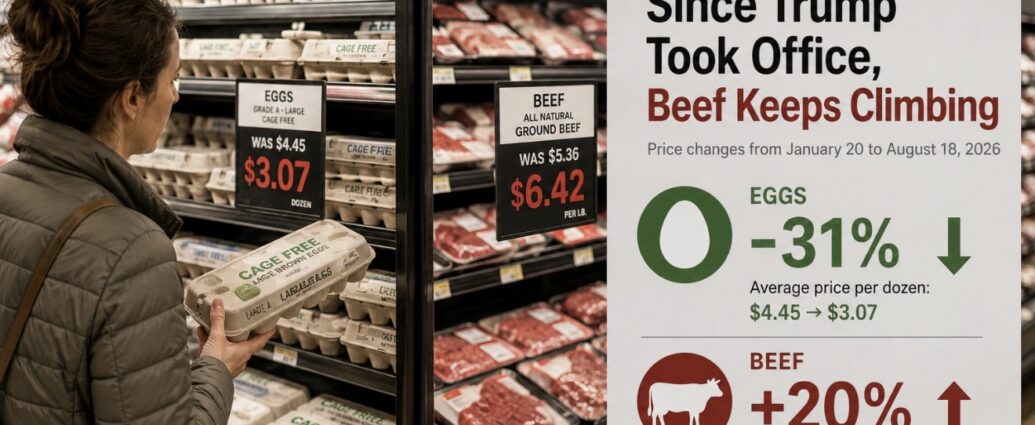
Meats, poultry and fish prices rose 0.7% in January and were 7% higher than a year ago. Beef and veal prices declined 0.4% in the month but are up 15% from last year. Egg prices continued to decline following an avian flu outbreak that impacted supply, with prices down 7% for the month and 34.2% year over year. The fruits and vegetables index was up 0.1% on a monthly basis and is up just 0.8% from last year.

BEEF PRICES IN FOCUS AS TRUMP SIGNS ORDER AIMED AT CONSUMER RELIEF

Energy prices declined 1.5% for the month and are down 0.1% over the last year. Gasoline prices fell 3.2% for the month and are down 7.5% year over year. Utility gas service prices rose 1% in January and are up 9.8% from last year, while electricity costs declined 0.1% for the month but are up 6.3% year over year.

Housing prices rose 0.2% in January and are up 3% on an annual basis. The BLS noted that the increase in the shelter index was the largest factor in the overall CPI increase in January. Tenants’ and household insurance costs declined 0.1% in January but have risen 6.9% from last year.

Transportation services costs were up 1.4% in January and are 1.3% higher than a year ago. Airline fares jumped 6.5% for the month and are up 2.2% from last year. Motor vehicle maintenance and repair costs are 4.9% higher than last year after a 0.1% increase in January.

Medical care costs were up 0.3% in January and have risen 3.9% in the last year. The personal care index, which includes haircuts and similar services, was up 0.6% in January and is 5% higher than a year ago.

The index for household furnishings and supplies rose 0.3% in January and is up 3.8% from a year ago. Furniture and bedding costs were up 0.7% on a monthly basis and 4% year over year. Tools, hardware and supplies were up 1% in January and are 6.4% higher than a year ago.

WHO IS KEVIN WARSH, TRUMP’S PICK TO SUCCEED JEROME POWELL AS FED CHAIR?

Bernard Yaros, lead economist at Oxford Economics, said that, “Headline CPI inflation was a touch softer than expected in January, delivering a welcome surprise to the downside at the beginning of the year.”

“The downside surprise in the January CPI is welcome news for the Federal Reserve, but we aren’t changing the baseline forecast for monetary policy based on one inflation reading. Lingering distortions from the shutdown in the price data, prospects for solid growth this year, and a stabilizing job market will keep the central bank on hold until June,” Yaros added.

Lindsay Rosner, head of multi-sector fixed income investing at Goldman Sachs Asset Management, said of the January CPI report, “Trust the groundhog. The Fed’s path to ‘normalization’ cuts appears clearer now with fears of a strong January print behind us with CPI coming in cold!” 

“How short or how long that path is, however, will depend on whether employment continues to show signs of improvement, given the FOMC’s sensitivity to labor market weakness. We continue to expect two cuts this year, with the next move coming in June,” Rosner said.

FED HOLDS INTEREST RATES STEADY, PAUSING RATE CUTS AMID ECONOMIC UNCERTAINTY

The Federal Reserve held rates steady at its most recent meeting in January after three consecutive cuts of 25 basis points to end 2025. The next meeting of the Federal Open Market Committee (FOMC), the central bank panel that sets monetary policy, will be March 17-18. 

Despite the downward trend, the January CPI readings remained well above the Fed’s long-run 2% target rate and uncertainty stemming from the shutdown-related data disruptions will factor into rate cut decisions, likely leading to a continued pause.

GET FOX BUSINESS ON THE GO BY CLICKING HERE

The market expects rates to remain unchanged in March, with the CME FedWatch tool showing a 92.3% chance of rates holding steady – up from 81.6% a week ago and 72.9% a month ago. It also shows a 71.3% probability of rates holding steady at the Fed’s late April meeting, with a 50.6% chance of a 25 basis point cut in June.

This post was originally published here

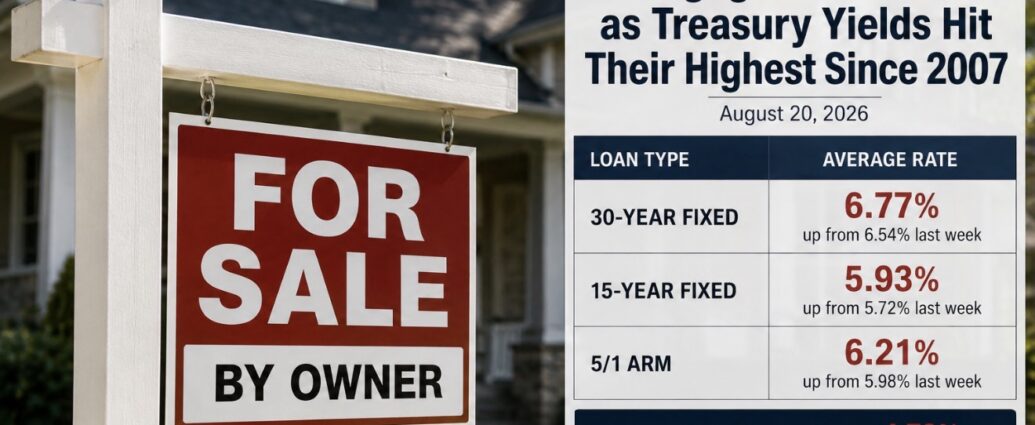
Mortgage rates inched lower this week, mortgage buyer Freddie Mac said Thursday.

Freddie Mac’s latest Primary Mortgage Market Survey, released Thursday, showed the average rate on the benchmark 30-year fixed mortgage slipped to 6.09% from last week’s reading of 6.11%. 

The average rate on a 30-year loan was 6.87% a year ago.

HOME DELISTINGS SURGE AS SELLERS STRUGGLE TO GET THEIR PRICE

“Bolstered by strong economic growth, a solid labor market and mortgage rates at three-year lows, housing affordability continues to measurably improve,” said Sam Khater, Freddie Mac’s chief economist. “These factors have caught the attention of many prospective homebuyers, driving purchase application activity higher than a year ago.”

The average rate on a 15-year fixed mortgage fell to 5.44% from last week’s reading of 5.5%.

Mortgage rates are affected by several factors, including the Federal Reserve and geopolitics. Though mortgage rates are not directly affected by the Fed’s interest rate decisions, they closely track the 10-year Treasury yield. The 10-year yield hovered around 4.1% as of Thursday afternoon.

“Mortgage rates have lingered in the low-6% range for weeks, letting buyers and sellers who were already prepared take action, but likely not low enough to entice the next wave,” Realtor.com Economist Jiayi Xu. “While active listings continued to rise year-over-year in January, inventory growth has slowed for the ninth consecutive month, leaving total supply still about 17.2% below pre-pandemic levels.”

THE MARKETS WHERE HOMEBUYERS MAY FINALLY GET SOME RELIEF IN 2026, REALTOR.COM SAYS

“In short, while the market remains stable, a larger drop in rates will be needed to attract new buyers and sellers and truly reignite the housing market,” Xu added.

HOMEBUILDERS REPORTEDLY DEVELOPING ‘TRUMP HOMES’ PROGRAM TO IMPROVE AFFORDABILITY

U.S. existing home sales tumbled to the lowest level in more than two years in January as falling inventory raised house prices.

Home sales dropped 8.4% last month to a seasonally adjusted annual rate of 3.91 million units, the lowest level since December 2023, the National Association of Realtors said on Thursday. Economists polled by Reuters had forecast home resales declining to a rate of 4.18 million units.

Last month’s sales likely reflected contracts that were signed in November and December, and would not have been impacted by winter storms that slammed large parts of the country in January. Home sales decreased 4.4% on a year-over-year basis.

GET FOX BUSINESS ON THE GO BY CLICKING HERE

Reuters contributed to this report.

This post was originally published on https://www.foxbusiness.com/economy/mortgage-rates-february-12-2026

A Georgia-based gun accessory company will pay $1.75 million in restitution to victims’ families, injured individuals and traumatized survivors of the 2022 mass shooting at a Buffalo supermarket and permanently stop selling a controversial magazine lock in New York under a settlement announced Wednesday.

Mean LLC, commonly known as Mean Arms, agreed to the payment and injunctive relief to resolve a lawsuit brought by New York Attorney General Letitia James and related civil claims filed by victims’ families.

“The racist mass shooting at Tops in Buffalo was an unbearable tragedy,” James said in a statement. 

“We lost 10 beautiful lives in a horrific act of violence and hate, and no amount of money can ever return those individuals to their families or erase the devastation the community was forced to endure,” she added. “Today, justice looks like accountability, and we have ensured that this device will never be sold in our state again.”

VIRGINIA TEACHER SHOT BY 6-YEAR-OLD STUDENT ‘THOUGHT SHE WAS DEAD’ AS BODYCAM EMERGES

The May 14, 2022, attack, carried out by Payton Gendron, killed 10 Black people and injured three others at a Tops Friendly Market in western New York.

Federal prosecutors said the then-18-year-old livestreamed the massacre online and targeted victims in what authorities described as a racially motivated hate crime carried out after substantial planning and premeditation.

Gendron was sentenced to life in prison without the possibility of parole in 2023.

James’ office alleged that Mean Arms marketed its “MA Lock” device as rendering rifles compliant with New York law, even though it could be easily removed, allowing the shooter to convert his weapon to accept high-capacity magazines.

“In January 2022, the Buffalo shooter purchased a semiautomatic rifle in New York with an MA Lock installed and a 10-round magazine. After following Mean Arms’ removal instructions, on May 14, 2022, the shooter inserted multiple 30-round detachable magazines onto his weapon,” her office said. “With a pistol grip and the high-capacity magazines, he did not have to stop to reload his weapon, and when he did reload, he could do so quickly.”

Under the settlement, the company must cease all sales of the MA Lock in New York, “remove any statements that claim the MA Lock is legal in New York, state on all packaging that the MA Lock cannot be sold or resold in New York, and notify all businesses currently selling the MA Lock that the product is not to be sold or resold to individuals and/or businesses in New York.”

BUFFALO BILLS, NFL FOUNDATIONS DONATING $400,000 TO RELIEF EFFORTS AFTER TOPS SUPERMARKET SHOOTING

In a press release from James’ office, Andrew Debbins, an attorney who represents several of the victims’ families, said: “No amount of money can compensate the victims of May 14 for the unspeakable horrors of that day, but this settlement is a victory in our continuing fight against hate and all who enable it.”

This post was originally published on https://www.foxbusiness.com/economy/gun-accessory-maker-pay-1-75m-buffalo-mass-shooting-victims-families

Washington skeptics were quieted Wednesday morning as the January jobs report beat expectations, revealing a resilient American workforce that added 130,000 jobs to start the year.

While experts predicted a winter chill for hiring, the 4.3% unemployment rate tells a different story — one of a Main Street economy — showing renewed strength. According to Patrice Onwuka of the Independent Women’s Center for Economic Opportunity, this isn’t just a lucky break; it’s the direct result of “one big, beautiful bill” giving businesses the tax certainty they need to build, hire and grow.

“Today’s January jobs report is strong and, importantly, beat expectations. This should inspire more hope for unemployed workers, but also boost confidence in the economy among Americans broadly,” Onwuka told Fox News Digital.

“Workers are being drawn back into the labor force because they believe they can find work,” she added. “Also, the tax cuts will boost employment. As workers also realize just how much the Working Families Tax Cuts… rewards hard work through no taxes on tips and no taxes on overtime, it may draw people back into the labor force or encourage those already working to stack up earnings by increasing their hours and effort.”

BESSENT SAYS TRUMP TAX CUTS COULD MEAN ‘SUBSTANTIAL REFUNDS’ FOR WORKING AMERICANS IN 2026

The Labor Department on Wednesday reported that employers added 130,000 jobs in January. That figure was above the expectations of economists polled by LSEG, who estimated the economy would add 70,000 jobs.

The unemployment rate was 4.3%, slightly lower than economists’ expectations of 4.4%.

“Employment is a lagging indicator, not a leading one,” Onwuka noted. “With the economy accelerating from just under 4% in Q2 to 4.4% in Q3, we are starting to see that growth show up in hiring. The Dow hitting new highs is great for those invested in the stock market, but job creation gets people on Main Street back to work.”

“Importantly, these are not public sector — government jobs — that are supported by our tax dollars, but the fruit of businesses confident about demand, sales, reduced cuts from deregulation and greater tax certainty, thanks to the Working Families Tax Cuts — i.e., One Big Beautiful Bill — that they are able to start hiring,” she said. “Look for more of this in 2026 as this federal pro-growth economic agenda works.”

While the headline showed 130,000 jobs added, those gains were concentrated almost entirely in healthcare and construction. Meanwhile, retail trade lost 25,000 jobs and financial activities lost 7,000. Economists often consider these traditional “office and shop” jobs that provide steady, climate-controlled, middle-class employment.

“Retail job losses are not surprising as retailers shed temporary, holiday season jobs that surged to accommodate the biggest holiday shopping season in history. Financial services experienced big job losses in 2025 due to high interest rates and AI replacing work. Americans should not be fearful of these narrow pockets of losses but see the growing opportunities in many industries that deliver middle-class and high-paying jobs in healthcare and personal services,” Onwuka explained.

“These are exciting careers for women which often provide a level of flexibility that traditional 9-to-5 jobs do not offer and the fulfillment. As baby boomers retire and live longer, demand for employment and supporting businesses in these sectors will only grow,” she continued.

Other notable strengths in the first jobs report of the new year include declines in the number of people working part-time jobs because they couldn’t find full-time work and the number of those unemployed for more than six months. Labor force participation rose overall for U.S. men and women.

GET FOX BUSINESS ON THE GO BY CLICKING HERE

“It takes time for hiring to rebound, but trends are moving in the right direction, and it may take some patience for unemployed individuals — or those looking to leave their jobs — to land their next job,” the economist advised.

“Pivoting may be appropriate for those who can’t wait. Perhaps it’s time to consider self-employment, freelance work or adding extra work,” Onwuka encouraged. “The growth of multiple jobholders is a sign that people are looking for extra income and turning to side jobs and side hustles… Increasingly, independent contract work for seasoned professionals and gig workers is the way Americans cobble together financial security. That should be respected and protected.”

READ MORE FROM FOX BUSINESS

FOX Business’ Eric Revell contributed to this report.

This post was originally published on https://www.foxbusiness.com/economy/expert-credits-trumps-tax-certainty-economic-confidence-americans-returning-workforce

The U.S. economy posted solid job growth in January as employers hired at a steady pace to start 2026 as the Federal Reserve evaluates the need for rate cuts in the months ahead.

The Labor Department on Wednesday reported that employers added 130,000 jobs in January. That figure was above the expectations of economists polled by LSEG, who estimated the economy would add 70,000 jobs.

The unemployment rate was 4.3%, slightly lower than economists’ expectations of 4.4%.

Revisions were made to the payroll numbers for the prior two months, with November’s report down by 15,000 from a gain of 56,000 to 41,000; December’s gains were revised down by 2,000 from a gain of 50,000 to 48,000.

Taken together, employment in November and December was 17,000 jobs lower than previously reported. Those revisions were affected by changes made in the Bureau of Labor Statistics’ (BLS) annual benchmarking process, which is outlined below.

TARIFFS MAY HAVE COST US ECONOMY THOUSANDS OF JOBS MONTHLY, FED ANALYSIS REVEALS

The January jobs report was initially scheduled for release on Friday, Feb. 6, but a brief partial government shutdown caused the agency to delay it until Wednesday.

Private payrolls grew by 172,000 jobs in January, well above the LSEG estimate of 70,000.

Government payrolls declined by 42,000 jobs in January, with job cuts at the federal (-34,000) and state (-18,000) level partially offset by a gain among local governments (+10,000). The report noted that some federal workers who accepted a deferred resignation offer last year officially left federal payrolls, while the federal government’s workforce is down 327,000 jobs since its October 2024 peak, a decline of 10.9%.

The manufacturing sector added 5,000 jobs in January, beating the expectations of the economists polled by LSEG, who estimated a loss of 5,000 jobs.

Healthcare companies added 81,900 jobs in January, with gains in ambulatory healthcare services (+50,300), hospitals (+18,300), and nursing and residential care facilities (+13,300). The sector’s gains were above its monthly average of 33,000 jobs added per month in 2025.

Construction firms added 33,000 jobs in January, with the gain focused among nonresidential specialty trade contractors (+25,100). Employment in the construction sector was essentially flat in 2025.

The financial sector shed 22,000 jobs in January and is 49,000 jobs off its recent peak in May 2025. Within the sector, insurance carriers and related activities lost 11,300 jobs over the month.

JANUARY LAYOFFS ROSE TO THE HIGHEST LEVEL FOR THE MONTH SINCE 2009

The number of long-term unemployed, defined as those who have been jobless for 27 weeks or more, was little changed in January at 1.8 million but is up 386,000 from a year ago. The long-term unemployed accounted for 25% of all unemployed people in January.

The number of people who were employed part-time for economic reasons decreased by 453,000 to 4.9 million in January, but is up 410,000 over the last year. These individuals would’ve preferred full-time jobs but were working part-time because their hours were cut, or they were unable to find full-time jobs.

The labor force participation rate was 62.5% in January while the employment-population ratio was 59.8%, both measures having changed little over the last year.

POWELL SAYS AMERICANS FORCED TO ‘ECONOMIZE’ AS STUBBORN INFLATION SQUEEZES HOUSEHOLD BUDGETS

The Bureau of Labor Statistics (BLS) goes through a benchmarking process every year to incorporate more accurate data from state unemployment records that are published quarterly along with business birth and death records into its estimates.

That process yields a more complete and accurate picture of the labor market than the agency’s monthly surveys that are used to create the jobs report, and serves as a means of mitigating the non-response and reporting errors that accumulate month-to-month.

BLS publishes its annual benchmark revision with each year’s January jobs report, and this report revised total employment for March 2025 downward by 898,000 jobs on a seasonally adjusted basis. On a non-seasonally adjusted basis, the downward revision was 862,000, or -0.5%, while the absolute average benchmark revision over the last 10 years was 0.2%.

Total nonfarm employment for 2025 was revised from a gain of 584,000 to 181,000 on a seasonally adjusted basis. That reduced average monthly job gains from an average of over 48,000 to just over 15,000 per month.

FED HOLDS INTEREST RATES STEADY, PAUSING RATE CUTS AMID ECONOMIC UNCERTAINTY

“Markets may have been expecting a downshift in today’s numbers after last week’s soft data, but the jobs market hit the gas pedal instead. Today’s data shows an acceleration in employment that was strong enough to drive unemployment lower – vindication for Chair Powell’s holding pattern,” said Ellen Zentner, chief economic strategist for Morgan Stanley Wealth Management.

“The economy has an anemic demand for workers. This year may be more of the same with average monthly payroll gains expected to hover around 50,000 but with employers increasing average hours worked, especially in areas like construction with low availability of workers,” said Jeffrey Roach, chief economist at LPL Financial.

“Job growth is encouraging, but small business owners are still approaching hiring with discipline. They’re not just asking, ‘Can we hire?’ They’re asking, ‘Should we hire, and where does it drive the most value?’ We’re seeing more focus on productivity, training, and role clarity instead of broad expansion,” said Andy Bregenzer, head of U.S. regional and small business banking and co-head of commercial bank at TD.

SENATE BANKING CHAIR SAYS POWELL DIDN’T COMMIT CRIME IN TESTIMONY

The Federal Reserve held rates steady at its January meeting after three consecutive cuts of 25 basis points each to close out 2025. Policymakers noted that inflation remains “somewhat elevated” and that the economy was expanding at a solid pace, with low levels of job gains but signs of the unemployment rate stabilizing.

Fed Chair Jerome Powell said that with interest rates at their current level, the central bank is well-positioned to “let the data speak to us” as policymakers weigh fresh inflation and labor market data as they debate potential rate cuts.

GET FOX BUSINESS ON THE GO BY CLICKING HERE

The Fed’s next policy meeting is March 17-18, and the market anticipates the pause on rate cuts will continue. The CME FedWatch tool shows a 94.1% probability of rates being left unchanged in March, up from 79.9% yesterday and 90.6% a week ago.

This post was originally published on https://www.foxbusiness.com/economy/us-jobs-report-january-2026

The Federal Aviation Administration lifted a flight restriction that had grounded all flights to and from El Paso International Airport in Texas on Wednesday, after previously warning that the U.S. government “may use deadly force” against any aircraft in violation.

A Trump administration official told Fox News that the initial lockdown came in response to “Mexican cartel drones” that breached U.S. airspace. The FAA had announced Wednesday morning that all flights to and from El Paso were being grounded, including commercial, cargo and general aviation. The restriction was initially set to be effective from February 10 at 11:30 p.m. MST to February 20 at 11:30 p.m. MST.

“Mexican cartel drones breached US airspace. The Department of War took action to disable the drones. The FAA and DOW have determined there is no threat to commercial travel,” the official told Fox News.

The FAA had cited “special security reasons” for the earlier closure, but did not elaborate.

TRUMP DECLARES NATIONAL EMERGENCY OVER CUBA, THREATENS TARIFFS ON NATIONS THAT SUPPLY OIL TO COMMUNIST REGIME

The El Paso airport had issued a statement confirming the closure on Wednesday.

“Travelers should contact their airlines to get the most up-to-date flight status information,” it said in a statement.

TRUMP SAYS CUBA IS ‘READY TO FALL’ AFTER CAPTURE OF VENEZUELA’S MADURO

Former FAA safety team member Kyle Bailey told Fox News on Wednesday that a 10-day restriction like the one initially announced would have been “unprecedented.” He also noted the airport’s proximity to the Fort Bliss Army post.

GET FOX BUSINESS ON THE GO BY CLICKING HERE

“It’s definitely something like a national security event, a high-level VIP,” Bailey speculated, “but the interesting thing is that on the Mexican side of the border there is no flight restriction.”

FOX Business’ Bonny Chu contributed to this report.

This post was originally published on https://www.foxbusiness.com/economy/faa-halts-all-flights-el-paso-international-airport-10-days-special-security-reasons

Jaguar Land Rover is recalling nearly 2,300 electric SUVs in the U.S. over concerns that a high-voltage battery may overheat, increasing the risk of fire, the National Highway Traffic Safety Administration (NHTSA) announced on Tuesday.

The recall impacts 2,278 Jaguar I-Pace vehicles from the 2020–2021 model years.

“As an interim repair, the battery software will be updated by a dealer, or through an over-the-air (OTA) update to limit the state of charge to 90%” the NHTSA said, according to Reuters, adding that the final remedy is currently under development.

BMW RECALLS NEARLY 90,000 VEHICLES OVER ENGINE STARTER FIRE RISK

There will be no charge to vehicle owners for the interim repair, the recall report said.

Customers can monitor their vehicle’s charging with the latest version of the Jaguar Remote App or inside the vehicle, according to the report, which says owners should physically stop charging by unplugging the cable when it reaches a 90% state of charge.

Vehicle owners are urged to park outside and away from structures and to charge outside if possible.

“Vehicles have experienced thermal overload, which may show as smoke or fire, that may occur in the high voltage traction battery pack. The investigation is ongoing,” the report reads.

Investigations pointed to a “folded anode tab” in battery cells produced at an LG Energy Solution facility in Poland, which can lead to short-circuiting.

CHRYSLER RECALLS MORE THAN 450,000 VEHICLES OVER BRAKE LIGHT FAILURE

GET FOX BUSINESS ON THE GO BY CLICKING HERE

“Modules that were identified by the remedy software as having characteristics of a folded anode tab, which may contribute to a risk of thermal overload, are still being inspected by the supplier,” it added.

Notification letters are expected to be mailed to affected owners starting April 3.

This post was originally published on https://www.foxbusiness.com/economy/jaguar-land-rover-recalling-2300-electric-vehicles-us-over-over-fire-risk

The housing market has cooled off this winter with the annual pace of home price growth easing to levels unseen since the nation was recovering from the Great Recession. And while some areas continue to see strong price growth, others have seen notable declines.

New data from Cotality, a data analytics and tech company in the real estate, mortgage and insurance industries, showed that annual housing price growth slowed to just 0.9% in December, which was one of the softest rates since the post-Great Recession recovery.

“We are seeing a significant departure from the rapid surges of recent years; while the upward pressure on prices remains, the momentum has moderated enough to suggest that the market is finally becoming more navigable for prospective buyers,” said Cotality Chief Economist Selma Hepp.

HOMEBUYERS GAIN UPPER HAND IN 3 MAJOR CITIES AS INVENTORIES GROW

Home prices have declined in several key areas across the South and West, particularly in areas that had previously seen rapid expansion as in-migration trends moderate and inventory levels increase.

Cotality’s report found that the local housing market with the steepest declines was Kahului-Wailuku, Hawaii, with prices down 8% in December on a year-over-year basis.

The Lone Star State had a pair of localities in the top 10, with Victoria, Texas, down 7.4% and Wichita Falls, Texas, down 7.2%.

Napa, California, had the steepest decline among West Coast localities, with prices falling 7.1%.

THE ‘POISON PILL’ AND DIGITAL SECRETS FLIPPING THE SUNSHINE STATE’S CONDO POWER DYNAMIC

Florida had five communities represented in the top 10 localities with the steepest price declines, led by Naples (-6.8%), Punta Gorda and Cape Coral (-6.2% each), North Port (-5.9%) and Sebastian (-5.2%).

Rome, Georgia, rounded out the top 10 with a 5.2% year-over-year price decline.

The hottest housing market identified in Cotality’s report was Youngstown, Ohio, which saw prices surge 15.9% over the last year.

THESE STATES ARE CONSIDERING ELIMINATING PROPERTY TAXES FOR HOMEOWNERS

Four of the hottest markets were in the state of Indiana, led by national runner-up Terre Haute’s gain of 11.4%. Other Hoosier State metros with notable price rises were Columbus and Muncie, with 10.2% gains each, and Kokomo’s 8.8% increase.

Illinois was home to a pair of housing markets with strong price growth, as prices in Decatur rose 10.5% and Peoria 8.9%.

Two other markets in the Midwest and Plains were in the 10 hottest markets, with prices up 8.7% in Manhattan, Kansas, and 8.5% in Traverse City, Michigan.

The hottest housing market in the South was in Hattiesburg, Mississippi, which saw prices rise 8.4% over the last year.

GET FOX BUSINESS ON THE GO BY CLICKING HERE

“As we move through 2026, the market’s trajectory will depend heavily on wage growth and how soon buyers regain the purchasing power needed to meet sellers’ pricing thresholds. For now, Cotality data shows a housing landscape is still finding its footing, but it is ultimately stabilizing after an extended period of imbalance,” Hepp said.

Fox News Digital’s Amanda Macias contributed to this report.

This post was originally published on https://www.foxbusiness.com/economy/housing-market-cools-price-growth-hits-slowest-pace-since-great-recession-recovery

The Wyoming Board of Land Commissioners voted 3–2 on Feb. 5 to begin canceling controversial wind leases tied to the Pronghorn and Sidewinder projects in the eastern part of the state.

The Wyoming Tribune Eagle reported that the Pronghorn project involves state land in Converse County, while the Sidewinder project is located in Niobrara County. 

Both leases were approved by the state board in April 2025 but have faced months of opposition from local residents and landowners.

The outlet said state Auditor Kristi Racines, Secretary of State Chuck Gray and Superintendent of Public Instruction Megan Degenfelder supported the motions to begin unwinding the wind leases, while Gov. Mark Gordon and state Treasurer Curt Meier opposed the action.

EXCLUSIVE: TRUMP ADMIN NIXES GIANT WIND FARM APPROVED ‘LAST-MINUTE’ BY BIDEN TEAM

In a statement following the vote, Gray said he believed the board was acting within its authority after a court found the original lease approval unlawful.

“I continue to oppose these woke wind leases because they’re wrong for Wyoming and are inconsistent with the fiduciary duty of the board,” he said.

“As the only member of the State Board of Land Commissioners to vote against this boondoggle wind proposal when it originally came before the board last April, I know that the people of Converse and Niobrara Counties have been anxiously awaiting resolution to this issue,” Gray added.

MINNESOTA GREEN ENERGY PROGRAM FUNDED BY OBAMA FINED FOR KILLING BALD EAGLE: ‘NATIONAL TREASURE’

Many residents who offered public comment at the meeting in the Capitol Complex Auditorium in Cheyenne raised concerns about the long-term impacts of large-scale wind development on wildlife, water resources and property values.

Others focused on water use and infrastructure, arguing the projects could strain local water supplies and disrupt existing land uses, while several speakers criticized what they described as a lack of transparency and shifting project plans.

“There’s not been a lot of transparency in this whole thing. That’s been one of our complaints,” said one man at the more than six-hour meeting.

This post was originally published on https://www.foxbusiness.com/economy/wyoming-state-board-votes-cancel-wind-leases-two-counties

American Airlines’ leadership is facing a rare public rebuke from within its own ranks as the unions representing flight attendants and pilots have publicly questioned and criticized CEO Robert Isom’s leadership.

The Association of Professional Flight Attendants (APFA) on Monday issued a vote of no confidence in Isom. The union, which represents more than 28,000 American Airlines flight attendants, noted the vote of no confidence was the first in its history against an American Airlines CEO. 

In an announcement about the vote, the APFA said “management decisions” have left American Airlines “dangerously behind” its competitors. Additionally, the union said that the vote was a signal that the airline’s “largest unionized workgroup has no confidence or trust” in Isom’s leadership. The union demanded leadership change at the airline in addition to accountability and “improved operational support.”

AMERICAN AIRLINES PLANS TO RESUME NONSTOP SERVICE TO VENEZUELA

American Airlines has faced challenges that have caused it to lag behind its competitors. The airline made $111 million last year, while Delta Air Lines brought in $5 billion and United Airlines earned more than $3.3 billion, according to CNBC. The outlet noted that the discrepancy comes even as American Airlines flew at a similar capacity to its competitors in 2025.

“From abysmal profits earned to operational failures that have front-line Workers sleeping on floors, this airline must course-correct before it falls even further behind,” APFA President Julie Hedrick said in a statement following the vote. “This level of failure begins at the very top, with CEO Robert Isom.”

In response to FOX Business’ request for comment, American Airlines referred to remarks Isom made during the airline’s recent earnings call, which took place on Jan. 27.

“Our strategy to deliver on American’s revenue potential centers on four key areas: delivering a consistent, elevated customer experience, maximizing the power of our network and fleet, building partnerships that deepen loyalty and lifetime value, and continuing to advance our sales, distribution and revenue management efforts. While this has been a multi-year effort, 2026 will be the year these efforts start to bear fruit,” Isom said during the call in excerpts provided to FOX Business.

“I’ve been in this business for a long time, and I’m incredibly excited about what lies ahead for American. The foundation we built in 2025, combined with our go-forward strategy, positions us to deliver sustainable growth and create long-term value for our customers, team members, and shareholders,” he added.

AFPA cited several reasons behind its board’s unanimous vote of no confidence in Isom, including lagging competitiveness against rival airlines, excessive executive compensation despite financial losses, an allegedly botched sales strategy that tanked industry rankings and deepening operational instability.

DELTA FLIGHT ABRUPTLY MAKES MIDAIR U-TURN AFTER SMOKE REPORTED FROM ENGINE

Captain Dennis Tajer, spokesperson for the Allied Pilots Association (APA) Communications Committee, told FOX Business that the pilots’ union “understands” the APFA’s “deep frustration” with Isom.

The “APA understands and respects their deep frustration with Mr. Isom’s leadership and his stewardship of American’s lack luster financial recovery to include the lack of a long-term strategy to catch Delta and United while defining an identity and positive culture for our airline. We have similar frustration,” Tajer said.

On Feb. 6, just days before AFPA issued its vote of no confidence, the APA sent a letter to the American Airlines Group Board of Directors requesting a formal meeting amid concerns about the airline’s leadership decisions. In its letter, the union noted that it represents more than 16,000 American Airlines pilots.

“Our airline is on an underperforming path and has failed to define an identity or a strategy to correct course,” the APA’s letter read. “This assessment is not the result of a single interaction with management, an isolated operational disruption, or an individual earnings report; it is the result of persistent patterns of operational, cultural, and strategic shortcomings. Copying competitors’ initiatives and reactive repairs to the mistakes of the past is not a strategy to a future that closes the gap between American and our premium competitors, Delta Air Lines and United Airlines.”

GET FOX BUSINESS ON THE GO BY CLICKING HERE

The union said that the airline’s management failed to “articulate a credible strategy and demonstrate measurable improvement,” despite the APA voicing its concerns “for more than a year.” The APA accused American Airlines leadership of praising “efficiency” while failing “to fully monetize the assets under their charge.”

“While our premium competitors’ market capitalization has soared, American’s has soured. As their free cash flow is sustained and growing, ours is inconsistent and stumbles,” the APA letter read.

Tajer said that the APA’s leadership was continuing to “consider all the options available,” though it was focused on “seeking engagement with the American board.”

The APA said it has yet to receive a response from the board of American Airlines.

FOX Business reached out to APFA for comment.

This post was originally published on https://www.foxbusiness.com/economy/american-airlines-pilots-flight-attendants-rebuke-ceos-leadership

Chipotle CEO Scott Boatwright suggested in leaked audio that the company would begin focusing on customers who make more than $100,000 per year, indicating further price hikes.

During a recent earnings call, Boatwright said 60% of customers earn more than $100,000 a year and that he wants to “lean into that group in a more meaningful way.”

“We learned that 60% of our core users are over $100,000 a year in income, in average household income. That gives us confidence that we can lean into that group in a more meaningful way — to really drive meaningful transaction performance in the year,” he said in leaked audio of the call, according to Yahoo Finance.

WALMART BOOSTS PAY POTENTIAL FOR SOME PHARMACY STAFF, COLLEGE DEGREE NOT REQUIRED

“What we’ve learned is the guest skews younger, a little higher income, is typically a digital native, and that their grounded purpose aligns with our North Star as a brand, around clean food, clean ingredients, high protein,” Boatwright also said, according to Business Insider. “We are the way they want to eat, and we’re going to lean into that in the most meaningful way.”

Chipotle has also launched a new high protein menu to match the demand for “clean” food and ingredients, as well as high protein.

Chief Financial Officer Adam Rymer said during the call that consumers can expect menu prices to increase 1–2% amid rising food and labor expenses.

COSTCO DROPS FRESH LINEUP OF VALENTINE’S TREATS AND SAVORY BITES FOR SHOPPERS: REPORT

Boatwright later attempted to clarify the “misinformation” surrounding the chain’s pricing controversy.

He told Yahoo Finance that “60% of our consumers’ average household income is over $100,000 a year, and they’re still spending in this tough economy.”

The executive added that the company plans to “lean into those consumers with brand innovation, menu innovation and really give them more compelling reasons to come in.”

Chipotle spokesperson Laurie Schalow also said “pricing was never mentioned” regarding the $100,000 and over cohort.

GET FOX BUSINESS ON THE GO BY CLICKING HERE

“CEO Scott Boatwright stated on Chipotle’s earnings call last week that 60% of its customers have an average household income over $100,000, so the company sees an opportunity to lean into these customers with new occasions like group or solo dining experiences,” she said in a statement to Complex. “Since this consumer population is actively spending more at shops and restaurants today, Chipotle is giving them additional reasons to visit through new marketing and menu innovations, and enhancing the digital experience for all guests.”

“Pricing was never mentioned regarding this consumer cohort, and Chipotle has taken a slow and measured approach by only increasing prices in this quarter by around .7% compared to the industry average of 4%,” she added.

This post was originally published on https://www.foxbusiness.com/economy/chipotle-ceo-allegedly-suggests-company-would-keep-raising-prices-lean-into-customers-making-over-100k

President Donald Trump on Friday signed an executive order to expand beef imports from Argentina as consumers face higher prices amid supply constraints impacting the U.S. cattle industry.

Trump’s order implements a trade framework he reached with Argentina in November that aims to increase beef imports to help mitigate the surge in beef prices that has occurred in recent years.

In 2018-19, ground beef prices were under $4 per pound but began rising during the pandemic and have been above $5 a pound since June 2023 while continuing to increase, reaching about $6.69 a pound in December, according to data from the Bureau of Labor Statistics (BLS). Sirloin steaks were around $8.50 a pound in 2019, but have been over $11 a pound since the summer of 2023 and hit $14.02 a pound in December.

Over the last year, ground beef prices are up 15.5% through December while the cost of a steak has risen 17.8%, according to the BLS’ consumer price index (CPI). A fresh read of the CPI inflation is due at the end of this week when January’s data is set to be released – though high beef prices are expected to persist due to domestic supply challenges.

RANCHERS DISPUTE PRICE CLAIMS AFTER TRUMP EXPANDS ARGENTINE BEEF IMPORTS IN EXECUTIVE ORDER

Cattle ranchers have reduced their herds due to drought and wildfire affecting key ranching regions in recent years, which left the nationwide cattle inventory at its lowest level in 70 years. Although some ranchers have started to slowly rebuild their herds, it takes at least two years to raise full-grown cattle.

Overhead costs for cattle ranchers have also climbed, with feed, labor, fuel and equipment expenses trending higher. 

Additionally, cattle imports from Mexico have been restricted due to the New World Screwworm, a parasitic infestation that can afflict livestock.

BEEF PRICES SOAR AS AMERICAN FAMILIES PAY STEEP PRICES FOR STEAKS AND BURGERS NATIONWIDE

Under the Trump administration’s announcement, the tariff-rate quota for imports of lean beef trimmings from Argentina will increase by 80,000 metric tons for calendar year 2026. 

The additional imports will be allocated entirely to Argentina and released in four quarterly tranches beginning on Feb. 13.

The White House said in a fact sheet that the action is intended to boost supply and make ground beef more affordable for American consumers, citing an 8.6% decline in domestic beef cattle inventory since 2020.

BEEF PRICES HIT RECORD HIGHS AS NATIONWIDE CATTLE INVENTORY DROPS TO LOWEST LEVEL IN 70 YEARS

The announcement drew pushback from the nation’s largest cattle industry group, which questioned whether increased imports would deliver the price relief the administration is promising.

“While we fundamentally disagree with the premise that increased imports can lower beef prices, NCBA is encouraged to see the Trump administration take necessary steps to address longstanding market-access challenges for U.S. beef in Argentina,” said Kent Bacus, executive director of international trade and market access at the National Cattlemen’s Beef Association (NCBA).

Bacus warned that Argentina’s history with foreign animal diseases raises concerns about expanding imports without stronger safeguards.

GET FOX BUSINESS ON THE GO BY CLICKING HERE

“Given Argentina’s issues with foreign animal diseases, NCBA remains concerned that expanding imports from Argentina without increased inspection protocols and up-to-date audits could place American consumers and our cattle herd at unnecessary risk,” Bacus said.

FOX Business’ Jasmine Baehr contributed to this report.

This post was originally published on https://www.foxbusiness.com/economy/beef-prices-focus-trump-signs-order-aimed-consumer-relief

Players who will take the field for Super Bowl LX on Sunday will face a significant tax bill due to the game’s location triggering what’s known as a “jock tax.”

Super Bowl LX will be played in Santa Clara, California, and the Golden State is one of a number of states that has implemented a so-called jock tax on professional athletes, which assesses taxes on players based on the number of days they spend playing or practicing in a given jurisdiction – including those away from their home state.

The NFL’s collective bargaining agreement sets the bonuses paid to players on both the winning and losing sides of the Super Bowl – players on the winning team each receive a $178,000 pay day while players on the losing team will get $103,000.

Jeffrey Degner, a research fellow in economics at the American Institute for Economic Research, told FOX Business that while those bonuses are “nothing to sneeze at,” the amount that players will actually take home after taxes like the jock tax and other state and federal liabilities is considerably smaller.

FANATICS SPORTSBOOK SEES MAJOR SPIKE IN DOWNLOADS FROM KENDALL JENNER’S VIRAL SUPER BOWL AD CAMPAIGN

“What that means here is that the winning team, their take-home pay will be approximately $86,000. If you’re on the losing side, the take-home would be about $49,800,” Degner said.

Jock taxes apply to NFL players throughout the season in jurisdictions when they’re in effect, so any time they play or practice in an area where a jock tax has been implemented, they’ll be subject to the tax on income earned that day. 

‘SUPER BOWL BREAKFAST’ RETURNS WITH FOCUS ON LEADERSHIP AND LEGACY AHEAD OF NFL SHOWCASE

Both states and cities can implement jock taxes, adding layers of complexity to the player’s tax burden, though they remain more popular at the state level than in municipalities.

Most jock taxes are implemented using a “duty day” standard, as other frameworks have faced challenges in court as well as feasibility issues. 

SOUTHWEST TO DEBUT NEW SUPER BOWL AD, SHOWCASING ITS ‘SELF-AWARE’ HUMOR

The duty day format uses the number of days an athlete spends “on duty” playing in a game, practicing, participating in team meetings, travel days and – in the case of the Super Bowl – fulfilling team-related media obligations. 

The total earnings are multiplied by a ratio of duty days spent in a given jurisdiction out of the athlete’s total duty days to determine the jock tax liability.

“The days on duty include days when you’re practicing or, in the case of the Super Bowl, even the media day counts as a day on duty and if that activity is happening in California, you’re subject to those tax rules,” Degner said.

GET FOX BUSINESS ON THE GO BY CLICKING HERE

“The players have a really complex tax situation where they can have 10 or more different states that they’re having to file taxes for,” he said. “This is why a lot of these young players, it’s really important for teams to settle them in with sharp financial advisors and tax advisors so that they don’t lose their shirts, so to speak.”

This post was originally published on https://www.foxbusiness.com/economy/super-bowl-lx-players-lose-thousands-californias-jock-tax-athlete-income

The recent surge in gold and silver prices to record highs will make the medals awarded at the 2026 Winter Olympics the most expensive in history.

The Milan Cortina 2026 Winter Olympics officially begin on Friday and the value of the gold and silver medals that will be awarded to the winners and runners-up, respectively, have risen with the price of the precious metals.

The spot price of gold has risen over 70% in the last year, trading around $4,950 per ounce on Friday. In that timeframe, silver prices have surged 143% and the metal is trading around $76 per ounce as of Friday.

While Olympic medals have a clear sentimental value to the athletes who have typically spent years training to win them, that price surge increases the underlying value of the medals.

2026 MILAN CORTINA OLYMPICS: EVERYTHING TO KNOW ABOUT THIS YEAR’S WINTER GAMES

Medals that will be awarded during the Milan Cortina Olympic Winter Games are made by the Italian State Mint and Polygraphic Institute based on set specifications using metal that was recycled from its own production waste, event organizers said in announcing the design last summer.

All medals are 80 mm in diameter with a thickness of 10 mm – although the gold, silver and bronze medals have different compositions.

TEAM USA STARS TO KNOW AS THE 2026 WINTER OLYMPICS BEGIN

Gold medals awarded at the 2026 Winter Games will have just 6 grams of gold in their total weight of 506 grams, with the remainder composed of silver. Silver medals are made solely of silver and weigh 500 grams. 

At a price of $4,950 per Troy ounce, six grams of gold amounts to about $955, while the 500 grams of silver are worth about $1,221 given a price of $76 an ounce.

Bronze medals are made of copper and weigh 420 grams (about 0.93 lbs). At a current market rate of $5.89 per pound, a bronze medal is valued at roughly $5.45.

US SKI STAR LINDSEY VONN STUNS IN OLYMPIC TRAINING RUN ONE WEEK AFTER ACL TEAR

Olympians occasionally choose to sell their medals, which can go for significantly higher prices at auction than the intrinsic value of the metals they’re composed of due to the novelty and scarcity of an Olympic medal.

Four-time Olympic gold medalist Greg Louganis, who is widely regarded as one of the greatest American divers of all-time, said in a social media post last year that he auctioned three of his medals – two gold medals from the 1984 and 1988 Games and a silver from the 1976 Montreal Olympics – to help finance a move to Panama. According to SwimSwam, the auction earned Louganis more than $430,000.

GET FOX BUSINESS ON THE GO BY CLICKING HERE

Swimmer Ryan Lochte – who won six gold medals, three silver and three bronze across four appearances at the Summer Olympics – sold three of his golds at auction last month for $385,520.

Fox News Digital’s Paulina Dedaj contributed to this report.

This post was originally published on https://www.foxbusiness.com/economy/why-medals-2026-winter-olympics-worth-more-than-ever

Mortgage rates ticked higher this week, mortgage buyer Freddie Mac said Thursday.

Freddie Mac’s latest Primary Mortgage Market Survey, released Thursday, showed the average rate on the benchmark 30-year fixed mortgage increased to 6.11% from last week’s reading of 6.10%. 

The average rate on a 30-year loan was 6.89% a year ago.

HOME DELISTINGS SURGE AS SELLERS STRUGGLE TO GET THEIR PRICE

“For the last several weeks, the 30-year fixed-rate mortgage has remained at its lowest level in years,” said Sam Khater, Freddie Mac’s chief economist. “The combination of improving affordability and availability of homes to purchase is a positive sign for buyers and sellers heading into the spring home sales season.”

The average rate on a 15-year fixed mortgage rose to 5.5% from last week’s reading of 5.49%.

THE MARKETS WHERE HOMEBUYERS MAY FINALLY GET SOME RELIEF IN 2026, REALTOR.COM SAYS

Realtor.com Senior Economist Anthony Smith noted that the 30-year fixed mortgage rate was little changed and ticked marginally higher from the last reading after the Federal Reserve left interest rates unchanged and President Donald Trump nominated former Fed Governor Kevin Warsh as the next Fed chairman.

“The Freddie Mac 30-year fixed mortgage rate held steady this week at 6.11%, up 1 basis point from the previous reading. While the Fed held rates steady at its January meeting, the nomination of Kevin Warsh as the next Federal Reserve chair has re-centered attention on the importance of policy credibility and investor expectations,” Smith said.

HOMEBUILDERS REPORTEDLY DEVELOPING ‘TRUMP HOMES’ PROGRAM TO IMPROVE AFFORDABILITY

“Mortgage rates are not directly set by the Fed but instead reflect long-term yields, which respond to shifting economic signals, market sentiment and perceived risks. If investors grow uncertain about the Fed’s intentions or begin to question its independence, long-term yields can rise even during a rate-cutting cycle,” Smith said. “That paradox underscores the risk of mixing political objectives with monetary policy.

“For housing, that means aggressive calls for rate cuts may not lower mortgage rates unless market confidence in the Fed’s inflation-fighting credibility remains intact.”

GET FOX BUSINESS ON THE GO BY CLICKING HERE

Smith also said home affordability benefits from low inflation and a stable labor market, coupled with wage growth to boost household purchasing power.

“Whether buying a first home, relocating or moving up, American families need both stable prices and steady income growth. A Fed that is seen as credibly delivering on its dual mandate of price stability and maximum employment is the most durable path to better housing affordability over time,” he added.

This post was originally published on https://www.foxbusiness.com/economy/mortgage-rates-february-5-2026

U.S. employers’ announced job cuts surged in the month of January and hit the highest level since 2009, a new report shows.

Global outplacement and executive coaching firm Challenger, Gray & Christmas found that employers announced 108,435 job cuts in January – an increase from the 49,795 cuts announced in the same month last year. Job cuts increased 205% from December, when there were 35,553 layoffs announced.

This January saw the most layoffs for the month since 2009, when 241,749 cuts were announced. It was also the highest monthly total since October 2025, when there were 153,074 layoffs.

“Generally, we see a high number of job cuts in the first quarter, but this is a high total for January. It means most of these plans were set at the end of 2025, signaling employers are less-than-optimistic about the outlook for 2026,” said Andy Challenger, workplace expert and chief revenue officer for Challenger, Gray & Christmas.

PRIVATE SECTOR ADDED 22,000 JOBS IN JANUARY, WELL BELOW EXPECTATIONS

The transportation sector had the highest number of job cuts in the month of January with 31,243 announced, most of which came from logistics giant UPS announcing 30,000 cuts as it scales back on handling shipments for Amazon.

Technology firms announced 22,291 cuts in January, most of which came from Amazon, which announced 16,000 reductions as it reorganizes its management structure.

“[Amazon] CEO Andy Jassy, like many CEOs recently, has said AI will cost jobs in the coming years, but this cut appears to be due more to over hiring and reducing layers than to the new technology,” Challenger noted.

UPS TO CUT 30,000 MORE JOBS AMID TURNAROUND PLAN

Healthcare companies and health products manufacturers announced 17,107 job cuts in January, which was the most for the sector since April 2020 when 19,453 cuts were recorded.

“Healthcare providers and hospital systems are grappling with inflation and high labor costs. Lower reimbursements from Medicaid and Medicare are also hitting hospital systems. These pressures are leading to job cuts, as well as other cutting measures, such as some pay and benefits,” Challenger said.

Chemical manufacturers announced 4,701 cuts in January, which were primarily driven by an announcement at Dow amid an AI and automation shift.

AMAZON TO CUT 16,000 ROLES AS IT LOOKS TO INVEST IN AI, REMOVE ‘BUREAUCRACY’

The main reasons companies announced layoffs in January were contract loss, which was cited in relation to 30,784 cuts, while market and economic conditions followed with 28,392 cuts.

Other reasons included restructuring (20,044 cuts), closings (12,738) and artificial intelligence (7,624).

Challenger noted that it’s difficult to tell how much an impact AI is having on layoffs, saying that, “We know leaders are talking about AI, many companies want to implement it in operations, and the market appears to be rewarding companies that mention it.”

GET FOX BUSINESS ON THE GO BY CLICKING HERE

The report also found that employers announced 5,306 hiring plans in January, the lowest total for the month since Challenger’s tracking of the metric began in 2009. 

That figure is down from the 6,089 hiring plans announced in the same month last year, as well as from the 10,496 announced in December.

This post was originally published on https://www.foxbusiness.com/economy/january-layoffs-rose-highest-level-month-since-2009

Chrysler is recalling more than 450,000 vehicles and more than 2,000 tow-trailer modules over a brake light failure that could raise the risk of a crash, according to the National Highway Traffic Safety Administration (NHTSA).

The recall affects 456,287 vehicles and an additional 2,871 tow-trailer modules, the NHTSA said in a pair of notices Monday.

The affected vehicles contain the faulty modules, which the agency said were improperly designed.

TOYOTA RECALLS 161K TUNDRA TRUCKS OVER REARVIEW CAMERA DEFECT THAT INCREASES CRASH RISK

The modules affected by the recall may result in the brake lights on attached trailers failing to illuminate, or they may cause trailer brakes to fail altogether, cutting visibility and increasing crash risk.

The affected products include the 2026 Jeep Cherokee, 2024-2026 Jeep Wagoneer S, 2025-2026 Ram 1500, 2025-2026 Ram 2500, 2025-2026 Ram 3500, 2025-2026 Ram 4500, 2025-2026 Ram 5500 and certain Mopar tow-trailer modules.

Anyone with the recalled tow-trailer modules installed can take them to a Fiat Chrysler dealer for a free replacement. If the module is not installed, dealers will repurchase the item.

TOYOTA RECALLS ABOUT 127K PICKUP TRUCKS, SUVS OVER POTENTIAL ENGINE ISSUES

GET FOX BUSINESS ON THE GO BY CLICKING HERE

Owners of recalled vehicles that come with the module installed can take them to their Fiat Chrysler Automobiles dealer for a free replacement.

Owner notification letters will be sent out March 24, 2026.

This post was originally published on https://www.foxbusiness.com/economy/chrysler-recalls-more-than-450k-vehicles-over-light-brake-failure

Companies in the private sector added just 22,000 jobs in January, payroll processing firm ADP said Wednesday.

The figure is well below economists’ estimates of a gain of 48,000 jobs. The prior month’s payrolls number was revised lower to a gain of 37,000 from an initially reported gain of 41,000.

“Job creation took a step back in 2025, with private employers adding 398,000 jobs, down from 771,000 in 2024,” said ADP chief economist Nela Richardson. “While we’ve seen a continuous and dramatic slowdown in job creation for the past three years, wage growth has remained stable.”

GOVERNMENT SHUTDOWN WILL DELAY RELEASE OF JANUARY JOBS REPORT

Education and health services added 74,000 positions, leading job creation in December. Financial activities added 14,000 positions, while construction added 9,000.

Leisure and hospitality, trade, transportation and utilities each added 4,000 jobs. Hiring in natural resources and mining was flat for the month.

US ECONOMY EXPECTED TO GROW FASTER IN 2026 DESPITE STAGNANT JOB MARKET: GOLDMAN SACHS

On the negative side, professional and business services lost 57,000 jobs. Other services and manufacturing lost 13,000 and 8,000, respectively. Hiring fell by 5,000 positions in information.

GET FOX BUSINESS ON THE GO BY CLICKING HERE

Wage growth in December was little changed from last month. People staying in their roles saw their pay climb 4.5% from the prior year, while pay gains for those changing their jobs fell slightly to 6.4% from 6.6% in December.

This post was originally published on https://www.foxbusiness.com/economy/private-sector-added-22000-jobs-january-well-below-expectations-adp-says